Home Blog Page 462

Pulling together to better feed food insecure Singaporeans

0

SINGAPORE: At 9am every day, 80-year-old Ho Hon Kee hobbles slowly on arthritic, bowed legs down to his void deck, to collect two styrofoam boxes of cooked food given out by a charity kitchen.

Today’s free meals – one for his lunch, one for dinner – consist of generous servings of rice, stir-fried spinach, a braised soy sauce egg, and fried ikan kuning. It’s more than enough for his modest appetite, but there’s more to come.

Upstairs, on his return, he finds by the door of his one-room flat another still-warm packet of food, this one left by his Meals-on-Wheels provider. There’ll be another meal drop-off from them in the afternoon, bringing the day’s total to four.

Inside the untidy flat, there’s no space at the small dining table for Uncle Ho to sit and eat. That’s because there’s a small mountain of donated biscuits (cream-filled, hi-fibre wheat crackers, oatmeal cookies, even croutons) and two unopened loaves of white bread. Elsewhere, on the floor and other random surfaces, lie months-old unopened snacks and other food packs. 

“A lot of food hor?” he remarks sheepishly in Mandarin. “People bring to my doorstep; sometimes they’re from the Residents’ Committee (RC), sometimes the church nearby.”

A2 food insecurity 47

Ho Hon Kee, 80, has no idea what these are, only that they are too hard for him to chew. 

He’s tried eating some of the cookies and croutons, but they are too dry. And too hard for his dentures and toothless gums.

As for how he gets through four packed meals a day, he doesn’t. He picks out what he likes.  

“Slowly eat, cannot finish just throw,” he said, urging us to take one box back to the office with us.

Having too much food sounds like a happy problem for old folks like Uncle Ho, who finds it a struggle to walk to the coffee shop and who doesn’t have the equipment to cook at home.

Surely, it’s better to have too much help, than none at all?

WATCH: Hunger in Singapore – the documentary, part 2 (19:53)

WHEN HELP IS TOO MUCH

But Uncle Ho’s surfeit reveals the complexities involved with Singapore’s “many helping hands”-based landscape of food assistance.

In a 2018 paper on food insecurity, researchers from the Lien Centre for Social Innovation identified a total of 125 food support organisations based on their online presence. They range from non-profit organisations and charities with Institutions of a Public Character (IPC) status, to soup kitchens, Meals-On-Wheels providers, and informal volunteer groups.

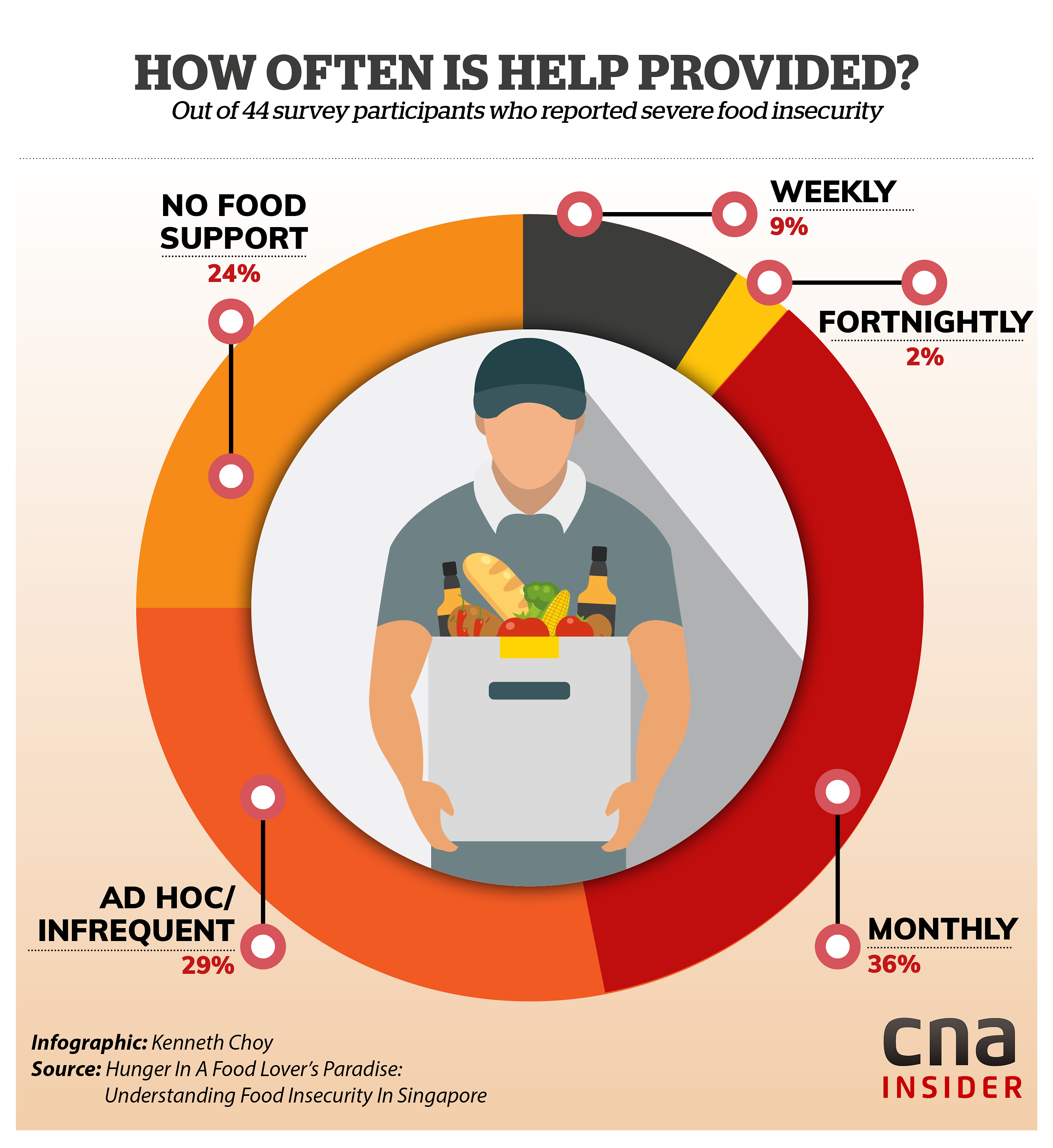
And yet, the study also found that more than half of the 44 severely food-insecure households interviewed had infrequent or no food support at all – which suggests inefficiencies in the charitable food support eco-system.
A2 food insecurity 65

Charities that CNA Insider spoke to say the duplication of assistance comes down to the lack of coordination or information-sharing among the groups.

Nizar Mohd Shariff, 49, who founded Free Food For All (FFA) six years ago to provide free halal meals for the less fortunate of any race or religion, was “shocked” when he realised that the beneficiaries he was serving were getting help from multiple sources. “Why is there no central database that indicates if this person has already received food from an organisation?” he asked.

At Ang Mo Kio, for instance, “the residents told us that between FFA and whatever they were getting from others, there was just too much for them to consume,” Nizar said. So he has decided to back out of the area and channel much-needed resources elsewhere.

The Ministry of Social and Family Development (MSF) noted that “generally, areas with a sizeable and older cluster of rental flats tend to be more well known, and thus better served by food support organisations”.

The consequence? “This may lead to wastage in some cases, and some households remain underserved, especially those who do not live in rental flats,” said an MSF spokesperson.

A2 food insecurity 54

An organisation distributing monthly rations to seniors. 

MP for Jalan Besar GRC Denise Phua has tried to “keep a tighter rein” to avoid duplication of services in her ward. But, “it is not always easy because some donors prefer to do what they want, and are not concerned about partnering with others to reach the unreached,” she said.

Food support groups typically give out the same kinds of non-perishables with a long shelf-life. So, overserved beneficiaries end up with too much rice, instant noodles, biscuits, and canned sardines and baked beans.

“You can tell when one household is being served by three, four groups,” said Li Woon Churdboonchart, founder of social enterprise Volunteer Switchboard which runs Project Home Sweet Home.

A2 food insecurity 1

The biscuits found at Uncle Ho’s flat.

Its volunteers, who deliver food rations every month to the elderly poor at Jalan Kukoh, make it a point to go through the packs with them. “We will take out every single item and ask, would you eat this? If you don’t, we’ll take it back,” she said. The seniors even pass them surfeit items given by other groups.

The frequency at which rations are distributed is a problem. 

Every Wednesday Aunty Loh, 88, must pick up two heavy plastic bags of rations that she signed up to receive from a temple.

It’s too much for her, but she claims she has no choice. “If one week you don’t come and pick up, they will strike your name off. They won’t give you the next week,” she said in Mandarin.

When CNA Insider visited her one-room rental flat with volunteer group Keeping Hope Alive (KHA), there were at least 10 bags of rations sitting untouched. Several packets of rice and bee hoon had become infested with bugs, while a tin of something that had leaked was crawling with maggots.

A2 food insecurity 5

The food-giving usually intensifies around periods like National Day or Chinese New Year, when ad hoc groups show up to help. And so, the elderly residents “accumulate more and more”, said Fion Phua, 50, KHA’s founder.

“They think that so long as something is not opened, it still can be eaten, never mind the expiry date.”

Her volunteers visit a different rental block every Sunday, and help the residents to clean their flats and clear unwanted items. The bulk of Aunty Loh’s food donations had to be thrown away because they had spoiled or long expired.

Sometimes, the 88-year-old said, she passes the food to her neighbour. “Her husband is in jail and she has one child. It’s tough and she has to work.”

A2 food insecurity 53

Aunty Loh is given more than she can eat. 

THE OTHER EXTREME: LITTLE TO NO AID

Just two floors down from Aunty Loh, an eight-year-old girl was going without lunch, and was drinking water to feel full. It’s a stark representation of how, even in the same block, one can find both the overserved and the underserved.

When CNA Insider first met Katie*, she, her grandaunt and her dad were struggling without regular food assistance, while most of their money went to paying off debts. They had a simple dinner at night. “It’s not like we’re super-hungry,” Katie said.

READ: Why in a cheap food paradise, some Singaporeans are still going hungry

Typically, the food charities work with case referrals by the family service centres (FSCs), RCs, senior activity centres and community centres. But the family didn’t seem to be on any group’s radar. 

Their plight came to Fion’s attention only because she chanced upon Katie along the corridor. The family has since been getting help from Keeping Hope Alive, including with groceries and regular meals.

Then, there are cases like Serene Loh, who finds the typical bag of rations – while more than enough for an elderly person – to be far too little for her family of six.

A1 food insecurity 16

Serene’s family of 6 gathers for dinner, often her only meal for the day. 

“We used to receive food rations from the FSC every two weeks. but we can finish them in a day,” she said. “My kids are still growing so they will eat a lot.”

That could be one reason why a few of those receiving frequent food aid – once a week or fortnight – still reported being severely food insecure, in the Lien study. That is to say, they went without eating for a whole day, or couldn’t afford to eat when hungry.

Serene feels that the seniors living in her rental block get significantly more from the volunteer groups that come by. “It’s not fair that only the elderly get so much help,” she said.

THE HIDDEN PROBLEM

Others fall off the radar by a twist of geographical fate.

Take the Chin Swee area, said KHA’s Fion. “People only see blocks 51 and 52 because these are the rental flats with a majority of old people.

“But just behind Chin Swee is Jalan Minyak, blocks 4, 5 and 6. You don’t see many elderly folks there because there’s a mix of families with children as well. So, if you focus only on serving the elderly, you wouldn’t enter that area.”

A2 food insecurity 58

A young family at Jalan Minyak. (Photo: Rauf Khan)

When CNA Insider spoke to several residents at Jalan Minyak, we were told that a food charity used to serve the area every week until they stopped three months ago, for reasons unknown.

“They would send one or two vans every Tuesday. Sometimes we’d get fresh groceries, sometimes rations,” said a resident in his 40s. “Whoever wanted could just come and take.”

Other groups had also offered food assistance occasionally, but have not been seen lately, said a resident.

Over at Holland Village, behind the bustle of its bars and chic cafes, is a single block of rental flats at Holland Close. “People don’t see it because the focus is always on big estates,” Fion said.

“Plus, this kind of flats are not near the MRT station.” This makes it more inconvenient for volunteers to lug large quantities of rations.

A2 food insecurity 11

In that block, 500m from folks sipping artisan iced lattes, KHA and CNA Insider found Ahmad, his wife and their five children in a one-room flat. Their youngest child, born four months ago, was fast asleep on a dirty, sunken mattress.

Providing for her diapers and milk powder on Ahmad’s earnings of S$650 as a part-time cleaner means they have that much less for food. They get monthly rations from a charity – but it’s all consumed well before the month is up. So when Fion and her volunteers came by with hot vegetarian porridge donated by a hotel, Ahmad asked for six servings.

Families like his are why the KHA volunteers visit a new area every two to three weeks. “To be honest, if you ask me where you can find people in need, just open up to any location on the Singapore map,” said Fion.

‘GHOSTING’ AID

Despite the sheer number of food support groups on paper, in reality, many of these efforts to help can be irregular.

That’s why Volunteer Switchboard has been focusing on the low-income neighbourhood of Jalan Kukoh for six years, even though, on the surface, it seems like “everybody wants to help there”.

A2 food insecurity 56

Volunteer Switchboard packing rations for residents of Jalan Kukoh. 

“A lot of people ask me, Jalan Kukoh is overserved, why are you still there?” said Li Woon. In response, she points to how she has seen well-intentioned efforts peter out. “One group was there to give bread, so we didn’t include bread in our ration packs. 

“Then suddenly, one day, we realised they were gone.”

Not every group has the ability to function as a full-fledged food charity, noted Nichol Ng, the co-founder of The Food Bank Singapore, which collects excess food from companies or individuals and channels these to the needy through community partners.

“Under the National Council of Social Service umbrella, there are over 2,000 members and many of them have some kind of food programme,” she said. “But not many have a living, breathing food distribution effort that spans 365 days a year.”

A2 food insecurity 13

Food From The Heart (FFTH) is one of those that do have a sustained programme. The 16-year-old charity is pledged to “alleviating hunger through efficient distribution of food”, in the form of food packs that currently feed 3,600 families – some, who have been beneficiaries for many years.

Said CEO Sim Bee Hia: “It’s a sustained effort, not something where you collect food this month and then the next month you won’t have. That’s the worst thing you can do to them.”

WHEN FOOD BRINGS MORE (HEALTH) PROBLEMS

The frequency and even spread of food assistance aside, another issue is that of quality of donations, and whether these match the beneficiary’s needs – especially when it comes to their health.

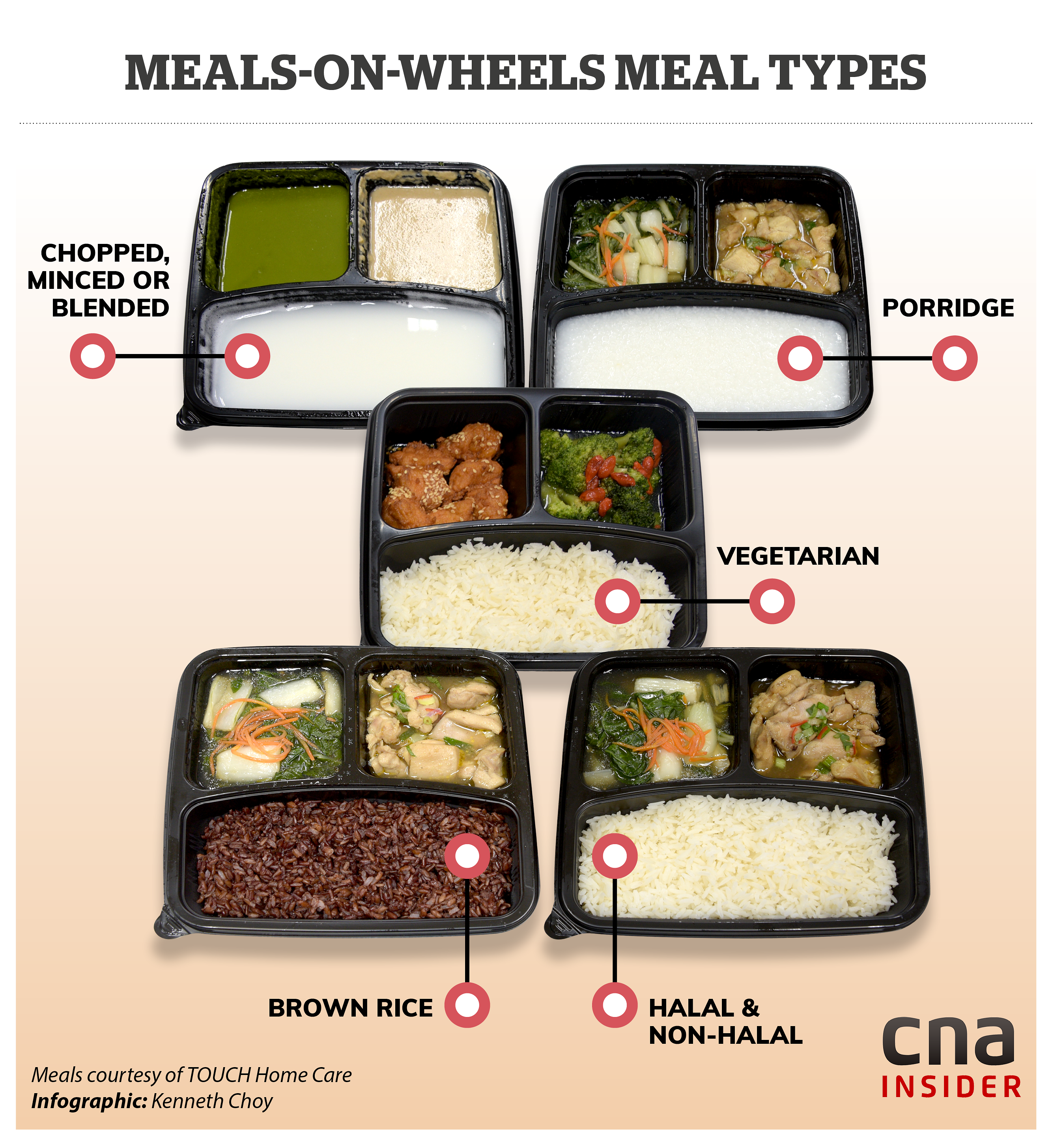
Under the Meals-on-Wheels programme – funded by the Agency for Integrated Care, to provide homebound individuals with meal deliveries at a subsidised rate – service providers must cater, upon request, to clients’ special requirements such as meals for diabetics or soft diets.
A2 food insecurity 64

But this aside, there is little to dictate what other food assistance groups should give. Take Aunty Loh, the 88-year-old inundated with food donations, who should not be eating some of the rations she is given.

“I have diabetes,” she said as she injected herself with an insulin pen, then threw the used needle into the trash with the syrup-heavy canned longans thst Fion’s KHA volunteers had discarded.

Aunty Loh also has high blood pressure and high cholesterol, and takes more than 20 pills a day to keep her ailments under control.

Holding up a can of fried dace fish with black beans, Fion sighed: “This is deep fried, it’s salty, it’s preserved. Aunty already has the three ‘highs’. Let me tell you frankly. If she eats all these, it is a slow suicide.”

A2 food insecurity 8

In April 2018, the Health Promotion Board (HPB) released guidelines for charities and donors to choose healthier products when providing food for beneficiaries.

But Dr Jenson Goh, who led a research programme on Singapore’s food system at the National University of Singapore, thinks it’s insufficient considering the “complex” nutritional needs of the food insecure. “The guidelines are a broad stroke, but there are very different, unique individual needs. The approach has to be personalised,” he said.

Others note that despite the guidelines, the standard “starter pack” of food rations contains items that don’t actually improve food security – which refers to not just access to food, but specifically to nutritious food.

“Instant noodles are high in saturated fat and sodium, which may lead to higher risks of heart disease and stroke,” said Goh Yiting, senior dietitian at Tan Tock Seng Hospital. “Such food may be loaded with calories, but aren’t high in nutrients like vitamins.”

A2 food insecurity 35

A ‘starter pack’ of food rations. (Photo: Goh Chiew Tong)

Retiree Esther Lim is conscious of managing her diabetes and high blood pressure, and would prefer to cook her own healthier meals. But the 58-year-old – who stopped working because of leg pain and can’t walk far – was disheartened by the kind of rations she had to make do with.

Couldn’t the food donations include fresh vegetables and fresh meat? She wished.

But giving out healthier options, like brown rice instead of white, might not go down well with everyone. FFTH’s Bee Hia noted: “Change is disruptive, especially for old folks.”

OTHER MISMATCHES

Food handouts can also fail to match needs in other crucial ways.

Fion recalls meeting an elderly Malay woman who was taking care of three primary school-age grandsons, and – on top of that – battling stage 3 cancer. “There was no household income because both parents were in jail, so the family relied on charity food items,” she said.

They got regular packed meals, but the food wasn’t halal. “So, they would put the ingredients aside and eat only the white rice.”

A2 food insecurity 3

Then, there are beneficiaries’ physical limitations. Esther, for example, struggles to open tins of Milo because of the stiffness and pain in her hands. “I end up not using it,” she said. Sachet-form drink mixes would serve her better.

On one visit to Uncle Ho, CNA Insider came across a delivery of fresh carrots and sweet potatoes from one charity. There was also a large bottle of olive oil.

Healthier alternatives, for sure – but unfortunately, they were useless to Uncle Ho as he had no stove or equipment to cook them with. “I don’t know what to do with them,” he said helplessly.

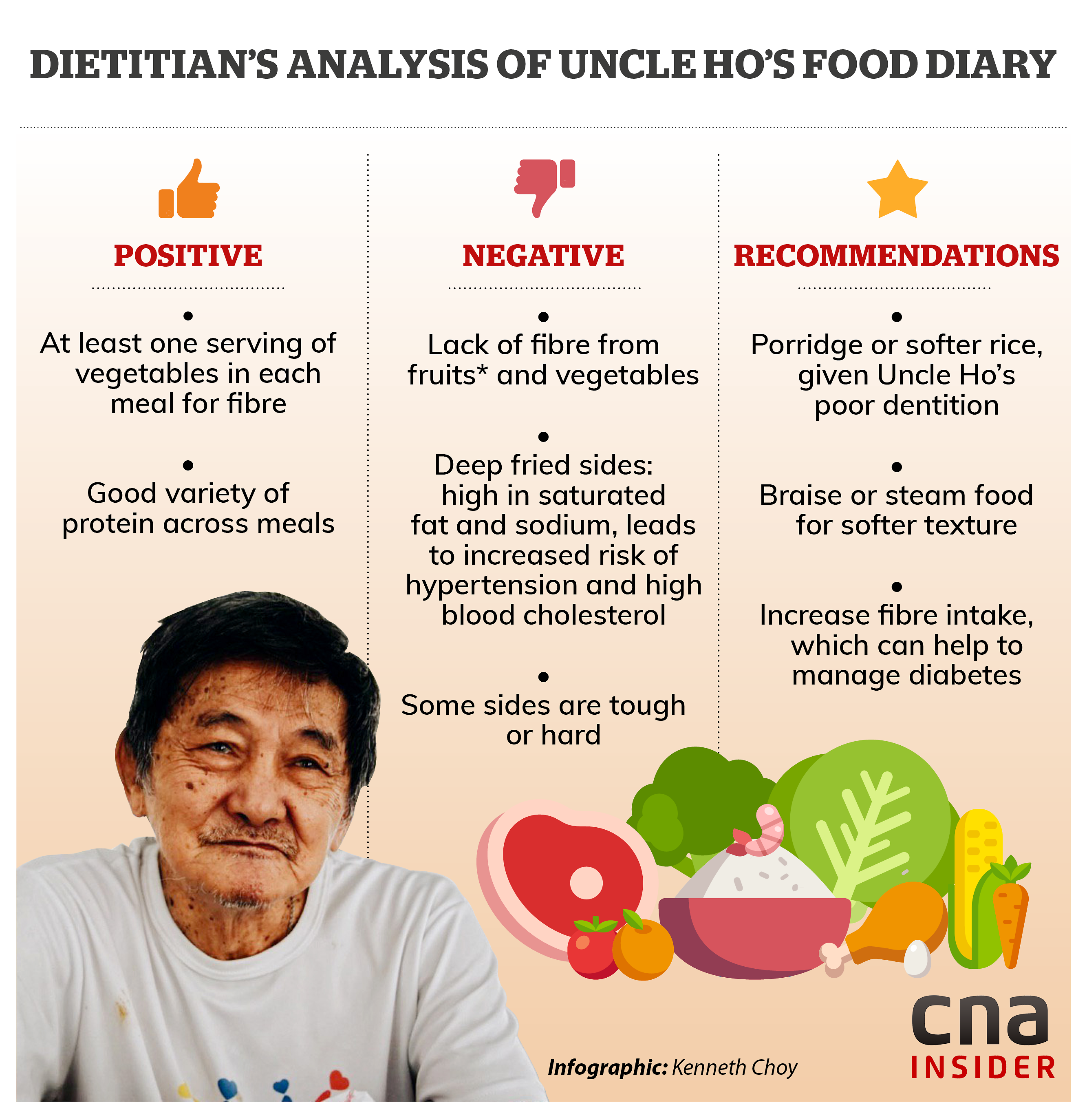
As for the cooked food he receives, dietitian Goh Yiting looked at a log of several days’ meals that CNA Insider presented her, and found them to tick the nutritional boxes in terms of vegetable servings and proteins.

But, Uncle Ho sometimes gets fried food items or meat that hasn’t been minced, which is tough for him to chew. “Just slowly eat lor,” he said. Softer foods or porridge would be ideal for him.
A2 food insecurity 63

*He’s given oranges, but doesn’t like them.

To better match beneficiaries’ needs, Dr Jensen Goh said, feedback channels need to be open. “But because groups often just leave the food at the door, the beneficiaries don’t tell anyone that they are overserved.”

Others might be apprehensive about giving feedback for fear of being misinterpreted, said Fion. “If they say ‘I don’t eat macaroni’, for example, people might call you ungrateful. Like, ‘I give you and you still want to choose’.”

Esther, who got a similar response when she tried to give feedback on the “bland” cooked meals by a charity kitchen, said: “We can’t give feedback because the food is free… It feels like we are beggars, what they give, we must eat.”

A2 food insecurity 36

A charity kitchen distributing cooked food at a void deck.

DONORS NEED TO GIVE BETTER

But it may not be entirely up to food charities, either. Often what determines what they can give out, are the donations they receive from the public and from companies.

Said Food Bank’s Nichol: “While charities want to feed their beneficiaries better, they won’t be able to do so if they are consistently getting unhealthy donated food. It’s therefore up to groups to communicate to their donors which items are more or less useful.”

Food From The Heart holds nearly 300 food donation drives a year for its Community Food Pack programme. Said Bee Hia: “If you give us a lot of luncheon meat, I can only give it to Chinese families. If you give us 3-in-1 Milo and coffee, I cannot give to people with diabetes.”

“People might want to give ‘fancy’ items like macaroni and cheese. But I can’t give that to seniors, they won’t know how to consume it!” she added.

A2 food insecurity 14

She also emphasised that they cannot accept expired canned food. “We are not a dumpster, but sad to say, some donors treat us as a way to clear whatever they have at home.” The Food Bank also has received opened bottles and half-finished food items.

Charity kitchen Willing Hearts, which cooks up 6,500 free meals daily for collection or delivery, sometimes gets complaints about the lack of variety. But – aside from the fact that options are limited as it doesn’t use pork or beef out of cultural considerations – it relies on donated ingredients.

Its president Teh Eng Hua, 63, said: “Whatever people give, we use. If it’s flooding season in Malaysia, we won’t get so much green vegetables. So we’ll be eating Chinese cabbage for many days. But there’s still Chinese cabbage to eat, right?”

A2 food insecurity 41

Cooks at Willing Hearts prepare 6,500 meals a day.

He thinks beneficiaries should remember that the food comes from the goodwill and “hard work” of many donors and volunteers. “Plus, it’s delivered to your doors. So we must all be thankful.”

However, with standards of living having risen in Singapore, Nichol thinks there’s room to improve on the range of food given to the needy, as “we can’t be giving the same types as 20 years ago”.

Giving beneficiaries more choice can be a double-edged sword, though, in Nizar’s experience. The FFA founder said candidly: “You get some entitlement issues…  They will ask, why are the oranges this brand? Not Sunkist?”

“When I started to give milk and cheese – things the beneficiaries would not be able to afford – they started asking for better brands… if it’s not Nestle or a premium brand, they wouldn’t want.”

A2 food insecurity 15

Donating cash instead to food charities is not a bad option – the groups, after all, can buy groceries that would meet their beneficiaries’ needs.

However, groups do feel the obligation to stretch the donor’s dollar by buying in bulk, or larger portions that are more value for dollar. Hence, why food packs are often standardised with little room for customisation; and why there’s often wasted food.

“When I first started doing charity work, I wanted to give 10kg bags of rice because why not?,” said FFTH’s Bee Hia. “But I didn’t realise that a senior living alone is going to take a very long time to finish that much rice.”

A2 food insecurity 45

A free packet of food discarded by a senior citizen, who told CNA Insider she didn’t know how to eat pasta. (Photo: Goh Chiew Tong)

MEAL DELIVERY HICCUPS

Charity kitchens face an additional set of issues: Finding the volunteers to get cooked meals delivered every day, on time; and avoiding food spoilage.

Willing Hearts starts preparing the meals as early as 6.30am, which are then delivered across the island from 9.30am to 11.30am by some 30 to 40 volunteers.

Guidelines by the Singapore Food Agency states that cooked food should be consumed, refrigerated or frozen within two hours, but sometimes beneficiaries keep a pack until dinner time without a fridge to store it in. KHA’s Fion noted that it was “quite common” for them to find that their food had gone soggy or turned sour.

A2 food insecurity 37

A meal from a charity kitchen. 

Said Willing Heart’s Eng Hua: “Occasionally we hear that people do not know how to store or heat up the food properly. If it was possible to recruit more volunteers or partners, we could serve dinner in the afternoon. But for now, this is the best we can do.”

READ: ‘Not enough manpower to get food to people in need’: Food charities hit as coronavirus measures ramped up

Even the Meal-on-Wheels programme relies largely on volunteers.

TOUCH Home Care, for instance, delivers lunch by 12.30pm and dinner by 6.30pm to some 1,000 frail elderly in Toa Payoh, Ang Mo Kio and Jurong. But, on rare occasions, meeting that schedule is a challenge.

“Some volunteers would back out last minute or come too late – the meals would be close to expiration,” said Sam Ngeow, centre manager for TOUCH Home Care. “They need to be consumed within four hours of cooking. I can’t let them be delivered.”

That’s why TOUCH also gives its clients food rations every two months, so they don’t go hungry in such a situation.

A2 food insecurity 34

Deliveroo rider Muhammad Dzul, 27, volunteered for the TOUCH partnership to give back to the pioneer generation.  

Recently, one possible solution presented itself: A tie-up with Deliveroo, to deliver meals to TOUCH’s beneficiaries.

“Delivering food is what we do best… (And) we already have a steady core of riders that TOUCH can use,” said general manager Siddharth Shanker. Deliveroo also, for one month, got customers on its app to contribute a S$5-meal, raising some 1,000 meals that were delivered to 155 beneficiaries.

For folks who are ambulant, there is other generous help available that doesn’t rely on delivery services. Many grassroots and non-profit groups give out vouchers that can be redeemed at neighbourhood coffeeshops or hawker stalls.

Some F&B outlets, from restaurants to fast-food, have even stepped up to offer free meals to those in need. Others, like cafes and food courts, have pay-it-forward initiatives that (much like Deliveroo’s) rallies customers to pay for someone else’s meal.

READ: He went hungry as a teen. Now Stuff’d boss is feeding kids who can’t afford a meal

READ: Pilot to encourage public to donate meals to needy launched in Pasir Ris

But pride, and the stigma of being seen as needing charity, can stop some from coming forward – an issue Bee Hia has noted when some parents decline to let their children collect FFTH’s goodie bags at school, for fear of how their classmates might view them.

A2 food insecurity 12

SEARCHING FOR A BETTER WAY FORWARD

For all the challenges that food assistance groups face, the good news is that a number have already set the wheels of change in motion, in ways both small and big.

Firstly, by doing what they already do, better.

FFTH, for example, now tailors its Community Food Packs: A larger quantity of items for young families, for instance. Food packs curated for diabetics and for dialysis patients (in consultation with a dietitian), featuring non-fried instant noodles, or vegetables with low-to-medium potassium levels such as french beans and cucumbers.

A2 food insecurity 2

FFTH tweaked its School Goodie bag to include healthier options, fewer cans of baked beans, and more items to suit the growing needs of young families. 

Esther, too, has started to get more choices from her food rations provider, in the months since CNA Insider first met her. She is now given a list to choose from, which includes frozen protein such as sausages and nuggets, with a cap of S$50 in value.

“This is better than canned food, even though it is fried,” she said.

FFTH has gone even one better by opening, in February, The Community Shop @ Mountbatten. There, 500 needy households can choose what they want for free – instead of having to accept pre-packed rations.

The charity is at the same time collecting data of their preferences, which will help to shape smarter donations.

a2 food insecurity ffth comunity shop

Community Shop @ Mountbatten (Photo: Food From the Heart Facebook page)

MP Denise Phua has done something similar in the Kampong Glam precinct: A mini-mart where Comcare recipients can help themselves to donated food and groceries. “It’s important to match the needs of the recipients with what is given,” she said.

Indeed, for food groups to give better, the public needs to be educated, Bee Hia says.

“We’re hoping that people would change their mindsets and think from the perspective of the beneficiary,” she said. “Say, there’s a food drive in your child’s school, what do you do? Do you open your pantry and take out what your child doesn’t want to eat anymore?

“Or, do you take out items that you know your child enjoys, and think another child would enjoy too?”

A2 food insecurity 27

Sim Bee Hia giving out root vegetables at Marine Terrace, one of Food From The Heart’s distribution points. 

INNOVATING TO FEED THE HUNGRY

Others aren’t waiting for a mindset change to happen, but are finding new ways to serve their clientele, with some creative thinking. Like FFA’s Nizar.

After six years of distributing food rations and cooked meals to low-income families, he believes he’s come up with a solution that will address most problems. He has turned combat rations-type MREs (meals ready to eat) into easy meals for the food insecure – only, of tastier variety.

Think buttermilk prawns, seafood fried rice and biryani: Meals more complete in nutrition than instant noodles, and quicker to prepare.

FFA produces the MREs with a shorter two-year shelf life, so that the food can be cooked in tastier ways, said Nizar. The bright-yellow retort pouches can be reheated in a microwave, but meals are also safe to consume without reheating.

A2 food insecurity 31

Ready-to-eat meal pouches developed by Free Food For All.

“It’s especially viable for the elderly, those who can’t cook for themselves or are non-ambulant,” said Nizar.

What’s more, he said, the cost of producing these is cheaper than the cost of preparing and transporting freshly cooked meals which run the risk of spoiling. One box of 36 meals could feed an individual for weeks.

“We have to innovate, we have to adapt. Instead of going to someone’s house daily, you can bring them a box just once a month,” he said.

Then there is Food Bank’s food pantry, which has been reimagined as convenient 24-hour vending machines providing emergency rations and meals to beneficiaries in Toa Payoh. Given cash cards topped up with 50 credits, they can ‘buy’ 25 items a month.

Said Nichol: “Let’s say you really need bread, you can just tap your card to redeem; Nutella and peanut butter is free.” The aim here is to make food more accessible any time they need it – while empowering the beneficiaries with choice.

a2 food insecurity vending machine

The Food Bank Singapore’s first food rations vending machine, located in Toa Payoh. 

And if the vending machines idea works, Food Bank plans to introduce blast-frozen food as one of the offerings. “This brings food waste reduction to the next level. With this mode of preparation, you can give salvaged food like vegetables an extended shelf life of three to six months,” Nichol said.

TAPPING FOOD WASTE TO SOLVE HUNGER

Meanwhile, SG Food Rescue (SGFR) – which collects unsellable fresh produce from suppliers at Pasir Panjang Wholesale Centre and other places – has been redistributing this excess to partners like FFA, welfare homes and charities. It has also been stocking free-for-all community fridges, which are open 24/7 at seven locations.

While the group’s primary focus is tackling food waste, SGFR founder Daniel Tay says, helping the food insecure is one way to do that. “We collect lots of food and we need people to eat it.

“Vegetables and fruits are definitely more nutritious than instant noodles. It’s about giving people better options,” he said.

A2 food insecurity 26

Residents with rescued vegetables they collected from a community fridge. (Photo: Goh Chiew Tong) 

Tapping the tonnes of food waste to feed the food insecure is an idea that is gathering momentum in Singapore – though it is not without its challenges.

Crucially, most charities and groups lack the chilled storage facilities to keep vegetables and fruits fresh until they can be given to the needy; and lack the manpower or resources to process and distribute these perishables fast enough.

Said Daniel: “We’re doing this purely on a voluntary basis. If other government bodies and businesses step up to help fund this, we can do so much more.”

Similarly, FFTH’s Bread Run programme could do with more help to pick up leftover bread from more than 100 partner bakeries and hotels, and bring it to collection points for beneficiaries.

“We have bakeries who want to come on board, and we need more volunteers,” said Bee Hia.

And soon, there could be even greater need for logistical help.

A2 food insecurity 20

The Singapore Food Agency (SFA) is exploring the possibility of Good Samaritan laws to provide some legal protection against liability for those who render assistance – such as hotels or restaurants that donate surplus food.

It could be a gamechanger. Food Bank’s Nichol said: “We can then encourage donors to give without fear of being sued. It would increase the range and volume of food we’d receive.”

On the downside, she said, some suppliers might then be tempted to use food charities as a “dumping ground” to avoid paying for incineration costs. Much care would also have to be taken to ensure that cooked food donations are safely handled.

Said a spokesperson for the Ministry of Environment and Water Resources (MEWR): “In considering the feasibility of such laws, there is a need to strike a balance between facilitating food donation, and ensuring that food donors and distributors exercise due care and practise good hygiene when distributing donated food.”

A2 food insecurity 40

Food Bank beneficiaries being treated to a buffet meal at Shangri-La Hotel Singapore during Feeding Week. 

Still, in the broader scheme of things, economist Walter Theseira questions whether re-channelling food waste and relying on volunteer power are the best ways to tackle food insecurity.

“It sends the implicit signal that if you’re low income, you only ‘deserve expired food’. I think it’s more dignified to have money to make the choice (of what to eat) yourself,” said the Nominated MP and associate professor at the Singapore University of Social Sciences.

“Efforts to distribute food that is unwanted or going to expire are driven by volunteers who mean well. But many of these organisations also limit their activities to a few times a month because the reality is, they can’t find enough volunteers to reliably do it day after day,” he added.

“The universality of volunteer efforts is a big problem… What if you’ve found an area without a volunteer group? Do you set up one there, which is difficult because by definition, volunteers organise themselves organically?

“That’s why I think there is unfortunately no substitute for some kind of coordinated action and government-led effort. It’s not to denigrate the role of volunteers – but if we have a systemic problem with food insecurity among low-income individuals, it’s a problem the government is best equipped to tackle.”

A2 food insecurity 19

(Photo: Goh Chiew Tong) 

A NEED FOR TRUST – AND A MAP

In 2018, officers from the Ministry of Social and Family Development (MSF) began informally engaging several food support organisations.

It led to the establishment of a multi-agency workgroup in 2019, involving groups like Food Bank, FFA, FFTH, Willing Hearts and SGFR; and agencies such as MEWR, HPB and SFA.  The idea is to provide a platform for stakeholders to collaborate on tackling food waste and food insecurity.

More communication could certainly help to tackle food aid duplication and reach more of those in need, the charities felt.

“The first thing they should be looking at is big data,” said Food Bank’s Nichol. “We know that people need help, but where are they? Who are they? This information can only be gotten from the government.”

MSF says its role in the workgroup, apart from facilitating, would include bringing in other government agencies and “pulling together data where relevant”. 

A2 food insecurity 21

However, getting groups to share information with each other – such as which households each is serving – would be a challenge.

“It’s sensitive data,” said Jenson Goh, who serves as a facilitator with the workgroup. “Between the food group and the beneficiary, there is already trust built. The food insecure often face complex problems, so groups feel the need to be more careful (about their clients’ privacy).”

Nichol nonetheless believes it is important to put together a map that shows the precise locations each group’s programmes are serving. “I don’t think we should overlap each other’s territories. Let’s say if you’re already covering this area’s 1,000 households, maybe some of us should be hands off,” she said.

But is obtaining such cooperation easier said than done?

A2 food insecurity 44

A charity kitchen distributing food at a void deck. 

“We have heard stories from our beneficiaries that another charity organisation came knocking on their doors and asked them, ‘Can you not take the rations from Volunteer Switchboard? Can you sign up with my group?’” said Li Woon.

This sort of thing happens she says, because groups must reach certain beneficiary numbers in order to receive grants to run their programme. (One example is the Do-Good Grant by Central Singapore Community Development Council, which can cover up to S$10,000 or 80 per cent of the project start-up costs.)

FFA’s Nizar admits that competition is unavoidable. “As charities, we are always vying for eyeballs because that’s how we get donations coming in. I think people are afraid that ‘if I were to do something collectively (with others), it would dilute my ability to get funding’,” he said.

Added Nichol: “So a lot of people guard their turf very closely – and especially guard the donors.”

A2 food insecurity 22

FINDING COMMON GROUND

Within the workgroup, there are also philosophical differences, Jenson noted. “For example, for SGFR the primary philosophy is that (food rescue) volunteers have first pick of the food waste. But groups whose philosophy is to feed the food insecure might think that that’s self-serving.”

Yet, he thinks the workgroup has made headway in coordinating efforts. For instance, the stakeholders have compiled a list of sources, such as restaurants and distribution centres, willing to contribute unwanted food.

“We’ve also mapped the food groups and their needs – so we are trying to cross-match to deconflict people who are sourcing from the same food sources.”

a2 food insecurity comm fridge

A volunteer stocking up Free Food For All’s community fridge at Yishun.

One project in the works involves providing distributors at Pasir Panjang Wholesale Centre with a collection schedule for the various food rescue groups. A systematic approach and clearer communication to distributors, as well as between groups, could lead to more food being available to all, said Jenson.

Said an MSF spokesperson: “We are encouraged that members are open to working together to improve the charity food landscape, and look forward to deepening this collaboration.”

While it might take a while to break down silos in Singapore’s food charity landscape, Nichol is hopeful that groups can find common ground.

A2 food insecurity 55

Volunteer Switchboard at work.

“We’re all in the business of helping others, so let’s do this business better – a team of charities bonding over the love of food and over the love of feeding other people,” she said.

This is the second of CNA Insider’s two-parter on food insecurity. In Part 1: Why in a food paradise, some Singaporeans are still going hungry.

HOW YOU CAN CONTRIBUTE

Free Food For All: https://freefood.org.sg

Food From The Heart: https://www.foodfromtheheart.sg 

Food Bank Singapore: https://www.giving.sg/the-food-bank-singapore-ltd

Willing Hearts: http://www.willinghearts.org.sg

SG United: Various charity efforts amid the COVID-19 outbreak https://www.giving.sg/sgunited

TOUCH Community Services: To volunteer for Meals-on-Wheels delivery, call 68046565

Source link

Bullied Australian boy Quaden Bayles to get MMA training in S'pore following invite from One founder Chatri

0

[ad_1]

Australian Quaden Bayles will be in Singapore to undergo mixed martial arts training after his family accepted an invitation from One Championship founder Chatri Sityodtong on Friday (Feb 21).

The martial arts champion, 49, offered an all-expenses-paid trip and has also promised to “teach (Quaden) personally myself”.

Nine-year-old Quaden has been bullied at school for his dwarfism.

He received an outpouring of support after a video of him was uploaded to Facebook by his mother, Yarraka Bayles.

The clip – watched more than 16 million times by Friday – showed him crying and repeatedly saying he wanted to die after being bullied at school.

“I want to help this little boy because I want to use our power to help those who are powerless,” Chatri told The Sunday Times on Saturday. 

[ad_2]

Source link

3 more confirmed COVID-19 cases in Singapore; mother and 6-month-old baby discharged

0

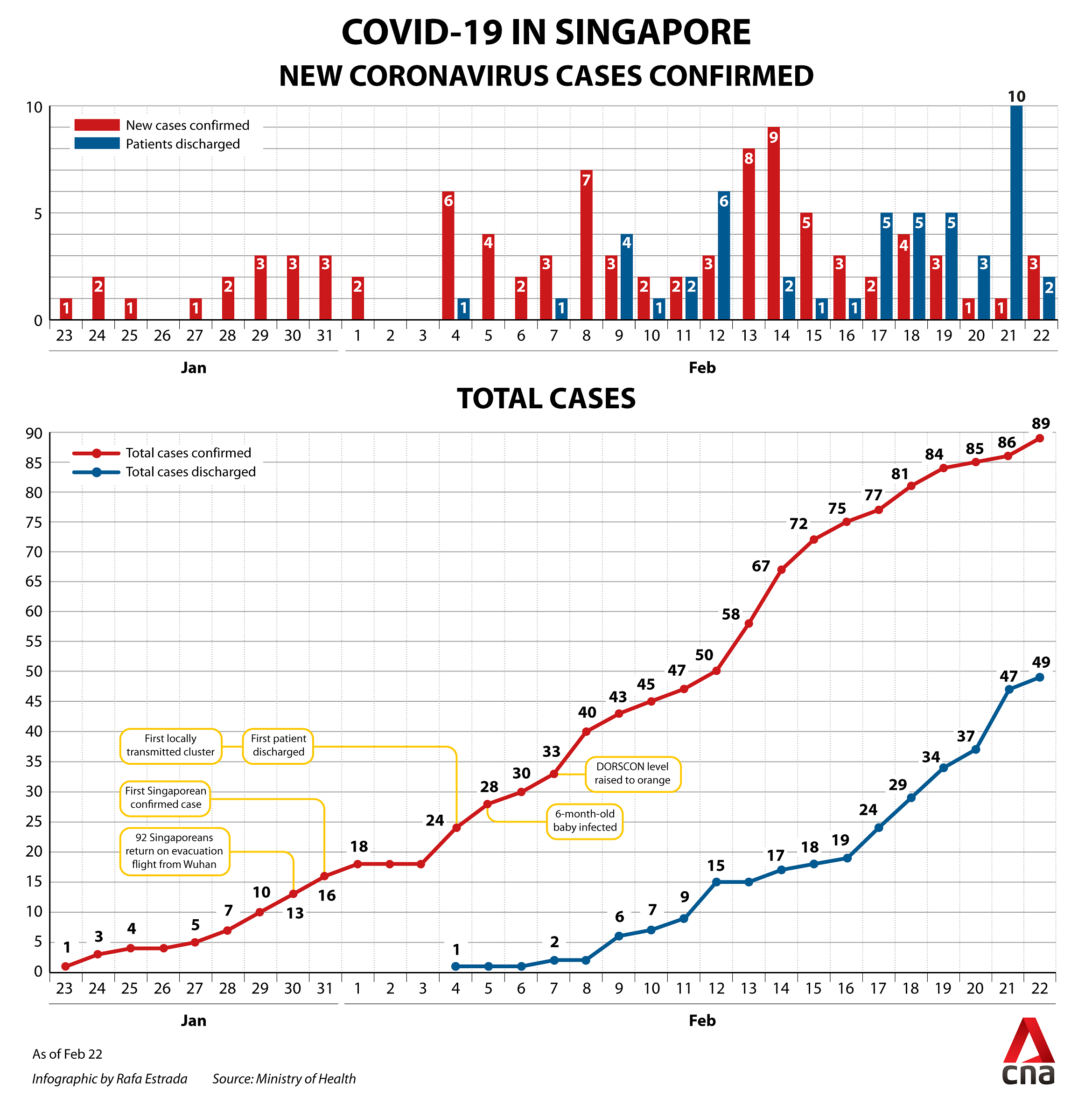
SINGAPORE: Singapore reported three more confirmed cases of COVID-19 on Saturday (Feb 22) said the Ministry of Health (MOH) in a daily update, adding that two more were also discharged.

This brings the number of cases in the country to 89.

The recovered patients are a 28-year-old mother (Case 19) and her six-month-old baby (Case 28).

So far 49 people have recovered from the virus in Singapore.

The latest confirmed cases include one from the cluster at Grace Assembly of God, and one was among the group of Singaporeans who were evacuated from Wuhan on Feb 9.

For the third case, MOH said that contact tracing is under way to establish any links to previous cases or travel history to China.

covid-19 cases in singapore, feb 22

LATEST CONFIRMED CASES

According to MOH, Case 87 is a 32 year-old male Singaporean who was evacuated from Wuhan on Feb 9. He did not show symptoms when he boarded his flight, but was put under quarantine upon landing in Singapore.

He was confirmed to have the virus on Feb 21 and is currently warded at an isolation room at the National Centre for Infectious Diseases (NCID).

He is linked to Case 76 who is a one-year-old baby who was also evacuated from the epicentre of the outbreak.

The second case confirmed on Saturday, Case 88, is a 30 year-old female Singaporean with no recent travel history to China. Symptoms developed for her on Feb 16 and she visited a clinic the next day.

As she was identified as a contact of Case 66, a 28-year-old Singaporean man linked to cluster at Grace Assembly of God, she was referred to NCID on Feb 21. She was confirmed to have the virus on the same day.

Prior to hospital admission, she had mostly stayed at her home at Hougang Street 91.

Case 89 is a 41 year-old male Singapore Permanent Resident who has no recent travel history to China.

He was confirmed to have COVID-19 infection on Saturday morning, and is currently warded in an isolation room at NCID.

As of noon on Saturday, MOH has identified 2,734 close contacts who have been quarantined. Of these, 1,101 are currently quarantined, and 1,633 have completed their quarantine.

Originating in the central Chinese city of Wuhan, COVID-19 has killed more than 2,300 people and infected more than 75,000, mostly in mainland China.

It has spread to more than 25 countries, including Singapore, Japan, South Korea and Thailand.

South Korea reported its second death on Saturday from the virus, as the number of new cases rose by 142, bringing the nationwide total to 346. 

On Saturday as well, Japan confirmed four more infections.

Outside mainland China, 14 people have died from the disease. These include passengers who were on the Diamond Princess cruise ship, and residents in Japan, South Korea, Hong Kong, Taiwan, France, the Philippines and Iran.

On Wednesday, the World Health Organization (WHO) said it was “very impressed” with Singapore’s response to the COVID-19 outbreak.

READ: One month of COVID-19: Concern, containment and collective effort

Singapore on Feb 7 raised the Disease Outbreak Response System Condition (DORSCON) to Orange, prompting additional precautionary measures.

The country has also set aside S$800 million in Budget 2020 to support frontline agencies in their efforts to contain the COVID-19 outbreak, with the bulk allocated to the Ministry of Health.

BOOKMARK THIS: Our comprehensive coverage of the novel coronavirus and its developments

Download our app or subscribe to our Telegram channel for the latest updates on the novel coronavirus outbreak: https://cna.asia/telegram

Source link

4 arrested for e-commerce scams involving face masks, hand sanitisers

0

[ad_1]

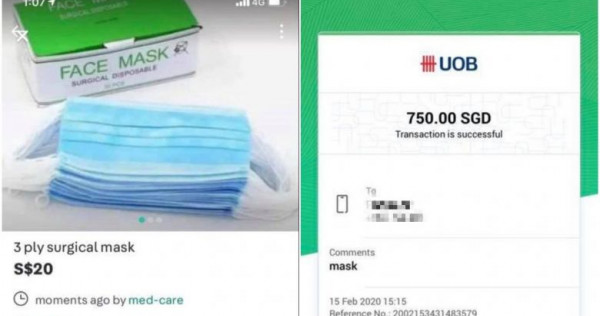
Four people have been arrested for their suspected involvement in separate e-commerce scams that left buyers in the lurch after payments were made for face masks, hand sanitisers and other items.

The crackdown comes amid a high demand for masks and other items used in the fight against the coronavirus, with panic buying leaving store shelves empty.

The police said in a statement on Saturday (Feb 22) that they had received many reports between Jan 2 and Feb 19 from people who said they had been cheated by online sellers advertising face masks for sale.

The sellers became uncontactable after payments were made through bank transfers, the police said.

[ad_2]

Source link

Coronavirus: 10 more patients in S'pore discharged; 1 new case linked to woman who had dengue

0

[ad_1]

Ten more patients who had the coronavirus disease have been discharged, the highest number since Singapore reported its first case on Jan 23.

There is one new confirmed case, bringing the total number infected to 86, the Health Ministry (MOH) said on Friday (Feb 21).

Of the total cases, 47 – more than half – have fully recovered and been discharged from hospital.

Most of the 39 confirmed cases who are still hospitalised are stable or improving.

Five are in critical condition in the intensive care unit, one more than the day before.

Asked about whether the new high of discharged cases could point to a positive trend, an MOH spokesman said Singapore’s numbers need to be put into the context of global efforts to fight the virus.

Even if the country manages to contain the outbreak and others do not, there is always a chance that the coronavirus can be “reseeded” into Singapore again, he said.

“So it’s a little bit hard for me to tell you, even if the numbers come down… That we’re actually free of the virus,” he added.

[ad_2]

Source link

‘Running a marathon on the bed’: COVID-19 survivors describe their struggles with the coronavirus

0

SINGAPORE: By the time she found out she was afflicted with COVID-19, the worst had already been over for her. 

The 39-year-old Singaporean woman – also known as case number 33 – had spent a week unconscious in the intensive care unit as doctors fought to save her.

She was finally given a clean bill of health and discharged earlier this week. The woman and her sister who both attend Life Church and Missions at Paya Lebar spoke to CNA about their battle with the disease.

The 39-year-old was initially warded at Sengkang General Hospital for pneumonia on Feb 2.

Doctors desperately tried to treat an infection for the 39-year-old that affected both lungs. Her fever just kept coming back, and she grew increasingly breathless. 

“It was like she was running a marathon on the bed,” said her sister.

Her health deteriorated over the next four days to the point that she became critically ill. “She was on the maximum limit of oxygen support in the general ward setting, and the doctor thought that she would be better taken care of in the ICU,” said her sister.

READ: Coronavirus cases in Singapore: Trends, clusters and key numbers to watch

Explore our interactive: All the COVID-19 cases in Singapore and the clusters and links between them

A WEEK IN THE ICU

The 39-year-old was wheeled into the ICU on Feb 6. 

“My last memory was (feeling) a little panicked because I didn’t know what to expect … But I just had to trust that the medical team knows what they are doing,” she said. The last thing she remembered was a mask being put over her face to sedate her, and she slowly drifted off.

Her sister said doctors faced difficulties getting enough oxygen in her blood. “So they paralysed her with medication to totally knock her out, so (machines) can take over her work of breathing, hoping that they can rest her lungs,” said the sister. 

Around the same period, the Government began testing all pneumonia cases for the coronavirus. 

covid-19 isolation ward (3)

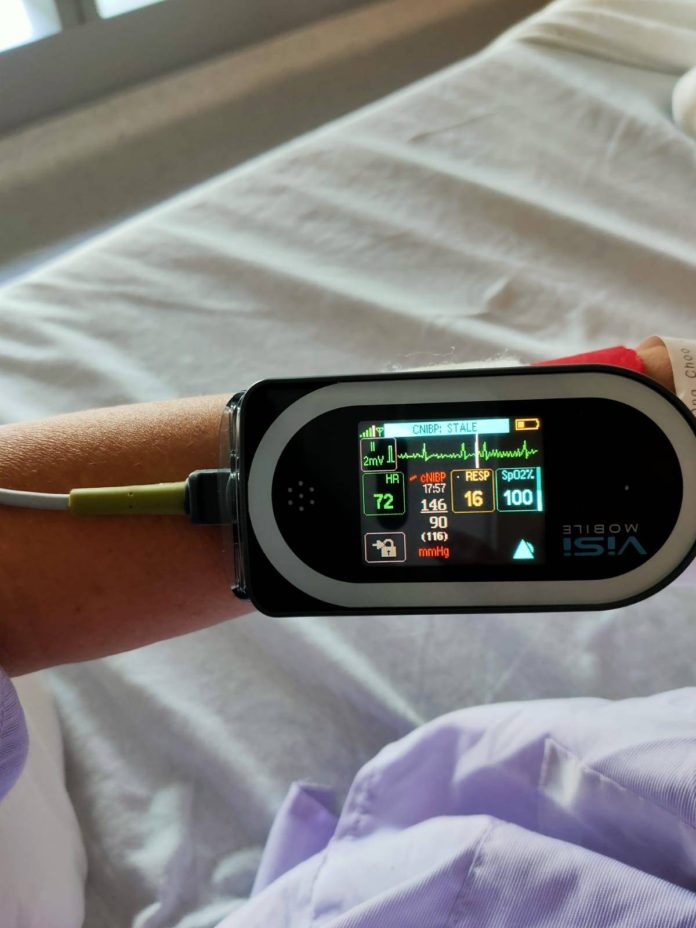
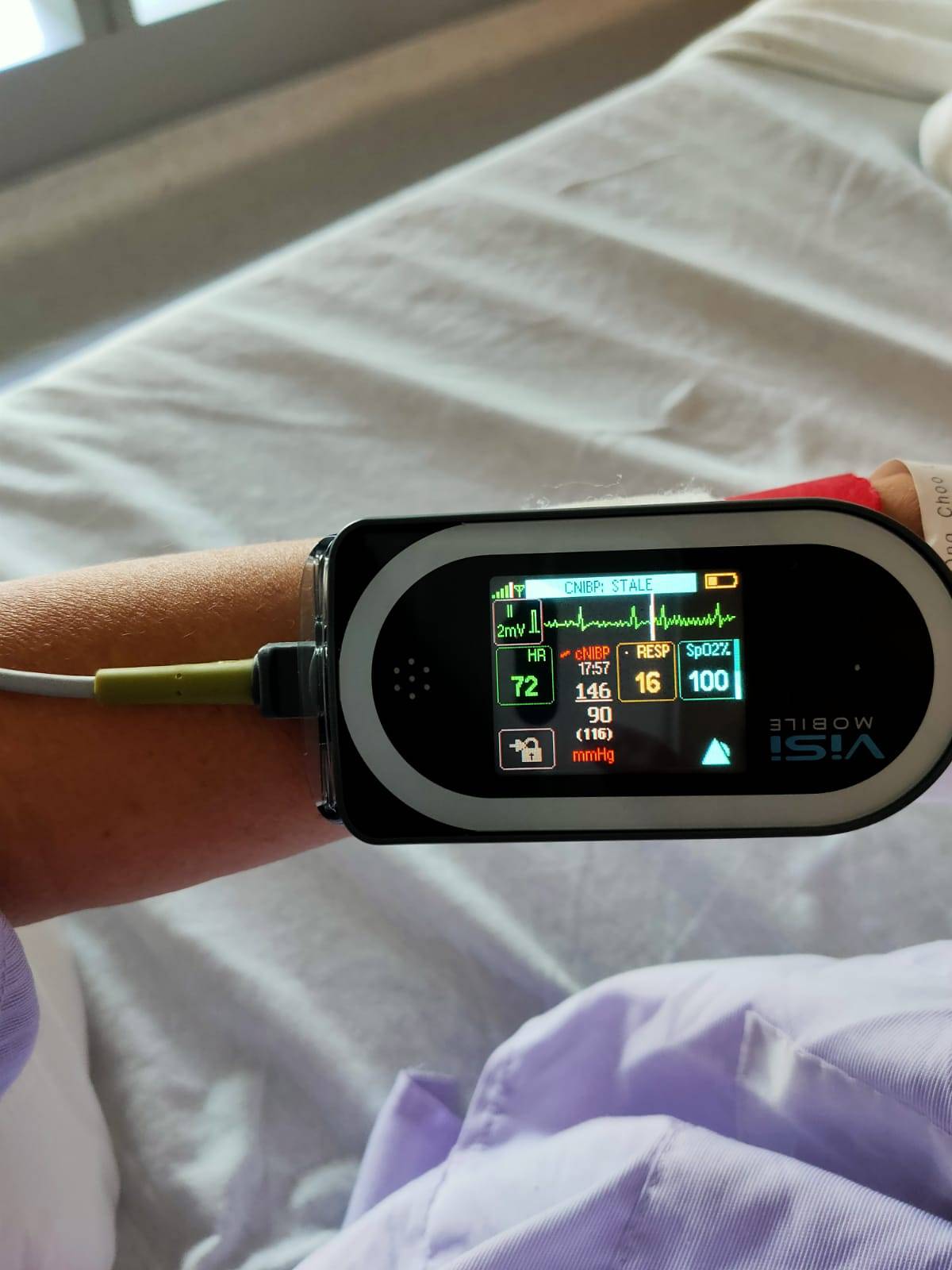
A monitoring device attached to a patient’s arm.

On Feb 6, she was confirmed as Singapore’s COVID-19 case number 33. The call to family members came the next day morning. “I was very stunned because I thought the likelihood was low, but they were pretty sure,” said her sister.

What ensued was “madness”, said the sibling. 

Government officers from the Ministry of Health and Singapore Police Force started calling her to help with contact tracing. “I was receiving calls till my battery went flat,” she said. 

Ambulances were also sent to take all the family members – including a one-month old child – to different hospitals for screening. They were eventually cleared, and sent home to serve out quarantine orders.

READ: Novel coronavirus in Singapore: What we know about the patients who have fully recovered

READ: World must act fast to contain coronavirus, says WHO’s Tedros

Meanwhile in the ICU, doctors were considering an advanced life support technique called ECMO if they still could not get enough oxygen into her body. The procedure would mean that the medical team would have to transfer her to Singapore General Hospital. 

Eventually, that option was no longer needed as her condition stabilised in the ICU. 

Doctors had also given her medication typically used to treat HIV patients. The medical team then attempted to lift her out of the medically-induced paralysis by cutting down her sedation. 

covid-19 isolation ward (2)

An RFID tag used to monitor the patient’s temperature. 

But doctors told the family members that once they did that, she “became very agitated and started to wrestle a little unconsciously”, due to the discomfort of having breathing tubes in her.

“We were thinking that if we were her we would also be very agitated, being put through all these uncomfortable things in an unfamiliar place,” said the sister. Because the family couldn’t be by her side to comfort her, they recorded audio messages of encouragement instead.

“We (told her) she would be fine … and all the invasive things on her were transient, and going to help her for a period of time only,” the sister said. That worked, and slowly, doctors were able to reduce the amount of sedation she needed.

Friends from the church also rallied around the family.

“When I started to gain consciousness, I saw nurses and medical staff around me. There were tubes connected to my mouth,” she said.

The woman said she was confused when she was told that she had the COVID-19 infection. Till today, she does not know how she caught the virus. 

covid-19 isolation ward

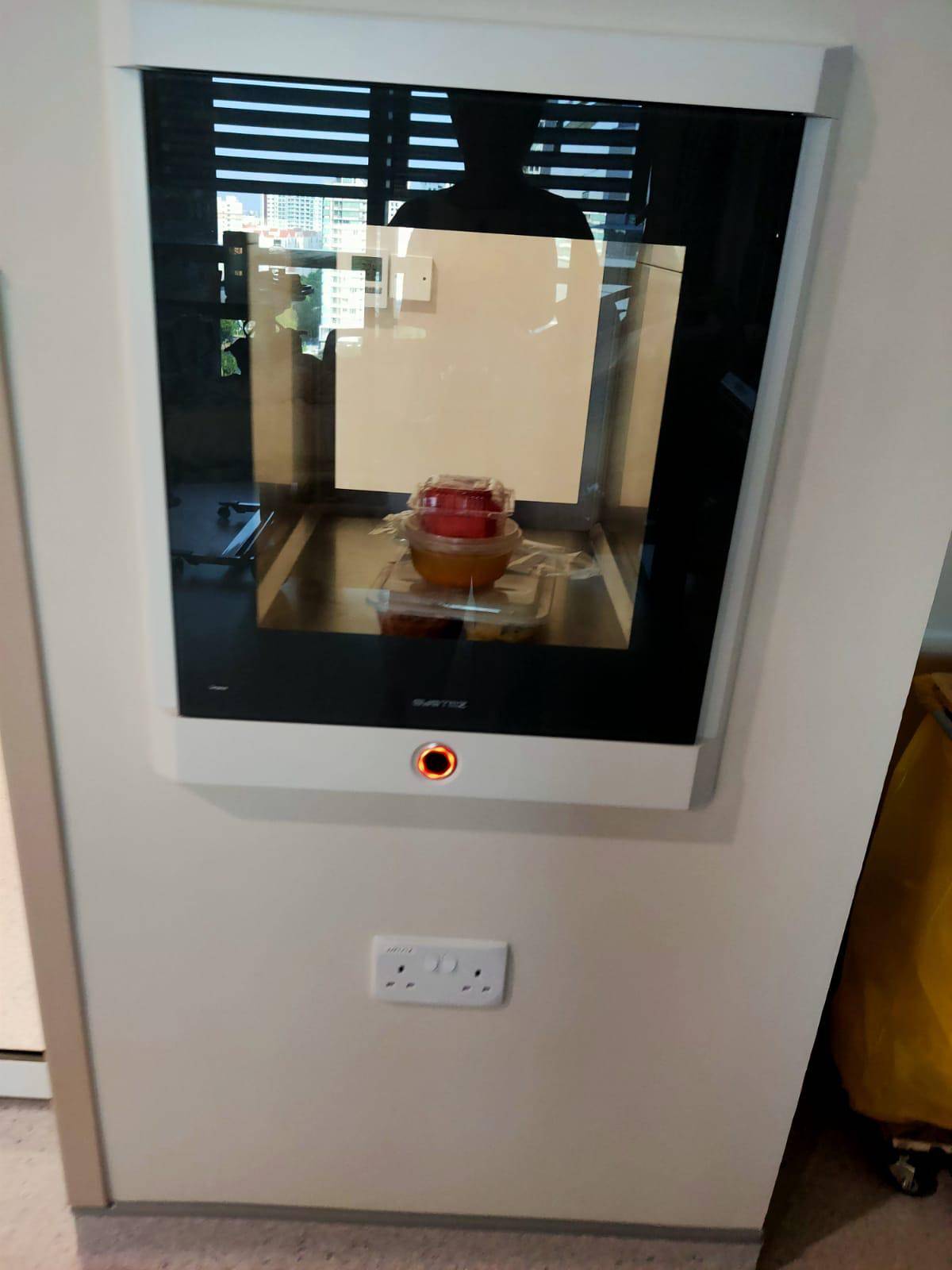
Food is delivered to patients through a secured hatch.

After being moved out of the ICU on Feb 13, she spent the rest of her days in the hospital in an isolation ward where she slowly regained her strength.  She was free to go home on Feb 18.

“If you are sick because of the coronavirus, you are probably (one of) the most important patients in Singapore right now,” said case 33’s sister.  “This disease didn’t kill her,” she added. 

READ: COVID-19 relief measures appropriate for now but Government will do more if necessary: DPM Heng

READ: WHO ‘very impressed’ with Singapore’s COVID-19 response

BREATHING FELT LABORIOUS 

Another woman in the same cluster, case 38, said she had a different experience fighting the infection. 

“People thought I (would be in) extreme pain, and probably looked absolutely skin and bones … I dispelled that (misconception) through video calls,” said the 52-year-old woman, who was also discharged from the National Centre for Infectious Diseases earlier this week.

While her breathing felt laborious at the worst point of her illness, case 38 said doctors told her it was her own immunity that fought off the virus. 

The most challenging thing for her was the 10-day stay in the isolation ward. Doctors spoke to her mostly through the phone. Even her temperature was monitored by an RFID tag, while her food was sent through a secured hatch.

covid-19 isolation ward (1)

A typical meal served to those staying in an isolation ward at the National Centre for Infectious Diseases. 

“People joke about being stranded on an island, but it does feel that way,” she said.

“I had everything that I needed, but it was the lack of human contact,” she added.

READ: Could warmer weather help contain COVID-19?

READ: Israeli woman on virus-hit Diamond Princess tests positive upon return to Israel

While she saw “love in action” when friends reached out and sent her daily encouragements, there were those who questioned if the church had taken enough precautions against the virus. 

Others were fearful and anxious that they had gotten the infection from her.

“Entire families had to be quarantined – which meant that work and schooling, and generally their way of life was affected. There was some fear, which I can understand,” she said, adding that it did not even dawn on her to blame the church or anyone for her COVID-19 infection.  

“I used the opportunity to comfort others in fear … and (used) my experience as a form of encouragement and testimony to those who were worried,” she added.

The 52-year-old also saw the sacrifices nurses and medical staff had to make. 

“I felt extreme compassion for them,” she said. 

“You can sense the tiredness, and also the courage they have in spite of all of these,” she said, urging Singaporeans to share more appreciation for frontline staff.

“This too, will come pass,” added case 38. “We have survived SARS. Today, we are in the midst of surviving COVID-19.”

BOOKMARK THIS: Our comprehensive coverage of the novel coronavirus and its developments

Download our app or subscribe to our Telegram channel for the latest updates on the novel coronavirus outbreak: https://cna.asia/telegram

Source link

Commentary: Rising temperatures, fires and floods highlight importance of understanding climate extremes

0

SINGAPORE: The year 2019 concluded a decade of consistently rising global temperatures, rapidly retreating ice sheets, and record sea levels – all driven by greenhouse gases produced for the most part by human activities.

Average temperatures for the last five years were the highest on record for most of the planet. Land-based global temperature from January to October 2019 was approximately 1.1 degrees Celsius above the pre-industrial period, according to the World Meteorological Office.

In Singapore, 2019 was our joint hottest year on record, on par with 2016 temperatures.

The island state is heating up at about 0.25 degrees Celsius per decade – twice as fast as the rest of the world, according to the Meteorological Service Singapore (MSS).

READ: Commentary: That low-carbon future for Singapore isn’t so far-fetched

Worse, our planet’s oceans, which act as a buffer by absorbing heat and carbon dioxide, continue to heat up far more quickly than previously thought. Recent research has estimated the oceans are heating up 40 per cent faster on average than estimated five years ago.

At our coast, the rate of sea level rise continues to accelerate primarily due to the melting of ice sheets in Greenland and Antarctica, driven by rising greenhouse gas concentrations. Concentrations of carbon dioxide in the atmosphere hit a record 411.85 parts per million (ppm) in December 2019.

Carbon dioxide we emit into the atmosphere stays there for centuries, and carbon dioxide taken into the ocean stays for even longer, thus locking us into further climate change and global warming.

HOTTER DAYS

Our planet continues to heat up on average. Singapore’s hottest day in 2019 was Apr 17, with 36.4 degrees C measured in Paya Lebar, according to the MSS.

Hot weather, sun in Singapore file photo

A woman with an umbrella on a sunny day in Singapore. (File photo: Gaya Chandramohan)

Our hottest days are likely to get even hotter. Hotter days are not only unpleasant for humans and many animals, but they will likely place greater strain on human health and our health system in Singapore. An increase in the number of days over 36 degrees will place tremendous stress on our vulnerable elderly and those that work outdoors.

Singapore and much of Southeast Asia already experience relatively hot temperatures and high humidity year-round. High humidity means perspiration doesn’t evaporate as quickly placing stress on your body as it is harder to stay cool.

If the temperature continues to rise and humidity remains high then there will likely be an increase in the number of people who experience heat exhaustion and heat stroke.

READ: Climate change, floods and drought: Here’s how badly Singapore could be affected

READ: Commentary: Jakarta, the fastest sinking city in the world faces the biggest flooding challenge

This problem is not unique to Singapore. Many other regions across Asia are likely to feel the pressures of extreme heat and its effects on ageing populations and the economically disadvantaged.

ABNORMAL WEATHER EVENTS

While the average climate change indicators continue rising, the day-to-day impact of climate change on our lives are felt through extreme or “abnormal” weather events.

One of the main impact of climate change is erratic rainfall patterns. Such variability in rainfall threatens agriculture and crop yields, which combined with population increase, pose considerable food security challenges to vulnerable countries in the region.

In mid-2019, Thailand saw a significant drop in rice production as reservoirs dried up. Australia, a net exporter of wheat, faced the unique case of needing to seek imports to supply its domestic demand.

Late monsoon fury kills 100 in north India (1)

Patients wade through floodwaters on their way to hospital during heavy monsoon rain in Patna in the northeastern state of Bihar on Sep 28, 2019. (Photo: Sachin Kumar/AFP)

Other events in 2019 also demonstrated the importance of understanding extreme events such as floods and droughts, as much of Asia received abnormally high or low rainfall.

In India, the onset and withdrawal of the Indian Monsoon was delayed, causing a dry spell and water stress in June.

The dry spell was followed by extreme rainfall that generated a series of floods in late July and early August 2019. The floods killed at least 200 people and displaced more than a million.

People were going from having no water in a drought to too much water in floods in the space of a few weeks.

Exceptionally dry conditions prevailed in Asia Pacific over 2019, especially Indonesia and the Mekong basin in the second half, which led to the most significant fire season since 2015, with haze spreading across the region, including Singapore.

READ: Commentary: Air pollution’s nasty effects should motivate stronger action but hasn’t

Commentary: Typhoon Mangkhut destroys rice, corn and fish – but what has this got to do with Singapore?

Drought conditions in Australia also highlighted this peril to the world. Much of inland eastern Australia had been experiencing drought through 2017 and 2018, and in 2019, the drought expanded and intensified.

Australia just experienced its worst fire season in recent memory, but as some fires ended, the rains came. Much of fire-ravaged eastern Australia is now experiencing dramatic flood events.

There should be no doubt the Australian fires are linked to climate change. A warmer, dryer atmosphere coupled with prolonged drought were a catastrophe waiting to happen.

The Australian government was warned repeatedly and accurately. The Garnaut Climate Change Review of 2008 said projections of fire weather “suggest that fire seasons will start earlier, end slightly later, and generally be more intense”, further stating that “this effect increases over time, but should be directly observable by 2020.”

Trees are engulfed in flames as a bushfire spreads in Adaminaby, New South Wales

Trees are engulfed in flames as a bushfire spreads in Adaminaby, New South Wales, Australia, on Jan 9, 2020, in this still image from a video. (Image: Ingleside Rural Fire Service/via REUTERS)

Other climate extremes that made the news several times in 2019 were tropical cyclones or typhoons, with Typhoon Hagibis barely missing Tokyo in October, but still causing severe flooding and significant economic losses.

Toward year-end, the people of the central Philippines experienced yet another damaging typhoon, as Typhoon Phanfone battered the Philippines on Christmas Day, bringing a wet, miserable and terrifying holiday to millions.

With continued warming of our oceans, the future of cyclones and storms remains a topic of considerable debate. Here too, there is much more to do to answer questions about the future of cyclones in our region.

READ: Commentary: I care about climate change. I don’t wish to live in a Waterworld like Kevin Costner

THE IMPORTANCE OF CLIMATE RESEARCH

Climate researchers are always examining the likelihood of changes in how often extreme weather and climate events will occur and whether or not they will become larger and more damaging.

Unfortunately, our understanding of the dynamic processes in the tropics remains rather poor. We have very little data on the comparative frequency and intensity of past events.

However, the extreme climate events of 2019 have generated a groundswell of activity calling for a new wave of climate impact research. In July 2019, for instance, Malaysia’s Ministry of Water, Land and Natural Resources commissioned a national audit on the water industry in anticipation of the longer droughts expected due to climate change.  

Such research would inform and facilitate efforts by industries and governments to improve the way they interpret and manage risks around extreme climate events.

Swathes of Australian farmland have suffered three or more years of drought

Swathes of Australian farmland have suffered three or more years of drought AFP/Peter PARKS

What we do know is that extreme events are commonly the result of a combination of driving factors. Multiple hazardous events cascade when they act as a series.

For example, droughts can lead to increased risk of wildfires, which then heighten the risk of landslides. This rising risk posed by extreme events is very real in the tropics and Asia’s emerging cities.

We urgently need to dig deeper for detailed investigations of likely changes in storm systems, dry periods, extreme rainfall or heat in the context of a rapidly changing climate.

READ: Commentary: As ice caps melt, Singapore a hot spot for sea-level rise

READ: Commentary: How effectively can Singapore adapt to sea level rise?

CORE ISSUES FOR SINGAPORE’S FUTURE

Climate change and climatic extremes are a core issue for Singapore’s future.  Not only do hotter days strain public health, but prolonged droughts or dry spells will almost certainly stress our water supply.

This will force Singapore to consider further investment in relatively expensive water recycling and desalinisation engineering. 

Moreover, flooding events are all likely to affect the everyday lives of many Singaporeans by disrupting transport and business.

READ: Commentary: As time runs out on the climate crisis, Singapore prepares to address the cost of adapting

Against the backdrop of rising sea levels, Singapore faces an increased risk of compound flooding as flood waters reach our coast.

In his Budget 2020 speech, Finance Minister Heng Swee Keat announced a new Coastal and Flood Protection fund with an initial injection of S$5 billion. Being that climate change adaptation might cost S$100 billion or more over 100 years, Singapore is beginning to set aside resources for it.

As we keep an eye on climate change, it’s crucial that we understand how it can manifest as extreme weather, with adverse impact on Singapore and the region.

Adam Switzer is the Associate Chair (Academic) of the Asian School of the Environment and a Principal Investigator in the Earth Observatory of Singapore at Nanyang Technological University (NTU).

Source link

One month of COVID-19: Concern, containment and collective effort

0

SINGAPORE: It has been a month quite unlike any other.

What began as faraway rumblings in the city of Wuhan has turned into a battle on Singapore’s frontlines.

Beginning as an unknown, the disease took on many names –  Wuhan virus, novel coronavirus, and now, COVID-19.

To fight the battle, masks and hand sanitiser turned into the weapons of choice for Singaporeans. 

An acronym became a buzzword. And as the Disease Outbreak Response System Condition (DORSCON) level turned from Yellow to Orange, the queues snaked at supermarkets as some people rushed to prepare for a worst-case scenario. 

Thirty days, 86 cases, 47 people recovered, five in critical condition. 

The numbers change daily, but the effort to contain the threat remains constant as Singaporeans across sectors and industries work double-time. Singapore is “leaving no stone unturned” in the COVID-19 outbreak, said Dr Tedros Adhanom Ghebreyesus, director-general of the World Health Organization (WHO), on Feb 18. 

“We are very impressed with the efforts they are making to find every case, follow up with contacts and stop transmission,” he added. 

This Sunday (Feb 23) marks a month of grappling with COVID-19. Here’s what happened over the last 30 days: 

SINGAPORE’S FIRST CASES

Authorities saw this one coming – initially implementing temperature screening at Changi Airport for all travellers from Wuhan. Those found to have pneumonia and recent travel history to China were quickly isolated. 

A multi-ministry task force was also formed in preparation, as Singapore geared itself for the possibility of an imported case of the virus.

On the evening of Jan 23, Singapore’s first case was confirmed. 

READ: Singapore confirms first case of novel coronavirus

This was a 66-year-old Wuhan resident who flew with his family to Singapore from Guangzhou on a China Southern flight. He visited Singapore General Hospital (SGH) on Jan 22, and tested positive for the coronavirus the next evening. 

Authorities acted quickly to extend temperature screening to land and sea checkpoints, as Singapore prepared to celebrate the Chinese New Year.

And as the holiday began, Singapore confirmed its fourth case of the virus on Jan 26. 

In anticipation of the surge in people returning from China after the Chinese New Year holidays, the task force also announced a slew of additional measures – increased border checks and compulsory leave of absence for students, teachers, healthcare and eldercare workers returning from China.

READ: Increased border checks, leave of absence among new counter-measures

To address the need for containment areas, university hostels, government chalets as well as the Outward Bound camp in Pulau Ubin were repurposed as government quarantine facilities.

Travel restrictions were also implemented as the authorities announced they would stop entry or transit for new visitors who travelled to Hubei in the last 14 days, as well as holders of Chinese passports issued in Hubei.

FIRST FLIGHT FROM WUHAN RETURNS HOME 

Singaporeans at the epicentre of the outbreak were not forgotten, as 92 were flown home from Wuhan on a Scoot flight on Jan 30. “We will always look out for Singaporeans in distress overseas,” Minister for Foreign Affairs Vivian Balakrishnan said in a Facebook post.

READ: 92 Singaporeans flown home from Wuhan; some remain in the city as they are symptomatic

With masks, thermometers and hand sanitisers already becoming hot commodities, the task force announced on the same day that each Singapore household will receive four surgical face masks

“We are doing this to assure Singaporeans that every family will have access to masks if someone in your family really needs it,” National Development Minister Lawrence Wong explained. 

Five million masks had been released to retailers in the previous nine days, revealed Minister for Trade and Industry Chan Chun Sing, but the usage was much higher than expected.

READ: Retailer Deen Express asked to explain high prices for masks: MTI

With reports of profiteering surfacing, the Ministry of Trade and Industry took action, sending a letter of demand to retailer Deen Express and letters to e-commerce platforms Lazada, Carousell and Qoo10 to request information on potential profiteers using their platforms. 

FIRST CLUSTERS EMERGE, START OF THE GRAND HYATT HOTEL TRAIL

Singapore saw its first few locally transmitted cases of COVID-19 on Feb 4, bringing the total number of cases to 24. 

READ: What we know about the locally transmitted coronavirus cases in Singapore

Four Singapore residents with no recent travel history to China tested positive for the virus. One of them was a tour guide for a group of Chinese tourists, two worked at a shop the group had visited, while a fourth case of local transmission was the domestic helper of one of the cases. The travellers were from Guangxi, and at least two of them had been confirmed with COVID-19 at the time. 

Singapore also saw its first discharged patient on Feb 4. Case 7, a 35-year-old man from Wuhan “comprehensively tested negative” for the virus, said the Ministry of Health (MOH). He had tested positive for COVID-19 on Jan 27. 

On Feb 4, Malaysia also confirmed the country’s first citizen case of COVID-19, and it was revealed that the Malaysian national had been in Singapore from Jan 16 to Jan 23 for a business meeting at the Grand Hyatt hotel that involved Chinese nationals. 

READ: Malaysia confirms first citizen case of novel coronavirus; man was in Singapore for meeting attended by Chinese delegates

The next day, South Korea confirmed two more cases of COVID-19 – the two men had met the Malaysian national and attended the same conference

That evening, MOH said that the Jan 20 to 22 conference was attended by 109 participants from one company – later revealed to be Servomex. 

Of the 109 participants, 15 were Singapore residents and 94 were from overseas, including the three patients from South Korea and Malaysia. On Feb 6, a British male was confirmed as the UK’s third COVID-19 case, and it was revealed that he was also at the conference. 

The Briton is believed to have passed the virus on to at least 11 of his compatriots who were at a French ski resort that he visited after leaving Singapore.

Later in February, it emerged that Cases 30, 36 and 39 are linked to the same meeting. 

READ: From Singapore to UK through the Alps: How one man spread coronavirus

DORSCON ORANGE, ‘KIASU’ SINGAPOREANS

More cases of local transmission were confirmed over the next few days, and on Feb 7, three new COVID-19 cases were announced. This time, none of them were linked to existing cases or had been in China recently. 

A Victoria Junior College teacher was among the three new cases announced, and one of the cases went visiting during Chinese New Year after developing symptoms, said MOH. At the press conference, Health Minister Gan Kim Yong said that authorities were expanding their case definition and doing “proactive case finding”.

With this development, the task force also announced that the DORSCON level would be raised to Orange. This means the disease is deemed severe and spreads easily from person to person, but has not spread widely and is being contained. Moderate disruption is expected, due to measures such as quarantine and visitor restrictions at hospitals.

READ: What you need to know about additional precautionary measures under DORSCON Orange

“I understand that Singaporeans are anxious, concerned and there’s much that we do not yet know about the virus,” Mr Gan said, when making the announcement. 

“New information is emerging daily, we expect that this is likely to take time to resolve, maybe months, life cannot come to a standstill but we should take all the necessary precautions and carry on with life.”

Shortly after the DORSCON Orange announcement, there was a rush to supermarkets by some people to stock up on daily essentials, including rice, noodles and toilet paper. Photos and videos of shopping carts and cupboards overflowing with food made their rounds on social media, while supermarket shelves were quickly emptied. 

Empty shelves supermarket Singapore Feb 7, 2020

Near-empty shelves seen at NEX shopping mall’s NTUC FairPrice on Feb 7, 2020. (Photo: Henry Yin)

Over the next two days, ministers and members of parliament spoke up to urge people to buy only what they need and avoid hoarding food and daily necessities at home. 

Speaking to media on Feb 8 in front of a tower of toilet paper in an NTUC FairPrice distribution centre, CEO of FairPrice Group Seah Kian Peng said the supermarket chain saw five times the usual demand for rice, four times the usual demand for noodles and more than two-and-a-half times the usual demand for toilet paper the day of the DORSCON Orange announcement.

The next day, FairPrice implemented purchase limits for paper products, vegetables, rice and instant noodles “to ensure more customers have access to high-demand items”.

READ: No need to rush for supplies, says Chan Chun Sing, amid reports of surge in demand

Since then, things have more or less got back to normal, with supermarket shelves replenished as needed, and people able to do their shopping without fighting their way through the crowds.

With the DORSCON level raised to Orange, schools suspended all inter-school and external activities until the end of the March school holidays, including the national school games, learning journeys and camps.

The National University of Singapore and Singapore Management University also announced that e-learning would be implemented for class sizes above 50. Staff and students were also required to take their temperature and declare it twice a day. 

Employers and event organisers have also been affected by DORSCON Orange, with many large-scale events like the HSBC Women’s World Championship and multiple business summits cancelled shortly after the announcement was made. 

BIGGEST CLUSTER EMERGES

With extensive contact tracing by MOH and the Singapore Police Force, several new clusters were uncovered as the case numbers continued to rise. 

On Feb 12, two people linked to the Grace Assembly of God church were confirmed to have caught the virus. Another five were announced the next day, and six more the day after that, including a senior pastor of the church. 

At the time, director of medical services at MOH Kenneth Mak said there was “not enough information” to determine if there was a “super spreader” in the cluster. 

“At this time, we do not have enough information to identify a particular individual as being a super spreader or to suspect that this is indeed the case,” he said.

But this was just the beginning of what would become Singapore’s largest locally transmitted cluster. There are now 22 confirmed cases linked to the church, which has two branches in Tanglin and Bukit Batok.

Explore our interactive: All the COVID-19 cases in Singapore and the clusters and links between them

Other clusters also emerged at The Life Church and Missions Singapore in Paya Lebar and a Seletar Aerospace Heights construction site. 

MOH announced on Feb 8 that Cases 8 and 9, a married couple from Wuhan, and Case 33 had links to The Life Church and Missions Singapore. 

Subsequently, Cases 31, 38 and 83 were also linked to the church, bringing the total number of cases in this cluster to six. 

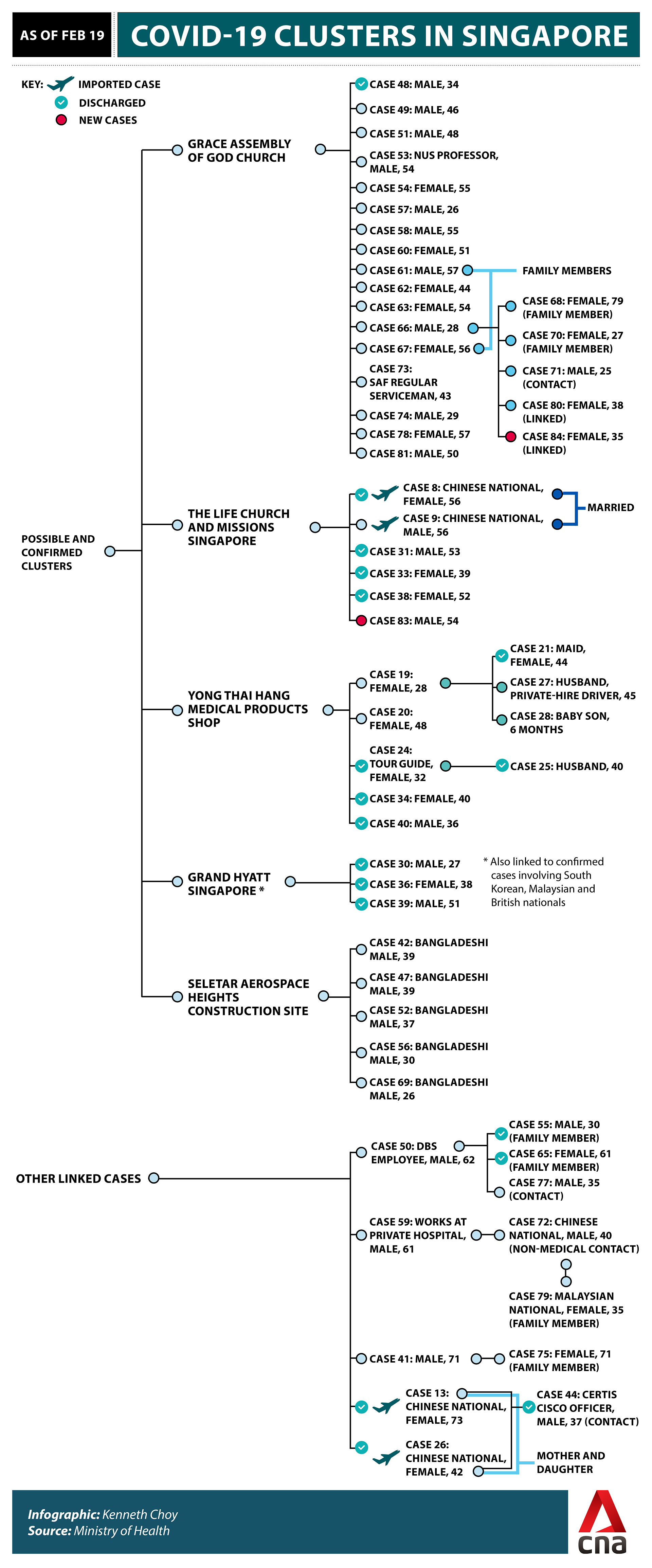
Singapore virus cluster Feb 19

On Feb 8, a 39-year-old Bangladeshi worker who worked at a construction site in Seletar Aerospace Heights was also confirmed as a COVID-19 case. 

Four more workers who had worked at the expansion sites for the Bombardier Service Centre at 8 and 12 Seletar Aerospace Heights were later confirmed to be COVID-19 cases as well. 

Boustead Projects, the real estate company behind the worksite, confirmed on Feb 18 that the five Bangladeshi work pass holders are all workers under the company’s subcontractors. Construction was stopped immediately after the company was notified of the first case on Feb 9. 

READ: Coronavirus cases in Singapore: Trends, clusters and key numbers to watch

With the new cases emerging from the different clusters almost every day, National Development Minister Lawrence Wong noted on Feb 14 that the transmission mechanism of COVID-19 is closer to H1N1 or influenza than Severe Acute Respiratory Syndrome (SARS).

Like influenza, COVID-19 is infectious when symptoms are mild, the researchers found.

Because of this transmission mechanism, COVID-19, like influenza, can spread “quite quickly”, said the minister.

“With our mild symptoms, we sometimes let our guard down – we continue going out even though we don’t really feel well, and that’s how the virus transmits,” he said.

TOURISM AND TRANSPORT INDUSTRIES HIT

It has been just one month, but Singapore’s economy has not been spared. Calling the current outbreak “very intense”, Prime Minister Lee Hsien Loong said that it would have a significant impact on Singapore’s economy for the next couple of quarters.

While Singapore was declared SARS-free in less than four months, COVID-19 “may not be so fast”, he said. “It will eventually pass, and we will be back to normal, but I cannot say for sure how long it will take.”

READ: COVID-19 to have ‘significant’ impact on economy: PM Lee Hsien Loong

According to the Singapore Tourism Board, the tourism sector will take a “significant hit”, with visitor arrivals estimated to fall by 25 per cent to 30 per cent this year, it said on Feb 11.

Singapore is losing an average of 18,000 to 20,000 international visitors per day and most of the lost visitor arrivals are Chinese due to travel restrictions on both sides, STB chief executive Keith Tan told members of the media.

“We believe that the situation this year will be at least as severe as the situation we faced in 2003 during SARS, probably worse,” said Mr Tan.

Among other sectors, the transport industry has also been hit by the COVID-19 outbreak.

Recognising this, the Government on Feb 13 unveiled a S$77 million Point-to-Point Support Package to help taxi and private-hire car drivers affected.

The Government will contribute S$45 million towards the package, with the remaining provided by taxi and private-hire car operators. The package has multiple components – with the largest portion a S$73 million Special Relief Fund that will help active full-time taxi and private-hire car drivers defray business costs, comprising S$41 million in government contributions and S$32 million from operators.

READ: S$77 million package to help taxi, private-hire drivers affected by COVID-19 outbreak

Recognising the impact that the COVID-19 outbreak has had on the economy, Singapore’s Budget for 2020 also included a S$4 billion package on a slew of new measures and enhancements to existing schemes to stabilise the economy amid near-term uncertainties caused by the virus.

This included a Stabilisation and Support Package designed to help workers to remain employed and aid companies with cash flow. Sectors that have taken a direct hit from the coronavirus outbreak, such as tourism, aviation, retail, and food services, will receive additional help, Deputy Prime Minister Heng Swee Keat said in his Budget statement.

READ: Budget 2020: 5 things to know about plans to help workers and businesses amid COVID-19 challenges

In addition, Mr Heng said he will set aside an additional S$800 million in the Budget – the bulk of which is set to go to the Ministry of Health as the Government tries to slow down the spread of the virus.

Reiterating a sentiment shared by a number of Singapore’s political office holders throughout the first 30 days, Mr Heng added: “I am confident that together, we will stay strong and get through these trying times.”

Source link

Commentary: Why do parents still pay top dollar for pre-schools when there are more affordable options?

0

SINGAPORE: When my parents began planning for my education, they were largely saving up to put me through university. 

Fast-forward some three decades: I am now paying a comparable amount for my daughter’s pre-school even before she can speak in full sentences.

In recent decades, pre-schools went from being an exception to a necessity for many.

While childcare duties traditionally fell squarely on mothers or grandparents, today women play an increasingly larger role in the workforce, and nuclear families are also more common. As such, pre-schools have become a crucial part of family planning and budgeting.

So when Deputy Prime Minister and Finance Minister Heng Swee Keat announced in his Budget speech on Tuesday (Feb 18) that the government will double spending on the early childhood sector to more than S$2 billion a year over the next few years, I was delighted.

READ: Budget 2020: Enhanced bursaries for low- and middle-income students as part of education measures

With higher pre-school subsidies for all eligible income groups rolled out since January, DPM Heng also said that the Government would increase the share of places in government-supported pre-schools from 50 per cent at present to 80 per cent by 2025.

This led me to wonder if the vast playing field in the pre-school sector was narrowing.

HIGH QUALITY EDUCATION FOR ALL

Sceptics ask why the Government needs to set aside billions each year to enhance pre-schools. Some have argued many of us spent the very same “formative years” of our lives tossing plastic pick-up sticks and catching tadpoles, and mostly turned out fine.

But there is a huge research consensus establishing the criticality of quality early childhood education in developing high-performing adults. Studies suggest that 85 per cent of the brain develops before the age of five and that begins to form a complex network of connections during this period.

Early childhood education is believed to translate into better academic performance, healthier emotional and social development later in life, and higher future earnings.

With that said, it is natural for parents to be selective about school choices. Cost seems to be one of the key differentiators of the pre-school landscape in Singapore, with monthly fees ranging from a few dollars to thousands of dollars.

READ: Commentary: Parents need not fear getting ready for the first day of school

READ: Commentary: Long-neglected but now in the spotlight, Singapore’s pre-school sector

Since January, some Singaporean households in selected income brackets need to pay as little as S$3 a month for their kids’ fees in government-supported pre-schools.

However, a mid-range option like Cherie Hearts costs $1,180 for a full-day childcare programme, according to its website. After the S$300 working mother’s subsidy from the government, that rings up to S$42,240 over four years – enough to put a Singaporean through three years of an undergraduate law degree at the National University of Singapore.

MOE kindergarten

A teacher interacting with students at an MOE Kindergarten. (Photo: Ministry of Education)

On the other end of the spectrum, EtonHouse at Vanda Road costs S$6,370.25, for a 10-week Pre-Nursery 1 term without subsidy, according to EtonHouse’s website. With four terms over the year, that amounts to S$25,481 for a single year.

IS PRICIER ALWAYS BETTER?

But the question begs: With the availability and enhancement of government-sponsored pre-schools, why are parents still paying for higher-priced options?

One reason is that pre-schools are highly differentiated, and sometimes, selecting the right fit can be more mind-boggling than picking the right formula milk.

I remember sifting through at least eight disparate brochures and attending more than five open houses, trying to cut through the marketing spiel and identifying important and tangible differences.

Some branding aspects like Montessori or Montessori-inspired are not easily quantifiable. The Montessori approach in early childhood education, designed in 1907 by Italian educator Dr Maria Montessori, is designed to empower children to drive their own learning process through collaborative play and hands-on activities.

Since the “Montessori” brand is not a trademarked name, not every school that uses it is accredited. “Montessori-inspired” schools or curriculum therefore can be loosely adopted. It may not guarantee a wide use of Montessori materials, or that many teachers within the school have completed accredited Montessori training programmes.

READ: 52 pre-school operators apply to be new partner operators: ECDA

READ: Commentary: When parenthood comes knocking, life’s never the same again no matter what route got you there

Another differentiating factor for high-end options is lavish facilities. White Lodge International Preschool for instance has a trampoline and sand pit, and Little Tykes has a maritime-inspired sensory room with fibre-optic blankets and a colour-switching infinity portal. Many of these pre-schools are also replete with other stimulating educational props and toys.

However, it remains debatable if all these are necessary for optimal childhood development, or if they are worth the considerable price difference. Some studies suggest that children with fewer toys are more creative and have longer attention spans.

Perhaps the prohibitive pricing and luxury branding are also among the factors that add to their appeal for some, transforming high-end pre-schools into a reflection of socio-economic status?

CLOSING THE GAP WHERE IT MATTERS

That said, some factors like the teacher-to-child-ratio do seem to make a difference in ensuring that budding young minds get the attention and stimulation they need. And these naturally cost more from a human resource perspective.

Generic preschool image. Photo: TODAY (1)

An early childhood educator with her students. (File Photo: TODAY)

Immersive second language environments, and extra-curriculum classes such as art, music, dance, speech and even financial literacy contribute to a well-rounded programme as well. So do pre-school compounds with ample space for children to engage in physical activities. These are often reflected in pricing.

Increased government funding for more operators makes affordable pre-schools more available. Grants also enable more schools to invest in staff training to nurture effective and dedicated teachers, and enhance facilities to close the gap with premium private brands.

Some government-sponsored preschools today offer art, dance, music and acting programmes, either as part of the curriculum or as opt-in programmes. My First Skool 2 Punggol Drive, an NTUC First Campus Pre-school, even includes five play zones, such as an outdoor playground with a bamboo igloo, a water play area, and a forest play zone with a tree house.

READ: Commentary: How Sesame Street set the gold standard for education

As the differentiating factors between branded pre-schools and government-supported options narrows, more parents may begin to opt for affordable options. This reduces the burden on young parents at a time when they are still building their financial foundation.

In a nation widely lauded for its education system and equal opportunities, this also paves the way for pre-schools to evolve in the same direction as primary and secondary schools – where high-quality programmes are available and accessible to all income brackets.

After all, for a country without natural resources, realising the potential of each child is an investment in the future. It is heartening to think that somewhere in a classroom today, a child’s brain synapses are firing away, laying the infrastructure for a future of limitless possibilities.

And more importantly, this need not necessarily come at a staggering four-figure price point.

Annie Tan is a freelance writer.

Source link

Dad cycles to deliver bag of chocolates to NSF son and fellow firefighters

0

[ad_1]

I don’t know about you, but growing up I always thought that my dad was super down to earth and self-sacrificing.

It didn’t matter if he made himself the butt of a joke. All he wanted was to bring to us – my sister and I – happiness.

While all parents show their love and support differently, here’s one dad that brought it to a whole new level.

CYCLED TO WHERE HIS SON WAS AFTER FIGHTING A FIRE

It was literally the cutest and sweetest thing as the adorable dad was seen smiling widely as he waved to his son.

[ad_2]

Source link