Home Blog Page 461

The Big Read: A month into COVID-19 outbreak, retailers, eateries are reeling from near-empty malls and streets

0

SINGAPORE: It has been just about a month since the first case of COVID-19 landed in Singapore, but Ms Patricia Zhuang has already had her pay cut by half, to just under S$1,000. 

The 37-year-old sales staff at Vivy Boutique, an apparel store at Novena Square, was converted from a full-time employee to a part-time staff as part of her company’s cost-cutting measures. 

“Now, I’m only earning my pocket money,” said Ms Zhuang. 

It’s a similar story for Mr Rex Xu, a manager at Ker’s Hair Salon, over at Jurong East. The decline in the number of customers at the hair salon has led to a drop in his commission, resulting in an overall 50 per cent dip in income, said the 32-year-old. 

“If this continues, we cannot survive. We need to eat and pay rent,” he said. 

boutique store owner patricia

Ms Patricia Zhuang, who works at a boutique at Novena Square. (Photo: Raj Nadarajan/TODAY)

The novel coronavirus, now officially known as COVID-19, originated from the Chinese city of Wuhan and has now spread to 29 other countries and territories, with Singapore reporting 86 confirmed cases as of Friday (Feb 21). 

Explore our interactive: All the COVID-19 cases in Singapore and the clusters and links between them

READ: Coronavirus cases in Singapore: Trends, clusters and key numbers to watch

Not only has the virus infected close to 75,000 individuals globally and caused more than 2,000 deaths, mainly in China, it also left a trail of economic casualties. 

As the authorities in Singapore try to curb the spread of the virus through various measures, such as a travel ban on non-residents who have been to China recently, businesses in the retail and food and beverage (F&B) sectors have borne the brunt of the sharp drop in tourist arrivals and weak consumer spending among Singaporeans. 

The virus-related blow comes on the back of an already challenging retail environment, which has been buffeted by continuing US-China trade tensions and e-commerce competition. 

The plight of Ms Zhuang and Mr Xu was not uncommon among retail and F&B employees, based on our visits to eight different locations across the island this past week to find out how businesses in these sectors were coping with the economic fallout of the COVID-19 outbreak. 

On Monday (Feb 17), the Trade and Industry Ministry downgraded its 2020 full-year growth forecast for Singapore to between -0.5 per cent and 1.5 per cent — with a possible recession — from an initial projection of between 0.5 per cent and 2.5 per cent. 

Prime Minister Lee Hsien Loong had earlier said that the COVID-19 situation already had a greater impact on the economy compared to when Singapore went through an outbreak of the severe acute respiratory syndrome (SARS) back in 2003, and would likely last longer. 

A ‘PITIFUL’ SIGHT 

With travel restrictions imposed on non-residents who have been to China in the last 14 days, it is unsurprising that tourist spots have been hit the hardest. 

READ: New Stay-Home Notice with stricter measures for Singapore residents, long-term pass holders returning from mainland China

READ: Commentary: COVID-19 the new national test for Singapore. How are we doing?

At Chinatown, staff and business owners of several establishments said sales had gone down by 80 per cent. 

“Business has dropped so much that it’s very quiet here, nobody at all during the night time … Everybody here is very worried, it’s very pitiful,” said Ms Kathy Fan, co-owner of Vietnamese restaurant Co Ba Quan, which is located along Chinatown’s Food Street. 

During a visit on a weekday afternoon, it was possible to see one end of the road from the other, lined with rows of empty tables. Tourists were few and far between, with some restaurants serving only one table of customers, or none at all. 

One elderly worker could be seen dozing off at an empty table.

Earlier this week, local news reports highlighted how some Chinese workers, businesses in Singapore — including those in Chinatown — are being shunned, amid discrimination faced by some Chinese nationals here. The discrimination stems from anxiety over COVID-19, which originated in the city of Wuhan in China.

chinatown empty tables covid 19

Empty tables at Chinatown, where the outbreak of the coronavirus has hit businesses hard. (Photo: Nuria Ling/TODAY)

But the retail slump goes beyond that — consumers are also avoiding retailers and F&B outlets elsewhere. 

At Jewel Changi, sales staff said that business had gone down by as much as 70 per cent. Queues at fast-food outlets Shake Shack and A&W were also visibly shorter.   

READ: Some Johor Bahru eateries feel the pinch as fewer Singaporeans travel across the Causeway

READ: Tenants at Changi Airport to receive 50% rental rebate for 6 months

And it is not just retail outlets at tourist spots that have been affected. Businesses in the heartlands from Simei to Jurong East also reported a slump in sales.  

Mr Kelvin Wai, owner of Evergreen Handphone Shop at Simei, said the travel restrictions had also affected his business as 20 per cent of his customers were Chinese tourists who bought mobile phone SIM cards. He has stopped ordering new stock with business down by 40 per cent. 

At The Digital Gadgets, a mobile phone accessory outlet at Westgate mall in Jurong East, its manager, Ms Serena Nguyen, said that her company was trying to push for more online sales via e-commerce websites as business had dropped by 50 per cent at the shop. 

Reports of confirmed COVID-19 cases at Marina Bay Financial Centre, as well as companies’ directive for staff to work from home, have also turned the Marina Bay Link Mall into a “ghost town”, said Ms Lyn Lee, founder of Awfully Chocolate. 

Sales of her two stores at the Marina Bay area have been particularly affected, she said. 

When we visited Suntec City around noon on Thursday, there was a decent lunchtime crowd at the restaurants surrounding its iconic Fountain of Wealth. But those located further away were more than half empty. 

Mr Oscar Apiado, the outlet manager of apparel store The Shirt Bar, said that the mall corridors were “almost empty” after 3pm when the lunchtime crowd dwindled. 

At Japanese buffet restaurant Kuishin Bo, staff could be seen standing around, tending to only a handful of customers during the lunch hour.

Its restaurant manager, Ms Chao Jun, said that the place would typically be three-quarters full during lunchtime, but it was not even a quarter-full at the time of visit.

SHORTER OPENING HOURS, STAFF ASKED TO TAKE NO-PAY LEAVE 

With sales dropping by 80 per cent, Ms Chao said staff had been asked to clear leave as there was no longer the need to have the usual manpower strength of five servers on a weekday. 

“Now I only plan for two people to work. Even two people also got nothing to do … only standing there waiting for customers,” she said.

READ: Amid fears of 80% revenue loss due to COVID-19 outbreak, restaurants hope for rent rebates

LISTEN: Singapore Budget 2020: A report card, a Heart of the Matter podcast

Even restaurants which open only for dinner are facing the same problem. Two Saturdays ago, Mr Marjun de Claro, manager at the House of Peranakan at Outram Park, said that the restaurant did not have a single customer for the whole night. 

The “zero sales” phenomenon is also happening at retail outlets. Ms Zhuang said that there were several days where the store did not manage one single transaction. There was one particular day where it made a total of S$15 in sales.  

During a visit to apparel store Ns’ Boutique at Novena Square at 2pm on Wednesday, its director Ms Chrislyn Ng said the store had not managed a single sale since it opened at 10.30am.  

novena square businesses covid

Businesses at Novena Square and the surrounding areas have been affected due to the proximity to Tan Tock Seng Hospital. (Photo: Raj Nadarajan/TODAY) 

With business down by 30 per cent, Mr Freddy Ng, operations manager of Wang Tian Kitchen at Outram Park, said that his restaurant is now closed on Saturdays. Operating hours on weekdays have also shortened by about two hours. 

Across the island, several business owners said they have started similar cost-cutting measures, such as reducing the number of part-time staff, or shortening the working hours of their full-time staff, inevitably affecting the income of these workers. 

Several workers also voiced fears about losing their jobs if their companies continue to be battered over the next few months.

READ: Commentary: How much damage will COVID-19 inflict on China’s economy?

READ: Commentary: Amid gloomy outlook, Hong Kong wrestles with novel coronavirus. But it’s surprisingly resilient

Ms Candy Chen, 47, a sales staff at Just Mobile, a mobile phone accessory store at Nex mall in Serangoon, said her commission had fallen by 30 per cent along with the drop in sales. 

All three employees of Mr Joe Chen, a director of two apparel stores at Novena Square, have been asked to take turns to go on no-pay leave. As a result, they end up working only three to four days a week.  

He has applied for them to go for skills upgrading courses on the days that they are not working.

READ: Commentary: Don’t waste Budget money. Here’s how to stretch your SkillsFuture dollars

CONSUMERS STAYING AT HOME 

With companies activating remote-working arrangements, and more individuals choosing to stay home because of the COVID-19 outbreak, it is not surprising that malls are seeing lower footfall, thus affecting the businesses of retailers and F&B outlets. 

For Ms Michelle Chin, 49, it is not just the malls she is avoiding. She has also stopped going to her church in Bukit Batok.  

“When (the virus crisis) first broke out, I said I didn’t want to go church. My kids say, ‘Ma, don’t be paranoid’. But it’s my personal choice… It’s just a precaution,” said the retiree, who had stopped attending church service for the past three Sundays. 

Some churches and other religious institutions have cancelled or scaled back their regular religious services and holding them online instead, after two COVID-19 clusters were identified at churches.

READ: Grace Assembly of God COVID-19 cluster – How it unfolded

Before the outbreak, Ms Chin used to head to Novena Square at least once a day to buy her groceries, and patronised some of the shops in the mall now and then. 

That has all but stopped with the exception of a weekly grocery run. 

Even then, it is a real quick run. “The minute I get into the mall, I get to the escalator, buy whatever I need and run back,” said Ms Chin. 

READ: F&B, retail businesses in CBD feel pinch as people work from home amid coronavirus concerns

READ: Commentary: The biggest work-from-home exercise may have just begun. How ready is Singapore?

While work-from-home arrangements naturally mean that F&B establishments in office areas would see a smaller lunch-time crowd, it does not automatically translate to increased sales at outlets in residential estates. 

To reduce the risk of exposure to the virus, Ms Doreen Yeow started working from home whenever possible even before her workplace made it official. 

Her lunch now consists of home-cooked food, as the 38-year-old engineer has stopped going to crowded places, such as malls. 

“I don’t step out of the house at all,” she said. She only left home twice in the past week, once to visit her parents and another time to attend a class. 

Mr Sean Wei Leong, a 32-year-old risk manager, who also started working from home last week, said he generally avoids crowded areas, such as Orchard Road, although he does head to the suburban malls in Tampines where he lives. 

SOME LANDLORDS EXTEND A HELPING HAND 

Amid mounting calls for help from the retail and F&B sectors due to the COVID-19 outbreak, Deputy Prime Minister Heng Swee Keat on Tuesday unveiled two special packages totalling S$5.6 billion to help firms and workers, as well as households during his Budget speech.

The packages dwarf the S$230 million package introduced during the SARS crisis in 2003, and significantly exceeded analysts’ expectations of at least a S$500 million package. 

Part of the S$5.6 billion package is a S$4 billion Stabilisation and Support Package (SSP) meant for businesses and workers affected by the COVID-19 outbreak. 

The SSP includes: 

  •  A S$1.3 billion Jobs Support Scheme where the Government will pay for 8 per cent of the wages of local employees, up to a monthly cap of S$3,600, for three months.
  •  Flexible rental payments for tenants and lessees under the JTC Corporation, Housing and Development Board (HDB), Singapore Land Authority, Singapore Tourism Board and Sentosa Development Corporation.
  • A waiver of one full-month of rent for tenants at National Environment Agency-managed hawker centres and markets.
  • A half-month rent waiver for tenants under government agencies, such as HDB. 
  • A 15 per cent property tax rebate for Changi Airport and commercial properties.

“I strongly urge landlords to pass this on to their tenants by reducing rentals,” Mr Heng had said.

Several property developers, such as CapitaLand, GuocoLand, AsiaMalls and Frasers Property, have said that they will pass on the full savings of the tax rebates to their tenants, in response to queries. 

Marketing campaigns and free parking for visitors, among other initiatives, have also been introduced by some developers to help their struggling tenants.  

BUSINESSES SAY THEY NEED MORE HELP  

On the Budget measures, several businesses said they would have preferred more direct help on rental rebates — such as how Jewel Changi is offering a 50 per cent rebate on rent for its F&B tenants for the months of February and March — instead of leaving it to the landlords’ discretion whether to pass on savings from tax rebates to them. 

“Savings from the tax rebates are nothing to me … We are talking about occupancy costs (being) as high as 70 to 80 per cent (out of tenants’ total costs) now,” said Mr R Dhinakaran, president of the Singapore Retailers Association (SRA).  

READ: Commentary: Singapore Airshow in a COVID-19 outbreak – smaller but not quite

READ: Commentary: Novel coronavirus turns 2020 into a bleak year for Asian airlines

If developers do not provide a direct rebate on rent, a potential consequence would be the closures of several retailers, causing the malls to be empty, he noted. 

“What can (the developers) do? They can’t sue everybody who can’t pay rent… (Retailers) will just pull down the shutters and go away… That’s a situation, I hope, will not happen,” Mr Dhinakaran said.

Instead, a “fair approach” during these challenging times would be to pay the landlord a certain percentage of the tenants’ sales as rent, he suggested.

empty changi jewel covid 19

Some establishments at Jewel Changi Airport have seen a 70 per cent fall in business amid the COVID-19 crisis.​ (Photo: Raj Nadarajan/TODAY)

Mr Vincent Tan, president of the Restaurant Association of Singapore (RAS), echoed Mr Dhinakaran’s sentiments, adding that passing on savings from a tax rebate is “way below” what the association is asking for. 

“In fact, the 15 per cent rebate (announced during Budget) comes from the Government. The developers (are not going to) sacrifice a single cent,” Mr Tan said.  

Last week, RAS told the media that it had sent letters to 24 landlords, requesting that they offer rental rebates of up to 50 per cent for February, March and April. 

Awfully Chocolate’s Ms Lee said there was “little” offered in the Budget that would help retailers directly and materially. Recalling how property tax rebates were also part of the SARS relief package back in 2003, she said that landlords then were reluctant to pass on the savings to their tenants.

“It felt as if a great amount of cajoling had to be done before help was given … Is the same thing going to happen? I can only assume so … So if the Government’s intention is that these tax rebates are passed down to the tenants, then I think they should be given with a set of parameters and directives. Not left to goodwill and best endeavours,” she added.

READ: Businesses welcome S$4 billion package as timely relief, but some say more help needed

Passing on the savings of a tax rebate may also not be as timely as compared to a direct rebate, said Wang Tian Kitchen’s Mr Ng.  

“If for now, I keep paying the same rent, so at the end of the year, the landlord say, ‘I rebate you 15 per cent’. What’s the point? It won’t help already. The thing is already over by then,” he said.

Some businesses said they were disappointed that unlike the 2003 SARS relief package, the foreign worker levies were not reduced this time. 

While Ms Chris Lim, a business partner at children edutainment provider Diggersite, said she knows that the Government’s intention is to encourage companies to hire more locals, her hands, unfortunately, are tied.  

“Our situation is different. The jobs we have, the locals will not take… (The Government) thinks we should hire locals, but it’s actually not our call,” said Ms Lim, whose business includes a cafe at Suntec City. 

As her company provides edutainment at company events and conducts field trips for children, she has had to temporarily suspend these weekday services, as the Government has discouraged large-scale public gatherings with the raising of the Disease Outbreak Response System Condition (DORSCON) risk assessment level from Yellow to Orange. 

READ: Commentary: Disruptive tech is coming for COVID-19 threat, but needs more funding

LISTEN: Getting to grips with DORSCON orange in Singapore’s fight against COVID-19, a Heart of the Matter podcast episode

As for Mr Wai, who is renting a space from HDB for his mobile phone accessories shop in Simei, he lamented that the half-month waiver for rental is “very little” and not of much help. 

However, he said he was looking forward to the possibility of setting up flexible arrangements to pay rent, such as through an installment plan. 

A STRUGGLE TO HANG ON 

Businesses are worried about the prospect of closures should the situation drag on longer than expected. 

Mr Heng has repeatedly assured businesses and households that the Government is watching the situation closely, and it will not hesitate to do more if needed. 

Mr Chen, the apparel store director, said that he has an emergency fund that would be able to tide him through this crisis for the next six months, at most. 

“If worst comes to worst, if after six months and we’re still making losses, then we may have to close one of our stores. Instead of two, we would just run one,” he added. 

READ: Commentary – COVID-19 could redefine Singapore’s place in the global economy

READ: One month of COVID-19 – Concern, containment and collective effort

Other businesses gave a shorter time frame. 

For example, Diggersite’s Ms Lim said she may have to take more drastic measures, such as retrenching full-time staff, if things do not improve in three months. 

Mr Shah Iskandar, owner of South Asian eatery Az Zumar at Outram Park, said he would assess the situation in a month’s time.  

“If the problem goes beyond end of March, finances will be very tight for us,” he said. He might have to cut short his eatery’s operating hours, which is currently open for 24 hours daily to just 12. 

That would also mean cutting the number of staff required to sustain the operations, he added. 

Mr Dhinakaran said most retailers would probably be able to hold the fort for only the next two to three months, if things do not get better or if the landlords do not provide substantial rebates in rent. He said:

Suppliers will also chase for money. You have stock in the shop but not sold, doesn’t mean they won’t chase… You have to pay this, pay that, but no sales, how do you pay? Then everybody will put up their hands and say, ‘Sorry cannot pay’. That’s what will happen. 

RAS’ Mr Tan said most F&B outlets would be able to sustain business under current conditions for the next three to six months. 

Professor Lawrence Loh, from the National University of Singapore Business School, called on major developers — the ones with the “deep pockets” — to “demonstrate their social responsibility” and help retailers and F&B outlets struggling to cope with the crisis. 

He pointed out that the economy this time would not undergo a V-shaped recovery, unlike what happened after Singapore eradicated SARS in July 2003.  

“It would be more like a flat U-shaped recovery … For this COVID-19 outbreak, it’s expected to be longer. It will simmer on, in dribs and drabs … There will be a persistent effect on retail. And even after the outbreak is officially declared to be over, business will not just recover overnight,” he said. 

In the meantime, for service staff like Ms Zhuang and Mr Xu, they would need to tighten their belts and watch their spending — setting off a spiral of reduced consumption which would further hit retailers and eateries. Mr Xu said:

Right now, having a job is not bad already.

BOOKMARK THIS: Our comprehensive coverage of the novel coronavirus and its developments

Download our app or subscribe to our Telegram channel for the latest updates on the novel coronavirus outbreak: https://cna.asia/telegram

Source link

Commentary: How to make Singapore smile for the facial recognition camera

0

SINGAPORE: In Singapore, security cameras watch corridors of housing blocks and student hostels.

Cameras detect littering from high-rise buildings, illegal smoking and e-scooters on footpaths.

Singaporeans, it seems, are accustomed to being watched for security and safety, and to curb nuisances.

Now, it’s increasingly practical to use cameras that not only capture images but recognise faces.

READ: Commentary: Why China’s social credit system gets thumbs-up from citizens

READ: Commentary: Is Huawei dangerous because it’s Chinese? What about Facebook?

Singapore is among nations experimenting with facial recognition at immigration checkpoints.

Next, Singapore must choose. It can weave the technology more widely into everyday life, or join those taking a wait-and-see approach.

Adopting the technology, along with regulations to maintain public trust, is the smarter approach.

GLOBAL DEBATE

Worldwide, in recent months, some have scrambled to bar facial recognition while others embrace it.

FILE PHOTO: A European Union flag flies outside the European Commission headquarters in Brussels

FILE PHOTO: A European Union flag flies outside the European Commission headquarters in Brussels, Belgium, December 19, 2019. REUTERS/Yves Herman

In January, the European Commission considered a five-year moratorium on facial recognition in public places so that the authorities could develop a risk management strategy. Google CEO Sundar Pichai expressed openness to the ban. The Commission ultimately rejected a ban.

Both San Francisco and Oakland, California – home to many who work in the tech industry – barred city government from using the technology last year. Then the whole state of California banned law enforcement from using it. Cambridge, Massachusetts – home to Harvard and MIT – just banned it.

Berlin also imposed a moratorium.

READ: Privacy, data security concerns as facial recognition becomes more common

In December, the US dropped a plan to require facial scans of its citizens at immigration checkpoints. In February, two US senators introduced a bill that would impose a moratorium.

Meanwhile, in recent days, authorities in India announced trials of facial recognition on railways. Police in London and Moscow announced they will use it in public places to match passers-by to “wanted” lists in real-time.

Facial recognition is here to stay. A moratorium on it carries its own risk: falling behind other nations in the development of cutting-edge crime-fighting capabilities.

Instead, developing controls on the technology can prevent errors and abuses and maintain public trust.

INEVITABLE PROLIFERATION

Europe's top rights court ruled that Britain's programme of mass surveillance, revealed by

File photo of a surveillance camera. (Photo: AFP/Leon Neal)

One might think that a searchable international database of billions of photos would need central planning and decades to build.

The New York Times reported in January that over 600 American law enforcement agencies used the services of Clearview AI.

This tiny start-up scraped – that is, it automatically harvested – billions of publicly available images from all sorts of websites, including Facebook, Instagram, YouTube and Twitter.

When a user uploads a person’s photo to the Clearview app, other images of the person appear. By following links to the sources, a user can often get the subject’s name and more.

READ: Commentary: The uncomfortable choices US tech firms face in investing in booming China

Clearview’s scraping violates the terms of service of the social media sites. But a US court refused to block such scraping.

The Clearview case shows how available the technology is and how easy it is to build a massive database of images.

Artificial intelligence experts everywhere know how to design facial recognition technology, because, as Al Gidari of Stanford Law School says: “There is no monopoly on math”.

Those opting for a moratorium on facial recognition can rest assured that friends and foes around the world use it.

Surveillance cameras are seen at Lujiazui financial district in Pudong

Surveillance cameras are seen at Lujiazui financial district in Pudong, Shanghai, China Mar 14, 2019. (Photo: REUTERS/Aly Song/Files)

If others stand still, China looks set to dominate facial recognition. China uses it in subways, airports, and rail stations in the name of public safety and health.

To manage the spread of COVID-19, SenseTime, a leading Chinese AI company, unveiled a facial recognition product that incorporates thermal imaging to detect and identify people running a fever. It can scan up to 10 people per second, and has been deployed in public places in Beijing, Shanghai and Shengzhen.

But there’s the question of overreach. Getting a mobile phone line in China requires facial scans. Limits on data-sharing between private and public sectors are unclear.

READ: Commentary: Disruptive tech is coming for COVID-19 threat, but needs more funding

READ: Commentary: Tech is not all bad. Our COVID-19 experience shows this

Others also have a head start. The US state of Florida began experimenting back in 2000.

London has for years been a pioneer. Brexit supporters argued that a reason to leave the EU was to escape its cautious approach to artificial intelligence.

RISKS AND SOLUTIONS

Those who favour going slowly on facial recognition say we must not be guinea pigs in experiments with error-prone technology.

MIT researchers published studies showing that commercially available facial recognition products made more errors in identifying the gender of people with light skin than dark skin. They made more errors in determining the gender of women than men.

In December 2019, a US government study found similar biases in most of the hundreds of the algorithms on the market.

The probable explanation: Algorithms were trained on more images of light-skinned people than dark-skinned people and more images of men than women.

ICA facial recognition camera Woodlands Checkpoint

Travellers queue at Woodlands Checkpoint. (Photo: Marcus Ramos)

If facial recognition makes more mistakes with some groups than others, using it could be viewed as discrimination. Public trust in it may erode. The risks are vivid in a city as diverse as Singapore.

The explanation for the technology’s bias also points to a solution. If it’s trained on more diverse data, it may perform better.

The way to improve the algorithms is not a moratorium, but to develop better algorithms and train them better.

READ: Commentary: Bad news. Artificial intelligence is biased

READ: Privacy, data security concerns as facial recognition becomes more common

ITERATION

Breezing through immigration checkpoints without presenting a document is an appealing vision. But the crime-fighting potential of facial recognition makes experimenting with it urgent.

The technology has been used to rescue victims of child sex abuse, to catch perpetrators of these and other crimes, and to identify bodies of murder victims.

The New York police commissioner has argued:

It would be an injustice to the people we serve if we policed our 21st-century city without using 21st-century technology.

An engineer monitors a live video feed sent by a surveillance drone at a command centre in Singapore

An engineer monitors a live video feed sent by a surveillance drone at a command centre in Singapore. (Photo: AFP/Roslan RAHMAN)

Microsoft’s president Brad Smith said: “There is only one way at the end of the day to make technology better and that is to use it”.

As callous as it sounds, technological development proceeds through trial and error – through iteration. Automobile and air travel, and countless medical procedures, were once far riskier than we would tolerate now.

The way forward is to refine the technology, deploy it, and learn from mistakes. And set the rules.

READ: Commentary: The rise of the digital economy and tech-driven inequality

REGULATION IS THE BEST PROTECTION

A compromise between standing still and proceeding unfettered is to regulate the technology to maintain trust.

In a deviation from the usual Silicon Valley approach – “move fast and break things” – both Google’s Pichai and Microsoft’s Smith have advocated AI regulation.

Simon Chesterman, dean of the National University of Singapore Faculty of Law, has wisely observed that it’s hard to anticipate, when a technology like facial recognition is in its infancy, what regulations are required.

That said, no matter how facial recognition develops, certain legal questions are inevitable. Answers are worth considering now.

False positives – saying your face matches one from a wanted list when you are not on the list – are an entirely foreseeable, dire problem.

Two surveillance cameras were installed in London to analyse and track passers-by using facial

Two surveillance cameras were installed in London to analyse and track passers-by using facial recognition technology. AFP/Tolga Akmen

Before a facial recognition technology is relied on to make arrests, it could be legally required to meet high reliability standards across demographic groups in field trials.

Laws could require that before an arrest, a person’s identity must be confirmed through multiple methods, not just a camera saying it’s a match.

Should facial recognition cameras be installed in most public places, people worry that they will be continuously tracked and lose anonymity.

A warrant could be required before law enforcement can use the cameras to monitor an individual as she goes about the city, or before stored footage is checked to see where she has been.

Exceptions could be made for emergencies. Rules can determine how long such data is kept and how securely.

READ: Commentary: The ubiquity of cameras and social media fuels unhealthy mob behaviours

Microsoft has backed requiring court orders to track individuals with facial recognition.

US law has precedents: It generally allows data collection in public, but some exceptions require a warrant.

People don’t like surprises about how their data is used. An everyday example: Many find it creepy to browse online for a pair of shoes and then get shoe ads for weeks.

Ideally, people want notification about – and they want to consent to – handling of their data. Law enforcement must sometimes forgo notification and consent to avoid tipping off the targets of investigations.

But the closer governments come to meeting those ideals, the more likely they are to maintain trust.

An anti-government protester is covered by umbrellas while spraying a CCTV camera during a demonstr

An anti-government protester is covered by umbrellas while spraying a CCTV camera during a demonstration at New Town Plaza shopping mall in Hong Kong, China, October 13, 2019. REUTERS/Umit Bektas

In Hong Kong and worldwide, some fear that facial recognition could be used to monitor government critics. They want reassurance about limits on its use.

Protocols for when government employees can access facial data may prevent abuses like a rogue officer tracking an ex-girlfriend.

The sharing of facial recognition data among government agencies could be regulated. Then, to give a hypothetical example, people won’t be surprised to find immigration photos are used to identify them in other contexts.

Rules can tell us when law enforcement can access our images from social networks. In response to the Times’ report on Clearview, New Jersey barred police use of the app.

Commentary: Big Tech is showing some love to the US government – which comes as no surprise

STANDING STILL MEANS FALLING BEHIND

Standing still as rival nations develop technology means falling behind.

Harnessing technological potential – without alienating people or depriving them of their rights – requires developing regulations along with the technology.

Trust in the authorities is high in Singapore. Clear rules can help maintain and strengthen that.

Dr Mark Cenite is a principal lecturer at the Wee Kim Wee School of Communication & Information at Nanyang Technological University, where he teaches courses on communication law and artificial intelligence and the law.

Source link

Laugh and cry with these theatre shows in Singapore happening March to July 2020

0

[ad_1]

Few experiences are more powerful than being swept up in a good drama – the kind that makes you ugly-cry till the snot runs, cackle till your ribs hurt, or both at once.

Ready for some live intrigue?

We’ve rounded up the best theatre and stage productions happening in Singapore from March through July this year.

Coronavirus and some cancellations aside, the show must go on – here’re the hottest plays, musicals, and dance performances you need to get booking.

THE IMPORTANCE OF BEING EARNEST

7 February to 8 March 2020 | Wild Rice @ Funan

PHOTO: wildrice

Wild Rice hits the big 2-0 this 2020, and it’s set to celebrate with a wilder, wackier lineup than ever.

Kicking off the season is an adaptation of Oscar Wilde’s The Importance of Being Earnest, spiced up with an all-male cast.

[ad_2]

Source link

'Certified organic' food in Singapore: What does it mean?

0

[ad_1]

As demand for healthier food products has increased over the years, organic food is becoming more and more common in Singapore’s supermarkets, shops and even wet markets.

However, is it really true that organic food is healthier than non-organic food? What does “organic” really mean?

WHAT DOES ORGANIC FOOD MEAN?

The Singapore Food Agency (SFA) does not have a definition of organic foods.

However, organic food and drink generally refers to products that are made in compliance with organic standards in Singapore, meaning that they are:

Grown naturally without the use of synthetic fertilisers, pesticides and insecticides; and

Not modified or processed using synthetic products and additives.

LABELLING FOOD AS “ORGANIC” IN SINGAPORE

According to section 9B(5) of the Food Regulations, food can only be labelled as “organic” if it has been certified as “organic” under an inspection and certification system that:

[ad_2]

Source link

Coronavirus: 3 new cases in Singapore, bringing total to 89; 2 discharged including 6-month-old baby

0

[ad_1]

SINGAPORE – There are three new confirmed cases of the coronavirus in Singapore, bringing the total number infected to 89, the Ministry of Health (MOH) said on Saturday (Feb 22).

Two more patients infected with the coronavirus have been discharged, bringing the number of people discharged to 49.

The two discharged are Case 19, a 28-year-old permanent resident who works at Chinese health products shop Yong Thai Hang, and Case 28, her six-month-old son.

Of the new cases announced, one is linked to the cluster at Grace Assembly of God, and one was among the group of Singaporeans evacuated from Wuhan on Feb 9.

Contact tracing is under way for the remaining case to establish any links to previous cases or travel history to China.

Case 87 is a 32-year-old male Singapore citizen who was evacuated from Wuhan on a specially arranged Scoot flight on Feb 9. He was without symptoms when he boarded the flight and was put under quarantine upon landing in Singapore.

He was confirmed to have the coronavirus disease, known as Covid-19, on Friday afternoon.

[ad_2]

Source link

3 teenagers investigated for spit on lift buttons at Rumbia LRT

0

[ad_1]

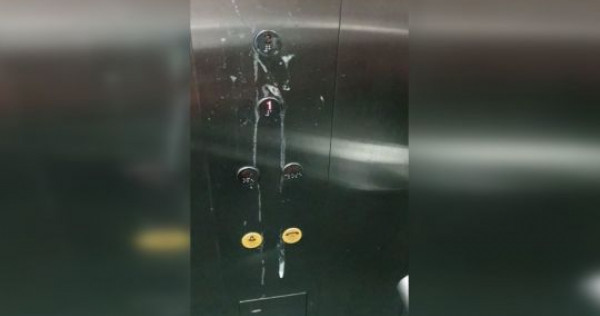
SINGAPORE – Three male teenagers are being investigated by the police for spitting on the lift buttons in a lift at Rumbia LRT station.

The incident, which came to light on Thursday (Feb 20) after SBS Transit posted a photo on Facebook of the lift buttons covered in spittle, had sparked condemnation coming amid the coronavirus outbreak.

SBS Transit, the operator of the Sengkang LRT line, said it had lodged a police report over the “abhorrent act”.

On Saturday, the police said in a statement that it is investigating three 15-year-olds over the incident, for an offence of mischief.

The teenagers had been caught on police camera, and their identities were established on Friday through ground enquiries by officers from the Ang Mo Kio Police Division.

[ad_2]

Source link

Coronavirus spurs Singapore and Hong Kong Christians to see crisis as test of faith and unity

0

[ad_1]

As the novel coronavirus spreads in Asia, health authorities zeroing in on community infections have found a surprising commonality – many of the cases are springing from Christian churches.

In Singapore, a third of the 89 reported coronavirus infections are linked to two churches; in South Korea, more than 200 of the 556 cases are linked to one church. No infection clusters in Hong Kong churches have been identified.

Globally, Covid-19 has now spread to 25 countries, with more than 78,000 infections and 2,300 deaths worldwide.

The situation has left church leaders like Ian Toh pondering: What is the narrative of God in everything that has been happening?

[ad_2]

Source link

COVID-19: Some Johor Bahru eateries feel the pinch as fewer Singaporeans travel across the Causeway

0

JOHOR BAHRU: Food eateries in Johor Bahru that usually see many customers from across the causeway are reeling from a sharp decline in sales, amid fears over the COVID-19 outbreak.

Restaurants and outlets interviewed by CNA said that the steep drop in business has been evident since Chinese New Year, when Johor reported its first confirmed case of the virus.

Among the affected businesses is Hiap Joo Bakery & Biscuit Factory, known for its banana cakes. The bakery typically attracts a line of customers outside its doors near Jalan Dhoby.

READ: 100-year-old oven the secret to famous banana cake in JB bakery

Following the outbreak, sales has dipped by at least 50 per cent, said Mr Lim Toh Shin who runs the bakery’s operations.

Hiap Joo bakery

File photo for Hiap Joo Bakery at Johor Bahru. (Photo: Amir Yusof) 

“There is usually a long queue for our cakes at 11am every day, but these days, the line will only last for five minutes,” said Mr Lim.

“We now have excess cakes and are unable to sell all that we bake for the day,” he added.

“VIRTUAL GHOST TOWN” 

Mr Lim estimates that Singaporeans typically make up more than half of his total customer base, and the sharp decline recently can be attributed to fewer Singapore visitors.

“It’s clear because there are markedly fewer visitors on weekends, when most of our customers from Singapore usually come and buy,” he said.

READ: Wuhan virus: Johor steps up precautions as tourism sector braces for impact

Meanwhile along the same street, Mr Rahim Khan, operator of Salahuddin Bakery echoed similar sentiments.

Salahuddin Bakery sells freshly baked curry puffs and French loaves. Mr Khan said that business has slowed down by 40 to 50 per cent recently.

salahuddinbakery

Salahuddin bakery along Jalan Dhoby, (Photo: Amir Yusof) 

He attributed the fall in sales to people’s fear that they might catch the virus if they travel.

“I can understand the fear. Some of my regular customers from Singapore called and apologised that they are unable to come, but I understand. It would not be worth the journey if they become sick,” he added.

Both bakeries are located near Jalan Dhoby in downtown Johor Bahru. The area is well known for its hipster cafes, traditional Chinese restaurants and classic bakeries. It is a hotspot for Singaporean visitors.

But recently, the place has become a “virtual ghost town” said Mr Khan.

dobiwalkway

Although the pedestrian walkkway near Jalan Dhoby has been recently expanded, the foot traffic is low because of the spread of the coronavirus. (Photo: Amir Yusof) 

He added: “The virus is definitely to blame. But also, we are suffering now because there has been some construction work to widen pedestrian walkways. This makes it hard for our customers to park”.

There have been 22 cases of COVID-19 in Malaysia, with 17 people discharged so far. 

LESS CAUSEWAY CONGESTION

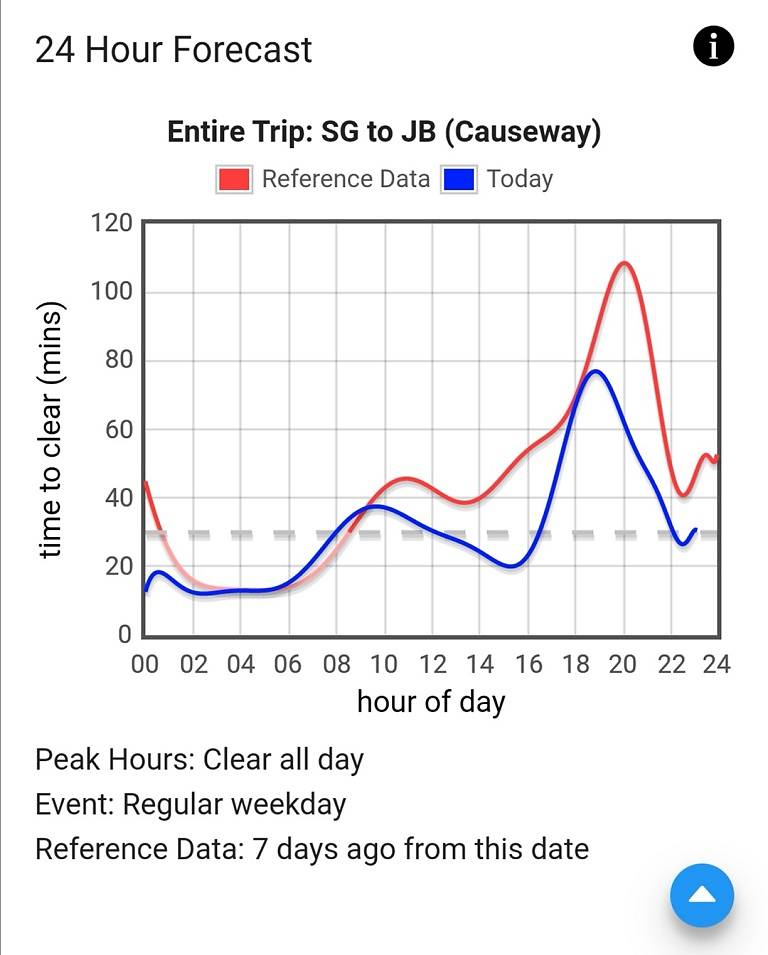
According to media reports, there has been less congestion at the Causeway over the past few weeks.

On Thursday (Feb 20) evening, the journey from Woodlands Checkpoint to Johor Bahru via the Causeway took around 20 mins, based on what CNA experienced. This peak hour commute usually takes around one to three hours.

Beat The Jam app

Screenshot from the “Beat the Jam!” app showing how travel duration across the Causeway from Singapore to Johor Bahru on Feb 20 is lower overall than the week before.  

The “Beat the Jam!” app, which charts travel duration at the Causeway and Second Link throughout the day, has noted a sharp decrease in movement from Singapore to Johor Bahru, even on weekends.

Mr Mohd Taufik Mohd Jamal, a Johorean who travels to and fro Singapore for work six times a week, told CNA that the lack of congestion at the Causeway has been a “pleasant surprise”.

“In my 10 years of travelling back and forth, I’ve never experienced weeks like this where the travel times are less than half an hour,” said the 45-year-old who works in construction.

READ: Coronavirus outbreak: Johor to suspend all state-organised events in February

Despite that, he expressed hope that things will go back to normal.

“Many businesses in Johor, including the F&B businesses, are suffering because of the virus. It’s not a healthy situation for Malaysians,” added Mr Mohd Taufik.

Over at Pandan Wholesale Market, a popular area for Singaporeans to do their groceries and have their meals, the footfall was very low.

The food courts at the market, popular for Indonesian, Thai and Pakistani cuisine, were empty during dinner time.

When a stray customer walked by, vendors would approach them and hurriedly hand out their menus. 

pandancourt

This food court near Pandan Wholesale Market has more vendors than customers. (Photo: Amir Yusof) 

Ms Dewi Rudyman, who operates an Indonesian stall, said revenue has dipped by 70 per cent since Chinese New Year.

“Pandan wholesale market is a bit narrow, and shoppers are forced to walk close to one another,” she said. 

“I heard from my customers claiming it’s not safe to visit now because you never know if there will be a spread of the (coronavirus). So far, there has been no case reported from here though.”

NO MOOD FOR SEAFOOD

Seafood restaurants in Johor Bahru are also reporting slow sales.

A chain of Chinese seafood restaurants at Kampung Telok Jawa, which is popular among Singaporeans, have all seen fewer customers over the last three weeks.

seafood

Seafood restaurants in Johor Bahru – Todak, YX, TKK and Tepi Pantai – are all impacted by the coronavirus. (Photo: Amir Yusof) 

A staff member from Todak Restaurant, who wanted to be known only as Mr Lim, told CNA that some regular customers from Singapore “have no mood” to eat a luxury seafood meal amid the spread of COVID-19.

“I think customers are scared of getting infected. Maybe the whole mood to sit down and enjoy is not the best right now,” he added.

The restaurant is popular for its fresh fish, butter squid and salted egg crab. Usually, customers have to wait in line before they are even seated. However, the outlet was only half full when CNA visited on Thursday evening.

todak

The seats at Todak restaurant facing the Johor Straits were empty. (Photo: Amir Yusof) 

Mr Wilson Tay, a Johorean customer at Todak Restaurant said he is enjoying the smaller crowd while it lasts.

“There’s no need to queue and it takes a shorter time to process orders. It’s not a bad time to visit,” he said.

BOOKMARK THIS: Our comprehensive coverage of the novel coronavirus and its developments

Download our app or subscribe to our Telegram channel for the latest updates on the coronavirus outbreak: https://cna.asia/telegram

Source link

For Nominated Members of Parliament, it’s not just about talking in Parliament

0

SINGAPORE: In the parliamentary sitting on Feb 3 and 4, Nominated Members of Parliament (NMP) Anthea Ong and Walter Theseira once again raised their views on a wide range of issues, from the local impact of COVID-19 to the e-scooter footpath ban that was implemented overnight in 2019. 

The social entrepreneur and labour economist have become mainstays on the podium since they were appointed officially on Sep 26, 2018 as part of the 14th batch of nine NMPs. 

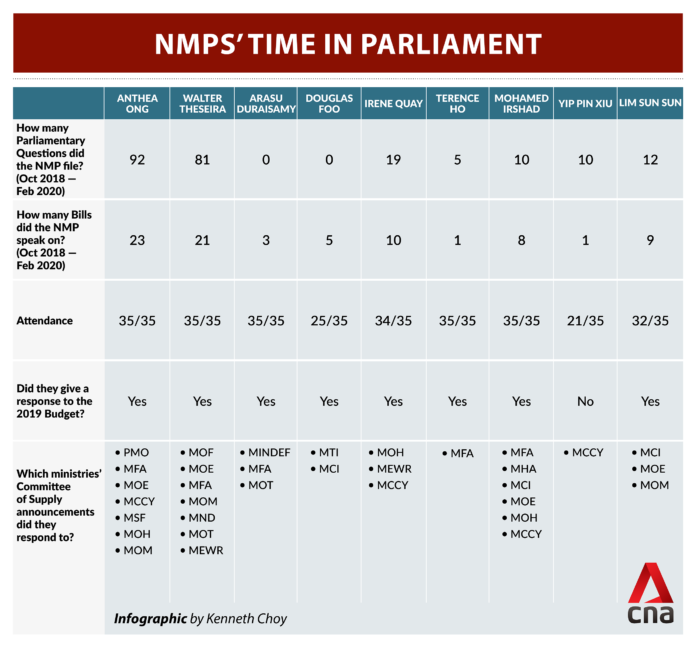
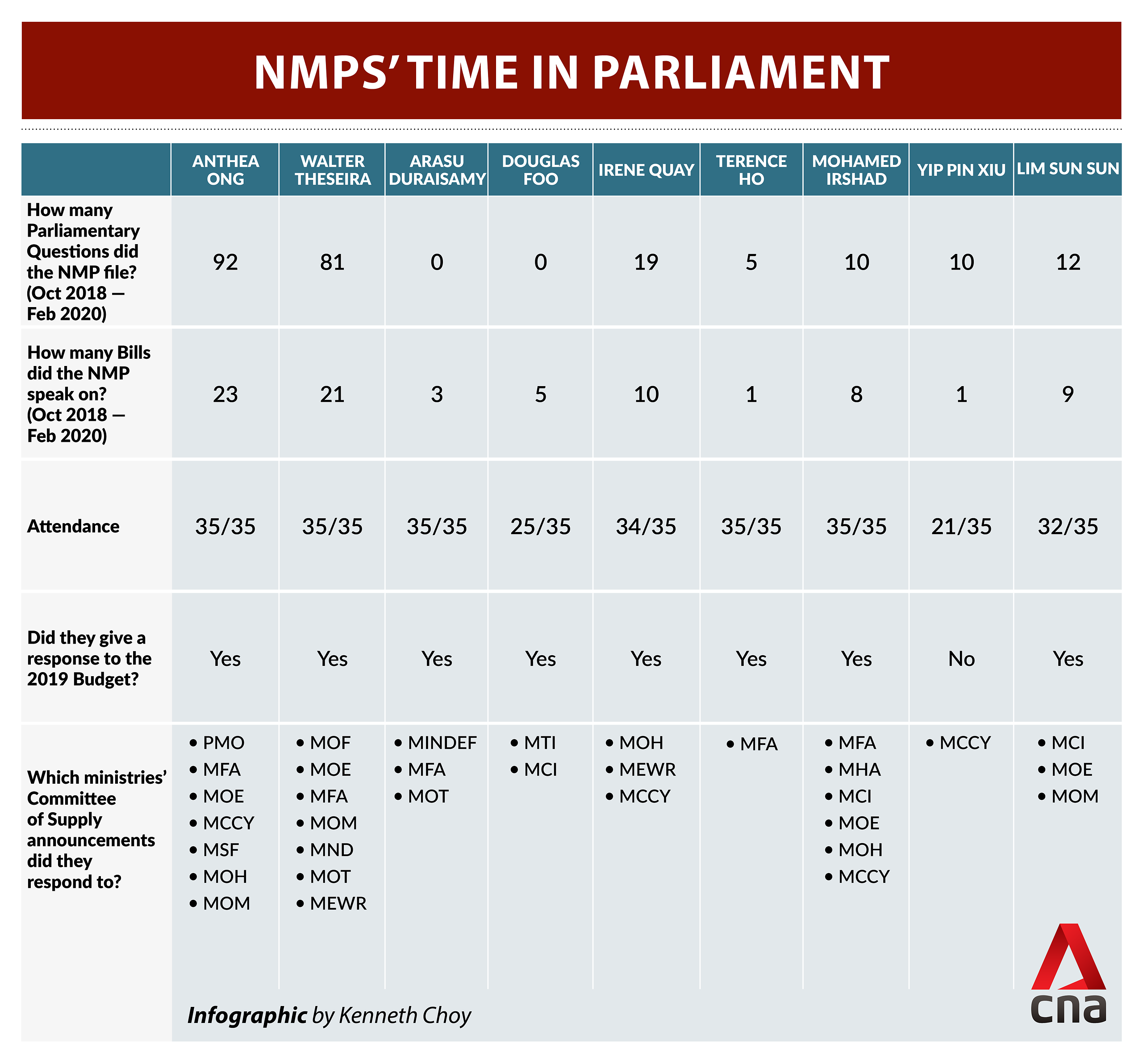
Among their peers, Ms Ong and Associate Professor Theseira have spoken the most number of times on bills and filed the most number of parliamentary questions (PQs).

They have responded to more than twice the number of bills compared to the others, and filed at least four times more the number of PQs than the rest. 

Here is a tally of the NMPs appearances and speeches in Parliament since October 2018. 

(rp) NMP tally of how much they spoke in parliament

A tally of the number of times the Nominated Members of Parliament (NMPs) spoke in Parliament and their attendance since their first sitting in October 2018. This excludes other ways the NMPs can participate, such as by asking supplementary questions or speaking on motions and ministerial statements. 

SERVING IS A PRIVILEGE, SAY NMPS 

“I don’t know if I know how to be half-hearted or lukewarm with things I’ve decided to say yes to,” Ms Ong said.

She has spoken up at every sitting and filed the most number of PQs – 92 – among the NMPs.

She said she owes it to the realisation that the “hallowed chambers” where laws are made and announced affects even the most ordinary person’s life. 

Similarly, when asked whether he makes it a point to speak up often, Assoc Prof Theseira was quick to note that parliamentary time “is actually very expensive” and that he only speaks when he thinks he can contribute. 

“But I’ve also found that because of the nature of my work, as well as the nature of people who have connected to me because of this position, there just happened to be quite a lot of bills that I could speak on,” the labour economist, who has spoken on 21 bills – the second-most among the NMPs – said. 

His research areas of applied microeconomics, as well as public and labour economics are often relevant to issues that come up in Parliament, he added. 

“I don’t feel as if I have to open my mouth every single time, but I also have found that many of the bills (that come up) are issues that either I feel strongly about or they are issues which I feel  I could contribute something on, and that’s why I’ve spoken on them.” 

Dr Felix Tan, associate lecturer at the Singapore Institute of Management Global Education (SIM GE), said “meaningful contributions” have come from Assoc Prof Theseira and Ms Ong, noting that they have both spoken on issues such as youth advocacy and the standard of a more liberal education in Singapore. 

“Although there has been little change in the government response and attitude towards any meaningful changes in that aspects, it has definitely brought something valuable to the table that may, or may not, be discussed in the future,” said Dr Tan. 

However, he also questioned how an NMP’s performance is measured since they are not elected representatives. 

“The views of these NMPs have been non-partisan and have rarely crossed the line when it comes to some more heated debates that have engulfed parliamentary sessions,” said Dr Tan. 

“However, there are also some of the NMPs that have been rather quiet and have not always necessarily contributed much to the overall discussions on policy matters and one wonders what difference has their presence made in tweaking policies and/or providing for an alternative voice in Parliament.” 

BEING AN NMP IS NOT JUST ABOUT TALKING IN PARLIAMENT

Mohamed Irshad, a NMP representing the religious and youth communities, has attended every sitting, but there are months when he does not speak in Parliament, such as in April and September 2019. It should not be taken as a sign that he treats his role lightly, he said. 

“You can’t just speak on a bill just because it’s being debated,” the founder of inter-faith group Roses of Peace said. “You have to see what’s the value and the contribution you are bringing to the conversation (based on) my pet areas.”

Mr Irshad gave some examples of bills he felt he added value to during the debates. Between October 2018 and February 2020, he spoke on eight of them.

The Gas Act, which was passed during his first month in Parliament, is one. He felt that he needed to ask some questions on it as the topic is very much linked to Singapore’s sovereignty, given that the country imports gas from Malaysia and Indonesia.

“I felt as a young Singaporean, that this is an issue that should be raised, because it directly impacts the survival of Singapore, which is going to impact the future generations,” he said. 

As for filing parliamentary questions, he explained that unless there is going to be a “tangible output”, he would refrain from filing questions for which parliamentarians can get information directly from a ministry outside of Parliament. He can always raise supplementary questions or clarify with a minister on a particular issue separately.

In his case, a “tangible output” would mean highlighting issues that have a national impact, is of public interest or surfaces people’s concerns. For instance, representatives from religious or youth communities have in the past came to him with the hopes of getting a problem heard or fixed.

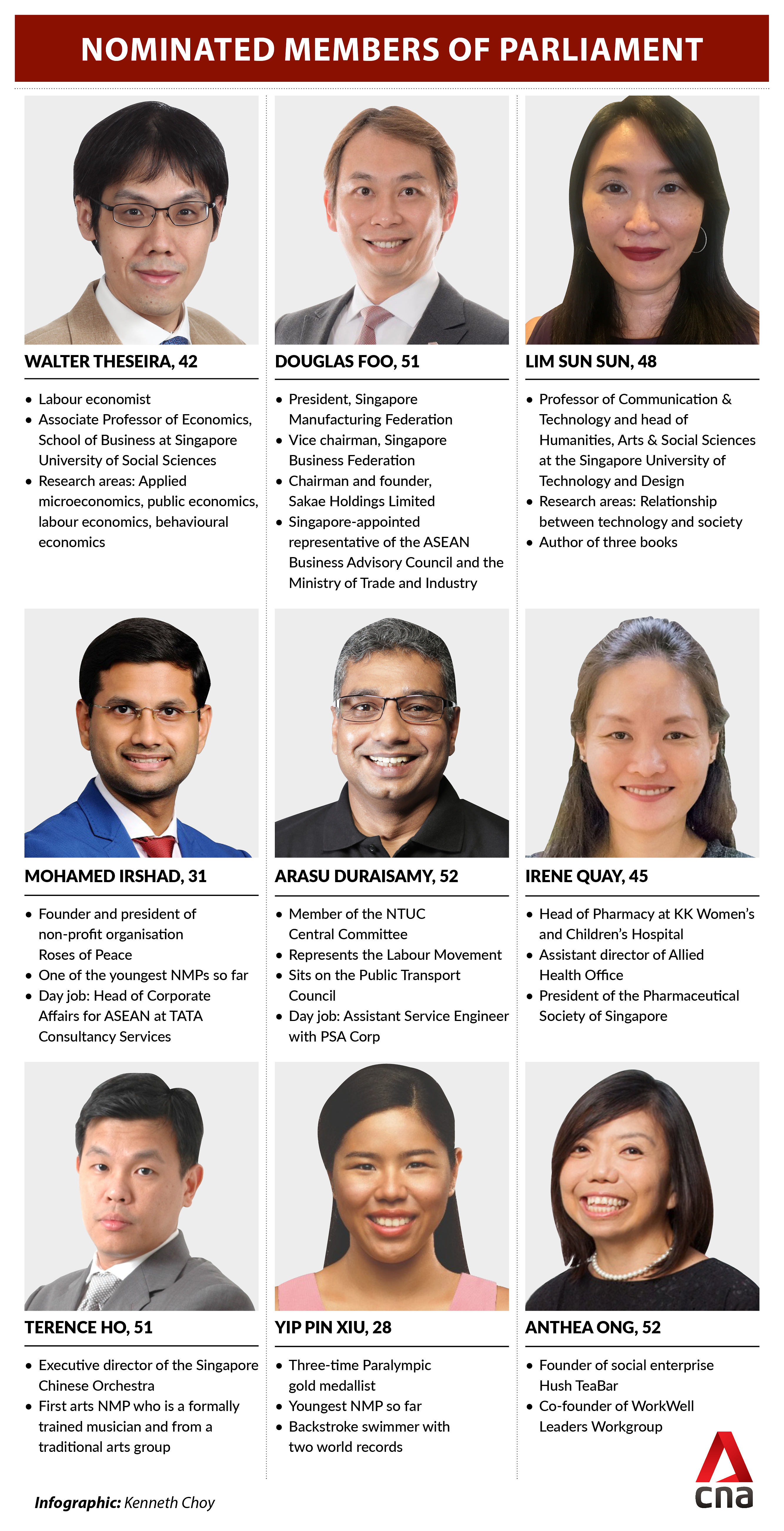
(rp) Who are the NMPs?

The 14th batch of NMPs started their run since October 2018. 

His appointment extends beyond parliamentary sittings, he said. The NMP post has given him a platform to interact with politicians candidly and tell them the problems on the ground, while explaining to members of the public, including religious leaders, what the challenges are when it comes to crafting policy.

National para-swimmer Yip Pin Xiu and executive director of the Singapore Chinese Orchestra Terence Ho agreed. 

The paralympian believes she has championed para-sport in Parliament as an NMP, both by raising issues from the circle in parliament, and through her efforts to connect sport organisations – particularly the Singapore Disability Sports Council and specific sport associations – to develop a more inclusive sports scene. 

“It gives me legitimacy to do so,” she said.

Mr Ho stressed that the NMPs are not measured by the number of speeches or parliamentary questions they submit. 

“I think it’s very much outcome-driven. I like to work with an end-to-end model, you also need to engage the agency, you also need to engage the ministry,” he added. 

“If you’re going to speak up on something which is not relevant or in the pipeline or agenda, I feel that that’s wasting your own research time and Parliament time.” 

READ: Paralympian Yip Pin Xiu, Sakae Holdings chairman Douglas Foo among 9 new proposed NMPs

READ: Plans for Parliament: NMP candidates share motivations to be in politics

Mr Douglas Foo, founder and CEO of Sakae Holdings and vice chairman of the Singapore Business Federation, noted that aside from speaking up in Parliament, NMPs also take on other roles in committees and workgroups behind the scenes. 

“If you realise, I don’t pick a lot of bills to speak on because I think there’s already not a lot of time (in Parliament). And so (only when) I really have something that I want to put on the table, then I will choose that particular bill to talk about,” he said. 

Mr Foo was part of the tripartite workgroup working up to the recommendations for low-wage workers announced late last year. He shared that he had taken part in about 15 months of discussions with the enterprises, workforce, unions and government agencies on the matter. 

“I also serve in quite many areas in terms of the various ministries, so sometimes you don’t have to be necessarily able to put it through Parliament, but just actually hearing some of the views and thoughts that other subcommittees and working groups (have), actually you could put those essential points across.” 

PET CAUSES

The NMPs are chosen to represent at least one of seven ‘functional groups’, or areas of society: business and industry, the professions, the labour movement, social and community organisations, media, arts and sports, tertiary education institutions, and civil society.

Notably, Ms Ong, who said that she advocates for civil society, often brings up mental health and climate change issues. This is no accident, she said, noting that she has brought up either issue in every bill she has spoken on. 

“Mental health and climate change are so invisible they are often pushed to the ‘important but not urgent quadrant,” she explained. 

And for mental health, there is a second reason: “Bringing it up at this level of society would be a big, big way of destigmatising mental health (conditions).”

“Shame goes away, things get done, policies are being developed, designed, changed. And budget is being allocated to this.” 

Being persistent does bear fruit, Ms Ong attested. She said she has been engaging the Ministry of Health on mental health issues for the upcoming Budget.

And in April last year, education minister Ong Ye Kung asked if she would like to meet privately and discuss mental health education, which has led to ongoing dialogues with the ministry’s senior management.

READ: Public service committed to provide ‘inclusive and mental health-friendly’ workplace: Chan Chun Sing

As for Assoc Prof Theseira, aside from education and economics, he also often files parliamentary questions about LGBTQ issues. 

Stressing that he does not have pet causes, he explained that he often speaks up on the topic because he felt it was important that LGBTQ individuals and issues are represented in Parliament. 

“In terms of the numbers we don’t really know how many (LGBTQ people there are), but I wouldn’t be surprised if (the number) was equivalent to some of our minority groups,” he said, adding that he receives hundreds of emails from members of the public each time he speaks on the topic. 

“And the fact that in our political system, nobody who’s elected would feel comfortable bringing up those issues, I think it’s a problem for representation.”

As for fellow academic and educator Professor Lim Sun Sun who heads the Humanities, Arts and Social Sciences school at the Singapore University of Technology and Design, being an NMP has allowed her to speak on issues she champions, like media literacy, the rights of children, and the protection of individuals on digital platforms. 

“When I entered the position I felt that it would mean basically having a larger classroom and a very interesting position from which to share academic insights in a way that was productive and constructive to policy-making,” said Prof Lim, who spoke on the Protection from Harassment Act. 

“It’s been interesting because (when) you say these things in Parliament, versus if you just write it in a journal article, the impact is definitely greater and it also opens the doors to deeper conversations with policymakers as well as municipal leaders.” 

VALUE IN NMP SYSTEM

The NMP scheme came into effect in September 1990 to introduce more diverse and non-partisan views in Parliament.

In July 1997, the maximum number of NMPs was increased from six to nine, and their term raised from two years to two-and-a-half years in August 2002. 

Despite the NMPs’ confidence in their work in Parliament, the NMP system has had its fair share of criticism. 

For one, the NMPs are chosen by an eight-member special select committee, in which the latest batch – like the previous – was made up of seven members from the ruling People’s Action Party and only one from the opposition Worker’s Party.

Political observers have said in the past that the discussion and votes among the committee members should be recorded and made public, so that people can examine how and why the NMPs were selected.  

The concept of having NMPs represent the functional groups has led to the political analysts questioning whether the system confines the NMPs to speaking only on behalf of the interest group that nominated them, while keeping silent on issues outside their domain. 

Another view, said SIM GE’s Dr Tan, is that the NMPs cannot speak on behalf of Singaporeans because they do not represent any constituencies.

But he noted multiple occasions where NMPs, both past and present, have raised “important issues facing society that needed to be addressed”. 

For example, Ms Eunice Olsen, who was an NMP between 2004 to 2009, made contributions to women’s issues and pushed for a more open discussion on a topic that mattered to an important segment of society, added Dr Tan. 

“By and large, the NMP scheme has been useful and has brought the debates to a higher level of substance. It has a neutrality that is sometimes needed in the midst of a very touchy and controversial policy discussion,” he said. 

And while what NMPs present in parliament may not translate to an immediate change in policy, said Mr Irshad, their speeches and questions can be used to “set off conversations…have policymakers look into the issues (and be used as a) point of reference for future parliamentarians.”

“I don’t have lofty delusions around the impact that we have. Ultimately a lot of people don’t know who the NMPs are, they may not even know such a scheme exists,” said Prof Lim 

“But if in my own small way, I can use this provision to raise awareness on some issues, then I will make the most of it.”

Source link

Commentary: Electric vehicles will take over Singapore. But here’s what must happen first

0

SINGAPORE: It’s official.

Singapore has announced ambitious targets for 2040 when we plan to phase out internal combustion engine vehicles, paving the way for greater adoption of electric vehicles (EVs) in the intervening years.

Incentives to prod more drivers towards vehicles operating on cleaner energy have been announced, including extension of the Vehicular Emissions Scheme (VES) to light commercial vehicles, rebates for early adoption and the revision of road taxes for qualifying vehicles.

READ: Incentives likely to encourage electric vehicle adoption in Singapore, but questions remain, say analysts

LISTEN: Singapore Budget 2020: A report card, a Heart of the Matter podcast

FILL IN THE MISSING PIECES

But the plan for these ambitious goals still has some missing pieces. 

Deloitte has estimated that the global EV market will reach a tipping point by 2022 when the cost of ownership of an electric vehicle will be on par with its internal combustion engine vehicle cousin, but result in a supply gap of almost 14 million EVs in 2030 which could thwart Singapore’s efforts. 

It is also unclear what the zero combustible engine vehicle target will mean for hybrids, plug-in EVs and motorcycles, though the move to review the road tax for EVs and some hybrids suggest details will be forthcoming.

For now, Budget 2020 has done enough to get us moving forward towards electrification of private and public road transport sector.

Crucially, it has addressed two key consumer adoption concerns identified by Deloitte’s 2018 Global Automotive Consumer Survey that governments should do something about: A dense national charging infrastructure and the cost premium of owning an EV.

Driving range and time to charge, which are primarily a battery technology issue, make up the other top two concerns, currently the pre-occupation of battery suppliers and research institutions all over the world including Singapore.

FILE PHOTO: A car is plugged in at a charging point for electric vehicles in London

FILE PHOTO: A car is plugged in at a charging point for electric vehicles in London, Britain, March 6, 2018. REUTERS/Simon Dawson

Deputy Prime Minister and Finance Minister Heng Swee Keat has set forth an audacious goal of creating 28,000 charging points, a significant infrastructure surge from the 1,600. Even over ten years, this is a demanding project timeline.

But the Government cannot do this alone and must work with private sector incumbents like SP Group, BlueSG, Shell-Greenlots, Red Dot Power, in partnership with carpark owners and operators including Wilson, Metro and building owners.

The key now is to distribute these points to ensure high utilisation rates to realise returns on investments. We should also start thinking how we can couple charging infrastructure to solar and battery systems, to reduce the dependency on gas-fuelled electrons.

READ:  Commentary: Why Singapore is ripe for an electric vehicle revolution

READ: Commentary: Where are all the electric vehicle charging points?

BENCHMARKING AGAINST THE WORLD’S BELLWETHER IN ELECTRIC VEHICLES

How do Singapore’s goals and plans match up? A look at Norway, the bellwether state for EVs, offer perspective.

Norway, the world’s largest per capita market in electric vehicles, has more than 1,500 public charging points per million population, offers some benchmarks. With over 8,500 charging points, the EV share of sales is around 30 per cent, covering 2,100 sq km of urban Norway.

In comparison, Singapore’s target is about 10 times more charging point density than Norway’s, suggesting range anxiety should be little of a concern.

Norway owes its success to both the carrot and the stick. It offered extremely generous incentives to EV buyers, and financially punished people who continue to use gas or diesel cars.

FILE PHOTO: Electric cars are seen at Tesla charging station in Gulsvik

FILE PHOTO: Electric cars are seen at Tesla charging station in Gulsvik, Norway March 17, 2019. Picture taken March 17, 2019. REUTERS/Terje Solsvik/File Photo

Norway had put in place generous tax regimes that reduced the cost premium of EVs, necessary at an earlier time when electric vehicles costs were massive and choices of models were limited, compared to today.

With an abundance of clean-and-green electrons from its hydropower, its capital Oslo has even gone one step further with free charging and special vehicle access to certain roads and parking. But such moves may not be sustainable, when market and technology development forces should drive further adoption.

Furthermore, Oslo is also considering a move towards becoming car-free city which means city access and other EV related benefits could be curtailed in its effort to realise a cleaner, greener and more liveable city. Similar forces in Singapore, which have called for the pedestrianisation of Orchard Road and more, may be at play.

READ: Commentary: Car-making just doesn’t quite gel with future trends

READ: Commentary: The year e-scooters were kicked off footpaths

FOCUS ON TACKLING CONGESTION TOO

In the larger sustainability fight, while Singapore fixes her eyes on EV adoption, we must press on with tackling the scourge of traffic congestion, which continues to exact a large carbon toll. 

Therefore, enhancing and electrifying the public transport system to nudge more consumers to use public transport will have a significant impact on lowering the dependency on private transport and our overall carbon and emission footprint.

EV sharing schemes including BlueSG, has further contributed to these two objectives and could be encouraged.

Finally, where private or commercial vehicle ownership is desired or required, Singapore has put in place pragmatic policies to contain their numbers, including maintaining a high Certificate of Entitlement (COE), a target of zero vehicular growth, and the VES, together with new early-adoption incentives to nudge consumers to make cleaner and greener decisions.

OTHER WAYS TO QUICKEN EV ADOPTION

Motorshow 3

Demonstration of the Hyundai electric car by being charged by its ’emergency car’. (Photo: Christy Yip)

Having said that, to deliver a positive impact to the environment as its preservation is an existential issue for Singapore, the speed and scale of EV penetration is critically important.

While the schemes announced thus far addresses new purchases, we should also consider encouraging early retirement of petrol vehicles to facilitate switching to EVs.

Achieving a faster speed and scale of adoption could also involve creating a separate COE category just for “green” vehicles recognising the future may also see fuel cells, hydrogen and biofuels as potential green solutions.

READ: Commentary: That low-carbon future for Singapore isn’t so far-fetched

This category could also have extendable five-year COEs to facilitate the adoption of newer green technology.

Commercial fleets should also be targetted more fiercely as swapping out a fleet of taxis or delivery vans will create a quick and huge impact on lowering carbon emissions.

This also means we have to up-skill technical personnel to ensure the reliability of the future electrified transport ecosystem.  

GOOD TO HAVE BIG AMBITIONS

Budget 2020 announcements around the electric vehicles is a courageous milestone because it makes the existential crisis arising from climate change real. We are putting money where our mouth is in more areas of sustainability.

The S$5 billion Coastal and Flood Protection Fund committed to adapt to rising sea levels is just a start of putting aside the S$100 billion mentioned in Prime Minister Lee’s National Day Rally in 2019.

Aerial view of polder site at Pulau Tekong

Aerial view of polder site at Pulau Tekong. (Photo: Housing & Development Board)

To meet out COP21 commitments and our Nationally Declared Contribution targets, Singapore will also need to fund a range of initiatives across the board from buildings to transport to consumer behaviour.

Budget 2020 does just that and with the right motivation – in preserving environmental sustainability and citizens’ liveability.

Having concrete numbers to give our climate action words tangible targets has signalled seriousness and will move the needle, knowing that the Government will track these targets, with detailed plans executed to ensure KPIs are met on time.

READ:  Commentary: Climate action is our generation’s 1965

READ: Commentary: The revival of the digital economy – building citizen confidence as Smart Nation momentum picks up

We must also recognise that while more than 20 cities around the world has already echoed bold steps towards electrification of their private and public transport system, this announcement may just be one of many at the global stage.

Yet, it is important for us who live on this island city-state with unique constraints, exacerbated by the few levers we have to pull to contribute towards the global fight against climate change.

Innovation around the charging infrastructure and its intelligent distribution, new business and financing models and an enhanced consumer experience will be key enablers for this successful transition.

Dr Sanjay C Kuttan is Chairman at the Sustainable Infrastructure Committee at Sustainable Energy Association of Singapore.

Source link