Only at seven years of age, Simone Lim has not only emerged as champion in a recent international Pokemon tournament — the Singaporean has also won the hearts of audiences and netizens who watched the contest unfold.
The 2020 Pokemon Oceania International Championships were held in Melbourne, Australia over the weekend, where Simone took part in her first major tournament.
In the Junior division of the grand finals of Pokemon Sword and Shield, it was a showdown between the young Singaporean and Justin Miranda-Radbord, a boy twice her age who’s a tournament veteran with multiple wins under his belt.
The odds weren’t in her favour — Simone had been whittled down to her last Pokemon (a Tyranitar) while Justin still had his Rhypherior and Dusclops. The girl, however, correctly predicted that Justin would use a move called Protect on Rhypherior, leaving her room to decimate Dusclops with a super-effective attack.
Simone cleaned up quickly after commanding her Tyranitar to use its Superpower attack on Justin’s last Pokemon. The young girl emerged as the champion, scoring US$5,000 (S$6,985) and bragging rights.
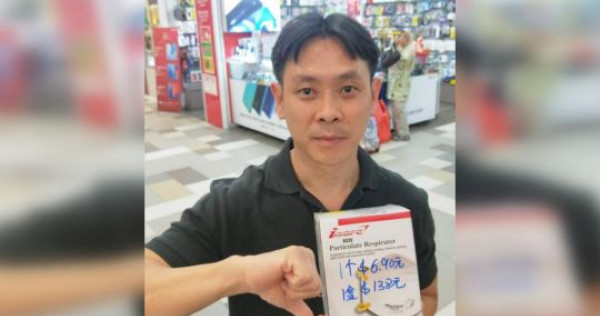
SINGAPORE – A retailer that came under scrutiny for profiteering from the sale of face masks has lowered the price of the masks and apologised, the Ministry of Trade and Industry (MTI) said on Tuesday (Feb 25).
The retailer 3 Stars has also produced records and invoices showing significant increases in the cost price of face masks from its overseas suppliers, the MTI said, adding that it will not be taking further action against the company for now.
“MTI will continue to monitor 3 Stars’ pricing practices and reserves the right to take further action under the Price Control Act if warranted,” the ministry said.
It did not say in its statement how much the retailer had lowered the price of its masks by.
The pricing had prompted public complaints.
MP Louis Ng on Feb 8 posted on Facebook a photo of a box of masks sold by 3 Stars going for $138 in his Nee Soon constituency.
“Not all angels have wings, some wear scrubs,” so goes an anonymous internet quote in praise of medical staff.
But besides doctors and nurses, there are others without uniform who work quietly in the background (or foreground, in this case) to fight against the coronavirus during these tumultuous times.
Sandra Aw is the Head of Visitor Services at Singapore General Hospital (SGH).
Responding to the stigma faced by healthcare workers in recent weeks, Aw, who’s in her late 20s, said: “Personally, I haven’t felt stigmatised, because I wear civilian [clothes], so nobody knows I work in a healthcare setting.”
But there are other challenges that Aw faces on a daily basis at the hospital, such as maintaining crowd control and ensuring that the well-being of both patients and the general public are protected through the screening process. All these while making sure her team is assured that the hospital has taken measures to safeguard their health.
SINGAPORE: The Committee of Supply debates on the Budget will begin when Parliament sits on Wednesday (Feb 26).
The Supply Bill and Supplementary Supply (FY2019) Bill will be introduced for the first time during tomorrow’s sitting.
The Committee of Supply will explore each ministry’s plans for the financial year ahead in detail. After voting on all ministries’ estimates, it will report its decision to Parliament, which will debate and vote on the Supply Bill.
The Bill will then be sent to the President for assent. If given, the Bill is then enacted into a law called the Supply Act, which controls the Government’s spending in the coming financial year.
Members of Parliament have also submitted more than a dozen questions on several issues.
On the ongoing COVID-19 outbreak, NMPs Walter Theseira and Mohamed Irshad will ask about the Government’s efforts to ensure that control measures for work pass holders are implemented fairly, as well as how educators and lecturers in Institutes of Higher Learning are being taught to handle the outbreak.
Mr Theseira will also ask what the Ministry of Manpower has done to ensure that work pass holders that violated their mandatory Leave of Absence or other quarantine orders did not do so under duress or misinformation from their employers.
The virus, which originated in Wuhan, China, has killed nearly 2,700 and infected more than 80,000 worldwide.
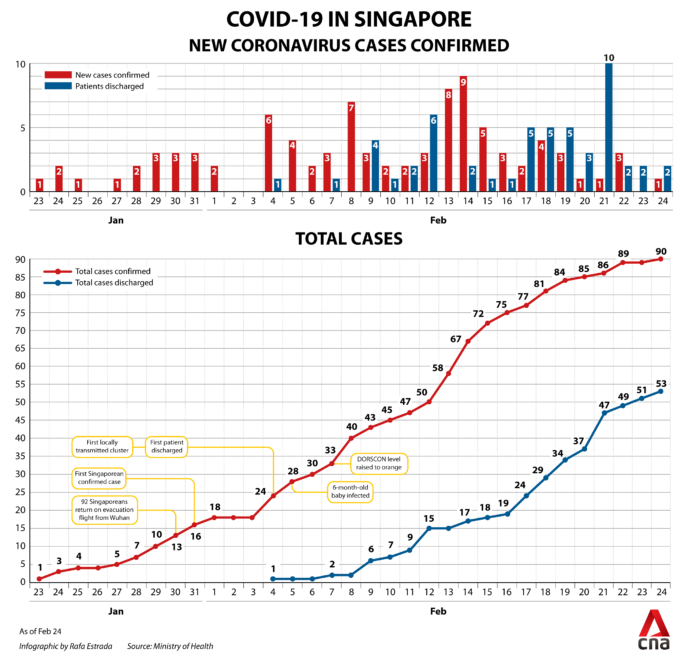
Singapore has reported 91 confirmed cases of COVID-19, about half of whom have recovered and been discharged from hospital.
Singapore has also set aside S$800 million in Budget 2020 to support frontline agencies in their efforts to contain the COVID-19 outbreak, with the bulk allocated to the Ministry of Health.
In Parliament on Wednesday, MP Louis Ng will ask for an update on the Platinium Dogs Club case. The former pet boarding facility is facing investigations into alleged animal abuse offences after its operator was arrested in January 2019.
The Nee Soon MP will also ask the Government to consider increasing the number of lactation rooms required in office buildings, as well as if the Government will consider increasing the period during which paid paternity leave may be consumed, from within 12 months of childbirth to within 24 months.
Dr Intan Azura Mokhtar will ask about the number of diabetes cases diagnosed in Singapore in the last five years, as well as when measures such as mandatory front-of-pack labels and advertising prohibitions to reduce Singaporeans’ sugar intake from sugar-sweetened beverages will be implemented.
For all the hard work in these trying times, healthcare workers definitely deserve all the accolades and appreciation they can get.
Thankfully, a growing list of companies have stepped up to show their support for those at the frontline in the fight against the spread of the coronavirus.
Here are some treats that have been launched to reward our healthcare heroes for their sacrifices and hopefully brighten up their day!
Check back regularly for more updates.
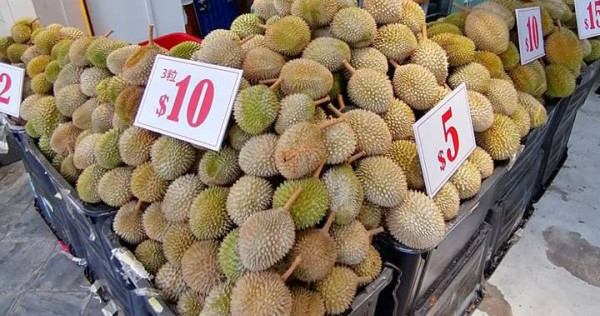
FREE DURIANS
Hello to ALL healthcare workers in Singapore!
Thank you standing at the frontline to fight against the COVID-19 virus!…
MyRepublic has just announced that it will be the exclusive telco carrier for Sony’s Xperia 5 smartphone.
As a recap, the Xperia 5 was announced last year at IFA 2019 and its’ essentially a cheaper and more compact version of the flagship Xperia 1.
It has a 6.1-inch OLED display with a 21:9 aspect ratio and a resolution of 2,520 x 1,080 pixels, and it’s powered by the Snapdragon 855 processor with 6GB of RAM and 128GB of internal storage.
As for photography, you have a triple-camera setup consisting of a wide angle, a telephoto, and an ultra-wide.
All three shoot at 12MP.
You can pay for the phones either in one lump sum of $1,099 or in credit card monthly instalments of $91.58.
SINGAPORE: With his shaggy grey beard, rose-coloured robe and a prayer cap that extends his tall frame, shopkeeper Tariqul Islam is an imposing figure on the stall-lined street that serves up home comforts to Singapore’s Bangladeshi community.
He stands out even more now many of his customers have left the country or been told to avoid crowds after a coronavirus outbreak infected some Bangladeshi construction workers, thinning out the normally bustling thoroughfare.
Unease over the virus has gripped groups of migrant workers across Asia – who often live in crowded, cramped conditions – and their families thousands of miles away who want them to return home.
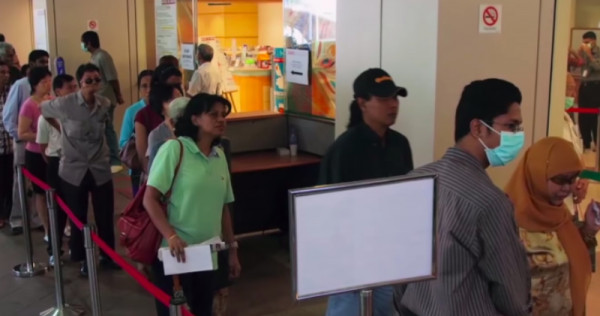
Migrant workers mostly from Bangladesh wear masks as they enjoy a day off on a weekend in Singapore February 23, 2020. Picture taken Feb 23, 2020. (Photo: Reuters/Feline Lim)
“A lot of people have gone back,” said Islam, 52, as a few customers wearing masks perused the fruit and vegetables spread outside his shop on Lembu Road in Singapore’s Little India neighbourhood.
“When people think about life or family, they don’t care about money.”
The street, blocked off to traffic and patrolled by security staff on weekends, was significantly quieter than usual when Reuters visited on Sunday.
Singapore has reported 90 coronavirus cases, five involving Bangladeshis who worked at the same construction site. One is in a “very critical condition,” Bangladesh’s foreign minister said.
A Bangladeshi in the United Arab Emirates has also been infected, as have Filipino and Indonesian domestic workers in Singapore and Hong Kong.
In Singapore, construction workers from South Asia often live in 12-bed dormitories with shared bathrooms. Some of the high-profile virus clusters during the outbreak have involved people living close together, such as in prisons or aboard cruise ships.
Migrant workers mostly from Bangladesh on their day off in Singapore on Feb 23, 2020. (Photo: Reuters/Feline Lim)
Kakon Miyan, a 24-year-old construction worker in Singapore, said a lot of his friends had returned to Bangladesh, where there have been no reported cases of the virus, and will only come back when the city-state appears clear.
“We’re staying for now, but maybe if the situation worsens then we will go back too,” he said, speaking in Bengali alongside a few colleagues.
Bangladesh’s high commission in Singapore said it has been trying to stop people from leaving by contacting them online and visiting dormitories to hand out masks, hand sanitiser and leaflets about the virus printed in their native language.
“We are becoming a bit proactive to stop them leaving the country… to assure them that this is not something we should be excessively or illogically fearful about,” High Commissioner Mustafizur Rahman told Reuters.
The country has no restrictions on travel to or from Singapore.
There are around 150,000 Bangladeshis in the city-state, according to the high commission’s website, making them one of its largest immigrant populations.
HIGH STAKES
Bangladeshis can become heavily indebted when they set off to find work Singapore, with some forced to pay agency fees equivalent to many months of their basic wages in Singapore.
That raises the stakes for those considering leaving.
Majidul Haq, 25, a construction worker who came back to Singapore on Monday after a one-month break in Bangladesh, said that his parents didn’t want him to return but that he felt compelled because of his family’s financial needs.
Migrant workers from Bangladesh wear masks as they enjoy a day off on a weekend in Singapore on Feb 23, 2020. (Photo: Reuters/Feline Lim)
“My income is crucial,” said Haq, whose father, a farmer, does not earn enough to support his six-member family, several of whom are still in school.
Other workers said Singapore’s high-quality healthcare facilities and preventative measures, such as taking employees’ temperatures twice daily and isolating suspected cases, gave them confidence to stay.
Migrant workers from Bangladesh shop for sunglasses in Singapore on Feb 23, 2020. (Photo: Reuters/Feline Lim)
Rauf Naushard, who runs a travel agency just off Lembu Road that mainly serves Bangladeshi workers, said bookings have risen more than 50 per cent over the last 14 days, with some customers requesting flights to Bangladesh’s capital, Dhaka, with just a day’s notice.
“It never happened before. They had travel plans before. Nowadays … they just want to leave,” said Naushard, adding that many direct flights to Dhaka are full, so he must route trips through Bangkok or Kuala Lumpur.
Can you find meals for a dollar or less in this concrete jungle?
New York-based travel vlogger Bobby Briskey found himself hard-pressed to find the ultimate cheap eats while in Singapore.
And by cheap, we mean $1 kind of cheap.
The YouTuber regularly travels the globe, taking up little challenges along the way. His latest adventure brought him to our sunny island where he got to review what he considered the world’s best vending machines and the world’s best airport.
But of course, he’s not Briskey if he doesn’t attempt one of his regular challenges — finding food for under a dollar.
In his video posted last Friday (Feb 21), Briskey began his journey at Maxwell Food Centre.
When the severe acute respiratory syndrome (Sars) hit Singapore in 2003, health care professionals were caught off guard and left scrambling to deal with the epidemic.
A shift in priorities in the city state’s health care system over the past two decades could explain why health professionals were unprepared for the outbreak and the sweeping impact it had, said health economist Phua Kai Hong.
“In our public health schools, we saw a trend of a decline in infectious diseases. Most of our doctors and training then shifted towards chronic diseases and ageing,” said Phua, who was an associate professor of public health administration at the National University of Singapore during the Sars outbreak.
“But new infectious diseases came back with a vengeance and Sars was a good example.”
More than 230 people in Singapore were infected with Sars, which killed 33 patients over three months. Since then, the country has upped its game and taken a more proactive approach when infectious diseases emerge, Phua said.





.jpg "20202502_youtube-1.jpg")