The claw machine is meant to be a simple game: Players inserted a token for a chance to grab their desired prize. If they did not succeed, they fed the machine more coins for another try.
Stomp contributor Anonymous was passing by Block 183 Toa Payoh Central on Tuesday (Feb 25) when he noticed a group of women doing just that at a claw machine located outside a beauty salon.
Anonymous, who witnessed the incident at around 6.40pm, identified the women as staff from the salon.
In a video that Anonymous submitted to Stomp, four women can be seen surrounding the claw machine. One of them then uses both her arms to lift the machine.
Yang Club is the latest swanky joint to grace the Clarke Quay nightlife district, having taken over the former grounds of VLV late last year.
We’re sure that the club will be around for a long time — especially after a partygoer blessed the premises with a framed portrait of himself in his Singapore Armed Forces (SAF) uniform.
SINGAPORE: The COVID-19 outbreak has us all on edge, seeing how badly it is affecting China and not knowing whether or when we’ll see similar scenes here.
Singapore’s response has been singled out for praise by WHO chief Dr Tedros Adhanom and Harvard don Professor Marc Lipsitch, but can we keep it up if the outbreak gets worse?
Even if Singapore is successful at containing the current wave of infections, developments in the rest of the world may seed subsequent waves of outbreak despite our best efforts at preventing further importations.
The rising numbers of infections in Italy, Iran, South Korea and Japan over the past week suggest this scenario cannot be ruled out.
It would be rash to say what we think will happen given the uncertainties involved. But it is only prudent for governments to consider scenarios for how the outbreak and its control may affect our lives in the months ahead, based on our studies of past outbreaks, and see if current plans can sufficiently tackle these challenges.
People are seen wearing protective face masks at Orchard Road, Singapore on Jan 28. (Photo: Gaya Chandramohan)
SCENARIO 1: THE OUTBREAK BECOMES WORSE BUT CAN BE CONTAINED
The first scenario is one where countries manage to bring the virus under control, despite numbers growing worldwide.
Through the unprecedented social distancing imposed by their government, the outbreak in China is brought under control within a few months.
Other countries manage to stop COVID-19 outbreaks from becoming established and the nature of transmission of the virus has led to its successful containment.
In Singapore, there is a sizable number of clusters because of our proximity to the worst affected countries, but each of these is brought under control by contact tracing, quarantine and isolation.
Because it looks controllable, government officers continue to work round-the-clock tracing contacts, and issuing quarantine orders. The number of cases never gets so high that hospital capacities are exceeded, though elective surgeries are postponed and healthcare workers are forced to work even longer hours than normal.
As the outbreak globally dies down, clusters in Singapore become fewer and smaller, and the economy starts to pick up again.
Locally, there may be a few dozen deaths. Globally the death toll exceeds SARS but doesn’t come close to the H1N1 influenza pandemic of 2009.
By the middle of the year, life for most people has gone back to normal, though there is a glut of toilet paper on Carousell.
SCENARIO 2: THE OUTBREAK BECOMES UNSTOPPABLE
A second scenario is less optimistic. By the time the outbreak has abated in China, through a mix of control efforts and the virus running out of people to infect, it has already established new foci in Europe, Asia and around the world.
More clusters start to appear in Singapore with no link to China. As more unlinked cases appear, eventually there is no point continuing travel restrictions and the government response switches from containment to mitigation.
After moving to the mitigation phase, intensive contact tracing has stopped, as cases are too numerous to track.
People seen wearing protective face masks at Orchard Road, Singapore on Jan 28. (Photo: Gaya Chandramohan)
The focus switches to stopping the most vulnerable — the very young, the elderly and those with underlying conditions — from getting infected, and ensuring all those infected receive prompt treatment.
As the case counts rise, it starts to look as if hospitals may run out of capacity, so schools are closed and companies ask their staff to work from home to slow down the transmission so that the peak of the number of cases does not overwhelm hospitals.
After some time of rising case counts, and as hospitals get perilously close to running out of ICU beds, the number of cases begins to drop. Evidence starts to emerge that many people have been infected, but with mild symptoms, for the most part like a common cold or flu.
Through a combination of social distancing and herd immunity, the epidemic can no longer sustain itself. In a few more months it is all over.
Hundreds of Singaporeans have died, but the consensus is, it could have been much worse.
SCENARIO 3: THE MOTHER OF PANDEMICS
The third scenario outlines developments after new foci outside China keep growing and deaths begin to mount. Governments switch from trying to contain to trying to mitigate the new pandemic.
It becomes clear that the analogies to seasonal influenza were wrong, there are fewer mild cases than we thought, and a substantial fraction of infections need to be hospitalised.
Singapore move to DORSCON Red, and normal life grinds to a halt. Schools and workplaces are closed, a curfew is imposed, and field hospitals are established to take the overflow from the hospitals.
After several months, with thousands dead in Singapore, and millions worldwide, the number of cases begins to drop.
By the end of the outbreak, a shell-shocked world starts to pull itself together and implement reforms to better detect and respond to outbreaks, vowing this will never happen again.
THE RISK OF A WORSENING SITUATION HAS GROWN
The COVID-19 outbreak is an incredibly fast-moving event. Every day brings new information about the biology of the virus, how it spreads, what proportion of people are in critical condition, and new information about where in the world the virus now is.
Over the weekend we had news of large surges of yet-to-be-linked cases in Iran, Italy and South Korea. This has led experts around the world to believe that the window for limiting the epidemic to China is rapidly closing.
Tourists in traditional Korean hanbok dress wear face masks as they visit at Gyeongbokgung palace in Seoul on Jan 30, 2020. (Photo: AFP/Jung Yeon-Je)
If COVID-19 is as transmissible here as it appears to be in China, then eventually a large-scale outbreak in Singapore will be unavoidable. Once it breaks the cordon of contact tracing, the virus will only stop when enough people have immunity through infection or vaccination.
If that should happen, our efforts now would have bought us a few months to be better prepared, for more and better information from Singapore and overseas to be available on the severity and origins of this virus, and for our doctors to have better treatment options and diagnostic measures.
Whether scenario 2 or 3 is more likely will depend on how accurate reporting has been. We saw similar uncertainty about H1N1 in 2009: That pandemic seemed extremely severe at first, but this was because the milder cases in Mexico were not being tallied well.
As more outbreaks, and deaths, occur outside China, just how severe this epidemic will be should soon become clear.
SHIFT IN RESPONSES NEEDED IF SITUATION EVOLVES FURTHER
The COVID-19 outbreak has the potential to be an unprecedented event within our lifetimes.
Singapore is at the forefront of the global response. However, the biology of the virus and global developments may require a shift in the response to the threat as the epidemic unrolls.
Right now, at an individual level, we can ensure we use good personal hygiene and limit contacts such as handshaking. Those of us who get infected can protect others by not going to work when we are sick, isolating ourselves and wearing a mask.
We should remember that a mild infection may feel like a regular cold to one person, but could be very serious for someone else catching the virus.
At the societal level, our forbearance of social distancing measures may be necessary if the outbreak does appear to follow the paths depicted in the second or third scenarios.
Download our app or subscribe to our Telegram channel for the latest updates on the coronavirus outbreak: https://cna.asia/telegram
Hannah Clapham is an assistant professor at the Saw Swee Hock School of Public Health at the National University of Singapore and was previously the head of modelling at the Oxford University Clinical Research Unit in Ho Chi Min City. Alex R Cook in an associate professor who leads the Biostatistics and Modelling Domain and serves as the vice dean of research at the same school.
Singapore Airlines (SIA) has responded to a Stomp query about its travel waiver policy amidst complaints from passengers about being unable to get refunds for their flights to South Korea.
The Republic of Korea has reported 1,146 confirmed cases of Covid-19 infection, with a death toll of 11, according to Yonhap news agency on Wednesday (Feb 26).
About 80 per cent of confirmed cases come from two clusters of infections: Shincheonji Church of Jesus in Daegu and Daenam Hospital in Cheongdo.
The Ministry Of Health (MOH) announced on Tuesday (Feb 25) that all new visitors with recent travel history to Daegu and Cheongdo within the last 14 days will not be allowed entry into Singapore, or transit through Singapore.
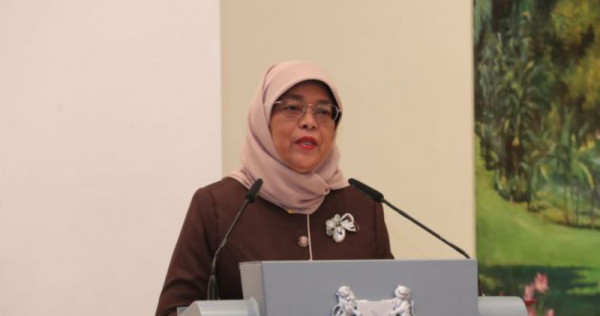
SINGAPORE – President Halimah Yacob on Wednesday (Feb 26) said she has reported to the police a fake e-mail inviting recipients to a dinner event with her, Prime Minister Lee Hsien Loong and Cabinet ministers.
She told her Facebook followers that the e-mail is a phishing hoax.
Those who receive the e-mail are told to download an invitation letter via content-sharing platform Sharepoint and to key in their e-mail passwords.
“I strongly urge all Singaporeans to remain vigilant against online exploits and scams, and to familiarise yourself with tell-tale signs of a phishing e-mail, so that we do not fall prey to these malicious cyber threats,” she wrote.
The Straits Times has contacted the police for more information.
Earlier this year, MacPherson MP Tin Pei Ling lodged a police report after the image of a doctored Chinese New Year banner she was in began circulating online.
The original banner had Ms Tin wishing residents “a happy and prosperous Lunar New Year” in English and Chinese, alongside a photo of her in a red-and-white outfit.
SINGAPORE: Three people were arrested and about S$171,000 worth of drugs seized by officers from the Central Narcotics Bureau (CNB) in an operation on Monday night (Feb 25).
The individuals arrested comprise a a 38-year-old Malaysian man, a 62-year-old Singaporean man and a 62-year-old Singaporean woman.
In a press release on Wednesday, CNB said that they intercepted a Malaysia-registered car along Lorong 6 Toa Payoh after observing the 62-year-old suspected drug trafficker entering the vehicle, and then exiting it a short while later.
The car was driven by the 38-year-old Malaysian. Officers were forced to break the windows of the car in order to gain entry and arrest the driver, who had refused to comply with orders, CNB said.
“The suspect had refused to comply with the lawful orders of the officers and necessary force was used,” said CNB.
About S$11,200 was found on the driver.
Cash found on the Malaysian suspect on Feb 25, 2020. (Photo: CNB)
Separately, another team of officers arrested the 62-year-old who had been in the car in Toa Payoh East. About 299g of Ice and 1,504g of heroin was found on him.
CNB officers escorted him to his home at Toa Payoh East, where the third suspect, a 62-year-old Singaporean woman, was also arrested.
About 508g of heroin and various drug paraphernalia was found in the house.
Heroin and Ice seized during the operation on the night of Feb 25, 2020. (Photo: CNB)
Investigations into the drug activities of all suspects are ongoing, said CNB.
The drugs seized in the operation are worth about S$171,000, said CNB. The amont of heroin seized is sufficient to feed the addiction of 960 abusers for a week, while the amount of Ice seized can feed the addiction of 170 abusers for a week.
SINGAPORE – A 45-year-old Singapore permanent resident (PR) who breached stay-home notice (SHN) requirements while he was in Singapore from Feb 20 to 23 has lost his PR status.
He has also been barred from re-entering Singapore, the Immigration & Checkpoints Authority (ICA) said on Wednesday (Feb 26).
According to the ICA, the man was served with the notice on Feb 20 when he arrived at Changi Airport as he had travel history to mainland China in the past 14 days.
These notices are issued to Singapore residents, long-term pass holders and foreign workers who have travelled to mainland China, outside of Hubei province, in the last 14 days.
He was briefed on the requirements of the notice but failed to respond to phone calls, and was not at his declared place of residence when ICA officers conducted enforcement checks in the days after his return to Singapore.
On Feb 23, he was spotted attempting to leave Singapore, and was warned that he had breached the requirements of his notice and could face penalties.
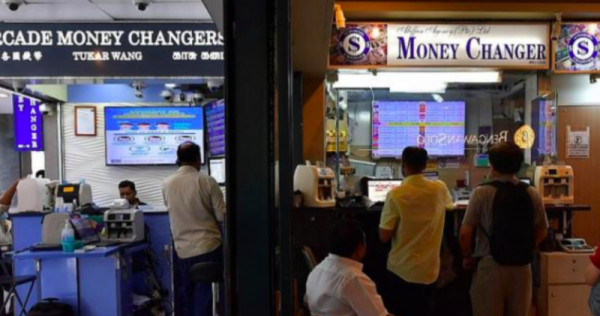
Money changers here are reeling from the impact of the coronavirus outbreak.
Business has been down by about 60 per cent for all currencies, but the South Korean won and yuan have suffered the most.
The New Paper visited five money changers at Bishan on Monday evening and at Raffles Place yesterday.
While short queues formed at a few shops around noon at The Arcade in Raffles Place, money changers said it was a far cry from the normal crowded scene at lunchtime.
“It has completely stopped,” said Mr Abdul Haleem, a managing partner of City Money Changers in The Arcade, about the sales in won during the last couple of days.
Another money changer at The Arcade said business in won has dropped by about 80 per cent, while others see just one customer a week for yuan.
A travel advisory issued by the Ministry of Health on Sunday against non-essential travel to Daegu city and Cheongdo county in South Korea has prompted many holidaymakers to cancel or postpone their trips to the country.
Mr Hussein Ahmed, who runs AR Money Exchange in Junction 8 in Bishan, said: “On a normal day, we close the shop between 9pm and 9.30pm.
On the ongoing COVID-19 outbreak, NMPs Walter Theseira and Mohamed Irshad will ask about the Government’s efforts to ensure that control measures for work pass holders are implemented fairly, as well as how educators and lecturers in Institutes of Higher Learning are being taught to handle the outbreak.
Mr Theseira will also ask what the Ministry of Manpower has done to ensure that work pass holders that violated their mandatory Leave of Absence or other quarantine orders did not do so under duress or misinformation from their employers.
The virus, which originated in Wuhan, China, has killed nearly 2,700 and infected more than 80,000 worldwide.
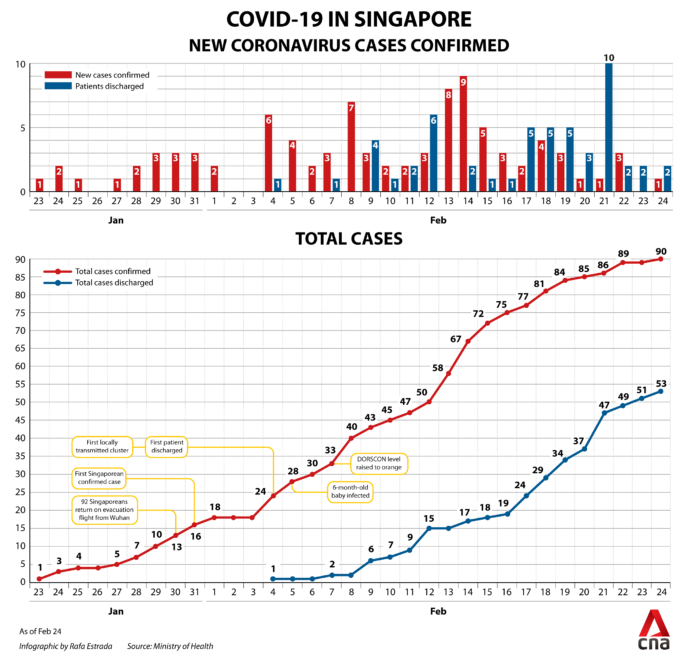
Singapore has reported 91 confirmed cases of COVID-19, about half of whom have recovered and been discharged from hospital.
Singapore has also set aside S$800 million in Budget 2020 to support frontline agencies in their efforts to contain the COVID-19 outbreak, with the bulk allocated to the Ministry of Health.
In Parliament on Wednesday, MP Louis Ng will ask for an update on the Platinium Dogs Club case. The former pet boarding facility is facing investigations into alleged animal abuse offences after its operator was arrested in January 2019.
The Nee Soon MP will also ask the Government to consider increasing the number of lactation rooms required in office buildings, as well as if the Government will consider increasing the period during which paid paternity leave may be consumed, from within 12 months of childbirth to within 24 months.
Dr Intan Azura Mokhtar will ask about the number of diabetes cases diagnosed in Singapore in the last five years, as well as when measures such as mandatory front-of-pack labels and advertising prohibitions to reduce Singaporeans’ sugar intake from sugar-sweetened beverages will be implemented.
Editor’s note: An earlier version of this story stated that the Committee of Supply debates begin on Wednesday. This is incorrect. We apologise for the error.
Huawei will be the first smartphone maker in Singapore to launch a 5G smartphone when it starts selling the 5G variant of its flagship Mate 30 Pro this Saturday (Feb 29), claims the Chinese tech giant.
The Huawei Mate 30 Pro 5G ($1,500) features the same world-class innovations of the original Mate 30 Pro, but has a slightly new design, being wrapped in vegan leather for a more premium touch.
Using Huawei’s own Kirin 990 5G chip, it is the world’s first second-generation 5G smartphone, according to its maker.
Mr Phil Xu, managing director of Huawei Singapore’s consumer business group, said: “The era of 5G is an opportunity to rethink smartphone technology and the Huawei Mate 30 series is the ultimate expression of what’s possible.”
Exclusive gifts, including the Huawei FreeBuds Lite true wireless in-ear headphones, will be given out with every purchase of the smartphone at the launch roadshow in Bedok Mall this Saturday.