SINGAPORE: Member of Parliament for Sengkang West Single Member Constituency (SMC) Lam Pin Min said on Friday (Mar 13) that he expects fierce competition from opposition parties in the newly formed Sengkang GRC.
Sengkang West has been an SMC for the past two electoral cycles since 2011, but will be absorbed into Sengkang GRC in the upcoming General Election that must be called by April 2021.
The new four-member GRC includes polling districts that belonged to Pasir Ris-Punggol, and also absorbs Punggol East SMC, currently helmed by MP Charles Chong. Sengkang GRC covers Rivervale, Compassvale and Anchorvale.
“Whoever the opposition team may be, we will do our best and let Singaporeans decide based on our track record of service to our fellow citizens,” Dr Lam told CNA, in response to queries.
“However, with a backdrop of the COVID-19 pandemic and a worsening global economic situation, our greatest challenge would be the safety, wellbeing and livelihoods of Singaporeans.”
HAPPY TO SERVE EXISTING RESIDENTS
While the slate of candidates standing in the GRC is yet to be decided, as the incumbent MP in the precinct of Anchorvale, he would be happy if asked to continue to serve the residents there, he said. He has known many of them since entering politics in 2006, he added.
The candidates will be decided by the People’s Action Party and will be made known at an appropriate time, he said.
“Having served in an SMC for almost a decade, I would have to adjust to being part of a GRC and work as a team with the other candidates,” he said.
He noted the changes in his ward where the population has grown significantly, with more new BTO flats and condominiums being built.
Sengkang West SMC has 47,891 electors, far higher than the ceiling of 38,000 electors set by the EBRC for an SMC. The new Sengkang GRC will have 117,546 electors.
The constituency is also part of the larger town-wide development of Sengkang which includes the precincts of Rivervale, Compassvale, Anchorvale and Fernvale, Dr Lam said.
The Sengkang Town Development Committee in 2018, made up of the various MPs and grassroots leaders in Sengkang was formed to oversee and coordinate the programmes and infrastructural development of Sengkang Town, Dr Lam said.
“As a new GRC, the utmost priority would be to forge a common identity and to integrate the town-wide developments and programmes for the residents,” Dr Lam said.
The Stomp contributor said he was travelling along the CTE towards Ang Mo Kio at around 9.21am when the incident occurred.
He recounted: “A car cut into my lane and I slowed down. Then he started a braking game.
“When we went into the tunnel, my car lights automatically turned on. He might have thought that I high-beamed him and got triggered.
“Then, he made a sudden brake that caused me and the van behind us to e-brake.
“I believe the van, with its height, should have seen what happened.
“Moreover, after this e-brake, the car driver pointed his middle finger at me, but it was not captured on video due to the angle.
“Please look at the video and if I’m in the wrong, please correct me. After watching it a few times and showing it to my friends, they told me that I have done nothing wrong too.”
SINGAPORE – With the World Health Organisation declaring Covid-19 a pandemic, and as countries across the world step up measures to contain the spread of the virus, the multi-ministry task force here announced on Friday (March 13) additional precautionary measures.
Here are seven things to know about the latest updates.
Travel: With the March school holidays approaching, the Government has announced new guidelines for travel. It is advising people to review their plans according to what experts have outlined.
1. DEFER NON-ESSENTIAL TRAVEL TO COUNTRIES MOST AFFECTED BY COVID-19
The list provided by the multi-ministry task force includes eight countries, with Italy, France, Spain and Germany newly added to the list, as they have had “very high numbers of cases and very high rates of increase”.
The Government previously advised Singaporeans to defer all non-essential travel to China, Iran, Japan and the Republic of Korea (South Korea), as well as to defer all travel to Hubei province, the epicentre of the coronavirus outbreak.
Yeap, that’s no typo. Huawei’s new and improved sequel to their first foldable mobile device is here in Singapore for more than the price of two entry-level iPhone 11 Pro Max units.
The Mate Xs will be available islandwide come March 21 at the cool, cool price of $3,788 at all Huawei Concept branches, various consumer electronic stores, as well as selected M1 and StarHub outlets. For Singtel subscribers or anyone else who’s understandably staying away from crowds these days, there’s always Lazada and Shopee.
Amid reports of hoarding, scams and racism, it’s easy to lose faith in humanity. But as one recent viral video proves, we should give our fellow humans a little more credit.
Diners at Jinjja Chicken in The Clementi Mall were faced with the wrath of the online mob when a video posted to Facebook on March 13 showed them ignoring a woman who had fainted.
The truth?
They had been instructed by mall security not to approach the lady, a Jinjja Chicken spokesperson told AsiaOne.
SINGAPORE: The registers of electors have been updated and will be available for public inspection from Mar 14 to Mar 27, the Elections Department (ELD) said on Friday (Mar 13).
In a media release, ELD said the registers contain the names of all qualified electors as of Mar 1, 2020.
The statement was issued hours after the Electoral Boundaries Review Committee’s (EBRC) released its report delineating changes to the electoral divisions.
Singapore citizens are able to check their particulars in the registers with their NRIC or passport through the following means:
At any Singapore overseas missions that serve as overseas registration centres
At the Elections Department
Claims and objections may be submitted online through the Elections Department website, or in person at community centres or clubs, at Singapore overseas missions that serve as overseas registration centres and at the Elections Department.
Those with their names removed from the registers for failing to vote in a past election may apply to have them restored, to be able to vote in future elections, the release said.
Overseas Singaporeans, whose names are listed in the registers of electors, and have resided in Singapore for at least 30 days between Mar 1, 2017 and Feb 29, 2020, may apply to register as overseas electors to vote at one of the designated overseas polling stations in future elections.
Those who have registered earlier as overseas electors will need to re-register if they meet the qualifying criteria as of Mar 1, 2020 and wish to remain as overseas electors.
However, applications will not be processed during the period from the third day after the Writ for an election is issued until after Nomination Day if the election is uncontested, or until after Polling Day if a poll is to be taken.
CHANGES TO ELECTORAL BOUNDARIES, ELECTION EXPECTED
In a report published on Friday, the EBRC recommended that there be more electoral divisions and no six-member Group Representation Constituencies (GRCs) in the upcoming election.
The committee suggested adopting 31 electoral divisions, up from 29, with a total of 93 seats in Parliament, four more than the 89 in the House currently.
A new Sengkang GRC has been created with four seats, bringing the number of GRCs to 17, up from the current 16.
There will also be 14 Single Member Constituencies (SMCs), one more than the current 13.
The Government has accepted the committee’s recommendations and will implement them in the next election.
This is an indication that that the next GE, which must be held by early April 2021, is likely to be called soon.
Get ready, because new HDB BTO launches are coming!
This time, an estimated 7,830 new units spread over 11 locations across Singapore will be up for sale in May and August 2020.
Spread over two exercises, one in May and one in August, their exact dates have yet to be released by HDB.
The launch in May features 4 projects, namely Choa Chu Kang (Non-Mature Estate), Tengah (Non-Mature Estate), Pasir Ris (Mature Estate) and Tampines (Mature Estate).
On the other hand, the launch in August will feature 5 projects, namely Woodlands (Non-Mature Estate), Ang Mo Kio (Mature Estate), Bishan (Mature Estate), Geylang (Mature Estate) and Tampines (Mature Estate). More details on the BTO launches can be found here.
To cut through the confusion and what surrounding schools or amenities are available for prospective residents (like yourself), here’s all you need to know about each HDB BTO project.
SINGAPORE: The freshly renovated Darul Ghufran Mosque sits on a vast field in central Tampines, its pale brown walls cutting a lonely sight.
On any normal Friday, the 5,500-capacity mosque – the largest in Singapore – would be a buzzing hive of activity in the afternoon ahead of the weekly Friday prayers.
Students still in their uniforms would buy cold drinks in the heat. Congregants would snap up spots in the shade. Shoes and slippers would spill onto the wide cement paths leading to the mosque.
The Darul Ghufran Mosque in Tampines is surrounded by red tape. (Photo: Aqil Haziq Mahmud)
But this Friday (Mar 13) was not any normal Friday. It was the day after the announcement that all mosques in Singapore would be temporarily closed – the first time it has happened in the country’s history.
Many used makeshift barricades, posters and red tape to seal off their premises.
Authorities took the unprecedented decision to shut the mosques for cleaning after 82 Singaporeans, who could have been regulars at various mosques, returned from a mass religious gathering in Malaysia that had been attended by confirmed cases of COVID-19.
Two individuals from the group have already tested positive for the virus. Authorities are conducting contact tracing for the rest and will decide whether to re-open the mosques based on developments from the Malaysia gathering.
The workgroup comprises ministers, doctors and religious teachers.
“We want to make sure the community knows the closing of mosques is part of social distancing and we are not encouraging any mass gathering at the same time emphasising the importance of taking personal responsibility and taking care of themselves,” workgroup member Ustaz Zahid Zin said.
Workers inside Ghufran were seen removing footwear left on racks. (Photo: Aqil Haziq Mahmud)
So on Friday, there was no booming prayer call signalling the start of the pre-prayer sermon – just the sounds of mosque staff shuffling inside, wearing luminous vests and clearing out the spaces.
Other mosques CNA visited were also making preparations before professional cleaning agencies worked on their premises over the weekend. Some washed by hand, others used industrial-grade cleaning machines.
Mosque staff also told CNA they had to turn away congregants, including foreigners and construction workers who had not heard the news.
Signs had been put up outside Al-Mawaddah Mosque in Sengkang. (Photo: Zhaki Abdullah)
Back at Darul Ghufran, a lone auxiliary officer employed by the adjacent Our Tampines Hub stood on the path to the mosque. He had to turn away at least two people who had come for the prayers, pointing to a sign explaining the works.
He was just lending a hand, he said.
On the other side of the mosque, retiree Arshad Abu Yamin, 71, stopped on a bicycle. Despite hearing the news, he had come to check if the mosque would still allow him to conduct the usual daily prayer there by himself.
The Al-Taqua Mosque on Jalan Bilal was largely empty save for a couple of cats inside. (Photo: Aqil Haziq Mahmud)
After all, Mr Arshad, who lives nearby, had in recent years attended every one of the five daily prayer sessions held at the mosque.
“For people who don’t usually go to mosque, it’s a different story,” he said softly in Malay. “But for people who love going to the mosque, it’s really sad.”
Fellow retiree, 69-year-old Ramli Ibrahim, had just finished having his dinner nearby when he thought he would visit Darul Ghufran to see if he could do his supplementary prayers there. He knew it would be closed, but said it would be “such a waste” if he could not.
“I’m already in my ’60s so I’m trying to prepare for the afterlife,” he said, noting that praying in the mosque carried one of the greatest rewards for Muslims.
The Al-Ansar Mosque in Bedok is usually packed on Friday afternoons. (Photo: Aqil Haziq Mahmud)
Mr Ramli said it was good that the mosques were being cleaned to prevent the spread of COVID-19, but felt authorities could have still allowed individual congregants to conduct minor prayers.
“I grew up not missing a single Friday prayer,” he said. “I’m fine with praying just outside the mosque. It doesn’t have to be inside.”
At Al-Ansar Mosque in Bedok, workers said staff and ustaz will wait outside the mosque to explain to congregants the decision to close from both a practical and religious perspective. People were also seen entering the mosque with cleaning equipment.
SOME CONGREGANTS NOT AWARE
At Punggol’s Al-Islah Mosque, four staff members were stationed outside the mosque to inform congregants of the closure. One told CNA he had turned away at least six people from 12pm to 1pm on Friday.
While some were foreign workers – the mosque sees a good number of visitors from a dormitory about 2km away – some were also locals who did not follow the news or use social media.
Bangladeshi construction worker Alom Shah, 27, was one of five foreign workers CNA observed at the mosque shortly before 1pm on Friday.
Worshippers outside the Al-Islah Mosque in Punggol. (Photo: Zhaki Abdullah)
He said he was not informed of the closure and that it was the first time he had seen the mosque closed in his four years of working in Singapore.
In Pasir Ris, staff at the Al-Istighfar Mosque said they had had to turn away two individuals from Malaysia. In the background, a worker could be seen using a floor scrubbing machine.
Bangladeshi construction worker Mohammad Ulzzal, 26, looked lost as he stood alone outside the perimeter wall. “Last week, I prayed here as per normal,” he said. “I totally didn’t know about this.”
Mr Ulzzal said he would pray at the temporary shelter near his work site just beside the mosque. Nearby, a group of foreign workers gestured to a colleague who had just arrived in prayer garb to say the mosque was closed.
Part-time lorry driver Jumahat Hatri, 61, said he too did not know mosques were closed. “I’m not sad,” he said. “My intention was to visit a mosque and pray. It was just not meant to be.”
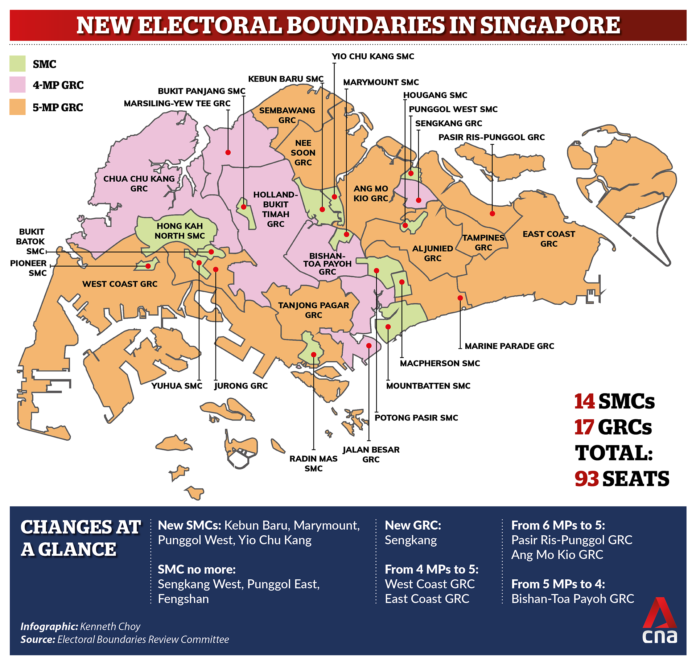
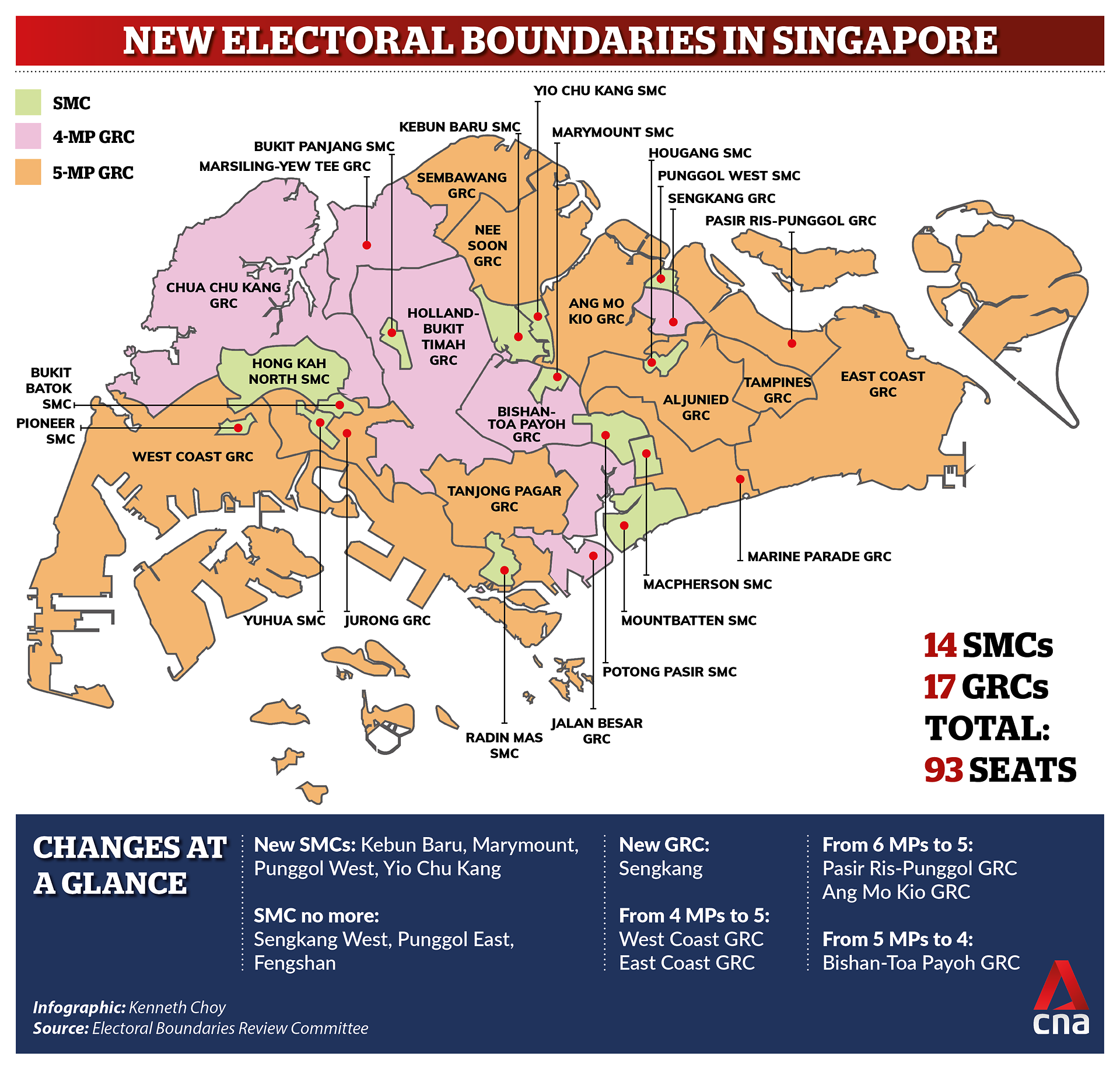
SINGAPORE: Voters will see five new constituencies in the coming General Election, while three have been removed, in changes to Singapore’s electoral boundaries that were released on Friday (Mar 13).
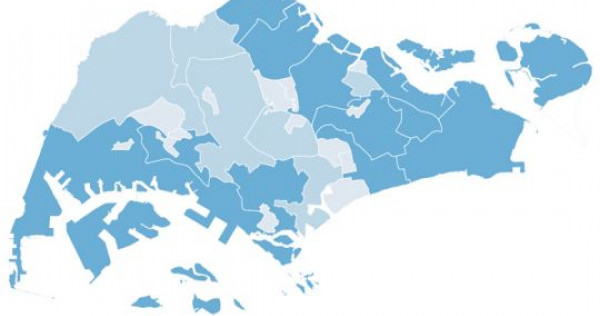
There are now 31 electoral divisions, up from 29 in the last election, according to the report by the Electoral Boundaries Review Committee (EBRC); and a new Group Representation Constituency (GRC) has been created in Sengkang, a region which has seen recent population growth.
Four new Single Member Constituencies (SMCs) have sprouted to replace three that have disappeared.
Here’s where the battle lines have been drawn for the next election:
MORE MPS, MORE CONSTITUENCIES
Singapore’s next Parliament will have 93 seats, four more than the current 89 in the House. The increase comes as the number of voters in the Register of Electors grew by more than 134,000.
There will be 31 electoral divisions: 14 Single Member Constituencies (SMCs) and 17 Group Representation Constituencies (GRCs).
That’s one more SMC and one more GRC than in 2015, but some existing wards have been removed or redrawn.
NO MORE SIX-MEMBER GRCs
One major change this time is that the two GRCs which had six members have been down-sized.
Ang Mo Kio, the GRC led by Prime Minister Lee Hsien Loong, and Pasir Ris-Punggol, helmed by Senior Minister Teo Chee Hean will become five-member GRCs.
There were five six-member GRCs during the 2001 and 2006 elections.
Changes were expected for Pasir Ris-Punggol as, with housing development in the area, the GRC had grown considerably in the number of electors. Its 242,225 voters are far more than the 190,000 ceiling recommended by the EBRC for a five-member GRC.
NEW SENGKANG GRC
A new four-member GRC has been formed in Sengkang. It includes polling districts that belonged to Pasir Ris-Punggol, and has absorbed districts from the two former SMCs – Punggol East and Sengkang West.
A few other GRCs have expanded or shrunk.
Bishan-Toa Payoh has shed one MP to become a four-member GRC. Both East Coast and West Coast GRCs have grown from four members to five.
There are four new SMCs out of a total of 14 for the coming election, one more than in 2015.
The new wards are Kebun Baru, Marymount, Punggol West and Yio Chu Kang.
Kebun Baru has been carved out of Nee Soon GRC, Marymount from Bishan-Toa Payoh GRC, Punggol West from Pasir Ris-Punggol GRC and Yio Chu Kang from Ang Mo Kio GRC.
MISSING: 2 CLOSELY FOUGHT WARDS IN 2015
Three SMCs have been removed: Fengshan, Punggol East and Sengkang West.
Punggol East saw a close fight in the 2015 General Election.
Veteran politician from the People’s Action Party (PAP) Charles Chong wrested Punggol East from then Workers’ Party’s Lee Li Lian with a narrow margin, winning 51.77 per cent of the votes.
In Fengshan, PAP new face Cheryl Chan won with 57.5 per cent of the votes against WP’s Dennis Tan.
Fengshan districts are now integrated into a larger East Coast GRC while Punggol East has been drawn into Sengkang GRC. The new GRC also absorbs parts of Sengkang West – the third SMC erased.
A few districts from Sengkang West, which grew substantially in voting population from 2015, will go to Ang Mo Kio GRC.
POTONG PASIR REMAINS BUT ALTERED
There had been speculation that Potong Pasir SMC might cease to exist after it changed from opposition hands to being a PAP ward after MP Sitoh Yih Pin’s win in 2011.
While this has not happened this time, it looks like the district’s boundaries, which was unchanged for decades under veteran opposition politician Chiam See Tong, have now shifted.
According to the EBRC report, two polling districts that were from Marine Parade now form part of Potong Pasir, boosting voter numbers there from 16,739 to 18,551.
Part of the SMC has also been drawn into Bishan-Toa Payoh GRC.
THE 31 CONSTITUENCIES
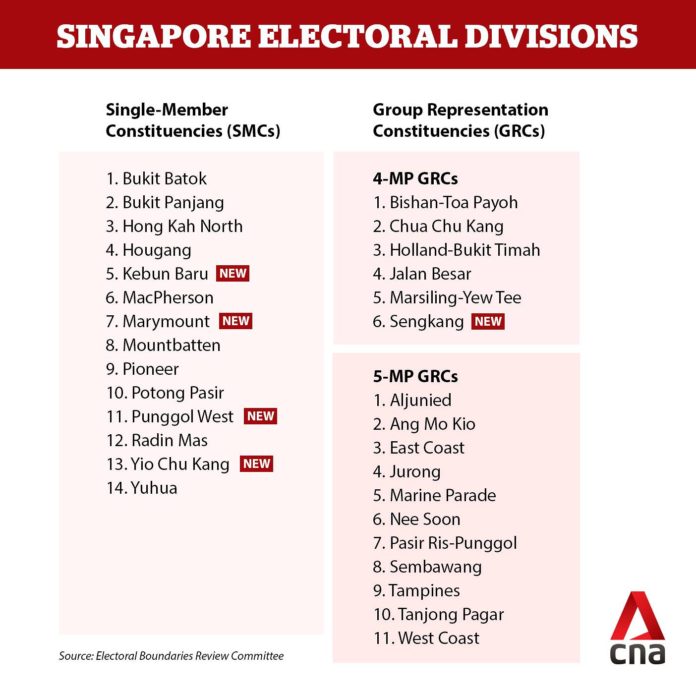
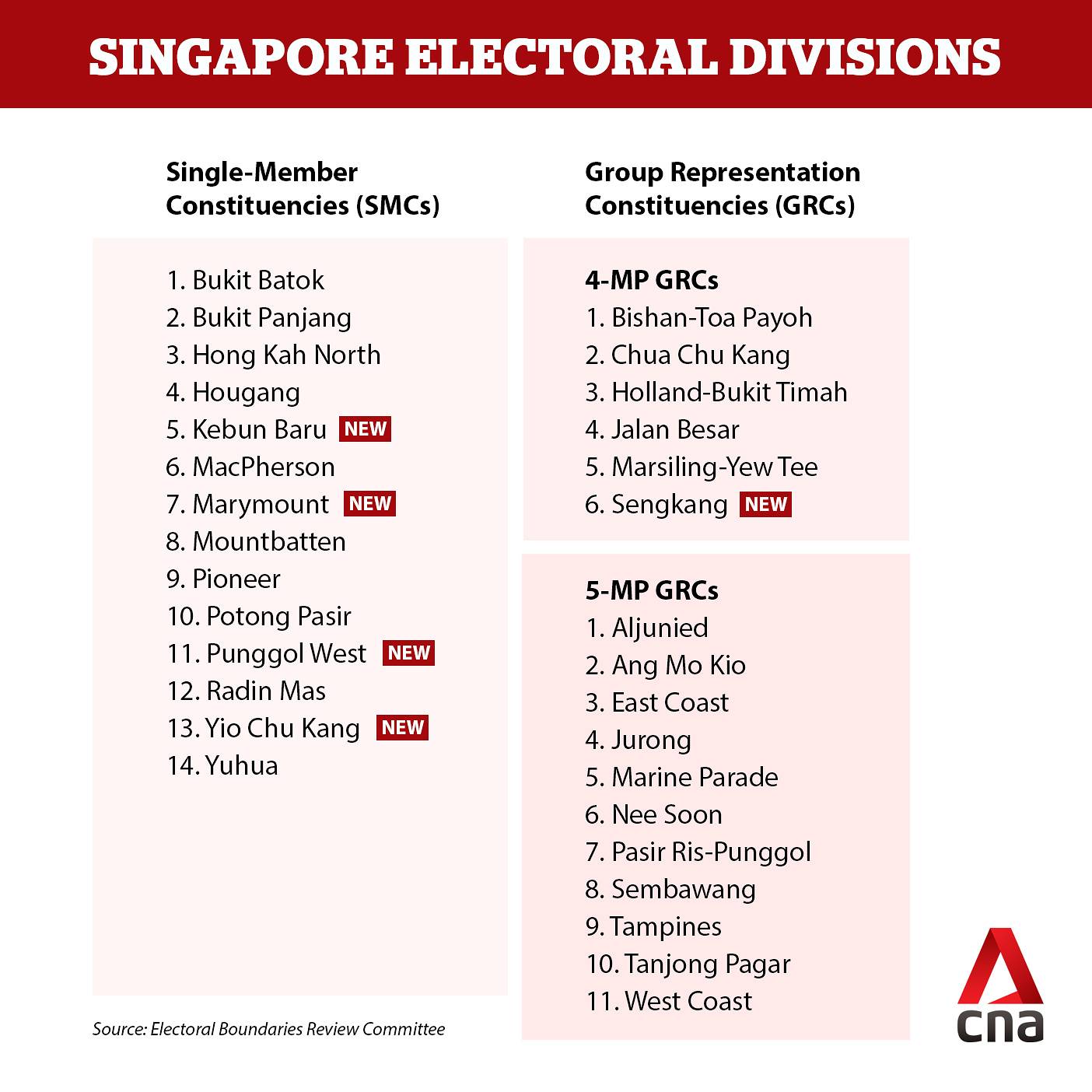
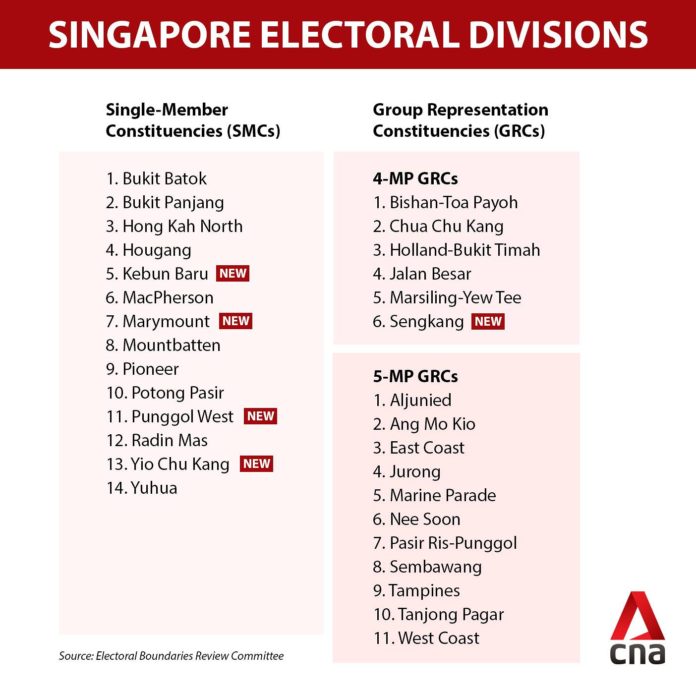
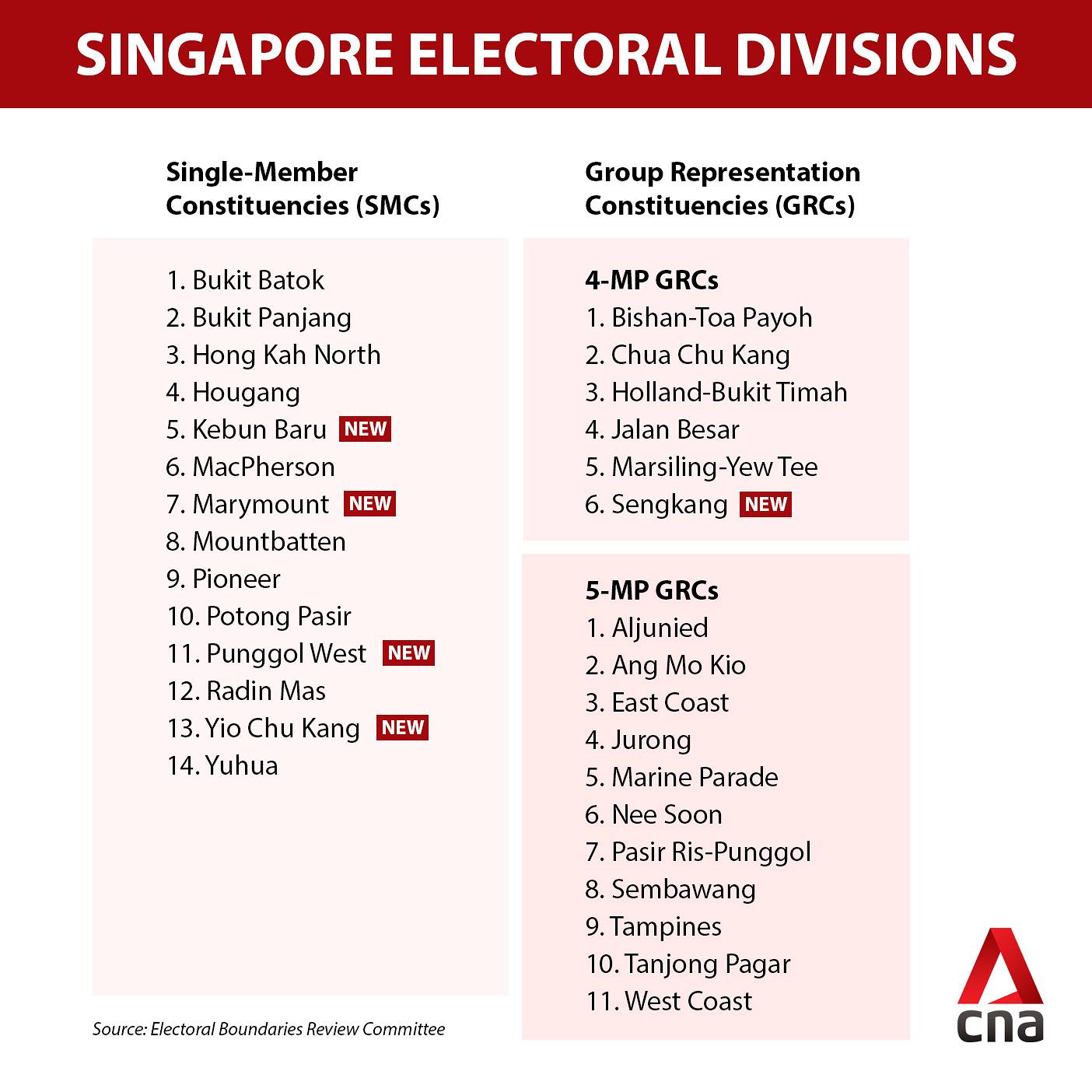
These are the 14 SMCs and 17 GRCs in the coming GE, with the new constituencies highlighted in bold:
SMCs
1. Bukit Batok 2. Bukit Panjang 3. Hong Kah North 4. Hougang 5. Kebun Baru 6. MacPherson 7. Marymount 8. Mountbatten 9. Pioneer 10. Potong Pasir 11. Punggol West 12. Radin Mas 13. Yio Chu Kang 14. Yuhua
Four-member GRCs
1. Bishan-Toa Payoh 2. Chua Chu Kang 3. Holland-Bukit Timah 4. Jalan Besar 5. Marsiling-Yew Tee 6. Sengkang
Five-member GRCs
1. Aljunied 2. Ang Mo Kio 3. East Coast 4. Jurong 5. Marine Parade 6. Nee Soon 7. Pasir Ris-Punggol 8. Sembawang 9. Tampines 10. Tanjong Pagar 11. West Coast
SINGAPORE – Singapore will increase the number of MPs in Parliament by four, and do away with six-member GRCs in the latest changes to electoral boundaries announced on Friday (March 13), raising expectations that the next general election could be called soon.
The changes to constituency boundaries are incremental in nature, with the largest changes in the fast-growing north-eastern part of the island.
The report comes on the same day that Singapore announced more social-distancing measures in its fight against the global coronavirus pandemic, including limiting the size of gatherings to 250 people to reduce the risk of transmission.
In its report submitted to Prime Minister Lee Hsien Loong on Wednesday (March 11), the Electoral Boundaries Review Committee (EBRC) recommended an increase in the number of elected Members of Parliament from 89 to 93. The Government has accepted the recommendations.
There will be 14 Single-Member Constituencies (SMCs) and 17 Group Representation Constituencies (GRCs), up from the current 13 SMCs and 16 GRCs.


.jpg "fainting-comments-1.jpg")