SINGAPORE – A 30-year-old man has been arrested and charged over a fire in front of a neighbourhood police post (NPP) in Boon Keng, the police said.
No one was injured in the incident, which police said was not an act of terrorism.
The man, who acted alone, had set fire to a few bags of clothes using petrol or diesel, and smashed the glass door of the NPP, said police.
Although he had scribbled “ISIS” on several pillars near the police post, preliminary investigations showed that he was a “disgruntled person unhappy with the perceived social inequality”, said the police.
Singaporean Sivaprakash Mailravanan was charged on Saturday (March 14) with mischief by fire. He will be remanded for further investigations and the police will seek a court order to send him for psychiatric assessment.
The Straits Times got to the scene in Towner Road just after midnight on Saturday and saw vulgarities scrawled on the void deck walls surrounding the police post. “ISIS” was visible on at least three walls. The glass panels of the police post at Block 105 Towner Road were also shattered.
SINGAPORE (Reuters) – After a coronavirus outbreak began to disrupt lives and activity in Singapore late in January, Conceicao Edwin Philip keeps himself ready to rush to hospital at a moment’s notice, if summoned.
Philip is not a doctor or nurse, but his work, using a telephone to question patients separated from him by two glass walls, has become crucial in the Asian city-state’s fight on the virus, which has caused 187 infections in Singapore.
As one of a team of contact tracers, Philip, 31, swings into action as soon as virus patients are diagnosed, to piece together the jigsaw of their prior movements and contacts.
“We have to drop everything, scramble and figure out where these patients have been,” said Philip, an employee of Singapore General Hospital (SGH), who wore spectacles and a bowtie.
He typically tries to jog patients’ memories by asking them about their meals, all the way from breakfast to supper.
“Because once they can remember who they sat down with for a meal, that would give a rough estimate of the number of people in their surroundings, and they can usually remember what they did,” Philip added.
Organisers of upcoming events with 250 participants or more have been urged to cancel or defer them in light of the Covid-19 situation.
But if the events have already been committed to, they will only be allowed to proceed if satisfactory precautionary measures are put in place.
This is to reduce the risk of local transmission, as part of its updated advisory on social distancing measures announced yesterday (March 13) by Minister for Health Gan Kim Yong and Minister for National Development Lawrence Wong, who chair the multi-ministry task force on tackling the virus.
New requirements and advisories for gatherings, workplaces and public venues were also introduced.
For all other mass gatherings, including religious services and private functions, organisers are advised to reduce the scale to below 250 participants, reduce crowding, improve ventilation, and advise participants to reduce contact with others.
Organisers should also have in place temperature and health screening, turning away of unwell persons, and measures to facilitate contact tracing, such as obtaining participants’ contact details.
Observers had earlier picked out two possible windows for this year – March to April and May to mid-June – both of which are now in play given the timing of the report.
A significant delay prompted by the Covid-19 outbreak now appears unlikely.
Dr Felix Tan, associate lecturer at SIM Global Education, said: “With the report coming out sooner than expected, we are perhaps looking at some time in the May period.”
He said that the election is likely to go ahead in the midst of the Covid-19 outbreak.
“The Singapore Government will want to get this election over and done with, so it can focus on tackling the issue of the pandemic, which is getting worse around the world,” said Dr Tan.
SINGAPORE: Earlier this week, dog lovers rejoiced as the Animal and Veterinary Service (AVS) announced that larger dogs can now be rehomed in HDB flats.
Dogs with heights 55cm and below are now eligible for adoption into HDB flats under the ADORE (Adoption and Rehoming) programme.
This is a 10 per cent increase from the previous 50cm height limit. The weight limit, previously set at 15kg, was also removed as a criterion for rehoming.
The ADORE programme was set up in 2012 to allow rehoming of mixed breed dogs into HDB flats. While the recent increase in height of 5cm may seem insignificant, it has far reaching implications for homeless dogs.
Most stray and mixed breed dogs here – affectionately referred to as the “Singapore Specials” – are medium to large-sized. Only one in nine to 10 fit the old ADORE criterion.
With the revised criteria, at least one in two of Singapore Specials now qualify. The small 5cm increase now gives three to four times the number of dogs a chance to find loving homes.
MOVING PAST FEARS OF BIG DOGS
The size restrictions of dogs were laid out early in Singapore’s history. Before ADORE, only some toy breed dogs were allowed in HDB flats.
In the 1970s, Singapore was a very different place. Our parents were ushered from kampungs into high-density HDB apartments. Pet ownership was the last thing on their minds.
Our parents were more concerned about making ends meet. And so our authorities rightly took a cautious approach towards pet ownership, to maintain harmony among neighbours.
As a result, a generation of Singaporeans, myself included, grew up in an environment largely devoid of dogs, especially large dogs. We were warned by our elders that large dogs are dangerous. We grew up to be afraid of large dogs.
This perception towards larger dogs was the the biggest challenge animal welfare groups and authorities faced when ADORE was rolled out.
HDB and AVS are very careful to be sensitive towards people who are not receptive towards larger dogs. Hence, it took several years of careful planning and collaboration just for a 5cm height revision to materialise.
BAD OWNERS RESULT IN BAD DOGS
Ask someone why they are afraid of big dogs, and they will probably tell you that they were previously almost bitten or chased by one, or know someone who was. Unfortunately, these negative experiences with large dogs often happen as a result of irresponsible owners, rather than bad dogs.
Keeping a dog is a huge commitment. Besides feeding and housing them, owners must bear the responsibility of training their dogs well.
Like children, dogs may not know what behaviours are wrong, unless they are taught and corrected. Teaching the right behaviours is easier said than done, as owners themselves often do not know what is right.
For example, picking up and cradling a dog is not the right way to stop it from barking. This only reinforces their behaviour: The dog learns that it is rewarded when it barks excessively. (Ironically, for this reason, small dogs often bark more than larger dogs.)
(Photo: Unsplash/Freestock)
Being a responsible pet owner means seeking the help of a certified dog trainer to correct problematic behaviours we cannot manage, then spending time to work through these issues with our dogs. In time-sparse Singapore, this is often not done.
TWO COMPLAINTS TO BE ADDRESSED
Besides excessive barking, the two most common complaints against dogs which we come across at SOSD are: Owners not picking up their dogs’ poop, and owners letting their dogs off-leash in public areas.
Not picking up dog poop is a cardinal sin which needs to change, but the latter, in my opinion, is more difficult to address, because many dog owners do not think there is anything wrong with letting their dogs enjoy the freedom of going off-leash.
The problem with allowing dogs off-leash is that we can never be absolutely sure that our dogs will not be spooked or triggered by something or someone which may bring out their worst side. We have experienced cases where off-leash dogs ended up running off and biting someone, or another dog.
Dog owners also need to understand that even if our dogs are the sweetest angels, they may chase someone, another dog, or a car out of excitement.
Another common scenario is when an overly-friendly dog approaches a stranger. For someone who is afraid of dogs, the sight of an approaching large dog, in particular, will be traumatising, whether or not the dog means any harm.
At the end of the day, it is important to realise a dog’s size does not determine whether they are good or bad – it is the owner who makes all the difference. In densely populated Singapore, it is very easy to for human-dog conflicts to arise if we are not mindful.
SMALL GESTURES GO A LONG WAY
Animal welfare groups follow stringent screening criteria and regulations for dogs adopted into HDB flats. For example, the dogs must undergo compulsory basic obedience training by AVS-accredited trainers.
Owners must also agree to follow a Code of Responsible Behaviour, which lays down rules and etiquette they need to follow. Failure to comply can end up with removal of the adopted dog. We do all these to ensure that the owners do their part, when introducing a larger dog into the neighbourhood.
I believe that no one inherently hates dogs. But not everyone in Singapore is used to being around larger dogs as yet.
There are simple things we can do to show that we are sensitive to fellow Singaporeans, such as allowing our neighbours to take the lift first when we are bringing our dogs downstairs, or keeping our dogs on a short leash when there are other people around so that our dogs do not get too close to them.
This way, we allow our neighbours to slowly understand dogs more, and overcome their misconceptions and fear of larger dogs.
PAVING THE WAY FOR AN INCLUSIVE SOCIETY
As we become more mature as a society, it is only natural that we become kinder and more accepting towards our animal friends. In August 2018, a pilot expansion of Project ADORE allowed members of the public to adopt retired sniffer dogs, which are larger in size, from K9 units.
It was a significant step in the evolution of pet ownership in Singapore – a glimpse into what the future may be like, when we finally understand that man’s best friend comes in all shapes and sizes.
A large dog can be very well behaved, and conversely, a small dog may not be so. It all depends on the owners. What matters is responsible pet ownership, rather than size.
With the continued efforts of dog owners and animal welfare groups, I believe there will come a day when size will no longer be such restrictions on dog ownership in HDB flats.
SINGAPORE: Mr Wee Pang Chun has had so many jobs that he cannot remember all of them. The 25-year-old, who has mild intellectual disability, started working after graduating from secondary school.
Until recently, he worked at NTUC FairPrice as a store assistant for two years, his longest stint yet. But he found the work boring and went looking for another job.
After approaching various agencies for help with finding a new job, he was introduced to Inclus, a startup that helps the differently abled find jobs and stay in them.
Pang Chun underwent a four-week training camp with Inclus, and was placed in a position at Far East Orchid, where he was paid about S$500 per month.
Six months later, the Inclus team who tracked his progress, found that he had become a more capable worker, and placed him in a packing job with Bollore Logistics, where he now earns S$1,300 per month.
Adding that his colleagues are friendly and willing to guide him, Pang Chun said he is thankful to Inclus for the support and the opportunity to learn more things in a different company.
“They supported me a lot, now I feel more confident. I feel happy, I can buy anything I want,” he said, adding that he can give his parents money if they need it now that he is earning more, and plans to stay in this job unless there is a better opportunity.
Co-founder of Inclus Mr Anders Tan is not new to the employment problems faced by those with special needs or disabilities.
After seeing his brother-in-law, who has high functioning autism, drop out of three jobs and fired from his fourth in a matter of months, Anders decided to take action to help others like him.
With Mr Shaun Tan and Mr Arudra Vangal, who also has autism, he founded Inclus in July 2018, a startup that helps people with special needs and disabilities not just to secure jobs but stay in them.
“In the course of my journey, for 27 years I experienced a lack of education expertise, job opportunities, behavioural support and social acceptance, which is typical in the world of young ASD (autism spectrum disorder) adults,” said Arudra.
Many companies still see hiring those with special needs or disabilities as doing a good deed, Anders observed.
“When we sell to corporates, the first thing that we always tell them is, if you’re doing this for CSR (corporate social responsibility), then you might not be the right fit.
“We are bringing someone of value to your organisation, someone who can do the work that you’re asking for, and you will build up the capabilities of this person because you know this person will stay in your organisation, so there’s longevity.
“Otherwise, if you’re seeing this as CSR, then once your funding runs out, maybe this (employee) will become not essential.”
Trainees are assessed using Lego Mindstorm kits, which allow trainers to observe their motor skills and even programming capabilities. (Photo: Inclus)
A new wage offset scheme, alongside enhancements to an existing training grant, will be introduced to enhance the employment of persons with disabilities (PWDs), announced Minister of State for Manpower Zaqy Mohamad on Mar 3 during the Committee of Supply debate.
The new Enabling Employment Credit (EEC) will be available from 2021 to 2025 at a cost of about S$31 million a year, and is set to replace two existing wage offset schemes – the Special Employment Credit and Additional Special Employment Credit schemes – that are due to expire at the end of this year.
In September 2019, Mr Zaqy said in Parliament that nearly three in 10 persons with disabilities (PWDs) who are of working age are employed.
The resident employment rate was 28.6 per cent among PWDs in the working ages of 15 to 64, he said. Another 4.2 per cent of PWDs in this age range were without a job and actively looking for one, translating to a resident unemployment rate of 12.9 per cent, he said.
Mr Zaqy said that the remaining two-thirds of PWDs in this age group were “outside the labour force”, with most of them citing poor health or disability as the main reason.
TRAINING FOR CORPORATES, INDIVIDUALS
Anders believes firms who hire the differently-abled can benefit from more training in how to manage them.
“So what we are seeing in the market is that people are hiring people with special needs or disabilities. But none of them can keep them for long enough,” he added.
He noted that the lack of support for differently abled individuals starting a new job could cause friction within teams, especially if co-workers do not know what to expect.
For example, a typical individual with special needs or disabilities may receive about two hours of support per week from a job coach when they join a new organisation, said Anders.
But integration “doesn’t just happen” over two hours, he stressed.
“You need to observe (the person) over a period of time, talk to their colleagues, make the colleagues understand their conditions, and get them to work together and create an environment for them. That requires time and effort,” said Anders, adding that many individuals who are not well-supported leave the organisation after three to six months.
This is why, at Incus, they receive a full month of training before they are officially placed into employment.
Inclus secures job positions with companies who want to hire differently-abled individuals before opening up corresponding training programmes for the individuals, said Shaun.
The four-week training programme comprises two weeks of internal assessment and classroom training and another two weeks of practical on-site training.
Before the individuals are placed in the organisation, the Inclus team also meets with company management to provide inclusivity training for the management, hiring managers and the departments that the individuals will be joining.
Trainees under going work-trial training at SF Fruits & Juices and SF Farm Mart. (Photo: Inclus)
“Let’s say there are individuals with autism or ADHD (attention deficit hyperactivity disorder) joining the organisation. We will explain the conditions to them, and how they should handle it,” said Shaun.
During the practical onsite training, Inclus’ life skills coaches will observe and support the individuals at work for two weeks. This will also give employers an idea of what to expect post-training.
“We can immediately see a lot of things. Are they hyper or hypo sensitive to lights and sound? Is the environment something they are comfortable with?” said Shaun.
“That is also the part where we talk to their colleagues who will be working with them directly, because the person directly with them has to understand how to manage them.”
Once the training is complete, Inclus will match those who are deemed suitable for the job with the employers. Since its first training run in March 2019, the startup has placed 14 out of 20 individuals into jobs. They also have available positions in accounting, admin, finance, technology, retail, F&B and logistics.
SG Enable funds up to 90 per cent of Inclus’ train and place programme, and trainees can expect to pay between S$350 and S$1,350, said Anders.
Inclus describes itself as a “social business”. Companies who partner them pay a fee for the support given. Anders said the response has been “very good” so far, estimating that between 90 per cent and 95 per cent of the companies they approach ending up as partners.
One such employer, Bollore Logistics, has opened up eight job positions to Inclus for placement, and intends to scale up the number by expanding the project to more sites as it progresses, said a spokesperson. Two people have been placed with the company, which is the logistics arm of the French Bollore Group, so far.
“We firmly believe in tapping into non-traditional sources of workforce in Singapore and have been working closely with local organisations to hire and integrate persons with disabilities into the workforce,” said the spokesperson.
“This collaboration has enabled us to reach out to a prospective source of manpower while bolstering our steps towards better social integration.”
Adding that the company is happy to have them, she said: “Overall, they are as capable as anyone else and we hope to see them grow with Bollore.”
Shaun said that companies often hire differently abled individuals for roles with high turnover rates because employers recognise that they may be more loyal.
“So there comes another group of untapped workforce, who can potentially be as productive, if not more. And the loyalty in this group really is higher,” he added.
The startup is also one of 268 companies that will work with the Institute of Technical Education (ITE) this year on a work-study diploma programme. The diplomas, which were first launched in April 2018, allow students to be hired as full-time salaried staff and graded by the companies and the ITE at the end of their course.
THE COST OF UNEMPLOYMENT
Stressing that the employers are responsible for imparting the actual skills required for the individual to carry out the job, the training at Inclus focuses more on soft skills like making friends and being part of a group, said Shaun.
This is important because once differently-abled individuals graduate from secondary school, especially those with special needs, they no longer have an individualised educational programme, he added. This could make the transition to an institute of higher learning (IHL) or employment very challenging.
“If regression happens then, then when they graduate (from IHLs), the amount of work that needs to be done to place them into a job or to help them be part of society will be even more,” said Shaun.
He also highlighted that the cost to families will be even greater if a differently-abled child graduates from school and is unable to find a job.
A workplace preparation class with trainees at one of Inclus’ training camps. (Photo: Inclus)
According to Ms Cheng Oi Lin, a job coach with SG Enable’s School-to-Work programme, more companies have been open to hiring persons with intellectual disabilities or autism as they recognise the value of inclusive hiring and that persons with disabilities are “an untapped talent pool”.
“Some employers hesitate to hire persons with intellectual disabilities or autism as they may have negative perceptions about them, such as them being less productive. They may also be unsure of how to interact and work with them,” she said.
“With training and workplace accommodation, the perceived barriers of inclusive hiring can be lowered, and obstacles can be overcome.”
“MANY INTANGIBLE BENEFITS ON MULTIPLE LEVELS”
Since 2014, SG Enable has placed more than 2,600 persons with disabilities in jobs and over 1,000 companies have hired persons with disabilities through SG Enable, said assistant chief executive Tan Ko We.
“We are also progressively building up the pool of companies that are ready to hire persons with disabilities. Since 2014, about 5,000 staff from various companies have attended training programmes organised by SG Enable,” he added.
Although there has been progress, Anders thinks employers could still afford to be more inclusive and hiring processes should be more diversified.
“It’s no fault of (the employers), it’s because the culture is not there. When we grow up, we are differentiated by special needs and mainstream in schools. An individual like us may grow up not knowing that there are actually differently abled individuals in society,” he said.
Shaun added that a detailed business profile and personalised training for both the individual and the employer serves to reduce misunderstandings and miscommunication between the two parties.
“Having all this will help an employer have empathy,” he added.
“Because if we use what we understand of the typical workforce and slap it on them, we will say this is unacceptable, and that’s why a lot of them don’t stay in jobs for long.”
SINGAPORE: With the focus on keeping our hands clean amid the coronavirus disease 2019 (Covid-19) outbreak, antibacterial soaps have been flying off the shelves.
These soaps use chemical agents like chlorhexidine, which supposedly make them better germ killers than normal soap.
They are also sold, on average, at a premium of about 2.6 times the price of normal soap, as noted on the programme Talking Point. But are they indeed better at killing germs and thus worth that much more?
To find this out, Talking Point got preschoolers to use three kinds of cleaning agents — regular soap, antibacterial soap and vodka — after they played in a playground.
The before and after samples of bacteria on their hands were collected using special gels, and the results surprised even the microbiologist who did the tests. (Watch it here.)
Special gels to collect the bacteria the children picked up.
The girl who used normal soap had a bacterial count of 314 before washing her hands and a count of 264 afterwards, a 16 per cent drop.
The girl who used antibacterial soap had an initial count of 256 bacterial colonies, and after washing, it was 184 — or 28 per cent less germs.
This difference between the two soaps, however, could be attributed to how thoroughly both girls had washed their hands, according to programme host Rai Kannu.
The difference is also “not much”, said principal microbiologist Renugopal Jagadeesan at Marchwood Laboratory Services, where the tests were done. “Common soap also has germ-killing properties,” he pointed out, adding that “it isn’t necessary” to buy antibacterial soap.
Renugopal Jagadeesan.
What he found “surprising”, however, was the difference in the bacterial count for the girl who washed her hands with vodka: From 340 colonies to 147 colonies, a 57 per cent reduction.
“Alcohol has a very strong antibacterial activity, or antimicrobial activity. It can kill bacteria, viruses, yeast and mould,” he noted.
While the girl was allowed to wash off the vodka with water, he added that doing this reduces the effectiveness, especially if done immediately. “(The alcohol) needs sufficient time to kill (the bacteria).”
People who want to have their own alcoholic handwash at home should note, however, that alcohol can cause dryness of skin.
Rhianne with the bottle of vodka handwash she used.
DIRTY HANDS AND SURFACES
Before the Covid-19 struck, not many people may have given this much thought to the germs their hands could be harbouring. Nine-year-old Desmond Chew, for example, hardly washed his hands unless his parents asked him to.
His mother thought he had the dirtiest hands in their family of four — as with many children, who touch all sorts of surfaces. He thought his father, however, had the dirtiest hands as a car mechanic.
But when bacterial samples taken from their hands were analysed at the Changi General Hospital, microbiologist Crystal Wong found that the mother had the most bacteria — “very concentrated bacteria … compared to the rest of the family: Junior, granny and dad”.
“We’ve concluded that perhaps mummy is the busiest person. She’s … working, doing the household (chores), doing shopping,” cited the associate consultant.
Dr Crystal Wong and Talking Point host Rai Kannu with the Chew family.
Chew Zee Meng, the father, noted that he always has to wash his hands because they get visibly dirty at work, whereas his wife, who works in an office, “only touches everyday things (like) handbags, doors and so (on).”
“We forget that we’re … in contact with bacteria all the time,” he said.
While their bacteria samples were all “harmless”, Wong cautioned that “if you touch something that happens to have harmful bacteria”, and then touch a family member or go on to cook food, “that’s when it becomes a problem”.
So which are the dirtiest surfaces? From the swabs Talking Point took around Singapore, which were tested at Marchwood Laboratory Services, the highest count of E. coli, or faecal bacteria, was found in soap dispensers in public washrooms.
Looking for traces of dangerous bacteria on soap dispensers.
The highest concentration of staphylococcus aureus — which can cause pneumonia, among other diseases — was found on mobile phones followed by shopping trolleys.
“(On) the skin, it isn’t a problem. If it (is brought into) contact with food, it would create food poisoning; it would grow in numbers,” said Renugopal. And a serious infection could be fatal if it enters the bloodstream.
Covid-19 or not, that is why Singaporeans have heard the usual refrain about keeping their hands clean. And “any soap and water is good enough to protect us”, said Rai.
Watch this episode of Talking Point here. New episodes on Channel 5 every Thursday at 9.30pm.
Rai admits that he often takes his hands for granted, even as a guitarist.
SINGAPORE: A 31-year-old man was arrested on Friday (Mar 13) night after a fire broke out at Block 105 Towner Road.
Police said they were alerted to the fire at 11.10pm.
A resident of Block 103 told CNA that he heard a commotion outside the neighbourhood police post at about 11.10pm.
Police officers arrest a man at Towner Road on Mar 13, 2020. (Photo: W Koh)
The eyewitness, who wanted to be identified as W Koh, said an “incendiary canister” was suspected to have been thrown into the fire. He reported hearing four “mild explosions in the midst of the fire”.
Police officers arrest a man at Towner Road on Mar 13, 2020. (Photo: W Koh)
Mr Koh said he also saw IS graffiti on several pillars and on the walls at the scene.
After putting out the blaze, firefighters appeared to search the remains for other incendiary devices, he said.
There was a silver van parked nearby, said Mr Koh, adding that the man could be heard shouting expletives.
Police said no injuries were reported and that investigations are ongoing.
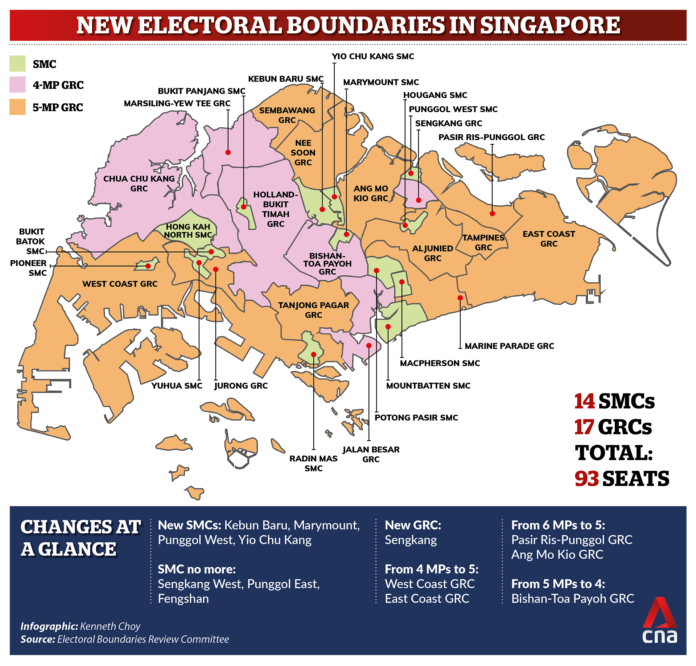
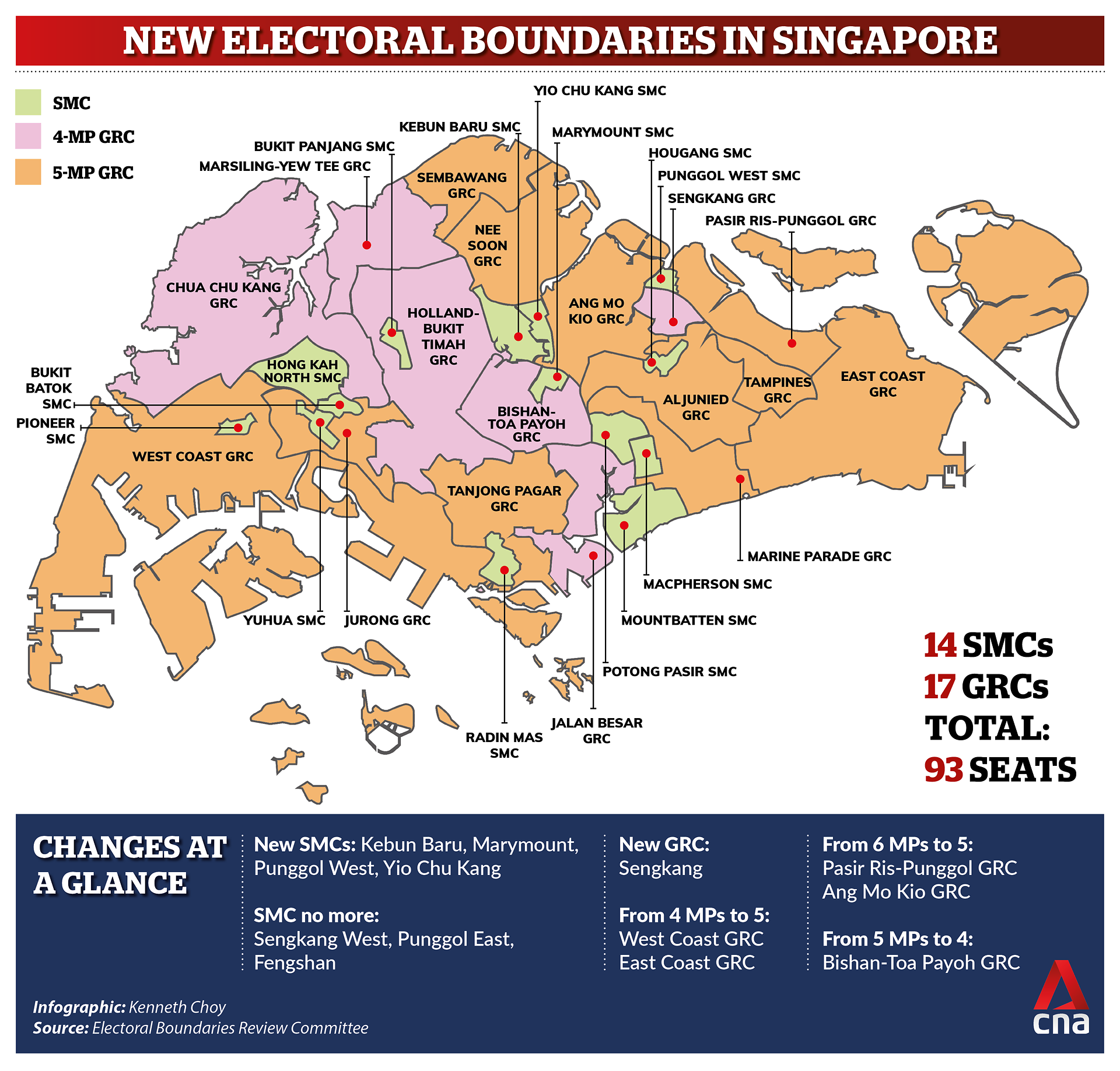
SINGAPORE: The removal of six-member Group Representation Constituencies (GRCs) and smaller constituencies could be a good thing for opposition parties that typically have difficulties forming bigger teams, political observers said on Friday (Mar 13).
There will be 14 Single Member Constituencies (SMCs), one molast re than the current 13. The two existing six-member GRCs – Ang Mo Kio and Pasir Ris-Punggol – have been reduced to five members, while Bishan-Toa Payoh GRC, which currently has five MPs, will now be a four-member GRC.
The next General Election (GE) has to be called by April next year.
Deputy director of research at the Institute of Policy Studies Dr Gillian Koh said the changes increase the contestability of elections, which means more parties might find the size less intimidating, and if they are small, they are more able to contemplate contesting in them. This is the principle of contestability, she said.
“Raising its (contestability) level is a positive step for democracy in the case of Singapore. It must be possible for more or all political parties to feel that they can present their political alternatives to the people,” she said in response to queries from CNA after the release of the Electoral Boundaries Review Committee report.
The parties should feel that they are able to contest in SMCs and GRCs, instead of feeling that there are too many barriers to entry in terms of resources that they do not have, said Dr Koh, who is also a senior research fellow in the Governance and Economy Department.
“These moves are good for the smaller opposition parties – they make an election seem fairer to them,” she said.
She also noted that there are no changes to the boundaries of constituencies held by the “leading” opposition party, Workers’ Party (WP), which is good for them, she said.
Former Member of Parliament (MP) Inderjit Singh offered a similar analysis.
There have been constant calls to reduce the size of GRCs to be fairer to the opposition as they generally have difficulties forming bigger teams to compete, he said.
“I believe the opposition parties will feel they have a better chance in some of the constituencies now,” he said.
However, he added that it is not unexpected that the sizes of the GRCs would decrease, as Prime Minister Lee Hsien Loong had already indicated that he wanted such changes.
CHANGES TO MAKE PAP STRONGER IN SOME WARDS
While Mr Singh called the changes “fair” and not done to benefit just the ruling People’s Action Party, changes to constituencies like East Coast and West Coast benefit the PAP more, he said.
The East Coast and West Coast GRCs, which currently have four MPs, will have five seats. Fengshan SMC, which was carved out of the East Coast GRC in the last GE in 2015, has been re-absorbed into the GRC.
Both Punggol East and Sengkang West will be absorbed into a new Sengkang GRC. Mr Singh said that Punggol East being dissolved could be put to incumbent Charles Chong probably retiring.
“The PAP would be taking risks sending a new candidate to the SMC,” he said.
Dr Koh noted that the closest fights among the SMCs in the last GE were Punggol East, Fengshan and Sengkang West, which have now been wiped off the map.
“It is notable that they are now absorbed into larger entities. This will ease the pressure on the incumbents there … These changes favour the PAP in reducing the risk of a weak showing if there has been no shift in political opinion and affiliation in the ground from the last election,” she said.
Political analyst Mustafa Izzuddin said the dissolution of the three SMCs could be a setback for WP, which had contested all three in 2015 and where the WP had been working the ground.
“Party leaders may need to revise and refashion their electoral strategy for the upcoming election,” said the research fellow with the National University of Singapore’s Institute of South Asian Studies.
WHEN WILL THE GENERAL ELECTION BE CALLED?
The EBRC issuing its report puts Singapore a step closer to a GE, said Dr Koh.
“There can be months before it is called but it does place all political parties on notice,” she said.
“A contest is imminent and they have to decide where they wish to contest and which candidates to field.”
Parties will also need to handle issues such as finding “good people” to nominate and assent to candidates, as well as readying election deposits, she added.
“My own reading is that GE will be called very soon, in a month or two,” said Mr Singh.
The PAP will want to quickly form a strong government to tackle issues such as the economy and the coronavirus outbreak, which could last a few years, he said.
“Waiting too long may hurt the economy and Singapore more than calling a snap election now,” he added.
However, given the “social distancing” guidelines put in place on Friday – including restrictions on gatherings of more than 250 people – political analyst Felix Tan said it is unlikely that the election will be called in the coming weeks.
“Rallies and campaigning would be a little bit challenging,” said the SIM Global Education associate lecturer.
While such restrictions put an election in either March and April “out of the question”, he expects that it may be called in May when the COVID-19 situation here is likely to be “more settled”, adding that voters are already expecting an election this year.
“If May is too much of a risk given the COVID-19 crisis, the last quarter of 2020 is a possibility,” said Dr Mustafa.
“Either way, what is certain enough is that the election will likely be held this year because the Government has tended not to favour holding an election the year it is due, which in this instance is 2021.”
IMPACT OF COVID-19
The ruling party’s handling of the current COVID-19 crisis, which has won praise from international bodies such as the World Health Organization (WHO), is likely to give it a strong mandate in the coming election, analysts said.
“I think what we are seeing is that the Government is handling the pandemic pretty well,” said Dr Tan, adding this is likely to sway voters towards the incumbent PAP.
Having an election while the COVID-19 outbreak may still possibly escalate will give the advantage to parties that have been “tending the political ground on an on-going basis”, said Dr Koh.
This benefits the incumbent party if voters feel that it has provided “a firm and steady hand in government” in guiding the country through the outbreak, she added.
Recent policy reforms in areas such as education, housing and cost of living may suggest to voters that their concerns are being addressed, she noted.
“So apart from the politics, the PAP may be viewed as having done its homework and has policies that put it in a good place politically, quite apart from the question of how it is managing the COVID-19 situation.”
A second stimulus package, which Deputy Prime Minister Heng Swee Keat said was in the works to address both the global economic downturn and the COVID-19 outbreak, may be something the PAP is offering as part of its election strategy, said Dr Koh.
“That may be a somewhat controversial strategy but it is also something that many voters do ask for – to spend the reserves on a rainy day which seems to have arrived,” she said, noting this comes after political leaders had committed to forfeiting one month’s pay in light of the coronavirus.
“The gestures will certainly be noticed and discussed in the hustings,” she said.
Two years ago, at 20, I thought I had everything going for me until doctors discovered a tumour near my spine, during a medical check-up for my back pain. The health scare has since given me a new perspective on life.
Then, I was in a state of emotional turmoil when I first heard the news. I had to undergo the tumour removal operation within a week after I met with the doctors, for fear that any delay could affect my walking ability.
I asked myself, why did this happen to me? I’m only 20.
I was scared as the thought of death crossed my mind. The days leading up to the operation were my darkest moments.
I dropped out from The New Paper New Face 2016 contest to undergo the operation. It was the second competition I had joined, following my early exit from the 2013 The Final One singing contest, where I fell on my back while onstage.
Luckily, the operation was successful, and I was back on my feet in a month, and my then-boyfriend, Marc Than, proposed to me.