Singapore Airlines (SIA) is asking customers to only contact it for assistance for flights departing within the next 72 hours.
The national carrier has struggled to cope with a high number of enquiries about cancellations arising from the coronavirus outbreak, which has left some customers waiting for hours.
In a note sent to the media yesterday, SIA said that it is experiencing an “extraordinarily high volume of customer enquiries at our customer services centres, reservation and sales offices, and social media channels”, following travel restrictions that have affected its services.
“Customers are encouraged to only contact us if their flight is departing within the next 72 hours in order for our agents to focus on and assist those with urgent flight changes,” said SIA.
“Customers with flight dates beyond the next 72 hours are advised to reach out closer to their trip.”
The airline added that customers can also fill in an online form on its website, and an agent will get in touch with them as soon as possible.
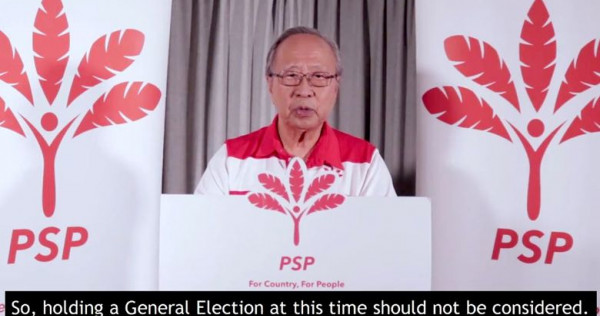
Dr Tan Cheng Bock, who leads the Progress Singapore Party, strongly urged the Government not to hold polls during the Covid-19 pandemic, even suggesting that a caretaker government could be formed if elections cannot be held by April 2021.
In a three-minute video put up on Facebook, Dr Tan said the release of the electoral boundaries report on Friday was an indication that an election was coming soon and he questioned if one should be held in the midst of the outbreak.
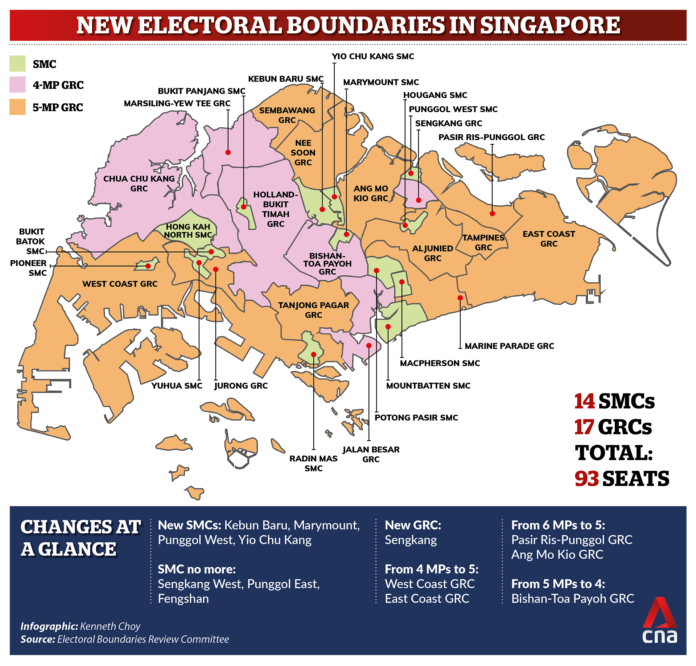
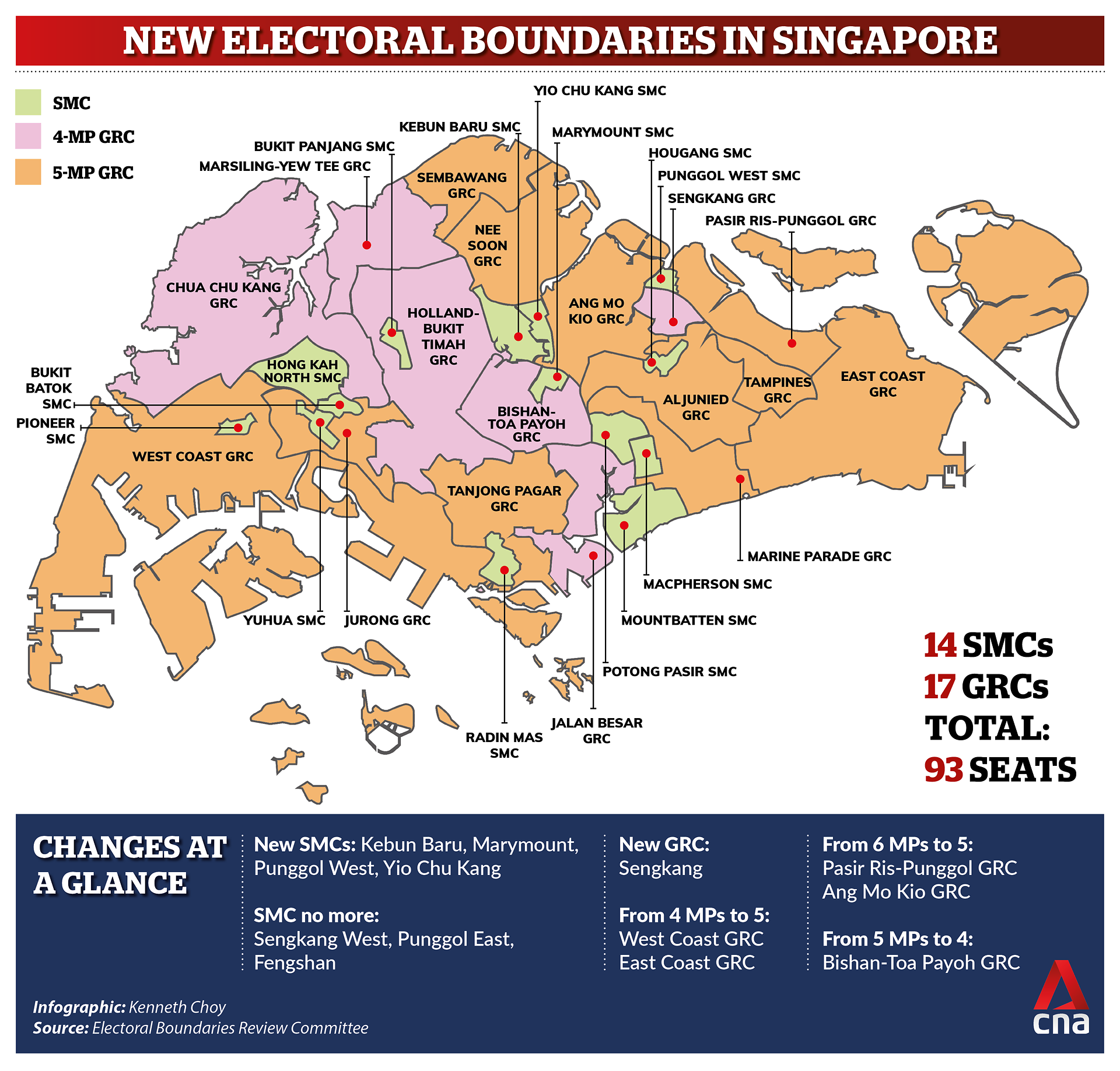
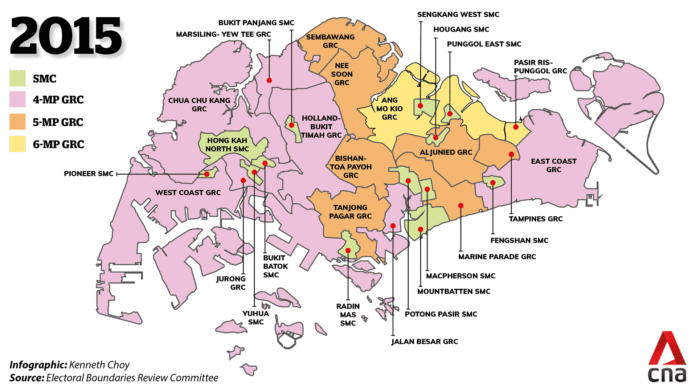
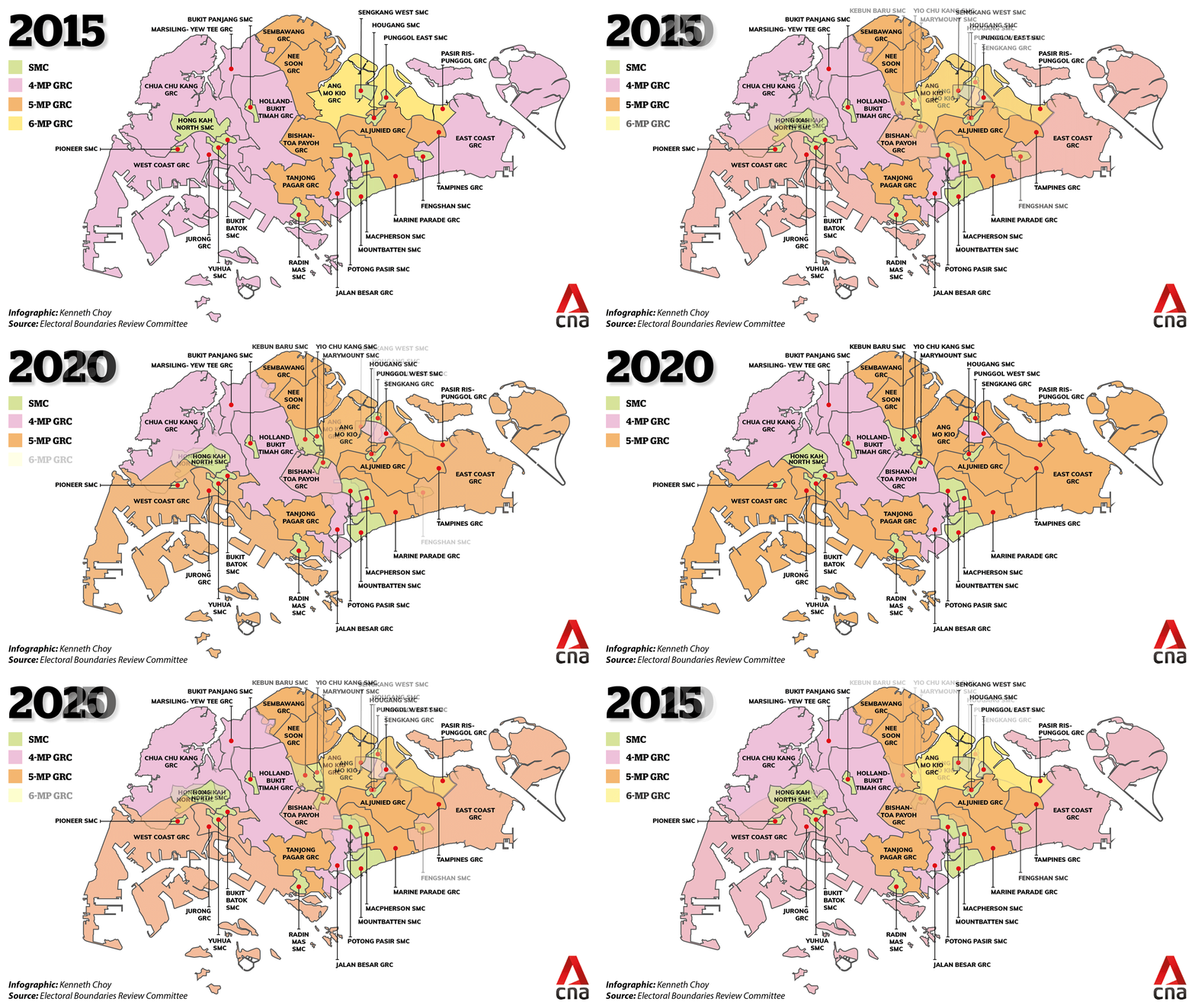
SINGAPORE: One can’t fault the Electoral Boundaries Review Committee (EBRC), which released its report on Friday (Mar 13) and fulfilled its mission to the letter – to further reduce the average size of the Group Representation Constituencies (GRCs) and to have more than the 13 Single Member Constituencies (SMCs).
Some observers consider the changes, which include one more SMC and the removal of six-member GRCs, a positive step for democracy, with increased contestability and a sense of fairness, if it encourages more parties to compete in the race.
Another positive outcome is the increase in the number of Members of Parliament (MPs) from 89 to 93, which roughly maintains the representation ratio for each MP at just slightly below 28,000 electors, instead of 29,200, if the number of MPs had stayed the same.
This is in line with the EBRC’s primary tasks to review the boundaries of the electoral divisions based on current demographical distribution and recommend the number and mapping of boundaries of GRCs and SMCs, taking into account the number of voters in each electoral division.
It has also largely achieved its other objective of an estimated 20,000 to 38,000 voters per MP, although an exception is Potong Pasir SMC, longstanding stronghold of opposition veteran Chiam See Tong up until 2011, which remains below this minimum threshold but has been topped up with more voters from 16,739 to 18,551 voters.
On balance, the EBRC, comprising senior civil servants, has completed its due diligence and achieved its stated objectives. The Government has accepted the recommendations.
Still, changes in the boundaries will continue to come under scrutiny as parties begin to make sense of what these mean for their preparations for the political battle ahead and as commentators read the tea leaves to derive implications for the General Elections (GE).
MIXED SENTIMENTS OVER CHANGES IN GRCS
Huge GRCs have been a lightning rod for decades. While introduced as a three-member system in 1988 to bring in minority candidates, the consequent effect of the GRC system in reducing electoral contest appeared evident in 1991, when 10 out of the 15 GRCs were walkovers for the People’s Action Party (PAP).
Part of the reason of this result was a deliberate by-election strategy of the opposition to concede sufficient seats so the PAP could form the government of the day, while the opposition campaigned on the message of a check-and-balance to the ruling party.
But this approach also belied the difficulty opposition parties faced in attracting high-calibre candidates, what more forming a strong team of four or five to challenge established PAP candidates.
Additionally, the more members there are in a GRC, the riskier it is for the opposition to concentrate already scarce resources there, instead of spreading these over more chances to win in various SMCs.
Six-member GRCs first became a feature at the 1997 GE. In 2001, four-member GRCs disappeared completely, with all 14 GRCs either five- or six-member constituencies.
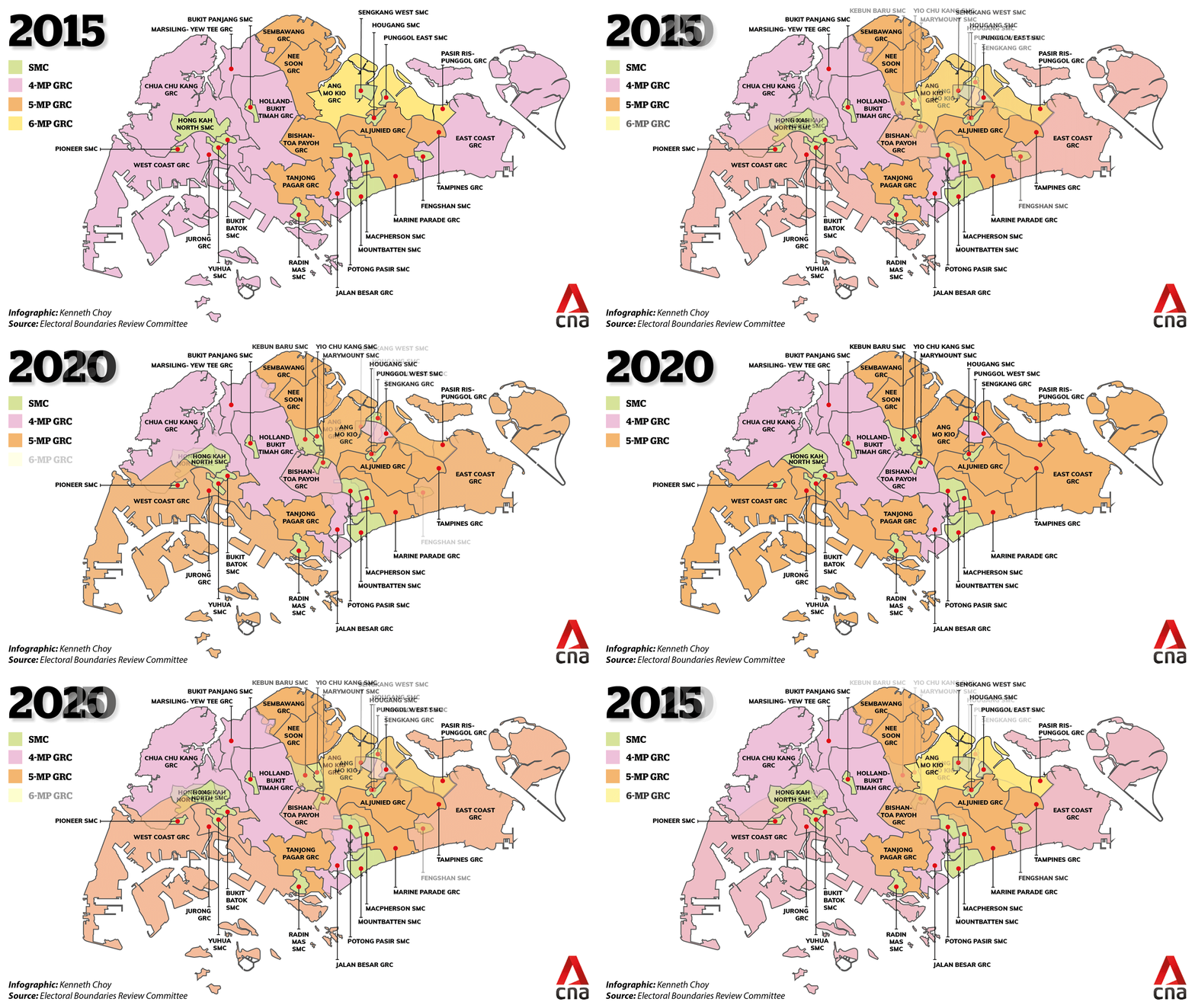
The number of six-member GRCs were reduced from five to two in 2011. Despite expectations they would go completely in 2015, after PM Lee indicated he had asked for the average GRC size to be reduced then, the last two, Pasir Ris-Punggol and Ang Mo Kio remained six-member GRCs.
Hence, the doing away of six-member GRCs in this EBRC’s report has been met with broad approval, potentially going some way to address sentiments that bigger GRCs allow new MPs to ride on the coat-tails of established veterans into Parliament.
Yet, overall, while the directive given to reduce the average size of GRCs has now been achieved, the irony is that net effect has been a slight increase in the number of GRCs overall from 16 to 17.
Meanwhile, two four-member GRCs, West Coast and East Coast, widely identified to be key battlegrounds in the next GE by experts, have been enlarged to become five-member GRCs.
It also remains to be seen if the reduction in size in in the six-member GRCs anchored by Prime Minister Lee Hsien Loong and Senior Minister Teo Chee Hean respectively will move the needle for opposition parties contesting there, some of whom were dubbed “suicide squads” in past polls.
MIXED SENTIMENTS OVER CHANGES IN SMCS
Since the introduction of GRCs in 1988, SMCs – up until Aljunied GRC was first contested and won by the Workers’ Party at the watershed 2011 election – were the few sites of electoral excitement in Singapore. GEs in Singapore were otherwise deemed uneventful, even boring.
This year’s increase in SMCs from 13 in 2015 to 14 is less significant when one considers we had 42 SMCs in 1988 and 21 SMCs in 1991. The contraction started in 1997 when SMC numbers dropped to 9 and stayed unchanged up to 2006.
Over the years, electoral battles fought over SMCs like Potong Pasir, MacPherson and, most recently, Joo Chiat entered Singapore’s political folklore.
The controversy surrounding Joo Chiat SMC’s elimination in 2015 is particularly instructive in making sense of the changes with Sengkang West, Punggol East and Fengshan SMCs dissolved for the forthcoming GE.
In 2011, Joo Chiat SMC was hotly contested by the opposition Workers’ Party (WP) candidate Yee Jenn Jong. Yee lost by 388 votes or 1 per cent, the narrowest of margins, to PAP old hand MP Charles Chong.
Yee continued to work the ground after Joo Chiat was absorbed into Marine Parade GRC in 2015, but lost. That episode remained a source of frustration for him and the WP.
This is also where the silence over specific changes surrounding which SMCs are dissolved and which remain were arrived at in the EBRC report sheds little light.
Indeed, since Sengkang West, Punggol East and Fengshan SMCs have been reasonably strong stomping ground for WP candidates since 2011, experts have concluded these changes favour the PAP.
Meanwhile, the creation of the four new SMCs – namely, Marymount, Yio Chu Kang, Punggol West and Kebun Baru – served currently by members of Cabinet Josephine Teo, Koh Poh Koon and Sun Xueling, and 2015 entrant Henry Kwek, are worth watching to see if the incumbents will stand in those wards.
Facing such a challenge would allow these Singapore national leaders to earn their electoral spurs, with victory bolstering the winning MPs’ positions.
A COVID-19 GENERAL ELECTION?
While observers have focused on how the boundaries could shape electoral strategies and individual parties’ chances of winning specific seats, the global pandemic that is COVID-19 is undoubtedly the elephant in the room that may be the ultimate game-changer.
A man seen wearing a protective face mask at Chinatown, Singapore on Mar 11. (Photo: Gaya Chandramohan)
COVID-19 has become a perfect, albeit unforeseen, backdrop for the PAP that will allow it to command the narrative, while the disease engulfs many other countries around the world.
Many major media outlets across the globe have reported on Singapore’s management of the coronavirus outbreak with aplomb, through a combination of quick detection and diagnosis, strict quarantine measures and open communication, with PM Lee’s two addresses receiving the thumbs-up for its honesty and effectiveness in tackling concerns.
During a period of uncertainty, voters may give more weightage to the PAP’s track record, including its stewardship of the country during the SARS episode and the global financial crisis, and technocratic credentials.
AN E-ELECTION?
If a GE is called amid the pandemic, Singaporeans could also see the advent of e-rallies and other electoral innovations.
This would be ironic given how Singapore has been wary about electronic campaigning, going as far as to ban podcasts and vodcasts back in 2006.
An e-election is also not beyond the realm of possibility as Singapore is one of the most digitally networked societies in the world and the Government has a much stronger online machinery today than in the past.
While speculation that Singapore could go to the polls as early as May is rife, it is not a foregone conclusion, where doing so could backfire if voters see this to be an opportunistic act that risks public health and safety.
PM Lee laid out the options in a Facebook post on Saturday. “We have two choices. Either hope and pray that things will stabilise … Or else call elections early, knowing that we are going into a hurricane, to elect a new government with a fresh mandate and a full term ahead of it, which can work with Singaporeans on the critical tasks at hand,” PM Lee said.
And so I leave you with one final thought: The possibility that the release of the EBRC report does not herald an imminent GE in the first half of this year.
If there is significant pushback, the PAP could hold off calling an election until COVID-19 dissipates somewhat. If the situation continues to deteriorate, this could also bolster an eventual argument a fresh mandate to combat the outbreak should be sought.
Trade and Industry Minister Chan Chun Sing’s comments that the EBRC report is “not correlated” to when the GE will be held suggests this should not be ruled out.
Terence Lee is Associate Professor of Communication and Media at Murdoch University, Australia. He is co-editor with Professor Kevin Y L Tan of Voting in Change: Politics of Singapore’s 2011 General Election and Change in Voting: Singapore’s 2015 General Election, both published by Ethos Books.
SINGAPORE: Every day, Tamimi Pohan battles to do things we think nothing of, like going to the toilet on his own.
Even the act of switching on the light at home is nigh impossible, as the switch is too high for him to reach. Having brittle bone disease means this 15-year-old must rely on a wheelchair for his daily activities.
His mother, Sarina Siregar, wishes he could be like any normal teenager. “I want him to be enjoying himself … like I see (with) other children,” she said.
More than anything, he wishes for better mobility. “If I could do anything tomorrow, I’d want to be independent,” he said.
Technology may have some solutions, the series Gadg(AID) discovers. Here are seven ways in which existing technology, meant to bring convenience to the masses, can be tailored to bring independence to persons with physical disabilities, like Tamimi.
From left: Dad Muliadi Pohan, Tamimi, sister Tiurma and Mdm Siregar.
1. CAN’T SWITCH ON LIGHTS AND FANS WITHOUT HELP
Because of his condition, Tamimi sleeps in his parents’ room. He needs them or his helper to carry him onto his wheelchair. And he needs help with activities like switching on the lights and the fan.
The advent of voice-enabled technology, however, has opened up new possibilities for him in terms of accessibility.
Gadg(AID) enlisted the help of Cheryl Chiang, co-founder of smart home solutions provider Home-A-Genius, to fit his home out with voice-control devices and smart switches.
The firm also upgraded his iPad so that he could control the fan, the light switches and even adjust the brightness and colour of the lights.
Gadg(AID) host Preston Lim with Cheryl Chiang and Tamimi.
“Now you don’t need to scramble for the remote control any more,” Chiang told him. “You can use your voice. You can use the app to control the devices in your house.”
She also automated the living room curtains so that he will be able to open or close them by shaking a smart cube controller.
“Every morning, I can switch on the lights by myself, and I can also switch the fan on and off,” he said. “It makes me feel independent.”
2. FLYING IS CHALLENGING
Tamimi previously spent four months creating artworks of his home, to show the public what life with his condition is like.
He was invited to showcase them in an exhibition in Bali, but travelling overseas for him is pretty daunting as a wheelchair user.
To help him, Gadg(AID) asked Eugene Soh, the founder of Dude Studios, to “transport” Tamimi to the exhibition by using virtual reality (VR) technology.
This creative tech studio has used VR to enable nursing home residents to explore the Great Wall of China.
For Tamimi, Soh flew to Bali to film a VR experience of the exhibition and even captured the way attendees responded to his works.
Tamimi was able to view this with a pair of VR goggles. He was entranced as he saw and heard the people commenting on his drawings.
“It helps me make it more realistic, and it makes me feel like I’m actually there,” he said. “My favourite part was the encouraging comments … It motivates me to do more artworks.”
3. DIFFICULTY REACHING FOR THINGS IN THE FRIDGE
Paralympian Yip Pin Xiu, who suffers from muscular dystrophy or more specifically Charcot-Marie-Tooth — a disease that results in muscle weakness and atrophy — also lives with her family.
She reckons that when she moves out in future, she will face challenges using the kitchen and cooking her meals. For example, reaching for items high up in the fridge can be a struggle, since she is on a wheelchair.
The good news is that in recent years, manufacturers have made smart kitchens whereby appliances can be controlled remotely.
A smart fridge would allow her to see what is inside using a mobile app, instead of her having to go to the kitchen.
But some limitations remain. “I’ll only be able to use half the fridge because anything higher, I won’t be able to reach it,” she said.
4. HAVING TROUBLE TURNING THE OVEN KNOBS
Yip also lacks fine motor skills, so tasks that require a certain dexterity, like buttoning clothes, tying her hair and turning the knobs on an oven are hard.
There are smart ovens, however, which Pin Xiu can control from her smartphone, allowing her to preheat, regulate and switch off the oven remotely.
So she need not fiddle with the knobs or enter and exit the kitchen multiple times during the cooking process. But even with these smart equipment, she still needs help with things like washing and chopping ingredients.
5. CAN’T GRIP HEAVY ITEMS
Yip often has problems gripping heavy or hot items but a robotic glove invented by local company Roceso Technologies may be able to help her with her grip.
The Esoglove was invented to help stroke patients regain their grip strength during physical rehabilitation. It does so detecting muscle signals and guide patients to move their fingers.
With the Esoglove, she was able to hold a tumbler with one hand, instead of two which she usually uses.
While the Esoglove is primarily used for therapy purposes, there are plans to develop a portable assistive glove more suitable for fine auto movements and daily use, said Jane Wang, the chief executive officer of Roceso Technologies.
6. NOT ALL PAVEMENTS ARE WHEELCHAIR-FRIENDLY
The other problem that Yip faces is trying to navigate around Singapore’s paths and streets on a wheelchair, which can be challenging because of obstacles such as kerbs and uneven terrain.
Some of the pavements are too narrow for wheelchairs.
“One problem that I have with a newer place is that sometimes I go in with a lot of apprehension, I don’t know what I am going to face,” she related.
To help wheelchair users like her, Kong Song Wei, lead engineer of SmartBFA, said they are developing a route-planning app which can locate barrier-free routes in Singapore.
The app, called Smart Barrier Free Access uses colours to indicate pavement quality, green for a smooth path, orange for an uneven one and red for a bumpy ride.
After trying out the app, Yip liked the idea of having such information on one’s smartphone and knowing which barrier-free routes to take.
She thinks the app will be very useful in encouraging the disabled to go out more often and to explore more of Singapore.
“But I think there is still a bit of limitation in it. The general areas near the roads are well mapped up but I hope to see in future (more data on path accessibility) on the smaller routes, like inside the housing estates,” she said.
7. FEW SCHOOLS EQUIPPED WITH SMART TECHNOLOGY
There are about 19 special needs schools in Singapore but only a few are equipped with some form of smart home technology.
Manju Mohta, an occupational therapist with the Cerebral Palsy Alliance Singapore (CPAS), said that any technology which reduces manual effort will benefit people with disabilities more than able-bodied people.
Part of her job is to find technology that helps those with little control over their physical movement triumph over their limitations.
For example, one of her ideas was the setting up of a smart kitchen in the CPAS connected to smart switches where students are able to work the lights and fans with their voice.
With a limited budget of S$3,000, the kitchen was all the school could afford to deck out.
In Singapore, there are subsidies for the disabled to buy assistive technology.
“They might not achieve 100 per cent independence, but when we see the shift from 100 per cent dependent to 30 per cent independence. They’re quite happy,” she said.
SINGAPORE: During the Ministry of Trade and Industry’s (MTI) Committee of Supply debate, Minister Chan Chun Sing said that Singapore will expand its network of free trade agreements (FTAs), so as to not “overly rely on any one particular market”.
Meanwhile, the COVID-19 outbreak is making headlines, and has had knock-on effects on economies worldwide. In response to concerns about the outbreak, the MTI cut its growth forecast range for 2020 to -0.5 per cent and 1.5 percent, down from an earlier forecast of 0.5 per cent to 2.5 per cent.
Companies, big and small, have been affected as normal economic activities are displaced or delayed. To help tide companies through these uncertain times, the Government has pledged a slew of measures, including a S$4 billion Stabilisation and Support package to help workers remain employed and companies maintain cash flow.
How, then, would more free trade agreements (FTAs) help buffer our economy – considering that Singapore already has 25 FTAs with economies that represent more than 85 per cent of global GDP?
COVID-19 HIGHLIGHTS NEED FOR DIVERSIFICATION
The impact of COVID-19 on business activities has thrown the importance of diversification and the need for back-up plans into sharp focus for both businesses and individuals.
For businesses which have established supply chains of ingredients, raw materials or intermediate goods for its operations, the combination of city lockdowns, factory shutdowns, travel restrictions, logistics delays and drastic changes in demand for certain items such as electronic and automobile parts, building materials and consumer items purchased on e-commerce platforms have led to disruption of many such chains.
If an affected business is unable to quickly switch to alternative suppliers, its operations may be imperilled.
From another perspective, a business which is located within such a supply chain may find that its goods are stuck at borders or in warehouses, if it has no alternative fulfilment avenues.
Trade and Industry Minister Chan Chun Sing speaking in Parliament on Feb 4, 2020.
At the consumer level, a visit to the neighbourhood store may lead to disappointment and panic for some when an item is not in stock due to unusually high demand. Indeed, consumers, too, have realised that they may need to diversify their sources, by resorting to other stores or online purchases.
FTAs HAVE HELPED SINGAPORE DIVERSIFY
Although COVID-19 drives home the need for diversification, this need has always existed. Singapore’s food supply, for example, is largely imported and is a good example of the need for all-weather diversification of supply.
Ensuring continual availability of staple food items, for example, can be facilitated by diversified trade networks, and FTAs which promote faster and lower-cost movement of goods across borders.
The FTAs which Singapore has with other trading nations provides for a smoother flow of goods, services and investments between our businesses and those in other countries, and more open access to foreign markets which may otherwise be blocked or hampered by national import rules and procedures.
Such access represents “outbound” trade opportunities, as FTA legal rules can help to reduce tariff and other barriers such as “red tape”, to give Singapore businesses preferential market access overseas.
Such diversification allows Singapore businesses to tap different overseas markets when their usual markets are adversely affected.
While Singapore’s FTAs have already paved the way to a large number of markets, such as ASEAN, Australia, New Zealand, China, India, South Korea, Japan, the US, and through the Comprehensive and Progressive Agreement for Trans-Pacific Partnership (CPTPP), Mexico and Canada – and soon, the European Union (EU), when the EU-Singapore FTA comes into force – there remain relatively new markets in the Southern hemisphere and Central Asia which beckon.
RESPONDING TO THE TRADE WAR
A further dimension is the ongoing decoupling of supply chains of the US and China. While Singapore’s FTAs may be with countries which cover 85 per cent of global GDP, business activities do not always align exactly with FTA geography, as commercial decisions are dependent on many factors such as costs, quality, risks and availability.
EU Trade Commissioner-designate Phil Hogan and Singapore’s Minister-in-charge of trade relations S Iswaran at a gala dinner on Nov 8, 2019. (Photo: MTI)
A business may find that it needs to include in its supply chains, suppliers found in more than one set of FTA countries. As each FTA carries its own set of controlling “rules of origin” to determine what goods can benefit from its terms, such a business may find that it has to navigate a number of FTAs – each with its own “rules of origin” – to realise the benefits.
For example, a Singapore company may need to source for parts from a number of countries to manufacture its final product. The company may then wish to export the product to separate markets, such as those of the EU and ASEAN, where preferential access would be controlled by different FTAs.
In an ideal world, multilateral rules would facilitate trade more broadly around the globe, but with WTO trade negotiations sputtering in recent years, FTAs have had to serve the role of paving the way for businesses in a nimbler way.
The US-China decoupling requires quick responses by businesses, and a wide network of trade agreements can help facilitate flows through new goods supply chains.
FTAs also promote the flow of services. Digital services, for example, flow particularly well across borders to buyers far away, and Singapore businesses offering such services can look to exploit opportunities, unhampered by geography or time zones, in new markets opened up by FTAs.
DIVERSIFYING WHERE WE GET OUR SUPPLIES FROM
Apart from export markets, FTAs can also facilitate inbound trade opportunities, allowing Singapore businesses to locate alternative suppliers for their customers or supply chains. They may also provide for improved legal protection for investments made in each other’s countries. This last point may not seem to be related to diversification, but an example allows us to see its relevance.
Trade and Industry Minister Chan Chun Sing (left) with Chinese Vice Minister of Commerce and China International Trade Representative Fu Ziying at the conclusion of the Singapore-China FTA upgrading talks in 2018. (Photo: MTI)
Rice is a staple food in Singapore, and its availability is ensured through various means, including a national stockpile and purchases from a variety of countries. Having FTAs with various countries can smoothen the way to such diversified purchasing by creating new sourcing channels and by reducing the time taken for their rice exports to reach Singapore.
Singapore businesses may also choose to invest in production facilities overseas to ensure both the availability and quality of rice for Singapore consumers. Such investments can be protected through an FTA with the country in which the investment is made. This can also apply to Singaporean investments in the overseas production of goods in non-food sectors.
For the consumer, enhanced trade opportunities with newer markets mean opportunities to enjoy imported goods from a variety of sources, if, for example, climatic or other conditions in a familiar source country turn problematic. In practical terms, it means that one can still enjoy rice, meat, eggs, vegetables, bananas and avocados, even if one of Singapore’s usual supplying sources is unable to deliver such items for any reason.
Diversified trade can therefore bring two-way gains.
FTAs can promote trade diversification through export and investment opportunities in overseas markets, new supply chain networks, and greater import flexibility, security and peace of mind for businesses and consumers.
As regional or global events cause significant dislocations and adjustments in supply chains, Singapore will be no doubt be planning the most effective ways to remain a leader of global trade connectivity, through its FTAs and other arrangements.
Locknie Hsu is Professor of Law at the School of Law at the Singapore Management University.
SINGAPORE: The problem of mental health among employees in Singapore is real.
Four in 10 Singaporeans had gross misconceptions and therefore prejudices about persons with mental health conditions.
These were but some of the findings in the Attitudes Study on Persons with Mental Health conditions by the National Council of Social Service (NCSS) in 2018. The same study also found that nearly one in two Singaporeans are unwilling to work with colleagues facing mental health issues.
The Singapore Mental Health Survey 2016 revealed that the rate of unemployment among those with at least one mental disorder was 8.3 per cent which was significantly higher than the 4.8 per cent rate of unemployment in those without mental illness.
STEPS IN THE RIGHT DIRECTION
In December 2019, the Tripartite Alliance for Fair Employment Practices announced (TAFEP) updated its guidelines to employers that asking job applications to declare their mental health conditions without good reason is discriminatory – a move that many had advocated for many years, which I also echoed in my maiden speech in Parliament in November 2018.
Last week at the Committee of Supply debate, in response to my and other MPs’ questions, the Ministry of Manpower announced that a tripartite advisory on mental well-being will be issued in the second half of this year to educate employers on what could be done.
Despite these steps in the right direction, many have asked me to talk about the elephant in the room: Are these efforts and measures enough to make employers hire and retain persons with mental health issues? Yes, because there are real benefits to doing so.
Today, evidence shows that investing in workplace mental well-being is not only the right thing but also the smart thing to do as it improves productivity and long-term business sustainability.
A 2017 survey of 505 companies by NCSS found that for every S$1 invested in workplace adjustment (like flexible work arrangements, job redesign, peer training) to support persons recovering from mental health conditions, it generated an average return of S$5.60 through a reduction in absenteeism and medical claims as well as an increase in productivity.
In fact, I think the real elephant in the room is this: With one in seven people in Singapore experiencing a mental health condition in their lifetime, employers know they cannot pretend that mental health and well-being is someone else’s problem because part of our workforce will have to grapple with mental health conditions while under employment.
One in seven people in Singapore will be experiencing a mental health condition in their lifetimes. File photo. (Photo: TODAY/Nuria Ling)
With young adults most at risk of suffering from mental disorders in Singapore as reported in the Singapore Mental Health Study, hiring and talent retention practices must clearly evolve now to support these millennial employees so that businesses can thrive in the future economy.
COMMUNITY INITIATIVES
There has been a groundswell of community efforts in recent years to raise and promote awareness of mental health.
Beyond the Label, an anti-stigma campaign launched by NCSS in 2018, helped start a much needed national conversation on mental health.
Recognising that leaders play a key role in integrating well-being in their company because they shape the company’s culture, 25 C-suite leaders from public and private sectors joined me to start the WorkWell Leaders Workgroup (WLW) in May 2018 to share, discuss and co-create fair and inclusive practices to support employee mental health as a strategic priority.
Many wonder how employers would view them if they come forward to share their mental health challenges. I think there is nothing more powerful in creating a safe and destigmatising environment than bosses and leaders taking the first step to share their own mental health journeys.
Accenture, a WLW leader, is a trailblazer in creating such psychological safety in their workplaces. Sharing his own story of coping with anxiety, Senior Partner Pavan Sethi certainly led by example and helped create a space of trust for his team members to understand that should they face mental health difficulties, they aren’t any less valued.
Here are some examples from a handful of our WLW leaders on how they employ and support persons with mental health conditions:
At Johnson & Johnson, “mental health diplomats” are employees with lived experiences of mental conditions and allies who encourage peer-to-peer conversations about mental health and well-being.
At Aviva and the Agency for Integrated Care (AIC), they have in place necessary coaching, counselling and peer support structures alongside flexible work arrangement policies for employees who live with mental health conditions.
NCSS is a pioneer in Singapore with training 22 wellness warriors in mental health first aid to be “first respondents” for distressed colleagues. It has also produced a Mental Health Toolkit for Employers.
EMPLOYERS NEED A PARADIGM SHIFT
Small and medium-sized enterprises need to be, in my view, even more progressive and adaptive in their attraction and retention strategies, given the local talent war with larger employers and reducing dependence on foreign manpower.
Hush TeaBar was founded to promote mental wellness and empathy with silence and tea in workplaces, out of my own brush with depression when my world collapsed around me 13 years ago. The team is made up entirely of seven differently-abled employees – Deaf persons and persons who live with mental health conditions and learning difficulties.
Nominated Member of Parliament Anthea Ong (second from left) with Hush TeaBar staff (in green) at one of their diversity sessions. (Photo: Facebook/Hush TeaBar)
For almost two years now, the team has been running all projects for large MNCs and schools, even creating our current campaign to distribute our specially designed self-care kits to healthcare workers, completely on their own. Yes, we have had to make many workplace adjustments and job redesign but I see that as precious lessons in adaptability and innovation as Hush continues to thrive with these dedicated and resilient employees who are able to fulfill their true potential.
Minister of State for Manpower and National Development Zaqy Mohamad mentioned in parliament last week pilots and police officers as professions in which good mental health is important. Some may even say that for jobs like doctors, teachers and bus drivers we must surely insist on good mental health as a prerequisite.
Yet this is the paradigm shift we need to make. Mental health is not just good or bad, nor now or never – it is a continuum because our environment and life events play a significant role in our mental wellbeing.
We mustn’t forget that “human” comes first when we talk about human resources or human capital.
Former CEO of the HSBC Group John Flint started a very progressive conversation with the bank’s 238,000 employees across 55 countries on how to be the best version of themselves. Among those who have gone through mental health conditions, John learnt that “they are the ones who often possess a resilience, a resourcefulness, an empathy and an EQ that the rest do not possess”.
I cannot agree more. Resilient companies are built from resilient employees, and every employee is a member of our society.
Anthea Ong is a Nominated Member of Parliament, Member of the Tripartite Oversight Committee for Workplace Safety & Health, Founder of WorkWell Leaders Workgroup, Hush TeaBar, A Good Space and formerly held senior leadership positions in various MNCs. She is also Author of 50 Shades of Love (www.antheaong.com)
SINGAPORE: Progress Singapore Party (PSP) chief Tan Cheng Bock has joined other opposition leaders in pressing for the next General Election not to be held until after the COVID-19 outbreak.
“We have a COVID-19 pandemic crisis now. Is it wise to hold a General Election in the midst of this COVID-19 pandemic?” he said in a video statement on the party’s Facebook page on Saturday (Mar 14).
“We are exposing more than 2.6 million voters to the virus on Polling Day because voting is compulsory and everyone must go to the polling stations to cast their votes.”
He pointed out that rallies and election activities during election campaigning can lead to mass exposure to the virus.
“Holding a General Election at this time should not be considered,” he said.
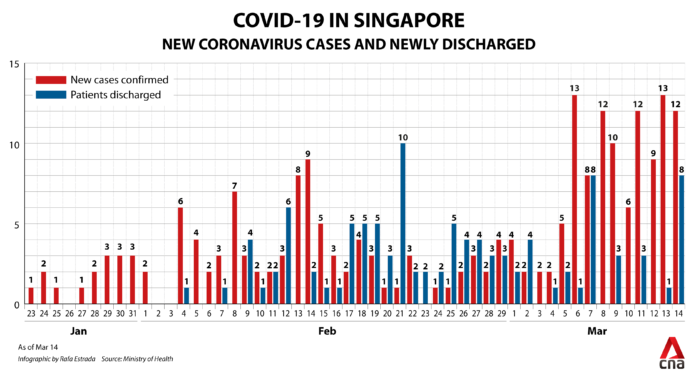
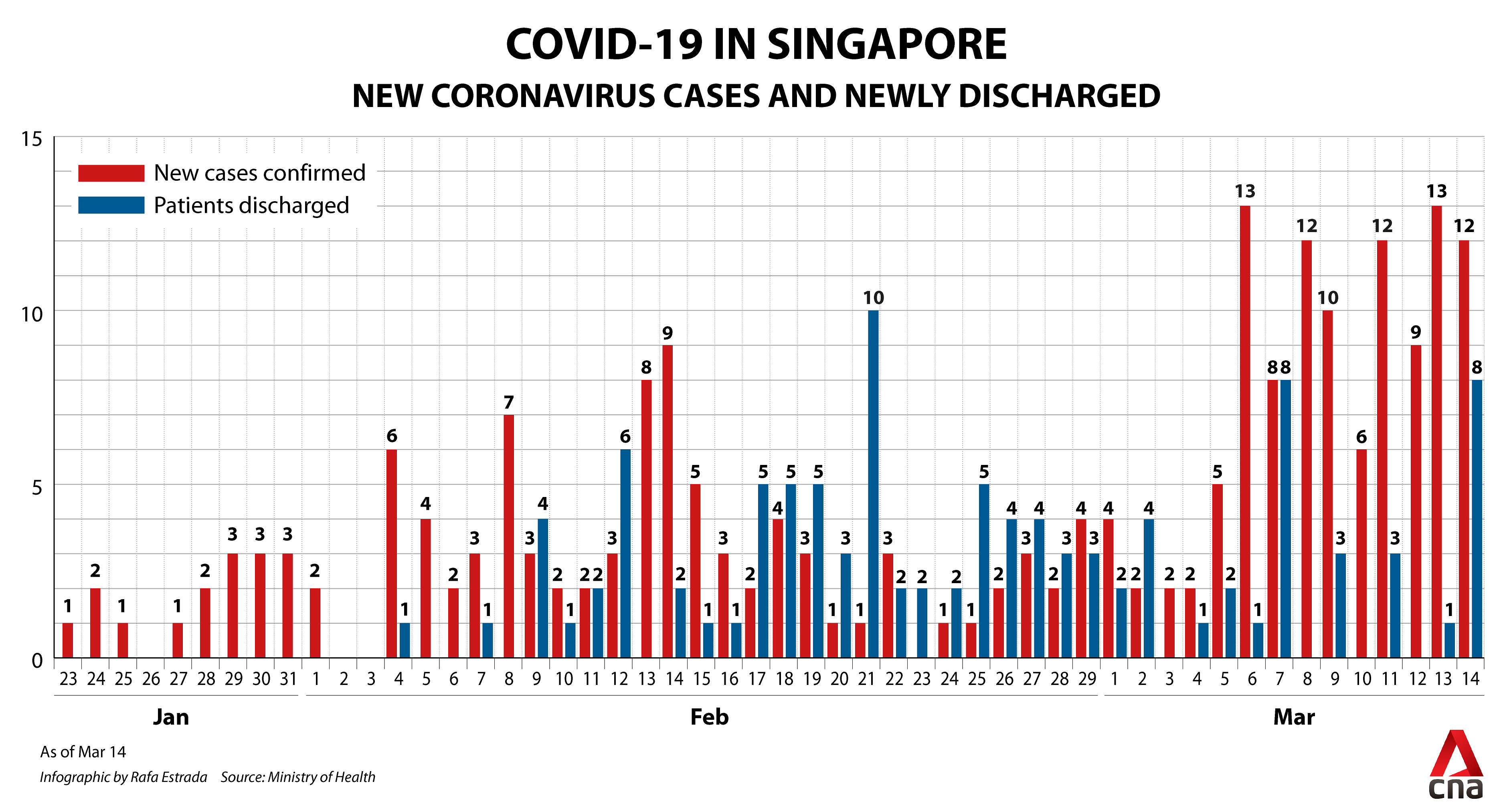
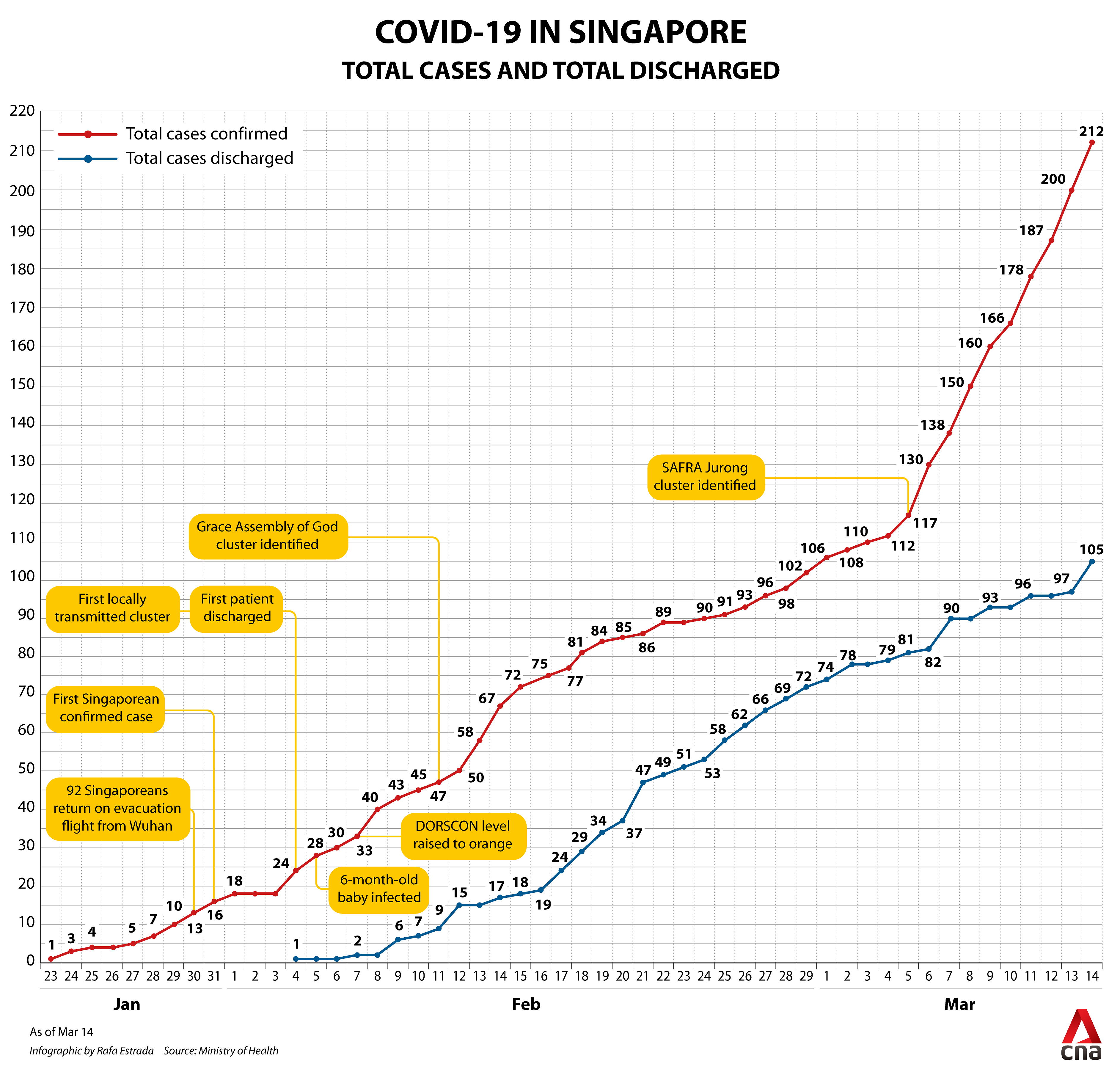
A total of 212 cases of COVID-19 have been confirmed in Singapore, with 105 patients recovered and discharged from hospital.
Authorities in Singapore had on Friday announced additional social-distancing measures, such as deferring or cancelling events attended by more than 250 people.
All mosques have been temporarily shut for cleaning after a number of Singaporeans were infected with COVID-19 at a religious gathering in Malaysia. Many churches and other places of worship have also suspended services and mass activities.
The Electoral Boundaries Review Committee released its report on Friday announcing changes to the electoral divisions in Singapore.
This is seen by most as a sign that elections are imminent, with past polls being held no more than three months after the report’s release.
Prime Minister Lee Hsien Loong has not ruled out holding the General Election amid the COVID-19 crisis, saying in a Facebook post on Saturday that Singapore can hold elections after things stabilise or call elections early.
“We have two choices. Either hope and pray that things will stabilise before the end of the term so that we can hold elections under more normal circumstances – but we have no certainty of that,” he wrote.
“Or else call elections early, knowing that we are going into a hurricane, to elect a new government with a fresh mandate and a full term ahead of it, which can work with Singaporeans on the critical tasks at hand.”
Precautions will be taken if elections are to be held before the COVID-19 situation is over, he added.
Other opposition parties, including the Singapore Democratic Party and the Singapore People’s Party, have also voiced objections to elections being called in such circumstances.
Dr Tan raised three alternatives: To hold the election when COVID-19 is “no longer a crisis”, to hold it at the end of the current government’s term in April 2021, or to delay it even after that.
“If the pandemic is still with us by then, the President can exercise her soft power and form a caretaker government consisting of some of the current MPs,” he said. “Subsequently, call for fresh elections when COVID-19 is no longer a crisis.”
He added: “(The PSP) strongly urge the Government not to hold a General Election while the COVID-19 pandemic is still with us.”
On Saturday night, Reform Party leader Kenneth Jeyaretnam added his objections to calling the election during the coronavirus outbreak, while declaring where the party will stand if the election is called.
“This is a fake election that is totally unnecessary and called before it’s due. Clear proof that the PM puts himself first, then the interests of his family, his party before lastly the interests of the country,” he wrote.
“But whatever the date Reform Party will be contesting West Coast as it has in 2011 and 2015. We will also be contesting Ang Mo Kio, Radin Mas and the new SMC of Yio Chu Kang which has been hived off from AMK (Ang Mo Kio).”
SINGAPORE: The Ministry of Health announced 12 new COVID-19 cases – with nine imported ones – on Saturday (Mar 14), bringing the country’s total to 212.
The new cases in Singapore also include one case linked to the SAFRA Jurong cluster, one linked to a previous case and one patient with no links.
A total of eight people have recovered and been discharged from hospital. In all, 105 have fully recovered from the infection, MOH said.
Of the 107 confirmed cases who are still in hospital, most are stable or improving, MOH said, adding 14 are in critical condition in the intensive care unit.
NEW CASES
CASE 201
Case 201 is a 52-year-old female Singapore citizen, linked to the largest cluster in Singapore to date – the SAFRA Jurong cluster.
She has no recent travel history to affected countries and region. She is currently warded in an isolation room at Ng Teng Fong General Hospital (NTFGH). She is linked to the cluster involving the private dinner function at SAFRA Jurong.
She first reported symptoms on Mar 5 and was confirmed to have the virus on Friday afternoon.
Prior to hospital admission, she mostly stayed at her home at Teck Whye Lane.
CASE 202
Case 202 is an imported case involving a 44-year-old Singaporean man who had been in Malaysia from Feb 28 to Mar 3. He said he first showed symptoms on Mar 3 and tested positive for the virus on Friday afternoon.
Before he was hospitalised, the man visited Masjid Al-Mawaddah, Masjid Jamae and Masjid Al-Istiqamah.
He is currently warded in an isolation room at Sengkang General Hospital (SKH).
CASE 203
Case 203 is likely to be an imported case involving a 36-year-old Singaporean woman who had been in Indonesia from Mar 6 to Mar 8. She first reported symptoms on Mar 11 shortly after her return. She was confirmed to have the virus on Friday afternoon.
She is currently warded in an isolation room at Changi General Hospital (CGH). Before she was hospitalised, she stayed at Pasir Ris Street 51.
CASE 204
Case 204 is an imported case involving a 32-year-old American man who is a Singapore work pass holder, and had been in Japan from Feb 29 to Mar 8. He is currently warded in an isolation room at Singapore General Hospital (SGH).
He lives in the Tanjong Pagar Road area and first reported symptoms on Mar 11 and sought treatment the next day. He was confirmed to have the virus on Friday afternoon.
CASE 205
Case 205 is an imported case involving a 30-year-old Filipino woman who is a Singapore long term visit pass holder, and had been in the Philippines from Feb 27 to Mar 6.
She was confirmed to have COVID-19 infection on Saturday morning, and is currently warded in an isolation room at the National Centre for Infectious Diseases (NCID).
CASE 206
Case 206 is an imported case involving a 33-year-old woman from the New Zealand who is a long term visit pass holder in Singapore.
She had been to the United States from Feb 28 to Mar 13, and tested positive for the virus on Mar 14.
CASE 207
Case 207 is an imported case involving a 40-year-old Singaporean woman who had been in the United Kingdom from Mar 6 to Mar 11. She was confirmed to have COVID-19 infection on Saturday morning and is currently warded in an isolation room at NCID.
CASE 208
Case 208 is a 26-year-old Singaporean woman who has no recent travel history to affected countries and regions. She was confirmed to have COVID-19 infection on Saturday morning, and is currently warded in an isolation room at NCID.
CASE 209
Case 209 is an imported case involving a 32-year-old Singaporean woman who had been in the United States from Mar 2 to Mar 7 She was confirmed to have COVID-19 infection on Saturday morning, and is currently warded in an isolation room at SGH.
CASE 210
Case 210 is an imported case involving a 56-year-old German man who is a Singapore long term visit pass holder. He travelled to Germany from Feb 27 to Mar 3, and again from Mar 11 to Mar 12, and Switzerland from Mar 3 to Mar 10.
He was confirmed to have COVID-19 infection on Saturday morning and is currently warded in an isolation room at NCID.
CASE 211
Case 211 is a 35-year-old female Filipino national who is a long term visit pass holder in Singapore. She was confirmed to have COVID-19 infection on Saturday morning, and is currently warded in an isolation room at NCID. She is linked to Case 142, a 26-year-old Singaporean man who is a family member of two patients from the SAFRA Jurong cluster.
CASE 212
Case 212 is an imported case involving a 64-year-old Indonesian man. He was confirmed to have COVID-19 infection on Saturday morning, and is currently warded in an isolation room at NCID.
As of Saturday, 12pm, MOH has identified 5,244 close contacts who have been quarantined. Of these, 1,712 are currently quarantined, and 3,532 have completed their quarantine.
MORE MEASURES IN SINGAPORE, SHARES TAKE HIT
As the the coronavirus situation develops in Singapore and abroad, authorities here have adopted more precautionary measures and wider travel restrictions.
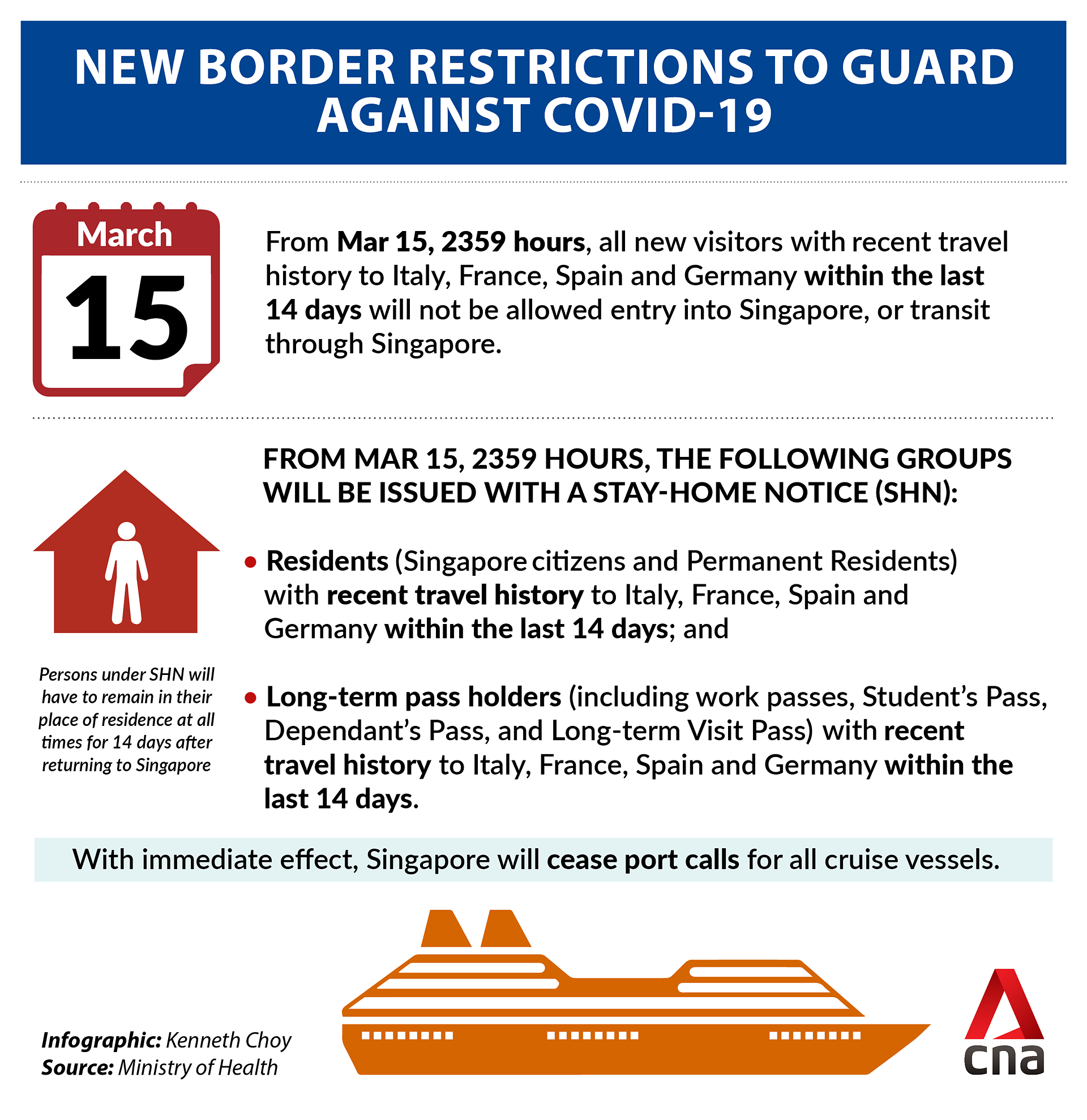
On Friday, MOH announced Singapore will block entry or transit for visitors with travel history to Italy, France, Spain and Germany within the last 14 days, amid a surge of COVID-19 cases in Europe.
The new border restrictions, which take effect on Sunday at 11.59pm, come after an increase in imported cases in Singapore, particularly of those with travel history to European countries.
SINGAPORE: The release of the Electoral Boundaries Review Committee (EBRC) report is “not correlated” to when the General Election will be called, said Minister for Trade and Industry Chan Chun Sing on Saturday (Mar 14).
Responding to questions about the release of the report and when elections will be called, he said: “Let’s not get ahead of ourselves. This is the release of the EBRC report, it makes no comment on when the elections will be held.”
Earlier on Saturday, Singapore Democratic Party (SDP) chief Chee Soon Juan had criticised the timing of the release of the EBRC report, saying that the General Election should only be held after there are “clear signs” that the COVID-19 situation has abated.
“Don’t forget, they (EBRC) had seven to eight months to do this. But it waits till the point where this outbreak of the virus is at its worst, pandemic has just been declared,” Dr Chee had said.
The World Health Organization had on Wednesday declared the global COVID-19 outbreak a pandemic. As of Saturday morning, the disease has killed more than 5,000 people and infected 140,000 all over the world.
“It is the worst of possible times for us to call for elections at this stage … PAP (People’s Action Party) cannot be more irresponsible to do something like this when we should be focusing our state resources, that the minds of Singaporeans at least on overcoming, conquering this virus,” Dr Chee added.
In past elections, Parliament had been dissolved between one day and about two months after the EBRC report was released, leading analysts and opposition parties to speculate that the next polls will be called as early as May.
The COVID-19 situation, however, is likely to last “a year or more”, Prime Minister Lee Hsien Loong had said in a televised message on Thursday.
The Singapore People’s Party (SPP) also said on Friday that holding the General Election during the COVID-19 outbreak “would be most irresponsible”.
“This is not the time for partisan politics, but for national unity. It would be nothing less than irresponsible for the Government to call a General Election while the COVID-19 situation is rapidly evolving,” said SPP in a statement published on their Facebook page on Friday.
“We are confident that the Government will not risk exacerbating the outbreak by calling for a general election before the situation has stabilised. There is nothing more important than the health of all Singaporeans.”
Minister for Trade and Industry, Chan Chun Sing interacting with staff of the Singapore Zoo on Mar 14, 2020 to understand how they have upheld good sanitation and hygiene practices to contain the spread of COVID-19. (Photo: Hanidah Amin)
Speaking to reporters after a tour at the Singapore Zoo, where he presented the SG Clean certificate to Wildlife Reserves Singapore, Mr Chan noted that the “focus at this point in time” is the COVID-19 outbreak.
“I think we have a situation that we need to manage at this point in time, our energy is all focused on managing the current situation, at the same time creating those conditions for our eventual recovery, and that when the recovery comes we would be able to distinguish ourselves.”
According to the EBRC report released on Friday, there will be more electoral divisions and no six-member Group Representation Constituencies (GRCs) in the coming election.
The committee recommended the adoption of 31 electoral divisions, up from 29, with a total of 93 seats in Parliament, four more than the 89 in the House currently.
A new Sengkang GRC has been created with four seats, bringing the number of GRCs to 17, up from the current 16. There will also be 14 SMCs, one more than the current 13.
No matter how much you enjoy each other’s company, date nights can get a little dull and routine if you keep going to the same places.
Thankfully, Singapore has plenty of interesting locations for you and bae to explore. Check out our list of dating spots for some the best places to go on your next date.
Do you and bae enjoy doing outdoor activities? Why not head down to Forest Adventure and challenge yourselves to a treetop obstacle course?
Located at Bedok Reservoir Park, the thrilling obstacle course has 44 wobbly crossings and 3 giant zip-lines over the water. After going through a safety briefing, you are free to proceed at your own pace while instructors will be on the ground if you need any help.
The two of you will definitely have an unforgettable experience as you work together to overcome the obstacles and reach the end of the course!