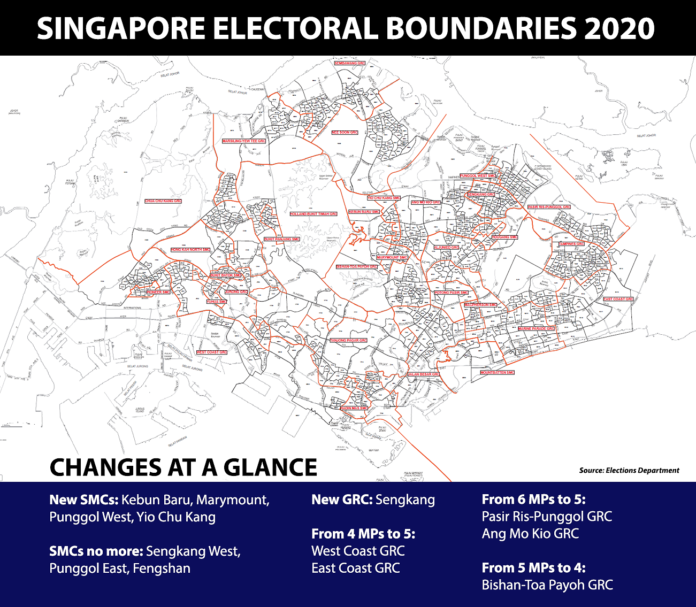
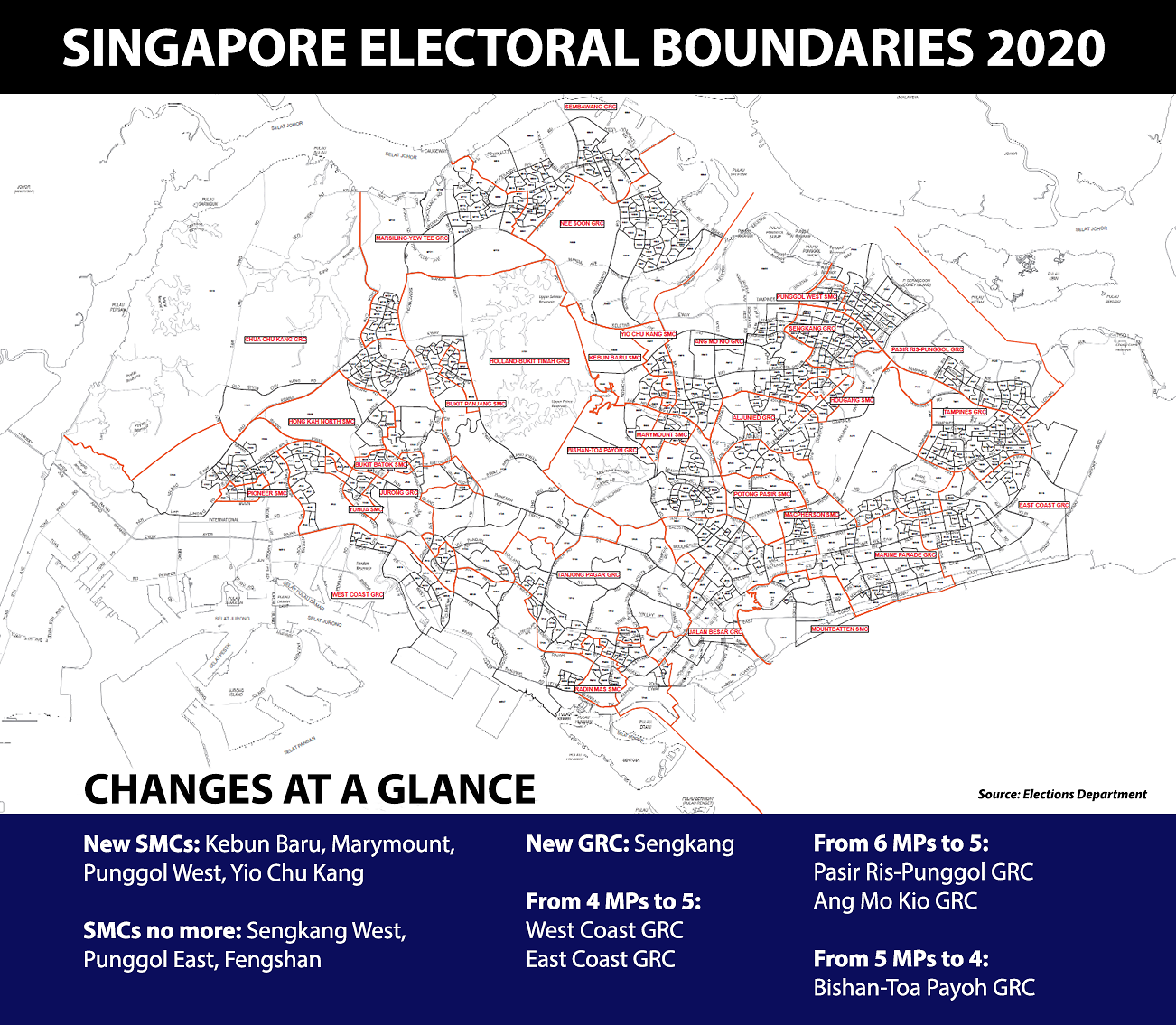
SINGAPORE: There will be more electoral divisions and no six-member Group Representation Constituencies (GRCs) in the coming election, according to the Electoral Boundaries Review Committee’s (EBRC) report released on Friday (Mar 13).
The committee recommended the adoption of 31 electoral divisions, up from 29, with a total of 93 seats in Parliament, four more than the 89 in the House currently.
A new Sengkang GRC has been created with four seats, bringing the number of GRCs to 17, up from the current 16.
There will be 14 Single Member Constituencies (SMCs), one more than the current 13.
The Government has accepted the committee’s recommendations and will implement them in the next election.
This means that the next GE, which must be held by early April 2021, is likely to be called soon.
The next step is for President Halimah Yacob to dissolve Parliament on Prime Minister Lee Hsien Loong’s advice, a development that had taken between just a day and more than two months from the release of the EBRC’s report in past elections.
In 2015, the report was released on Jul 24, a month before parliament was dissolved. Polling day was on Sep 11, 2015.
NEW SINGLE-MEMBER WARDS, NEW GRC
Four of the single-member wards are new – Kebun Baru, Marymount, Punggol West and Yio Chu Kang. Three SMCs have been wiped off the map: Fengshan, Punggol East and Sengkang West.
Both wards under the Workers’ Party – Aljunied GRC and Hougang SMC – remain.
Of the 17 GRCs, six have four members and 11 have five members. The six-member GRCs – Ang Mo Kio and Pasir Ris-Punggol – have been reduced to five members.
The East Coast and West Coast GRCs, which currently have four Members of Parliament (MPs), will have five seats.
The other five-member GRCs are: Aljunied, Jurong, Marine Parade, Nee Soon, Sembawang, Tampines and Tanjong Pagar.
Bishan-Toa Payoh GRC, which currently has five MPs, will have its seats reduced to four.
Including the new Sengkang GRC, the other four-member GRCs are: Chua Chu Kang, Holland-Bukit Timah, Jalan Besar and Marsiling-Yew Tee.
When the formation of the EBRC was announced last year, ELD said that it had been asked to further reduce the average size of the GRCs and to have more SMCs.
In the next election, 79 candidates will stand in GRCs, working out to an average of 4.65 MPs per GRC. This is lower than the 4.75 MPs per GRC in the 2015 GE and the five MPs per GRC in 2011. The figure had peaked at 5.36 in 2001 and 2006 before falling in the last two elections.
In 2015, the majority of GRCs – eight – had five candidates, while there were six GRCs with four members each. Only two GRCs had six MPs each – Ang Mo Kio and Pasir Ris-Punggol.
The GRC system was established in 1988 to ensure that the minority races will be represented in Parliament.
GRCs can have three to six MPs and at least one of them must be from a minority race. Moreover, the number of GRCs with a Malay MP cannot be more than three-fifths the total number of GRCs.
INCREASE IN ELECTORS SINCE 2015
It has taken the EBRC, a committee made up of five senior public servants, eight months to release its report since the committee was formed in August.
For each election, the committee considers population growth and shifts due to housing development.
The number of electors in the latest Registers of Electors as of Apr 15, 2019, is 2,594,740, an increase of 134,256 electors from 2,460,484 electors certified on Apr 7, 2015.
On Wednesday, Deputy Prime Minister Heng Swee Keat said that the COVID-19 outbreak in Singapore will be a “major factor” in deciding when the Government decides to call for elections.
Speaking at a roundtable discussion organised by the Straits Times and Business Times, Mr Heng said the elections have to be called before April next year so “we cannot deviate from that”.
“What we must do, is to create the conditions that will allow us to manage the situation to the best of our abilities. Looking at the global developments, I think the virus outbreak is likely to stay with us for longer,” he said.
It may get more challenging in the months ahead for the Government to deal with the COVID-19 situation, but “we need to be able to respond as fully as we can as one country, and as a people”, he added.
A Hyundai driver has run afoul of the internet after he was filmed driving his car into a flock of chickens at Jalan Pemimpin.
The answer to the perpetual question of why did the chickens cross the road remains untold, but the more pressing query should be this: was the man even aware of his transgression in the first place?
While things aren’t so clear-cut from the footage, that hasn’t stopped netizens from picking up their digital pitchforks and calling for the driver to be identified.
The post that got them all riled up was shared by Wun Chiang on the Complaint Singapore Facebook group yesterday (March 12), which has since garnered hundreds of reposts and hundreds more furious comments.
After a few months of beta, Riot Games’ brand-new free-to-play collectible card game (CCG), Legends of Runeterra, has launched on mobile devices, first exclusively in Singapore.
Starting today, March 11, 2020, players in Singapore will be able to download the full game via iOS and Android, and will also be able to access the PC open Beta that is currently live for other regions. This means that players in the Little Red Dot can be the first in the world to experience the cross-platform feature of the game.
To download Legends of Runeterra, on either the App Store or Google Play Store, players have to set the app’s region to “Singapore”, while also being physically in Singapore to be able to download the game. Additionally, a Riot account must be created if one hasn’t done so already. After that, the game can be played on the go, or on PC with the same Riot account.
No news on the full release of the PC version of Legends of Runeterra or its mobile version in other regions has yet been announced.
SINGAPORE: Singapore will block entry or transit for visitors who travelled to Italy, France, Spain and Germany within the last 14 days, amid a surge of COVID-19 cases in Europe.
The new border restrictions, which take effect on Sunday (Mar 15) at 11.59pm, come after an increase in imported cases in Singapore, particularly of those with travel history to European countries, the Ministry of Health (MOH) said on Friday.
As of Thursday, nearly 25 per cent of all COVID-19 cases – or 47 cases out of 187 – in Singapore were imported, according to Health Minister Gan Kim Yong.
“Over the past 10 days alone, there have been 23 imported cases, or nearly a third of all new cases. These included 13 cases with travel history to European countries and six cases from Indonesia,” MOH said.
“We cannot be complacent. Despite our best efforts at contact tracing and ring-fencing confirmed cases, we still see new cases every day, and increasingly, more imported cases,” Mr Gan said.
Singapore citizens, permanent residents and long-term pass holders who travelled to Italy, France, Spain and Germany within the last 14 days will be issued with a Stay-Home Notice.
Those issued with the notice will have to remain in their place of residence at all times for 14 days after returning to Singapore.
“All border restrictions are temporary, and will be reviewed regularly based on the global situation,” the health ministry said.
From left to right: Medical services director at the Health Ministry Kenneth Mak, Health Minister Gan Kim Yong, National Development Minister Lawrence Wong; at a press conference on Mar 13, 2020. (Photo: Gaya Chandramohan)
With immediate effect, all visitors entering Singapore with fever or symptoms of respiratory illness will also be issued with a 14-day Stay-Home Notice, regardless of their travel history.
Such travellers were previously required to undergo a COVID-19 swab test and, if tested negative, may be allowed to enter Singapore.
Now, even if the swab test is negative for COVID-19, they will be issued with a Stay-Home Notice.
“A swab test that is negative at the point of test may not be sufficient assurance because that person who is already exhibiting some symptoms – be it fever or respiratory symptoms – may be just going through the incubation stage of the virus,” said National Development Minister Lawrence Wong, who co-chairs the multi-ministry taskforce for COVID-19.
“In doing this surveillance, we will pay particular attention to these countries where we have seen imported cases, and we want to be quite stringent about this,” he added.
Those who meet the clinical suspect case definition will be taken to a hospital for follow-up, MOH said.
Singapore will also cease port calls for all cruise ships with immediate effect.
The ministry advised Singaporeans to defer “all non-essential travel” to Italy, France, Spain and Germany as well.
“The four countries have had very high numbers of cases and very high rates of increase,” MOH said.
Italy, the worst-hit country outside China, on Thursday said the number of its COVID-19 cases has exceeded 15,000, with more than 1,000 dead. France, Spain and Germany have reported nearly 3,000 cases each.
Existing travel advisories to defer all travel to Hubei, where the coronavirus outbreak began, and non-essential travel to the rest of mainland China, Iran, Japan and South Korea remain, MOH said.
Singaporeans should also be cautious when travelling to other countries hit by the deadly virus, including Indonesia, Philippines and the UK, it said.
“Even as we continue to tighten border controls, we know that it will not be tenable for us to close our borders to every affected country and region and shut ourselves out from the world,” said Health Minister Gan Kim Yong.
SINGAPORE – Virtual telco Zero Mobile’s operating licence was suspended with immediate effect on Thursday (March 12) by the Infocomm Media Development Authority (IMDA).
This was due to Zero Mobile’s failure to address outstanding billing disputes with former subscribers in spite of repeated reminders following the cessation of the company’s service plans in December, IMDA said.
The company and its directors have also been blacklisted by IMDA. Based in Australia, the mobile virtual network operator (MVNO) does not have any operations there; Singapore is its only market.
“IMDA is investigating Zero Mobile for contraventions of consumer protection requirements under IMDA’s Telecom Competition Code, and will take enforcement action if there are any breaches,” IMDA said in a press statement.
About 230 former subscribers are affected by Zero Mobile’s service cessation. IMDA said it has worked with Zero Mobile to ensure that the porting of the customers’ numbers to other telcos and advised affected former subscribers to stop their recurring auto-payment arrangements, if any, with Zero Mobile.
It’s a place associated with worship and peace, but a mosque along Tiong Bahru Road recently became the setting of a fight between two men and a woman.
In a video clip that is making its rounds on social media, the men could be seen taking turns to attack a woman wearing a red tudung.
One of them was seen picking up a plastic chair to hit the woman, while the other rained blows on her upper body, and did not relent even after she fell to the ground.
As they attacked the woman, she appeared to be holding up a cane-like object to block their blows.
The man recording the fight could be heard yelling in Malay: “Oi oi oi! Have you lost your mind? Oi! Aren’t you ashamed?”
PHOTO: Facebook screengrab
However, some netizens took issue with his actions, and said he should have stepped in to help break up the fight.
It is theoretically possible that Covid-19 could be damaging to men’s reproductive health, according to an article published on the Hubei government’s website on Thursday, only to be removed a few hours later.
Men who had contracted the disease and recovered from it should seek medical advice on whether it might have had a detrimental impact on their fertility, said the piece, which was produced by a team from the reproductive medicine centre at Tongji Hospital in Wuhan, the capital of Hubei.
While there was no evidence to suggest the infection could damage the male reproductive system, it was theoretically possible as the coronavirus was genetically similar to the one that caused SARS (severe acute respiratory syndrome), it said.
The infection could result in “impairment of immune homeostasis in the testes”, which could cause orchitis – an inflammation of the testicles – which in turn could reduce a man’s sperm count and possibly lead to infertility, it said.
Both Covid-19 and SARS invade cells by combining with an enzyme called Ace2, which exists in large amounts in the testicles, as well as in other organs like the kidneys and heart.
SINGAPORE – Three teenagers have been arrested over an alleged spitting incident in a shopping mall in central Singapore.
The two males and one female are aged between 17 and 19, the police said in a statement on Thursday (March 12).
The incident came to light after a video was posted online showing a male teenager spitting from a high floor in a shopping mall. A police report was made on March 3.
Investigations showed that an 18-year-old male was on level 4 of the mall when he committed the act on Feb 28 at about 6.30pm. Police did not name the mall.
The act was recorded and the video was later uploaded on his friend’s social media accounts. It is unclear how the other two teenagers were involved.
With the help of ground enquiries and images from closed-circuit television cameras (CCTVs), officers from the Central Police Division identified the three teenagers and arrested them.
Investigations are ongoing. Police said in the light of the coronavirus outbreak, such incidents can cause alarm and annoyance.
The arrests came in the wake of earlier incidents also involving teenagers.
SINGAPORE: Even as Singapore moves to expedite the expansion of its bicycle path network, more can be done to encourage cycling as a mode of transport here, said observers.
Last Thursday (Mar 5) during the Transport Ministry’s Committee of Supply debate it was announced that the country’s cycling paths would be doubled to 800km by 2023, two years ahead of schedule.
Senior Minister of State for Transport Lam Pin Min said then that the Government plans to invest more than S$1 billion in the expansion of cycling paths over the next decade as part of the new Islandwide Cycling Network Programme, with such paths expected to span 1,320km islandwide by 2030.
Cycling advocate Francis Chu welcomed the announcement, saying it proved the authorities were committed to promoting “active mobility”.
While it is legal to ride bicycles on both the road and footpaths, such cycling paths are needed as those on bicycles may not feel safe riding alongside motor vehicles, especially on busy roads, said the co-founder of cycling enthusiast group Love Cycling SG.
“Well-designed cycling paths can help more people to use bicycles in such conditions,” he said.
In this regard, more can be done to improve the design and placement of such paths here, he added.
Mr Chu said Singapore’s current arrangement of having cycling paths – where cyclists are able to ride at speeds of up to 25kmh – next to pedestrian footpaths without any barriers between them could pose a danger to vulnerable pedestrians such as children and the elderly.
This is especially since motorised devices such as personal mobility devices (PMDs) and e-bikes are still allowed on cycling paths, he noted.
E-scooters were banned from footpaths in November last year, with other PMDs such as hoverboards and electric unicycles to follow suit in April. But their use remains legal on the 440km of cycling paths islandwide.
While other cities such as New York and London have introduced on-road cycling lanes, Associate Professor Park Byung Joon said such lanes may not be suitable here.
This is because such cycling lanes may further constrict Singapore’s “narrow roads”, said the Singapore University of Social Sciences urban transport expert, adding that this would impact the flow of traffic.
A man rides his bicycle past a view of the financial district in Singapore. (Photo: AFP)
Mr Chu said the authorities here should follow the Dutch example, noting the “vast majority” of cycling paths in the Netherlands are physically separated from pedestrian pathways.
“Physical separation can be bushes, low barriers, or when the space is tight, simply a difference in levels (between the pathways),” he said, suggesting for example that pedestrian pathways could be made 15cm higher than cycling paths.
Width is another factor that should be considered when designing future cycling paths, said Mr Chu, noting this should take into account the location and number of cyclists in a particular area.
He pointed to the Design Manual for Bicycle Traffic published by Dutch transportation non-profit CROW.
The manual suggests a width of at least 1.5m for cycling paths where there are 50 cyclists passing by per hour and a width of at least 3m in each direction for long distance “bicycle highways”.
Singapore’s own Walking and Cycling Design Guide – published by the Land Transport Authority and the Urban Redevelopment Authority in 2018 – says cycling paths should be between 2m and 2.5m wide to cater to cyclists heading in both directions.
Associate Professor Lynette Cheah, who leads the Sustainable Urban Mobility research group at the Singapore University of Technology and Design, said that there should also be continuity between bicycle paths, and that such paths should provide connections to places of interest.
Other factors such as the availability of shower facilities at workplaces as well as the availability of bicycle parking would also help encourage more people to cycle, she said.
In November last year the LTA introduced the Active Mobility Grant – which subsidises up to 80 per cent of construction costs, capped at S$80,000 – for workplaces to provide facilities such as showers and changing rooms to encourage active mobility modes.
Associate Professor Park however cautioned against spending too much on cycling facilities, suggesting that only a small percentage of commuters were likely to switch to cycling for their daily journeys.
Meanwhile, Associate Professor Cheah noted that though public transport features most prominently in Singapore’s car-lite vision, cycling is also important, particularly for shorter trips of up to 8km.
“So the active mobility modes are great for getting around or across your neighbourhood. It also promotes healthier living,” she said.
SINGAPORE: The COVID-19 outbreak has gone global, infecting more than 100,000 people in all continents across the world, except Antarctica.
The World Health Organization (WHO) has now declared this a pandemic to galvanise the world to fight the SARS CoV2 virus which causes COVID-19 disease.
This declaration has had a significant economic impact but it will hopefully succeed in mobilising resources to contain the rapid rise in cases seen globally.
The WHO has also said that this is the first pandemic to be caused by a coronavirus but it will also be the first pandemic that can be controlled.
It is possible that the rapid rise in cases we are now seeing in many countries is the result of infections in highly affected countries reaching a critical point. It may also be a result of the successful detection of infections in countries which have just ramped up testing. In both situations, activating resources will be critical.
COVID-19 cases could also possibly have been missed early in the outbreak, given that its symptoms are similar to influenza and since the early part of the outbreak coincided with the flu season in the northern hemisphere.
Researchers at the University of Washington concluded last week the virus may have been circulating for weeks in the US, after comparing genetic samples of a recent case from a nursing facility in Seattle where there have been a number of deaths, with that from the first US COVID-19 case identified in a traveller in January.
Flowers left by community members rest against a sign at the entrance to the Life Care Center of Kirkland, the long-term care facility linked to several confirmed coronavirus cases in the state on Mar 8, 2020. (Photo: REUTERS/David Ryder)
Other possible explanations for that finding include an unusually long incubation period but that would be harder to prove.
A recent case in Singapore also illustrates the importance of recognising false-positive dengue rapid test results in patients with COVID-19.
TWO TRAJECTORIES THE GLOBAL SPREAD COULD TAKE
The good news? Like SARS, the vast majority of patients with COVID-19 will experience a mild illness. A small proportion, about one in 8 to 10, will require intensive care, and some may not survive.
With SARS, testing only became available weeks after the outbreak began, meaning that many mild cases early on were missed, inflating the fatality rate.
The other big difference between SARS and COVID-19, especially in countries previously affected by SARS, is the high degree of healthcare worker protection, which may mean lower rates of infections in medical professionals working on the frontlines.
The bad news? There are two possible scenarios we foresee going forward.
In these, it is important to keep in mind that the extent of the global outbreak in the following months will depend on many key factors that can be shaped, including public health responses, the developments in rapid testing, demonstration of effective treatments and potentially the roll-out of a vaccine.
In the first scenario, the epidemic slows down in the northern hemisphere as it starts to warm up. Even now, the countries with high chains of transmission are those where the temperature remains in the 10 to 15 degrees Celsius range and below – South Korea, Italy, Iran and other European countries, as well as the northeast and northwest of the US.
While many tropical countries have had some cases, so far, there has not been widespread community transmission so far, perhaps because the higher humidity and warmer weather may be preventing rampant spread.
While the virus might disappear altogether in the northern summer like SARS, there is also the risk that, similar to the influenza pandemics of 1918, 1957 and 1968, the COVID-19 outbreak may slow down during the northern hemisphere summer season, but may return in a second wave in October or November when it gets cold again.
Travelers wear masks in John F Kennedy International Airport in New York, U.S., amid coronavirus reports, March 11, 2020. REUTERS/Lucas Jackson
The second possible scenario is that the COVID-19 disease may turn out not to be sensitive to temperatures, in which case, the spread of infection will continue worldwide for months, at least until herd immunity develops in communities.
Scientists are speculating what proportion of the population will get infected in that case. For H1N1 in 2009, we know that figure was around a quarter of the population after the first wave of infections.
We also know that COVID-19 is more severe than influenza so the impact on healthcare systems, especially in low and middle-income countries can be significant if such large proportions of the population are infected.
While the vast majority of patients with COVID-19 do not spread the infection at all and some spread the infection to only a couple of family members, there are some unique situations that have resulted in much more extensive spread – these have been dubbed “super spreading events”.
One of the first super-spreading events was the Diamond Princess cruise ship that remained off the coast of Japan for 14 days. Eventually, a total of 696 persons were infected out of 3,711 persons onboard, as well as some public health officers.
Cruise ships are already well known for outbreaks of other highly infectious pathogens including the norovirus (known locally as “stomach flu”) and influenza for a variety of reasons, including the close quarters, risk of environmental contamination and generally older population.
Cruise ships, including Costa Fortuna which berthed at Singapore this week, will continue to be watched carefully.
Second, larger gatherings where people huddle together, sing or share food, can potentially lend themselves to huge outbreaks, if there happens to be someone shedding large quantities of virus.
The huge and rapid outbreak in South Korea among members of a religious group, which has over 200,000 members, accounted for more than half of the over 7,000 cases of COVID-19 infections in the country.
Instead of taking the Chinese approach of locking down affected cities, South Korea has embraced a model of open information, public participation and widespread testing AFP/Jung Yeon-je
Third, a large outbreak could happen in communities where there are big numbers of people susceptible to the virus. The nightmare scenario for public health is the COVID-19 outbreak at Life Care Center nursing home in Seattle, Washington, which has become one of the epicentres of the outbreak in the US after seeing at least five COVID-19 related deaths.
Nursing homes have elderly patients with many comorbid conditions. Many live in close quarters with common staff and caretakers.
Thus, there is always a risk of healthcare acquired infections which can spread rapidly, including influenza and other respiratory viruses, norovirus and other gastrointestinal illnesses. The COVID-19 outbreak has led to new screening, visiting and other precautionary measures in many nursing homes and assisted living facilities in the US.
The fear remains that if such incidents occur in other long-term care facilities across the world, the toll on elderly or disabled people from COVID-19 will be significant.
FOCUS ON MEDICAL DEVELOPMENTS, RELOOKING LARGE GATHERINGS AND ENCOURAGING TESTING
Three areas of focus lie ahead in the fight against COVID-19.
First, scientists are already working on treatments. There are studies now enrolling patients (with some starting this week in Singapore) to see if any of the known and newer anti-viral drugs will be effective.
In addition, newer and more effective tests are being developed, including blood tests that can tell whether a person has already been infected such as the one used by Duke-NUS to establish the link between the two church clusters in Singapore.
Second, the need to cancel large gatherings and the impact of social distancing can be better examined once more reliable testing on a population basis can be done.
Third, while countries focus on containing the virus, the key is still in identifying every case. In addition to broadening testing, providing free treatment or compensation for those on medical leave is critical to encourage people to get tested and treated, to ensure that they will not be penalised by their employers, or be deterred by the thought of potential financial difficulties.
This is especially challenging in low-income countries and low-income households with sole bread-winners.
People wearing protective face masks walking at Orchard Road, Singapore on Jan 28. (Photo: Gaya Chandramohan)
Difficult decisions will have to be made while we wait for the scientific consensus or the development of new treatments and vaccines.
Public health authorities must decide when to move from containment, which requires doing costly and labour-intensive contact tracing for every case, to mitigation, where we focus on those who are most vulnerable to prevent complications while keeping track of the situation in the broader community.
With the concerted global effort of clinicians, scientists, public health professionals and the public, there is a good chance, we will succeed in limiting suffering and deaths from COVID-19.
Download our app or subscribe to our Telegram channel for the latest updates on the coronavirus outbreak: https://cna.asia/telegram
Assistant Professor Jyoti Somani works at the Department of Medicine at the Yong Loo Lin School of Medicine at NUS. Professor Paul Ananth Tambyah is President of the Asia Pacific Society of Clinical Microbiology and Infection and works at the same school.