SINGAPORE: One of the first pictures Ivan Bok took through a telescope is the Orion Nebula. It is one of the brightest nebulae located in the Milky Way, visible to the naked eye in the night sky.
“For most people, the first thing that (they really remember) is looking at things like the moon and Saturn,” said the 26-year-old National University of Singapore student.
“But the reason it was this more obscure object (for me) was because I saw it in books. I always thought it was somewhere within the realm of professional astronomy that amateurs like us will never be able to see.
“But turns out it’s actually a really popular amateur target. Even under Singapore’s light-polluted sky, you can still see it.”
Although his attempt at taking a picture of the nebulae – a cloud of interstellar gas and dust – was “horribly blurry”, this was what “hooked” him on astrophotography.
Ivan has taken over a hundred pictures of planets and galaxies, accumulated over his decade-long interest in astrophotography.
FROM A YOUNG AGE
Even as a child, Ivan had been “very interested in science”. He remembered reading astronomy books while in primary school and got his first telescope at the age of eight.
“It was just this refractor from Toys R’ Us,” he said.
His first “real” telescope came in Secondary 2, which he bought from the Singapore Science Centre for S$400, with his own savings.
“Even then, it wasn’t cheap for a secondary school student,” he said.
“Back then, when everybody was buying a PSP (Playstation Portable), I don’t know what went through me, I bought a telescope.”
An image of the Orion Nebula taken by Ivan. (Photo: Ivan Bok)
It was “exciting”, the first time he got to try it out. He remembered that the night sky was cloudless when his father brought him to the ground floor of their flat to set up the telescope.
But Ivan could not remember what was the first object he saw through the telescope, saying it was probably either a planet, or the star Sirius.
He only started taking photographs of the night sky when he got his next telescope three years later. The S$2,000 telescope was computerised. Its tracking mount – which allowed the telescope to automatically track celestial objects across the sky – made it suitable to take pictures with.
DEVELOPING A GOOD IMAGE
By his own admission, the photographs he took for the first two years were “pretty bad”.
“I was doing this entirely alone and I didn’t realise I could shoot from my window,” he said, which meant that opportunities to practice were few and far between.
His equipment also wasn’t ideal for taking pictures of deep sky celestial objects, outside the solar system. He did not use filters either, which meant that he got the “full brunt of Singapore’s light pollution” in his shots.
The filters Ivan uses helps to block Singapore’s light pollution. (Photo: Cindy Co)
The pictures he took improved after he received pointers from someone in the local astrophotography community and upgraded his equipment.
Ivan shared that although the person used basic equipment, he was able to get good images because he spent over an hour shooting the same object.
Long exposures would allow him to collect more light from the objects, and thus more detail.
That inspired him to try it out with his telescope setup, which he has aimed at the heavens from the window of his flat.
Ivan said that the long exposure made “a whole world of difference” after he combined the images digitally.
AN ART AND A SCIENCE
As someone who is interested in both art and science, astrophotography combines the best of both worlds for Ivan. While he has applied his technical know-how to use his telescopes – which he has spent about S$20,000 on – he gets to express his artistic side with the colours he adds to the images.
When he shoots, he creates “false colour” images, which are commonly used by astronomers to make images more comprehensible. “False colour” images are not the same colours that the human eye would see if it were to look at the celestial object directly.
“But this doesn’t mean that the image is fake in that sense. It’s just that the colours that we choose represent a different truth behind the image,” he said.
An image of the Andromeda Galaxy by Ivan. (Photo: Ivan Bok)
Images in false colour would be based on what the photographer finds “aesthetically pleasing”, Ivan said.
“So if you give two astrophotographers the same base data set, you’ll never get an identical image out at the end of the day.”
“ALWAYS A JOURNEY”
Even though he has had his pictures published in two magazines – Astronomy, and Sky and Telescope – Ivan still sees room for improvement.
“It’s definitely always a journey. So there’s never a point where I feel like I ended what I want to do, and I think that’s the beauty of it,” he said.
Other than shooting from his window, Ivan hopes to be able to shoot from dark skies overseas, which gives him a larger variety of objects to shoot. (Photo: Cindy Co)
For now, he is just looking forward to being able to shoot from dark skies, where there is little or no light pollution. He also hopes to capture the images of distant galaxies and nebulae.
When asked if he would consider using his hobby as his primary source of income, Ivan’s answer was a firm “No”.
The double degree Business and Engineering student said that he would rather “segregate work and hobbies” to maintain a balance.
“It is contrary to what a lot of people say. Do something you love and never work for another day. But I feel like if money or livelihood is tied to my enjoyment, it’s going to diminish my enjoyment,” he said.
Instead, he hopes to pursue a career in the corporate world.
But it is the emotional connection that keeps him going with astrophotography, he said.
“I really, really enjoy astronomy (as) it fulfils an innate sense of curiosity about the universe … It creates this connection with the natural world.
“It really drills down to, on one hand, mankind’s insignificance, and on the other hand, what there is that we don’t know. I think these discoveries are what keeps humans progressing.”
SINGAPORE: Former construction company owner Chen Chee Min suffered a stroke in October 2010 which left him paralysed on his left side.
The 59-year-old has had difficulty finding a job following his rehabilitation and learning to walk again. Despite taking the initiative to get retrained, and seeking help from disability organisations, he has only been gainfully employed for one out of the last 10 years.
In Singapore, cases like Mr Chen’s are not uncommon. According to the Ministry of Manpower (MOM), just 28.6 per cent of resident persons with disabilities (PWDs) aged 15 to 64 are employed.
Another 4.2 per cent of PWDs in this age range were without a job and actively looking for one, said Minister of State for Manpower Zaqy Mohamad last September in Parliament.
Following his stroke, Mr Chen spent time mostly at home, rehabilitating himself. In 2016, he signed up for an architectural software course taught by non-profit BIM Studio, after a friend told him about it piqued his interest.
After the course, he was invited back to intern with the social enterprise. He was paid S$800 a month to produce 2D and 3D architectural drawings. But after the one-year internship ended in 2018, BIM Studio was unable to match him to more permanent employment. Mr Chen was out of a job again.
At home, Mr Chen practises producing architectural drawings on the Building Information Modelling software – a common tool in the construction industry – in hopes of finding a job. (Photo: Rachel Phua).
He has been looking for a job again since then. To bolster his chances, Mr Chen took up one course after another – from digital marketing to building information modelling – under training providers brought in by SG Enable. The job offers that did come his way were either unrealistic – one firm offered to pay S$500 a month for him to design websites six days a week – or they were suddenly rescinded. He would be told: “You don’t have the right skills.”
Mr Chen thinks it is his disability to blame, even though he had 28 years’ experience in construction before his stroke.
Autistic artist and researcher Dr Dawn-joy Leong claimed that when she applied to teach art and music at various private schools after she returned to Singapore in 2017, she was either “ghosted”, or told that she was “not suitable for (their) culture, or “overqualified”.
“It’s quite ridiculous because…if they advertise XYZ amount a month, and I apply for it, it’s obvious that I’m aware (of the pay),” Dr Leong, who is now a freelance artist and educator after a futile two-year job hunt, said.
Until he was diagnosed with cone-rod dystrophy, an incurable degenerative eye condition that causes vision loss, Raymond was an operations manager for a chain of travel retail stores, in charge of 17 shops and 250 employees.
He resigned soon after the diagnosis in 2011, “feeling bad” about his inability to do his job properly. It required him to drive, and send out e-mails and texts frequently.
“I can’t drive, I can’t use the PC,” Raymond, who declined to give his last name. “Anything more than one metre away looks like a blurry figure to me. I can’t make out its features.”
He found jobs that required less paperwork, travelling and computer use, but even those were too taxing for his eyes. In his last role before he stopped work temporarily, Raymond was a salesperson at a lifestyle store, but reading numbers on the cash register and looking at price tags was too much of a strain on his eyes.
His ophthalmologist advised him to stop working, so he stayed home for two years until he was told by the doctor he could rejoin the workforce – with caveats: “Nothing that would stress my eyes, no computer work, no sunlight”.
Raymond remembers getting the green light in May 2018. After that, it took him six months to find a job as a guest relations staffer at a tourist attraction, and that was through a friend’s recommendation.
He sent out “hundreds of applications”, to online job portals like LinkedIn, and only got “a handful of calls back”. He had openly disclosed his disability.
These calls, he claimed, focused only on “asking me what I can see and cannot see”. No one followed up after that.
When asked why he did not report these cases to the Tripartite Alliance for Fair and Progressive Employment Practices (TAFEP), the official body that looks into discrimination claims, Raymond looked surprised.
The Tripartite Alliance for Fair Employment Practices, or TAFEP, is the official agency that looks into cases of employment discrimination. (Photo: Facebook/TAFEP).
“I didn’t know about TAFEP until you told me. Nobody told me about them,” he said.
TAFEP said in a written response that in recent years, it received “on average about one complaint of discrimination against people with disabilities each year”, and encourages them to contact the agency if they encounter discrimination.
“To verify allegations, TAFEP’s officers engage employers to review supporting documents, such as job ads, application forms, job descriptions, interview records, relevant HR policies, and correspondence between the parties involved,” the spokesperson said.
NUMBERS NOT A TELL-ALL
Just because the figure is near zero does not mean PWDs are not unfairly sidelined, said Dr Marissa Lee Medjeral-Mills, the executive director of the Disabled People’s Association.
The lack of anti-discrimination laws – which the Ministry of Manpower has said could deter employers from hiring the very people the law protects – and fear among disabled job hunters make it tough to prove any wrongdoing.
“Without anti-discrimination legislation, it is difficult to define discrimination and come to a general agreement on what it constitutes in the workplace,” said Dr Medjeral-Mills.
On the other end, disabled jobseekers may stop short of lodging complaints for several reasons. They may have doubts whether their case would be fairly resolved, or they could be unaware they are victims of discrimination.
Stroke is a leading cause of adult disability. (Photo: Pixabay)
Some might brush off the act as they are more desperate to secure a job than to stake their rights, she said, referring to a 2018 study DPA did with the Institute of Policy Studies on the forms of discrimination PWDs faced in the workplace.
Representatives from SG Enable and Workforce Singapore, which run the Open Doors Programme aimed to help PWDs find employment, acknowledged the bias some employers have against those with disabilities.
“Some employers hesitate to hire PWDs as they may have negative perceptions about them, such as them being less productive,” the agencies said in a written response. “They may also think that supporting an employee with disabilities would be too costly or require too much effort.”
However, “with a reasonable amount of support and understanding, employees with disabilities are capable of working independently and be as productive,” they said, alluding to the schemes for both employer and PWDs under the programme.
Even after getting hired, PWDs face a slew of employment issues – low pay, a limited choice of jobs and impatient colleagues.
Raymond, now a concierge staff at a technology firm, earns about 30 per cent of what he last drew at the travel retail chain.
He recalled getting frequently asked “why are you staring at me?” at his current workplace, until he was given a tag informing others of his sight condition. He stares because he takes a long time to figure out what the object in front of him is, he explained.
Coming to terms that life will never be the same is something Raymond still grapples with.
“Sometimes, I still can’t accept, especially when I… think of how we were (like) previously and what we are now,” the father of two said. “We were comfortable then. We were staying in (a condominium). We had maids, we had dogs.”
“(Now), instead of going to restaurants to eat, we are eating at food court,” he added. “(Because) of the coronavirus, we didn’t go out the whole weekend, (but it was more of an) excuse not to go out so that we don’t spend money.”
As for Mr Chen, he is willing to accept a job that pays below S$1,000 a month – about a third to a quarter of what he earned as a contractor – as long as it covers his transport and food expenses, he said.
Disability organisations noted that PWDs are usually presented with rank-and-file options.
The PWDs placed by the Open Door Programme tend to take up back-of-house positions in food services, hospitality, retail, as well as administrative and customer service roles, said WSG and SG Enable.
A practice model Mr Chen drew up on the modelling software. (Photo: Rachel Phua).
The agencies have helped over 2,100 PWDs get hired by almost 820 companies between January 2016 and September 2019 through the initiative.
Lee Hui Lin, the assistant director of employment and training at SPD (formerly known as the Society for the Physically Disabled), said that of the 180 clients the organisation helped to secure employment last financial year (April 2018 to March 2019), 126 were placed in rank and file roles.
“It’s either freelance, or F&B, or something they can work from home,” said Dr Medjeral-Mills. “I would say it is reinforcing that PWDs can only do certain things, because it’s all about representation.”
There are plenty of so-called sound business reasons that employers can use to justify prejudiced thinking, said Dr Justin Lee, a senior research fellow at the Institute of Policy Studies.
Some of the excuses include “don’t do customer facing roles, because customers don’t know how to communicate or interact with you,” or “our company faces a lot of competition and times are hard, so we cannot afford to pay you so much”, he said.
Hardly any PWDs occupy leadership or upper management positions, because companies do not think they are able to handle the work, Dr Medjeral-Mills said.
NOT GIVING UP
According to 2019’s manpower figures, the labour force participation rate of PWDs (aged 15 to 64) at 32.8 per cent, is less than half of the entire population’s (aged 15 and over) 68 per cent.
But disability advocacy groups and PWDs themselves commend the strides the country has made in improving employment opportunities for individuals with disabilities.
Government agencies like SG Enable and the Ministry of Manpower have been offering more grants, legal protection and training for both employers and PWDs, said Dr Medjeral-Mills, citing last year’s amendments to the Employment Act as one example of ensuring better safeguards for employees, including PWDs.
As more workers become aware of their rights today, an increasing number of companies are also “taking a harder look at their current employment practices and trying to remove barriers that they may face in the workplace,” she added, such as embracing diversity in their hiring practices and updating their internal staff policies.
The F&B and hospitality sectors are experiencing high manpower shortage, which is why they are more open to training and hiring PWDs, said Autism Resource Centre president Denise Phua.
But they should not be limited to these fields, noting places such as UOB and NTUC Fairprice have hired PWDs on a “sustainable basis”, Ms Phua, who co-chairs a workgroup on raising PWDs’ employability that will report its recommendations this year, added.
Raymond, for one, is thankful for the assistance SPD has lent him. After explaining to one of its job coaches why he needed to leave his previous workplace at a tourist attraction – he could not stand in direct sunlight for long hours – she got him an interview with his current employer “in (just) a few days”.
Rather than abandon all hope, attending one workshop after another has kept Mr Chen steadily optimistic about finding a job.
He remembers the despair when he first came home after his stroke. Every day for a year, he practised climbing onto a stool with suicide in mind.
But the day he successfully stood on it, he thought to himself: “What is the point of jumping if I can train myself to move?”
Nine year later, he possesses the same spirit of perseverance, believing that it is a matter of the mind.
“Our mind controls us,” he said. “Once we tell ourselves that we can’t do it, then we won’t be able to do it.”
“So I tell others: if I can continue, why can’t you?”
SINGAPORE: If you have been on social media earlier this year, you might have seen a curious meme going viral.
For the “LinkedIn, Facebook, Instagram, Tinder” challenge, users have to compile four profile images of themselves corresponding to what they would post on these respective social media platforms.
While Facebook and Instagram profiles can sometimes look similar, there is a striking distinction between the kind of pictures people would use on business networking platform LinkedIn and dating app Tinder – and rightly so.
Obviously, LinkedIn images tend towards compelling, professional headshots, while Tinder photos often try to project a more fun-loving image that display one’s personal interests and can even sometimes be more suggestive.
It is clear people innately understand the difference in the purposes of each platform. But that clinical separation of these platforms does not always work out so cleanly in real life.
File picture of Facebook, Messenger and Instagram apps. (Photo: AP Photo/Jenny Kane)
CONFUSING INTERACTIONS ON SOCIAL MEDIA
For instance, there was a recent case in Singapore when a man met his Tinder date in person only to find out that she was just trying to sell him insurance. Unsurprisingly, it ended in disappointment on both sides.
On the other hand, people are turning to LinkedIn to scout for potential partners and using its messaging service to chat up others.
The Tinder insurance encounter is undoubtedly annoying but what is arguably more uncomfortable is when the opposite happens and a LinkedIn contact turns out to be a Casanova trying to score a date.
LinkedIn is the main business networking platform that most people gravitate to. With 1 million users in Singapore – and over 500 million worldwide – it has become a powerful and economic way for people to make useful business contacts and collaborate on new ideas.
LinkedIn’s built-in discoverability and connectivity functions serve up a list of ambitious, successful candidates who might be seeking fresh opportunities. But what was meant to be a professional human resource tool for companies have morphed into a personal human resource tool for some individuals.
The trouble arises because although there are well-defined guidelines about appropriate conduct at the workplace, with social media, the boundaries between work and play are more blurred. Platforms can be used in unintended, new ways that do not gel with their original purpose.
Perhaps the more relaxed terms of online interaction makes it easier for some to inadvertently slip into casual behaviour they may think twice about in an office. Is it ever appropriate to establish a romantic connection via LinkedIn? And how do you respond to someone asking you out?
RULE #1: SET YOUR OWN BOUNDARIES
Navigating the tricky grey area of LinkedIn come-ons can be challenging precisely because it shouldn’t be.
Woman speaking to a colleague in the office. (Photo: Unsplash/Mimi Thian)
In general, most people would not walk up to a random co-worker and complement their appearance or ask them out for coffee with no additional context. You would think the same general rules apply on LinkedIn.
Yet, I have heard from friends how they have received unsolicited comments about their appearance. I have also previously received private LinkedIn messages asking me out for coffee even though I can barely identify what work-related commonalities we might have just by scanning the other person’s profile.
On Facebook or Instagram, when I receive unwanted DMs (direct messages), I delete them and move on without replying.
But on LinkedIn, when such personal comments creep in when one is expecting a work-related discussion, it can feel particularly jarring. This makes it difficult to ignore – or to excise from one’s memory. It can sometimes make one wonder, are you being valued for your carefully compiled resume and proven track record or your looks and baby-making worthiness?
At the same time, it does not make sense to turn down all requests for meet-ups just because there are the occasional irritating pests who try to hound an uninterested person into going on a date.
After all, having more professional contacts can come in useful for one’s career. It is nice to have a career buddy in our otherwise increasingly solitary professional journeys. Like-minded individuals who have strong professional chemistry do go on to forge partnerships that add value to their career goals, without ever wanting to date each other.
So, just like in real life, I’ve set some personal boundaries to help figure out whether or not it is worth my time to meet a LinkedIn contact.
I typically agree to a face-to-face meeting only after we’ve had fairly productive digital correspondences. Some coffee “dates” have resulted in mutually beneficial working relationships over the years.
On a couple of occasions, these contacts have become friends I see at both work-related events and social settings. Friendships can grow out of meaningful career contacts.
Sometimes I politely decline an offer to meet when I find there is little potential in furthering our conversations in person. There are no hard feelings – it’s just business after all.
Small toy figures are seen between displayed U.S. flag and Linkedin logo in this illustration picture, Aug 30, 2018. (File photo: Reuters)
And that one time when a complete stranger asked me out for no apparent reason, I ultimately decided to treat it like an unwanted Instagram DM – I simply did not respond at all.
RULE #2: FIND YOUR DATE ON A DATING APP INSTEAD
For everyone trying to increase their chances at finding love, why not focus on actual dating apps to help you find a match?
Single Singaporeans really like using dating apps to find romance, the one bright spark that might just boost our declining birth rates.
A 2019 survey by dating company Lunch Actually found that 51 per cent of 600 Singaporean singles surveyed prefer to use dating apps to search for a partner. Popular matchmaking apps like Coffee Meets Bagel and Paktor say Singapore ranks among their top markets.
Paktor has about 850,000 users on its app in Singapore and recorded a 36 per cent jump in the number of matches from 2018 to 2019. On Coffee Meets Bagel, 1.6 million introductions were made in Singapore in 2017.
More Singapore couples are openly admitting they first met on such dating apps. The success probably stems from a national culture of practicality and efficiency. There are few better ways to put oneself out there to a large pool of potential dates, who share the same personal objective of finding someone special.
But rare is the couple who met on LinkedIn and did more with that enduring spark. The lesson learnt? Better to hunt for a potential date in a space where the terms of engagement are clear and there is little chance of misunderstandings arising.
And if you just can’t shake the thought of prowling LinkedIn to find someone who checks all your right boxes, such as educational background and occupation, your prayers are answered.
There is, in fact, a new dating app called The League that draws on LinkedIn to verify its users. Just imagine getting fuss-free access to a group of single, eligible and qualified individuals who are ready to meet their match.
Now, go forth and mingle. Just stay off LinkedIn please.
SINGAPORE: Wakes for COVID-19 victims will be permitted as long as there is no contact with the body, the National Environment Agency (NEA) said on Saturday (Mar 21).
In response to media queries, NEA said that although wakes are allowed, families will be asked to keep the funeral wakes short to minimise any risk posed by contact among the potentially large number of visitors during the wake.
Burial is only permitted if there are strong religious reasons, it added.
On Saturday morning, two patients in Singapore died from complications due to COVID-19, the first deaths in the country linked to the infection.
One of them was a 75-year-old Singaporean woman who lived at Bishan Street 12 and was linked to the cluster at The Life Church and Missions Singapore.
In its statement, the church said that it is unsure how to handle the funeral arrangements, but the deceased’s family will make the final decision on the funeral details.
Member of Parliament for Bishan Toa-Payoh Chong Kee Hiong told CNA that his grassroots leaders have reached out to the family and left their contact details with them.
They will do their best to assist the family during their time of need, he said.
NEA said that it had issued a circular on Feb 7 to the relevant funeral services companies listing measures on handling bodies with suspected or confirmed COVID-19 infections.
In a copy seen by CNA, it said that the body should not be sprayed, washed or embalmed.
Bodies will be double-bagged by the hospital staff, and religious rites may be performed by healthcare workers in the isolation ward before the body is placed in a body bag.
It added that cremation is highly recommended, but burials are permitted if there are strong religious reasons. Wakes should also be kept short – within three days, for example.
In its media response, NEA laid out a set of other measures. These include only allowing some funeral services companies whose staff have undergone the basic infection control course conducted by the National Centre for Infectious Diseases to collect, casket and transport the bodies for cremation or burial.
Staff members of funeral services companies have to be suitably protected when they carry out their work, it added.
On Feb 21, NEA gave the Ministry of Health a list of funeral services companies who are able and willing to handle bodies related to COVID-19, the agency said.
The list has been shared with hospitals who will advise affected families when such information is required.
Funeral companies CNA spoke to said they are following the guidelines strictly.
Mr Ang Zisheng, the general manager of Ang Chin Moh Funeral Directors, said that the firm has six workers – split into two teams of three – who have been designated to deal with COVID-19 cases.
The funeral company is one of the companies on NEA’s list, said Mr Ang, who is also the president of the association of funeral directors.
In addition to NEA’s guidelines, other measures include sanitising vehicles that transport the bodies from one destination to another – for instance, from the mortuary to the crematorium – he said.
Mr Nicky Teo, the director of Singapore Funeral Solutions, said that they will follow the directives set out by NEA if called to handle a COVID-19 case.
For one, workers such as funeral directors and undertakers must don full protective gear – surgical gloves, goggles, gowns, a hair cap and masks – when managing the remains, he said.
SAFE DISTANCING AT SERVICES
Safe distancing measures will also have to be followed during funeral services, NEA said.
The agency sent an updated advisory on Friday to funeral directors and funeral parlour operators telling them to implement additional precautionary measures, from screening temperatures to registering visitors.
For one, the scale of gatherings in the funeral wake spaces should be limited to below 250 people at any one time, and there needs to be a physical spacing of at least 1m between attendees, NEA said.
This could be done by increasing distance between the tables, reducing the number of seats per table, and spacing out attendees during prayers.
The agency also discourages the set-up of buffets, and encourages operators to consider alternative arrangements such as distributing individual bento sets.
At the Mandai crematorium, staggered seating is also in place at the service halls, and funeral directors have been advised to inform families to keep the attendees to below 50 people, NEA added.
“No doubt this period of time is stressful for the undertakers, whereby we have to do contact tracing, we have to do temperature check for all the attendees,” Mr Teo of Singapore Funeral Solutionssaid. “But this is for the good of the community and also for ourselves.”
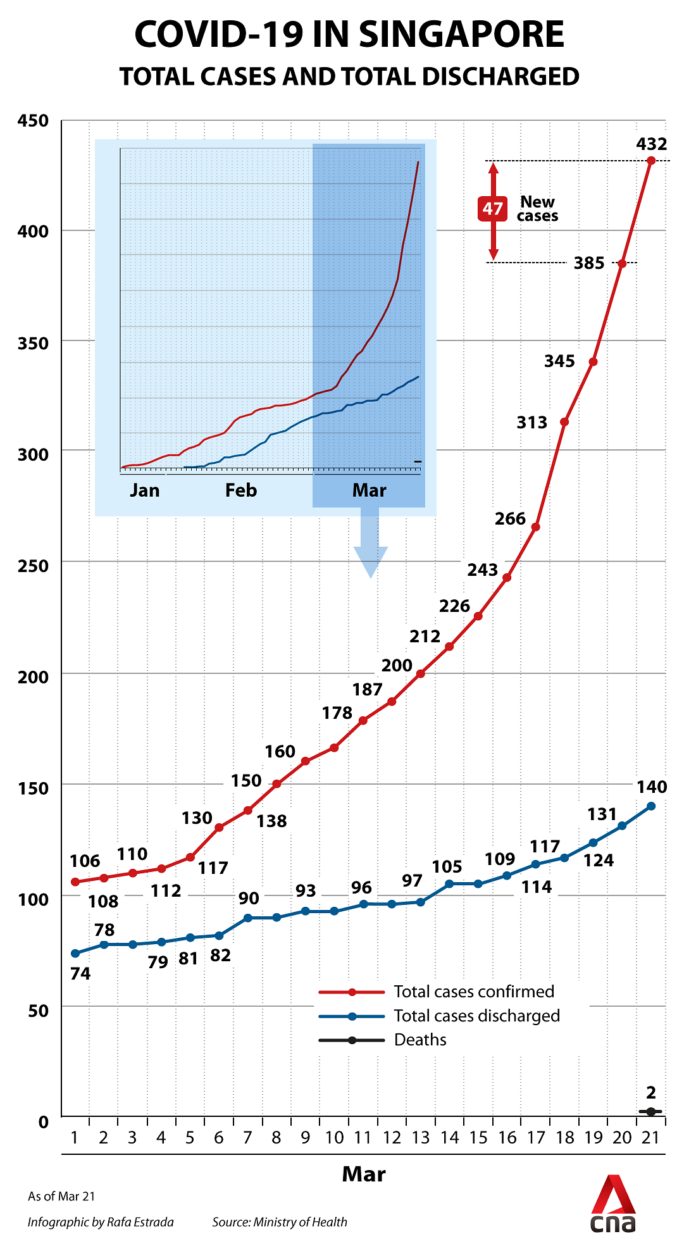
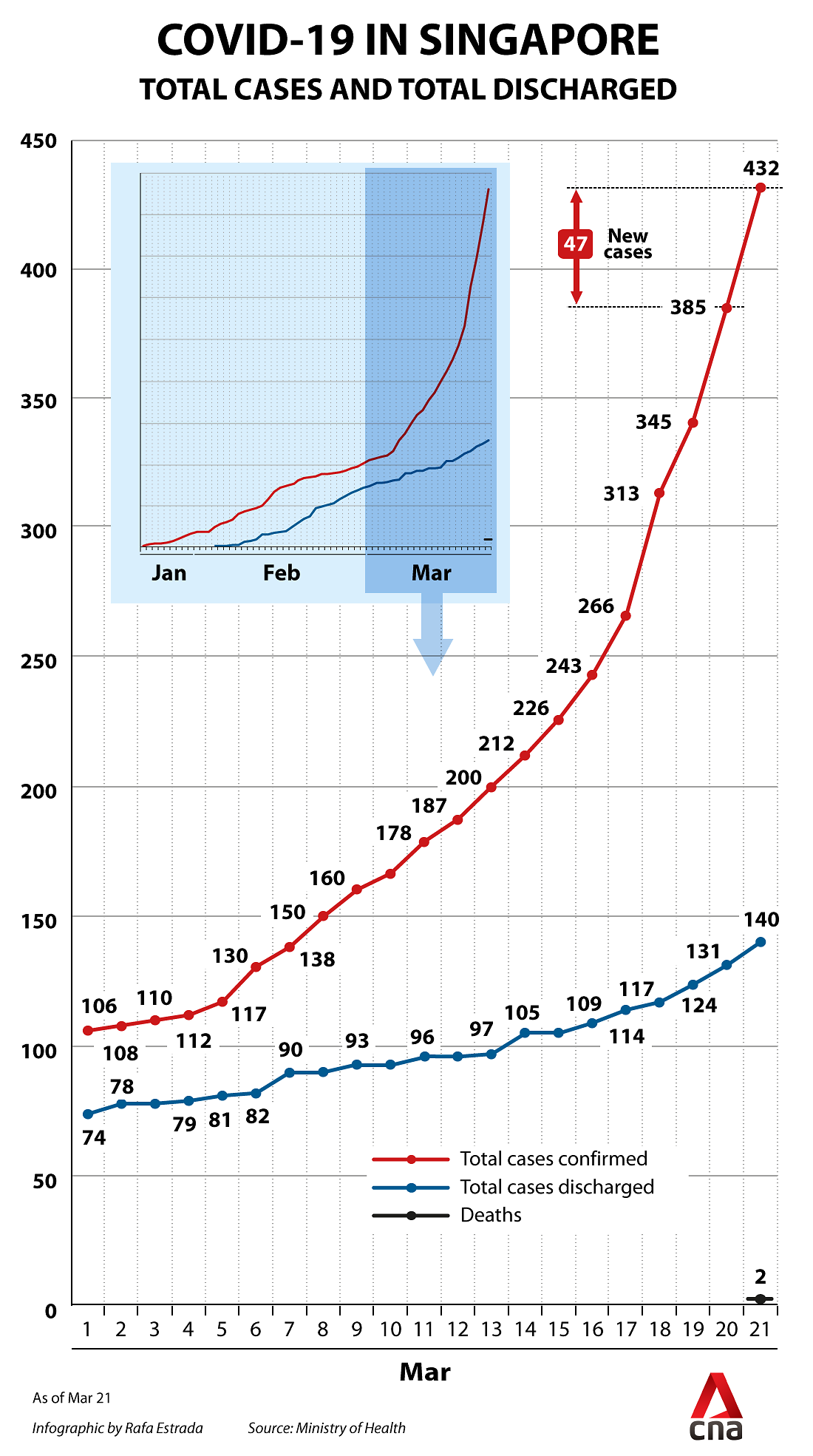
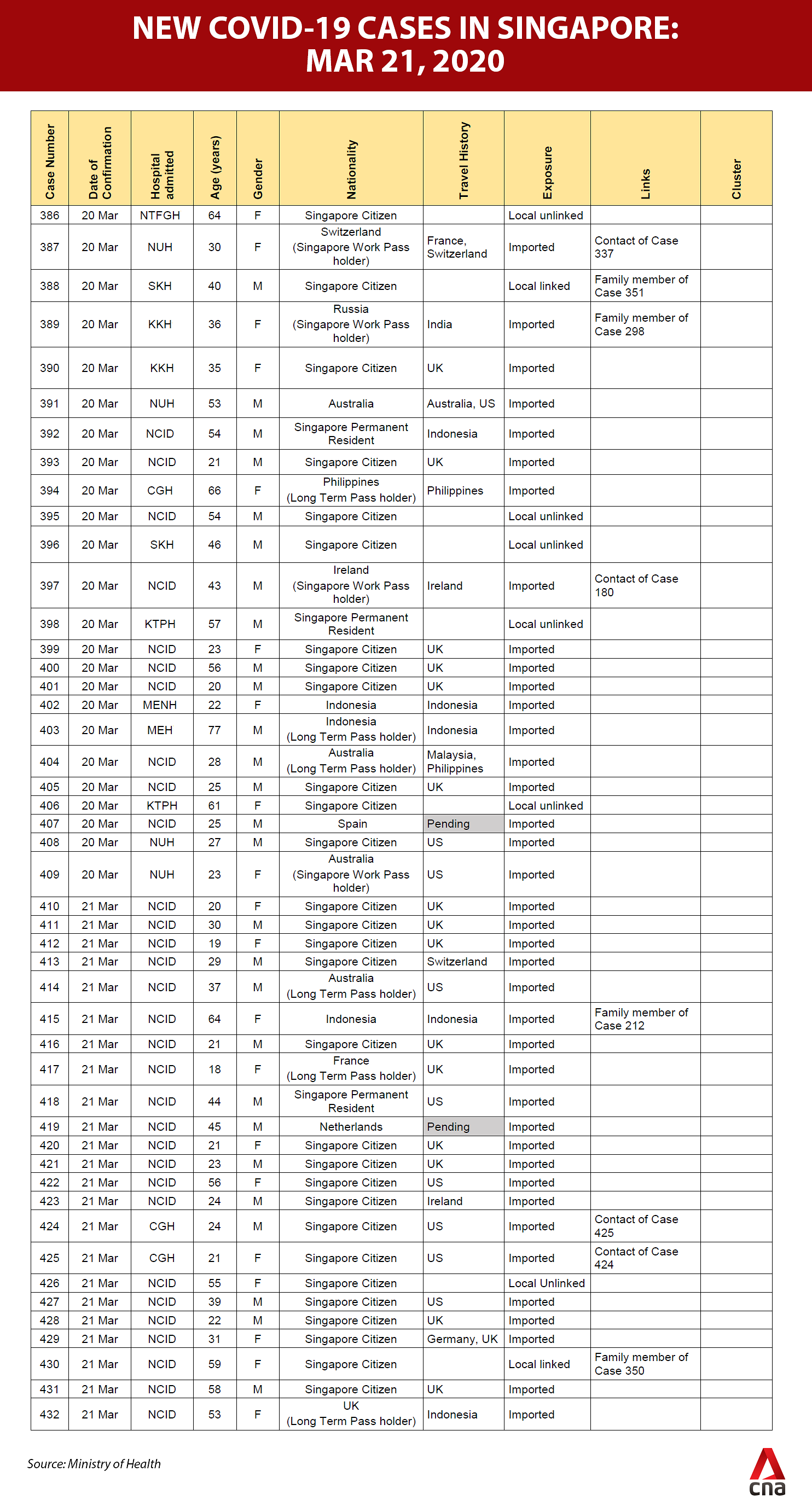
SINGAPORE: Singapore on Saturday (Mar 21) confirmed 47 new cases of COVID-19, of which 39 were imported cases.
Nine more people have been discharged, taking the total number of patients who have recovered to 140, said the Ministry of Health (MOH).
The increase takes the national total to 432, on a day when the country confirmed its first deaths from the disease.
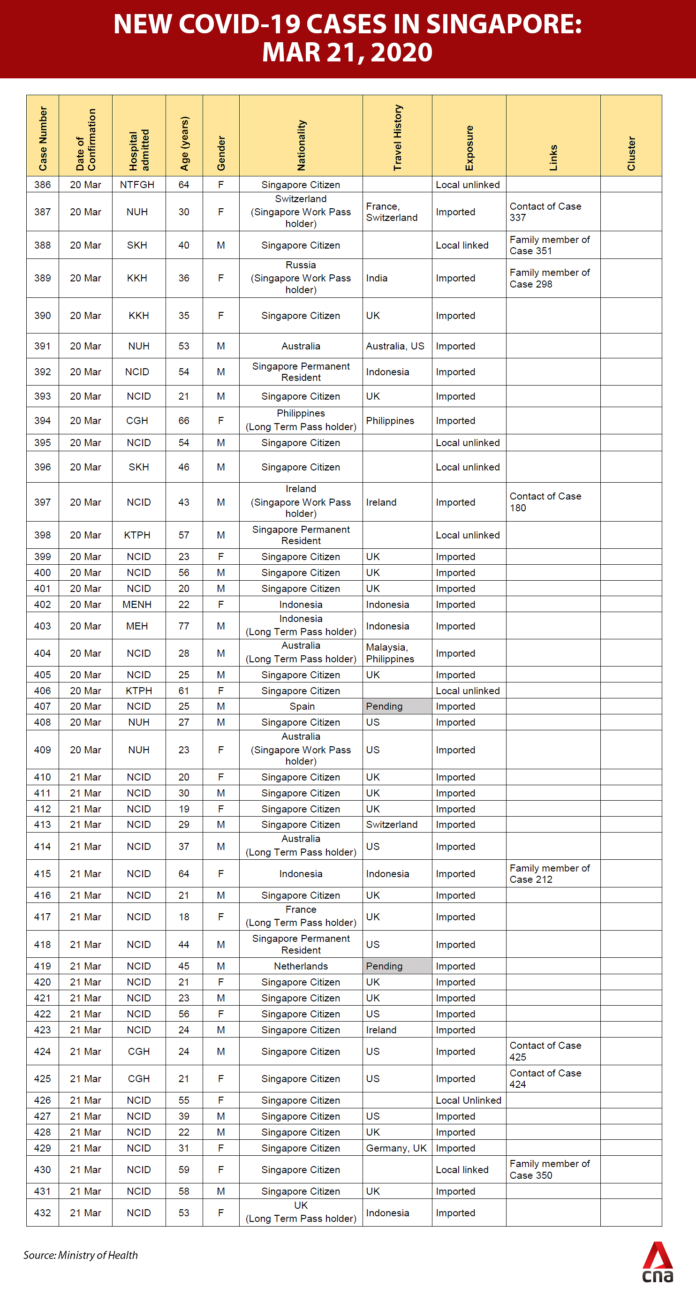
The 39 imported cases had travelled to Australia, Europe, North America, ASEAN and other parts of Asia, said MOH.
Of these 39, 33 were returning residents and long-term pass holders. The remaining six were short-term visitors.
Two of the cases are linked to previous COVID-19 patients – case 388 is linked to case 351 and case 430 is linked to case 350.
Six of the cases, 386, 395, 396, 398, 406 and 426 are currently unlinked.
The ministry also said that of the 290 confirmed cases still in hospital, most are stable or improving. Fourteen are in critical condition in the intensive care unit.
Health Minister Gan Kim Yong announced the two deaths earlier on Saturday morning.
The two patients – a 75-year-old Singaporean woman and 64-year-old Indonesian man – both died on Saturday morning.
The woman, known as case 90, was linked to the cluster at The Life Church and Missions Singapore.
The second patient, known as case 212, was a 64-year-old Indonesian man with a history of heart disease.
“I know Singaporeans will be worried and anxious. We must take courage and not give in to our fears,” Health Minister Gan Kim Yong told reporters.
“We announced a series of safe distancing measures yesterday, and we must all take the necessary precautions to keep ourselves and our families safe,” he said.
SINGAPORE – All doctors in public and private hospitals, as well as private specialist clinics, have been advised by the Ministry of Health (MOH) to immediately stop or defer accepting new foreign patients who do not reside in Singapore.
They have also been instructed to encourage their existing foreign patients to seek continued care in their home countries.
An internal circular issued by the MOH to private and public healthcare institutions on Thursday (March 19), which was seen by The Straits Times, said it was necessary “to conserve limited healthcare resources for Singapore to cater to managing Covid-19 cases as well as the existing needs of our local patients.”
The circular said the latest measures will last until further advised by the MOH.
“Failure of the specialist to comply with the above may adversely impact public health and safety, and as such, will result in more stringent considerations of subsequent applications by MOH,” the circular said.
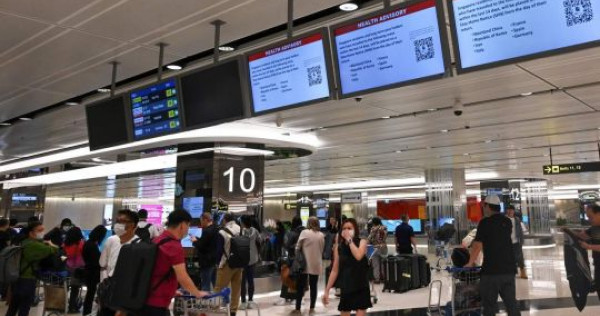
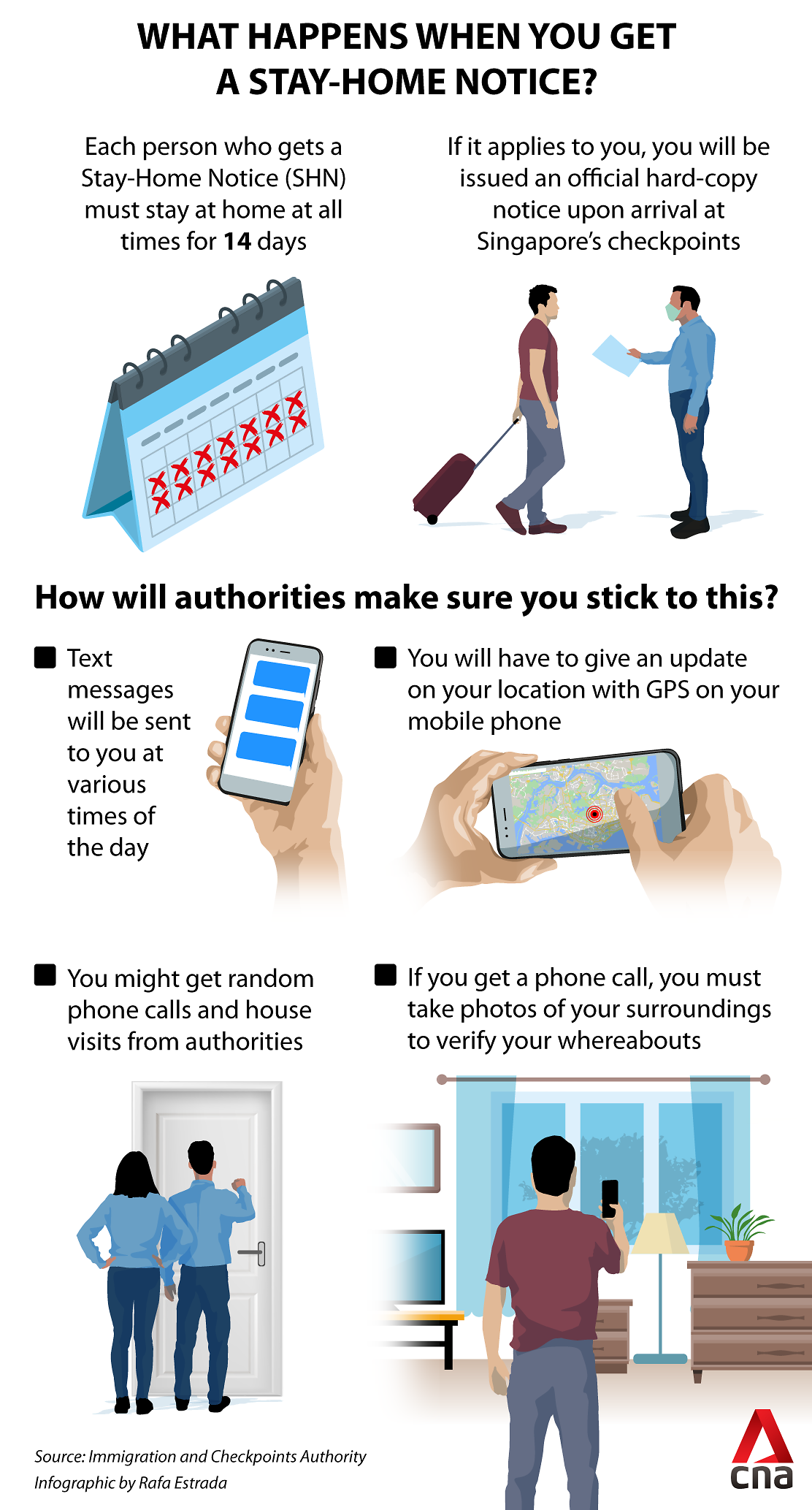
SINGAPORE: More than 21,200 stay-home notices have been issued as of Thursday (Mar 19), and immigration authorities plan to increase manpower as the restriction is expanded to apply to all travellers entering Singapore from Saturday.
Of the stay-home notices handed out, more than 13,900 were issued between Mar 12 and Mar 19, said the Immigration and Checkpoints Authority (ICA) in response to CNA’s queries.
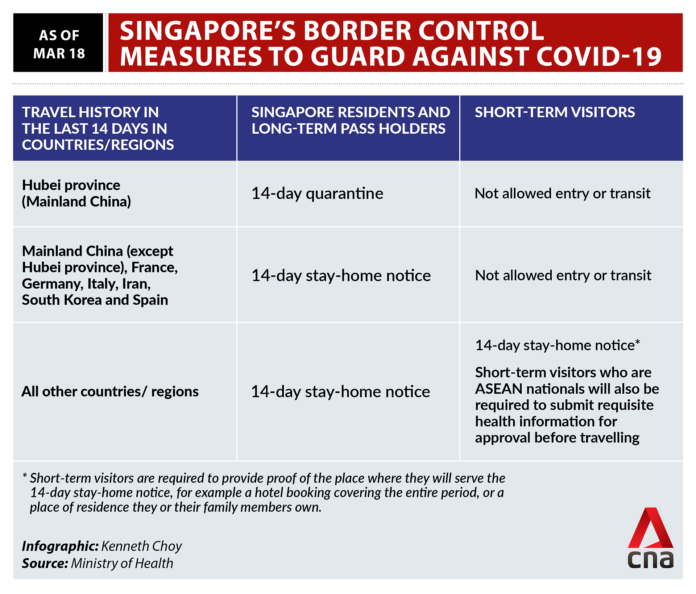
The stay-home notice was first implemented on Feb 18 for Singapore residents, long-term pass holders and foreign work pass holders returning from mainland China outside Hubei province. Those returning from Hubei are subject to a quarantine order.
It was later extended to travellers returning from Daegu city and Cheongdo county in South Korea, then expanded to the whole of South Korea, as well as Iran and northern Italy, then again expanded to France, Germany, Spain and the whole of Italy.
Earlier this week, the restriction was widened to all ASEAN countries (with the exception of land and sea crossings with Malaysia), Japan, Switzerland and the United Kingdom.
On Wednesday, the COVID-19 multi-ministry task force said that anyone entering the country, including citizens and residents, will be issued a 14-day stay-home notice.
“With stay-home notices being expanded to include travellers returning from all other countries/regions from Mar 20, 11.59pm, ICA is scaling up our manpower resources,” it said.
Those issued stay-home notices are required to remain at home at all times for 14 days as a precautionary measure to minimise the risk of COVID-19 transmission in Singapore.
The notice is stricter than a leave of absence, which allows people to leave their homes briefly for purposes like having meals or buying household supplies, but slightly more flexible than a home quarantine order, which requires individuals to be separated from others within the same home.
To ensure compliance, ICA officers send text messages at various times throughout the day to those issued with a stay-home notice. These individuals are required to update ICA of their location within an hour, through their phone’s GPS location service via a unique web link provided in the text message.
Calls are also made, including to those who do not reply to the text messages, with individuals required to take photos of their surroundings to verify their whereabouts.
“Officers donning body-worn cameras will conduct house visits on those who did not respond to the calls or text messages. Random house visits are also conducted,” said ICA.
“ICA will not hesitate to take enforcement measures against those who do not comply with the requirements of the stay-home notice,” it said.
Those who fail to comply with the notice face prosecution under Section 21A of the Infectious Diseases Act, and may be fined up to S$10,000, jailed up to six months, or both.
Other penalties include revoking or shortening the validity of a person’s permanent residency status, long-term visit pass, dependent’s pass, student’s pass or work pass.
SINGAPORE – Two patients died from Covid-19 on Saturday morning (March 21) due to complications, the first deaths the Republic has seen.
A 75-year-old Singaporean woman with a history of chronic heart disease and hypertension died at 7.52am.
She had been admitted to the National Centre for Infectious Diseases (NCID) on Feb 23 for pneumonia and was confirmed to have Covid-19 the same day.
She had been in the intensive care unit since and developed serious complications. She died after 26 days in ICU, a Health Ministry statement said.
The second patient is a 64-year-old Indonesian national who was admitted to intensive care on March 13 after arriving in Singapore from Indonesia the same day.
Prior to his arrival, he had been hospitalised in Indonesia for pneumonia and had a history of heart disease.
He developed serious complications and died after nine days in ICU at 10.15am.
“We are deeply saddened by their passing. Our thoughts are with their families during this difficult time. We will render all necessary assistance to their families,” Health Minister Gan Kim Yong said on Saturday.