The People’s Action Party’s by-election candidate for the Bukit Batok by-election says plans will be “implemented well” if elected.
Source link
Multi-generational park, covered linkways in the pipeline for Bukit Batok residents: PAP's Murali
Esprit 40% Off All Sale Items 12hr Promo till 2359hrs on 24 Apr 2016 | SINGPromos.com

12HRS ONLY: Esprit 40% off all sale items (ends 24 Apr 2359hrs)
Esprit 40% Off All Sale Items 12hr Promo till 2359hrs on 24 Apr 2016 | SINGPromos.com
Get an extra 40% off *all* sale items, ends midnight on 24 April exclusively online
Wages in Singapore are competitive, survey shows
Singaporean workers had much to cheer about last year.
Citizen unemployment was low and the labour market remained tight with more jobs chasing available workers, even though redundancies grew as well.
The nominal median wages of Singaporean workers grew 6.5 per cent last year.
After adjusting for the negative inflation of 0.5 per cent, the real growth of wages was 7 per cent.
But even as wages raced ahead, productivity growth remained tepid. It shrank by 0.1 per cent last year.
This has led some analysts to question if these wage increases are sustainable over the longer term.
Can too much wage growth be a bad thing in the long run?
PRODUCTIVITY VS WAGES: A SIMPLE EQUATION
The problem of wage growth outstripping productivity growth in Singapore is not a new one.
In fact, a chart drawn up by The Sunday Times on productivity and wage changes in the last decade found that wages grew faster than productivity in eight of the past nine years.
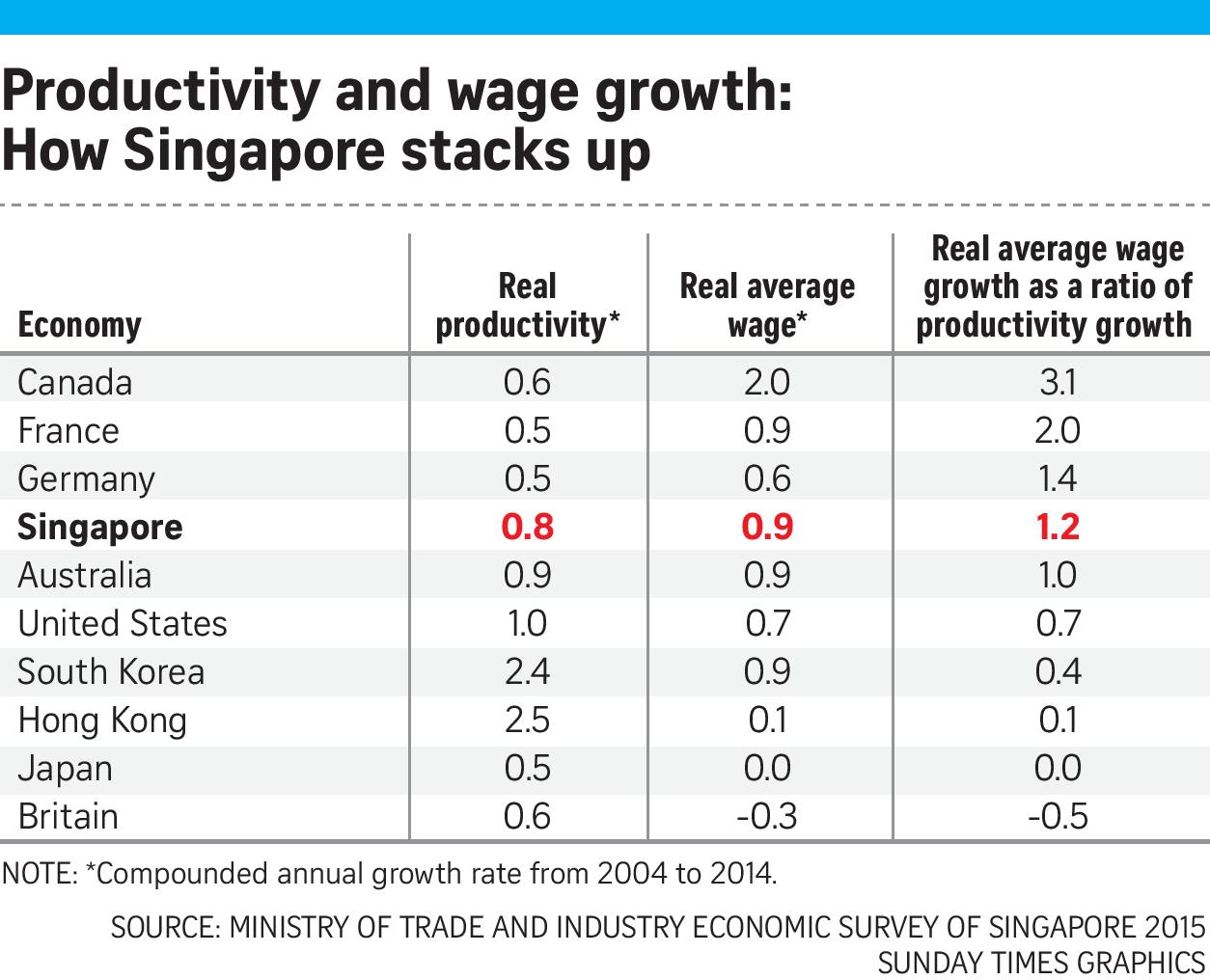
The only year when wages lagged behind productivity growth was in 2010 when productivity grew 11.6 per cent and median gross income grew 2.5 per cent as Singapore rebounded from the global financial crisis. (See chart.)
When asked if it is worried about wages rising faster than productivity, the Manpower Ministry (MOM) would only say: “Wage growth may fluctuate from year to year, and it is useful to look at a longer period.”
It did not shed more light on the reasons behind the 7 per cent wage hike of Singaporeans or the long-term trend of wage growth.
But wage growth without a corresponding rise in productivity is a recipe for disaster, said economists.
In the recent debate in Parliament on MOM’s annual budget, Manpower Minister Lim Swee Say put out some simple maths to illustrate the dire situation of low productivity.
Economic growth is a combination of both manpower growth and productivity growth.
The problem with Singapore, however, is that recent growth has largely been powered by manpower growth.
Over the past five years, the Singapore economy’s growth of about 4 per cent a year was powered solely by manpower growth, while productivity was more or less stagnant, Mr Lim told Parliament.
Add in a shrinking local labour force and a slowing foreign workforce growth, and the result is simple: Growth will fall.
“Without a breakthrough in productivity growth… low growth will become the new norm,” he warned.
And if productivity does not improve, the country’s economic competitiveness over the long run will take a hit, economists pointed out.
Said Singapore Management University (SMU) Professor of Economics Hoon Hian Teck: “Wage growth that outstrips labour productivity growth translates into declining profit margins, business closures, and layoff of workers.
“Unless accompanied by a depreciation of the Singapore dollar, the increase in unit labour costs also implies a loss of international competitiveness.”
Singapore Business Federation (SBF) chief executive Ho Meng Kit agreed.
“If wage growth continues to outpace productivity growth, we will price ourselves out of a globally competitive market. Our businesses will be uncompetitive,” he said.
In a paper published in February, Ministry of Trade and Industry (MTI) economist Foo Xian Yun found that from 2005 to last year, labour productivity grew annually by 0.5 per cent.
But the real wages of the resident labour force grew by 1 per cent annually.
If employers’ Central Provident Fund contributions were added, the annual wage growth was even higher at 2 per cent.
“It will be difficult to sustain increases in wages over the longer term without a corresponding increase in productivity, given the potential impact on our economy’s competitiveness,” she warned.
SEARCHING FOR SOLUTIONS
But while it is easy to understand the maths behind the productivity challenge, fixing it is a lot harder.
For one thing, it is a difficult task just trying to get an accurate measure of productivity.
Economists point out that the way labour productivity is measured – gross domestic product divided by the total number of workers – is too crude.
This is because of the large pool of lower-skilled, low-wage foreign workers present in the Singapore economy, said labour economist Hui Weng Tat from the Lee Kuan Yew School of Public Policy.
Many of these low-skilled workers end up doing low-value jobs and are also not eligible for subsidies to upgrade their skills.
As a result, overall productivity is pulled down, especially if companies continue to rely on large numbers of foreign workers.
“Productivity performance is the outcome of joint team effort of both local and foreign workers,” said Associate Professor Hui.
The other fear is that should wages continue to push above market rates for an extended period of time, when a recession hits, workers could take a hard hit, with large numbers of layoffs.
On the flip side, the rapid wage growth could also be the result of distortionary factors in the economy.
Government policies in recent years also probably accelerated the pace of wage growth among Singaporeans, said economists.
Prof Hui said government wage subsidies like Workfare Income Supplement (WIS) and the Wage Credit Schemes could have raised wages without corresponding productivity improvements.
The WIS scheme was introduced in 2007 to boost the income of low-wage workers.
The Wage Credit Scheme was introduced in 2013 as a three-year scheme under which the Government co-funds 40 per cent of the wage increases that are given to Singaporean employees over 2013 to last year. It has been extended to next year at a lower co-funding level of 20 per cent.
Said Prof Hui: “Both schemes increased income without providing incentives for the employer to raise productivity through training or job and process redesign.”
Correspondingly, the national push to raise productivity, which includes programmes like the Productivity and Innovation Credit scheme launched in 2010, has not made a tangible impact on the productivity numbers.
NOT ALL GLOOMY, YET
But while economists and businesses are clearly worried about Singapore losing its competitiveness should wages continue to push ahead of productivity, some said that it is not all doom and gloom yet.
For many companies, including multinational firms, the decision to set up shop in Singapore rests on a multitude of factors.
Labour is a big part of that equation but firms also have other reasons for wanting to do so.
So far, Singapore has managed to retain its top billing in many international surveys of economic competitiveness.
For instance, it ranked second in the World Economic Forum’s Global Economic Competitiveness Report last year.
NUS economist Tilak Abeysinghe noted that commercial rents became lower in the second half of last year.
“There may not be a substantial erosion of international competitiveness as yet,” he said.
SMU’s Prof Hoon said that there are other factors that continue to make Singapore attractive to foreign investors.
“Our strong legal and corporate infrastructure, our strong economic link with the global economy, and a forward-looking and eager-to-learn workforce all provide us a margin of advantage,” he said.
It comes down to whether Singapore workers are able to make themselves invaluable to employers, said SBF’s Mr Ho.
“So long as our workers provide a premium to the companies they work for exceeding their cost, they will be competitive.
“However, that premium is no longer a given. It has to be worked for and earned,” he warned.
The productivity push has also made progress since it was launched, with the Government taking a more targeted approach in tackling it now.
Earlier this month, Deputy Prime Minister Tharman Shanmugaratnam identified the laggard in the productivity race: the domestic sectors of the economy.
From 2011 to last year, the average annual productivity growth in outward-oriented sectors, such as manufacturing and finance, was 3.2 per cent. But in the domestic sectors such as construction and retail, it was 0.2 per cent.
Mr Victor Mills, chief executive of the Singapore International Chamber of Commerce, is not surprised by how the domestic and export sectors responded to the productivity push.
“The export sectors have no choice (but to innovate) because they’re competing globally,” he said.
Lastly, Singapore’s challenge is not a unique one as others are also grappling with the same problem. This gives the country some buffer to find the right solutions.
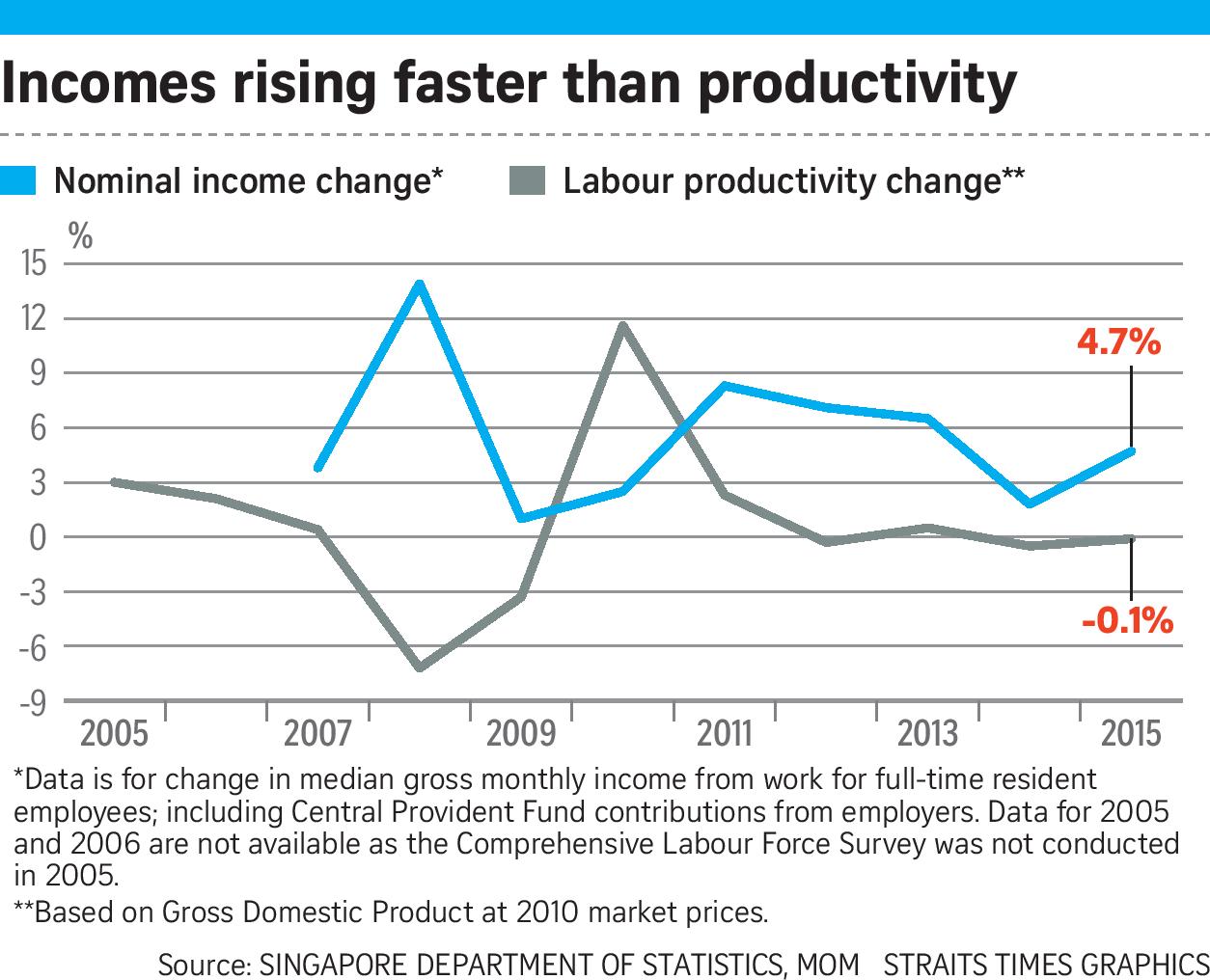
According to the MTI paper last year, the wage and productivity growth trends of nine developed economies from 2004 to 2014 showed that in countries like Canada, France and Germany, productivity also lagged behind real wage growth.
But in countries like the US, South Korea and Japan, real wage growth was lower than the productivity gains over the same period.
Said Ms Foo: “Apart from helping export-oriented sectors to restructure into higher value-added products and services, emphasis should also be placed on raising the productivity of domestically oriented sectors in order to sustain wage growth in these sectors.”
The $4.5 billion Industry Transformation Package introduced in the recent Budget is proof that the Government has not given up the fight to raise productivity.
Workers and employers now need to roll up their sleeves and get down to the hard work of getting more value from the same amount of resources.
Singapore’s economic competitiveness and its workers’ wages depend on it.

This article was first published on April 24, 2016.
Get a copy of The Straits Times or go to straitstimes.com for more stories.
Image:
Publication Date:
Sunday, April 24, 2016 – 17:00
Keywords:
Send to mobile app:
Source:
Story Type:
Others
Singapore 'not immune to terrorist ideology'
Stressing that Singapore is not immune to terrorist ideologies, Parliamentary Secretary for Home Affairs Amrin Amin yesterday urged the youth here to be vigilant and work towards maintaining social cohesion.
He stressed the need to be careful about what they read online, to verify sources of information and be responsible users on social media.
Addressing about 300 students at a forum on countering radicalism, he said that while Singapore has tough laws and tight border security, the crux of its counter-terrorism strategy is a community which is vigilant, resilient and united.
“The modes of attacks are targeted at tearing people apart,” he explained, adding that terror attacks aim to get people to mistrust one another.
Yesterday’s event, held at the Institute of Technical Education (ITE) College West, is the fourth youth forum held by the Inter-Agency Aftercare Group – a voluntary group set up to support families of detained terrorists.
Mr Amrin said that while recent attacks in Paris and Brussels are half a world away, Singapore is still susceptible. He highlighted how 27 Bangladeshi foreign workers were arrested last year under the Internal Security Act (ISA).
They supported armed jihad ideology of terrorist groups such as the Islamic State in Iraq and Syria, or ISIS.
It was also revealed last month that four Singaporeans had been dealt with under the ISA for undertaking or intending to undertake violence in overseas armed conflicts.
Two were detained last year, while the others were placed under restriction this year.
But countering terrorist ideology cannot be the Government’s job alone, and communities have to be watchful and guide loved ones from going down the wrong path.
The anonymous nature of the Internet also allows individuals to propagate violent ideas, and he urged them to be mindful of what they read.
“Take care what you read online, verify sources and help to correct misconceptions. When seeking religious knowledge, it’s important that you check the sources,” Mr Amrin said.
He encouraged young people to get involved in community exercises against terrorism, and also to be aware of what to do in an emergency.
He also said on the Government’s part, a national movement called SG Secure will help strengthen the community response to terrorist threats and to stay united in the aftermath of an attack.
Second-year ITE student Shilpa Shades, 19, one of the participants, said: “These forums are useful in that it keeps young people like us aware of how we should prevent ourselves and our peers from falling into terrorist ideologies, and joining these groups.”
This article was first published on April 24, 2016.
Get a copy of The Straits Times or go to straitstimes.com for more stories.
Image:
Publication Date:
Sunday, April 24, 2016 – 17:00
Send to mobile app:
Source:
Story Type:
Others
Bukit Batok by-election: Police issues traffic and security advisory for Nomination Centre
The police have issued traffic and security guidelines on Nomination Day at the Nomination Centre for the Bukit Batok by-election.
Source link
Cafe owners worried as home bakers rise as 'rivals'
From low-carb protein loaves to mango sticky rice tarts, more home bakers here are whetting appetites with their unique artisanal offerings. As they work from their own kitchens and do not run a brick- and-mortar shop, they are not required to be licensed by the National Environment Agency.
Most sell their products through word of mouth and social media.
However, concerns have surfaced over whether the authorities should be keeping a closer tab on the industry.
In a forum letter published last month, Ms Chong Siew Yen, 41, highlighted how home bakers who sell their products to the public are putting licensed bake shops at a disadvantage.
“We are competing with a higher cost, which includes rental, utility bills and licence fee,” she wrote.
Home bakers come under the Housing Board’s Home Based Small Scale Business Scheme, which allows them to practise “baking on a small scale for sale” in homes “without turning the flat into a bakery”.
But Ms Chong, who owns The One Bake Shop in Toa Payoh, and other cafe owners The Sunday Times spoke to believe that such a definition is a grey area that home bakers could exploit.
“I’ve noticed several of them selling their baked goods to corporate clients and even catering a spread for functions,” she said.
Ms Jessica Loh, who started dessert cafe Shiberty Bakes this month, said: “If I sell my cakes to my friends, is that not commercialism in a minor way?”
After baking from home for about four years, she decided to open her cafe at Owen Road.
“If you want to reel in the big clients, they will definitely require you to be licensed and operating in a commercial space,” she explained.
However, running a cafe in Singapore is extremely costly, she added.
“It makes the business very cut-throat.”
For housewife Shireen Shen Jega, 31, home baking has become a viable way to pursue her passion while selling her bakes for a small income.
The mother of two, who has been baking cupcakes and customised cakes for the past three years, has dreamt of opening a cafe, but the high costs of doing so has held her back on several occasions.
Clamping down on home bakers would stifle opportunities for those who are simply pursuing it as a hobby, she added.
“We have only one person doing the baking and that’s definitely not going to generate a lot of business, compared to an established bakery,” she said.
“In today’s tough economy, we should be looking for opportunities to help everyone supplement their incomes.”
Other home bakers believe that their baked products serve a niche market that would complement, rather than compete, with others in the industry.
For instance, 22-year-old Singapore Management University undergraduate and bodybuilder Yu Huimin enjoys baking “guilt-free” protein loaves and muffins for other health buffs like her.
A loaf, or a set of eight muffins, costs $13.20 and she receives about two orders of each every week.
She earns about $80 a month from home baking. “I bake protein products that have really good macro-nutrients. I even label them for customers if they are tracking their diet closely,” said Ms Yu, who has enjoyed baking since she was 13.
Though she believes some form of regulation of the home baking industry is necessary, in particular to ensure food hygiene, she added that this could be difficult to enforce.
“Most bakers do this on an extremely small scale, like me. If all bakers had to be licensed, it would probably greatly reduce the number of recreational bakers who don’t rely on this as a source of income.”
This article was first published on April 24, 2016.
Get a copy of The Straits Times or go to straitstimes.com for more stories.
Image:

Publication Date:
Sunday, April 24, 2016 – 17:00
Keywords:
Send to mobile app:
Source:
Story Type:
Others
My focus is on the by-election campaign; everything else just a distraction: Chee Soon Juan
Singapore Democratic Party’s candidate for the May 7 Bukit Batok by-election, Chee Soon Juan, has responded to questions over a picture of him and former SDP chief Chiam See Tong in a newsletter.
Source link
Singapore's Helen Keller fighting cancer
Meningitis robbed her of her hearing and her sight when she was in her early teens, leaving her to live in a dark and silent world for nearly 60 years.
Now, Ms Theresa Chan Poh Lin, Singapore’s Helen Keller, is battling another foe – cancer.
The 72-year-old, whose amazing life inspired film-maker Eric Khoo’s award-winning movie Be With Me, was diagnosed with advanced lung cancer earlier this month.
She is now in Singapore General Hospital and has been told that the cancer has metastasised.
“There has been pain in my left leg and I’ve not been feeling very well since January, but I didn’t know what I was suffering from until I came here,” she told The Sunday Times from her hospital bed.
“But I’m not afraid of cancer.
“If I have to go home, I will be happy to see Jesus. I hope people will remember me and remember that whatever their disabilities, they should have hope and not be unhappy and discouraged,” added the devout Catholic, articulating in complete sentences her responses to questions finger-spelled on her hands by an interpreter.
She has no regrets, she said, adding: “I have lived and loved and enjoyed a wonderful life.”
The only daughter of a hawker and a waitress, she grew up in Chinatown’s Sago Lane, where there were many funeral houses.
She lost her hearing at 12, and her sight at 14, after a bout of meningitis. Her life changed after a social worker found her.
An extraordinary chain of events saw her enrolled not only at the Singapore School for the Blind, where she learnt Braille, but also at the Perkins School for the Blind in the United States in 1960, where she learnt how to pronounce English words by feeling and touching a speaker’s lips and throat.
The late John Wilson, who was director of the Royal Commonwealth Society for The Blind, described his encounter with Ms Chan in his 1963 book, Travelling Blind.
He wrote: “She told me she wanted to learn like Helen Keller, to speak English like the Queen of England, to meet everyone in the world.’
It was exactly what she did.
Ms Chan spent 13 years in the US.
She did not just receive an education. She also played sports and travelled extensively, not just the length and breadth of the US but also other countries including England, Germany, Portugal and Spain.
She met Queen Beatrix in the Netherlands, and the late Mother Teresa while attending mass in a New Delhi church.
She even fell in love, but tragically lost her boyfriend to throat cancer one Christmas morning.
After her return to Singapore in 1973, she taught at the School for the Blind until 1990.
An independent soul who lived on her own and cooked her own meals, her zest for life so inspired Mr Khoo that he made her the spine of his movie Be With Me.
The film, which explores the interconnected lives of several individuals, opened Directors’ Fortnight at the Cannes Film Festival in 2005.
Until she was admitted to hospital, Ms Chan stayed in touch with her friends and kept abreast of the news with her BrailleNote, a computer for people with visual disability, donated by the Khoo Foundation.
Her current condition has robbed her of her appetite, but not her wit or her feistiness.
Mr Khoo, who visited her in hospital, said: “She was frank, practical and, in her usual humorous way, told me and my sister not to send her any wreaths when she goes.
“She would prefer that the money go to her church.”
He added: “Although she was in discomfort and a bit frail, she was still that tough cookie I met more than a decade ago – strong, brave, one of a kind.
“I really love her laughter.”
During this interview, Ms Chan gamely posed for photos with her stuffed panda Popo and grumbled about a social worker who told her recently that she would be taken off public assistance and she needed to use her Central Provident Fund savings.
The septuagenarian, who hopes to be admitted to Assisi Hospice, also told The Sunday Times to put her story on “Book Face”.
Ms Chan was referring to Facebook.
She has but one wish.
“Please remember me.”
This article was first published on April 24, 2016.
Get a copy of The Straits Times or go to straitstimes.com for more stories.
Image:

Publication Date:
Sunday, April 24, 2016 – 14:00
Send to mobile app:
Source:
Story Type:
Others
‘Makerspaces’ allow students to get messy – and creative

SINGAPORE – An electrically-powered go-kart; a radio-controlled plane that glides at least one kilometre across the sky; and an alarm clock that tickles its owner awake.
These are among the things students aspire to build with tools such as 3D printers,…
Source link
Concerns over private-hire car firms driving up COE premiums
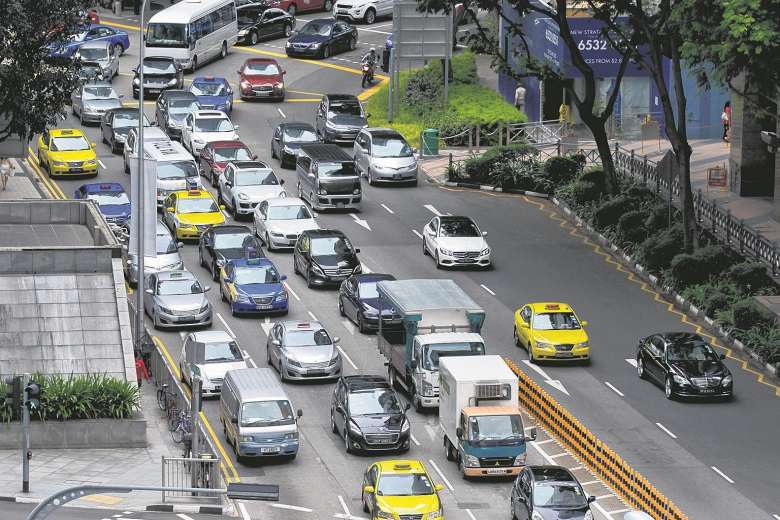
Concerns have been raised about private-hire car firms buying large numbers of certificates of entitlement (COEs) recently, even as the Land Transport Authority (LTA) said it will continue to “monitor the situation” .
COE premiums for cars have continued to climb recently despite more being available. At the latest bidding, last week, the COE price for cars up to 1,600cc and 130bhp ended 2.8 per cent higher at $47,300. That for cars above 1,600cc or 130bhp finished 5.5 per cent higher at $49,602.
Uber-owned Lion City Rental is believed to have submitted 630 bids, including in the Open category, and succeeded in obtaining 510 COEs – 14 per cent of total successful bids in the three categories.
In the previous tender, it secured 270 COEs from 810 bids submitted.
Though most of the approximately 10,000 private-hire cars on the road are older vehicles, in recent months both Uber and Grab have started competing with private car owners for fresh COEs.
Pressure on bids may also have come from other private-hire companies such as SMRT’s new outfit, Strides.
Mr Lim Biow Chuan, a member of the Government Parliamentary Committee on Transport, said he hoped the Ministry of Transport would come up with more comprehensive rules for private-hire car operators, adding that it would be in the interest of the public as well as existing taxi operators.
“As a car owner myself, I’m concerned about how companies like Uber can impact COE prices,” said Mr Lim, who is also Member of Parliament for Mountbatten.
Mr Zaqy Mohamad, who is also on the committee, said it may be time to review the regulations for Category A – for cars up to 1,600cc and 130bhp – and Category B – for cars above 1,600cc or 130bhp – to allow only private individuals to bid.
“One person can’t fight against a company buying hundreds of cars,” said Mr Zaqy, an MP for Chua Chu Kang GRC, adding that firms looking to buy vehicles should be restricted to the Open and commercial categories.
MP for Jurong GRC Ang Wei Neng said the bids by private-hire car services negated the higher supply of COEs and eroded the ability of individuals who may need to buy cars.
The LTA said the availability of private-hire services might reduce the demand for private cars over time.
It added that COE premiums are reflective of market supply and demand, and that it would continue to keep an eye on the situation.
Ms Daphne Gan, whose Honda Accord’s COE expires next February, is concerned that Uber would drive COE prices up further.
“It’s not right for them to bid in the private car categories,” said the 33-year-old interior designer, who hopes the LTA would remove private-hire cars from the bidding process as it had with taxis in 2012.
Dr Walter Theseira, an economist with SIM University, said that while Uber buying large numbers of cars may raise COE prices in the short term, it was unclear what effect it would have in the long term.
National University of Singapore transport researcher Lee Der Horng supported the call for greater regulation, saying that firms had an unfair advantage over individuals when bidding for COEs.
This article was first published on April 24, 2016.
Get a copy of The Straits Times or go to straitstimes.com for more stories.
Image:
Publication Date:
Sunday, April 24, 2016 – 14:00
Keywords:
Send to mobile app:
Source:
Story Type:
Others


