Home Blog Page 4128

Conjuring movie magic is not just lights, camera and action

0

Making people angry, cry and laugh is part of his job as a film director.

But Boo Junfeng says he has to help actors and crew deal with emotions off camera, too.

The 32-year-old Singaporean says: “When the cast and crew have a problem, I talk to them to understand why. Sometimes I feel like a counsellor.”

At work, Boo is often in a T-shirt and jeans. That laid-back attitude makes him more approachable, he says.

He shares easily – it’s like talking to a friend. One almost forgets that he’s an award-winning film-maker with a feature film, Apprentice, competing at the prestigious Cannes Film Festival next month.

His previous feature film, Sandcastle, was listed by The Wall Street Journal as one of Asia’s most notable films in 2010.

How does it feel to receive accolades for his work? Boo says modestly: “I have always been blessed to work with the best people and the film is as much theirs as it is mine.”

He says it is important as a director to carefully choose the people you work with.

Boo does not just think of acting chops when casting for his films. He also considers how the actors relate with one another.

“Sometimes I get really good actors who work well on their own but might not have the best chemistry,” says Boo.

What happens then?

He sighs: “We have to let them go but it’s the hardest thing to do. Sometimes it’s so difficult, I need the help of my casting director to do it.”

But Boo says it is this attention to detail that has helped him produce his seven short films and two feature-length movies. Sometimes he feels more like a “researcher” than a director.

The research for Apprentice, a drama about a correctional officer who befriends a prison executioner, started five years ago.

Boo spoke to those “inside and outside of the system”, including families whose breadwinners have been executed and people who worked in prisons.

“When I make a film, I try to understand people’s lives and draw out the humanity in them so that it can appeal to all of us,” Boo says.

He adds that a film-maker has to always be resourceful because things can and do go wrong.

Once, when he was travelling to Australia for a shoot, Boo realised there was not enough luggage space to take all the gear he wanted.

He dumped his warm clothes to squeeze in another tripod or lens. His crew followed suit.

“This was when it was chilly over there and I really felt it. But that had to be done and I’m glad my crew was willing to make the sacrifice too,” he says.

Despite the support he gets, Boo says the pressure of film-making can be intense. “All these people have invested in you, financially or otherwise, and you just don’t want to let them down.”

The stress got to him was when he was directing Sandcastle, his first feature film that premiered at Cannes.

Two days before the shoot, Boo suffered a panic attack, afraid the film would not meet expectations.

“All eyes were on me and it’s not like I could just hide the film under my bed if it was bad,” he says.

But after a lengthy phone conversation with his producer, Boo arrived on set and saw the entire crew was all geared up and had his back.

He says he recognised he was not alone and everyone was ready to give their all to help him.

The movie became a hit and won awards in film festivals overseas.

Boo says: “It’s like they are all these great colours and palette, and I am lucky enough to be the painter who gets to create beautiful art.”


This article was first published on April 24, 2016.
Get The New Paper for more stories.

Image: 
Category: 
Publication Date: 
Monday, April 25, 2016 – 09:00
Keywords: 
Send to mobile app: 
Source: 


Story Type: 
Others

Source link

Children of Thai military 'favoured because of trust in family'

0

Prime Minister General Prayut Chan-o-cha has found nothing wrong about his nephew being given a post with the Third Army without having to undergo a recruitment exam.

“Every year, when posts become vacant, there are two systems for recruitment. One is about competitions open to various applicants. The other is selection by high-level committees,” he said. “It’s normal.”

Former Army chief Prayut said sarcastically that if his nephew had been singled out simply because of his surname, he would agree to change it.

According to the prime minister, children and relatives of current or retired military officers are recruited partly because of trust in their family background and their familiarity with military discipline.

Earlier this month, an internal document from the Defence Ministry was leaked to the public. It showed Deputy Prime Minister Prawit Wongsuwan had authorised General Preecha Chan-o-cha, a younger brother of Prayut, to approve the recruitment of his son Patipat Chan-o-cha as a sub lieutenant to work in the Third Army Area.

Preecha, now permanent secretary for Defence, used to head the Third Army Area.

Third Army Area chief Lt-General Somsak Nilbanjerdkul said he was waiting for the Defence Ministry to send a letter regarding the recruitment to his agency.

“When it arrives, Patipat can report himself for duty,” Somsak said.

Patipat graduated from Naresuan University with a bachelor’s degree in mass communications.

“He’s qualified,” Somsak said, downplaying criticism about alleged nepotism.

Like Prayut, Somsak insisted that Patipat’s recruitment was in line with proper procedures.

Image: 
Category: 
Publication Date: 
Sunday, April 24, 2016 – 14:30
Keywords: 
Send to mobile app: 
Source: 


Story Type: 
Others

Source link

Greeenpeace warrior poorer but happier

0

By his own reckoning, Calvin Quek was nondescript and colourless when he was a pupil in Anglo-Chinese Primary.

“I was probably a kid that most teachers will not really remember except for the accident,” he says.

The accident in question took place when he was 11. He hurtled down a hill on his bicycle, hit a fence, got thrown 4m into the air, landed face down in a ditch and cracked his skull.

Thankfully Mr Quek outgrew his mediocrity and went on to lead a rather interesting life.

He studied architecture but became a banker, and after six years, junked the fancy job title and fat pay cheque to become an environmental activist.

Today, the 38-year-old is the Head of Sustainable Finance at Greenpeace East Asia based in Beijing, and the go-to guy for researchers, investors and policymakers wishing to know more about environmental and energy issues in the Middle Kingdom.

Debunking the activist stereotype of a strident agitator, he is Clark Kent-ish and speaks in the measured, reasoned tones of a thinker.

He is the elder of two sons of an architect and a banker who moved from Singapore to Vancouver in the 1970s. Life in Canada did not agree with his parents so they came back to Singapore when he was five.

He was an introverted child.

“I was quite pudgy and awkward, probably mildly autistic,” says Mr Quek, who, like his father and grandfather, went to Anglo-Chinese School. “I was below average in my studies. The only thing I could do very well was draw.”

The awkwardness and the puppy fat which dogged him as a kid vanished in his teens. He picked up basketball, became more sociable and developed a surer sense of self.

After completing his O levels, he spent a short stint at Anglo-Chinese Junior College before leaving for first, Syracuse University in New York, and later, Carnegie-Mellon in Pittsburg, to study architecture.

Those years in the United States stretched his mind. “I read a lot: Emerson, Melville and the American transcendentalists who talked about reliance, personal responsibility and the nature of man,” he says, referring to writers Ralph Waldo Emerson, Herman Melville and the philosophical movement which believes that the inherent purity of man and nature is corrupted by society and its institutions.

“I got an education in culture, history and self-awareness in a big way,” he says.

In his last two years at university, he discovered that motion and graphic design fascinated him more than building architecture did. “I taught myself Photoshop and other computer graphic skills. To this day, I still consider myself a very visual person. I think in terms of proportion, space and colours.”

Dot.com fever was raging when the Canadian citizen graduated in 2000. Razorfish, an Internet firm in Los Angeles, offered him a job as an information architect. The annual pay package was US$60,000 to build websites, not bad for someone fresh out of school.

But just six months into the job, the bubble burst and he was retrenched.

“It was an extremely humbling experience,” he says. “They put us in two rooms, it was almost like American Idol. If you heard the other room cheering, you knew you were done and you felt as though you were in the gas chambers.”

For six months, he bummed around in Los Angeles and San Francisco.

“I read a lot, watched a lot of basketball, played my guitar, and lived on my savings, unemployment cheques and Taco Bell.”

On the advice of his mother, he came back to Singapore to look for a banking job.

“I left on the day of 9/11 from the West Coast. When I reached Singapore, I found out that the world had changed in a profound way.”

He found a job as a Web designer and usability expert in Citibank, building templates for websites and overseeing eyeball tracking. Next came a stint in e-business.

“In 2005, I told myself that if I were to stay in a bank, I got to find out what finance and accounting was all about,” he says.

So he got the bank to finance his Masters in Wealth Management at the Singapore Management University; his thesis explored philanthropy and socially responsible investments.

He also put himself through a CFA (Chartered Financial Analyst) programme and spent the next three years in financial research and investment banking.

The debacle that was the subprime crisis exploded next, coating the banking industry with a layer of slime.

But by then, the idea of doing something socially responsible had taken root in his head.

“I didn’t like banking much. I didn’t like going to work, going to drink and showing off how much you can buy. The nature of the banking world was political and I really didn’t want to bend over,” he says.

He much preferred hanging out at cafes in Bussorah Street where he learnt to play the sitar.

“I realised that I loved hanging out with strange people, people who think that the worst form of pollution in Singapore is spiritual pollution. And freegans,” he jokes, referring to those who reclaim and eat food that has been discarded.

His attempts to jettison his financial career for one in a sustainable industry, however, came to naught.

“I wanted to scale it up against systems and policies but Singapore has nothing, it is not the right pond for such jobs,” he says.

Why the environment?

“Because I need a cause to latch on to. I can think of no better cause than the environment. Maybe if I had experience in saving someone’s life, I might have been involved in humanitarian issues. Or if I had been born poor, I might have been involved in poverty alleviation.”

Fascinated by the green lobby that was happening in the US and Britain, he applied to do his MBA and was accepted by the University of Notre Dame in Indiana.

He quit Citibank. Because he had several months to kill before he had to leave for the US, he decided to hightail it to China to teach English.

That decision changed the course of his life.

He ended up in Beijing Union University.

“When they found out that I was from Citibank, they told me, ‘Tell us about American culture.’ I started supplementing other people’s classes and teaching all these 19-year- olds everything from politics to subprime. It was such an amazing experience,” he says.

The stint kickstarted a deep interest and curiosity about China.

“I met lots of interesting Chinese people who were discussing lots of interesting ideas. I was curious.”

That curiosity was so consuming that he decided to forfeit the registration fee he had paid for Notre Dame, and do his MBA at Peking University instead.

“It was really to buy myself more time so that I can figure out how to be a green guy in China.”

At Peking University, he started a Green Club and attended events organised by the Beijing Energy Network (BNE), a grassroots outfit interested in environmental issues in China. It was founded by Singaporean Julian Wong, whom he had known since they were both altar boys at the Church of St Ignatius.

He got to know Greenpeace staff at BNE events and started volunteering for the outfit, which is well-known for its direct actions. The organisation does not accept funds from governments, political parties or corporations, and relies on its supporters and foundations instead.

Not long after he finished his MBA, he joined Greenpeace’s sustainable finance team.

Although Greenpeace campaigns through direct action (some of which have resulted in lawsuits against the organisation), lobbying and research, it has to operate differently in China which forbids civil disobedience and often comes down hard on the media.

His work, he says, involves changing mindsets not just outside the organisation but within as well.

“Very often, environmental issues arise not because of one evil person but because of incentives and economics. Behind bad air pollution is a whole mountain of issues.”

He adds: “I also believe causes cannot be won just by protests and civil disobedience. I believe that if you really want to be effective, we have to open up to all kinds of ways, markets or governments, go up, go down, whatever.”

The trick to campaigning in China, he says, is not to make it a “we versus them” issue.

“The authorities know they need to get their act together, you don’t need to shove it down their throats. We have the best expertise in air pollution and economics. So we say, ‘You, Mr Government, you want to get the issue solved but here is the problem.'”

His corporate experience and network of contacts in the financial industry have served him well.

Trading on the mountain of non-public and credible information Greenpeace has, he started by talking to bank researchers whose job is to sell ideas to investors.

“They were like, ‘Oh, this is interesting. You’re showing us a part of China we never knew about’,” says Mr Quek, who now heads a team of five at Greenpeace.

This led to presentations to not just investors but also banks and bodies like the European Chamber of Commerce, the British Embassy and Norwegian policymakers.

The winner of SMU’s 2014 Rising Star Award is chuffed that he has played a part in the recent movement for investors to move away from coal, the dirtiest of all energy sources and the biggest culprit in global warming.

“Investors told me that the fact that I could talk to them about coal not just in ideological terms but from a financial and environmental perspective was very helpful,” says the activist, whose views today are often quoted in research reports and newspaper articles.

Greenpeace, he says, has not shied away from taking on big players including the Shenhua Group, the world’s biggest coal producer by volume.

Among other things, the organisation exposed Shenhua’s practice of dumping toxic wastewater and over-exploitation of groundwater in the Haolebaoji basin, threatening its already fragile ecology.

Engaged to a Belgian earthquake expert, Mr Quek now earns a lot less than what he used to as a banker but he is way happier.

He says candidly: “Honestly, I don’t know how much difference I am making in the grander scheme of things. But I hope I inspire other people to apply themselves to the fullest and test their boundaries.”

kimhoh@sph.com.sg


This article was first published on April 24, 2016.
Get a copy of The Straits Times or go to straitstimes.com for more stories.

Image: 
Category: 
Publication Date: 
Monday, April 25, 2016 – 09:00
Send to mobile app: 
Source: 


Story Type: 
Others

Source link

Things going swimmingly

0

On a night when two of Singapore’s most celebrated swimmers responsible for the country’s biggest achievements in the international arena were lauded for their achievements in 2015, national coach Sergio Lopez assured that the future of local swimming will remain bright.

Yesterday evening, national swim stars Joseph Schooling and Tao Li were honoured by the Singapore Swimming Association, at its awards and appreciation night at the Shangri-La Hotel, with the male and female Athlete of the Year (Swimming) award respectively .

Schooling, 20, swept all nine of his events at the SEA Games at home last June, and won Singapore’s first-ever medal at the Fina World Swimming Championships last August. Likewise, Tao clinched golds in all five events she had entered at the SEA Games.

But while Schooling and Quah Zheng Wen – the only swimmers so far to have made the Olympic ‘A’ mark – leads the male pack, there is a gap in the female ranks after butterfly specialist Tao decided to put elite training aside for now as she focuses on her new swim school and studies.

But Lopez dismissed concerns of a lack of female swimmers of her calibre, and he is confident that a next Tao Li will arise from a promising crop of youngsters.

He noted: “We have a stable batch of young (under-17) swimmers like (Hoong) En Qi, (Quah) Jing Wen. And even the older ones like Amanda (Lim), (Quah) Ting Wen and Roanne Ho, they are clocking faster times than before.

“I don’t care about the deficiencies we’ve had in the past. Joseph’s (success) didn’t happen in two days.

“When you look at the world’s top 10 female swimmers, you won’t find many youngsters below 25. So I believe we have enough talent right now such that by the next Olympics, they’re going to be at their prime.”

One of Asia’s most established butterfly sprinters, Tao is a two-time Asian Games gold medallist and became the first Singaporean swimmer to make an Olympic final in 2008.

While the 26-year-old agreed that there is no local female swimmer good enough to win an Asiad gold for now, she is hopeful that her successor will come sooner or later.

She said: “I hope that even if I am not swimming, there’ll always be someone up there.”

And she chirped: “Maybe it’s time I groom one.”

Besides running her swim school, which currently have 50 children between the ages of five and 11, Tao attends classes four times a week for her business management course at the Singapore Institute of Management-RMIT.

But she is not done with competition yet. The relaxed and jovial swimmer is targeting a comeback in the pool following the completion of her studies in November.

She wants a final hurrah at the 2018 Asian Games, where she said it will be her last competition before rounding up a glittering career.

Tao said: “It’s time for a change in career and to let the young swimmers grow. I think that (2018 Asian Games) will be my last one and then it’s time for me to step down.”


This article was first published on April 24, 2016.
Get a copy of The Straits Times or go to straitstimes.com for more stories.

Image: 
Category: 
Publication Date: 
Monday, April 25, 2016 – 04:00
Send to mobile app: 
Source: 


Story Type: 
Others

Source link

What does it mean to be poor in Singapore

0

Nicholas wants to shield his extended family from the shame of him being poor in Singapore.

He wants a fictitious name used and pictures that do not show his face.

The former freelance tutor, 51, tells The New Paper on Sunday: “I have siblings, nephews and nieces here, and I don’t want to shame them.”

Nicholas did not start out poor.

He had a job that paid $2,500 a month and was a strapping man until he took ill suddenly in 2008.

“My potassium level had fallen really low a couple of times that year, and I had to be warded and given potassium chloride from a drip.

“The pain was excruciating,” he recalls.

It was then that Nicholas was diagnosed with diabetes, a condition that had gone undetected for two years.

By the time it was discovered, he had already suffered nerve damage.

The chronic disease that cost him his sense of touch also took away his confidence to teach and face the world.

“No one would give me, a sick man, a job. My self-confidence and emotions took a tumble,” he says.

“The condition got worse and I lost the use of my left hand. I’ve no feeling in my hands – I can’t retrieve coins from my trouser pockets because I can’t feel them.”

Getting up from a chair or the toilet seat is a long-drawn-out process.

STRUGGLE

“It takes me 10 to 20 minutes every morning when I go to the toilet because I struggle to get up. The pain I encounter every day cripples me, both physically and mentally,” Nicholas says.

He could not work because of his condition, and it took a toll on his mental well-being. He is also now no longer on speaking terms with his family. Without support, Nicholas became depressed.

“I tried applying for a rental flat, and the Housing Board officer advised me to approach the CDC (Community Development Council).

“I guess I ticked all the boxes because I got on Public Assistance without any hitches,” he says.

Nicholas says that out of the $450 he receives a month, he has a little more than $200 left after paying all his bills.

“It is still a struggle. I’ve to make sure I spend only between $7 and $8 a day to survive,” he says.

“Every morning, Willing Hearts delivers food packs. I usually have that for lunch – sometimes for both lunch and dinner. I add water to make the food into porridge for dinner,” he adds.

Willing Hearts operates a soup kitchen that cooks and distributes about 4,500 meals to the needy every day.

Fully run by volunteers, its beneficiaries include the elderly, people with disabilities, low-income families, children from single-parent families as well as migrant workers here.

Nicholas says his Medisave ran out in 2013 and he now depends on help from both Changi General Hospital and the CDC for his medical expenses.

Every day is a struggle for Nicholas.

When asked what he fears most, he says: “Tomorrow.”

Robin Hood of North Bridge Road
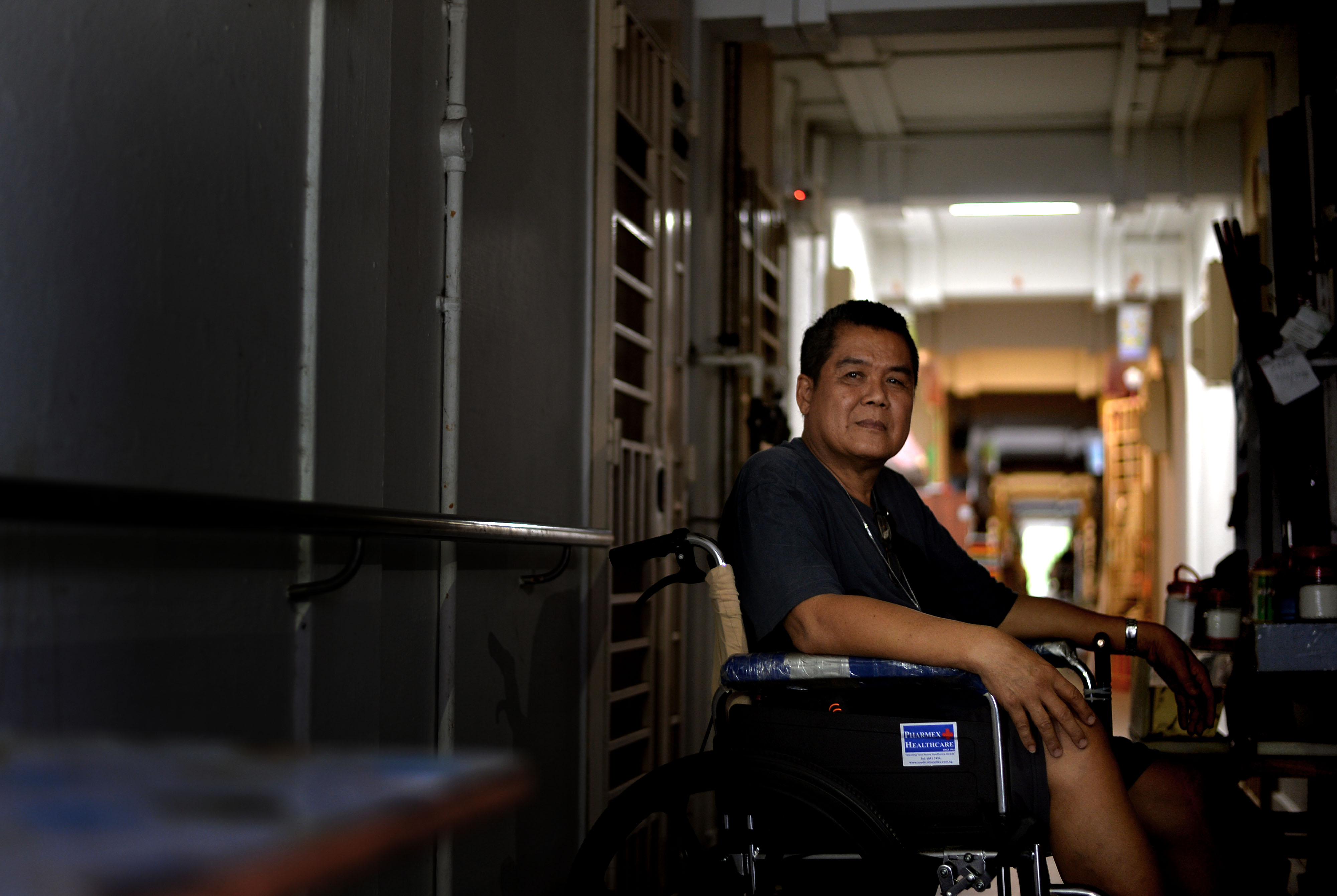

Photo: The New Paper

Mr Willie Yeo, 65, is wheelchair-bound and needs financial and medical help.

But his poor elderly neighbours are his priority.

“Whenever my friends, who remember me, take me out for a scrumptious meal at a grand restaurant, I would tar pau (pack in Hokkien) food back for my neighbours,” he says.

It is no wonder that he earned the nickname “Robin Hood” among his neighbours at the rental flats in North Bridge Road.

Mr Yeo, a divorcee who lives alone, says he lost his job because of his many health problems.

“The bank foreclosed my flat in Yishun, and I was forced to sell it. I made only $15,000 from the sale, which went to paying back money I had borrowed,” he says.

“I used to be a roving salesman more than 10 years ago, selling beads for making jewellery.

ILLNESSES

“I would lug between 20 and 30kg of beads from one place to another and travelling only by public transport,” he says.

He believes that was the cause of his degenerative wear and tear of his right ankle, which resulted in metal pieces being attached to his right foot.

Mr Yeo has a litany of other problems.

“I have diabetes and hypertension, and I suffer from fatty liver. I also have asthma and testicular cancer.

“I recently underwent radiation treatment for prostate cancer. I go to Tan Tock Seng Hospital for a check-up twice a month. That’s why the nurses all know me well,” he says with a chuckle.

He is also recovering from a fractured right shoulder – believed to be due to osteoporosis – and suffers from pain in his knees.

While his medication is covered by Medifund and the hospital’s endowment fund, Mr Yeo is no longer on Public Assistance since he started collecting his Central Provident Fund in 2013 after he turned 62.

“So I withdraw $540 each month, and I sell tissue paper to earn another $300 to supplement my income,” he says.

Some people have rebuked him for selling tissue paper and that has depressed Mr Yeo.

“I hope people understand that we didn’t ask to be sick and to be thrown suddenly into poverty.

“Who doesn’t want to be healthy and earn a proper living?

“Perhaps that’s why I throw myself into helping my neighbours out. I feel happy when I see them happy,” he says.

He hopes to become healthy again
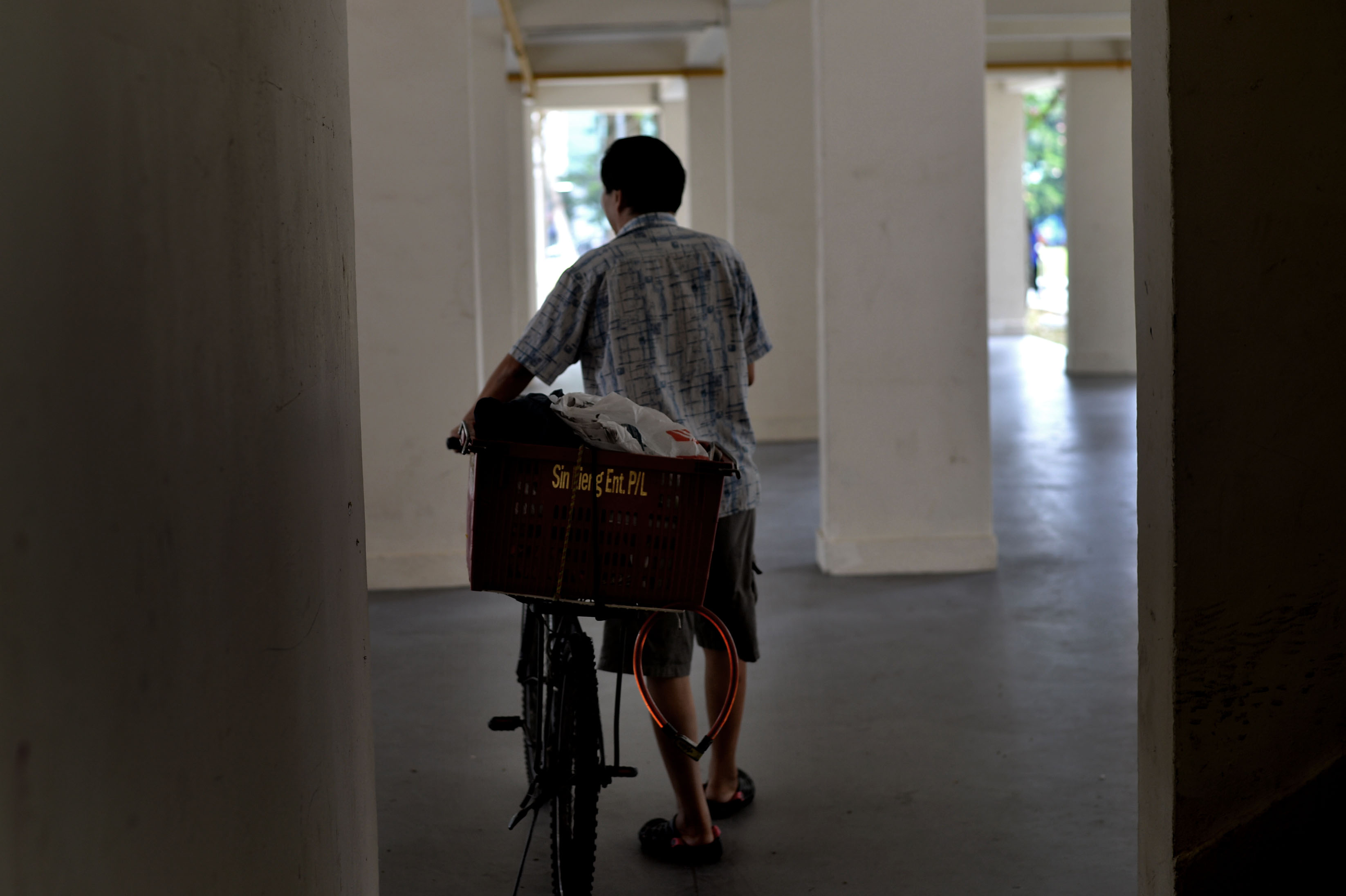

Photo: The New Paper

He was once a cook – and a good one too, he says.

Then the 54-year-old, who wants to be known only as Mr Lee, suffered a heart attack and stroke six years ago.

He says he lost his job, his family and a roof over his head.

The bachelor was living with his mother in her flat in the east of Singapore, but he felt like a burden as he was jobless and sick, so he left.

“I felt that I was a disappointment to her. If I were not living there, it would be out of sight, out of mind,” he says, tears welling in his eyes.

Homeless for the last three years, Mr Lee has been sleeping in parks and sometimes at an uncle’s place.

“He recently suffered from a stroke, so by staying over, I can help to keep an eye on things,” he adds.

Mr Lee gets his meals from charity Willing Hearts, which runs a soup kitchen.

PHYSIOTHERAPY

“Previously I went to a Chinese temple in Geylang for vegetarian food. Many homeless people I’ve met take their meals there.

“But I developed gout and have to stay away from bean-based food, so I stopped going to the temple,” he says.

For his daily hygiene, Mr Lee says he goes to a public pool for his showers.

“I don’t go in free of charge. I use the voucher given out by the Government for SG50. I also swim once in a while as a form of physiotherapy.

“I am hoping to get back my health so that I will be able to look for a job,” he says.

He told The New Paper on Sunday that his Public Assistance fund of $400 a month “will dry up by the end of the month”.

“I can’t simply wait around for handout,” he says.

He was advised to claim insurance as he suffered his heart attack while still working, “but I don’t want to, because that would mean if I win, then I cannot seek help from any government agencies any longer”.

He does not have a clue how much money he can claim from his insurance.

Mr Lee hopes to return to cooking for a hawker stall, even though the stress may be too much for his heart to take.

“I am working on getting healthy because that is the only skill I know, but I am worried no one will hire a sick man,” he says.

“Then again, tomorrow is another day,” he adds in a chirpy voice before riding off on his bicycle, with his worldly possession contained in the basket behind him.

About the study

To design solutions for the poor and get low-income Singaporeans to help lead the study, the researchers formed an advisory committee made up of 10 men and women from low-income communities.

The Centre for Culture-Centred Approach to Research and Evaluation then launched an online campaign to raise awareness on poverty here.

Research assistant Naomi Tan says: “This is where we argue that the community members, in this case the low-income, are in the best position to identify and define the problems they face and the corresponding solutions that would actually be impactful and relevant to them.”

What does it mean to be poor

The study found:

Low-income Singaporeans either live in interim or public rental housing. Some are homeless.

They have a monthly household income of $1,500 or less. Some are on Public Assistance, which ranges from $450 to $1,180 each month and has a set of eligibility criteria.

They are unable to afford healthcare as they do not have enough savings or do not earn enough.

Some of the elderly, despite having children, are struggling to get by.

They suffer from food insecurity, so they eat cheap but non-nutritious food.

They cut down on the number of hot meals a day, worry if there is enough food in the house and are choosing to not spend their limited cash on healthier foods

Challenges faced by the poor

Although the resources to help are available, the poor do not know how to get information on what they are eligible for or how to get to the relevant agencies.

Another significant hurdle is the submission of an application that is according to the requirements set out by the agencies.

Many from the low-income group find the stringent conditions tedious and frustrating.

Stigma and alienation from relatives and the community at large hinder the poor from seeking the help needed.

The Government has set up safety nets, such as Medifund, for low-income individuals who face health problems.

Despite these efforts, they still cannot afford healthcare due to insufficient savings or a low wage.


This article was first published on April 24, 2016.
Get The New Paper for more stories.

Image: 
Category: 
Publication Date: 
Sunday, April 24, 2016 – 21:00
Send to mobile app: 
Source: 


Story Type: 
Others

Source link

PM Lee encourages more Singaporeans to have children

0

The Prime Minister was speaking at the Teck Ghee Healthy Baby contest which organisers said is aimed at promoting community support for Singaporeans to start families. 

Source link

Former White Rabbit candy firm chairman killed by stone kicked by monkey

0

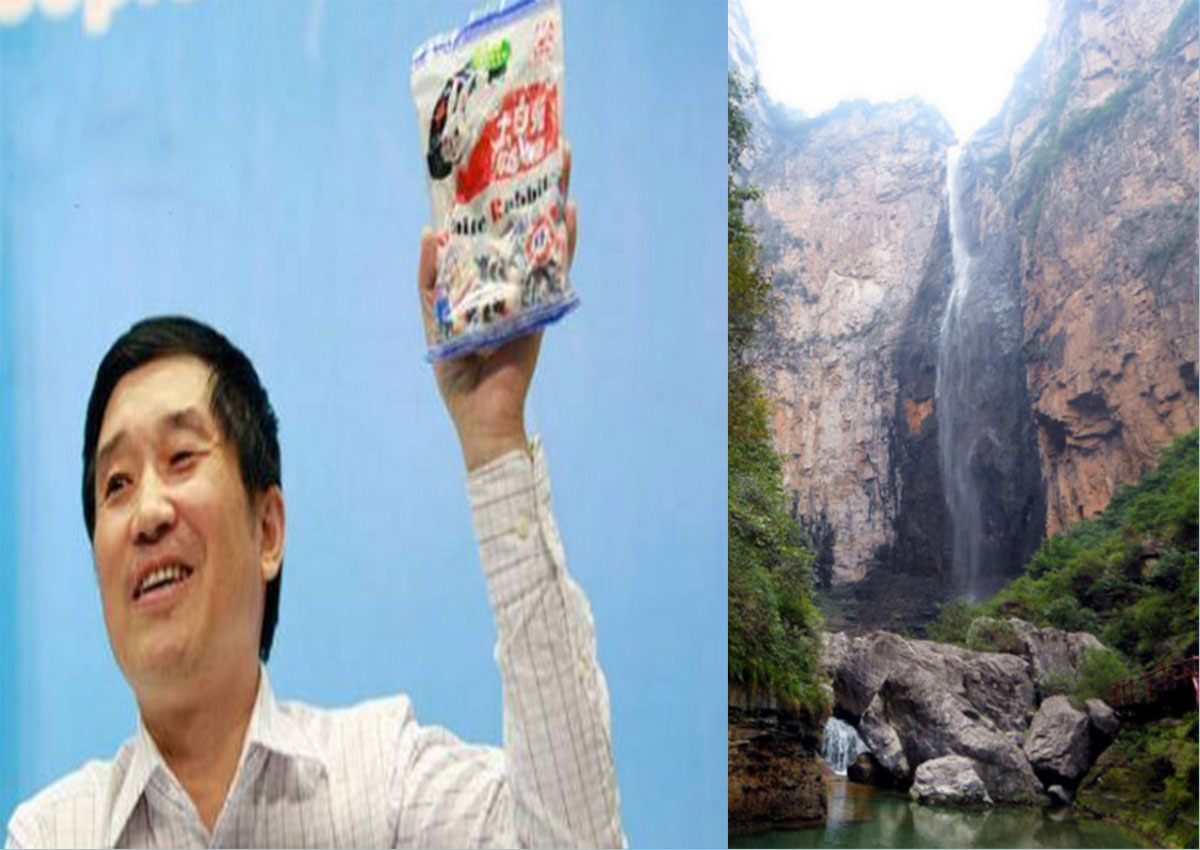
If you grew up in Singapore, you’d probably be familiar with the White Rabbit milk candy brand which not only had a strong presence in the schoolyard, it remains a mainstay of Chinese New Year goodies.

While it is a hot favourite among children and adults alike, what’s grabbed headlines in recent days about the treat isn’t so much to rave about its comforting milky sweetness, which has been popular since the 1960s.

Instead, it’s news that the former chairman of the Chinese company behind the candy died on Tuesday after an incident at a tourist spot in Yuntai Mountain in northern Henan province, reported the South China Morning Post.

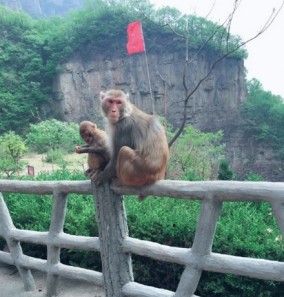
But what’s bizarre is, Mr Weng Mao, 67, who was the ex-chairman of the Shanghai food company Guan Sheng Yuan (Group) Co. Ltd., was killed after he was struck in the head by a falling rock that a monkey had kicked.

Yes, a monkey.

via GIPHY

He was rushed to the Xiuwu County People’s Hospital but later died.

Weng Mao’s trip had been organised by the Shanghai Yelv Travel Agency, reported ShanghaiDaily.com.

A notice published by the park said that Weng Mao was “accidentally hit by a stone from above which was kicked down by a monkey”.

The notice added that the tourist route has been closed for investigations.

The prime suspect in Mr Weng Mao’s untimely death was a macaque, a second-class protected animal species in China, which lives in its natural reserve at the mountain park’s Xiaozhaigou Valley, reported china.org.cn.

CCTV News reported that there have been several reports in recent years of people being killed by falling rocks in scenic areas across China.

Last year, seven tourists were killed by massive falling rock pieces in Caidie Mountain in Guilin.

sujint@sph.com.sg

Image: 
Category: 
Publication Date: 
Sunday, April 24, 2016 – 12:09
Send to mobile app: 
Source: 


Rotator Image: 
Story Type: 
Rewritten Story

Source link

S'porean takes part in N Korean marathon, becomes translator for tour group in Pyongyang

0

On April 7, 13 North Korean restaurant workers defected en masse to South Korea.

This suggests that North Korea is a place people flee from, not flock to.

Yet three days later, 1,000 foreigners flocked to the reclusive country to run in the Mangyongdae Prize International Marathon, also known as the Pyongyang Marathon.

Singaporean Ong Wann was one of them. She was there with her brother, a running enthusiast, to race in the 10km category of the event.

He had asked her to go along to be his translator as she speaks Korean.

Miss Ong, 39, who owns and operates the Hanok Korean Language School in Singapore, had studied to be a Korean language teacher in Sogang University and Kyung Hee University in Seoul.

She had previously run the 10km race in the Standard Chartered Marathon and Great Eastern Women’s Run. This would be her first overseas race.

Was she apprehensive about going to North Korea, especially since an American tourist was recently sentenced to 15 years of hard labour for stealing a poster from a Pyongyang hotel?

“Nope,” Miss Ong says. “I have friends who have been there and all of them got back safely.

“But the South Korean teachers in my school were both excited and worried for me. One of them said, ‘You must come back alive!’

“Although she was joking, I think she really meant it too.”

WORST AIRLINE

Miss Ong had to fly from Singapore to Beijing, China, to make the connecting flight to Pyongyang on Air Koryo, North Korea’s national carrier, which has been ranked the world’s worst airline four years in a row by Skytrax.

After surviving the two-hour flight, she was surprised to find that she could order a skinny latte at the Pyongyang airport cafe.

“Some cafes in Singapore don’t even have low-fat milk,” she says.

Miss Ong was then taken in a tour bus to 22m-tall bronze statues of late North Korean leaders Kim Il Sung and his son Kim Jong Il and instructed to place flowers in front of the statues and bow to them.

During a pre-tour briefing, Miss Ong was told that the leaders were treated almost like religious figures, and visitors must be careful not to behave inappropriately at their monuments.

While photography is allowed, the whole statue must be in the frame. You cannot, for example, take a picture of the statues from the waist up.

There are other restrictions – no photos of the military, construction sites and local people without their permission.

But when Miss Ong saw a local couple using the giant statues as backdrop for a bridal shoot, she couldn’t resist taking a picture of them – without their permission.

It is a wonder she wasn’t arrested and sent to a labour camp immediately.

You are also not allowed to go anywhere without your tour guide. At the hotel, guests were warned not to wander beyond the hotel grounds.

Not that you would want or need to. In the Yanggakdo International Hotel, where Miss Ong stayed and the American stole the poster, you can drink at the bar, buy snacks, shop for souvenirs, get a haircut, swim, bowl, play billiards and table tennis, and sing karaoke to rock classics like Bohemian Rhapsody.

“During the pre-tour briefing, we were told there’s a massage parlour, which was really a brothel,” she says.

Before going to Pyongyang, Miss Ong also read that the North Koreans foreigners see on the streets are actors.

To verify this, after completing her 10km race, she chatted with two young North Korean runners and asked for permission to take pictures with them. “They are not actors,” she concludes.

Her fluency in the Korean language also came in handy as she became the de facto translator for her tour group of runners from Europe, US, Israel and Hong Kong, who turned to her to find out the prices of souvenirs and decipher random signs and slogans on propaganda posters for sale.

“I know as tourists, what we saw and experienced are many times better than what most North Korean enjoy,” says Miss Ong.

“By talking to the local tour guides, it seems their leisure lives revolve around sports and hanging out with friends and family.

“Although they use mobile phones and have a national intranet instead of the Internet, they are careful about what they say and have a slower pace of life – it’s almost like going back to 30 years ago.

Miss Ong flew out of North Korea with her brother the day after the marathon and was surprised that at the Pyongyang Sunan International Airport, their cameras weren’t checked for unauthorised photographs.

PRESUMPTIONS

The trip made her grapple with her presumptions about the country, “some true and others utter nonsense”, she says.

“I could describe the experience as surreal, strange, unexpected, because the place is really more normal than what we expected it to be.”

Back in Singapore, in the taxi from Changi Airport, Miss Ong mentioned to the driver that she and her brother had just returned from North Korea and was taken aback by the cabby’s intense reaction.

She recounts: “He started telling us how dangerous the place was and insisted that it wasn’t safe like we said.

“It was as if he was the one there – not us.”


This article was first published on April 24, 2016.
Get The New Paper for more stories.

Image: 
Publication Date: 
Sunday, April 24, 2016 – 14:00
Send to mobile app: 
Source: 


Story Type: 
Others

Source link

Why the world needs Unbreakable Kimmy Schmidt

0

Some years ago TV comedies found grim humour in ordinary domestic life. Now even sitcoms about murder and sex slavery are bright and bubbly. Nicholas Barber asks, “What changed?”

Did you hear the one about the woman who was locked in an underground bunker for 15 years by the leader of an apocalypse cult?

True, it doesn’t sound particularly side-splitting, but that’s the set-up of Tina Fey’s acclaimed sitcom, Unbreakable Kimmy Schmidt, which is beginning its second series on Netflix.

The programme has one of the darkest premises of any television comedy, and yet, miraculously, Unbreakable Kimmy Schmidt is as optimistic as its title suggests.

Kimmy (Ellie Kemper) is released from captivity at the start of the first season, so the humour stems from her sunny naivety as she adjusts to life in the open air.

Watching each episode, you marvel at the way it balances such intense darkness and such twinkly light – but Unbreakable Kimmy Schmidt isn’t unique.

In sitcoms, the most joyous comedy is often associated with the most horrific scenarios. Stranger still, the most depressing comedy tends to be set in places that don’t seem too bad at all.

A typical sitcom revolves around fairly cheerful people in largely comfortable surroundings: a taxi firm, a family home, a bar where everybody knows your name.

But sometimes a series will look beyond these convivial environments to examine the characters’ misery, whether it’s the frustrations of Harold in Steptoe and Son, or Al Bundy in Married with Children, or – best of all – Reggie in The Fall and Rise of Reginald Perrin.

This gloomy sitcom strain reached its pitch-black extreme in the late 1990s and early 2000s, a time when any British comedy associated with Chris Morris, Julia Davis, Mark Gatiss or Armando Iannucci was unwatchable without strong nerves and a stronger stomach.

Read the full article here

Image: 
Category: 
Publication Date: 
Sunday, April 24, 2016 – 12:35
Send to mobile app: 
Source: 


Story Type: 
Others

Source link

Singapore’s leaders send congratulations to Laos' new leadership

0

In their letters, President Tony Tan Keng Yam and Prime Minister Lee Hsien Loong highlighted close cooperation between the two countries and extended invitations to their Lao counterparts.

Source link