Home Blog Page 410

COVID-19 Budget: Unemployment benefits increase; higher cash payouts for adult Singaporeans

0

SINGAPORE: Financial assistance for the unemployed and low-income workers are set to increase as the COVID-19 outbreak unnerves businesses and employees across Singapore.

“The best way to safeguard the well-being of our people is by supporting them to stay employed,” said Deputy Prime Minister and Finance Minister Heng Swee Keat in Parliament on Thursday (Mar 26).

“As the impact of COVID-19 on our economy deepens, some workers will lose their jobs or see their incomes significantly reduced. We will help them.”

UNEMPLOYMENT BENEFITS

Between May and September this year, low- and middle-income workers who become unemployed can receive a grant of S$800 a month over three months as they look for a new job or undergo training under the COVID-19 Support Grant.

Those who are eligible must not have a per capita household income of S$3,100 a month or live in a property with an annual value of S$21,000 or more, among other criteria. Beneficiaries can apply at their nearest social service offices (SSOs).
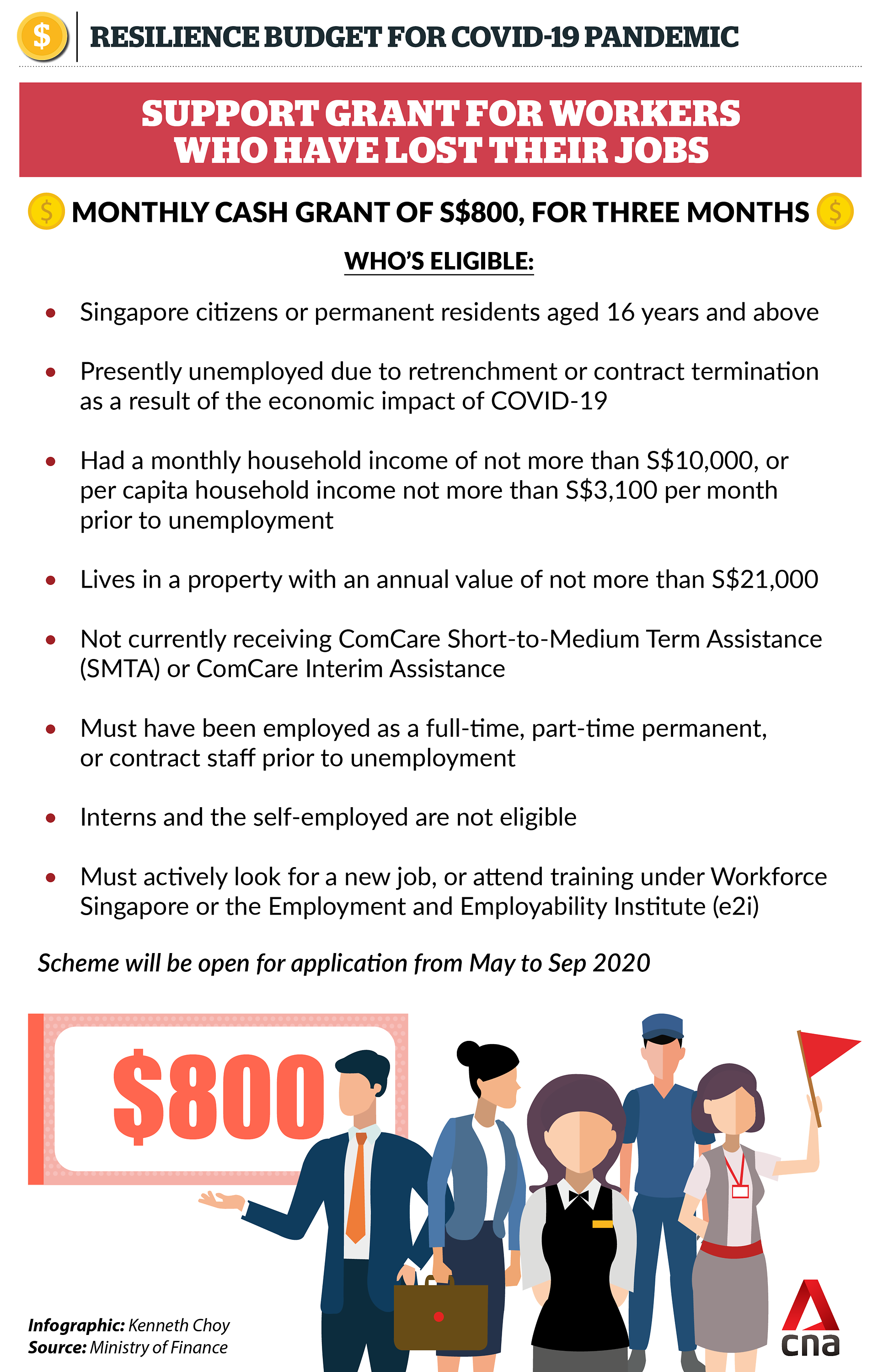
COVID-19 budget job loss support grant infographic

READ: COVID-19 Resilience Budget: ‘Landmark’ S$48 billion package to tide Singapore through ‘unprecedented’ crisis

READ: 10 things you need to know about Budget 2020

Residents who require help more urgently can tap on the Temporary Relief Fund, which they can access via the SSOs and community centres come April.

Eligibility for the ComCare scheme – a government welfare programme that provides assistance to those who fall into financial hardship – will be eased to ensure affected Singaporeans can get help.

A total of S$145 million will be set aside for this set of unemployment benefits.

HELP FOR HOUSEHOLDS

The Care and Support package, originally valued at S$1.6 billion, will now cost about S$4.6 billion. 

Mr Heng said: “Many Singaporeans are concerned about how they will pay their bills and household expenses if their livelihoods are affected during this uncertain period. 

“We will put more cash in the hands of all families to help them cope.”

Cash payouts for all adult Singaporeans will now be tripled to a range of S$300 to S$900, depending on their income.

The additional cash payout given to each Singaporean parent with at least one Singaporean child aged 20 and younger will also be tripled from S$100 to S$300.

READ: COVID-19 Budget: Self-employed people, firms, first-time jobseekers to receive more support

READ: COVID-19 Budget: Income tax payments for companies, self-employed people delayed for 3 months

Singaporeans aged 50 and over who were set to get a S$100 top-up in their PAssion cards will receive the amount in their bank accounts instead, as to avoid the need to queue at top-up stations, said DPM Heng.

These cash payouts will be disbursed between August and September this year.

Grocery vouchers given to needy Singaporeans this year will also triple from S$100 to S$300. Together with the S$100 voucher given to them next year, they will receive S$400 in grocery vouchers over 2020 and 2021.
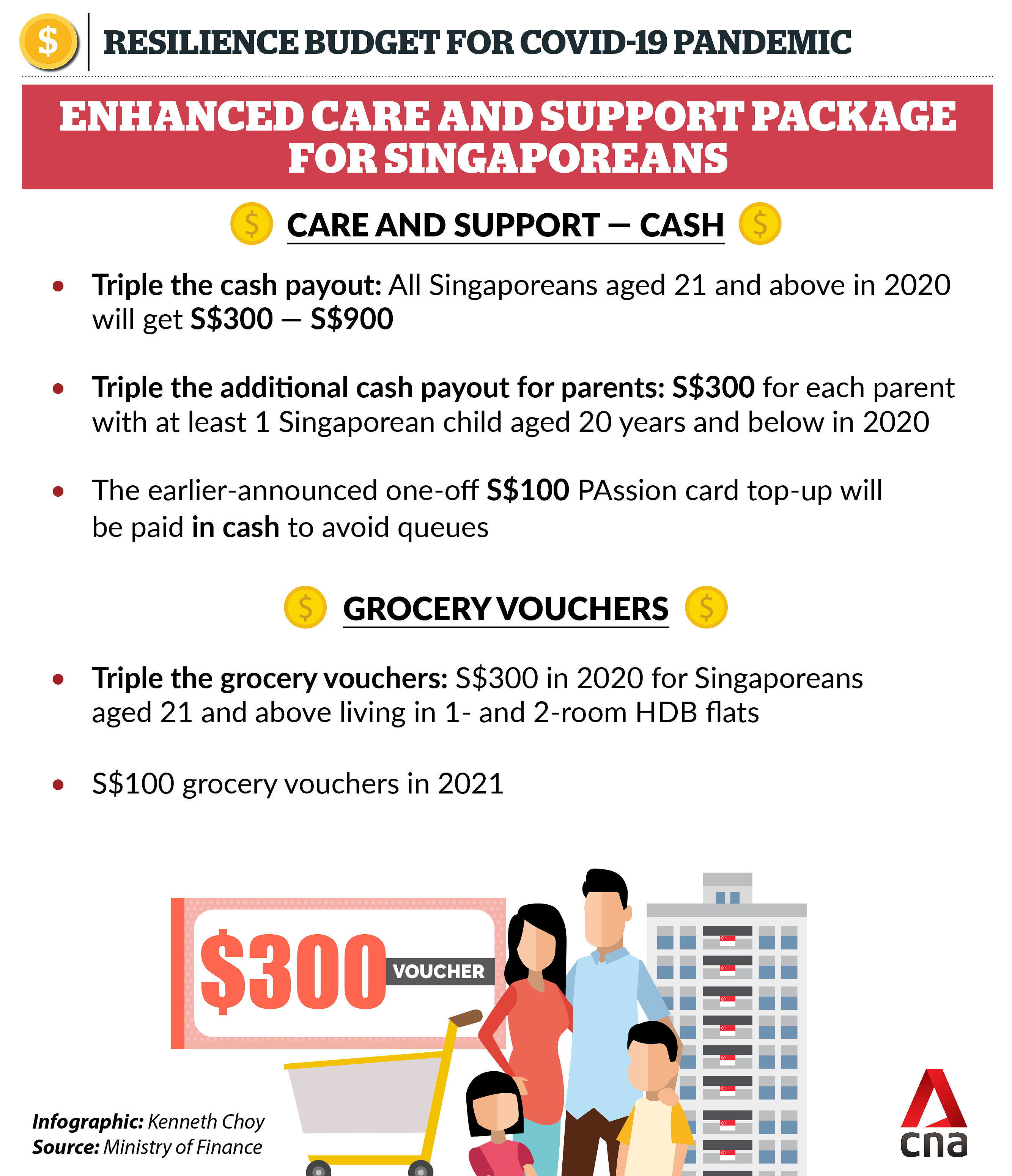
COVID-19 resilience Budget help for households

READ: Budget 2020: 5 things to know about measures to help Singapore households with living costs

READ: Budget 2020: Free meals for vulnerable families islandwide as MPs urge more help for those in need

Grants given to self-help groups and community development councils (CDCs), which have their own assistance schemes, will be increased. Self-help groups will receive S$20 million over two years.

CDCs will receive S$75 million this year, S$50 million more than the original sum announced.

FREEZE IN FEES AND LOANS

All government services fees and charges will be frozen for a year, from Apr 1 to Mar 31, 2021, Mr Heng said.

Graduates’ loan repayments and interest charges will be suspended for one year between Jun 1 and May 31 2021 as well, in order to help graduate who are worried about having to pay off their student loans while finding job in this economic climate, said DPM Heng.

READ: COVID-19 Budget: More than S$1 billion for aviation, tourism, other sectors

READ: About 940,000 HDB households to receive S$134 million in S&CC rebates

Late payment charges on HDB mortgage arrears will also be suspended for three months, to help those who are struggling with their mortgage payments, he said.

The Housing and Development Board will continue to exercise flexibility when providing assistance during this period through existing measures such as deferring payment of loan installments for six months, he added.

SUPPORT FOR LOW-INCOME, SELF-EMPLOYED WORKERS

Singaporeans who are on Workfare will receive more money under the new Workfare Special Payment scheme announced at the Budget this year.

They were originally going to receive a one-off stipend of 20 per cent of their 2019 payout, with a minimum S$100 payout.

They will now each receive S$3,000 in cash instead.

READ: Singapore’s reserves are for rainy days, COVID-19 already a ‘mighty storm’: DPM Heng

READ: Enhanced training assistance for low-wage, self-employed people to improve career prospects

Mr Heng pointed out that the country’s labour movement is also helping workers, including freelancers.

The National Trades Union Congress (NTUC) announced last week that it will set aside S$25 million to provide a one-off relief of up to S$300 to low and middle income union members.

The union also topped up the training support scheme offered to self-employed workers – now a rate of S$10 per hour – by S$4 million, giving union members an additional training allowance of up to S$1 per hour.

READ: Union members affected by COVID-19 outbreak to receive one-off relief of up to S$300: NTUC

“We will protect jobs, support our workers, and protect livelihoods,” said Mr Heng as he listed the various initiatives in his speech. 

“We will continue to monitor the situation closely, and are prepared to take swift action to do more if needed.”

BOOKMARK THIS: Our comprehensive coverage of the novel coronavirus and its developments

Download our app or subscribe to our Telegram channel for the latest updates on the coronavirus outbreak: https://cna.asia/telegram
Source link

COVID-19 Budget: Self-employed people, firms, first-time jobseekers to receive more support

0

SINGAPORE: Self-employed people, firms and first-time jobseekers will receive more financial support, announced Deputy Prime Minister Heng Swee Keat on Thursday (Mar 26), amid an economic slowdown caused by the COVID-19 outbreak.

This is part of a S$48 billion Resilience Budget to deal with what is likely to be the “worst economic contraction since independence”, said Mr Heng, and follows the S$4 billion Stabilisation and Support Package for workers and firms announced during Budget this year.

READ: COVID-19 Resilience Budget: ‘Landmark’ S$48 billion package to tide Singapore through ‘unprecedented’ crisis

READ: COVID-19 Budget: Income tax payments for companies, self-employed people delayed for 3 months

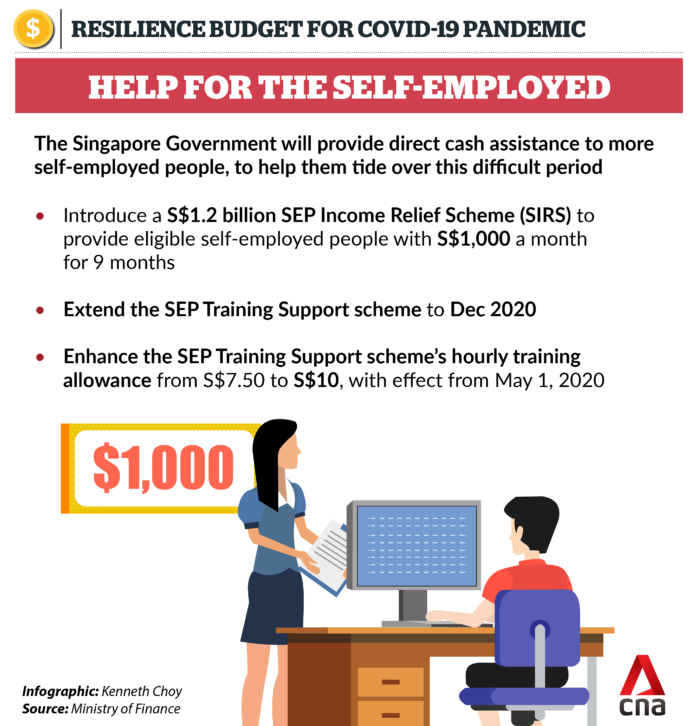
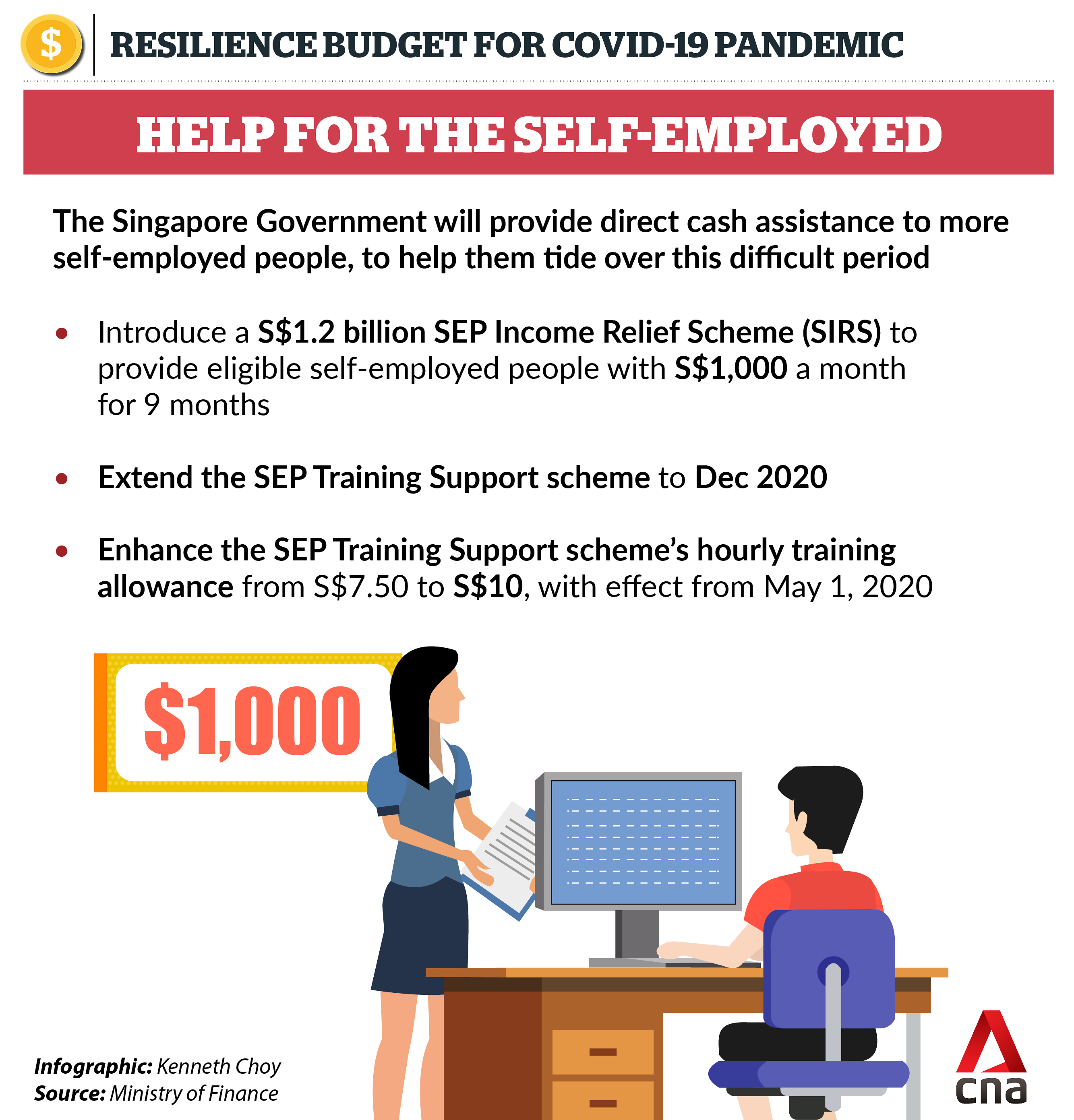
Under the Resilience Budget, those who are self-employed will receive direct cash support through a Self-Employed Person Income Relief Scheme, which offers S$1,000 per month to eligible self-employed people for nine months.

“Some of them have less means and family support, and need help to tide over this difficult period,” said Mr Heng, adding that S$1.2 billion will be set aside for this scheme.

“Overall, we expect to reach out to most of the self-employed persons who depend on self-employment for their livelihood and have less means and family support,” he said.

In addition, self-employed people will receive enhanced hourly training allowances under the Self-Employed Person Training Support Scheme, for them to use the downtime to train and upskill.

From May 1, the hourly training allowance will be raised from S$7.50 to S$10. The training support scheme will also be extended to December this year.

“The enhanced training allowance is on top of the already generous training subsidies, which cover up to 90 per cent of fees.

“In addition, trainees will be able to tap on their SkillsFuture Credit to further offset the course fees,” said Mr Heng, who is also Minister for Finance.

He added that S$48 million will be set aside for this enhanced scheme.

Self-employed persons COVID-19 budget

READ: COVID-19 Budget: More than S$1 billion for aviation, tourism, other sectors

READ: ‘It always helps when you know you are not alone’: Freelancers rally online after taking hit from COVID-19 outbreak

KEEPING WORKERS EMPLOYED

The Jobs Support Scheme, introduced during Budget this year, will be enhanced and extended, said Mr Heng. The scheme aims to help firms retain local workers during this period of uncertainty. 

“The situation now calls for bolder and more aggressive moves to save jobs and keep workers in employment,” he said.

For firms, the Government will co-fund 25 per cent of every local employee’s wage, up from 8 per cent. Firms in the food services sector will receive 50 per cent co-funding per local worker, while firms in the aviation and tourism sectors – the most badly affected sectors – will receive 75 per cent co-funding.

More workers will also qualify for co-funding, with the qualifying wage ceiling raised from S$3,600 to S$4,600. The median wage in Singapore is S$4,600.

The Jobs Support Scheme will also be extended for two quarters until the end of 2020. Employers will receive payouts in May, July and October.

Effectively, a total of S$15.1 billion will be allocated to 1.9 million local workers under the Jobs Support Scheme, more than twice the support provided during the Global Financial Crisis.

“With this support from the Government, I urge employers to do your part to hold on to your workers,” said Mr Heng.

READ: COVID-19 Budget: Unemployment benefits increase; higher cash payouts for adult Singaporeans

READ: President Halimah Yacob gives ‘in-principle support’ to draw on reserves for second COVID-19 assistance package

MORE JOBS FOR FIRST-TIME JOBSEEKERS

For first-time jobseekers concerned about the current job market, the Government will offer traineeships and provide more help to find employment for them.

The SGUnited Traineeships will give young people the opportunity to “gain valuable work experience” and give “an added boost for employers to emerge stronger from this crisis”, said Mr Heng.

“Under this programme, Workforce Singapore will co-share manpower costs with enterprises that offer traineeships targeted at local first-time jobseekers this year,” he said, adding that he hoped to support up to 8,000 traineeships this year, across large and small enterprises.

“This will include science and technology traineeships in our R&D labs, deep-tech startups, accelerators and incubators,” he said, with more details to be announced by the Ministry of Manpower.

READ: Singapore’s reserves are for rainy days, COVID-19 already a ‘mighty storm’: DPM Heng

In addition, the Government will set up an SGUnited Jobs initiative, to create about 10,000 jobs over the next year, with the public sector taking the lead.

“Our agencies have been planning our manpower needs early, and there is a range of jobs which we need to fill in emerging areas.

“We will accelerate hiring plans to fill these roles, while giving our people meaningful employment opportunities,” he said.

This includes long-term roles in areas such as social services, early childhood education and ICT to enhance the provision of essential services, and short-term temporary jobs like health declaration assistants, temporary management support officers and Transport Ambassadors to handle the increase in COVID-19 related operations.

At the same time, the Government is also working with the Singapore Business Federation and Trade Associations and Chambers to identify jobs in the private sector.

“These may come from businesses recruiting for the eventual recovery, or with short-term manpower needs due to disruptions in labour supply,” he said.

He added that Workforce Singapore will be holding a virtual career fair on Friday with more than 2,200 job vacancies, with a focus on short-term temporary jobs that are immediately available. Jobseekers looking for long-term roles may visit mycareersfuture.sg instead.

BOOKMARK THIS: Our comprehensive coverage of the novel coronavirus and its developments

Download our app or subscribe to our Telegram channel for the latest updates on the coronavirus outbreak: https://cna.asia/telegram
Source link

COVID-19 Resilience Budget: ‘Landmark’ S$48 billion package to tide Singapore through ‘unprecedented’ crisis

0

SINGAPORE: A public health crisis, an economic shock and a social test rolled into one – the COVID-19 outbreak has been an “unprecedented crisis of a highly complex nature”, Deputy Prime Minister Heng Swee Keat said on Thursday (Mar 26) as he announced what he called a Resilience Budget to help deal with the situation.

In recent weeks, as the novel coronavirus escalated its spread around the world, more countries have ramped up public health measures. These moves have, however, caused severe economic disruptions, with global financial markets roiled in mounting uncertainties.

These global shocks will deeply impact Singapore’s open economy, which could see its “worst economic contraction since independence”, Mr Heng warned. Preliminary figures on Thursday already showed the economy shrinking 2.2 per cent year-on-year in the first quarter.

“This extraordinary situation calls for extraordinary measures,” he said.

With that, Mr Heng, who is also Finance Minister, unveiled an unparalleled S$48 billion package of measures to steer aid to workers and businesses – with more targeted help for those hardest-hit by the coronavirus pandemic – as well as strengthening economic and social resilience.

To fund this supplementary Budget, the Government will draw up to S$17 billion from Singapore’s past reserves, he said. President Halimah Yacob has given her in-principle approval for this.

Together with the S$6.4 billion announced in Budget 2020 last month, Singapore will be setting aside close to S$55 billion, amounting to 11 per cent of gross domestic product (GDP), for the battle against COVID-19.

READ: Singapore’s economy contracts by 2.2% in Q1 as COVID-19 outbreak hits construction, services

READ: President Halimah Yacob gives ‘in-principle support’ to draw on reserves for second COVID-19 assistance package

The Resilience Budget dwarves any other stimulus packages that the Government has announced. The biggest had been the S$20.5 billion Resilience Package rolled out in 2009 during the throes of the global financial crisis. Other off-Budget packages announced during the downturns of 1998, 2001 and 2003 ranged from S$230 million to S$11.3 billion.

“This is a landmark package, and a necessary response to a unique situation,” Mr Heng said.

SAVING JOBS, SUPPORTING WORKERS

More than one-third of the Resilience Budget is dedicated to saving jobs and supporting workers, which remain top of the Government’s priority list, said Mr Heng.

One way is to “significantly” enhance and extend the Jobs Support scheme – first announced in Budget 2020 to help firms defray wage costs – to provide “more impactful and sustained” support. This will cost the Government S$15.1 billion. 

Co-funding of wages for every local worker will be raised from 8 per cent to 25 per cent, announced Mr Heng. Sectors that have borne the impact of COVID-19 will receive higher support in wages – 50 per cent for food services and 75 per cent for the most badly-affected aviation and tourism industries. 

Apart from raising the monthly qualifying wage ceiling from S$3,600 to S$4,600, the scheme will also be extended for another two quarters until end-2020. Employers will hence receive three payouts in May, July and October this year. 

Help will also be set aside for the self-employed to provide them with a “safety net” during this difficult period, said Mr Heng.

This will include direct cash assistance through a new Self-Employed Person Income Relief Scheme (SIRS), for which the Government will set aside S$1.2 billion. Another S$48 million will go into extending a training support scheme until December 2020, while increasing hourly training allowance to S$10 from May 1.

READ: COVID-19 Budget: Self-employed persons, firms, first time jobseekers to receive more support

READ: Singapore’s reserves are for rainy days, COVID-19 already a ‘mighty storm’: DPM Heng

An array of assistance was also announced for lower-income workers, job seekers and those unemployed. 

There will be higher payouts under an enhanced one-off Workfare Special Payment for the lower-income, while jobseekers can look forward to two new initiatives – an SGUnited Traineeships programme and an SGUnited Jobs Initiative that aims to create about 10,000 jobs over the next one year. 

The Government also wants to help those that may lose their jobs during the COVID-19 outbreak, said Mr Heng. 

For instance, the Government will “exercise more flexibility” when considering applications for the ComCare scheme, which provides those who fall into financial hardship with assistance. 

A Temporary Relief Fund will also be set up in April to provide immediate financial assistance to those in need, while a separate COVID-19 Support Grant will provide low- and middle-income workers who lost their jobs with a monthly grant of S$800 for three months.

In total, S$145 million will be set aside for the new schemes and increased flexibilities to ComCare, said Mr Heng. 

“Even then, we cannot prevent an economic recession as the external health and economic situation will evolve beyond our control,” he added. “But it will help us mitigate the extent of the downturn and more importantly, help save jobs and protect livelihoods.”

READ: COVID-19 Budget: Unemployment benefits increase; higher cash payouts for adult Singaporeans

HELPING HOUSEHOLDS

Turning to households, the Care and Support Package, which was announced in Budget 2020, will be ramped up in various ways to around S$4.6 billion.

This will include a tripling of the cash payout for all adult Singaporeans, as well as that given to parents with young children. To help needy Singaporeans with daily expenses, especially in the cost of food, grocery vouchers given to them this year will also be tripled to S$300.

Mr Heng also announced other moves to strengthen the network of support for workers and families, such as doubling grants to self-help groups. 

The Government will also exercise greater flexibility on its fees and loans during this period, including a freeze on all Government fees and charges for a year until Mar 31, 2021, as well as all loan repayment and interest charges for a year for graduates who have taken a government loan for their university and polytechnic studies.

“We will continue to monitor the situation closely and are prepared to take swift action to do more if needed,” he said. 

SUPPORTING BUSINESSES

More relief is also in store for businesses, namely in the areas of cash flow, cost and credit.

In the first aspect, Mr Heng said the Government is already doing its best to flow the payouts under the wage support schemes, with more than S$600 million to be disbursed to employers by the end of this month.

To further ease cash flow for businesses, Mr Heng announced on Thursday an automatic deferment of income tax payments for companies and the self-employed for three months.

When it comes to costs, the property tax rebate will be enhanced with a higher amount and to cover more properties.

Qualifying commercial properties badly affected by the virus outbreak, including hotels, serviced apartments, tourist attractions, shops and restaurants, will pay no property tax for 2020. 

For businesses in other non-residential properties, such as offices and industrial properties, a property tax rebate of 30 per cent will be granted.

Reiterating a point he made last month, Mr Heng “strongly” urged landlords to do their part and pass on these rebates to their tenants “fully”.

The Government will lead by example with enhanced rental waivers, he added. For instance, NEA will give stallholders in hawker centres managed by NEA or NEA-appointed operators a three-month rental waiver, up from the one-month waiver announced last month.

As for ensuring access to credit, various financing schemes, such as the Enterprise Financing Scheme – SME Working Capital Loan, Loan Insurance Scheme and the Temporary Bridging Loan Programme, will be enhanced. 

The Monetary Authority of Singapore is also working with banks and insurers to see how best to help businesses and individuals with their loan obligations and insurance premium payments, said Mr Heng. More details will be announced.

People wearing protective masks

People seen wearing masks at Chinatown, Singapore on Mar 11. (Photo: Gaya Chandramohan)

HELP FOR HARD-HIT SECTORS

For sectors engulfed by the outbreak, more help is on the way, with more than S$1 billion set aside for sectors such as aviation and tourism.

This includes an enhanced Jobs Support Scheme for businesses whose activities are based principally in the aviation sector, so as to ensure that the temporary shock to Singapore’s air hub does not become a permanent one.

A separate S$350 million enhanced aviation support package will be introduced to fund measures, such as rebates on landing and parking charges, and rental relief for airlines, ground handlers and cargo agents. 

Other tourism-related industries will also receive a similar enhanced version of the Jobs Support Scheme, as well as an additional S$90 million set aside to help the sector rebound strongly.

READ: COVID-19 Budget: More than S$1 billion for aviation, tourism, other sectors

The food services sector, which has been impacted by people opting to stay at home, will also get an enhanced Jobs Support Scheme for wage support.

Meanwhile, the Point-to-Point Support package will be extended and enhanced to support taxi and private-hire car drivers. This will cost the Government another S$95 million.

Mr Heng also announced an additional S$55 million support package for the arts and culture sector so as to save jobs, support upskilling and digitisation in the sector.

BUILDING RESILIENCE IN ECONOMY, SOCIETY

Even as the country battles the ongoing downturn, it needs to build capabilities for the eventual recovery – a point that Mr Heng also made in last month’s Budget statement.

To do so, S$1.9 billion will be set aside for this. 

This will include helping businesses to build long-term capabilities and for this, the Government will be matching S$1 for every S$2 raised by Trade Associations and Chambers or business groups for qualifying initiatives. The SMEs Go Digital Programme and the Productivity Solutions Grant will also be enhanced.

BUDGET POSITION

Explaining the need to draw S$17 billion from the reserves, Mr Heng said the COVID-19 pandemic is exactly the sort of event Singapore has been accumulating its reserves.

“We have saved up for a rainy day. The COVID-19 pandemic is already a mighty storm, and is still growing,” he told the House.

The measures will raise the overall Budget deficit for financial year 2020 to an “unprecedented” S$39.2 billion, or 7.9 per cent of GDP. 

“We are able to support this unprecedented deficit, and still remain fiscally sustainable, because we have been disciplined in the use of past reserves, tapping on it only in exceptional circumstances like these,” he said.

Mr Heng warned that the fiscal situation remains highly fluid and uncertain with significant risks, stating that it will be affected by both revenue and expenditure.

He also said he expects significant volatility in the economy and financial markets in the near future, adding that the Government will continue to review expenditure plans very carefully and adapt its responses as new developments occur. 

“We will adopt a nimble fiscal posture, so that we can quickly channel the resources at hand to the most urgent and important needs of our people,” he added.

MORE PAY CUTS FOR OFFICE HOLDERS

Towards the end of his speech, Mr Heng also announced that all political office holders will take an additional two-month pay cut and have a three-month cut in salary in total.

The President, Speaker and both Deputy Speakers will also take a similar pay cut, he added.

“It is in times of crisis that the character of a nation can be seen. We are all in this together and we must all look after one another in these trying times,” he said. 

“This is what it means to be SG United.”

He also said that the months ahead will not be easy, as the situation continues to evolve. But the Government will lead the way in anticipating and responding to developments.

“While we attend to the immediate and urgent tasks, we will also set our sights on the long-term so that Singapore comes out of this crisis stronger as a people,” he said.

Source link

COVID-19 Budget: Income tax payments for companies, self-employed people delayed for 3 months

0

SINGAPORE: Companies and self-employed people will get an automatic deferment of income tax payments for three months, announced Deputy Prime Minister Heng Swee Keat in Parliament on Thursday (Mar 26), amid an economic slowdown caused by the COVID-19 outbreak.

The deferment is part of a slew of measures under a S$48 billion Resilience Budget announced by Mr Heng to provide additional support to workers, businesses and households.

This follows the S$4 billion Stabilisation and Support Package for workers and firms announced during the Budget in February.

Companies will not have to make income tax payments due in April, May and June, said Mr Heng, meaning that payments will only be payable from July.

This will allow them to use the cash that has been freed up to meet other urgent needs, Mr Heng said.

For self-employed persons, income tax payments due in May, June and July will be deferred, he added.

“Employees may approach the Inland Revenue Authority of Singapore if they need help with their income tax payments, and wish to avail themselves of this arrangement,” he said.

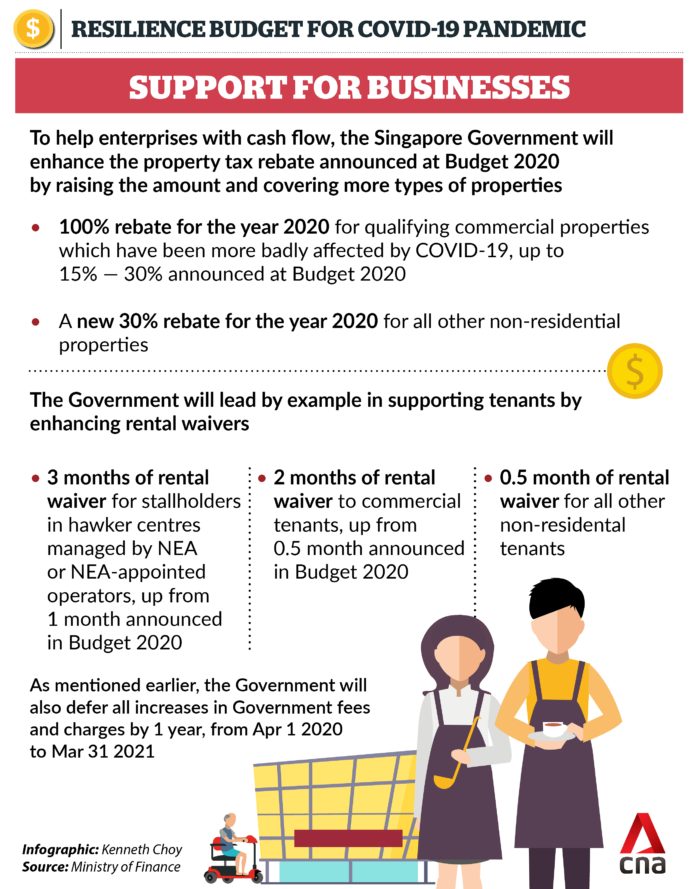
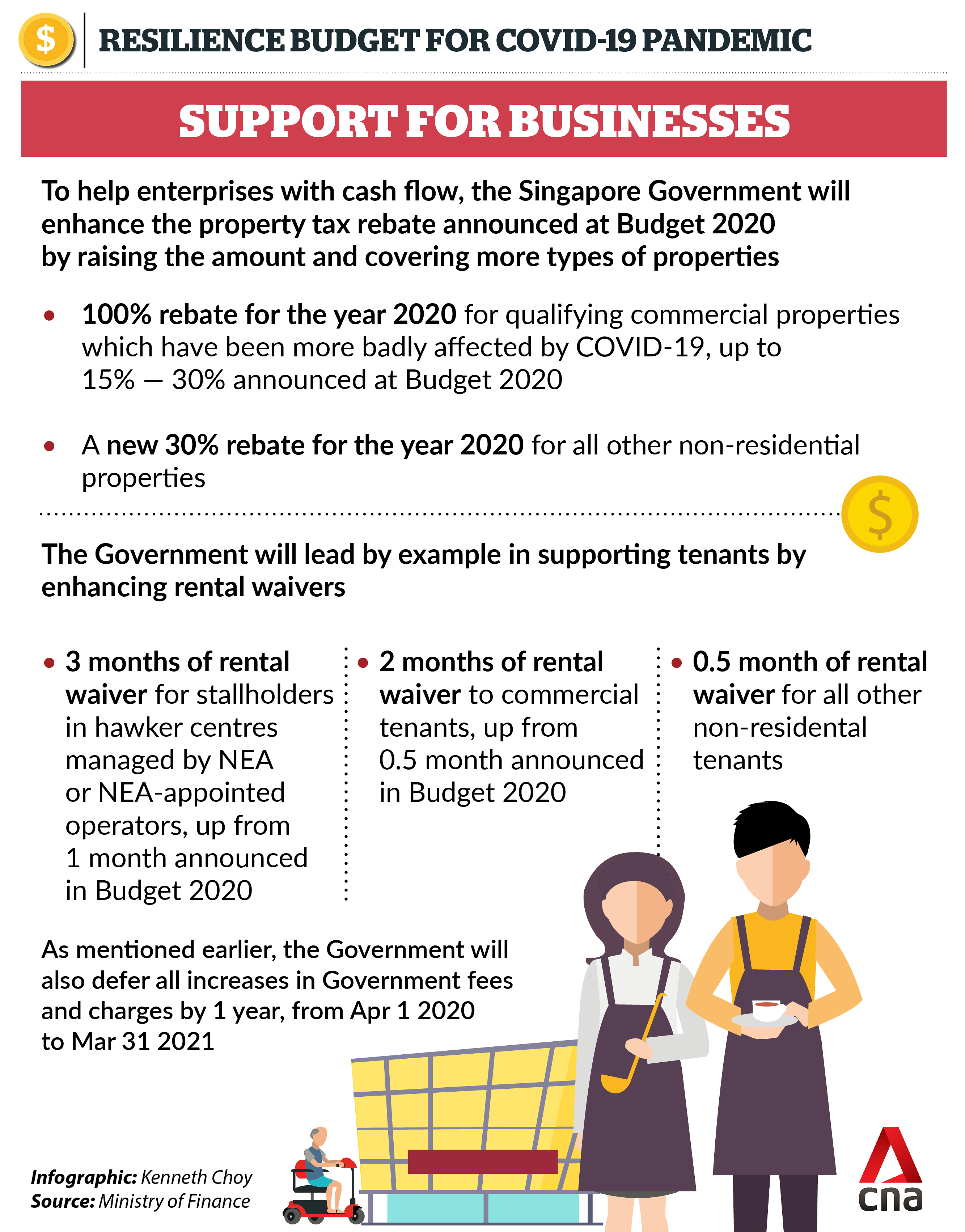
COVID-19 Resilience Budget help for businesses infographic

READ: Budget 2020: 5 things to know about plans to help workers and businesses amid COVID-19 challenges

To ease the load of qualifying commercial properties that may have been “more badly hit” by the COVID-19 outbreak, property tax will be suspended for the year, said Mr Heng.

These commercial properties include hotels, restaurants, shops, tourist attractions and serviced apartments.

This is an enhancement over the support measures Mr Heng announced in response to the outbreak during this year’s Budget in February, Mr Heng said. At the time, he said these properties would receive 15 per cent to 30 per cent property tax rebate.

Businesses in other non-residential properties such as offices and industrial properties will be granted a property tax rebate of 30 per cent this year, as they are also affected by the COVID-19 situation, Mr Heng added.

READ: COVID-19 Budget: Unemployment benefits increase; higher cash payouts for adult Singaporeans

LANDLORDS URGED TO FULLY PASS ON REBATE

He “strongly urged” landlords to fully pass on the rebate to tenants, by reducing rentals, to directly ease the cash flow and cost pressures faced by them.

“Many businesses have pointed out that it will be a lose-lose situation if landlords do not support their tenants. After all, if tenants fail, the properties will be empty,” he said.

“So my message to landlords is: Do your part, chip in, and give additional help to tenants who are more badly hit.”

The Government will lead by example, he said.

The National Environment Agency (NEA) will give stallholders in hawker centres it manages or NEA-appointed operators three months of rental waiver, up from the one month announced during the Budget.

Other Government agencies, such as the Housing & Development Board and the National Arts Council will provide two months of rental waiver to eligible tenants, such as social service agencies and charities, Mr Heng said.

This is up from half a month previously announced. All other non-residential tenants will receive half a month of rental waiver.

READ: COVID-19 Budget: Self-employed persons, firms, first time jobseekers to receive more support

ENHANCED FINANCE SCHEMES

Additionally, said Mr Heng, S$20 billion of loan capital will be set aside in this Budget, Mr Heng said.

“This will help support good companies with strong capabilities, and catalyse private sector loan capital. As the situation is fluid, we will seek to provide help where the credit needs are more acute,” Mr Heng said.

Mr Heng also announced enhancements to several financing schemes “so that even the hardest-hit businesses can continue to have access to credit”.

For instance, to support businesses’ trade financing needs, Mr Heng said he will double the maximum loan quantum for the Enterprise Financing Scheme-Trade Loan from S$5 million to S$10 million, and increase the Government’s risk-share from up to 70 per cent, to 80 per cent.

Subsidies to businesses for loan insurance premiums under the Loan Insurance Scheme will also increase from 50 per cent to 80 per cent.

The Temporary Bridging Loan Programme, which was previously only for enterprises in the tourism sector, will be extended to all enterprises. The maximum supported loan amount will also be increased from S$1 million to S$5 million.

Small and medium enterprises that require further support can continue to tap on the EFS-SME Working Loan Capital, which has a S$1 million maximum loan quantum, up from S$600,000, Mr Heng said.

The Monetary Authority of Singapore (MAS) is working with banks and insurers to see how best to help businesses and individuals facing cash flow challenges with their loan obligations and insurance premium payments, he added. Details will be announced by MAS and the industry at a later date, he said.

READ: President Halimah Yacob gives ‘in-principle support’ to draw on reserves for second COVID-19 assistance package

GIVING PEOPLE LEGAL RELIEF

While the measures deal with helping people in financial terms, Mr Heng said giving people relief from legal obligations that have arisen because of the COVID-19 situation is an “important and complementary part”.

He provided an example of individuals who may have placed deposits for large gatherings that will not be able to proceed.

“It is not their fault that the gathering cannot go ahead. Should the deposits be simply forfeited? That won’t be right,” he said.

The Government is studying the issue and the Minister for Law will present a set of measures next week to deal with this, he said.

IMPORTANCE OF INVESTING IN R&D

Mr Heng noted that the COVID-19 outbreak has reinforced the importance of investing in research and development to prepare for critical challenges such as managing pandemics and ensuring food security.

Singapore’s investments in R&D have borne fruit, said Mr Heng, citing how Singapore was one of the first countries to successfully develop COVID-19 test kits.

COVID-19 has also emphasised the importance of having resilient supplies of food and other essential items, Mr Heng said.

Singapore is building up its national stockpile of health supplies such as masks and hand sanitisers, and is strengthening its food resilience for the long term, Mr Heng said.

“Some may be concerned about the impact on our food supplies, arising from supply chain disruptions. We need not worry,” he said, assuring Singaporeans that the country has in place a multi-pronged strategy to ensure that its people continue to have a stable supply of safe food.

READ: Singapore’s economy contracts by 2.2% in Q1 as COVID-19 outbreak hits construction, services sectors

BUILDING ECONOMIC RESILIENCE

At the industry level, all firms have a part to play in building economic resilience, as the country prepares for recovery, Mr Heng said.

This is why the Government introduced the SG Together Enhancing Enterprise Resilience (Steer) programme, he said. The programme supports industry-led initiative to help companies tide over today’s economic uncertainties, and build longer-term capabilities.

The Government will now match S$1 for every S$2 raised by trade associations and chambers, or business groups for qualifying initiatives. It previously matched S$1 for every S$4.

Support for skills upgrading will also increase, Mr Heng said. All employers will receive 90 per cent absentee payroll rate to provide additional cash flow relief when they send their employees for training from May 1 this year, he said.

He also said that Singaporeans may make early use of the base S$500 SkillsFuture Credit Top-up for their courses from Apr 1 this year, ahead of the full implementation date in October.

“I hope this will help many more workers, jobseekers, and self-employed persons make use of the downtime to learn, develop new skills and stay employable,” he said.

BOOKMARK THIS: Our comprehensive coverage of the novel coronavirus and its developments

Download our app or subscribe to our Telegram channel for the latest updates on the coronavirus outbreak: https://cna.asia/telegram

Source link

What to do this weekend? Have a Zouk party in the comfort of your own home

0

[ad_1]

In case you haven’t heard, with stricter social distancing measures in response to rising coronavirus cases, all cinemas, bars and entertainment venues will be closed from 11.59pm tonight until April 30.

So what’s one to do? Well, you can stay home and party on, thanks to a partnership between nightclub Zouk, homegrown gaming company Razer, and live streaming platform Bigo.

According to a press statement released on Wednesday (March 25), the country’s iconic nightclub will be curating a series of closed-door sets that will stream exclusively to viewers on Razer’s Bigo Live channel. 

The event will be held on March 27 at 8pm and is touted to be Southeast Asia’s first “cloud clubbing experience”. 

https://twitter.com/Razer/status/1242740741916352513[/embed]

And sticking to how Bigo live streams work, viewers will be able to interact with DJs via the Livestream chat, and send virtual gifts using Razer’s virtual currency — which you’ll have to pay real money for, of course. 

[ad_2]

Source link

President Halimah gives 'in-principle support' to draw on past reserves for 2nd coronavirus assistance package

0

[ad_1]

SINGAPORE – President Halimah Yacob has given her assent for the Government to tap on the Republic’s reserves for a substantial assistance package to deal with the coronavirus outbreak – an extraordinary move to deal with what she called an unparalleled and unprecedented crisis.

In a message read out in Parliament by Speaker Tan Chuan-Jin, Madam Halimah said she has given her “in-principle support” for the draw – which is before the House for debate.

Such a draw on the national reserves to fund special Budget measures, has only happened once before in Singapore’s history – during the 2009 global financial crisis, when then-President S R Nathan approved a draw of $4.9 billion to fund support measures.

This draw will fund a second tranche of support measures to deal with the Covid-19 pandemic, which will be outlined by Deputy Prime Minister Heng Swee Keat in Parliament on Thursday (Mar 26).

It comes after an initial $4 billion package announced by Mr Heng during the Budget last month.

[ad_2]

Source link

StarHub SIM Only customers can change a phone every year with StarHub JUMPhone

0

[ad_1]

Customers on StarHub’s #HelloChange SIM Only plans will be able to enjoy a new phone every year with the launch of StarHub JUMPhone offering.

Under this, customers can buy a new phone annually for $0 upfront cost and with immediate guaranteed savings every time they do so.

They will pay a monthly fee for the phone that will be charged to their monthly bill and will also enjoy full protection with after-sales care included.

Is this a contract-based plan?

Yes. The JUMPhone offering comes with a 24-month contract to complete the 24-month instalment for the device, even if it’s a SIM-Only plan.

What kind of after-care and service protection does a JUMPhone come with?

To be clear, what JUMPhone is offering is a SIM Only plan that allows you to pay for your new device via monthly instalments and adding in StarHub’s full-fledged SmartSupport service.

The latter is slightly different from the SmartSupport Lite that was launched earlier and is applicable to SIM Only plan users.

[ad_2]

Source link

Groomsman on trial for allegedly molesting and violating bride

0

[ad_1]

A groomsman is on trial for allegedly molesting and sexually assaulting his friend’s bride on the wedding night.

The 40-year-old man, who cannot be named to protect the identity of the victim, had allegedly touched the victim’s chest underneath her nightgown and sexually violated her in the hotel wedding suite in 2016.

The man claimed that he thought the alleged victim was his wife and that he was sleeping at home.

The court heard that after the banquet that night, several of the bridesmaids and groomsmen continued drinking in the wedding suite.

According to Yahoo, the groom said his wife was preparing to sleep and did not join the drinking session.

He said the accused gradually became drunk and fell asleep on the sofa, and the groom himself fell asleep as he was also drunk.

He said his wife later woke him up and said the accused had entered the sleeping area and molested her by touching the lower and upper part of her body.

The husband then saw that the accused, who claimed that he had touched only the victim’s upper body, topless.

The groom angrily chased him out of the room.

[ad_2]

Source link

Singapore MPs go the distance to showcase social distancing on social media

0

[ad_1]

Social distancing is all the rage these days, even though that’s pretty much a daily routine for introverts, agoraphobics and homebodies. Love it or hate it, the habits of the easily anxious will protect you (and others) from the ongoing global pandemic. 

Staying spaced out from other people seems to be something that the powers that be want to hammer in these days too. 

Judging from the trend of social media postings by Members of Parliament (MPs) across the political divide, it’s utterly important to give other folks a wide berth. 

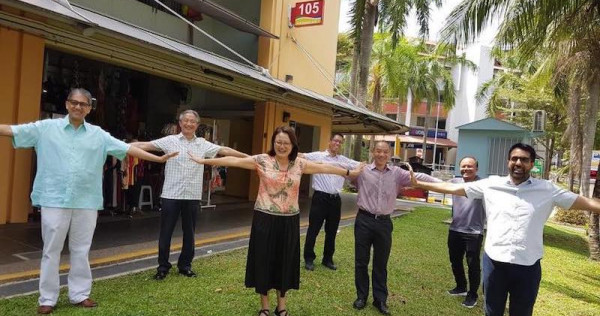
Take the Workers’ Party, for example. The opposition party in Parliament made sure to showcase how they’re leading by example on Facebook — by putting both their arms out and keeping away from each other at that length. 

From the view of someone who spends too much time on the internet, this is called doing a “T-pose to assert dominance”, which I’m sure was not the intended message by the party. 

[ad_2]

Source link

'Farewell' and 'last hurrah' parties at clubs slammed by public

0

[ad_1]

Nightclubs hoping to host “last hurrah” and “farewell” parties yesterday were hit by instant public backlash, not to mention stern disapproval from the authorities.

The proposals for such parties come in the wake of Tuesday’s announcement that all entertainment venues, including bars, nightclubs and discos, must be closed from 11.59pm tonight to help stem the spread of Covid-19.

Some establishments urged clubbers to come out for “one last bash” before the closures.

Cherry Discotheque at Cecil Street posted details of such a party on social media, with a number to call for “sofa reservations and public backlash”.

Others, like Club Lux at Orchard Plaza, decided on a two-day event with special promotions and performances, inviting clubbers to drink with them at “the last supper” before the shutdown.

It did not go down well, with netizens slamming the clubs, calling them irresponsible.

https://www.facebook.com/k.shanmugam.page/posts/2910734378973073[/embed]

[ad_2]

Source link