SINGAPORE – Singapore can consider further easing strict circuit breaker measures if the coronavirus situation improves by June 1, said Health Minister Gan Kim Yong on Monday (May 4).
For this to happen, community cases would have to remain low or drop further, while cases in migrant worker dormitories would need to come “clearly under control”.
The country will also need to drastically ramp up its capacity to test for the virus before the economy can restart, he said, adding that there are plans to increase testing capacity to 40,000 tests a day, up from the current 8,000 now.
In his ministerial statement, Mr Gan listed three factors that the Government will consider before lifting circuit breaker measures.
First, community transmission must be stopped or be very low. Cases among migrant workers in dormitories must also be reduced, or the country will risk a spillover from this group into the wider population, he said.
The Government will also assess the global situation, as well as that in individual countries to see the rate of transmissions and what they have done to contain the spread of Covid-19.
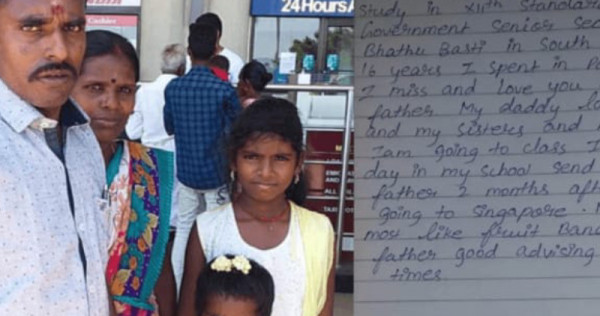
Following the recent death of migrant worker, Alagu Periyakarrupan, who died due to multiple injuries from a fall from height at Khoo Teck Puat Hospital, his eldest daughter Roopa has penned a moving handwritten letter to thank volunteers…. » READ MORE
SINGAPORE: While the COVID-19 situation within larger foreign worker dormitories was mostly stable for now, the condition at smaller dorms was still “mixed” and “taking up much bandwidth”, Manpower Minister Josephine Teo said in Parliament on Monday (May 4).
She was responding to questions from Members of Parliament on whether the measures to deal with the COVID-19 outbreak within the foreign worker community have been effective.
The larger dormitories she referred to were the 43 purpose-built dormitories that house about 3,000 to 25,000 people each, and 200,000 foreign workers altogether. The 1,200-odd factory-converted dormitories are comparatively smaller, housing between 50 and 500 workers each, totalling about 95,000 workers.
Another 20,000 workers live in temporary quarters within construction sites.
The measures, which she described in her ministerial statement, include stationing medical teams at some of the dormitories, and catering food for the workers as they had to ban communal cooking.
Mrs Teo did not elaborate on how the conditions between the accommodations differed, but went on to say that the teams were actively testing the workers so they could isolate and treat them, and prevent the virus from further transmitting.
She added that most of the workers were well and those who tested positive were recovering, but said “the full results of these efforts will take time to show”.
Outside the dorms, infection among workers in the construction sector, said Mrs Teo, was noticeably higher than the general community, and has not tapered off.
The Government has attempted to further slow the COVID-19 spread by putting 100,000 work permit holders and S Pass holders in the construction sector who live outside the dorms, and their dependents, on a four-week stay-home notice, Mrs Teo said.
“While they may not be infectious, it is safer to minimise their interactions with each other and the broader community,” she added.
AVERTING COVID-19 RESURGENCE
Though the authorities were still taking steps to contain the spread of COVID-19, it was also looking at getting its recovery phase right, Mrs Teo said.
Part of the plan is building community recovery facilities and housing recovered workers in suitable accommodations to minimise the risks of recurrent transmissions, and finding a way to allow recovered and uninfected workers to go back to work safely.
“This will again be an enormous challenge, and not just the logistics of it,” Mrs Teo said, noting that the public officers dealing with the outbreaks among the foreign worker community were managing 400,000 migrant workers right now.
Workers will be re-housed and have to get used to new friends and habits, while employers will have to adjust to their workers being in different locations with new arrangements.
New methods to monitor the workers’ health would also need to be developed; one strategy in the pipeline would be to issue pulse oximeters and require the worker to take readings regularly, and turn to telemedicine, she said.
Medical personnel inside the compound of the factory-converted dormitory at 31 Sungei Kadut Avenue. The dorm has been declared an isolation area to prevent the spread of COVID-19. (Photo: Gaya Chandramohan)
IMPROVING HOUSING STANDARDS
Mrs Teo also said that the Government would look at how to raise housing standards, especially at the older dormitories.
These purpose-built dorms sprang up in response to the construction workers’ needs as more of them started to come from China, Bangladesh, Myanmar and India to Singapore in the early 1990s, she said.
“One important consideration was, ‘what would a migrant worker want at the end of the work day, if he can’t see his family?’ Well, it is to be with his friends, cook a meal he liked, practise his religion,” she said.
Over the years, the Government had sought to raise housing standards by enacting regulations, such as the Foreign Employee Dormitory Act (FEDA) in 2015, she added.
Under the Act, dormitories that accommodate 1,000 or more workers must have health facilities like sickbays or isolation rooms and draw up contingency plans for quarantine arrangements.
“In early February, the Ministry of Manpower asked all FEDA-licenced dormitories to each put aside at least 10 quarantine rooms. Today, in dormitories with few infected workers, this provision has helped us to quickly isolate the close contacts,” she said.
Smaller dwelling types, though not covered by the Act, must still comply with “a whole range” of laws set by various agencies, such as the National Environment Agency and the Building and Construction Authority.
Manpower ministry officers regularly inspect licensed dormitories to ensure compliance, she said. Last year, about 100 dormitory inspectors conducted 1,200 inspections and 3,000 investigations across all housing types.
Every year, the ministry penalises about 1,200 employers for unacceptable accommodation under the Employment of Foreign Manpower Act, and around 20 operators for breaching the Foreign Employee Dormitory Act licence conditions.
Improving current dormitory standards will not just require different space requirements, technical standards or stronger regulatory levers, she said in response to MP Louis Ng’s questions on amending the Act and development guidelines, but also “public education”.
“The virus respects no housing type, no nationality nor occupation. We will therefore need to re-look how everyone interacts with one another at home and at our workplaces,” she said.
“Even the way we socialise will have to change … so the same for our migrant workers.”
But, she said, the focus right now is bringing the outbreak under control and resuming activities safely once the “circuit breaker” period was lifted.
“When this is over, we will reflect and thoroughly look into areas where we could have done better, so that we will be better prepared the next time.”
SINGAPORE – A man is said to have hurled vulgarities at a policeman and spat at another officer after he was allegedly spotted not wearing a mask over his nose and mouth while outdoors on Saturday (May 2) amid the coronavirus outbreak.
Singaporean Pay Kiaw Keng, 60, was charged in court on Monday with one count each of harassment, using criminal force on a public servant and an offence under the Covid-19 (Temporary Measures) Act 2020.
He is accused of failing to wear a mask over his nose and mouth at the void deck of Block 644, Hougang Avenue 8 at around 9am on Saturday.
After he was caught and inside a police vehicle about an hour later, he allegedly hurled vulgarities at Sergeant Muhamad Danish Haikal Donny Budiarto Indarto.
Pay was at a lockup at the Woodlands Police Division at around 10.30am when he allegedly spat on Special Constable Sergeant Muhammed Shariz Sazali’s right arm.
Pay is said to have breached a remission order when he allegedly committed these offences.
He had served time behind bars for an earlier offence and was given an early release last December.
For a limited time only, enjoy these attractive rates on CIMB Bank’s SGD Fixed Deposit when you make your placements online*!
With CIMB’s Fast Fixed Deposit, you are now just Clicks away from making your placements instantaneously, and at your own time! Simply log on to your CIMB Clicks Internet Banking to make a placement or amend your maturity instructions. If you’re new to the bank, the application process will allow you to make a placement seamlessly within 10 minutes.
Rates as of4 May 2020
Comparison
Interest Rates (% p.a.)
3M
6M
12M
Branch Rates
0.80
0.80
0.80
Exclusive Online Rates^
1.10
1.10
1.10
^Above rates apply to a minimum of S$10,000 per placement
*Terms and conditions apply for CIMB Fast Fixed Deposit Promotion. Click here for full terms and conditions. Promotion is valid from 01 May 2020 to 31 May 2020. Rates are subject to change without prior notice.
Rates are subject to change without prior notice.
For more info and latest updates, click here or here (for upfront interest)
Watch your spare cash grow with minimal risk and earn competitive interest rates.
Enjoy interest rate of up to 1.25% p.a.* on your Singapore Dollar Fixed Deposit.
This promotion is available from 2 May 2020 – 30 May 2020.
Tenor
Promotional Interest Rate* (p.a.)
Minimum Deposit (Fresh Funds)
10-month
1.00%
S$20,000
11-month
1.25%
S$150,000
The Promotional Interest Rate(s) quoted are as at 2 May 2020. This promotion is applicable to individual customers only and is not valid with any other privileges or promotions unless otherwise stated. The fixed deposit must be made with fresh funds and not funds transferred from existing UOB savings/current/fixed deposit account(s) or UOB cheques, cashier’s orders and demand drafts. The promotional interest rate will only apply if the fixed deposit is held to maturity. If the fixed deposit is withdrawn before its maturity, no interest will be payable unless UOB decides otherwise (in which case, the amount of interest payable will be determined by UOB). UOB may change the terms and conditions of this promotion (including the promotion period, promotional interest rate, fixed deposit tenor, or terminate this promotion) at any time without having to provide any reason or prior notice. It is important to read and accept the full terms and conditions that apply to the Promotional Interest Rate(s). This promotion is available from 2 May 2020 – 30 May 2020.
You must have a Maybank Savings or Current Account and Online Banking Access to make the placement online.
Terms and Conditions
Promotional rate is applicable from 17 April 2020 for a minimum placement amount of S$25,000 in iSAVvy Time Deposit via Maybank Mobile/Online Banking (for individuals only).
Deposit placed into iSAVvy Time Deposit must be debited from customer’s existing Maybank Savings or Current Account via Maybank Mobile/Online Banking.
For placements via Mobile/Online Banking, an upfront interest of 0.25% p.a. will be credited into customer’s savings or current account, opened and/or maintained with Maybank, on the next business day following the successful placement of the iSAVvy Time Deposit. The remaining interest will be paid upon maturity.
Additional Terms and Conditions governing this Promotion apply together with the Terms and Conditions Governing Singapore Dollar Time Deposit. Additional Rules and Regulations governing Current and Savings Accounts for individuals shall also apply.
A wee dog in Toa Payoh has joined the pantheon of meme-worthy critters who’ve masked up during the pandemic, and in adorable fashion too.
It was on April 29 that the canonical canine first appeared on Singapore’s radars through a rather superb picture taken by The Straits Times photographer Gavin Foo. In a worrying article about the vulnerability of senior citizens to coronavirus infection, an all-encompassing photo was used.
It’s a picture taken at Toa Payoh Central that aptly captures the current situation of the heightened safety measures in Singapore. There’s a cordoned-off coffee shop. There’s a GrabFood delivery rider, presumably waiting to pick up an order. There’s a senior lady riding her bicycle. And then, there’s her fluffy little dog (seemingly a Pomeranian) ambling ahead of her… with a bag over its head.





 savings
 with CIMB!
 rates on CIMB Bank’s
 SGD Fixed Deposit
 when you make your placements online*!
 a placement or amend your maturity instructions. If you’re new to
 the bank, the application process will allow you to
 make a placement seamlessly within 10 minutes.
 as of
as of 4
4 May 2020


 a
a
 minimum of S$10,000 per placement
 are subject to
 change without
 prior notice.