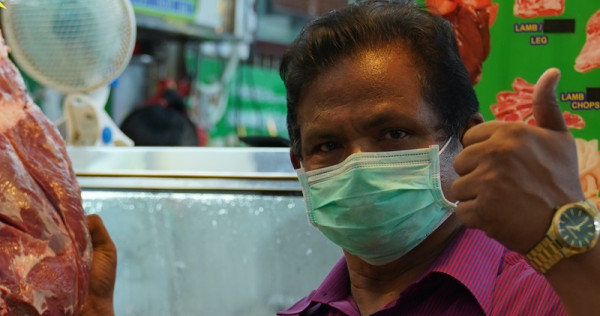
The word of the week is “sovereign”, and we have the so-called Queen of Shunfu Mart to thank for the bizarre bit of entertainment that transpired on Sunday (May 3).
Various clips shared on social media have showcased the rather ludicrous explanations made by a 40-year-old Singaporean woman who repeatedly and deliberately ignored circuit breaker measures by not wearing a mask outdoors. The first incident took place on April 14, when she went shopping for groceries at a wet market and insisted on eating her meal at Shunfu Mart, defiantly filming police officers who confronted her.
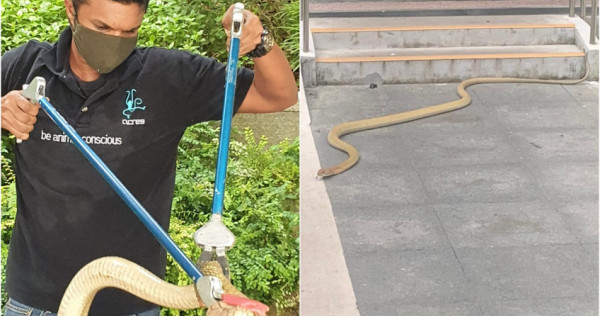
While most people are cooped up at home during the circuit breaker, a three-metre-long King Cobra was spotted taking a stroll near Marsiling MRT on Sunday (May 3) afternoon…. » READ MORE
SINGAPORE: Retails sales across almost all categories plunged in March but a few sectors were unscathed, most notably supermarkets and hypermarkets.
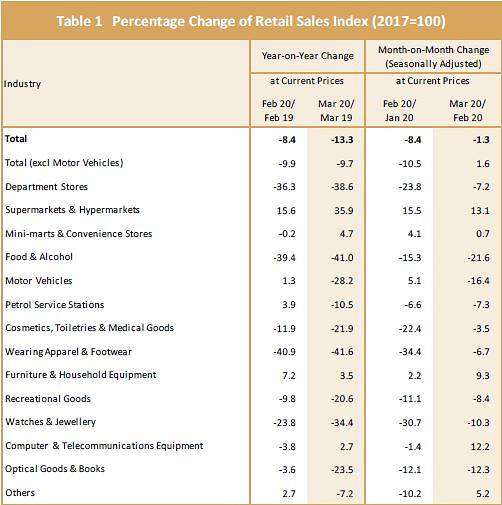
Figures released by the Department of Statistics (SingStat) on Tuesday (May 5) showed that overall retail sales in March declined 13.3 per cent, compared to the same period last year.
This is the biggest drop since September 1998, according to Reuters.
SingStat attributed the decline in retail trade to weaker domestic consumption and fewer tourist arrivals as a result of the COVID-19 outbreak.
Sales of clothes and footwear saw the sharpest decline of 41.6 per cent on-year, followed closely by food and alcohol. Department stores were also badly hit.
Compared to February, sales of food and alcohol, and motor vehicles fell 21.6 per cent and 16.4 per cent respectively.
Similarly, sales of optical goods and books declined 12.3 per cent, mainly because of a lower demand for books, according to SingStat.
Excluding motor vehicles, retail sales fell 9.7 per cent.
SUPERMARKETS BUCK TREND
With more people staying home because of safe distancing measures, supermarkets, hypermarkets, mini-marts and convenience stores benefitted from a higher demand for groceries.
Supermarkets and hypermarkets saw higher sales of 35.9 per cent year-on-year in March, while mini-marts and convenience stores experienced a 4.7 per cent bump.
One such supermarket chain, Sheng Siong, previously reported a near 50 per cent rise in first quarter profits following “elevated demand” that was triggered when the Government raised the DORSCON level to Orange on Feb 7.
Likewise, business has been reportedly brisk for grocery chains, minimarts and provision shops during the COVID-19 outbreak as they mop up some of the demand from people wanting to shop close to home.
Items such as rice, oil and toilet paper were particularly popular when panic buying took place, group managing director of grocery chain HAO mart Patrick Tan explained previously.
“Now they (customers) are moving on to the fresh items – fruits, vegetables, eggs … all these are high demand items,” he said.
A clear trend towards working from home was good news as well for those selling furniture, as well as computer and telecommunications equipment. These categories reported growth of between 9.3 per cent and 13.1 per cent compared to February.
Overall, the estimated total retail sales value in March was about S$3.3 billion. Of these, online retail sales made up an estimated 8.5 per cent.
(Table: SingStat)
FOOD SECTOR SEES DECLINE
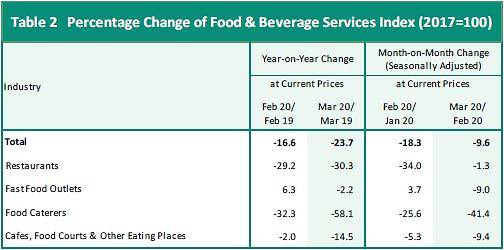
Safe distancing measures also hit food and beverage services. Compared to the same period last year, sales fell 23.7 per cent in March.
On a seasonally adjusted basis, sales of food and beverage decreased 9.6 per cent in March compared to February.
The total sales value of food and beverage services in March was estimated at S$678 million. Of these, online food and beverage sales made up an estimated 15.6 per cent.
Turnover of food caterers and restaurants fell 58.1 per cent and 30.3 per cent respectively in March compared to the previous year.
Sales at cafes, food courts and other eating places, and fast food outlets decreased 14.5 per cent and 2.2 per cent respectively year-on-year. On a month-on-month basis, these outlets and restaurants recorded lower sales of between 1.3 per cent and 9.4 per cent during this period.
Now, thanks to the Infocomm Media Development Authority (IMDA) and creative agency BLKJ, aspiring home chefs can get access to the freshest produce, meats and vegetables over the internet without leaving their homes and without compromising the experience of shopping at wet markets.
Tekka Market, the country’s oldest wet market, has officially gone online. The initiative is designed to help out both the sellers and consumers, especially seniors who prefer getting their goods from wet markets and actually interact with the vendors.
Hate to break it to you, but if you thought you were the only genius who thought of buying a gaming console to tide you through the circuit breaker lockdown, you’re wrong.
In February, there was a “global shortage” of Nintendo Switch consoles and according to iPrice , public interest for PS4 consoles increased by a whopping 713per cent in March. Sure seems like Singaporeans are getting desperate.
Granted, they’re expensive — most are in the $450 to $550 range — but ultimately, gaming consoles are cheaper than gaming PCs, which can cost thousands of dollars.
If you follow the news then you will more than likely aware of the huge spike in Covid-19 cases among migrant workers in Singapore. To help curb the spread of the virus, the government has temporarily closed down the workers’ dormitories and housed in other community facilities.
These are without a doubt trying times for the many migrant workers affected by Covid-19. To help give them a moment of respite in these uncertain times, The Walt Disney Company will be working with the Singapore government to help bring the Indian streaming service Hotstar to migrant workers during this period for free.
From today, migrant workers in Singapore will be able to stream more than 85,000 hours of blockbuster movies, cricket matches, Star India TV shows, and live news from Hotstar on their mobile phones.
“We are honoured to work with the government to bring Hotstar to migrant workers in Singapore,” said Uday Shankar, President of The Walt Disney Company APAC and Chairman of Star & Disney India, in a press statement.
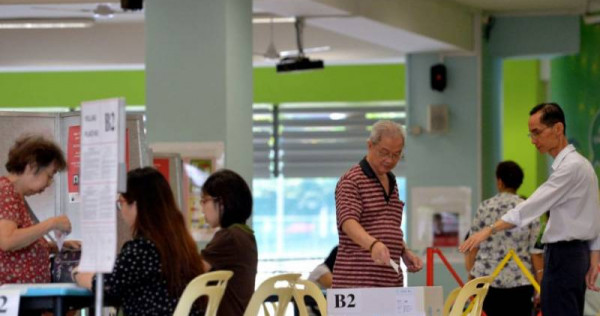
SINGAPORE – Parliament passed a law on Monday (May 4) to allow special, temporary arrangements to be implemented should the next General Election take place amid the coronavirus pandemic, so that voters, candidates and election officials can go to the polls safely.
The upcoming GE must be held by April 14, 2021.
Citing this constitutional timeline, and the likelihood that the Covid-19 crisis will last many more months, Minister for Trade and Industry Chan Chun Sing, speaking on behalf of Prime Minister Lee Hsien Loong, said it is prudent to make contingency plans.
“This is the responsible thing to do. To robustly plan well ahead. To keep our citizens safe while upholding our democracy,” he added as he opened the debate on the Bill.
The Parliamentary Elections (Covid-19 Special Arrangements) Bill allows some electors who are subject to movement control orders to vote and excuses some others for not voting.
It also allows for aspiring candidates to authorise a representative to file nomination papers for them if they are unable or unfit to do so.
The 58-year-old Singaporean had travelled to Turkey with her husband before she tested positive for the coronavirus on Mar 26 and died on Apr 30, the news website reported on Monday (May 4).
She is the youngest patient in Singapore to die from the disease.
Her eldest child, Ms Siti Noraisah Ali, said that a week before the death, a doctor told her over the phone that her mother was free of the coronavirus.
“Mama was confirmed free of COVID-19. Unfortunately, her body was unable to hold on any longer,” said Ms Noraisah, 37.
“We were told Mama’s condition had deteriorated, the effects of the virus had reached her brain and hope was thin,” said the housewife, who operates a home-based business.
Ms Salha Mesbee leaves behind her husband, three children and five grandchildren. (Photo: Siti Noraisah Ali)
Her father and two brothers also contracted COVID-19, Ms Noraisah said.
The four family members were treated at Ng Teng Fong General Hospital but while the three men recovered and were discharged, Ms Salha remained in intensive care after suffering several complications.
Ms Noraisah told Berita Mediacorp her mother did not have a history of other illnesses.
“She was admitted into the intensive care unit because her lungs were weak and her blood pressure low. Then it started to spread to other organs such as her kidney and heart. The doctor said she was one of the more critical patients,” said Ms Noraisah.
When Ms Salha was declared virus-free, her family became hopeful.
“Her battle with COVID-19 had ended. We were happy because she no longer had the disease,” said Ms Noraisah.
But the hope diminished a day later, when the family received shocking news from the doctor.
Ms Salha Mesbee and her husband. (Photo: Siti Noraisah Ali)
“On that last night, the doctor examined her eyes. Mama didn’t respond to light, so the doctor did a CT scan and found swelling in her brain,” she said.
“The next morning, the doctor confirmed she was brain dead and she was relying on the life support system. We had to make the decision to keep going or to let her go.”
Ms Noraisah said the doctors and nurses were determined that her mother received the best treatment possible. “When we met the doctor, we could sense the doctors were doing their best,” she said.
As her mother had been declared virus-free, the family was allowed to bring her body home for the funeral rites.
“We would’ve been really worried had we not been allowed to see her for the last time. We’re very grateful for that. We’re happy we were able to bring her home and conduct normal burial rites,” said Ms Noraisah.
Ms Noraisah told Berita Mediacorp her mother was well-liked and an active member at her mosque and Residents’ Committee.
“Everyone is affected by her death. She was a joyful person who cared about others. They know her character and feel the loss,” she said.
Ms Salha leaves behind her husband, their three children and five grandchildren aged between two and nine.
Ms Noraisah said her parents had gone to Turkey to celebrate their wedding anniversary, and it was the first time the couple had been on a “honeymoon” since they got married 38 years ago.
“My parents went everywhere together. At the moment, we are giving our father the full support he needs to move forward,” she said.
SINGAPORE: Doctors in Singapore are using remdesivir – a drug created originally to tackle Ebola – to treat COVID-19 patients here as part of clinical trials.
Dr Shawn Vasoo, clinical director at the National Centre for Infectious Diseases (NCID), told CNA that there are “no proven therapies” for the coronavirus, and that remdesivir is among the drugs being trialled here as a possible treatment for COVID-19 patients.
Antiviral drug remdesivir has been described by the World Health Organization as one of the most promising therapies against COVID-19, which also includes two HIV drugs and anti-malaria medications chloroquine and hydroxychloroquine.
The NCID is part of a workgroup announced by Health Minister Gan Kim Yong in March that is looking at how repurposed drugs and new therapies can be used to treat the disease.
These include antiviral drugs, anti-inflammatory drugs, humoral therapies such as convalescent plasma and biologics, and vaccines.
The group will then provide a critical evaluation of the proposed treatments and address any queries about treatment regimens or adverse reactions.
Patients who have signed up to take part in the clinical trials will either receive remdesivir or a placebo, if they are in the control group.
“Some of these trials may be industry-sponsored, for example remdesivir, or conducted together with other national or international bodies,” Dr Vasoo said.
“The workgroup reviews available evidence as it emerges and makes recommendations for therapy for COVID-19 in the form of therapeutic guidance.
“Because they are as yet no proven therapies for COVID-19, it is important that robust clinical trials are conducted.”
Vials of remdesivir are capped at a Gilead Sciences facility in La Verne, California, US on Mar 18, 2020. (Photo: Gilead Sciences via Reuters)
Remdesivir, manufactured by pharmaceutical company Gilead, is an experimental, broad spectrum antiviral drug created to treat Ebola.
A major trial against Ebola started in the Democratic Republic of Congo about four years ago, but was halted last year when it did not boost survival rates as greatly as two monoclonal antibody drugs.
But in February this year, the US’ National Institute of Allergy and Infectious Diseases (NIAID) said it was dusting off remdesivir to investigate how it would react against SARS-CoV-2, the pathogen that causes COVID-19.
Dr Anthony Fauci, who oversaw the study, told reporters at the White House last week that the data shows remdisivir has a “clear-cut, significant, positive effect” in COVID-19 patients’ recovery time.
But a trial of the drug in Wuhan, China – the epicentre of the pandemic – showed there were no benefits in terms of recovery time or mortality.
“In this study of adult patients admitted to hospital for severe COVID-19, remdesivir was not associated with statistically significant clinical benefits,” reported medical journal The Lancet, which published the findings.
The study in Wuhan had to be stopped early and it did not have enough participants as planned.
Dr Vasoo said: “We are still awaiting the publishing of the full results of the NIAID trial and further data on remdesivir, and also trial results other agents such as immunomodulating (anti-inflammatory) drugs such as tocilizumab.
“Meanwhile the mainstay for COVID-19 patients is supportive ICU and ventilator support for those with severe disease.”
HIV, MALARIA DRUGS USED AGAINST COVID-19
In February, the Ministry of Health’s chief health scientist Prof Tan Chorh Chuan said retro antiviral drugs lopinavir and ritonavir – which are more commonly used to treat HIV – were given to “a small number” of patients in Singapore infected with the coronavirus.
Individual treatment decisions are made by doctors in consultation with their patients, with the “best available evidence”, said Dr Vasoo.
He added that there has been some “limited” clinical trial and experimental data regarding the use of lopinavir, ritonavir and hydroxychloroquine to treat COVID-19 patients.
An ampule of Ebola drug Remdesivir is pictured during a news conference at the University Hospital Eppendorf (UKE) in Hamburg, Germany, Apr 8, 2020, as the spread of COVID-19 continues. (Photo: Reuters/Ulrich Perrey)
“These have had some limited off-label use, on a case by case basis with careful discussion with patients or their next of kin, weighing the risk-benefit ratio,” Dr Vasoo explained.
While the outcomes of such “off-label use” are being monitored, it is not the same as a “well-executed clinical trial”, the NCID clinical director said.
The published data on all three drugs have not shown a “clear beneficial effect” or have shown “conflicting data”, he cautioned.
He noted a trial in Hubei that used lopinavir and ritonavir on patients with severe COVID-19 infection had come back with “disappointing results”. The trial started within days after the virus was identified.
An editorial in the New England Journal of Medicine (NEJM), which published the findings, said “no benefit was observed in the primary end point of time to clinical improvement”.
The findings showed “intriguing results” for secondary end points, in that there were fewer deaths among patients who received the two HIV drugs, but this observation was “difficult to interpret” because of the small number (199) of patients in the trial.
The drugs had “no discernible effect” on viral shedding, the trial found.
Dr Vasoo said the trial showed that both drugs did not seem to be effective in patients with severe or later stages of the disease.
“It is not so clear if it will be so in a study with earlier treatment or combination with other antivirals, and the authors suggest that more studies are needed,” he added.
“Thus there appears to be a limited role, if any, for lopinavir-ritonavir; certainly more data of its performance in earlier treatment and in combination with other anti-virals (eg beta-interferon) would be welcome.”