Don’t you just hate it when you’ve psyched yourself up for a big event only to be told that it has to be postponed – like a job interview, a bungee jump or a first date.
One can only imagine what it’s like for the recruits (around 6,250 of them) enlisting during the extended CB period, and being told that the SAF has likewise extended its suspension of BMT to 1 Jun 2020.
On top of exposing cracks in the healthcare systems of various nations, the coronavirus pandemic has also brought to light the need to bridge the digital divide within societies.
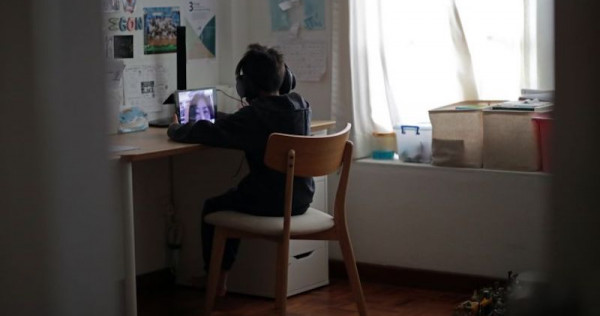
With schools shut down and online learning made mandatory, students in households without broadband internet access and personal computers are left behind.
TPG Telecom wants to lend a hand. In support of low-income families affected by the Covid-19 crisis, Singapore’s fourth telco is providing mobile wifi routers and 50GB SIM-only plans for students to get online for home-based learning programmes. The company assured that it is easy enough to get the hotspot up and running quickly.
Working together with various social enterprises and non-profit organisations like Viva Kids Pte Ltd and Engineering Good, the initiative should be able to provide high-speed 4G network connectivity for underprivileged students.
Thankfully, places that sell hot food in addition to those mentioned above are still allowed to operate as part of essential services. So it’s not like people can’t satiate their sweet tooth, but it’s only a matter of whether it’s from their favourite brands.
Not long after the announcement, we started seeing unlikely F&B brands collaborations sprouting up during the CB period. Suddenly, Koi started teaming up with Grain, Milksha with Yum Cha Express, Each-a-cup with Enaq Prata shop, as well as LiHo and its many food collaborators. Talk about being creative to survive in hard times.
Patients consulting the roving medical team at the community recovery facility at Tanjong Gul for minor ailments such as headaches. (Photo: MINDEF)
SINGAPORE: The Singapore Armed Forces (SAF) is housing about 3,000 recovering migrant workers with COVID-19 in six military camps across Singapore.
The Jurong, Bedok, Amoy Quee, Guillemard, Tanjong Gul and Lim Chu Kang camps have been converted into community recovery facilities (CRFs).
Operational since Apr 28, the CRFs are for COVID-19 patients who remain well at Day 14 of the disease and do not require further medical care.
With Singapore reporting hundreds of new coronavirus infections among migrant workers every day, the Ministry of Health (MOH) aims to have more than 10,000 bed spaces in CRFs by the end of June. This includes non-SAF facilities and is part of a broader strategy to ensure sufficient healthcare capacity.
To establish the CRFs, camps that were either temporarily vacant or camps with standalone accommodation facilities that are separated from other camp facilities and have ceased operations were identified.
The SAF facilities can take in 300 patients each day, with a maximum capacity of 5,300 patients. Colonel (COL) Chua Jin Kiat, who is in charge of the CRFs, told reporters on Wednesday (May 6) that this is sufficient to meet national requirements.
Foreign workers at CRFs will be discharged based on MOH guidelines, which state that two swab tests conducted on consecutive days must come out negative prior to discharge. COL Chua said he expects a number of workers to be discharged over the next two days.
Personnel involved in managing the CRFs at the SAF camps are equipped with PPE that is in line with Ministry of Health’s guidelines. (Photo: MINDEF)
Personnel managing day-to-day activities on the ground, including auxiliary officers and civilian vendors, must adhere to strict protocols to reduce exposure to the virus.
This includes dividing the facilities into different zones depending on the risk of exposure to the virus. Personnel in the different zones are required to wear personal protective equipment (PPE) commensurate to the level of risk.
LIFE IN CAMP
Workers who first come in are medically screened and have particulars – such as dietary preferences – taken down before being brought to the living area. Technology like infrared fever scanning, information management systems and health monitoring applications are also used.
Patients observing a safe distance while queueing to consult the roving medical team at the CRF at Tanjong Gul. (Photo: MINDEF)
The workers are then split into smaller groups to ensure safe distancing. These groups have designated amenities, like food collection points, dining and outdoor recreational areas, to minimise transmission risks.
They are also given three meals a day, access to Wi-Fi and SIM cards, as well as mobile minimarts to buy things like snacks and basic clothing. Roving SAF medical teams will attend to their medical needs at a designated time every day.
Patients are able to move about freely within their designated sectors in the CRFs. (Photo: MINDEF)
Beyond meeting their needs, COL Chua said it is important for SAF personnel to reassure these workers that they are well on their way to recovery.
“For some of these patients, especially the foreign workers, it has not been an entirely good experience because they are COVID-19 positive. There is a huge element of fear,” he said.
“This last step is to tell them: ‘Brother, you’re almost there. One more place, you’re cured and you can go back to work.’ And letting them know we will continue to take care of them.”
Outdoor spaces and mobile toilets in Tanjong Gul Camp. (Photo: MINDEF)
Another important thing, COL Chua said, is ensuring that they have enough space to move around within their living areas, especially if they have been cooped up in community care facilities such as the Singapore Expo.
“In Expo they are in an indoor place, so when they first came to us they were quite happy to see the sunrise and sunset,” he said.
A foreign worker having his temperature taken before collecting a meal. (Photo: MINDEF)
Then there are the little things like providing pails and drying points so they can wash their own clothes and ensuring each bed has its own charging point. Workers can also scan a QR code to give feedback on their meals.
“I would say that the general approach is one of engaging them with some degree of empathy,” COL Chua added.“I suppose as a military this is something that we have learnt over the years (as this is) how we treat our soldiers.”
This involves introducing a sense of routine. For those who are not fasting, breakfast is at about 7am, after which some will rest in the bunks, walk around in the sun or do their laundry.
There’s also a morning “sick parade” where workers can report to the roving medical teams to get medicine for ailments such as body aches and headaches. COL Chua said the most serious condition he has seen is chickenpox.
A foreign worker having a medical check-up. (Photo: MINDEF)
After lunch at noon, vendors in PPE will drive food trucks to the entrances of their living areas.
Items on sale include snacks, non-alcoholic beverages and necessities like towels and clothing for those who might not have packed enough before being isolated. These items are reviewed based on workers’ feedback too, COL Chua said.
Dinner is past 6pm and then it’s the end of the day. “It’s not as if it’s very exciting,” COL Chua admitted. “But we try to make sure that their basic needs and welfare are met.”
SAFETY ISSUES
When it comes to safety, COL Chua said the SAF and external personnel on the ground must wear face masks at all times. Those who enter the “yellow zones”, which include corridors and entrances where workers pass through, must put on gloves and face shields.
The living areas are considered “red zones” that are self-contained with all the amenities workers need. “Typically, we would not need to go in,” he added. “We do very clear zoning, and we have very clear rules about who actually needs to go in to interact.”
With cases of healthcare personnel being infected in other community facilities, COL Chua said personnel on the ground are properly fitted and trained in wearing industry-standard PPE.
“We have a strict training protocol that governs this, and we put all our people through it, including civilian contractors and vendors who need to go near the workers,” he said.
“Sometimes fatigue sets in and you take off your gown and gloves in the wrong sequence, so little things like this we just continue to remind our people. We have roving teams that go around to check on this.”
SAF personnel suiting up in PPE. (Photo: MINDEF)
On the issue of security, COL Chua said auxiliary officers guard the camp entrances and operate in the yellow zones to enforce zoning measures. The SAF has also linked up with the various police divisions.
“In case there is any trouble or anything more serious, the police will be the second line of response,” he said.
HOW IT BEGAN
Considering that the SAF only had two weeks to set up the facilities, COL Chua acknowledged that there was time pressure to get it done. A total of 600 SAF personnel, mostly regulars, were involved in setting up and running the CRFs.
This includes engaging contractors to build large tents in three vacant camps – Guillemard, Tanjong Gul and Lim Chu Kang – where buildings are structurally unsound.
For the other three camps with existing units, hoardings were set up to physically separate the workers’ living areas.
More beds needed to be added to maximise capacity, and dining areas had to be set up. Mobile toilets were brought in where necessary.
A medical station in Tanjong Gul Camp. (Photo: MINDEF)
After slightly more than a week of operations, COL Chua said the SAF is in the process of handing over management of these facilities to external contractors who operate dormitories.
This is because the SAF needs to resume training and its regulars need to go back to their primary jobs. The contractors are also professionals in the business of managing CRFs.
“The regulars are trying to hand over processes, systems and a lot of the little things that go on behind the scenes,” COL Chua said, adding that the handover will be completed in the next two to three weeks.
“So that the facility managers can continue to provide the same level of care and welfare for the patients.”
POSITIVE FEEDBACK
COL Chua said feedback from the workers has been “pretty positive”, based on the chatter in WhatsApp groups that tell them when to collect their meals.
A foreign worker having his meal in Tanjong Gul Camp. (Photo: MINDEF)
“Some of them even openly share that they have friends with COVID-19 who work in other countries, and they are certainly not as well treated as the way they are in Singapore,” he said, describing it as a national effort.
“My guys on the ground will feel it even more. You can see real gratitude and genuine appreciation for what the country has done for them.”
Amid all the grand gestures like lighting up buildings and islandwide singalongs, sometimes it’s the smallest things that show front-line workers just how much people care.
For taxi driver Kenneth Chan, it was a $10 tip from an unlikely passenger, he shared in a moving Facebook post on May 5.
The trip that evening had started out normally enough, Chan said. He had picked up a woman at Vivocity and ferried her to her home at Toa Payoh, enjoying a pleasant chat along the way.
But when it was time for payment, the passenger, who had told him that she was a cleaner, handed him $25 for a $15.87 fare.
“I told her there is no need to give me so much as money is hard to make… but she insisted [on] giving me as she knows times are very hard and that taxi drivers are really having a very hard time,” the Premier Taxi driver wrote.
Singapore will propose a new protocol that would allow for a cross-border movement of people in ASEAN regions, once the Covid-19 pandemic reaches manageable level.
Singapore’s Ambassador to Indonesia Anil Kumar Nayar said in a press briefing on Monday that ASEAN countries needs to come up with new procedures that would allow citizens to travel in the region.
“Before reopening, we need to have a common set of checklist of cross border rule before we can open border. This will take time but worth exploring,” Kumar Nayar said.
He said that ASEAN countries could look to efforts taken by countries like Australia and New Zealand to discuss a travel hub that could soon restart travel between the two countries.
The envoy was quick to add that cross-border travel between ASEAN countries could only start if local transmission of Covid-19 could be put under control and mortality rate has reached a low level.
Since April 7, Singapore has introduced what it called as “circuit breaker” measures, an elevated safe-distancing measures that would last until June 1.
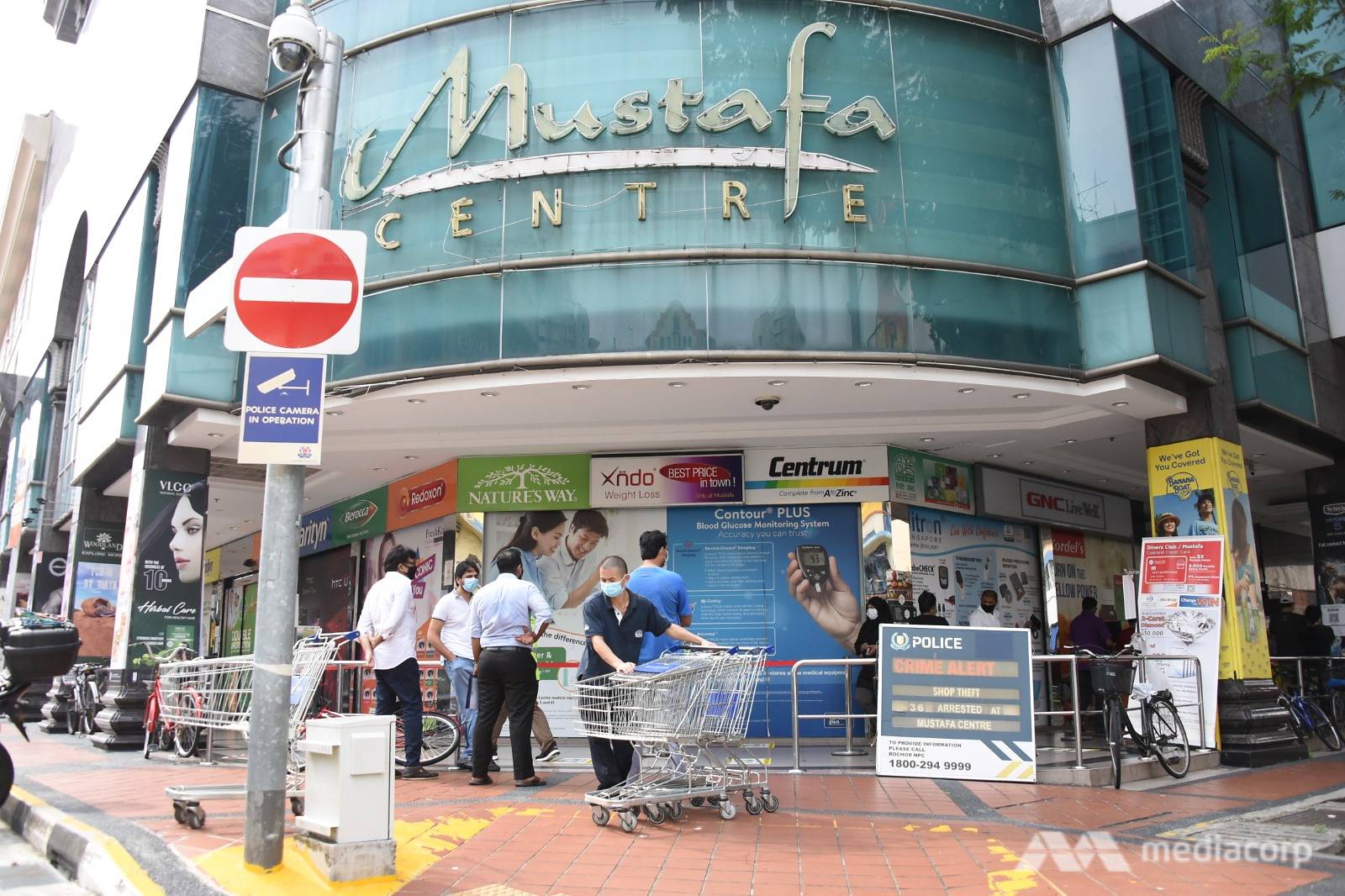
The rest of the mall will remain closed for now, said Mustafa’s managing director.
Shoppers at Mustafa Centre will have to furnish either their passport or NRIC again before they exit the shopping centre. (Photo: Try Sutrisno Foo)
(Updated: )
Bookmark
SINGAPORE: Megamall Mustafa Centre, which was a COVID-19 cluster, reopened its supermarket on Wednesday (May 6), more than a month after it was closed.
All other sections of the mall, which sells a range of products from clothes, to shoes and electronics, will remain shut as part of measures taken during the “circuit breaker” period.
Mustafa’s managing director Mustaq Ahmad told CNA that the supermarket, which is about 55,000 sq ft in size, reopened at about noon on Wednesday. This was after the management received approval from the authorities to reopen the supermarket portion of the mall following checks, he said.
“We have put in the necessary measures to make sure that Mustafa is safe, including limiting the number of people inside. We have a system that monitors the numbers,” he added.
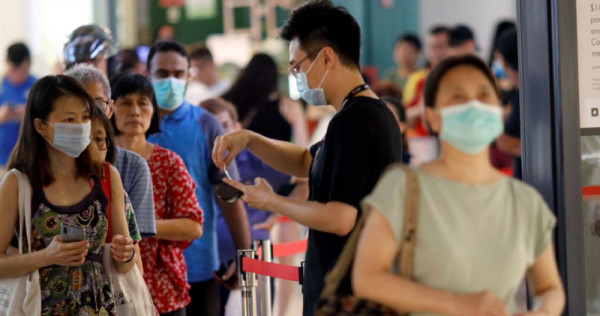
Shoppers at Mustafa Centre have to furnish either their passport or NRIC before they are allowed to enter the shopping centre. (Photo: Try Sutrisno Foo)
A maximum of 325 people will be allowed in the supermarket at any one time, Mr Mustaq said. The management has also put in place other safe-distancing measures, such as tape on the ground to space customers apart at cashiers.
Like at other supermarkets around the country, customers will also need to have their identity cards scanned and their temperature checked, he said. There is currently also one only one entrance and two exits in use, compared to six entrances and exits previously.
About 100 employees will be working at the supermarket in shifts, Mr Mustaq added.
Besides getting their NRICs scanned, shoppers entering Mustafa Centre can also check-in on their mobile phones by scanning this QR code. (Photo: Try Sutrisno Foo)
When CNA visited Mustafa Centre at about 3pm on Wednesday, staff members told us only the supermarket and a section selling chocolates were open.
On Apr 2, the Ministry of Health (MOH) announced that Mustafa Centre was a COVID-19 cluster, with 11 cases linked to it at the time.
Mustafa Centre partially reopened its doors to shoppers on May 06, 2020. Shoppers can only make purchases at level 2, where the supermarket is located. (Photo: Try Sutrisno Foo)
A total of 124 COVID-19 cases have been linked to the mall as of May 3.
The mall announced that it would close for at least two weeks in early April, while it got professionally disinfected. The management was also advised by MOH to keep the mall closed for two incubation periods, or 28 days, Mr Mustaq said.
SINGAPORE: A project involving the release of specially bred mosquitoes to fight dengue will be widened to include more neighbourhoods, following successful field tests in Tampines and Yishun.
From May, the National Environment Agency (NEA) will release male Wolbachia-Aedes mosquitoes to more than 200 blocks in Choa Chu Kang and Bukit Batok.
NEA said in a media release on Wednesday (May 6) that more than 90 per cent of the urban Aedes mosquito population has been suppressed at Yishun and Tampines under the agency’s Project Wolbachia.
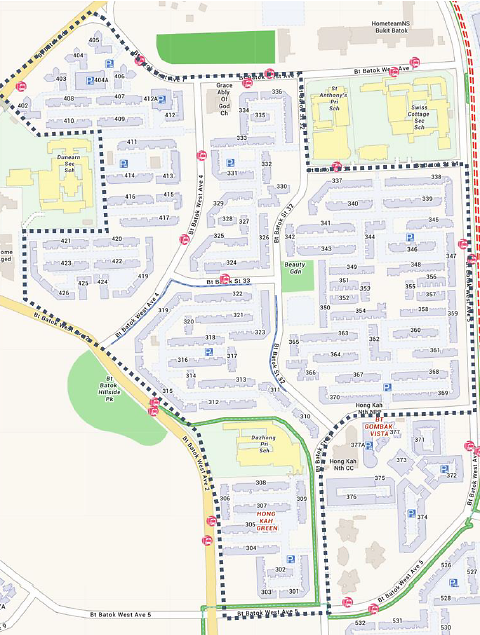
The 207 blocks at Choa Chu Kang, Keat Hong and Hong Kah North were selected as the next testing ground due to their “consistently high Aedes mosquito populations, and hence higher risk of dengue clusters forming there”, said NEA.
The mosquitoes will not be released directly into homes, but at public spaces including stairwells, void decks and open spaces between blocks of high-rise homes.
“MORE TARGETED APPROACH”
NEA explained that the total area of the new release sites is smaller than the test areas in Yishun and Tampines, resulting in a more targeted approach.
The objective is to “test different strategies, to determine the most effective and impactful approaches for future wider scale deployment for Project Wolbachia,” said the agency.
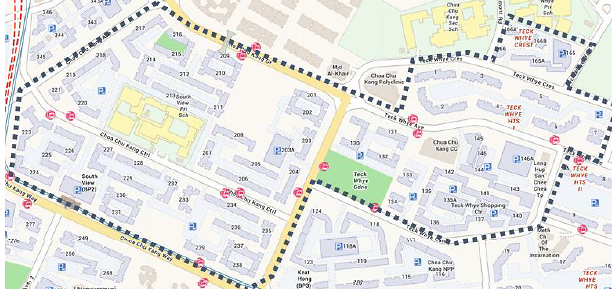
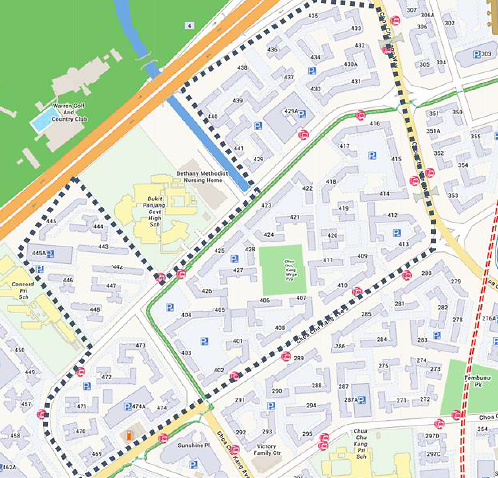
Location map of release site at Choa Chu Kang. (Graphic: NEA)
At the Choa Chu Kang and Bukit Batok sites, the study will “zero in on selected neighbourhoods with consistently high Aedes aegypti mosquito populations”, said Director of NEA’s environmental health institute Associate Professor Ng Lee Ching.
The aim, this time round, is to preemptively suppress the populations.
In contrast, the tests in Yishun and Tampines adopted more of a “rolling approach”, with the gradual expansion of release sites to adjacent neighbourhoods within each town, said Assoc Prof Ng.
Location map of release site at Keat Hong. (Graphic: NEA)
NEA said that an average of six or fewer male Wolbachia mosquitoes per person will be released regularly.
While residents may see more of these male mosquitoes, they will not attract female mosquitoes to the area, said the agency.
“Residents do not have to do anything differently, and should continue to stay vigilant and carry out mosquito control procedures as usual,” added NEA.
Location map of release site at Hong Kah North. (Graphic: NEA)
65-80% FEWER DENGUE CASES AT YISHUN, TAMPINES STUDY SITES
According to data from 2019, there were 65 to 90 per cent fewer dengue cases at the Yishun and Tampines study sites where the male Wolbachia mosquitoes were released, compared to sites without releases, said NEA.
In areas with reduced urban Aedes aegypti mosquito populations, fewer male Wolbachia-Aedes mosquitoes were also needed to maintain the suppression, added the agency.
Phased field studies have been conducted at Yishun and Tampines since 2016 to evaluate the use of male Wolbachia mosquitoes to suppress the urban Aedes aegypti mosquito populations.
NEA explained that when male Wolbachia-Aedes mosquitoes mate with urban female Aedes aegypti mosquitoes, the resulting eggs do not hatch.
“Over time, continued releases of male Wolbachia-Aedes mosquitoes are expected to gradually reduce the urban female Aedes aegypti mosquito population, and hence lower the risk of dengue transmission.”
NEA said that it will continue with the current releases in the ongoing Phase 4 of Project Wolbachia at Yishun and Tampines. This involves a total of 533 blocks – about a 14-fold expansion compared to Phase 1 in 2016.
The multi-ministry task force on Covid-19 will “continue to look at” loosening restrictions on traditional Chinese medicine (TCM) halls, Health minister Gan Kim Yong said at Monday’s (May 4) Parliament sitting after Nee Soon MP Lee Bee Wah pressed for an explanation on why dessert shops were allowed to resume operations before certain TCM shops.
Lee’s queries came in the wake of the government’s announcement that TCM needle acupuncture would be allowed from May 5, but only for pain management. Other therapies such as cupping, tuina, guasha and moxibustion are still not permitted under the circuit breaker rules.
TCM halls with a resident registered TCM practitioner will also be allowed to sell retail products from May 5.
However, many neighbourhood TCM retail stores do not have registered TCM practitioners, Lee explained.
Addressing Gan in Mandarin, Lee posed the question of why TCM retail shops were required to close while pharmacies were allowed to remain open during the circuit breaker period.
Amid the fuss over which services are essential during the Covid-19 pandemic, less contentious is the good work that charities such as the Singapore Children’s Society do in the community.
But keeping their services running has been a challenge for many of them, albeit in a different way. While the rest of Singapore forges ahead with various Smart Nation initiatives, the non-profit sector has been struggling to pick up the pace.
For Children’s Society, that meant hard-copy case files and frequent visits to the office to update their shared drives – not a good idea during a pandemic.
Enter iShine Cloud, Singapore Pools’ non-profit IT cloud service.
Not always about giving money
With limited manpower and financial resources, many charities lack proper IT support and often outsource their computing needs to external vendors.



.jpg "taxifb2-1.jpg")