SINGAPORE: The police on Saturday (May 16) warned of a rise in phishing scams during the COVID-19 “circuit breaker” period, with 151 cases reported from Apr 7 to May 7.
That’s a sharp increase from the monthly average of 20 cases reported in the first three months of this year.
“Members of the public who have fallen victim to such phishing scams would receive emails or text messages purportedly sent from a company they know or trust, such as banks, government agencies, trade unions like NTUC, or companies such as SingPost, StarHub and Netflix,” said the Singapore Police Force (SPF).
These messages or emails usually include fake offers or claims to trick recipients into clicking on a link. Victims will then be redirected to fraudulent websites where they are asked to provide their credit or debit card details and a one-time password.
Most victims only realise that they have been scammed when they discover unauthorised transactions in their bank accounts, said SPF.
Screengrab of phishing e-mail impersonating NTUC. (Photo: Singapore Police Force)
According to the police, the top companies impersonated in these scams are SingPost, StarHub, Netflix, PayPal and Grab.
In the case of the SingPost scam, with 45 police reports made from January to April, scammers typically trick people into believing that their parcel will not be shipped unless payment is made.
Scams which use StarHub’s name often claim that a recipient’s bill has been overpaid and that credit card details are needed to collect a refund.
As for the scam impersonating Netflix, the text message claims that the company is giving out “3 months of Netflix Premium” during the COVID-19 pandemic.
Screengrab of phishing text messages impersonating Netflix. (Photo: Singapore Police Force)
The police advised members of the public to follow these crime prevention measures:
Do not click on links provided in unsolicited emails and text messages.
Always verify the authenticity of the information with the official websites or sources.
Never disclose personal or Internet banking details and OTP to anyone.
Report any fraudulent credit or debit card charges to your bank and cancel your card immediately.
People who wish to provide any information related to such phishing scams can call the police hotline at 1800 255 0000 or submit their information online at https://www.police.gov.sg/iwitness
Members of the public may also call the anti-scam helpline at 1800 722 6688 or visit http://www.scamalert.sg to seek scam-related advice.
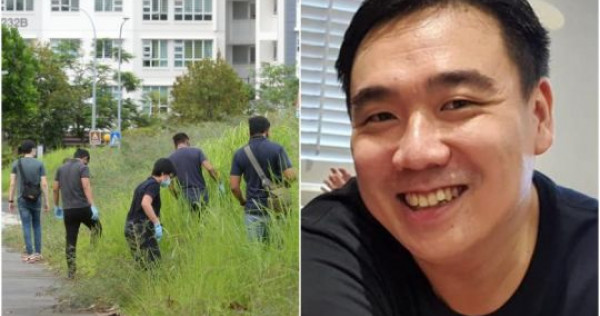
SINGAPORE – A 20-year-old Singaporean man has been arrested in connection with a suspected murder of a jogger in Punggol Field.
He will be charged in court on Sunday ( May 17).
The suspect is expected to be charged with murder, which carries the death penalty.
The police identified and arrested the man on Saturday (May 16) at 2.45am following round-the-clock investigations, extensive ground inquiries and review of closed-circuit television (CCTV) footage.
Preliminary investigations revealed that the suspect is not known to the victim and is believed to have acted alone.
Last Sunday, Mr Tay Rui Hao, 38, was jogging in the area when he was stabbed near the bus stop in Punggol Field, opposite Block 227A Sumang Lane.
A resident heard Mr Tay’s cries for help and saw him struggling to the bus stop, where he collapsed on a grass patch.
Mr Tay then told the resident that he had been attacked and was losing his breath.
The resident called the police, and Mr Tay was sent to Sengkang General Hospital.
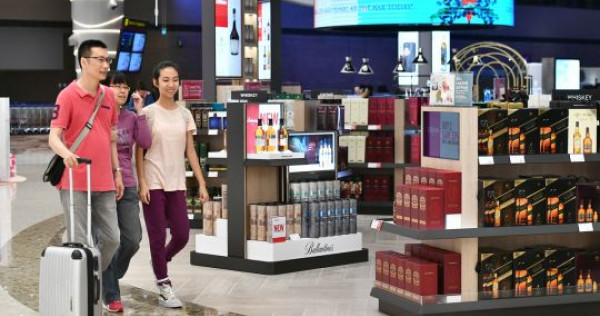
SINGAPORE – Luxury travel retailer DFS has started to clear its stock before leaving Changi Airport next month.
After 35 years, Changi’s biggest and oldest tenant will be making its exit from the airport’s wines and spirits concession on June 8.
From now till the end of May, customers will be able to enjoy prices slashed up to 70 per cent for over 200 exclusive offerings of wines and spirits from DFS Singapore Changi Airport, sold online. The site offers Duty and Goods and Services Tax (GST) absorbed priced products.
Retailers at the airport have been hit hard in the last few months due to Covid-19, as flights decreased due to travel restrictions and passenger numbers dried up.
Changi Airport announced on Tuesday that it would suspend operations at Terminal 4 from Saturday (May 16) onward, following a suspension of services at Terminal 2 on May 1. The terminal’s suspension includes the closure of all stores and restaurants.
The airport currently sees about 80 flights a week, down from the 7,400 flights per week before the Covid-19 pandemic, and only around 100 passengers arriving and 700 departing every day.
SINGAPORE: It was a long wait that spanned more than 50 days – 48 at D’Resort and three at the National Centre for Infectious Diseases – but when she was told of her discharge on Friday (May 15), COVID-19 patient Pamela (not her real name) was more confused than relieved.
Because, as far as she knew, she was still positive for the virus.
Speaking to CNA from her home, Pamela said she received a call early Friday morning from staff at community care facility D’Resort, who informed her that she could be discharged.
“I asked them: ‘Are you sure? Because I did my first swab only yesterday and I should be (getting) my results today. If it were negative, I should be getting my second swab today’,” she told CNA. “They said MOH (Ministry of Health) told them that I could be discharged so I was a bit confused. They told me to pack up and get ready to be discharged from 9.30am onwards.”
To clarify, Pamela called the MOH hotline. She was told that she would be discharged and that there would be a call from the duty nurse at D’Resort to explain the situation. During the call from the nurse, Pamela was told that she was still COVID-19 positive, but was eligible for discharge.
“I told her I didn’t know my result. She said she had my result and that it was positive,” Pamela recalled. “I told her I was happy to stay longer. I’d stayed so long and it didn’t matter already. It was the right thing to do.”
“I’M HAPPY TO STAY FOR LONGER”
“Her advice was for me to go home and stay indoors, and not be in the same room as my parents,” said Pamela. “The whole morning I felt like I didn’t know if I should be leaving – maybe I thought I should have just locked myself up in the room.”
Pamela’s stay at D’Resort had been a largely pleasant one, she said.
“Coming from the hospital, having the fresh air and the balcony (at D’Resort) really was quite a blessing. I would rather have been there than at the hospital … Out of the 48 days, there were maybe three or four days that I was quite down – Mothers’ Day was not great, and (neither were) the days when I got a positive (test result) after it had been negative the day before.”
Pamela was still uncertain when she left the isolation facility at about 10.40am.
“You don’t know if you should be happy because you are told you are still positive,” she said.
“It was a bit hard to explain why I was home,” she added. “I didn’t tell my parents that I was (coming) home initially, because I wasn’t sure if things were going to change … They were surprised.”
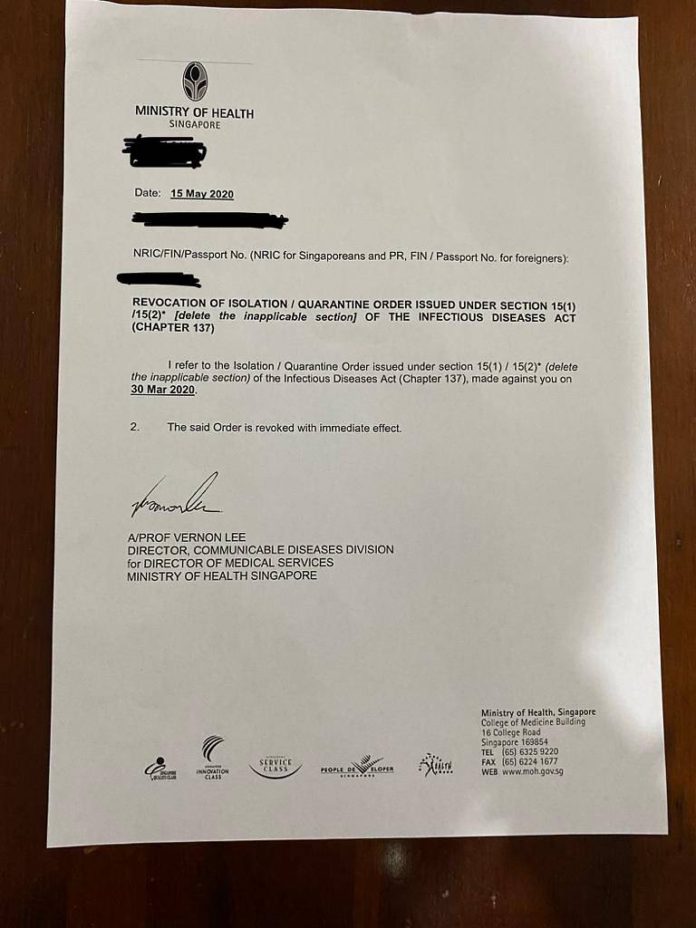
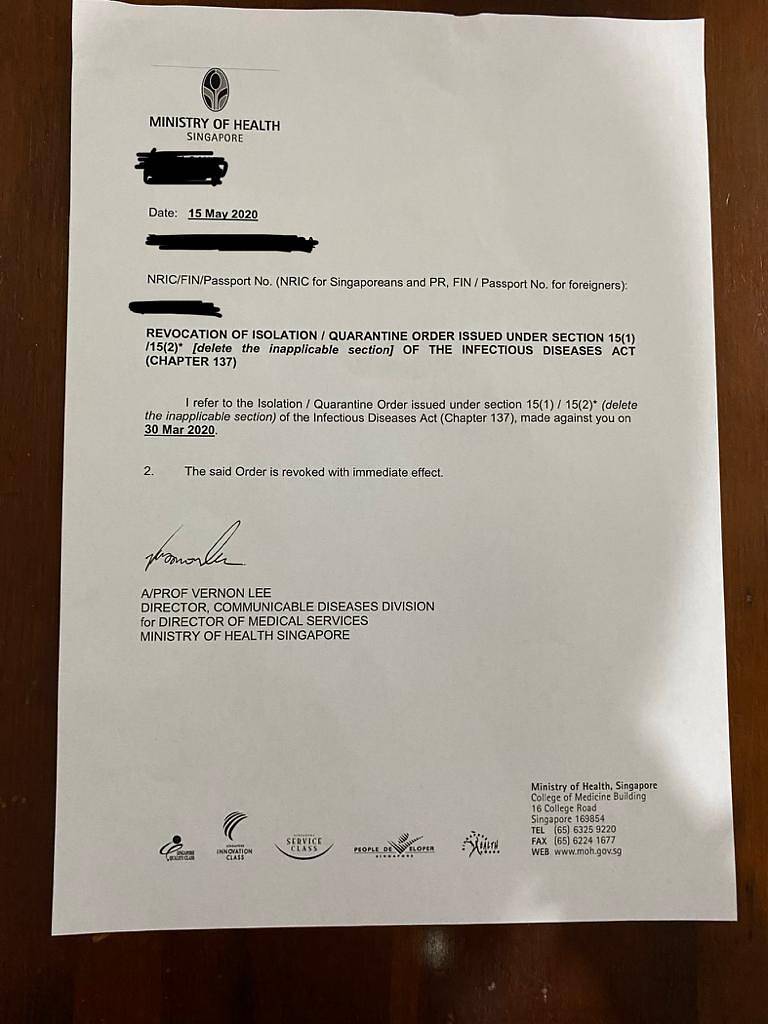
A copy of the letter Pamela* was given following her discharge. (Photo: Pamela)
In response to CNA’s queries, MOH confirmed on Saturday that 18 COVID-19 positive patients who had stayed at D’Resort as long as 51 days were discharged after it was determined that they were no longer infectious to others.
The patients, who were clinically “very well” and had stayed at D’Resort for “prolonged periods”, were referred to a medical review committee. They had persistently tested positive for COVID-19, MOH said.
“The committee deliberated on each of these cases individually and determined that the patients are shedding dead viral components, detectable through the PCR test, but which are no longer transmissible and infective to others,” said MOH. “After careful consideration, the Ministry of Health decided that these individuals can be cleared for discharge.”
As an added precautionary measure, these patients are required to be home quarantined for a further seven days, said MOH.
Pamela was handed her quarantine order on Saturday morning. The measure brought her a little relief, she said, but concerns remained.
“It’s definitely a bit better but there is still that sense of uncertainty, maybe because it (the information) didn’t come along during my discharge,” she said.
“Factually, logically speaking, it helps because I know that these are my boundaries,” she said. “I’m happy to be home but I’m also stuck. I might as well have been stuck there.”
Given that her last test was still positive, Pamela also remains unsure if she will be swabbed at the end of her quarantine to confirm that she is virus-free.
“How do we know if we are officially negative? Will it be via the test?” she said.
In its reply to CNA, MOH said that infectious diseases experts have advised that patients are unlikely to be infectious beyond 14 days from their onset of illness, as the virus can no longer be cultured from biological samples taken from these patients, even if they continue to test PCR positive.
Even so, Pamela is doubtful and feels that it might have been better if she had stayed on at D’Resort or at a quarantine facility.
“I don’t mind (being away from home) because I think it’s clearer for everybody. I wouldn’t even think whether they (my family) would be infected. There would be a certainty that it wouldn’t happen,” Pamela said. “I’m sure some people would rather stay at home, and I would rather stay at home but it makes more sense to be isolated.”
SINGAPORE – Building contractors can gradually resume operations from June 2, starting with critical projects, but they must put in place new safe distancing requirements.
These include avoiding cross-deployment of workers between projects and implementing contact tracing technology at worksites, the Government announced at a virtual press conference on Friday (May 15).
Most construction work has been suspended during the circuit breaker period that began on April 7, with only 5 per cent of the construction workforce – or about 20,000 workers – continuing to work on a few critical projects and those that cannot be left idle for long for safety reasons.
The Building and Construction Authority (BCA) expects another 5 per cent of the workforce to gradually resume work, which means about 10 per cent of them will be out at work in June.
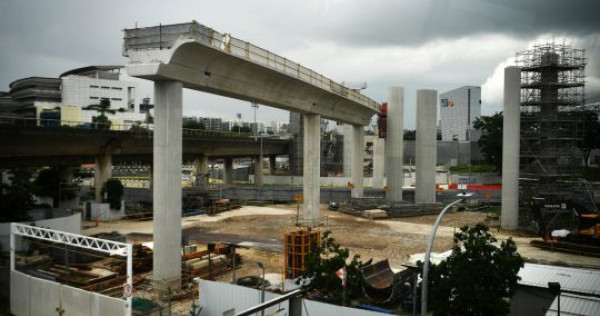
Priority will be given to projects such as MRT works, deep tunnelling of sewerage systems and residential renovation projects that were suspended.
All projects will need BCA’s approval before they can restart.
Also, foreign construction workers must be tested before they can return to work.
It’s a dog-eat-dog world out there, and what happens in bedrooms should probably stay in bedrooms.
Especially if one’s kink involves BDSM, animal roleplay and the Singapore Armed Forces (SAF) uniform.
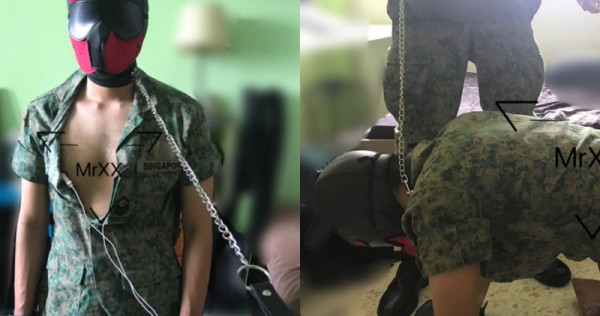
In an explicit tweet made by an account by the handle of @KingMrXX on Jan 20, two publicly viewable images depicted two uniformed men in the throes of an… unorthodox sexual activity.
In one picture, a man in an unbuttoned SAF uniform is wearing a dog gimp mask with his neck leashed to a chain. His nipples and his exposed genitals were clamped and hooked up to what seems to be electrical cables.
In the next image, the masked man is seen kneeling in all fours with his pants down and a tail plug extruding from his rump. Another man in an SAF uniform — his genitals exposed as well — stands over him with a cane in one hand and the leash in the other.
A Singapore study into the effects of Covid-19 on overweight Asians – the first of its kind, according to researchers – has found that they are more than three times as likely to be admitted to intensive care as their slimmer counterparts.
The study, by Singapore’s National Centre for Infectious Diseases, looked at 91 Covid-19 patients under the age of 60 and found that those with a body mass index (BMI) of 25 or higher were 6.3 times more likely to need supplemental oxygen, 1.2 times more likely to need mechanical ventilation and 3.1 times more likely to be admitted to intensive care, although the intensive care finding was not statistically significant.
Previous studies in other countries have returned similar results, though most used a higher BMI threshold of 30 or above. A lower cut-off was used in Singapore as “it is known that Asian populations have higher disease risks at lower BMI thresholds, possibly due to variations in fat distribution and lipid metabolism”, the researchers said.
While community cases have been coming down in recent days, Singapore needs to reopen carefully and slowly or chance a large spike in new cases, Health Minister Gan Kim Yong has said.
Mr Gan was asked at a virtual press conference by the multi-ministry task force on Covid-19 if the single Singaporean/permanent resident confirmed here yesterday meant Singapore has successfully “flattened the curve” for cases in the community, as the large majority of the 793 cases that the Ministry of Health (MOH) announced yesterday were foreign workers staying in dormitories.
The term refers to the n-shaped epidemic curve, used to visualise when new cases happen and at what speed during a virus outbreak.
A sharp rise in cases results in a steeply inclined curve, while a slower growth in cases spread out over a longer time period creates a moderate plateau.
This is a key goal of public health officials to prevent health systems from being overwhelmed.
SEOUL: While breastfeeding her son in January, Connie Sun discovered a lump in her breast. The new mother figured it was a “breastfeeding lump, which would disappear”.
So she went on to visit Singapore for Chinese New Year. On Feb 11, the Singaporean returned to Seoul, where she lived with her Korean husband — and where the COVID-19 outbreak was worsening, at the worst possible time for her.
The 37-year-old had to observe a two-week quarantine and could not consult a doctor about that lump. When she finally did, it turned out to be cancerous.
“If I’d gone to the hospital slightly earlier, I wouldn’t have been a stage three; I might’ve been a stage two,” she said. “The lump grew rapidly within the first few weeks (of me) discovering it.”
Connie Sun’s diagnosis was confirmed on March 5.
After her diagnosis, she was faced with the dilemma of whether to seek treatment in South Korea or in Singapore.
The problem with flying home was that it would entail leaving behind her husband, Chang Hwan Lee, and her then nine-month-old son, Ian.
Chang was unable to travel to Singapore because of entry restrictions following the COVID-19 outbreak; their son was waiting for his Singaporean citizenship approval and could not leave South Korea yet.
She knew that juggling being a new mother and cancer while separated from her family in Singapore was going to be hard.
“Being a new mum (and) having the coronavirus pandemic now is tough,” she said. “My mum would’ve been able to teach me how to be a mum. My brother and sister-in-law could’ve helped with Ian.”
Sun with her extended family in Singapore.
NO STRENGTH TO CARRY SON
The news of her cancer diagnosis was so overwhelming at first for Sun and her husband that they started “crying uncontrollably” while queueing to pay at the hospital.
“Both of us just broke down in front of the cashier and my son,” she recalled. “It took quite a while to stabilise ourselves and to have the courage to inform our family members in Korea and in Singapore.”
Her immediate thoughts were of Ian: Who would care for him while she undergoes treatment? How would he do without her breast milk?
Initially, she also had problems seeking treatment, as many of the hospitals in South Korea were designated for COVID-19 patients. She resorted to making video calls to a number of different hospitals before she secured an appointment with a doctor.
“There was also the fear that every time we visited a hospital, there was always the chance that a coronavirus patient had been there,” she said.
Early last month, she started on chemotherapy, which led to side effects like nausea, bleeding gums and fatigue.
“It made me feel like I didn’t have control of my body any more. Every day, there were new symptoms appearing,” she recounted.
She grew weaker and soon found that she even lacked the strength after each chemotherapy session to carry her son or play with him for long.
“Sometimes when he’s crying, and my husband’s in the bathroom, there’s nothing I can do. I can’t carry him, I can’t change his diaper, I can’t do much to pacify him,” she said.
“Those are the times when it drives me crazy.”
During her chemotherapy sessions, which take place over four-day stretches, her husband must stay with her in hospital. And her friends cannot visit.
“That definitely has made it a lot lonelier while receiving treatment,” said Sun, who has been living in South Korea since 2012. “The support isn’t there when we see the doctors. There are only two of us.”
She misses her mother. And as she battles nausea, all she can think about is her mum’s cooking and Singaporean food.
“Learning about my cancer diagnosis was tough, and it happening around the same time as the coronavirus made it even tougher because there were a lot of things I had to adjust,” she added.
BOTH LOST THEIR JOBS
There is also the cost of the treatment, estimated to come to about S$114,000 including chemotherapy, medication and hospital stays, which is “pretty huge”, said Sun.
If she were treated in Singapore, where she has an insurance plan, it would have covered most of her hospital and chemotherapy bills, she noted.
But in South Korea, after government subsidies, she has to pay about S$2,500 per chemotherapy session — and her treatment is expected to span 18 chemotherapy and radiotherapy sessions.
To add to her anxiety, she and her husband lost their jobs.
Chang was a freelance tour guide until the tourism industry ground to a halt, while Sun was teaching English until her company decided that an English teacher was no longer required.
“(My savings) have been depleted,” she said. “A lot of that has gone to paying for all the tests and the chemotherapy.”
She is thankful that some of her friends rallied around and created a campaign on Give.asia to raise funds towards her treatment. They have raised about S$25,000 so far.
She was, however, initially hesitant about accepting financial help. She felt that she should be helping others instead.
“My friend told us that there was no way we could do this on our own with a young child,” she added. “She made me realise that … we needed help.”
While the donations have somewhat eased her anxiety, she is still concerned about the long-term medical cost, and that selling her home in Singapore may be the only way to finance her treatment.
THE WIND BENEATH HER WINGS
A silver lining in Sun’s personal crisis is the network of friends who have stepped up to support her — not only financially, but also by cooking for her family, delivering food and groceries and even cleaning their apartment.
On those days when she goes for chemotherapy with her husband, her church friends babysit Ian until the couple return home.
“The help we’ve received is tremendous,” she said. “They knew that we had no family members in Korea who could help us. So they tried their best to do what a family would do for me in the situation.”
There were strangers on Facebook who offered to send her vitamins and left messages of encouragement.
Long-lost school friends also offered her financial help after the programme On The Red Dot featured her story, in a segment on how the global lockdown has cut off many overseas Singaporeans from their loved ones back home.
“I’m feeling very positive because of all the love (I’ve) received. It’s given me an immense amount of energy to carry on,” she said.
“It feels like everyone’s supporting us and we aren’t fighting it alone … That’s done a great amount to lift my spirit.”
When she shared her story online to stress the importance of early detection in breast cancer, it spurred some mothers to go for checks. Some of them discovered that they were at the pre-cancerous stage.
“I want to remind mums that it’s possible to have breast cancer while breastfeeding,” she said.
“If I’d known that, I’d have definitely taken my lump a lot more seriously from the start. I’d have checked myself regularly and wouldn’t have taken it for granted.”
Going forward, she intends to return to Singapore to seek a second opinion about her prognosis and to spend more time with her extended family.
“My mum’s already lost her husband to oesophageal cancer a few years ago, and I definitely don’t want her to suffer that loss again,” she added.
She wants to be strong also for her 11-month-old son. “I’m afraid that if anything were to happen to me, he might not even remember me.”
In the 5-part series Alone.Together, the programme On The Red Dot looks at life under lockdown for various groups. Watch this episode here.