SINGAPORE: More than 140,000 employers will receive S$4 billion in the next Jobs Support Scheme (JSS) payout, Deputy Prime Minister Heng Swee Keat said on Sunday (May 17).
“Our wage support for companies in Singapore is very significant – in total, we have committed more than S$20 billion under the JSS over three Budgets – Unity, Resilience and Solidarity.
“I urge companies to use the JSS wage subsidies to retain their workers during this difficult period,” Mr Heng said in a Facebook post.
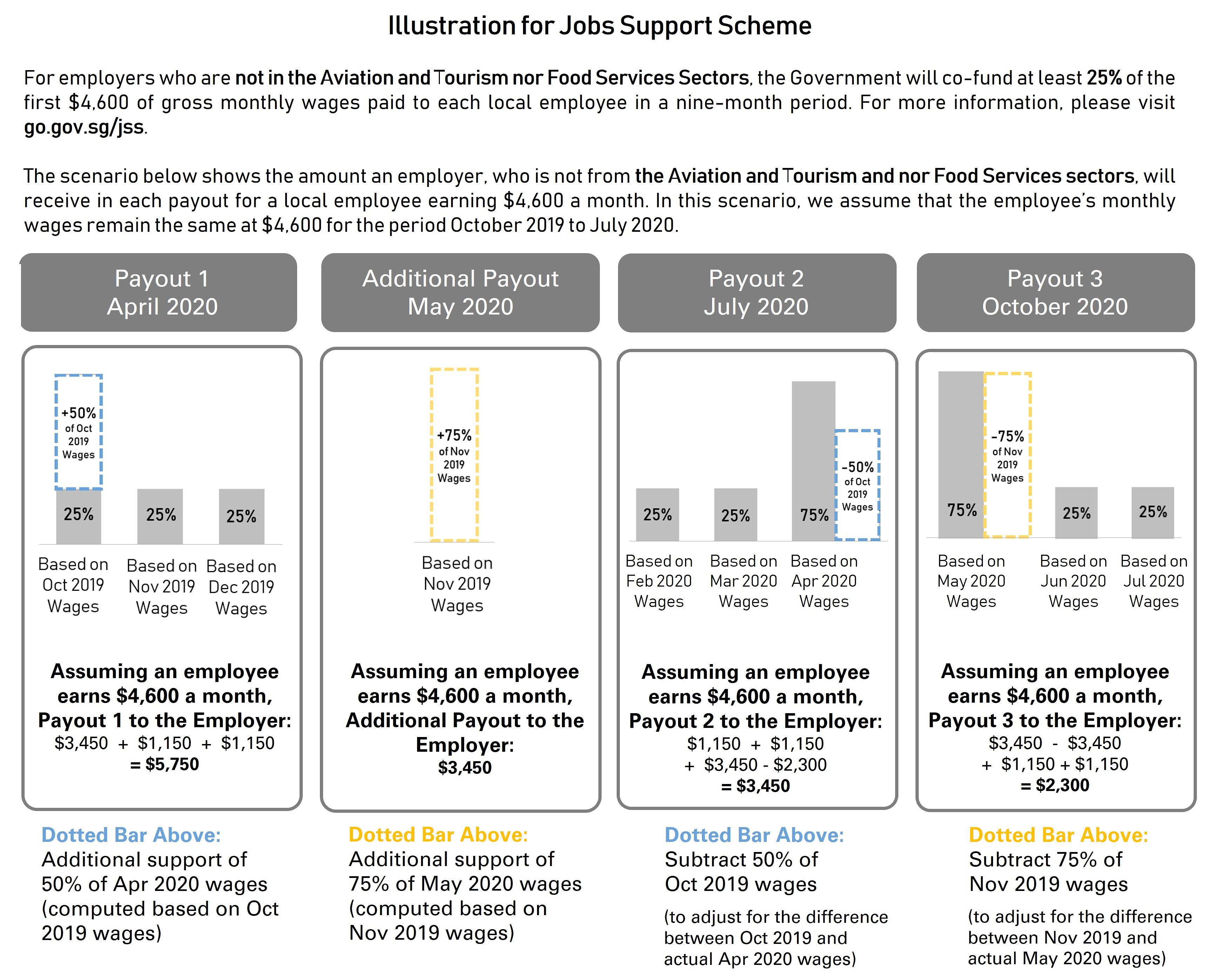
Employers will receive 75 per cent wage support for their local employees, capped at the first S$4,600 of wages paid. Some shareholder-directors will also qualify as previously announced, Mr Heng said in a Facebook post.
Mr Heng, who is also Minister for Finance, said that some companies are doing well and have returned the funds.
“I hope the rest which are also doing well will do likewise. Many companies and individuals have also been donating to worthy causes that they support. You can find out more on these causes at Giving.sg.”
The wage support will be disbursed from May 28, said the Ministry of Finance (MOF) in a press release.
Employers need not apply for the scheme, as the cash grant will be automatically computed based on Central Provident Fund (CPF) contribution data as at Feb 14.
MOF encouraged employers to sign up for PayNow Corporate by May 22 to receive faster payouts. Those who do so can expect to receive the payment by May 28. Other employers will receive their cheques between Jun 3 and Jun 5.
First announced by Mr Heng in February’s Budget, the JSS is a wage subsidy programme to help companies retain and pay their workers as businesses take a hit from the impact of COVID-19.
SINGAPORE: New drones which can fly beyond the operator’s line of sight, and which can be operated without an on-site operator, are currently being trialled by the police, who hope to use it to complement their ground operations during the COVID-19 outbreak.
The trials, which started in late April, will end after enough information on data system reliability and mission effectiveness has been collected.
“The industrial estates can get rather deserted during this circuit breaker period. So the police need to keep up our presence for any illegal or unusual activities. The deployment of drones complement our police officers in keeping the industrial estates crime-free,” said DSP Elvis Chong, commanding officer of the Clementi Neighbourhood Police Centre, which oversees the area where the drones are deployed.
“We don’t want criminals to have the opportunity to actually break into these empty warehouses or office areas itself, because one crime is also too much for anyone to swallow, especially during this difficult period itself.”
Developed by HTX’s Robotics, Automation & Unmanned Systems Centre, the drone uses an advanced mode of unmanned flight operation through a Drone Box concept. The drones can be operated remotely from a back end command and control centre and eventually fly beyond visual line of sight.
“What is found inside this drone box system is a series of what we call robotics and automation system, where mundane preparatory tasks like battery insertion, battery preparation, picking and swapping of the payload that’s required for that specific mission has been automated away by the drone box system,” said senior engineer at Robotics, Automation & Unmanned Systems Centre Low Hsien Meng, who is involved in the trial deployment of the Drone Box.
This means that the operator would need minimal training to operate the drones, as it would only require a few clicks of a button to start the flight. A separate wireless network is used to transmit data from the drone to the command and control centre.
Footage from the drone. (Photo: Singapore Police Force)
Although this is not the first time the police have deployed drones in their operations, this is the first time they will be using autonomous drones. The drones will be used for aerial surveillance in industrial areas, but the police are looking to extend its use in the future.
Autonomous drones will allow the police to view difficult-to-access areas and provide a “safer and most cost efficient way of gaining greater insights in critical operations”, said the police in a media release.
“Without the need for an on-site operator, these drones can operate safely in the most hazardous and remote sites,” said the police, adding that there was “huge potential” for these drones in public safety, search and rescue and delivery of supplies.
Police have previously deployed drones during major security events.
The drones weight 10kg and are able to fly out for a distance of a few hundred metres. (Photo: Cindy Co)
Currently, the police are conducting trials in the western part of Singapore, with each trial lasting about 30 minutes. The drones are able to fly for a few hundred metres and are being tested at an altitude of below 250 feet above sea level.
The Ministry of Defence has confirmed that a police report has been lodged over an incident that saw two individuals in Singapore Armed Forces (SAF) uniforms pictured in the midst of a BDSM activity.
On Tuesday (May 12), Mindef was alerted to a highly explicit tweet that saw the two men engaged in the throes of an unorthodox sexual activity. We don’t need to go into details, but it involved electrical cables, a gimp mask, a cane, a leash, animal role-play, and exposed genitalia. PHOTO: Twitter screengrabThe tweet has since been deleted, and so has the Twitter account.
On his 15th day at Changi General Hospital (CGH) battling the coronavirus, Mr Andrew Phay woke up to news that he had low oxygen levels in his blood.
All he could do was pray for a miracle.
X-ray checks showed his lungs were in bad shape and he needed breathing tubes to direct oxygen into them.
Mr Phay, 56, had tested positive for Covid-19 on March 17, after a 25-day trip to the United States and Mexico. His wife Anna Yeo, 57, and their two friends who were on that trip also contracted the virus.
“The fear of the unknown hit hard,” said the retiree of the possibility that he would have to be moved to the intensive care unit.
“I prayed, I cried and despaired.”
Doctors resorted to using hydroxychloroquine, typically used to treat malaria, to improve his lung function after his body responded poorly to an earlier related drug.
Mr Phay, Singapore’s case 277, was earlier given chloroquine, also used to treat malaria, for three days. But those were the “worst three days” of his hospital stay, he said, as his body “reacted very badly” to it.
SINGAPORE: Since the circuit breaker was implemented in April, parents all over Singapore have found themselves thrown in the deep end.
We had to scramble to re-arrange and carve out makeshift workspaces at home.
We also had to adjust to become full-time caregivers of our kids; instead of being able to have pockets of time during the day when they attend school or enrichment classes, we took on the added roles of teacher, play-mate and full-time cook, on top of whatever existing work we had.
Needless to say, many WhatsApp chat groups have seen a sharp rise in parental complaints and questions like: “Any ideas what to do with the kids during the May holidays?”
Amidst all the transitions, one group of parents has been quietly whirring away in the background like a ceiling fan that you don’t take notice of: Stay-at-home mums (SAHMs).
As they go about their daily tasks of preparing meals, tending to their children’s intellectual and socio-emotional needs, cleaning the house and generally being the glue that keeps the family together, they are probably wondering what all the hubbub is about.
What is the secret sauce that these mums have that others don’t?
CIRCUIT BREAKER JUST AN EXTENSION OF SAHM DUTIES
For this group of mothers, cooking is typically second nature. So adding on a few more meals in a week might mean more planning and grunt-work but they are likely to remain nonplussed.
Many also tend to be in tune with our kids’ learning, so tackling home-based learning is also an extension of their current job-scope rather than a 360-degree pivot.
Don’t get me wrong; the workload of stay-home mothers is far from light, but the skills that they’ve been quietly honing in the background, such as organisational, child-minding, multi-tasking and culinary chops, are precisely the ones that we need most today.
Without organisational skills, our kids would be jumping off walls and tearing the house down.
Without patience and creativity, one wouldn’t be able to keep the kids engaged or help them to use their time wisely.
These afore-hidden skills of an SAHM are now the order of the day.
Full-time working parents have these skills too if they have been involved in caring for and engaging their children.
But if the care of the kids has mostly been outsourced to grandparents, domestic helpers or childcare centres, then these parents may still find themselves out of their depth.
Now that work has shifted into their homes, these parents have to cope with child-minding on top of their work responsibilities, thereby brewing a perfect storm.
To be able to focus on your Zoom call while a sibling squabble is taking place requires focus of the highest degree, not to mention a steely resolve not to flinch in front of your business associates.
For stay-home mothers (or those with experience working from home), some coping abilities would have already been honed, such as the power to deal with interruptions as if they had never happened and to discern when they need to mediate a conflict.
Not to mention that they don’t have to deal with the pressures of work and a demanding boss for eight to ten hours a day.
(Photo: Unsplash/The Creative Exchange)
Prior to the COVID-19 bombshell falling, few people would have envied the position of a SAHM; but now, some working mums may feel as if they have the shorter end of the stick.
EMOTIONAL HEAVY LIFTING AN UNSEEN WORK
But no matter your formal employment status, the harsh realities of this new world mean that parents across the board are experiencing higher levels of stress and anxiety – ranging from financial strains to worries about health and children’s studies – all while being cooped up under one roof.
Even the calmest and most equipped parents among us do not escape unscathed, so while SAHMs may have a head start, they still partake in the shared sense of loss of freedom, space and time.
Herein lies the biggest leveller of this playing field for both stay-home and working mothers: The loss of personal time and space as the once-distinct domains of work and family merge.
The age of the children is also another major factor, since the older they are the more likely they can entertain themselves or to make themselves useful around the home.
In response to my embarrassment about having to deal with squabbling kids while on a work-call, the mother of teens whom I was speaking to quipped, “If only my teens would emerge from their rooms and quarrel like that.”
With young kids at home around the clock, it is hard to take a breather or find a hiding spot where you can stay hidden long enough.
I too have spent time hiding out in my car after heading out to run an errand. The peace and quiet in that small space helps me recalibrate before returning home to my motherly duties.
No matter how “professional” we are at parenting, there will still be hits and misses; and since the home is the workspace of a stay-home mum, it is here where she will take the biggest hit.
During this circuit breaker, she may have wondered many times to herself, “Am I really cut out for this?”
Perhaps much of the work of a parent occurs in the deepest recesses of the human spirit.
The fruits of our labour may not surface until many years later.
When a child frets because things are not going as planned, we try to use it as a teachable moment, to process and unpack those hard emotions.
In a workplace setting, no one is going to give you a pep talk when things go south. You’re simply expected to pick up the pieces yourself.
Such is the everyday unseen work of an SAHM. It goes unnoticed and unpaid; there’s no physical office to walk out of when you’re upset; no sick leave to take, but when a child thrives because his emotions have been handled with care, his rough edges sanded smooth, and his identity secure, that is in itself the reward.
A couple preparing dinner in the kitchen. (Photo: Unsplash/Soroush Karimi)
While working mums do their fair share of emotional heavy-lifting, SAHMs have to major in this department as it represents the bulk of their work.
HOME CAN BE AN EXPANSIVE SPACE
Teaching and disciplining children can be especially taxing in such stressful times but staying home does have its perks.
As a friend who has been a work-at-home mother for the past 14 years shared, “Home can be an expansive space if you choose to see it that way.”
Even though I may be busy with managing my three children or chipping away at my to-do list, I still express my love for my family (and de-stress) by whipping up some bakes or trying out a new recipe in the kitchen.
Perhaps it is truly a matter of perspective. If you deem home as an expansive space, a place for opportunities, then it is an empty canvas for the stay-home mum: The energies, love and care that she puts in can result in a unique piece of art.
Sure, there are flaws and imperfections, but it is the process of nurturing and moulding lives that makes a stay-home mum’s work so priceless, and her role, irreplaceable.
As those of us who have had a taste of the stay-home mum’s life over the past few weeks would likely agree, I think we are beginning to have a new-found respect for the mothers who have taken up this mantle.
Long after COVID-19 bites the dust, I hope this respect for the stay-home mother’s place in society continues on.
Download our app or subscribe to our Telegram channel for the latest updates on the coronavirus outbreak: https://cna.asia/telegram
June Yong is a mother of three, an educational therapist and owner of Mama Wear Papa Shirt, a blog that discusses parenting and education in Singapore.
SINGAPORE: While queuing to make a purchase at the wet market, 53-year-old Emily Ong was brusquely told off by a fellow shopper.
“I forgot to keep the safe distance and the lady was very angry that I came so near to her”, said Ms Ong. “She scolded me and said: ‘Are you uneducated? During this time, we cannot stand so near to each other!’
“After she blew up like that and gave me that very angry, pissed-off face – only then I realised that I was standing too close.”
But this wasn’t because of a random slip of memory.
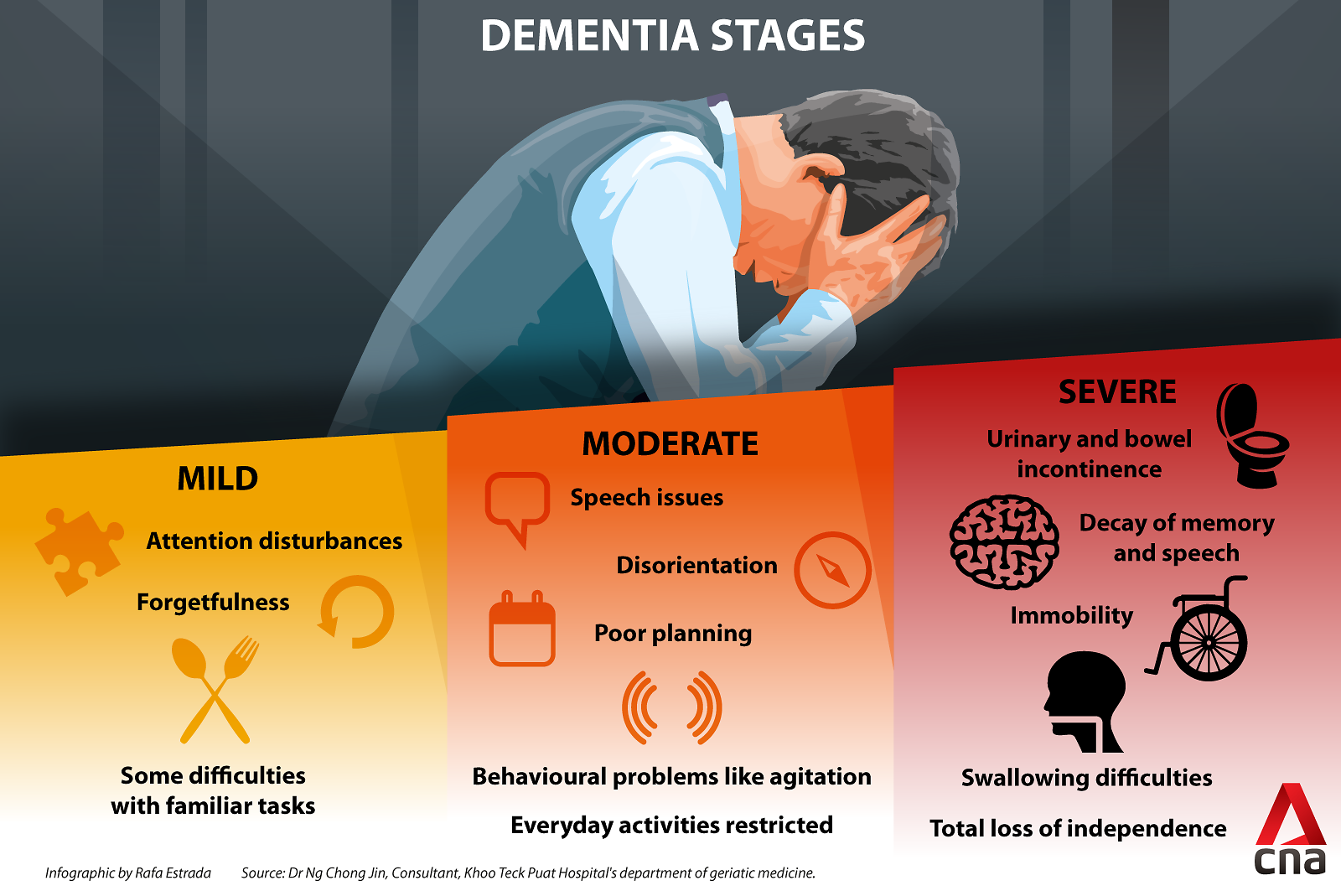
Ms Ong has young onset dementia, which affects people under the age of 65. For individuals and caregivers alike, the COVID-19 pandemic has brought with it new rules to observe, new routines to follow and new challenges to overcome.
While Ms Ong is able to understand why measures such as safe distancing are necessary, due to her condition she sometimes forgets the rules.
“I do frequently forget that I need to wear a mask, and then when I wear a mask, I’m not supposed to touch the front side of my mask,” Ms Ong explained. “I have to be reminded by my family members and that’s one reason why I don’t want to go out (much) because I will not be able to remember things like social distancing … These (things) are very new for us.
“Let’s say I go to my neighbourhood supermarket for half an hour to get something, I will not be able to remember that I need to maintain social distancing by the time I come to the cashier.”
This is a similar struggle that Mr Steven Lau faces, said his caregiver and wife Ms Wong Lai Quen.
On the rare occasions where the both of them leave home to run errands, Mr Lau often forgets the need to observe safe distancing measures when attempting to interact with others.
“He likes to say hi and bye and chit-chat, and he forgets about safe distancing. He would want to shake hands with people, to go near to people and people would move away from him. I will have to pull him away and tell him that there’s safe distancing,” Ms Wong said.
“Safe distancing can be a challenge, because he cannot remember so he will go near the person and they will feel: ‘Why are you coming near me? Don’t you understand safe distancing?’
“But he can’t remember. He isn’t aware even after six weeks.”
Mr Steven Lau and Ms Wong Lai Quen pose for a portrait during an online photography class. (Photo: Wong Lai Quen)
‘I HAVE TO BE QUITE GENTLE’
For caregivers such as Ms Wong, there is a need to explain to their loved ones why they are no longer able to go out of the house.
“I have to be quite gentle and rephrase to tell him that it’s COVID-19 and there’s a circuit breaker,” said Ms Wong, whose husband has Alzheimer’s and vascular dementia. “He will understand, then after a while he will forget. When he wants to go out again, I have to repeat this again.”
As part of circuit breaker measures, individuals should only leave the house for essential needs. Given Ms Ong does not go out as often as in the past, this has taken a toll on her body as well.
“Not being able to go out under the sun is affecting me, and my body is not able to tell the time,” she explained. “At night, I am not able to fall asleep and stay asleep. I still keep to the routine of going to bed at 10pm as usual but the problem is that now my body is not able to tell that its time to go to sleep. The brain is not able to come to a relaxed mode … Now I will wake up at 3am.
“When you look outside from your windows, you can see sunlight, but that is very different from when you go out and have the natural feeling under the sun,” she added. “A lot of our understanding and comprehending have to come through our other senses. So now, we cannot count a lot on our senses because we are at home.”
Where she would previously have left the house about four times a week, Ms Ong now only goes out about once a week.
“I don’t feel comfortable going to the park and things like that, because I might get lost,” she added. “Once I go to the park, it’s very different, there are a lot of things that I need to look out for.”
Having a fixed routine is also important for individuals with dementia like Ms Ong, and they also face issues adapting to the new normal.
“A routine is more than a timetable for us … It makes us feel comfortable and confident because we know what to expect. The predictability of a routine helps to make us not so anxious,” said Ms Ong. “But now because of the circuit breaker, a lot of the things that I have been doing … are affected and that disruption creates havoc in my system.”
But having been advised by her family members to stay at home more, Ms Ong added that she has been coping better.
“I had to come up with a temporary routine which has some of the usual components – because familiarity is very important to us – so I will find things that allow me to be engaged and purposeful,” added Ms Ong. “That transition was very important.”
It is not uncommon for persons with dementia to exhibit “sudden mood changes, anxiety and discomfort,” said the Agency for Integrated Care (AIC), in response to queries from CNA.
Set up by the Ministry of Health, the AIC oversees, coordinates and facilitates all efforts in care integration.
“This could be due to factors such as the changes to their routine, anxiousness when seeing others wearing masks or even physical discomfort due to dehydration and health issues,” added AIC. “In some instances, persons with dementia may also exhibit tendencies to wander outside the safety of their home and unknowingly flout COVID-19 measures.”
A ‘STIFLING’ EXPERIENCE
In response to queries from CNA, Alzheimer’s Disease Association (ADA) CEO Jason Foo agreed that individuals with dementia face a number of challenges during the circuit breaker period.
“This period of enhanced safe-distancing measures can be a difficult time for persons with dementia,” he said. “On regular days, some persons with dementia are already isolating themselves from their families and friends because of feelings of inadequacy and rejection. We often encourage them to have as much social interaction as possible so as to lead a purposeful and meaningful life.
“However, during this time of strict safe-distancing measures, they are encouraged to stay at home instead. It is already difficult for people in general to stay cooped-up at home for 58 days (Apr 7 to Jun 1). Imagine how stifling it will be for persons with dementia who need that social and mental interaction even more than others.”
In addition, there is also added stress on caregivers who may need to manage “expressions of unmet needs” from their loved ones with dementia, explained Mr Foo.
“Caregivers also need to constantly think of ways to keep their loved ones with dementia active and engaged through creative and cognitively stimulating games, puzzles and TV shows,” he said. “Some caregivers may need to juggle multiple tasks (working from home, children’s home-based learning, daily meals etc) on top of caring for their loved ones with dementia. It can be a lot for a person to bear.”
Given that Ms Wong is now working from home, she has to balance between work meetings and taking care of her husband.
“He would come and talk to me as though I am available at any time,” said Ms Wong. “So if I don’t talk to him or respond to him, he gets very angry … This can be a bit challenging. So when I have meetings with my colleagues I will tell them to continue talking first and I’ll go and make sure that he is paid attention to and he is okay.”
With the current circuit breaker measures in place, Mr George Chong, who has young onset dementia, is no longer able to attend day care, said his caregiver and wife Ms Lynn Leng.
“He’s at home for the whole day so it’s more stressful for us,” she said. “But the good thing is that all of us are at home so we take turns to manage … When he goes to day care, he gets to see different people, he’ll do different things. But (now) having to see the same people, and he cannot understand what’s going on.”
Along with her sons, Ms Leng has worked out a schedule to take care of her husband’s daily needs. “We have found our momentum,” she added.
The AIC’s integrated community mental health network comprise outreach teams, community intervention teams, specialist-led teams and partners who provide care and support for clients and caregivers in the community, it said.
“Due to the circuit breaker measures, the community outreach teams and community intervention teams are using alternative methods such as phone calls to support their clients,” said AIC. “For high-risk clients who seek require urgent assistance, the community intervention teams will still conduct home visits with precautionary measures in place.”
Among other measures, AIC is also developing three activity booklets aimed at engaging seniors including individuals with dementia who are at home.
“With caregivers guiding and engaging the persons with dementia, these activities are good for social interaction, cognitive stimulation and recreational purposes,” said AIC.
The booklets contain arts-based activities that can be downloaded and printed as activity sheets for them to do with the assistance of caregivers and loved ones. The booklets also contain short messages on key COVID-19 messages.
The first book is available for download, the second will be released on May 18 and the third at the end of June.
The ADA is also helping both individuals with dementia and their caregivers overcome the challenges posed during the circuit breaker. For one, it has moved some programmes and activities from various of its centres online.
This includes a series of pre-recorded “Stay-Home Workout” videos, as well as daily 1-hour live video calls for ADA staff to talk to clients. The association has also loaned tablets to those who have no access to mobile devices.
Mr Lau has been able to participate in activities such as photography sessions remotely, said Ms Wong. This has helped keep him occupied, along with reading newspapers and watching war movies on Netflix.
Activity packs distributed by the Alzheimer’s Disease Association as a means to keep some of its clients occupied. (Photo: Alzheimer’s Disease Association)
“He enjoyed the photography because the attendees are friends that he got to know at events at ADA,” said Ms Wong.
The ADA’s caregiver support team has been able to keep on offering guidance and support to caregivers over the phone via a dedicated helpline.
Along with the Agency for Integrated Care (AIC), the ADA announced a new initiative last week to help those with dementia who may inadvertently break circuit breaker measures.
Called SPOC-19, or ‘Support for Persons living with dementia Over the COVID-19 period’, it contains three ‘identifiers’ that individuals with dementia and their caregivers can register for. This will allow members of the public or ground enforcement authorities to easily recognise individuals with dementia and offer appropriate assistance.
One of these three ‘identifiers’ is a new memo from the ADA which states the individual and caregiver’s names, and explains that the individual may lack the ability to adhere circuit breaker measures. While this does not give the memo holder immunity, it allows enforcement officers to be aware of the individual’s condition, said ADA and AIC.
“In general, the public needs to have more education on this hidden disability of dementia, because unless you have very severe dementia, most people will not be able to identify that you have dementia,” said Ms Ong.
When asked why she did not respond to explain her condition during her unpleasant encounter at the wet market, she explained: “I just said I was sorry.
“I felt at that point of time that there was no point for me to explain, especially since I’m a young onset dementia patient, people will not believe that I have dementia.”
SINGAPORE: Global commerce has been the lifeblood of Singapore.
Singapore’s success has been tied to an open, connected and functional global economy. But now, the coronavirus pandemic has battered world commerce, which is facing its greatest challenge in a century.
The World Trade Organization is predicting that global trade could contract by as much as 30 per cent from the previous year. For Singapore, the prognosis is even starker: More than a 40 per cent contraction.
The COVID-19 lockdown has dealt an equally painful blow to Singapore’s services sector, with hotels and restaurants operating at a fraction of boom-time capacity, while Singapore Airlines, the nation’s world-class carrier, has grounded more than 90 per cent of its fleet.
All of this begs the inevitable question: Are Singapore’s days as a dynamic global trading hub over?
The answer lies farther down a long, strenuous road, and depends on three key factors: Singapore’s successful migration into the post-pandemic digital economy, adept navigation of US-China geopolitics and active participation in multilateral frameworks.
THE POST-PANDEMIC DIGITAL ECONOMY
Singapore’s digital DNA is well suited for a post-pandemic economy. Social distancing has spawned new technology-driven ecosystems on the Internet involving fintech, health services, conferencing and educational services, entertainment, cybersecurity and privacy, logistics services, telecommunications, and, of course, e-commerce.
The 2020 Financial Times Asia-Pacific High Growth Companies ranking of 500 firms, for example, included more than 70 Singapore based companies – an impressive number for such a small country. Some notables include Grab (technology), Reddot payment (fintech), Sunseap (energy); Boxgreen (e-commerce), MiRXES (health) and Blue Wireless (telecommunications).
On another positive note, despite coronavirus challenges, Singapore is rolling out nationwide 5G services for deployment by 2025 and beyond, at a cost of billions of dollars.
A man walks past an advertisement promoting the 5G data network at a mobile phone store in London, Britain on , Jan 28, 2020. (Photo: REUTERS/Toby Melville)
The Infocomm Media Development Authority (IMDA) recently announced that three of Singapore’s telecoms operators, Starhub, Singtel and M1, had won contracts to build a standalone cloud-based 5G infrastructure.
The logic of forging ahead with 5G reveals several underlying motives. By choosing multiple companies, Singapore avoids having a 5G landscape that features one dominant telecommunications company, thereby avoiding the negative aspects that such an arrangement brings.
Singapore Minister for Communications and Information S Iswaran said: “Our focus has been on overall network resilience and security, and ensuring vendor diversity.”
As the standalone 5G network is designed with unique specifications around security features, for example, small and medium-sized tech companies in Singapore will play key roles in designing and building the network.
In the longer term, many of these firms will benefit from 5G capacity-building opportunities in other markets, as and when other countries manage to recover from COVID-19 and develop their own 5G networks.
But another subtle reason to go with a diversified 5G network is based on geopolitics. Singapore must reduce reliance on any one single foreign telecommunications firm, which could pull the city-state into a messy techno-nationalist row involving two of its key partners, the US and China.
AVOIDING A US-CHINA BINARY CHOICE
The coronavirus pandemic has laid bare the extent to which Sino-US relations have deteriorated. This systemic rivalry has reached a tipping point.
The world’s two super powers are fundamentally at odds on terms of trade, technology transfer, basic economic and political ideology, and, of course, China’s military expansion in the South China Sea.
Now COVID-19 has become a flashpoint, with accusations that China had not done enough to prevent the outbreak from getting out of hand and allegations of a Wuhan lab being behind the virus.
Pompeo has said that there was ‘enormous evidence’ that the new coronavirus came out of a Wuhan lab. (Photo: AFP/Andrew Harnik)
Singapore finds itself in a precarious position. As it is pinched between two of its most important partners, it will have to perfect the art of avoiding zero-sum, binary-choices, if at all possible.
AMERICAN INFLUENCE
US security and economic ties run deep and long. At over US$244 billion, US companies, are by far, Singapore’s biggest investors. In 2019, they accounted for more than 20 per cent of all foreign direct investment (FDI) in Singapore and have invested more than all other Asian companies combined.
In the manufacturing sector, US FDI in Singapore is almost 50 per cent more than all other Asian investment. In the electronics sector, American firms such as HP and Texas instruments, were the first to invest in Singapore’s nascent tech sector, which is now a key part of Singapore’s future as a vital trade hub, with US tech firms still at the core of complex ecosystems and value chains.
The coronavirus pandemic is accelerating US-China tecno-nationalist tensions. As de-coupling between American and Chinese companies increases, Singapore’s tech sector could see an influx of foreign firms looking to relocate operations from, not only China, but even Taiwan.
As it is doing with other historic allies and partners, the US will lean on Singapore-based tech firms to reduce ties with Chinese telecommunications giant Huawei, something that could directly impact Singapore’s long-term 5G development plans, depending on how self-sufficient Singapore’s local firms can become.
Similarly, Washington will likely escalate its use of export controls around US semiconductor manufacturing equipment, which could place restrictions on Singapore firms that export microchips or other parts to blacklisted Chinese companies.
This scenario is already unfolding in Taiwan, where Washington is pressuring TSMC, UMC and other Taiwanese semiconductor firms to cut off sales to China.
CHINA’S INFLUENCE
Meanwhile, China remains Singapore’s largest trading partner and number one destination for outbound FDI.
As China continues its post-lockdown economic recovery – especially as the US and the rest of the world lag behind – Singapore’s severely bruised sectors would seem poised to rush into China’s arms.
As Beijing turns to economic stimulus in the construction and infrastructure sectors, for example, Singapore businesses in the engineering, construction and project consultation sectors could get a huge opportunity.
But Beijing is likely to leverage access to its economic recovery in exchange for support of its broader geopolitical objectives in the region. This may include pressing for acquiescence on its South China Sea military activities, and pulling Singapore closer into its techno-nationalist orbit as it pushes China standards and Chinese firms in areas such as 5G, surveillance-tech and data privacy.
People visit Tencent’s booth at the World 5G Exhibition in Beijing, China, Nov. 22, 2019. (File photo: REUTERS/Jason Lee)
Prior to the coronavirus lockdown, China’s growing tourist population had accounted for a significant portion of visitor revenue in Singapore’s hospitality and retail sectors, not to mention its flagship carrier, Singapore Airlines.
In the future, as circumstances allow, Beijing will likely use its lucrative tourism base as a bargaining chip to obtain support for its other strategic objectives in the region.
All of this puts Singapore on very delicate footing as it tiptoes between US and Chinese interests.
SINGAPORE’S PARTICIPATION IN MULTILATERAL FRAMEWORKS
If Singapore is to maintain its global-hub status, it must continue participating in free trade agreements (FTA) that link the city-state to rules-based frameworks with high standards of transparency, sustainability and data privacy.
By participating in free trade agreements such as the Comprehensive Partnership on the Trans-Pacific Partnership and the EU-Singapore FTA, for example – which have deep standards baked in – Singapore achieves maximum connectivity with the world’s leading innovators and will have full access to an expanding global knowledge economy.
By partnering with six other like-minded countries to keep supply chains and trade routes open, Singapore ensures the continued flows of goods and essential supplies, and has a basis from which to build greater connectivity once the outbreak is over.
A post-pandemic digital economy will present collaborative opportunities around another looming crisis management challenge: Climate change. Here, again, in areas like carbon-tracing and clean tech, Singapore has vast potential.
Make no mistake, the post-pandemic road ahead will be long and hard for Singapore.
But it just might navigate the geopolitical landscape adeptly enough to avoid costly binary choices on the US-China matter, and, in the long term, continue to set the standard for a global trading hub.
SINGAPORE: A 67-year-old Singaporean man has died from complications due to COVID-19, bringing the country’s total number of fatalities from the disease to 22.
The man, known as case 1516, had a a history of ischaemic heart disease, hypertension and hyperlipidaemia.
He was confirmed to have COVID-19 on Apr 7 and died on May 15.
“Sengkang General Hospital has reached out to his family and is extending assistance to them,” said the Ministry of Health (MOH) on Saturday (May 16).
According to MOH’s summary of confirmed cases, the man was listed as a local unlinked case on Apr 8.
Most of Singapore’s coronavirus-related deaths are elderly cases. The youngest patient here to die from the disease is a 58-year-old Singaporean woman who was declared free of the virus before her death.
Singapore confirmed 465 new COVID-19 cases on Saturday, with the vast majority still work permit holders living in dormitories.
Among the five new cases reported in the local community, four are Singaporeans and one is a work pass holder.
Two of the Singaporeans work at migrant worker dormitories. One of them is a 31-year-old dormitory inspector. It was not stated where he worked.
The other, a 54-year-old man, works at Cochrane Lodge II. The remaining two Singaporean cases are listed as his household contacts. Together, the three cases are linked to the cluster at Cochrane Lodge II, located at 49 Admiralty Road West, which has 387 confirmed cases currently.
The number of new cases in the community has gone down, from an average of nine cases per day in the week before to an average of three per day in the past week, said MOH.
The number of unlinked cases in the community has also decreased, from an average of three cases per day to an average of one cases per day, the ministry added.
As the number of community cases goes down to single digits, authorities have been easing some “circuit breaker” restrictions, such as allowing more businesses to reopen.
However, Health Minister Gan Kim Yong cautioned on Friday that the measures need to be lifted “carefully and slowly”, as the number of COVID-19 community cases is “likely” to increase as some of the measures are rolled back.
“Because if we are not careful, the number of cases will spike up, and you may have big clusters forming again,” he said.
“We hope that if we do it carefully and do it right, the number, even as it goes up, it will continue to go up slowly, and it will continue to remain under control and we will be able to step up our contact tracing, our quarantine efforts to minimise the risk of transmission in the community, and minimise the risk of large clusters being formed.”
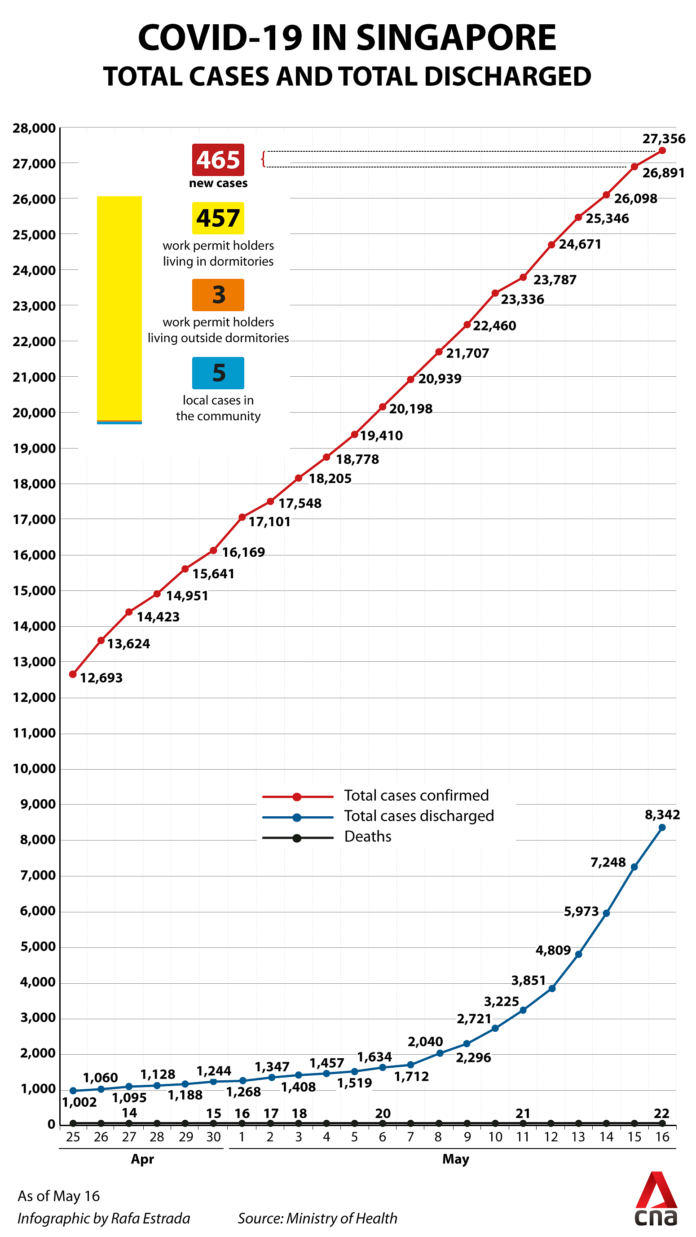
SINGAPORE: Singapore reported 465 new COVID-19 cases as of noon on Saturday (May 16), taking the country’s total to 27,356.
The Ministry of Health (MOH) also announced one more death – a 67-year-old Singaporean man known as case 1516. This brings the total number of fatalities from the disease to 22.
The man, who had a history of ischaemic heart disease, hypertension and hyperlipidaemia, was confirmed to have COVID-19 on Apr 7. He died on May 15 at Sengkang General Hospital.
Of the 465 new cases, 457 are work permit holders residing in dormitories.
Five cases are from the local community – four Singaporeans and a work pass holder. One of the Singaporeans is a 31-year-old dormitory inspector.
The number of new cases in the community has gone down, from an average of nine cases per day in the week before to an average of three per day in the past week, said MOH.
The number of unlinked cases in the community has also decreased, from an average of three cases per day to an average of one cases per day, the ministry added.
It noted that the number of new cases reported on Saturday is lower due to a testing issue at a laboratory.
“The lower number of cases today is partly due to fewer tests being processed as one testing laboratory is reviewing its processes following an earlier apparatus calibration issue, and will need time to ramp up its testing capacity,” said MOH.
Of the new cases, 99 per cent are linked to known clusters, while the rest are pending contact tracing.
A total of 1,094 more patients have been discharged. In all, 8,342 people have fully recovered from the infection and have been discharged from hospitals or community care facilities, said MOH.
There are 1,111 confirmed cases who are still in hospital. Of these, most are stable or improving, and 16 are in critical condition in the intensive care unit.
A total of 17,881 are isolated and cared for at community facilities. These are those who have mild symptoms, or are clinically well but still test positive for COVID-19.
Three new clusters have also been identified. They are at 9 Sungei Kadut Way, 7 Tech Park Crescent and 137 Tuas View Square.
Earlier on Saturday, MOH said it had released 18 patients from the D’Resort community care facility, who had been staying there for “prolonged periods”.
The 18 were “clinically very well” yet “persistently tested positive” for COVID-19, said the ministry.
A medical review committee “deliberated on each of these cases individually and determined that the patients are shedding dead viral components, detectable through the PCR test, but which are no longer transmissible and infective to others”, said MOH.
Singapore has less than a month of its “circuit breaker” period left to go. Until Jun 1, all workplaces will remain shut except for those providing essential services. Residents are also barred from leaving their homes except to exercise alone or for basic necessities.
At a press conference held by the multi-ministry task force dealing with the COVID-19 outbreak on Friday, Health Minister Gan Kim Yong said circuit breaker measures need to be lifted “carefully and slowly”, warning that community cases will “likely” increase with the easing of some restrictions.
“Because if we are not careful, the number of cases will spike up and you may have big clusters forming again,” he said.