SINGAPORE – Concession cardholders will be automatically refunded the unused value of their monthly concession passes till the end of the circuit breaker period.
TransitLink, which handles public transport transactions, said on Monday (May 18) that the extension was made in tandem with the lengthening of the circuit breaker period.
Although the circuit breaker ends on June 1, many restrictions and measures are likely to remain, the Government had said earlier.
TransitLink said two groups of commuters – those who bought their monthly concession passes before April 4, and who bought them between April 4 and 21 – will automatically receive refunds on the unused value of their passes.
For commuters who bought their passes before April 4, they will automatically receive refunds for the period of April 7 to June 1, or up to the pass expiry date, whichever comes earlier.
Students will get their refunds for the period beginning April 8 instead.
Meanwhile, commuters who bought their passes between April 4 and 21 will get a pro-rated refund for the period of April 22 to June 1, or up to the pass expiry date, whichever comes earlier.
SINGAPORE: An IT system testing glitch on Saturday (May 16) resulted in 357 patients receiving an erroneous SMS message informing them that they had tested positive for COVID-19, said the Ministry of Health (MOH).
“The messages had been sent due to an IT system testing glitch as we sought to improve the efficiency of our system,” said MOH on Monday in response to CNA’s queries, adding that no confidential information was breached.
Two former COVID-19 patients who received the SMS told CNA that they had previously been confirmed as negative and had already been discharged.
Another patient said he received the message while he was in the D’Resort community isolation facility. He was confirmed as negative the next day and discharged.
“On May 16 at about 7pm, 357 patients who had previously tested positive for COVID-19 received an erroneous SMS message informing them that they had tested positive for COVID-19, although they had already been informed earlier,” said MOH.
“The Ministry of Health has taken immediate steps to rectify the situation once the error had been detected. A follow-up message was sent to all affected individuals by 10pm to clarify that the earlier SMS message had been sent in error, and to apologise for any inconvenience and anxiety caused,” said the ministry.
“We have since reviewed our processes to ensure that a similar error will not recur.”
A screenshot of the series of messages that a former COVID-19 patient received on Saturday.
Despite the thunderous applause, choral homage and intricate light displays meant to pay tribute to our healthcare workers, it seems that not all are treated with such dignity.
A nurse who had previously endured stares and insults from his neighbours finally made a police report after they began spraying him with disinfectant last Wednesday (May 13) and chanting: “Virus! Virus!”, 8world reported.
SINGAPORE: Enhanced measures to improve queue management have been implemented at the Changi Exhibition Centre community care facility for COVID-19 patients, after a video of large crowds was circulated on social media.
Mandarin Oriental Singapore, which is the managing agent of the facility, said on Monday (May 18) that the video in question was taken more than a week ago, on May 10.
“We can understand the concern that some have expressed about the occupants coming into close proximity with each other. As they are all COVID-19 positive, they do not pose risks to one another,” the firm said in response to CNA’s queries.
A copy of the video, shared by Facebook user Joseph Nathan, showed scores of people crowding in the hall. The video, which was first shared on Sunday, has since been viewed at least 10,000 times on Facebook and shared more than 500 times.
This screengrab shows migrant workers at the Changi Exhibition Hall isolation facility. (Image: Facebook/Joseph Nathan)
Mandarin Oriental said that the queues during the distribution of afternoon snacks were orderly, “except for this section of around 300 migrant workers”.
The facility currently looks after more than 2,600 migrant workers who have tested positive for COVID-19.
“We have nevertheless sought to work with the migrant workers on the need to maintain orderly queues, and enhanced measures to improve queue management by deploying more personnel and having volunteers among the migrant workers to assist with meal distribution and crowd management,” Mandarin Oriental said.
Staggered meal timings by sectors have also been implemented to reduce crowding at the meal collection area.
“The situation has improved significantly and is generally stable,” the company added.
Mandarin Oriental thanked people for supporting its frontline workers who have made personal sacrifices to care for COVID-19 patients.
“We have been receiving donations such as snacks, clothes and blankets, and have benefited from volunteers who have been assisting us with translation work. We look forward to receiving such continued societal support as we battle COVID-19 as one united nation.”
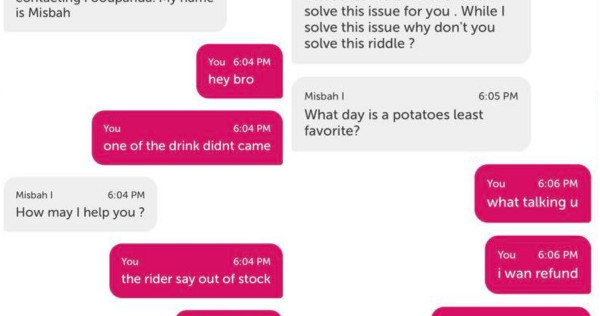
A hungry man is an angry man, but nothing that laughter can’t cure.
Which is why if you’ve recently contacted a Foodpanda customer service agent for help, you might have been presented with a riddle to solve.
“In early May, we encouraged our customer service agents to use riddles tactfully and in appropriate situations to lighten the mood while customers wait for a response from our staff,” Foodpanda told AsiaOne.
One such customer was Chin Hoe Lee, who shared his amusing exchange on Facebook last Thursday (May 14).
order come wrong nevermind ask me solve riddle , now I ask them solve back foodpanda ( Refunded with voucher ) ORDER MORE AND SUPPORT FOODPANDA RIDDLE TIMES👏🏻👏🏻😂
SINGAPORE: The number of dengue cases in Singapore is on the rise, with a total of 529 dengue cases reported in the week ending May 16, said the National Environment Agency (NEA) in a media release on Monday (May 18).
This is higher than the 300 to 400 weekly cases in the first four months of the year, said the agency, as it warned of an increased risk of dengue in the warmer months ahead.
“As we enter the warmer months ahead, the increased risk of higher transmission of dengue is a concern,” said the agency.
This is due to the accelerated breeding cycle and maturation of Aedes mosquitoes, as well as a shorter incubation period of the dengue virus.
About 84 per cent of the the 821 dengue clusters notified this year have been closed, said the agency, but large clusters still persist.
These include a cluster of 153 cases located at Pavilion Circle, one at Woodleigh Close with 136 cases and another at Westwood Avenue with 104 cases. Intensive vector control efforts are ongoing in these places.
However the 189-case cluster at Jurong West Street 91, 183-case cluster at Begonia Drive, 154-case cluster at Elias Road, 148-case cluster at Jalan Bangau, 124-case cluster at Ang Mo Kio Avenue 3 and 106-case cluster at Gangsa Road were closed in the first four months of the year.
From January to April, the agency conducted about 310,000 inspections for mosquito breeding islandwide, and uncovered more than 6,400 mosquito breeding habitats.
INCREASED AEDES MOSQUITO BREEDING IN HOMES
There has been a marked increase in Aedes mosquito breeding found in homes in recent years, and such breeding has continued to persist even during the current “circuit breaker” period to stem the spread of COVID-19, said NEA.
The agency said it had observed a 50 per cent increase in Aedes mosquito larval breeding in homes over the past three years, as compared to the three years preceding this period.
“During the circuit breaker period, NEA continues to detect mosquito breeding in homes, despite residents spending most of their time at home and having more opportunities to remove mosquito breeding habitats,” said the agency.
It urged homeowners and occupants to pay attention to any mosquito breeding or adult mosquitoes present in their homes, and to take the necessary steps to prevent or remove them.
“With more people staying home, there is a higher risk of disease transmission within housing estates, especially in areas where the population of the Aedes mosquito vector – a day biter – is high,” said NEA.
“Besides good housekeeping to prevent mosquito breeding within their own premises, residents can also take simple, proactive steps against adult mosquitoes in the environment to help break the transmission chain.”
This includes preventive spraying of insecticide in dark corners of the home, such as under the bed and sofa, behind the curtains, and in the toilets, said the agency.
During the circuit breaker period, the agency said it has continued home inspection efforts to remove mosquito breeding in large dengue cluster areas in order to stem the transmission of the disease.
Along with the Ministry of Health, polyclinics and general practitioners, it has also provided more than 300,000 bottles of mosquito repellent for distribution to patients with suspected dengue fever.
NEA officers performing dengue home inspections are equipped with personal protective equipment, and take necessary precautions to protect themselves and homeowners and occupiers during the course of their work, said the agency.
These precautions include not reporting to work if unwell, a strict temperature tracking regime, and sanitising their hands before and after every home inspection. Residents in dengue cluster areas are strongly urged to cooperate with NEA officers and facilitate their checks, added the agency.
FOCUS ON CONSTRUCTION SITES
Preventive surveillance has also been stepped up at construction sites given their closure during the circuit breaker period, said NEA, with increased audits to ensure control measures are in place.
Workers wearing face masks fumigate a construction site to prevent the spread of dengue fever in Singapore on Apr 17, 2020. (Photo: AFP/Roslan Rahman)
Before the start of the circuit breaker period, construction site operators were told to maintain a minimum workforce to carry out housekeeping and facilitate pest control services within the sites.
Since then, NEA said it has increased audits to make sure vector control measures are in place.
Of the 1,514 construction and additional and alteration work sites, those within dengue cluster areas and within residential areas will see prioritised audits by the NEA. To date, 50 per cent of these have been inspected.
From January to April, 31 summonses and two stop work orders were issued to construction sites, and two contractors will be charged in court for repeat offences, added the agency.
NEA is also working with the Ministry of Manpower and operators of dormitories to ensure that vector control measures are in place, as most dormitory residents are staying indoors.
Information about locations with higher Aedes mosquito populations and dengue clusters can be found on the NEA website and myENV app.
Singapore’s roads may be quieter than usual lately but several motorists in Yishun were greeted with a strange sight on Friday (May 15) evening.
A child riding a kick scooter along Yishun Avenue 8 was rescued by a cyclist, narrowly avoiding a collision with a truck, according to dashcam footage posted on Facebook.
The harrowing 30-second clip of the incident shows a small child riding a scooter in the middle of the three-lane road.
A cyclist, who had been travelling in the leftmost lane, veered right to grab the child, stopping the errant scooter rider.
Mere seconds later, a silver truck which had been heading towards the pair swerved, narrowly missing them.
Fortunately, the rest of the surrounding vehicles slowed down and gave way to the cyclist as he carried the child off the road to safety.
SINGAPORE: Amid the risk of COVID-19, Republic of Singapore Navy (RSN) soldiers are wearing additional personal protective equipment to board merchant ships that pass through Singapore waters.
Based on land, Accompanying Sea Security Teams (ASSeT) personnel from RSN’s 180 Squadron must now put on protective goggles, face masks and latex gloves when heading out to board ships.
Their task is to ensure that vessels do not carry terrorists, stowaways and contraband items that threaten Singapore’s security, said 180 Squadron commanding officer Major (MAJ) Brandon Choo on Monday (May 18).
Speaking to reporters via video conference, MAJ Choo, 38, said his men are maintaining the frequency of boarding – up to two to three ships a day – to continue acting as a deterrence against potential threats.
An ASSeT operator speaking to a crew member on board a merchant ship. (Photo: MINDEF)
Singapore’s maritime industry contributes 7 per cent to its gross domestic product, and the threat of sea robberies in the region is an ongoing one.
Data from a maritime information sharing centre showed that sea robbers boarded ships sailing through the Singapore Strait in 12 incidents from January to April.
This is a three-fold increase from the four incidents in the same period last year, according to figures from the Regional Cooperation Agreement on Combating Piracy and Armed Robbery against Ships in Asia Information Sharing Centre.
“The sea robbery incidents continue to happen, but we still continue to ensure that these robberies do not affect our maritime trade,” he said, stating that the enemy “doesn’t rest” regardless of the outbreak.
“We also offer the global maritime community greater confidence to operate in our waters. This encourages their willingness to come to Singapore and to operate in our ports to deliver our essential goods, especially during this time.”
PROTECTIVE MEASURES
This is why there is such a need to keep the boarding operations going while protecting the RSN’s soldiers during the COVID-19 pandemic.
These personnel would take a small craft out to the anchorages and climb ladders to get on ships entering Singapore waters.
The potential of getting infected with COVID-19 while engaging with foreign crew on board these ships “is of course a concern”, MAJ Choo said.
He added that the crew must have completed a health declaration and indicated that their last five port of calls were not “affected” by COVID-19, even before their ships are boarded.
Boarding a ship at night. (Photo: MINDEF)
“These additional measures ensure that ships coming in will have already a layer of inspections prior to 180 Squadron doing their boarding operations,” he said.
On board the small craft, personnel will leave alternate seats empty for safe distancing. This means two members have to sit inside the inner cabin of the craft, which is reserved for ship crew and is usually empty.
ASSeT operators restraining an uncooperative merchant ship crew member during a simulated exercise. (File photo: MINDEF)
When on board, personnel must again maintain a safe distance from ship crew, and because they are wearing masks, communicate with additional hand gestures. This usually involves telling crew where to go.
Once done, personnel must also clean the small craft and their individual gear, including helmets, armoured vests and weapons.
“I DEFINITELY FEEL SAFER”
ASSeT operator Private (PTE) Nigel Lim, 22, said the wearing of masks means speaking louder and using clear gestures.
“Because we’re not able to show our face, we have to learn to smile with our eyes to appear less intimidating to ship crew,” the full-time national serviceman said.
Most crew have been cooperative, he said, except for one who got annoyed that his ship was being boarded.
PTE Nigel Lim (left) and his team member ensuring that their personal protective equipment are put on properly before operations begin. (Photo: MINDEF)
Nevertheless, PTE Lim said the extra gear is necessary to minimise the risk of COVID-19, noting that the latex gloves provide an extra layer of protection under his usual gloves.
“I definitely feel safer with all these items,” he stated.
Back on land, PTE Lim also has to spend weeks stuck in camp while on 24-hour shifts, as compared to the situation pre-COVID-19 when he could book out every day.
ASSeT pperators working in pairs to take down hostile targets on board a merchant ship during a simulated operation. (File photo: MINDEF)
But he feels it is worth it.
“My parents were initially worried because they were afraid that the exposure is very high when boarding merchant ships. But I assured that the squadron takes necessary precautions,” he added.
“I feel that we are very important to the safety of our sea lines. So by performing these operations daily, we make sure that important necessities such as food go from sea to Singapore safely.”
She claimed she had to endure verbal abuse from her employer from the time she started working for the family in January.
And she said it got worse during the circuit breaker period, with enforced and prolonged stay-home measures putting her under greater scrutiny.
The foreign domestic worker (FDW) from the Philippines, who is in her late 30s, eventually reached a breaking point and ran away from her employer’s home earlier this month, Ms Jaya Anil Kumar, a case manager at the Humanitarian Organisation for Migration Economics (Home), told The New Paper.
“She told us her employer called her ‘bull****’ and she would sometimes have to eat lunch late because she was made to finish her work first,” said Ms Jaya.
The woman called Home’s helpline, and the migrant worker advocacy group arranged for her employment agency to pick her up.
She is now housed by her agency and awaits repatriation as she wishes to return home.
Tensions between employers and FDWs during the Covid-19 pandemic have escalated, according to the Foreign Domestic Worker Association for Social Support and Training (Fast).
SINGAPORE: Three of Mediacorp’s Tamil drama series will be featured on Indian streaming giant ZEE5, under the company’s largest and highest-profile Indian distribution deal to date.
As part of the collaboration, a total of 160 hours of Mediacorp’s Tamil titles has been sold to ZEE5, India’s largest content producer, said Mediacorp in a news release on Monday (May 18).
Three drama series are now available for free to India-based users of the platform.
These titles, which originally aired on Vasantham and meWATCH, include seasons one, two and four of long-form suspense series Vettai, which features A-list actors Vignesh Wadarajan and Gunalan Morgan.
The other two titles are the 54-episode Uyire, which explores an enigmatic ex-military officer’s explosive past, and the 49-episode Arivaan, based on a barber with paranormal powers and his pursuit of a mysterious mass murderer.
Arivaan is about a barber with paranormal powers and his pursuit of a mysterious mass murderer.
Uyire is a series which explores an enigmatic ex-military officer’s explosive past.
The deal is “the first foray of its kind with the Mumbai-based streaming service operated by Essel Group via its subsidiary Zee Entertainment Enterprises Limited”, Mediacorp said.
“We are excited to embark on this endeavour with ZEE5 in proffering our premium Tamil content to consumers in India,” said Mediacorp Vice President of Content Distribution Jesslyn Wong.
“We hope this is the beginning of a commercially fulfilling relationship between our two companies that will ultimately strengthen our mutual standing in a competitive and ever-evolving mediascape.”
ZEE5 added this move was a way to ensure consumers had fresh content to watch during the COVID-19 lockdown in India.
“As India’s entertainment super-app, we are cognisant of the current situation and have undertaken planned measures to urge consumers to stay indoors by serving them with their daily dose of entertainment across languages,” said Aparna Acharekar, programming head of ZEE5 India.
“Our partnership with Mediacorp is one such strategic step towards delivering a series of bespoke Tamil original content for viewers who were devoid of access to fresh content during the ongoing lockdown in India.”