Home Blog Page 311

From Macau’s casinos to a Kallang farm: The gaming industry professional who now grows baby spinach

SINGAPORE: For five years, Mr Ray Poh mingled with high rollers in Macau, which has been dubbed the gambling capital of the world. 

It was a lucrative career filled with opportunities to travel frequently. But in 2015, Mr Poh gave all of that up.

“I did think about making it a career,” said Mr Poh, who had studied in Australia since the age of 12. “But I think at the end of the five years, I realised that I’d been away for most of my life from my mum, who was back in Singapore. That was one of the main factors (that led me to leave).”

It took him a year to completely leave the industry, but by 2016, Mr Poh had decided on a very different career path: Urban farming.

His indoor hydroponics farm, Artisan Green, specialises in growing baby spinach. The 3,200 sq ft farm is located in Kallang in central Singapore, with its entire set-up costing Mr Poh slightly under a million dollars.

Although Artisan Green was founded in 2018, a year before Singapore announced its ’30 by 30’ goal to produce 30 per cent of Singapore’s nutritional needs locally by 2030, it is part of an increasing wave of indoor farms looking to use sustainable methods to grow produce locally.

In April, the Ministry of Environment and Water Resources announced a S$30 million 30×30 Express grant for the agri-food industry to speed up the production of commonly consumed food items like eggs, vegetables and fish.

READ: COVID-19 pandemic highlights importance of strengthening Singapore’s food security, say experts

READ: Interest in urban farming sprouts amid COVID-19 outbreak

A FAMILY BUSINESS

While casino gaming was never something he had been interested in, a chat with his mother post-graduation was enough to convince Mr Poh to enter the family business.

“I was thinking of entering the banking industry, but the thought of being behind a desk didn’t appeal to me much. So we were having a discussion and she said, why don’t you give this a try. Your father needs some help in the company, perhaps you can go out and see what you can do,” he said.

Initially, he did business development with his father’s manufacturing company, developing products such as slot machines. As he became more involved in product design, so his interest in the industry grew, he said.
casino gamer to farmer 4

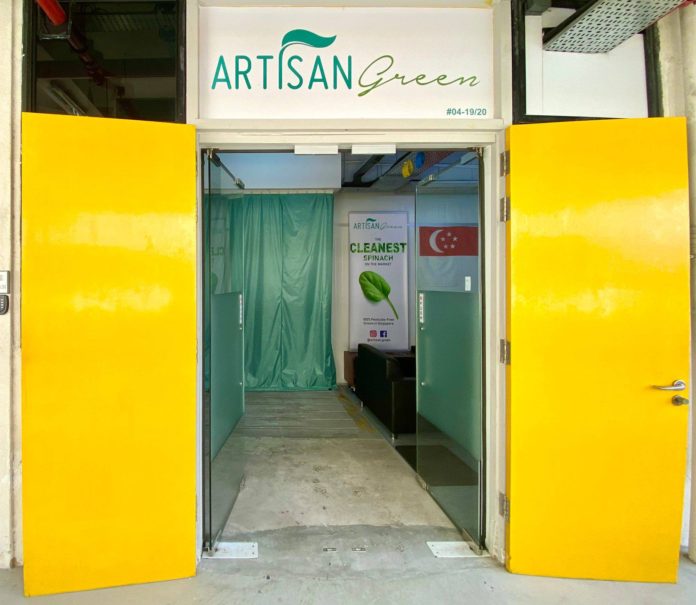
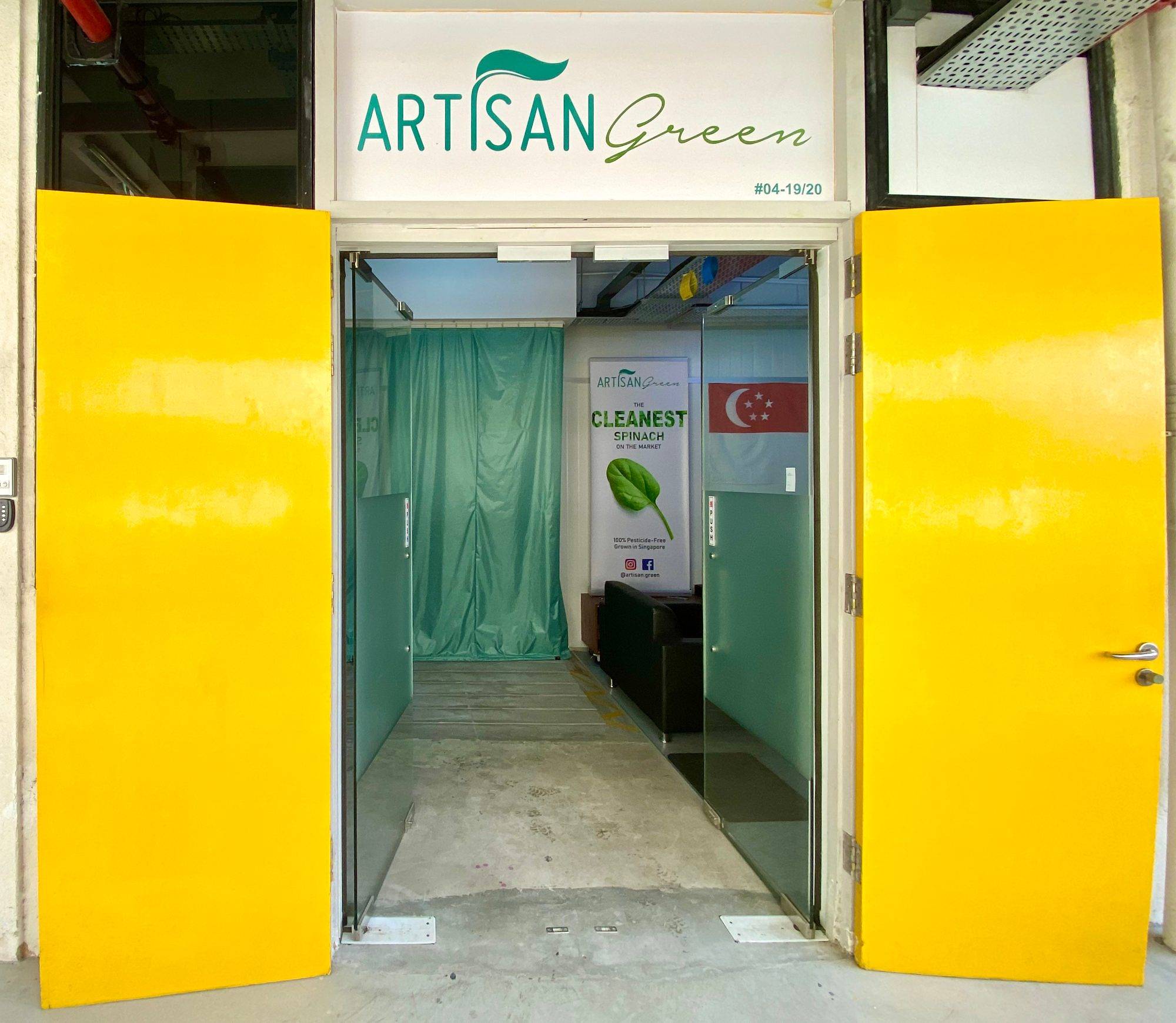
The exterior of Artisan Green. (Photo: Artisan Green)

After a year, his boss convinced him that he ought to head to Macau to advance his understanding of the industry, which turned out to be a fruitful experience.

“I think at the very start when I first went there, I didn’t know anything or anyone in Macau, so the main thing I did was to network around. I met a lot of good people, and at the same time, obviously, you meet people that are not so good.

“What I did was learn what to do and what not to do. It was a very good experience,” he said.

Being new to the industry also meant that people did not take him seriously. Mr Poh had to work hard to brush up his knowledge on the casino gaming industry by doing research, reading industry magazines and making friends who could teach him – skills which would later put him in good stead to enter a completely different industry.

CONTRIBUTING TO SUSTAINABILITY

When he told his family that he wanted to move out of casino gaming, they were supportive of his decision, said Mr Poh.

“I think from the business aspect of things, it was more of a diversification. I’ve always thought that agriculture is something that’s evergreen. People will always need to eat. Whereas casino gaming is something like the entertainment sector,” he said, adding that he wanted to “do something more to contribute to the sustainability segment”.

“At first I thought about doing landscaping, but I didn’t really want to go back to study more. So I thought farming might be an easy way in. 

“But I was very wrong about how easy it was. After doing the research, I quite naively thought that I would do this for about a year and network around, meet more people and then move into landscaping. But it just took me down towards farming all the way,” he said.

casino gamer turned farmer 2

Artisan Green has 120 growing racks, with six layers in each rack. (Photo: Artisan Green)

Just like when he started out in Macau, Mr Poh had “zero knowledge” of the agriculture sector, and people also did not take him seriously when he started.

“I knew I had to build up my knowledge from ground-up again,” he said.

He attended courses and conferences, forged relationships with people in the industry, watched Youtube videos and built prototypes.

Building the prototypes gave him the confidence to decide that he wanted to build his entire farm from scratch. After leasing a space from Mapletree and procuring all his supplies and tools, Mr Poh set himself to work as the main contractor of his own farm.

Save for the electrical wiring and the plumbing, Mr Poh put the entire 3,200 sq ft farm together with his own hands over the course of three months.

“When I was building the farm, I was there from 9am to 10pm. I’d only eat one meal a day during the building, because I didn’t want to waste time. So I would only eat one really huge brunch and then just work the entire day in the farm,” he said.

It was challenging work, as he did all the sawing, drilling and lifting, and even suffered a back injury from hunching over and moving around too much. While he admitted that he should have gotten a partner to build the farm with him in hindsight, Mr Poh said that the process was necessary.

“Now that I’ve gone through this, I can safely say that I know pretty much everything in the farm. I’ve sourced for every single piece of equipment by myself which makes it even easier for me to understand other people’s systems.

“I can look at other people’s systems, I can derive how it’s built, how it’s done, and that experience isn’t something you can get from reading books or watching tutorials online,” he said.

WHAT KEEPS HIM GOING

Even with his extensive research, his lack of science and engineering knowledge posed challenges for him.

“I didn’t really do chemistry, so that was kind of hard to pick up, and I knew that I needed to get the foundational knowledge of farming in terms of the science aspect to be able to do well in it,” he said, as science was an integral part of farming.

He also had to engage professional engineers to help him ensure the farm was built well.

This was in addition to the time he had to sacrifice in those early months, when he was just starting out, with many weekends spent at the farm just to make sure that everything was running well.

And even with the farm up and running, the team also ran into other problems, such as nutrient deficiency issues for their spinach.

casino gamer to farmer 3

Artisan Green’s team packing spinaches. (Photo: Artisan Green)

But what kept Mr Poh going was his desire to “see the final product”.

“And we’re quite proud of what we’ve done with this current farm. We’ve had people from the industry – from the US, Europe – coming to visit us and they were quite impressed with the farm we’ve built. They told that it was comparable to some of the more advanced overseas farms as well.

“Hearing that gives us the motivation and a stronger belief in what we do.”

FUTURE PLANS

In the short-term, Artisan Green hopes to scale up its production from its current 30kg to 250kg of vegetables per week.

Although Malaysia’s Movement Control Order has temporarily disrupted the farm’s supply of equipment which they require to scale up, Mr Poh is hoping to at least double the farm’s output by the end of the “circuit breaker” period and to hit 100kg per week by the end of the quarter.

In the longer-term, Mr Poh is also looking to build his second farm – this time bigger, and with a wider variety of crops. But rather than growing specialty crops, Mr Poh said he now wants to start growing crops such as chinese cabbage, which he says there is a bigger demand for in Singapore.

“The next farm will have to be more automated, from end-to-end. That’s what our future goal is: to build the second farm and also to grow different crops, not just baby spinach, and work towards something where we can fulfil the whole ’30 by 30’ vision by the Government,” he said.

Source link

Singapore reports smallest number of COVID-19 patients in ICU since start of circuit breaker

SINGAPORE: The number of COVID-19 patients in the intensive care unit (ICU) has fallen to a low since the start of Singapore’s “circuit breaker” period.

As of noon on Friday (May 22), eight patients were in critical condition in the ICU, said the Ministry of Health (MOH) in a media release.

READ: Singapore reports 614 new COVID-19 cases, including 2 pre-school staff

This is also the first time that the number of COVID-19 patients in the ICU has fallen to a single digit since the circuit breaker started on Apr 7.

According to previous data from MOH, Singapore had a high of 32 COVID-19 patients requiring intensive care on Apr 10.

The number of patients in the ICU ranged between 20 and 31 for most of April and the first two weeks of May, before trickling down to 10 cases on May 19.

In Friday’s release, MOH reported another 614 new COVID-19 cases, taking Singapore’s total number of infections to 30,426.

The majority were foreign workers residing in dormitories, and four cases were from the community, all of them Singaporeans.

A total of 838 COVID-19 patients were discharged on Friday, taking the total of recovered patients to 12,955.

Singapore covid cases May 22

MOH’s release on Friday also showed an increase in the average number of cases in the community – from five a day in the week before, to an average of seven a day in the past week.

This is in part due to the ministry’s active surveillance and screening of nursing home residents and pre-school staff, said MOH.

The testing has uncovered infections in at least five pre-school staff, as well as four nursing home residents, according to MOH’s updates on Thursday and Friday.

READ: 3 pre-school employees contract COVID-19, leave of absence issued to ‘small group’ of children, staff

READ: 2 more pre-school staff members test positive for COVID-19

Additionally, MOH on Wednesday also started including work permit holders living outside dormitories into its daily count of community cases.

Work permit holders residing outside dormitories were previously listed under a separate category in the ministry’s daily COVID-19 update.

BOOKMARK THIS: Our comprehensive coverage of the coronavirus outbreak and its developments

Download our app or subscribe to our Telegram channel for the latest updates on the coronavirus outbreak: https://cna.asia/telegram

Source link

Gong Cha to open Causeway Point, Paya Lebar Quarter and Nex stores on May 23

[ad_1]

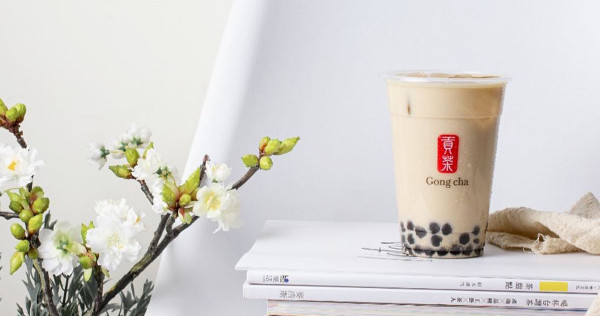
Gong Cha fans rejoice! The brand will open three of its outlets tomorrow (May 23) for takeaway and delivery orders. 

The three stores that will be serving customers are located in Causeway Point, Paya Lebar Quarters and NEX. 

In a Facebook post on May 22, Gong Cha Singapore revealed that they were permitted to open because the three outlets, which are also the brand’s newest branches, sell souffle pancakes and are classified as snacks.

The brand shared that safety ambassadors will be around to facilitate with crowd management and that they will “stop orders if the queue becomes unsafe to all”. 

Gong Cha also advised that customers ordering the souffle pancakes should expect a minimum wait of 20 minutes as the pancakes are made to order.

[ad_2]

Source link

Singapore reports 614 new COVID-19 cases, including 2 pre-school staff

SINGAPORE: The number of COVID-19 cases in Singapore topped 30,000 on Friday (May 22), with 614 new cases reported as of noon.

This brings the total number of cases in the country to 30,426.

There were four new cases in the community, all of them Singaporeans.

Two of the community cases are pre-school staff. Case 30387, a 58-year-old woman who is currently an unlinked case, went to work at My First Skool @ Westgate after she experienced onset of symptoms on May 8. She tested positive for COVID-19 on Thursday. 

The other case, a 50-year-old Singaporean woman, had not gone to work recently. MOH did not specify where she works. She also tested positive for the coronavirus on Thursday. 

Two other Singaporean men, aged 35 and 37, are contacts of Case 24831 and are part of the CDPL Tuas Dormitory cluster, which now has 617 cases. 

Case 24831 was reported on May 13 and was deployed for operation duties at the dormitory.

“The number of new cases in the community has increased, from an average of five cases per day in the week before, to an average of seven per day in the past week. 

“This is partly due to our active surveillance and screening of nursing home residents and pre-school staff, which have picked up more cases in the past week,” said MOH.

The ministry added that the number of unlinked cases in the community has remained stable at an average of two per day in the past two weeks.

A total of 610 of the new cases are foreign workers living in dormitories, MOH said.

The ministry added that it continues to pick up many cases among work permit holders residing in dormitories, including in factory-converted dormitories, because of extensive testing in these premises. 

Two new clusters were identified. They are at 564 A-E Balestier Road and 71 Kaki Bukit Industrial Terrace. 

READ: Singapore reports highest number of new COVID-19 cases among citizens or PRs in more than 3 weeks

A total of 838 more cases of COVID-19 infection have been discharged. In all, 12,955 have fully recovered from the infection and have been discharged from hospitals or community care facilities.

There are currently 798 confirmed cases who are still in hospital. Of these, most are stable or improving while eight are in critical condition in the intensive care unit. 

A remaining 16,650 are isolated and cared for at community facilities. These are people who have mild symptoms, or are clinically well but still test positive for COVID-19. 

To date, 23 have died in Singapore from complications due to COVID-19 infection.

READ: COVID-19: Four Singaporeans part of family linked to Cochrane Lodge II dormitory cluster

Singapore covid cases May 22

The People’s Association said on Thursday a third mask distribution exercise will begin on May 26, ahead of the easing of “circuit breaker” restrictions on Jun 1.

On Thursday, Education Minister Ong Ye Kung also addressed concerns by some parents about the reopening of schools on Jun 2.

After having brought community transmissions to a “low and controlled level”, school should resume with “many precautions”, he said, adding that attendance cannot be voluntary as that would affect students’ and teachers’ morale.

READ: Transition to a ‘new normal’ after circuit breaker: How will measures be lifted beyond Phase 1?

BOOKMARK THIS: Our comprehensive coverage of the coronavirus outbreak and its developments

Download our app or subscribe to our Telegram channel for the latest updates on the coronavirus outbreak: https://cna.asia/telegram

Source link

How Muslims in Singapore can mark the end of Ramadan on Facebook and YouTube

[ad_1]

Things have been plainly different for Muslims in Singapore observing the month of Ramadan this year, and the abnormality will continue for Hari Raya amid the global viral outbreak.

Tradition calls for Muslims to congregate at the mosque to conduct prayers en masse on the morning of Hari Raya, but the current circumstances dictate that this will not be possible. It’s not feasible either for the usual house visits and family reunions to take place as ongoing circuit breaker measures prohibit interacting with anyone outside of one’s residential household. 

This being 2020 and all, technology is here to be of assistance during the festive season. The recital of prayers after the last breaking of fast will be livestreamed on the SalamSG TV YouTube channel and Facebook, through the pages of the Islamic Religious Council of Singapore (MUIS) and various local mosques. 

[ad_2]

Source link

2 men arrested after knife brandished, blood splattered in Hougang sibling fight

[ad_1]

A pair of brothers, aged 33 and 29, were arrested after a fight broke out in their flat along Hougang Avenue 5 last night (May 21).

The police told AsiaOne they are looking into a case of voluntarily causing hurt with dangerous weapon.

During the scuffle, their 31-year-old brother not only lost half a tooth but also sustained cuts on his right arm and under his chin, both of which required stitches.

According to the injured man, his younger brother had been drinking at home when he became increasingly agitated. 

When his older brothers tried to appease him, the drunk man got even more upset and brandished a knife, waving it around the house.

Their attempts to stop him resulted in injuries in the younger two siblings, as well as a 29-year-old man who was visiting their home.

In an interview with the Chinese evening paper, a neighbour recounted how they had heard a heated argument between the three siblings coming from next door. Shouts and screams were heard at times. 

[ad_2]

Source link

Coronavirus cases cross 30,000 mark with 614 new patients

[ad_1]

The Ministry of Health has preliminarily confirmed 614 new coronavirus cases in Singapore today (May 22), with four community cases. Most of the new cases are foreign workers living in the dormitories.

Further details will be provided later tonight.

A total of 30,426 cases have been reported in Singapore so far, with 12,117 cases discharged and 23 deaths.

For the latest updates on the coronavirus, visit here.

bryanlim@asiaone.com

[ad_2]

Source link

COVID-19: Pre-school and primary school students to get face shields, hand sanitiser

SINGAPORE: Pre-school and primary school students will each be given a face shield and hand sanitisers as they prepare to head back to the classroom from Jun 2.

All pre-school teachers and staff members will also receive face shields and an oximeter, as part of an initiative by Temasek Foundation in partnership with the Early Childhood Development Agency (ECDA) and the Ministry of Education (MOE).

Some teachers have already received the items as they completed their COVID-19 swab tests in the past few days. Others will get them in the next few weeks, said Temasek Foundation in a media release on Friday (May 22).

“Face shields can be washed simply with soap and water, to maintain its anti-fog properties,” it added.

preschool face shield

The face shields can be washed with soap and water. (Photo: Temasek Foundation) 

READ: All pre-school staff to be swabbed for COVID-19 before centres resume full services

All pre-school, primary, secondary, junior college and special education school students will also be given two bottles of hand sanitiser each – a 50ml pocket-sized bottle and a larger 500ml one. 

The sanitiser solution contains 40 per cent isopropyl alcohol and 0.1 per cent benzalkonium chloride. 

ITE STUDENTS AND STAFF TO GET REUSABLE MASKS 

Students, service contractors and staff at the Institute of Technical Education will also get two bottles of hand sanitiser each, along with a pair of reusable masks.

According to Temasek Foundation, these masks can retain their anti-microbial effectiveness for up to 30 washes. “With a wash one, wear one approach, the pair of MaskSafe reusable masks can provide daily use for up to two month,” it added.

In all, the initiative is expected to benefit more than 650,000 students, as well as 42,000 teachers and contract staff.

“Temasek Foundation is working with its partners to ensure that all schools can receive these items by Jun 8,” it said.

“Given the logistics involved, some students may not receive the items on the first day they return to school.

“Should this be the case, we encourage parents to ensure their pre-school and primary school children to use their own masks or face shields in school in the interim.” 

READ: COVID-19: Graduating primary, secondary students to attend school on weekdays after circuit breaker ends; others to rotate weekly

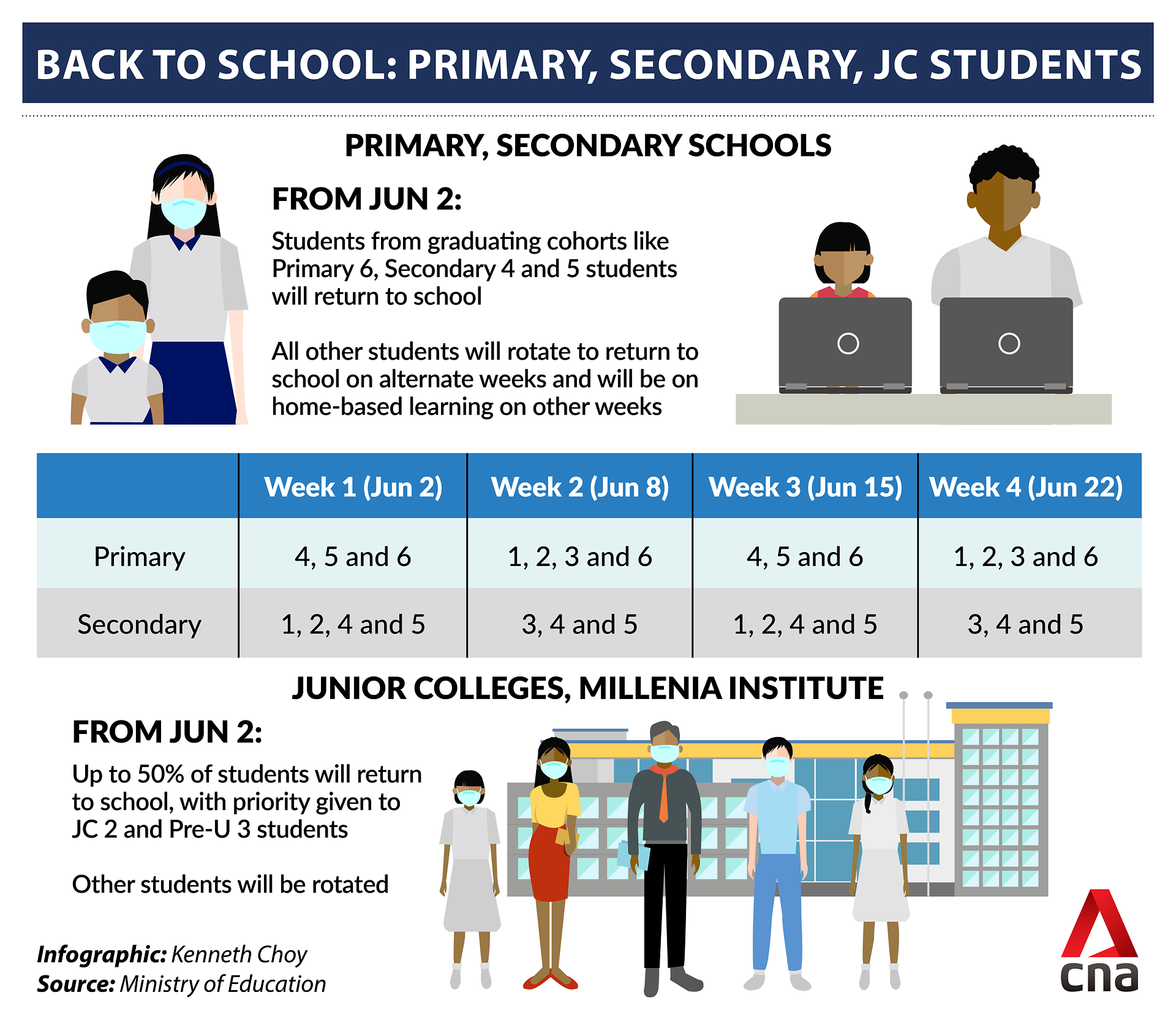
MOE had announced that students will return to school in two phases, with graduating primary and secondary school students attending classes from Mondays to Fridays when Term 3 starts on Jun 2. 

Students in other cohorts – those in Primary 1 to 5 and Secondary 1 to 3 – will rotate weekly between home-based learning and returning to school for lessons. 

READ: COVID-19: School cannot be ‘voluntary’, not good for morale of students and teachers, says Ong Ye Kung

As for pre-school and early intervention centres, classes will resume gradually from Jun 2, beginning with children in Kindergarten 1 and 2. 

Those in Nursery 1 and 2 will return from Jun 8, and children in infant care and playgroup can return from Jun 10. 

may 19 back to school graphic

In a Facebook post on Thursday, Education Minister Ong Ye Kung addressed some parents’ concerns about schools resuming classes on Jun 2, saying that exceptions can only be made for “specific concerns arising from medical conditions”.

He added that the Government cannot make attendance at school “voluntary” as such a system is not good for the morale of both students and teachers.

“It is likely that COVID-19 will stay with us for more than a year, and until a vaccine is available.

“We simply cannot keep our children at home for so long,” said Mr Ong, adding that it would seriously impact their socio-emotional and mental well-being. 

BOOKMARK THIS: Our comprehensive coverage of the coronavirus outbreak and its developments

Download our app or subscribe to our Telegram channel for the latest updates on the coronavirus outbreak: https://cna.asia/telegram

Source link

Blunt response to The New York Times' 'racist' article on Singapore's Covid-19 efforts goes viral

[ad_1]

A rather dramatic op-ed about the Covid-19 situation in Singapore has garnered an equally dramatic response by a Singaporean, who believes that the original article published by The New York Times (NYT) holds a “racist spin”. 

The parties involved: Megan K. Stack, veteran journalist and best-selling author; Ivan Hong, entrepreneur and social commentator; and Singapore, the country they both call home. 

On Wednesday (May 20), Stack’s article about how the Singapore government and its citizens are handling the coronavirus outbreak was published on NYT. It’s a commentary from an outsider’s point of view, filled with common tropes about the republic’s stances on homosexuality, civil liberties, surveillance and the death penalty. 

[ad_2]

Source link

Dining in would have to wait, here's why

[ad_1]

Singapore might be exiting the circuit breaker on June 2, but the country’s three-phase reopening would mean those planning to dine in at eateries would have to wait for at least another month.

Maintaining a degree of restrictions on the majority of activities during the first phase is something Professor Teo Yik Ying, Dean of National University of Singapore’s Saw Swee Hock School of Public Health, considers prudent.

He told the Straits Times: “We have seen that the virus is transmitted very well when people dine together, and there have been instances in Singapore where the spread was because people came together for meals.”

[ad_2]

Source link