It’s a special birthday for Singapore this year as the nation focuses on celebrating the 55th year of its independence in August during an ongoing viral outbreak.
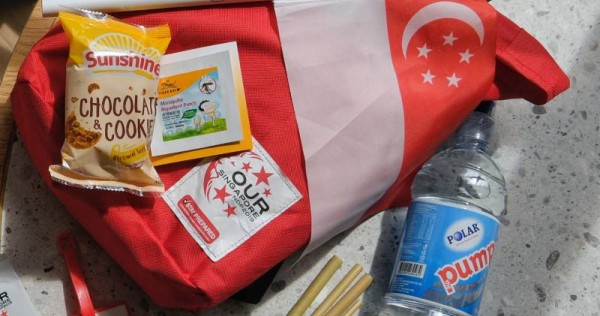
About 1.2 million funpacks — normally given to parade audience and participants — will be given to every Singaporean and permanent resident household, the National Day Parade organising committee said on Wednesday (May 20).
Shortly after the announcement was made, comments started pouring in on the Facebook posts of NDPeeps and Defence Minister Dr Ng Eng Hen.
While they appreciated the gesture, numerous Singaporeans questioned if the resources used to prepare the NDP funpacks could be put to better use as the country weathers the Covid-19 pandemic.
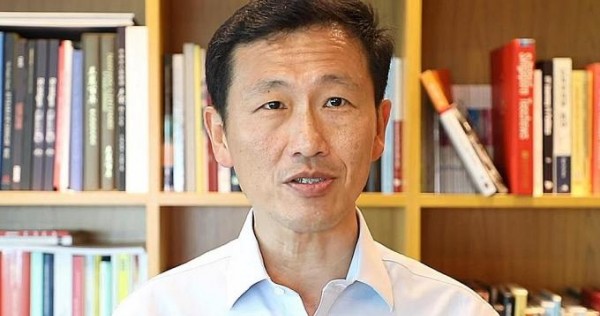
Attending school cannot be made voluntary, Education Minister Ong Ye Kung said yesterday.
In a Facebook post, Mr Ong said there have been some concerns after the announcement to reopen schools come June 2.
Some parents asked if their child can do home-based learning (HBL) if they are uncomfortable sending him to school.
Mr Ong said unless there are specific concerns arising from medical conditions, school cannot be made voluntary.
He said: “It is likely that Covid-19 will stay with us for more than a year and until a vaccine is available. We simply cannot keep our children at home for so long. The impact on their socio-emotional and mental well-being will be serious.”
He said a voluntary system will not be good for the morale of both students and teachers, and it will also segregate students into those whose families are able to provide care at home, and those who cannot.
It is also unsustainable for teachers to juggle classroom teaching and facilitating HBL for every lesson.
Mr Ong added that some parents said their child will have difficulty wearing a mask for the whole day.
Teh is a serious culture in Singapore with deep roots in history, no matter what ethnic background you come from.
For instance, did you know that teh tarik originated from the time of Indian-Muslim immigrants who set up drinks stands for the workers at rubber plantations around the Malay Peninsula after World War II?
The Indians substituted their spiced chai for a tea that had heavier milk, hence creating teh tarik.
To celebrate Internationl Tea Day today (May 21), here are some other things you might now know about tea in Singapore:
1. What makes teh tarik so special?
Our unique spin on the Indian style of heavily sweetened milky black tea is teh tarik, which literally translates to ‘pulled tea’.
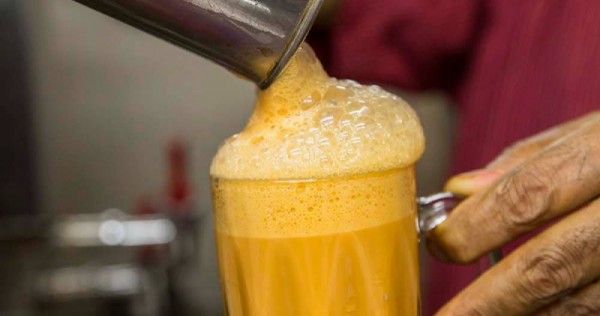
Tea dust and condensed milk are mixed together in a long cotton tea filter and then repeatedly poured from one iron beaker to another.
This theatrical ‘pulling’ mixes the tea and gives it a foamy, frothy appearance.
In fact, it’s worth hopping over the border to watch Malaysia’s annual pouring competitions where teh artisans juggle tea through the air without spilling a drop.
In the second such case in four days, another group of people were spotted in a gathering, this time at a Marine Parade carpark, allegedly to gamble illegally.
Chinese-language newspaper Shin Min Daily News reported yesterday that about 25 men were seen at a carpark at Block 57 Marine Parade Road allegedly betting.
Several were standing in small groups while others sat around. Most were holding their mobile phones and believed to be watching a video clip.
Shin Min also reported that there were beer bottles and food items next to them, and most did not maintain a safe distance of 1m from one another.
A resident who wanted to be known only as Miss Guo, told Shin Min the gathering takes place at least three days a week.
Videos
She said: “There will be a bigger group on Wednesdays and during the weekends. And they will be watching videos of horse racing or football matches with the volume turned up loud.”
A cleaner, who wanted to be known only as Mr Zhuo, said the group would sometimes appear at 1pm and stay for at least four hours.
The authorities should put a stop to this, he added.
SINGAPORE – Singapore residents can collect improved reusable masks from next Tuesday (May 26), in a third mask distribution exercise that will span three weeks.
The latest distribution of new masks – which are more comfortable to wear and have better filtration qualities – will continue until June 14. The previous two rounds lasted about a week each.
About six million reusable masks have been prepared for the exercise, similar to the previous one. Collection counters will be set up at 109 community clubs (CCs) and 661 residents’ committee centres (RCs) across Singapore.
This time, residents can also pick them up from 24-hour vending machines. Some 400 machines will be placed at all CCs for those unable to pick up their free masks from the collection counters.
Residents with a valid identification card can collect one reusable mask each. This includes foreign domestic workers, foreign workers not living in dormitories and international students living in hostels. The Manpower Ministry will distribute masks to foreign workers living in dormitories.
SINGAPORE: A teenager accused of drinking from juice bottles before returning them to a supermarket shelf had his guilty plea rejected on Friday (May 22) after he maintained that he did not consent to the caption “how to spread Wuhan virus”.
Nigel Pang Yew Ming, 17, is accused of taking two bottles of fruit juice from a refrigerated shelf at the NTUC FairPrice supermarket at 2 Bukit Batok West Avenue 7 on Feb 6 and drinking from them.
He then placed the bottles back on the shelf, with his friend Quek Xuan Zhi, also 17, accused of filming the incident and posting it on Instagram.
The video was captioned “how to spread Wuhan virus” and was posted to an account with at least 1,360 followers, the court heard on Friday.
Pang was in court with his mother to plead guilty to his actions, but insisted that he did not know about the caption.
As a result, the judge rejected his plea as he said this formed an important part of the charge.
“I wish to add that actually I didn’t know that the caption ‘how to spread Wuhan’ was being uploaded to the video, because that wasn’t my intention of the video,” said Pang.
“If you now say that you do not know that Quek actually inserted the caption and intended to upload it to Instagram, then you are qualifying a very material portion of the statement of facts,” answered District Judge Seah Chi-Ling.
Pang said he did consent to the video being posted, but said he did not know about the accompanying caption.
“I really did not know that the caption ‘how to spread Wuhan’ was being added until it went viral, then I realised it was being added,” said Pang, who was unrepresented.
His mother told him to “just say the truth”.
Deputy Public Prosecutor Timotheus Koh said Pang had given a statement indicating that he knew that Quek would caption the video “how to spread the Wuhan virus”.
Pang contested this, saying that he “really did not know” about the caption until it went viral. He said Quek usually asked him about captions but said he did not this time.
The prosecutor said he intended to ask for a probation suitability report, but would reserve his position on whether to seek probation until after the report was tendered.
Pang said he wanted to “continue with the sentencing”, saying: “I’m really stressed with the whole thing.”
However, the judge explained that he could not accept the plea as it stands.
He allowed Pang some time to speak to his mother, but Pang maintained that he did not know about nor consent to the caption.
The judge adjourned the matter for Pang to get a lawyer.
Quek’s case is still pending, with the next mention scheduled for June.
The penalty for public nuisance is a maximum jail term of three months, a fine of up to S$2,000 or both.
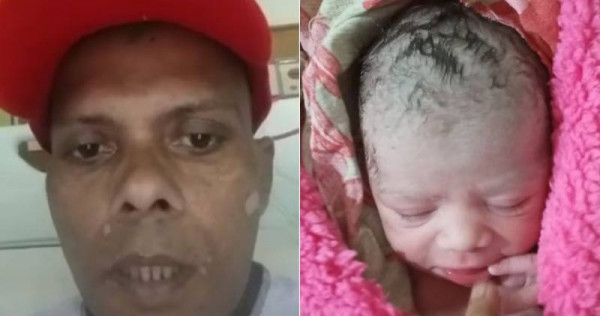
SINGAPORE – After a more than three-month journey in hospital, including a nearly two-month stay in the intensive care unit, the first Bangladeshi worker who contracted Covid-19 in Singapore is well enough to be moved into a community hospital that focuses on rehabilitative care to recuperate.
In a video uploaded on Facebook by the Migrant Workers’ Centre (MWC) on Thursday (May 21), 39-year-old Raju Sarker, who was Case 42, thanked caregivers and those around him for their support.
“I want to thank the Singapore Government and those who prayed for me. I also want to thank my company and the MWC for supporting my family,” he said.
Appearing in his hospital bed and in a red hat, Mr Raju also expressed gratitude to the doctors and nurses that “worked tirelessly” to help him recover as well as the Government for footing the bill for his treatment.
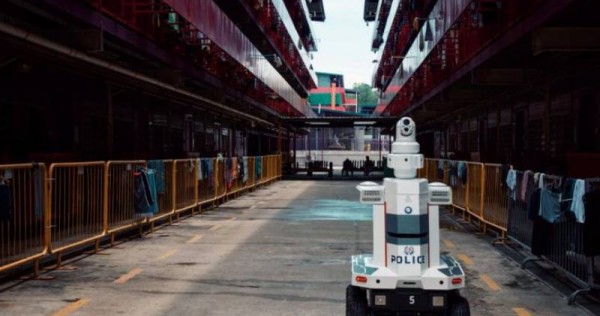
SINGAPORE – Autonomous police robots have been deployed at a foreign worker dormitory in the eastern part of Singapore to patrol the premises and ensure residents there abide by safe distancing rules.
Two Multi-purpose All-Terrain Autonomous Robots, or Matar, have been patrolling the dormitory – which has been gazetted as an isolation facility – since the start of May, complementing police officers on the ground.
The robots were previously deployed at a Government Quarantine Facility from mid-April.
Inspector Teo Wan Ling, who leads a team of over 15 officers at the dormitory, said the robots help the police cover more ground in a similar duration, as it can patrol separate areas from the officers.
The robot’s functions, such as cameras and speakers, can be controlled remotely by an operator in a command centre.
They can be dispatched to attend to minor incidents, reducing the need for officers to be physically close to those under quarantine.
SINGAPORE: With the end of the “circuit breaker” coming up in less than two weeks, it is timely that Singapore policymakers are adopting a phased approach to re-opening the Singapore economy.
Under Phase 1, businesses that are allowed to resume from Jun 2 include manufacturing and production facilities, as well as services including finance and insurance, wholesale trade and logistics and storage.
Pre-schools and schools will re-open in stages and with special arrangements.
If the situation remains under control for about four to six weeks, then we will move to Phase 2 which will allow more businesses and facilities to re-open, including retail outlets, gyms and tuition centres.
Phase 2 could last several months and Phase 3 will be at a yet to be determined date but the official tone suggests even this will not be a return to “business as normal” but a “new normal”.
Judging by the experience of other countries that had re-opened earlier, the risk of a second wave of infections cannot be fully discounted.
The current picture is still mixed – Hong Kong, New Zealand and Australia have so far reported zero to very low new cases after re-openings, whereas France, Spain and South Korea have seen a fresh pick-up in new infections after restriction measures were eased.
Meanwhile, on the COVID-19 vaccine development front, progress remains very tentative at this juncture.
Since Singapore is adopting a gradual, rather than an instantaneous and full, reopening of all economic engines, this approach affords companies some leeway on how they want to scale up their operations after being in stasis for the past two months.
It will clearly not be exactly “business as usual” for some time.
As businesses may still be relatively cautious about the demand recovery and the ongoing supply chain disruptions, they may not be in a big rush to restart 100 per cent of their operations either.
The expected pain points may be trying to resolve existing manpower constraints since the lockdowns and travel restrictions may still be in place for many regional economies, including Malaysia whose Movement Control Order ends only on Jun 9.
People wearing face masks walk past a closed retail mall along the Orchard Road shopping belt in Singapore on May 6, 2020. (Photo: AFP/Roslan Rahman)
Companies may also need to overcome global supply chain disruptions as the inability to source imports of raw materials and components may impede one’s ability to resume business operations.
At the same time, some businesses will need to figure out how to implement and maintain necessary social distancing and hygiene factors, such as lesser staff and face masks, which also implies higher business costs and lesser clientele on-site.
RECOVERY SOMEWHAT IN SIGHT
The fact that 75 per cent of economic activities will restart does mean that we should not write off the second half of 2020 yet.
This resumption of business activities suggest that while the second-quarter growth momentum is likely to be worse than the previous three months and may still register a double-digit contraction, nevertheless, it may now be slightly less severe than the 20 per cent year-on-year decline that was initially expected.
Nevertheless, since Phase 1 is likely to stretch from four to six weeks, and Phase 2 may last a couple of months, this may mean that the recovery growth momentum may be muted until the fourth quarter of this year.
This could mean a sharp drop-off in the first half of 2020, but a more gradual sloped recovery from the second half onwards, putting the shape of the recovery somewhere between a V- and U-shaped trajectories.
This still puts the 2020 full-year growth output contraction in the region close to our bank’s -6 per cent forecast.
That said, the better-than-expected March industrial production figures imply that the flash first quarter 2020 GDP growth estimate is likely to be revised upwards from the initial -2.2 per cent to around -1.5 per cent.
LESSONS FROM CHINA
We can draw some reference from China, which was the first-in-first-out country of the COVID-19 pandemic.
While China has seen a V-shaped bounce in April’s industrial activity due to an orderly resumption of factories, the demand recovery, especially for private consumption, is more tepid.
This is because the average Chinese consumer, who is conservative and prudent, is currently favouring consumption of essential goods and services and deferring discretionary purchases given the weak global growth outlook and softening labour market outlook.
People wearing face masks walk past a Huawei store at a shopping mall, following an outbreak of the coronavirus disease (COVID-19), in Beijing, China May 18, 2020. REUTERS/Carlos Garcia Rawlins
This suggests that while individual countries can implement their own reopening strategy, at the end of the day, domestic consumer confidence is still tied to global demand conditions, which is in turn dependent on the global developments of the COVID-19 pandemic and also the global recovery.
Within manufacturing, the biomedical cluster, especially pharmaceuticals, have already been faring well in the current COVID-19 environment where medical and personal protection equipment supplies, COVID-19 testing and vaccine-related development are in hot demand.
For the services sectors, financial, logistics, information and communications technology – especially cyber-security & e-commerce-related industries due to the drive for digitalisation and online platforms – will also likely continue to be in demand for the rest of the year.
The food and beverage (F&B) and retail industries will see a delayed reopening only from Phase 2, which will likely lead to calls for more wage support in terms of the Job Support Scheme extension to stay afloat in the coming months.
This brings me to the last point about what’s next in terms of fiscal policy stimulus since we know that Deputy Prime Minister and Finance Minister Heng Swee Keat will announce a further round of assistance measures on May 26.
LONGER TERM MEASURES NEEDED TOO
After the Unity, Resilience and Solidarity Budgets were launched in quick order between February to April, amounting to some S$63.7 billion or 12 per cent of GDP, there may be some speculation if another sizeable package is on the cards again.
The earlier substantial fiscal stimuli were mainly targeted at throwing out urgent lifelines to sinking boats – namely in terms of mitigating the liquidity crunch faced by companies and households and the potential retrenchments that could follow in a sharp economic downturn, especially during the circuit breaker.
However, since the Singapore economy is now potentially at a turning point with the lifting of some circuit breaker restrictions in phases, this could warrant a different perspective of preparing for the recovery phase with more targeted and curated help for specific industries to stage a comeback, while not forgetting more medium-term strategies to shore up our economic resilience in anticipation for the next crisis.
More assistance may be needed to get viable businesses and workers back on their feet again after the two months of “cold storage”, especially for the worst-affected sectors, including tourism and hospitality-related industries such as the F&B and the retail sectors.
It is plausible that to help businesses and individuals adapt and build resilience in the continuing fight against the COVID-19 pandemic, some extension of current assistance schemes such as the Jobs Support Scheme and liquidity and rental support for a longer period of time may be needed.
As highlighted earlier, this is especially for industries such as F&B that will see deferred reopening and below capacity utilisation under new social distancing norms.
In addition, more help may be needed to help some hospitality-related businesses reorientate their business model to cater more to local demand as overseas tourism may take a longer time to recover.
FILE PHOTO: People pose for photos at Universal Studios Singapore in Sentosa March 4, 2020. REUTERS/Edgar Su
However, beyond helping the businesses and households with their immediate survival needs, rationally, we would also need to refocus on medium-term strategies that further diversify our import sources.
Singapore’s vision to grow enough food to meet 30 per cent of our nutritional needs by 2030 may be accelerated for instance, for example beyond the S$30 million 30×30 Express grant to ramp up local production of eggs, leafy vegetables and fish over the next six to 24 months.
This is aimed at helping reduce Singapore’s vulnerability to global supply chain disruptions, especially in food and medical supplies.
In addition, some post-COVID-19 thought is needed to strengthen our economic ecosystem to be better prepared for the next crisis, as well as ensure companies and industries accelerate with their digital transformation journey and maybe re-examine our reliance on foreign manpower.
Much has been said about the “new normal” post-COVID-19, given potential shifts towards more on-shoring of essential production to mitigate supply chain disruptions, shifting consumption patterns to more online and less discretionary purchases as well as focusing more on health, hygiene, and buying local.
Even tourism patterns may evolve with more domestic or regional travel preferred over long-haul travel when travel restrictions are lifted.
Notwithstanding a deep kitty in the form of substantial reserves, Singapore will still need to grapple with balancing the needs of the day and saving for another rainy day.
At this juncture, there is probably no urgency to pile on the fiscal stimulus to overtake current global frontrunners such as Germany and Japan whose cumulative fiscal stimulus to-date to combat the COVID-19 pandemic already exceeds 20 per cent of GDP.
It may be more prudent to leave some fiscal room for the 2021 Budget.
SINGAPORE: Four of the Singaporean COVID-19 patients announced by the Ministry of Health (MOH) on Thursday (May 21) are residents of Orange Valley Nursing Home in Simei.
The residents are aged between 72 and 97. They were discovered and confirmed as positive cases on Wednesday as a result of the ministry’s ongoing surveillance testing of all nursing home residents.
They are currently currently warded at Changi General Hospital, the Agency for Integrated Care (AIC) said on Thursday.
CASES PICKED UP THROUGH ACTIVE TESTING The four Orange Valley residents were among the 13 new Singaporean or permanent resident cases reported on Thursday.
Testing is being carried out for residents and employees at nursing homes, welfare homes, sheltered homes and adult disability homes, as they are deemed particularly vulnerable to developing complications from COVID-19, MOH and the Ministry of Social and Family Development said earlier this month.
The AIC said that more than 10,200 nursing home residents have been tested as of Wednesday.
“Of the test results received thus far, all residents have tested negative except for the four Orange Valley residents,” AIC said in a press release.
All Orange Valley staff were negative for the coronavirus when they were tested in early May.
The authorities have implemented several measures to protect the elderly, including minimising movement among nursing home and residential home employees.
Client-facing staff have also been instructed to move to designated accommodation facilities in the nursing homes, or at hotels during the “circuit breaker” period.
Orange Valley staff have been staying at designated hotels since May 8, said AIC.
The close contacts of the four patients have been tested as an added precaution, the agency said. This includes the staff who had earlier tested negative at the start of the month. All tests returned negative.
“Orange Valley has complied with enhanced precautionary measures in line with prevailing MOH advisories, such as disallowing visitors to the nursing home, strictly adhering to split-zone requirements and ensuring safe distancing,” said AIC.
“With the confirmed cases, Orange Valley has also thoroughly cleaned and disinfected the ward and affected areas of the nursing home, and will enhance the usage of personal protective equipment (PPE) among staff,” it added.
Orange Valley Nursing Homes operates five nursing homes, located at Balestier, Changi, Clementi, Marsling and Simei.
“Contact tracing is ongoing to identify and quarantine the close contacts of the residents,” AIC said.
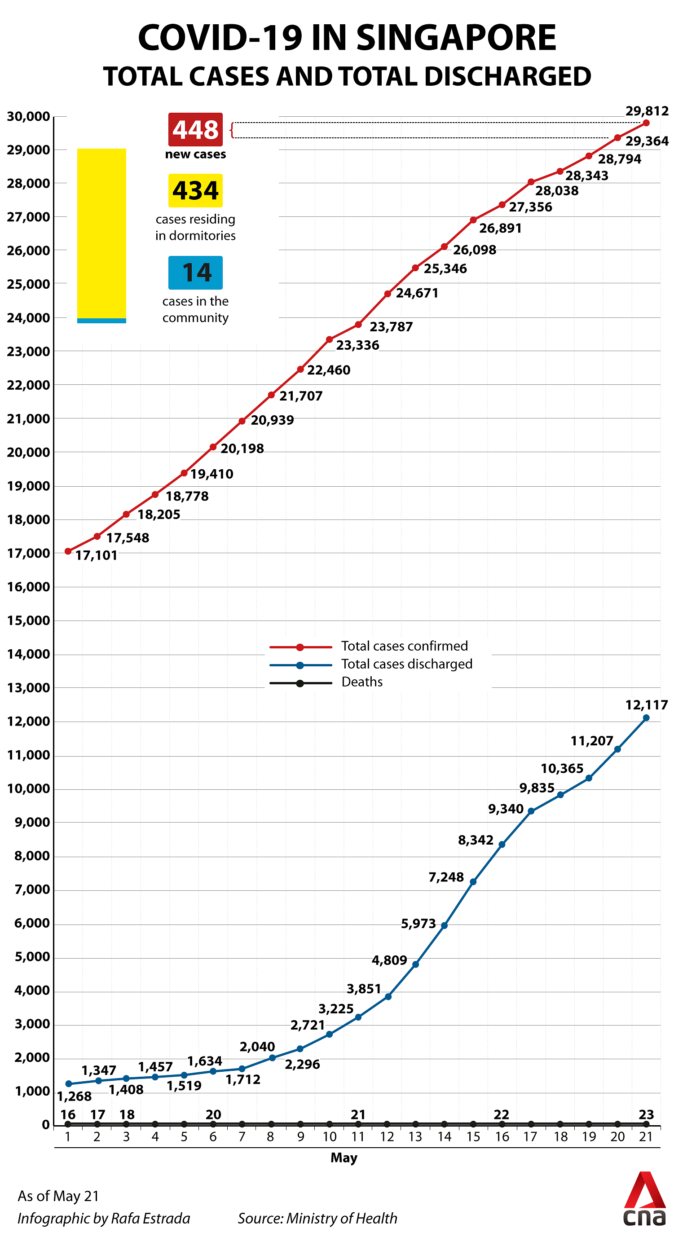
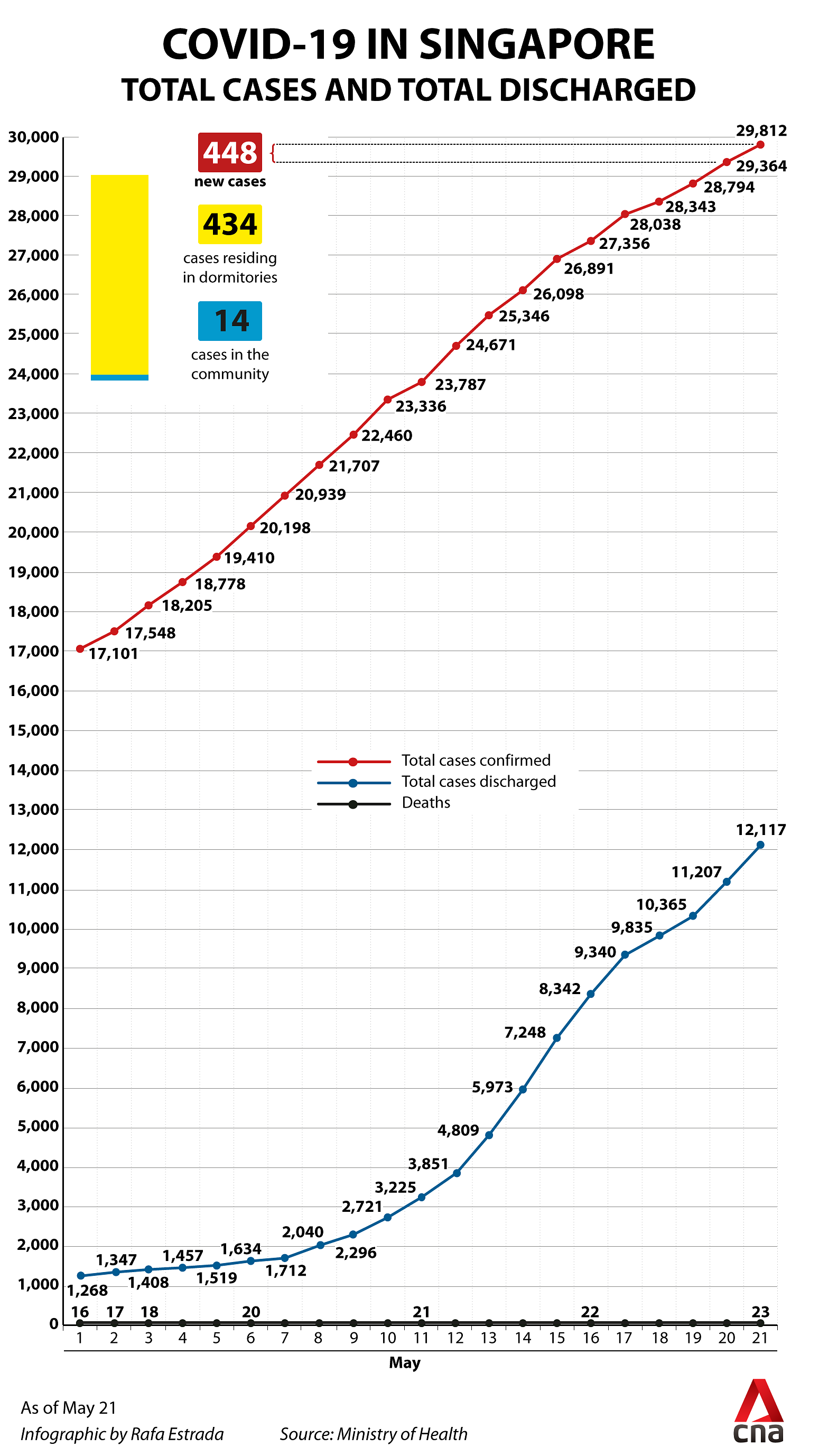
On Thursday, Singapore recorded its 23rd death from the coronavirus – a 73-year-old Singaporean man with a history of hypertension, hyperlipidaemia and hypothyroidism.
It also reported 448 new cases on Thursday, taking the total number of infections to 29,812.
Three of the new cases are pre-school staff, who were also confirmed via the ministry’s active testing regimes.
Four other patients are family members of a man who had gone to work at Cochrane Lodge II dormitory in Admiralty, a cluster with 394 confirmed cases.
Another 910 COVID-19 patients have been discharged from hospitals or community isolation facilities, taking the total number of recovered patients to 12,117.