The area is currently cordoned off, with police at the scene.
Source link
Concrete structure outside Tampines HDB unit gives way
Changi soars online but Facebook has ID crisis
Facebook user Danny Morgan Lin Yu is passionate, greatly values his downtime with friends, loves travelling, lives in Britain, and speaks Italian and English, according to his Facebook page.
He describes his strongest beliefs as “hope, faith and confidence”. There is a profile photo that looks professionally shot, and he has been adding more and more friends in recent weeks.
Problem is, “Danny” is not who he claims he is. Whoever he or she may be is impersonating Facebook user Terence Quek, one of the founding members of Project Happy Feet, a non-profit group that provides footwear, schooling and job training for poor children.
The identity thief “cloned” Mr Quek’s account, copying over all the publicly available information about him, including his profile picture and photos.
Mr Quek, the chief executive of a consultancy firm, told The Sunday Times a friend first alerted him to the imposter a week ago. Surprised and annoyed, he immediately went to Danny’s page and reported it to Facebook.
“This was not the first time it had happened to me,” he said.
Under its terms and conditions, the social network does not allow imposter accounts. It asks victims of identity theft to report the account or file a form, should they not have an account.
But things did not go as planned for Mr Quek. The Facebook team which reviewed the complaint told him that the fake profile had not violated community standards, and so it remained.
Even worse, Facebook disabled Mr Quek’s account for “pretending to be someone else”, he said.
To prove that he was who he said he was, Mr Quek, a Facebook member since 2007, would need to supply the tech giant with a government-issued identification card. Over the next few days, Mr Quek sent in photos of his driver’s licence as well as his passport page.
At one point, he even had to take a photo of himself holding up the documentary proof.
Mr Quek, 41, also mobilised his 4,300 Facebook friends to help out and report Danny’s mischief. More than 100 responded within the next 24 hours.
He eventually regained control of his account. “It was a frustrating experience,” he said. “But crowdsourcing for help from friends worked for me.”
While Mr Quek’s ordeal passed fairly quickly, there are thousands of others who might not be so lucky and end up having to fight a protracted battle for their identity.
So why do scammers bother to impersonate strangers?
One possible reason is that there’s money in it.
Mr Quek’s first encounter with an impersonator was in June. A female Facebook user he did not know was fooled and sent money to the person pretending to be him.
He found out only after the woman contacted him to complain. “Unfortunately, there wasn’t much I could do for her,” Mr Quek said.
Some identity thieves even use the victim’s exact name and birthday, in order to appear legitimate.
They might also block or report the victim first, in hopes that Facebook might suspend the genuine account or make it harder for the victim to report them.
From there, the con artists start “work” by seeking out other users.
To be fair, the social media giant is aware of the problem and is actively clamping down on impersonators.
Earlier this year, it announced that it would notify users if new profiles might seem too similar to existing ones. Profiles that have been reported would also be manually reviewed by a team.
But with millions of users joining every month, it is an increasingly challenging task.
Social media users can protect themselves by being circumspect with the information they put out and ensuring their privacy settings are up to date.
The Changi Experience Online
It started off as an innocuous thread on Reddit, but led to a pat on the back for Changi Airport.
Last week, Reddit user jullia321 posted a question asking pilots and flight attendants which airports they loved or hated.
It was probably little surprise that the name of Changi Airport – voted World’s Best Airport in a Skytrax survey earlier this year – came up.
“Changi is like a major shopping and entertainment complex that just happens to have an airport attached to it. Amazing place,” said one user. “Singapore airport has got to be one of the best in the world. Arcade, movie theatre, gym, best place for long layovers,” said another.
One of the top posts in the thread, which garnered close to 3,000 “upvotes”, was a list of amenities and services available to travellers at Changi.
The thread was reported by alternative news site Mothership.sg, and shared by Minister for Social and Family Development Tan Chuan-Jin.
Mr Ivan Tan, senior vice-president of corporate communications at Changi Airport Group (CAG), said the team was pleasantly surprised by the attention. Social media is an important part of CAG’s communications strategy, he added, as it allows them to monitor what’s being said about the airport.
“As an example, through feedback received through various channels, we have introduced charging points for mobile devices.”
It has also been busy producing content to serve its followers on its various social media accounts.
It routinely live-streams events which might appeal to its nearly 1.4 million Facebook followers.
The first live video, posted in April, was a war dance by the Fiji Rugby Sevens Team in Terminal 3.
More recently, it also streamed the arrivals of Olympic swimmer Joseph Schooling in August and the national Paralympian team last week.
Apart from its Facebook page, the airport has a presence on platforms such as Twitter, Instagram and LinkedIn.

This article was first published on September 25, 2016.
Get a copy of The Straits Times or go to straitstimes.com for more stories.
Image:

Publication Date:
Monday, September 26, 2016 – 06:00
Keywords:
Send to mobile app:
Source:
Story Type:
Others
Dancing Queen
When wheelchair-bound Ms Julie Chong dances on stage, she has a specific aim.
Through her turns and swivels, the 41-year-old IT professional wants to make the wheelchair she’s sitting on disappear.
Ms Chong tells The New Paper on Sunday: “The wheelchair has to become a part of you, so that when you dance, it’s not a glaring thing.
“With dance, the audience sees the person as more than just a person in a chair.”
Despite suffering from brittle bone disease, in which a person has fragile bones that break easily, Ms Chong has been making a name for herself as a dancer.
She has performed at ticketed events at the Esplanade and Marina Bay Sands and even danced with local celebrities.
A workshop she attended in 2001 sparked her interest in wheelchair dancing, but Ms Chong started dancing regularly only three years later.
“What appealed to me most was that one can negate the view of looking clumsy in a wheelchair. It’s possible to look graceful too,” she says.
Ms Chong focuses on Latin-ballroom dancing, where she dances with a partner who is standing up.
Coordination between the two partners involves a lot of communication, and Ms Chong says that can be a challenge.
“They have to be mindful of their own footwork and coordinate their steps for us,” says Ms Chong.
“Not only do we have to know how to control our chairs, dancing with a standing partner requires an understanding and trust with each other.”
Her best dancing partner is also her partner in life.
Ms Chong’s able-bodied husband, teacher Andy Ang, 46, says he enjoys performing with her because it is something that always “makes us happy”.
Says Mr Ang: “It’s different because the person in the wheelchair looks to the one standing to take the lead.
“But holding hands and doing the steps together, it’s all about that strength and connection.”
When asked about the achievements of para-swimmers Yip Pin Xiu, Theresa Goh and the other Team Singapore paralympians who made the rounds yesterday (See Page 3), Ms Chong speaks excitedly about how proud she is.
“What everyone sees is the result, but some of us in the community have known them since they were young,” she says.
Grow
“Seeing them grow into their sport and achieve so much makes me happy and proud.
“They might not be physically strong but mentally, they are giants.”
Wheelchair dancing is also a paralympic sport. The first world championship took place in Japan in 1998 – the year the sport came under the management of the International Paralympic Committee.
When asked if she dreams of being a paralympian, Ms Chong laughs and says she still wants to train and be good enough to join competition.
What she does hope for is a more inclusive community for people with special needs.
Ms Chong says: “There’s a lot being done for us, but there can always be more.
“An underlying support system must be in place to help disabled people in doing whatever they want to do.
“If people see the value in us, we can be (more than) paralympians. There can be people like us who can be world-renowned scientists, writers and painters too.”

This article was first published on September 25, 2016.
Get The New Paper for more stories.
Image:

Publication Date:
Sunday, September 25, 2016 – 21:00
Keywords:
Send to mobile app:
Source:
Story Type:
Others
Asia scoops top honours at San Sebastian film festival

SAN SEBASTIAN, Spain – Asian cinema dominated awards at the San Sebastian film festival, with veteran Chinese director Feng Xiaogang’s “I am not Madame Bovary” taking the top Golden Shell prize while Fan Bingbing won the best actress gong for her role in the same film.
In the satirical comedy, Chinese star Fan plays a cafe owner caught in the bureaucratic maze of the Chinese legal system after she is swindled by her ex-husband.
It had attracted attention earlier this month at the Toronto film festival where it won the International Federation of Film Critics’ prize, with the jury hailing “its ambitious rendering of a woman’s Kafkaesque struggle as she takes on the Chinese legal system”.


Among the other awards Saturday, prolific South Korean filmmaker Hong Sang-Soo won ‘best director’ for his comedy “Yourself and Yours” about the adventures of a painter seeking to win back his girlfriend, a woman who while drinking tends to forget her flirtations.
Spanish actor Eduard Fernandez took home the best actor Silver Shell for his role in “Smoke and Mirrors”, about a real-life a Spanish spy, Francisco Paesa.
The festival’s “Latin Horizons” section on Latin American film honoured Chilean director Pepa San Martin’s first feature “Rara” about the struggle of a lesbian judge who loses custody of her daughters because of her sexual orientation.
The 64th edition of the festival held in the northern Spanish seaside resort saw 17 films in competition from China, Spain, Argentina, Chile, France, Britain, the US, Sweden, Iceland, Poland, South Korea and Japan.
Image:

Publication Date:
Sunday, September 25, 2016 – 16:01
Keywords:
Send to mobile app:
Source:
Story Type:
Others
ESM Goh to make 4-day visit to Astana
ESM Goh Chok Tong’s visit is at the invitation of Kazakh president Nursultan Nazarbayev, says MFA. This will be ESM Goh’s first visit to the country, added MFA.
Source link
The woman who lost everything but found herself
Up on the 18th floor of an HDB block in Marine Crescent is a unit which its owner has named The Bliss Loft.
The living room is uncluttered, and if you look out of the window, you see the sea. A smiling Buddha statue sits in a corner. On the coffee table, there are Tibetan prayer bells and a vase filled with, among other varieties, heliconia and sunflower.
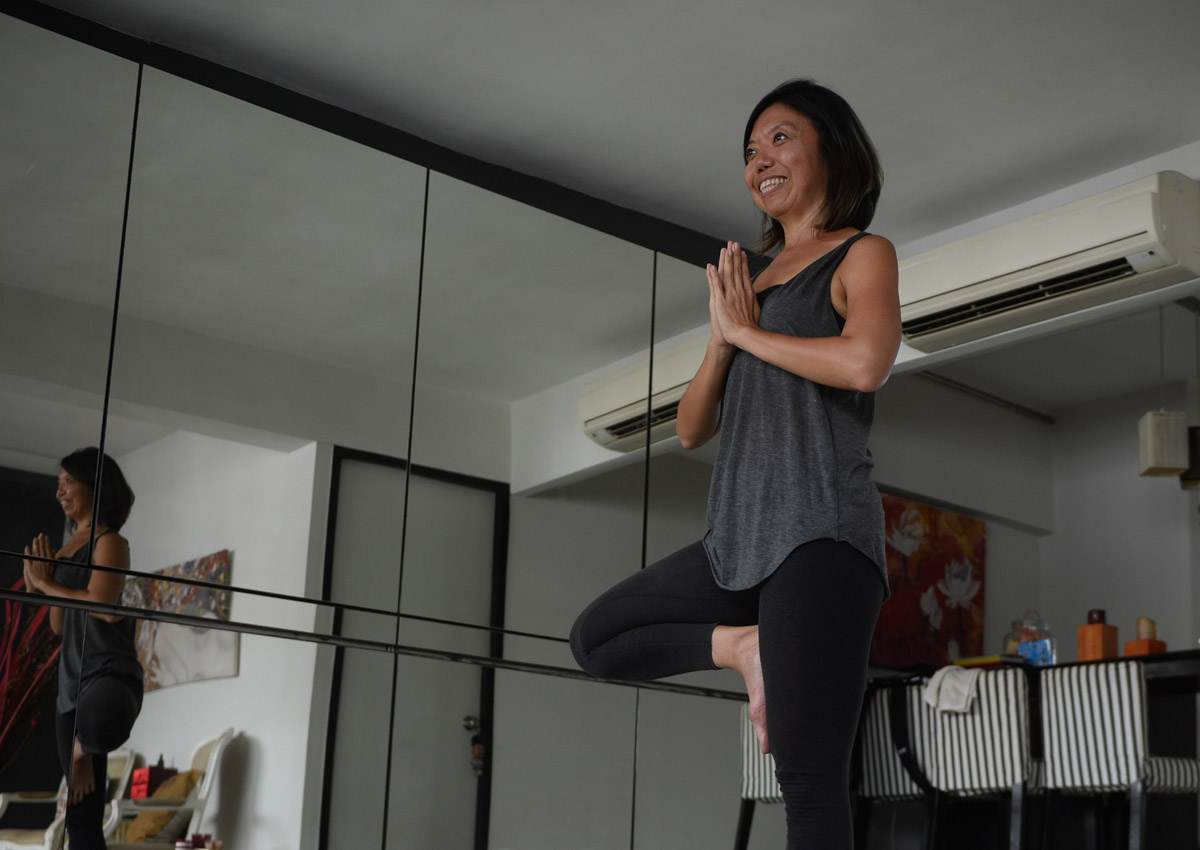
Ms Anthea Ong, who lives here, is a free spirit. She teaches yoga, hugs a tree every week, is vegan and can meditate for more than two hours. Do not, however, write her off as a loopy hippie.
She was a corporate high-flier and a technopreneur. Her last job, which she left three years ago, was as managing director of an international consultancy which paid her more than $400,000 a year.
A series of events led her to junk the corporate world for a life of yoga teaching, life coaching and volunteerism.
The 48-year-old pats the couch she is sitting on. Some eight years ago, she says, she had lain on that same couch, overwhelmed by a sense of hopelessness, despair and barrenness. An acrimonious divorce and a failed business had taken the wind out of her sails.
“That same day I checked my bank balance. I had only $16 to my name,” she says. “But I also realised then that I was still alive and breathing. At the point when I completely lost everything, I also found out what I truly am about.” Hers has been quite the journey.
She is the second of three children. Her father became a taxi driver after losing his construction company. Her mother is a housewife.
Her early years were spent in Toh Yi Drive off Bukit Timah where her grandparents lived with their rather sizeable brood on a big piece of land filled with fruit trees and vegetable plots. Because she was born with a squint in both eyes, she was subjected to a lot of taunting by adults as well as children.
Some of her relatives thought she was mentally challenged and called her “sampat”, which means halfwit in Hokkien. They stopped doing so only when she started going to school and topped her class every year.
“The taunting gave me a complex but I also developed a very driven personality,” says Ms Ong, whose family moved into their own three-room flat in Ang Mo Kio when she was 10.
To teachers and fellow students at Cedar Girls’ Secondary and National Junior College, she was a confident self-starter, solid both in her studies and extra-curricular activities.
“But I had a deep sense of insecurity about my appearance. I even fabricated stories about having a boyfriend. Super loser, right?” says Ms Ong, covering her face with her hands to feign embarrassment.
She read business at the National University of Singapore and, upon graduating, joined United Overseas Bank where she got into corporate banking. In no time, she was acing her Institute of Banking and Finance courses and tests.
Despite being on the fast track, she felt restless and quit after just four years. “I remember looking at the levels in the op charts. Although I was getting promoted every year, there were 12 levels. I told myself, ‘no lah’,” she says.
“I was also angsty and wanted to travel. I told myself I was going to get out of this big ocean where I was a little fish and be a bigger fish in a smaller pond.”
She joined a conference organiser AiC, which later became Terrapinn.
“As conference manager, my job was to create conferences and events so I had to read the trends and know what the next big thing was going to be.”
“The job exposed me to a lot of sectors, from disaster recovery to theme parks to credit cards. I was paid a basic salary and a huge profit share. Essentially, I was running a business because I was looking at marketing, venue, creation of content.”
By 25, she was already general manager earning a five-figure salary. Barely a couple of years later, she was made managing director of the office in Indonesia.
Her smarts earned her the attention of the company’s founder who got her over to Sydney – where she was based for two years – to start a new business in financial training.
Not long after, she helped to negotiate a partnership with the New York Institute of Finance, and became the managing director of this new set-up in Singapore in 1997. The Middle East and Asia-Pacific later came under her purview too.
When there was a corporate reshuffle three years later, she took a redundancy deal to the tune of a whole year’s salary, as well as a $25,000 outplacement package. It did not take her long to find another job as managing director of an e-learning outfit.
Her career was going great guns but her love life was less than ideal. Although correcting her squint at 30 did wonders for her self-esteem, she still nursed a chip over her attractiveness.
A relationship went south after eight years. “We are very good friends now but when we broke up, he said, ‘Anthea, I will never be the boyfriend you have in your head’,” she recalls with a sigh.
In 2002, she decided to take on the world by becoming a technopreneur. With a former classmate from university, she set up e-learning company Knowledge Director.
It was a bold move for a 34-year-old who had no computer background, and who was already making more than $20,000 a month.
But she had a lot of faith that her product learningDirector – a user-friendly Web-based app for creating e-learning content and games – would propel her into the big league.
“I invested $50,000 and didn’t draw a salary for four years. If you’re talking about opportunity costs, it probably cost me $1 million,” says Ms Ong, who had a two-storey office in Joo Chiat and a team of more than 15 people.
The product won an award from Innovators and Entrepreneurs Association and the company was soon counting the likes of Citibank and Singapore Power as clients.
Ms Ong was en route to the big league when she negotiated a deal with an international computer giant to have the product embedded in one of its software programs.
“It was a 50-page contract,” she says.
Life was made sweeter when, through a friend, she met an American e-learning consultant and married him after just seven months in 2004. But things fell apart when she went to Bali to celebrate her wedding anniversary on the weekend just before the launch of her collaboration with the Internet giant.
Due to a technical oversight, the product was loaded on an unsecured website. The Internet giant found out and the deal – with potential earnings worth millions – fell apart. “Overnight, we went into the dungeons,” she says.
To pick up the pieces, Ms Ong decided to switch tack, and go from e-learning to educational consulting. She managed to bag three high-profile education transformation projects – using technology to boost learning in classrooms – in Singapore, Taipei and Kaohsiung.
“I thought we were starting to turn around. But as life would have it, I discovered my husband’s infidelity,” she says. “The night I found out, I thought I was actually having a heart attack.”
It took more than a year before she mustered the strength to walk out of the marriage.
“I was trying to deal with my own issues. I was making excuses: ‘I couldn’t see myself coming out of the marriage; maybe it was a one-off; maybe he will change.’ “
But when she finally filed for divorce, her ex-husband responded with six legal suits against her company, all served on special occasions such as her birthday.
It took more than a year, several court appearances and tens of thousands of dollars before her legal troubles were over.
“I was barren and in despair, very displaced. It affected the way I was running the business,” says Ms Ong, who was forced to call it a day in 2008 after a creditor sued to have Knowledge Director wound up.
What saved her and changed her life, she says, was yoga.
In 2006, she started learning ashtanga yoga – which included lessons in breathing and meditation – at Ananda Marga Yoga Society of Singapore.
“I believe I did not go into a downward spiral because I was practising every day. The only time I felt sane was when I was practising.”
Then came that fateful day when she was lying on her sofa with the realisation she had only $16 to her name. “I was feeling that deep sense of loss of self.
I was attached to my identities as married woman, high achiever, innovator, and then I realised I was not defined by all those things and I was so much more than that.”
It marked the start of her recovery. She took on corporate social responsibility projects and started volunteering with the likes of Very Special Arts, a charity which provides arts and education programmes for people with disabilities, and served in various organisations including Unifem and Wings (Women’s Initiative for Ageing Successfully), where she was president for two terms.
In 2008, she decided to rejoin the corporate sector and became managing director of Omega Performance, an international consulting group for banks and financial institutions. “Before I got on board, I told them the job would just be one-third of my life.
The other two-thirds I would give to service to humanity, and self-development,” says Ms Ong.
She got her mojo back in the corporate world, and was amply rewarded for what she did. She also travelled extensively (she has scaled all the “holy mountains” on her bucket list, including Mt Sinai and Machu Picchu) and got herself certified as a micro-finance trainer and a life coach.
She founded a string of community-driven initiatives, including Project Yoga-on-Wheels – yoga for the underprivileged and disadvantaged; Playground of Joy – educating children through yoga, mindfulness and play; and Circle of Bliss, which holds weekly community meditation sessions.
“I’m not an accolade collector, okay? I just wanted to learn, it’s interesting lah,” says Ms Ong, who gave up alcohol, cigarettes and her car and became a vegan.
After more than five years, she decided to leave the corporate world.
“I can live with very little now. I’ve survived with just $16. What else can scare me?”
She now makes a living as a life coach. Two years ago, the husky-voiced woman set up Hush, a social enterprise which hires deaf servers to guide participants through tea sessions which encourage mindfulness and self-reflection.
The venture – which recently received a grant from The Singapore Centre for Social Enterprise (raiSE) – now conducts about three sessions each month for corporations and has about 30 trained tea servers on its roster.
Meanwhile, she is content to follow her heart and go where her spirit takes her.
“My biggest wish is that with my experience and the skills that I have, I’m able to support other people who are struggling and tumbling and help them see the goodness and strength in themselves.”
Social entrepreneur Saleemah Ismail, 47, has known Ms Ong for a long time. “She was a person who used to mask her insecurities by being bossy and getting people to do her bidding. But Anthea has undergone a transformation.”
“She now listens and emanates silent love.”
Ms Ong knows people laugh at her for being such a multi-hyphenate.
“The human experience is a multi-dimensional one. Who says we must have that one job?”
kimhoh@sph.com.sg
Image:
Publication Date:
Sunday, September 25, 2016 – 17:00
Keywords:
Send to mobile app:
Source:
Story Type:
Others
Easing back for more success

Water is where swimmer Joseph Schooling reigns supreme. But right now, the pool is the last place he wants to be.
Following his historic Olympic gold at the Rio de Janeiro Games last month, the 21-year-old has since made no secret of his next major target – to break the 100m butterfly world record of 49.82sec.
But when The Sunday Times asked what his plan to achieve this next step is, he said: “I’m not ready to be talking about racing again.
“Just the thought of getting up and going into a race sounds horrible to me right now.”
Surprising words, from someone who could not get enough of the water when he was a young boy, even waking his dad Colin up at 4am to go swimming – during his holidays in Malaysia.
Yet, as he assumes the role of a reigning Olympic champion, he has grown to understand the long, arduous process that makes him one.
He said in a phone interview: “I just went through a stressful summer at the Olympics and I’m not ready to be back at 100 per cent yet – and I don’t need to be, which is the good part.
“I’m not badly out of shape, and I’m ahead of where I was last year when I started training for the Olympics.”
Click on thumbnail to view photos. Source:
The Straits Times, Reuters, AFP













































Comparing his current state of fitness to that after last year’s World Championships, in which he clinched a bronze in the same race, Schooling said: “It took me a while to get back into shape (then). This time I took about the same time off, if not less, and surprisingly, I feel fine.
“Maybe I’m stronger because I’ve got more training behind me and having a good base always helps.”
And so, the boy who never wanted to leave the water is now a man who takes a firmer control of his own training.
While he previously let coach Eddie Reese take full rein over his training, Schooling said he now “fights” the University of Texas swimming coach on occasion.
“Eddie’s pushing for me to take it back to the water and do morning practice, but I’m not going to do that because I swam a month ago, while these kids have had the whole summer off,” he said.
“So I’ve had to ‘fight’ Eddie on this sometimes, but it’s good because we check each other.”
Far from being disrespectful or lazy, however, the economics major explained that it is simply a matter of understanding his own body.
Hundreds give Joseph Schooling triumphant homecoming at Changi Airport
Click on thumbnail to view photos. Source:
The Straits Times, AFP, Reuters, The New Paper, Hannah Alkaff, Lianhe Zaobao, AsiaOne




























































“It’s all about maturing, gaining experience and knowing how your body and mind feel. Everything is a steady process,” he said.
Even as Schooling speaks of wanting to ease back into training and “trying to take the rest of September as easy as I can”, the desire to break the world record remains immense.
Still, the Straits Times’ Star of the Month for August stressed that he is in no hurry to approach the task with “a 100 per cent effort”.
He said: “If I step on the gas right now, it’s not going to be good. If I start pounding away again, it’s going to be harder to do better in Tokyo in 2020.”
Besides the world record, he is also targeting more events at the 2020 Tokyo Games.
Now training once a day for six days a week, Schooling does not know when he will ramp up the frequency of his training yet, but is confident he is on track.
“I know what I need to do; I know how I’m feeling now and I know how it’s going to play out at the end of the year,” he said.
“So I’m taking all the necessary steps I need right now to have fun and forget about swimming, but also stay in shape so that when I’m ready to come back full force, I’ll just have to flip a switch – that’s what I’m conditioning myself to do.”
Highlights from Olympics 2016
Click on thumbnail to view photos. Source:
AFP, Reuters, The Straits Times













































































6.jpg)























This article was first published on September 25, 2016.
Get a copy of The Straits Times or go to straitstimes.com for more stories.
Image:

Publication Date:
Sunday, September 25, 2016 – 17:00
Keywords:
Send to mobile app:
Source:
Story Type:
Others
Tennis: Wozniacki ends title wait with Tokyo victory

TOKYO – Former world number one Caroline Wozniacki overpowered Japan’s Naomi Osaka 7-5, 6-3 to capture the Pan Pacific Open on Sunday, her first tournament victory since February 2015.
The Dane, who has battled back from a wretched run of injuries this year, weathered an early storm from her teenage opponent before running out a comfortable winner, claiming a second Tokyo title and the 24th of her career.
Wozniacki, the Pan Pacific champion six years ago, survived another health scare after dropping serve to go down 4-3 in the first set.
After feeling a twinge in her left thigh, she left the court to undergo treatment and returned with her leg heavily bandaged.
But it appeared to have little adverse effect as Wozniacki took complete control, ripping a backhand down the line to take the set.
Wozniacki, who reached the US Open semi-finals earlier this month to signal her return to form, roared into a 5-0 lead in the second as Osaka’s game unravelled in the Tokyo sunshine.
Playing with the roof open after a week of typhoon rains, Osaka paid for her youthful exuberance, her strategy of attempting to hit the fur off the ball on every shot backfiring badly against a vastly more experienced opponent.
The 18-year-old, who called a medical timeout of her own for a sore right shoulder after losing the first set, produced spirited late resistance to avoid the dreaded ‘bagel’ but it was too little too late.
Wozniacki, who had seen her world ranking plunge to 74th after suffering wrist and ankle injuries, completed victory with a crisp backhand which forced Osaka into yet another wild shot, giving the 26-year-old her first title since Kuala Lumpur last year.
The Dane also maintained her record of having won a tournament every year since 2008 and is set to climb to 22 or 23 in the rankings.
Osaka, born of a Japanese mother and Haitian father, broke into the top 50 after her fairytale run.
Image:

Publication Date:
Sunday, September 25, 2016 – 14:52
Keywords:
Send to mobile app:
Source:
Story Type:
Others
Wanted: Feedback for war on diabetes
How do you motivate people to eat properly, exercise regularly, watch their weight and stay healthy?
These are the questions that the Diabetes Prevention and Care Taskforce hopes to answer through a six-month crowdsourcing exercise that was launched yesterday.
It is the next step in the “war on diabetes” declared by Health Minister Gan Kim Yong in April. Feedback from the exercise will go into an action plan that the ministry will roll out in stages next year.
Mr Gan, who heads the 16-member task force with Acting Minister for Education (Schools) Ng Chee Meng, stressed the importance of arresting the spread of diabetes.
“Diabetes can lead to serious complications, such as stroke, heart attack, kidney failure and lower limb amputations,” he said.
“Today, there are about 400,000 Singaporeans with diabetes… By 2050, about one million Singaporeans will have diabetes if nothing is done.”
From now until December, the task force will look at the factors stopping people from leading a healthy lifestyle. In the first two months of next year, it will seek more detailed feedback on the earlier suggestions.
Apart from reaching out to regular Singaporeans, the task force will speak to representatives from the food-and-beverage industry, academia and non-governmental organisations.
Supporting the task force will be three workgroups, which will offer strategies to get people to live healthier, help existing diabetics manage their condition, and raise public awareness of the chronic disease.
But getting different segments of the community to adopt healthy behaviour can be difficult, said Speaker of Parliament Halimah Yacob, who is part of the task force.
She recounted how during a food-distribution exercise for needy residents earlier this month, most opted for white rice despite being given the option of healthier brown rice.
“They are mostly senior citizens, and they’ve grown up eating white rice – that’s the only thing they know,” said Madam Halimah.
Making sure that people have easy access to healthier options is also critical, she added.
“You go to the hawker centre and the food is mostly oily, salty or very sweet,” she said. “Are there alternatives that people can consume so they can eat healthily?”
Endocrinologist Ben Ng of Arden Endocrinology Specialist Clinic said the trick is to help people make changes that they can continue with in the long term.
“The secret is to make sustainable changes that start at the family level,” Dr Ng said.
“Simple things like getting the family to exercise together, for example, by making it part of family time.”
This article was first published on September 25, 2016.
Get a copy of The Straits Times or go to straitstimes.com for more stories.
Image:

Publication Date:
Sunday, September 25, 2016 – 17:00
Keywords:
Send to mobile app:
Source:
Story Type:
Others
She became Singapore's No. 1 fencer despite hearing disability
She has not only tackled the stigma and frustrations of having hearing impairment since young, but has also literally fought her way to the top.
Meet Zhao Hui, who became Singapore’s Number 1 fencer at the tender age of 15, despite being born with the condition.
The inspiring tale of the woman, now in her adult years, was told in a short video uploaded on We Are Majulah Facebook page, which is a movement that aims to foster a stronger sense of national identity and harmony through mutual understanding and compassion.
In the clip, Zhao talks spiritedly about the frustrations she faces in everyday situations, as well as those in the sporting arena.
Even with a hearing aid, talking over the phone is like “trying to read a book without glasses when you’re short-sighted”, she surmised.
On the obstacles encountered in fencing, she highlighted the protective mask that often constricted her view and the occasions when some referees forgot to use hand language and relied only on their voices instead.
But Zhao was determined to focus on her cut and thrust, and emerged victorious in the end.
After the matches, her opponents were surprised to find that she is hearing impaired and communicates by lip reading. They were impressed with her fencing accomplishment – so are we.
We Are Majulah has collaborated with ConnexionSG to feature people such as Zhao, who are commonly misunderstood in society. The video is the second of a six-parter called ‘The Misunderstood Series’.
Produced by Storyteller Productions, the video was also uploaded on YouTube.
A tribute to Zhao can be seen in We Are Majulah’s post on its Facebook page: Disabilities may slow you down, but they cannot defeat you, not with a heart like Zhao Hui’s.
chenj@sph.com.sg
Image:

Publication Date:
Sunday, September 25, 2016 – 14:25
Keywords:
Send to mobile app:
Source:
Story Type:
Rewritten Story


