Home Blog Page 2715

In Japan, young women are tricked and forced to appear in adult videos

0

TOKYO – Sexual violence targeting young women is a serious problem, with victims being forced into appearing in adult videos or falling prey to the so-called “high school girl business.”

Things get even worse for victims when these videos are released online, and many suffer in silence. This new series addresses the reality that these women face and support measures available to them. This is the first instalment of the series.

“I was tricked by a production company into appearing in an adult video,” said a 26-year-old woman living in the Kanto region. The woman was a college senior in the summer of 2012 when she was approached in Tokyo by a man who claimed to be searching for glamour models for publications.

Her dream at the time was to become a singer and the man told her, “If you appear in a swimsuit, I’ll let you debut in the music world.”

The woman was introduced to the president of an entertainment agency, and was persuaded to sign a contract stipulating her affiliation with the agency. But she was not given enough time to read it carefully, nor provided with a copy.

What the woman had been told was a swimsuit shoot turned out to be a nude one. People in the agency, including the president, told her, “If you don’t appear in an adult video, there will be no more work for you,” and “If you participate, you’ll be able to succeed in show business.”

“At the office, I was surrounded by five or six men all trying to persuade me. I was almost being brainwashed,” she recalled.

The woman once broke down in tears during the filming of an adult video, forcing the shoot to a halt. She was then threatened by staff who told her: “The staff here have families, too. Can you handle that responsibility?”

The woman appeared in a second video, but before she received payment, she was told the company had gone bankrupt. “I wasn’t even able to contact them.” The video can still be found on the internet.

Cases of young women being bullied into appearing in adult videos are on the rise. They are often lured by the promise of modeling work, and end up being forced to appear in adult videos after signing contracts they do not understand. They may be charged heavy penalties for breach of contract if they refuse. In some cases, talent agencies even threaten to tell the women’s parents about the videos.

The nonprofit organisation Lighthouse: Center for Human Trafficking Victims, which provides support to victims, had only one reported case in 2013. However, this number rose to 36 in 2014, 62 in 2015, and 74 by the end of August this year.

According to Aiki Segawa, a staff member at the organisation, the victims are mainly women from the ages of 18 to 25, who have little life experience.

“Forcing someone to perform a sexual act and then releasing the video to the public is a severe violation of human rights,” Segawa said. Victims struggle with post-traumatic stress disorder and some have even committed suicide.

With free videos flooding the internet, some claim that businesses in the adult video industry are forcing women to appear so they can produce more new videos at lower costs.

“Victims are beginning to speak out, but many may still be suffering in silence,” said Segawa.

The widespread use of the internet makes the situation even more grave for victims. Support groups have been hearing such reports as “The video shot a few years ago is still online,” and “I don’t want the video to be discovered by my family or boyfriend.”

These groups are urging businesses and website managers in the industry to suspend sales and delete video content, but in reality, once released online, videos are difficult to completely eliminate.

In June, the former president of a Tokyo entertainment talent agency was arrested by the Metropolitan Police Department on suspicion of violating the Temporary Staffing Services Law, after dispatching one of the agency’s models to an adult video shoot against her will.

The model was forced to appear in such a video and perform acts including sexual intercourse, and the police judged that this fell under the law’s definition of hazardous work.

Some businesses in the industry have tried to evade the application of the law by having women work as contractors or other designations, instead of entering into direct employment contracts. The law banning child pornography limits its scope to people under 18.

“We need legislation stipulating such measures as banning unfair solicitation and suspending sales of these videos,” said Kazuko Ito, a lawyer and secretary general of the nongovernmental organisation Human Rights Now.

In June, the Cabinet approved a written answer stating that forced filming of adult videos constitutes violence against women.

“We will ascertain the situation and seek such measures as creating a system that makes it easy for victims to report cases and have consultations,” an official of the Cabinet Office’s violence prevention office said.

Courage needed to consult

Setsuko Miyamoto, a member of the citizens’ group People Against Pornography and Sexual Violence, warned people to “be aware of the grave cases of victimization and not enter into any contract without due consideration.”

Contracts provided by companies, including entertainment talent agencies, are generally hard to understand. There are a conspicuous number of cases in which victims were forced to sign contracts without being told their work included appearing in adult videos.

If victims who are forced into filming after signing a contract get in touch with support organisations, they can receive assistance in negotiating with the talent agencies.

“While many victims blame themselves, this is not something you should face alone. Have the courage to come forward and talk to us,” said Miyamoto.


Image: 
Category: 
Publication Date: 
Sunday, October 2, 2016 – 14:41
Keywords: 
Send to mobile app: 
Source: 


Story Type: 
Others

Source link

Lift upgrading no longer a hot-button issue

0

A decade ago, Housing Board lifts were making headlines. Tempers flew, but the problem was not with existing lifts. Rather, it was over lifts yet to be built.

In the early to mid-2000s, lifts were a hot political topic, thanks to the Housing Board’s $5 billion Lift Upgrading Programme (LUP).

The scheme was for blocks built before 1990, which did not have lifts that stopped at every floor.

At its inception in 2001, the Government made it clear that the LUP was not free of political considerations – quite the opposite.

In announcing the LUP, then National Development Minister Mah Bow Tan said that “upgrading programmes are possible only because our people continue to support the Government” which generates budget surpluses.

“That is why… the Government has given priority to those who have actively supported these programmes,” he said.

Two months before the 2001 General Election in November, Mr Mah was more blunt: “It’s only fair that we give those constituencies that have given us support, higher priority.”

In the 2006 General Election, many People’s Action Party candidates made lift upgrading part of their campaign promises.

Opposition candidates protested at what they saw as the partisan use of a national scheme, with Workers’ Party (WP) leader Low Thia Khiang calling the politicisation of the LUP “immoral”.

A day before the May 6 general election, Mr Low said: “If they want to continue with the policy of upgrading using government funding to selectively reward PAP supporters, they are dividing Singapore.”

Yet, between that election and the next, the LUP’s political significance receded.

The Government abandoned its earlier stance that lift upgrading would be completed in all PAP wards first.

In 2009, it was announced that precincts in the opposition wards of Hougang and Potong Pasir would be selected for LUP, rather than be sent to the back of the queue.

By the 2011 elections, lift upgrading was no longer a hot-button issue. Indeed, when a leaflet by several PAP candidates claimed that the WP was against national upgrading programmes, WP candidate Gerald Giam publicly rebutted this.

Mr Giam said the WP “has never been against HDB upgrading programmes, especially the Lift Upgrading Programme”.

And when the Workers’ Party won Aljunied GRC in the 2011 elections, lift upgrading there proceeded as planned.

By the end of 2014, the scheme had benefited residents in more than 500,000 households, bringing lift access on every floor to 5,000 blocks, with at least one new lift in each upgraded block.

janiceh@sph.com.sg


This article was first published on October 02, 2016.
Get a copy of The Straits Times or go to straitstimes.com for more stories.

Image: 
Category: 
Publication Date: 
Sunday, October 2, 2016 – 15:00
Send to mobile app: 
Source: 


Story Type: 
Others

Source link

Swords and skewers at Thailand's gruesome vegetarian festival

0

PHUKET, Thailand – Swords, axe handles, kebab skewers and even a model boat were among the bizarre array of objects pushed through devotees’ cheeks on Sunday as southern Thailand’s gruesome vegetarian festival got under way.

Many Chinese communities across Southeast Asia go vegetarian this week for the annual Taoist “Nine Emperor Gods” festival but few do it with quite the gusto and shock factor of Phuket’s inhabitants.

Throughout the week devotees show their religious devotion through ritualistic self-mutilation and pain trials, including running over hot coals and piercing their bodies with an astonishing – and stomach-turning – variety of objects.

At a temple on the outskirts of Phuket’s main town on Sunday, dozens of people put themselves to the test.

Dressed in flowing robes they worked themselves into a trance-like frenzy against a constant backdrop of drums, a status they say allows them to feel no pain.

One man shook his head from side to side before another created a hole in his cheek with a large metal spike, watched over by medics.

The bowsprit of a large model boat was then threaded through the hole before he joined a parade through town to show off their new facial accessories.

“It’s an unforgettable experience,” 55-year-old Canadian tourist Barry Rafftery told AFP as he looked on. “I’m surprised by the lack of blood.” Fellow Canadian traveller Julie Bedford, 33, was taken aback by the scale of festival.

“I figured there might be a handful but everywhere you look people are getting their faces pierced.” The tropical island of Phuket – best known to holidaymakers for its parties and beaches – boasts a sizeable Chinese population, most of whom trace their roots back to Hokkien speaking areas of China’s southeast.

Local folklore has it that the island began celebrating the vegetarian festival en masse after 1825 when illness struck a visiting opera troupe from China.

The stricken troubadours adopted a vegetarian diet, paid homage to the Nine Emperor Gods and were miraculously cured.

The festival emphasises purification, embodied by the giving up of meat for nine days and dressing in white.

Participants must adhere to a series of strict rules throughout the festival – including abstinence from sex, drinking and gambling.

But what makes Phuket stand out from the crowd is the devotees who choose to self mutilate.

Later in the week, some also test their faith by running barefoot across burning coals or climbing bladed ladders.

A taxi driver, who gave his nickname Chang (Elephant), said he had no plans to skewer his body but he had been abiding by the abstinence rules.

“It has already brought me good luck,” he grinned. Last week, there was no work but yesterday I had many fares after praying to Lord Buddha.”

Image: 
Category: 
Publication Date: 
Sunday, October 2, 2016 – 14:36
Keywords: 
Send to mobile app: 
Source: 


Rotator Image: 
Hermes ID: 
2 638 767
Hermes ID String: 
VLVEG2
Hermes Author: 
GRONGLOH
Story Type: 
Others

Source link

What's up with HDB lifts?

0

When an elderly Housing Board resident lost a hand in a lift accident last October, it turned out to be the first in a spate of accidents that have plagued HDB lifts over the last year.

Madam Khoo Bee Hua, then 85, had stepped into her lift in Jurong and pressed the lift button without realising that her dog was outside – while she was still holding its leash. As the lift rose, her hand is believed to have been pulled through a gap in the doors.

The worst of the incidents since then came this May when Mr Lim Hang Chiang, 77, died when his mobility scooter fell over while backing out of a lift that was not level with the ground floor.

Since then, the authorities have stepped up audits of lifts, and completed the first phase of a lift regulations review which began in 2014.

The latest move is a $450 million Lift Enhancement Programme (LEP) announced last month, under which the HDB will give town councils around 90 per cent of the funding required to modernise lifts of up to 18 years of age, by installing recommended safety features. Town councils will have to chip in the remainder.

The scheme is voluntary.

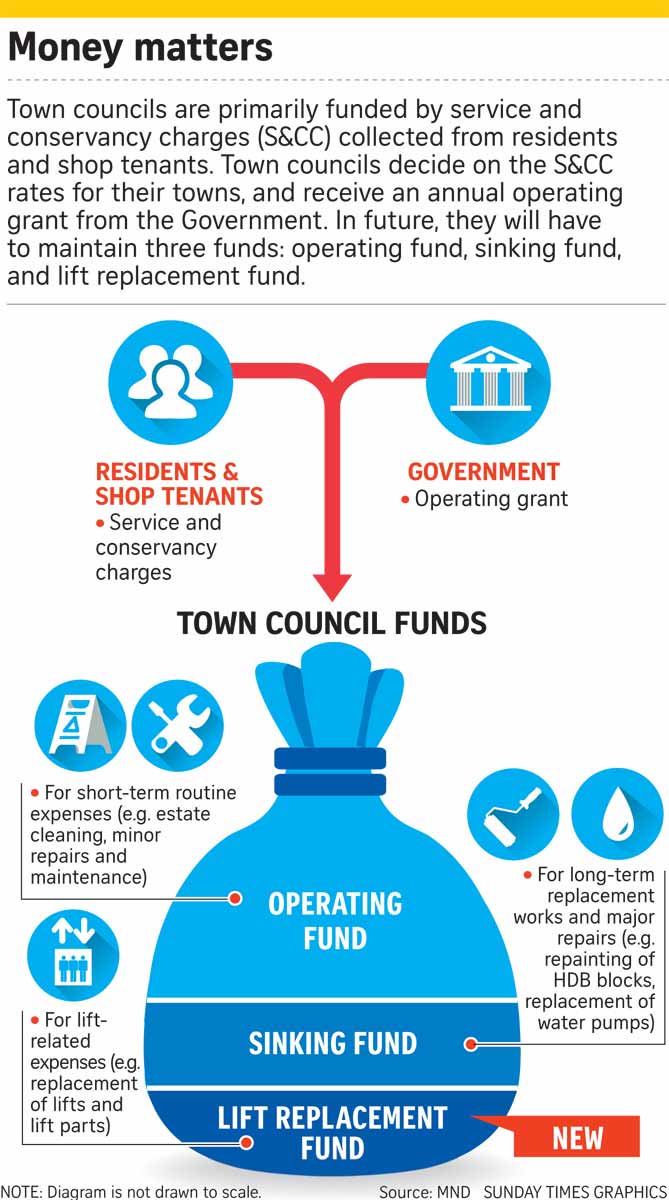
In addition, town councils face a new requirement, which is not voluntary: They will have to put more of their service and conservancy charges (S&CC) collections and government grants into their sinking funds, and allocate resources to a new Lift Replacement Fund.

The balance in sinking funds – used for long-term estate maintenance, repairs and upgrading – across all town councils is about $1 billion, some of which is used for lift improvements.

As noted by National Development Minister Lawrence Wong in a blog post on the scheme last month, that is considerably short of the estimated $3 billion needed from now to 2035 to cover the cost of future lift replacements.

What impact might the new programme and funding requirements have on town councils, whether in terms of residents’ demands or financial issues? And residents will be wondering: Will this lead to an increase in S&CC fees? And will we actually get improved lifts if the LEP is voluntary?

MODERNISING: WHAT IT INVOLVES

Preceding by three days the HDB’s announcement of the lift enhancement scheme was a call by the Building and Construction Authority (BCA) for lift “owners” to modernise their older lifts for greater reliability and safety.

There are about 61,000 passenger lifts in Singapore, including those in private condominiums, malls, office buildings and public housing estates.

The BCA also released a list of eight recommended features that lifts should have. These include a battery-powered automatic rescue device that can bring a lift to the nearest landing and open the doors if there is a power failure.

In its announcement, the HDB said it would support town councils to modernise their lifts in line with the BCA’s list, with about 20,000 lifts expected to benefit.

Some might wonder why modernisation was not made mandatory, but the BCA noted that current lifts already meet safety standards.

“Existing lifts, when properly used, maintained and inspected, will continue to be safe for operation,” it said.

Newer lifts already have some or most of the recommended features, said industry players.

Town councils said they are now assessing how many lifts will come under the scheme, based on age and whether they lack the recommended features.

To be eligible for the LEP, lifts must have been in operation for no more than 18 years.

This thus excludes older lifts like those involved in the incidents that cost Madam Khoo her hand and Mr Lim his life. They had been operating for 19 and 24 years respectively.

Lifts that old will eventually have to be replaced entirely. The HDB generally recommends that town councils replace them after 28 years.

In his blog, MrWong said: “For the older lifts, it will make more sense for the town councils to replace them with new lifts which will come with these enhanced features.”

DOWNSIDE: IT COULD TAKE YEARS

The scheme instead seeks to improve lifts that are not yet up for replacement, but lag behind their newer counterparts.

Some new lifts might already have the recommended features. This could be the case in towns such as Punggol and Sengkang, as well as estates which have recently benefited from the Lift Upgrading Programme that ended in late 2014.

“As a mature estate, some of our lifts are currently either very new, as a result of the Lift Upgrading Programme, while others have been in operation for more than 18 years,” noted Mr Pritam Singh, chairman of the Workers’ Party-run Aljunied-Hougang Town Council.

Still, the town council will put up some lifts for consideration under the scheme, he added.

Finding out how many qualify is thus the first step.

Dr Teo Ho Pin, coordinating chairman for the People’s Action Party (PAP) town councils, said the PAP Town Councils Lift Taskforce – formed in July – will collate the number of eligible lifts from the 15 town councils.

For instance, Pasir Ris-Punggol Town Council oversees 2,750 lifts, of which 78 per cent have been in operation for 18 years or less.

“We are currently checking to confirm the extent of works needed,” said its chairman Zainal Sapari.

The fact-finding stage could take a while. As a Nee Soon Town Council spokesman explained: “We are currently working closely with the various lift manufacturers on details of the enhancement required on a per lift basis.”

She added: “This exercise will require time and is important.”

Some town councils already plan to implement the LEP for all eligible lifts. But that may not necessarily be the case islandwide.

Dr Teo said the PAP’s lift taskforce will study the safety enhancements, cost implications, and benefits of implementing the features.

He added that it will then make recommendations to the respective town councils, “taking into consideration the eligibility of lifts according to their age, safety performance and maintenance costs”.

Even after such decisions are made, it could be years before the lifts are updated. The LEP is to be rolled out over 10 years, and implementation will have to be staggered.

“It will require scheduling… to minimise inconvenience to our residents – ensuring at least one working lift per block while the LEP is being carried out,” said the Nee Soon Town Council spokesman.

Bishan-Toa Payoh Town Council chairman Chong Kee Hiong noted that the sheer number of potentially eligible lifts – 1,000 out of 1,300 under his purview – would require the programme to be carried out in phases.

“Completion of the LEP would also depend on the lift companies’ ability to cope with enhancement of lifts, due to demand from all town councils,” he said.

A SINKING FEELING?

Amid competing demands on finances, the LEP funding simply makes it easier for town councils to take that voluntary step.

“Town councils often have to look at different spending priorities,” said the Nee Soon Town Council spokesman. “This fund provides the town council with a dedicated budget to implement the necessary improvements.”

As it is, the town councils will only have to stump up about 10 per cent of the remaining LEP costs not covered by funding.

Less clear, however, are the likely effects of a new mandatory requirement: the Lift Replacement Fund.

Currently, town councils are required to set aside 30 to 35 per cent of their S&CC collections and government grants for their sinking funds every quarter. The rest goes into their operating funds.

But soon, town councils will have to contribute even more to the former. They will also have to set aside funds for a dedicated Lift Replacement Fund. This is because expenses related to cyclical works such as facade repair and repainting, which draw on the sinking funds, will rise as estates age.

And from now to 2035, some 11,500 ageing HDB lifts will have to be completely replaced – an exercise that may cost almost $3 billion.

Exactly how much will be needed, however, has yet to be determined. The Ministry of National Development will be asking all town councils to prepare and submit their financial projections for their sinking funds over the next 10 to 30 years.

“These projections will enable us to assess the appropriate levels of contribution to the TC (town council) sinking funds and Lift Replacement Funds,” said Mr Wong on his blog.

The changes will affect how much operating funds town councils have, as well as how much of the sinking fund is used for non-lift-related works, noted Dr Teo.

Town councils declined to comment on the likely financial impact until more details are released.

They also declined to speculate on how much they might be required to put into the new lift fund.

But if past expenditures are any indication, town councils may have varied needs. For Nee Soon Town Council, lift cyclical works took up 8 per cent of the sinking fund for the 2015-2016 financial year.

In contrast, lift works formed 20 per cent of the sinking fund expenditure for Holland-Bukit Panjang Town Council.

Will S&CC rates – payable by residents each month- have to go up?

Dr Teo said the PAP town councils are “looking into” a revision, but gave no further details.

HIGH ANXIETY FOR SOME

Public attention may have been focused on lift-related incidents where there was a loss of life and limb, but other injuries have also drawn complaints from residents and observers.

A 23-year-old lift in Ang Mo Kio shot up and down suddenly in March, causing a domestic worker to fall and hurt her back.

And in June, a 22-year-old lift in Bukit Batok that was not level with the ground floor when the doors opened caused an elderly resident to trip and fall.

With such injuries making headlines, even incidents without casualties can cause unease.

In June, Sengkang resident Tan Joo Jin, 45, was in one of his block’s three lifts with his neighbours when it jerked suddenly, stopped briefly between floors, shot down, and then stalled again before eventually reaching the ground floor.

No one was trapped or hurt, but the memory lingers, said Mr Tan, an assistant health and safety manager.

“Now, some people prefer to only take Lifts A and B,” he added, referring to the block’s other two lifts.

He lives in Block 299A Compassvale Street, which was completed in 2001, meaning that its lifts might be eligible for the LEP.

Mr Tan hopes the lifts at his block will be updated – and that residents will be informed of the details.

“As residents, we don’t know what upgraded features have or haven’t been added to our lifts,” he said. “We are the ones living there, we should know the situation.”

The LEP is thus important, not just for the tangible benefits it could bring to some 20,000 lifts, but also the intangible reassurance it could provide to the many more residents who use the lifts.

Admittedly, it will take both time and money, and residents will have to put up with temporary inconvenience.

Replacing aged lifts across the island, with its estimated $3 billion price tag, will exact an even larger cost – one that could spill over to residents if S&CC charges rise.

But for safer lift rides and peace of mind, this is arguably not too high a price to pay.


This article was first published on October 02, 2016.
Get a copy of The Straits Times or go to straitstimes.com for more stories.

Image: 
Category: 
Publication Date: 
Sunday, October 2, 2016 – 15:00
Send to mobile app: 
Source: 


Story Type: 
Others

Source link

Open prams on buses

0

The authorities recently announced that open prams will soon be allowed on buses.

But even before the ban on open prams is lifted, some parents of children with disabilities have asked if they can be exempted from the rule first.

As their children cannot walk and need to remain in prams or paediatric wheelchairs, they said that they need to be allowed to board buses with open prams.

They now have to put up with a lot of stress when taking the bus as they often have to negotiate with bus drivers to allow their children on board while getting impatient stares from other commuters.

They told The Sunday Times of instances where drivers did not recognise cards that identify children as people with disabilities and mistake paediatric wheelchairs for prams, thus not allowing children in such wheelchairs to board.

“The buses have labels to show they are disabled-friendly, but the drivers are not disabled-friendly,” said housewife Cindy Wong, 48. Her daughter, 13, has cerebral palsy, in which brain injury causes impairment of motor functions.

An estimated 3 per cent of the Primary 1 cohort each year have special needs, though this includes people with intellectual disabilities.

Mainstream schools have an enrolment of 18,000 special needs pupils and a smaller number are in special education schools.

BUS OPERATORS’ POLICIES

The Land Transport Authority (LTA) said prams on buses must be folded as open ones can “pose safety hazards to both the child and passengers if (bus) emergency brakes are applied”.

But a spokesman said this is being “actively reviewed” and LTA is studying different restraint systems with bus operators.

Most bus operators said they allow open prams for children with disabilities on a case-by-case basis.

SBS Transit, the largest bus operator, said that since late May, it has made arrangements to allow children with special needs to travel in their prams on its buses. It has been progressively briefing its 6,000 bus drivers about this.

Its senior vice-president for corporate communications Tammy Tan said the wheelchair ramp of buses will be deployed for the prams to be pushed on board.

“The caregiver has to hold on to the pram and ensure that the child is securely fastened at all times,” she said.

The caregiver has to produce the child’s SG Enable or Developmental Disability Registry (DDR) cards too.

Tower Transit said its bus drivers do not require proof before allowing the prams on board. But prams may have to be folded during peak periods, when the buses are crowded.

Go-Ahead Singapore said its bus drivers are trained to assess whether to allow open prams on buses, on a case-by-case basis.

SMRT said that its bus drivers would help to fold up prams and find a seat for special needs children.

PARENTS’ CHALLENGES

Parents told The Sunday Times that allowing their special needs children in open prams to board buses was long overdue.

They said it may be dangerous to require that prams be folded.

Said cabin crew Shirley Ong, 40: “Asking a parent to handle a special needs child with a folded pram in a moving bus is more dangerous than having the child strapped safely in the stroller, with brakes applied.”

Housewife Juliah Kasiman, 35, had to carry her son in a sling carrier till he was six, as bus drivers did not allow open prams on board.

She said: “If my son is in a sling carrier and I bend down to fold the pram, he’ll bend forward. His head is not supported and could hit the floor. Having to carry him and the folded pram and then tap the EZ-Link cards – I’d be like an octopus.” Her son is now seven years old.

Ms Jasmine Lee, 31, creative director of a resource website for parents of special needs children, said bus drivers need to be educated.

“A parent showed a driver the DDR card (to prove her child has a disability), but he still insisted that she fold the pram.”

Welfare groups agreed on the need for education and training.

Cerebral Palsy Alliance Singapore executive director Jessie Holmberg said: “Inclusive transport should help people with disabilities go to places without worries and negative reactions from service providers. It is vital that bus drivers go through training, from understanding the different types of disabilities to communicating with parents and children with disabilities.”

While noting “great progress” in the accessibility of public transport, Disabled People’s Association executive director Marissa Lee said some drivers may not be inclusive enough.

“Drivers need to understand why children with disabilities, like wheelchair users, should not have to transfer out of their prams.”

She said: “How can we hope to have social integration for these children when they are not able to get to the places where they can learn and play with other children?”

Bus rides an ordeal for mother of boy with cerebral palsy

Taking the bus is no simple matter for housewife Mutmainnabibi Angullia whenever she travels with her three-year-old son Arshad.

For the boy has cerebral palsy, a condition in which brain injury causes impairment of motor functions, and needs to sit in a pram.

The 37-year-old takes her son from their Tampines home to the Cerebral Palsy Alliance Singapore (CPAS) four times a week for an early intervention programme.

“Sometimes, when I wait for the bus, my heart is pounding. What type of driver would I get? Would I have to argue with him to let my son remain in the pram when we board the bus?” she said.

She estimated that for half of the bus rides she has taken with her son, the drivers had not let him board while staying in the pram, citing safety reasons.

She told The Sunday Times: “Once, I showed the driver my son’s DDR (Developmental Disability Registry) card and he still did not allow us to board.”

This card is administered by the National Council of Social Service and indicates that the cardholder has a disability.

“I decided to just carry the pram, with my son in it, up the bus, even though the ramp had not been lowered. But the driver refused to continue the journey. I just sat in the bus angrily and he eventually took off,” she said.

“When we alighted, I cried. Why is it so hard to go to school?”

She said it is unsafe, and hardly possible, for her to carry a folded pram in one hand and her son – who weighs 13kg and whose muscles can go stiff – in the other.

Frustrated, she wrote to SBS Transit in March.

She also ordered a paediatric wheelchair in May, hoping that more drivers would let her son board “since it is a wheelchair and not a pram”.

In July, SBS Transit e-mailed her, saying that arrangements had been made to let special needs children remain in prams on buses.

She now has that e-mail printout when she takes the bus and has had to show it to drivers sometimes.

As more drivers get briefed on the arrangement, she said there have been no problems in recent weeks, at least with drivers of bus service 518 which she takes to CPAS.

Bus operator Go-Ahead took over the service last month but she has not had any problems.

However, she is hesitant about taking other bus services with her son to go to other places.

She said: “I’ll take bus 518 with him several more times. If there’re no problems, I’d be more confident and perhaps I’d try taking him to other places in the pram.

“I want him to go out more, not just to school. I want to let him feel the wind, hear noises from cars and have fun.”


This article was first published on October 02, 2016.
Get a copy of The Straits Times or go to straitstimes.com for more stories.

Image: 
Category: 
Publication Date: 
Sunday, October 2, 2016 – 15:00
Send to mobile app: 
Source: 


Story Type: 
Others

Source link

LKY estate takes issue with AGC on ruling

0

The estate of Mr Lee Kuan Yew yesterday took issue with a statement by the Attorney-General’s Chambers (AGC) on interviews Mr Lee gave in the early 1980s, after a court ruling on copyright to them.


But AGC said in reply to press queries: “The judgment speaks for itself and there should have been no necessity for the Attorney-General to repeatedly correct inaccuracies about Court proceedings.”

Dr Lee Wei Ling and Mr Lee Hsien Yang, the executors of the late Mr Lee’s estate, had last year applied to clarify an agreement their father had made over the control and use of the interviews.

Last week, the High Court ruled that the estate had a limited copyright to the transcripts – that is, only for the purpose of making sure the Government complies with the terms of the agreement Mr Lee had signed regarding the interviews, done when he was prime minister.

On Thursday, the estate welcomed the decision that it had the copyright, saying this “resolves a key point on which the Government disagreed with the estate”.

But on Friday, the AGC clarified this claim, saying the Government “agreed that the estate does have a limited copyright” to the material.

Yesterday, Mr Lee’s estate said their application sought a ruling “that all rights” given to him in the interview agreement vested in the estate, and “this clearly included the copyright”, but “the Government resisted the application”.

“Nowhere in the correspondence leading up to the proceedings, or the affidavits, or the documents filed for the proceedings, did the Government state that it agrees that copyright (whether in a limited form or otherwise) vested in the Estate,” the estate added.

It said “the Government’s concession” only appeared from its written submissions filed on July 7, one week prior to the hearing.

The AGC replied last night, saying: “The latest statement issued by the Estate of the late Mr Lee Kuan Yew is as unfortunate as the last.

“It is not true that the Government changed its position on the issue of copyright. The Government had always held that the late Mr Lee Kuan Yew had a limited copyright to the transcripts during his lifetime, and thereafter for five years after his passing or up to 2000, whichever is the later. The agreement that the late Mr Lee and the Government signed makes this plain, and the Government has always honoured the agreement.”

“The point of contention between the Estate and the Government was not copyright. Rather, the point of contention was the Estate’s belief that it was entitled to free and unfettered access and use of the transcripts, which were produced as part of a Government project and protected by the Official Secrets Act,” the AGC added.

“The Government believed this was never the intention of the late Mr Lee, and had to stand firm. The Court upheld the Government’s position and consequently dismissed the Estate’s application in full.”

charyong@sph.com.sg


This article was first published on October 02, 2016.
Get a copy of The Straits Times or go to straitstimes.com for more stories.

Image: 
Category: 
Publication Date: 
Sunday, October 2, 2016 – 15:00
Keywords: 
Send to mobile app: 
Source: 


Story Type: 
Others

Source link

Singaporean climber falls and dies during Mt Kinabalu climb

0

A Singaporean climber who fell during a training climb on Mount Kinabalu on Saturday (Oct 1) has died of his injuries.

Woon Tai Kiang had gone missing…

Source link

Nathan Hartono gets into finals of Sing! China

0

Home-grown singer Nathan Hartono has emerged the front-runner to win popular Chinese television singing contest Sing! China after coming up tops in the semi-finals.

In the semi-final broadcast on Friday, the 25-year-old received the highest score – 93.65 – among the six semi-finalists, which included singers from China and Malaysia.

Hartono also received overwhelming support, receiving 47 out of 51 of the votes from the show’s judges and 333 votes from the 350-strong audience.

Despite being the clear favourite to win, Hartono told The Sunday Times that his chances of winning Sing! China are “not very high”. The final will be aired on Friday.

“I honestly didn’t think I was going to get this far and it blows my mind,” he said. “That said, I am still going to go up there and do all I can to kill it.”

He added: “If I win, I will rent a fleet of Milo vans and treat everybody to Milo peng (iced Milo).”

On his game plan for the final, Hartono is sticking to the strategy that has brought him there: The love of performing for a live audience.

He said: “I am a serial people-pleaser, and I have this desire to help the audience get into this live experience, as opposed to watching me stand motionless and singing to the camera.”

He will be amplifying this experience “100 times” at the show’s final at Beijing National Stadium.

His strategy paid off handsomely at the semi-finals show.

He crooned an emotionally rousing version of the Eagles classic Desperado and mashed it with the Angus Tung song Can’t Forget. The two songs are “old classics from both sides of the planets”, he said.

His coach on the show, Mandopop star Jay Chou, said he had chosen a risky combination of two different songs, released more than 10 years apart but sharing the same chord progression, to give Hartono a chance to impress the judges.

Hartono is the only member from Chou’s team to have made it to the Sing! China final.

Guangzhou’s Wang Chengrui from coach Na Ying’s team was second in the semi-final with a score of 89.28, and Shenyang’s Xu Geyang from coach Wang Feng’s team was third.

On being part of Sing! China, Hartono said: “I am having a blast and it has been a real education. I can’t wait to come back and share how much I have grown through my music.”


This article was first published on October 02, 2016.
Get a copy of The Straits Times or go to straitstimes.com for more stories.

Image: 
Category: 
Publication Date: 
Sunday, October 2, 2016 – 14:00
Keywords: 
Send to mobile app: 
Source: 


Story Type: 
Others

Source link

'We tried to warn her about Yang'

0

Last week, former China tour guide Yang Yin was jailed for eight years and two months for cheating wealthy widow Chung Khin Chun of $1.1 million and duping the authorities into granting him permanent residency.

The Sunday Times talks to the widow’s friend, neighbour, maids and former driver on how Yang kept up his ruse for five years before he was arrested in September 2014.

Former China tour guide Yang Yin may have already been convicted and jailed for cheating wealthy widow Chung Khin Chun of $1.1 million, but one person still blames herself for what happened.

Madam Chang Phie Chin, a close family friend of Madam Chung, told The Sunday Times yesterday: “I was the one who introduced them to each other. If they had not met, maybe all these things would not have happened.”

Madam Chang, a retired Chinese language teacher who is now 87, first met Yang in 2005 during a tour to Shanghai, China. They kept in touch afterwards, and Yang would visit her whenever he was in Singapore.

On one such visit in 2006, Madam Chang introduced Yang to Madam Chung and her husband, Dr Chou Sip King. “Yang said that he liked paintings so I took him to visit their private art gallery,” she said.

Madam Chang was then living with Dr Chou and Madam Chung. The couple, who were childless, had invited her to live with them in 2004 so that they would have each other’s company in their old age.

Madam Chang, who is unmarried and has no relatives, agreed as she had been friends with the couple since 1958 when she used to visit Dr Chou’s clinic in Upper Serangoon Road.

After Dr Chou’s death in 2007, both Madam Chang and Madam Chung decided to tour Beijing and they hired Yang as their private tour guide. “It was a mistake,” said Madam Chang.

After the tour, Yang kept in contact with both women.

A year later, in 2009, he moved into the Gerald Crescent bungalow.

He was granted an employment pass to work in the music school he had set up using the bungalow’s address. It was later found that the business was a sham.

“Yang thanked me for being his big benefactor,” said Madam Chang. “Thinking back now at what he said, my heart really aches.”

Madam Chang said that she tried to warn Madam Chung about Yang when he started asserting control over the household expenses, maids and driver.

She decided to move out of the bungalow in 2011 after buying a Housing Board studio apartment where she lives alone today.

She still keeps in touch with friends in the Gerald Crescent area, including Ms Linda Tan, who lives in a corner terrace house several units away from Madam Chung’s bungalow.

Ms Tan, a property agent who is in her 50s, told The Sunday Times that Madam Chang told her about her suspicions about Yang as early as 2009. “There was little that I could do at that time,” she said.

After Madam Chang moved out in 2011, Ms Tan tried to visit Madam Chung several times but was barred from entering the house by the maid, who was acting on Yang’s instructions.

Before, the gate was always unlocked and neighbours were free to visit Madam Chung any time, said Ms Tan.

In November 2012, she spotted Yang at a grassroots leaders appreciation dinner.

Surprised that Yang had already obtained permanent residency when she knew that he was not employed, she wrote to the Immigration and Checkpoints Authority, asking it to review his status.

She also got in touch with Madam Chung’s sister Doris and niece Madam Hedy Mok, through Madam Chang.

The five of them met at a restaurant at Changi City Point in early 2014. They hatched a plan to get Madam Chung away from Yang.

On Aug 21, Madam Mok, under the pretext of taking her aunt out for lunch, took her to live with her. Yang, not knowing where Madam Chung was, even made a missing person’s police report.

Madam Chung’s maid Surti Teguh played a part in Madam Chung’s flight. A week before, she packed some of her employer’s clothes and passed them to Ms Tan over the gate.

Madam Mok also started a legal suit against Yang, alleging that he had manipulated her aunt into handing over control of her assets through a Lasting Power of Attorney in 2012.

On Sept 2, a week after removing Madam Chung from Yang’s care, Madam Mok, Ms Tan and three family friends marched into the bungalow, when Yang was overseas, and told his wife and their two children to leave. The family had moved into the bungalow in 2013.

Looking back on the confrontation, both Madam Chang and Ms Tan wished they had done more to protect the widow, and acted earlier. They also miss Madam Chung.

“If only things could go back to the way they were,” said Madam Chang. “If it is possible, I wish I could move back to the bungalow and live with my friend.

“We don’t have many years left.”

‘I told Madam she might find herself homeless’

Photo: The Straits Times

When former tour guide Yang Yin moved in to live with 89-year-old widow Chung Khin Chun at her Gerald Crescent bungalow in 2009, he claimed it was to take care of her.

But both of Madam Chung’s maids then – Ms Yuliani, 48, and Ms Surti Teguh, 45, did not see any sign of this.

While he started to take control of the running of the bungalow, including keeping a tight rein on expenses, he spent little time with the elderly woman, said Ms Yuliani, who had started working for Madam Chung in 2001.

He would wake up at about 11am every day, then read the newspapers and walk around the garden by himself. Other times, he was on the computer, she said.

Read also: Yang Yin trial: Widow’s niece regrets not acting earlier

Ms Yuliani was eventually fired at the end of 2012. Yang told her that Madam Chung no longer had any money to pay her. “I cried after hearing this,” said Ms Yuliani, who now works for Madam Chung’s niece, Madam Hedy Mok.

In 2013, Yang moved his wife and two children into the bungalow. “Yang and his family would go out to eat once every week but they never took Madam Chung along,” said Ms Surti, who had been working there since 2007.

Madam Chung’s personal driver of more than three decades said he knew trouble was brewing when Yang moved into the bungalow.

Mr Jarudin Mustafa, 82, told The Sunday Times that Yang gradually took control over the running of the household.

He advised his employer, whom he addressed as “Madam”, that if she continued to let Yang live in her bungalow, she might one day find herself homeless. “When I told her, she didn’t believe. She said: ‘Are you sure?’ “

Speaking at the Gerald Crescent bungalow yesterday – the first time he was back there after quitting, Mr Jarudin described the widow and her late husband, Dr Chou Sip King, who passed away in 2007, as a kind and caring couple.

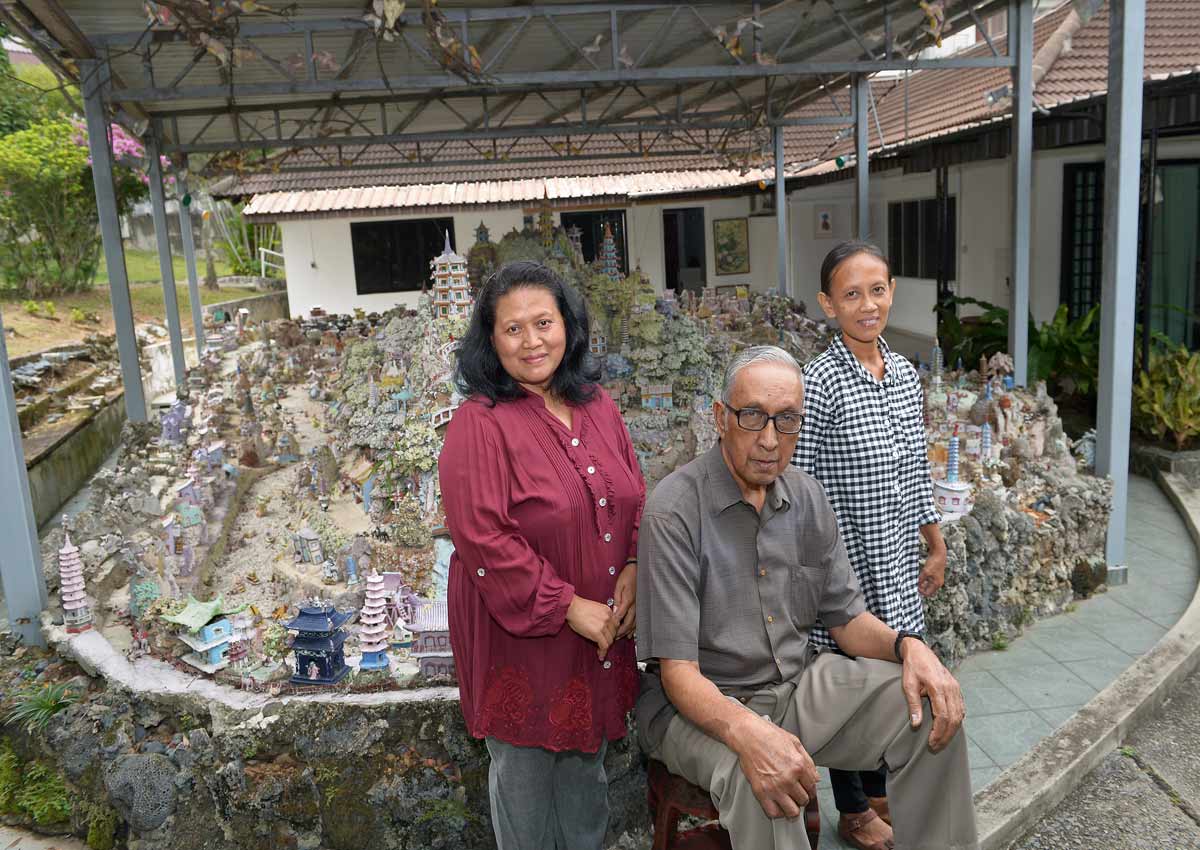
He fondly remembers how he and his son, Imran, used to help Dr Chou make the mini-sculptures and figurines displayed on the bungalow’s front porch. They would spend hours each week painting and putting pieces of cement and styrofoam together.

When Hari Raya came, the couple would give him a month’s bonus. They also gave him groceries like fish and vegetables to take home.

But things were very different with Yang around.

For one thing, he became unhappy whenever he saw Madam Chung giving groceries to Mr Jarudin.

Also, when shopping for groceries, Yang would buy items in bulk.

Before, it was Madam Chung’s long-time friend, Madam Chang Phie Chin, who would decide how much to buy and she would spend only on what was needed.

Because Yang spoke in Mandarin, there was a language barrier between him and the driver.

Still, Mr Jarudin knew Yang was not happy with him. Yang added some blindspot mirrors to the car and would mumble in anger when Mr Jarudin wanted to re-adjust them.

A few months after Yang moved in, Mr Jarudin told Madam Chung that he wanted to quit.

Even though he had enjoyed working for the widow and her late husband, he felt unhappy with how things were under Yang.

Madam Chung gave him a gift of $50,000.

Yang had claimed in an affidavit that Mr Jarudin was sacked after trying to strangle him.

The driver denied this, saying that he had never touched Yang.


This article was first published on October 02, 2016.
Get a copy of The Straits Times or go to straitstimes.com for more stories.

Image: 
Category: 
Publication Date: 
Sunday, October 2, 2016 – 14:00
Send to mobile app: 
Source: 


Rotator Headline: 
Friends tried to warn widow when Yang Yin started asserting control over household expenses, maids and driver
Rotator Image: 
Story Type: 
Others

Source link

Missing Singaporean climber found dead on Mount Kinabalu

0

KOTA KINABALU – A Singaporean climber, who was reported missing while training for the Mount Kinabalu climbathon early Saturday, has been found dead.

Woon Tai Kiang was found in a 150m deep ravine near Sayat-Sayat which is the last checkpoint before climbers make their way up to the summit.

The victim’s body was discovered by Mountain Search and Rescue (Mosar) personnel at about 7.30am Sunday.

It is believed that Woon died after sustaining serious head injuries when he slipped off the trail and fell into the ravine.

However, the rescue team has yet to confirm the cause of death as they are still making their way down from the mountain.

More details are expected to be known later this afternoon.

The annual Mount Kinabalu International Climbathon, which was put on hold for one year following the June 5 earthquake in 2015, will be held on Oct 16.

Image: 
Category: 
Publication Date: 
Sunday, October 2, 2016 – 13:40
Send to mobile app: 
Source: 


Rotator Image: 
Story Type: 
Others

Source link