Singapore has offered to help in hunting down a Singaporean who is considered one of the most wanted terrorists in the region.
Philippine Foreign Minister Perfecto Yasay told Manila-based reporters in Singapore yesterday that Prime Minister Lee Hsien Loong was given the terrorist’s name, but he declined to disclose the name and further details.
Security officials had previously tagged just one Singaporean, Abdullah Ali, also known as Muawiyah, as among the senior leaders of the Jakarta-based Jemaah Islamiah. The group has been training Islamist militants in the war-torn southern island group of Mindanao in the Philippines.
Muawiyah was said to have fled to the Philippines with Malaysian terrorist Zulkifli bin Hir, alias Marwan, who was killed in a police raid in January last year.
“(President Rodrigo Duterte) had mentioned that on one occasion, our intelligence information showed that there was a Singaporean who was actively involved in terror and other criminal activities. We did not hesitate to, upon the request of the Prime Minister, give them the name of the person concerned. This will trigger a lot of areas of co-operation and information-sharing in the future,” said Mr Yasay.
Asked what help Singapore was offering, Trade Minister Ramon Lopez said at the same news briefing that the city-state “has the technology, a software that really is quite strong in terms of intelligence, and I heard they are willing to share that technology with us”.
Muawiyah was said to have participated in the 2009 abduction of three members of the International Committee of the Red Cross.
Philippine military officials said previously that both Marwan and Muawiyah were killed in an air strike in Jolo province in Mindanao on Feb 2, 2012, along with Abu Sayyaf leader Umbra Jumdail, alias Dr Abu.
Marwan’s and Jumdail’s deaths have been confirmed, but not Muawiyah’s death.
This article was first published on Dec 17, 2016. Get a copy of The Straits Times or go to straitstimes.com for more stories.
In a welcome usually reserved for rock stars, Philippine President Rodrigo Duterte was greeted with loud cheers when he met members of the Filipino community yesterday at the end of his two-day state visit to Singapore.
Despite the heavy rain in the early afternoon, long queues formed outside the registration area of the Max Pavilion and Hall 9 at the Singapore Expo.
Mr Duterte’s hour-long speech touched on a range of subjects, from his controversial war on drugs and the international community’s criticisms of human rights abuses, to the recent protests against the burial of former president Ferdinand Marcos.
He acknowledged reports in international media earlier this week about his remarks that he personally killed suspected criminals when he was mayor of the southern Philippine city of Davao, to set an example for the police.
“They are not wrong. I will really kill them,” he said of the reports, but stopped short of admitting carrying out any killings personally.
His speech, while laden with expletives, was met with approval and cheers. Three out of four Filipinos in Singapore who voted in the May election chose him to be their leader.
Mr John Yap, 39, a banking executive, said he supported the President’s efforts to eradicate illegal drugs. “I believe he is sincere, and the high number of those surrendering to date is a good sign of traction. However, he needs to manage citizens’ concerns of errant police officers and clear up the perception that only the poor is targeted in this drug war,” he said.
In his speech, Mr Duterte also slammed the United States for tying aid to his country to human rights, and accused it of treating the Philippines like a “dog on a leash”.
Earlier this week, a US poverty reduction agency said its board was reviewing development aid due to concerns about the “rule of law and civil liberties”.
Mr Duterte also recalled a US senator’s effort to block arms purchases last month. He said he did not care as the Philippines can always get weapons from China and Russia.
On the protests last month in the Philippines over the burial of former president Marcos, who has been accused of widespread graft and corruption, in a heroes’ cemetery, Mr Duterte defended his decision, saying it was time for the country “to end the hatred”.
Mr Duterte also expressed gratitude for the sacrifices made by the more than 180,000 Filipinos working and living in Singapore, whose remittances help prop up the economy. He reassured them that he will continue to battle corruption, and promised to make government services more efficient.
Ms Maria Cristina Nable Jra, 26, a customer service executive, said she was happy to hear the President’s remarks. “I can feel his sincerity in wanting to help the overseas workers here in Singapore. Listening to his speech inspires me to work harder.”
President Duterte meets the Filipino community in Singapore
Philippine President Rodrigo Duterte yesterday (Dec 16) defended his brutal war against drugs in a speech to almost 7,000 Filipinos who gathered at the Singapore Expo.
“My campaign against drugs will not stop until the end of my term… until the last pusher and last drug lord (is killed),” said the President as he wrapped up his two-day state visit to Singapore.
Mr Duterte won his country’s general election in May largely on an anti-crime platform. Since taking office in June, more than 2,000 people have died in anti-drug operations, while more than 3,000 others have been killed in unexplained circumstances, official figures show.
The campaign has been criticised by the United States and the international community for violating human rights. But Mr Duterte yesterday brought out a thick pile of papers listing suspects in the illegal drug industry, saying the scale of the problem merited the response.
The President received a boisterous welcome from those present at the Max Pavilion and Hall 9, as he spoke in a mix of English, Filipino and his local Visayan dialect.
At the start of his speech, Mr Duterte thanked Singapore for hosting more than 180,000 Filipinos and for its good treatment of those working here. “I have to thank first the Republic of Singapore for… giving them the opportunity to work and earn money here and for treating my countrymen the way you… (do) ordinary Singaporean citizens. It is almost being equal here.”
Earlier in the day, Mr Duterte was hosted by Prime Minister Lee Hsien Loong to lunch at The Coconut Club, an eatery in Ann Siang Hill known for its nasi lemak.
Mr Duterte and Philippine Trade and Industry Secretary Ramon Lopez then met Singapore business leaders to discuss trade and investment opportunities.
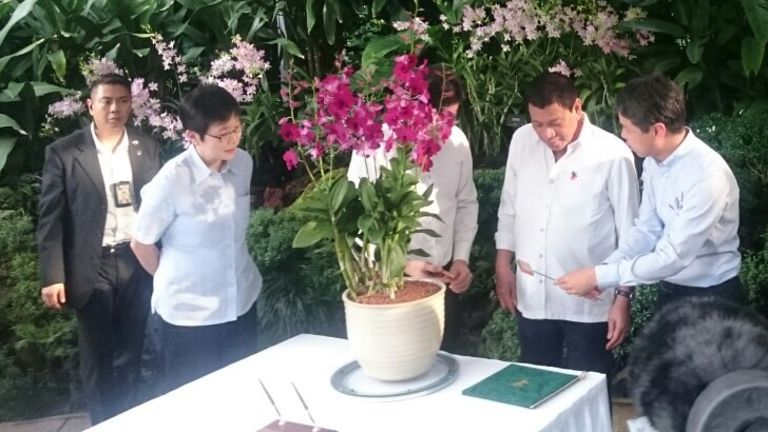
Mr Duterte also visited the Singapore Botanic Gardens, where he had an orchid, the Dendrobium Rodrigo Roa Duterte, named after him, a traditional honour for visiting foreign leaders.
Employers who do not take adequate steps to ensure the safety and health of their workers at the workplace can expect to face stiffer fines in the future.
The High Court has reviewed the sentencing regime for breaches of the Workplace Safety and Health Act after agreeing with prosecutors that the fines imposed in previous cases have been too low.
The prosecution had argued for a doubling of the $150,000 fine handed to GS Engineering & Construction Corp last year for a 2014 accident in which two workers fell to their deaths from the seventh floor of a Fusionopolis worksite.
On Thursday, the company was fined $250,000 – the highest fine to be imposed under the Act.
Prosecutors argued that the courts have not “utilised the full range of the sentences prescribed by Parliament”, which had set the maximum fine at $500,000, and proposed that the High Court establish a sentencing framework.
The Act, which replaced the Factories Act in 2006, was enacted after a review of workplace safety regulations following three high-profile worksite accidents in 2004.
It sets a maximum fine of $500,000 for first-time offenders and $1 million for repeat offenders. Under the old Factories Act, the maximum fine was $200,000.
While Parliament sets the prescribed maximum, the courts can lay down sentencing guidelines.
Prosecutors argued that most of the fines meted out so far fall below 30 per cent of the maximum of $500,000. Before GS, no firm had been fined more than $200,000.
In a 42-page written judgment, Judicial Commissioner See Kee Oon agreed that the fines imposed thus far have been too low.
“For future cases, the sentencing court should bear in mind that the legislative intent for the introduction of more severe penalties was to create a more palpable deterrent effect and encourage stakeholders to take more proactive measures to minimise the occurrence of accidents at the workplace,” he said.
He laid down a sentencing framework which sets out a range of possible fines, depending on whether the culpability of the employer and the potential harm in each case were high, medium or low. For instance, a firm whose acts reflect a high level of culpability and a high potential for harm could be fined between $300,000 and $500,000.
On the other end of the spectrum, a company whose acts show a low level of culpability and a low potential for harm could be fined up to $20,000. The fine would then be calibrated based on aggravating or mitigating factors of the particular case.
In the case of GS, the judicial commissioner increased the fine to $250,000, ruling that the potential harm was high and culpability fell within the medium to high category. But he took into account that the firm had a good safety record and had taken remedial steps.
A spokesman for the Manpower Ministry said the Attorney- General’s Chambers and the ministry had sought a deterrent sentence in the case “in (the) light of the seriousness of the safety failures that led to the accident”.
This year, 64 workers have died on the job.
Manpower Minister Lim Swee Say had warned in August that workplace fatalities were on the rise.
Mr Lim noted that although Singapore managed to bring down the fatality rate from 2.8 per 100,000 workers in 2008 to 1.8 in 2014, it crept up to 1.9 last year and is projected to hit 2.2 this year.
selinal@sph.com.sg
This article was first published on Dec 17, 2016. Get a copy of The Straits Times or go to straitstimes.com for more stories.
SINGAPORE: Philippine President Rodrigo Duterte on Friday (Dec 16) addressed thousands of his fellow Filipinos who turned up to welcome him during his visit to Singapore.
During his speech, Duterte slammed critics of his controversial war on drugs and said: “If you are into drugs … I will kill you”.
Addressing human rights concerns about the number of killings in his anti-drugs clampdown – three-quarters of which are estimated to have been part of police counter-narcotics operations – he added: “If you were police, why would you wrap a body up and put a cardboard [sic] on it? Just shoot them.”
Duterte again repeated his call for US President Barack Obama to “go to hell”, and slammed a US decision to withhold humanitarian aid to his country.
“I am like a dog on a leash,” he said of the Philippine-US relationship. “You lived off the fat of my land,” he added, addressing Americans. “Do not bull**** me.”
He rounded off his address by thanking Filipinos in Singapore “from the bottom of my heart for contributing to the economy”, and urged them to stand up for their rights.
“Merry Christmas, and be assertive of your rights.”
Filipinos wait in line to take a free shirt home after the event with Philippine President Rodrigo Duterte. (Photo: Xabryna Kek)
Free shirts from the event with Philippine President Duterte. (Photo: Xabryna Kek)
Organised by the Philippine Embassy, registration for the event held at Singapore Expo had to close early after demand surpassed the venue’s maximum capacity of 6,000 people.
The crowd began gathering at the venue as early as 8am for the event.
Duterte’s visit to Singapore is his first since he took office in June after a landslide election victory.
Finish that bit of last minute festive shopping with Starbucks latest promo! From the 16th to 25th December 2016, purchase sselected merchandise for your loved ones at 40% off – just in time for Christmas!
SINGAPORE: Dr Ang Hak Seng will be appointed Commissioner of Charities-designate on Jan 2, 2017, the Ministry of Culture, Community and Youth (MCCY) announced on Friday (Dec 16). He will replace Mr Low Puk Yeong, who will step down as Commissioner of Charities (COC) on Jan 16, 2017.
Mr Low, the current COC, was first appointed in 2006. Under his leadership, the charity sector strengthened its standards of governance and enjoyed greater public confidence and support for charitable giving, said MCCY.
He worked with the Charity Council to progressively strengthen the code of governance to encourage the adoption of good governance standards and best practices to promote self-regulation in the charity sector, the ministry said.
Mr Low will also step down as senior director of Registry and Cooperative Societies and Mutual Benefit Organisations (RCS).
Dr Ang’s appointment as COC will be made official on Jan 16. He will also take on two other appointments: Executive director-designate at RCS and deputy secretary-designate at the helm of Singapore Cares, a national movement to foster a more caring and inclusive society.
Dr Ang is currently Chief Executive Director of People’s Association. He was appointed in April 2013, after serving as a grassroots leader in Yuhua and in South West Community Development Council for 15 years, said MCCY.
Deputy chairman of the PA board of management, Minister Chan Chun Sing noted that Dr Ang has made enormous contributions to PA as chief executive director.
“Under his leadership, PA strengthened its engagement with Singaporeans from diverse backgrounds to weave the social fabric of our nation; helped the Government to close the last mile in communicating government policies to residents in a simple and personal way; and helped to communicate the people’s feedback to the Government for more responsive policies. I thank Dr Ang for his many contributions to PA,” said Mr Chan.
Brigadier-General Tan Kok Ming Desmond will fill Dr Ang’s position at the PA. He is currently the Chief of Staff (General Staff) of the Singapore Armed Forces.
BG Tan will be appointed PA’s chief executive director-designate on Jan 2, and his appointment will be made official on Jan 16.
SINGAPORE: Durian featured on the menu on Friday (Dec 16) when Prime Minister Lee Hsien Loong hosted visiting Philippine President Rodrigo Duterte to lunch at a restaurant at Ann Siang Hill.
In a Facebook post, Mr Lee said they capped off their nasi lemak meal with “some excellent D13 and Mao Shan Wang durians”.
Mr Lee noted that it was the second time this week that he had had durians. On Tuesday, Malaysian Prime Minister Najib Razak hosted him and his delegation to dinner in Putrajaya, after the signing of the high-speed rail agreement between the two countries.
“International diplomacy is indeed dangerous for waistlines!” Mr Lee quipped.
Mr Duterte, who is on the second and last day of his state visit to Singapore, also had an orchid named after him.
The “compact, robust and vigourous hybrid” was named during Mr Duterte’s visit to the Botanic Gardens’ National Orchid Gallery on Friday afternoon, said the National Parks Board (NParks).
The hybrid is a cross between the Dendrobium Sonia Beauty and the Dendrobium Urmila Nandey, with violet red sepals and petals.
Called the Dendrobium Rodrigo Roa Duterte , the orchid “produces upright flower sprays that bear up to 15 striking and well-arranged blooms, each velvety bloom measuring about 6cm across”, NParks added.
Philippine President Rodrigo Duterte with the orchid hybrid named in honour of him. (Photo: President Duterte’s Corp Comms)
SINGAPORE — Communications manager Sabrina Tay, 34, recalled her apprehension and how she was saddled with guilt about three years ago when she opted to put her then 12-week-old firstborn in infant care.
“When the babies cry, you’re always afraid no one will bother about them. Or if they get sick … you’re a bad mum for sending them there … I had people asking me, ‘Wow, you can (bear to do so) … It makes you feel very bad, but you have no choice,” she said.
Mrs Tay said she did not want to burden her mother-in-law — who was at the time carrying out major renovations at home — with looking after her daughter. When her second child arrived earlier this year, she initially hired a domestic helper – only to ultimately resort to putting her second child in infant care as well, after she had issues with the maid.
Similarly, Mrs Kimberlyn Tan, 30, had problems with hired help. “I’d rather send him to school where I can have peace of mind, rather than worrying while I’m at work,” said the key account executive, who tried in vain to juggle work and looking after her baby. Her husband is frequently away on business trips while her Malaysian mother-in-law regularly shuttles between Singapore and Johor Bahru.
Slowly but surely, stigma and a sense of guilt that afflict parents, especially mothers, for leaving newborns in the hands of someone outside the family and away from one’s home are gradually eroding. From as young as two months old, more and more infants are being placed in the care of professionals by working parents — some by choice, while others had few options — after futile searches for suitable and affordable nannies or bad experiences with domestic helpers, for example.
Parents who are tapping on infant-care services also tell TODAY that their own parents are either busy working or they wish to spend more time on themselves in their golden years, instead of looking after their grandchildren. Human resources professional Adeline Ng, 28, for example, has three young kids – aged 5 years and under – and her parents are in their early 50s. “When I was pregnant with my first child, I was already looking for infant care. My parents are young grandparents, so I wasn’t expecting them to give up their jobs to look after a baby,” she said. “To me, my parents have brought me up, and are finally getting a breather… I don’t want to have to burden them with a baby as we know that looking after a baby is not an easy task.”
A GROWING INDUSTRY
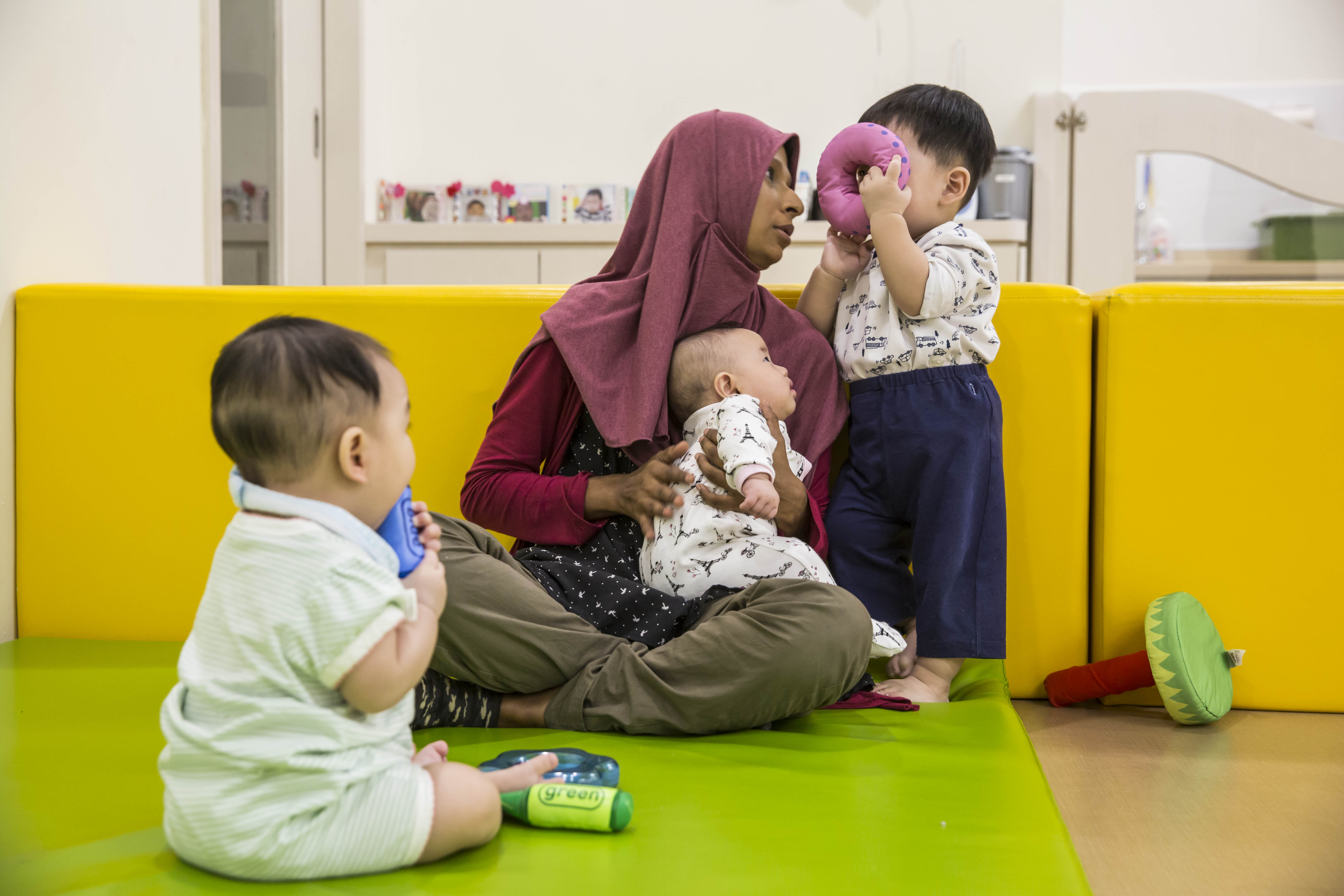
At My First Skool located at Punggol Waterway Point, a typical day involves the infants being fed milk or solid foods, getting their diapers changed, and getting some naptime. Depending on their ages, the infants may also participate in activities such as reading, sing-along sessions, and scrawling on A3-sized paper with chalk. Photo: Nuria Ling/TODAY
Earlier this month, Senior Minister of State (Prime Minister’s Office) Josephine Teo noted the sharp increase in demand for infant-care services in recent years. Mrs Teo, who helps to oversee the National Population and Talent Division, said about one in 10 babies who are 18 months old or younger are enrolled in centre-based care today, a growth of 60 per cent since 2012.
Early Childhood Development Agency (ECDA) figures showed that in 2012, there were fewer than 300 childcare centres – out of a total of 1,016 centres – which offered infant care services. As of the third quarter of this year, the number has jumped to 468 out of a total of 1,329 centres. In all, 4,221 toddlers are currently enrolled in infant care, compared to 2,604 in 2012.
The demand is so great these days that some couples start enquiring about the services when they are not even expecting a child yet, said Ms Bernice Sim, principal of Skool4Kidz Tampines GreenLeaf.
Experts and industry players attribute the increased demand to a combination of factors, including higher participation of women and seniors in the workforce, as well as parents’ greater acceptance and trust in the care provided by childcare centres. NTUC First Campus CEO Chan Tee Seng pointed out that the quality of infant care services has also improved, apart from the fact that these services are now widely available in convenient locations.
Adding that demand from younger couples especially has increased, he also noted the “considerable” government support to offset families’ expenses for childcare services. “We’ve seen a significant shift in parents’ need for both infant and child care over the past five to seven years, and their attitude towards it. Parents are quite happy and comfortable to leave their children at infant care centres these days,” he said. “People are more confident of sending their children to infant care, compared to leaving then with the foreign domestic helpers or grandparents.”
Like many couples here, personal assistant Christina Lueftenegger, 41, and her husband, who works as an executive chef, clock long hours at their workplace. After she gave birth to her son two years ago, she returned to work soon after and placed her child in infant care. Her mother has high blood pressure and it was not an option to seek her help.
“We needed the money of course, and I felt that I would want to continue to work… In the past, my mum would be a stay at home housewife, but now it has changed. Immediately after we graduate, we will want to look for a job and it continues… For me to switch to being a (stay-at-home mum), I didn’t (consider) because I felt I was young enough and I still would want to keep on working,” said the Singaporean, whose husband is Austrian.
The observers noted that the changing attitudes towards the outsourcing of care is part of a larger shift in Asia, which is following in the footsteps of Europe, especially the Scandinavian countries. Sweden, for example, provides services including round-the-clock childcare.
In Singapore, the industry has grown significantly, with a wide range of operators running a suite of half-day, full-day or flexi-care programmes.
At My First Skool located at Punggol Waterway Point, a typical day involves the infants being fed milk or solid foods, getting their diapers changed, and getting some naptime. Depending on their ages, the infants may also participate in activities such as reading, sing-along sessions, and scrawling on A3-sized paper with chalk. The timings of diaper changes, feeding and naps for every single one of the 11 infants currrently under the centre’s care are also recorded down. The centre’s executive principal Sylvia Yeo said: “We don’t have a fixed routine for the child as infants have their own (behavioural) patterns… so we follow their own routines.”
The older ones are brought to the nearby supermarket where they are taught new words. To keep the parents updated on what their child is doing at the centre, teachers upload photographs on an e-portal. Mrs Ng, who sends her kid to My First Skool at Bukit Panjang, is pleased with the effort and thinking the centre puts behind the design of its programes. “It’s not just toys which they buy off the shelf, it’s about doing things for the infants which are more sensory related… I don’t think that if I hired a helper, she would bother to do that.” she said.
The average full-day fees for infant care is currently S$1,478 a month, according to ECDA. The fees vary across different operators, depending on the programme which parents opt for as well as the subsidies they are eligible for.
In comparison, it costs about S$800 to S$1,500 to have an infant cared for at a babysitter’s home, and between S$2,000 and S$3,000 if the nanny is required to look after a kid at the employer’s place, said Mr Adrian Ng, director of nanny agency BBNanny.
Private preschool Kiddiwinkie Schoolhouse – which is run by Nurture Education Group – charges about $2,200 each month for its full-day infant care programme. It has a low staff-child ratio of 1:3 – compared to ECDA’s minimum requirement of 1:5 – and it provides services such as a baby spa. The centre also employs a full-time nurse. “(We also look into) the nutritional value (of the food), even the choice of music in the background, the lighting controls, the choice of toys selected… we pay special attention to all of these,” said Nurture Education Group co-CEO Matthias Koh.
EtonHouse International’s E-Bridge Pre-School offers full-day infant care at S$1,275 a month for Singaporeans. This year alone, E-Bridge opened four new centres providing infant care, including a new mega childcare centre in Punggol which can take in 30 infants. EtonHouse is part of the government’s pre-school Anchor Operator Scheme. Operators under the scheme receive government funding and get priority when sites at Housing and Development Boards are allocated.
Mrs Ng Gim Choo, founder and managing director of EtonHouse Group, said that E-Bridge, which has a “dedicated in-house curriculum team”, offers an “inquiry based programme” which integrates different developmental areas such as literacy, numeracy, science, and creative arts.
While parents gradually warming to the idea of placing their newborns at childcare centres, the educarers – or those who care for young children – said they have to gain the trust of parents, who would usually raise a whole host of questions and concerns before enrolling their infants. Madam Foo Mee Eng, 53, an infant care teacher at My First Skool at Punggol Waterway Point, said that trust can be built through constant communication and reassurances. She said in Mandarin: ““At first, parents are not familiar with you… so they are very worried. They will ask, ‘how do you know when my child is hungry, or needs to sleep, or why is the child sleeping so little today… But over time, once they see that their child is fine, they will trust you.”
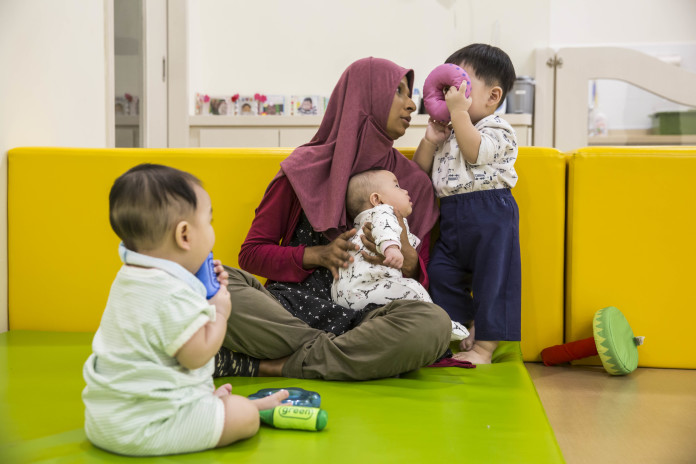
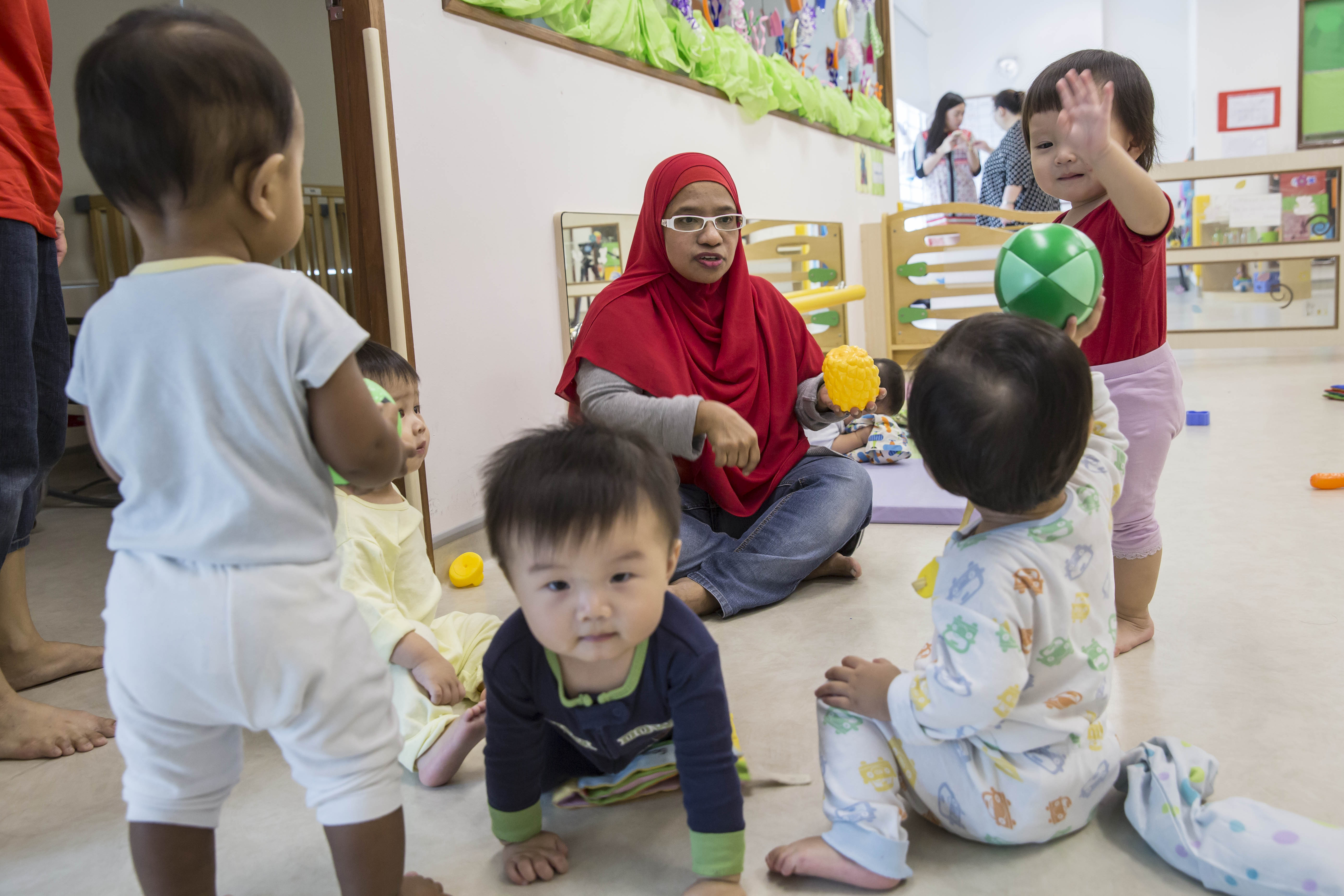
Madam Rozinah Ibrahim, 46, infant care teacher at Skool4Kidz Tampines Greenleaf, said she and her colleagues also need to handle parents’ expectations and demands. For example, some would request that their child be given solid food more times in a day. Others would take issue with the aircon temperature or ask for extra attention to be given their child. Nevertheless, it is not the parents who pose the biggest challenge – it is the little ones themselves. “I’m always worried when the children come in and refuse to eat because it’s a new environment,” she said. “For instance, a child who doesn’t (usually) take brown rice at home, or an infant who’s used to breastfeeding and takes some time to drink from a bottle and keeps crying… But no matter what, we try our best to (adapt) suit a child’s needs.”
Madam Rozinah Ibrahim taking care of children at Skool4Kidz Tampines Greenleaf. Photo: Nuria Ling/TODAY
In order to ensure quality care is given at such centres, Dr Kok Siat Yeow, deputy director of programmes at SEED Institute, stressed that society needs to see that an educarer’s job goes far beyond babysitting duties such as bathing and feeding the toddlers. “People may think it’s easy, but they underestimate that it’s a very demanding job… You have to be very watchful, and plan, observe (the infants’) growth, assess their development and be accountable to parents,” she said.
To keep up with the sector’s demand, the SEED Institute has trained more than 420 infant educarers since its inception in May 2013. This year, the institute saw six runs of the WSQ Advanced Certificate in Early Years programme, and it plans to increase the number to seven next year.
AN INEVITABLE TREND?
The number of infant care places has increased by about 47 per cent, compared to 2012. In all, there are 6,921 places as of the third quarter of this year. Actual enrolment stands at 4,221.
Mrs Teo noted that if the government wants to provide better support to millennial families, infant care is an area to look into. Apart from higher subsidies for fees and a certification framework for quality assurance, parents interviewed suggested a centralised enrollment system that could help shorten the waiting lists for popular centres. More centres, particularly in the non-mature estates, should also be built, they said.
Risk manager Kenneth Boey, 32, who lives in Sengkang, pointed out that there are no infant care services in the vicinity. Business advisor Alex Tay, who is in his late 40s, recalled that it took a while before he managed to secure a place for his son at My First Skool at Marine Terrace. “You have to do pre-booking at a few places, so one set of parents can be putting their names on three or four centres… as a result, it artificially extends the long queue… Going ahead, a centralised system might be better,” he said.
Sociologists said they expect the demand to continue to grow.
National University of Singapore (NUS) sociologist Tan Ern Ser said: “We are moving towards using professional help in more areas of our lives, so why not infant care as well?” He noted that caregivers are “trained specialists and therefore perceived to be in a better position to provide quality care”. “The bottom-line is that if there is quality care, minus the tension and anxiety that may be associated with the more ‘traditional’ arrangements, then why not,” he said. Fellow NUS sociologist Vincent Chua felt that the trend “reflects social conditions” and is driven by a variety of factors including the lack of alternatives at home, a greater ability and willingness to pay for professional services, as well as an increasing number of options in the market. Grandparents who are working themselves may not be able to take care of the children, he added.
Clinical coordinator Rosie Yeo, 53, for example, told TODAY that she had considered retiring earlier to help look after her grandson. However, she felt she was not ready yet to give up a job where she has spent almost three decades in.
“I love looking after (my) patients… Seeing that they are feeling good gives a sense of reward and job satisfaction for me… As long as I can still meet the (company’s) expectations, I’ll still stay,” said Mdm Yeo, who aspires to open a cafe one day. Nevertheless, she helps take care of her grandson on weekends, when she is not busy pursuing her passions such as cooking for her church.
Mr Tay noted that some young couples may, in fact, prefer to send their children to infant care centres – to avoid conflicts with their parents. “(There may) be too big a generation gap in upbringing or teaching style, where the husband and wife have already come to some understanding on what are the dos and don’ts… You don’t want to involve another set of decision makers,” he said.
Still, there are some parents such as admin executive Noraini Hussin, 31, who are not keen on infant care services. Ms Noraini said if push comes to shove, she would choose to work part-time to care for her two-year-old daughter and three-week-old son. Currently, her mother is helping her with them. “Every child is different, and to have four to five children being taken care by one person, no matter how experienced or professionally trained you are, I still don’t have the confidence of having any of my kids under the care of a complete stranger,” she said.