SINGAPORE: Two cars were damaged after an 8m-tall rain tree and a lamp post fell on them on Sunday (Jan 14) morning.
The incident happened at an open-air car park along Margaret Drive, beside SkyVille @ Dawson.
The windscreen of a white BMW was badly shattered, and a silver Nissan had a big dent on its roof. No injuries were reported.
“I wanted to go out for a meal, but when I came down to the car park I saw my car like that,”said Mr Elvin Ang, the owner of the white BMW and a resident in the area.
“The police were here this morning, and they just told me to make a report. I called my insurance agent straight away. I have no idea what to do next,” he added.
A white BMW had its windscreen badly smashed by a lamp post, which had been brought down by the fallen tree. (Photo: Elvin Ang)
According to eyewitnesses, the tree – which looked to have been completely uprooted – had knocked down the lamp post, which also fell onto the cars.
Channel NewsAsia understands that the tree and the lamp post were cleared from the cars at about 9.30am this morning.
The tree near a carpark along Margaret Drive fell on cars before it was removed. (Photo: Vincent Huang)
Trees in public spaces come under the purview of the National Parks Board.
There have been several reports of fallen trees over the past month, including one in Toa Payoh last Monday that saw two people taken to the hospital.
A lamp post was damaged after an 8m-tall tree in Margaret Drive fell on Sunday (Jan 14). (Photo: Rachelle Lee)
SINGAPORE: The monsoon surge affecting the South China Sea continues to keep Singapore cool as parts of the island on Sunday (Jan 14) morning hit 21.2 degrees Celsius, according to the Meterological Service Singapore,
The temperature, which was recorded in Admiralty and Jurong West between 5am and 6am, dipped below the 21.4 degrees Celsius recorded on Friday at Jurong West.
Cool weather continues in Singapore on Sunday (Jan 14). (Graphic: Meteorological Service Singapore)
Other parts of Singapore experienced temperatures between 21.3 and 22.4 degrees Celsius on Sunday between 5am and 6am.
The highest temperature recorded as of 1pm on Sunday was 24.9 degrees Celsius at Jurong Island.
NEA forecast on Wednesday that the monsoon surge will persist over the next few days, during which windy conditions with periods of moderate to heavy rain, at times with thunder, are expected over Singapore.
Temperatures are expected to range between 22 degrees Celsius and 28 degrees Celsius during this period. However, the rainy weather is expected to gradually ease over the weekend, said NEA.
On Thursday, the mercury hit a low of 21.6 degrees Celsius at Jurong West, and temperatures fell to 21.9 degrees Celsius in Ang Mo Kio and Admiralty at 10.30pm.
Singapore has in the past five years experienced weather as chilly as this: 21.2 degrees Celsius in 2016 and 20 degrees Celsius in 2013.
It has been cool and wet over the past few days, with the heavy downpour causing flash floods in parts of eastern Singapore on Monday. In the Kim Chuan Road area, about half of Singapore’s average monthly rainfall in January fell in just four hours.
SINGAPORE: For nearly two years, since he joined his running club, Mr Jimmy Hoon had kept a secret from his running mates, something that only a few of the trainers knew.
He had done eight half-marathons with them and completed his first full marathon last month. But it was only recently, as CNA Insider produced this story, that the 54-year-old revealed to them his condition.
After their warm-ups in Punggol Park before their usual Sunday run, Mr Hoon shared this: In 2013, he had open-heart surgery because of blocked arteries. He was a bypass patient.
“I was very down for one and a half years. I didn’t feel like doing anything. So running actually built my confidence,” he told the group, which responded with gasps of “ooh”, and then applause in a show of support for the man whom one running kaki called a “good running partner” and a “hero”.
Without his operation – a quadruple bypass, no less – Mr Hoon would not have the Standard Chartered Singapore Marathon under his belt now. And he felt good about telling his running buddies that.
There was a lot more he could have told them, had they not had their 15km run to do – like how he used to smoke two packs of cigarettes and drink 15 cups of coffee a day. Or how work stress used to induce panic attacks.
The journey out of his unhealthy lifestyle to reach the best shape of his life has been a long one. And literally running that road to recovery has been his redemption.
SMOKING, DRINKING AND PANIC ATTACKS
Mr Hoon picked up smoking at the age of 17, starting off as a casual smoker. But he stopped during National Service because he needed stamina then.
When he moved to China for work, however, smoking became a heavy habit because “everybody smoked” there and cigarettes were “so cheap”.
Mr Hoon went to Shanghai in 1992 as a restaurant manager of a hotel. Two years later, he moved to Beijing as Hard Rock Cafe’s operations manager when it opened in the capital. That was when the hard living began.
“In my job, I drank a lot and needed to entertain friends. Once they opened a bottle, I needed to drink a bit,” he recalled. Among those he had to entertain sometimes were Chinese officials.
“It was a totally different ball game between Singapore and China. In China, you needed to have some friends to help you along,” he said. “(Entertaining) made it easier and smooth, and you didn’t need to go through a lot of different channels. But you still had to apply for the permits.”
Another thing he had to do was to check out what other clubs were doing. “Clubbing was one of the key … things in our kind of line.”
Mr Hoon had more responsibility than ever before, from marketing to human resources to merchandising. But he enjoyed his work, especially after his wife-to-be joined him in Beijing in 1995, a year before they got married.
And he was not concerned about his health then, thinking that he was “still young, still enjoying (his) life”.
The stress of work, however, made him smoke more. It also began to trigger panic attacks – the first of which came, in fact, when he had to leave work behind: Just before his honeymoon to Mauritius.
His wife Iris Ho, 52, recalled: “We had no clue it was a panic attack. He was feeling it so much that he wanted to get off the plane. It was just fear.”
Nothing much changed after the couple started a family in 1997. Mr Hoon stopped smoking at home when the children were around, but his heavy workload still meant long days and late nights, from 10am to 3am.
Eventually, he cut down on his drinking and caffeine, after he was diagnosed with high cholesterol, gout and panic disorder. But he did not stop smoking. He went through two packs a day for at least 10 years.
A HEART-FELT BLOW
In 2012, Mr Hoon returned to Singapore after the closure of Hard Rock Cafe Beijing, not knowing what he would do next.
Tying up the loose ends was also a stressful and “emotional” period, one he had to handle alone because Mdm Ho had come back more than two years earlier with their son and daughter so that the latter could prepare for her PSLE.
A few months after returning, Mr Hoon went for a routine check-up, two years after his last one. In the intervening period, he had been feeling a slight chest discomfort on and off after going to the gym.
“It wasn’t pain. It was like a contraction kind of feeling,” he described. “It wasn’t a constant thing … so I just left it as it was.”
What it was, however, was his heart not getting enough oxygen because he had four blockages of between 50 and 90 per cent in his arteries.
At first, he was told angioplasty and stenting would unclog his blood vessels. But when it turned out that a bypass was needed, taking veins from his leg and arm to attach to his heart, the news hit him hard.
He had never thought he his unhealthy lifestyle would take such a toll. “(If) it comes, it comes lah – don’t care,” he said of his previous way of thinking.
But when it comes, you care. When it hits you, you care … you learn. That’s my experience – it hit me badly.
Up until the night before his operation, he had not come to terms yet with his situation.
“He was still asking Dr Wong (his surgeon) why. Why did it happen? And Dr Wong didn’t say anything because he had gone through the whys and the how … All the years of drinking, heavy smoking, not enough sleep, bad diet,” said Mdm Ho.
In April 2013, three months after his check-up, Mr Hoon went under the knife for five hours.
UNBEARABLE PAIN, DEPRESSION
About 99 per cent of bypass operations are successful, heart and lung surgeon Wong Poo Sing told CNA Insider. And so it was for his patient.
“We were able to improve the blood flow to (his) heart muscle, so that his heart function still remains good,” said Dr Wong.
The first thing after his operation that Mr Hoon remembers, however, was pain, which was “so bad and unbearable” that he needed a lot of painkillers.
During the next two months after his one-week stay in hospital, he felt “very frustrated” and “lousy the whole day”.
“I couldn’t lift my hands high up. I couldn’t put my hands behind. I couldn’t bend down. All (my) movements were restricted,” recounted Mr Hoon, whose wife had to help him shower and change clothes.
For three months, he confined himself to home before he finally ventured out for a walk. He had promised himself that he would stay healthy, and quitting smoking was something he had already done, a month before his surgery.
But other than walks and the recuperation exercises at home that his doctor had advised, Mr Hoon switched off and slid into negativity – unable to accept his new circumstances.
“Before, I could do a lot of things. Suddenly, it was like a 50 per cent cut. I didn’t have the strength,” he said, wincing slightly at the memory. “I was very short-tempered. I kept everything to myself.”
One and a half years went by before he managed to rouse himself, before depression could take hold. And the turnaround began by changing up his walks.
“I had a plan: Three minutes of walking, one minute of running. But that run was a very slow run,” he said.
Slow as it was, he was comforted that he could run when he had imagined that it was beyond him. Gradually, he improved to two minutes of walking and two minutes of running, until he could run for four minutes.
He then worked his way up to 2km runs. His wife – a supportive figure throughout his darkest days who made healthy meals for him – then threw him a challenge that would change his life completely.
THE FIRST 10KM
Three months after her husband started running, Mdm Ho signed him up for the 10.5km Green Corridor Run 2015. He had one month to prepare.
“It was a meaningful run, so I thought why not. I took up the challenge,” said Mr Hoon, adding that he could not back out also because his wife, who had no training and disliked running, had signed up too.
So he roped in his brother, joined a gym and began to run longer distances. During that time, however, there was one thing he felt he needed to do while running, which was to keep his hands to his chest.
Maybe it was psychological – I felt that my heart was jumping up and down … When I held (my hands up to) my chest, I felt comfort.
And that was how he did the run, from the starting point at Tanjong Pagar Rail Station all the way to the old Bukit Timah Rail Station, completing the race in one hour and 10 minutes.
“Because of my condition, when I crossed the finish line, I felt great,” he said. “I could actually do it. Why did I punish myself for one and a half years and not get up and exercise?”
His first 10.5km race, the Green Corridor Run in March 2016, with his wife.
The run came almost two years after his surgery and is still the one he “enjoyed the most”. And it got him hooked.
His second run was on Coney Island, and two months after that, he signed up for the Yellow Ribbon Prison Run.
After three 10km runs, he then joined the Safra Punggol running club, having noticed their runners so often while running near his home.
With the training sessions they had, and the greater discipline that came from running in a group, he became more confident about running longer distances. And that was why he wanted to test himself by running half-marathons.
Stretching out during the Sunday morning runs with the Safra Punggol running club.
‘LISTEN TO YOUR BODY’
The biggest test, however, came when Mr Hoon decided to go for his first full marathon. “Nobody convinced me, but I checked around (with) my club’s runners. Most of them signed up, so I just signed up,” he said.
People who didn’t understand said I was a little bit crazy … But why with my condition couldn’t I run? This was what I told myself.
Before he took the plunge, however, he googled for “bypass patients running a marathon” and found not only “a lot” who did but also those who have done triathlons.
“And they’re as old as or much older than me … 70 years old and they’re still running a marathon,” he said, though he noted they were “all in the United States, not in Asia”.
“The advice is still the same: Listen to your body.”
His cardiologist, who knew about his running experience, had told him to “take it easy”. But when it came to running a full marathon, Mr Hoon kept his cards close to his chest and only went for a normal check-up.
He did not think that any doctor would endorse his fitness for a marathon in case something were to happen.
He followed the club’s structured 16-week programme of training and recovery for the marathon.
He reasoned to himself: “A cardiac arrest can happen not only to bypass patients (but also) to a normal guy … Anything can happen (during a marathon).”
In his case, Mr Hoon did not care about his timing and so was not going to push himself, focusing instead on following the club’s structured 16-week programme of training and recovery for the marathon.
And when the time came, he found that his first marathon was like a “sightseeing” tour.
When it’s quiet, the road is closed, the sky is dark, businesses aren’t (open) yet … (the scenery) is actually beautiful. I found those moments very peaceful. I really enjoyed it.
When fatigue set in at the 35km mark, he slowed down, walking every 400 metres and then running 600 metres until the finish line, five hours and five minutes after he had set off.
It was a hugely emotional moment. “Finally, I did it. That’s the feeling. I achieved something great. I had never imagined that I’d complete a full marathon.”
Achievement unlocked – his first full marathon, in December 2017.
When Mr Hoon’s surgeon heard of his feat, he was “amazed” and also concerned.
“The type of exercise we expect (bypass patients) to do is brisk walking and maybe simple jogging,” said Dr Wong.
Jimmy is the only person I’ve known probably in the last 20 years who’s done a marathon after a heart operation.
He cautioned that heart patients who want to go and do a marathon should not do it on their own: “They must get approval from a cardiologist.”
And undergoing a bypass doesn’t mean the future will be problem-free, Dr Wong said. “Heart disease is for life.”
THE FUTURE, AND FAMILY
Which is why these days, besides regular exercise, the Hoons make sure to eat well, cooking up healthy meals in their kitchen.
Running, Mr Hoon reckons, has given him another 10 years’ lease on life, and the opportunity to see his two children grow up and live their own lives. The benefit isn’t just physical – “I feel I have more focus in many ways … I feel I’m calmer these days,” he said.
Since he picked himself up, he has returned to the food and beverage industry as a partner and operations manager at ice cream chain 320 Below (which, he highlighted, uses natural fruits with no preservatives).
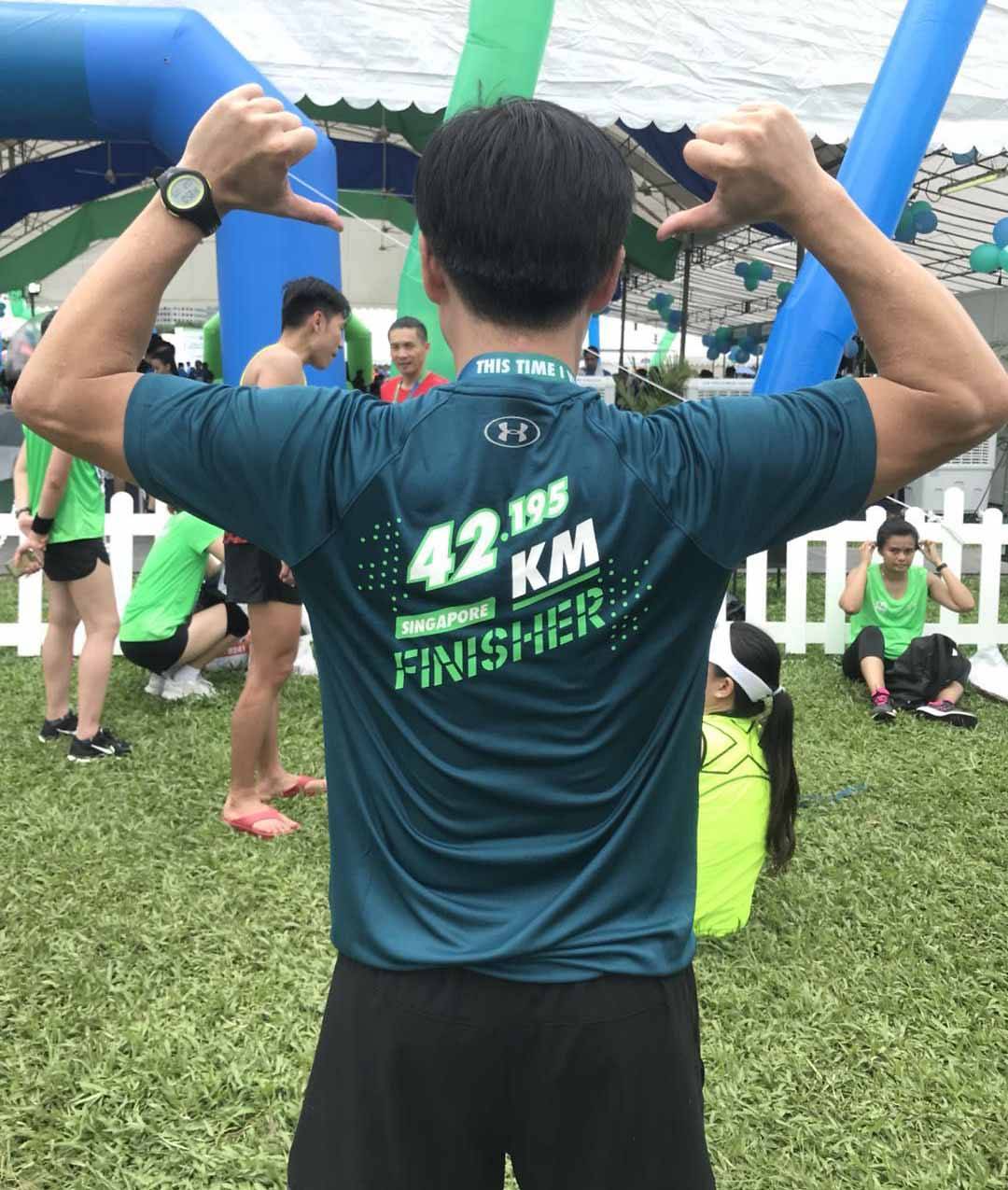
Framed on a wall in his home are the bib numbers and finisher medals for all his runs as well as the finisher jersey for his marathon – a reminder of the lifestyle change he has made.
His wall of achievements.
His biggest regret in life is that he picked up smoking, but Mr Hoon is more concerned with looking forward positively these days – to his second 42.195km run, the Sundown Marathon in May, and possibly a third one overseas, like in cooler Chiang Mai, Thailand.
Mr Raymond Lim, 46, a trainer with the Safra Punggol running club, is already amazed at what Mr Hoon has done.
“Jimmy’s case is definitely very extraordinary,” he said. “I’ve got a lot of friends or relatives who have a heart condition. Nobody even talks about running.”
Mr Hoon’s daughter Clarisse, 18, is also proud of her father’s accomplishments.
“It isn’t easy to keep up this lifestyle while working as much as he does. He proves that at no matter what age, you can still take up new hobbies or improve yourself,” said the sports and wellness management polytechnic student.
The Hoon family.
“Through seeing his health improvements, I’m encouraged to pick up healthy habits too. I hope my dad will achieve all his personal fitness goals this year and continue to run with gusto,” she said.
For Mr Hoon, there is one other thing he hopes his story can do: Inspire patients like him to “get up and exercise” with, of course, their doctor’s advice.
“It’s not easy … but (they) need to do that, be it running, swimming … whatever they need to do within their own comfort,” he said. “Exercise builds confidence.”
SINGAPORE: On Wednesday (Jan 10), Parliament agreed to the Government’s proposal to appoint a Select Committee to study the problem of “deliberate online falsehoods” and to recommend responses.
Outlined in the Green Paper accompanying the Government’s recommendation were a slew of examples of how such online falsehoods have been spread, and the damage that they have done internationally.
Addressing deliberate attempts at destabilising societies and democracies is at its core defensive. Enemies are often invisible, and the threat of retaliation as a deterrent often pointless.
As societies fight what is best described as a disease (more popularly if not bluntly called “fake news”), attacking root causes is useful, but what is most needed is inoculation. And there is no better place to start than in the concept of Total Defence.
IT STARTS WITH DEFINITIONS
Before even starting to define a solution, it is imperative that the committee sets out as clearly as possible, the problem that it seeks to address.
The Green Paper provides two important starting points.
First, it is noteworthy that the Green Paper, as well as Minister for Law K Shanmugam in his motion speech and Minister for Communications and Information Yaacob Ibrahim in his remarks in Parliament, avoided the term “fake news” entirely.
For journalists, the term has never presented anything new. Lies have always been lies. But in its recent popularisation, particularly by US President Donald Trump, it has posed significant problems.
The term “fake news” simplifies and distracts, as well as conflates and complicates.
In common parlance today, “fake news” encompasses everything from disagreements with the media, to mistakes, rumour, unsubstantiated reporting, to sophisticated propaganda and information warfare.
The term has distracted from the biggest concerns for democracies, which must be the latter. And this is something that the spirit of the Green Paper seems to have taken some pains to highlight.
Members of the Select Committee (clockwise from top left): Senior Minister of State Janil Puthucheary, Workers’ Party MP Pritam Singh, Deputy Speaker Charles Chong, Minister K Shanmugam, MPs Rahayu Mahzam, Edwin Tong, Seah Kian Peng and Sun Xueling, NMP Chia Yong Yong and Minister Desmond Lee.
The clearer definitions can be, the greater the likelihood that the Government will be able to design new policies or legislation where necessary, or see how existing tools can be used. Left vague, fear and misunderstanding follow (e.g. concerns that free speech will be curtailed) and real threats go unaddressed.
“Deliberate online falsehoods” is therefore a better start than the nebulous if not more popular “fake news”.
Second, another good start is the focus that the Green Paper has given to these falsehoods as a “tool for foreign interference (emphasis added)”. In the examples that the paper provided, as experienced in the United States, France, Germany, Italy and Sweden, it was primarily foreign threats that were highlighted.
In his motion speech calling on Parliament to convene the committee, Minister Shanmugam also pointed to our unique attractiveness as a target through which foreign interests in the region and internationally can be advanced through meddling in Singapore’s domestic affairs.
The Select Committee would therefore also do well to sharpen its focus, and find the right balance in ensuring that the most significant threats are addressed.
As it stands, these would appear to be foreign, and that is a good starting point.
“What we say on regional issues, international issues, carries weight,” Mr Shanmugam said in Parliament. “If we can be influenced and swayed, then foreign interests can be advanced through us.” (File photo: TODAY)
During the debate that followed Minister Shanmugam’s motion speech, Members of Parliament took turns to describe the various instances where “fake news” had been propagated in the past. Mr Seah Kian Peng pointed to the still-circulating photographs of “halal pork”, while Ms Sun Xueling raised the hoax in online photographs suggesting the collapse of the Punggol Waterway Terraces condominium.
Both were no doubt egregious instances of deliberate mischief, but there is no reason why such local acts cannot be dealt with in the same way that other acts of public nuisance – and especially those which threaten public security – have been approached before, i.e. through the Penal Code.
In summary, as it approaches “deliberate online falsehoods” the scale of which are outlined in the Green Paper, the committee will do well to focus on what the core issue should be: The foreign weaponisation of lies in information warfare.
TOTAL DEFENCE V.2
Thus defined, this is not by any stretch a new challenge. Information warfare has existed for as long as warfare itself. What is newer is the ease at which such warfare can be conducted through a highly networked population, and the extreme difficulty in dealing with a non-traditional and invisible “enemy”.
As recently as 2015, the Ministry of Defence had identified information as a tool of warfare as a growing threat.
In his speech at his Ministry’s Committee of Supply debate, Minister Ng Eng Hen referred to “hybrid warfare”, and how the SAF will have to raise capabilities to detect and counteract it in the cyber and information domains.
Hybrid warfare is an orchestrated campaign to fracture the solidarity of the target nation through undermining its defences in civil, economic, social, psychological and military spheres., said Minister for Defence Ng Eng Hen at the 2015 Committee of Supply debate in Parliament. (Photo: Koh Mui Fong/TODAY)
The role of the SAF and other agencies is a key part of Singapore’s armoury. But it is only one part. Indeed, Mr Ng importantly also recognised that “the concept of hybrid warfare is as old as war itself. This is why we launched Total Defence in 1984.”
Speaking to explain its launch that year, then Minister for Defence Goh Chok Tong outlined the evolving needs of a young nation and the concomitant defence imperatives that the country faced: From military and civil defence, to economic defence, social defence to defend the country’s multiracial space, and finally to an undergirding psychological defence, to ensure that Singaporeans are “willing to stand up for themselves”.
I would argue that focus on a new area of defence is needed, to ensure that Singaporeans are not just able to stand up for themselves, but also think for themselves, in what could be called a cognitive defence.
Such a defence at its core is deeply personal, and involves two key dimensions: First, growing and maintaining a deep-seated awareness of current affairs and the world around us, and especially what’s driving international conflicts.
Second, being educated about these issues, in ensuring that we understand the nuances and trade-offs, their domestic relevance, and understanding that one should only come to a judgement with all the necessary and credible information available.
One of the examples of “foreign interference” raised in the Green Paper was not strictly related to falsehoods, but leaks – involving the so-called “Macron Leaks”, where in the lead-up to the French presidential election, a massive leak of data related to the Macron campaign was orchestrated, ostensibly to tilt the vote in favour of his opponent, the far-right leader Marine Le Pen.
By all accounts, the effort had little impact on the eventual vote. There have been several reasons purported as to why this was so, e.g. it came too late, or it circulated primarily on English social media accounts following “alt-right” topics.
A leak of hacked emails belonging to the Macron campaign started spreading in the last days before France was to vote for a new president. (Photo: AFP/Andreas Solaro)
But more interestingly, in other analyses offered in the New York Times, Johan Hufnagel, managing editor of the French daily Libération suggested a few other possibilities.
First, the absence of a “broadcaster with a wide audience and personalities who build this up and try to use it for their own agendas.” In other words, there was no FOX News in France, and no tradition of a partisan tabloid media.
Second, he said that French voters, with the experiences of the US presidential vote and Brexit in the United Kingdom “didn’t want to get into that game.”
“They were mentally prepared after Trump and Brexit and the Russians, even if it’s not clear they’re behind it,” he said.
This, therefore, is more than just about media literacy. It is about mental preparation and fortitude.
On the part of the committee, it may therefore be useful for it to look into how this can be cultivated, potentially as a sixth pillar to Total Defence.
More importantly, however, Singaporeans will themselves have to step up, and build up their own “cognitive defences”, in the face of the relentless barrage of information – both truthful and otherwise.
Much like the narrative that has been developed on terrorism, the day when a concerted effort at foreign influence via online falsehoods takes place is a matter of when, and not if.
Similarly, as and when it does happen, protection in government policy and legislation will help, but what will be most important is how each one of us makes careful assessments, keeps calms, and carries on.
SINGAPORE: It’s been about four months since Tan Chuan-Jin took on the role of Speaker of Parliament, but still, the word that is most often associated with him is “demoted”. When I meet him in Parliament House for our interview, he says with a wry smile that he thinks it’s unfortunate that many members of the public continue to fixate on this.
The 48-year-old, who spent nearly 24 years in the military before entering politics, has been “a good soldier” throughout this. If he is disappointed with his new role, he rarely shows it, often speaking about it with a smile on his face.
But beneath the veneer of the good soldier, there must be a man who wondered why he was moved from his position as a full minister to take on the largely procedural role of Speaker and a politician who might be worried about his future.
He admits to wondering about the reasons for his new appointment.
“I did think about why this happened. I thought about it in my own mind, but I don’t linger on these issues.
“There will be those who feel that you didn’t do well and that’s why. And there will be those that felt it might have been health issues. There were those who suggested I stepped on some other peoples’ toes,” he says.
“But actually, when the prospect of Mdm Halimah becoming President was raised with me, I felt that (being Speaker) is something that I could possibly do.”
Did he ask anyone in Cabinet why he was being nominated for the post?
“No, I just pretty much embraced it. That’s pretty much how I’ve approached every single transition to every job.”
THINGS DON’T ALWAYS PAN OUT AS YOU WISH
“In life, things don’t always pan out exactly as you wish,” he says, as we continue to discuss his career.
“Perhaps you wish you could have been promoted. You wish you could have this job or that job and sometimes you don’t always have full control over it and I’ve come to realise that another perspective to look at is really to be just passionate about whatever you are doing.”
But what was his original “wish”?
“Frankly, when I first came into politics, if I had the choice, if I’d been asked, I would’ve asked to go to the then-Ministry of Community Development, Youth and Sports, but I was asked to go the Ministry of National Development. I ended up enjoying it a great deal because we were dealing with environment and heritage issues which, to me, were related to us caring for something that’s beyond just the transactional.”
Mr Tan eventually moved to the Ministry of Social and Family Development and launched initiatives such at KidStart for children from disadvantaged backgrounds. He also launched SG Cares, an initiative to encourage volunteerism.
He speaks passionately several times during our interview about “tending to the softer aspects of society”. He continues to oversee SG Cares and has been appointed adviser to the National Council of Social Service.
It was in 2009 as head of the organising committee for National Day that he saw the benefits of contributing.
“We brought the military police and some of our artillery guys to the Assisi Hospice. The performance that they put up there was probably more important than the one they put up on the actual day because for many of the residents in the hospice, they were not actually going to get to see this again.”
“I realised that the takeaway was not just for those whom we are reaching out to, but the impact on us. That’s when you realise that perhaps there is something that we can do in our society to build a society that’s more caring, that’s truly inclusive, compassionate.”
Mr Tan Chuan-Jin, Minister for Social and Family Development, giving out vouchers to needy residents in Bedok (Photo: BBTC)
POLITICAL AMBITIONS
But I still wonder about his political ambitions and whether because some have said he was likely in the running to be Prime Minister, he desires the post.
“That has not been something that I think about. It’s something that others talk about.
“It doesn’t matter to me. I have the responsibility in whichever role to carry it out to the best of my abilities to make the difference I can,” he says.
“I take this approach to life and my career, not just in politics but even in the Singapore Armed Forces. I go where the openings are. If I’m told that there’s this job and I’m going to be posted there, basically I take it up and then move forward. I know that certain jobs can be seen as prestigious, but I think I have a duty and responsibility to just take up where the organisation or the team feels that I’m best suited to go and I’ve embraced every opportunity.”
ASSESSING HIS POLITICAL CAREER
Considering that his latest transition could spell the end of his political career, I wonder if he has considered the possibility.
“I don’t call the shots. If the party feels it’s time for a renewal, thanks you for your services and says it’s time to move on, then it’s time to move on and then you serve the public in a different capacity,” he says.
“We shouldn’t be self-entitled to think that just because we enter politics, it remains in perpetuity. You serve only as long you have value-add and are needed.”
There it is again – the veneer of the good soldier who doesn’t crack. He goes where he is needed and steps away quietly when he is not.
Is he worried that his career is in danger?
“No, I’m not,” he says as soon as the question is asked.
He pauses just for a second before he adds, almost circumspectly, “I’m only worried in so far as if I don’t have the stature and influence to shape the things that I feel are important to society.”
As he has said in previous interviews, helping the public understand parliamentary processes and procedures and democracy is one of these things.
But he also wants to use his role as Speaker to “begin to reach out to groups, to individuals, to different segments of society to look at the whole concept of giving and volunteering.”
He is currently working with schools and corporates and hopes his stature will enable him to get “face time” with decision-makers to raise Singaporeans’ desire to contribute to society.
He points out that his political career remains varied. After all, he continues to lead Marine Parade GRC.
What would he do if his political career does indeed end though?
“I’ve always been interested in the social realm. If I hadn’t joined politics that could be something I’d be doing. I can imagine that is something that I could do subsequently as well.”
STILL SEEN AS THE MINISTER “WITH NO SENSE OF REALITY”
While Mr Tan speaks of his passion to help the disadvantaged, some of his comments about this group have come under intense scrutiny in the past few years.
“I’m still seen as the minister with no sense about reality, stuck inside an ivory tower and who thinks that old people collect cardboard boxes for leisure or exercise,” he says.
It was in 2015 that he met cardboard collectors in Jalan Besar with members of the Youth Corps Singapore team. He subsequently posted on social media that not all cardboard collectors are people who are unable to take care of themselves financially.
This drew the wrath of many netizens, some of whom bring it up today when Mr Tan’s name is mentioned.
His boyish, light-heartedness dissipates as we discuss this.
“All I was saying was that there is a range. I have residents who collect cardboard. Some of them I know, because they are on public assistance. We are helping them, but they continue to want to do that. I also know one who has six figures in her bank account. My point really was to say that the key thing is to speak to them, find out. If in doubt, help them. Get the details, let us know and we will follow up. That was the context.
“But one of the sites zoomed in on one particular comment and took that as definitive and everything else didn’t matter. Unfortunately, I’m stuck with that.”
Has this made him more careful about how he communicates today?
“It’s not pleasant. I guess for some, making comments like that, tearing someone down, makes their day. For me, I guess that’s part and parcel of public life today,” he tells me.
“I think we need to be circumspect but we can’t live in fear; because otherwise I’ll just end up making very sterile statements. Usually, that means saying pretty much nothing.”
“I’m only worried in so far as if I don’t have the stature and influence to shape the things that I feel are important to society,” says Tan Chuan-Jin. (Photo: Gaya Chandramohan)
THE OPPOSITION GETS OVER 30 PER CENT OF PARLIAMENTARY AIRTIME
We move on to discussing parliamentary issues.
As with most Speakers from the ruling party, people have raised concerns about his possible lack of impartiality.
“I’ve had people come up to me and say, now that you’re Speaker, you should be more impartial and let the opposition speak more. I ask them, ‘What exactly do you mean? Are you basing it on perception, or are you basing it on fact?’”
He asked his parliamentary staff to research the last year’s proceedings.
“It’s shown that in terms of airtime, the opposition members speak up over 30 per cent of the time whether through responses or through questions. Just nine of them – six elected members and three Non-constituency Members of Parliament in a field of 101 members of parliament and they get over 30 per cent of airtime.”
“I know Mdm Halimah gave them time and I certainly do. I personally actively try to set aside opportunities for the opposition to speak up, especially in a PAP-dominated parliament. We do try to make sure that there is fair representation.”
I put it to him that while volume is one factor, some members of the public take issue with the texture of debate in that they perceive that PAP members “bully” the opposition members or don’t consider their views.
“These are the perceptions of certain members of the public, and we cannot control that.”
AGNOSTIC ABOUT “LIVE” STREAMING
We then discuss “live” streaming of parliamentary proceedings for the sake of full transparency for members of the public who are still sceptical.
“I’m quite agnostic. I don’t have a particular issue with that.”
He points to data that shows viewership of “live” broadcasts remains low. The number of people who watched the Budget “live” is fewer than 10 per cent of those who watched the parliamentary highlights on the news that evening. Fewer than one per cent of all viewers watched the Budget live using web-streaming.
In spite of that, Mr Tan is willing to consider raising the possibility of “live” broadcasts again.
“I would have to discuss this with government, whether this is something that we would seriously want to consider and perhaps do another trial.”
But he emphasises this is not a silver bullet.
“More important is actually understanding. I can watch, but I may not understand how that process is supposed to unfold or why this person speaks, why that.”
This is why he is determined to start a public education process to explain the various parliamentary procedures and processes. He intends to do so on social media and even through YouTube videos.
He hopes to also strengthen the Singapore Model Parliament initiative, a platform for Singaporean youths to learn about parliamentary processes and national issues through stimulation of parliamentary debates.
A NEUTRAL SPEAKER
I point out to him that perhaps one way to ensure impartiality is to have a Speaker who is not from any political party.
“That’s not up to me,” he says.
It isn’t, but I seek his opinion on the issue. He is non-committal.
“That’s one approach,” he suggests.
“In some other parliaments, you can remain under party; in some other parliaments, they resign and become neutral. But I think it’s useful to ask the opposition MPs whether I’m fair and impartial.”
In September last year, when Workers’ Party (WP) MP Sylvia Lim did not get to speak on her adjournment motion on the Presidential Election till much later, members of the public had alleged that PAP MPs had filed motions of their own to block her.
“But people didn’t realised that adjournment motions had been tabled before by three other MPs. We balloted, we picked one and two of them were rolled over and then as it turns out, Sylvia tabled hers. Everybody thought that Vikram’s and Murali’s motions were tabled out of nowhere just to block Sylvia’s. If they had known the sequence, one could argue that she came up with a motion to block theirs,” he explains.
While the opposition has suggested greater citizen participation in policy-making through Select Committees and even more consultation exercises, Mr Tan believes the basics need to be explained first.
“People get very agitated when they don’t understand the process and feel that it is unfair. I think it’s important for them first to have confidence in the process.”
He also highlights the misconception that some parliamentary questions are not answered.
“The truth is, every parliamentary question is answered, whether orally or in written form. Sometimes in terms of sequencing, they may not get answered. But it’s rolled over, sometimes several times.”
Speaker of Parliament Tan Chuan-Jin at work.
LIFTING THE WHIP
Considering Mr Tan has also been talking about encouraging more free-flowing and robust parliamentary debates since his appointment, I ask if this should be reflected in parliamentary votes as well.
Former PAP MP Inderjit Singh had suggested lifting the party whip when Parliament votes on major policies such as the Population White Paper, not just on issues of conscience.
“In order for you to make good decisions, you do need the robust exchange of ideas, so you need to facilitate that but ultimately you need to be decisive,” says Mr Tan.
I put it to him that inevitably, they may not take into account perspectives considered important by some quarters.
“You elect a government who would then represent you in the course of the term of the government, whose duty is then take on board feedback, sense-make, and decide decisively. If you take it to the other extreme, it’s almost like referring most decisions to a referendum. I’m not sure whether that’s the path we want to take.”
LOOKING THROUGH EVERY IVORY TOWER
“We must also remember that the debate no longer resides in Parliament alone. We receive so many inputs from the members of the public who are involved in focus groups, who write to us with very in-depth perspectives.”
But how much does the Government actually listen?
He admits that people often raise that question.
“When I was in the Manpower Ministry for example, I had companies and individuals saying, ‘You’re stuck in an ivory tower. What do you understand about my business?’
“But my issue is I need to look out through every ivory tower because your company feels that there’s this need but someone else’s company feels that there’s a different need.”
MPs’ COMMITMENT
Another issue that comes up from time to time is how committed MPs really are.
Their attendance rate has been questioned. Some have even said they’ve noticed MPs doing non-parliamentary work during sessions.
“That’s where the whip and the leader needs to make sure that the members are fully aware of their responsibilities and carry that out.
“At times they are also clearing something that may be urgent. In the real world today, at work, many things are happening at the same time. We have developed abilities to also toggle – listen while clearing something.”
I again point out that surely for an MP, parliamentary proceedings should take priority.
“In different degrees. At this point, I wouldn’t insist and say that the MPs should just give undivided attention and nobody should be clearing any correspondence or any messages that come through. I think right now there’s a reasonable balance.
“But if it does become a chronic problem that’s something that I will have to speak to the respective leader and whip of the day about.”
To prevent distractions, I suggest encouraging more MPs to go full-time.
“I think we have a responsibility to our residents, but at the same time, as a Member of Parliament you need to be plugged in to the rest of the world, not just as an MP on the ground. When you are working, whether in the social sector, whether in the private sector, it also allows you to have a better perspective of the different issues that actually concern us.”
A FLAWED DEMOCRACY?
While Mr Tan has touched on building a strong parliamentary democracy, I wonder what the term actually means to him.
The Economist Intelligence Unit (EIU), in a report last year, rated Singapore a “flawed democracy”.
“I strongly believe in S Rajaratnam’s words that it’s not a democracy of words but it’s a democracy of deeds. It’s about what is able to improve the lives of our people,” Mr Tan says.
“Organisations like EIU can choose to label us in whatever way they so wish. That’s their prerogative and there are also other organisations that rate us well on different fronts. We are not answerable to them. We are answerable to our people.”
I remark that lately on several fronts including transport, many say the Government isn’t doing enough to improve people’s lives.
“Understandably, the problems affect confidence. For some, it’s a definitive issue in an election. It is the right of individuals if they use that as a benchmark. Obviously things can be better. We can improve.
“When it comes to an election, our people will make their sentiments known. Certainly in 2011, we could sense it, we could feel it.”
Tan Chuan-Jin posing with Singapore Armed Forces personnel at the National Day Parade in 2015.
THINKING ABOUT A LEGACY “IS ABSOLUTELY THE WRONG THING TO DO”
Towards the end of our conversation, we turn to issues of legacy.
What would a career soldier, a former minister and now, Speaker of Parliament want to be remembered for?
“I really don’t want to start thinking of building a legacy. I think that’s absolutely the wrong thing to do.
“I might become more concerned about how people will regard me and the work I do than actually doing the work. I think it might affect the way I approach things because I’d be more mindful about how it possibly could be seen badly.”
However, what he says next shows that he does want to leave his mark in some form.
“I would like to support efforts that would help Singapore become a better society, us becoming better people, truly look beyond self and care for others. I don’t know how far I’ll go but I think it’s something worth striving for.”
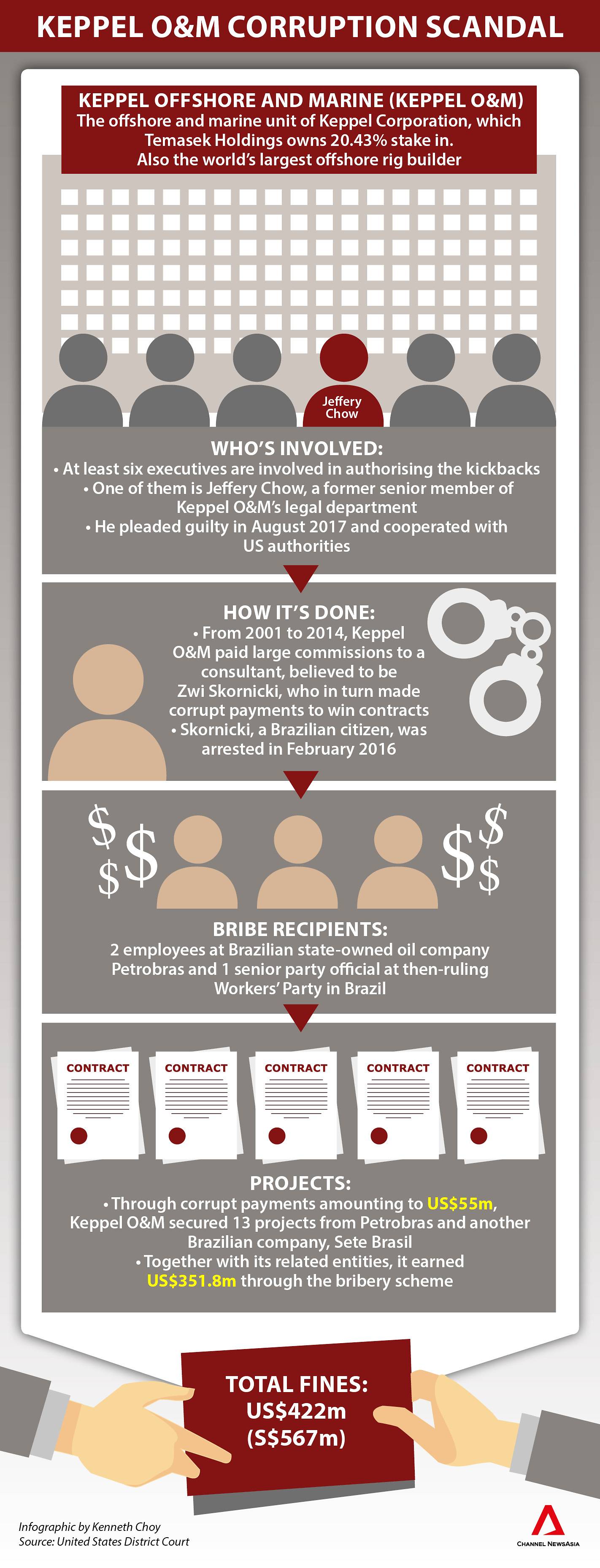
SINGAPORE: In February 2001, a joint venture of Keppel Offshore & Marine (Keppel O&M) in Brazil snagged a US$75 million (S$99.6 million) contract to convert an aging tanker into an offshore production centre.
The floating production storage and offloading facility (FPSO) would be deployed for oil and gas production at Caratinga, a deep-water oil field located northeast of Rio de Janeiro.
The contract, awarded by a Brazilian subsidiary of US engineering company KBR Inc, was a win for the young joint venture formed by Keppel FELS, which was later merged into Keppel O&M, and Brazil’s PEM Setal Group.
Called the P-48, it was the “largest” FPSO conversion project undertaken in Brazil then and its delivery in 2004 marked a “milestone” for Keppel O&M’s operations in the South American country, said former CEO and chairman Choo Chiau Beng in a stakeholders report.
There was, however, a darker side to the story.
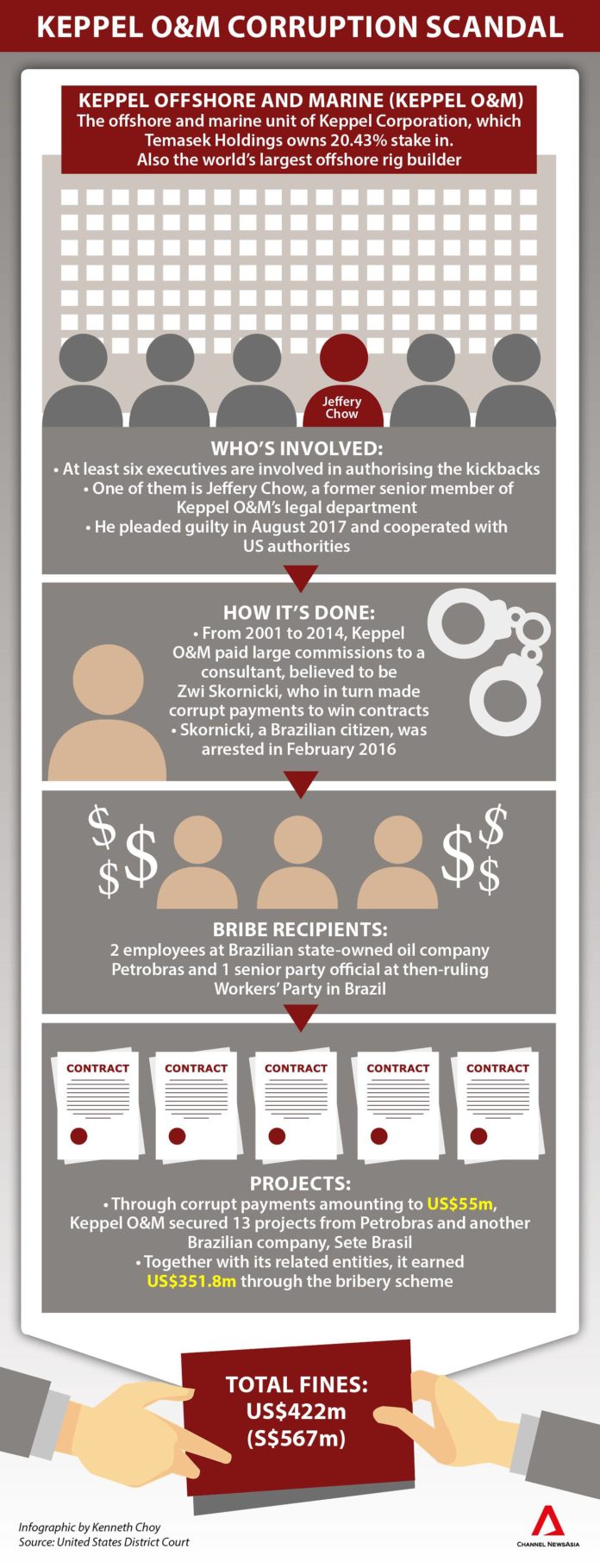
Between June 2001 and April 2002, Keppel O&M paid bribes in installments to Brazilian government officials who had helped “put pressure for the (P-48 project) to be carried out”, according to court documents released last month by the US Department of Justice (DOJ).
Emails between Keppel O&M’s executives, a financial controller at its subsidiary and a joint venture partner contained instructions for money to be paid to “some governmental guy(s)”, and later referred to as “friends”, who said “it was definitely with their help that the conversion landed up in Brazil”.
When the email authorising the last installment of US$50,000 was sent on April 4, 2002, a total of US$300,000 in corrupt payments had been made for the P-48 contract.
That marked Keppel O&M’s first bribe-for-contract payment in Brazil and by 2014, the bribes had snowballed into US$55 million for the inking of another 12 deals with Brazilian state-owned Petrobras and Sete Brasil.
As part of its modus operandi, millions of dollars in bribes were disguised as large commissions to a consultant in Brazil under legitimate consulting agreements. This consultant is believed to be Mr Zwi Skornicki, Keppel’s former agent in Brazil who was arrested in February 2016.
These illicit payments, made to bank accounts in and out of the US under the names of shell companies controlled by Mr Skornicki, were then transferred to bank accounts elsewhere and into the pockets of company officials and politicians at the then-governing Workers’ Party in Brazil.
For its dirty deal-making over 13 years, Keppel O&M, a unit of local conglomerate Keppel Corporation which state investment firm Temasek Holdings holds a 20.43 per cent stake in, was slapped with a hefty fine of US$422 million as part of a global resolution with authorities in three countries.
This was a penalty harsher than the Keppel unit would have received under Singapore’s Prevention of Corruption Act, said Senior Minister of State for Finance and Law Indranee Rajah in Parliament this week.
In response to the flurry of questions from Members of Parliament (MPs) during the first Parliament sitting of the year, Ms Indranee emphasised that Keppel O&M did not get off lightly for its involvement in the international corruption case.
The Attorney-General’s Chambers (AGC) has also sought assistance for evidence from authorities in other jurisdictions for local investigations to move “as expeditiously as possible”.
THE RISE OF WORLD’S LARGEST RIG BUILDER
Headquartered in Singapore, Keppel O&M was incorporated in 2002 through the integration of offshore rig builder Keppel FELS, vessel repairer Keppel Shipyard and specialised shipbuilder Keppel Singmarine.
The formation of the new Keppel unit was aimed at drawing the “synergies and collective strengths of its yards and offices worldwide”, and “end in-fighting and competing against each other”. “To become a truly global company, we would have to forge a unified team,” Mr Choo was quoted as saying.
And become a global player it did.
Through acquisitions and partnerships with governments and businesses, Keppel O&M has since built up a network of 20 yards in the Asia Pacific, Gulf of Mexico, Brazil, the Caspian Sea, the Middle East and the North Sea regions. It also has a stable of engineering and technology centres in countries, including Bulgaria and China.
Keppel O&M has been the biggest cash cow of its parent company, typically contributing about two-thirds of group revenue, until recent years when plunging oil prices hammered profits at the world’s largest rig builder.
It operated at break-even profitability for the third quarter, while revenue for the three months to Sep 30 dropped 26 per cent to S$380 million on lesser work volumes and the deferment of projects.
Keppel O&M also witnessed a change in leadership in 2017, with Mr Chris Ong taking over Mr Chow Yew Yuen as its chief executive. Prior to this, Mr Ong, 42, was the managing director of Keppel FELS.
“STRONG NEXUS” WITH BRAZIL
The Keppel unit’s relationship with Brazil dates back to the 1980s when it took on various vessel repair and conversion jobs from Petrobras.
In 2000, Keppel FELS formed a 60:40 joint venture with Brazil’s PEM Setal Group to grab a bigger slice of the Brazilian market.
Within a year, FELS Setal secured US$120 million worth of contracts and began running its shipyard in Angra Dos Reis, said an April 2001 media release.
The P-51 project, a semi-submersible production platform used in Petrobras’ Marlim Sul oil field, was one of the 13 deals that Keppel O&M won through the bribery scheme. (Photo: Keppel O&M)
Its activities in Brazil expanded alongside the rise in the South American country’s profile as an important oil and gas (O&G) market, following the discovery of large oil reserves off the coast of Rio de Janeiro in the 2000s.
Riding on this tide of growth in Brazil, Keppel O&M saw strong growth and along the way, began differentiating itself by moving up the value chain to produce higher-value customised rigs fit for harsh sea environments, industry experts told Channel NewsAsia.
By 2012, the Keppel unit had delivered some 20 major projects, including floating production units (FPUs), drilling rigs, FPSO units and drillships in Brazil.
According to IHS Markit’s analyst Ang Dingli, Brazil accounted for the majority of Keppel O&M’s higher value projects.
“Brazilian projects have definitely contributed much to Keppel’s order book given that each Brazilian project was typically of higher contract value than the smaller conversions that Keppel mostly secured in Asia,” he said.
Underscoring Brazil’s status as one of its key markets, a 10-year anniversary supplement published in 2012 said the company is “anchored in Brazil” and has developed a “strong nexus” with the country.
Even as Brazil’s O&G sector took a hit from a double whammy of political woes and plummeting oil prices, Keppel O&M said in its 2016 stakeholder report that the country “is expected to remain as an important oil and gas market in the long-term”.
Apart from the country’s vast offshore oil and gas reserves, other positive factors include “significant funds for Exploration & Production (E&P) investments” from Petrobras and the intention of foreign oil majors, such as Shell, Total and Statoil, to increase their investments in Brazil.
The Brazilian government also had flattering words for Keppel O&M.
Speaking at the naming of the P-56 project, which was a US$1.2 billion contract clinched by a Keppel-led consortium to build a semi-submersible FPU for a Petrobras subsidiary, then-Brazilian President Dilma Rousseff said: “We have proven that it is possible to build rigs, platforms and equipment for offshore exploration in Brazil.”
“We shall count on the partnership of companies which come from far away, such as that of Keppel FELS that comes from Singapore… They know that if they come to Brazil, they will have the guarantee of a demand from Petrobras,” she was quoted as saying in Keppel O&M’s 10-year anniversary supplement.
Former Brazilian President Dilma Rousseff (centre) seen at the naming of P-56 in June 2011 with Keppel O&M’s top managers, such as former CEO Chow Yew Yuen (left). (Photo: 10th Anniversary Special Supplement in Upstream)
But stiff competition for projects may have forced the company to find any edge possible to secure a deal.
According to the US court documents, Keppel O&M made corrupt payments to obtain the 13 contracts even when concerns of running afoul with the law surfaced – as seen in the emails for the P-61 project.
The US$1 billion contract, awarded in 2010 to an equal joint venture between Keppel FELS and US engineering firm J. Ray McDermott, involved the building and operating of the P-61 Tension Leg Wellhead Platform (TLWP) in the Papa-Terra field located in Brazil’s Campos Basin.
Apart from being a boost in its order book, the project would help Keppel O&M to establish a “stronger presence” in a niche product area like the TWP, said OCBC analyst Low Pei Han.
Work to obtain the large platform construction contract from Petrobras began in 2007 but in March, a joint venture manager had expressed concerns about retaining Mr Skornicki for the project because “under the joint venture partner’s corporate governance rules it cannot pay (Consultant) to pay government officials”.
An email from Keppel O&M’s executives in April said that if they are “so hand tied to the US Code of Business Conduct, it would not be possible to involve (Consultant) which in reality diminishes our chances in the project.”
In 2008, following several discussions about limiting the scope of Mr Skornicki’s consulting services and bribery concerns expressed by the joint venture partner, an email from a Keppel O&M executive reiterated the need for “fees” to be made.
“(Consultant) also mentioned that (the joint venture) was not originally invited for this project until much lobbying with his friends help. And the fees were told to us sometime ago. If they perceive us as not honouring our commitment, it may be bad for future business,” DOJ’s documents showed.
In 2009, executives from Keppel O&M authorised the payment of bribes equal to a percentage of the P-61’s contract value to a Brazilian official and the country’s then-ruling Workers’ Party. The illicit payment totalled US$8.8 million.
A Keppel-J. Ray joint venture secured Brazil’s P-61 TLWP contract worth about US$1 billion in February 2010. (Photo: Keppel O&M)
OVERHAUL OF CORPORATE CULTURE NEEDED
Despite the high-profile corruption scandal, industry experts believe that Brazil remains a key market for Keppel O&M given the country’s abundance of deep-sea oil and gas reserves.
Singaporean rig builders also remain best positioned to land upstream oil and gas contracts with their experience and expertise.
But to avoid falling into the murky waters of corruption again, it will need a comprehensive revamp of the organisation, said Mr Toru Yoshikawa, professor of strategic management at the Singapore Management University’s (SMU) Lee Kong Chian School of Business.
Citing how Keppel Shipyard was also charged with corruption more than 20 years ago, Prof. Yoshikawa noted that an overhaul of both the board and corporate culture will be necessary.
“A change in people does not mean that this will never happen in the future so there needs to be a change in the system.”
According to the Corrupt Practices Investigation Bureau (CPIB), Keppel Shipyard was charged in 1997 for giving bribes to secure business deals overseas.
For one, Prof. Yoshikawa raised the example of implementing a whistleblowing policy that would encourage and protect employees who speak up about malpractice in the company.
These changes will also have to be extended to its subsidiaries overseas, he added.
As part of its Deferred Prosecution Agreement (DPA) with US authorities, Keppel O&M has had to take on “extensive remedial measures”.
Those included disciplinary action against 17 former or current employees which led to seven employees departing the company; demotions and/or written warnings to seven employees; approximately US$8.9 million in financial sanctions on 12 former or current employees; and anti-corruption and compliance training for six employees.
Keppel’s spokesperson said the company has “moved quickly” to strengthen its regulatory compliance measures and has rolled out an enhanced programme across the group.
Specific measures include an enhanced code of conduct containing detailed anti-corruption provisions and guidance on dealing with intermediaries.
Amid questions raised by corporate governance experts about the efficacy of its auditing and internal governance, the spokesperson responded to queries on Jan 5 that the current boards of directors of Keppel Corp and Keppel O&M “were not aware of the illegal payments” made in Brazil.
The illegal payments were “deliberately concealed by those complicit in the bribery and structured as agency fees”.
“The agency fees were not approved by the Boards of Keppel Corporation or KOM as they were built into the contract values of the respective projects and bidding for projects is in the ordinary course of KOM’s business,” the spokesperson added.
While it is possible for the board to be unaware of the unclean deals, Prof. Yoshikawa suggested the set-up of an independent department within the company moving forward.
This department will “be neutral and free from any influence” as it provides information about the company to board members.
Such “actionable” plans will be crucial as Keppel O&M seeks to recover from the scandal, said the SMU professor.
“Companies usually announce some commitment to make changes following such incidents, but people will be watching at how actionable and implementable these plans are.”
SINGAPORE: The police will be taking action against two restaurants in Chinatown that were caught selling alcohol after the time they were licensed to do so.
In a news release on Saturday (Jan 13), the police said it conducted a series of licensing checks at bars, pubs and restaurants along Prinsep Street and Chinatown on Friday.
The two restaurants were the only ones out of the 44 outlets checked found to have breached liquor licensing conditions by supplying liquor and allowing its consumption beyond the permitted timing, according to the police. Action will be taken against these operators, they added.
The restaurants were caught selling alcohol and allowing customers to consume it after the permitted timing. (Photo: Singapore Police Force)
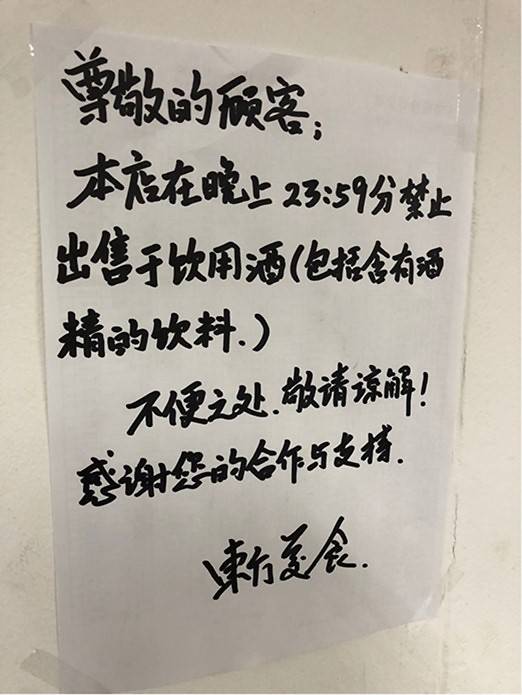
Channel NewsAsia understands Oriental Chinese and Si Xi Restaurant, both along New Bridge Road, were licensed to sell alcohol and have patrons consume alcohol on their premises until 11.59pm.
A notice in Mandarin, posted at Oriental Chinese, even notes the rule: “Dear valued customers, this restaurant stops selling and allowing consumption of liquor (including alcoholic beverages) at 11.59pm. Please forgive us for any inconvenience! Thank you for your cooperation and support.”
A notice posted outside one of the restaurants notes that it must stop selling and allowing consumption of alcohol by 11.59pm. (Photo: Singapore Police Force)
Any shop found selling liquor or allowing liquor to be consumed within its premises after permitted hours may be fined up to S$10,000.
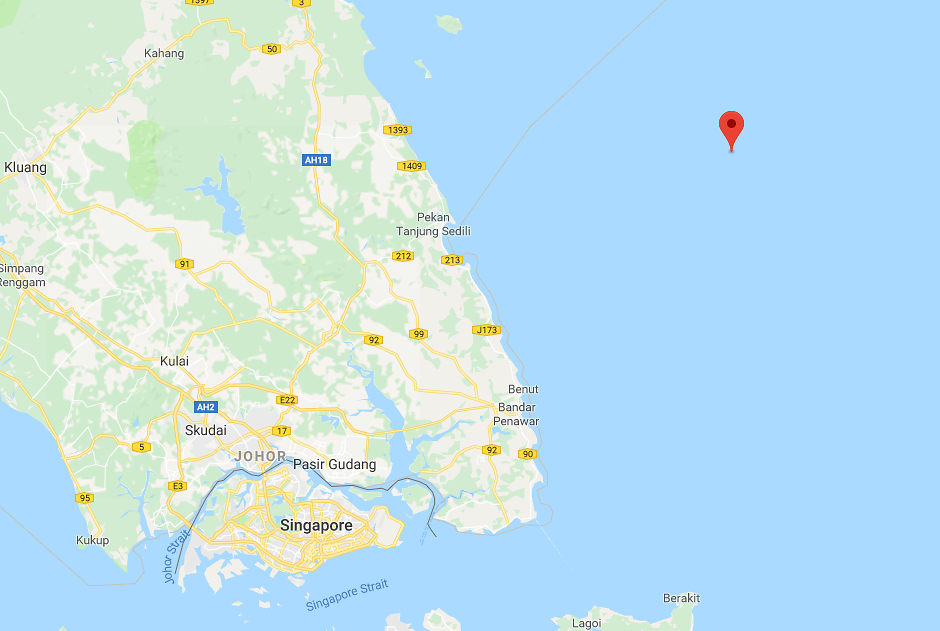
SINGAPORE: Eleven crew members have been rescued from a sunken vessel in the South China Sea while two more are still unaccounted for, said the Maritime and Port Authority of Singapore (MPA) in a media release on Saturday (Jan 13).
At about 3.50pm on Friday, MPA said it was informed by three passing merchant vessels that they had rescued 11 people from a vessel that had sunk in the South China Sea within the Singapore Maritime Search and Rescue Region.
According to the survivors, there were 13 crew members on board the sunken vessel. Two are still unaccounted for.
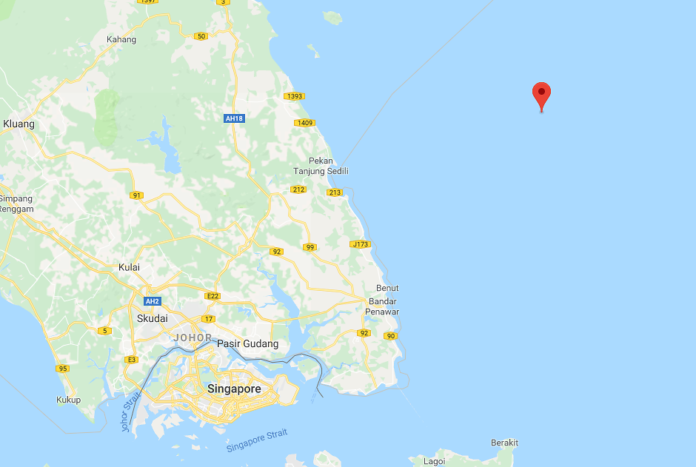
The location of the vessel based on MPA coordinates. (Source: Google Maps)
MPA said that it has been providing navigational broadcasts to vessels in the area to report any sightings of people overboard and to navigate with caution in the vicinity of the incident.
The Republic of Singapore Air Force (RSAF) has also deployed one Super Puma helicopter and one Fokker-50 maritime patrol aircraft to support the search and rescue operation.
MPA is coordinating the ongoing search and rescue operation with the Malaysian and Indonesian authorities, it said.