Iconic rock musician Eric Clapton has revealed that he was “going deaf” after being diagnosed with tinnitus.
“[What] I’m concerned with now is being in my 70s and [staying] proficient. I mean, I’m going deaf, I have got tinnitus, my hands [are] just about work,” the singer-songwriter, who has just released his documentary, “Eric Clapton: Life in 12 Bars,” said in an interview with BBC Radio 2.
“I mean, I’m hoping that people will come and see me for more than that; [because] I’m a curiosity,” he said. “I know that is part of it, because it’s amazing to myself that I’m still here.”
LONDON – Ed Sheeran’s latest bestselling album will vie with four debut offerings at this year’s Brit Awards, including one by breakthrough pop star Dua Lipa.
Sheeran, whose “Divide” was the fastest-selling album ever for a male solo artist in Britain, is nominated in the best solo artist and best album categories at the Feb 21 awards.
Dua Lipa has five nominations including best British female solo artist, where she will battle it out against 2015 winner Paloma Faith, rapper-poet Kate Tempest, Jessie Ware and Laura Marling.
Dua Lipa is also among four artists whose first full-length studio albums have been nominated. Grime star Stormzy, singer Rag’N’Bone Man and rapper J Hus join her and Sheeran for the best album prize.
In the solo male category, Sheeran faces former Oasis frontman Liam Gallagher, Stormzy, London rapper Loyle Carner and Rag’N’Bone Man.
The best British band nominees are Gorillaz, London Grammar, Royal Blood, Wolf Alice and The xx.
In the international categories, Foo Fighters, Haim, The Killers, LCD Soundsystem and Arcade Fire are up for best group.
Taylor Swift, Lorde, Bjork, Pink and Alicia Keys are up for best international female while Childish Gambino, Beck, DJ Khaled, Drake and Kendrick Lamar are up for best international male.
SINGAPORE: As Singapore continues to develop as a Smart Nation, there is a need to include more women in building a strong core of Singaporeans in all growth sectors such as science and technology.
Second Minister for Home Affairs and Manpower Josephine Teo said this at the launch of the inaugural Women in Technology and Design conference at the Singapore University of Technology and Design (SUTD) on Monday (Jan 15).
While female employment rate in Singapore ranks high globally, Mrs Teo said that pockets of concerns remain.
In the corporate world, women occupy some 30 per cent of the senior executive positions but just 9.9 per cent on the boards of publicly listed companies in Singapore, behind countries whose economies are less developed.
Specifically in the sector of science and technology (S&T), about one in four is a woman and this proportion has stagnated in a decade.
While the number of female IT professionals has grown about 10 per cent since 2011, it is still less than half the growth seen in their male counterparts.
At the local universities, female enrolment in S&T has plateaued at around 3,300 students, with the share of women dipping below 40 per cent.
This, she said, raised two areas of concern.
“The first is that as Singapore develops as a Smart Nation, new industries and career opportunities are opening up for those with specialised skills which often draw on a background in S&T.
“When young women who have the ability to master science, technology, engineering or mathematics (STEM) subjects shy away from these disciplines, it sets them on a course in life that is less likely to benefit from the uplift that technology brings to industries and of course to careers,” Mrs Teo said.
“A second reason to be concerned is that in seeking to build a strong core of Singaporeans in all our growth sectors, it will most certainly be a loss to society if not enough of our women have the relevant training to come on board,” she added.
SPECIAL INTEREST GROUP TO HELP WOMEN IN TECH
The conference also saw the launch of the Women in Technology@SG (WiT@SG) interest group, housed under the Singapore Computer Society.
Made up of 11 women from Citi, IBM, DELL EMC and SUTD, the group was created to increase and advance the participation of leadership of women in technology through the creation of a platform for women.
(From left) Howie Lau, Chan Ai-Ling, Shanya Sun, Dr Dawn Tan, Prof Lim Sun Sun, Prof Chong Tow Chong, Second Minister for Manpower & Second Minister for Home Affairs Mrs Josephine Teo, SUTD Chairman Mr Lee Tzu Yang, WiT@SG Chair Meggy Chung, Corinna Choong, Chong Yoke Sin, Jane Tan (front), Veronica Lim, Seow Khun Lum and Michelle Saw. (Photo: Fann Sim)
“I think it’s indisputable that women have a lot to add to the industry to contribute to the technology industry whether it be the intellect, creativity, emotional intelligence and many many more,” said Meggy Chung, chair of WiT@SG.
“We need to do a lot more work in fostering the next generation of women in technology. We need to keep raising the participation of STEM,” she added.
WiT@SG will provide programmes for its members to support and empower women in the industry. Each company represented will also take turns to host quarterly events for networking and industry discussion forums.
“One day perhaps, we won’t need a special conference for women in technology and design or for that matter, any special committee or taskforce to help women advance in any field. The time isn’t here just yet,” Mrs Teo said.
As popular Chinese teenage boy band TFBoys is rumoured to be disbanding after its three members set up their own working studios, three top actresses are said to be wooing them, Sin Chew Daily reported.
Fan Bingbing, who owns Fan Bingbing Studio, is reportedly interested in signing Roy Wang.
Li Bingbing is said to be close to Karry Wang while Vicky Zhao apparently wants to collaborate with Jackson Yi.
TFBoys (or The Fighting Boys) is regarded as China’s most successful homegrown boy band, having drawn millions of followers since making its debut in 2013.
SINGAPORE – Malaysia and Singapore will sign an agreement on the Rapid Transit System (RTS) rail track linking Johor Baru and Woodlands in Singapore which is expected to commence in 2024.
The signing of the agreement tomorrow will be witnessed by the two prime ministers – Datuk Seri Najib Tun Razak and Lee Hsien Loong – after their eighth annual retreat here.
The RTS is another notch in connectivity links between Malaysia and its southern neighbour which will also see the High Speed Rail (HSR) between Kuala Lumpur and Singapore starting in 2026.
The RTS, first announced after Najib and Lee’s annual retreat in 2010, will integrate with public transport services in Johor Baru and Singapore. It was originally targeted to be operational by 2018.
The RTS will connect Bukit Chagar in Johor Baru and the planned Woodlands North MRT station, which is part of the upcoming Thomson-East Coast (TEL) Line.
Malaysian High Commissioner to Singapore Datuk Zulkifli Adnan in a media briefing yesterday said while waiting for the rail link to start operations, there must be efforts to reduce the congestion at the Causeway.
“We have seven more years to go, so what are we doing to address the present congestion?
“Transport ministers of the two countries have been discussing the possible solutions, including increasing the Tebrau bus shuttle service from 26 trips to 31 each way and reviving ferry links,” he said.
Najib, who is arriving today, will be accompanied by seven Cabinet ministers including Transport Minister Datuk Seri Liow Tiong Lai, Foreign Minister Datuk Seri Anifah Aman, International Trade and Industry Minister Datuk Seri Mustapa Mohamed and Minister in the Prime Minister’s Department Datuk Seri Rahman Dahlan.
Zulkifli said a memorandum of understanding on educational co-operation will also be signed.
The Prime Minister will pay a courtesy call on President Halimah Yacob who was sworn in as the eighth president last year.
Lee and Najib will also launch the Marina One and Duo projects jointly developed by Khazanah Nasional Bhd and Temasek.
The two projects are part of a land swap deal for KTMB land in Singapore, with Marina One in the Marina Bay area and Duo in Ophir-Rochor Road boasting of office space, retail shops and luxury apartments.
SINGAPORE: Residents of Housing and Development Board (HDB) flats across multiple locations in Singapore have complained of “exploding floor tiles” in their respective homes over the weekend.
Cases were reported in Punggol, Sengkang, Bukit Panjang, Woodlands, Hougang and Jurong West.
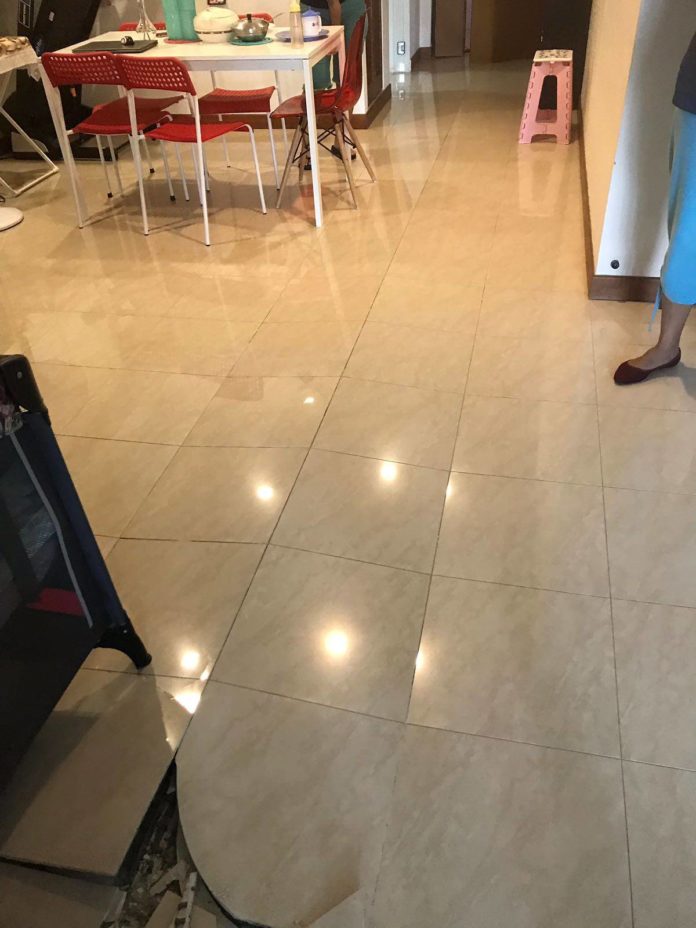
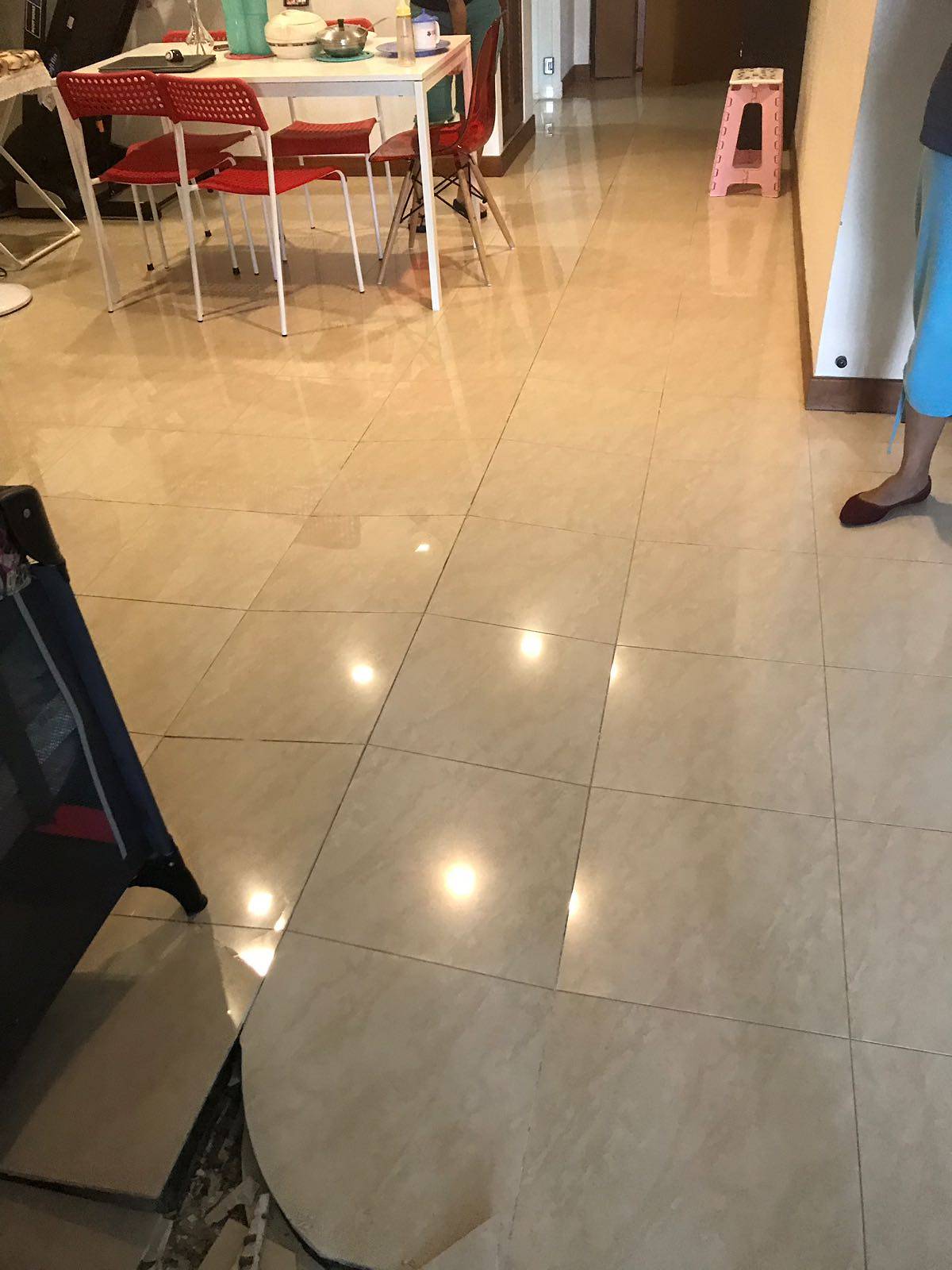
Mr Bobin Thomas, his wife and two children woke up to the sound of floor tiles in their dining room “exploding” one by one in their flat at Block 638A, Punggol Drive on Sunday (Jan 14) morning.
Mr Thomas told Channel NewsAsia that when he and his wife saw the tiles start bending inwards, they immediately grabbed their two-year-old girl and a seven-year-old boy, and left the house.
“The tiles started bending inwards one by one (like there was) an invisible force. It was like something you see in the movies,” said Mr Thomas.
“We called our children and got ourselves out of there,” added the 35-year-old IT engineer.
The tiles snapped inwards by “an invisible force”. (Photos: John Choo)
As the family tried to navigate their way out, Mr Thomas said the tiles they stepped on wobbled and sank slightly.
“At the time, we thought that the building was about to collapse. It only became clear our unit was the only one affected when we saw that none of our neighbours were leaving,” he said.
It was only when the family was safely in a friend’s unit at a nearby block did Mr Thomas, who is a tenant at the unit, called the owner of the flat to inform him of the situation. The owner later contacted the HDB.
According to Mr Thomas, a contractor later visited the unit and covered the affected tiles with cardboard.
Cardboard was later placed by contractors on top of the tiles. (Photo: John Choo)
The family will stay in a nearby apartment temporarily while their HDB flat is being repaired.
“It was just not possible for us to go back there. We have two kids and we don’t know what might happen if the tiles explode again,” he said.
“CRACKLING SOUND”
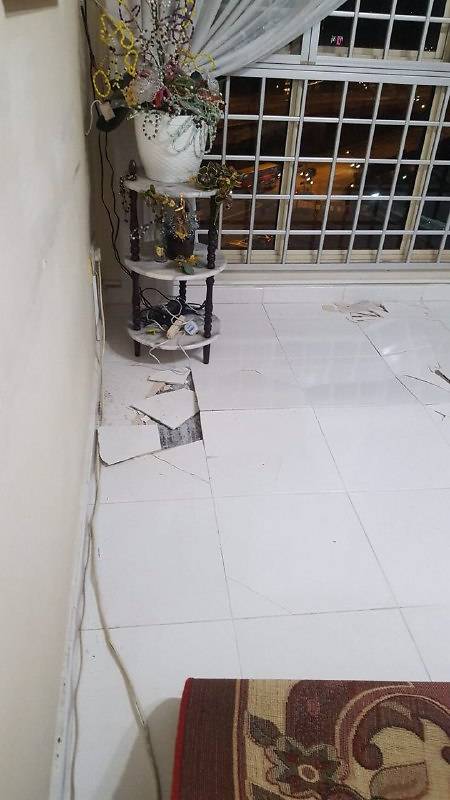
Meanwhile, Mr Zul Effandy, who lives at Block 185, Jelebu Road at Bukit Panjang, told Channel NewsAsia that he and his wife were watching television at about 8pm when he suddenly heard a “cracking sound” from underneath the carpet in the living room.
As the sound got louder, the pair jumped from their seats and backed away to safety, Mr Zul said. When the sound stopped, they pulled away the carpet to see that the tiles had “exploded”.
The tiles popped up at this flat in Jelebu Road, Bukit Panjang. (Photo: Zul Effendy)
“We are worried. I keep thinking it will happen again. I don’t think we will get a good night’s sleep tonight,” he added.
Mr Zul said that this is the first time the floor tiles have cracked since he moved in in 2000.
In another case, Mdm Ng Siew Hoon, a resident at Jurong West, said she was “scared” by what sounded like a “loud explosion” to her.
“Within five minutes, there was a loud explosion sound, like fireworks. Then all my floor (tiles) all cracked, from the door to the window. And the tiles in front of my toilet doors also. I was very scared and I called for help, called for my husband to come out and have a look,” she told Channel NewsAsia.
Channel NewsAsia has contacted HDB, Pasir Ris-Punggol Town Council and Holland-Bukit Panjang Town Council for comment.
Mr Tan Chim Hoon, adviser at Singapore Renovation Contractors and Material Suppliers Association, said poor workmanship may be a possible cause of the cracks, and the recent chilly weather may be another reason.
“Now it’s very cold or very hot. And there’s a little bit of vibration. So this causes the tiles to have no place to expand. Because of this, the tiles all pop up,” he said.
SINGAPORE: Parts of Singapore on Sunday (Jan 14) morning hit 21.2 degrees Celsius – the lowest recorded temperature in the country since 2016.
The temperature was recorded in Admiralty and Jurong West at around 5am, said the National Environment Agency (NEA) in a Facebook post on Sunday afternoon.
The lowest temperatures recorded at other locations this morning ranged from 21.3 to 22.2 degrees Celsius, the agency added.
Cool weather continues in Singapore on Sunday (Jan 14). (Graphic: Meteorological Service Singapore)
Last Thursday, the mercury hit a low of 21.6 degrees Celsius at Jurong West, and temperatures fell to 21.9 degrees Celsius in Ang Mo Kio and Admiralty at 10.30pm.
NEA said that for the next few days, the lowest temperature is expected to range between 23 and 24 degrees Celsius, and a dip to below 22 degrees Celsius is “not likely”.
According to NEA, the rainy weather in Singapore over the past few days was from “a monsoon surge”.
“The rainy weather has eased this morning with the gradual weakening of the monsoon surge in the South China Sea,” NEA said. “The rest of today is forecast to be cloudy.”
The highest daily total rainfall was 47mm at Loyang on Saturday (Jan 13). NEA said the rainfall experienced recently “is not considered high for a monsoon surge event”. It pointed out that the highest daily total rainfall from a January monsoon surge over the last five years was 134.8mm at Changi in 2013.
It has been cool and wet over the past few days, with the heavy downpour causing flash floods in parts of eastern Singapore last Monday. In the Kim Chuan Road area, about half of Singapore’s average monthly rainfall in January fell in just four hours.
SINGAPORE: When I tell people that part of my research involves photographing exhumations in cemeteries and their accompanying rituals, the inevitable question I get is: “Have you seen or felt anything?”
To be honest, I have not.
However, I once thought I heard a child crying outside my bedroom. Thinking that something had finally followed me home, I jumped out of bed to confront the spectre.
It turned out to be my foster cat, throwing up under the dining table. I almost wished it had been a ghost.
Aside from ghostly-feline shenanigans, the time I spent in Bukit Brown Cemetery between 2011 and 2014 has shown me just how alive cemeteries can be.
As part of the team documenting the social and cultural life of the cemetery, I was witness to a multitude of rituals, festivals, events, memories and emotions.
Many of these memories and emotions were personified in the determination of the people I met along the way.
Take for example Qing Ming Jie – the Chinese version of All Saints Day, when families gather to pay respects to their ancestors.
I once photographed a man who went by Mr Taijuddin, who now mostly resides in Indonesia. At the age of 73, he still climbed the slippery, moss-covered slopes in business shoes and a long-sleeved shirt to do his filial duty.
BEING PHYSICALLY CLOSE TO A LOVED ONE’S GRAVE
The ability to be physically close to a grave is one advantage that cemeteries have over columbaria. Even if you paid for a niche at eye-level, there is nothing quite like having your own space to say a few words or conduct religious rites.
Cemeteries also provide a more personal way of interacting with loved ones.
Cemeteries afford a certain kind of personal space for families to gather and remember. (Photo: Terence Heng)
One friend commented that when visiting his grandmother’s niche, he was never sure if she could “receive” his offerings on the ground since her ashes placed were far above eye-level. Waving his hands, he mimicked pushing the spiritual essence of offerings up, saying “we hope ah ma gets these lah”.
The destruction of cemeteries has become a contentious issue in Singapore. What was once a norm to see entire swathes of graves cleared for malls, MRT depots and housing estates can be a fiercely contentious issue, especially for those that have significant cultural and historical value, like Bukit Brown Cemetery.
More recent exercises like the Government’s plans to clear 80,000 graves to make way for Tengah Air Base’s expansion have been met with a range of reactions, from a mere shrug to disappointment that national development is coming at a cost to the dead.
Many argue that cemeteries are impractical – there is no way to leave that much space for the dead when the living are already squeezed into ever smaller pigeon holes.
We are told that we cannot be sentimental, that we must be pragmatic.
In place of cemeteries we have ever-more intensifying columbaria, designed to accommodate the most number of remains using the least amount of space. The recent announcement of a funeral complex in Bidadari to replace the columbarium complex at Mount Vernon is an example of this.
Such arguments and actions are less about cemeteries, and more about what constitutes a “useful” and “efficient” space – planners are always looking for ways to make spaces more livable, effective and beneficial to the population. Dead bodies and remains don’t seem to figure in this equation.
Maybe all people need are simple places to sit and reflect. (Photo: Terence Heng)
The other side of the argument is that cemeteries are alive with memories, rituals and personal stories, that they are an important connection to our past in ways that single memorials or buildings could never act as.
Again, these are less about cemeteries and more about what makes a space meaningful, and what kinds of spaces can anchor us to our social, cultural and national identities.
Both sides of the argument make good points. We have limited land but to eliminate seemingly inefficiently used spaces that are material anchors leaves us empty and undefined. What then do we do?
NOT A “DIRTY” SPACE
We can begin by not seeing cemeteries (or indeed any space that houses the dead) as places that are spiritually off-limits or set-aside for most of the year.
Colloquially speaking, they cannot be framed as “dirty”, “inefficient” or “useless” spaces.
Intensifying a columbaria suggests that we see no use for such spaces other than a repository and somewhere to visit once or twice a year.
To do this, it means we need to collectively think of and talk about death more candidly. As long as death is taboo, so too will be the spaces associated with death.
Death needs to, in millennial-speak, be disrupted in ways that allow us to more fully engage with it as a process of life.
If we go ahead and clear all cemeteries, the alternative needs to be more imaginative than simply stacking us one on top of the other in the easiest and most cost-effective way possible. By this I do not mean fancy air-conditioned country-club style designs with lasers.
Rather, constructing spaces that encourage contemplation and give a sense of refuge would be a good start. Somewhere we can think about what life really means to us, far away from the hustle and bustle of life, as we take time to visit those who have gone before us.
A refuge from the hustle and bustle of life in Singapore. (Photo: Terence Heng)
Last year, my family visited my father’s resting place in the Garden of Remembrance, a Christian columbarium located along Old Chua Chu Kang Road. His ashes have resided there after we moved him from the garden columbarium in Mount Vernon.
The Garden of Remembrance is a lovely, peaceful place. Recently refurbished, it also hosts a small number of gravestones from the now-exhumed Bidadari cemetery – a reminder that in Singapore, one’s resting place is never final.
My mother was pleased with the renovations to the columbarium, but as we walked back to the car, she could not help but comment that it was Mount Vernon, with its garden setting and slightly untamed appearance, that was truly special.
Terence Heng is a lecturer in Sociology at the University of Liverpool, where he studies the changing identities of Chinese Singaporeans through ritual and religion.