Singapore
Sunday, February 18, 2018 – 19:04
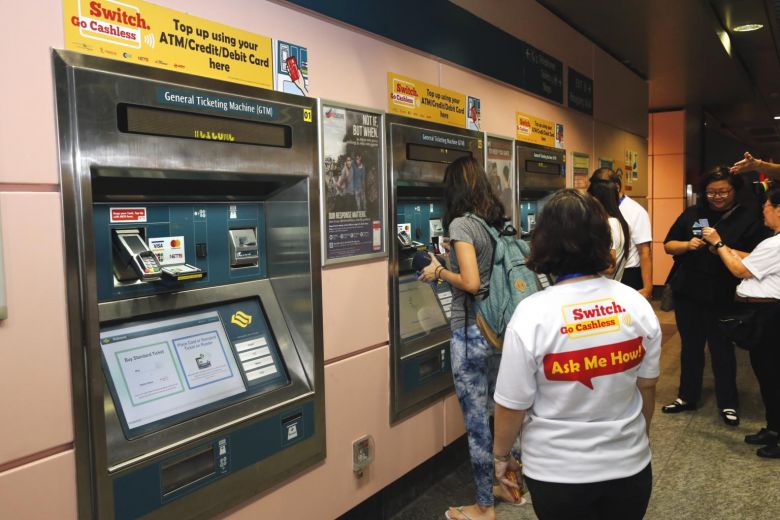
Cash top-up at MRT passenger service centres to be phased out by March
The Straits Times
Others


A shocking video clip has been circulating online of a group of students from Westwood Secondary School bullying one of their classmates.
In response to Stomp’s media queries, the school’s principal Mr Abdul Harris Sumardi confirmed that the incident happened on Feb 9 and involved the school’s students.
He said: “We have counselled the students involved and taken appropriate disciplinary measures. We are also working with their parents to help the students learn from the incident.”
The video, which was shared on Facebook on Thursday (Feb 15), has garnered over 100,000 views.
In the video, the boy who is recording the incident goads his other classmates into “teaching” one of their classmates a lesson.
He tells them in Malay to hurry up before their teacher comes back.
Two of the students start throwing chairs at a boy who is sitting at his table playing with his mobile phone.
One of the boys then walks up to him and starts punching and kicking him.
He then flips the boy’s chair, shoving him to the floor.
He continues to punch and stomp on the boy before the one filming tells him that it is “enough”.

bullying Education and Schools
SINGAPORE: A 57-year-old man was arrested on Sunday (Feb 18) at Block 15, Upper Boon Keng Road after he was reported to be throwing household items and cans of paint from his flat.
Police were alerted to the incident at the HDB block at 10.20am. No injuries were reported.
Channel NewsAsia understands that the items were thrown from the fourth floor and three cars were damaged. The car park in the area was cordoned off during the incident.

Paint splattered on cars parked at Block 15, Upper Boon Keng Road after a man threw household items and cans of paint from the block of flats. (Photo: A Rajandarn)
Paint splattered on a car parked at Block 15, Upper Boon Keng Road after a man threw household items and cans of paint from the block of flats. (Photo: A Rajandarn)
The man was arrested for committing a rash act and under the Mental Health Act. Police investigations are ongoing.
The Singapore Civil Defence Force (SCDF) said forcible entry was conducted by police before the man was arrested.
The SCDF set up two lifepaks and deployed a rescue net.
A photo circulating on WhatsApp shows a lifepak positioned at Block 15, Upper Boon Keng Road.

It’s another viral dancing sensation. And once again, it’s from Daddy Yankee.
The Puerto Rican king of reggaeton who co-wrote “Despacito” has people around the world moving their hips with his latest song, “Dura.”
Millions of people have clicked on online videos inspired by “Dura” as aspiring dancers around the world — from fresh-faced children to top models to endearing elderly people — find their groove, with varying degrees of skill or stiffness.
“I’m beyond honoured and feel very blessed. You make music for an audience,” Daddy Yankee told AFP. “And the audience has made this song in their own organic, spontaneous way.”
Daddy Yankee helped bring reggaeton — a Latin dance music, with roots in Jamaican dancehall and the style of hip-hop, that was historically associated with the marginalised Afro-Puerto Rican community — to a global audience starting with his 2004 hit “Gasolina.”
But “Dura” marks a fresh turn in the 41-year-old singer and rapper’s career as the song has taken off based largely on how fans appropriate it.
“Why have so many people — even babies — liked it?” he asked rhetorically. “Well, some things you can’t explain. It’s the magic of music, a magic that just happens and that you can’t understand.”
He has one theory. “Dura,” he said, harks back to “the rhythm and nostalgia for music of the late 1980s and early 1990s, that essence of reggae that inspired reggaeton.”
No excuse not to dance
Daddy Yankee, whose real name is Ramon Luis Ayala, released “Dura” on January 18. The next day, Colombian model Andrea Valdiri posted a video on Instagram, barefoot in sweatpants and a loose white top, as she danced to “Dura” with her hands rubbing sensually around her body.
The video has been viewed nearly nine million times on her Instagram account and in Daddy Yankee’s repost. It also set off a rush of new homemade interpretations of the song — posted under hashtag #DuraChallenge.
Daddy Yankee’s original video has been seen nearly 200 million times on YouTube.
More recently, the 25-year-old Valdiri has been eclipsed as the #DuraChallenge star by a nonagenarian.
Rachel Phillipsen, a 90-year-old New Yorker of Puerto Rican origin, follows a zumba instructor with impressive rhythm and coordination as Daddy Yankee sings in Spanish, “I like how you move that ram-pam-pam.” The video has generated 5.5 million clicks.
“There are no excuses not to dance. The excuse is all in your mind,” the zumba instructor, Rina Elena Martinez (@rina_25), told AFP. The Venezuelan appears in the video shot in a gym in Miami.
Daddy Yankee agreed. “The 90-year-old grandmother was phenomenal,” he said, adding: “No doubt that video gives encouragement to the whole world.”
Celebrities who have taken the #DuraChallenge include Venezuelan model Diosa Canales, Dominican reggaeton singer Natti Natasha and the Puerto Rican former Miss Universe Zuleyka Rivera, who also appeared in the “Despacito” video.
‘You’re one tough mama’
“Dura,” which literally means “hard” but could also mean “hot” when it comes to appearance, is an ode to a beautiful woman.
“You’re one tough mama,” Daddy Yankee sings, with lines such as “If it’s a crime to be so beautiful / I’ll arrest you in my bed and put you in handcuffs.”
Musically, the song returns to early reggaeton without the pop melodies that mega-stars such as Shakira, Enrique Iglesias or “Despacito” co-writer Luis Fonsi deployed to bring the genre to the anglo pop world.
In a retro video, Daddy Yankee and his cohorts dance around well-trodden streets covered with vibrant street art. Women, who so often take passive roles in highly sexual songs, assume the lead in showing their moves.
“We were inspired by the bright colours of the ’90s and a bit of the era’s fashion. I wanted to make this fun and to show that the song could empower women,” Daddy Yankee said.
The video was directed by Carlos Perez, the Puerto Rican who shot “Despacito” and has worked with Ricky Martin and Marc Anthony.
“Despacito” also spawned spoofs and has made history as the most-watched video on YouTube with more than 4.8 billion views.
Helped by a remix featuring Justin Bieber, “Despacito” tied a record by spending 16 weeks on top of the benchmark Billboard singles chart in the United States — a major feat in a country where non-English songs rarely fare well.
“Dura” as of Friday was number 10 on Spotify’s global singles chart and number one in several Latin American countries.

SINGAPORE: Transformative. Invaluable. Life-changing.
These are the words used by a growing NOC alumni in describing their overseas stints interning in start-ups in entrepreneurial hotspots around the world such as Silicon Valley, Beijing and Israel.
The NOC, short for NUS Overseas College, is the highly acclaimed internship programme started by NUS over a decade ago to immerse its undergrads into the intense high-energy start-up environment of top start-up regions.
The intent is for them to experience for themselves the thrills and spills of being part of a small team seeking to change the world with new innovations.
In fact, the Global Innovation Alliance programme that came out of the Committee on the Future Economy early last year was largely inspired by the NOC’s success.
More resources have since been made available to scale up NOC-type programmes to establish more permanent linkages with entrepreneurial hotspots overseas.
NUS Enterprise, the innovation arm of NUS, has been quick in setting up Block 71-like offices in Silicon Valley, Jakarta and Suzhou.
GROWING SERIAL ENTREPRENEURS
How much does the NOC and similar overseas internship programmes contribute towards Singapore’s ambition to become an entrepreneurial nation?
Evidence suggests that a sizeable proportion of NOC alumni ends up joining start-ups upon their return compared to the general student population.
Many of the more well-known start-ups that came out of NUS were indeed founded by NOC alumni – Carousell, Shopback and Zopim come to mind.
Alumni from the earlier batches are becoming serial entrepreneurs in the tradition of Silicon Valley start-up founders. Darius Cheung for instance, is now into his third start-up in real estate company 99.co having sold his first company tenCube to McAfee almost a decade ago.
Students sitting around campus. (File photo)
As a professor teaching tech entrepreneurship at the NUS School of Computing for many years, I can certainly see the difference an NOC stint does to students.
Students returning from NOC internships are generally more confident, vocal and tech-savvy. They are able to present their ideas effectively and in more creative ways. They become natural team leaders.
For example, NOC (New York) alumnus Jake Goh, co-founder and CEO of RateX, an e-commerce company providing savings for cross-border purchases, was fully confident and clear about his business model and strategy when he applied to have his start-up housed in the School of Computing’s incubator a year ago.
In that time, he and his founding team built their product, launched the business, attracted paying customers and raised funding.
Not bad for a bunch of students doing all these while studying for their finals.
SELF-SELECTION?
Of course, self-selection plays a large part. Students applying for the NOC programme are likely to be those who are self-driven, adventurous and with an entrepreneurial bent.
But with growing popularity, the pre-requisites for applying to NOC have also risen over the years – students are now encouraged to get letters of support from their professors and have to clear an interview with a panel that looks for students who demonstrate entrepreneurial qualities.
Being far away from home probably plays a part as well. Just as Singaporean students tend to do well when studying abroad, the same drive to prove themselves in a foreign environment may well be true for NOC interns.
I believe however, that the biggest reason why the NOC internship stints have been successful in preparing students to become entrepreneurs is because they immerse the students completely in a very well-developed start-up eco-system.
The NOC sites of Silicon Valley, Beijing and Israel are arguably the top start-up eco-systems in the world.
Therein lies the power of mature eco-systems and start-up communities.
Mr Foo Tiang Lim, currently the operating partner of seed-stage venture capital firm SeedPlus, described the NUS Overseas College programme as a “life-changing” experience for him. (Photo: Tang See Kit)
When one is surrounded by huge numbers of smart people with high drive, strong entrepreneurial ambitions and a “can do” attitude, it is difficult to remain unaffected, particularly so when news of fellow start-ups raising venture capital or getting acquired for millions are everyday occurrences.
In such environments where every aspiring start-up founder knows of dozens of his peers achieving some form of success or other, it becomes natural to expect that his turn would surely come.
POWER OF AN ECO-SYSTEM
I recall talking with some Israeli entrepreneurs several years back at a start-up event in Tel Aviv.
Israel, with a population only slightly larger than Singapore’s, is an undisputed global leader in tech entrepreneurship. It has achieved a reputation as the “Start-up Nation”, attracting more venture capital investments and achieving higher start-up exit value per capita than any other country.
When I asked those present what the top career choices are for bright graduating college students, their answers were unequivocal. Everyone wanted to start a company or work in a start-up.
Failing that, the next best option is to work for a high-tech company like Google, Facebook or Intel, which have a strong tech development presence in Israel. And for many, even that was just a stepping stone before going into a start-up.
Working for government comes in almost as a last option, when all else fails. While these views may not be representative of the general population (these were entrepreneurs after all), I suspect the strong start-up preference is not that far off among the young in Israel.
Employees work at website-designer firm Wix.com offices in Tel Aviv, Israel on Jul 4, 2016. (Photo: REUTERS/Baz Ratner)
Almost all the aspiring entrepreneurs I spoke to knew of someone – a relative, classmate or neighbour who has done well in a start-up venture and that gave them the inspiration and confidence that they could do so as well. It’s just a matter of time.
Singapore’s intent of strengthening our innovative capability by forging global innovation alliances with leading innovation regions is not a bad strategy. It is consistent with our aspiration to become an entrepreneurial hub.
Indeed, with a highly diversified workforce, advanced infrastructure and high standard of living, we are well-placed to be a hub for start-ups in Southeast Asia that can attract venture capitalists, entrepreneurs, technical talent and support service players.
This plays to Singapore’s strengths – the quality, abundance and flow of talent will greatly enrich, invigorate and reinforce our eco-system in a virtuous cycle.
As we mature as an entrepreneurial hub, internships in start-ups overseas via NOC-type programmes will become less of a means for us to merely learn from others and more of a global multi-directional exchange programme.
The real indication that we have become successful as an entrepreneurial hub is when other countries begin to send their students to intern in Singapore-based start-ups.
It is then that we know we have built up a healthy and sustainable entrepreneurial eco-system.
Dr Francis Yeoh is Professor for Entrepreneurship at the NUS School of Computing, as well as executive director of the Mediapreneur, Mediacorp’s incubator programme.
SINGAPORE: In a multilingual Singapore, people see benefits in being fluent in multiple languages.
Any school-going child in Singapore would probably be well-exposed to the pressures of learning to be effectively bilingual. Chances are, they’ll be encouraged profusely by well-meaning parents to live and breathe English as well as Chinese, Malay or Tamil.
And for good reason. A language opens the door to another world, offers a lens into another culture, and allows one to express oneself so as to be understood by more people.
This pressure doesn’t let up in adulthood – where there are significant economic and professional benefits to being conversant in several languages.
In fact, multilingualism and Singaporeans’ ability to understand the region around us are arguably cornerstones of Singapore’s economic success.
One language of choice is standing out, amid the focus on bilingualism and the importance of being conversant in English and mother tongue – that of programming language, such as Java or Python.
Mastery over coding, in knowing how to harness programming languages allows one to write computer programmes that give instructions to a computer.
Where Singapore’s Smart Nation future is encouraging the build-up of capabilities by leveraging technology to solve everyday problems, it seems knowing to code may help your kid achieve an edge over others when he or she enters the workforce some day.
COMPUTATION TOUCHES US ALL
Barely any discipline or any profession today remains untouched by computation. A cursory search for the query “computational” on the National Library Board catalogue throws up books covering such subjects as computational finance, computational sciences, even computational approach to painting and calligraphy.
With computers and information technology permeating every aspect of how we work and live, modern-day multilingualism may involve picking up one or a few programming languages.
Many Singaporeans are jumping on the bandwagon.
In some shopping malls, coding schools for kids can be found alongside Chinese enrichment centres.
Coding fever is at an all-time high. 19 secondary schools now teach programming at the GCE O level. 6 IP schools or junior colleges offer computing as an A-level subject. Applications to IT-related degrees are rising in local universities.
Professionals and new graduates attend short-term, intensive coding boot camps, hoping to transition to the tech industry.
This greater cognizance of the importance of programming and computing bodes well for our future digital economy and will serve our Smart Nation vision well.
A kid spends time on a computer (Photo: Reuters)
But what we need to keep in mind is that learning programming needs to go beyond simply understanding specific syntax and the peculiarities of a programming language.
Coding is useful, not because kids learn how to use computers, but because it helps them develop skillsets to think about the world and go about problem solving.
HOW TO BE AN EFFECTIVE CODER
Just as knowing English grammar rules alone does not make one an eloquent speaker of English, knowing the syntax rules of how to put together a computer programme does not make one a proficient programmer.
Communicating well in a language involves a host of skills, not least of which is the empathic consideration for how the message will be processed and acted upon by the computer.
The phrase “computational thinking” has been coined by professor of computer science at Columbia University Jeanette Wing.
It encapsulates the thinking process involved in formulating a real-world problem in computational terms, and to design an algorithm – a sequence of step-by-step operations the computer can take in reaching a solution in good time.
In learning coding, kids may go away with a well-rounded education, provided they also develop a grasp of concepts that underpin computational thinking.
These include logical thinking, how to apply algorithms, abstraction and decomposition, among others.
Computational thinking helps kids develop practical skillsets in questioning the world around them and learning how to approach problems from a variety of perspectives, applying axiomatic principles.
One computational thinking principle is to design algorithms that can still be executed in reasonable time even as the problem scales up.
For instance, it is an Olympic tradition to conduct a torch relay that visits a number of localities in the host country. One may use a computer to calculate the route with the shortest distance for instance.
Yet for Tokyo 2020, the fastest supercomputer today cannot investigate every possibility to arrive at the best route to tour the 47 prefectures in Japan, even within our grandchildren’s lifetime. So a solution with less complexity, with a smaller set of possible solutions, may be more practical.
The new logos of the Tokyo 2020 Olympic and Paralympic Games. (Photo: AFP/Yoshikazu TSUNO)
Another computational thinking principle is the importance of organising one’s data well to allow a problem to be solved efficiently. You can only use a hard-copy dictionary quickly if you know that the words are ordered alphabetically.
Similarly, an understanding of how data is organised stands at the heart of search engines like Google – which can search trillions of pages on the World Wide Web, and yet return the relevant links to us within a second.
Kids need to take to heart the same adage when they learn how to programme.
Once kids begin to realize that at an abstract level many problems are fundamentally similar in computational terms, they will see the applications of computational thinking at every nook and cranny.
For example, Webpages link to one another just as Twitter users follow one another. Intuitively, there is similarity between finding an authoritative web page and finding an influencer on Twitter.
For another example, finding the fastest way to send a message over the Internet is not very different from finding the fastest way to go from one’s home to Lau Pa Sat for supper. An algorithm that solves one could be applied to solve the other.
The computational thinking process allows kids to gain inspiration from a variety of problems, and thus widens the applicability of programming across various disciplines.
When learning a foreign language, we learn not only new vocabulary, but more importantly a new way of thinking.
In the same way, coding can help our kids be better communicators and problem solvers, if it helps them develop these skillsets along the way.
Hady W Lauw is assistant professor of information systems at the School of Information Systems, Singapore Management University.
SINGAPORE: Registering a child for Primary 1 can be a laborious process due to the amount of checking and documentation required for the various phases of the Primary 1 Registration Exercise. And implementing stricter measures to ensure no parent gets away with lying about their address could border “on the absurd”, former teachers told Channel NewsAsia.
This follows a recent case of a couple who was fined S$9,000 for lying about their address to get their child into a popular primary school in Bishan.
The parents had used a fake address in the Bishan area to register their child for Primary 1 at the school under Phase 2C of the registration exercise, which gives priority to families living within one kilometre of a school. The family had, in fact, lived at a bungalow in Serangoon Gardens.
One former primary school teacher who wished to be known only as Ms Ang said in her experience, a lot of checking and documentation is required in the registration process. Parents would have to fill up registration forms, and come prepared with various supporting documents like identity cards, birth certificates and immunisation records.
“We would have to check all these, and also their address on the IC, to make sure it falls within the one to two-kilometre mark to qualify them for Phase 2C,” she said. “I’ve come across some parents that have no idea about such things … the documents they are supposed to bring, or their address could be just outside of the two-kilometre mark, and they will try and appeal.”
Changing one’s residential address on the IC can be done at any neighbourhood police post or at the Immigrations and Checkpoints Authority (ICA) Building, according to criminal lawyer and director of Straits Law Practice LLC, S Balamurugan. He explained that hardcopy documentary evidence of one’s new address is required, like a bill, statement or letter from HDB, a credit card or bank statement or a utilities bill from Singapore Power.
One could also request online for a pre-notification letter from the ICA, which will mail a letter to the new residential address within seven working days, he added. This can then be used as documentary evidence of the new address.
“One security measure is the requirement of providing hardcopy documentary evidence,” he said. “As the ICA will give out an address sticker for pasting on your IC, it may be possible that some may print out their own sticker to paste on their IC.”
DIFFICULT TO CATCH PARENTS LYING ABOUT THEIR ADDRESS
With the amount of paperwork and verification already required at the schools upon registration, Ms Ang stressed that going above and beyond the existing safeguards to catch errant parents who lie about their address would be difficult.
“What more can they do? You can’t possibly be interviewing neighbours for every child, or (get) CCTV footage … Does that mean everyone would need to submit that? It would be a tall order,” she said. “I think the existing system of checks is really as far as it can go, and if it goes beyond that, that would really border on the absurd for parents.”
She suggested that in the Bishan case, it was possible that the parents’ action may have come to light upon questioning of the child.
“If you want to lie about your address, you’ll have to prepare everyone involved, including the child, and children of that age are empty vessels,” she said. “Or maybe it was just a harmless activity, where maybe the child had to write their address down in a lesson, and they realised it wasn’t a match.”
Alternatively, another former primary school teacher pointed out that the parents could also have been caught if someone who knew of what they were doing had blown the whistle on them.
“Maybe someone tried to sabotage them,” said the teacher, who taught in a popular boys’ school. “They may have let the school know that the parent had lied about their address, and that could have been the trigger for the school to investigate.”
“Otherwise, it’s really very hard to catch these people,” the teacher added. “If you really want to take the time to check everything in detail, the registration process would take even longer, and I don’t know if the schools are willing to go through all this.”
It is not known how such cases are investigated, but the Ministry of Education (MOE) had earlier said that it views the use of false addresses during the Primary 1 Registration Exercise as a serious matter, and will refer any suspected cases to the police. It added that there have been fewer than 10 reported cases in the last 10 years.
In this particular case, it was reported that the parents have 14 days to appeal against their sentences. In cases where the verdict is finalised and the parents are convicted of the charge, the child who was previously registered in a school based on false information would be transferred to another school with available vacancies. MOE was not able to provide a further update to this case.
Students boarding a school bus in Singapore. (File photo: Wee Teck Hian/TODAY)
While Straits Law Practice’s Mr Balamurugan has not personally come across such cases, he pointed out a few that were reported. In 2007, a former lawyer was jailed two months for providing a false address to enroll his daughter in a top primary school. And in 2015, a man was fined the maximum S$5,000 for doing the same thing.
“Previous cases of parents who have provided false addresses have come to light when officers from MOE visited the false addresses,” he said. “Given that the punishment for falsifying one’s address can be an imprisonment term and much publicity of such cases now, it appears that the penalties can act as sufficient deterrence on the parents.”
“Perhaps criminal prosecution can be initiated against home owners who accept payment or favour in exchange for their address for parents who intend to enroll their children in schools which they would not have gotten without the falsification,” he added. “In addition, parents should give an undertaking that a child who gains priority admission into a school would be required to reside at the address until Primary 6 unless there are exceptional reasons.”
“THE ONES WHO BROKE THE LAW MUST BE REALLY DESPERATE”
But despite the fact that these parents ran afoul of the law, some parents Channel NewsAsia spoke to understood why they may have resorted to this.
“Though what they did was quite extreme, I can emphathise with them,” said a parent of two boys in a school in Bishan who wished only to be identified as Mrs Chan. “When we were signing up, a lot of people were saying things like ”What if your child cannot get into a good school?’ So even if you don’t feel anything from the start … it adds a lot of undue stress for the parents.”
“Parents will definitely try to do the best they can for their kids,” said another parent, Kende Chew. “It’s sad, but I’m not surprised.”
Sociologists pointed out that the parents’ actions are reflective of the large amount of stress they face in putting their child through the education system.
“Parents are probably under the impression that getting into a reputable school is critical to their child’s future,” said associate professor of sociology at the National University of Singapore Tan Ern Ser. “The ones who broke the law must be really desperate, thinking that their child’s future is at stake.
“It could also be a matter of pride, in the sense that they would lose face if their child can’t get into a reputable school.”
“Some parents may be engrossed in ideas about what constitutes a good or top school, even when there is no official ranking as such,” added lecturer G Kaveri from the Singapore University of Social Sciences’ (SUSS) School of Human Development and Social Services. “There are also certain labels that continue to exist among many parents about schools and the results they can produce, and an obsession towards product-based, results-oriented education.”
Singapore Management University sociology professor Paulin Straughan also pointed out that these parents’ actions, coupled with other “tell-tale signs” like parents’ pre-occupation with enrichment lessons, reflects that there may be too much at stake in national examinations like the Primary School Leaving Examination (PSLE).
“The perception is that if you don’t do well at the PSLE and you don’t get streamed to your desired school, you won’t have the kind of opportunities to rise to your potential,” she explained. “The difference after PSLE is quite startling, because you get your IP schools, your independent schools, and then it’s down the stacking order.
“So parents feel that if you don’t do everything you can in the formative years of their education – which is really primary school – once they cross over into secondary school and they’re in this traditionally feared stage of teenage rebellion, they want their children to be in an environment which they consider safe.”
The role parents play is critical in helping their children manage stress, embrace failure and accept disappointment. (Photo: Pixabay)
One factor that is often overlooked is the role of the family in the child’s development.
Senior lecturer Sirene Lim from SUSS’ School of Human Development and Social Services said: “A teacher has to work with 30 to 40 children in a class within a limited amount of time, and it is impossible for him or her to educate each child the way that parents are able to,” adding that research is beginning to uncover the importance of a quality home learning environment as a predictor of a child’s success in school and later in life.
“Such findings increasingly reveal that it is not parents’ education or socio-economic status that matter most in predicting a child’s academic success, but it is what parents do and say on a daily basis that can better predict a child’s language and mathematical learning in school.”

BEIJING: Two of China’s most famous and well-loved pop stars stole the show at state television’s annual glitzy, often much mocked marathon show welcoming in the lunar new year on Thursday (Feb 15), singing their first public duet in two decades.
Traditionally, hundreds of millions gather around their televisions to watch the “CCTV Spring Festival Gala,” a more than four-hour showcase of skits, music and dance that has been a TV staple since the first edition was broadcast in 1983.
But it was superstars Faye Wong and Na Ying many people tuned in to see this holiday, singing an old school-style ballad called “Years”, with some online polls rating their appearance the most eagerly anticipated part of the show.
While neither spoke to the audience after their performance, fans quickly took to Chinese social media in an outpouring of praise, though some said their appearance was too fleeting.
“Did you see? This is my mother. Isn’t she awesome?” Wong’s singer daughter Leah Dou wrote on the Twitter-like Weibo site, attaching a picture of herself as a baby pointing at a photo of her mother, an image that soon attracted more than 500,000 likes.
Beijing-born Wong’s icy demeanour and eclectic music tastes ranging from syrupy love songs to off-kilter trip-hop and Buddhist-infused folktronica have made her one of the biggest stars in the Chinese speaking world of the last three decades.
Na, who sung at the closing ceremony of the 2008 Beijing Olympics, shot to fame in the 1990s with her hit “Conquering”and has more recently become a staple of Chinese television singing talent shows.
While this year’s show had other crowd-pleasers, including wholesome Chinese teenyboppers TFBoys for the third year running, China’s ruling Communist Party was always going to be present.
Several songs praised the “New Era”, a reference to President Xi Jinping’s political theory about making China even stronger through socialism, cemented since late last year in the party’s constitution.
Another skit celebrated China’s relationship with Africa, a key part of Xi’s Belt and Road initiative, complete with an African actress speaking in Chinese and quoting Xi.
The lunar new year of the dog, which officially starts on Friday, is the only holiday of the year for many Chinese, and is normally marked by riotous bursts of fireworks and firecrackers.
But many large cities, including Beijing, have heavily restricted their use again this year to help prevent smog.
It won’t be a happy holiday for all.
Hong Kong’s South China Morning Post said Xi’s corruption crackdown means Beijing’s main jail for top level prisoners is too full to allow family members to come and have a traditional new year meal with inmates.


YouTube has received a lot of flak lately especially after the antics of popular YouTube star Logan Paul.
When he posted a video of a dead body hanging from a tree, it sparked a discussion online on content that is made available online viewed by young, impressionable teenagers.
Many fans defended Paul and accepted his apology on how he wanted to raise “awareness for suicide and suicide prevention”.
Apart from the notorious suicide forest video, he has made a name for himself with pointless pranks and shock-value antics like faking his own murder in clear view of his young fans.
It is somewhat troubling how young people all over the world look up to such influencers and find what they do just harmless fun.
Some even try to emulate them.
//afarkas.github.io/lazysizes/lazysizes.min.js
A Stomp contributor alerted Stomp to a YouTube video featuring two youths heading to a local Ikea store to carry out a “fort challenge”.
They go around the store collecting items like cushions, throws and stools before heading to an area stacked with boxes of furniture to make their “fort”.
Throughout the video, they are fully aware that they can potentially get kicked out if they get caught but they go ahead with their “dare” anyway.
Eventually, what they were fearing, and what they were probably expecting to happen, occurs when they film themselves being escorted out of the store by a staffer.
Despite this, they feel no remorse.
As they head out, one of them says, “I don’t care, guys, we will come back to Ikea again and do the fort again, I don’t care!”
Is this really the new standard of entertainment for our youths now?

Youtube Youth
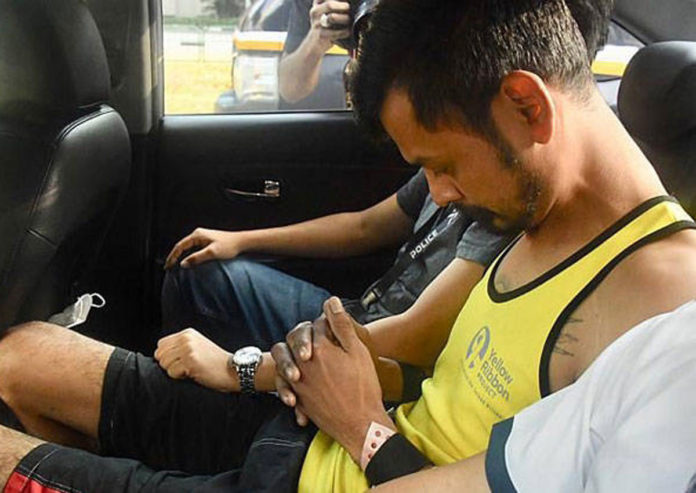
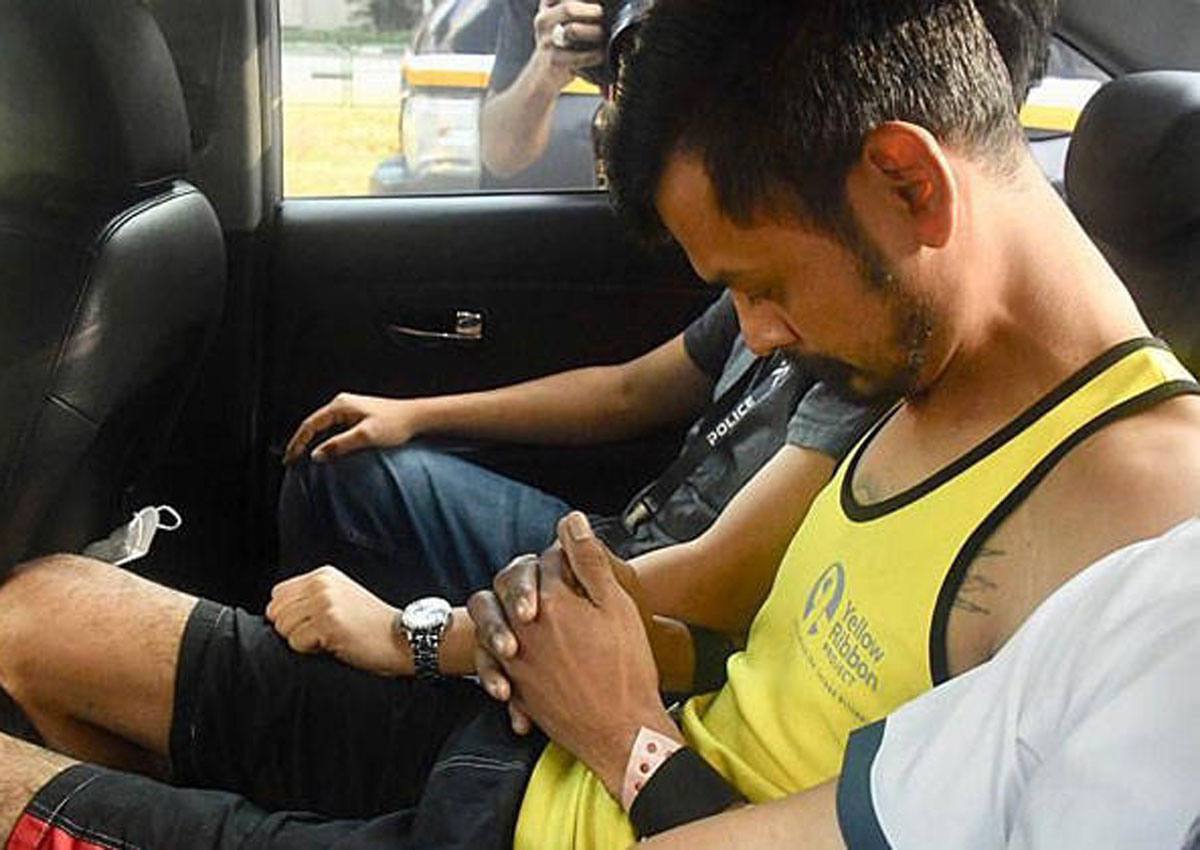
A 31-year-old man was charged in court today (Feb 17) with a murder that took place on Thursday (Feb 15).
Saravanan Arimuram allegedly killed Sivakumar Perumal, 43, along Jurong Town Hall Road between 5.30pm and 5.48pm that day.
In a statement, the police said they were alerted to an accident involving a prime mover along Jurong Town Hall Road towards Ayer Rajah Expressway.
Three men, aged between 18 and 43, were taken to National University Hospital (NUH).
The 43-year-old man suffered injuries to his face and chest and was subsequently pronounced dead on the same day at 7.46pm.
The police said preliminary investigations revealed that the accident is believed to have resulted following a dispute between the deceased and the suspect.
The Straits Times understands that Sivakumar was driving the vehicle when he allegedly got into a scuffle with Saravanan.
Saravanan will be remanded at Central Police Division and will be back in court on Feb 23.
Offenders convicted of murder will be given the death penalty.
Murder/Manslaughter


