Singapore
Monday, February 19, 2018 – 14:49
Cyclist hit by car at Jurong West zebra crossing, police investigating
The Straits Times
Others


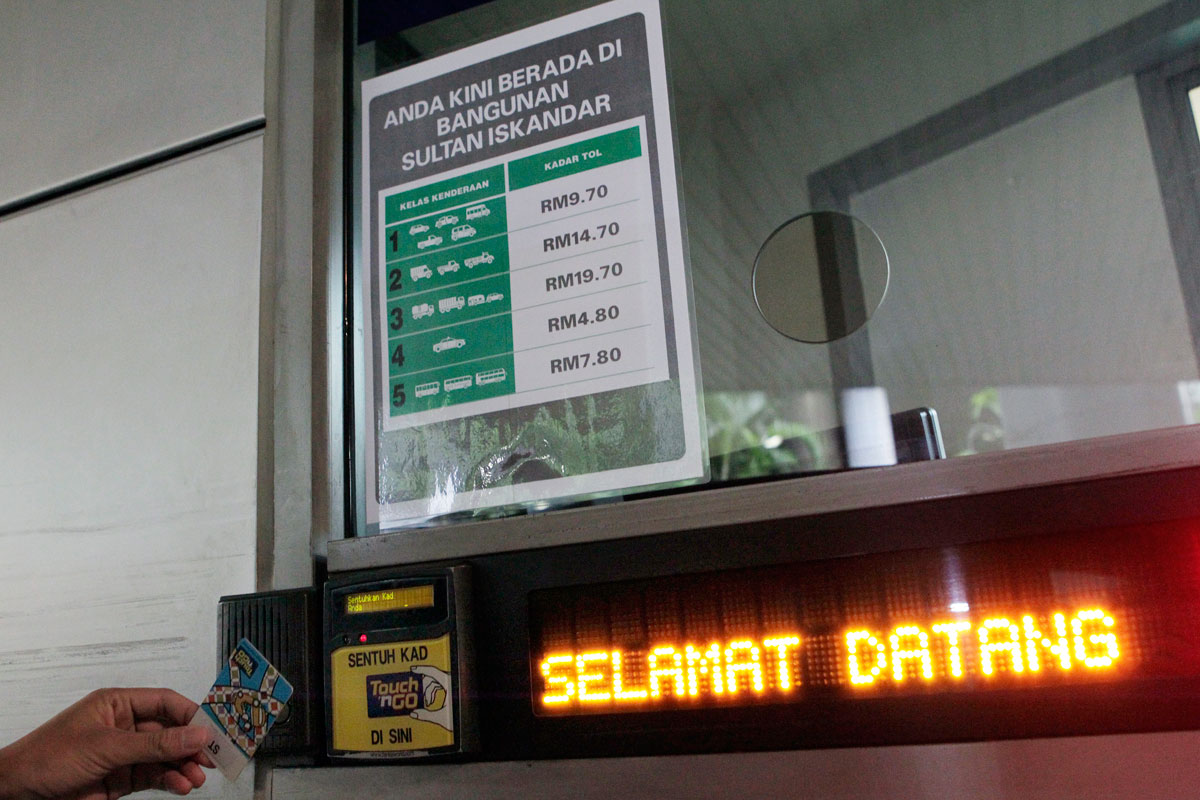
JOHOR BARU – Singaporean motorists have mixed feelings on the proposed move to impose a surcharge of S$10 (RM30) for Touch n Go cards with insufficient balance when entering Johor from Singapore.
The plan, currently in the pipeline and mooted by the Johor Government, is meant to ease traffic congestion at the Johor Causeway here and the Second Link Crossing in Tanjung Kupang, Gelang Patah.
There are also plans to remove reload booths checkpoint entrances as motorists who stopped to reload their cards would slow traffic down.
//afarkas.github.io/lazysizes/lazysizes.min.js
Sales assistant Felicia Ngoi, 29, who travels to Johor Baru on the weekends, welcomed the plan if it could help improve traffic flow at the checkpoints
“Every time I come to Johor Baru, I’ll see many drivers stopping by to top up their cards and it causes congestion,” she said.
Ngoi said it usually takes her about 90 minutes during peak hours to reach Taman Sentosa, even though it is about 5km from the Johor Causeway.
Another road user, Melissa, 33, said that while removing the booths could be a good idea, first-time Singaporean drivers could run into problems as they may not know where to buy the cards.
“The Johor authorities could distribute flyers on the plan to motorists coming from Singapore to avoid inconveniencing them,” she said.
Pharmacist Lee Foo Yun, 35, said it was the responsibility of motorists to check if they have enough credit in their Touch n Go cards before entering Johor Baru
It was reported in The Star that the Johor government considered several methods to further ease traffic congestion at the Causeway and Second Link.
Johor Public Works, Regional and Rural Development Committee chairman Datuk Hasni Mohamed said these included increasing the number of toll booths at the Second Link and building a covered walkway for pedestrians.
Better traffic management methods at both checkpoints could include separating bigger and larger trailers from smaller lorries for faster clearance and increasing the number of security personnel during peak hours.

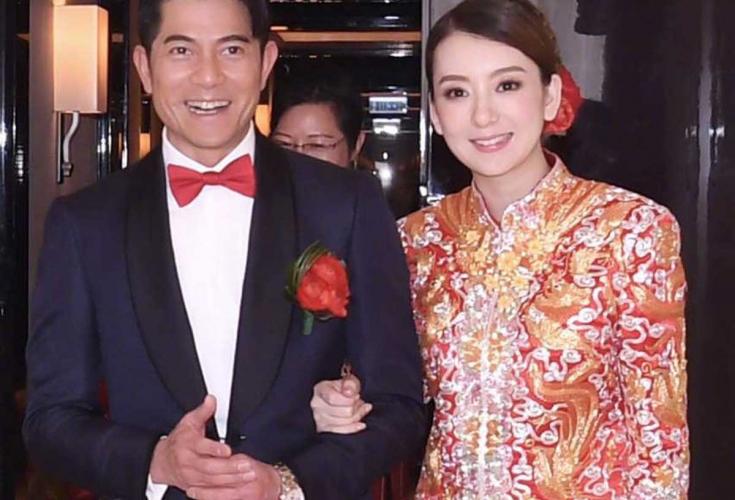
Newly-married Hong Kong superstar Aaron Kwok‘s “promise” to give hongbao to the citizens of the entire region 24 years ago is haunting him now, reported Sin Chew Daily.
He was reported to have said this during a movie promotion in 1994. In front of rolling cameras, Kwok said that everyone in Hong Kong will receive “red envelopes” from him after he was married.
The 52-year-old Kwok wed Moka Fang, 30, last April. They welcomed a baby daughter later in September.


LONDON – Women’s rights activists walked the red carpet with some of British cinema’s biggest female stars at the Bafta film awards on Sunday (Feb 18), the latest salvo in a campaign against sexual harassment in the entertainment industry.
The Death Of Stalin star Andrea Riseborough was accompanied by Phyll Opoku-Gyimah, a co-founder of activist group UK Black Pride.
“There are so many people to look up to in the world, and Lady Phyll is one of them,” Riseborough told Reuters of her decision to invite the activist to the event.
Their Finest star Gemma Arterton was also among those taking part.
Some female stars dressed in black outfits, echoing a similar protest at last month’s Golden Globes awards ceremony in Los Angeles. Both male and female attendees sported badges name-checking the Time’s Up campaign against sexual harassment.
British newspaper The Observer had earlier published an open letter calling for sexual harassment and abuse to be stamped out, signed by 190 actresses including British Oscar winners Emma Thompson and Kate Winslet and Oscar nominee Saoirse Ronan.
“This movement is bigger than just a change in our industry alone. This movement is intersectional, with conversations across race, class, community, ability and work environment, to talk about the imbalance of power,” said the letter, whose signatories also included Sophie Okonedo, Olivia Colman, Carey Mulligan and Emma Watson.
The #MeToo and Time’s Up movements have seen victims use social media to share their stories of harassment and abuse as allegations have emerged in recent months of sexual misconduct by many powerful men in business, politics and entertainment.

SINGAPORE: When Finance Minister Heng Swee Keat delivers the Budget for 2018 on Monday (Feb 19), the focus will be on the long term.
One reason being this year’s Budget will have “the benefit of riding the wave of a firmer economic footing for the first time”, said UOB economist Francis Tan.
Compared to the first two Budgets of the Government’s term, Singapore’s economic growth quickened last year on the back of a stellar run in the manufacturing sector. Official data released this week showed the economy expanded 3.6 per cent in 2017, trumping earlier estimates and the Government’s revised growth forecast ranges.
With a slowing economy out of the way, Mr Heng is expected to devote his attention to the longer-term goals of economic restructuring and transformation.
Also high up on the agenda will be the task of keeping Singapore in good fiscal health as the Government’s expenditure continues to outstrip revenue.
“I see this year’s Budget continuing its focus to transform the economy in areas of capabilities building, innovation and internationalization, as well as go deep and granular in addressing skills gap and skills mismatches,” said Mr Liang Eng Hwa, chairman of the Government Parliamentary Committee (GPC) for Finance and Trade.
“On the social front, I expect the Finance Minister to focus its attention on healthcare and eldercare. What is also getting attention for this year’s budget is our finances,” the Holland-Bukit Timah GRC MP added.
Here are the five issues that could be given the spotlight in Budget 2018:
1. LAYING OUT SINGAPORE’S SPENDING NEEDS
In the lead-up to the Budget, the Government has signaled that higher public expenditure on areas, including healthcare and infrastructure, will be inevitable as Singapore’s population ages.
By 2030, one in four Singaporeans will likely be aged 65 and above.
Before that, the country’s ageing population will reach a “critical demographic crossroad” this year, when the share of the population who are 65 and older will match those under 15 for the first time, said Mr Tan.
Given the demographic challenges, one major implication is the need for more healthcare and social spending in the coming years, according to the UOB economist.

An old man walks on an overhead bridge. (File photo: Francine Lim)
A greying population also means that forward-planning will be necessary when it comes to infrastructure to enhance the liveability of Singapore, said Mr Heng in an earlier interview with Channel NewsAsia.
Meanwhile, billion-dollar major infrastructure projects, including Changi Airport’s Terminal 5 and the Tuas mega port, will be essential in maintaining Singapore’s competitiveness, he added.
Amid heightened terror threats, homeland security will also be “a very major item” in the upcoming Budget as it is an “important area to invest resources in”, Mr Heng said last month.
2. TAX HIKES: NOT IF, BUT WHEN
In light of growing spending needs, speculation of a review of the tax regime has dominated the chatter in recent months especially since Prime Minister Lee Hsien Loong said that raising taxes will be inevitable.
Some economists and tax experts are expecting Budget 2018 to see a hike in the Goods and Services Tax (GST), given how Singapore’s rates remain comparatively low against regional countries.
Other forms of tax increases that the taxman might be mulling include an e-commerce tax, a further increase in “sin” taxes such as those levied on tobacco, alcohol and gambling, as well as wealth taxes.
But each has its own downside.
For one, many economists have described higher GST as “regressive” tax that would hurt the lower-income household, while some like Nomura economist Brian Tan fear that a hike in GST would be “tempting fate” and risk derailing the turnaround in the broader economy.
Overall, OCBC’s head of treasury research and strategy Selena Ling reckoned that Budget 2018 will likely see a “give and take tone”.
“The finance minister had previously articulated the need to keep the tax system fair and progressive across income groups,” she wrote in a note. “A sustainable tax system is one that rewards effort by individuals and enterprise, and fiscal sustainability is about striking the right balance between current and future generations.”
People cross a traffic junction in the Orchard Road shopping district in Singapore. (File photo: Roslan RAHMAN/AFP)
3. PRUDENCE
As such, the Government’s underlying principle of being prudent with its spending will likely be given more emphasis.
Last year, a permanent 2 per cent downward adjustment was implemented to the Budget caps of all ministries and organs of state, as part of an effort to control expenditure.
Moving forward, the Government will need “to instill further prudence” to ensure a responsible and sustainable fiscal position, said Mr Liang who is hoping for the finance minister to provide “greater clarity on (Singapore’s) fiscal position in the medium to long term” amid growing expenditure.
“How is the revenue trajectory picture looks like beyond 2020 and whether we have satisfy ourselves that we have in place a sustainable and diversified revenue sources to fund the various big ticket expenditure that are in our priorities,” he elaborated.
But for FY2017, there will be some good news in the form of a bumper Budget surplus on the back of stronger growth, said UOB’s Mr Tan. The economist is estimating an overall budget surplus of S$3.1 billion, which works out to 0.7 per cent of GDP, compared to the Government’s estimates of S$1.9 billion.
Apart from a rise in collection from corporate income tax, higher volume of property transactions may have bumped up Government revenue from stamp duties.
This means that the Government will have “more firepower” in Budget 2018 to nudge its economic stakeholders towards the seven strategies mapped out in the Committee for Future Economy (CFE) report, he said.
4. TRANSFORM BUSINESSES, WITH HELP FOR STRUGGLING INDUSTRIES
With that in mind, firms can expect a “pro-business” Budget with more support when it comes to innovation, going digital and venturing abroad.
Experts are pencilling in more measures to strengthen the Industry Transformation Maps (ITMs) – the 23 roadmaps that were first announced in Budget 2016 as part of a S$4.5 billion industry transformation programme – as well as a ramp up in research and development (R&D) tax incentives to fill the gap when the Productivity and Innovation Credit (PIC) scheme expires.
“It has been laborious for both large and small companies to leverage the current R&D enhanced tax deductions to scale their innovation efforts. For SMEs in particular, where cash is key to survival, they would no longer find it worth the effort to avail of the incentive with the expiry of the PIC,” said Ms Tan Bin Eng, partner and business incentives advisory leader at Ernst & Young Solutions LLP.
She suggested a simplification of the Government’s current approach of evaluating R&D eligibility and documentation requirements, particularly for SMEs. Alternatively, it could also consider extending and increasing the cash payouts under the PIC exclusively for R&D-related activities, Ms Tan added.
Budget 2018 may also contain some relief measures for underperforming sectors, such as the construction and the offshore and marine sectors. These include a deferment of the foreign worker levy hikes or bringing forward more public sector infrastructure projects for the construction sector, experts said.
5. CONTINUE TO UPSKILL WORKERS, BOOST PRODUCTIVITY
Ensuring that Singaporeans remain employable in the face of a fast-changing economic landscape will also be on the agenda.
To sharpen the plethora of policies that were rolled out over the years, Mr Liang expects enhancements to be unveiled for schemes, such as the Professional Conversion Programmes under Workforce Singapore.
“There is the real possibility that disruptive changes to employment may outpace the speed in which workers can reskill themselves. Hence, as we restructure the economy to create new jobs, we need to double efforts and intensity to develop new skills sets among our workers,” said Mr Liang.
There should also be continued efforts to boost overall labour productivity, said UOB’s Mr Tan.
While overall labour productivity in 2017 surged to a seven-year-high of 4.5 per cent, the improvement was powered mainly by the externally-oriented sectors.
By contrast, labour productivity growth in the domestically-oriented sectors remained stuck in low gear.
“It thus remains important that Budget 2018 contains more tools and resources to help improve the labour productivity of the service sectors,” he noted.
SINGAPORE: When emergency calls come, it is a race against time for Singapore Civil Defence Force (SCDF) paramedics.
They are quickly dispatched to attend to an incident, usually within 11 minutes.
If needed, fire and rescue specialists are also deployed on fire bikes, as they can weave around traffic and reach an incident site earlier.
But how fast is it from the time a 995 call is made to when paramedics are called into action?
SCDF’S NERVE CENTRE
The answer lies in the SCDF Operations Centre, which is the nerve centre of the Life-saving Force.
Operations centre specialists deal with distressed callers frequently, which can mean taking some time to pin down details like location and symptoms.
SCDF says it takes 80 seconds to dispatch its vehicles, but in more challenging situations, it could take longer.
Captain Shawn Tan, rota commander of SCDF’s operations department, said: “When members of the public call in with a 995 distress, we will guide them to give us a location and what exactly has happened. If we know there is a medical or a fire of HAZMAT (hazardous materials) or rescue incident, we will send the appropriate response to their condition.
“When a call ends, it doesn’t just end there. We will continue to monitor the situation. Sometimes in a medical call, we will monitor all the way until the patient arrives at the hospital in the care of caretakers.”
A rare look at the SCDF Operations Centre, the nerve centre of the Singapore Civil Defence Force.
RELENTLESS UPWARD CLIMB
Singapore’s ageing population means an increase in ambulance calls and a greater number of more complex medical emergencies that SCDF has to deal with.
SCDF has said that the number of ambulance calls has been on a “relentless upward climb” for the past two decades.
More than 180,000 emergency medical service calls were made last year – an increase of more than 2 per cent compared to the year before. Between 2012 to 2016, the number of calls rose by an average of 6 per cent yearly. In a single day, the operations centre can receive up to 1,000 calls.
When needed, ambulances are quickly dispatched to attend to an incident typically within 11 minutes.
NEW EMERGENCY MEDICAL SERVICE FRAMEWORK
In response to the growing numbers, SCDF set up an Emergency Medical Service framework in April last year.
This is how it works – let’s say a man is suffering from a cardiac arrest. When a 995 call is made, operations centre specialists will conduct a medical triage to assess the situation. What this means is that life-threatening cases will be prioritised when determining the appropriate resources to be deployed.
If needed, fire bikes are also dispatched in times of emergency, to be able to reach an incident site earlier, before the ambulances.
In the event of a cardiac arrest, an ambulance will be deployed as well as a fire bike, which has a quicker response time. Meanwhile, the specialist stays on the line with the caller, to guide him to perform dispatcher-assisted CPR. Community first responders within the vicinity will also be activated via the myResponder App to respond to the emergency.
RELYING ON TECH & COMMUNITY
The myResponder app was launched in April 2015. As of end-2017, it had more than 72,000 downloads and more than 21,000 members registered as Community First Responders.
More than 1,600 responders have arrived at incident scenes to help after receiving notifications from SCDF, and there have been nine survivors thanks to the app.
SCDF’s myResponder App started in 2015.
WO2 Siti Zarinah Sarip, senior operations centre specialist and paramedic, said: “Sometimes when the callers call us, they will be very, very panicked. They don’t know how to do CPR and they will just keep screaming. With myResponders, they actually come over and assist while we (are) online and calm the callers, and also myResponders will do the CPR as well.”
Captain Tan added: “We try to use myResponder to rally help from community responders, so the survivability rate of the patient is really increased. While the ambulance is en route, the person next to the patient themselves is the fastest caregiver and every second counts when it comes to a cardiac arrest case.”
HELP FROM NURSES
Nurses seconded from the Ministry of Health are also at the Operations Centre to help. They audit some of the calls, provide medical education for all the dispatchers and tap on the National Electronic Health Record for more complex cases.
“This allows the nurses to access the records when someone calls for a person who is critically ill,” said chief medical officer Colonel (Dr) Ng Yih Yng. “We look through the records for relevant information that we can forward to the ambulance crew. That way, they are better prepared with more information to help treat the patient when they arrive.”
With the number of emergency calls set to rise, SCDF says it is also looking into ways to further tap technology to rally the community in times of crisis.
SINGAPORE: In the one week that he’s been in Singapore, orphan-no-more Lucas Yap Keyuan has been eagerly soaking up his new life with a new family like a sponge.
The eight-year-old from China has helped do the laundry with gusto, raked leaves, had his first taste of Chinese New Year bak kwa, visited the library (picking out Dr Seuss books that Mama and Papa had been reading to him), shopped for groceries at NTUC FairPrice – and even started learning basic English and Maths.
“Amazingly, he’s taking to all these with interest and having fun at it all,” said his daddy, Mr Yap Vong Hin. “We were expecting him to be guarded, hesitant about new things; but he just seems to really take it all in.”
Keyuan relishes doing his share of chores. (Photo: Yap family)
The one little hitch in Keyuan’s brand-new world: He’s afraid to sleep alone.
For the past three years, he slept in a room with six to eight other children at his foster care centre, Alenah’s Home in Beijing. (Read his story here.) So now, “at night if he realises there’s no one else in the room, he’ll cry, and someone has to go and calm him down,” said his sister Elliana, 17.
And so, the Yap siblings have been taking turns to sleep in his room – to chase away their new little brother’s night terrors.
Ask Keyuan about his fears, and the bubbly boy makes light of it. “There are bad people who would kill me,” he said cheekily in Mandarin.
When his mum protested that there are “not so many bad people in Singapore”, he shoots back: “There are in my room, from 6.30pm onwards.”
Enjoying bak kwa on the first day of Chinese New Year. (Photo: Yap family)
GETTING A NEW LITTLE BROTHER
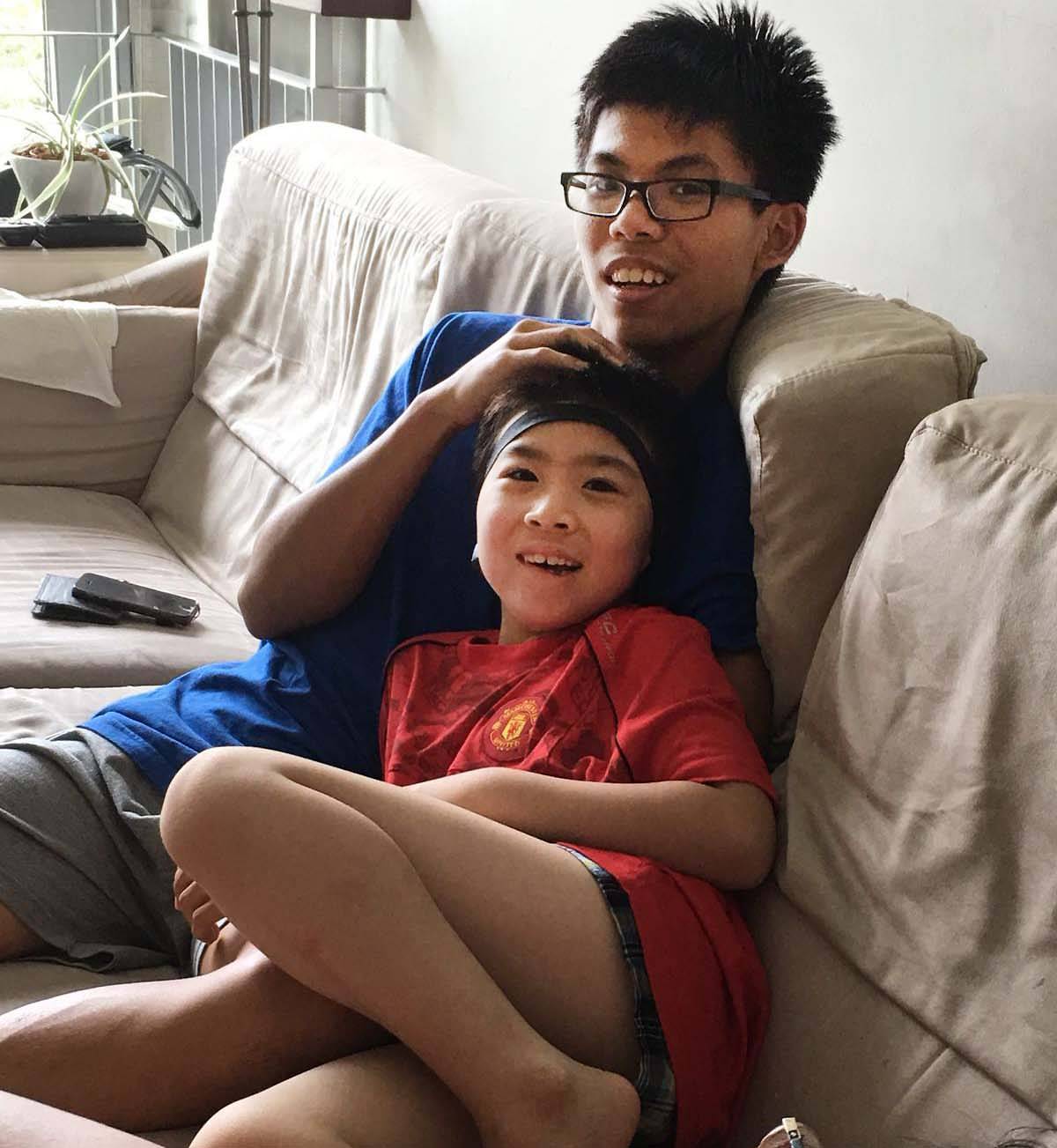
The past week has been as much an adjustment for Keyuan as it has been for Elliana and her brothers, Elijah, 19, and Max, 17.
While their parents had first met Keyuan back in July 2017 when they flew to Beijing on his birthday, the three Yap siblings only met their new brother in the flesh for the first time on Feb 10, 2018 – a few days before the Chinese New Year.
They were stunned when their parents announced last year that they were going to adopt an orphan boy from China, after seeing him in a Get Real documentary by Channel NewsAsia.
“They, of course, thought we were a little bit crazy, that we were moving way too fast,” said their mum, Dr Lim Poh Lian, 52, a senior consultant at a hospital.
“But they did come around, that we could make a difference as a family for one person. We told them we wouldn’t do it unless it was a family decision.”
Dr Lim Poh Lian and Keyuan arriving at Changi Airport on Feb 10. (Photo: Lam Shushan)
Max remembers things slightly differently.
“I was like, not really. They were like, okay, we’re going ahead to do it,” said the Year 5 student at an independent school.
I was a little bit selfish. I thought it would take away from the time I would have with them.
But then, last week, he hugged his new little brother at the airport, and things changed.
Granted, the 10-month adoption process had given the siblings time to get used to the idea, and for Max to get over his “little bit of state of shock”. And when they did, they started preparing for their little brother.
“Getting the room ready. Getting out all our old clothes. Just talking about what we would have to do while around him, what he would be like,” said Max.
None of that, however, truly prepared the 17-year-old for the overnight transformation from carefree youngest child to protective older brother. Or the shock of finding how much he liked it.
It feels great. I didn’t realise how good it would feel. I was talking to a friend who’s just full of love for her younger sister. I didn’t really understand that until I had a younger brother in Keyuan.
“I feel like I’ve known him for a long time, and he seems to take really well to me. Sleeping in the same room with him, having him hold my hand, having him talk to me as his gege (big brother), it was really something special,” said Max.
“Now I really have to look out for someone, someone who really, really values my time with them.”
Max and Keyuan. (Photo: Yap family)
JUST LIKE THE OTHER KIDS, EXCEPT…
The sociable Keyuan, on his part, had been looking forward to meeting his new brothers and sister since seeing pictures of them in a photobook his parents presented him last year.
And he wasted no time in latching on to them – even Elliana, who is “still warming up” to him.
“On the first day, he literally clung on to us, and wouldn’t let us go,” she said.
Elliana and Keyuan. (Photo: Yap family)
On Saturday, the second day of Chinese New Year, the Yaps had friends over to their townhouse for the first time since Keyuan’s homecoming.
Easy-going Keyuan was right in the midst of the riotous group of children running around, playing with toy trains and squabbling over toys. In other words, you wouldn’t think he was anything but right at home.
Except that every five to ten minutes, he’d leave the group to look for Papa or Mama. To see what they were doing, or to show them something he was given.
(Photo: Ray Yeh)
Afterwards, he helped Elliana dry the dishes and put them away. A chore, like all the others, that he seemed to genuinely enjoy, perhaps because it made him feel a part of the family.
He never seemed to tire of physical affection – always asking for a hug or a piggyback ride, or simply to sit next to someone. When he wasn’t playing, he was clutching on to Mama, or demanding her attention over a tiny burn on his finger that he got playing with sparklers.
Was this just the way he was raised with the other children at the orphanage, where he was constantly the “big brother” looking out for the smaller kids?
Or was it a former orphan’s need for physical reassurance against the fear that his newfound family might, somehow, stop loving him?
Keyuan wanting mum’s attention for his burnt finger. (Photo: Ray Yeh)
Keyuan was just a few days old when he was given up by his birth mother. He grew up with foster parents and in two foster care centres. He was passed over time and again by prospective adopters looking for a child who was younger, and who were perhaps scared off by his lack of ears – a birth defect.
FAST LEARNER WHO’S DRIVING DAD CRAZY
Born without external ears or ear canal, Keyuan didn’t properly learn to speak until about three years ago, when he received a hearing-aid implant and speech therapy. The Yaps were thus expecting at first that he might be behind in his development.
So they’ve been “pleasantly surprised” by how far along he actually is in his verbal and cognitive capabilities. Testimony, said Mr Yap, to “the great educational work” that Alenah’s Home and his kindergarten invested in him.
Already he’s been learning to write his name and his address in English “in case he gets lost”, said Dr Lim.
(Photo: Ray Yeh)
The plan is for Mr Yap, 60, to homeschool him until his grasp of English improves. Already, the stay-at-home dad has been impressed – and slightly exasperated – with his hunger to learn and how quickly he learns when taught.
The one thing he’s been doing that drives me crazy is, he’s at the age where he’s inquisitive about everything. Why this, why that. Constantly. I can’t stop to think.
“When our kids were the same way at this age, I’d tell them, ‘Please can you shut up so I can think!'” he said.
For an eight-year-old, television is a great teaching aid. “The kids and we are enjoying reliving their childhood by replaying all the music DVDs and Disney videos long sitting idle in our collection … But human ears can only take so many reiterations of ‘Old MacDonalds’ and similar ditties,” said Mr Yap.
(Photo: Ray Yeh)
On a more serious note, the Yaps have a couple of priorities. The first is to apply for Singapore permanent residency for Keyuan. The couple, who were born in Malaysia, are US citizens with Singapore PR status, as are their three older children. They’ve lived here for 15 years.
The second is to set up a slew of medical specialist appointments in the next few months. Because of Keyuan’s condition, he needs to be assessed before they can get him proper medical insurance. The list includes a paediatrician, ear, nose and throat specialist, CT scans, audiology tests, speech therapy, dental checks, and vaccination updates.
IF IT HELPS ANOTHER CHILD, IT’S WORTH IT
While the initial week seems to gone well, given the age difference, the three teenagers will still have to figure out how to play big brothers and sister.
While Elliana was herself adopted by the Yaps roughly 16 years ago, she was a toddler then and is “not sure” how she can guide her youngest brother in adjusting to his adoption.
“I think they don’t quite know what to do with children that age,” said Mr Yap. “The good thing is that he’s very fond them. So that makes it easier for them to relate to him.”
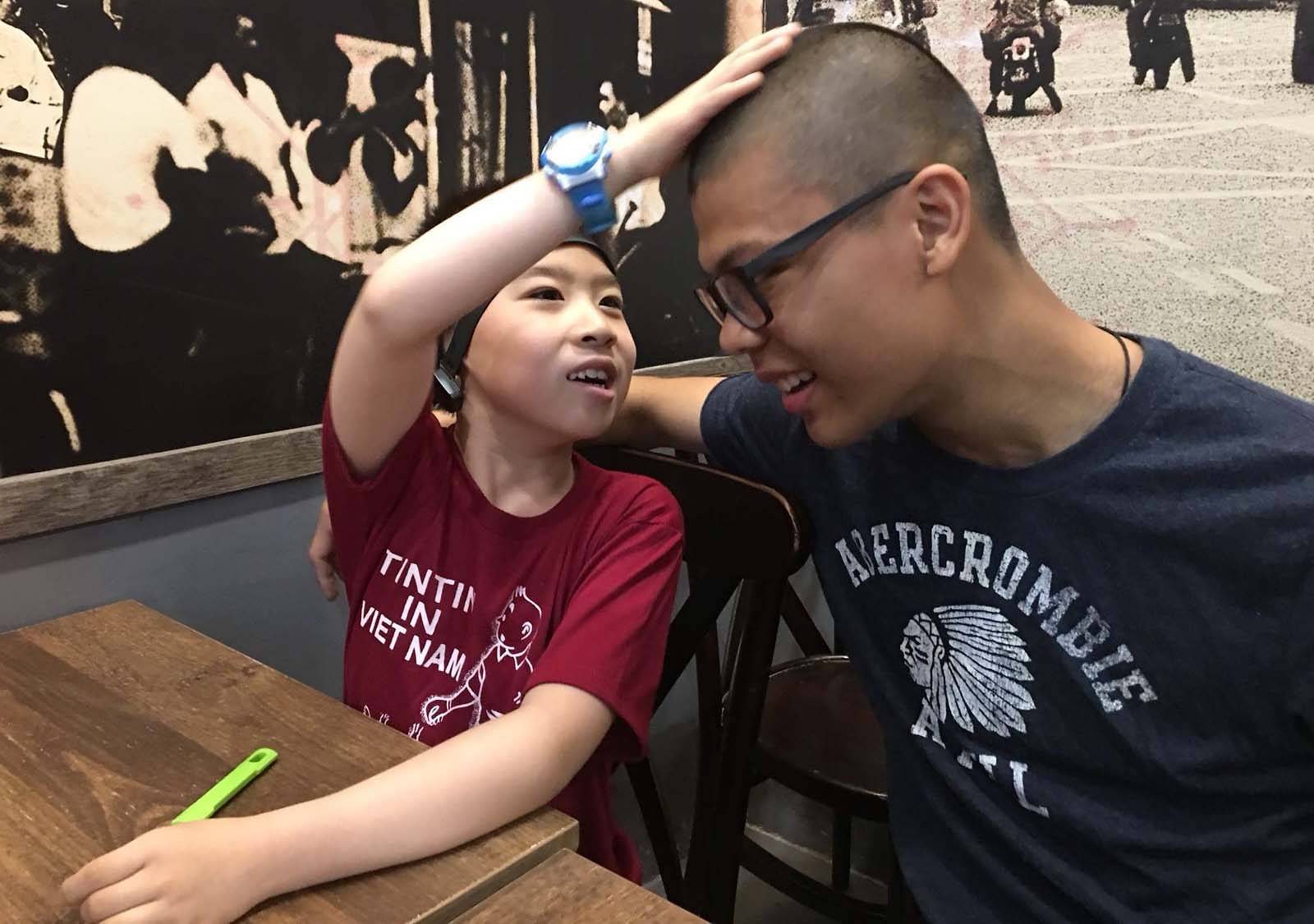
Keyuan checking out eldest brother Elijah’s NS crewcut, when they for the first time after he booked out of camp on Tuesday. (Photo: Yap family)
Meanwhile, there’s been an “amazing” outpouring of well-wishes and support for the family – from friends and strangers alike, who were moved by Keyuan’s story.
They’ve come forward, said Mr Yap, with “all sorts of help and practical assistance in terms of clothes, books, school supplies” (because of course, the Yaps had long ago gotten rid of their older children’s early school material).
Said Dr Lim: “We’ve been deeply touched by the way Keyuan’s adoption has moved so many people. There has been such an outpouring of kindness, joy and encouragement which we hope will make a difference for good.”
Despite finding the media spotlight on their family a bit unnerving, the couple hope their story will help other children in need of families – be it back in the orphanage in China, in Singapore or elsewhere.
Said Mr Yap said: “If this in any way helps other people to understand the whole adoption issue, and have their hearts moved to do something – it would be more than worth it.”
Read the first part of this story: China orphan who broke our viewers’ hearts finds a home, 4,500km away in Singapore
Keyuan in his Sunday church outfit (Photo: Yap family)

Actresses Kate Winslet and Emma Watson joined around 200 British stars in demanding an end to sexual harassment and abuse, in an open letter published Sunday ahead of the Bafta film awards.
Signatories including Emma Thompson, Kristin Scott Thomas, Keira Knightley and Saoirse Ronan, expressed solidarity with the Time’s Up movement in the United States and called for donations to a new “justice and equality fund” for victims.
The letter to The Observer newspaper is addressed to “dear sisters”, as was a similar statement by US actresses last month, and calls for an international movement to stamp out a culture of abuse exposed by the Harvey Weinstein scandal.
“In the very near past, we lived in a world where sexual harassment was an uncomfortable joke; an unavoidable, awkward part of being a girl or a woman. It was certainly not to be discussed, let alone addressed,” they say.
“In 2018, we seem to have woken up in a world ripe for change. If we truly embrace this moment, a line in the sand will turn to stone.”
‘Imbalance of power’
The letter was published ahead of the British Academy Film Awards on Sunday night, when some stars are expected to repeat the protest staged at last month’s Golden Globes and wear black in a show of solidarity with victims.
“As we approach the Baftas, our industry’s time for celebration and acknowledgement, we hope we can celebrate this tremendous moment of solidarity and unity across borders by coming together and making this movement international,” the letter says.
It emphasises that revelations about abuse in Hollywood have now spread across the world, saying the movement is about more than just the entertainment industry.
It highlights problems in Britain such as the gender pay gap and the changes to work that make it more insecure.
“This movement is intersectional, with conversations across race, class, community, ability and work environment, to talk about the imbalance of power,” the letter states.
Around 160 activists and academics have signed a sister letter pledging support for the new fund, which aims to make workplaces safe and support victims of abuse.
The signatories thank the high-profile stars for helping “push issues such as sexual harassment and rape into the public consciousness in an unprecedented way”.
“We believe that this is a moment in time when we can harness our collective energies to dismantle the wall of silence that surrounds violence against women and girls,” they say.

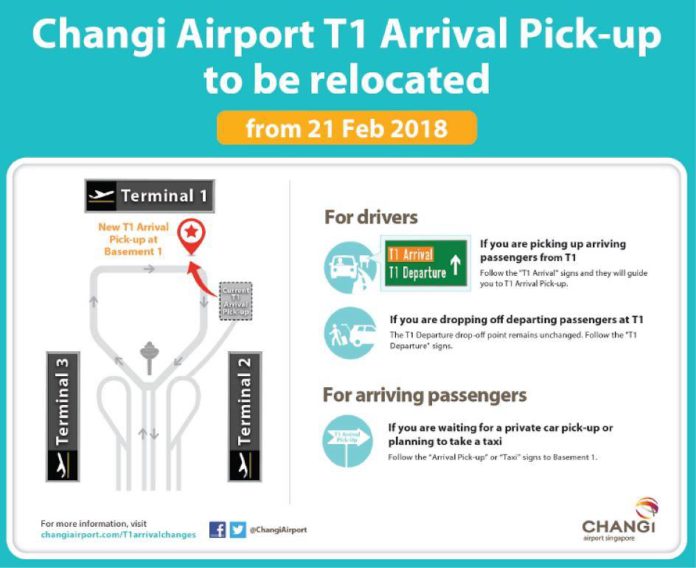
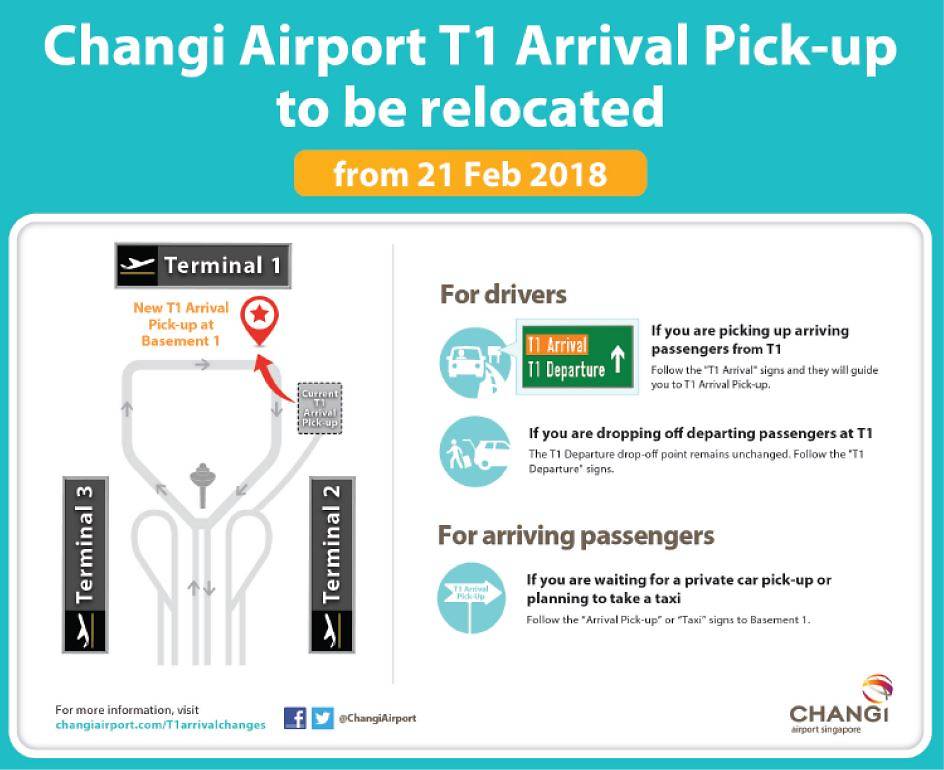
SINGAPORE: Changi Airport Terminal 1’s (T1) arrival pick-up facility will relocate to basement 1 of the terminal next Wednesday (Feb 21), Changi Airport Group (CAG) said.
This relocation is part of the ongoing T1 expansion works, CAG said in a media release on Sunday.
“Wayfinding signs at the T1 Arrival Hall on Level 1 will guide passengers to use either the travellator or lift to the new arrival pick-up facility,” it added.
“Drivers travelling on the Airport Boulevard are advised to follow road signs that indicate ‘T1 Arrival’.”
When approaching the Changi Control Tower in the direction of T1, drivers are advised to keep right and take the down ramp into basement 1.
BIGGER TAXI STAND
The T1 taxi stand has also been shifted to basement 1 since December last year.
The stand, which currently has 21 bays, will be expanded to 40 bays when Jewel Changi Airport opens next year.
Other new ground transport facilities such as the new T1/Jewel car park and coach stand will be ready in the final quarter of this year. The car park will have five levels underground, with about 2,500 parking spaces.
Upgrades are being made to both the arrival and departure halls, with new check-in facilities and more space to accommodate higher passenger flows, CAG said.