Home Blog Page 1109

International issues will ‘increasingly be dragged’ into domestic discourse: Vivian Balakrishnan

0

SINGAPORE: Singapore’s open, multi-racial and multi-religious society gives foreign actors many opportunities to try and test its resolve or undermine its unity, said Minister of Foreign Affairs Vivian Balakrishnan on Thursday (Mar 1). 

Speaking at his ministry’s Committee of Supply debate, Dr Balakrishnan told Parliament that international issues will increasingly be dragged into the domestic discourse, and Singaporeans need to be well-informed of what’s happening around the world.

“Singaporeans must be well-informed about not only the multitude of viewpoints, but also the corresponding trade-offs we have to weigh up,” he said. 

“Singaporeans also have to be discerning towards ‘fake news’ and not allow ourselves to be distracted and divided.”

To this end, he said the Ministry of Foreign Affairs (MFA) has been stepping up its outreach to Singaporeans at various levels. “We do need strong and informed support from the public, because foreign policy begins at home,” said Dr Balakrishnan. 

Taking a quote from former President Tony Tan at last year’s S Rajaratnam Lecture, Dr Balakrishnan noted that “when someone comes to you with a message, reflect upon the message and ask yourself what it really means”.

“Think carefully about who stands to benefit from the proposed message, and whether it is in Singapore’s own national interest,” he said. 

Most of all, he added, Singapore’s foreign policy rests on a “domestic consensus on national interests”. 

“I will continue to work with all members to reach out to Singaporeans, to build a deeper appreciation of the fundamental truths – the hard truths – that underpin our foreign policy, and to develop a shared national instinct against external attempts to pressure, influence, or divide us,” he said. 

In pointing out some of Singapore’s future challenges, Dr Balakrishnan noted that while Singapore’s diplomatic relations are in good order, there is a need to stay alert to “known unknowns, and unknown unknowns”, or “wild cards”. 

“What are these known unknowns? Tensions on the Korean Peninsula present a major challenge to regional peace and stability,” he said.

“Singapore has been implementing the United Nations Security Council Resolutions fully and faithfully. We hope that the recent talks between the Republic of Korea and the Democratic People’s Republic of Korea will help arrive at a peaceful resolution and ultimately we hope there will be a denuclearisation of the Korean Peninsula.

“How we in Singapore weather external shocks actually boils down to our domestic resilience and unity,” he said. 

SINGAPORE’S ROLE AS ASEAN CHAIR

Dr Balakrishnan also touched on Singapore’s role as ASEAN chair. He noted that Singapore will be called upon to proactively manage ASEAN’s response to difficult issues.

Foreign ministers prepare to pose for a group photo at the Association of Southeast Asian Nations (

Foreign ministers prepare to pose for a group photo at the Association of Southeast Asian Nations (ASEAN) Foreign Ministers’ Meeting retreat in Singapore, Feb 6, 2018. (Photo: Reuters/Calvin Wong)

He pointed to questions from MPs Louis Ng and Christopher de Souza on what more Singapore or ASEAN can do to alleviate the humanitarian situation in Rakhine State. A Myanmar military crackdown on rebels that began last August sparked an exodus of Rohingya Muslims to neighbouring Bangladesh. Villages have been razed to the ground in Rakhine amid the crackdown.

ASEAN operates on the principles of consensus and non-interference in the domestic affairs of member states, Dr Balakrishnan noted.

“We can’t directly intervene but I would say this is a humanitarian disaster of the highest order If not resolved properly, we will end up creating yet another flash point, sanctuary for extremists and terrorists, and It will become another trans-boundary threat,” he said.

“We have to try to make a positive difference in our own, quiet, behind-the-scenes way.”

In response to the situation in Rakhine, ASEAN agreed to mobilise the ASEAN Coordinating Centre for Humanitarian Assistance on Disaster Management (AHA Centre), to deliver assistance to affected communities in Myanmar without discrimination, he said, adding that to date, AHA Centre has delivered two loads of relief supplies worth about US$500,000 to the Myanmar government.

ASEAN foreign ministers have also urged Myanmar to continue implementing the recommendations made by the Advisory Commission on Rakhine State, which was led by former UN Secretary-General Kofi Annan.

“We also encouraged the expeditious commencement of the voluntary return of displaced persons, but it has to be done in a safe, secure and dignified way without undue delay,” said Dr Balakrishnan. 

Nevertheless, the responsibility to resolve the complex inter-communal issues ultimately rests with all the stakeholders in Myanmar, and Singapore and ASEAN will continue to do their part by encouraging all parties to work towards a long-term and comprehensive solution, and create a conducive environment for affected communities to rebuild their lives, he added. 

Saying he is “heartened” that many members of the House emphasised the importance of ASEAN, Dr Balakrishnan said he took MP Sylvia Lim’s point that there is a “need to fly the ASEAN flag more”.

“We have taken it for granted that there is no war in Southeast Asia,” he said, adding that when there are disputes, member states go to the international courts.

Dr Balakrishnan also reiterated that ASEAN has always been a cornerstone for peace and prosperity in the region.

RELATIONS WITH MALAYSIA, INDONESIA REMAIN OF “UTMOST IMPORTANCE”

When there is the “right spirit of cooperation”, the countries can embark on win-win initiatives, Dr Balakrishnan said.

This has strengthened bilateral ties and allowed Singapore companies to tap on the dynamic Malaysian and Indonesian economies, he added.

“Our relations will always be complex, and issues will surface from time to time. When they do, we should have a sense of perspective, and not let a single issue derail the overall relationship,” he said. 

He elaborated on Singapore’s bilateral relations with the two countries. With Malaysia, Singapore continues to set new milestones, he said, pointing to the opening of the Marina One and DUO joint venture developments, which have a combined Gross Development Value of S$11 billion. There was also the signing of the Johor Bahru-Singapore Rapid Transit System (RTS) Link Bilateral Agreement. 

RTS 1 (use from Jan 16, 12.30PM)

Artist’s impression of the RTS Link Woodlands North Station. (Image: LTA)

Responding to a question about the Pedra Branca cases at the International Court of Justice and the impact on bilateral ties, Dr Balakrishnan said: “Let me put this very simply – we will not let this issue define or derail our relationship.”

He also drew reference to Malaysia’s upcoming General Election, and noted that Singapore had been used as political fodder in the heat of election fever in the past.

“We will not be drawn into the domestic politics of our neighbours, and neither will we allow the import of foreign countries’ politics into Singapore,” he said. 

With Indonesia, bilateral cooperation remains deep and multi-faceted, said Dr Balakrishnan, adding that Singapore remained Indonesia’s top foreign investor in 2017, with realised investments at US$8.4 billion (S$11.1 billion). 

Singapore is also working with Indonesia on a digital industry cluster in Batam and tech start-up ecosystems in Jakarta, and the two countries continue to work closely to strengthen counterterrorism efforts. They are also working together to tackle and manage the haze situation. 

Dr Balakrishnan also responded to members’ questions on Singapore’s relations with major powers China and the United States. 

The relations and cooperation between Singapore and China are “deep, longstanding and substantive”, he said, while acknowledging that as two sovereign states with “very different” national circumstances, issues will arise occasionally.

“We must expect some differences in perspectives, and we must not get flustered even when pressured. This is to be expected in international relations because you cannot expect two countries’ interests to be completely identical.  

“We’ve had some bumps along the way but these episodes over the last two-and-a-half years have helped both sides understand each other’s position better. I think it has made for a more mature relationship,” said Singapore’s Foreign Minister.

As for relations with the US, Dr Balakrishnan said it remains a strategic partner with longstanding, strategic and mutually-beneficial relations, with defence ties forming  the backbone of the bilateral relationship.

Source link

New SingPass Mobile app promises ease of on-the-go use for citizens

0

Singaporeans will no longer need to carry a physical token to transact securely with the Government once the app is rolled out later this year, says GovTech.

SingPass screengrab

Screengrab of the SingPass website. 

SINGAPORE: There will be a new SingPass Mobile app that will be launched in the second half of the year, allowing Singaporeans to use their mobile phones to log in and transact securely while on the move – eliminating the need for physical two-factor authentication (2FA) tokens.

This was announced by Minister-in-charge for Smart Nation Initiative Vivian Balakrishnan during the Committee of Supply debates on Thursday (Mar 1), as part of the National Digital Identity (NDI) initiative that the Smart Nation and Digital Government Office (SNDGO) revealed last August.

The SingPass Mobile app is positioned as an alternative 2FA method as it uses a six-digit passcode or biometrics such as fingerprint or facial recognition. Users would not need to key in their passwords every time they log in to a digital service, while citizens based overseas will be able to authenticate themselves for such services without the need of a physical token, the Government Technology Agency (GovTech) said.

It said it is conducting internal trials for the app, and will progressively roll it out to the public in the latter half of the year.

The agency also reiterated that the NDI system is planned to be operational in 2020, with progressive trials for digital signatures to facilitate paperless transactions.

It will also work with the private sector to develop more services that build on the NDI such as signing digital agreements and drive widespread adoption for increased productivity and reduced business costs.

Singaporeans have already been using SingPass for key transactions with Government agencies, and NDI will be building on the SingPass system. Dr Balakrishnan had in March last year said the system is not good enough and there is a need for a quick upgrade.

Just last month, service disruptions hit both SingPass and CorpPass systems over two days, which GovTech subsequently attributed to a server fault.

Source link

Budget 2018 passed in Parliament, with 8 Workers’ Party MPs voting against it

0

SINGAPORE: Budget 2018 was passed in Parliament on Thursday (Mar 1), with 89 MPs voting for it, and eight members of Parliament from the Workers’ Party (WP) voting against it. WP chief Low Thia Khiang was not present for the vote.

In his speech wrapping up the Budget debate in Parliament, Finance Minister Heng Swee Keat addressed issues and concerns on the Budget raised by MPs over two and a half days. 

Noting that some had asked if the Government’s increased spending for the future could be funded with a “windfall surplus”, like the S$9.6 billion one in FY2017, he said the Government’s plans to secure Singapore’s future cannot be funded on the basis of “episodic windfalls”.

He pointed out that the FY2017 surplus was largely due to “one-off, exceptional factors” that the Government does not expect to occur every year.

“If we are fortunate to have these occasional windfalls, we should do the responsible thing and save most of it for future needs,” he said. “We should not plan for our future in the hope that markets will always continue to move in Singapore’s favour.”

He explained that this is why the bulk of the FY2017 surplus will be reserved for future needs like the MRT development plans and ElderShield subsidies.

Budget 2018 vote in Parliament, 8 WP MPs vote no

A total of 89 MPs supported Budget 2018 in a vote, and eight Workers’ Party MPs voted “No”.

THREE WAYS OF FINANCING SINGAPORE’S NEEDS

In his speech, Mr Heng outlined the Government’s approach to financing Singapore’s needs, pointing out three ways of doing so: Raising taxes, borrowing or drawing on reserves.

“Each of these methods serves a purpose; each involves risks and trade-offs,” he said. “We have decided on our approach only after deep and serious study – firstly of our spending needs, followed by the options available to fund them.”

In explaining why the Government has decided to raise taxes, Mr Heng stressed that this is not an option that has been taken lightly.

“Not just because raising taxes is unpopular, but because the Government should as far as possible avoid taking people’s hard-earned money and deciding on their behalf how the money should be spent, unless it has to do so for critical social, economic or national needs,” he said.

He added that the Government should not shy away from addressing the need for taxes, where it sees areas of collective need that can be better met by Government provision. This, he said, includes areas like healthcare, supporting the elderly and retirees, investing in people through preschools and SkillsFuture, and strengthening Singapore’s security.

“Many members in this House have fought for the Government to do more in these areas,” he said. “But we should also consider the costs and how to fund them.

“Looking ahead, we have needs that occur year after year. The responsible way for us to fund such spending is to raise taxes.”

Mr Heng also noted that borrowing – which he said is the second way of financing Singapore’s needs – is a “reasonable option for major long-lived capital investments with high capital expenses”. This is because the benefits of these assets are enjoyed mainly by future generations.

He explained that this is an option the Government is pursuing for major long-term projects like Changi Terminal 5. 

But Mr Heng stressed that it is important to live within our means, and not over-borrow and over-burden future generations with unsustainable debt. 

“The stark difference is that unlike some other countries, we borrow not to spend on recurrent needs like healthcare, education and security, but to invest in long-term infrastructure,” he said. “Such long-term investments will continue to yield economic benefits and position Singapore well far into the future.”

He added that the Government is “strategically leveraging” the strength of its financial position to optimise its borrowing. To reduce financing costs, Mr Heng said the Government is considering the provision of guarantees to back borrowings by statutory boards and Government-owned companies.

“This way, we tap on the Government’s triple-A credit rating and the strength of our reserves without directly using it,” he said. “This is how we are helping the current and future generations.”

But he stressed that the Government is only able to do so because it has planned its finances soundly and accumulated strong reserves. “We are one of only 11 countries in the world, and the only Asian country, who have a triple-A credit rating, which represents the solid foundation and safety net that our forefathers left for us,” he said.

“We do not and cannot take our credit rating for granted.”

AMENDING RULES ON LAND SALES, NIRC CAP AS FIRST RESORT IS “ILL-DISCIPLINED AND UNWISE”

Mr Heng also explained the Government’s rationale for protecting the reserves.    

“Our reserves have been painstakingly built up over half a century by our pioneers and previous generations,” he said. “We have inherited this nest egg and must act as responsible stewards.”

He explained Singapore has, over the years, “carefully deliberated” and developed a comprehensive set of rules to safeguard and manage the use of its reserves. 

He pointed out that contributions from reserves are already the largest contributor to revenues. “If we did not introduce the Net Investment Returns (NIR) framework, we would have had to double our personal income tax collection or our GST collection to raise the same amount of revenues,” he said. 

“Yet, some have suggested increasing the Net Investment Returns Contribution (NIRC) spending cap from the current 50 per cent to 60 per cent, or using a portion of land sale proceeds for recurrent social spending.

“All these sound very tempting – it seems relatively painless to do so compared to raising taxes,” he added. “But is it the right thing to do? No.”

Under the NIR framework, the Government can spend up to half of the expected long-term investment returns generated by the Monetary Authority of Singapore, Temasek Holdings and GIC. 

Stressing the importance of not giving into the temptation to “chip away at our strategic national asset”, Mr Heng noted that rules on land sales and the 50 per cent NIRC cap were deliberately introduced, “so we do not succumb to the temptation to draw more from our reserves to fund current expenditure or eat into the principal sum.”

“To amend the rules as a first resort is ill-disciplined and unwise. This would defeat the purpose of enshrining the 50 per cent cap in our Constitution,” he said. “Moreover, if as soon as we need more money, the first thing we do is to relax the rules, that is the surest way to change Singapore’s basic orientation – from saving and building for the future, to living for today and letting tomorrow look after itself.”

He said that the constitutional arrangements for the use of reserves represent the discipline the Government has set for itself. “As the Prime Minister said in 2008, it is about “our commitment to continue growing our reserves, while allowing the Government to tap on part of the investment income for current spending”,” he explained. “Deviating from these rules in a sustained way will put this critical balance at risk, and may compromise the long-run health of our reserves.

“Be it NIRC or land sale proceeds, we must uphold the discipline in tapping on our reserves in a sustainable way.”

Source link

Aaron Kwok's 5-month-old daughter makes first public appearance

0

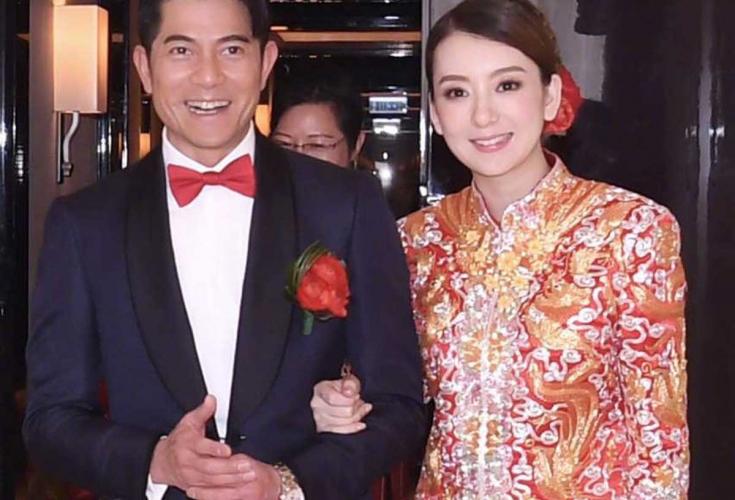
Aaron Kwok’s five-month-old daughter Chantelle has made her first public appearance.

Hong Kong publication, East Week, reported that Aaron’s wife, Moka Fang, and her family were recently in Hong Kong for a Chinese New Year reunion dinner.

Aaron arranged for a seven-seater car to ferry his wife and in-laws to a restaurant at The Peninsula Hong Kong Hotel.

In front of family members, friends, and colleagues, Moka was seen carrying her daughter, with Aaron following her, reported Shin Min Daily News.

From the first impression, Chantelle’s thick hair and eyebrow resemble her father’s.

Her large eyes and small mouth resemble her mothers, and placed beside Moka’s childhood photo, it can be said that Chantelle is a literal carbon copy of her mother.

Thursday, March 1, 2018 – 15:53

More about

Aaron Kwok

Others

Source link

Musical "Evita" kicks off Asian tour in Singapore

0

SINGAPORE – Forty years after opening in London’s West End, the musical “Evita”, about Argentina’s legendary first lady, Eva Peron, made its Asian debut in Singapore in February.

Directed by Broadway’s Harold Prince and produced by Tim Rice and Andrew Lloyd Webber, the show charts the rags-to-riches story of former President Juan Peron’s wife, whose death, at the height of her popularity, cemented her status in Argentina.

The story is still relevant today, say cast members and the musical’s director.

“There are themes about love, and a woman’s determination, and essentially a woman’s strength in politics, which I think we are wanting more of in the world,” said British actress Emma Kingston, who plays Evita, as she was affectionately known.

In an interview, Prince agreed, saying, “The other thing, of course, is the larger message, because that pertains to all of us. Who are our icons? And are they appropriately our icons? Or are they dictators?”

The musical and its hit songs, such as “Don’t Cry For Me, Argentina” and “High Flying Adored”, was inspired by the image of Evita raising her hands at the microphone addressing huge rallies, with her blonde hair drawn back into a chignon.

The 1996 film based on the musical starred the singer Madonna opposite Antonio Banderas.

“Evita” originally opened in 1978 at London’s Prince Edward Theatre, where it ran for eight years.

The current version is to run in Singapore until March 18, before travelling to Hong Kong, Taiwan and Tokyo.

Thursday, March 1, 2018 – 16:00

More about

musicals

Others

Source link

No increase in ministerial salaries, review after 5 years or when it becomes necessary: DPM Teo Chee Hean

0

Singapore

Thursday, March 1, 2018 – 15:47

The Straits Times

No increase in ministerial salaries, review after 5 years or when it becomes necessary: DPM Teo

Others

Source link

No changes to ministerial salary levels and structure: DPM Teo Chee Hean

0

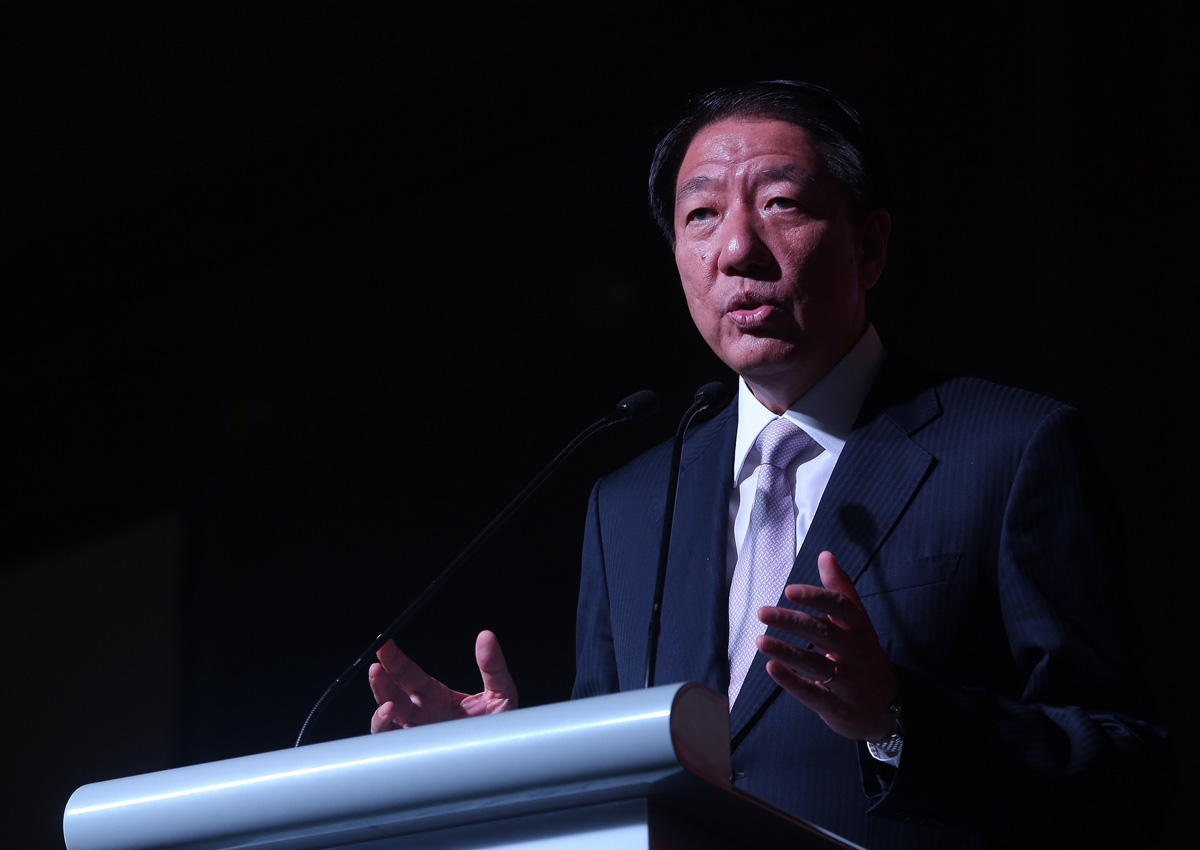
SINGAPORE: Ministerial salaries and their guiding framework will remain unchanged, said Deputy Prime Minister Teo Chee Hean in Parliament during the Committee of Supply (COS) debates on Thursday (Mar 1).

Mr Teo’s announcement came after several Members of Parliament such as Mr Vikram Nair and Mr Liang Eng Hwa asked whether a salary review has been conducted.

The last review by an independent committee chaired by Dr Gerard Ee was completed on Dec 30, 2011, and a White Paper on this was subsequently endorsed by Parliament in January 2012. The 2011 committee had suggested reviewing the ministerial salary scheme every five years, and a new review committee was formed by Prime Minister Lee Hsien Loong in 2017.

The Deputy Prime Minister said Mr Lee had done so last year to review whether the salary framework remains appropriate and valid against its intended goals and what adjustments may be useful. The committee was also to look into whether “there is a need to adjust the salaries, should there be a change in overall salary levels based on the proposed framework”, he added.

Chairing the committee was Dr Ee, and the other eight members were: Dr Abdul Razakjr Omar, Mr Thomas Chua, Mrs Fang Ai Lian, Ms Euleen Goh, Mr Stephen Lee, Ms Mary Liew, Mr Ramasamy Dhinakaran and Mrs Mildred Tan-Sim.  

The committee’s conclusion is that the scheme remains “relevant and sound”, but it recommended adjusting the salary levels to match the updated benchmark and some finetuning on the National Bonus conditions, Mr Teo said. 

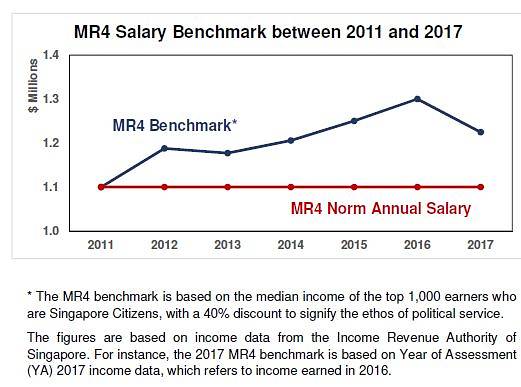
For salary levels, the committee recommended that this is adjusted annually in line with annual benchmark movements. The committee noted the benchmark has increased by 9 per cent since 2011, or a compound growth rate of 1.5 per cent per year over this period, and that no adjustments were made to salaries over this period, he said. 

It also recommended reviewing the ranges for the National Bonus indicators to take into consideration changing economic conditions and national outlook, and to adjust the allowance for Non-Constituency Members of Parliament (NCMPs) from 15 per cent of the allowance for elected MPs to 20 per cent. 

The committee suggested this to “recognise that NCMPs have full voting rights in Parliament from April 2017”, Mr Teo said.

In a subsequent media release from the Public Service Division (PSD), committee chairman Dr Ee said: “It is important to ensure that the right salaries are in place, as we believe that having the right people to lead Singapore will have a fundamental impact on the future of Singapore. However, we noted that since the reduction in salaries in 2012, ministers’ salaries have not been adjusted to keep up with the benchmark for six years.”

In response, Mr Teo said the Government has decided not to make any changes, and to maintain the current salary framework and salary level. 

Explaining the decision, he said that while the MR4 (or entry-level minister) benchmark has increased by 9 per cent since 2011, the Government noted that the 2017 MR4 benchmark is lower than the 2016 one. It will continue to watch salary trends further, he added.

Ministerial salary benchmark chart

Chart: Public Service Division 

“The Government will, of course, keep this House fully informed of any changes to the salary structure or level,” Mr Teo said, adding it will review the matter again after five years or when it becomes necessary.

Mr Teo was speaking during the Prime Minister’s Office session at the COS debates.

Source link

Singapore’s economic strategy ‘inextricably linked’ to building caring society, opportunities for all: Heng Swee Keat

0

Speaking in Parliament on Thursday (Mar 1), Finance Minister Heng Swee Keat also stressed the importance of not allowing social stratification and inequality of opportunity to erode Singapore’s social harmony.

Heng Swee Keat budget

Finance Minister Heng Swee Keat wraps up the Budget debate in Parliament on Thursday (Mar 1, 2018). 

SINGAPORE: All of the Government’s efforts to steward resources and grow the economy are, said Finance Minister Heng Swee Keat, about forging “the kind of society we want”. This means staying cohesive and united, as a society with opportunities for all, and building a caring society, with people who are passionate about “contributing to the common good”.

Making this point in his round-up speech on the Budget debate in Parliament on Thursday (Mar 1), Mr Heng stressed the importance of not allowing social stratification and inequality of opportunity to erode Singapore’s social harmony. “Singapore must continue to be a society where everyone, regardless of background, has the opportunity to do well based on personal efforts and talent,” he said.

“How we achieve this is inextricably linked to our economic strategy.”

He noted that as MPs Jessica Tan and Tan Wu Meng pointed out, diversified and broad-based growth creates opportunities for Singaporeans to pursue their aspirations, and is the best way to help all Singaporeans progress in life. “Rather than focus on how the pie is divided, we should grow the pie so that all can enjoy a larger slice.”

In his speech, Mr Heng outlined how the Government intends to give Singaporeans a good chance of realising their potential at various stages in life: From significant investments in the early childhood sector, to ensuring that all students have access to a quality education regardless of their family background and circumstances, and by broadening pathways to success. The Government is also investing heavily in SkillsFuture, he added, which gives everyone the opportunity to move into new areas of the economy “in line with their aptitude and interests”.

But Mr Heng also noted that bridging social divides is not just a matter of fostering opportunities and closing the income gap. “As a society, we must be mindful not to allow invisible, intangible divides to fester,” he said. And apart from creating common spaces like hawker centres, parks and HDB neighbourhoods, Mr Heng noted that another way to bridge such divides is to “nurture our common values, by building a caring society”.

“A good society is not just one where each of us is able to do well for ourselves,” he said. “It should be one where we all feel a sense of responsibility towards one another, a spirit of caring.”

“This is why this Budget seeks to strengthen partnerships between the Government and the community and to encourage a spirit of giving in every Singaporean,” he added. “We want to foster a caring society through the SG Cares movement, bringing together individuals, informal groups, community organisations and corporates to partner one another, and better reach out to those in need.”

Source link

Tampines double deaths: Victim's father says daughter did not have affairs with married men

0

The father of a woman fatally stabbed by a jaded ex-lover who then jumped to his death from her 10th-floor flat, insisted that his daughter did not have affairs with married men. 

The harrowing incident happened at Block 520A, Tampines Central 8, on May 29, 2017.

Safety supervisor Chng Hong Nam, 49, a married father-of-three, stabbed sales telemarketer Serinn Tan Bee Leng, 46, in her chest and abdomen, killing her. 

Ms Tan’s body sported many stab wounds, including three fatal injuries on her chest, a 6cm-long laceration on her arm, and another stab wound on her abdomen.

The injuries inflicted on Ms Tan was so severe, that her bones and small intestine were exposed. 

In addition to the knife wounds, Ms Tan also bore bruises, suggesting that she had been bound by cable ties, which were recovered at the foot of the block along with Mr Chng’s body. 

The court heard that the two had started having an affair back in 2013.

However, this was later discovered by Mr Chng’s wife, who told her husband to sever all ties with Ms Tan.

Mr Chng’s wife also confronted Ms Tan over the affair at the latter’s flat, but she denied the allegations. 

According to The Straits Times, after the two ended their affair, Ms Tan, a divorcee with a 16-year-old son, moved on to a new romantic interest — her supervisor at work, who coincidentally, is also married. 

Mr Chng persistently called Ms Tan to ask for a meeting, but each time, she would come up with excuses to avoid him.

She finally gave in and the two met at her home. 

After killing Ms Tan, Mr Chng sent a text message to his wife. 

In the message, he thanked her for staying by his side over 20 years and acknowledged that he had hurt her with his infidelity. 

He told her that her suffering would end soon. 

After sending the messages, he leapt from the flat and plunged to his death. 

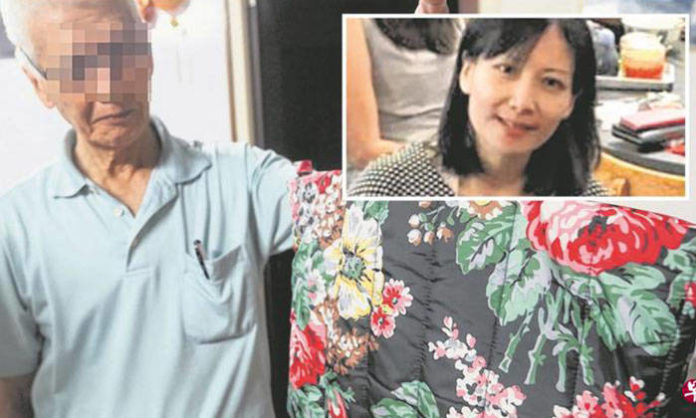
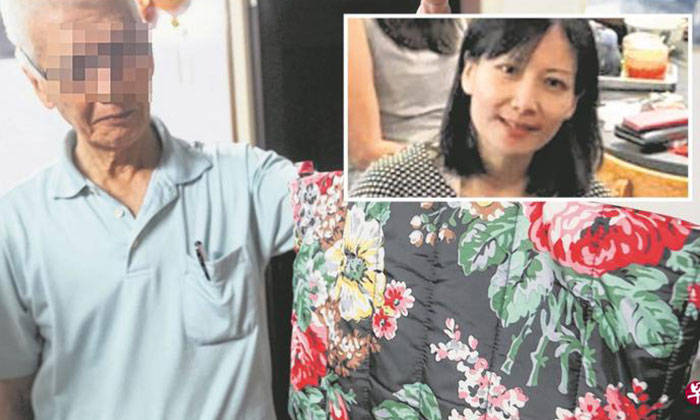
Ms Tan’s father, Mr Chen Wei Sheng, 72, told Lianhe Wanbao that his daughter had divorced from her ex-husband 10 years ago.

Ms Tan and her son then moved in with her parents. 

On March 2017, her daughter finally got the keys to her new flat, but barely two months later, she was stabbed to death.

Mr Tan said that he was a yong tau foo hawker by trade, and his daughter had been very filial, asking him to retire early, while she supported the family financially. 

The elderly man choked as he recalled the moment he received a call telling him that his daughter had died.

Mr Tan said that he felt that he had failed his duties as a father:

“I wasn’t at the scene to shout out her name and left her body lying alone in a pool of blood.

“As a father, I feel ashamed.”

Ms Tan’s son who is now in secondary school is currently staying with his grandparents. 

Mr Tan said that his grandson and his daughter slept in the same room every night, and the boy still misses his mother. 

He also vehemently denied that his daughter had affairs with married men, and pointed out that it had all been wishful thinking on Mr Chng’s part.

Mr Tan revealed that his daughter had switched jobs three times just to avoid Mr Chng, and made up lies about her being attached so he would back off.

She even chose to work in the isolated Tuas area so she could avoid him, said Mr Tan.

Mr Tan insisted that his daughter had never spoken about Mr Chng, or he would have warned her about him. 

He said that based on his understanding, Mr Chng had visited his daughter after finding out that she would be going to Pakistan.

Although Ms Tan told him that she was not free, Mr Chng still showed up at her door.

He then brutalised and killed her.

Despite the attacks, Mr Tan said his daughter’s will to live was strong and cited that she had used her arms to block the stabs, thus explaining the injuries on her arm. 

He added that the flat had been bought by his daughter using her own money, and she had not gotten an ounce of help from Mr Chng.

Hence, he does not believe that his daughter had been in an affair with Mr Chng.

He lamented:

“She is innocent. If anyone says she is his mistress, that is slander.”

Singapore

Thursday, March 1, 2018 – 15:04

Stomp

Others

Source link

SHINee pays tribute to Jonghyun in Japan concert

0

Standing before avid fans in Japan, the members of SHINee expressed love and respect for their former bandmate Jonghyun, whose premature death last year shocked the Asian music scene.

The K-pop act on Monday and Tuesday held concerts at Tokyo Dome to wrap up its Japan tour, which kicked off with performances at the Kyocera Dome Osaka in Osaka from Feb. 17-18. The concerts brought together an accumulated 180,000 fans.

But the highlight of the tour was when the members paid tribute to Jonghyun. 

SHINee performed songs that was recorded by all five members, including the new songs “Every Time” and “From Now On,” which marked the finale for the Tuesday concert.

Five microphones were put onstage, with Jonghyun’s one placed in the center with a rose. 

“It’s not only for this stage, but from now on, we will always think that all five of us are taking the stage. Please promise us one thing; to always remember Jonghyun,” Minho was reported as saying.

SHINee is slated to release “SHINee The Best From Now ON” on April 18 in Japan.

A black and white memorial for SHINee’s Jonghyun by Singaporean fans at Hong Lim Park

Thursday, March 1, 2018 – 14:58

Others

Source link