Home Blog Page 1089

Commentary: Go beyond addressing deliberate online falsehoods to encourage a thinking society

0

SINGAPORE: When you saw the post on social media a few years ago alleging that a local supermarket was selling “halal” pork, what did you do?

Some instinctively shared it. Others might have taken a minute to consider its veracity and decided against it. 

Perhaps it’s time we are all encouraged to do so.

These days it’s becoming harder to tell what’s real and what isn’t.

Sophisticated machinery, bots and fake accounts converge to create manufactured information that often seems legitimate.

Many examples of deliberate online falsehoods have been cited in the last few months as Parliament debated the issue and a Select Committee was formed to examine it. Public hearings on the issue began on Wednesday (Mar 14).

In their Green Paper, the Ministry of Communications and Information and Ministry of Law gave several examples of falsehoods that have been deliberately spread online, “to attack public institutions and individuals”. 

“The aim is to sow discord amongst racial and religious communities, exploit fault-lines, undermine public institutions, interfere in elections as well as other democratic processes, and weaken countries,” it said.

One overseas example was a rumour that former US presidential candidate Hillary Clinton and her chief of staff were running a paedophile ring out of a pizza restaurant in Washington DC. The rumour had gone viral, and led to threats and demonstrations against the restaurant and its owners.

In Italy, a 2016 referendum on proposals to significantly overhaul its constitution is said to have attracted falsehoods spread by foreign state-linked media, as well as domestic parties opposed to the proposals. 

Online news sites linked to one of the Italian parties are said to have inundated the lead-up to the referendum with falsehoods, and sought to undermine proposed reforms and discredit then-Prime Minister Matteo Renzi.

Former Prime Minister of Italy Matteo Renzi became his country's youngest ever leader in 2014

Former Prime Minister of Italy Matteo Renzi became his country’s youngest ever leader in 2014 but his popularity had dimmed following a lost referendum two years later. (Photo: AFP/TIZIANA FABI)

Researcher Dr Mathew Mathews in his oral and written representations to the Select Committee on the first day of public hearings on deliberate online falsehoods pointed out how deliberate online falsehoods by elements seeking to exploit existing divisions within our society for their own ends, could harm social cohesion. 

He cited a local example of how website The Real Singapore had spread a story about a Filipino family complaining about Singaporeans who played music loudly during the Thaipusam religious festival.

Dr Michael Raska of the S Rajaratnam School of International Studies Singapore pointed out that the use of disinformation campaigns aimed at political, racial and religious fracture points can offset an attacker’s military inferiority adding that the use of social media has become as vital as conventional military warfare. 

Clearly, disinformation can have a significant impact.

This is why in the coming months, as policies, laws and regulations are shaped, it isn’t just the Government that needs to be working on the issue.

READ: A commentary on reviewing the threats in deliberate online falsehoods and relooking what Total Defence means.

DEVELOPING A HEALTHY SCEPTICISM

Each of us, as consumers of information, needs to be sensitised to such deliberate falsehoods.

According to the Ministry of Education, information literacy, which helps students discern the authenticity of digital information, is “infused into a variety of academic subjects” like English, History and Social Studies. It is also taught in the cyber-wellness syllabus for primary and secondary schools, as part of the Character and Citizenship Education curriculum.

Similar efforts are gaining momentum in other countries too.

Hopefully, this will lead to students being equipped with the critical thinking and analytical skills that will lead them to have a healthy scepticism of information they are exposed to.

It may get harder to tell truth from fiction as falsehoods also cover doppelganger news websites such as fake CNN news pages. This requires even more discernment.

To check veracity, experts have recommended reviewing multiple sources, using Google’s reverse image search to check whether photos are legitimate and among other things, looking up domain records to see if a news outlet is unfamiliar.

Checking the elements within a story such as whether the sources are named, who they are, whether opposing opinions are provided, whether the story is too good to be true or too ridiculous to believe have been suggested too. 

fake news in schools 1

Sembawang Secondary history teacher Puah You Kai conducting a lesson on fake news for his students. (Photo: Lianne Chia) 

CLEAR DEFINITIONS – FOR ALL OF US

While we exercise a healthy scepticism, we need to have clarity on what encompasses deliberate online falsehoods.

The term that has been most commonly bandied about lately – “fake news” – seems to cover everything from disagreements with the media, differences of opinion, mistakes, rumour, conspiracy theories, hoaxes and propaganda.

Institute of Policy Studies (IPS) senior research fellow Carol Soon and research assistant Shawn Goh, in their written representation to the Select Committee, noted that the “overly broad use” of the term fake news is “problematic on many fronts.” They added:

As such, the select committee’s focus on deliberate online falsehoods (instead of just fake news) is a commendable move.

They pointed to news that is “deliberately fabricated with the intent to deceive, motivated by economic gains or political influence and assumes the disguise or trappings of an authoritative news source”.

Some netizens have questioned whether efforts to clamp down on deliberate online falsehoods are the Government’s way of silencing dissent. Will this mean that the only thing that will win in this information war is “government propaganda”?

The authorities seem to be aware of these concerns, which is why policies and legislation are likely to be defined clearly to prevent abuse.

Considering that any type of deliberate falsehood can cause anxiety and has the potential to destroy societies, people on the ground need to understand these definitions too in order to be able to call out deliberate online falsehoods appropriately. 

BEYOND TRUE OR FALSE

Laws and regulations can reduce the clutter and protect a society, but ultimately the onus is on thinking individuals to be able to evaluate the remaining information onslaught that could persist in spite of measures taken by the authorities.

This is an opportunity to also equip ourselves with tools to better analyse and develop the ability to form informed opinions about information in general, beyond true or false.

For instance, we need to acknowledge that fact is different from opinion.

If an expressed opinion doesn’t sit well with you, launching a vituperative attack by calling it a falsehood or “fake news” is certainly not warranted.

Information is far from binary, that is, real or fake.

That’s just the first layer.

select committee on online falsehoods

Members of the Select Committee (clockwise from top left): Senior Minister of State Janil Puthucheary, Workers’ Party MP Pritam Singh, Deputy Speaker Charles Chong, Minister K Shanmugam, MPs Rahayu Mahzam, Edwin Tong, Seah Kian Peng and Sun Xueling, NMP Chia Yong Yong and Minister Desmond Lee​​​​​​​.

Aside from authenticity, information analysis encompasses context, bias, viewpoints, agendas – both the information providers’ and our own.

We may all be presented with the same set of information but how each of us processes it or comes to conclusions about it could differ greatly.

The goal is not for all of us to come to the same conclusions. Rather, it is for each of us to come to informed conclusions bearing in mind the various layers.

MULTIPLICITY OF SOURCES

Any media literacy programme can only give us the tools to do this for ourselves. A didactic or protectionist approach, regardless of who initiates it, will not work to create a thinking audience – which should be our goal.

I have friends who declare that they’ve stopped consuming mainstream media because it is nothing but government propaganda. These are individuals who are also harsh critics of government policy. 

There’s nothing wrong with being critical, but in order to criticise something intelligently, surely you need to know what it is exactly you’re criticising. Some of their criticism is based on inaccurate information or perceptions of policies.

That’s where it gets dangerous – forming opinions without knowing the facts or possibly based on misinformation from unreliable sources. 

By no means does being vigilant against sources of deliberate online falsehoods mean only trusting one or two information sources.

Today, information sources have become more diverse. Some experts say more credible alternative news sources should be encouraged in any society in order to create a culture of debate and for consumers of information, a culture of informed analysis and discussion.

But instead of availing ourselves of multiple sources, many end up living in their own echo chambers, exercising our own confirmation bias.

While the multiplicity of sources can serve to confound, if reliable, it can also serve to inform and encourage plurality of opinions, helping people gain access to not just knowledge but a sense-making of knowledge.

K Shanmugam at Select Committee on Deliberate Online Falsehoods

Minister K Shanmugam at the public hearings for the Select Committee on Deliberate Online Falsehoods on Mar 14, 2018.

QUESTION EVERYTHING

As far as possible, we need to take advantage of the situation to help ourselves and future generations develop such skills. Don’t just read what social media platform algorithms curate for you. 

The key is to adopt a critical stance when evaluating any argument and question everything whether it feeds our own worldview or not.

Technology has also empowered individuals to create information for audiences. This is why these efforts should go further to inform not just consumption, but creation as well.

Participating in open discussions of current issues, not just in school but encouraging it at home could help us develop the sensibilities required to do this in an intelligent and balanced manner.

It’s a start to learning how to process diverse information sources and how to form our own information-gathering and opinion-formation skills.

Here is an opportunity for all of us, while working to address the weaponisation of information through deliberate online falsehoods, to make information a source of power to create a thinking society that enriches public discourse and in turn, the way we live, not just online, but offline as well.

Bharati Jagdish is the host of Channel NewsAsia Digital News’ hard-hitting On The Record, a weekly interview with thought leaders across Singapore, and The Pulse, Channel NewsAsia’s weekly podcast that discusses the hottest issues of the week.
Source link

Wall Street opens higher as tech stocks recover

0

U.S. stock index futures signaled a rebound for Wall Street on Wednesday, a day after the main indexes fell more than half a percent on fears of political and trade uncertainties.

Traders work on the floor at the New York Stock Exchange (NYSE) in Manhattan, New York

Traders work on the floor at the New York Stock Exchange (NYSE) in Manhattan, New York City, U.S., March 2, 2018. REUTERS/Andrew Kelly

REUTERS: Wall Street opened higher on Wednesday as technology stocks recovered from losses and economic data further eased fears of faster interest rate hikes in 2018.

The Dow Jones Industrial Average rose 90.02 points, or 0.36 percent, to 25,097.05. The S&P 500 gained 9.24 points, or 0.33414 percent, to 2,774.55. The Nasdaq Composite added 28.62 points, or 0.38 percent, to 7,539.64.

(Reporting by Sruthi Shankar in Bengaluru; Editing by Arun Koyyur)

Source link

Disinformation campaign a ‘logical conclusion’ for countries with inferior military strength

0

The changing character of conflict invites “asymmetrical types of strategies”, and this may offset military inferiority, said Dr Michael Raska from the S Rajaratnam School of International Studies. 

michael raska

Assistant Professor Michael Raska from Nanyang Technological University during the public hearing of the Select Committee on Deliberate Online Falsehoods. 

SINGAPORE: Singapore’s deterrence and defence capabilities are “second to none” in the region. But countries with inferior military might could weaken Singapore by exploiting issues that cause tensions among groups, said Assistant Professor Michael Raska from Nanyang Technological University on Wednesday (Mar 14).

Speaking at the first public hearing of the Select Committee on Deliberate Online Falsehoods, Dr Raska, who is from the S Rajaratnam School of International Studies, added that cyber-enabled information conflicts essentially challenge concepts of deterrence.

The changing character of conflict invites “asymmetrical types of strategies” that may offset anyone’s military inferiority and achieve similar political outcomes, he said. 

Dr Raska was responding to a question from committee member and Law and Home Affairs Minister K Shanmugam, on the first day of the committee’s public hearings in Parliament. 

“If you want to weaken Singapore, but you don’t think you can do it through military means in the first place, the logical conclusion is that you must first engage in information warfare?” Mr Shanmugam had asked. 

Dr Raska said that was correct. 

“I think there’s a sense in Singapore of a type of invulnerability towards these kind of threats because Singapore is so small, it can block any sort of external foreign media interference, and it can basically identify this kind of attack,” he said. 

“But I believe this is not necessarily correct, because that type of crisis is not necessarily from within Singapore.”

“SUBTLE INFORMATION” CAMPAIGN TO IDENTIFY FRACTION POINTS

Countries could use a “subtle information” type of gradual campaign that would identify society’s fraction points and political fraction points that create tensions, he said. 

“These points are any issues that either put specific groups together or put specific groups apart. And so once you have done that, then you can essentially from outside tailor specific communication towards Singapore,” he added.

“If Singapore is hit by cyber or information type of attack, in conjunction with a terrorist attack, how does Singapore deter them in the first place, and how does Singapore respond militarily? Particularly if these attacks can happen far away, from places where conventional reach is not viable,” he asked. 

In his written representation to the committee, Dr Raska added that under the changing nature of conflict, Singapore and the Singapore Armed Forces will likely have to “redefine its objectives necessary” to achieve “victory”.

“The use of social media campaigns in conflicts is becoming as important as winning the military campaign,” he said. 

Source link

Deliberate online falsehoods: Are Singapore’s laws sufficient to deal with the threat?

0

SINGAPORE: There are selected levers in Singapore’s legislative framework that can be used to counter deliberate online falsehoods, but these tools when applied to real world situations “run up against limitations of scope, speed and adaptability”, said Singapore Management University’s law school dean Goh Yihan in his written representation to the select committee looking at the issue.

His written submission, published on Parliament’s website on Wednesday (Mar 14), highlighted current legislative tools here that can be used to respond to the spread of deliberate online falsehoods, and said these deal with the issue in at least three ways.

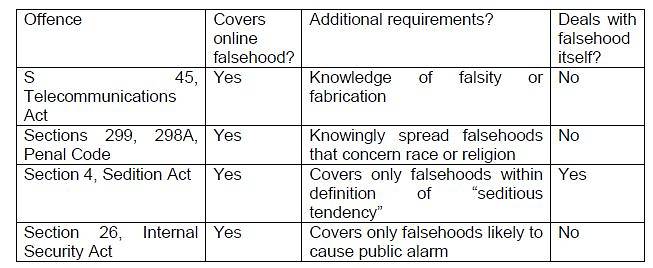
The first is that the spread of online falsehoods may constitute a criminal offence through various provisions, and some of these are Section 45 of the Telecommunications Act, Section 4 of the Sedition Act, Section 26 of the Internal Security Act (ISA) and Sections 298 and 298A of the Penal Code.

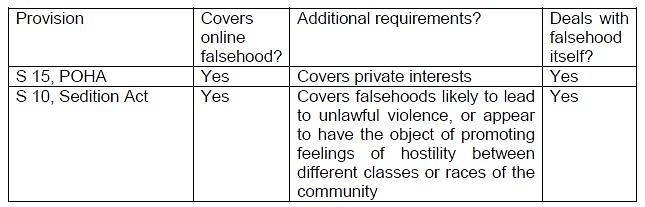
Table on existing laws on online falsehoods 1

(Table: Goh Yihan’s written submission to select committee on deliberate online falsehoods)

These tend to deal with the individual responsible for spreading the online falsehood, and not the falsehood itself, he pointed out.

Secondly, for judicial remedies – such as court orders – these deal with the online falsehood instead of the person. For example, a person can apply for assistance under Section 15 of the Protection from Harassment Act (POHA) to remove the falsehood, Mr Goh said.

Table on existing laws on online falsehoods 2

(Table: Goh Yihan’s written submission to select committee on deliberate online falsehoods)

​​​​​​​

Thirdly, there are executive actions that the Infocommunications Media Development Authority (IMDA) can take under the Broadcasting Act, and these, unlike judicial remedies, can be taken without applying to the court, he said.

EXISTING LIMITATIONS

Mr Goh then used these tools and tested them against real cases of online falsehoods such as those during last year’s Hurricane Irma, and in particular the story of a Ms “Rebecca Riviera”.

The lady said she was a resident of Saint-Martin, a French territory affected by the natural disaster, and in its aftermath claimed on Facebook that Air France had increased the price of its tickets to €2,500 before the disaster. She also claimed the hurricane left thousands dead and dozens of bodies floating in the street, and one of her videos with such claims was seen 5 million times, the law dean said, adding the claims were false.

In terms of criminal laws that could be used here, Mr Goh said Section 45 of the Telecommunications Act could be used if it can be proven that “Rebecca Riviera” knew the information she was putting out was false. The ISA can also be used, considering  falsehoods about the impact of Hurricane Irma are likely to cause public alarm, he noted.   

But before any criminal prosecution can be initiated, he said investigations need to be made to ascertain the identity of “Rebecca Riviera”, and this takes time. It is also a possibility that identity can never be established, or whether the account was operated by a social bot, Mr Goh pointed out.

He added that even if “Rebecca Riviera” is arrested for spreading falsehoods, this false information will remain online with no means to ensure that readers are made aware of true facts.

One of the select committee’s members, Mr Edwin Tong, asked him to elaborate on how the existing laws do not address deliberate online falsehoods during his oral representation on Wednesday.

Mr Goh explained that there are three characteristics to such falsehoods: These are cross border in nature, whether geographical or virtual, they are rapidly and easily spread, as well as tend to have serious, sometimes irreversible, consequences.

Any law for this, the law dean suggested, thus should “punish and deter”, “prevent the spread” on deliberate online falsehoods and have “remedial consequences”.

That said, Mr Goh was keen to point out during his reply to another member of the select committee, Ms Chia Yong Yong, that legislation is by no means the only approach to this issue. “We must balance legislation with education as well as reaching out to different communities,” he said.

EMPOWERING THE PUBLIC

His perspective echoed that of the first speakers at the public hearing, Institute of Policy Studies (IPS) researchers Carol Soon and Shawn Goh.

In their written representation, they had pointed out three areas of non-governmental interventions to address this issue: Self-regulation, fact checking and critical literacy.

For self-regulation, they said a key measure is for technology companies to do so by using their technical expertise and resources to tackle the problem “they are complicit in”. They are already doing so, with Twitter making changes to its application programming interface (API) to prohibit users from performing coordinated actions across multiple accounts in their services, while Facebook’s latest move relegates news publishers in users’ News Feed, the researchers pointed out.

Dr Soon and Mr Goh also delved into critical literacy, and how it goes beyond just recognising characteristics of a piece of online falsehood.

It is about questioning the content, the source and the motivations of the source, as well as making people more aware of how the online space works and how effects like echo chambers capitalise on their biases and hinder their assessment of the information they encounter online.

“In the long run, equipping citizens with critical thinking skills will boost their ‘immunity’ to the different types of false information circulating in our information ecology,” the IPS researchers said.

“More importantly, increasing people’s critical literacy will prepare them for challenges that unfold in the future, which we cannot envisage at present.”

Source link

Big Bang's Seungri reveals enlistment plan

0

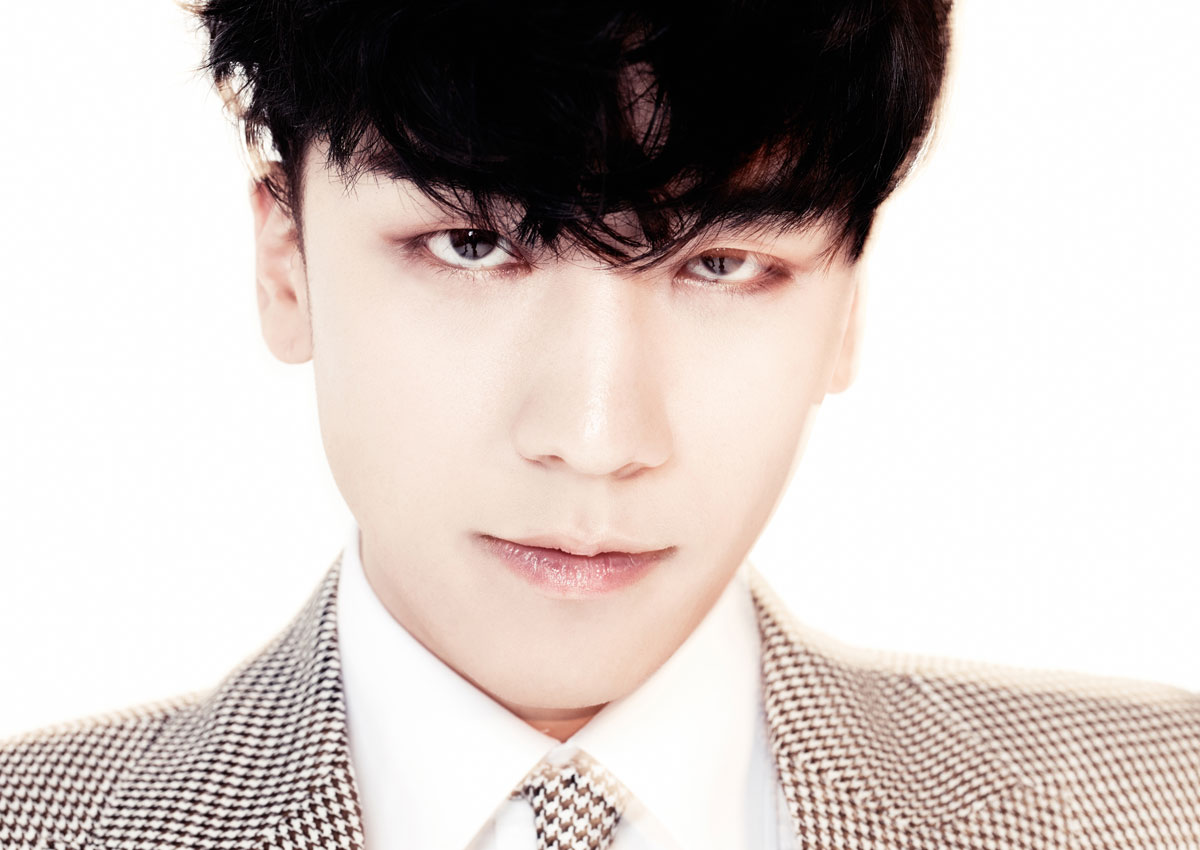
Seungri of Big Bang revealed his plan to enlist in the military via his social media account.

The youngest Big Bang member took to Instagram on Tuesday evening to share his thoughts on his mandatory military service.

“Today, Daesung enlisted. And I, the last group member who has yet to enlist, also plan to join the Army after finishing all scheduled activities for this year, in order to minimise the group’s hiatus,” he wrote.

Seungri posted a promotional image for the group’s new single “Flower Road,” which was produced before the act went on a break due to their military duties.

“Looking at the five fully-bloomed flowers on this poster, I am reminded of the first moment I met the members and everything in between,” he added.

The band’s leader G-Dragon joined the Army on Feb. 27, followed by Taeyang and Daesung who enlisted on Monday and Tuesday, respectively. Rapper T.O.P enlisted in January last year. He is currently serving as a public service worker after being dishonorably discharged from the police due to charges of marijuana use.

Seungri is currently promoting his first Chinese film “Love Only” and is scheduled to release a solo album in the first half of this year.

“Flower Road” swept local music charts upon its release Tuesday.

Wednesday, March 14, 2018 – 17:03

More about

K-pop

Others

Source link

Babies of critically endangered Singapore Freshwater Crab hatched in captivity

0

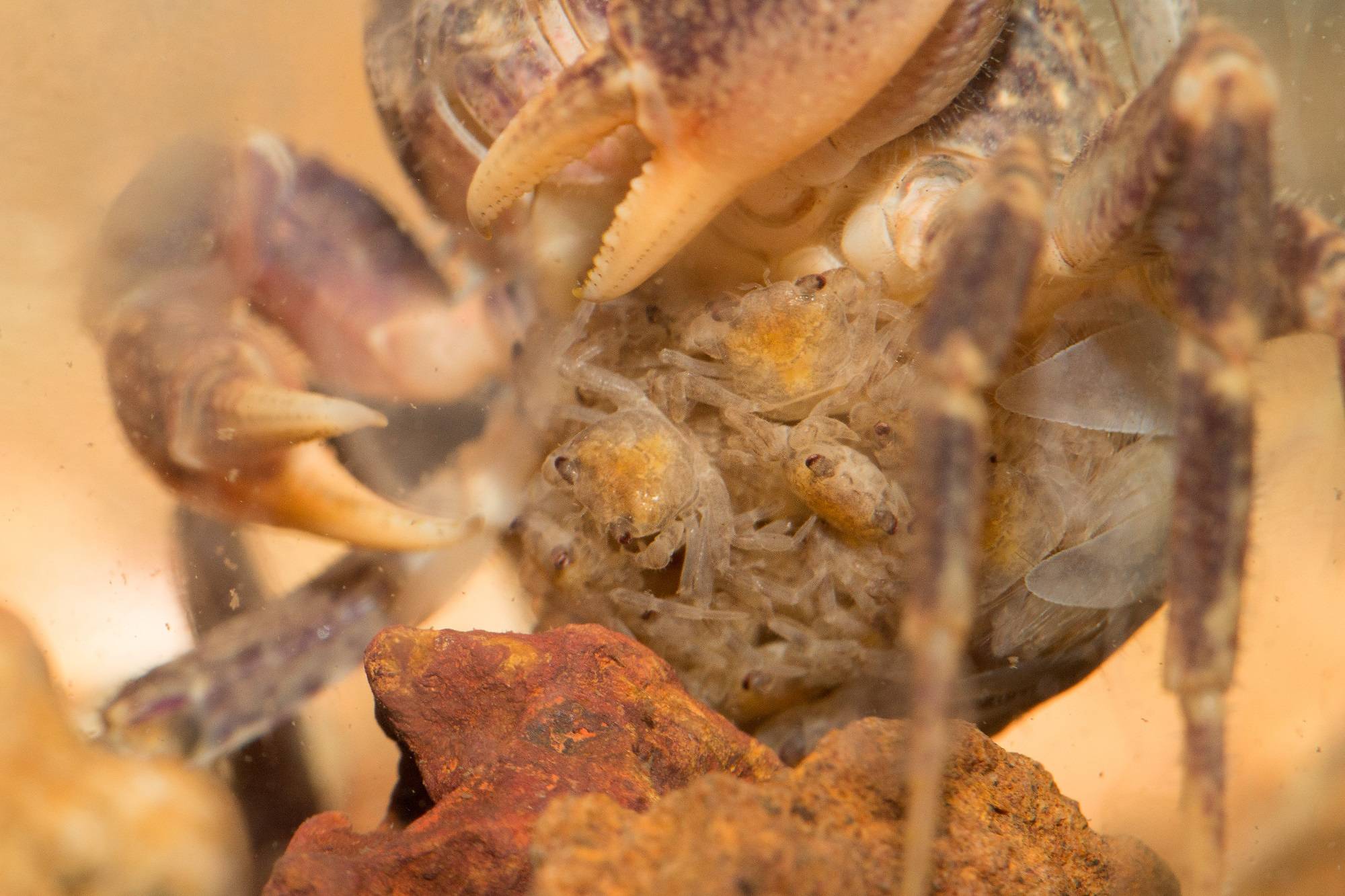
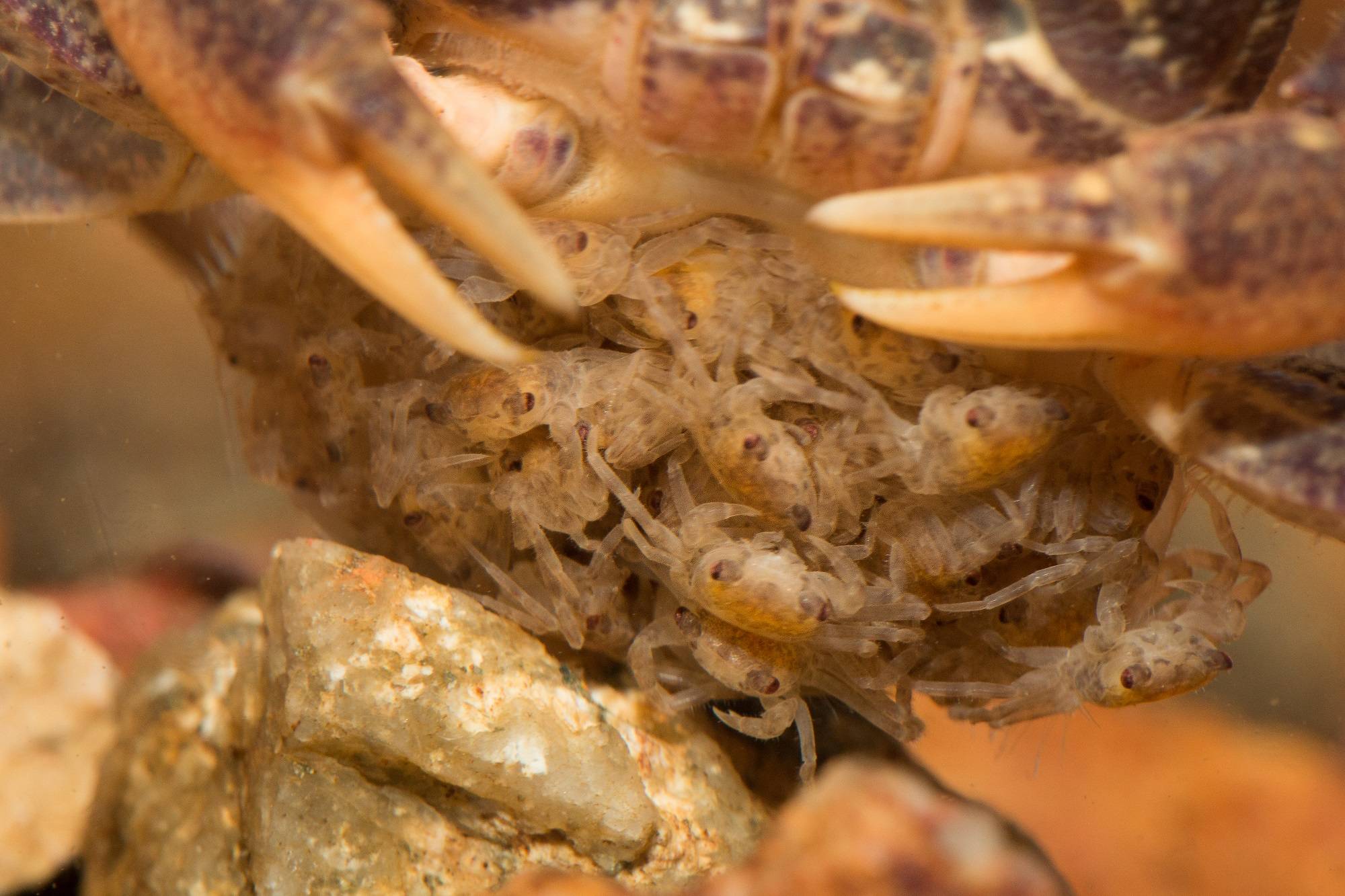
For the first time, Johora singaporensis crablets have been successfully hatched outside of their natural environment, as part of efforts to repopulate the critically endangered species

Johora crablets

A Johora singaporensis crab carrying her crablets. (Photo: National Parks Board)

SINGAPORE: For the first time, Johora singaporensis crablets have been successfully hatched outside of their natural environment, as part of efforts to repopulate the critically endangered species.

Led by the Crab Working Group, which includes members from the National Parks Board (NParks), the National University of Singapore (NUS) and the Wildlife Reserves Singapore (WRS), the effort resulted in more than 40 crablets being hatched and subsequently growing into healthy juveniles.

They are the offspring of one pregnant female crab that was among a few of the crustaceans collected by researchers in December last year.

“If we manage to bring all these 40-plus crablets to full maturity, it will represent a fairly significant proportion of crabs out there in total,” said Mr Lim Liang Jim, group director of NParks’ National Biodiversity Centre.

Johora crablets 2

A mother Johora and her brood. (Photo: National Parks Board)

Typically found in fast-moving streams in hills, the Johora singaporensis, commonly known as the Singapore Freshwater Crab, is one of three known species of crabs that can only be found in Singapore.

However, with researchers estimating the current adult population of the species to be in the hundreds, the pebble-sized freshwater crab is on the brink of extinction. The International Union for Conservation of Nature (IUCN) considers it critically endangered and among the 100 most threatened species worldwide.

To ensure the successful hatching of the eggs, researchers modified tanks to be similar to the crab’s natural habitat. This includes using water taken from the streams, as well as installing pumps to mimic the fast-flowing current and oxygen-rich water it lives in.

Additional measures, such as separating the crablets from each other as well as the mother crab, were also taken to increase their chances of survival. This is because Johora singaporensis are known to be a relatively aggressive species, with past cases of cannibalism and fights leading to death.

Johora crablets brood

A brood of Johora singaporensis crablets. (Photo: National Parks Board)

With very little known about the species, researchers hope to learn more about the ecology and biology of the crabs by observing them. Going forward, the researchers will be looking at getting male and female crabs to mate and breed.

“Our ultimate aim is to build up the pool of specimens to where we can release and repopulate the wild population,” said Mr Lim.

Source link

Madonna to direct film on Sierra Leone dancer

0

NEW YORK – Pop superstar Madonna on Tuesday (Mar 13) announced that she will direct a biopic about Michaela DePrince, a war orphan from Sierra Leone who overcame overwhelming odds to become a successful ballerina.

Taking Flight, taken from the name of DePrince’s 2014 autobiography, will be the musical icon’s third time as a feature film director after Filth And Wisdom in 2008 and W.E. in 2011.

DePrince, abandoned by her uncle during the West African nation’s brutal civil war, was neglected in an orphanage as she suffered from the skin disorder vitiligo.

After being adopted by an American family, she rose to become a ballerina in the United States, South Africa and The Netherlands, where the 23-year-old is now a soloist in the Dutch National Ballet.

“Michaela’s journey resonated with me deeply as both an artist and an activist who understands adversity,” Madonna said in a statement.

“We have a unique opportunity to shed light on Sierra Leone and let Michaela be the voice for all the orphaned children she grew up beside. I am honoured to bring her story to life.”

DePrince’s story earlier was made into a documentary, First Position. She also appeared in Lemonade, Beyonce’s 2016 intertwined film and album that delves into the experience of African American women.

Camilla Blackett, who has written for sitcoms Fresh Off The Boat and New Girl, will adapt a screenplay for the film, which will be released by studio MGM.

The plight of orphans is dear to the heart of Madonna who has adopted four children from Malawi. In 2008, she narrated and produced I Am Because We Are, a documentary about Malawi’s orphans who lost their parents to AIDS.

Wednesday, March 14, 2018 – 16:14

More about

Madonna celebrities

Others

Source link

Singapore investigating firms accused of selling luxury goods to North Korea

0

SINGAPORE – Singapore said on Wednesday it was investigating two local companies accused of supplying luxury goods to North Korea in violation of UN sanctions.

Citing a leaked draft of a UN report, British broadcaster BBC said earlier this week the two firms were OCN and T Specialist, sister companies that share the same director.

“The Singapore authorities are aware of these cases and we are in correspondence with the UN Panel on them,” Singapore’s foreign affairs ministry said in a statement.

“In respect of the two companies mentioned in the BBC report – OCN and T-Specialist – our authorities have commenced investigations into these companies. However, we are unable to provide additional details as investigations are ongoing.”

Under UN sanctions, it has been illegal to sell luxury items to North Korea since 2006.

Singapore

Wednesday, March 14, 2018 – 15:37

More about

NORTH KOREA Embargoes and economic sanctions

Reuters

Others

Source link

Controversial Social Studies guidebook not on approved textbook list: MOE

0

SINGAPORE: A Secondary Three Social Studies book that has sparked online controversy for its content is not on the Ministry of Education’s (MOE) approved textbook list, MOE confirmed on Wednesday (Mar 14). 

Pictures of a page from the book with the subheading “Socio-Economic Status (SES)” have gone viral online as netizens criticised the book’s description of people with “lower SES”. 

The guidebook, entitled “Complete Guide to GCE O-Level Social Studies Volume 1” and published by MarketAsia Books, defined SES as a factor “that shapes a person’s identity”. 

The book also included a list of personal choices purportedly undertaken by someone with lower SES. The list included “using Singlish or different dialects in daily conversation”, playing “sports like soccer or basketball” at local HDB estates, “eating at hawker centres or at home” and youths who take “on part-time jobs during vacation” to meet “basic family needs”.

Facebook user Ahmad Matin posted a picture of the SES section from the book on Monday (Mar 12), with the caption: “Surprised this is even published. I am appalled!”, and tagged MOE to the post. 

As of Wednesday morning, the post had garnered more than 4,750 shares, 850 interactions and 280 comments.  

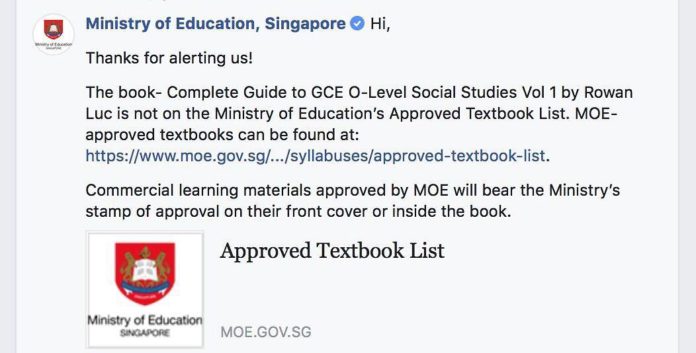
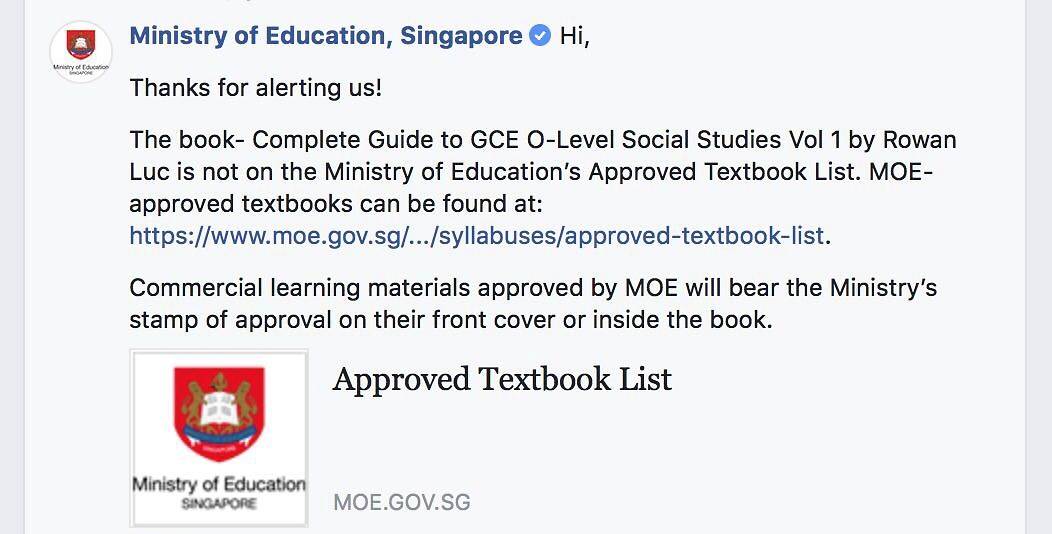
In response to the post, MOE commented on Wednesday that the book is “not on the Ministry of Education’s Approved Textbook List”.  

MOE reply controversial guidebook

(Photo: MOE) 

“Commercial learning materials approved by MOE will bear the Ministry’s stamp of approval on their front cover or inside the book,” it added. 

Netizens reacted negatively to the book, with many frustrated by the impact it could have on young readers. 

Source link

Analysts raise Singapore’s 2018 GDP growth forecast to 3.2%: MAS survey

0

An outperformance in the electronics sector is predicted to boost the Singapore economy but economists are increasingly concerned about the risk of a global trade war.

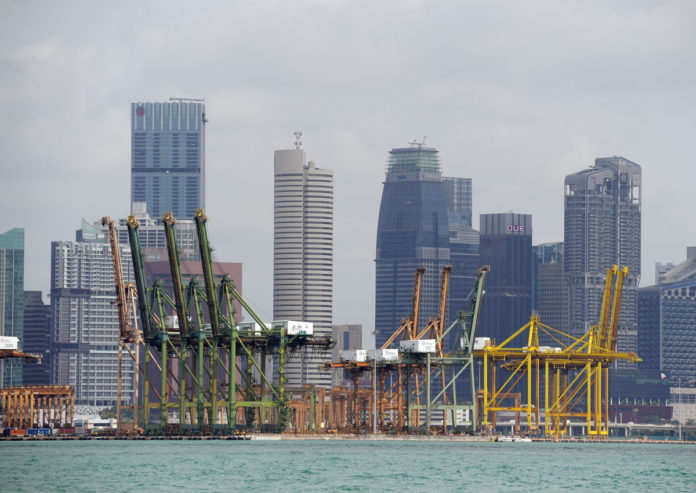
FILE PHOTO: A view of the skyline of Singapore

FILE PHOTO: A view of the skyline of Singapore March 26, 2017. REUTERS/Woo Yiming/File Photo

SINGAPORE: Private sector economists are pencilling in higher growth for Singapore’s economy this year, the latest quarterly survey from the Monetary Authority of Singapore (MAS) showed on Wednesday (Mar 14). 

Economic growth for 2018 is expected to come in at 3.2 per cent, according to the 24 economists and analysts polled. This is up from an earlier 3 per cent forecast in December. 

For next year, expectations are for Singapore’s gross domestic product (GDP) to expand by 2.8 per cent. 

This comes on the back of official data last month, which showed the economy clocking faster-than-expected growth of 3.6 per cent for 2017 and the year’s final quarter. Official estimates also tipped 2018 growth to come in slightly above the middle of the forecast range of 1.5 to 3.5 per cent, barring the materialisation of any downside risks. 

Since the last survey in December, respondents have lifted their forecasts for most economic indicators for 2018, including finance & insurance, wholesale & retail trade, accommodation & food services and private consumption. 

The indicators that either maintained or had a downward revision in their forecasts are manufacturing, construction and non-oil domestic exports. 

Nearly half of the respondents singled out an outperformance in the electronics sector as the main potential upside for the economy. Buoyed by stronger global demand, the manufacturing sector, particularly electronics, has been the key driver of Singapore’s economic growth for 2017 though chances of a moderation have been flagged partly because of a comparison against a high base.

A generally positive outlook on external growth also continues to be another common upside risk in the survey results, at around 41 per cent. 

There also appears to be increasing optimism on the property market, with a noticeable rise in the proportion of respondents citing it, from 27 per cent in the previous survey to 41 per cent.

On the other hand, 88 per cent of respondents cited the possibility of a global trade war scenario as one that they are concerned about, more than double of that in the December survey. 

The threat of a slowdown in the Chinese economy is comparatively more subdued, at 53 per cent of responses, down from 67 per cent previously. Financial sector uncertainty due to global market movements, at 18 per cent of responses, represents the third most common downside risk. 

The forecasts for both headline and core inflation in 2018 remained unchanged from the previous survey at one and 1.6 per cent, respectively. 

On the labour front, respondents also expect the unemployment rate to be 2.1 per cent at year-end, unchanged from the previous survey.

Source link