SINGAPORE has retained its title as the most expensive city in the world for the fifth year running, according to a new report from the Economist Intelligence Unit (EIU).
Singapore’s top ranking is reflective of a regional trend, with the costs of living picking up across parts of Asia as their economies expand.
Coming in close second is Paris, followed by Zurich, Hong Kong and Oslo, Norway rounding out the top five.
Singapore’s top spot will come as little surprise to anyone who has ever tried to buy a car in the city state, where you can be expected to fork out upwards of SGD70,000 (US$53,000).
Despite its high ranking, the report found Singapore still offers relative value in some categories compared with its regional peers. Personal care, household goods and domestic help in Singapore remain significantly cheaper than its peers.
Here’s the full top 10 most expensive cities in the world:
Singapore, Singapore
Paris, France
Zurich, Switzerland
Hong Kong, Hong Kong
Oslo, Norway
Geneva, Switzerland
Seoul, South Korea
Copenhagen, Denmark
Tel Aviv, Israel
Sydney, Australia
A view of the Hong Kong Habour. Source: ESB Professional/Shutterstock
The EIU’s annual ranking compares more than 400 individual prices across 160 products and services. These include food, drink, clothing, household supplies and personal care items, home rents, transport, utility bills, private schools, domestic help and recreational costs.
The survey is designed as a tool for companies to calculate cost-of-living allowances and compensation packages for employees moving abroad.
Notably, there are no American cities in the top 10, as the weakening of the US dollar in 2017 caused New York and Los Angeles to slip to 13th and 14th positions, respectively. Both Chicago and Washington DC did make the top 10 for biggest drop in standing since last year’s survey.
Bangalore, Chennai, Karachi and New Delhi all featured among the top 10 cheapest locations this year.
They were joined by Damascus, Caracus, Almaty, Lagos, Algiers and Bucharest.
SINGAPORE: You close your eyes but can’t fall asleep until 2am. Or you find yourself jolted awake in the middle of the night by a work worry.
These scenarios will be all too familiar for many. Research reveals that globally 30 per cent of people experience difficulty in initiating and maintaining sleep.
This is felt in Singapore too, where recent research shows that people are falling far short of the recommended seven hours of sleep per night.
Philips’ latest global sleep survey found that insomnia (26 per cent) and snoring (21 per cent) are universal issues that impact sleep for over one in five adults.
And, according to a recent SingHealth study, four in ten Singaporeans get less than seven hours of shut eye on weekdays, which more than a quarter of us even miss out over the weekends.
SLEEP AS LITTLE AS POSSIBLE – THE OLD MANTRA
The importance of sleep is in the spotlight as we celebrate World Sleep Day today, but for decades the business elite extolled the benefits of getting by on as little sleep as possible.
Barack Obama famously survived on less than six hours a night during his presidency. Indra Nooyi, one of the world’s most-prominent female executives since taking the top job at PepsiCo, averages a measly four hours a night.
With only 24 hours in the day, it was seen as a simple equation – the less you sleep, the more you can achieve. Until recently, corporate high-flyers were expected to burn the midnight oil and “pulling an all-nighter” was seen as part of the territory for many city jobs.
Thankfully, this attitude is starting to change as more research highlights the negative impact that lack of sleep can have on workplace productivity and health.
The work-life balance movement is gaining more ground as Generation Z – the cohort born in the mid-1990s onwards – enters the workforce, forcing employers to completely re-think their working cultures and policies on overtime to retain the best talent.
Former US President Barack Obama speaks during a Leadership Summit in Delhi, India on Dec 1, 2017. (Photo: REUTERS/Cathal McNaughton)
Arianna Huffington is at the vanguard of this nascent workplace revolution, leading the charge against what she refers to as the twenty-first century’s “sleep deprivation crisis”, and some businesses are starting to follow suit in recognising the boardroom benefits of a well-rested workforce.
She says she now sleeps eight hours a day.
TECH ADDICTION
Work pressures aside, technology addiction is another thing keeping so many of us up into the wee hours.
The blue-and-white light given off by phones and other devices prevents our brains from releasing melatonin, a hormone that tells our bodies it’s night. Over-dosing on screen time, particularly just before bed, is wreaking havoc on our internal body clocks.
Another common, and growing, problem in Singapore is taking its toll on quality of sleep – which can be just as important as the number of hours clocked.
A recent study found that as many as one in three Singaporeans suffer from a little-known sleep disorder called Obstructive Sleep Apnea (OSA), where their breathing stops and starts repeatedly during sleep, sometimes hundreds of times a night.
In addition to the cosmetic and productivity implications associated with sleep deprivation, if left untreated sleep apnea can result in a variety of long-term health problems too, including high blood pressure, stroke and diabetes.
Although snoring is an audible side effect of this condition, and home testing kits make diagnosis relatively easy, it is still undiagnosed in the majority of cases in Singapore.
FILE PHOTO: A man uses a smartphone in New York City, in this picture taken November 6, 2013. REUTERS/Mike Segar
HELP OURSELVES
Employers and governments certainly have a role to play in prioritising and promoting better sleeping habits. But are we doing enough to help ourselves?
Unfortunately the answer seems to be “no”, and many still find it a struggle to address sleep in the same way they would exercise or nutrition.
Philips’ global sleep survey found that although adults recognise the significant impact sleep has on their overall health and wellbeing, even surpassing exercise, financial security and diet, less than half maintain a regular bedtime schedule and less than one in three feel guilty about not maintaining good sleep habits.
Interestingly, the study also found that there is much more rigour paid to schedules for meals and wake-up time and more guilt around exercise and eating habits than there is towards quantity and quality of sleep.
This has to change.
From being stricter about a “digital detox” in the bedroom, to seeing the doctor to diagnose whether snoring could be something more serious, it’s time for us all to make sleep a priority, and stop putting up with any less than seven hours a night.
So, if you’re reading this in bed and it’s late, switch off now.
SINGAPORE: Ten women were arrested during a two-week operation targeting unlicensed and errant massage establishments, the police said in a news release on Thursday (Mar 15).
The women were arrested for offences under the Women’s Charter and Employment of Foreign Manpower Act. The police also found 14 massage parlours that were operating without a valid licence.
The enforcement operations, which took place between Mar 1 and Mar 14, saw the police conduct checks on 41 massage establishments across 15 neighbourhoods.
These neighbourhoods comprised Ang Mo Kio, Bishan, Bukit Batok, Bukit Merah, Bukit Timah, Changi, Choa Chu Kang, Orchard, Jalan Besar, Jurong West, Paya Lebar, Serangoon, Tanjong Pagar, Toa Payoh and Upper Thomson.
Five of the women arrested during the two-week operation. (Photo: SPF)
Investigations are currently ongoing.
If found guilty, the operators of the unlicensed massage parlours will face enhanced penalties under the new Massage Establishments Act, which came into force on Mar 1.
First-time offenders may be jailed up to two years and fined S$10,000. Repeat offenders face a jail term of up to five years and a S$20,000 fine.
The police also said that they will be enhancing checks on all massage establishments and “will not hesitate to take tough regulatory action” against operators of unlicensed massage establishments, landlords who knowingly lease their premises to unlicensed operators and errant establishments found to breach any provisions, rules and licensing conditions under the new Act.
SINGAPORE – Much has been said about Bhutan and its Gross National Happiness (GNH) index – a philosophy of measuring prosperity and well-being of its citizens over gross domestic product.
The Himalayan kingdom has been labelled as the ‘happiest place on Earth’ and that simple tagline has enticed travellers all over the world to visit Bhutan – mostly to seek that same happiness the country and her people are known for.
But what is the secret behind Bhutan’s success and are her people truly happy? It seems like Singaporean director Dr Loretta Chen might have the answers to that.
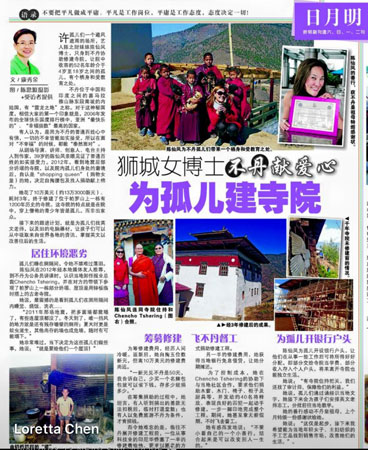
Chen, who is also an entrepreneur and a professor based in Hawaii, is currently working on a travelogue that seeks to uncover the secrets of Bhutan’s GNH and how it balances modernity in the wake of evolving socio-economic change.
Together with conservation and wildlife photographer Brian Doyle as the documentary’s director of photography, the two aim to capture the innate DNA, culture and soul of the Bhutanese people in two half-hour episodes.
According to Chen, the documentary is scheduled to be broadcast on an international channel in March 2019. Filming is slated to begin in December.
Although the documentary is supported by the Tourism Council of Bhutan and the State Trading Corporation of Bhutan, a remaining US$25,000 (S$32,860) is still needed before filming commences.
“The bulk of the money raised came from friends and supporters who knew about my philantrophic work,” said Chen, who helped raised funds in 2014 to rebuild a 17th century monastery and monastic school for orphan monks in Paro.
Photo: Shin Min Daily NewsChen (2nd from right) at Euta Goemba, a 17th century monastery in Paro, Bhutan, that she helped raise funds to rebuild.Photo: Dr Loretta Chen
Chen with a group of young monks at Euta Goemba.Photo: Dr Loretta Chen
The 41-year-old has also forked out her own savings in order to produce the documentary, which she believes is a way of paying it forward to the country and the Bhutanese people, whom she said has “deeply moved” her.
IN LOVE WITH BHUTAN
Chen’s first foray into Bhutan in 2012 came in the form of work. Her resume was circulated and handpicked by the then chairman of government-linked investment arm Druk Holdings and Investments.
She initially entered the country to conduct a series of training. Before she knew it, one thing led to another and over a period of four years, Chen worked as a consultant and corporate traner with various government agencies, including Bhutan Telecoms.
Chen said her love for Bhutan has lasted till today.
“I don’t think I could ever leave Bhutan, as I have such close ties with the kingdom and her people. My serendipitous encounter with Bhutan is once again testimony to the fact that once you open your heart to love, light and positivity, doors open,” said Chen.
Chen told AsiaOne that the film project is her “ode and love song to the kingdom”. It is also a form of thank you to the country and what “her people have done for me”.
“The documentary is part memoir, part travel documentary and part reality show – but 100 per cent heart,” she explained.
I don’t think I could ever leave Bhutan, as I have such close ties with the kingdom and her people. My serendipitous encounter with Bhutan is once again testimony to the fact that once you open your heart to love, light and positivity, doors open.
– Dr Loretta Chen, director
The film project was first conceptualised in 2016 for World Happiness Day. However, Chen ripped both her knees surfing in August 2015 and the project was put on hold. The soon-to-be director now plans to film in Bhutan over a two-month period.
SECRETS TO HAPPINESS?
But does Chen truly believe that she has uncovered the secrets to happiness in Bhutan?
“Yes, I do think the Bhutanese are happy or at least, they are content. In the Buddhist tradition, which believes in the concept of karma, wherever we are in this life is because of our previous life, so there is an acceptance of what this life metes out.
“And it is this sense of contentment that leads to happiness which may be misconstrued in the Western sense,” said Chen.
She also attributes the Bhutanese sense of happiness to the number of young graduates who return to Bhutan, even though they have had the opportunity to be educated overseas.
Chen with Bhutanese girls at Euta Goemba monastery.Photo: Dr Loretta Chen
“Her (Bhutan’s) citizens will almost always return home for that is where their hearts are. Now if that is not a metric or marker of contentment, I do not know what else is.”
For Chen, returning to the Land of the Thunder Dragon for this TV documentary is perhaps a homecoming of sorts for her as well.
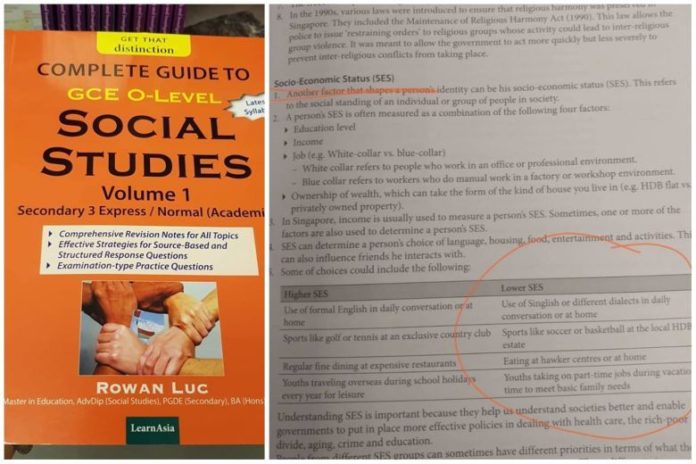
Do you speak Singlish, play sports at HDB void decks, eat at hawker centres or work to earn money during your school holidays?
Why, then you belong to a lower socio-economic class — according to this Social Studies guidebook for Secondary 3 students.
In a post that has since gone viral with over 6,000 shares, Facebook user Ahmad Matin shared a page from the Rowan Luc book, titled ‘Complete Guide to GCE O-Level Social Studies Vol 1’, which discusses Socio-Economic Status (SES) in Singapore.
The 38-year-old said he came across the book at a prominent local bookstore.
on Facebook
Surprised this is even published. I am appalled! Ministry of Education, Singapore @ Singapore
Posted by Ahmad Matin on Monday, 12 March 2018
Besides naming education level, income, occupation and ownership of wealth as factors affecting SES, the book also compared choices that people from different social classes would apparently make.
For instance, according to the book, using formal English to converse indicates you are from a higher SES while speaking Singlish implies that you are from a lower SES.
The book has been criticised by netizens for its “inaccurate” generalisations of Singaporeans.
Responding to a query by Stomp, a spokesman for the Ministry of Education (MOE) said the book “is not on the Ministry of Education’s Approved Textbook List.”
“Commercial learning materials approved by MOE will bear the Ministry’s stamp of approval on their front cover or inside the book,” added the spokesman.
In response to the outrage, distributor MarketAsia said that the particular section of the book should be “read in context of the whole chapter, which discusses crucial themes pertaining to Singapore’s social mobility and inequality issues”.
According to The Straits Times, this section corresponds to chapters four to seven of MOE’s new social studies syllabus, introduced last year, about diversity in Singapore. It also deals with topics like race and religion.
Lynn Hung delighted fans with a her latest weibo post which shared some pictures from a photoshoot documenting her eight-month of pregnancy.
The Chinese model-actress, best known for playing Cheung Wing Sing, the first wife of Wing Chun grandmaster Ip Man in the Donnie-Yen starring Ip Man film franchise, uploaded a series of professionally-shot photographs on her weibo with a message about her baby, which is said to be due next month.
While she’s eager to embrace motherhood, the beautiful mother-to-be expressed that she felt like she would miss being pregnant.
The message begins with: “It is getting closer and closer to baby’s birth. Looking forward to it. Yet, feeling somewhat reluctant. For the past few months, every fetal movement has given me an even more intimate connection with my baby.”
Photo: Weibo/Lynn Hung
In her March 12 weibo post, Hung, 37, also showered praises on her businessman husband Ken Kwok Ho Chung, younger brother of Hong Kong actress Kenix Kwok.
“My husband has been so accommodating and caring to me, that I am absolutely assured our little family will definitely be blissful and happy.”
Hung (also known as Xiong Dailin) tied the knot with Ken in 2016, after dating for two years.
Born in Nanjing City, Jiangsu Province, China, Hung studied costume design and performing arts at Soochow University.
The statuesque beauty (1.79m) made her name as a fashion model in Shanghai before relocating to Hong Kong to pursue a career in film.
Besides her role in Ip Man, Hung is also known for her comedic turns in Raymond Wong’s lunar holiday romantic comedies such as the All’s Well Ends Well franchise (2010, 2011, 2012).
Photo: Weibo
A much sought-after model and actress, Hung is also a shrewd businesswoman who runs Devi Sport, an activewear business she started with her husband in 2015.
She was last seen acting alongside Orlando Bloom and Simon Yam in the 2017 high-octane British-Chinese heist thriller The Shanghai Job (also known as S.M.A.R.T Chase).
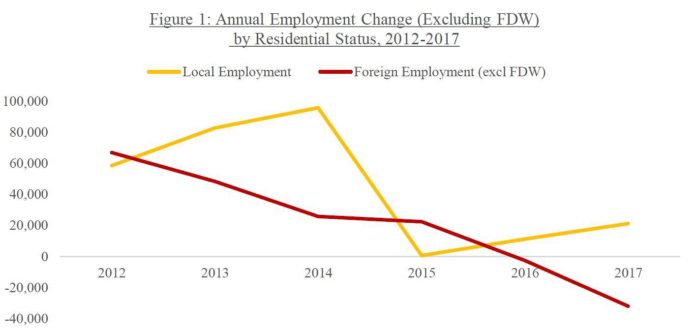
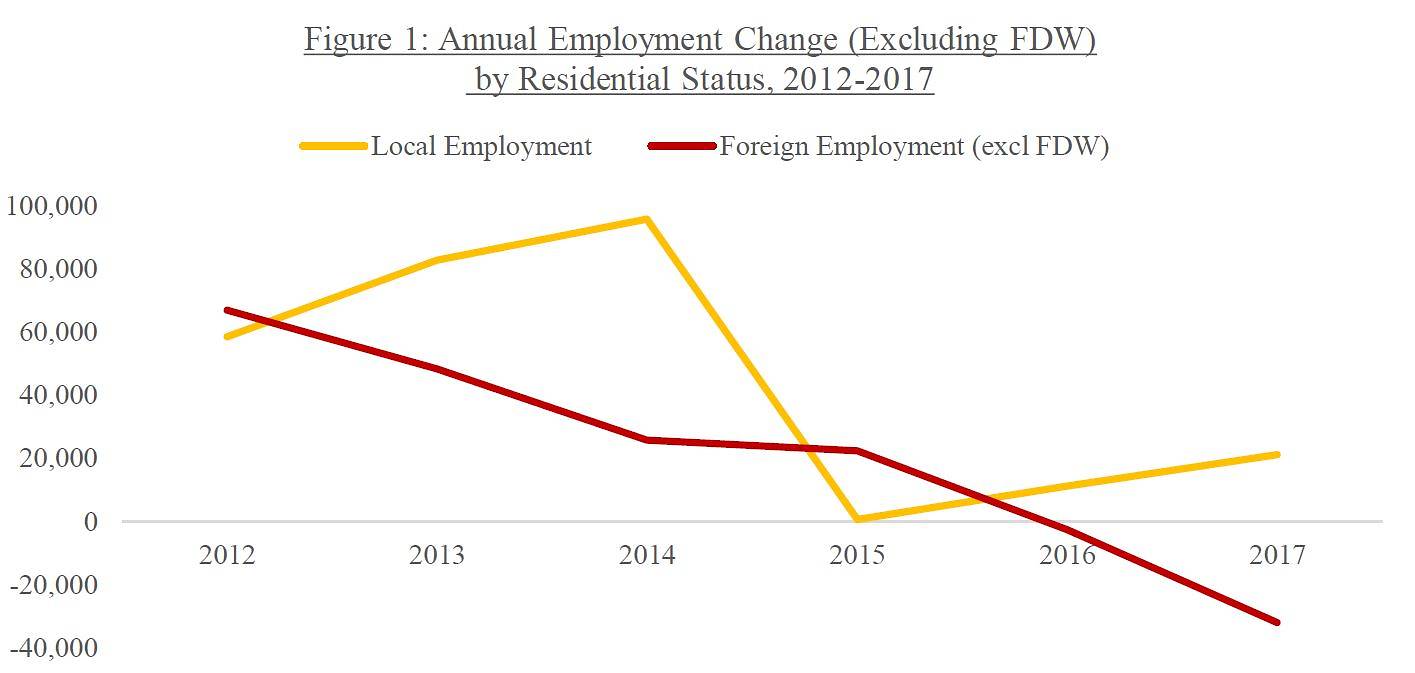
SINGAPORE: Local employment grew by 21,300 last year, nearly double the growth in 2016, according to the Ministry of Manpower’s (MOM) 2017 labour market report released on Thursday (Mar 15).
Employment saw growth mainly in sectors with relatively higher shares of professionals, managers, executives & technicians (PMETs).
These include the financial and insurance services, information and communications, professional services as well as healthcare sectors, MOM said.
Additionally, the seasonally-adjusted resident unemployment rate declined over the course of 2017 to 3.0 per cent in December 2017, down from a high of 3.2 per cent the year before.
The decline was across all education groups, except for degree holders, MOM said.
However, the resident long-term unemployment rate remained at 0.8 per cent, unchanged from a year before, the statistics showed.
Meanwhile, foreign employment continued to contract in 2017, declining by 32,000 in 2017 as compared to 2,500 in 2016.
The decline was mainly due to a decrease of 32,200 work permit holders in sectors such as marine shipyard and construction, MOM said.
S Pass holders grew by 4,700, while Employment Pass (EP) holders declined by 4,500. The decline in EP holders was mainly in professional services as well as information and communication sectors which saw growth in local employment, the Ministry added.
(Source: MOM)
On the whole, total employment, excluding foreign domestic workers (FDWs), declined by 10,700 in 2017. With local employment growth and foreign employment both falling in 2017, the local share of total employment, excluding FDWs rose from 66.4 per cent in December 2016 to 67.2 per cent in December 2017.
RETRENCHMENTS ‘SIGNIFICANTLY LOWER’; MORE JOB VACANCIES
The statistics also showed that retrenchments in 2017 declined to 14,720, significantly lower than that the 19,170 in 2016. However, the 2017 figure is higher than between 2011 and 2015 when retrenchments averaged about 12,000.
The main reason for retrenchments in 2017 continued to be business restructuring and reorganisation, MOM said. The Ministry added that Singapore residents remained proportionately less affected, with their share of redundancies, at 61.9 per cent, remaining lower than their share of employment, at 67.2 per cent.
Additonally, the ratio of job vacancies to unemployed persons improved for the fourth consecutive quarter, to 0.92 in December 2017.
There were also more job vacancies in Dec 2017 (49,700), higher than the year before (47,400).
HIGHER CITIZEN INCOME GROWTH AT MEDIAN, 20th PERCENTILE
The statistics showed that the nominal median monthly income from work of full-time employed Singaporeans increased by 5.9 per cent over the year to S$4,050 in June 2017, or 5.3 per cent in real terms.
“This was faster than the growth in June 2016 (nominal: 0.7%, real: 1.3%), and could reflect the pick-up in economic growth and changes in the composition of the labour force,” MOM said.
From 2012 to 2017, real income growth at the 20th percentile of full-time employed Singaporeans (4.3% per annum) was faster than at the median (3.9% per annum), supported by initiatives to raise the incomes of low-wage workers in recent years, the Ministry added.
The report also showed that labour productivity growth in 2017 was more than double that of 2016.
Looking ahead, MOM said it expects local employment to continue to grow this year as the economy is expected to expand between 1.5 per cent and 3.5 per cent, albeit with some continued unevenness across sectors.
“Hiring is expected to remain cautious in sectors such as construction and marine shipyard, while job opportunities will continue to be available in the manufacturing sector as well as the services sectors, particularly infocomms and media, finance and insurance, healthcare, professional services, logistics and wholesale trade,” MOM said.
SINGAPORE: A high-performance submarine cable will soon provide additional bandwidth between Southeast and North Asia, Singtel said on Thursday (Mar 15).
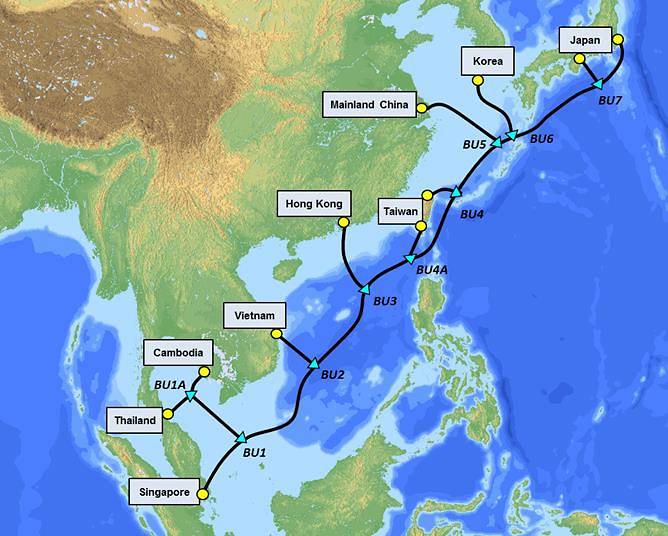
The telco and the members of the Southeast Asia-Japan 2 consortium (SJC2) signed an agreement with NEC Corporation on Thursday to build the cable connecting Singapore, Thailand, Cambodia, Vietnam, Hong Kong, Taiwan, mainland China, South Korea and Japan.
The new cable will support the requirements of “advanced technologies such as the Internet of Things, robotics, data analytics, artificial intelligence and virtual reality applications”, it said in its media release.
Singtel said the 10,500km submarine cable will link eleven cable landing stations in the region and is expected to be completed by the fourth quarter of 2020.
It will also feature up to eight pairs of high capacity optical fibre with a total capacity of 144 terabits per second, roughly the equivalent of simultaneously streaming 5.76 million ultra-high definition videosevery second.
The SJC2 cable will be built and operated by a global consortium comprising telecommunications and technology companies, including China Mobile International, Chunghwa Telecom, Chuan Wei, Facebook, KDDI, Singtel, SK Broadband and VNPT.
A graphic depicting the SJC2 submarine cable route map. (Image: Singtel)
“The construction of SJC2 cable is timely and will provide additional bandwidth between Southeast and North Asia, whose combined population of more than two billion are driving demand for data as their economies undergo digital transformation,” said Mr Ooi Seng Keat, vice-president of carrier services at Singtel.
In April 2017, Singtel and its partners announced the construction of the9,000km INDIGO submarine cable connecting Singapore to Perth and Sydney, Australia.
In December 2016, Singtel and a consortium of 17 global partners also completed the 20,000km Southeast Asia-Middle East-Western Europe 5 cable.