SINGAPORE: Forget familiar holiday destinations like central Europe and Japan, Singaporeans are increasingly expanding their travel footprint to include places such as the Balkans, the Baltic states and East Africa, said the Singapore Outbound Travel Agents Association.
It is offering a range of travel packages to cater to changing preferences and demand, at its three-day travel fair which started on Friday (Mar 23) at Marina Bay Sands.
For instance, there were Russian cruises being offered, a 10-day Kenya and Tanzania animal migration tour, as well as an eight-day “glamping” trip in Melbourne.
Brochures of the various tour packages offered at a travel fair organised by the Singapore Outbound Travel Agents Association.
The Balkans and Baltic states are “trending destinations”, said the association. Many travel agencies at the fair were also offering packages to see the Northern Lights.
“The Baltics is one area in Europe that not many people have travelled to. Recently they have opened up, especially Belarus where it is visa-free for Singaporeans if they are flying through for five days,” said Mr Ken See, managing director of LGE Travel.
“Russia is also becoming very popular for the chance to see the Northern Lights, yet it is not as cold as places like Finland, Sweden, Norway or Iceland so more people are travelling there as well,” he added.
A tour package to Russia which includes a chance to see the Northern Lights.
Some travellers at the fair said they chose to book their trips to “unconventional” or “exotic” locations with a travel agent, as logistics and food will be taken care of.
“I think it’s okay going with a reliable tour agent, all things will be provided for. Whereas Japan all that, we’ve been to, so we want to try more exotic places,” said one traveller, who wanted to be known as Regina, after she booked a trip to Croatia.
Travel agents added that in cases of emergencies, being booked with a tour has its benefits, especially in unconventional travel destinations.
Said Chan Brothers Travel’s marketing communications executive Justine Koh: “Even on our free-and-easy tours, what we have is a 24-hour emergency hotline so there’s always that assurance that while they are on tour, they are not completely by themselves … There is extra protection in a way, beyond insurance.”
This is the association’s seventh edition of the bi-annual fair.
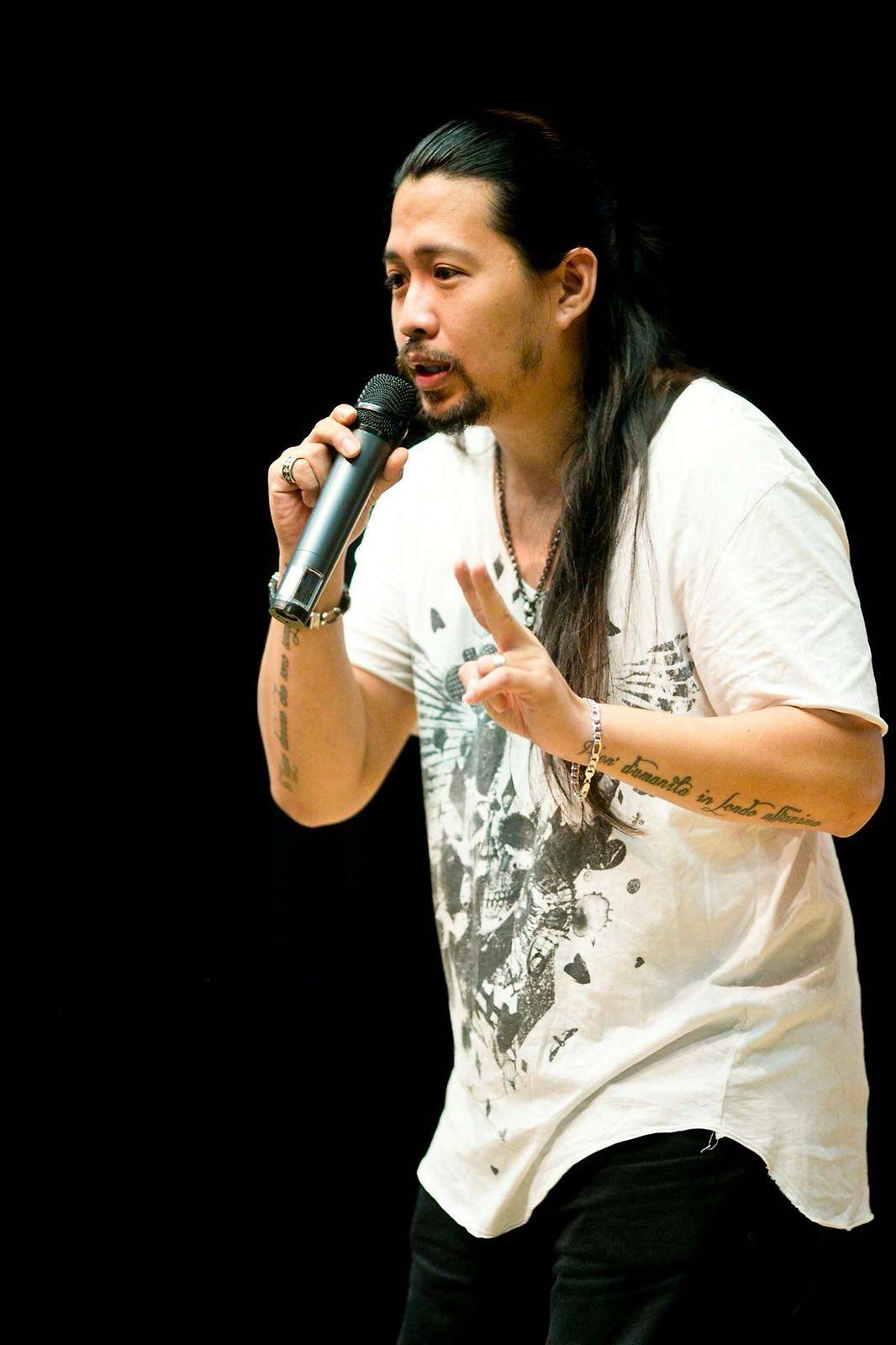
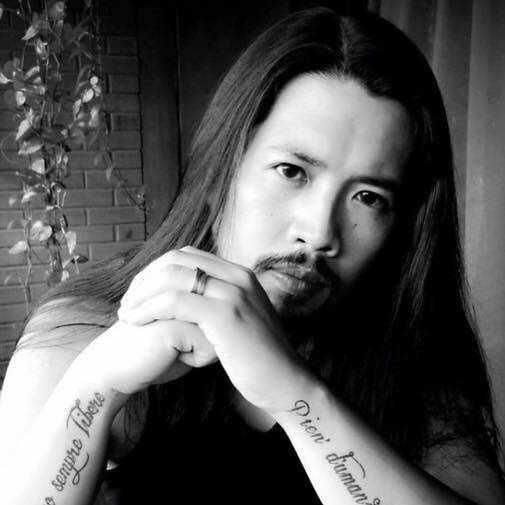
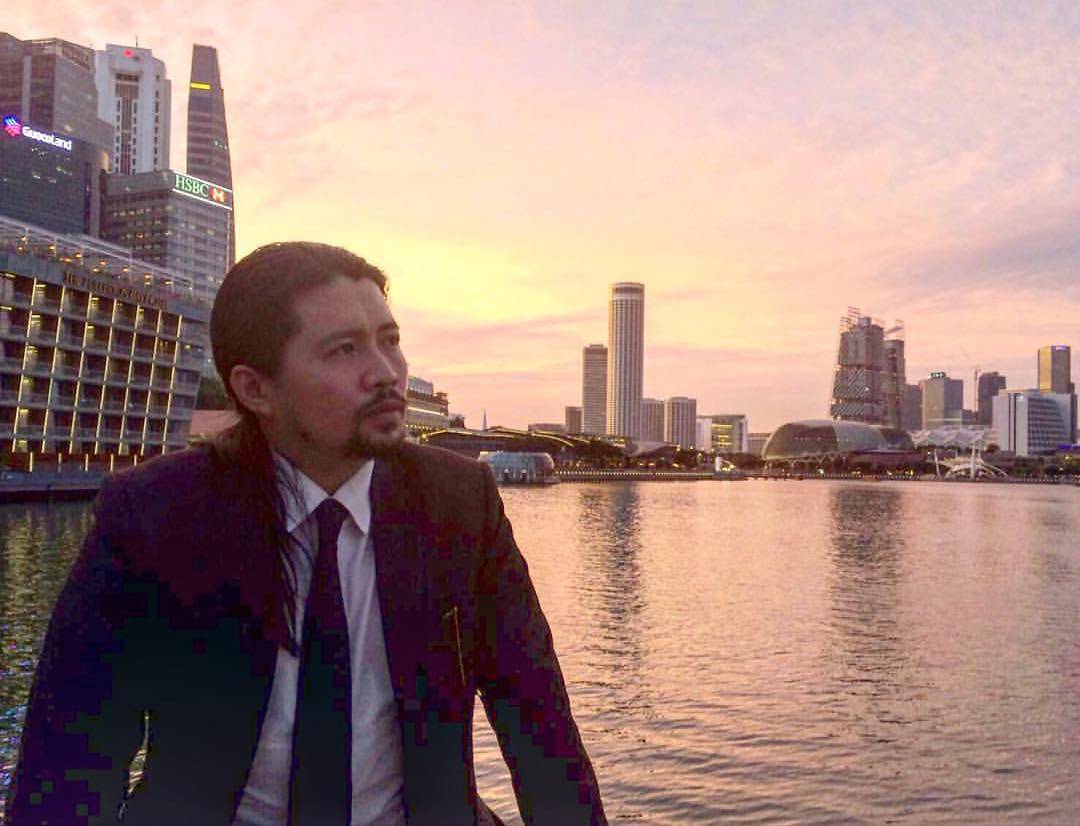
SINGAPORE: Josephus Tan has worn the label of “gangster lawyer” like a badge of honour. Among the things that make him stand out are his long hair, a physical manifestation of his delinquent past and the tattoos on his arms, a tribute to his father.
For years, he has been the darling of the local media.
The story of his dramatic turnaround from delinquent to a prominent lawyer who’s handled some high-profile criminal cases including the recent case of Annie Ee, the intellectually disabled waitress who was tortured to death by a husband and wife, also inspired a Channel U drama, Second Chance.
In the lead-up to the 2015 General Election, there was even talk that he might be fielded as a political candidate for the People’s Action Party (PAP).
His candidacy was never confirmed.
Before the election, he had often been seen participating in grassroots activities in Chong Pang and Chua Chu Kang constituencies. He had said then that he was helping out at the Meet-the-People Sessions, giving pro bono legal advice to residents.
When talk of him running for elections became more widespread on the ground, he even debunked it publicly.
But during our interview today the 39-year-old says that there was indeed a plan for him to run and while he had been telling some people who asked why he ultimately wasn’t fielded that he “pulled out due to personal reasons”, it wasn’t entirely true.
“I don’t deny the fact that I was a potential candidate for the ruling party. Make no mistake about it. I was approached to join politics.
“I never once thought that a person like me deserved a chance in the grand scheme of things. I just wanted to use whatever legal knowledge I possess to help people, but the fact remains that I was first approached. I was told, ‘Why not join politics?’ and effect changes at the highest level and I thought, ‘Yes, why not. If I can save millions through a good policy, why not?’ So I got involved, got interested, went to interview after interview, tea session after tea session. In the end, I was deployed. I was working the ground hard and it all came to nothing.”
Josephus Tan was seen at several grassroots event in the lead up to GE 2015. (Photo: Josephus Tan)
It clearly came as a shock when he realised in 2015 that his silky long hair which is the stuff of shampoo commercials, and his tattoos could be working against him.
Concerns on the ground about his public image crushed his political ambitions.
He claims this was one of the reasons he was ultimately not fielded in 2015.
His public image, in fact, seemed like a selling point up till then. He’s probably the only lawyer in Singapore who looks the way he does. It made him stand out.
He reveals that in addition to ground concerns about his image, there were concerns about his “mannerisms, how I’m very straight with my words, even my financial status or my past records, my admission to the fact that I was prone to criminality, maybe during National Service as well.”
He has admitted in previous interviews that he had gone AWOL several times. His financial status was unstable because he had been doing mostly pro bono legal work and didn’t have a steady income stream.
However, it looked as if he was connecting well with people on the ground in spite of this.
His well-publicised and compelling personal story certainly helped.
He grew up in a rough neighbourhood, joined a gang and lived an aimless life of vice and violence. At 22, a big quarrel with his girlfriend catalysed a dramatic change in his life.
He was drunk and rage caused him to abuse her physically and subsequently threaten to throw her off the balcony of his 23rd –storey flat.
His father wrestled him to the floor and slapped him twice.
He often relates this story with a sense of pride saying that his life was changed by “two tight slaps.”
He slogged hard to get his law degree with the help of his parents and relatives who had helped fund part of his education.
IS REDEMPTION A MYTH?
He admits the rejection in 2015 “baffled” him.
“I thought a lot of people by now would have accepted me for who I am and the way I look. I really didn’t see an issue, but I don’t know. I might just be living in my own world. Maybe the big conservative group out there expressed a different view even though maybe on the surface, they seemed to be in agreement with what I am or who I am.”
It seems even the fact that he had turned his life around after facing numerous obstacles couldn’t overpower these concerns.
After all this time, he still looks visibly dejected as he tells this story.
So is redemption a myth?
“I have reconciled with my past but I cannot expect others to do the same. Everyone loves reading a good redemption story but who can truly live and believe in one? It’s disappointing to say the least but it doesn’t stop me in continuing to advocate for second chances for others especially the underprivileged.”
“I have reconciled with my past but I cannot expect others to do the same,” says Josephus Tan. (Photo: Facebook / Josephus Tan)
While he seems more at peace with it today, in 2015, he says there was anger mixed with his disappointment.
I ask him if he feels the PAP should have stood up for him.
“I think people on the ground are all that matter. They are the electorate. I think it’s very important to have the mandate of the people. If there’s really a concern from the ground as to my candidancy, then I should just take it upon myself to better my chances if I ever contemplate stepping into politics again. I wouldn’t want to second-guess the party. I think that perhaps maybe there were better candidates and there were for sure.”
STILL HAS POLITICAL INCLINATIONS
The party told him “perhaps, another time then.”
“So hopefully the time comes,” he says.
This surprises me. Considering he was judged so harshly, why would he still want to join politics?
“I think what is inspirational about my story is I didn’t stop for anything. I just kept forging ahead regardless of how many crises I met and it’s the same for politics. To say that I don’t have any political inclination is a lie.
“To me, politics is important. I’ve been serving the people in my line of work. So I have a consistent track record and I feel that if I can do this at a policy level, it would have been great because I really understand what’s happening on the ground because I’m on the ground everyday with the people.”
But why serve a public that could not appreciate his contributions enough to support his candidacy?
“Put all these rejections aside, I think the mission itself is of paramount importance. There were certain reasons why I was rejected and it’s legitimate. I take responsibility. The fact is that there are actually problems in these few areas and I just need to work myself out. So the day that I solve all these problems, when I’m truly free and that is where I would know whether this stands true.”
“Why must I remove the tattoos which remind me of my father?,” asks Josephus Tan. (Photo: Facebook / Josephus Tan)
WON’T CHANGE HIS PUBLIC IMAGE
He’s referring to solving his financial problems which we discuss in-depth later, but I’m curious about whether he would get rid of his tattoos or cut his hair to placate the electorate.
“I wouldn’t,” he says categorically.
“I’ve expressed this before to the powers that be. I’ve been looking this way because there’s a need for me to embrace my past. It’s also a daily reminder of where I came from. If I’m going to remove my tattoos, change my hairstyle just because I want to get into politics, there’s an element of hypocrisy to it. The electorate will think, ‘Ok, this guy is bending backwards. He used to be so upright, he’s fighting for the underclass but right now because he wants to join politics, go into the ruling party, he’s changing.’ I feel that such a message doesn’t go down well not just with the people, but even with myself.”
Hair and tattoos might seem like superficial things, but to him they hold immense meaning.
“At the height of my teenage rebellion, I was growing out my hair long. So over the years, it has become very, very comfortable and I like the way I look and I think there’s no issue. I go to court, I observe the decorum, I tie my hair and I think it shouldn’t be an issue. Why must I remove the tattoos which remind me of my father?”
In 2013, his father died of cancer. Shortly after, as he worked on overcoming his grief, he was inspired.
“I took a soul-searching trip to Phuket. I was listening to this song, an Italian opera. It’s called Nella Fantasia, which means “In My Fantasy”.”
The tattoo on his arm translated into English would read: I dream of souls that are always free,
Like the clouds that fly, Full of humanity in the depths of the soul.
“At that time the song had a very calming effect on me and it speaks out what I feel inside. I believe that every soul including myself and my dad, we should all be free, we should all be happy.”
TOO MUCH PRO BONO WORK AND A DESPERATE ATTEMPT AT PIETY
He’s currently working on fixing his financial troubles and recently opened his own firm Invictus Law Corporation with a personal loan from a few close friends.
He’s keeping his firm’s operations lean with a small office space and leveraging technology in order to minimise manpower reliance.
While taking on more and more pro bono work was fulfilling, he concedes it hurt his pocket.
He’s working on striking a better 50-50 balance between paid and pro bono work, but at last count, 70 per cent of his cases were done on a pro bono basis.
This was exacerbated by the fact that he had started spending more time on grassroots work and giving motivational talks instead of taking on cases.
In the lead up to his father’s death, he had also borrowed heavily in a “desperate attempt at piety.”
“That remains my biggest and my only regret. That I couldn’t provide for him (my father) while he was well,” says Josephus Tan. (Photo: Facebook / Josephus Tan)
“I felt that I had failed as a son. I didn’t provide the necessary financial stability, not only to myself but also to my parents and that’s the reason why in his dying months, I borrowed heavily from the bank to rent a nice colonial terrace house, to engage a foreign domestic worker, to buy a second hand Mercedes.
“He used to drive a white Mercedes before he went bankrupt. When he was lying in the hospital, I told him dad, ‘Look, if you can muster the courage and the strength and the will to live, I promise you I’m going to bring a Mercedes to drive you back home.’ I couldn’t get a white one because the only one I could afford was second hand and it only came in red.”
His father, by that time, was too ill to appreciate any of it though.
“I saw the sadness in his eyes and he couldn’t really speak anymore. He was so skinny.”
“That remains my biggest and my only regret. That I couldn’t provide for him while he was well.”
His father too had a chequered history.
He had a security business which went bust. He then started working as a security officer and moonlighted as a dough and bread-maker at a factory.
“Since the early part of my childhood, until today I hate eating bread and it’s because my father would always bring the factory rejects home. Loads and loads of bread. I thought that was my father’s way of showing his love – literally bringing bread to the table and that was what he did. But I got sick of eating bread.”
His father also had gang connections.
“When I was very young, I saw how my father got beaten up at the market by a group of thugs. His head was bloodied and of course he was rushed to the hospital and was stitched up. He said it was a mistaken identity, but that’s when he told me about how different parts of the market or hawker centres were ruled by different gangs.”
However, when asked he maintains his dad’s background played no part in turning him wayward.
“I actually had a wonderful childhood. We were poor but we were always loved and in a very, very basic way. I mean basic shelter, basic food, basic care and attention. My mother even helped borrow money from relatives to help finance my law education.”
It was more a result of the neighbourhood he grew up in and teenage angst, he claims.
Last year was a particularly tough year for him.
His financial problems came to a head as his debt and interest on debt accumulated. It almost hit six figures, but he still wanted to complete his pro bono cases.
At one point, to earn additional income, he worked as a pest controller on international tankers – a job a friend helped him get. He even worked as a dishwasher at private events.
As he continues to work on solving his financial problems as a result of his desperate attempts at piety and a lack of balance between paid and pro bono in his law practice, he is convinced he’s headed towards stability.
“It’s really right down to the last bank loan and then finally I will be free.”
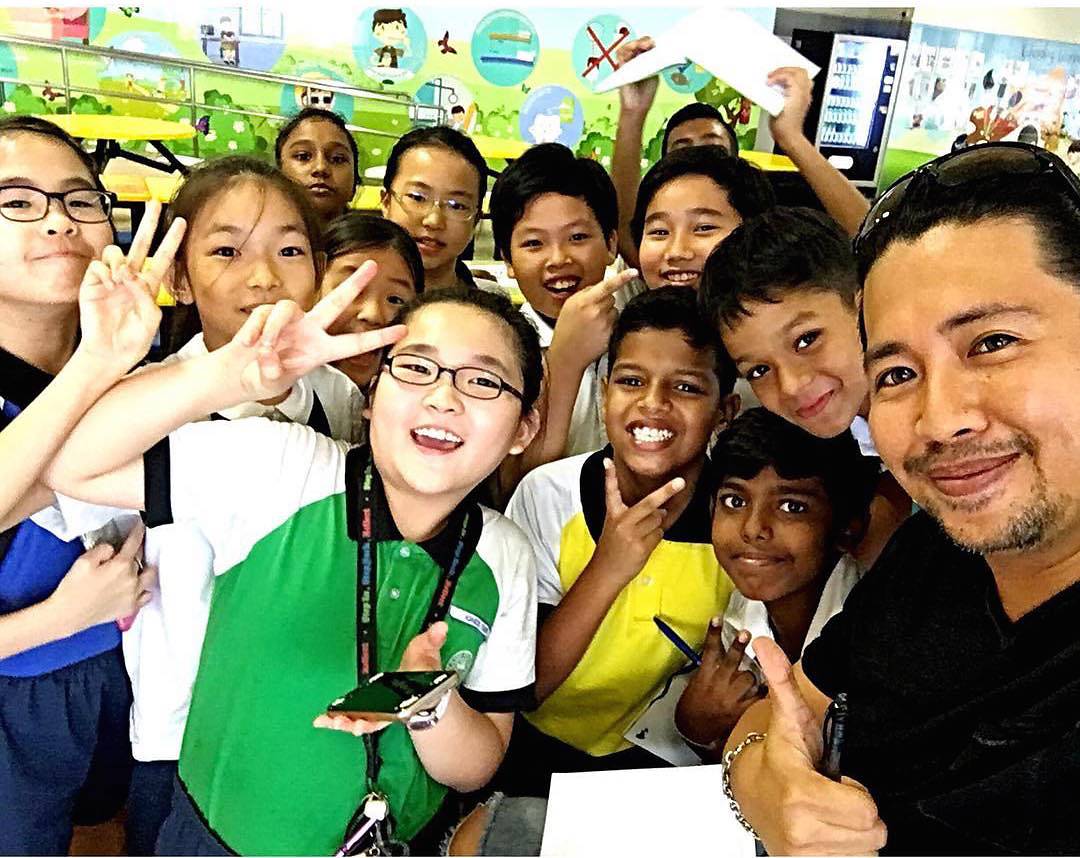
Josephus Tan spends a lot of his time giving motivational talks to students. (Photo: Facebook / Josephus Tan)
HIS MARITAL BREAKDOWN
But his health and personal life have suffered too.
He came very close to having a stroke and went through a divorce last year.
Because of the divorce, he is currently renting a room near his office to minimise his costs.
His ex-wife is actually the same girl he threatened to fling off the balcony of his flat when he was 22.
She stuck by him even after that and was married to him for 14 years.
“I’m still very grateful for the fact that actually she stood by me from that time till now.”
So what ended the relationship?
“I was just so focused on rehabilitating myself, on turning my life around, on recovery. When I found my purpose or what I call my “mission”, I got lost in it.”
He neglected her and claims the damage had been done over the years.
“I was the one who actually suggested the divorce. It’s much better to put an end to something in the hope for something better for the both of us.”
She is in a happy relationship, he says. He, on the other hand, isn’t seeing anyone.
“I just started my own law firm so I’m all geared up to really restart and recharge myself and right now the focus is on the aspirations ahead. I’ve got to get the basics right and I know that the next person that comes along, I’ll make sure she will be in a much better place.”
DEFENDING THE WORST CRIMINALS
We turn to discussing his career which he is eager to talk about.
He himself was lucky enough not to be incarcerated in spite of his delinquent past, but he seems to be able to empathise with even those who commit heinous crimes.
Naturally, we talk about the case of Annie Ee. He made headlines last year for defending her abusers and was himself criticised and harassed by some members of the public for doing so. He maintains now as he did then that every one deserves fair legal representation no matter how heinous their crime – something that his mentor, the late prominent lawyer, Subhas Anandan asserted many times.
“As as long as you know you are doing the right thing, have no fear at all. I thought about it that way when I saw people were getting angry.”
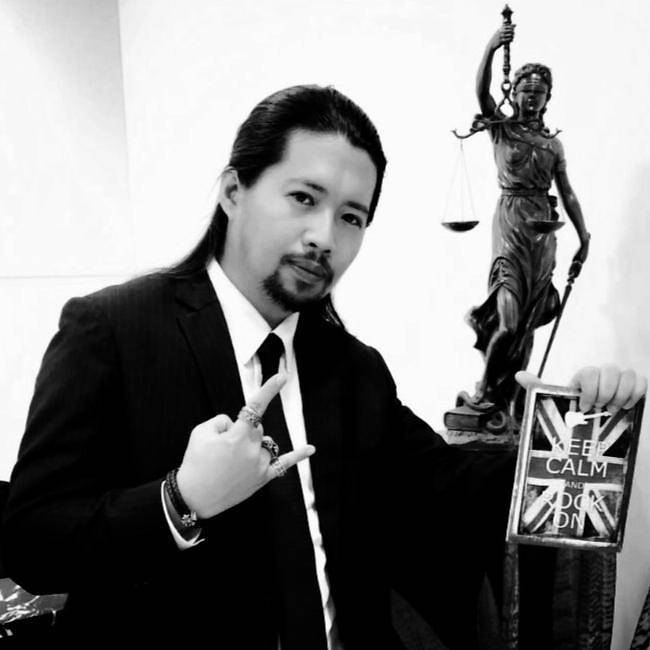
Josephus Tan opened his new law firm in October last year. (Photo: Facebook / Josephus Tan)
He’s often said that criminal lawyers have to be able to suspend judgment.
“You’re human first, then a lawyer,” he says to explain his empathy for those he defends.
While he uses this as a justification to defend even the worst criminals, one could say by that same token, shouldn’t he have an adverse reaction to those suspected of conducting heinous crimes. It’s only human, isn’t it?
“Very good question but really I think the good thing about our profession is that we will usually have the so called “inner” story. Right from the get-go when we take on a case like Annie Ee’s case, the lady who abused her was herself diagnosed to be emotionally complex. She had mental issues and this was actually brought up by the expert psychiatrist. So who are we to say?
“Often, there are reasons for their behaviour. Out of the hundreds of cases I’ve handled, only maybe one or two involve perpetrators who have are born evil. They are psychopathic or sociopathic and have no remorse for their actions.”
For others, there will be a form of explanation for what they did and mostly it’s a circumstantial factor. They are either lowly educated or in a financially difficult position, or they have medical or mental illnesses, or they come from a broken family nucleus, all sorts of problems. It’s almost like a social problem and the legal problem is just one part of it.”
He feels that Annie Ee’s case in fact brings up other urgent issues for society.
“Why did she fall through the cracks? That’s why the stakeholders need to look into this issue.”
“FIGHT LIKE A TIGER”
His future in pro bono criminal law is something he’s excited about even though he plans to scale it down to achieve a better financial balance.
Under the Criminal Legal Aid Scheme, nowadays pro bono lawyers actually receive a S$500 honorarium per case. This was not the case when he started out 10 years ago.
He thinks the money should be channeled into the community to fund needs such as bursaries for the poor and other services.
“I understand that some lawyers use it as a form or survival which is not wrong. But if you have the right balance of paid and pro bono work, why not channel the S$500 to Voluntary Welfare Organisations or foundations to see whether we can do a dollar-to-dollar matching to help others.”
He also feels that generally, Singaporeans lack legal literacy and aims to help with legal education.
“Singapore has never been a very litigious society so we lack knowledge compared to our peers in other countries. I think most Singaporeans engage in what we call “kopitiam laws”. They believe more in vigilante justice or they have this lynch mob mentality.
“Every lawyer should be doing their part to help in the education effort.”
What does he say to those who think lawyers don’t put as much effort into pro bono cases.
“It’s still a person’s life and you shouldn’t be working any harder for the person who pays you and less for the person who doesn’t pay. I think those who do that are shooting themselves in the foot because clients will start to know.
“Clients will look at how hard I fought for my pro bono clients and then in turn they will actually go and reprimand the lawyers that they’re paying money for and say that look, ‘You’re not doing much. This guy is doing it for free and he fought like a tiger.’ If you’re doing it for free and you fight like a tiger, it helps you get paid clients too. If you do a bad job, even those who can pay may not come to you.”
His hardships, he claims have not discouraged him and many young lawyers he has observed are still keen on pro bono work.
He sees the work as his “baby” and is intent on “moving the pro bono movement to the next level.”
Today, it’s clear Josephus Tan is intent on “fighting like a tiger” to reclaim his life after his crisis last year, not just in the law but he hopes, in the near future, in politics as well.
SINGAPORE: In the first two weeks of public hearings by the Select Committee on Deliberate Online Falsehoods, the role of legislation in countering deliberate online falsehoods was debated by academics and experts.
Several experts agree that legislation can play a role in the fight against deliberate online falsehoods, but there are gaps in existing legislation due to rapid advancements in technology which need to be plugged.
However, experts also agree that legislation cannot be the only solution. First, legislation will always lag behind the increasingly sophisticated technological tools that perpetrators use to produce and disseminate online falsehoods.
Second, relying solely on legislation may cultivate over-reliance among citizens on authorities to help them discern truth from fiction.
Thus, a suite of non-legislative interventions with both near-term and long-term effectiveness is required to complement legislation.
Measures with near-term efficacy such as self-regulation by Internet intermediaries – for instance Facebook, Google and Twitter – and fact-checking provide interim relief to the problem, while measures such as strengthening critical literacy will boost people’s “immunity” against falsehoods in the long term.
SELF-REGULATION BY INTERNET INTERMEDIARIES
As people spend increasingly more time in the online space, one important measure is for Internet intermediaries to self-regulate by leveraging their technological expertise to tackle the problem they are complicit in.
Technology companies have acknowledged the importance of self-regulation, experimenting with different approaches to counter deliberate online falsehoods both during election periods and on a day-to-day basis.
For instance, Twitter has improved its algorithm to stamp out bot accounts targeting election-related content, while Google and Facebook have committed to improving accountability and transparency regarding political advertisements on its platforms.
Facebook has also rolled out a new “Related Articles” initiative (which will give users more context about why a story is false) after realising that their previous “Disputed Tags” initiative may not be effective.
Representatives of Google, Twitter, Facebook and industry association Asia Internet Coalition at the public hearing by the Select Committee on Deliberate Online Falsehoods on Mar 22, 2018.
However, there are limitations to self-regulation by Internet intermediaries. For one, technology companies are still experimenting with various techniques and re-examining their philosophy and approach towards regulating content on their platforms. There is no fool-proof solution yet.
Second, some observers doubt that these technology giants would have sufficient will and incentive to self-regulate effectively because they would ultimately prioritise profit-maximising goals.
Third, technology companies still have a long way to go in terms of upholding standards of accountability and transparency as seen from Facebook’s failure to inform its users about breach of trust in the Cambridge Analytica scandal. Hence, other measures are needed.
THREE-PRONGED APPROACH: GOVT-LED, INDUSTRY-LED AND GROUND-UP
Another important measure to tackle the problem of deliberate online falsehoods is fact-checking. Research shows that debunking inaccuracies in a piece of information and repeating corrective information can help mitigate the effects of misinformation.
Thus, it is crucial to provide and support fact-checking facilities that the public can access.
Currently, fact-checking efforts in Singapore are led by the Government.
One example is the Factually webpage run by the Ministry of Communications and Information, which seeks to dispel and clarify false information that has gained sufficient public attention, such as the WhatsApp rumour which claimed that Singaporeans’ Central Provident Fund savings will be transferred to their nominee’s Medisave account by default upon death.
Screengrab of Factually website.
While Government-led fact checking efforts are important, they are insufficient on their own. Research shows that people with low trust in government and institutions are more likely to believe in rumours, conspiracy theories and alternative narratives. During a crisis where the Government itself is embroiled in a deliberate online falsehood, people are likely to turn to non-government platforms to seek information or verification.
Thus, we should encourage the establishment of non-Government fact checking to complement government efforts by increasing the number of avenues that people can go to in times of doubt and fear. These can either be industry-led or ground-up initiatives.
One example of industry-led fact checking is the BBC’s fact-checking service, Reality Check, which targets fabricated content masquerading as real news.
We can look to Indonesia for ground-up fact-checking efforts that tap on collective participation — Indonesia’s Anti-Hoax Community counters the spread of false information online using a crowdsourcing-based application called Turn Back Hoax.
The application curates false information and hoaxes circulating on the Internet and on social media, and is a resource the public can use to verify information.
Septiaji Eko Nugroho, founder of Masyarakat Anti Fitnah Indonesia (Mafindo) at the public hearing by the Select Committee on Deliberate Online Falsehoods.
STRENGTHENING CRITICAL LITERACY, RECOGNISING PERSONAL BIASES
Nevertheless, fact checking is not a panacea and has its limitations as well. It happens after the falsehood and considerable effort must be made to put up corrections in a timely fashion.
Thus, it is necessary to strengthen critical literacy among Singaporeans. The National Library Board’s SURE campaign, the Media Literacy Council’s Better Internet Campaign, and the Ministry of Education’s Cyber Wellness programme seek to increase information and media literacy among different segments of the population through various avenues. However, more can be done.
First, cultivating critical literacy should go beyond equipping people with the skills to recognise the features of a piece of online falsehood. It should focus on building competencies in questioning the content, source and motivations of a source.
Second, it should make people more aware of their biases and how the online space exacerbates them. Research shows that corrective information may not always change people’s beliefs, especially when the new information conflicts with their pre-existing beliefs.
Thus, critical literacy should help people recognise these cognitive biases that can hinder their assessment of the veracity of information they encounter online.
Third, critical literacy can be better incorporated into the core education curriculum, and not taught in silos.
There is no single solution to the problem of deliberate online falsehoods. Only by deploying a suite of measures with complementary strengths will we stand a chance in the fight against deliberate online falsehoods.
Shawn Goh, research assistant, and Carol Soon, senior research fellow, are from the Institute of Policy Studies. This commentary is written based on the authors’ submission in their personal capacity to the Select Committee on Deliberate Online Falsehoods.
SINGAPORE: It might seem obvious that in sunny Singapore, there’s an abundance of a natural resource to be tapped for our energy needs, and a more sustainable future.
So one might wonder: Why does the island currently draw only about 2 per cent of its electricity from solar energy?
Tapping the sun’s energy is more complex an issue than it might seem, beginning with at least two constraints that Singapore faces: Limited land, for solar energy generation requires large areas for photovoltaic panels to be laid; and intermittent sunshine, because of cloud movements and rain.
But a push is underway to overcome or at least mitigate these constraints, with the goal of one day having solar energy meet 15 per cent of peak electricity demand during the day.
Several projects and innovative programmes are in the works – ranging from an initiative since 2008 to install solar panels on Housing and Development Board rooftops, to floating solar ‘farms’ on our reservoirs.
MAKING PUBLIC HOUSING SUSTAINABLE
Before the current solar power output of 140 megawatt-peak (MWp) can be bumped up to the eventual target, the plan is to reach 350 MWp by 2020. This will be about 5 per cent of Singapore’s projected peak electricity demand.
And the HDB has a role to play as the largest housing developer here. It has about 10,000 residential blocks, providing “ample” roof space.
“Aspirationally, we want to install solar panels in every block that we can,” HDB deputy director (Energy Research) Ng Bingrong told Channel NewsAsia’s two-part special, Powering The Future.
But retrofitting rooftops with a solar energy system can be a tall order, and can take up to 40 days on each block.
“We’ve to take into consideration the block configuration and how to place the panels, to maximise solar generation; and looking at the existing roof structure design, how to lay the structural support and the trunking of the wiring,” he said.
In 2014, the HDB and the Economic Development Board launched the SolarNova programme to accelerate the deployment of solar panels across government agencies. It will have an estimated capacity sufficient to power 88,000 four-room flats annually.
In housing estates, this electricity generated can be used to power the gamut of services needed, from water pumps to corridor lights to lifts.
Across the island, there are over 2,000 solar panel installations on commercial and residential buildings. That number is rising. But since solar energy generation is dependent on surface area, Singapore’s land constraints remain a challenge.
Here, 10 different systems are being assessed, so that “we learn as much as possible before we go into a larger deployment”, said Solar Energy Research Institute of Singapore (Seris) deputy chief executive officer Thomas Reindl.
In principle, a floating solar farm is not that different from traditional ones on land. “You can put solar panels wherever they face the sun,” noted Dr Reindl. And in this case, the panels are placed on pontoons.
But Singapore must first test the techniques and economic feasibility of using this “interesting option” for enhancing its solar power capacity.
The EDB and national water agency PUB built the S$11-million test bed in 2016. And it generates one MWp of energy – enough to power 250 four-room flats for a year.
More importantly, the floating panels have performed 5 to 15 per cent better than Singapore’s rooftop installations.
PUB chief sustainability officer Tan Nguan Sen said: “This is mainly due to the cooler temperature of the reservoir environment.
Also, we have found no significant impact on water quality and biodiversity.
Based on these results, the PUB is exploring how to scale up the deployment of floating panels. For example, it is doing engineering and environmental studies at both Tengeh Reservoir and Upper Peirce Reservoir.
Kranji reservoir, one of 17 around Singapore.
With 17 reservoirs dotted around the island, there is the potential to add “a few hundred” megawatts of power, reckoned Dr Reindl.
There is, however, another consideration: Many of the reservoirs are designated for water activities. Said Mr Tan: “We would then have to plan together how we can allocate space for the solar panels and the water activities.”
NOT JUST A FACADE
To install panels on more surface areas, Singapore is also turning to building facades. This requires special panels known as building-integrated photovoltaics (BIPVs), which can be placed on buildings in many ways.
“BIPVs can be structurally integrated into balconies. They can be used as a window facade, as cladding … and as a prefabricated system that can be easily plugged into the facade,” said Seris research fellow Veronika Shabunko.
Solar panels on a building facade in France.
Last year, a Seris team installed solar panels on the side of a building at the National University of Singapore to see how they would fare in different weather conditions.
It is important to do such tests also because the panels must comply with Singapore’s building codes. And apart from the regulators, BIPVs must meet the standards of another group: Architects.
Dr Shabunko explained: “The aesthetic of building-integrated photovoltaics is also very important because architects have to accept them. And engineers have to work with architects in order to integrate such systems into the building facades.”
Building in Taiwan incorporating BIPVs.
So, for instance, BIPVs can be blue, golden, black, white or semi-transparent. “There are lots of newly developed BIPV modules that are flexible and can be placed on any curved surface,” she added.
NOT SUNNY ALL THE TIME
For all these efforts to mitigate land constraints, one fact will not change: Even in tropical Singapore, it is not always sunny. On average, the city state enjoys 5.5 hours of sunshine daily.
There are cloud movements. There is heavy rainfall up to five months in a year. And haze from forest fires in the region can reduce solar energy yield by up to a quarter.
(File photo: AFP/Roslan Rahman)
All these cause an occurrence called solar intermittency and thus the energy produced would fluctuate. Hence, a team of researchers are developing solar storage technologies that will smooth out the fluctuations.
And they are doing it on Pulau Semakau.
“Semakau Island is not inhabited, and this allows us to test various kinds of technologies and different scenarios before we can deploy them in a more densely populated area,” said Renewable Energy Integration Demonstrator director Choo Fook Hoong.
The microgrid being tested integrates renewable energy sources with battery storage. Such a system can supply electricity to urban consumers or to remote communities, which means it could also be an affordable energy solution within the region.
Currently in its first phase, the project features over 4,500 square metres of solar panels, lithium batteries and a hydrogen refuelling station for electric cars.
It is also harnessing another element that Singapore benefits from even at night: Wind. Noted Professor Choo,
The combined effect (of wind and solar energy) is that you have electricity supply during the day and night.
When fully completed in five years’ time, the system will cover the size of eight to nine football fields.
Singapore’s first long-span wind turbine was installed at Semakau Landfill. (Photo: Lee Li Ying)
EYES ON THE SKIES
On Pulau Ubin, another microgrid is already being put through its paces, benefiting some 30 businesses.
Before the Energy Market Authority implemented this project in 2013, diesel generators were the only source of fuel on the island, which is not on the national power grid.
And it was “quite difficult” to rely on the generators because if one malfunctioned, there had to be another on standby, said Ubin resident Koh Bee Choo, who runs a bicycle rental shop there.
“Now the solar-powered system is excellent. There’s no power cut, no problem at all,” said Ms Koh, who saves S$100 to S$200 a month from the switch.
While integrating such a solar grid into a small community may be straightforward, a more complex solution will be needed for the mainland.
As Dr Reindl noted, solar energy must be added to Singapore’s power grid without jeopardising its stability.
That is why a control system is also being tested to forecast solar intermittency across the country. It measures the sunlight intensity at any given solar installation site, and how well the system is converting sunlight into electricity.
Any deviation from the projected numbers should trigger an alert, and action can be taken to ensure an even power supply.
To increase predictive accuracy, more cameras are now being added to aid in the understanding of cloud movements.
“Our vision going forward is to use this real-time monitoring system and eventually make it into an autopilot,” said Dr Reindl.
IT’S ABOUT A SOLAR ECOSYSTEM
Even as all these technologies are being developed, the country’s size is still a factor limiting their application. So the Republic is looking to become a solar hub for the region – where cutting-edge ideas can originate and take flight.
Singapore will need an ecosystem of solar energy players. And so far, more than 50 companies, local and global, have set up base here, across the manufacturing, project development and financing segments.
Electrify.sg is one example. The local start-up is building a peer-to-peer energy trading platform ahead of the full liberalisation of the energy market later this year.
This platform will allow owners of solar panels to sell the surplus power produced in the daytime to other owners and consumers. If it takes off, this trading platform might be the first of its kind in the world.
Electrify.sg co-founder and CEO Julius Tan said: “We hope that we can encourage a livelier community of both consumers and producers. They can possibly discuss how best they can optimise their solar energy systems.”
Meanwhile, Norwegian manufacturer REC Solar has already won an international award for the performance and reliability of its TwinPeak 2 Series solar panels – whose research and development, design and launch were all done here.
REC solar.
The company has also been inspired by Singapore’s land scarcity to develop more flexible solar installations.
“We’re working with the Singapore government on movable solutions so we can deploy solar PVs on vacant land until it’s ready for development,” said CEO Steve O’Neil.
“It’s this kind of ecosystem where so many people are working together to bring clean energy to Singapore and to the world.”
Reducing the nation’s carbon footprint remains a big undertaking, but people like him and Mr Tan are optimistic that at least the future of solar energy here looks bright.
Watch the first episode of the Channel NewsAsia special Powering The Future here. Catch the second episode which is about solar energy on Tuesday, March 27, 9.30pm.
SINGAPORE: Some might consider it a crazy idea, but local maverick Lim Seng thinks it’s anything but.
After an aborted attempt in 2015, his tech company IN.Genius will this May launch its mission to send the first Singaporean into space.
The historic mission will take place at Alice Springs in Australia, where a yet-to-be-revealed Singaporean will be strapped in a capsule attached to a helium stratospheric balloon.
The plan is for the capsule to pass what is known as the Armstrong Line – 20km above sea-level – where survivable atmosphere ends and the uninhabitable void of outer space begins.
“There will always be sceptics but we must stay focused and clear on the strategic vision – to inspire Singaporeans that we can indeed take risks and responsibilities in sending the first Singaporean into space,” Mr Lim said in an interview with Channel NewsAsia.
PREPARED FOR LIFT-OFF
The initial plan was to launch the mission in 2015, in conjunction with Singapore’s 50th birthday celebrations, but that had to be scrapped due to an equipment issue.
The team has since used the time to improve on its plan “to ensure a 200 per cent safe life support system”.
According to Mr Lim, there had been “many technical complexities” to deal with.
Founder of IN.Genious Lim Seng explaining his team’s space plan. (Photo: Noor Farhan)
“In space, there are many hazards. You can’t have too little oxygen, and neither can you have too much oxygen. We learned from ‘Apollo 1’ which burned on the ground as it had too much rich, flammable O2,” he said, referring to the first manned mission on the United States Apollo programme, which caught fire during a launch rehearsal in 1967 that killed all three crew members.
“And so we had to design the oxygen box that our spaceman would attach to his space suit,” added Mr Lim. “We tested and calibrated it with all our volunteers, and now we have successfully managed to pump in oxygen in a controlled fashion.”
He added: “We built the electronics, we built the software, we calibrated the system with the big balloon and so the oxygen part is fully taken care of.”
NO SPACESUIT REQUIRED
His team has also made sure that the capsule will have enough air pressure for the spaceman to breathe normally.
“In our last test two months ago, cabin pressure dropped only 35 millibars over five hours,” Mr Lim said.
“That’s the same as taking the elevator in KLCC and going up to the 70th floor of the twin towers. And nobody needs a suit to go up there. That is to say, the internally controlled environment in our capsule is of that high quality. Which also means that we do not actually need to use a spacesuit.”
“But being a good, safety-conscious Singaporean, we wanted to be extra safe,” he added.
“We do have a flight-tested spacesuit.”
The team has done numerous tests to ensure the astronaut lands safely.
“In total, we’ve done a total of 40 drop tests in the laboratory, where we created a payload of 500kg and put honeycomb-design ‘crashables’ at the capsule base to cushion the landing,” Mr Lim said.
Ultimately, the aim of the mission is to prove that what seems impossible can be achieved.
“Our attempt here is to show Singaporeans that if we put our minds, our guts, and our grit to it, we can also send our first Singaporean into space using our own modest means,” Mr Lim said.
“Besides the technicalities – which are complex – we are just six people trying to do this.”
SINGAPORE: While the upcoming replacement of LRT vehicles and renewal of signalling systems on the Bukit Panjang LRT line will not address bumpiness issues, the proposed renewal works will still improve passenger service, the Land Transport Authority (LTA) has said.
Fixing the bumpiness, which has long been a bugbear of commuters, would require tearing down and rebuilding the tracks – which means the line needs to be shut down for a long period, LTA said.
“The electrical and mechanical issues from the train are something we know from the past few years of disruption issues and we want to tackle these head on,” said LTA chief executive Ngien Hoon Ping, on the sidelines of a signing ceremony for the Bukit Panjang LRT renewal with manufacturer Bombardier on Friday (Mar 23).
LTA chief executive Ngien Hoon Pin (centre, left), with Bombardier Transportation president Richard Hunter at the signing ceremony on Mar 23. (Photo: Noor Farhan)
The replacement of 19 LRT vehicles with new ones that have better air-conditioning, as well as installing of the new Communications-Based Train Control (CBTC) signalling system, is aimed at improving ride experience, while addressing disruption issues faced in the past.
RENEWING WITH LEAST DISRUPTION
Aware of bumpiness issues faced by commuters, Mr Ngien said that those can only be fixed by closing the line for an extended period – a “disruptive” option that he said was off the table.
“We cannot solve all the issues by tearing down and rebuilding our tracks, which will take many years, but at least, in terms of ride experience you can feel the difference with the renewal works,” he said.
For the renewal works on the Bukit Panjang LRT, one of the LTA’s main requirements was that it must not require the full shutdown of the line – a criterion which was met by Bombardier’s proposal.
“We had also taken into consideration things like redesigning the viaduct structure. That can only happen with massive disruption, which means you have to shut down a large portion, if not, the whole system,” said Mr Ngien.
“(Our decision) was analysed as the best move forward, given the need to keep services running while improving the system.”
MORE RELIABLE TRAIN MOTORS
The newer LRT vehicles will have AC motors, which are said to be more reliable than the existing DC ones.
Major sub-systems will also be renewed which allows for predictive maintenance.
On-site installation works will begin in the second quarter of next year, while all of the new LRT vehicles will enter full service by the end of 2022.
Works on the power rail will only be complete by 2024, when the old track circuit system will be decommissioned.
Prior to the renewal works, the Bukit Panjang LRT line will be closed every Sunday from Apr 15 to Jun 24 this year for additional planned maintenance.
Thirty shuttle buses will be deployed as an alternative travel option.
The LTA also announced a new bus service – Service 974 – which will ply between Bukit Panjang MRT Station and Joo Koon Bus Interchange via Choa Chu Kang and Jurong West.
SINGAPORE: An islandwide operation over 11 days saw 122 suspected drug offenders arrested, the Central Narcotics Bureau (CNB) said in a news release on Friday (Mar 23).
The operation, carried out between Mar 12 and Friday morning, was supported by the Singapore Police Force. It covered estates such as Ang Mo Kio, Bedok, Bukit Batok, Geylang, Hougang, Jurong, Sembawang, Tampines, Toa Payoh and Woodlands.
Officers also seized drugs, including 318g of Ice, 242g of cannabis, 47g of heroin, 296 ecstasy tablets.
Investigations against all arrested suspects are ongoing, CNB said.
In one of the cases which happened on Mar 12, CNB officers arrested two Singaporeans – a 37-year-old man suspected drug trafficker and a 52-year-old man suspected of abusing drugs.
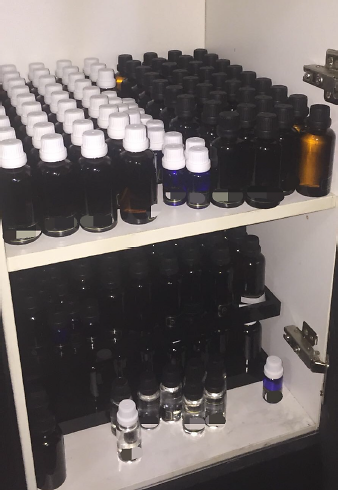
They were both arrested near Henderson Crescent. At the hideout of the younger suspect, officers recovered 84g of Ice, a wide assortment of unknown liquid substances suspected to be controlled drugs, and S$3,220 in cash.
Cabinet with numerous glass bottles containing unknown liquid substances, recovered in a CNB operation at Henderson Crescent on Mar 12, 2018. (Photo: CNB)
Accessories for taking drugs, including various drug-smoking apparatus and utensils, were found as well.
SINGAPORE: It’s not quite 20,000 Leagues Under the Sea, but close.
A team of Singapore and Indonesia scientists are venturing into the deep unknown of the West Java sea, where their goal is to uncover the vast array of marine life that, till now, has been unexplored.
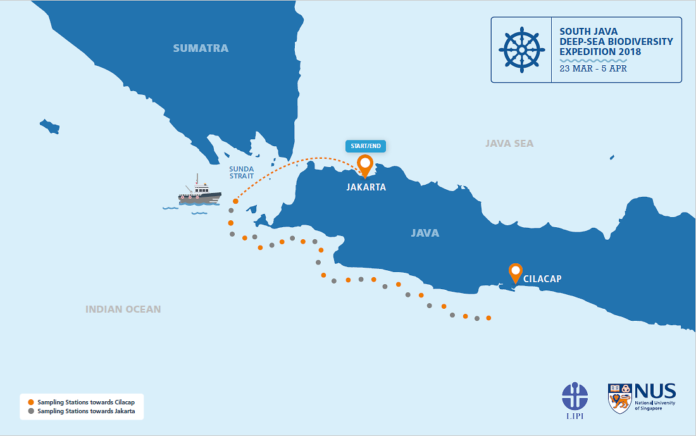
This first-of-its-kind 14-day expedition from Friday (Mar 23) till Apr 5 takes place on board the Indonesian research vessel Baruna Jaya VIII, which will carry a team of 30 researchers and support staff from the National University of Singapore (NUS) and the Indonesian Institute of Sciences.
The vessel will depart from Muara Baru, Jakarta in Indonesia, where the scientists will spend the next two weeks working in the vicinity of the Sunda Strait Trough off Cilacap, digging deep into the dredges to take samples from the seabed.
Based on the team’s experience, the depth of 500m to 2,000m usually displays the greatest diversity with the most interesting species, but the scientists also have a particular wish list they hope to document, ranging from crabs and prawns, shells, fish, urchins and even worms.
Each day, the research team plans to conduct sampling at three to four sites, covering a total of 29 sites. Each sampling exercise will take at least three to four hours to complete due to the depths involved and the time it takes to deploy the equipment.
Important biological samples will be sorted, photographed, preserved and labelled on board the research vessel. Some will even be kept alive for short periods in special, chilled aquariums so that they can be observed, studied and filmed.
Head of the NUS’ Lee Kong Chian Natural History Museum and one of the expedition leaders, Professor Peter Ng, said there is a wealth of biodiversity waiting to be uncovered.
“People always forget that the deep sea holds a huge number of different species of animals, many of them new to science, that we don’t even know they are there,” he said. “So I think it’s important to find out what are the kinds of animals living there, what are the species there, and this increase of knowledge will be very good as far as the conservation, use of resources in the future is concerned.”
Prof Ng also recounted past expeditions, which had “unearthed bizarre Darth Vader-like sea cockroaches, bloated oil-filled fishes with poorly developed eyes, eerie wraith-like crabs as well as spectacularly-coloured lobsters.”
Dr Dwi Listyo Rahayu, who is the chief scientist for the Indonesian team, said: “This deep-sea expedition will reveal the diversity of demersal organisms on the southwestern part of Java Island, the area where almost no exploration has ever been conducted. It will certainly incite a strong maritime spirit among young Indonesian scientists participating in the expedition to go forth and seek the many interesting animals that live in the deep waters of their country.”
The expedition is also significant because it has been 15 years in the making, and is the first time Singapore and Indonesia are teaming up on such a large-scale quest. Prof Ng said an immense amount of preparation and forward planning has taken place.
“So typically, we will plan for logistics, what we need. To feed 30 scientists on board, not counting the crew, the water, the equipment they need, the photographic equipment, and out at sea, you cannot replenish your supplies, you cannot just call somebody and somebody delivers, no such thing,” he said.
“You plan for worst case scenario, medical accidents, what do you do? So a lot of planning has to take place when you do a deep sea expedition out in open sea to ensure the risks are the minimum, the science can be maximised, and the results are useful for scientists to come.”
At the end of the expedition, the samples collected will be studied by scientists from both countries. This is anticipated to take up to two years, and the results will be shared and discussed with the world at a workshop to be held in Indonesia in 2020.
The output will then be collated and published in the Museum’s science-citation journal, The Raffles Bulletin of Zoology.
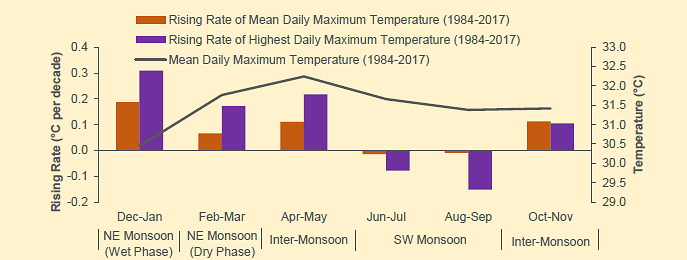
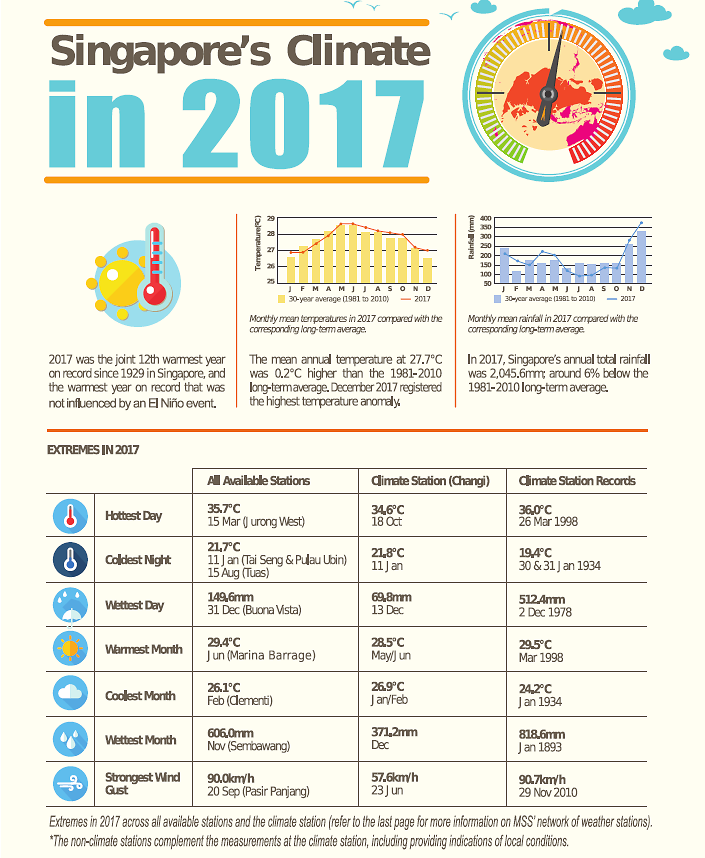
SINGAPORE: December and January, traditionally the cooler months in Singapore, experienced the highest rate of increase in extreme warm temperatures between 1984 and 2017, according to the Meteorological Service Singapore (MSS).
In its 2017 Annual Climate Assessment Report released on Friday (Mar 23), MSS said during the two months of December and January, there has been the strongest rate of increase in warm days and decrease in the number of cool days.
Between 1984 and 2017, the mean daily maximum temperatures for December and January increased by 0.19 degrees Celsius per decade, while the highest daily maximum temperatures increased by 0.31 degrees Celsius per decade.
Along with the warmer weather, there has also been an increase in rainfall during these two months, which are the wet phase of the Northeast Monsoon season. This is consistent with a warmer atmosphere being able to hold more moisture, which can then lead to higher rainfall from more severe rain events when they do occur, according to MSS.
In comparison, the maximum temperatures in the typically hotter months of April and May saw a more moderate rate of change over the same period.
“These trends indicate that the gap in extreme warm temperatures between the cooler and warmer months of the year is narrowing,” it said, adding that the reasons for these trends require further studies and research.
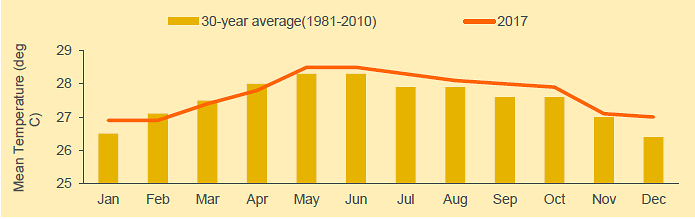
The annual mean temperature over Singapore has risen from 1984 to 2017, at an average rate of around 0.26 degrees Celsius per decade.
Monthly temperatures in 2017 were mostly slightly above the monthly 30-year average, with December 2017 differing most from the long-term monthly average with temperatures that were 0.6 degrees Celsius higher.
In January, MSS had announced that 2017 was the warmest year on record for Singapore that was not influenced by an El Nino event, with a mean annual temperature 27.7 degrees Celsius.
The report on Friday showed that the warmest month in 2017 was in June, with an average temperature of 29.4 degrees Celsius across all stations, while the coolest month was in February, with an average temperature of 26.1 degrees Celsius.
SINGAPORE: From smartphone makers to food delivery start-ups, GIC is increasingly interested in exploring more investments in the technology sector – an area it described as “important since day one”.
Among the steps that it has taken in recent years to fire up its plans – the formation of a global Technology Investment Group (TIG) and initiatives to provide the ecosystem with more than just capital resources, said chief executive officer Lim Chow Kiat in a group interview earlier this week.
Mr Lim stressed that the Singapore sovereign wealth fund is “not new” to tech given how its San Francisco office was set up in 1987. That has paved the way for GIC’s exposure and involvement in various parts of the tech ecosystem over the years, he explained.
Still, the need to be up to speed with technological disruptions has given GIC more reason to build up its exposure.
“If there are new technologies or new business models coming up, we want to know about it as early as possible so that we don’t get surprised by new competitors or new ways of doing businesses… (that) affect our incumbent holdings.”
When asked how GIC’s investment weightage in tech has changed, Mr Lim said it has “gone up a little bit” over the years through exposure from “multiple portfolios and teams”.
This week, it said that it was investing in UK-based Oxford Nanopore Technologies (ONT), which has developed the world’s only portable, scalable, real-time DNA sequencer. Prior to that, it announced in December that it will be part of a consortium buying a 10 per cent stake in digital maps firm HERE and in October, ramped up investments in China’s Meituan-Dianping by being part of its US$4 billion financing round.
When asked if other sectors have seen a change in investments as a result, Mr Lim replied: “To the extent that these are better investments, we will need the capital to be re-deployed.”
He declined to reveal the sectors that have seen a re-allocation and would only list businesses that remain reliant on the middleman or lacking a digital strategy among those that are “more at risk”.
“Even though we are long-term investors, it doesn’t mean we are static,” he said in response to Channel NewsAsia’s question. “We have to be positioned for change.”
During the interview, Mr Lim, together with Mr Jeremy Kranz who heads the TIG, shed light on GIC’s investment approach.
The TIG, which is more than one year old according to Mr Lim, was born out of the need to give the sovereign wealth fund’s tech investment efforts “a bit of a push”. With offices in Silicon Valley, China and India, its formation has enabled “capital to be deployed more flexibly including to hold existing stakes post the companies’ initial product offerings (IPOs), increase business development efforts and to highlight tech disruption risks in companies or sectors to benefit the overall GIC portfolio”, a spokesperson added.
Mr Kranz, who is usually based in Silicon Valley, said the TIG casts a wide net from start-ups to big listed firms, and invests in myriad ways such as direct investment or serving as a limited partner in top-tier tech funds.
On how the team picks its investments in start-ups that are deemed to be of higher risk, Mr Kranz explained that GIC’s multi-decade-long presence in key markets, such as the US and China, gave it “a lot of goodwill” and networks “to figure out which are the start-ups that are coming into growth phase and reaching an inflection point”.
He pointed out that is when the Singapore sovereign wealth fund invests directly.
GIC also tries to engage start-ups right from the initial stages though it rarely makes direct investments then.
Mr Kranz cited US-based DoorDash as an example and mentioned that he attended the food delivery start-up’s very first pitch at an incubator many years back.
“A lot of institutions will tell founders: ‘Call us when the cheque size is really big’. We really don’t think that way.”
One of the world’s biggest global investors, GIC also keeps an eye on emerging patterns and how they develop across geographies. For instance, in the food delivery space, it has also ploughed money into China’s on-demand service platform Meituan Dianping.
When asked what it would do when one of its investments disrupts another, Mr Lim replied: “Depending on the situation, the logical thing for us to do is to reduce our exposure to the one that gets disrupted and hopefully, we do that with enough alertness and lead time.”
GIC’s emphasis on holding a well-diversified portfolio has also given it the “ability to move more quickly”.
However, there seems to be one area where the sovereign wealth fund is drawing the line for now – Bitcoin. “I don’t think we know enough of it,” said Mr Lim.
Lastly, GIC and its global investment team are banking on “strategic collaborations” to differentiate it from the other investors keen to put money into the tech space.
For instance, it has a “multi-dimensional” relationship with Chinese smartphone maker Xiaomi. Apart from investing in the Chinese smartphone maker, GIC is also involved in Shunwei Capital, a venture capital fund founded by Xiaomi’s CEO Lei Jun, and has also participated in the firm’s ecosystem programme.
GIC fund is also focusing on creating platforms to bring people together to exchange ideas, build relationships and strengthen the overall ecosystem.
For one, it hosted 17 Chinese entrepreneurs and fund managers at its San Francisco office in October 2016 in what it termed as a China Entrepreneurship Trip. These Chinese entrepreneurs were introduced to Silicon Valley’s top venture funds and companies over the course of three days.
More recently, GIC jointly hosted the Bridge Forum with the Economic Development Board. With a focus on real estate technology, it brought together 80 real estate executives from 45 companies across China, India, Indonesia, Japan, Korea, Australia and Singapore and the US.
Said Mr Lim said: “We (don’t) just invest in the company and wait for the returns … We help both our investees and industry partners to create new businesses and new ideas.”