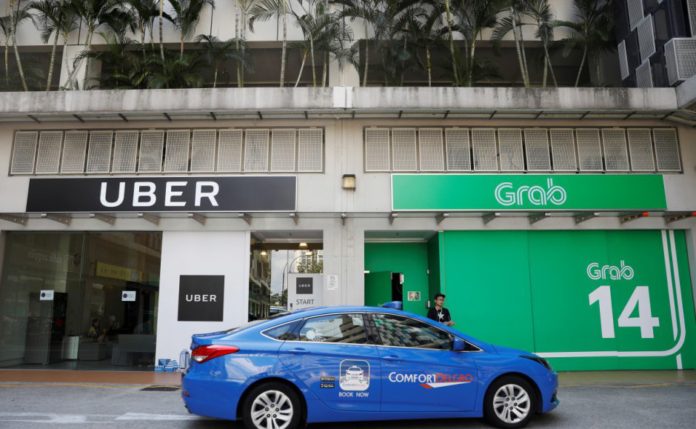
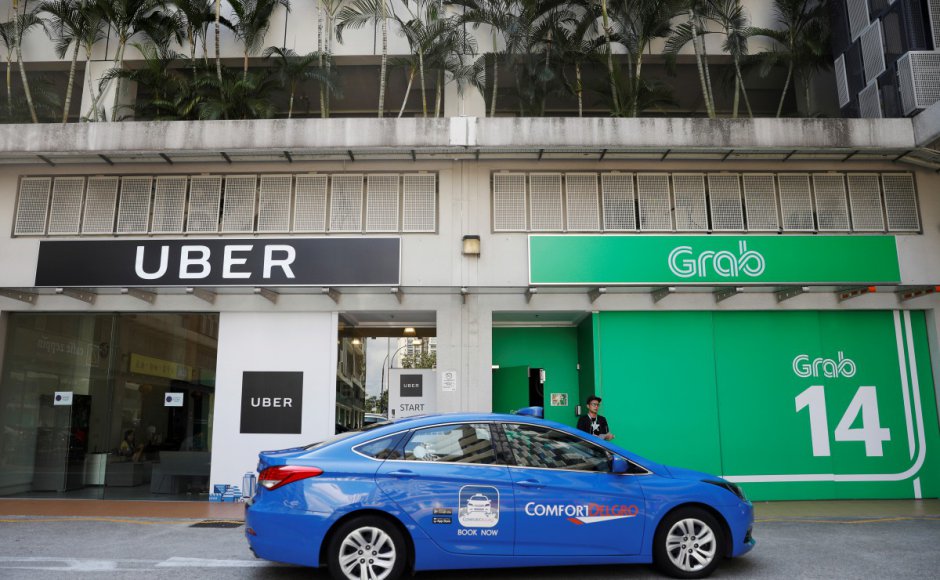
A ComfortDelgro taxi passes Uber and Grab offices in Singapore March 26, 2018. Source: Reuters/Edgar Su
AFTER weeks of rumoring and speculation, US ride-hailing giant Uber Technologies Inc. has finally announced the sale of its Southeast Asian operations to regional rival Grab.
The firms confirmed the sale in a statement on Monday, marking the US company’s second retreat from an Asian market.
The sale includes all of Uber’s operations in Southeast Asia, as well as Uber Eats in the region, according to Bloomberg. The deal provides the US company a 27.5 percent stake in the combined business, with Uber CEO Dara Khosrowshahi joining Grab’s board.
The merger marks the industry’s first big consolidation in Southeast Asia, home to about 640 million people, and puts pressure on Indonesia’s Go-Jek, which is backed by Alphabet Inc’s Google and China’s Tencent Holdings Ltd.
Expectations of consolidation in Asia’s fiercely competitive ride-hailing industry were stoked earlier this year when Japan’s SoftBank Group Corp made a multi-billion dollar investment in Uber.
SoftBank is also one of the main investors in several other big ride-hailing firms including Grab, China’s Didi Chuxing, and India’s Ola.
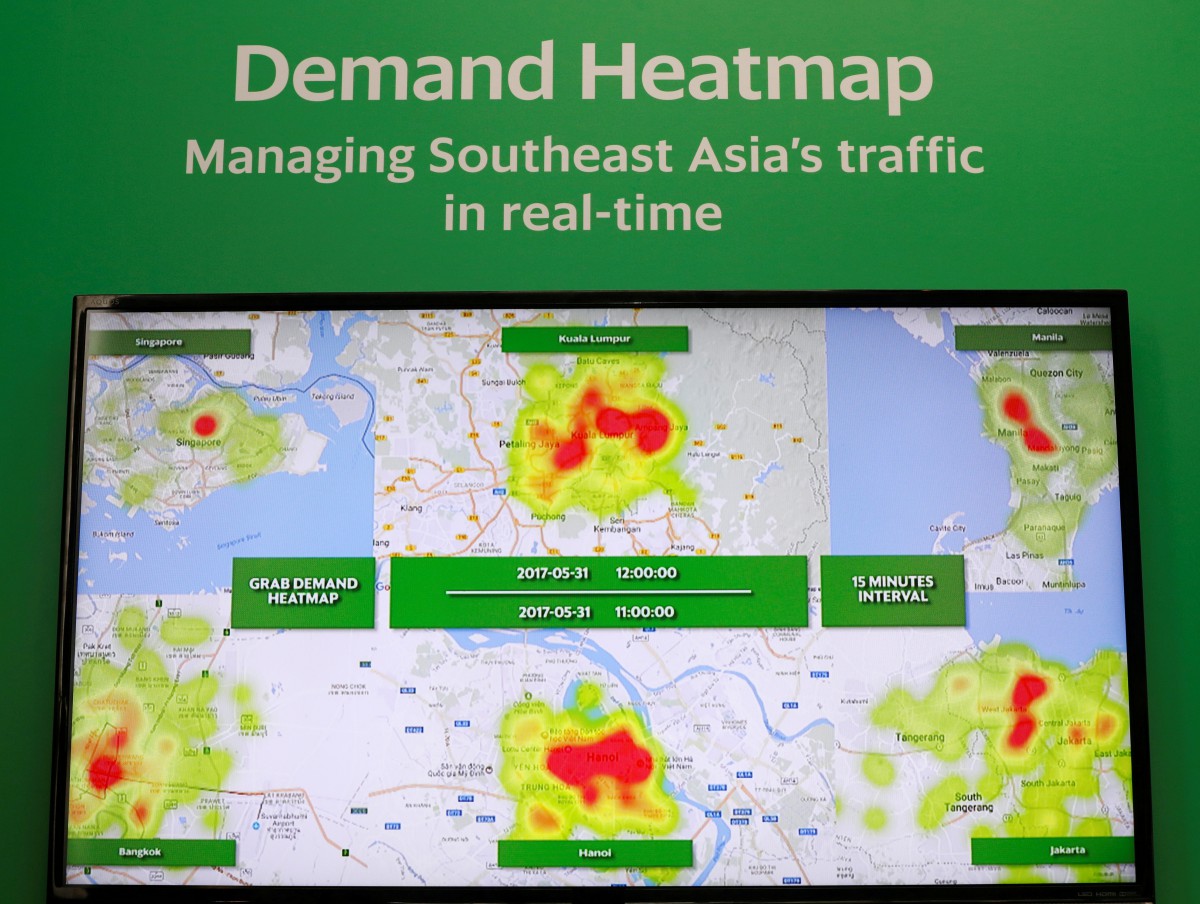
A heatmap showing the demand for Grab services in Southeast Asia is displayed during Grab’s fifth anniversary news conference in Singapore June 6, 2017. Source: Reuters/Edgar Su
Ride-hailing companies throughout Asia have relied heavily on discounts and promotions, driving down profit margins.
Grab has more than 81 million mobile app downloads, offering services in 178 cities across Singapore, Indonesia, the Philippines, Malaysia, Thailand, Vietnam, Burma, and Cambodia. According to CB Insights, the Singapore-based company was recently valued at US$6 billion.
Uber, which is preparing for a potential initial public offering in 2019, lost US$4.5 billion last year and has faced fierce competition at home and in Asia, as well as a regulatory crackdown in Europe.
“It will help us double down on our plans for growth as we invest heavily in our products and technology,” Khosrowshahi said in a statement.
Grab said it will take over Uber’s operations and assets in eight countries in the region, and will expand its food delivery services.
Grab co-founder and CEO Anthony Tan was quoted as saying the truce would bring to an end the leadership battle in a Southeast Asian ride-hailing market expected to reach US$20.1 billion by 2025.
This article was originally published on our sister website Tech Wire Asia. Additional reporting by Reuters.
Meanwhile, Singapore’s first-ever autism residence will be up by October and another home in Pasir Ris for those with physical disabilities is planned for completion in 2020, said the Ministry of Social and Family Development.
The Sembawang home for adults with intellectual disabilities has a capacity of 180 and will be operated by Thye Hua Kwan Moral Charities (THKMC).
(Updated: )
Bookmark
SINGAPORE: A new home in Sembawang for adults with intellectual disabilities will start operations in April, the Ministry of Social and Family Development (MSF) said, after initial reports said it would be built by March 2016 – a date later pushed to end-2017.
A spokesperson for the ministry also told Channel NewsAsia that Singapore’s first autism-focused home, located in Sengkang, is slated to be finished by October. Over in Pasir Ris, a home for those with physical disabilities is planned for completion in the second quarter of 2020, with its construction tender just called.
“All of these projects are proceeding on schedule,” said MSF.
The Sembawang home was completed in November last year at a cost of over S$18.5 million, while the other two homes in Pasir Ris and Sengkang are together expected to cost more than S$23.7 million. The addition of the trio will bring the total number of adult disability homes in Singapore to 11.
The latter, to be run by St Andrew’s Autism Centre, had its development schedule extended from June to October to incorporate design features better-tailored to autistic persons, said MSF.
“This new and innovative cluster home concept … will demonstrate how care can be better delivered to persons with Autism Spectrum Disorder (ASD),” said a spokesperson.
The Community Chest was also involved in the home’s development, to encourage Singaporeans to play a part in fundraising and caring for those with autism. The non-profit ran a campaign on giving.sg which raised S$16,144 out of its S$50,000 target.
“A NEW GENERATION OF SERVICES”
The Sembawang home, whose appointed service operator is Thye Hua Kwan Moral Charities (THKMC), will have a capacity of 180. THK chairman Lee Kim Siang said 97 clients have been referred so far, and admission to the home in batches of 20 will start next month.
The Sembawang Walk complex offers a gym, library, landscape garden and more, alongside an array of programmes. Residents are free to pick their activity of choice during scheduled free time.
The home is further equipped with specific facilities for persons with intellectual disabilities, such as multi-sensory rooms to both help improve attention span and improve coordination and motor-processing through cognitive exercises.
Mr Lee stressed that at the home, residents would be “treated with dignity and respect by acknowledging their personal preferences, interests and strengths and giving them choices in decision making”.
The home will use a mobile app to award points to residents when they follow rules, and accord small tangible rewards according to this points system.
“We want to ensure that residents are meaningfully engaged so they can stay healthy and active. It is important for them to become independent in doing their activities of daily living as well as leisure,” said Mr Lee.
He added that the long-term goal was to have the home’s residents contribute back in society and be reintegrated with either their own families or live independently.
“Hopefully, this will bring a new generation of residential services for the disabled.”
SINGAPORE: The civil service needs a “mindset change” if it is to deliver on a promise to help local contractors and consultants venture abroad, Member of Parliament Lee Bee Wah has said.
There is stiffening competition in Singapore’s construction industry due to the entry of foreign players and rising costs, against the backdrop of lower tender prices due to a smaller volume of projects. Expanding overseas has been cited as a way local firms can ride out the current business environment in Singapore.
In a recent interview with Channel NewsAsia, Nee Soon GRC MP Lee questioned: “Is enough being done for these contractors? Sadly, my answer is no. When I first graduated in 1985, I heard of this problem and today in 2018, we are still talking about the same problem.”
Local contractors and consultants welcome the opportunity to go regional and benefit from the booming infrastructure projects in the region.
For one, the China’s Belt and Road Initiative is projected to create billions of dollars’ worth of infrastructure projects in the construction of roads, railways, ports and waterworks.
It’s a huge pie that Singapore contractors and consultants are craving for a slice of, but some of them lack the pre-requisites, one of which is having a proven track record of having taken part in multi-million dollar projects in Singapore.
Dr Lee, a professional engineer who is involved in several public-listed companies in the real estate and construction sector, said: “It’s just that our own system does not give them the opportunity because we have such a thing as a ‘pre-qualification’. If our ministries and government are really determined to want to help our local companies to go overseas, we need to have the mindset change of everyone involved … all those in the various ministries, whenever they have any projects, to think of our local contractors first.”
PRE-QUALIFICATIONS CALLED FOR GOVERNMENT PROJECTS ARE “SO ONEROUS”
During the recent parliamentary debate on the Ministry of Trade and Industry’s budget, Dr Lee said that contractors have told her that some of the pre-qualifications called for government projects are “so onerous” that none of the local contractors or consultants can qualify.
Mr Kenneth Loo, president of the Singapore Contractors Association (SCAL), agreed with Dr Lee on the difficulties faced in fulfilling the requirements specified in these government project tenders.
“What they require is that you’ve done a similar project of that nature. And more often than not, a much bigger scale than what is required. A lot of our people don’t have that track record so they can’t even get to the starting point to submit a competitive tender to have a go.”
However, it’s a different story for foreign contractors and government-linked companies.
For example, the contract to build the 19-storey Outram Community Hospital was awarded to Japanese contractor Penta Ocean for some S$674 million. This marked the company’s fifth successful tender for the construction of large healthcare facilities in Singapore, like the upcoming Sengkang General Hospital, contributing to the Japanese firm’s track record in building this particular type of infrastructure.
As a result, smaller local contractors and consultants are left to scrap for residential and commercial projects, such as the construction of international schools and redevelopment of residential buildings.
Some of these companies have been more fortunate and have clinched sub-contractor roles, or positions lower in the value chain, in government projects, but securing that main contractor position, Mr Loo and Dr Lee said, is tough.
Although local contractors and consultants are eager to move up the value chain, SCAL said its member companies also understand that the government needs to be risk-adverse and safeguard its investments.
Local contractor Straits Construction is the contractor for the Nexus International School’s (Singapore) new site located at Aljunied Road. (Photo: Brandon Tanoto)
Mr Loo said: “Of course, if you give it to somebody which has a proven track record, it’s in safer hands in a certain way, but if you look at it from a national point of view, I think we should actually try to build our own internal capabilities. This is actually a form of national defence, you can look at it from that angle as well. At the end of the day, it’s a mindset issue.”
Dr Lee echoed Mr Loo sentiment, saying: “Somehow we have this ‘kiasu’ syndrome, so much so that whenever we do a project, we cannot fail. We want to make sure that we only give to those contractors that are proven.”
INFRASTRUCTURE OFFICE TO FACILITATE GREATER COLLABORATION
However, steps are already being made to address these concerns.
It was announced during Budget 2018 that Enterprise Singapore and the Monetary Authority of Singapore will set up an Infrastructure Office to help Singapore firms tap on infrastructure opportunities in Asia.
To be launched in October this year, the Office will bring together local and international firms across the value chain – from developers and institutional investors to legal, accounting and financial services providers – to develop, finance and execute projects in the region.
Precise details about the initiative have yet to be furnished, but Minister for Trade and Industry (Industry) S Iswaran said in his speech at the fourth Annual Asia-Pacific Energy & Infrastructure Finance Forum on Mar 21 that for the benefits of the Infrastructure Office to be realised, collaboration is key.
“The Infrastructure Office will facilitate greater collaboration by being the convening point for the different players across the industry ecosystem, the multilateral development banks, as well as the public sector. It will also help to deepen our understanding of the region’s infrastructure needs and project pipeline,” Mr Iswaran said.
Industry leaders on their part are also offering suggestions on how the Office can help local contractors in their bids for projects overseas.
Mr Chong Kee Sen, former president of The Institution of Engineers, suggested that the government could carve out some projects specifically for smaller local contractors and consultants to develop their competency and track record.
“The Government can do that instead of having the traditional way of open competition. The other way is that when going overseas, our Government-linked companies can help our local contractors and consultants by partnering with them, or bringing them along to go to other countries.”
Looking ahead, the Building and Construction Authority says the total value of contracts awarded this year is estimated to be between S$26 billion and S$31 billion – an improvement from the S$24.5 billion figure last year.
The increase is due to a projected rise in demand for institutional buildings and civil engineering works, as well as a slate of government projects that have been brought forward in response to the slowdown in the industry in the previous years.
These contracts include the 21km North-South Corridor of transport routes and national water agency PUB’s deep tunnel sewerage system.
SINGAPORE: I learn something new on Facebook almost every day.
Whether it’s reading a news story shared on my News Feed, or finding out about an old schoolfriend’s wedding, it seems that Facebook provides me with an almost never-ending source of entertainment and information with just a few taps and swipes on my phone.
Just a few days ago, I learnt that every single thing I’d ever done on Facebook – every message I sent, every ad I clicked on, and every emoji I sent or received in the past 10-odd years of my Facebook existence – was niftily captured in this file called Facebook Archive.
It wasn’t even that hard to download: The link was prominently displayed under the General Settings tab on my profile. All it took was a few minutes, and a copy of it appeared in my Downloads folder.
Here’s where you can download a copy of your Facebook data.
I’ll admit, I’m not the most active Facebook user. While I use it to some degree due to the nature of my work, I don’t like or share posts as much as some of my more social media savvy friends or colleagues.
But the sheer amount of data captured in my file was stunning.
I spent a slightly uncomfortable hour or so sifting through everything, and reliving bits of my past that had completely slipped my mind. From travel itineraries planned and shared with friends I’d long since lost touch with, to old photographs shared with people over Facebook Messenger and even groups created from my days as a student to discuss plans for school orientation, everything – absolutely everything – had been reproduced in full in that giant file.
And then there were the ads. Yes, as I soon realised, every single Facebook ad or link I’d clicked on over the past month was there. Most of them weren’t out of the ordinary – and in fact, gave me a lot of interesting insight into my current interests: Travel, wedding planning and interior design.
Facebook, it seems, knows more about my life than I do.
IT’S ALL ABOUT THE MONEY (AND TARGETED ADVERTISING)
The fact that Facebook captures and tracks so much of my data may have been surprising to me, but Simon Kemp, founder of marketing consultancy Kepios, was well aware of this.
“Facebook is aware of every single thing you do on Facebook,” he said. “Even if you’re just opening the app on your phone and scrolling through your feed.”
“Facebook knows when you pause and what you’re looking at on your feed, so even though you’re not actively tapping on it or clicking through, it knows that you’ve paused your feed at that point.”
But why would Facebook be interested in all these little nuggets of data, I asked. Kemp explained that it all comes down to one thing: Money. Or targeted advertising, if you will.
“Storing all these huge amounts of data obviously costs Facebook a lot of money, so they wouldn’t be collecting and storing this if it didn’t have financial value to them,” he said. “If you think about it, 99 per cent of their revenue comes from selling advertising, so it’s all about making sure their advertisers sell you the things you’re really interested in.
“Say a soap maker wants to sell you soap at the right place, at the right time and in the right colour,” he explained. “Facebook collects lots of information to make sure they’re not just selling you a bar of soap.
“They want to find out the colours you like, and the kind of things you’re interested in, so they can tell you a little story instead of just putting a picture of a bar of soap in front of you.”
And indeed, a lot can be learnt even from little things like the kind of emojis or stickers I use in my messages to friends, as Kemp explained. A smiley face, for example, can be used to make a text message seem more informal and make me seem more approachable. And perhaps, if I use a lot of smiley faces in my messages, that could mean that I’m cheerful or happy in real life as well.
“It can also tell how our social relationships work,” he added. “That’s a lot of information they can get based on just those little smileys.”
SHOULD WE BE WORRIED?
It all seemed slightly creepy to me, especially with news of the recent Facebook scandal with political consultancy Cambridge Analytica fresh in my mind. All those little nuggets of data, clearly, could be misused when accessed by the wrong pair of hands.
But to Kemp, it’s clear that the benefits far outweigh the possible risks.
“You’ve got two billion people around the world using Facebook, and the vast majority of them are doing absolutely nothing wrong,” he said. “But a small handful of people use the data to do things like manipulating elections, or bully people.
“Look at it this way,” he explained. “The vast majority of the world uses kitchen knives to prepare meals for their family, but every now and then, someone commits a crime with a kitchen knife.
“It doesn’t mean the kitchen knife is bad, it’s just that one or two people use them to do bad things.”
“Besides, the way Facebook shares its data with advertisers is anonymous, so they can target you, but they don’t know it’s you,” he added. “The rules have changed quite a lot since the Cambridge Analytica incident, and there are quite serious checks in place to make sure advertisers cannot get your specific data in that way.”
So, in a nutshell, should we be worried? The short answer, according to Kemp, is no.
“It’s a little bit scary when you look back at how you spent your day ten years ago, and you see how much data they’ve collected, but it was all you,” he said. “There’s nothing there that you didn’t do, so it’s following you across your activity.
SINGAPORE: I learn something new on Facebook almost every day.
Whether it’s reading a news story shared on my News Feed, or finding out about an old schoolfriend’s wedding, it seems that Facebook provides me with an almost never-ending source of entertainment and information with just a few taps and swipes on my phone.
Just a few days ago, I learnt that every single thing I’d ever done on Facebook – every message I sent, every ad I clicked on, and every emoji I sent or received in the past 10-odd years of my Facebook existence – was niftily captured in this file called Facebook Archive.
It wasn’t even that hard to download: The link was prominently displayed under the General Settings tab on my profile. All it took was a few minutes, and a copy of it appeared in my Downloads folder.
Here’s where you can download a copy of your Facebook data.
I’ll admit, I’m not the most active Facebook user. While I use it to some degree due to the nature of my work, I don’t like or share posts as much as some of my more social media savvy friends or colleagues.
But the sheer amount of data captured in my file was stunning.
I spent a slightly uncomfortable hour or so sifting through everything, and reliving bits of my past that had completely slipped my mind. From travel itineraries planned and shared with friends I’d long since lost touch with, to old photographs shared with people over Facebook Messenger and even groups created from my days as a student to discuss plans for school orientation, everything – absolutely everything – had been reproduced in full in that giant file.
And then there were the ads. Yes, as I soon realised, every single Facebook ad or link I’d clicked on over the past month was there. Most of them weren’t out of the ordinary – and in fact, gave me a lot of interesting insight into my current interests: Travel, wedding planning and interior design.
Facebook, it seems, knows more about my life than I do.
IT’S ALL ABOUT THE MONEY (AND TARGETED ADVERTISING)
The fact that Facebook captures and tracks so much of my data may have been surprising to me, but Simon Kemp, founder of marketing consultancy Kepios, was well aware of this.
“Facebook is aware of every single thing you do on Facebook,” he said. “Even if you’re just opening the app on your phone and scrolling through your feed.”
“Facebook knows when you pause and what you’re looking at on your feed, so even though you’re not actively tapping on it or clicking through, it knows that you’ve paused your feed at that point.”
But why would Facebook be interested in all these little nuggets of data, I asked. Kemp explained that it all comes down to one thing: Money. Or targeted advertising, if you will.
“Storing all these huge amounts of data obviously costs Facebook a lot of money, so they wouldn’t be collecting and storing this if it didn’t have financial value to them,” he said. “If you think about it, 99 per cent of their revenue comes from selling advertising, so it’s all about making sure their advertisers sell you the things you’re really interested in.
“Say a soap maker wants to sell you soap at the right place, at the right time and in the right colour,” he explained. “Facebook collects lots of information to make sure they’re not just selling you a bar of soap.
“They want to find out the colours you like, and the kind of things you’re interested in, so they can tell you a little story instead of just putting a picture of a bar of soap in front of you.”
And indeed, a lot can be learnt even from little things like the kind of emojis or stickers I use in my messages to friends, as Kemp explained. A smiley face, for example, can be used to make a text message seem more informal and make me seem more approachable. And perhaps, if I use a lot of smiley faces in my messages, that could mean that I’m cheerful or happy in real life as well.
“It can also tell how our social relationships work,” he added. “That’s a lot of information they can get based on just those little smileys.”
SHOULD WE BE WORRIED?
It all seemed slightly creepy to me, especially with news of the recent Facebook scandal with political consultancy Cambridge Analytica fresh in my mind. All those little nuggets of data, clearly, could be misused when accessed by the wrong pair of hands.
But to Kemp, it’s clear that the benefits far outweigh the possible risks.
“You’ve got two billion people around the world using Facebook, and the vast majority of them are doing absolutely nothing wrong,” he said. “But a small handful of people use the data to do things like manipulating elections, or bully people.
“Look at it this way,” he explained. “The vast majority of the world uses kitchen knives to prepare meals for their family, but every now and then, someone commits a crime with a kitchen knife.
“It doesn’t mean the kitchen knife is bad, it’s just that one or two people use them to do bad things.”
“Besides, the way Facebook shares its data with advertisers is anonymous, so they can target you, but they don’t know it’s you,” he added. “The rules have changed quite a lot since the Cambridge Analytica incident, and there are quite serious checks in place to make sure advertisers cannot get your specific data in that way.”
So, in a nutshell, should we be worried? The short answer, according to Kemp, is no.
“It’s a little bit scary when you look back at how you spent your day ten years ago, and you see how much data they’ve collected, but it was all you,” he said. “There’s nothing there that you didn’t do, so it’s following you across your activity.
SINGAPORE: One of the biggest purchase for most Singaporeans, it’s no surprise many watch property prices closely like hawks.
Yet the recent announcement of a 1 per cent hike on the Buyer’s Stamp Duty (BSD) on the top slice of residential properties in excess of S$1 million announced at Budget 2018 caught most by surprise, including many industry watchers.
For years, many had expected authorities to lift cooling measures, including the additional buyer’s stamp duty (ABSD).
Its immediate effect was seen in a tumble of 1.7 per cent in the FTSE Straits Times Real Estate Holding and Development Index, the benchmark indicator for real estate developers.
Shares of property developers such as CDL, UOL Group, Wing Tai and CapitaLand also dropped by between 1.9 per cent and 3.3 per cent the following day.
Nonetheless, most experts say the additional BSD is unlikely to dampen the current buying momentum as recovery in the private residential property market is expected to persist.
Some however caution the negative impact on sale prices for big-ticket projects, including en bloc and the Government’s land sales (or GLS).
Mid-tiered and high-end properties may feel the impact most severely, compared to the mass-market segment.
Regardless of the short-term impact, we can expect the hike to stay in place for the long term. So buyers should expect to pay more BSD out of their pockets in the long run, as property prices continue on their upward trend.
Marine Blue condominium at Marine Parade. (Photo: Rachel Phua)
INCREMENTAL TAX MOST KEENLY FELT BY PRIVATE HOUSING MARKET
While the impact will largely be felt by the private housing market, the increase could also affect selected HDB flats in neighbourhoods of high demand, such as Bishan, Dawson and Duxton (the Pinnacle) where apartments have been transacted for more than S$1 million in the resale market.
Contrary to popular perceptions, executive condominiums are not expected to be as severely impacted. The mean price for ECs was estimated at S$819,795 in 2017. Based on 3,501 EC transacted in 2017, only the top 90 percentile of EC transactions exceeded the S$1 million mark.
Unsurprisingly, the average apartment in the non-landed private housing residential market was sold above the S$1 million since 2015 so we can expect buyers in this market to bear the brunt of the new marginal BSD rate.
While those who bear the brunt of the taxes in absolute terms are buyers of luxury and other high-tiered property costing millions, its greatest marginal impact is on those who buy property just above the S$1 million mark.
The effect of the new BSD is that a 6.54 per cent increase in BSD paid for a property of S$1.2 million, compared to 27.67 per cent for a S$5 million property.
The rooftop garden of Dawson estate. (Photo: Wendy Wong)
SYNONYMOUS TO A WEALTH TAX
Unlike the ABSD introduced in 2013, which has targeted foreign and Singapore Permanent Resident buyers, as well as Singapore citizens who buy two or more properties, the BSD will apply to residential properties purchases by all buyers.
Given its progressive nature, the skewed effects on higher-end properties, it is largely synonymous to a tax on wealth.
Yet the amount it generates for Government coffers is modest.
Based on 15,059 private non-landed properties transacted as in 2017 at an average price of S$1,474,992, we estimate the BSD tax hike could generate an increase in tax revenue of approximately S$71.5 million per year.
However, this figure does not include increase in BSD tax revenue from en bloc and GLS transactions.
POSSIBLE COOLING IMPACT ON HOUSING PRICES
Despite the fact the market in general does not view the BSD as a new cooling measure, most analysts do not disagree that the BSD would introduce some friction, especially in the en bloc sale market. It would increase the total acquisition costs for residential lands, whether via the en bloc market or the GLS programme.
Where private housing prices are generally price inelastic, if the higher land acquisition costs are passed on by developers to buyers, prices of new launches are expected to increase.
However, in a market, where supply outstrips demand, it will be harder for developers to ask buyers to fully absorb the increases in BSD costs. In this case, where developers have to absorb the increases in BSD costs, most may reduce their bids for en bloc and GLS lands.
So this BSD hike may result in a downward spiral effect on property prices.
It is more likely that the brunt of the marginal BSD will be shared between sellers and buyers – where transaction prices will not fully price in the marginal BSD.
If this effect of a higher BSD causing housing price to decline becomes prevalent, sellers may agree to sell houses at below the valuation price, as a way to offset buyers’ transaction costs.
The jury is still out when it comes to a conclusive verdict on how the residential property market will react to the BSD. Prices could swing both ways. And effects vary depending on which part of the market you’re in.
In a sellers’ market where developers pass on higher land costs to buyers, the price could increase with the BSD rate hike. However, in a market with elastic demand, we should expect sellers to offset the BSD costs with lower prices.
The real differential may be in the response between credit-constrained and unconstrained buyers flushed with wealth – something housing policymakers and industry watchers will in turn be watching like a hawk over the next six to 12 months.
The one thing certain is that this new means to generate tax revenue in an equitable, progressive and sustainable manner is one that housing policymakers will likely retain for the long term and will not be so easily wished away.
Sing Tien Foo is the Dean’s Chair Associate Professor and Director of the Institute of Real Estate Studies (IRES) at National University of Singapore (NUS).
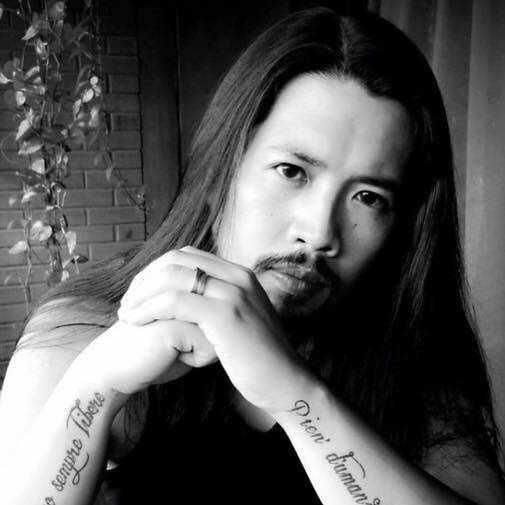
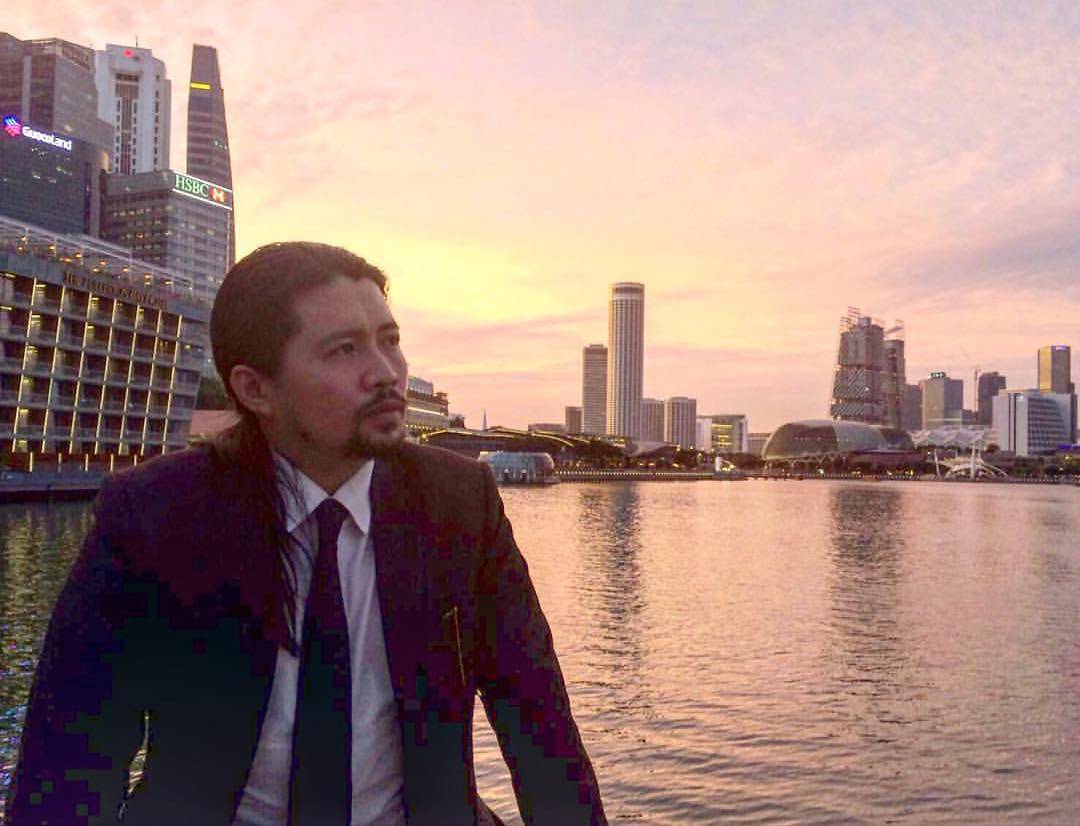
SINGAPORE: Josephus Tan has worn the label of “gangster lawyer” like a badge of honour. Among the things that make him stand out are his long hair, a physical manifestation of his delinquent past, and the tattoos on his arms, a tribute to his father.
For years, he has been a darling of the local media.
The story of his dramatic turnaround from delinquent to a prominent lawyer who’s handled some high-profile criminal cases, including the recent case of Annie Ee, the intellectually disabled waitress who was tortured to death by a husband and wife, also inspired a Channel U drama, Second Chance.
In the lead-up to the 2015 General Election, there was even talk that he might be fielded as a political candidate for the People’s Action Party (PAP).
His candidacy was never confirmed.
Before the election, he had often been seen participating in grassroots activities in Chong Pang and Chua Chu Kang constituencies. He had said then that he was helping out at the Meet-the-People Sessions, giving pro bono legal advice to residents.
When talk of him running for elections became more widespread on the ground, he even debunked it publicly.
But during our interview last week the 39-year-old said that there was a plan for him to run and while he had been telling some people he ultimately wasn’t fielded because he “pulled out due to personal reasons”, it wasn’t entirely true.
“I don’t deny the fact that I was a potential candidate for the ruling party. Make no mistake about it. I was approached to join politics.
“I never once thought that a person like me deserved a chance in the grand scheme of things. I just wanted to use whatever legal knowledge I possess to help people, but the fact remains that I was first approached. I was told, ‘Why not join politics?’ and effect changes at the highest level and I thought, ‘Yes, why not. If I can save millions through a good policy, why not?’ So I got involved, got interested, went to interview after interview, tea session after tea session. In the end, I was deployed. I was working the ground hard and it all came to nothing.”
Josephus Tan was seen at several grassroots event in the lead up to GE 2015. (Photo: Josephus Tan)
It clearly came as a shock when he realised in 2015 that his silky long hair, which is the stuff of shampoo commercials, and his tattoos could be working against him.
Concerns on the ground about his public image crushed his political ambitions.
He claims this was one of the reasons he was ultimately not fielded in 2015.
His public image, in fact, seemed like a selling point up till then. He’s probably the only lawyer in Singapore who looks the way he does. It made him stand out.
He reveals that in addition to ground concerns about his image, there were concerns about his “mannerisms, how I’m very straight with my words, even my financial status or my past records, my admission to the fact that I was prone to criminality, maybe during National Service as well.”
He has admitted in previous interviews that he had gone AWOL several times. His financial status was unstable because he had been doing mostly pro bono legal work and didn’t have a steady income stream.
However, it looked as if he was connecting well with people on the ground in spite of this.
His well-publicised and compelling personal story certainly helped.
He grew up in a rough neighbourhood, joined a gang and lived an aimless life of vice and violence. At 22, a big quarrel with his girlfriend catalysed a dramatic change in his life.
He was drunk and rage caused him to abuse her physically and subsequently threaten to throw her off the balcony of his 23rd –storey flat.
His father wrestled him to the floor and slapped him twice.
He often relates this story with a sense of pride saying that his life was changed by “two tight slaps”.
He slogged hard to get his law degree with the help of his parents and relatives who had helped fund part of his education.
IS REDEMPTION A MYTH?
He admits the rejection in 2015 “baffled” him.
“I thought a lot of people by now would have accepted me for who I am and the way I look. I really didn’t see an issue, but I don’t know. I might just be living in my own world. Maybe the big conservative group out there expressed a different view even though maybe on the surface, they seemed to be in agreement with what I am or who I am.”
It seems even the fact that he had turned his life around after facing numerous obstacles couldn’t overpower these concerns.
After all this time, he still looks visibly dejected as he tells this story.
So is redemption a myth?
“I have reconciled with my past but I cannot expect others to do the same. Everyone loves reading a good redemption story but who can truly live and believe in one? It’s disappointing to say the least but it doesn’t stop me in continuing to advocate for second chances for others especially the underprivileged.”
“I have reconciled with my past but I cannot expect others to do the same,” says Josephus Tan. (Photo: Facebook / Josephus Tan)
While he seems more at peace with it today, in 2015, he says there was anger mixed with his disappointment.
I ask him if he feels the PAP should have stood up for him.
“I think people on the ground are all that matter. They are the electorate. I think it’s very important to have the mandate of the people. If there’s really a concern from the ground as to my candidancy, then I should just take it upon myself to better my chances if I ever contemplate stepping into politics again. I wouldn’t want to second-guess the party. I think that perhaps maybe there were better candidates and there were for sure.”
STILL HAS POLITICAL INCLINATIONS
The party told him “perhaps, another time then”, he says.
“So hopefully the time comes.”
This surprises me. Considering he was judged in this way, why would he still want to join politics?
“I think what is inspirational about my story is I didn’t stop for anything. I just kept forging ahead regardless of how many crises I met and it’s the same for politics. To say that I don’t have any political inclination is a lie.
“To me, politics is important. I’ve been serving the people in my line of work. So I have a consistent track record and I feel that if I can do this at a policy level, it would have been great because I really understand what’s happening on the ground because I’m on the ground everyday with the people.”
But why serve a public that could not appreciate his contributions enough to support his candidacy?
“Put all these rejections aside, I think the mission itself is of paramount importance. There were certain reasons why I was rejected and it’s legitimate. I take responsibility. The fact is that there are actually problems in these few areas and I just need to work myself out. So the day that I solve all these problems, when I’m truly free and that is where I would know whether this stands true.”
“Why must I remove the tattoos which remind me of my father?,” asks Josephus Tan. (Photo: Facebook / Josephus Tan)
WON’T CHANGE HIS PUBLIC IMAGE
He’s referring to the financial problems he’s faced which we discuss in-depth later, but I’m curious about whether he would get rid of his tattoos or cut his hair to placate the electorate.
“I wouldn’t,” he says categorically.
“I’ve expressed this before to the powers that be. I’ve been looking this way because there’s a need for me to embrace my past. It’s also a daily reminder of where I came from. If I’m going to remove my tattoos, change my hairstyle just because I want to get into politics, there’s an element of hypocrisy to it. The electorate will think, ‘Ok, this guy is bending backwards. He used to be so upright, he’s fighting for the underclass but right now because he wants to join politics, go into the ruling party, he’s changing.’ I feel that such a message doesn’t go down well not just with the people, but even with myself.”
Hair and tattoos might seem like superficial things, but to him they hold immense meaning.
“At the height of my teenage rebellion, I was growing out my hair long. So over the years, it has become very, very comfortable and I like the way I look and I think there’s no issue. I go to court, I observe the decorum, I tie my hair and I think it shouldn’t be an issue. Why must I remove the tattoos which remind me of my father?”
In 2013, his father died of cancer. Shortly after, as he worked on overcoming his grief, he was inspired.
“I took a soul-searching trip to Phuket. I was listening to this song, an Italian opera. It’s called Nella Fantasia, which means ‘In My Fantasy’.”
The tattoo on his arm translated into English would read: I dream of souls that are always free, Like the clouds that fly, Full of humanity in the depths of the soul.
“At that time the song had a very calming effect on me and it speaks out what I feel inside. I believe that every soul including myself and my dad, we should all be free, we should all be happy.”
TOO MUCH PRO BONO WORK AND A DESPERATE ATTEMPT AT PIETY
He’s currently working on fixing his financial troubles and recently opened his own firm Invictus Law Corporation with a personal loan from a few close friends.
He’s keeping his firm’s operations lean with a small office space and leveraging technology in order to minimise manpower reliance.
While taking on more and more pro bono work was fulfilling, he concedes it hurt his pocket.
He’s working on striking a better 50-50 balance between paid and pro bono work, but at last count, 70 per cent of his cases have been done on a pro bono basis.
This was exacerbated by the fact that he had started spending more time on grassroots work and giving motivational talks instead of taking on cases.
In the lead up to his father’s death, he had also borrowed heavily in a “desperate attempt at piety”.
“That remains my biggest and my only regret. That I couldn’t provide for him (my father) while he was well,” says Josephus Tan. (Photo: Facebook / Josephus Tan)
“I felt that I had failed as a son. I didn’t provide the necessary financial stability, not only to myself but also to my parents and that’s the reason why in his dying months, I borrowed heavily from the bank to rent a nice colonial terrace house, to engage a foreign domestic worker, to buy a second hand Mercedes.
“He used to drive a white Mercedes before he went bankrupt. When he was lying in the hospital, I told him ‘Dad, look, if you can muster the courage and the strength and the will to live, I promise you I’m going to bring a Mercedes to drive you back home.’ I couldn’t get a white one because the only one I could afford was second hand and it only came in red.”
His father, by that time, was too ill to appreciate any of it though.
“I saw the sadness in his eyes and he couldn’t really speak anymore. He was so skinny.”
“That remains my biggest and my only regret. That I couldn’t provide for him while he was well.”
His father too had a chequered history.
He had a security business which went bust. He then started working as a security officer and moonlighted as a dough and bread-maker at a factory.
“Since the early part of my childhood, until today I hate eating bread and it’s because my father would always bring the factory rejects home. Loads and loads of bread. I thought that was my father’s way of showing his love – literally bringing bread to the table and that was what he did. But I got sick of eating bread.”
His father also had gang connections.
“When I was very young, I saw how my father got beaten up at the market by a group of thugs. His head was bloodied and of course he was rushed to the hospital and was stitched up. He said it was a mistaken identity, but that’s when he told me about how different parts of the market or hawker centres were ruled by different gangs.”
However, he maintains his dad’s background played no part in turning him wayward.
“I actually had a wonderful childhood. We were poor but we were always loved and in a very, very basic way. I mean basic shelter, basic food, basic care and attention. My mother even helped borrow money from relatives to help finance my law education.”
It was more a result of the neighbourhood he grew up in and teenage angst, he claims.
Last year was a particularly tough year for him.
His financial problems came to a head as his debt and interest on debt accumulated. It almost hit six figures, but he still wanted to complete his pro bono cases.
At one point, to earn additional income, he worked as a pest controller on international tankers – a job that a friend helped him get. He even worked as a dishwasher at private events.
As he continues to work on solving his financial problems as a result of his desperate attempts at piety and a lack of balance between paid and pro bono in his law practice, he is convinced he’s headed towards stability.
“It’s really right down to the last bank loan and then finally I will be free.”
Josephus Tan spends a lot of his time giving motivational talks to students. (Photo: Facebook / Josephus Tan)
HIS MARITAL BREAKDOWN
But his health and personal life have suffered too.
He came very close to having a stroke and went through a divorce last year.
Because of the divorce, he is currently renting a room near his office to minimise his costs.
His ex-wife is actually the same girl he threatened to fling off the balcony of his flat when he was 22.
She stuck by him even after that and was married to him for 14 years.
“I’m still very grateful for the fact that actually she stood by me from that time till now.”
So what ended the relationship?
“I was just so focused on rehabilitating myself, on turning my life around, on recovery. When I found my purpose or what I call my ‘mission’, I got lost in it.”
He neglected her and claims the damage had been done over the years.
“I was the one who actually suggested the divorce. It’s much better to put an end to something in the hope for something better for the both of us.”
She is in a happy relationship, he says. He, on the other hand, isn’t seeing anyone.
“I just started my own law firm so I’m all geared up to really restart and recharge myself and right now the focus is on the aspirations ahead. I’ve got to get the basics right and I know that the next person that comes along, I’ll make sure she will be in a much better place.”
DEFENDING THE WORST CRIMINALS
We turn to discussing his career which he is eager to talk about.
He himself was lucky enough not to be incarcerated in spite of his delinquent past, but he seems to be able to empathise with even those who commit heinous crimes.
Naturally, we talk about the case of Annie Ee. He made headlines last year for defending her abusers and was himself criticised and harassed by some members of the public for doing so. He maintains now as he did then that every one deserves fair legal representation no matter how heinous their crime – something that his mentor, the late prominent lawyer, Subhas Anandan asserted many times.
“As as long as you know you are doing the right thing, have no fear at all. I thought about it that way when I saw people were getting angry.”
Josephus Tan opened his new law firm in October last year. (Photo: Facebook / Josephus Tan)
He’s often said that criminal lawyers have to be able to suspend judgment.
“You’re human first, then a lawyer,” he says to explain his empathy for those he defends.
While he uses this as a justification to defend even the worst criminals, one could say by that same token, shouldn’t he have an adverse reaction to those suspected of conducting heinous crimes. It’s only human, isn’t it?
“Very good question, but really I think the good thing about our profession is that we will usually have the so called ‘inner’ story. Right from the get-go when we take on a case like Annie Ee’s case, the lady who abused her was herself diagnosed to be emotionally complex. She had mental issues and this was actually brought up by the expert psychiatrist. So who are we to say?
“Often, there are reasons for their behaviour. Out of the hundreds of cases I’ve handled, only maybe one or two involve perpetrators who have are born evil. They are psychopathic or sociopathic and have no remorse for their actions.”
For others, there will be a form of explanation for what they did and mostly it’s a circumstantial factor. They are either lowly educated or in a financially difficult position, or they have medical or mental illnesses, or they come from a broken family nucleus, all sorts of problems. It’s almost like a social problem and the legal problem is just one part of it.”
He feels that Annie Ee’s case in fact brings up other urgent issues for society.
“Why did she fall through the cracks? That’s why the stakeholders need to look into this issue.”
“FIGHT LIKE A TIGER”
His future in pro bono criminal law is something he’s excited about even though he plans to scale it down to achieve a better financial balance.
Under the Criminal Legal Aid Scheme, nowadays pro bono lawyers actually receive a S$500 honorarium per case. This was not the case when he started out 10 years ago.
He thinks the money should be channeled into the community to fund needs such as bursaries for the poor and other services.
“I understand that some lawyers use it as a form or survival which is not wrong. But if you have the right balance of paid and pro bono work, why not channel the S$500 to Voluntary Welfare Organisations or foundations to see whether we can do a dollar-to-dollar matching to help others.”
He also feels that generally, Singaporeans lack legal literacy and aims to help with legal education.
“Singapore has never been a very litigious society so we lack knowledge compared to our peers in other countries. I think most Singaporeans engage in what we call ‘kopitiam laws’. They believe more in vigilante justice or they have this lynch mob mentality.
“Every lawyer should be doing their part to help in the education effort.”
What does he say to those who think lawyers don’t put as much effort into pro bono cases.
“It’s still a person’s life and you shouldn’t be working any harder for the person who pays you and less for the person who doesn’t pay. I think those who do that are shooting themselves in the foot because clients will start to know.
“Clients will look at how hard I fought for my pro bono clients and then in turn they will actually go and reprimand the lawyers that they’re paying money for and say that look, ‘You’re not doing much. This guy is doing it for free and he fought like a tiger.’ If you’re doing it for free and you fight like a tiger, it helps you get paid clients too. If you do a bad job, even those who can pay may not come to you.”
His hardships, he claims have not discouraged him and many young lawyers he has observed are still keen on pro bono work.
He sees the work as his “baby” and is intent on “moving the pro bono movement to the next level”.
Today, it’s clear Josephus Tan is intent on “fighting like a tiger” to reclaim his life after his crisis last year, not just in the law but he hopes, in the near future, in politics as well.
GUANGZHOU, China: In class, shy four-year-old Lee Zixi is learning how to shed her social awkwardness by shaking hands with a stranger and introducing herself confidently – CEO-worthy skills deemed necessary to succeed in life.
Meanwhile on the golf green, three-year-old Guo Zi Ling struggles to tee off with a driver almost as tall as her. Her instructor Ding You Xiong stopped teaching adults this year to coach kids exclusively, so great is demand.
“We’ll be collaborating with neighbouring preschools, so we’d be working with even more three-year-olds soon,” he said.
These are just some of the many toddlers in Guangzhou, one of China’s richest cities, who are being trained in the finer arts of good manners, collaboration, leadership and how to influence others – from as young as the age of two.
Lee Zixi learns to overcome her social awkwardness.
In a country where citizens’ poor social habits have drawn the government’s admonishment, more parents now believe that emotional quotient, or EQ, is more important than IQ to succeed in life.
That is why a number are spending a small fortune each month to ensure their toddlers have the best headstart socially, as the episode How To Raise A Super (Prepared) Baby finds out. (Watch it here.)
LEARNING CHARISMA
Every week, Zixi attends a course at LeederEDU that promises to shape her into a charming chief executive of the future. Her father Lee Shao Hao signed her up to improve her poor social skills.
“I felt that we needed some kind of specialist backed by science to impart these skills to her,” said Mr Lee. “Previously she wouldn’t greet her relatives. Now she initiates interactions with us – even if it’s just asking if we’ve eaten or about our work.”
These lessons do not come cheap: They cost as much as US$8,000 (S$10,500) a year.
Golf, too, is seen as part of EQ training. At the club where Zi Ling is learning the sport – and where her mother Li Wen Qing is the president – parents pay US$150 a month to send their toddlers there. That’s on top of the yearly club member’s fee of RMB78,800 (S$16,400).
Golfers under the age of 10 are one of the fastest-growing groups in China. Golf has even become compulsory in many state primary schools.
Indeed, the Foison Golf Club plans to invite all the best preschools in the district to join its programme.
“Only golf as a sport requires impeccable manners and the mind to strategise, while encouraging self-discipline and even the charisma to shine in social situations,” said Mdm Li.
WATCH: (3:45)
NOT JUST ABOUT BOOK SMARTS
According to a 2014 report, 78.2 per cent of Chinese parents believe that EQ is more important than IQ for their child’s future career. And the best time to develop a child’s EQ is as early as possible.
Thus parents willingly spend on a gamut of courses that have sprung up in recent years. At LeederEDU, the children start at the recommended age of three, but some parents bring them in as young as two.
These CEO-wannabes, who graduate at six years old, start off by learning the basics of social etiquette – fundamental to developing good EQ.
The enrichment centre’s CEO, Mr Wei Yong An, said it started offering these classes in 1999, when it saw the need to expand early education.
“In the past, we always believed it’s enough to succeed in life by doing well academically,” he said.
But in reality, we need to have a lot more soft skills on top of being book-smart.
For future CEOs and even children, the best skills to have are the abilities to self-learn, self-manage, cooperate, compete and influence others towards one’s cause, he added.
A lesson in teamwork.
AN EARLY TASTE OF MANY CAREERS
In Shenzhen, as part of one experiential class that Channel NewsAsia observed, children were given full rein to explore an Audi showroom, jumping all over the leather seats and crawling into car boots.
This session was one of a series of enrichment activities for the children to experience different careers and workplaces, among other things. These were organised by early education group Gymboree, known in China for being one of the few global brands that look at life skills instead of classroom skills.
Hu Zhan Hua, aged three, gets behind the wheel of an Audi.
Three-year-old Hu Zhan Hua’s parents paid US$60 for him to get up-close and personal with the luxury vehicles. It’s a way for them to tell if he would be interested to work with cars in future.
By exposing him to different occupations – from fire-fighting to banking to merchandising – his mother Chen Yi Xi hopes he can discover what he likes.
We let him experience everything… And it opens up his world view.
The family spends more than US$11,000 – about a fifth of their annual income – on Zhan Hua’s enrichment activities, choosing to focus on a holistic approach to his education.
“If you miss out on this golden period, you can spend 10 or 20 times the money in future and still not get the same results,” reasoned Mdm Chen.
LEARNING TO MANAGE FRUSTRATION
But should parents worry about how a three-year-old manages his emotions, or should they let him sort it out as he grows up?
At the Singapore Institute for Clinical Sciences’ Neurodevelopment Research Centre, research fellow Stella Tsotsi studies how development in childhood is linked to later successes in life.
She believes that the way children manage frustration, fearful situations and even how they express joy, for example, can offer insight into their school performance and socio-emotional development in future.
In a social experiment she conducted, toddlers were given keys to a transparent box containing a smartphone or Play-Doh, which they could play with if they unlock the box. Unknown to them, the keys do not open the lock.
The purpose of this experiment was to test their ability to manage frustration when they failed.
WATCH: Different reactions and what they suggest (4:13)
One became anxious and started scratching her forehead and neck. Another gave up quickly and called for her mother; while one toddler inspected all the keys and persisted in trying to open the box.
Dr Tsotsi’s team of researchers believe that toddlers who can manage their frustration constructively will do better in life.
“Some of the things you learn very early in life – it’s quite possible that your reaction style … will be following you throughout adulthood,” she said.
Early childhood expert Gao Shou Yan, from the Beijing Normal University, said children between the ages of three and six value their positions and friendships in a small group.
And because of that, they understand that they must do things right to make good friends. “This is a very good stage in life to learn socio-emotional intelligence,” she added.
I’ve seen many children, around the age of two, who already have a flawed upbringing, whether it’s in emotional awareness or social skills.
She believes that carers such as parents and grandparents are partly to blame for a child’s poor EQ. Children pick up most of their social understanding from those around them, but many Chinese parents lack social skills, she opined.
“We can’t even manage our own emotions properly, which is a big problem.”
IS IT GENETIC?
Since not all aptitudes are immediately apparent, might a saliva swab be the key to revealing a child’s personality, and the career he or she should start working towards?
Swiss start-up Karmagenes claims that it is all in the DNA. In fact, one of the firm’s brochures claims that Apple co-founder Steve Jobs already knew, when his daughter was 14 months old, what her personality would be like.
Scientists have found certain genes to be linked to certain traits, and by reading those genes, Karmagenes promises that it can tell its clients a lot about themselves, including the career that would work best for their personality type.
National University of Singapore psychology professor Richard Ebstein, who has studied various genes linked to social behaviour, agrees that one’s traits, such as charisma, are partly caused by one’s genes.
“There’s almost nothing you can tell me about a person that isn’t probably due to some contribution of genes,” he said.
“Whether you like to go on roller coasters or not is half due to your genes … That probably means you have a gene for novelty seeking, adventure seeking or thrill seeking.”
The oxytocin receptor gene is another example; it is associated with things like social skills and bonding behaviour.
But at the same time, Prof Ebstein said that testing a person for that gene would show almost nothing because each gene explains “less than one per cent” of any particular trait.
And researchers worldwide have not identified enough genes to make a fair prediction about one’s character. “Keenly observant parents and the first teachers in school are going to be as good as the science can ever be,” said Prof Ebstein.
He cited the Stanford marshmallow experiment, in which the children were each given a marshmallow on a plate and told that if they were to not eat it and wait 15 minutes, they would be rewarded with a second treat.
“What it told us was that children who have patience and can delay enjoyment now and study hard for later success, would actually do well in life,” he said.
“That’s already at four to five years old and, to some extent, predictable. You don’t need (a test of) genes.”
SINGAPORE: Interest groups, non-governmental organisations (NGOs) and constituencies that are interested in holding green events in support of the Year of Climate Action can apply for a government grant from Apr 1.
Each group will be eligible for up to S$5,000 on a reimbursement basis, announced Senior Minister of State for the Environment and Water Resources Amy Khor on Saturday (Mar 24).
Interested groups have until the end of the year to apply for the grant.
The Climate Action SG Grant was first announced by Dr Khor during the Committee of Supply debate earlier this month, to help organisations defray costs of developing preogrammes to raise awareness of climate change.
Dr Amy Khor speaking at the event. (Photo: Elizabeth Neo)
Speaking at an eco-carnival at Our Tampines Hub, Dr Khor also touched on the subject of energy conservation.
Dr Khor said the Mandatory Energy Labelling Scheme (MELS) for household appliances, which currently covers air-conditioners, refrigerators, clothes dryers, televisions and general purpose lamps, will be expanded to cover more types of lamps.
This includes the compact fluorescent lamp without the integrated ballast, the T8 fluorescent tube as well as the LED direct replacements.
Dr Khor said the National Environment Agency will be consulting the industry and public on a proposal for this matter.
“Our studies show that for a household, if they actually choose a three tick LED instead of a two tick fluorescent lamp for instance, they will actually save 40 per cent of energy,” she added.
Dr Khor pointed out that the scheme has not only helped consumers choose more energy efficient models of household appliances but also transformed the market in two ways.
Suppliers are motivated to bring in more energy efficient appliance models due to the product differentiation offered by MELS, she said, and households have a wide selection energy-saving models to choose from.
“In 2016 … three-quarters of fridges that were sold were actually energy efficient ones,” Dr Khor said.
She added that more energy efficient models of appliances regulated under MELS have entered the market, thus giving consumers more choice.
Saturday’s event, called the Just One Earth (JOE) Carnival, is in its fourth year.
Organised by the North East CDC, the carnival aims to engage the community and inspire children and their parents to contribute towards a sustainable future for Singapore, through a variety of activities.
Residents got to try their hand at making a natural cleaner with fruit peels, as well as self-watering planters with plastic bottles and old cloth.
SINGAPORE: The new Jurong Lake Gardens will be home to the largest collection of water lilies in Singapore, with more than 140 varieties, announced the National Parks Board (NParks) on Saturday (Mar 24).
More than 100 varieties of water lilies will be new to Singapore, such as the Australian Giant Water Lily and the Foxfire Water Lily, added NParks.
Visitors will be able to see the aquatic plants up close from boardwalks which will extend across the terrace ponds.
These are part of the concept design for the gardens’ east and central zones which was unveiled on Saturday.
Boardwalks within water gardens so people can come close to appreciate aquatic plants. (Photo: NParks)
Touted as the next national gardens in the heartlands, the Jurong Lake Gardens is part of a larger transformation of the Jurong Lake District.
There are three parts to the gardens – west, east and central – and proposed plans for the latter two zones had been put up for public consultation from November 2016 to April 2017.
More than 14,000 suggestions were received, said NParks on Saturday.
Sharing some of the feedback, NParks said many people noted that the buildings and features in the Chinese and Japanese Gardens – in the central zone – held special memories for Singaporeans.
“The design for Jurong Lake Gardens Central hence seeks to retain the natural ambience and key features of the gardens by working with the existing landforms and key buildings and features, and leveraging on the water surrounding the gardens,” said NParls.
The iconic seven-storey pagoda at the Chinese Garden, for example, will be retained.
The Water Gallery Trail allows boats to travel along the banks of the lake surrounded by a swamp forest. (Photo: NParks)
One new feature will be a water gallery trail where boats can travel along the banks of the lake surrounded by a swamp forest.
As public feedback showed that people wanted more public spaces for activities, the northern shore of the gardens will be transformed into a space comprising a lawn, a pavilion housing food and beverage outlets and a youth park.
The Northern Shore of the gardens will also be transformed into a space comprising a lawn, a pavilion housing food and beverage outlets and a Youth Park.
To make the area more accessible, an East-West cycling route will be provided across the Chinese Garden to connect Taman Jurong to Jurong Town Hall and Jurong East.
A public exhibition on the new Jurong Lake Gardens will be held from Mar 25 until Apr 1, where people are invited to share their views on the programmes they would like to see at the new gardens.
A construction tender for the central and east zones will be called in the middle of this year, and works are expected to be completed progressively from 2020.
As for the western part of the gardens, works started in April 2016, and it is slated to open early next year.