Home Blog Page 1076

Singapore investigating Christian preacher’s alleged statements on Islam

0

A local online article claims that American religious leader Louis Dean Engle was “threatening a Christian-Muslim divide in Singapore”.

lou engle

American Christian preacher Lou Engle speaking at a conference in Singapore on Mar 13, 2018 (Photo: Kingdom Invasion Singapore Facebook page)

SINGAPORE: The Ministry of Home Affairs (MHA) said on Monday (Mar 26) it stands ready to take “firm action” should there be evidence that a Christian preacher from the United States had made statements to undermine religious harmony in Singapore.

MHA’s comments came after an article posted on online publication Rice Media described a speech made by Christian preacher Lou Engle at Singapore Expo earlier this month as threatening “a Christian-Muslim divide” in Singapore.

“MHA is aware of the allegations that Engle had made certain statements, particularly in respect of Islam, during the Kingdom Invasion Conference 2018,” the ministry told Channel NewsAsia in response to queries.

“MHA is looking into the matter,” it added.

The online article was written by Mr Benjamin Lim, contributing editor of Rice Media, who had attended the mass evangelism conference organised by the local Cornerstone Community Church.

During Mr Engle’s sermon to a 2,000-strong crowd, the Christian preacher spoke of “pushing back a new modern Muslim movement”, wrote Mr Lim.

ENGLE TOLD NOT TO UNDERMINE RELIGIOUS HARMONY: MHA

In response to queries, MHA said that Mr Engle was granted a Miscellaneous Work Pass to speak at the conference and that he had been told to “keep clear of controversial subjects and not undermine social, racial and religious harmony in Singapore”.

“If there is evidence that Mr Engle had made statements that could undermine religious harmony in Singapore or had mixed religion and politics, we will take firm action,” the ministry said.

“MHA will not tolerate any person undermining Singapore’s social, racial and religious harmony,” it added.

YouTube videos show Mr Engle also spoke at Kingdom Invasion conferences in Singapore in 2016 and 2017.

In his article, Mr Lim questioned how it came to be that “someone so radical in his religious beliefs (could) slip past the rigorous vetting processes of the authorities”.

He claimed that MHA did not respond to his queries on why the preacher was given a permit to speak in Singapore, given his notorious background.

“This lack of transparency and clarity is distressing, and gives the impression that double standards are exercised in the treatment of the various religious groups, especially when the authorities have lately been clamping down hard on Islamic extremism,” Mr Lim wrote.

In September last year, two Christian preachers were barred from speaking in Singapore, with MHA noting they had made “denigrating and inflammatory comments of other religions” and that “the Government will not allow religious preachers of any faith to run down other religions”.

The next month, two foreign Muslim preachers were also prevented from entering Singapore.

In early March this year, Home Affairs Minister K Shanmugam stressed in Parliament how foreign preachers – across all religions – who are known to spread ill-will towards other religions will not be allowed to speak in Singapore.
Source link

LTA to test new number plate recognition cameras along expressways

0

SINGAPORE: The Land Transport Authority (LTA) announced on Monday (Mar 26) that it will be testing new camera systems and communications beacons along expressways and major thoroughfares from now until 2019.

The new Automatic Number Plate Recognition (ANPR) camera system will aid enforcement efforts by capturing vehicle number plates with greater accuracy, LTA said in a press release.

In addition, new Dedicated Short Range Communications (DSRC) beacons will also be installed to further enhance positioning accuracy for navigation systems.

“These tests will enable LTA to determine the performance and reliability of such technologies under various real-life environmental and traffic conditions for future traffic management systems which will leverage Global Navigation Satellite System (GNSS) technology,” said LTA in its news release.

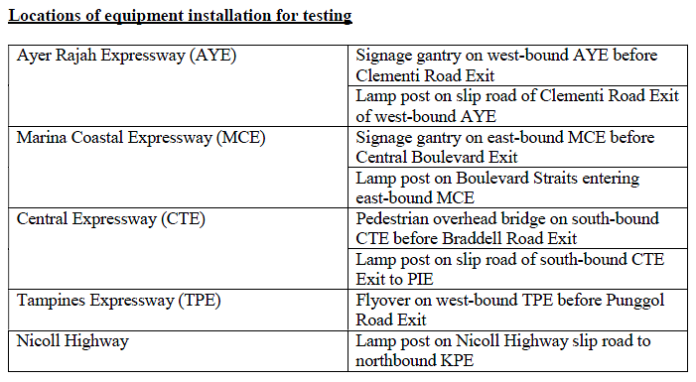
The technologies do not need heavy physical infrastructure and will be mounted on existing roadside infrastructure such as overhead bridges, overhead gantry signs, lamp-posts and Expressway Monitoring Advisory System (EMAS) gantries.

Test equipment will be installed along the Ayer Rajah Expressway (AYE), Marina Coastal Expressway (MCE), Central Expressway (CTE), Tampines Expressway (TPE) and Nicoll Highway.

LTA new camera system testing 3

Equipment will also be mounted onto vehicles and deployed at areas including Tuas South from April this year, before being expanded islandwide for testing.

LTA new camera system testing 1

Example of equipment that will be mounted onto vehicles. (Image: LTA)

The new tests come after LTA awarded a S$556 million contract in 2016 to the consortium of NCS and Mitsubishi Heavy Industries Engine System Asia (MHI) to build a next-generation Electronic Road Pricing system based on GNSS technology.

The new system will allow motorists to eventually be charged according to distance travelled on congested roads, removing the need for physical gantries. 

Source link

Grab acquires Uber in Southeast Asia: What you need to know

0

SINGAPORE: Following speculation over the weekend, Grab confirmed on Monday morning (Mar 26) that it has acquired Uber’s Southeast Asia operations, in a deal described as “the largest-ever of its kind in Southeast Asia”.

Here’s what you need to know about the combined business:

Uber will no longer be available in Southeast Asia from Apr 9, 2018

Uber will be available in Southeast Asia until Apr 8, 2018. All requests after that date should be made from the Grab app. Uber users who do not have a Grab account will need to register for one should they wish to use the service.

Uber accounts will remain active

Uber accounts will remain active and can be used in any country outside Southeast Asia where Uber operates. Users will also be able to view past trips and ratings in the Uber app.

Users who have accounts with both Grab and Uber will have their information transferred from Uber to Grab. Grab will notify users before transferring the data, according to a spokesperson for Grab.

Uber app

File photo of a person using the Grab app. (Photo: AFP/Mohd Fyrol)

Fares are not expected to go up

According to a spokesperson for Grab, fares are not expected to go up following the acquisition.

Services such as GrabCar and GrabBike will continue to be calculated based on distance, with a dynamic surcharge that will be applied based on various factors – including demand and supply.

Passengers who choose the taxi option will continue to pay metered fares, while rates for services such as GrabHitch or GrabShuttle will remain fixed, said Grab.

Uber Eats will run until the end of May

Uber Eats users will be able to use the platform until the end of May – after which, Uber delivery and restaurant partners will move to a platform called GrabFood, according to Grab. 

Customers can expect prices on GrabFood to remain the same as they were on Uber Eats. Restaurant and delivery partners should not expect to see a change in their compensation during the transition, it added.

ubereats email to users

Uber drivers can sign up to drive with Grab

According to Grab’s website, Uber drivers can sign up online to be a Grab driver. Following the completion of training, Grab will take five working days to process new driver registrations.

However, Grab added, the registration process could take longer than usual over the next few weeks on an expected increase in the number of new drivers.

Uber will pay its drivers any fares and incentives from rides they have picked up using the Uber Partner app. Any outstanding support requests with Uber will be resolved by Uber during the transition period, Grab said on its website. 

Source link

Internet love scams: ‘I got carried away with his words’ says victim as police strengthen task force

0

SINGAPORE: Freelance artiste Rosie (not her real name), 70, had been booked for a number of singing and acting gigs, and she wasn’t shy posting about it on Facebook.

So when someone she described as a young, good-looking man sent her a friend request on Facebook early last year, she didn’t think twice about accepting.

“When I was young I was in love with my husband, but the love has already gone,” said Rosie, who has a 40-year-old son with her odd job worker husband, whom she lives with in a three-room flat.

Every few days, Rosie chatted over the phone with the man, who claimed to be Malaysian but used a UK number and said he was based in Europe. His supposed photo, seen by reporters, made him look like a dashing, fair-skinned Indonesian celebrity.

The man swooned over her singing and acting, calling her a “talented lady” who didn’t look her age. He called her honey, darling and sayang. Naturally, Rosie was enamoured. “I’m happy being with a young man like him,” she said. “He’s so polite.”

The sweet conversations continued for a year, then the scam kicked in.

The man sent her a photo of a child in a hospital, hooked up with wires and needles. “I need a small amount for the medical treatment,” the man told her, saying that it was for a friend. The amount was S$10,000. “His life is in your hands,” the man said.

The fact that Rosie was already too deep in what she called her “fantasy”, coupled with a genuine guilt and concern for the child’s well-being, compelled her.

Because of her bank’s daily limit, she transferred S$2,000 to a Malaysian account each day for four days. She only had S$1,500 left, so she pawned her jewellery before wiring the remainder. She would never see the money again.

However, it didn’t end there. When Rosie’s savings were sucked dry, she was duped into becoming a money mule. She received close to S$20,000 from unknown sources, later revealed to be victims of the same syndicate, and passed it on to various Malaysian accounts.

Rosie was about to transfer another S$9,000 to the man when one of the victims reported the scam to the police, who then froze Rosie’s bank account. When the man realised that she had stopped sending money over, he threatened to publicise their affair on social media.

Rosie’s case is a classic ploy used in Internet love scams, which hit a new high last year. Cases increased by 30 per cent, from 635 in 2016 to 825 in 2017. The total amount cheated also rose by 54 per cent, from about S$24 million to about S$37 million over the same period.

Transnational Commercial Crime Task Force 1

The TCTF addressing reporters. (Photo: Aqil Haziq Mahmud)

With that, the police last October formed the Transnational Commercial Crime Task Force (TCTF), a crack squad comprising six investigation officers (IO) from the six land divisions, to investigate Internet love scams.

The TCTF consolidates cases at the Commercial Affairs Department (CAD) to intercept cash transfers from victims and mules quicker. It also enables authorities, when investigating foreign syndicates, to share information with foreign counterparts faster.

The police revealed on Monday (Mar 26) that it will from Apr 1 add six officers to the TCTF to investigate more types of transnational fraud, like impersonation scams.

This comes as the TCTF saw a drop in reported cases after investigating more than 200 money mules and seizing at least S$1 million. There were 41 cases in February compared to 102 last September, just before the TCTF was formed.

HOW INTERNET LOVE SCAMS WORK

According to the head of CAD’s syndicated fraud branch Superintendent of Police (Supt) Chew Jingwei, syndicates that operate Internet love scams are based overseas, largely in Malaysia.

These syndicates build close-knit relationships with victims before promising them lavish gifts, often with the catch that they have to pay courier fees or customs taxes. Some victims are even conned into sending their ATM cards abroad.

The victims are then asked to transfer the cash to a money mule, who passes it on to the syndicates for a cut of the transaction. When victims run out of cash, syndicates can also turn them into mules by asking them to open bank accounts for “legal fees”.

Syndicates make use of money mules to make it more difficult for them to be traced, said Assistant Superintendent of Police Kristian Kirkwood, a TCTF IO. Two-thirds of Internet love scam cases involve mules, Supt Chew said, adding that many of them are women.

“When a money mule is being featured, we work with the banks very quickly to freeze the accounts and detain the mule involved,” Supt Chew added. “The strategy for us is to stem the flow of money to the syndicates and recover as much as possible for the victims.”

But the TCTF also faces challenges in the form of victims who refuse to hand over their chat logs. Some even try to drop the investigation after lodging a report, believing that their “lover” is real.

Transnational Commercial Crime Task Force 3

Rosie telling reporters her story. (Photo: Aqil Haziq Mahmud)

In Rosie’s case, the Attorney-General’s Chambers issued her with an advisory to be more vigilant after she was found to have been “unwittingly” recruited. The TCTF managed to retrieve the S$9,000, but not the rest of the cash. The man remains at large.

Meanwhile, Rosie says she now feels hatred for the man who seduced her online. “I was naive,” she added. “I got carried away with his words.” Her family was initially furious, but they have forgiven her.

Supt Chew stressed that while there has been a drop in cases, the police are “not happy”.

“If the public thinks twice before transferring money to someone they do not know and taking instructions from someone they’ve never met before, these scams can stop,” he said.

Source link

Earth Hour 2018 sees the lights go off across Asia

0


CITIES across Asia went dark for an hour on Saturday night to mark Earth Hour as a symbol of commitment to preserving the planet.

The event, organised by the World Wide Fund for Nature (WWF), was celebrated this year in cities from Delhi to Jakarta, Manila to Taipei.

According to WWF, “Earth Hour is an initiative to encourage individuals, businesses and governments around the world to take accountability for their ecological footprint and engage in dialogue and resource exchange that provides real solutions to our environmental challenges.”

SEE ALSO: Southeast Asia is in the grip of a biodiversity crisis

It has been held on an evening in March every year since 2007, when the first lights-off event took place in Sydney, Australia. More than 180 countries have since participated.

2018-03-24T153315Z_1726168249_RC14F8196FA0_RTRMADP_3_EARTH-HOUR-PHILIPPINES

Boys with a painted number 60 on their faces, representing the 60 minutes of Earth Hour, are seen during Earth Hour outside a mall in Bacoor, Cavite city, south of Manila, Philippines March 24, 2018. Source: Reuters/Romeo Ranoco

In 2018, it was held between 8.30 and 9.30pm. Organisers said that more than 17,900 landmarks and monuments worldwide turned off their lights.

The Philippines government urged all its citizens to participate in Earth Hour to demonstrate their “commitment to saving mother earth” because the country was among the “most vulnerable to the impact of climate change”.

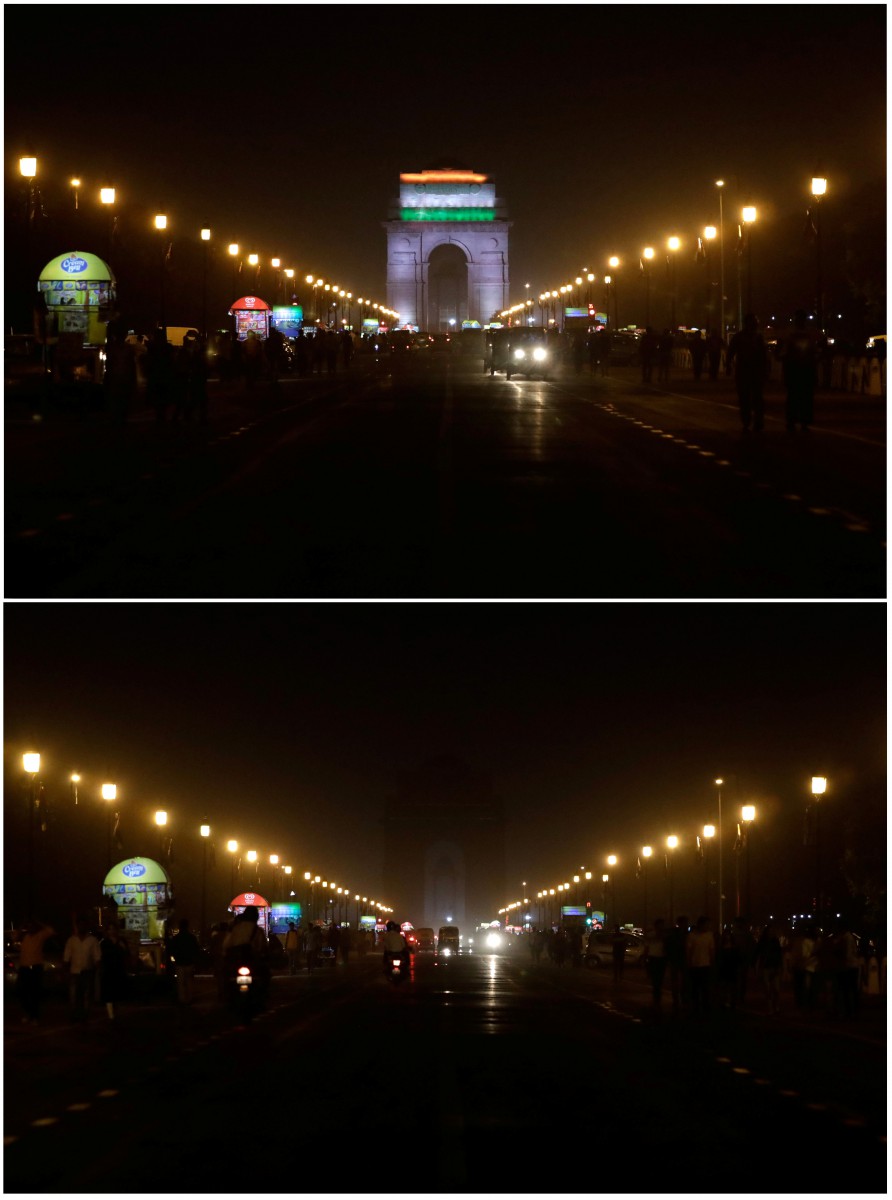
2018-03-24T164702Z_1356736489_RC1EA3F10080_RTRMADP_3_EARTH-HOUR-INDIA

A combination picture shows the India Gate war memorial before (top) and after the lights were turned off for Earth Hour in New Delhi, India, March 24, 2018. Source: Reuters/Saumya Khandelwal

In India, authorities switched off lights at the India Gate and Akshardham Temple in Delhi. The country’s Environment Minister Harsh Vardhan publicly urged the community to switch off all essential lights during Earth Hour.

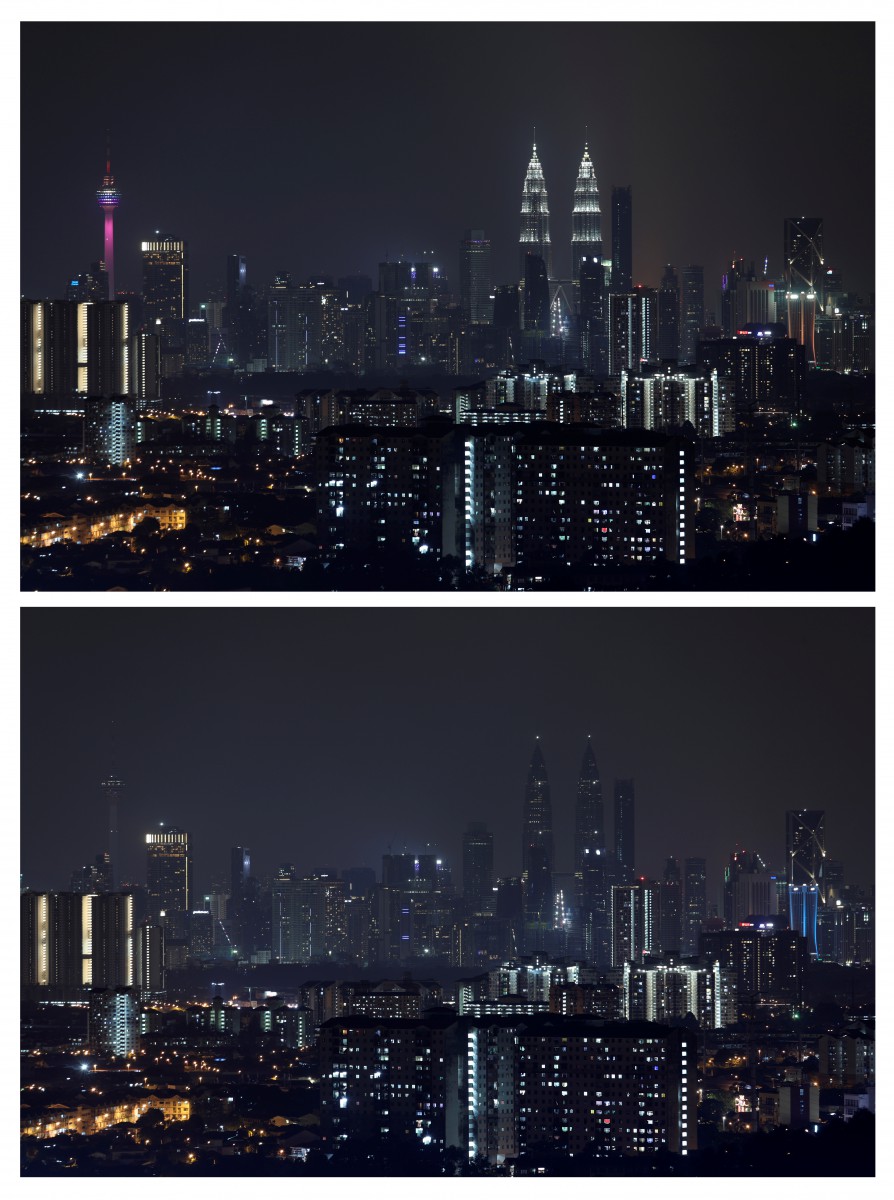
2018-03-24T142733Z_1657200011_RC1AE86752C0_RTRMADP_3_EARTH-HOUR-MALAYSIA

A combination photo shows the Petronas Twin Towers as lights were dimmed (bottom) and after lights were switched on to mark the Earth Hour in Kuala Lumpur, Malaysia March 24, 2018. Source: Reuters

“More than half of plant and animal species face local extinction in some of the world’s most naturally rich areas in biodiversity by the turn of this century if we continue along the current path that we are trending in terms of global warming,” Earth Hour organiser WWF Australia chief Dermot O’Gorman told the AFP.

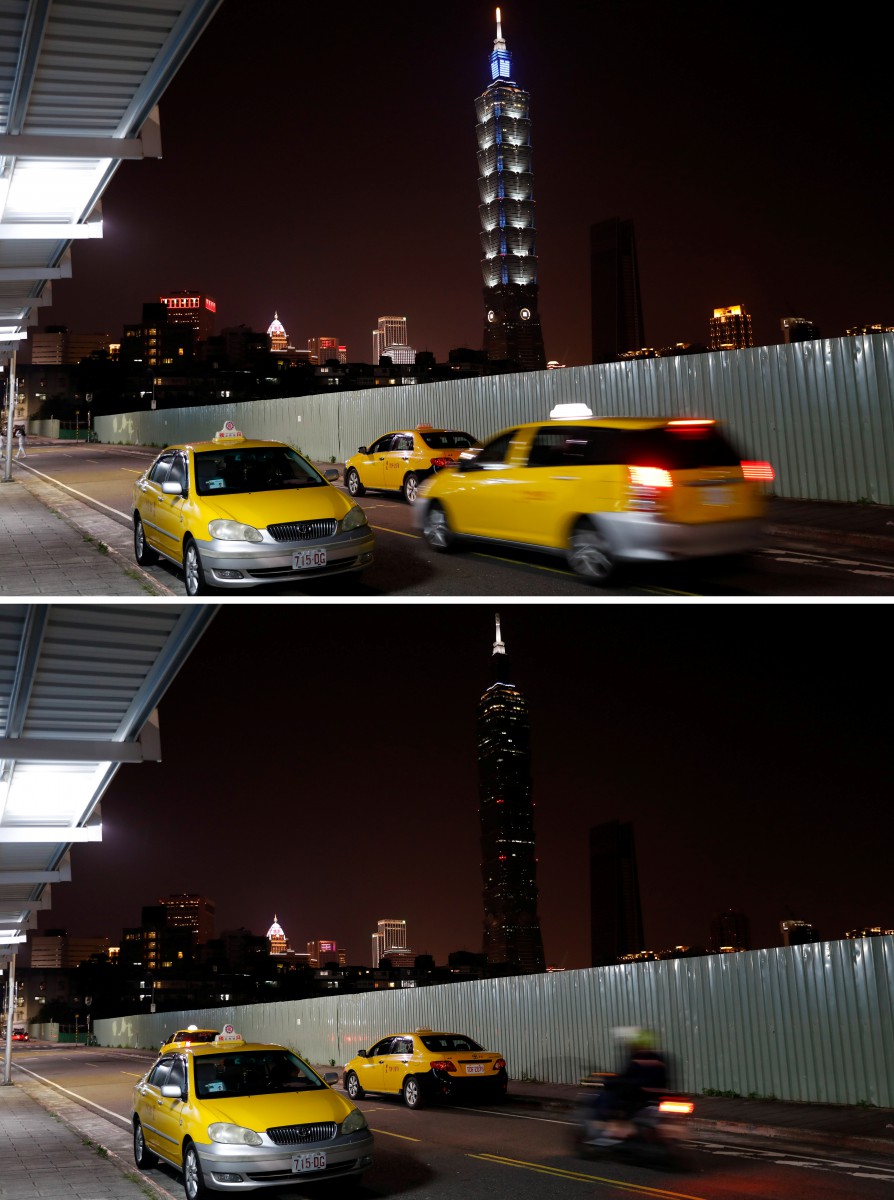
2018-03-24T130213Z_1552672161_RC1727E63010_RTRMADP_3_EARTH-HOUR-TAIWAN

A combination picture shows the Taipei 101 building before (top) and during Earth Hour in Taipei, Taiwan March 24, 2018. Source: Reuters/Tyrone Siu

Liu Yue-mei, the chairwoman of the Society of Wilderness in Taiwan was quoted by Focus Taiwan as saying: “this year we want to also highlight the importance of biodiversity and invite people to mitigate climate change and human disturbances to the environment.”

“We face an urgent global crisis on plastics – one that we as humans are responsible for,” said the CEO of WWF Singapore Elaine Tan as quoted by the Straits Times.

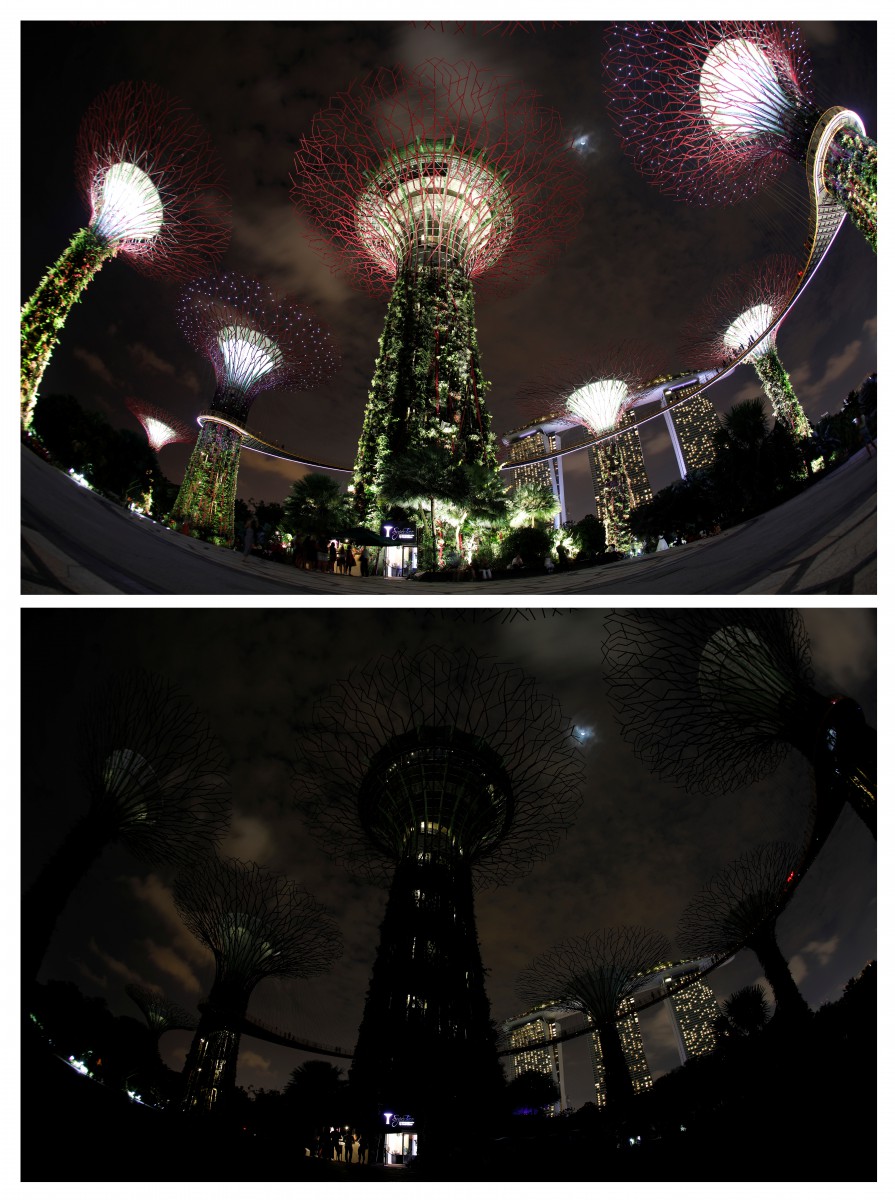
2018-03-24T125014Z_1682712378_RC19DA488700_RTRMADP_3_EARTH-HOUR-SINGAPORE

A combination photo shows giant concrete tree-like structures called ‘Supertrees’ before (top) and after the lights are dimmed to mark Earth Hour, at the Gardens by the Bay in Singapore March 24, 2018. Source: Reuters/Edgar Su

“It is therefore heartening to see the multitude of people joining us at Earth Hour, welcoming greater action including support for government legislation on plastic,” Tan said.

SEE ALSO: Cities need forests too: A call for forests amid our concrete jungles

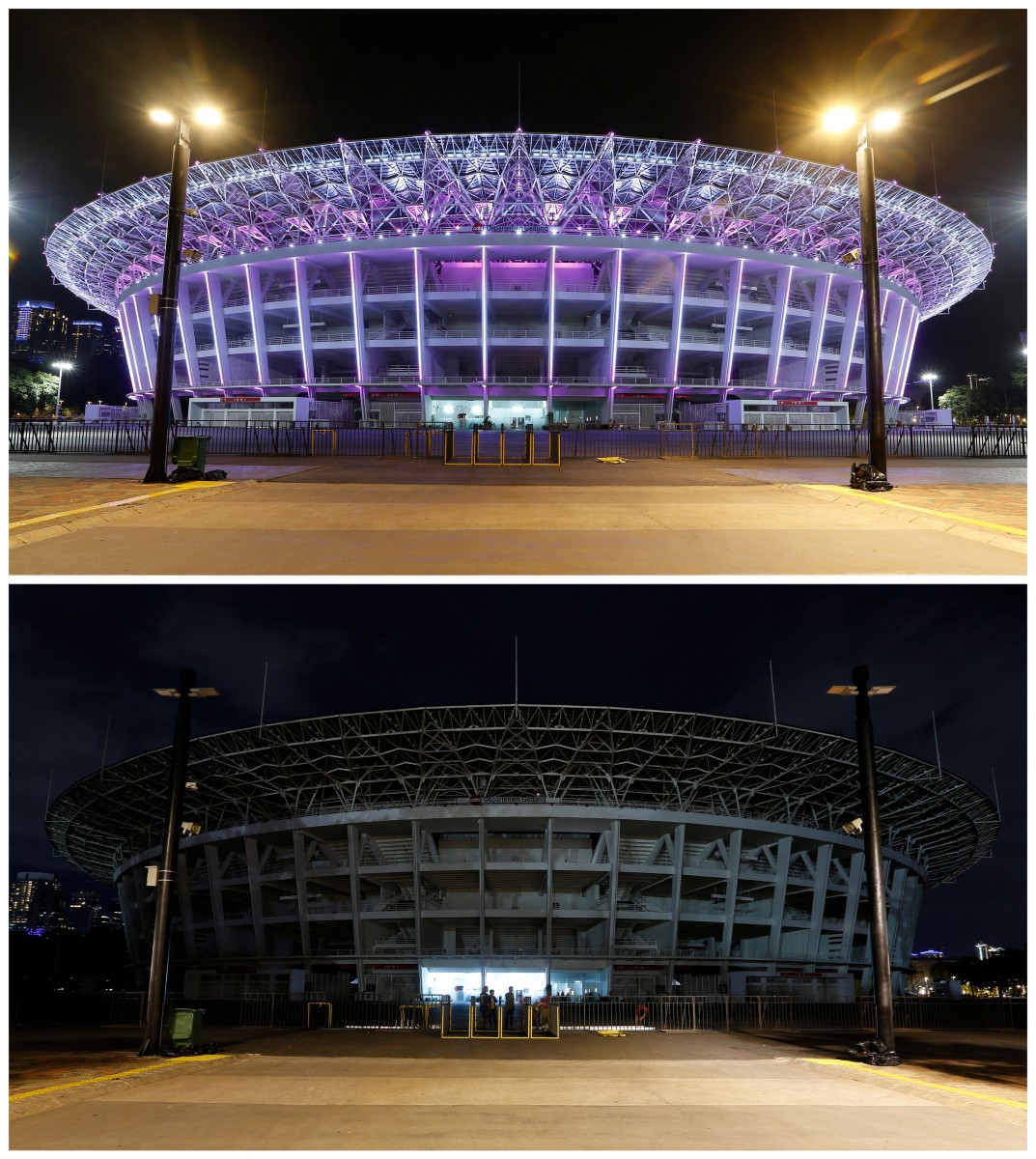
2018-03-24T152915Z_2124126321_RC15DEFAD2E0_RTRMADP_3_EARTH-HOUR-INDONESIA

A combination photo shows a general view of Gelora Bung Karno Stadium before and after the lights are dimmed to mark Earth Hour, in Jakarta, Indonesia, March 24, 2018. Source: Reuters/Willy Kurniawan

In the Indonesian capital, governor Anies Baswedan was quoted by The Jakarta Post as saying: “hopefully, we’ll have bigger awareness in the future, not only during the one-hour campaign, but also in our daily activities.”

Elsewhere in the world, Paris’s Eiffel Tower went dark, as did Big Ben and the London Eye in the UK.

{“total”:2,”error”:””,”linkedin”:0,”stumbleupon”:0,”google”:0,”pinterest”:0,”facebook_total”:1,”buffer”:1,”twitter”:0,”vk”:0}

Source link

Teachers to pay for parking in schools from August

0

SINGAPORE: Teachers will have to pay monthly season parking rates if they want to park their cars or motorcycles at their school car parks from Aug 1 this year, the Ministry of Education (MOE) confirmed on Monday (Mar 26). 

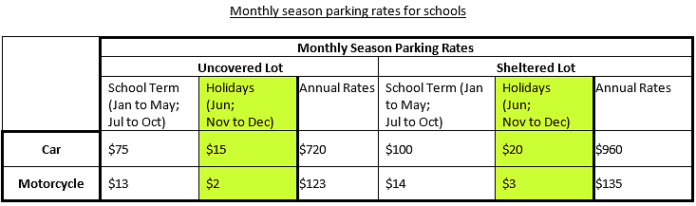
During the school term, the monthly season parking rates for cars is S$75 for an uncovered lot and S$100 for a sheltered lot. This is lowered to S$15 and S$20 for an uncovered lot and sheltered lot respectively during the school holidays. The annual rate for parking in an uncovered lot is S$720 while that for a sheltered lot is S$960.

For motorcycles, the monthly season parking rates during the school term is S$13 for an uncovered lot and S$14 for a sheltered lot. During the school holidays, the rates for uncovered and sheltered lots are S$2 and S$3 respectively. For the full year, it costs S$123 for uncovered lots and S$135 for sheltered lots. 

Monthly season parking rates for schools

The Education Ministry said that different rates will be charged during school term and the holidays as demand for parking fluctuates significantly between the two periods.

“This better reflects a sense of fair charging for the teachers, and was an important feedback we took away from our consultations with school leaders on the implementation aspects of school parking charges,” it said in a reply to Channel NewsAsia’s queries.

The parking charges are uniform for all schools regardless of location “for ease of administration”, it added.

The Education Ministry had said it was reviewing its car park policy for schools after the Audit-General’s Office (AGO) 2014/2015 Financial Year report noted that the Institute of Technical Education, Singapore Polytechnic and Temasek Polytechnic did not impose charges or had charges that were below the market rate.

“Such practices are tantamount to providing hidden subsidies for vehicle parking and are not in line with the requirements laid down in the Government Instruction Manuals,” the AGO had said.

MOE said that since then, it has been working with the Public Service Division and Ministry of Finance “to determine an appropriate treatment for staff parking in schools”. 

“It has become increasingly clear that the current treatment of allowing school staff to park for free constitutes a taxable benefit, as the vast majority of school car parks are located near chargeable car parks and the car parks are intended for the use of staff and authorised visitors, with no access given to the general public,” the Education Ministry said. 

To determine the annual market value for school car parks, MOE referred to the Housing and Development Board’s Tier 2 season parking rates for non-residents, it said.

It also considered inputs from a professional valuer, while also accounting for the restrictions on staff parking due to many school car parks being reserved for school buses to park in the evenings and on weekends, it added.

MOE explained that school car parks are generally intended to be “dual use” with clearly demarcated hours for school staff and for overnight school bus parking, Hence, the school season parking rates were set so that the total car park charges from both sets of season parking users are “broadly comparable” with HDB Tier 2 season parking rates.  

The charges will take effect from Aug 1 to “provide sufficient time for schools to finalise the implementation details and for MOE to engage teachers and school staff to address their queries before implementation begins”, MOE added.

CONTROVERSY OVER THE POLICY

MOE’s announcement in 2016 that it was reviewing the car park policy for schools was not well-received by teachers and members of the public.

The Worker’s Party Pritam Singh on Monday also expressed his stand against the new policy in a Facebook post.

“Some public sector professions and services – and I count teachers among them – must always be seen in an elected government’s eye through a lens that recognises their direct and indirect contributions to nation-building,” said the MP. 

“I stand against charging parking fees for teachers who drive cars or motorcycles,” he added. 


Source link

Singapore calls Human Rights Watch ‘biased and untruthful’

0


SINGAPORE’S government has at long last responded to a Human Rights Watch (HRW) report from 2017, which accused the city-state of “creative repression” in its silencing of activists and political opposition.

The Singaporean Ministry of Law released a statement on Friday regarding HRW’s failure to send representatives to its Select Committee on Deliberate Online Falsehoods, during which some 79 members of civil society were consulted.

Singapore is currently considering the introduction of new legislation to rein in what the government considers fake news.

“HRW’s stance is disappointing, but not surprising. HRW has a pattern of issuing biased and untruthful statements about Singapore,” said the Ministry of Law in a statement.

SEE ALSO: Political space shrinking in Singapore through ‘creative repression’ of activists

“It knows that its Report will not withstand any scrutiny, and has therefore chosen not to come to Singapore to publicly defend its views.”

Said report, entitled Kill the Chicken to Scare the Monkeys, was launched last year at a press conference in Kuala Lumpur, Malaysia, because it would have violated Singaporean legislation that prohibits foreigners participating in “cause-related gatherings” without a police permit.

The report documents limitations on freedom of speech, expression and media in Singapore – particularly under the tiny Southeast Asian nation’s laws regarding public order and scandalising the judiciary. HRW claimed that limitations on activism and criticism of the government had increased in recent years.

“HRW, by its conduct, has shown that it cannot be taken seriously as a commentator or interlocutor on issues relating to Singapore,” added the Ministry of Law, taking the New York-based NGO’s failure to attend as evidence of the report’s “serious inaccuracies”, “misimpressions” and “untrue statements”.

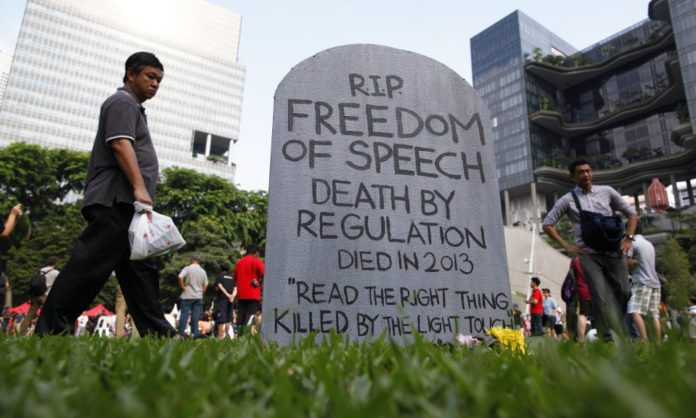
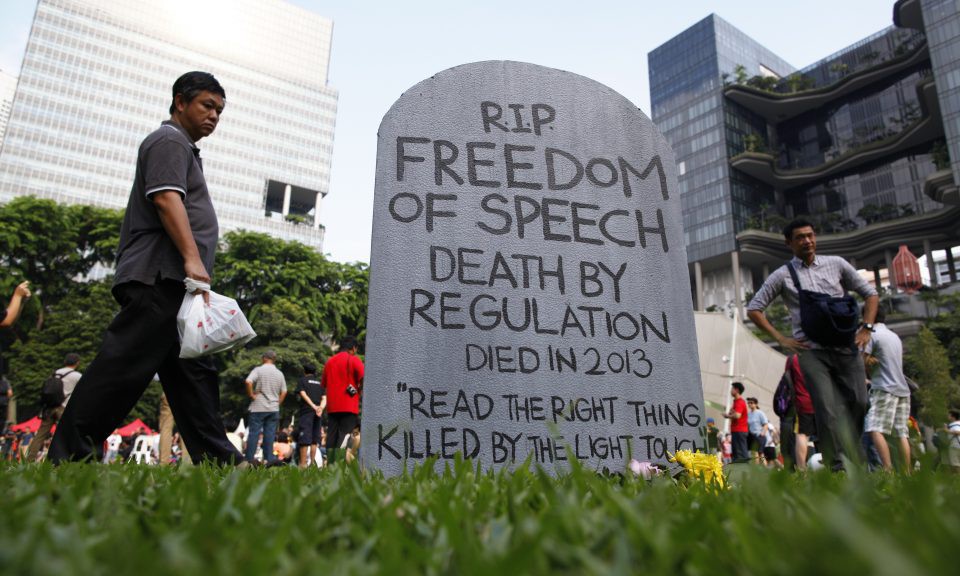
Singapore-Freedom-of-Speech-June-8-2013-960x576

Protesters walk past a mock gravestone that reads “RIP Freedom of Speech” during a protest against new licensing regulations imposed by the government for online news sites, at Hong Lim Park in Singapore June 8, 2013. Source: Reuters/Edgar Su

Vikram Nair, an MP for the ruling People’s Action Party, wrote in a submission to the Select Committee on Deliberate Online Falsehoods that HRW “seems to advocate the use of false and fabricated allegations in political discourse.”

“Singapore looks and feels different from many other countries. We stand out for our efficiency, the educational and social development of our population, the real freedoms that our people enjoy: the freedom from want, the freedom from deprivation, the freedom to walk around without fear of crime,” he wrote.

Critics fear that Singapore’s proposed anti-fake news legislation – the details of which have not yet been announced – will allow the government to further exert its influence over the country’s tightly controlled media.

SEE ALSO: Malaysia and Singapore’s fake news law proposals spark concern

Representatives from Google, Facebook and Twitter have warned the government against introducing new laws during the hearings of the Select Committee on Deliberate Online Falsehoods, stating that existing legislation is adequate to tackle the problem.

Reporters Without Borders (RSF) has also criticised the move, stating that there are already “stacks of draconian laws” in place in Singapore.

“Given the alarming legislative precedents in the city-state, RSF shares the deep concern that Singaporean defenders of the freedom to inform have expressed about this proposed law, which they suspect will be yet another tool for censoring dissent,” said the media watchdog’s Asia-Pacific desk Daniel Bastard in a statement.

On the World Press Freedom Index for 2017 Singapore was ranked 151 out of 180 countries.

{“total”:5,”error”:””,”linkedin”:0,”pinterest”:0,”facebook_total”:4,”google”:0,”stumbleupon”:0,”buffer”:1,”twitter”:0,”vk”:0}

Source link

Teachers to pay for parking cars, motorcycles in school from August

0

SINGAPORE: Teachers will have to pay monthly season parking rates if they want to park their cars or motorcycles at their school car parks from Aug 1 this year, the Ministry of Education (MOE) confirmed on Monday (Mar 26). 

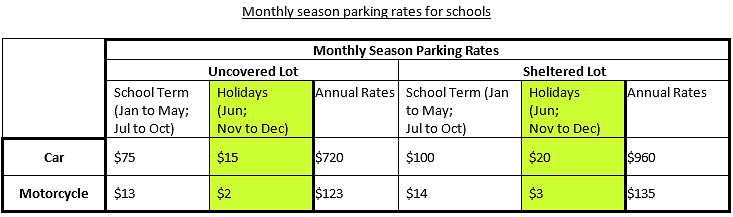
During the school term, the monthly season parking rates for cars is S$75 for an uncovered lot and S$100 for a sheltered lot. This is lowered to S$15 and S$20 for an uncovered lot and sheltered lot respectively during the school holidays. The annual rate for parking in an uncovered lot is S$720 while that for a sheltered lot is S$960.

For motorcycles, the monthly season parking rates during the school term is S$13 for an uncovered lot and S$14 for a sheltered lot. During the school holidays, the rates for uncovered and sheltered lots are S$2 and S$3 respectively. For the full year, it costs S$123 for uncovered lots and S$135 for sheltered lots. 

Monthly season parking rates for schools

The Education Ministry said that different rates will be charged during school term and the holidays as demand for parking fluctuates significantly between the two periods.

“This better reflects a sense of fair charging for the teachers, and was an important feedback we took away from our consultations with school leaders on the implementation aspects of school parking charges,” it said in a reply to Channel NewsAsia’s queries.

The parking charges are uniform for all schools regardless of location “for ease of administration”, it added.

The Education Ministry had said it was reviewing its car park policy for schools after the Audit-General’s Office (AGO) 2014/2015 Financial Year report noted that the Institute of Technical Education, Singapore Polytechnic and Temasek Polytechnic did not impose charges or had charges that were below the market rate.

“Such practices are tantamount to providing hidden subsidies for vehicle parking and are not in line with the requirements laid down in the Government Instruction Manuals,” the AGO had said.

MOE said that since then, it has been working with the Public Service Division and Ministry of Finance “to determine an appropriate treatment for staff parking in schools”. 

“It has become increasingly clear that the current treatment of allowing school staff to park for free constitutes a taxable benefit, as the vast majority of school car parks are located near chargeable car parks and the car parks are intended for the use of staff and authorised visitors, with no access given to the general public,” the Education Ministry said. 

To determine the annual market value for school car parks, MOE referred to the Housing and Development Board’s Tier 2 season parking rates for non-residents, it said.

It also considered inputs from a professional valuer, while also accounting for the restrictions on staff parking due to many school car parks being reserved for school buses to park in the evenings and on weekends, it added.

MOE explained that school car parks are generally intended to be “dual use” with clearly demarcated hours for school staff and for overnight school bus parking, Hence, the school season parking rates were set so that the total car park charges from both sets of season parking users are “broadly comparable” with HDB Tier 2 season parking rates.  

The charges will take effect from Aug 1 to “provide sufficient time for schools to finalise the implementation details and for MOE to engage teachers and school staff to address their queries before implementation begins”, MOE added.

Source link

Joseph Schooling signs with Hugo Boss in transition to pro-athlete

0

SINGAPORE: Hugo Boss has named Olympic champion Joseph Schooling as its first Singaporean ambassador.

Completing his transition from the collegiate swim scene in the United States, Schooling also announced that he has turned professional, after swimming the final National Collegiate Athletic Association (NCAA) competition of his amateur career last weekend.

“As a youthful talent with a relentless drive for success, he is a perfect fit to the brand,” said Mr Steven Lam, managing director of Hugo Boss in Southeast Asia. “His path to victory is a continual, ever-evolving journey that he approaches with dedication, precision and confidence.”


Schooling Hugo Boss pic 1

Joseph Schooling in a Hugo Boss suit. (Photo: Hugo Boss)

The company also released a capsule collection in collaboration with Schooling, which is now available in local stores of the German brand.

Said the 2016 Olympic gold medallist on his ambassadorial role: “It is a tremendous honour to be part of such an iconic brand,” he said. “(Its) focus on quality and authenticity resonates with me on a personal level.”

“Looking back, I would say I can be proud of my amateur career in general,” said Schooling, on his transition to being a professional athlete. “No doubt – as with every journey – I have had to endure some lows as well as some highs.”

“Every experience has helped me become the person I am today,” he added.

Joseph Schooling Hugo Boss pic 4

Joseph Schooling with one of his collaborations with Hugo Boss. (Photo: Hugo Boss)

This is the first of more commercial partnerships to be announced and Schooling’s parents Colin and May said they believe their son now has a good foundation to ease into the professional scene.

“For sure, Joseph has done amazingly well, and we are extremely proud of him,” said his mother May.

Joseph Schooling Hugo Boss pic 2

Schooling’s collaboration with Hugo Boss was revealed last Sunday (Mar 25). (Photo: Hugo Boss)


Added Schooling’s father Colin: “We are aware of the intricacies that come along with being an athlete going to the next step in his career. We believe we have the resources capable of easing the transition.”

The Olympic champion is Hugo Boss’ first swimmer in its collection of sports sponsorships. The brand also sponsors golfer Henrik Stenson, the German national football team, Formula E motorsports, as well as a sailing team.

MEDAL-LESS END TO NCAA CAREER

Schooling’s signing with Boss as their ambassador is a timely one. The 22-year-old did not engage in big money sponsorships during his collegiate stint with the University of Texas (UT) swim team, due to the NCAA’s strict rules on commercial deals.

His final NCAA meet last week did not go as planned in Minneapolis, as he finished without a medal in the four-day competition.

The Olympic champion finished fourth in the 100-yard butterfly event, which is his pet event, with a time of 44.68 seconds. It was some distance from his personal best of 43.75 seconds set last year.

His rival Caeleb Dressel, meanwhile, set a new meet record in the 100-yard fly, with his time of 42.80 seconds.

Joseph Schooling Hugo Boss pic 5

German fashion brand Hugo Boss ambassador Joseph Schooling. (Photo: Hugo Boss)

Schooling also did not podium in his other individual swims last week, finishing 13th in the 50-yard freestyle and 26th in the heats of the 200-yard butterfly.

His prior achievements in college include winning the 100-yard and 200-yard Butterfly Final in 2015 and 2016. In 2017, however, he finished second in the 100-yard event behind the fast-rising Dressel of University of Florida.

Joining UT on a scholarship in 2014, Schooling was previously from Bolles School in Florida. He enrolled in 2009 after leaving Anglo-Chinese School (Independent) in Singapore.

Source link

SIA welcomes new Boeing 787-10 Dreamliner; flights to Osaka, Perth from May

0

The new 787-10 features a total of 337 seats across its Business and Economy classes. It measures 68 metres in length and is made using lightweight composite materials. 

Singapore Airlines takes delivery of Boeing 787-10

Singapore Airlines takes delivery of Boeing 787-10 in North Charleston, South Carolina. (Photo: Singapore Airlines)

SINGAPORE: Singapore Airlines (SIA) has taken delivery of the first of its 49 Boeing 787-10 aircraft, which is due to enter commercial service in April, it said in a news release on Monday (Mar 26).

The new aircraft will be used for flights that take up to eight hours, with Osaka and Perth being the first two scheduled destinations from May. The aircraft will also fly on selected flights to Bangkok and Kuala Lumpur for crew training purposes. 

During a ceremony at Boeing’s production facility in North Charleston, South Carolina, SIA CEO Goh Choon Phong said, “It is an honour for us to be the world’s first airline to take delivery of this amazing aircraft. The 787-10 is indeed a magnificent piece of engineering and truly a work of art.”

The event was also attended by Mr Kevin McAllister, the Boeing Commercial Airplanes President and CEO, Mr Dominic Horwood, Rolls-Royce Director Customers and Services, along with some three thousand Boeing employees and invited guests. 

The new 787-10 features a total of 337 seats across its business and economy classes. It measures 68 metres in length and is made using lightweight composite materials. 

“Customers can look forward to customisable lighting preferences with large electronically dimmable windows, cleaner air, and a quieter and smoother ride,” SIA said in the release.

The new aircraft will be unveiled in Singapore at an arrival ceremony on Mar 28 after the aircraft’s delivery flight from North Charleston, via Osaka. Coordinating Minister for Infrastructure and Minister for Transport, Mr Khaw Boon Wan, will be gracing the event as the guest of honour. 

Additionally, SIA also has a firm order for 20 Boeing 777-9s, which are due for delivery from the 2021/22 financial year. 

Source link