Home Blog Page 1075

Commentary: Is free parking really the answer to teachers’ woes?

0

SINGAPORE: The news that teachers will have to pay monthly season parking rates if they want to park their cars or motorcycles at their school car parks from Aug 1 this year has sparked a public outcry that is to say the least, heartening.

It shows that generally Singaporeans appreciate that our teachers are deserving of recognition and rewards for their hard work.

Many have taken to social media since the news was announced to make a case for free parking for teachers in return for the numerous sacrifices teachers make in their jobs every day.

But in doing so, are we missing the point?

Yes, teachers’ welfare needs to be looked into, but is free parking really the right way to do it?

THE CASE FOR PARKING CHARGES

The case for charging for parking on school premises needs to be considered too.

The Ministry of Education (MOE) said it was reviewing its car park policy for schools after the Audit-General’s Office (AGO) 2014/2015 Financial Year report noted that the Institute of Technical Education, Singapore Polytechnic and Temasek Polytechnic did not impose charges or had charges that were below the market rate.

“Such practices are tantamount to providing hidden subsidies for vehicle parking and are not in line with the requirements laid down in the Government Instruction Manuals,” the AGO had said.

The charges are indeed in line with the Government’s “clean wage” policy.

MOE said that since then, it has been working with the Public Service Division and Ministry of Finance “to determine an appropriate treatment for staff parking in schools”. 

“It has become increasingly clear that the current treatment of allowing school staff to park for free constitutes a taxable benefit, as the vast majority of school car parks are located near chargeable car parks and the car parks are intended for the use of staff and authorised visitors, with no access given to the general public,” the Education Ministry said. 

Many have argued that if teachers are made to pay for parking, all other public sector organisation employees should too.

In fact, it is common for these organisations’ employees to do so already.

It was in 2005 that it was decided carpark benefits would not be offered by government agencies whether the carpark is owned by the ministry or a commercial organisation.

Now, it has been announced that from Sunday (Apr 1) season parking fees will apply at six military camps and bases for permanent staff.

This is addition to the 10 military premises that already levy such charges.

Mindef headquarters

File photo of the entrance to MINDEF headquarters on Hillview Avenue. (Photo: Aqil Haziq Mahmud)

That netizens have raised issues of equitable treatment is also heartening.

Such policies should not only apply to one group of civil servants.

THE CASE AGAINST

However, many have pointed out that teachers deserve special consideration.

They work long hours beyond the standard working day, spending their time completing not just administrative work, but to help weaker students.

Others say many teachers often pay for additional classroom material they are not reimbursed for.

The questions we need to be asking should be centred on what can be done to directly address such welfare issues.

Free parking hardly addresses the core of the problems teachers face on a daily basis.

HIGHER DEMANDS ON TEACHERS

We would do better asking instead how teachers’ workloads be lightened further?

Why aren’t teachers reimbursed for additional classroom material or even for working over time?

Granted, many schools might already be addressing these issues.

But are these efforts sufficient?

Why are many still feeling overworked and underappreciated?

students classroom Singapore

Secondary school students in a classroom in Singapore. (File photo: MOE)

In 2016, Minister of State for Education, Janil Puthucheary, in response to a series of parliamentary questions on the reasons for teachers leaving the service, said that workload is “not commonly cited”.

Instead, the main reasons for resignations range from family considerations like childcare, to a desire for a change of job, he said.

Yet, those who speak the loudest in informal chat sessions on the ground seem sceptical.

Are teachers themselves being honest about the real reasons the job might be wearing them down?

These issues should be discussed more openly with decision-makers and need to be addressed urgently.

Teachers’ work involves all of us. It doesn’t take a lot to recognise that what they do is crucial and has knock-on impact not just on education, but on the economy, and society as a whole.  

PARENTAL DEMANDS

Most of us recognise that we should do better by our teachers especially as the demands of education increase.

Yet, many teachers also raise the issue of parental demands on them.

Often, parents expect teachers to not just help their children in the academic sphere, but in character-building as well.

Most teachers would say this is part of the job too, but it requires the active partnership of parents.

Do parents do enough?

Do many still bother teachers at all hours with phone messages and “urgent” e-mails after-hours?

Family Singapore

A family walking in Singapore. (Photo: Gaya Chandramohan)

ARE BETTER SALARIES ENOUGH?

For all this work are our teachers paid fairly?

Remuneration for teachers and allied educators has improved over the years.

In fact, as far back in 2015, it was announced that  up to 30,000 teachers will receive 4 per cent to 9 per cent increases in their monthly wages.

It was also announced that all trained teachers would get an annual special payment each September from 2016, which is between S$500 and S$700 in cash.

Some might say this isn’t enough.

Others say, the money helps but the long hours, including often having to work during the holidays, negate the benefits of a higher salary, no matter how high.

This should force the authorities and those of us who come into contact with teachers to give teachers’ welfare a deeper relook.

Many of us acknowledge that teaching is a noble profession, but is free parking really the way to recognise this?

It seems like nothing but a “consolation prize”, and perhaps the wrong battle to be fighting as it hardly addresses the numerous issues that teachers face on a daily basis.

Aside from addressing the day-to-day rigours of the job, we should also have an honest conversation about what would be a fitting manner of rewarding our teachers in terms of privileges.

Since even free parking will soon be a thing of the past, it is even more pressing for the ministry, the schools, school leaders and parents and students alike to re-examine our expectations and the demands on teachers and while doing so, re-assess the way our teachers are recognised for the invaluable jobs they do.

Bharati Jagdish is the host of Channel NewsAsia Digital News’ hard-hitting On The Record, a weekly interview with thought leaders across Singapore, and The Pulse, Channel NewsAsia’s weekly podcast that discusses the hottest issues of the week.
Source link

Commentary: Curb Facebook? Don’t throw the baby out with the bathwater

0

SINGAPORE: The current situation with Cambridge Analytica and its misuse of Facebook material points to some of the unsavory dimensions of our online lives.  

Cambridge Analytica is a company, financed in part by the conservative financier Robert Mercer, which has used a variety of suspicious tactics to elect conservative politicians, such as Donald Trump in the US, and support conservative causes, such as Brexit in the UK, many have pointed out.

Numerous news reports have highlighted that in addition to the misuse of Facebook material, Cambridge Analytica has also used various “dirty tricks” techniques such as the use of front companies and subcontractors to pay bribes, and employed “honeypot” sex workers in the pursuit of their goals.  

Looking specifically at the issue of the misuse of data, Cambridge Analytica has developed tools that allow it to use information derived from social network sites such as Facebook to micro-target users with false news, based on their specific Facebook profiles and use patterns.

These Facebook posts are calculated to match our personality and thus they are more engaging. In this way they basically reinforce our pre-conceived ideas.

For example, if we were an American voter who was somewhat skeptical towards Hillary Clinton, a Facebook post that questions her patriotism, even when fabricated, can nudge us towards supporting Donald Trump.  

WEAPONISING OUR DATA

All this data mining and micro-targeting have been done without the permission of users and thus the use of personal information in order to mislead voters is extremely problematic. 

Indeed, this activity destroys the innocence associated with the use of social networking sites.

The building housing the Cambridge Analytica office is seen in central London

The building housing the Cambridge Analytica office is seen in central London, Britain March 23, 2018. REUTERS/Hannah McKay

It shows how our chatting, sharing of photos and engaging in light social discourse can be weaponised. It shows how these posts shape our attitudes by pandering to our beliefs.  

What is the social cost? At the first level, this type of activity poisons the simple joy of exchanging pleasantries with our friends and acquaintances on these platforms.

Social interaction is one of the key dimensions of social networking. We can catch up with friends, show them our vacation pictures and share harmless jokes. In this way, these platforms help us to weave the fabric of our social lives.

They make our interactions richer and they give us access to social ties that would otherwise be unavailable. The misuse of this social information can make us wary where before there was enjoyment. 

A FORCE FOR SOCIAL GOOD

Thinking somewhat more abstractly, the digital traces produced by these social networks are also a tool through which social good arises. 

Social media and other forms of digital traces (such as mobile phone metadata) represent a new tool with which to address major social issues. Indeed, large-scale databases can be used for social good and socioeconomic improvement.

Two examples illustrate this. One is the work done by researchers in the US, particularly in Harvard, on the use of mobile phone call data records and mobile phone location traces. Researchers drew on this data to follow the spread of infectious diseases.

Careful use of location information and its mapping gives insight into the spread of diseases such as malaria, dengue, zika, and influenza. This, in turn, means that medicines can be transported to the areas where the diseases are spreading.

Rather than having authorities guess as to the direction and the dynamics of the spreading, they can be more certain and they can mobilise resources appropriately.

Other examples were seen in the wake of the Haitian earthquake in 2010 by researchers in Stockholm and the 2015 Nepalese earthquake by researchers at Southhampton.

Again, tracing the location of people via their mobile phones and their use of social media meant that authorities knew, with better precision, where the refugees or victims were located. This meant that relief resources could be moved to the appropriate locations and thus better meet social needs.

nepal quake

A man walks through rubble of houses damaged by the earthquake in Bhaktapur near Kathmandu on Apr 28, 2015. (Photo: AFP/Menahem Kahana)

The real-time use of these digital traces means that we can create a society that is more responsive to the needs of people.

VIOLATE OUR SENSE OF PROPRIETY

In this context, the unethical use by companies such as Cambridge Analytica violate our sense of propriety and they cast the shadow of doubt over legitimate and socially constructive uses of big data.

Further, the development of fake news campaigns, spread via social networks such as Facebook, undercuts the legitimacy of traditional news sources since the reader may be reluctant to trust the broader news industry.

In sum, the social havoc wrought by companies such as Cambridge Analytica tears at the fabric of society.

Will this scandal mean that we shy away from the positive use of social media? Can regulation be developed that will allow the positive use of these platforms while clamping down on the misuse?

It is clear that social media can be a force for good. It is also clear that in order to fulfill this assignment, we cannot cast out the baby with the bath water. 

Rich Ling is Shaw Foundation Professor at Nanyang Technological University’s Wee Kim Wee School of Communication and Information. His research focuses on media technology and the social consequences of mobile communication.

Source link

Temperatures in Singapore dip to 23.3 degrees Celsius amid widespread rain

0

SINGAPORE: The weather was chillier than usual on Tuesday night (Mar 27) as temperatures dipped amid widespread rain.

Temperatures in Clementi fell to 23.7 degrees Celsius at around 10pm and was 23.3 degrees Celsius at Pulau Ubin, according to the Meteorological Service’s website. The temperatures in other parts of Singapore ranged between 24 and 25.4 degrees Celsius.

weather Mar 27

(Graphic: Meteorological Service Singapore)

It was raining in most areas, although the Met Service said the rain is expected to clear later in the night. Thunderstorms are expected on Wednesday afternoon, it said.

weather Mar 27 (1)

(Graphic: Meteorological Service Singapore)

Temperatures for the next four days are expected to range between 24 and 33 degrees Celsius, with thunderstorms in the afternoon on most days, it added.

In its latest weather outlook, the Met Service said the prevailing northeast monsoon is expected to persist in the second half of March. Thunderstorms due to daytime heating of land areas are expected on five to seven days, although these are expected to last around an hour or less in the afternoon, and extend into the evening on one or two days.

In January, Singapore experienced its longest cool spell in the last 10 years, with daily minimum temperatures dipping to as low as 21.2 degrees Celsius

Source link

197 motorcyclists caught at land checkpoints for smoke, excessive noise emission: NEA

0

SINGAPORE: The National Environment Agency (NEA) caught 197 motorcyclists for smoke and excessive noise emission offences this week, according to a media release on Tuesday (Mar 27). 

The operation, which targeted “smoky and noisy foreign motorcycles”, was carried out on Monday and Tuesday at the Woodlands and Tuas Checkpoints. 

A total of 34 foreign-registered motorbikes committed smoke emission offences, while 163 emitted excessive noise.

Last year, NEA took action against a total of 442 foreign motorcycles for smoke emission, while 163 were caught for excessive noise. 

Under the Environmental Protection and Management (Vehicular Emissions) Regulations, it is an offence for any vehicle to emit smoke or visible vapour while in use on the road. It is also an offence to use motor vehicles that emit noise above the level specified for their class. 

Owners of smoky vehicles “will be offered a tiered composition sum based on vehicle type and number of offences committed”, said the agency, adding that failure to pay the sum makes them liable to a fine of up to S$5,000. 

Smoky motorcycle NEA

A smoky motorcycle undergoing the noise emission test. (Photo: NEA)

NEA also stated that during enforcement operations, smoky foreign motorbikes undergoing smoke tests will also be tested for noise emission. If they fail the noise test, the foreign motorist will be asked to rectify the vehicle. The particulars of the motorist and the motorcycle will also be forwarded to the foreign authority for follow-up action, it added.   

“Reducing vehicle exhaust emissions and noise will help to achieve and sustain a healthy and clean living environment in Singapore,” said NEA. “Members of the community and stakeholders are urged to play their part in keeping our environment clean and ensure high standards of public health.”

Source link

Drivers with Lion City Rental contracts can take Grab bookings

0

SINGAPORE: Drivers who have contracts with Uber’s car rental partner Lion City Rental (LCR) will now be allowed to accept Grab bookings, said Grab in an email to Channel NewsAsia on Tuesday (Mar 27).

A Grab spokesperson said that the company is “committed to serving our passengers and drivers, and this means protecting our drivers’ livelihood while ensuring our passengers’ safety”.

The clarification comes a day after Uber’s merger with Grab in Southeast Asia on Monday. 

Many drivers affected by the merger had expressed concern over their rental contracts with LCR, which stipulates that they cannot use the car for ridesharing on platforms other than Uber. Uber’s app will cease on Apr 8.

Lion City Rental had posted on Facebook on Monday that it was “closed until further notice” and that there would be no change to its hirers’ weekly payment and rental.

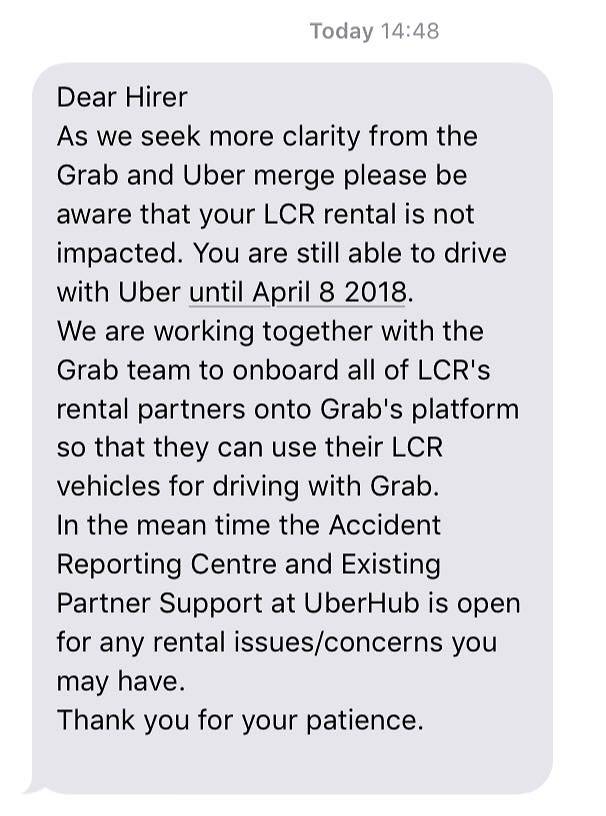
On Tuesday afternoon, the rental company circulated an SMS to its hirers to reiterate that their rental would not be impacted, and that it was working with Grab to “onboard” its hirers onto Grab’s platform. 

LCR screenshot

Uber’s rental partner Lion City Rental has circulated this SMS to its hirers. (Screengrab)

After their contract with LCR expires, these drivers can opt to rent a car from one of Grab’s 50-odd fleet partners.

Some Uber drivers have also expressed concerns over being banned from Grab’s platform for previous offences, such as using a rental car from Uber’s rental partner to accept Grab requests. 

Grab clarified that drivers who are banned on Grab’s platform can appeal their suspension. It added that it will review the suspension on a case-by-case basis.

Source link

SMRT reports 68% fall in profits in 2017

0

The public transport operator sees revenues plunge as it copes with increasing operating expenses.

An SMRT train leaves a station. (AFP photo/Alex Tan)

File photo of an SMRT train. (Photo: AFP/Roslan Rahman)

SINGAPORE: SMRT earned S$26 million in after-tax profits in 2017, a stark contrast to the S$81 million reported the previous year. 

According to the latest group review report released on its website on Tuesday (Mar 27), the public transport operator also recorded a fall in revenue of S$791 million for 2017 as compared to S$811 million in the previous year, citing “lower average fare”.

Meanwhile, SMRT’s earnings before interest and tax for the financial year of 2017 was recorded as S$27 million after it recorded S$97 million in the previous year.

The fall in earnings was in light of increasing operating expenses, SMRT said. This is due to “higher maintenance-related expenses for the ageing network” as well as “preparation for operating Tuas West Extension”, it added. The Tuas West extension to the East-West Line officially opened in June 2016.

Details of operating data revealed in the review showed an increase in average weekday ridership from 756 million in 2016 to 768 million in 2017. 

Meanwhile, total distance travelled by passengers decreased from 8,322 million kilometres in 2016 to 8,271 million kilometres in 2017. 

Source link

Grab buys Uber’s Southeast Asia operations: Who are the winners and losers?

0

SINGAPORE: In a move that its founder described as “the beginning of a new era”, Singapore-based Grab confirmed on Monday (Mar 26) that it will be taking over the Southeast Asia operations of its arch-rival Uber at an undisclosed sum. 

The announcement puts an end to months of speculation about a merger, as well as years of intense turf wars which have seen both operators dishing out generous promotions to entice passengers. 

With the acquisition, Grab will take over Uber’s operations and assets in eight Southeast Asian countries. It will be integrating Uber’s ride-sharing and food delivery business in the region into its platform. 

In exchange, Uber will take a 27.5 per cent stake in Grab and Uber CEO Dara Khosrowshahi will join Grab’s board. 

Analysts said the announcement is hardly a surprise given the rumours that has been fuelled over the past few months since SoftBank, an early investor in Grab, made a multi-billion investment in Uber. 

“That basically provided a form of possibility about the end of competition,” said Singapore Management University (SMU) transport researcher Prof Terence Fan. 

While Grab President Ming Maa told Reuters that the acquisition was “a very independent decision by both companies”, analysts like Dr Lee Der Horng from the National University of Singapore (NUS) believed that common investor Softbank likely gave “a very heavy push” to get the deal across the finish line. 

“Because from Softbank’s point of view, it doesn’t make sense for its right hand to continue fighting with its left hand,” he told Channel NewsAsia. 

Noting that Grab and Uber have long passed the start-up phase and are now considered mature technology firms, it is only “intuitive” for investors to start focusing on profitability and realise that the bruising battle for market share “doesn’t make sense”, Dr Lee added. 

Now, with the merger of the ride-hailing giants becoming reality, who are the winners and losers?

UBER: This marks the San Francisco-based firm’s second retreat from an Asian market, with the first taking place in 2016 when it merged its China operations with local rival Didi Chuxing. 

Analysts told Channel NewsAsia that seemed to have forewarned Uber’s fate in other parts of Asia where it has been locked in major tussles with local players, which tend to be more nimble and savvy to local demands. In Singapore, it also took on a more asset-heavy model with vehicle rental business Lion City Rentals, which may have further crimped its profit margins.

Uber could be trying to “clean up its balance sheet” as it prepares for a potential initial public offering (IPO) in 2019, said Mr Anuj Jain, co-founder of local venture building firm Startup-O.

“With the change in CEO and other troubles they’ve had, there is increasing pressure for Uber to prove itself financially. Given that they are fighting many wars at many fronts, they seem to have fallen back on a script – one that has worked for them in China – which is to pick their battles and end the big cash burn.” 

However, the ceding of its Southeast Asia operations may not be a total defeat for the US giant whose name has become synonymous with ride-hailing. 

After all, its stake in Grab means it will be able to maintain a “strategic presence” in this part of the world, said Assistant Professor Fan. 

“They are cutting losses and having some shares in Grab means they are not completely exiting from the rapidly growing Southeast Asia market.”

A view of Uber and Grab offices in Singapore

A view of Uber and Grab offices in Singapore March 26, 2018. REUTERS/Edgar Su

GRAB: A clear victory for the underdog turned market behemoth, which started slightly more than four years ago. 

Apart from homeground advantage, observers said the Singapore-based operator’s venture into on-demand bus routes, bike-sharing and having its own mobile wallet payment system proved that it understands the regional market “better” than Uber. 

For instance, compared to Uber’s reliance on credit cards for payment, GrabPay “fills in the gap” to target the underserved and unbanked population in Southeast Asia, explained NUS’ Dr Lee. 

Moving forward, the acquisition means that Grab will no longer need to engage in market strategies characterised by heavy discounts, allowing it “room to replenish its coffers”, said Assistant Professor Fan. 

Taking over Uber Eats will also be a boon to Grab’s lifestyle offerings and a heartier food delivery service will give it an advantage over regional rivals, such as Indonesia’s Go-Jek, according to Dr Lee. 

But more importantly, having more consumer data from Uber will sharpen Grab’s understanding of consumer experiences and requirements. This will help the on-demand transportation firm to craft better products for its diversification plans, particularly its recent foray into financial services. 

“As they said, data is the new oil so this is a big victory,” said Mr Jain. “They can plan routes that can be better served by buses or bikes, instead of cars. They can also use these alternative data points to find out the consumers who may wish to access fintech products in future.” 

In the longer run, all eyes will be on how Grab integrates operations with Uber, analysts said.

TAXI OPERATORS: While most of the taxi operators will likely be heaving a sigh of relief with the elimination of a major competitor, the same cannot be said for ComfortDelGro. 

“ComfortDelgro is the biggest loser from this,” said Dr Lee, citing the S$642 million alliance between the taxi giant and Uber struck just three months ago, in which ComfortDelGro would acquire a 51 per cent stake in Uber’s Lion City Holdings. 

The collaboration between the two also led to the launch of UberFlash in January. 

Analysts have said the alliance would give Singapore’s biggest taxi operator some help in keeping up with a disrupted taxi industry, as well as an uplift in earnings for its automotive engineering services and car leasing & rental divisions. 

But the merger announced on Monday will likely render this alliance “futile”, analysts said. 

Dr Lee noted that Grab has previously reached out to ComfortDelGro for potential collaborations but the latter picked Uber as its partner in the end. 

“Now, they are back to square one,” Dr Lee added. “Perhaps they should work with Grab if they like to remain relevant in this ride market.” 

When asked how the Grab-Uber deal would affect ComfortDelGro’s alliance with Uber, the taxi giant only said that it is “reviewing all aspects of the proposed tie-up” which is currently under review by the CCS.

Shares of ComfortDelGro appeared unaffected by the announcement, closing up 2.5 per cent on Monday.

For Phillip Capital Research investment analyst Richard Leow, the move by Grab and Uber could both be beneficial and detrimental to the taxi operators. 

While more rational pricing of commuter fares for private-hire cars could shift some demand back to taxis, a monopoly by Grab over the private-hire car business in Singapore would put it in a better position to compete against taxis, he said.

ComfortDelGro's taxis are parked at their vehicle inspection yard in Singapore

File photo of ComfortDelGro’s taxis parked at their vehicle inspection yard in Singapore. (Photo: Reuters/Edgar Su)

DRIVERS: Some private-hire car drivers have voiced concerns about how the latest deal could impact their incentives and commission rates. Labour MP Ang Hin Kee also wrote in a Facebook post that those whose contracts are with Uber-owned Lion City Rentals are particularly concerned.

“As there were no prior notice given to drivers, they are left feeling unsure about how they can continue with their business and obligations they are under. They are also not sure if potential losses can be recovered or if there might be other lost opportunities.”

Cab drivers from ComfortDelGro, who have been taking Uberflash jobs, are also “unsure about their options”, Mr Ang wrote late Monday.

In response to queries, Grab said that ComfortDelGro drivers “can continue to accept bookings via GrabTaxi”.

It added that it will be reaching out to Uber’s drivers in the coming days to aid with the transition. Uber has also sent out messages with specific sign-up details to all their drivers in Singapore.

Meanwhile, Dr Lee from NUS reckoned the attractive incentives that both companies have doled out to attract drivers could soon be a thing of the past.

This could translate into a “reorganisation” of the market and an eventual reduction of the more than 40,000 private-hire car drivers in Singapore.  “The number of private-hire car drivers is a little too much in my opinion. With the merger and a possible adjustment to the incentives, I wouldn’t be surprised if some drivers choose to leave the market, especially the part-time drivers,” said Dr Lee. 

RIDERS: Similarly for consumers, the takeover deal has also generated some concerns. 

While some like Dr Lee mooted the possible result of “a larger and integrated service”, almost all experts that Channel NewsAsia spoke to highlighted concerns about less-competitive prices to come.

“In theory, if everything comes under one roof, Grab can start raising prices either overtly or discreetly,” said Assistant Professor Fan from SMU. “After all, at some point, they need to start making money.” 

Ms Paige Kwok, 30, is among those concerned about potential price hikes. The HR executive said she usually toggles between the two ride-hailing apps before deciding on a ride.

“I am worried because consumers won’t have a choice in future. If I’m only left with the more expensive option, I’ll reconsider my travel methods.”

The Competition Commission of Singapore (CCS) said late Monday that it is writing to the companies to “clarify the details” of the deal after not receiving formal notifications from both parties. 

In response to Channel NewsAsia’s queries, Grab said it has informed the CCS and will be making a merger notification filing. It has also engaged the Land Transport Authority (LTA) and will “cooperate closely” with regulators.

Grab added that the merger with Uber will pave the way for a “more efficient transportation network”. 

“Passengers will get to enjoy shorter waiting times, more convenient and affordable rides through one platform. Drivers will also earn higher incomes with more ride bookings through one platform, as well as more efficient and faster matching with passengers,” its response said.

Source link

Commentary: Beyond price hikes and conservation campaigns, saving water through smart showers

0

SINGAPORE: Water is an important and scarce resource to Singapore. 

In order to be less dependent on imported water, the country turned to technology such as desalination.

However, the cost of maintaining and upgrading the country’s water supply infrastructure eventually led to the Government increasing water prices in July last year.

This has shown to be effective. Minister for the Environment and Water Resources Masagos Zulkifli recently revealed the 2017 price hike contributed to a drop in daily water use from an average 148 litres a day in 2016 to 143 litres for each member of a household.

For decades, water conservation has been a constant message for Singaporeans. But apart from price hikes and water conservation campaigns, are there other ways to sway behaviour at the point of consumption – especially when you take a shower?

Nudge theory and behavioural insights suggest this may be so.

The National University of Singapore (NUS) Business School and Department of Real Estate (DRE) collaborated with PUB to lead an international research team involving us, Davin Wang from NUS, Lorenz Goette from University of Bonn, Thorsten Staake from University of Bamberg and Verena Tiefenback from Swiss Federal Institute of Technology to study how households’ shower water usage behaviour can be improved for water conservation.

In Singapore, showers account for a staggering 30 per cent of an average family’s monthly water consumption. If households can change their behaviour during showers, that can yield substantial savings.

SMART SHOWERS

In Switzerland, researchers found one way to change behaviour is to furnish real-time feedback to users during showers on how well they were conserving water. So they equipped some households with smart shower devices that provide real-time feedback on water temperature, volume used and how well water consumption goals have been met. 

The researchers found with such devices, households reduced their water usage by 22 per cent.

Would a similar intervention work in Singapore? To answer this question, some 500 households in HDB flats were fitted with a smart shower device where data regarding water consumption was recorded, giving us information about 300,000 showers over a four-month period.

They were divided into seven groups. Five groups of households were given different water conservation targets and feedback regarding the volume used.

shower head

File photo of water dripping from a shower head. (Photo: AFP/Justin Sullivan/Getty Images)

Water conservation targets of 10, 15, 20, 25 or 35 litres per shower were given out. The 10- and 15-litre targets corresponded to ambitious targets, the 20- and 25-litre targets were moderately attainable, while the 35-litre target was considered an easy one.

Households with targets set were encouraged to try keeping their water consumption below these designated levels. During showers, besides showing the volume used, the smart meter also gave feedback on how they were performing vis-a-vis their targets.

A sixth group of households received only water temperature information with no target or feedback, while the last group received real-time feedback on water volume when showering with no feedback on how well they were conserving water.

ASTOUNDING SAVINGS

We know a priori that on average, Singaporeans use almost 20 litres of water in a single shower that takes about five minutes.

But with some simple feedback, the savings were quite astounding. When feedback was given regarding water usage, water consumption went down on average by about 10 per cent per shower, saving each person two litres daily.

But this saving varied by the targets set.

Those who received target and volume feedback reduced their consumption the most. Households that had a moderate volume target of 15 litres set saved the most of 3.9 litres less water during a shower, resulting in a saving of about 19 per cent – somewhat similar to the 22 per cent observed in the Swiss study.

Households that had an ambitious target of 10 litres set also saved water, with 2.9 litres saved on average during a shower. This lower amount of water saved is likely in part due to the fact that showering in Singapore’s humid weather probably necessitates a minimum threshold of water.

Tap water (2)

File photo of tap water. (Photo: AFP/Yoshikazu Tsuno)

SETTING TARGETS, MONITORING PERFORMANCE

Our study concludes that getting households to set targets and giving them feedback on their performance not only promote awareness of the need for water conservation but also result in them using less water.

Just as in the case of individuals where goal-setting and feedback are keys to performance, households behave similarly when it comes to water conservation.

Households are also like individuals in that the targets set must be within reach to motivate households to strive hard to attain them. When a target is too ambitious (below 10 litres) or too easily attainable (above 30 litres), it becomes less effective in encouraging households to save water.

With appropriate targets and feedback, households can be persuaded to be more water efficient. Their behaviour can be modified within a short span of time, and hopefully, over time, attitudes towards water conservation will also change for a more sustainable lifestyle.

The monthly utility statement that households receive shows how they performed on two distinct types of utilities – water and electricity – relative to the neighbourhood and national averages. Such feedback, though not in real time, has a social comparison dimension that may encourage water conservation practices, complementing the immediate feedback concerning one’s personal water usage.

Both these practices help to curb water wastage by keeping users informed – one via social comparison by knowing how one fares relative to others and the other through knowing how much water one is using.

The PUB statement also provides feedback such as “Well done. You have consumed less in all your utilities in the recent two months as compared to the previous two months”, much like what was furnished in our study. 

One caveat however, is that while real-time feedback is ideal as we’ve shown in our study, this may not be feasible for the time being because these smart devices are not cheap. 

But we can imagine a system where one day, households can link their spike in water consumption to specific activities such as car washing, and accordingly make conscious efforts to reduce the frequency or modify the way in which such water-consuming activities are carried out.

Given the speed with which the Internet of Things are benefitting households beyond our imagination, the future of getting granular real-time feedback on not only water but also utility consumption is in sight.

Sumit Agarwal is Visiting Professor at National University of Singapore (NUS) Business School and Sing Tien Foo is Dean’s Chair Associate Professor at the Department of Real Estate. More about this study can be found in Kiasunomics: Stories of Singaporean Economic Behaviours co-authored with Ang Swee Hoon and Sing Tien Foo, all at NUS.

Source link

What does the Grab buyout of Uber mean for you?

0


GOODBYE, Uber. It has been swell and all good things must come to an end. But has it, really?

On March 26, 2018, Grab released a statement confirming rumours that the company will be taking over Uber’s operations and assets in Southeast Asia as both ride-sharing giants will merge into one, effectively turning Grab into a ride-hailing juggernaut.

This includes Cambodia, Indonesia, Malaysia, Burma (Myanmar), the Philippines, Singapore, Thailand and Vietnam.

Uber, which is preparing for a potential initial public offering in 2019, lost US$4.5 billion last year and is facing fierce competition at home and in Asia, as well as a regulatory crackdown in Europe, Tech Wire Asia wrote.

SEE ALSO: Grab buys Uber’s business in Southeast Asia

“Grab today announced that it has acquired Uber’s Southeast Asia operations. This deal is the largest-ever of its kind in Southeast Asia,” Grab wrote. “Grab will integrate Uber’s ridesharing and food delivery business in the region into Grab’s existing multi-modal transportation and fintech platform.”

As part of the acquisition, Uber will take a 27.5 percent stake in Grab and Uber CEO Dara Khosrowshahi will join Grab’s board.

While Uber employees in Singapore and Malaysiawere scrambling to evacuate the offices, Uber’s loyal riders took to social media to wail: “What about my five-star rating on Uber?”, “With no competition, does this mean no more competitive pricing?”, “Will I still be able to order food from UberEats?”

Here’s what you need to know.

2018-03-26T081838Z_785292320_RC129F786BA0_RTRMADP_3_UBER-GRAB

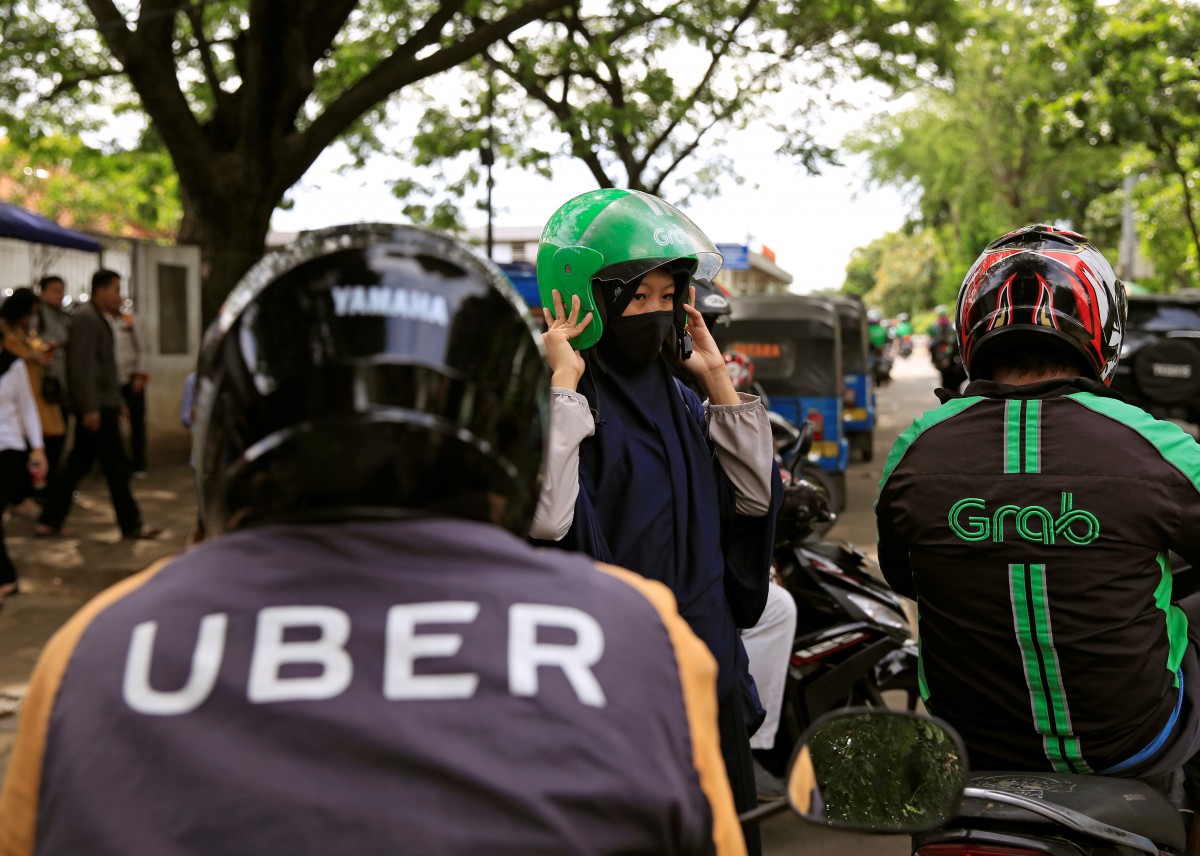
A passenger of Grab bike fixes her helmet next to Uber driver at Manggarai train station in Jakarta, Indonesia, March 26, 2018. Source: Reuters/Beawiharta

What’s going to happen to your Uber account?

As a rider, getting a five-star rating on Uber is such an immensely gratifying achievement. What’s going to happen now that the ride-sharing giants are merging?

Your account will still be active, so your five-star rating is not going to just disappear into the virtual abyss. But you can only use it in countries where Uber operates.

You will still be able to view your past trips and ratings in the Uber app, but data that you’ve previously shared with Uber (excluding payment information) will be transferred to Grab and it will not be visible in the Grab app.

If you don’t already have the Grab app, you will need to download it and register your account.

SEE ALSO: Here’s what ride-hailing app Grab thinks about rival Uber’s alleged spying

Will fares change?

No competition equals no competitive pricing? Grab says fret not.

Just like before, fares will continue to be calculated based on a base distance, with an applicable surcharge based on demand and supply, traffic conditions and estimated time taken for the journey.

For the GrabTaxi (Metered) and GrabTaxi (Executive) options, passengers will continue to pay by metered fares set by taxi companies. For Indonesian consumers, Go-Jek will continue to be a thorn in Grab’s side.

2017-12-19T043036Z_809951257_RC16DBD8DC80_RTRMADP_3_GRAB-CAMBODIA

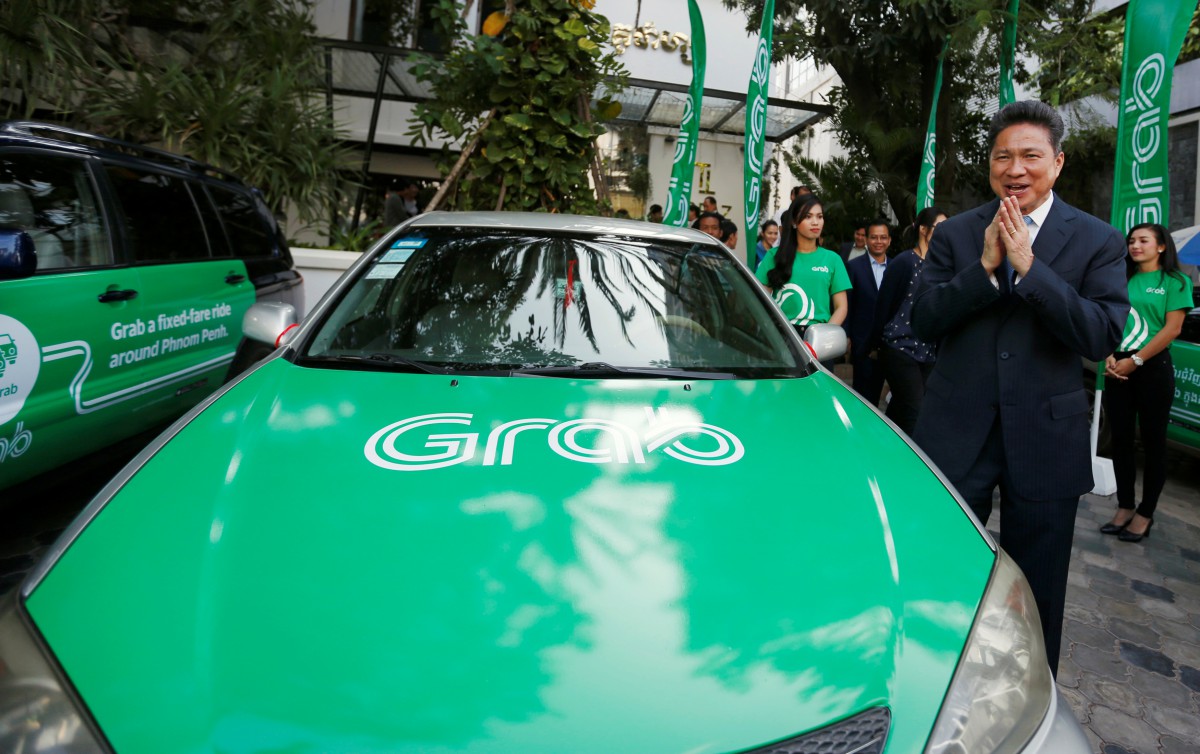
Sun Chanthol (R), Cambodia’s Minister of Public Workers and Transport, greets near a Grab car during a launch ceremony in Phnom Penh, Cambodia, December 19, 2017. Source: Reuters/Samrang Pring

Does this mean faster booking?

The assumption is that the Uber and Grab merger will result in more drivers on the road and therefore, shorter waiting times and faster bookings. And that is the dream.

However, as the companies are going through a transitional period, so will the drivers. Grab will need to get Uber drivers on board the Grab platform and also iron out the kinks.

As a rider, expect some service disruptions during the transition timeframe. But all will be well once the trial and error period is over, and you should be able to enjoy a faster booking experience.

What about UberEats?

Did you just start loving Uber’s food delivery app and how you can literally have food delivered right to your doorstep at work? Unfortunately, UberEats will cease to exist in Southeast Asia in May.

In its place will be a new food delivery platform, GrabFood. GrabFood already exists in Indonesia and Thailand but an expansion to Singapore and Malaysia, and other major countries in Southeast Asia, is currently underway.

All your favourite restaurants on UberEats will be available in the new GrabFood app and the prices are expected to remain the same as before. To use the service, you will have to sign up with a fresh account and profile on GrabFood.

SEE ALSO: Uber’s stalling in Asia is its own fault

2018-03-26T021744Z_1867450296_RC1F56913490_RTRMADP_3_UBER-GRAB

The Uber logo is seen on a screen in Singapore August 4, 2017. Source: Reuters/Thomas White

I’m an Uber for Business user. What gives?

Just like Uber’s service in Southeast Asia, the Uber for Business service will no longer be supported for trips taken in Southeast Asia.

Uber for Business lets companies set up corporate accounts through which employees can charge their rides directly to their employers. If you’ve been using Uber for Business, it’s best to start looking for alternatives if you need to be shuttled about in Southeast Asia for work.

The Uber app will continue to operate for two weeks to ensure stability for Uber drivers. As of April 8, 2018, Uber’s services in Southeast Asia will be unavailable.

A version of this article was originally published on our sister website Travel Wire Asia

Source link

Singapore revokes work permits for North Koreans

0


SINGAPORE’S government has repealed the work permits of all North Korean nationals in the country, in line with the latest United Nations sanctions against Pyongyang.

“Singapore has revoked the work passes of all nationals of the Democratic People’s Republic of Korea (DPRK) earning income in Singapore and will not grant new work passes to nationals of the Democratic People’s Republic of Korea,” said a statement from the Singaporean government to the UN Security Council’s sanctions panel last week.

The DPRK is the official name of North Korea. “There are therefore no nationals of the Democratic People’s Republic of Korea with work passes in Singapore,” it added.

Like other Southeast Asian nations, Singapore has previously enjoyed good relations with North Korea, however Pyongyang’s nuclear weapons programme and UN sanctions in recent years have put ties under strain.

SEE ALSO: Cambodia, North Korea the most corrupt Asia Pacific states

Singapore said earlier this month that it was investigating two local companies accused of supplying luxury goods to North Korea in violation of UN sanctions. Citing a leaked draft of a UN report, British broadcaster BBC said the two firms were OCN and T-Specialist, sister companies that share the same director. The companies have denied any wrongdoing.

“The Singapore authorities are aware of these cases and we are in correspondence with the UN Panel on them,” Singapore’s foreign affairs ministry said in a statement.

“In respect of the two companies mentioned in the BBC report – OCN and T-Specialist – our authorities have commenced investigations into these companies. However, we are unable to provide additional details as investigations are ongoing.”

Under UN sanctions, it has been illegal to sell luxury items to North Korea since 2006. Singapore suspended all commercial trade with Pyongyang in November 2017.

Additional reporting from Reuters.

1522125031

{“total”:5,”error”:””,”buffer”:1,”stumbleupon”:0,”facebook_total”:3,”pinterest”:0,”twitter”:1,”vk”:0}

188851

Source link