Home Blog Page 1074

ICA officers seize more than 13,000 cartons of duty-unpaid cigarettes

0

SINGAPORE: Immigration and Checkpoints Authority (ICA) officers have seized more than 13,000 cartons ​​​​​​​of cigarettes at two locations that were concealed in a container and hidden compartments on a bus. 

The total duty on the hauls amounted to more than S$1.4 million.

According to a news release on Wednesday (Mar 28), the first seizure took place at Pasir Panjang Scanning Station on Sunday at about 8.30am after an officer noticed anomalies in the scanned images of a container that was declared to contain 1,600 pairs of safety shoes in 18 pallets. 

After directing the 20-footer container for inspection, the officer discovered 10,800 cartons of duty-unpaid cigarettes. The total duty and Goods and Services Tax (GST) evaded was about S$1.12 million and S$81,410, respectively.

(na)ICA seized cigarettes on Mar 26

Duty-unpaid cigarettes uncovered at Tuas Checkpoint on Mar 26. (Photo: ICA)

The second seizure took place on Sunday at about 2.50pm after a Singapore-registered bus driven by a 57-year-old Singaporean man arrived at Tuas Checkpoint. 

ICA officers discovered 2,999 cartons of duty-unpaid cigarettes from “modified compartments” placed within the staircase and floorboard of the bus. The total duty and GST evaded amounted to about S$294,540 and S$21,410, respectively. 

All cigarettes, as well as the 57-year-old driver, have been handed over to Singapore Customs for further investigations.

The vehicle used in such offences is liable to be forfeited. 

Source link

Airports in Russia, Brazil operated by Changi Airports International win awards

0

SINGAPORE: Three airports in Russia and one in Brazil that are all operated by Changi Airports International (CAI) have clinched top aviation awards, the company announced on Wednesday (Mar 28). 

Russia’s Sochi International Airport took the prize of Best Airport by Size and Region for airports in Europe, among those that handle five million to 15 million passengers per annum. 

It was also voted Best Airport in Europe among those that handle more than two million passengers per annum, at the Airports Council International’s Airport Service Quality Awards. 

The awards are based on ratings by passengers based on 34 indicators, including airport access, check-in service, facilities and environment. More than 600,000 passengers from 84 countries had participated in the survey.

“Sochi International has rapidly grown its passenger traffic following CAI’s acquisition,” said CAI in a news release. “Since then, the airport has welcomed guests of major international events including the annual F1 Grand Prix and International Investment Forum. It will do so again for the upcoming FIFA World Cup 2018.”

CAI, a wholly-owned subsidiary of Changi Airport Group, also operates Singapore’s Changi Airport.

Meanwhile, Anapa International Airport was named Russia’s Best Regional Airport for the fourth consecutive year at the National Airport Infrastructure Show and Civil Aviation. 

Vladivostok International Airport won the Routes Asia 2018 Marketing Award for airports with under four million passengers per annum.

The award recognises airports with outstanding marketing services by helping airlines with the launch of new routes or strengthening of existing services, among others. 

(na) Vladivostok International Airport

The exterior of Vladivostok International Airport. (Photo: Changi Airports International)

In Brazil, the Tom Jobim International Airport was awarded Best Airport Operational Efficiency and Most Punctual Airport in Latin America for the 10 million to 20 million passengers per annum category by air travel intelligence company OAG.

(na)Tom Jobim International Airport

Aerial view of the Tom Jobim International Airport in Brazil. (Photo: Changi Airports International)

CAI added that 86 per cent of departures at the airport took place “within 15 minutes” of stipulated departure times in 2017, an increase from 82.2 per cent in the previous year. It was also ranked sixth by UK’s air transport rating company Skytrax for Best Airport Staff Service.

Source link

SMRT increases amount of fare revenue used for maintenance

0

SMRT says that 60 cents out of every dollar collected in fares is being spent on maintenance.

An SMRT train leaves a station. (AFP photo/Alex Tan)

File photo of an SMRT train. (Photo: AFP/Roslan Rahman)

SINGAPORE: SMRT has increased the amount of fare revenue collected from passengers that it directs towards maintenance-related expenditure, said the company’s president and Group CEO Desmond Kuek in a press conference on Wednesday (Mar 28).

Last year, 50 cents of every fare dollar was used for maintenance, but this has gone up to 60 cents in 2018.

“This is the kind of level we are seeing as we ramp up towards even higher reliability, and of course we have to work with all our partners and stakeholders to make sure that this is sustainable going forward,” said Mr Kuek. 

“I think more than 60 per cent is already very, very high in terms of the proportion of the amount of revenue that we are able to generate that goes into maintenance-related expenditures,” he added. 

Mr Kuek also said that the portion of fare income used for maintenance is not expected to go higher. 

“We don’t expect that this can go to 100 per cent, it will not be a sustainable way for us to manage so we will have to find the right balance,” he said. 

To get more out of each fare dollar, Mr Kuek said that the company will explore productivity extraction in the future, but remains focused on its operational and maintenance regimes for now amid a 68 per cent drop in profit last year

Source link

NTUC FairPrice overhauls online shopping platforms

0

SINGAPORE: Supermarket chain NTUC FairPrice on Wednesday (Mar 28) officially launched its revamped e-commerce platforms, which have been renamed FairPrice On.

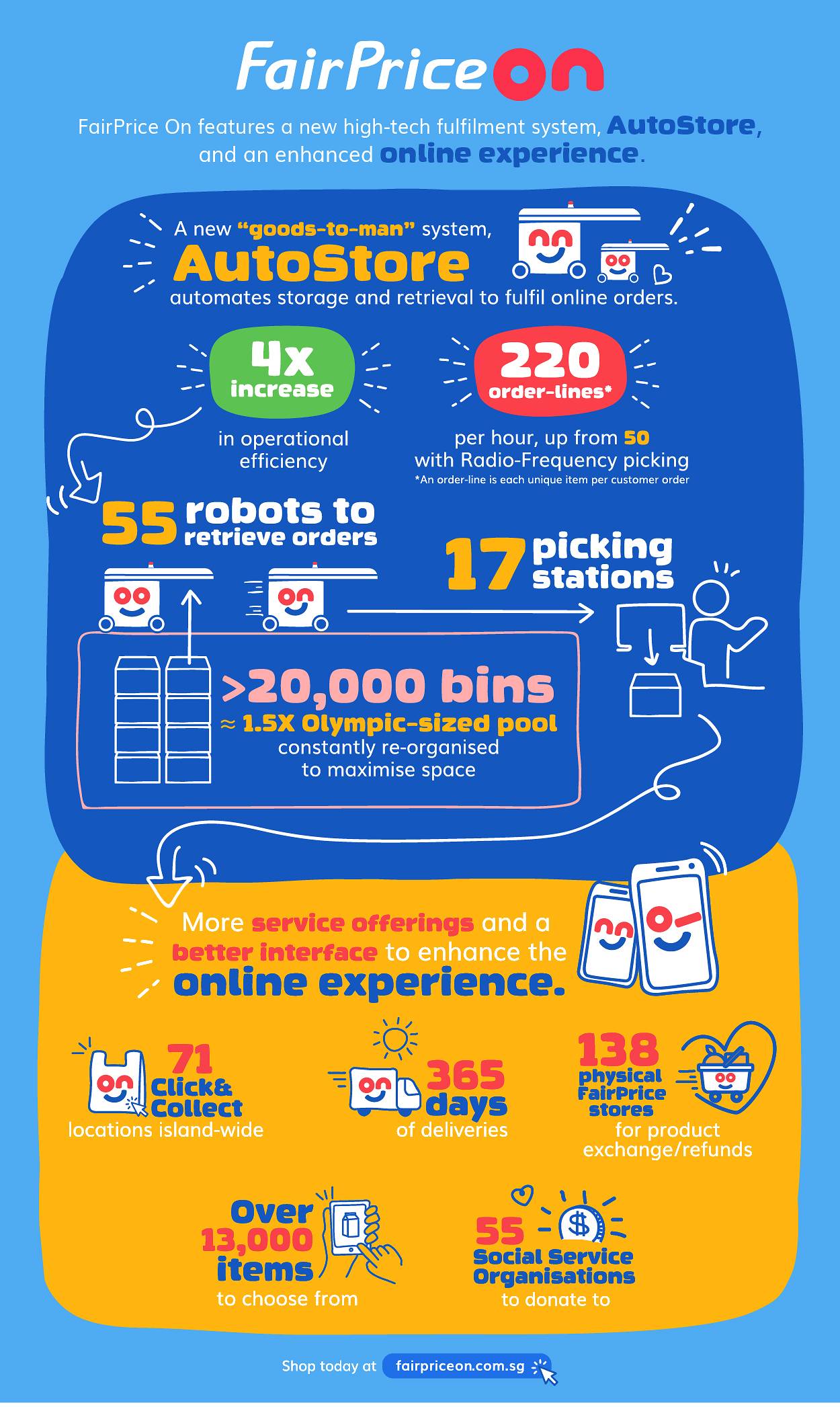
Its new automated storage and retrieval system will also make it much more efficient to fill orders, FairPrice said in a press release.

The new FairPrice On mobile app and its website have been streamlined to make shopping faster and easier for shoppers, and will utilise data analytics to send targeted promotions based on consumers’ profile, interests and consumption habits, the grocery chain said.

It currently offers more than 13,000 products and has more than 400,000 subscribers, it added. There is a delivery fee unless customers hit a minimum purchase amount or sign up for SCORE, a subscription programme NTUC launched with Grab last week.

Robots will be helping to fill the orders at AutoStore, an automated storage and retrieval system located at FairPrice Hub in Joo Koon.

FairPrice said AutoStore is able to handle up to 3,000 orders per day and is four times faster than its old method of retrieving products manually.

“This system is like a huge vending machine that is able to automatically store and dispense thousands of products,” said NTUC FairPrice CEO Seah Kian Peng. “We are able to pick up to 220 products per hour, compared to about 50 products per hour via the traditional picking method.”

NTUC FairPrice On launch

An employee at one of the picking stations where goods are packed for delivery. (Photo: NTUC FairPrice)

GIVING BACK TO THE COMMUNITY

FairPrice On also offers subscribers the option of donating to the less fortunate. Through a partnership with the National Council of Social Service, FairPrice On subscribers are able to choose from a list of 55 Social Service Organisations, such as Thye Hua Kwan Family Centres and Food from the Heart. 

Subscribers can then donate the required groceries directly to the beneficiaries. Delivery fees are waived for donated groceries, said FairPrice.

The launch was officiated by Mr Tharman Shanmugaratnam, Deputy Prime Minister and Coordinating Minister for Economic and Social Policies.

NTUC FairPrice On

(Graphic: NTUC FairPrice)

Source link

Showers and chilly weather of 23 degrees Celsius expected in Singapore

0

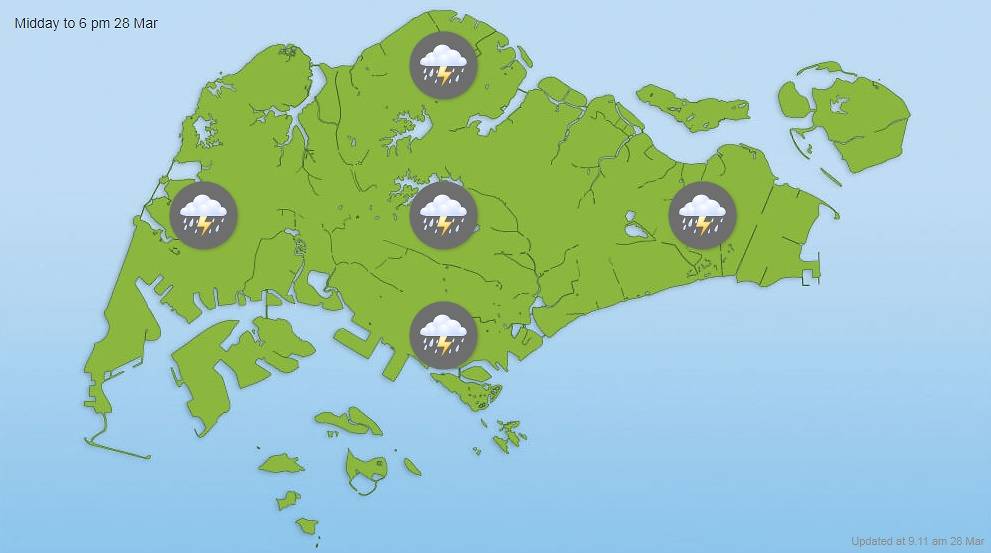
SINGAPORE: Temperatures could dip to as low as 23 degrees Celsius on Wednesday (Mar 28), following widespread rain that brought on chilly temperatures on Tuesday.

According to the Meteorological Service, residents can also expect thundery showers across the island in the afternoon and overcast skies in the evening. The maximum temperature is forecast to be 34 degrees Celsius.

In the early hours of Wednesday morning, the temperature fell to 23.1 degrees Celsius at Pulau Ubin.

Over the next four days, temperatures are also expected to fall to 23 or 24 degrees Celsius, with thundery showers expected mainly in the afternoon.

Weather Met Service Mar 28

(Graphic: Meteorological Service Singapore)

In its latest weather outlook, the Met Service had said the prevailing northeast monsoon is expected to continue until the end of the month.

Despite warmer temperatures, one or two episodes of monsoon surge can be expected in March, bringing a few days of cooler temperatures and occasionally windy conditions with passing showers to Singapore, it added.

In January, Singapore experienced its longest cool spell in the last 10 years, with daily minimum temperatures dipping to as low as 21.2 degrees Celsius.

Source link

SIA’s new Boeing 787-10 Dreamliner features revamped seats in economy class

0

The airline is investing S$458 million (US$350 million) in the introduction of the new cabin products for the first 20 aircraft.

(na)Economy class seats in SIA's Boeing 787-10

Economy Class seats in Singapore Airline’s new Boeing 787-10 Dreamliner. (Photo: Singapore Airlines)

SINGAPORE: Economy Class passengers on board Singapore Airline’s (SIA) latest aircraft will get to enjoy “ergonomically-designed” contour backrests with “six-way adjustable” headrests, said the national carrier on Wednesday (Mar 26). 

Following the arrival of its first Boeing 787-10 Dreamliner in Singapore, SIA issued a media release saying that it is investing S$458 million (US$350 million) in the introduction of the new cabin products for the first 20 aircraft. The airline has a firm order of 49 units for this type of aircraft. 

“The new products were the result of a series of consultations with customers, and from working closely with our seat designers and manufacturers,” said SIA CEO Goh Choon Phong. “We are confident that the new regional cabin products, with full-flat beds in Business Class and the many new features in Economy Class, will offer our customers a more comfortable in-flight experience even on the shortest flights.”

The new Boeing 787-10 features a total of 337 seats, with 36 in business class and 301 in economy class, SIA said. 

Economy class seats are arranged in a 3-3-3 configuration. Each seat comes with a headrest that has “foldable wings” to provide enhanced neck support. Monitors for Economy Class passengers each measures at 11.6 inches. 

Meanwhile, passengers on board business class will get to relax on 76-inch fully-flat beds and have direct aisle access. 

(na)Inside Singapore Airlines's Boeing 787-10 Dreamliner

Singapore Airline’s Boeing 787-10 Dreamliner features Business Class seats that can recline into a fully-flat bed. (Photo: Singapore Airlines)

Each business class seat measures 26 inches in width and comes with retractable armrests. Centre seats come with adjustable dividers to provide passengers with a “customised level of privacy” and an 18-inch touchscreen monitor powered by Panasonic’s latest eX3 system. 

Other cabin products include a personalised in-flight entertainment experience via the “mKrisWorld” platform, which offers content recommendations based on preferences and browser history. The aircraft is also equipped with in-flight WiFi supported by Panasonic’s Global Communication Services and GSM phone services provided by Aeromobile. 

The new Dreamliner will be used for flights that take up to eight hours, with Osaka and Perth being the first two scheduled destinations from May. The aircraft will also fly on selected flights to Bangkok and Kuala Lumpur for crew training purposes. 

Source link

Researchers create anti-bacterial surface coating inspired by dragonflies

0

SINGAPORE: The wings of dragonflies and cicadas inspired a group of researchers from A*STAR’s Institute of Bioengineering and Nanotechnology (IBN) to invent an anti-bacterial nano-coating that could be used to disinfect frequently touched surfaces such as door handles, tables and lift buttons.

In a news release on Wednesday (Mar 28), A*STAR said that studies have shown that the wings of these insects are covered in tiny structures called nanopillars, making them look like a bed of nails. When bacteria come into contact with these surfaces, their cell membranes get ripped apart immediately and they are killed.

Inspired by these studies, a group of IBN scientists grew nanopilllars of zinc oxide, a compound known for its anti-bacterial and non-toxic properties. The zinc oxide nanopillars can kill a broad range of germs like E. coli and S. aureus that are commonly transmitted from surface contact, according to A*STAR. 

Their new research was recently published in the journal Small.

This technology will prove particularly useful in creating bacteria-free surfaces in places like hospitals and clinics, where sterilisation is important to help control the spread of infections, the agency said. 

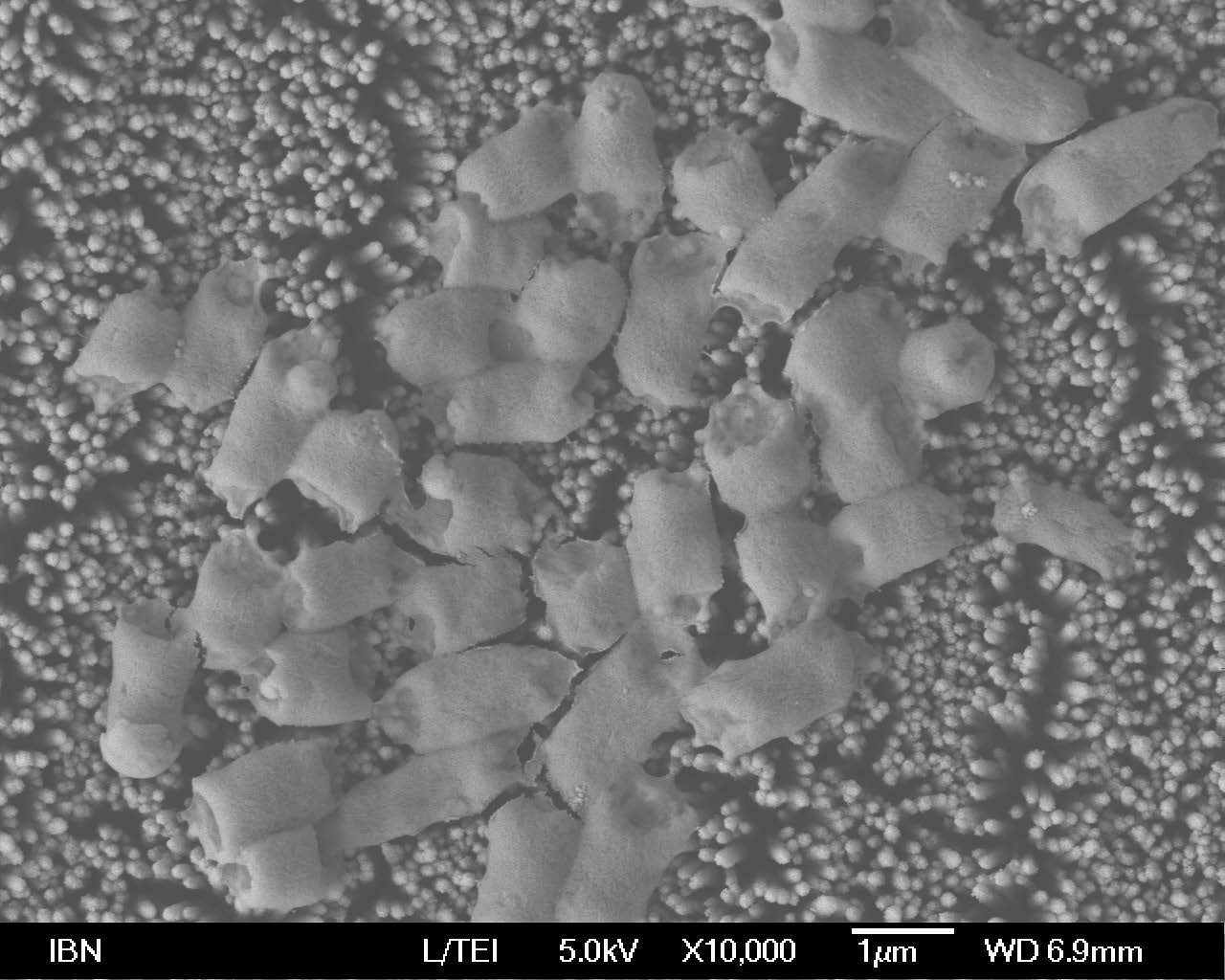
E. coli bacteria destroyed by the anti-bacterial coating made from zinc oxide nanopillars.

E. coli bacteria destroyed by the anti-bacterial coating made from zinc oxide nanopillars. (Photo: A*STAR)

A*STAR noted that 80 per cent of common infections are spread by hands, and said that while disinfecting commonly touched surfaces helps to reduce the spread of harmful germs in this way, it requires manual and repeated disinfection because germs grow rapidly.

Current disinfectants may also contain chemicals like triclosan which may lead to bacterial resistance and environmental contamination if used extensively, it stated in the media release. 

“There is an urgent need for a better way to disinfect surfaces without causing bacterial resistance or harm to the environment. This will help us to prevent the transmission of infectious diseases from contact with surfaces,” IBN executive director Jackie Ying said.

Tests on ceramic, glass, titanium and zinc surfaces showed that the coating effectively killed up to 99.9 per cent of germs found on the surfaces. 

“As the bacteria are killed mechanically rather than chemically, the use of the nano coating would not contribute to environmental pollution. Also, the bacteria will not be able to develop resistance as they are completely destroyed when their cell walls are pierced by the nanopillars upon contact,” A*STAR said in the media release. 

In addition, the nano-coating worked best when it was applied on zinc surfaces, according to the agency. On zinc surfaces, the zinc oxide nanopillars in the coating could kill even nearby bacteria that were not in direct contact with the surface.

The researchers studied the effect of placing a piece of zinc that had been coated with zinc oxide nanopillars into water containing E. coli. All the bacteria were killed, suggesting that this material could potentially be used for water purification, it added. 

The research team behind the invention is led by Dr Yugen Zhang. Dr Zhang said that the researchers hope to use the technology to create bacteria-free surfaces in a “safe, inexpensive and effective manner”, especially in places where germs tend to accumulate.

IBN has received a grant from the National Research Foundation to develop this coating technology, in collaboration with Tan Tock Seng Hospital, for commercial application over the next five years, according to the media release.

Source link

Relax and Refresh: Yoga with Sound

0

Relax and Refresh: Yoga with Sound
Saturday, July 14, 2018 at 12:15 PM

Yoga in Common

10 Petain Road, Singapore, Singapore

Source link

900,000 HDB households to receive S$126m in S&CC rebates

0

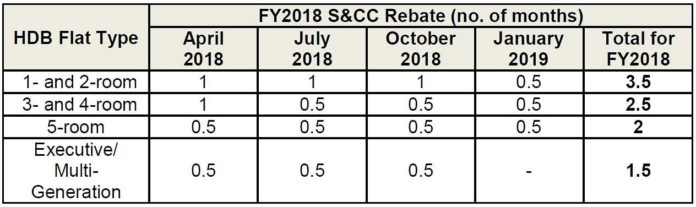
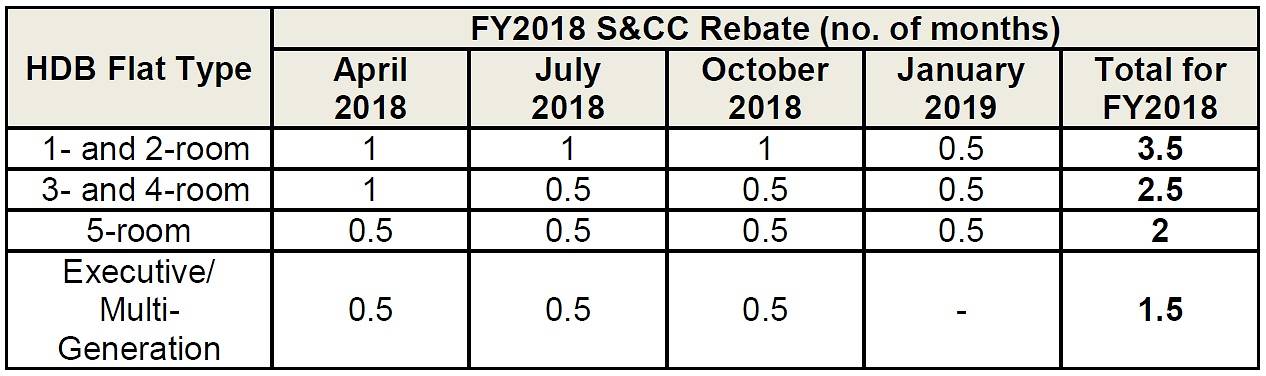
SINGAPORE: Around 900,000 Singaporean Housing and Development (HDB) households will receive S$126 million worth of Service and Conservancy Charges (S&CC) rebate from April to January next year.

In a news release on Wednesday (Mar 28), HDB said each eligible Singaporean household will receive 1.5 to 3.5 months of S&CC rebate in total, depending on their HDB flat type. 

Households will get a rebate every three months, with the first in April. They will also be getting them in July, October and January 2019.

Eligible households will receive a letter from end-March with more details of the S&CC rebate.

HDB rebates 2018 2019

(Table: Housing and Development Board)

The S&CC rebate was first announced during Finance Minister Heng Swee Keat’s Budget statement in February. 

In the last financial year, 880,000 households received S$120 million worth of rebates.

Source link

MOH urges parents to take measures to minimise spread of HFMD amid high numbers

0

SINGAPORE: With weekly Hand Foot Mouth Disease (HFMD) numbers hitting their highest level since June 2016, the Health Ministry (MOH) has “strongly urged” parents not to bring their children to school or any other crowded public places if their children are exhibiting symptoms.

Common symptoms include fever, mouth ulcers and rashes on the palms, soles or buttocks. The ministry’s advice comes in the midst of a rise in the number of HFMD cases since February this year.

According to a weekly notice on infectious diseases put up by MOH on its website, numbers peaked at 1105 cases in the week ending Mar 10. This was a 42 per cent increase from the week before, and a 65 per cent increase from two weeks prior.

Since that peak, the number dropped 14 per cent to 946 in the latest recorded period of Mar 11 to Mar 17. The last time the weekly figures peaked was in 2016, when numbers hit as high as 1344 in May, before falling to 1034 the following month.

The number of HFMD cases reported to MOH fluctuates from year to year and throughout the year, an MOH spokesperson told Channel NewsAsia. 

Overall figures, however, may be on the downward trend. There were more than 42,000 cases in 2016, a 20 per cent drop from the 34,000 recorded last year in preliminary figures.

HFMD is a viral infection which can affect both adults and children, but children below five years old are more susceptible. In Singapore, 90 per cent of children have had HFMD infection by 12 years of age, MOH said. The common viral infection is generally mild and self-limiting, the spokesperson added.

As children without symptoms can also be infectious, transmission commonly occurs in the community and in areas like playgrounds, malls and schools, she said.

Children infected with HFMD should avoid contact with other children, and articles contaminated by oral or nasal fluids from infected children should be disinfected, MOH said.

COMMUNICATION TO PARENTS KEY

While MOH encourages responsibility on the part of parents, civil servant Steven Chung believes communication to parents by schools is key in helping to prevent the spread of the virus.

In his case, the school attended by his sons, aged three and five, did not inform him of a case of HFMD in February. Instead, he heard from another parent. He then checked with the principal and found out that the child had contracted the disease, recovered and was back in school.

“The next thing we knew, the virus had spread and several other kids from the school also contracted HFMD,” he said.

Despite temporarily withdrawing his children, his younger son was diagnosed with HFMD.

HFMD graphic

He added that he understands it is not possible to eradicate HFMD at pre-schools. According to a circular seen by Channel NewsAsia, the centre in Kovan was closed for two days this month for disinfection to “break the chain of infection”.

The school did not respond to queries from Channel NewsAsia.

MEASURES TO CONTAIN SPREAD OF HFMD

My First Skool in Fernvale Link, which is on MOH’s list of childcare centres with active clusters of prolonged transmission of HFMD, said that it complies with MOH’s standard precautions and is working with parents to manage the outbreak.

At EtonHouse, which has had eight cases across 15 campuses, a strict sanitising protocol is part of its documented policy for before and in the case of an outbreak. Its centres are not on the MOH list.

When there is an outbreak, the HFMD protocol is initiated. Children are checked throughout the day for symptoms, including fever, a spokesperson said. 

“All sensory play and community experiences are suspended. The timetable is altered to minimise contact between the rest of the school and the group that is potentially at risk,” she added, 

She said that thorough santisation of resources, furniture and play equipment is done on a daily basis along with cold fogging. The affected class is kept quarantined for 10 days, she said.

She also stressed the role of parents in preventing the spread of infection.

“Reinforcing good hygiene practice at home also goes a long way in minimising the spread. The child should be sent to school only when the doctor certifies that it is ok to do so. It is also recommended that the child has no social contact outside of school during the contagious period,” she said.

Source link