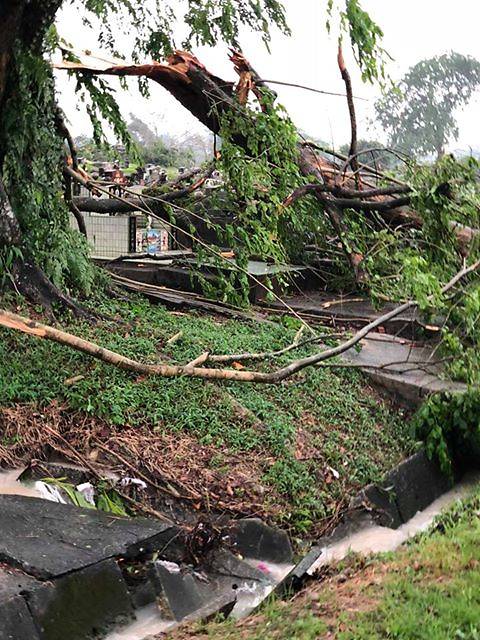
SINGAPORE: Incidents of fallen trees caused bus diversions in various parts of western Singapore and led to reports of traffic jams as heavy rain and strong winds hit the country on Friday (Mar 30).
Bus services were diverted due to fallen trees at locations including Bukit Batok Road and Choa Chu Kang Avenue 1, according to notifications from the SMRTConnect app.
Multiple fallen trees were also seen at a cemetery in Lim Chu Kang, with photos showing tombs covered by trees and a tree obstructing the road.
Forty-year-old Kelvin Koh, who works in logistics, told Channel NewsAsia that the area experienced “heavy rain and very strong winds” at about 3.50pm.
A fallen tree covering a tomb at the cemetery in Lim Chu Kang. (Photo: Kelvin Koh)
A fallen tree obstructing a road near the cemetery in Lim Chu Kang (Photo: Kelvin Koh)
Operations manager Kenny Koh, 31, told Channel NewsAsia he saw a fallen tree blocking both lanes on Murai Farmway in Lim Chu Kang at around 4.40pm.
A fallen tree blocked the road at Murai Farmway. (Photo: Kenny Koh)
Channel NewsAsia reader Zulkarnian reported traffic congestion at Bukit Batok Road towards Choa Chu Kang Way after a fallen tree obstructed two lanes of the three-lane road.
Video of the incident showed officers directing traffic and an ambulance at the scene.
The Land Transport Authority also warned motorists of obstacles in the area.
In a tweet at about 4.15pm, the authority warned of an obstacle on Old Choa Chu Kang Road towards Jalan Berseri after Choa Chu Kang Road, and added that Old Choa Chu Kang Road was closed after Choa Chu Kang Road.
In another tweet at about 4.30pm, the authority also warned of an obstacle on Bukit Batok Road towards Choa Chu Kang Road, after Pavilion Circle, and told motorists to avoid the right lane.
Obstacle on Bukit Batok Road (towards Choa Chu Kang Road) after Pavilion Circle. Avoid right lane
According to the National Environment Agency’s heavy rain alert, moderate to heavy thundery showers were expected over many areas of Singapore between 3.50pm and 5.10pm on Friday.
It also warned that flash floods may occur in the event of heavy rain.
SINGAPORE: Efforts to preserve the platform canopy of the former Tanjong Pagar Railway Station are underway, and it will look as good as new when it is integrated with part of Cantonment MRT station – one of the three remaining stations to be built on the Circle Line.
The Land Transport Authority’s (LTA) preservation effort involved cutting 580m of the platform into 63 equal segments and transporting them to a former stabling yard for the old railway just 500m away.
Physically moving them away protects the platform canopy from the digging and construction works required for the underground Circle Line and Cantonment MRT station.
About 580m of the platform were moved to this old stabling yard for cleaning and restoration. (Photo: Gwyneth Teo)
Special care was taken with the ornamental fascia fins, an iconic part of the platform’s design.
Fins at the corners of the segmented platform were removed in order to prevent them from weakening and falling during transportation.
Re-location of the canopy was completed last November.
A removed ornamental fascia fin, labelled and recorded to facilitate replacement. (Photo: Gwyneth Teo)
When Cantonment MRT station is completed in 2025, the platform segments of the old railway station will be reinstated. Part of the platform will be integrated with a future MRT entrance along Keppel Road.
During a tour of the preservation efforts on Thursday (Mar 29) morning, LTA’s Deputy Director of Rail Expansion, Mr Lim Kian Peng, explained that the next phase for the old platform is the restoration process.
This involves cleaning away the surface grime and stains with a high-pressure water jet and treating the plaster chemically to restore the original look of the building.
It will take place over the next five years, as trials for cleaning and treatment have only just begun.
When the restoration is completed, the platform will look as it did when the railway station was first built 86 years ago in 1932.
The contract for the entire relocation, restoration and reinstatement of the old railway platform was awarded at S$33.5 million and is scheduled to take eight years.
Other elements of the old platform that will be preserved include the Shanghai plaster on the columns and beams, a feature of the Art Deco period, as well as the colonial-era cast iron rainwater pipes.
The railway station was the southern terminus of Malaysian rail operator Keretapi Tanah Melayu, or KTM.
The first 80m of each platform and the main building with its iconic frontispiece were gazetted as a national monument in April 2011, and will not be part of Cantonment MRT station.
Cleaning and treatment being tested on a segment of the platform canopy before it will be applied to the rest. (Photo: Gwyneth Teo)
Cleaning will be conducted in situ for the gazetted part of the platform to restore it to its original condition. The Singapore Land Authority will also be refurbishing the main passenger lobby of the old terminus.
SINGAPORE: World Bipolar Day falls on Mar 30 each year – the birthday of Vincent Van Gogh.
A Dutch painter in the 1800s and one of the most famous and influential figures in the history of Western art, Van Gogh suffered from several mental breakdowns in his life.
He often neglected his physical health.
His friendship with a close friend and fellow painter, Paul Gauguin ended after a purported mental episode in which Van Gogh severed part of his own left ear and offered it to a prostitute.
As a result of his mental breakdowns, he spent extended periods of time in several psychiatric hospitals in the last few years of his life. After his last discharge, he moved to a place near Paris.
But his depression persisted and on Jul 27, 1890, Van Gogh shot himself in the chest with a revolver. He died from his injuries two days later.
Although it is difficult to say with certainty, Van Gogh may have well suffered from bipolar disorder. He had episodes of extreme elevated moods and episodes of severe depression.
It is not an uncommon illness. In a Singapore Mental Health Study conducted in 2010, we found that 1.2 per cent of Singaporeans suffered from this condition in their lifetime.
A visitor looking at the painting “Olive Trees” (Saint-Remy, June/July 1889) by Dutch artist Vincent van Gogh at the Kunstmuseum in Basel, Switzerland. (Photo: NICHOLAS RATZENBOECK/AFP)
INVINCIBLE AND POWERFUL, THEN DEPRESSIVE AND WITHDRAWN
Bipolar disorder is a very complex illness. Like many mental disorders, there are no obvious external signs. Rather, a person is susceptible to episodes of extreme moods.
They could have periods of extreme euphoria. During these episodes, they may feel invincible and powerful. They may feel rich or have the belief that they have special powers.
Sufferers have grandiose ideas or may perform irrational acts such as starting up several companies or buying 10 bedframes to give away.
During this state of extreme euphoria, they may also experience other symptoms including feeling like they have unlimited energy, their mind racing from idea to idea, or feel that they don’t need sleep. In milder cases, they may have spells of extreme creativity or productivity.
Then the pendulum swings, giving way to depressive episodes. Those who suffer from bipolar disorder would be thrown into extremely low moods. Many become socially withdrawn and in severe cases, feel keenly that life is not worth living.
(Photo: Pixabay/whoismargot)
Studies have shown that even between episodes, those who suffer from the illness have a greater degree of mood swings compared to the general population. Understandably, this paints a rather grim prognosis for anyone with the illness.
Stigma, dealing with the day-to-day challenges of a chronic illness, caregiver burden, its effects on the various facets of a person’s life (including career and family), all make it difficult to live with the illness.
LIVING WITH THE ILLNESS, FEELING LIFE MORE DEEPLY
However, while it is a complex illness, those who suffer from it should not feel like they have to go through it alone in the same way Van Gogh did.
Indeed, World Bipolar Day is not meant to be a day of grimness and negativity but a celebration of uniqueness and strength.
Author and psychologist Kay Redfield Jamison wrote in her autobiography An Unquiet Mind about her struggles living with the illness and how difficult it was to accept that she needed medication. However, she ended with a rhetorical question. If given a choice, would she still choose to have the illness?
She said that she would not if she had not received treatment. But with medication, her answer was different. She said the illness had enabled her to feel things more deeply, to experience both life and death intimately, and to experience loyalty and care.
Screengrab of YouTube video of author and psychologist Kay Redfield Jamison.
Although her autobiography was written in the 1980s, much of this still holds true today. There are more medication available to treat bipolar disorder today than in the 1980s. While they do not offer a cure, the medication help stabilise severe mood episodes.
OVERCOME THE STIGMA OF MEDICATION
A common fallacy is that once the mood episodes have been treated, medicines are no longer required.
However, it is recommended that such medication or mood stabilisers be taken on a regular basis. Doing so has been shown to help those who suffer from bipolar disorder manage mood swings in between episodes.
Many see medication as a reminder of their illness and a crutch. Some even see it as causing harm.
Indeed, many may feel like they need to stop their medication, in order to show they have recovered and can move on with life. It may be encouraged by friends and family.
There is also the fear that employers would discriminate against them if they learn about their illness and that it would render them uninsurable by healthcare insurance providers.
Yet, the goal of treatment is to enable a person to live a normal and full life, free from the severe mood episodes and mood swings. There is no reason why a person living with bipolar disorder should not be able to complete school, find a job, advance in their career and find love.
(Photo: Pixabay/Daniel Reche)
A CELEBRATION OF THE HUMAN SPIRIT
Today, beyond medication, there are resources and support groups available to help the person on their journey.
Specific therapies have been shown to help a person remain stable and well. Support groups and online information are available to help both the sufferer and caregivers learn to cope with such an illness.
Kay Redfield Jamison eventually became a professor of psychiatry at the John Hopkins University School of Medicine.
Many famous and successful people similarly struggled with and overcame bipolar disorder to achieve success in their fields.
Among them count Winston Churchill, the British prime minister during World War II, Carrie Fisher who starred as Princess Leia in Star Wars and famed singers like Demi Lovato and Sinead O’Connor.
So let’s celebrate World Bipolar Day. It’s a celebration of how far we have come in the management of this illness.
It’s a celebration of every struggle that those who suffer the illness had to face and overcome.
It’s a celebration of those who fell down and picked themselves up again and ultimately, a celebration of the human spirit.
Dr Mok Yee Ming is senior consultant and chief of department of mood and anxiety at the Institute of Mental Health (IMH).
READ: Channel NewsAsia’s commentary series with IMH on mental health which includes:
SINGAPORE: On June 2004, the unthinkable happened – a good part of Singapore went dark that evening in one of the largest ever blackouts here.
It resulted in some 300,000 homes left in the dark without electricity for two hours, costing businesses as much as S$6 million in losses.
The power outage – caused by a disruption to the natural gas supply from Indonesia – was an important wake-up call for Singapore.
Fast forward to today, and a behemoth is rising on Jurong Island that is the latest in the chain of developments since that fateful day.
Singapore’s fourth Liquefied Natural Gas (LNG) storage tank, when completed this year, will be one of the world’s largest – and a symbol of efforts to ensure the country’s energy supply would never again be so vulnerable.
“Imagine if we experience frequent or prolonged disruption to our import energy supply disruption,” said Mr Soh Sai Bor, the assistant chief executive of the Energy Market Authority’s (EMA) economic regulation department.
“The consequence will be that our lights may not turn on or stay on for long, and our economic activities will grind to a halt.”
More than 90 per cent of Singapore’s electricity is generated by natural gas largely imported from Indonesia and Malaysia.
Since then, the nation has been investing heavily on importing and storing LNG – which is natural gas in its liquid form – to safeguard its future energy needs, as the programme Powering the Future finds out. (Watch it here.)
MORE COST EFFICIENT
Why natural gas in the first place? While there are other energy resources such as coal and oil that Singapore can tap, natural gas is far cleaner and more energy efficient by mass, said Associate Professor Praveen Linga from the Department of Chemical and Biomolecular Engineering at the National University of Singapore.
Natural gas-based power plants emit “40 to 50 per cent less carbon dioxide” compared to coal as a fuel. Hence “it is also called the cleanest burning fossil fuel”, he said.
Currently, some 77 per cent of Singapore’s natural gas supply is delivered in gas form, via pipelines from Malaysia and Indonesia.
But when this gas is condensed into a liquid form or LNG, the volume can be reduced by as much as 600 times. This makes it far more cost-efficient to transport over long distances by ships.
In 2006, Singapore decided that LNG was the way to go, and decided to build its first LNG Terminal on Jurong Island.
Indeed, today, a quarter of the country’s natural gas supply comes in LNG form, from a diversified range of sources – such as Australia, the US and Qatar.
A key strategy to enhance our energy security is to diversify our energy resources.
“With our LNG Terminal, we are able to import LNG from all over the world, compared with piped natural gas where we are just importing from Indonesia and Malaysia,” said Mr Soh,
Developed by the Singapore LNG Corporation, the S$1.7 billion LNG Terminal was finally launched in 2013.
It started off with two storage tanks that year, with a third tank the following year to increase its total output. The three tanks can store some 540,000 cubic metres of LNG.
But the fourth tank, currently under construction, will have an impressive capacity of 260,000 cubic metres alone.
Singapore LNG Corporation’s CEO Mr John Ng said: “Having the tank means that we are able to store energy for when demand picks up.”
A LNG TRADING HUB
The nation has grand plans to become a key trading hub for LNG in the region, given that the global demand for energy is set to soar because of population and economic growth.
The Asian economies will be the biggest driver of demand, with China set to be the biggest importer of natural gas by 2018. And Singapore is poised to make the right connections in LNG trade.
With the LNG terminal, traders can import large quantities of LNG, break it up into small pieces and sell it to regional countries, Mr Ng noted. Singapore’s geographical position makes it ideal to supply small-scale LNG to islands in Indonesia and Philippines.
Mr Satvinder Singh, assistant CEO of IE Singapore, pointed out that Singapore is one of the largest commodity hubs in the world and “it’s not unnatural for us to also aspire to be relevant to the energy development in Asia and for the rest of the world”.
It is located among some of the biggest consumers of LNG – Japan, India, Korea and China – and it is a significant global financing hub for commodities and is able to finance sophisticated financing to support such flows, he added.
CHEAPER ELECTRICITY FOR CONSUMERS
For consumers, the extra sources of natural gas and a more competitive market for LNG could potentially translate to cost savings and lower electricity bills.
But most commentators expect that in the longer term, there would be a downward pressure on natural gas prices in Singapore, given a predicted increase in LNG supply over the next few years, said Mr Howson.
Japan’s leading trading house, Mitsubishi Corp, had projected that the world’s LNG market would grow 5 per cent year-on-year from 2017, almost doubling by year 2030 from 2017.
Mr Ng added that LNG could become a more liquid commodity here, as a result of more traders importing it from all over the world.
“When there’s an opportunity for bringing the cargo (LNG) in at a relatively cheap price, the traders can store in our tanks; and when the market is ripe, reload the energy out into the open market,” he said.
That will translate into competitive prices of energy coming into Singapore.
Consumers can also find savings in another way – come April 1, households and businesses in Jurong will have the option of buying electricity from a retailer under the Open Electricity Market initiative.
Since 2001, the EMA has been progressively opening up the electricity market by giving consumers the choice and flexibility to buy electricity from retailers.
This means that consumers will in future no longer be restricted to buying from SP Group at the regulated tariff.
“Consumers if they wish, can also shop around and buy electricity from their preferred retailers based on price plans that best meet their needs,” said Mr Soh.
SINGAPORE: The final Select Committee hearing on deliberate online falsehoods ended on Thursday (Mar 29), with Deputy Speaker and the committee’s chairman Charles Chong describing it as having “extensive involvement and robust engagement” in his closing remarks.
Over eight days in the past three weeks, 65 individuals and organisations from diverse backgrounds appeared before the 10-member parliamentary committee to present their views. The participants included representatives from media companies and technology firms, members of civil society groups, local and overseas academics, as well as students.
The committee received a total of 170 written representations.
The longest session occurred on Tuesday, stretching from 10am to nearly 10pm, with the hearing dominated by a debate between panellists and the representatives of non-mainstream media and local rights groups. But the longest segment occurred on the final day, with Home Affairs and Law Minister K Shanmugam crossing swords with historian Thum Ping Tjin.
There were several tense exchanges, and the discussions threw up a wide spectrum of views on the phenomenon of online falsehoods, how technology has worsened the problem, how Singaporeans are affected and how it should be tackled.
NEW LAWS: YES OR NO?
One issue that drew the most divergent views was whether new legislation is needed to combat fake news.
Those that disagreed argued that current laws are sufficient, while some expressed concern that any introduction of new legislation could curtail freedom of speech. These included local and foreign academics; tech giants Facebook, Google and Twitter; local rights groups and non-mainstream media representatives.
UK defence and disinformation analyst Ben Nimmo, for instance, said that legislation should be the “very last resort” while Hong Kong-based media studies professor Cherian George cautioned that introducing an anti-disinformation law against racial and religious insult could backfire.
Others, like Singapore Management University’s law professor Eugene Tan, took up positions toward the middle of the spectrum. Assoc Prof Tan called for a refresh and tweaking of the current legislative framework.
Some urged for targeted measures. Telcos Singtel and StarHub want more legislation to cover tech companies, while National University of Singapore’s Assistant Professor Mohamed Elmie Nekmat suggested laws to hold online content distributors accountable.
Sitting at the other end of the spectrum, NUS law professor Thio Li-ann said that a law regulating deliberate online falsehoods may be justified on the grounds of “public order”.
She added that not all forms of speech are equally worthy of protection. Given the harm that online untruths have on democratic institutions and processes, they belong to a category of speech that does not warrant protection, she argued. A law regulating such falsehoods should therefore not be seen as an incursion of free speech, she said.
SMU’s law school dean Goh Yihan pointed out gaps in the existing legislative framework, saying that they “run up against limitations of scope, speed and adaptability” when dealing with fake news. Assoc Prof Goh, however, stressed that legislation must be balanced with other solutions, such as education.
And such alternative suggestions, ranging from efforts to boost media literacy to the setting up of an independent body, were aplenty.
For instance, public policy analyst Gillian Koh mooted the idea of an independent body to monitor and flag online content related to elections in Singapore, specifically those designed by foreign actors.
There were calls (by researchers Carol Soon and Shawn Goh, and socio-political website The Online Citizen’s co-founder Andrew Loh) for independent bodies to advise on the type of online falsehoods to act against. Channel NewsAsia and Singapore Press Holdings also wanted an independent, transparent fact-checking “council, committee or body” to identify, assess and react to online falsehoods quickly.
Singapore’s news media giving oral evidence to the Select Committee on Deliberate Online Falsehoods on Mar 23, 2018. From left: Mediacorp’s Jaime Ho (Chief Editor, Digital News, Channel NewsAsia) and Walter Fernandez (Editor-in-chief); Singapore Press Holdings’ Mohamed Sa’at bin Abdul Rahman (Berita Harian Editor), Warren Fernandez (The Straits Times Editor) and Goh Sin Teck (Lianhe Zaobao and Lianhe Wanbao Editor) (Screengrab)
A trio of non-mainstream media journalists advocated for the Freedom of Information Act to allow Singaporeans to put in requests for Government data.
But despite the wide-ranging views, speakers agreed that deliberate online falsehoods are a threat that needs to be tackled.
Dr Mathew Mathews, a researcher on issues related to social cohesion, pointed out that online falsehoods, if left unchecked, have the potential to chip away, destabilise and ultimately destroy Singapore’s social harmony.
National security expert Shashi Jayakumar said that organised fake news and disinformation campaigns could already be influencing and undermining Singapore society, while Nanyang Technological University’s Asst Prof Michael Raska raised the scenario of how countries with inferior military could weaken Singapore by exploiting issues that cause tensions among groups.
But Dr Koh, while acknowledging the risks of falsehoods and agreeing that there is no purpose for them in a democracy, argued that citizens should be given “a process of deliberation” when it comes to content that are less clear-cut, such as opinion pieces “layered on some falsehoods”.
“You declare it is false, but people still need to be persuaded,” she said. “There will be citizens that will need to be convinced in their hearts and minds firstly that it is false.”
“LET ME FINISH”
Throughout the eight days, there were lengthy verbal sparring sessions that had moments of heightened tension.
Mr Shanmugam on Mar 22 crossed swords with Facebook executive Simon Milner. The discussion was supposed to include representatives from Twitter and Google but Mr Milner, who is Facebook’s Asia-Pacific vice-president of public policy, got the lion’s share of questioning given the revelations about the data breach involving Cambridge Analytica.
The three-hour to-and-fro, which Mr Milner described as a “tough Q&A”, saw the Facebook executive admitting that the social media giant should have informed its users earlier of the breach.
Home Affairs and Law Minister K Shanmugam and Facebook’s Asia-Pacific vice-president of public policy Simon Milner.
Another lengthy session took place on Tuesday when committee member Edwin Tong went head-to-head with Mr Terry Xu and Ms Kirsten Han, the current and former editors of TOC.
Exchanges over TOC’s articles about the suicide of 14-year-old Benjamin Lim and Ms Han’s references to a Human Rights Watch (HRW) report stretched the public hearing, which was at times interspersed with frequent utterances of “let me finish”, to a gruelling five hours.
But the longest hearing came on the final day when Mr Shanmugam grilled Dr Thum over the interpretation of historical events such as Operation Coldstore and the Hock Lee Bus riots.
The session, which lasted almost six hours, also saw both parties tussling over their perspectives on a wide variety of texts, including books from Lenin and Malayan Communist leader Chin Peng as well as Dr Thum’s own thesis and papers.
WHAT HAPPENS NEXT?
In his closing remarks, Mr Chong said that the wide-ranging evidence that the committee received “have given (it) much to think about”.
“We are grateful to everyone who has written to us and everyone who has given oral evidence,” said the committee chair.
Mr Chong added that when Parliament reconvenes after its mid-term break, the committee will meet again to “reflect on the evidence and work on the report”.
SINGAPORE: On Mar 20, Singapore Civil Defence Force (SCDF) personnel of Banyan Fire Station on Jurong Island were working out in the gym late in the day when they saw thick plumes of smoke rising from next-door Pulau Busing.
The officers did not wait for the alarm to ring. They dropped their weights and prepared their equipment, which included a “big gun” that shoots 23,000 litres of water a minute.
This gun, also known as a “large monitor”, is specifically stationed at Banyan due to the high risk of industrial fires on Jurong Island. Such large-scale fires cannot be fought with standard equipment.
Soon enough the emergency alarm was activated. It was a high-level code for an oil tank fire on Pulau Busing. The officers sprang into action, drove their big gun to Pasir Panjang Ferry Terminal and hopped on a speed boat.
When they reached Pulau Busing, what greeted them was “probably the biggest fire” that many SCDF firefighters have seen, said Colonel (COL) Alan Chow. The commander of the 1st SCDF Division, which covers Pulau Busing, was speaking to reporters during a media session on Thursday (Mar 29) where they recapped the events of that fateful day.
COL Alan Chow, commander, 1st SCDF Division. (Photo: Hani Amin)
It wasn’t just personnel from Banyan Fire Station who were deployed; their colleagues from Alexandra Fire Station on the mainland were activated as well. One of them, Sergeant (SGT) Muhammad Hud Ayub, 19, said he felt an “adrenaline rush”. He had seen conventional household fires, but this was a different monster.
“The first thing was to gather my cool, ready the equipment and take instructions from the senior officers,” the full-time national serviceman said. He was already sweating heavily under his hefty bunker gear, but “I needed to focus on my task”.
The task was challenging because of the logistics, COL Chow said, pointing out that the equipment had to be brought over on a barge.
“Offshore is definitely more challenging than onshore because of the time needed for transport,” he added. “Timing was very important because any delays meant the tank would continue burning for a longer period of time, which means tank failure will become even more imminent.”
That was not the only consideration. Officers first had to determine everyone was safe, then prevent the fire from spreading to two adjacent oil tanks. This was done by spraying water to lower their temperatures, which had risen to extreme levels.
Water, however, could not be used on the tank fire as it sinks in oil. This is where the big gun, which sprays a foam solution, comes in. The foam forms a layer on the oil that deprives the flames of oxygen.
SSG Mohamed Noor Abdul Kahar (left) demonstrating the setting up of equipment. (Photo: Hani Amin)
SCDF deployed two big guns, one of which was manned by Staff Sergeant (SSG) Mohamed Noor Abdul Kahar. It was his first time operating the gun during an actual operation. This was a huge responsibility because he had to ensure everything clicked, but he said he took it well.
“While there was adrenaline and apprehension, there was a clear plan that had emerged as well,” said Captain (CPT) Leon Yip, 26, one of the first responders. “This is very much within the scope of the training we have done.”
When operational, the big gun takes considerable effort to swivel. (Photo: Hani Amin)
The training also prepared the officers for the gruelling hours that followed. While SCDF had released photos of officers sprawled on the ground during water breaks, those involved said fatigue was the last thing on their minds.
“Even though we were resting, we were uneasy because the fire was blazing,” SGT Afiq Abdul Malik, 23, said. “We just had to see from afar and trust our men.”
Lieutenant Jerome Giam, 21, said it was a team effort. “We know that our guys inside the fire ground were exhausted, so we replenished our fluids and grabbed a bite before going back in to take over from them,” he added.
The fire was extinguished after six hours, in an operation that involved 128 personnel and 31 firefighting and support vehicles. After the flames were put out, SCDF personnel still had to stick around to empty the tank and prevent reignition.
The big gun comprises a pump system that draws water from an industrial ring main and pushes it to the gun. (Photo: Hani Amin)
SSG Noor was one of those who stayed on the island for more than 12 hours. Like the rest he had not had dinner, but “nobody thought about dinner”. He got home only in the afternoon the next day, hours after he was supposed to end his shift.
CPT Yip said that he was flooded with text messages from those who knew. He also texted his family, and they replied: “Stay safe.” “My family has accepted that this is an inherent risk of the job,” he said. “They also trust the force.”
There’s more than trust. Those involved also drew praise from netizens, Home Affairs Minister K Shanmugam and even the Prime Minister himself. How does that make them feel?
One roll of industrial-grade hosing weighs 20kg. (Photo: Hani Amin)
“Of course I feel very proud,” said Warrant Officer 2 Chryss Tan, 36. “To go for this fire is definitely a big challenge and a big battle.”
COL Chow said the battle was won with a “good team” that had the experience of fighting oil tank fires. Some of them responded to a similar incident in 2016 involving an oil tank on Jurong Island.
“So, we had confidence that we were able to deal with this situation,” he said.
SINGAPORE: Efforts to preserve the platform canopy of the former Tanjong Pagar Railway Station are underway, and it will look as good as new when it is integrated with part of Cantonment MRT station – one of the three remaining stations to be built on the Circle Line.
The Land Transport Authority’s (LTA) preservation effort involved cutting 580m of the platform into 63 equal segments and transporting them to a former stabling yard for the old railway just 500m away.
Physically moving them away protects the platform canopy from the digging and construction works required for the underground Circle Line and Cantonment MRT station.
About 580m of the platform were moved to this old stabling yard for cleaning and restoration. (Photo: Gwyneth Teo)
Special care was taken with the ornamental fascia fins, an iconic part of the platform’s design.
Fins at the corners of the segmented platform were removed in order to prevent them from weakening and falling during transportation.
Re-location of the canopy was completed last November.
A removed ornamental fascia fin, labelled and recorded to facilitate replacement. (Photo: Gwyneth Teo)
When Cantonment MRT station is completed in 2025, the platform segments of the old railway station will be reinstated. Part of the platform will be integrated with a future MRT entrance along Keppel Road.
During a tour of the preservation efforts on Thursday (Mar 29) morning, LTA’s Deputy Director of Rail Expansion, Mr Lim Kian Seng, explained that the next phase for the old platform is the restoration process.
This involves cleaning away the surface grime and stains with a high-pressure water jet and treating the plaster chemically to restore the original look of the building.
It will take place over the next five years, as trials for cleaning and treatment have only just begun.
When the restoration is completed, the platform will look as it did when the railway station was first built 86 years ago in 1932.
The contract for the entire relocation, restoration and reinstatement of the old railway platform was awarded at S$33.5 million and is scheduled to take eight years.
Other elements of the old platform that will be preserved include the Shanghai plaster on the columns and beams, a feature of the Art Deco period, as well as the colonial-era cast iron rainwater pipes.
The railway station was the southern terminus of Malaysian rail operator Keretapi Tanah Melayu, or KTM.
The first 80m of each platform and the main building with its iconic frontispiece were gazetted as a national monument in April 2011, and will not be part of Cantonment MRT station.
Cleaning and treatment being tested on a segment of the platform canopy before it will be applied to the rest. (Photo: Gwyneth Teo)
Cleaning will be conducted in situ for the gazetted part of the platform to restore it to its original condition. The Singapore Land Authority will also be refurbishing the main passenger lobby of the old terminus.
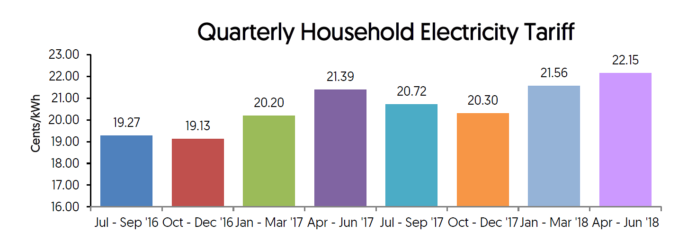
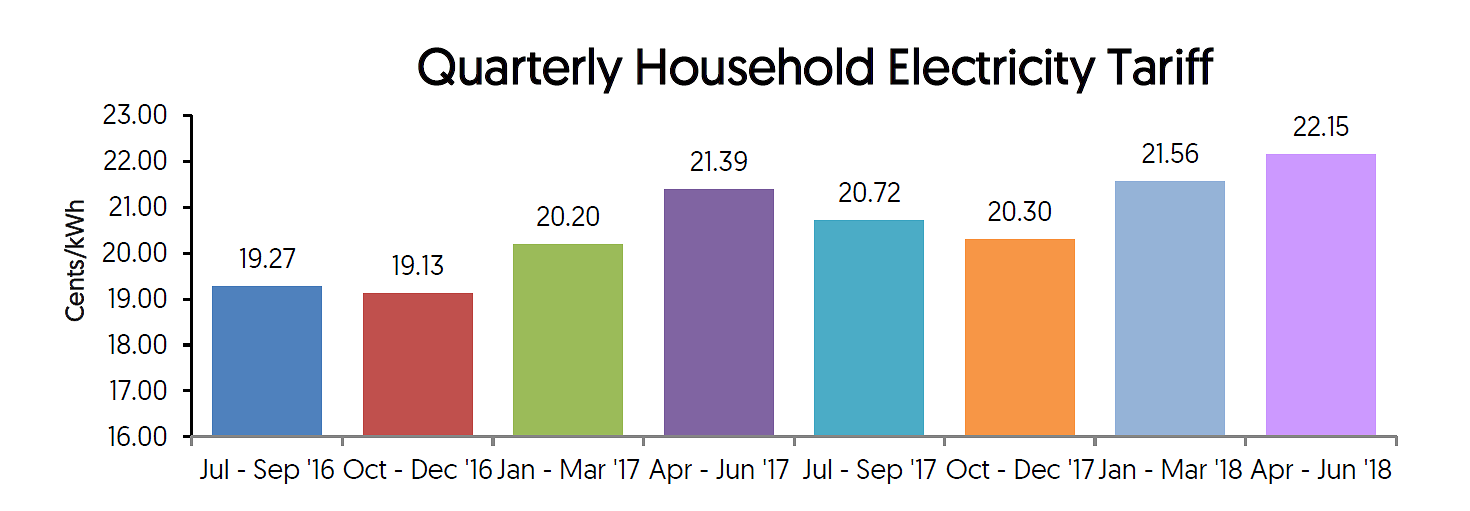
SINGAPORE: Electricity tariffs will increase by an average of 2.8 per cent or 0.59 cents per kWh from Apr 1 to Jun 30 this year, compared to the previous quarter, SP Group announced on Thursday (Mar 29).
This is mainly due to the higher energy cost of producing electricity, it said.
(Table: SP Group)
For households, the electricity tariff will increase from 21.56 to 22.15 cents per kWh, and the average monthly electricity bill for families living in 4-room HDB flats will increase by S$1.86.
SP Group reviews the electricity tariffs quarterly based on guidelines set by the Energy Market Authority (EMA), the electricity industry regulator.
SINGAPORE: There has been much discussion about the Grab and Uber merger and its implications for consumers, taxi operators such as Comfort, and relatively less discussion of the impact on Uber (and possibly Grab) drivers.
At the outset, it should be noted that comment on this makes the critical assumption that the merger will be approved by the Competition Commission.
Should regulators reject the merger, the following arguments will be moot.
INNOVATION AFFECTED?
There has been much talk about how the merger will affect innovation.
Let’s be clear though – the most impactful innovation in this space was the use of smartphones to offer ride- sharing services. It dramatically increased the transport options available to consumers and, in some instances, offered better prices, both of which led to higher consumer welfare.
Subsequently, the ride sharing companies formed a number of alliances with traditional transport providers (GrabTaxi, UberFLASH) which further improved consumer choices, and also introduced additional services such as food delivery, e-wallet (facilitating payments), and financial services (through alliances).
The drivers and other delivery partners (e.g. restaurants for UberEats) formed another key group of stakeholders that benefitted from the emergence of these services — they could utilise their time or assets (e.g. cars, motorcycles, bicycles or personal mobility devices or PMDs) to earn some extra income.
In other words, the shared ride companies offered business model innovation but other than the first big innovation, the rest were incremental additions to the first important idea.
Mr Jason Thompson, managing director of GrabPay Southeast Asia, sharing about the company’s new financial services at Money 20/20 conference. (Photo: Grab)
MASSIVE DISCOUNTES WERE UNSUSTAINABLE
Before we discuss whether the merger will lead to higher or monopolistic prices, it may be useful to remember that the intense competition between Uber and Grab was akin to a land grab.
In their zeal to acquire a larger piece of the business, the companies were probably doing unsustainable levels of discounting and subsidising.
With or without the merger, the discounting was bound to stop at some point in time, probably as early as next year, because of Uber’s planned IPO. So it is likely that the only effect of the merger might be to advance the discontinuation of an unsustainable level of discounting and subsidising.
Even leaving the discontinuation of deep discounting aside, we should not be unduly alarmed about the loss of consumer welfare because of high prices for the simple reason that there is a cap on how much the “new Grab” can raise prices, especially in Singapore.
Singapore has a good public transport system and a taxi system that doesn’t charge high fares. Consumers will switch to these alternatives well before the “new Grab” starts charging monopolistic prices.
GRAB LIKELY TO CONTINUE TO INNOVATE
Let us now turn to how the merger will affect innovation and welfare for other stakeholders such as drivers and partners, such as restaurants. I believe that the impact will be much less than is commonly believed and am sceptical about the merger’s detrimental impact on “innovation”.
In fact, as noted above, it may be a stretch to call some of these product extensions as innovations and there are a good number of providers offering these “innovative” services.
For instance, e-wallet services are being offered by many players, including SingTel. In services such as food delivery, there are several delivery options, besides the shared ride service providers, making the impact of the merger even less.
Given the low barriers to entry in this business and the low switching costs for consumers, more entrants may enter in the future as well, leveraging on the existing delivery network – a ready supply of cyclists, motorcyclists and PMD owners.
On Wednesday (Mar 28), homegrown carpooling app Ryde announced it would be launching RydeX, its new private-hire car service, as part of its growth expansion strategy.
What the RYDE app looks like on a mobile phone. (Image: www.rydesharing.com)
Even after the merger, Grab will continue to innovate. Its competition with Uber was only one of the reasons for trying new strategies and offering new services.
Other reasons include enhancing its profit streams by leveraging its consumer base to sell multiple services (e.g. GrabPay to customers or insurance to Grab drivers) and leveraging its skills in technology (e.g. matching riders and drivers). Both these motivations will remain powerful, post-merger.
DRIVERS MAY LOSE OUT
Drivers may be one key group who may lose out because of the merger. The “new Grab” may need fewer drivers. The intense competition between the two providers lowered the prices of their services and increased demand.
When prices become higher (they could have headed higher even without the merger), the demand might fall.
This is very much a part of the dynamics of competition. Entrants are attracted by the possibility of making profits, leading to excess supply and shakeout before a market discovers its equilibrium.
The Grab-Uber merger should therefore be seen from a dispassionate perspective.
Most analysts and observers overestimate the extent of innovation happening in this space and incorrectly label product extensions as innovations. It is also incorrect to assume that whatever is happening today (e.g. discounting) would continue indefinitely, without the merger.
As a believer in free choice and markets, I have few concerns about the merger. In a free market system, there is no reason why any party (including governments) should stop Uber from selling its Southeast Asian business if it chooses to do so.
The argument that it would lead to monopolistic prices is flawed.
Nitin Pangarkar is Associate Professor in the Department of Strategy and Policy at the National University of Singapore (NUS) Business School.
SINGAPORE: Seow Lam Seng was only 25 years old when he and his friend were stopped by police at Tanjong Katong Road after they were seen behaving suspiciously.
Seow was allegedly carrying a pistol. His friend, Lee Ah Fatt, drew a gun from his own back pocket and pointed it at the officers, prompting one of them to shoot at him. He later died of his injuries.
On Wednesday (Mar 28), 38 years after the incident, Seow was taken back to the crime scene. He had been on the run and was arrested in Penang, Malaysia last week.
Dressed in a red polo tee and black bermudas, Seow, now 63, was cuffed at his hands and feet. He was taken to the area outside a bar where he was stopped by police on Oct 3, 1980.
The area outside Sin Po Po Bar at 241 Tanjong Katong Road where Seow was stopped by police 38 years ago. (Photo: Hani Amin)
Seow was charged in court on Monday with unlawful possession of a firearm. The charge carries a maximum sentence of life imprisonment.
Seow Lam Seng visiting the crime scene along Tanjong Katong Road on Mar 28, 2018. (Photo: Hani Amin)
(Photo: Hani Amin)
Seow spent about five minutes at the scene before he was taken away at about 3.25pm in an unmarked grey van.