Home Blog Page 1072

Creature comfort: The volunteers helping premature babies with octopus toys

0

SINGAPORE: Civil servant Michelle Neo’s crocheting hobby took a serious turn last September. One of her friends had given birth to a baby prematurely and an idea she had been toying with – making octopuses for such newborns – popped into her head.

The 43-year-old was inspired by articles online about the “Octopus for a Preemie” movement.

It was borne out of the Danish Octo Project by a group of volunteers in Denmark which produces crocheted octopus toys for premature babies. The group says the tentacles of octopus toys resemble an umbilical cord and “remind babies of their time in the womb”.

Since its inception in 2013, the Danish Octo Project has made 29,000 toys for preemies – babies born before 37 weeks of pregnancy – in hospitals across Denmark. The initiative has also spread its arms worldwide with people in 38 countries taking part in the “Octopus for a Preemie” movement.

Premature baby with a crochet octopus

A premature baby with a crochet octopus (Photo courtesy of Michelle Neo)

Said Ms Neo of her first octopus for a preemie: “I had so many worries when I first started. Does it really work? What if anything happened to the baby? What would happen to me?”

Her friend accepted the toy readily, and it prompted Ms Neo to offer more crocheted octopuses via a private support group on Facebook for parents of premature babies.

Ms Neo recalls she crotcheted at every chance that she had thereafter. Parents came, one after another, looking for anything that could possibly help to soothe their babies, she said, noting that “not every (premature) baby will survive”.

 “One mother was so desperate, she did not even mind taking one of my first few pieces even though it was not at the appropriate standard,” Ms Neo said, referring to recommendations on the type of yarn and stuffing for the toy.

Premature baby with a crochet octopus 2

A premature baby with a crochet octopus (Photo courtesy of Michelle Neo)

Premature babies sometimes have underdeveloped organs, which can lead to a range of complications such as breathing difficulties, heart problems and infections. They depend heavily on breathing and feeding tubes for support.

“When the neonate, a newborn child, has to be delivered prematurely, they are exposed to different temperatures, light, sounds and a lot of handling for critical life-saving procedures. This can cause discomfort and pain,” said Dr Vidya Ramasamy a specialist in Paediatric Medicine and Neonatology with Raffles Children Centre.

As the tentacles of the octopus simulate an umbilical cord – which establishes the connection between the mother and child – it may give the child a sense of being comforted, added Dr Ramasamy.

However, Dr Ramasamy pointed out that specific care must be taken to clean the toy and that it may not be advisable for cases where a baby is in an incubator or is very prone to infection.

According to the doctor, some tertiary neonatal units in Singapore have begun this therapy, but proper clinical studies are still to be done. 

Crochet octopus toys 2

Crochet octopus toys made by volunteers Michelle Neo and Jess Lee (Photo: Christy Yip)

Still, some who have received such octopus toys are convinced they are effective. Ms Connie Lim’s twin boys were born premature at 26 weeks and often cried non-stop. Their heart rates were irregular as well. 

Scouring the Internet for ideas on what she could do for her sons, Ms Lim was about to order an octopus toy from abroad for S$50 when she chanced upon Ms Neo’s offer. 

Her boys stopped tugging at their feeding tubes and seemed less fitful when resting with the toy. “I’ve seen it work on my boys and I hope that more premature babies will be able to receive the octopus,” she said.

Another mother of a premature baby, Ms Lim Yuling, said that the octopus was especially helpful when she could not be with her son around the clock. She was also unable to swaddle her child due to the many tubes around him.

“He would be afraid of the slightest movement or any loud sounds. Having the octopus to hold on to helped him to sleep better and his breathing rate stabilised,” she said. “This initiative provides mental support for both the parents and the baby during their rough journey.”

It is stories like these that give Ms Neo heart. But there is one case which she cannot forget. 

“I was not able to reach one little warrior on time,” said Ms Neo, welling up. She’s made it a drill to produce and deliver one toy a day, on a first-come-first-serve basis. Once she puts her son to bed, over lunch, and on the way to work, she takes the time to crochet, she said.

“Any time I can do it, I will. But at that point, too many parents reached out to me. By the time the toy was done, the mother told me I could pass it on. Her child was already with the angels.

“I started to blame myself and I became desperate to do more.”

That was when she decided to solicit help through Facebook. Six of her friends came on board and the page Handmade with LOVE Octopus – for Preemies was set up.

Crochet octopuses 1

Close-up of the crochet octopus toys (Photo: Christy Yip)

One of them is Ms Jess Lee, a close friend of Ms Neo’s. Despite having no experience at crochet, she plunged into the project after seeing how hard her friend was working. She learnt from Ms Neo and in her spare time, watched tutorials online.

Soon after, she found herself committed to crocheting at least 30 of 80 octopuses that the group wanted to donate to a local hospital.

“We know that when a baby is not doing well or needs some help to grow up healthier, we feel the need to come up with something that we can contribute to them,” she said.

Michelle Neo and Jess Lee crochet octopus toys 2

Jess Lee and Michelle Neo crocheting octopus toys (Photo: Christy Yip)

Today, the volunteers continue to crochet regularly to ensure a ready pool of octopuses for any parent of a preemie who reaches out.

Two hospitals – which the group declined to name – accepted the toys and the group recently collaborated with infant clothing retailer, Tiny Babies, to include a crochet octopus in care packages the company offers to babies warded in neonatal intensive care units. 

At least one of the hospitals has ordered a second batch, and Ms Neo and friends aim to get more tie-ups sealed. “The hospital is the frontline as they are the first to reach out to the babies,” she said.

“We know that these octopuses are not going to bring miracles. But at least (the babies and the parents) know that there is support from the people around them.”
Source link

Serving up Hong Kong food in Singapore: How to keep customers returning

0

SINGAPORE: These days, local fans of authentic Hong Kong food no longer have to fly four hours north to get their culinary fix.

From dim sum to roast duck, a variety of Cantonese cuisine is increasingly being served on Singapore’s doorstep. Within the last five years, at least nine Hong Kong food brands have opened up or have announced plans to do so, with offerings that range from street eats to fine dining.

The most recent include Forbidden Duck, a Peking-style roast duck restaurant helmed by ‘Demon Chef’ Alvin Leung, which is slated to open this April, as well as popular cha chaan teng chain Tsui Wah Restaurant. The “tea restaurant” has partnered with Jumbo Group to open its first outlet at Clarke Quay later this year.

Other eateries to have made its way to Singapore include Tai Cheong Bakery and Honolulu Cafe, both of which are famous for their signature egg tarts.

DUPLICATE IT WELL OR “YOU’RE FINISHED”: SEETOH

But some have questioned whether the wave of Hong Kong eateries could be the latest food fad in a string of others which have come and gone.

“If you talk about the cha chaan tengs, it’s been around for many years. Way back in the 70s, 80s, there was quite a famous brand called Café de Coral, which has exited the market,” said food consultant K F Seetoh. 

“Hong Kong food generally does well because we have a lot of South Chinese here. We have our Teochew, Cantonese food, roast meats, dim sum, congee – they generally do well.” 

While brands may enjoy an initial uptick in business over the first four to six months as customers come to check them out, the founder of Makansutra and the World Street Food Congress said that people would ultimately measure what is on offer according to their own standards.

“Singaporeans over the decades have been overly discerning – they’re very well-travelled. So if you bring something from Hong Kong, like a porridge or roast meat, to Singapore, bear in mind Singaporeans have been there to eat at that original place,” Mr Seetoh added.

“So if you come here and do fireworks, and you don’t duplicate it well …  you’re finished.”

Manpower problems are among the challenges faced by any overseas brand vying for a share of the Singapore market, as well as maintaining food quality, often with higher costs involved.

Some brands that have faced snags include Kam’s Roast Goose, which had to undergo a name change to Kam’s Roast after it was unable to source suitable geese – it’s brand signature – from Hungary or the United States, the only two countries allowed to import the birds to Singapore.

“A lot of these brands I notice are mom-and-pop stores lovingly made by hand, but if you filter it through some machine or corporation, you lose a lot of what people originally love about the brand, and that sort of brings you down,” said Mr Seetoh.

FIGURING OUT THE WINNING RECIPE

Nonetheless, Hong Kong eateries say they are confident they can serve up offerings local foodies will like – and return for.

One-Michelin-starred Tim Ho Wan has the track record to prove it. The brand, which opened its first outlet at Plaza Singapura in 2013, has since gone on to set up eight other outlets across the island, with one more in the pipeline. 

“When (Tim Ho Wan) first opened, it was the first of its kind I believe,” said its CEO Cynthia Chua. “It was the first Michelin restaurant that had successfully replicated in another country.”

“The queues then were phenomenal,” she recalled. “But now that we are established, I believe we’re part of the local food scene … It’s to be expected that the hype of one restaurant freshly launched in Singapore will die down.”

Wendy Cha Chan Teng 5

Mui Kee Congee is a popular hawker stall located at a wet market in Mong Kok, Hong Kong. (Photo: Wendy Wong)

A newer kid on the block hoping to make its mark is Mui Kee Congee, a popular Hong Kong congee hawker stall. It tested the waters with an eight-month pop-up stall in Botanic Gardens last year in partnership with Les Amis Group, where it sold around 2,000 bowls of porridge a month. 

It opened a permanent restaurant at Shaw Centre in March, and expanded its menu to include new dishes catering to local tastes, including cheung fun – also known as steamed rice noodles – filled with Hokkaido scallops, and premium congee served with Alaskan crab legs and braised baby abalone, with prices ranging from S$7.80 to S$22.

Its third-generation owner said coming to Singapore was an obvious choice: “We have about 10 to 20 customers from Singapore visiting our stall in Hong Kong every day,” said Pierre Choi. “They told us that almost every year they will visit us whenever they come to Hong Kong.”

Wendy Cha Chan Teng 2

Hong Kong eateries say they are confident they can serve up offerings local foodies will like. (Photo: Wendy Wong)

While its pop-up stall noticed a 20 per cent drop in business after the initial hype wore off, Mr Choi said he believes their congee would keep customers returning.

To ensure that the quality of the congee served is up to standards, a chef was sent to Hong Kong to train at the hawker stall in Mong Kok, with Mr Choi regularly flying in to supervise the kitchen operations.

Wendy Cha Chan Teng 3

Around 10 to 20 Singaporean tourists visit Mui Kee Congee’s Hong Kong location every day, says Mr Choi. (Photo: Wendy Wong)

So far, Mr Choi said there are no plans to expand to another outlet yet as its “objective is to make sure we serve the same quality food as our stall in Hong Kong”.

“There is feedback from Singaporeans in Hong Kong that our price is higher, but they still continue to come back. This is because we choose to buy higher quality and fresh ingredients so our congee is value for money,” Mr Choi said.

Wendy Cha Chan Teng 1

Mui Kee Congee’s expanded menu includes offerings such as baby abalone porridge as well as side dishes, along with its signature fish porridge. (Photo: Wendy Wong)

It’s a strategy that’s part of the winning recipe in staying for the long haul, said Mr Seetoh: “All these international eateries selling comfort food – they’re up against the Singaporean palate spoilt by hawker centres, coffee shops, food courts and little cafes – they’ve been spoilt, price-wise and quality-wise … The ones that do well generally is because the location and pricing are good and they put out reasonably good quality food.”

Source link

5 arrested in credit card fraud syndicate bust

0

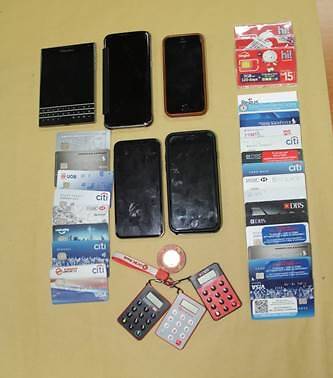
SINGAPORE: Five men have been arrested after they allegedly applied for credit cards using forged documents and made multiple transactions with these cards,  police said on Saturday (Mar 31). 

In a statement, authorities said they received reports from several banks from Mar 22 to Mar 29 about credit card applications supplemented with fake documents. These documents included salary slips and Notices of Assessment from the Inland Revenue Authority of Singapore (IRAS).

Following investigations, officers from the Central Police Division established the identities of the men and arrested them at various locations between Mar 22 and Mar 27.

Credit card fraud 1

The suspects are believed to be involved in more than 50 of credit card fraud amounting to S$200,000.  (Photo: SPF)

The men are suspected to have made multiple transactions with the cards they obtained from the fraudulent applications, said police. It is believed they are involved in more than 50 cases amounting to S$200,000 since October 2017.

If found guilty of cheating, the men face up to 10 years in jail and a fine.

Police investigations are ongoing.

Source link

Repairing thunderstorm damage could take months, says Lim Chu Kang nursery

0

SINGAPORE: Destruction caused by the recent thunderstorm could take months to repair, said Koon Lee Nursery, one of the farms in Lim Chu Kang that were affected.  

On Saturday (Mar 31), a day after heavy rain and strong gusts of wind hit the western part of Singapore, Koon Lee manager Mac Teo said recovery work could easily take two months and cost at least S$50,000. 

“I estimate that because most of my areas are damaged, we could be cleaning up for two months,” said Mr Teo. 

“If we had to rebuild everything, it would be in the hundreds of thousands. But I don’t think we’ll be able to do that because we’re required to move in January 2019 for the expansion of the airbase. 

“That’s about a year away and we don’t want to spend on the repairs and then move out straight away. But we can’t not do repairs … then we can’t carry on our operations, so it’s a bit of a dilemma for us. It’s a difficult time for us,” he added.

Mr Teo said Friday’s storm was “like a scene from a Twister” movie.

“There was a lot of howling. All it took was 30 seconds of very strong wind to cause this.” 

During Channel NewsAsia’s visit, members of the nursery staff were busy with repair work on tentage that had completely collapsed.  

More than half of his team of 20 workers have been redirected to help with recovery, said Mr Teo. The nursery was still accepting walk-in customers at a section that was not affected by the storm, but it was still “difficult” as a large amount of stock remained stuck under the debris, he added.

Chew’s Agriculture, which rears chickens for eggs and is located next to Koon Lee on Murai Farmway, was also badly damaged.   

The farm declined an interview, saying it was busy with “visits from authorities”, but the damage was visible from Koon Lee – rows of chicken houses were completely flattened and there was still poultry trapped underneath the rubble.  

Chew's Agriculture thunderstorm 3

Some chickens at Chew’s Agriculture were still trapped under the debris. (Photo: Cheryl Goh)

Senior Minister of State for Trade and Industry and National Development Koh Poh Koon visited several of the affected farms together with the CEOs of Agri-Food & Veterinary Authority of Singapore (AVA) and the National Parks Board (NParks) on Saturday morning. 

In a Facebook post, he said he visited Chew’s Agriculture, Williton Orchids, Koon Lee Nursery and Goh Swee Hoon fish farm, noting that Chew’s “suffered the most extensive damage”. 

“The owner assured me that they have business continuity measures in place and while this ‘act of God’ has brought challenges to them, he is glad to see that members of our farming community and government agencies are coming together to help them tide over this period,” said Dr Koh. 

Dr Koh added he assured them that the relevant agencies would render assistance where needed.

“In the days ahead, our officers from Singapore Land Authority, Building and Construction Authority, AVA and NParks will continue to support affected farms in their clean-up and rebuilding efforts,” he said. 

Source link

Lunchtime Concerts @ ACM

0

Lunchtime Concerts @ ACM
from Friday, April 27, 2018 at 1:00 PM to Friday, April 27, 2018 at 2:00 PM

Asian Civilisations Museum

1 Empress Place, Singapore, 179555 Singapore

Source link

Celebrate A Magical Easter Sunday With Mr. Bottle & Friends!

0

Celebrate A Magical Easter Sunday With Mr. Bottle & Friends!
from Sunday, April 1, 2018 at 12:00 PM to Sunday, April 1, 2018 at 4:30 PM

The Fullerton Hotel

1 Fullerton Square, Singapore, 049178 Singapore

Source link

Commentary: Why take up a postgrad education when I can Google almost anything?

0

SINGAPORE: Lifelong learning is encouraged in Singapore through incentives and myriad opportunities through programmes such as the SkillsFuture Initiative.

Institutions of higher learning also present an attractive platter of degree programmes and micro-credentials for continual learning.

But in a world where one can Google for almost anything, some may argue knowledge is almost ubiquitous. At the heart of it is this question –  do we still need to accumulate knowledge if we can call up information so easily?

For many of us who have completed our formal education, do such trends suggest that the value of pursuing additional formal education qualifications to move up the career ladder has vastly diminished?

Local media reports submit that such a debate about degrees versus skills has been underway. If so, it is useful to focus this discussion on what acquiring skills mean in today’s world.

In delivering the Budget 2018 statement earlier this month, Finance Minister Heng Swee Keat highlighted that the Singapore Government will continue to invest in education and skills upgrading to give every Singaporean the best chance to realise his or her potential and build deep skills for workers of all ages.

Minister for Education (Higher Education and Skills) Ong Ye Kung said during the Education Ministry’s Committee of Supply in Parliament that the Singapore education system should “anticipate the shape of things to come and build a system that can respond to and embrace the changes”. 

He announced that autonomous universities will roll out micro-credentials, a repackacing of certain courses to create pathways that lead to smaller qualifications.

This ostensibly gives Singaporeans the flexibility and access to postgraduate education that will help them develop skills and knowledge relevant to their jobs.

Ong Ye Kung at MOE COS for Budget 2018

Education Minister in charge of Higher Education and Skills Ong Ye Kung speaking during his ministry’s Committee of Supply debate on Mar 5, 2018.

READ: A commentary on Asia’s shifting higher education landscape.

IS FORMAL LEARNING NECESSARY?

Having been at the forefront of graduate studies and professional learning, I empathise with postgraduate students who have their reservations about pursuing paper qualifications set against competing demands on money, time and commitment.

One cannot help but ask if pursuing a postgraduate degree, whether through micro-credentials or the entire course of certification, can really make the sum difference in one’s career after one has had years of industry experience and demonstrated a proven track record.

The question of why anyone needs formal learning remains even as there are options to pursue postgraduate education through smaller modules. 

Indeed, some say as information relevant to workplace skills and knowledge have become more accessible, formal learning seems increasingly irrelevant.

Such questions are why as academic administrators of professional learning at the National Institute of Education (NIE), we have put much thought into how professionals in the teaching fraternity and other leading industries can have flexibility in the way they advance their learning.

Investing in a formal postgraduate education that teaches you to write reviews and carry out months of research seems out of step in an evolving digital era, where technical knowledge and mastery of a subject must be assimilated, processed and applied quickly.

After all, rapid technological advancements calls for a new generation of professionals who are highly adaptable and agile.

NIE investiture 2017

NIE Teachers’ Investiture Ceremony 2017. (Photo: Facebook/NIE)

READ: A commentary on agility, the secret skillset companies are looking to hire.

SIGNALLING VALUE

All things considered, in my opinion, the utility of a postgraduate education remains high. It comes back to the question of relevance in the job market amid stiff competition.

Employers look for the best experiences and potential in the candidates they come across. The fact remains that a postgraduate education still has signalling value.

On top of achieving best grades in an undergraduate programme and developing formal expertise, a formal postgraduate education certification can offer a powerful indication that a candidate is highly responsive to new challenges.

Employers in the field also know tacitly that certain types of knowledge and skills require development over a sustained period of time – honing these with experts in a subject area will contribute to the professional development of the individual.

We see this too in subtle shifts in how postgraduate programmes aim to equip graduates with skills and work-relevant expertise that will carry them further in their careers. 

In the past decade, postgraduate programmes have evolved tremendously to help students develop deep proficiencies in a wider scope of skillsets so that they emerge with deeper insights into a broader range of issues and a stronger ability to think creatively to solve real-world problems. 

Postgraduate programmes also have great networking value. Postgraduate students engage with other like-minded professionals through the course of the programme and make valuable connections in various industries, before they embark on the next phase of their career. 

They may also in time come to develop a community of best practices. They  are open  to new ideas which drive a renewed sense of passion.

WHAT PROGRAMME SHOULD I CHOOSE THEN?

It seems that the value of a postgraduate programme therefore can be subjective and unique to each person.

I have always asked my students: “What part of the programme you have completed benefitted you the most?”

Their replies vary but most generally appreciate the opportunities to advance critical thinking and new, meaningful ways to grow their capabilities.

A participant of the NIE Doctor in Education (EdD) programme, a research officer on adult education shared that the “learning experience in a postgraduate programme … developed my critical thinking and analytical capability which (are) fundamental competencies for the 21st century”.  

He chose the EdD programme, a practitioner-researcher based higher degree, because it was directly relevant to his job.

In another example, new practices may be grasped and developed. A head of department for Physical Education (PE) in a secondary school said “The Master of Science (Exercise and Sport Studies) … introduced me to disability sports and inspired me to introduce it in my schools”. He subsequently incorporated disability sports into the PE scheme of work for Primary 4, 5 and 6 pupils.

National Steps Challege

National Steps Challenge’s Rep with Steps being launched at Woodgrove Secondary School in 2016. (Photo: Hetty Musfirah)

ADD VALUE TO THE JOB IN NEW WAYS

Many higher learning institutes recognise that they have a high bar to meet because postgraduate learners are already established in their field with ample opportunities to develop job-relevant skills.

So a good programme needs a strong curriculum that incorporates ways to mature one’s capabilities to new levels of advancements in their areas of specialisation.  

For instance, a radiation therapist in the Master of Arts (Counselling and Guidance) programme once shared: “I felt powerless to help cancer patients cope emotionally”. Completing her course, she was able to apply knowledge from her postgraduate about phobias and relaxation therapy to help patients practise mindfulness techniques in overcoming the fear of treatment.

Skills such as working in a team, developing new perspectives and supporting the social-emotional aspects of people postgraduate candidates come into contact with, are highly prized in a 21st century world.

So the argument that the ability to call up information instantaneously negates the relevance of further learning becomes tenuous.

Back to the question about what good does a postgraduate programme do if you can Google anything. How do you search for that which you do not know? 

Postgraduate education, whether through full programmes or micro-credentials can help open minds. Incidentally, it does help one figure out what to google for and to discern if the search results are credible or relevant to one’s needs.

To this end, preparation and a clear goal in mind, solidifies the first steps toward a much-valued postgraduate learning journey.

Associate Professor Chang Chew Hung works at the Office of Graduate Studies and Professional Learning at the National Institute of Education, Nanyang Technological University, Singapore. 

Source link

AVA urges people not to feed pigeons amid a sharp rise in feedback about the birds

0

SINGAPORE: Drying clothes outside your home is a mundane task for most people, but not for Mdm Margaret Tan, who lives in a ground floor HDB flat in Balam Road. 

The 66-year-old retiree simply cannot do that. She has tried, but the clothes she took in were dirtier than before they were washed, with bird droppings on them. Mdm Tan lives in an area which has been affected by pigeon-related problems for years. 

Nearby is a big banner that urges residents not to feed pigeons by showing examples of problems they could cause – hygiene issues, attracting pests and the spreading of diseases.

But still, people feed the pigeons, she said. While the problem has improved, it still exists, Mdm Tan said. 

“I’ve written in to complain about the issue many times,” she said, but has now given up.

When contacted, Marine Parade Town Council, which oversees the area, said it is aware of the ongoing pigeon issues on the estate and that it has been continuously working with the Agri-Food and Veterinary Authority (AVA) to address them. 

AVA told Channel NewsAsia it has received 16 cases of feedback on pigeon feeding at Balam Road since 2015.

However, these numbers represent a tiny proportion of the island-wide statistics, which show that there is growing concern about pigeons: Last year, the AVA received 5,500 pieces of pigeon-related feedback from across Singapore, a 34 per cent increase from 4,100 in 2016. 

The HDB flats at Balam Road were recently given a fresh coat of paint, but when Channel NewsAsia visited the area, pigeon droppings had already dirtied some ledges.

When asked about what is being done to address the root problem of the pigeons making a mess, a spokesperson for the town council said: “As part of our Repairs and Redecoration (R&R), we are exploring mitigating measures such as using wire mesh and aluminium flashings to deter pigeons from roosting at these areas.” 

Pigeons on the ledge

Pigeons at the back of blocks in Balam Road. (Photo: Jalelah Abu Baker)

Such repairs and redecoration, which typically include upgrading of bin chutes and washing and painting of external walls, are undertaken by town councils to revitalise an estate.

“We had also received feedback from residents on pigeon feeders in the estate. This availability of food source attracts the birds to congregate in the area. As such, we would like to remind residents to refrain from feeding the pigeons and to maintain the cleanliness of the environment,” the spokesperson added.

AVA WORKING WITH TOWN COUNCIL TO IDENTIFY HOTSPOTS

AVA has been working with Marine Parade Town Council (MPTC) to identify pigeon hotspots at Balam Road, to reduce the population there and maintain hygiene and cleanliness, an AVA spokesperson said. 

The authority also works with other agencies to take action against high-rise litterers, who throw food from their homes to feed the pigeons, it said. 

Pigeons dirty the environment with droppings, and leftover food from pigeon feeding may attract other pests like rats, which carry diseases and pose a risk to public health, AVA added.

“Feeding encourages pigeons to breed and results in an increase in their population,” a spokesperson said, adding that feeders provide a regular source of food which may have led to pigeons congregating in the area. 

Banner on pigeons

Banner urging the public not to feed the pigeons, in Balam Road. (Photo: Jalelah Abu Baker)

AVA has been educating the public against pigeon feeding as it is an offence, it said. Anyone caught feeding pigeons can be fined up to S$500 under the Animals and Birds Act.

While AVA continues to work with stakeholders to manage the pigeon population, “members of the public can play their part by not feeding pigeons”, AVA said.  

Another place which has pigeon problems is Hougang.

After receiving feedback from a reader, Channel NewsAsia visited the area. Pigeons stood atop tree branches and on the roofs of shelters, flying as a flock from one spot to another. Dried bird droppings dotted pathways. 

Online seller Joseph Goh said that the problem has been around for several years, and that he complained about about the issue twice, more than a year ago, but he felt nothing had been done. 

“The pigeons are a nuisance, and their droppings on the ground can look very unsightly sometimes,” he said. He added that there are feeders who pack food just for the pigeons. 

Channel NewsAsia reached out to Aljunied-Hougang Town Council on the matter.

ACCUMULATED PIGEON DROPPINGS CAN BE “QUITE SUBSTANTIAL”

Business development manager at bird control company Mastermark Gloria Ngoi said that pigeons and their droppings are definitely a problem in Singapore. 

Ms Ngoi, who has been in the industry for eight years, said: “It may also be a problem when it comes to controlling the number of pigeon feeders. It’s a bit tricky to manage.”

The people who feed the birds may get into a habit, thinking they are doing good for the pigeons, she explained. 

As well as the problem of pigeon feeding, the birds are highly adaptable, allowing them to thrive in urban areas, she said.

“With the number of high rise buildings in Singapore, air-conditioning compressor ledges have become a conducive nesting ground for pigeons as it provides sufficient warmth and security away from predators.” 

She has received distressed calls from home-owners who are unable to open their windows because of the smell of pigeon droppings, which can accumulate to be “quite substantial” over time.

In order to break the pigeon’s nesting habits, one solution is installing bird netting that prevents pigeons from landing on the ledge. Another bird-proofing solution is using bird spikes which are designed not to allow birds to land.

Ms Ngoi said that feeding pigeons with contraceptives can also be an effective strategy to in deal with the issue. 

Bird netting to birdproof buildings

Bird netting to bird-proof buildings. (Photo: Mastermark)

PIGEONS POSE HEALTH AND OTHER RISKS

Other than being smelly, bird droppings can pose health risks as well. Infectious diseases specialist at Mount Elizabeth Novena Specialist Centre Leong Hoe Nam said bird droppings can cause lung, blood or brain infection, pneumonia and fungal infections. 

Ms Ngoi agreed that constant exposure to pigeon droppings could cause respiratory problems 

They also create other problems. “Their droppings are aesthetically damaging and corrosive. It may eat into paintwork, into concrete, and can eventually eat into metal as well,”  Ms Ngoi said.

That said, she finds that more HDB blocks and markets are being bird-proofed over the years. “When town councils go through R&R, they do improve bird control,” she said.

GOVT AGENCIES COLLABORATING TO HELP WITH SUCH PROBLEMS

Minister for Culture, Community and Youth Grace Fu, who oversees the Municipal Services Office (MSO), brought up pigeon issues during the Committee of Supply debate last month.

In explaining the MSO’s behind-the-scenes work on improving inter-agency processes, she brought up the example of these birds. 

Town councils oversee the cleaning of common areas, AVA takes enforcement action against pigeon feeders, while the National Environment Agency takes enforcement action in instances where high-rise littering is involved. Residents’ committees from the People’s Association are often roped in to counsel the feeders, she said.

Pigeon Hougang pigeon file photo

Pigeons congregating in Hougang Ave 1. (Photo: Jalelah Abu Baker)

“These agencies work together in order for pigeon-related issues to be
resolved holistically. To support their efforts, MSO has helped to formulate end-to-end workflows to clarify roles and responsibilities, and tighten coordination in their handling of such pigeon-related nuisance,” she said. 

In the meantime, residents hope that their neighbours will stop encouraging pigeons by feeding them. 

Mdm Tan, who has lived at her Balam Road home for almost 50 years, said: “They (residents) come down and feed them bread and rice even though there’s a banner asking them not to. Things will get better if they stop.” 

Source link

Heartache and duty: At 77, the petrol pump attendant who must keep working

0

SINGAPORE: When 77-year-old Mohamed Yasin gets scolded by a customer – and make no mistake, some can get demanding indeed – it affects him so much, it keeps him awake at night.

“I wouldn’t be able to sleep,” said the petrol pump attendant. “I’d think, ‘Why did I make that mistake?’”

Take the one time years ago when he put in the wrong fuel grade, after a couple differed on the grade they wanted. The woman refused to pay the S$87.

So he told her: “Though my pay is little, I made a mistake and I’ll pay.” His manager later made up for his loss by giving him vouchers.

You could say that for Mr Yasin, his job for the past 15 years at an Esso station in Yishun has been both a source of comfort and of anxiety.

DMUI petrol attendant 15

Assurance because, despite the long hours which can be exhausting at his age, the work is a source of income he desperately needs to support his wife and mentally disabled child.

It’s a duty to them that he will take seriously – in his words – for as long as he lives.

Anxiety because, as one of the oldest workers at the station, there’s always the worry that he could lose his job at any time to younger, fitter workers.

And yes, there are the patrons who find it easy to complain about attendants like him, especially as they wear a name tag.

“As a husband, I have a big responsibility,” he said in Malay. “If I can’t work, I don’t know what I’d do.”

DMUI petrol attendant 12

Which is why for the past 15 years, he has been working doubly hard at his job. He shares his story in the documentary Don’t Make Us Invisible, about those labouring in jobs that are crucial to Singapore but thankless at times. (Watch the series here.)

FAMILY WORRIES

Mr Yasin’s 48-year-old son Amran, the second of four boys, was nine months old when a high fever left him permanently brain-damaged.

All his life, he has been almost totally reliant on his parents. And they have devoted theirs to caring for him. “His disability isn’t that bad. He can speak a little and eat properly,” his father said stoically.

DMUI petrol attendant  2

Amran and his mother Iminah.

Mr Amran helps clean their flat as he “doesn’t like mess”, shared his mother Iminah. And when she is not feeling well, he’d rub ointment on her hands and feet.

With his strong hands, however, he sometimes breaks things at home, even a window handle once. And he goes into physical fits when, for example, he feels stressed.

His father said: “It’s quite pitiful to observe him going through it, with his face stiffening up, his hands and feet all cramped up. To open his hands is very difficult.”

Both Mr Yasin and his wife doubt that their other sons’ families can ever take care of him, even if his siblings may want to do so. Nor can the couple depend on them financially.

“It’s not that they forget about me. But they’re lacking when it comes to finances,” said the elderly man. “It’s not that they don’t give me money. Sometimes they do.”

DMUI petrol attendant 9

Mr Yasin, going through the bills at home, with Amran.

So he thanks his “luck” that Esso has shown no sign of letting him go – even if it was the merit of his hard work that saw him promoted to senior pump attendant 10 years ago, and that has kept him going all these years.

He earns well under S$2,000 a month, including Workfare benefits, which means he does not get to save very much after paying for daily necessities. But it is enough for his family, he said.

“There’s no need to have a table full of dishes,” he said. “If my wife cooks today, she doesn’t need to cook tomorrow – we can eat the leftovers. That’s how we cut cost.”

JOB ISN’T JUST PUMPING PETROL

Like the other attendants, he works an eight-hour shift. And each month, he gets six rest days.

He is such a familiar sight at the station that the regulars he often chats with sometimes enquire after him – “the Malay man, the one with the songkok” – on his days off.

WATCH: Dealing with tough situations (3:21)

As one of its senior service attendants, his job is not only about loading cars with fuel, but also about knowing the station’s protocols back to front, even more so than the eight regular attendants.

They must all go for safety training at the Singapore Civil Defence Force once every two years, supplemented with annual refresher courses conducted by Esso.

At these sessions, they learn how put out a small fire, perform first aid and cardiopulmonary resuscitation, as well as handle oil spills. And Mr Yasin has attended them all since 2003.

DMUI petrol attendant 4

Showing items like an oil stopper to be used in an emergency spill.

He must also be on the alert for “petrol thieves” – those who fuel up and drive off without paying.

But those are not the only unexpected situations he must be prepared to handle.

While Channel NewsAsia was filming him, something happened that he had never faced at the station: All the diesel pumps malfunctioned – and he had to handle the irate customers.

Trying to maintain service levels, he told one driver: “Sorry, they can’t do anything. The system got cut off. Please hold on a little while.” 

But the man snapped back: “What the hell, man? You must tell us earlier.”

DMUI petrol attendant 11

Trying to explain the situation to an irate customer when the diesel pumps malfunctioned.

Five minutes into the problem, and Mr Yasin and his colleagues were having to minimise the impact on the ground. So they were told to redirect diesel customers to another petrol station, in Sembawang.

Before long, the team returned the pumps to normal, after judging that the circuitry had been tripped.

MASTER OF THE SEA

Long before that, before he started directing vehicles and filling up their tanks, Mr Yasin was steering much larger vessels in a different career – as a tugboat master.

For decades, with his knowledge of local waters and sea laws, he ensured that ships made it through the narrow channels of Singapore’s harbour.

Safety was paramount to building a reputation as a first-class port, and he took that responsibility seriously – not least because his own life was also at stake.

“All it would take was one wrong step, and we could fall overboard,” said Mr Yasin, who did fall into the sea twice.

DMUI petrol attendant 3

He emerged unscathed, however, unlike some colleagues who lost life and limb: Manab, who died after his tugboat capsized; Peter, who had a forearm severed by boat propellers; Joseph, who suffered the same fate when a winch rope snapped.

At the age of 62, Mr Yasin had to retire, and his glory days as part of Singapore’s rise were over.

He still misses that life, and the memories came flooding back when he recently visited the Sembawang coast, where he used to work at the shipyard.

“I was a happy at sea,” he said, even though there were times he would not be home for days.

DMUI petrol attendant 14

At Sembawang jetty, reminiscing about the old days.

WORK, THE BEST PLACE TO BE

Then and now, he feels “more stressed” at home than at work, he admitted. “It’s healthy for our mental state when we’re working,” he explained.

If I keep staying at home, my mind slows down, I can’t think and I have negative thoughts, especially with my son like this.

Working as a pump attendant at his age can be tiring, especially on the 3pm to 11pm shift, when there are more cars to service. But he shrugs this off, saying: “I’m tired, but so is everyone.”

While attendants are allowed to sit when there are no vehicles, an empty station is a rare sight.

DMUI petrol attendant 6

At the back of his mind, there is also that niggling unease about his job security. When two Channel NewsAsia crew members came around one day, he thought the worst at first.

“I told them, ‘If you’re here because you want to fire me, I hope you won’t.’ They were taken aback, then they said, ‘No, no, uncle. It’s not like that. We’re from Mediacorp,’” he recounted.

“I had thought my company didn’t need elderly workers any more.”

Pronouncing that he is “still strong, still active”, Mr Yasin added that he is happy to be working at his petrol station. “As long as I can walk and I can work, I would,” he said.

“I’ll take care of my child, my wife, for as long as I’m alive … I pray to God to lengthen my life.”

Watch the series Don’t Make Us Invisible here. Read about other profiles featured: The 23-year-old out to change the way we think of bus drivers and the food and beverage manager who delivers service with a smile.

DMUI petrol attendant 1

Source link

Worker injured after thunderstorm causes heavy damage to nursery, farm in Lim Chu Kang

0

SINGAPORE: One person was taken to hospital after a thunderstorm caused heavy damage to Koon Lee Nursery and Chew’s Agriculture in Lim Chu Kang on Friday (Mar 30).

The Singapore Civil Defence Force said it responded to a call for ambulance assistance at 2 Murai Farmway at around 4pm. 

A worker from the nursery was taken conscious to Ng Teng Fong Hospital.

Channel NewsAsia understands the police and officials from the Building and Construction Authority were at the scene. 

Video and photos of the storm’s aftermath showed widespread damage to the nursery with collapsed structures and debris strewn across the ground. A fire engine could also be seen at the scene.

Damage to Lim Chu Kang farm and nursery 2

A heavy thunderstorm caused widespread damage on Friday (Mar 30). (Photo: Mac Teo)

Damage to Lim Chu Kang farm and nursery 1

Damage caused by the heavy thunderstorm. (Photo: Mac Teo)

Fallen trees were also seen in the area, with 31-year-old passerby Kenny Koh, an operations manager, telling Channel NewsAsia he saw a fallen tree blocking both lanes on Murai Farmway in Lim Chu Kang at around 4.40pm. 

A video taken by him showed collapsed structures in the area. 

Singapore was hit by heavy rain and strong winds on Friday, with fallen trees leading to bus diversions and traffic jams. 

Source link