SINGAPORE: AZ Marine Offshore Services and its operations manager Soh Eng Bee have been fined S$200,000 and S$80,000 respectively after an accident at a shipyard in Pandan Road resulted in the death of an engineer in 2016.
In a press release issued on Monday (Apr 2), the Ministry of Manpower (MOM) said Pan-United Shipping had hired AZ Marine for the berthing of two of its vessels – PU2416 and PU3202 – at the shipyard and employed the engineer, Mr Lim Meng Hoe, to perform engine health checks and supervise ship crew for minor repairs.
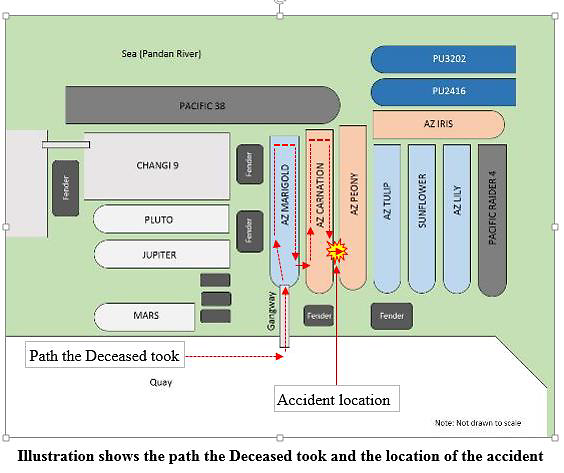
Upon arrival at the site on Oct 31, 2016, Mr Lim crossed a gangway placed between the quay and bow of a vessel AZ Marigold, which was berthed closest to the quay.
“As the boats were berthed side by side with bows facing the quay, the deceased had to climb over at least four vessels to reach vessels PU2416 and PU3202,” said MOM.
In his attempt to climb across one of the vessels, his left hand slipped and Mr Lim fell through the gap and into the sea.
MOM said it discovered that AZ Marine did not provide safety instructions on vessel-to-vessel access within the shipyard.
“It did not provide any gangways or other means to enter or exit berthed vessels safely. There were also no designated crossing points between vessels berthed at the shipyard.
“As a result, persons attempting vessel-to-vessel access are required to identify a point to cross between vessels based on their own assessment. They end up having to climb over the gunwale and stand on the fender or fender tyres before crossing over to the other vessel.
“This is an unsafe method. With no proper handhold or foothold provided, anyone attempting to access the vessels were at risk of falling into sea,” said the ministry.
Authorities said Soh Eng Bee was entrusted with the responsibility of ensuring workers’ safety at the shipyard, but did not take action even when he was aware that workers were entering and leaving the vessels in an unsafe manner.
Soh himself was accessing the vessels in that manner, said MOM, adding that by his example, he implicitly consented to the non-compliance of safe practices at the shipyard.
MOM’s director of occupational safety and health inspectorate, Mr Sebastian Tan, said the accident was “totally preventable”.
“Both the occupier and operations manager in charge of safety at the shipyard failed to ensure safe work procedures were in place to mitigate safety hazards and risks. Instead of flagging out the safety risks at the shipyard, Soh Eng Bee himself openly practised unsafe acts, leading others to follow his example,” said Mr Tan.
“Both the occupier and operations manager must be held accountable for their failures.”
SINGAPORE: The ministerial committee on 38 Oxley Road listed a range of options from preservation to demolition and redevelopment for Mr Lee Kuan Yew’s family home, in its report released on Monday (Apr 2).
While the committee acknowledged that there was “no immediate need to decide the fate of the property”, it added that the options were studied so that a future Government of the day “is better prepared to make a decision, when needed”.
The committee categorised the options into what it called three “broad” groups – retaining the property, retaining the dining room and tearing down the rest of the property and allowing the property to be demolished for redevelopment.
(Source: Ministerial Committee report on 38 Oxley Road)
OPTION 1: RETAIN THE PROPERTY
Under the retention option, the committee mentioned conservation and preservation as two possibilities, while stating that the former “does not confer the same national significance” as the latter.
Preservation under the Preservations of Monuments Act takes into consideration “historical, cultural, traditional, archaeological, architectural, artistic or symbolic significance and national importance”, it added.
“If the national and historical significance of the property is assessed to be high, one option is to preserve the property as a national monument,” the committee suggested in its report.
It added that once a preservation order is served upon the owner and occupier of the monument, the architecture of the property “cannot be modified in any manner” contrary to National Heritage Board guidelines.
The state is also legally required to acquire the house within a year from the date of the preservation order, since it is currently being occupied, the report said.
The committee suggested alternative uses for the site under this option, which could be “Civic and Community or Educational Institutional” in nature, as it reasoned that residential use “will not be tenable” after it is gazetted as a national monument. It also said the alternative use could involve restricted access to take into account Mr Lee Kuan Yew’s wish to protect the family’s privacy.
The second possibility of conservation under the Planning Act takes into consideration “special architectural, historic, traditional or aesthetic interest”, the committee explained.
“Conservation is an alternative way to retain the property for its historical and heritage value, while allowing greater flexibility for modifications to the property. If the property is gazetted for conservation, the building itself (including the dining room) will be protected by law, but more extensive modification and refurbishment of the interior will be allowed.”
The conservation option would “significantly address” Mr Lee’s concerns about privacy, the committee added.
The committee also suggested that conservation could be “an interim step” and that the Government can subsequently “upgrade” the status of the property and gazette it for preservation as a national monument at a later time.
OPTION 2: RETAIN DINING ROOM, TEAR DOWN THE REST OF THE PROPERTY
38 Oxley Road. (Photo: Howard Law)
The second category of options was to retain the basement dining room, and demolish the rest of the property.
In detailing this option, the committee highlighted that the basement dining room was assessed to be the “most historically significant” part of the property.
It added that under this option, the state could retain the room “by gazetting it as a national monument, whilst allowing the rest of the property to be demolished”.
This option would also require the state to acquire the property within a year of the preservation order.
“This is one way to fulfill Mr Lee’s wishes to tear down the building, and still retain the most historically significant part of the house, although there may be a loss of context in preserving a room alone without the rest of the property,” the committee added.
According to the report, the Preservation of Monuments Act allows for the preservation of not just entire buildings, but also parts of buildings and structures, unlike conservation which applies only to buildings.
The report went on to suggest possible plans for the dining room to be housed within a simple structure which could then be made available for “guided viewing”. It added that the structure could then be integrated as part of the overall plans for the site.
One possibility that the committee suggested was for the site to be curated as a park in view of the late Mr Lee’s support for the greening of Singapore.
Another possibility was to incorporate the structure into a new building which could be used as a research or heritage centre that allows public access for national education purposes while guarding the privacy of Mr and Mrs Lee’s way of life, the committee said.
The report included two existing glass structures – The Garden Room located in London and The Glass House located in Connecticut – as examples for this option to integrate the property with the surroundings.
OPTION 3: ALLOW PROPERTY TO BE DEMOLISHED FOR REDEVELOPMENT
The third category of options listed by the ministerial committee was to allow for the entire property to be demolished for redevelopment of the site, which can undertaken by the owner for residential use or the State for alternative uses.
This category included two possibilities: Redevelopment of the site by the owner for five-storey residential developments or to allow the state to acquire and redevelop the land for alternative uses.
The committee highlighted that if the property was allowed to be fully demolished by the owner for residential use, it “could result in the loss of a historically significant property, and the potential of that history being leveraged for commercial profit”.
File photo of 38 Oxley Road. (Photo: Toh Ting Wei/AFP)
If the state was to acquire it for alternative use, the committee suggested a public park, heritage centre, research entity or similar public institutions as some of the possibilities for such redevelopment, adding that this was one way to allow public access to the site.
“As is the current practice, the state will need to state the reasons for the acquisition (e.g. comprehensive redevelopment or public purpose) in the notice to the owner, as well as in the gazette, since it will not be for the purpose of preserving the property,” the committee said.
The report also suggested further possibilities beyond the options under the three categories. They included “amalgamating the acquired site” with part of adjacent state land to provide a “larger footprint”.
The committee reasoned that this option provides greater flexibility to meet planning needs of the proposed use of the site while retaining compatibility with the surrounding environment.
The casting call deadline has been extended to Friday (Apr 6).
Auditions are open for the Singapore version of MasterChef. (Image: mycastingnet.com)
(Updated: )
Bookmark
SINGAPORE: The Singapore version of popular cooking competition MasterChef will be produced in English and will premiere on Mediacorp Channel 5.
The show was slated to debut in Mandarin on Mediacorp’s Channel 8 as the English rights to the show were initially unavailable. However, following further negotiations with rights owner Endemol Shine Group, the show will be produced in English and air later this year on Channel 5.
Mediacorp, the broadcast partner, and Motion Content Group, a global content investment and rights management company, confirmed this in a joint media release on Monday (Apr 2), adding that the casting call deadline has been extended till midnight on Friday or Apr 6.
“Since the casting call went out in February, we have been impressed by the high levels of interest and passion from the public. We look forward to meeting the best amateur chefs Singapore has to offer,” said Mr Steven Murphy of Motion Content Group, Asia Pacific.
Motion Content Group, which is a part of the global media management company GroupM, had acquired rights to produce and broadcast MasterChef Singapore from Endemol Shine Group, a global production company who is also behind TV hits such as Big Brother and Deal or No Deal, said in the release.
The show will be produced by local production company Beach House Pictures. The judges and key sponsors of the show will be announced at a later date.
Mr Parminder Singh, the Chief Commercial and Digital Officer at Mediacorp said: “People love watching our food shows – a whole variety of them with unique flavours and cooking inspirations – on our different channels. MasterChef has clearly struck a chord with many and we are delighted to be able to premiere it on 5, the channel that brings people in Singapore together, as well as Toggle, our digital entertainment service.”
The show was originally created by English film director Franc Roddam. The format was revived as MasterChef Goes Large in 2005 by Shine TV in the UK. It has been adapted locally in 54 countries, seen in over 200 countries and watched by over 250 million viewers globally. There are 10 local versions in the Asia Pacific region alone.
Those interested can apply online via www.masterchefsingapore.sg. Applicants must be at least 18 years old, a Singapore citizen or permanent resident, and cannot be a professional chef or have ever worked as one. Those who have sent in their application will be contacted directly for the selection process.
SINGAPORE: Singapore companies, regardless of size, sector and stage of growth, will now find it easier to access government support in their efforts to grow, transform and go global.
This is with the launch of a new government agency Enterprise Singapore (ESG) on Monday (Apr 2), which formed through the merger of government agencies International Enterprise (IE) Singapore and SPRING.
Minister for Trade & Industry (Industry) S Iswaran told around 300 industry participants at the launch of ESG that it will work with a broad spectrum of businesses. This included startups, small- and medium-sized enterprises and high-growth companies.
The agency will also serve as the single point of contact for companies, said Mr Iswaran.
“Enterprise Singapore will support upgrading, innovation and business model transformation to capture new revenue streams,” he added.
The merged agency will also “promote digitalisation, automation and adoption of new technologies to improve productivity and overcome resource constraints facilitate expansion into overseas markets and strengthen leadership and management capabilities”.
New initiatives like the Productivity Solutions Grant (PSG) have also been launched in line with the agency.
Under the grant, companies can receive a subsidy of up to 70 per cent when they purchase ready-to-adopt IT solutions and equipment to improve productivity.
The new grant consolidates three existing grants – National Parks Board’s (NParks) Landscape Productivity Grant (LPG), SPRING Singapore’s Innovation and Capability Voucher (ICV) and the Infocomm and Media Development Authority’s (IMDA) ‘SMEs Go Digital’.
COMPANIES EXPLORING OVERSEAS OPPORTUNITIES
Companies looking to grow their business overseas can also look forward to a 70 per cent subsidy that would defray costs of exploring opportunities overseas.
This will be made possible under the Enterprise Development Grant (EDG) which will be made available from October this year.
The grant combines International Enterprise Singapore’s Global Company Partnership (GCP) Grant and SPRING Singapore’s Capability Development Grant (CDG).
Mr Png Cheong Boon, chief executive officer of ESG, said that the involvement of all stakeholders, including public and private sector partners, is crucial in helping local companies scale up and create good job opportunities for Singaporeans.
Chief executive officer of Enterprise Singapore Png Cheong Boon at the launch of the new agency on Apr 2. (Photo: Brandon Tanoto)
By ramping up partnerships with Trade Associations and Chambers (TACS) as well as unions, ESG will be able to “broaden the reach and magnify the impact of our industry transformation message”, said Mr Png.
This would also enhance the collective competitiveness of our industries, he added.
“TACs can help reach out to more SMEs and bring them on board the industry transformation efforts and help upgrade industries that are currently not covered by the Industry Transformation Maps,” Mr Png said.
At the same time, enterprises must also be willing to “upgrade and stay competitive” amid the external challenges, he added.
“They must be prepared to come forward, to seek advice. They can go online, call their associations, SME Centres or the Enterprise Singapore hotline. Or call their friends who know these channels. And they must be prepared to commit their time and resources, and want to upgrade their operations and develop their people.”
SINGAPORE: About 900,000 Singaporean HDB households will receive the next instalment of the GST Voucher – Utilities-Save (U-Save) rebate in April, the Ministry of Finance announced on Monday (Apr 2).
The rebate, which is part of the permanent GST Voucher scheme, is distributed every three months. It helps HDB households offset part of their utilities bills and serves to lower overall household expenses.
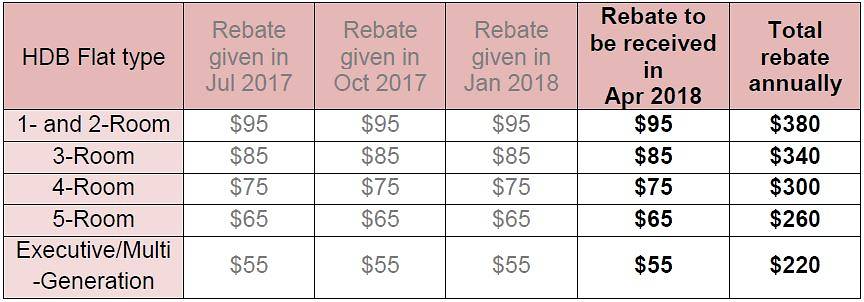
In April, eligible households will each receive a GST Voucher – U-Save of up to S$95 depending on their HDB flat type.
As announced in Budget 2018, eligible households will get an additional S$20 a year for three years, from 2019 to 2021.
“This will help households adjust to the carbon tax when it is implemented from 2019. On average, the increase in U-Save will cover the expected increase in electricity and gas expenses for HDB households arising from the introduction of the carbon tax,” said MOF in its press release.
SINGAPORE: Those looking to get their hands on Huawei’s latest P series smartphones will be able to from Apr 7 onwards, the Chinese tech company said on Monday (Apr 2).
The smartphone maker unveiled its P20 and P20 Pro devices during a glitzy launch event held in Paris, France, late last month when its Consumer Business Group chief Richard Yu shared details about the latest features including the triple-camera set-up for the higher end model.
Mr Cheng Jiangfei, managing director of Huawei’s Consumer Business group in Singapore, said in a media briefing the P20 will be available in only one variant: 4GB RAM and 128GB memory.
It will have three colours – Black, Midnight Blue and Pink Gold – and will retail for S$898, Mr Cheng said.
As for the higher-end P20 Pro model, it will come with 6GB of RAM, 128GB of memory space and three colours: Black, Midnight Blue and Twilight. Twilight, with the touted gradient colour finish, will only be available from May, the executive pointed out.
The P20 Pro will retail for S$1,148, which is cheaper than other flagship competitors currently in the market, including Samsung’s recently launched Galaxy S9+, which costs S$1,348 (64GB) and S$1,498 (256GB).
Apple’s iPhone X, which was unveiled last September, currently tops the price chart, retailing from S$1,648 for the entry-level 64GB model.
Huawei’s P20 and P20 Pro will be available for pre-order from 10am on Apr 2, and this will run till Apr 4, Mr Cheng said.
This can be done via the three local telcos – Singtel, StarHub and M1 – as well as its official online store and third-party e-commerce sites like Lazada, he added.
Consumers will then be able to start getting the handsets from Apr 7, and they will be available on shelves at the same time. Singapore is in the first wave of the company’s global launch strategy, Mr Cheng said.
AI IN SMARTPHONES JUST THE BEGINNING
During the launch of the latest P series phones, Mr Yu also noted how Huawei’s artificial intelligence-enabled Kirin 970 chipset works towards enhancing the photo-taking experience for consumers.
Mr Eric Zhou, planning director for Huawei Technologies’ Wireless Terminal Chipset Platform, told Channel NewsAsia in an interview after the Paris launch event that innovations like predictive focus and improving picture quality is “just the beginning” when it comes to how AI will be applied in the future.
Photo of a plant taken with the P20 Pro’s predictive Greenery setting.
For instance, the smartphones have the ability to identify 19 different scenarios and objects and apply the right technical settings to take the best possible photos, the company touted. And this has room to grow, the executive said.
“Right now, there are settings for Cat and Dog. In future, we could train the machine learning models to include specific breeds of dogs, like Chihuahua – and send these models to people’s phones through over-the-air updates,” Mr Zhou explained.
He added that the Kirin chipset’s AI smarts will not be confined to smartphones either. It could be included in connected cars, smart homes as well as retail, for example.
The company is also looking to expand its Hi AI – the name of its software development kit (SDK) – developer base, which currently numbers more than 200 internationally, Mr Zhou pointed out.
One example of this is its HiKey 970 AI development board, which was introduced in Hong Kong in March. The single-board Linux computer board is one that developers can use to write and test applications, and Mr Zhou said this will be available from middle of April at US$299.
I was standing over a pile of rubble, dressed in heavy-duty overalls and safety boots. I had my helmet, facemask and gloves on.
Along with three other men from Singapore Civil Defence Force’s (SCDF) Disaster Assistance and Rescue Team (DART), we were on a mission to search for survivors buried under the rubble.
Gearing up – DART members have to dress appropriately in heavy-duty overalls, safety boots, helmet, facemask and gloves. (Photo: Ashraf Zainal & Matin Akmal)
DART is an elite team specially trained to carry out such operations. Since it was set up almost three decades ago in 1990, the team has carried out 17 high-profile Urban Search and Rescue (USAR) missions abroad, such as in the wake of the Nepal earthquake in 2015.
I was embedded with the team for a day to get a taste of how these men train for such missions.
Assisting us was Dodge, a five-year-old dog that’s specially trained to locate people trapped in rubble.
When he sniffs out a casualty, he barks to alert rescuers, who then use wireless seismic sensors and a video camera probe to confirm the casualty’s location.
Dodge is trained to smell casualties trapped in the rubble. (Photo: Ashraf Zainal & Matin Akmal)
He will bark when he finds someone who needs rescuing. (Photo: Ashraf Zainal & Matin Akmal)
With the location confirmed, we had to crawl through a small tunnel, then use a drill to break the thick concrete slab in front of us to reach the casualty.
It’s back-breaking work. The hole had to be big enough for the casualty to be pulled through.
While gasping for air, we took turns to do the drilling.
Going through tight spaces in the rubble is not for the claustrophobic – it’s difficult to breathe. (Photo: Ashraf Zainal & Matin Akmal)
It’s back-breaking work to break the concrete to reach the casualty. (Photo: Ashraf Zainal & Matin Akmal)
“One of the most important traits of being a DART member would be to be a team player,” DART Platoon Commander Kelvin Koh said.
“In all the operations that DART is called upon for, it’s never about a one-man show. It’s always about a team, and how to work together as a team to achieve the most difficult scenarios or rescue operations.”
LESS THAN 30 MINUTES, BUT IT FELT LIKE HOURS
Depending on the size and thickness of the concrete, SCDF said it can take up to half a day at times to break through thick slabs of concrete.
Eventually, after what felt like hours (though we were told it wasn’t more than 30 minutes), we broke through, placed the casualty (a dummy) on a stretcher, and pulled it out to safety.
Being a team player is one of the most important traits of being a DART member. (Photo: Ashraf Zainal & Matin Akmal)
The “casualty” is pulled to safety. (Photo: Ashraf Zainal & Matin Akmal)
That was just a snippet of how far the team goes to save a life.
The rubble is one of several training areas at the (HTTC).
Captain Koh said: “I can essentially train my guys here on a day-to-day basis. I can plan a realistic USAR scenario that … will allow my platoon guys to be trained and prepared when they are deployed for such overseas missions.”
The Home Team Tactical Centre (HTTC) houses various challenging obstacles for DART members to hone their skills, specifically the “leaning tower” and piles or rubble. (Photo: Ashraf Zainal & Matin Akmal)
As I found out first-hand, these missions can be dangerous, complicated and a huge test of endurance.
My second mission involves what’s called a “leaning tower”, which is inclined at an angle of 18 degrees. While it may not seem like much, it makes simple tasks like climbing up and down the stairs that much more challenging.
Three members of DART and I were tasked to retrieve a casualty from the fourth storey of the leaning tower and to take it down to safety.
Simple tasks like climbing up and down the stairs are that much more challenging by the 18-degree incline of the “leaning tower”. (Photo: Ashraf Zainal & Matin Akmal)
I could feel sweat dripping from my face as I tried to keep my balance while carrying the heavy load.
By the time we reached the medical team on the ground, I could barely feel my right arm.
As I found out first-hand, these missions can be dangerous, complicated and a huge test of endurance. (Photo: Ashraf Zainal & Matin Akmal)
SINGAPORE: Singapore’s national water safety programme needs a “major revamp” to fit into the Ministry of Education’s (MOE) school curriculum and enrichment programmes to achieve better outcomes in swimming survival.
The former chair of the now disbanded National Water Safety Council Dr Teo Ho Pin said this, even after recent changes to the SwimSafer programme, which Sport Singapore (SportSG) said would provide participants with “a more rigorous water survival and swimming competency programme”.
Dr Teo, who is also Mayor of NorthWest Community Development Council, also called for a national body to spearhead the programme.
In February, SportSG announced SwimSafer 2.0, following a review it undertook with the Education Ministry. SportSG said all MOE primary schools currently offer SwimSafer to their students as part of Physical Education (PE) lessons, and will adopt the enhanced programme.
Those who participate in the programme through private instructors will also be affected. Among the changes, SportSG confirmed that students will no longer no be able to use goggles during the the survival skills assessment.
It said this is to ensure they are exposed to more realistic training should they be “caught in an adverse water condition outside of a swimming pool environment”.
“What SwimSafer 2.0 has done is simply identify a few skill sets and put them into a ‘circuit training’,” Dr Teo said.
“Water safety and survival skills competency can be further enhanced to reduce drowning risks, especially among youths.”
PROGRAMME TO RETAIN STAGES
SportSG said the enhanced programme will retain the current six-stage syllabus, in which students meet increasingly challenging learning outcomes.
After stage 1 for example, they should be able to swim forward 10 metres and backwards 5 metres. At the Gold stage, they should be able to swim 400m continuously, using methods such as front crawl and backstroke.
There is also an optional open water module that students can opt to do after completing stage 3.
SportSg told Channel NewsAsia that participants will spend more time “mastering their basic swimming competencies and water survival techniques”.
But students will no longer have to perform “in-water rescue”, which SportSg said may not be age appropriate. Channel NewsAsia understands this was previously assessed from Stage 3 onwards of the programme. At Stage 3, participants are required to perform a “reach rescue” – pulling a partner to safety.
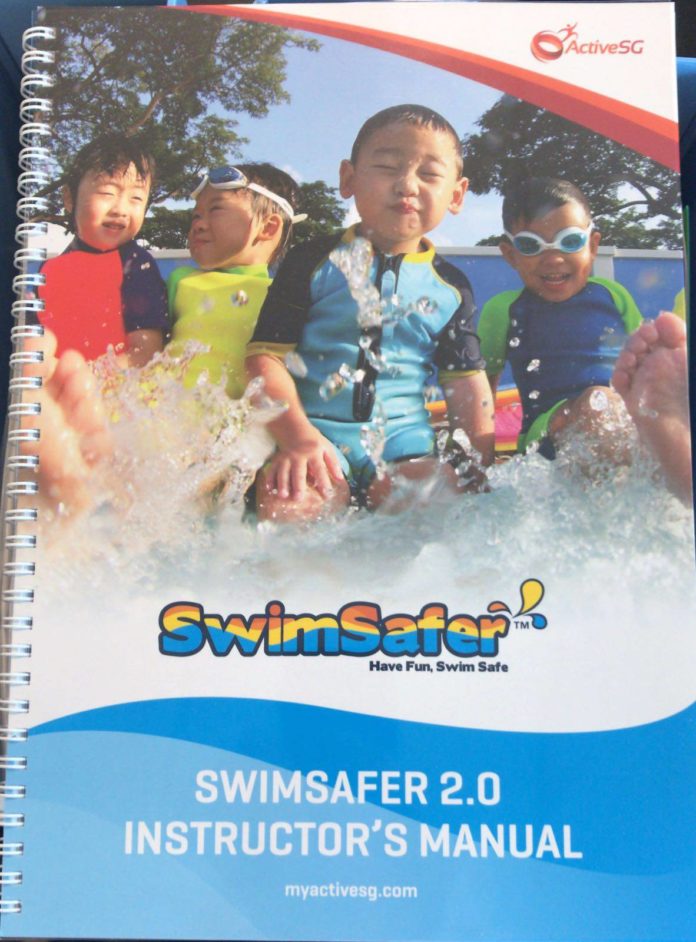
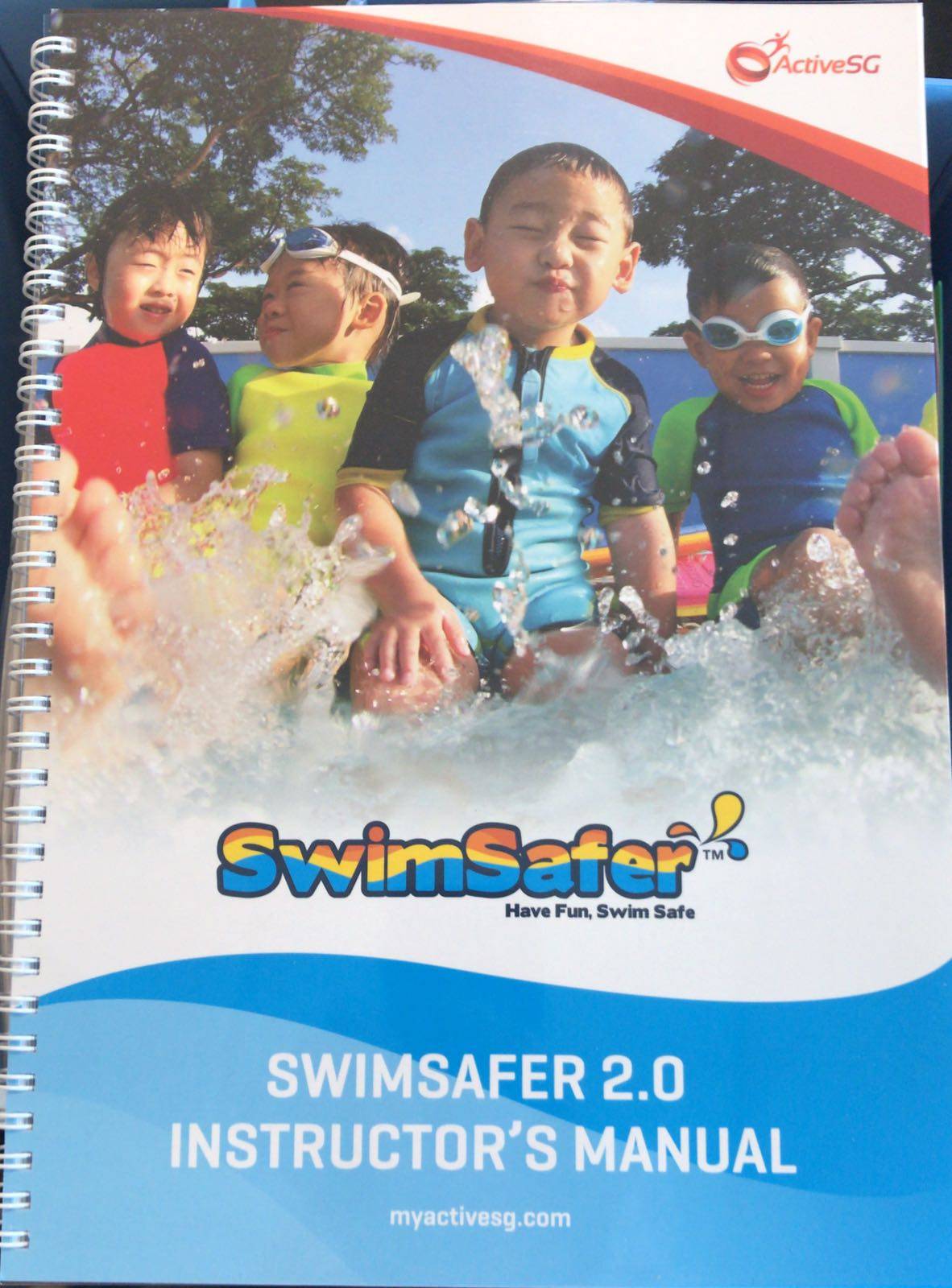
The SwimSafer instructor’s manual.
But they will still be assessed on personal survivability.
Indeed, swim coaches Channel NewsAsia spoke to agreed with the decision to remove this component. Danny Ong from AquaFins said the safe rescue component had become a concern among coaches and that some participants were too young to be able to execute some of the requirements.
Instead, Mr Ong, who said he was among those involved in the review of the water safety component of the programme, said the practical part of water safety now involves throwing a personal flotation device into the water.
“What we need to do is get them to understand the dangers behind it, and not just rushing into action when someone is in trouble,” Mr Ong said.
“In fact, if you look at life saving programmes across the globe, they have even as young as preschooler life saver programme but very different in the sense, they will ask them, if someone gets into trouble, what do you do? Do you jump in? No, you get an adult to help.”
SportSG said there will also be an online quiz implemented in SwimSafer 2.0, “to equip participants to assess risks better and make informed choices and exercise caution before swimming”.
“This will help participants consolidate their knowledge of water safety, including a better understanding of the differences between swimming in a pool and in other water conditions. Upon completion of the online quiz and practical assessment, participants will receive an electronic certificate,” SportSG said in its media release.
NO USE OF GOGGLES FOR SURVIVAL COMPONENT UNLESS MEDICALLY EXEMPTED
Mr Ong also welcomed the move to disallow goggles when being assessed for the survival component at the various stages. According to the instructor’s manual seen by Channel NewsAsia, participants will need to submerge their heads underwater, open their eyes, blow bubbles and identify objects on the pool floor, all without wearing goggles. They will also need to swim 10m without goggles.
“When you talk about survival skills, when it happens out of the norm, and technically, it may not happen in a swimming pool,” Mr Ong said.
“If that happens, he or she will not have goggles when the incident occurs. So we need to get them experienced with their eyes submerged in the water, and after they get out, what must they do. If the child is conditioned in that environment, automatically when an emergency happens, the panic attack will not come in. He will be more rational to conquer that emergency.”
Mr Ong said exemptions will be made for students with medical conditions that require them to wear protective goggles when swimming.
The checklist for gold in the manual.
Another swim coach who attended a SwimSafer refresher course earlier this year said the coaches were informed of the changes. They were also told that students vying for the silver and gold certificates will now need to be timed for their assessment.
“This is good because it enables kids to swim the stroke more efficiently,” Shawn Chua of Able Aquatic School said.
“In the past, this was not the case so they could take their own sweet time to complete the test. So it did not really require them to be good at the stroke and still pass the test.”
Mr Chua said coaches were informed that SportSG will take over administrative matters relating to the SwimSafer programme, such as bookings and payments, from the Singapore Life Saving Society. These services have also been made more efficient through the use of an app.
MOST STUDENTS DO NOT GO BEYOND STAGE 1; STILL AT RISK: DR TEO
The review came some seven years after the SwimSafer programme was implemented in 2010. It replaced both the Learn-To-Swim Programme (LTSP) and the National Survival Swimming Award (NASSA).
The programme was designed by the National Water Safety Council, a body of experts comprising stakeholders from the Home Team, the Naval Diving Unit, and the Singapore Life Saving Society.
“We designed it in such a way that you have to reach minimum (stages of) 1, 2, 3 and (attain the) open water certification to enjoy water sports like canoeing (safely),” Dr Teo said.
But Dr Teo, who is an accomplished swimmer and has a life-saving instructor certification, said the problem is that “everyone finishes (up to) stage 1 and calls it a day”.
File photo of Dr Teo Ho Pin speaking in Parliament.
According to SportSG, some 68,000 participants went through the SwimSafer programme last year. MOE and SportSG did not respond to questions on the breakdown of how many are students from primary schools and how many were those who had registered directly with private instructors.
In a statement, the ministry said about 70 per cent of students enrolled in the programme for the past three years are in stage 1. It said between 60 and 65 per cent passed their respective stages each year.
It is also unclear if they continued on to Stages 2 and 3, although MOE said the programme is co-funded together with the Ministry of Culture, Community and Youth (MCCY) for one cohort per school. It said this funding can be used for any of the swimming stages.
MOE said students can enrol in any stage based on their skills and abilities.
“Those with experience in swimming may begin the programme at a higher stage,” it said.
Mr Ong confirmed that students are assessed at the start of the 12-session programme, and based on their swimming abilities, are split into different stages.
This would mean the majority of students who undertake this programme would need to enrol in classes outside of school time to pursue the higher stages.
It is also unclear how many continue to learn beyond Stage 1. Dr Teo said a student who only finished Stage 1 is not equipped with enough survival or swimming skills to stay safe in the event of falling into the water.
“I set the standards that as minimum, you must be able to swim 15 metres and at the minimum, you must be able to survive 15 minutes in the water,” Dr Teo said of the Council’s intentions when it developed the programme in 2010.
“But at Level 1, you can only swim about 10 metres. It’s definitely inadequate. Because we planned a different tier- hoping schools would drive it to a certain level. We wanted them to do (a minimum of) 1,2,3 as well as the open water module.”
“So we are not achieving the outcomes we would like to achieve,” Dr Teo said.
Dr Teo said he understood the challenges faced by schools, with students already pulled in many different directions through an intense curriculum.
“But If you feel that this is something that every single child should have for a lifetime so that this child or adult will not drown one day, then I think you should invest in this programme.”
DO MORE FOR OPEN WATER SAFETY
When it was implemented in 2010, SwimSafer came amidst reports that more than 65 per cent of drowning incidents in Singapore between 2005 and 2008 occured in seas, rivers and reservoirs.
Last year, after a 12-yr-old drowned in the waters off East Coast Park, Deputy Prime Minister Tharman Shanmugaratnam said authorities needed to do more to equip children with open water swimming skills.
Children playing along East Coast Park. (Photo: Edric Sng)
It is unclear if changes have been made to the optional open water module in the programme. The new instructor’s manual sets out an outline for trainers, in which the theory component takes up five and a half hours, while the practical component takes up three and a half hours.
Mr Ong said under the enhanced programme, students will be asked more questions on open water safety.
“I did share with SportSG and MOE that sometimes we don’t need to bring out kids to the sea to learn open water concepts,” he said.
“We introduced fun play at the swimming pool, creating waves with the coaches, where coaches form two groups, and one group uses the kickboard to create waves and other group swims across.
“It can be a game but it brings across the concept on ‘how (do I) swim through big waves, how do I cope with it without goggles’ and so on.”
HAVE A NATIONAL BODY SPEARHEAD WATER SURVIVAL PROGRAMME
Dr Teo said the review has been timely, but suggested that more could be done.
SportSG said the committee that undertook the review consisted of members from MOE, the Singapore Life Saving Society, SwimSafer Trainers and the National Youth Sports Institute.
File photo of the Singapore Sports Hub. (Photo: TODAY/Wee Teck Hian)
But Dr Teo said having a national council overseeing the programme would allow for a better focus on water safety and drowning prevention.
“Our so called interest is, I throw you in the water, if you can swim whatever stroke, as long as you can swim 15m, whatever stroke, you can do dog stroke, cat stroke, I don’t care,” Dr Teo said.
“As long as you can swim to safety. Or you can float for a certain amount of time, we know you can survive in water. So our outcomes are different.
“Whereas from the Sport Singapore perspective, they may look at stroke for efficiency, the power and so on.”
He said a more structured approach for for the programme is needed.
“The present Swimsafer program needs a major revamp into a modular system for example, to fit into the school’s curriculum and enrichment programs so that more effective outcomes can be achieved with students having good water safety knowledge,” Dr Teo said.
“This especially in open water situations and competent swimming survival skills of staying afloat for at least 15 mins and swimming 15 metres.”
SINGAPORE: When Tina* was sexually abused by her father, she was in primary school and had thought it was “normal” for fathers and daughters to be physically intimate.
“I remember feeling lost and scared. My mother is very proud of the family and I didn’t want to hurt her.”
I didn’t want to be the cause of breaking the family. I was also scared she would not believe me or blame me. I was scared my father would deny everything, then what could I do? I felt so stuck as a child.
The abuse went on for five years, and her feelings of guilt and complicity kept her quiet for a decade. The first time she spoke about her sexual abuse was at the Sexual Assault Care Centre (SACC) last year.
Tina’s story is not unique. In the last two months, at least 13 reports on child sexual crimes appeared in local media.
While media coverage can shed light on the prevalence of sexual abuse among young people, we in turn need to break the taboo and start talking about child sexual abuse. Only when we talk about it can we understand the reality and gravity of such crimes, its impact on children, and how adults can sensitively support survivors.
After all, most cases, like Tina’s, don’t get formally reported; much fewer reach the courts and receive media attention. Countless survivors of child sexual abuse only recognise their experiences for what they are as adolescents or adults.
This raises an important question: Is our society doing enough to help our children comprehend – and receive support for – their experiences of sexual abuse?
PERPETRATORS USUALLY A FAMILY MEMBER, KNOWN TO VICTIMS
In 2017, SACC, the only specialised centre in Singapore serving sexual assault survivors, saw 515 cases of sexual violence. 20 per cent of those were survivors who experienced sexual abuse as a child.
The reality of child sexual abuse ought to be acknowledged beyond its common misconceptions. Many think of perpetrators as strange leering men in playgrounds or outside schools.
But in almost 90 per cent of the cases SACC received on sexual abuse suffered during childhood or adolescence, the perpetrator was a family member, or known to the survivor.
When children do speak out, many are disbelieved or have their experiences downplayed. Sentiments like “it was probably an accident”, or “it’s normal, he’s very touchy-feely” are often used to dismiss children.
Too many adults also default to the assumption that children and teenagers often lie about what happened to them, rather than recognise that abuse can happen anytime, and at the hands of anyone.
Screengrab of Roger Yue, a coach convicted of raping and sexually assaulting a teenage student, outside the High Court.
NEEDING TREMENDOUS COURAGE
It takes tremendous courage for any child to speak out against a perpetrator who not only wields significant power over them, but is also someone known, and often loved, by them and other people.
Another one of the child sexual abuse survivors that SACC saw last year, Lisa*, who was molested by a tuition teacher in her teenage years shared:
He was a really respected tuition teacher, known for getting students good exam results. People knew him as being kind and helpful. Who would believe the words of a teenager over a respected teacher?
This commonly-held suspicion about young people’s stories make it all the more easy for perpetrators to continue their abuse.
In some cases, the perpetrator may use the threat of harm or force to keep the survivor silent, others intentionally exploit a child’s emotional vulnerability and innocence to build trust.
In one recently reported case earlier this month, a perpetrator had given his 12-year-old victim gifts in exchange for sexual acts, and threatened to release nude photos of her if she broke things off with him.
Many survivors say the perpetrator “would praise me a lot”, “buy a lot of things for me”, and “spend a lot of time with me”.
This emotional power play may make a child feel confused about what is going on, particularly if the abuse occurs under the guise of friendship, concern or affection.
HELPLESS AND OVERWHELMED
Amid all this, it is normal for adults to feel overwhelmed or helpless when sexual abuse is brought to their attention. But all adults – including parents, older relatives and teachers – can responsibly and supportively offer opportunities for, and emotional support to children to talk to them in confidence about their experiences of abuse.
There are many ways to listen, show empathy, and seek help together with the survivor, for example, by allowing the child to finish speaking, and assuring them that they are listened to, not judged or blamed.
Children deserve to have their stories of sexual abuse taken seriously from the start. The damage when adults choose to instead question, judge or dismiss sexual abuse can be lasting.
Speaking to children from a young age about their bodies, respect for personal boundaries (both their own and others’), and letting them know that they can speak to you when these boundaries are encroached upon can go far in helping children identify signs of abuse early.
Child sexual abuse is traumatic for the survivor, and can be made worse if they are expected to be in close contact with the perpetrator.
Family members or loved ones of the survivors can tap on resources like family service centres, counselling centres or helplines to learn more about the options they have to protect the survivor and prevent further abuse.
Family members of survivors can also seek support to cope with their own emotions. One mother who sought support from SACC said:
Counselling gave me the space to share my emotions and come to terms with what had happened in my family.
Creating safe spaces for children to speak about sexual abuse requires effort and time, but it is urgent work that needs to be done to break the taboo of sexual violence.
Only when we believe children, can we create a world where their boundaries, agency and lives are truly respected, and ensure the road to recovery for young survivors is paved with support and compassion.
*Not their real names
Laika Jumabhoy is senior case manager at AWARE’s Sexual Assault Care Centre. The Sexual Assault Care Centre can be reached at 6779-0282 from Mondays to Fridays, 10am to midnight.
SINGAPORE: There is no doubt that Liew Mun Leong has had an illustrious career. The current Chairman of Changi Airport Group (CAG) was also the founding President and CEO of CapitaLand Group, a public listed real estate company, between 1996 and 2012.
At 72, you might think that he would look back on his achievements and decide it is time to call it a day. But he famously says in practically every interview that he does not believe in retirement. He tells me the same thing, “For sure, you will turn senile if you stop doing work.”
His statement is influenced by what happened to his late father.
Mr Liew and his brother felt that they could provide for their father and persuaded him to retire at 67 from his job as a lathe machinist. His father, he says, became senile, declined and passed on.
Mr Liew clearly regrets this.
Hence, in addition to his chairmanships at CAG, Surbana Jurong and Pavilion Gas, he is Provost Chair and Professor (Practice) pro bono at NUS Business School and the Faculty of Engineering.
His sprightly manner belies his years and he maintains a glint of excitement in his eyes during our interview. Talking about his work and life often has that effect on him, he says.
“I WENT TO A GANGSTER-INFESTED SCHOOL”
Trained as a civil engineer, he spent 22 years in the public service developing Singapore’s Changi Airport, military airports and establishments.
In the private sector, over a span of 21 years, he led 10 publicly listed companies in four countries.
He achieved all this with what could be called a “modest” education.
“I always get quite upset when people ask me was in Raffles Institution or whether I went to Cambridge or Oxford. I say, ‘No. I went to a gangster-infested school called Queenstown Technical School.’ In those days they were all gangster schools and I didn’t get a scholarship to Cambridge or Oxford or Harvard but I think what’s important is you have the fundamental training and you are prepared to use common sense and pragmatism to do things.”
He graduated from the National University of Singapore, but when he went on to be a civil engineer building camps for the Ministry of Defence, he noticed he stood out.
“When I joined the Ministry of Defence, I was the first civil engineer there and I was swamped by scholars. Almost everybody is a scholar. I’m one of the few non-scholars.”
He didn’t let it bother him though.
“I told myself that I have no fear of them. Why should I? It’s about your own confidence level, your own thinking that you can deliver.”
His career choice to be an engineer was inspired by his father.
“He admired engineers when he worked as a machinist. He was just a workshop person. The engineers were the ones who gave workers overtime pay and instructions and could remove you if they chose. At that time, they were typically British and he would come back and tell us how great they are. They were like God to him. So I said, ‘I can be God also’.”
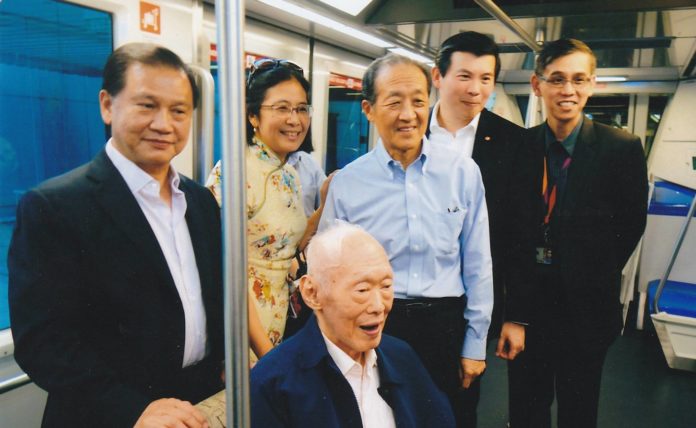
Liew Mun Leong with the late Mr Lee Kuan Yew at Changi Airport. (Photo: Changi Airport Group)
ARE HIGHER FEES AND LEVIES AT CHANGI AIRPORT JUSTIFIABLE?
His civil engineering skills enabled him to build Changi Airport’s first runway.
Today, Changi Airport has won numerous accolades and been named the world’s best airport several years in a row.
However, recent news that travellers flying out of Changi Airport will have to pay more in passenger fees and levies from Jul 1 to fund a major expansion of the airport, including the building of Terminal 5, has invited criticism.
The expansion is needed to keep up with growth and maintain Changi’s regional hub status.
It will mean that airlines will also see increased costs. Landing, parking and aerobridge fees, which are applicable to all flights at Changi Airport, will increase by 1 per cent from Jul 1. It will be further increased by 1 percent a year until 2024, when a review will be conducted.
The bulk of the costs will be borne by the Government and CAG, which operates the airport, but even this has not placated travellers and airlines.
As chairman of CAG, he feels the charges are justifiable.
“The project costs tens of billions of dollars. It’s an astronomical amount and it’s really a strain on the budget. So the Government has to work out how to finance this tens of billions of dollars. Fortunately we have built up a strong balance sheet but that’s not enough and if we have to get grant to get it done, it will also be a big strain on the reserve, on the overall budget. To me, the public who is using it is gaining a lot and we must start to learn how to pay for it.”
Others such as Hong Kong International Airport (HKIA) and those in Dubai and the United Arab Emirates have introduced similar charges to fund their own growth plans.
But the International Air Transport Association (IATA) has spoken up against this, saying it opposes pre-funding.
“You can start charging when it’s built but then there will be a big hole first in our budget. We are already building the third runway and we will use the third runway in three years or so. We need to share the burden of this big huge budget with the public who is using it,” he says.
He admits he considered other options.
“I can absolutely say to the Government that I can use the capital market to finance entirely the whole project. There will be a lot people, a lot of Wall Street bankers who will say, ‘We will help finance it.’ There will be plenty of people who want to invest in the best airport in the world. But the airport will be partially owned by the capital market. Do you want that? I don’t like the idea because once it is owned by the capital market, they can then do a lot of things that you will not agree in the long term interest of Singapore.”
IATA has called for more transparency on the projected costs and the proportion paid by the Government, CAG and users. This is something HKIA has been transparent about.
But Mr Liew reiterates that the Singapore Government has so far “decided that we should not discuss the total budget”.
“I think the budget is something that the Government wants to manage progressively. In a very big budget situation, the Government will have the prerogative to keep that confidentiality.”
Others have suggested tiered charges with budget airlines being charged lower fees.
“We think that it’s got to be shared equally. In the airports, when you land, you land. Whether you are a bigger aircraft, lighter aircraft, it doesn’t make any difference. If you want to use a good facility, you will accept that these are the charges.”
He seems confident that Changi Airport can remain competitive in spite of being one of the most expensive airports in the region for users.
“I think we will have to make it competitive by our service level, by our efficiency. We need to have a terminal big enough where we can cope with the demand and where we can also cope with the level of services that we now have.
“We have to keep the Changi experience, the service level. Do the bags come in early? We have standards. The first bag must come in within 11 to 12 minutes. Does it happen? What happens to cases where the bags are lost? How do we recover it?”
Liew Mun Leong also sits on the board of CapitaLand Hope Foundation (the philanthropic arm of CapitaLand). (Photo: CapitaLand)
REITS ARE “A PROBLEM” TODAY
Mr Liew is also known for being the founding President and CEO of CapitaLand Group.
He was instrumental in many of its successes, including venturing overseas.
“We were advised against it. People said nobody has made money doing overseas real estate but we said we have no choice. The market here was too small. So we went to China and we started from fundamentally building, a foreign company in real estate in China and we did it. It’s about patience and I got a group of very, very good outstanding people to work with me and we just told ourselves that we will make it.”
But there are other aspects of his career in real estate that he doesn’t seem very proud of.
He pioneered Real Estate Investment Trusts (REITS) in Singapore. REITS are widely believed to be driving up rents in malls and putting a strain on retailers while benefiting investors.
“I think the problem is not with our REITS. The problem is what other people do with REITS. The way we manage our REITS is we have a shopping mall and we try to do asset enhancement. That means we try to enhance the property whether it’s Raffles City or somewhere. We try to see where are the additional spaces we can commercialise, what renovation we can do, what asset enhancement we can do to create the dividend.
“If you look at Raffles City, we just put one more floor in the atrium and suddenly we have much more space, more tenants paying comparatively less in terms of rent at that time. So our rental increase for the first three years was only about 3 to 6 percent. The bulk of our dividend come not from rental increase. It came from asset enhancement, how we use the space more effectively, more efficiently or to change the product mix. So that is very professional management of the REITS.”
Clearly, he feels what is happening today in the REITS sector is unprofessional.
“Some REITS are just saying, ‘I put this shopping mall in the REITS. I’m going to increase rent, increase rent’, and I admit this is now a problem. I think today landlords are not doing enough in terms of increasing the productivity of the space.”
He seems to take it personally as it has affected retailers he has been loyal to for many years.
“There is a hairdresser I have been going to for the last 16 years. Recently they said, ‘Mr Liew, you can’t do your hair here because they want to increase the rent by 40 per cent. I’m only a hairdresser. I cannot cut 40 per cent more hair.’
“I think the landlord must understand this but they say, ‘Oh, I can get another retailer who is prepared to pay the amount.’ But my thinking is instead of just chasing rent, you must have long-term relationship with tenants. You must have the understanding that your retailer is your partner. If he cannot survive, he will go.”
But what do the landlords have to lose since, as he himself pointed out, there’ll be other potential tenants willing to pay?
“But it will come to a crash. The reason why this is happening is that a lot of people enter into the retail market without understanding the business. Somebody has a daughter who wants to start a restaurant, somebody has a wife who wants to start a boutique and there are new entrants and these new entrants do not understand the business. They don’t understand the calculation. They enter the market, pitch it high and then they go under and close shop. This is a very unhealthy trend.”
LESSONS OF A LIFETIME
He himself has had to learn some painful lessons. We talk about one his failures that still haunts him.
“I lost the Integrated Resorts tender. It was so painful. Somebody with a better background to beat us to it. For example with Marina Bay Sands, we were very competitive. The Government said you need 400,000 square feet of space. So we proposed 400,000. Sheldon Adelson built 400,000 plus one more million square feet. He won. One more million square feet of MICE which cost him S$1 billion more. So how did he survive? Do you know how he survived? Because it cost him $1 billion, his market value went up S$3 billion. I wish I had seen that part of it.”
It was one of the most important lessons he learnt in the private sector.
But he learnt several before that including when he made the transition from bureaucrat to businessman.
“Many people doubted me, but I think as a civil servant, I developed certain capabilities. For example, a high degree of integrity but more importantly, all these years, 22 years in the Government, I learnt to be a pragmatic civil servant.”
Overcoming bureaucracy was a process that he mastered quickly.
“There was a heavy burden on me to get things done and I was prepared to make discretional decisions to get things done.”
One of the examples he gives me goes back to the early days of building Changi Airport.
“When we first started Changi, it was really a massive site but the budget said that you can only have this number of staff and this number of equipment, but we couldn’t support the project. I couldn’t even get a modern typewriter or a fax machine. It will take years to approve. So what did I do? I put it all under the contractor supply services. You supply to me a fax machine, typewriter, everything and it is under the contract to be paid for, then returned. The contractor is supplying equipment anyway so now I’m saying that in addition to supplying equipment, you supply these other things to support the project.”
Even though some claim he was circumventing the rules, he says it was above board and even checked the Government’s instruction manual on such issues to be sure.
He is naturally a pragmatic person, he says.
“Finding solutions to problems without necessarily referring to past precedents or doctrines or theories or dogmatic thinking and at the same time, keeping your core values right, doing it for the right reasons. I was always prepared to answer for it.”
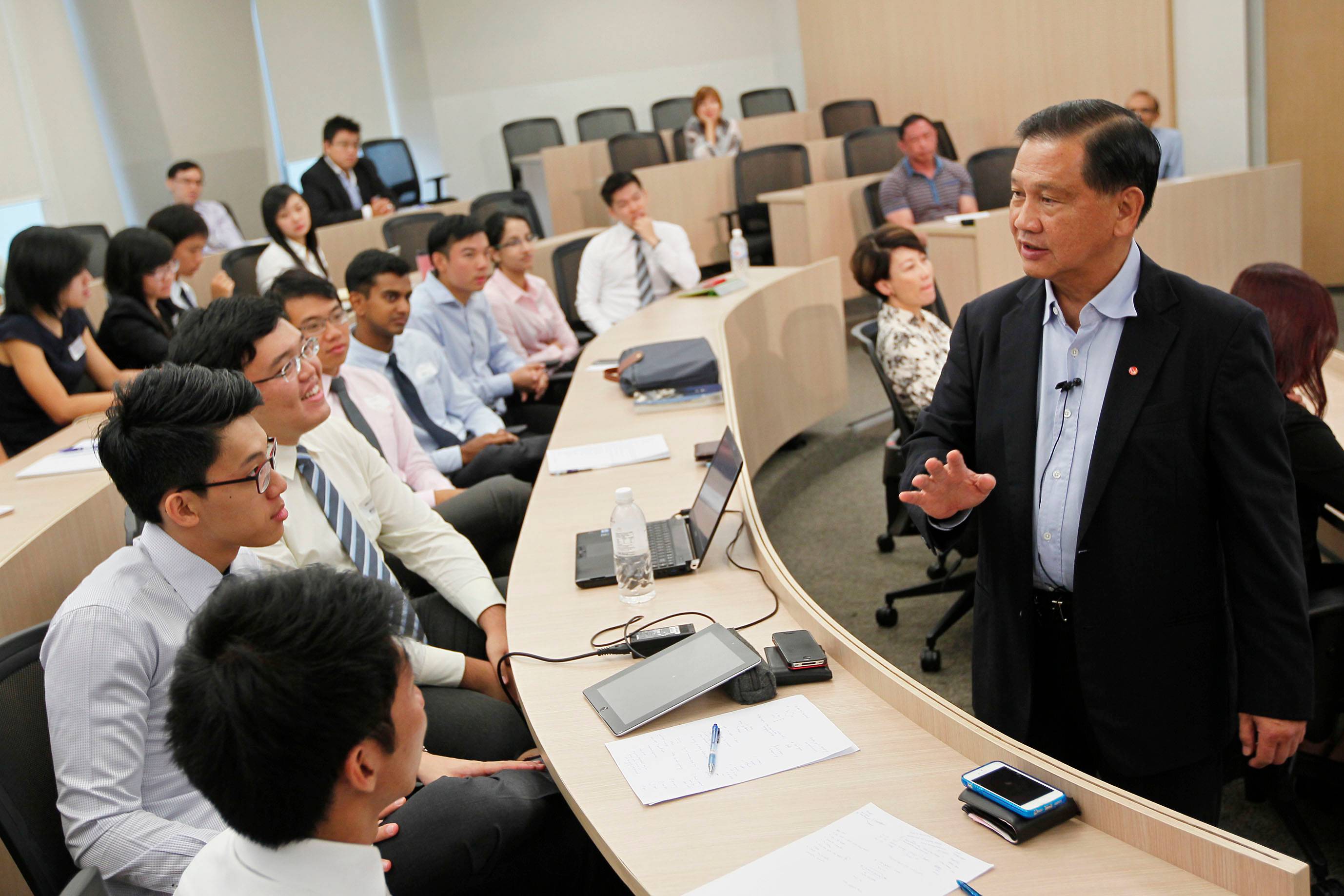
Liew Mun Leong teaches pro bono at the NUS Business School. (Photo: NUS Business School)
THE MERITS OF “BRAINWASHING”
Today, his lectures to students are peppered with such examples.
“I always think that education is a very committed task. Unless your people are educated and you are better-trained, you will not get a good workforce.”
He started a training institute in CapitaLand called CLIMB which stands for CapitaLand Institute of Management and Business.
“The ‘B’ also stands for brainwashing,” he says facetiously.
“My version of brainwashing is that you will have certain views that we might disagree with and we try to change it.”
That sounds dangerous, I remark.
“No, no. For example, we think that integrity is very important, so if you don’t have it, we have to brainwash you! Nothing to do with some ulterior motive to direct you in an untoward way,” he says laughingly.
Over the years, he claims he has managed to do 8-hour lectures towards this effort.
“If I invest in my staff to teach them the right things, I save a lot of my time, I save a lot of my problems down the road.”
As he teaches young aspiring entrepreneurs today, he feels many have romanticised the idea of running a business.
“To be an entrepreneur is one thing. To be a business manager is another thing. But you need both. Most youngsters come into it without knowing what is it all about.”
“I DON’T WANT TO BE ON MY DEATHBED AND SAY I HAVEN’T DONE ENOUGH”
At 72, he certainly knows what it is all about and continues to have business goals to achieve.
“I want to build urban-planning consultancy Surbana Jurong into a powerhouse. We are in 40 countries. I want Singapore to have a company that can do urbanisation and infrastructure project all over Asia. It’ll be like building another CapitaLand. And of course developing Changi Airport.”
“I don’t want to be on the death bed and say I haven’t done enough.”
His proudest achievement remains Changi Airport.
“From day one, over 40 years ago and I’m still there.”
When asked what he hopes his legacy will be though, he says he doesn’t think about it.
“Actually, I don’t need legacy. Why do I need legacy? People know me. They recognise me in the streets to talk to me. My main job is to help others. How do I help the CEOs to see? How do I build talent in schools? I do these things pro bono but I feel that I am occupied and I’m growing.”