DAS Charity Movie Screening
Wednesday, April 25, 2018 at 7:00 PM
Wednesday, April 25, 2018 at 7:00 PM
Cathay Cineplex, Cineleisure Orchard
8 Grange Road, Singapore, 229223 Singapore
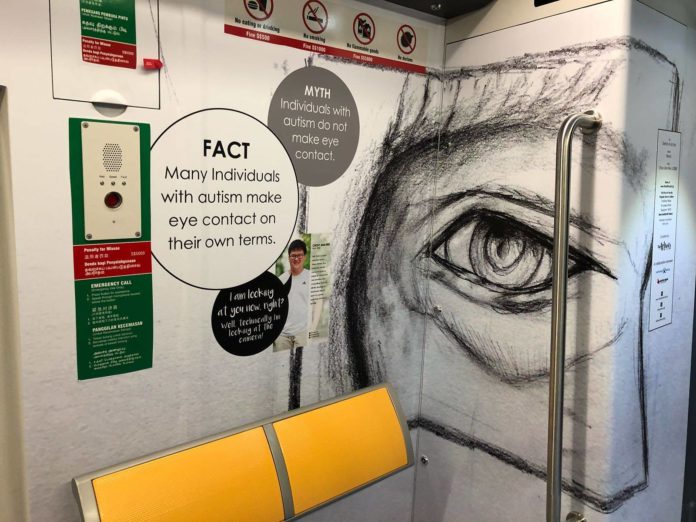
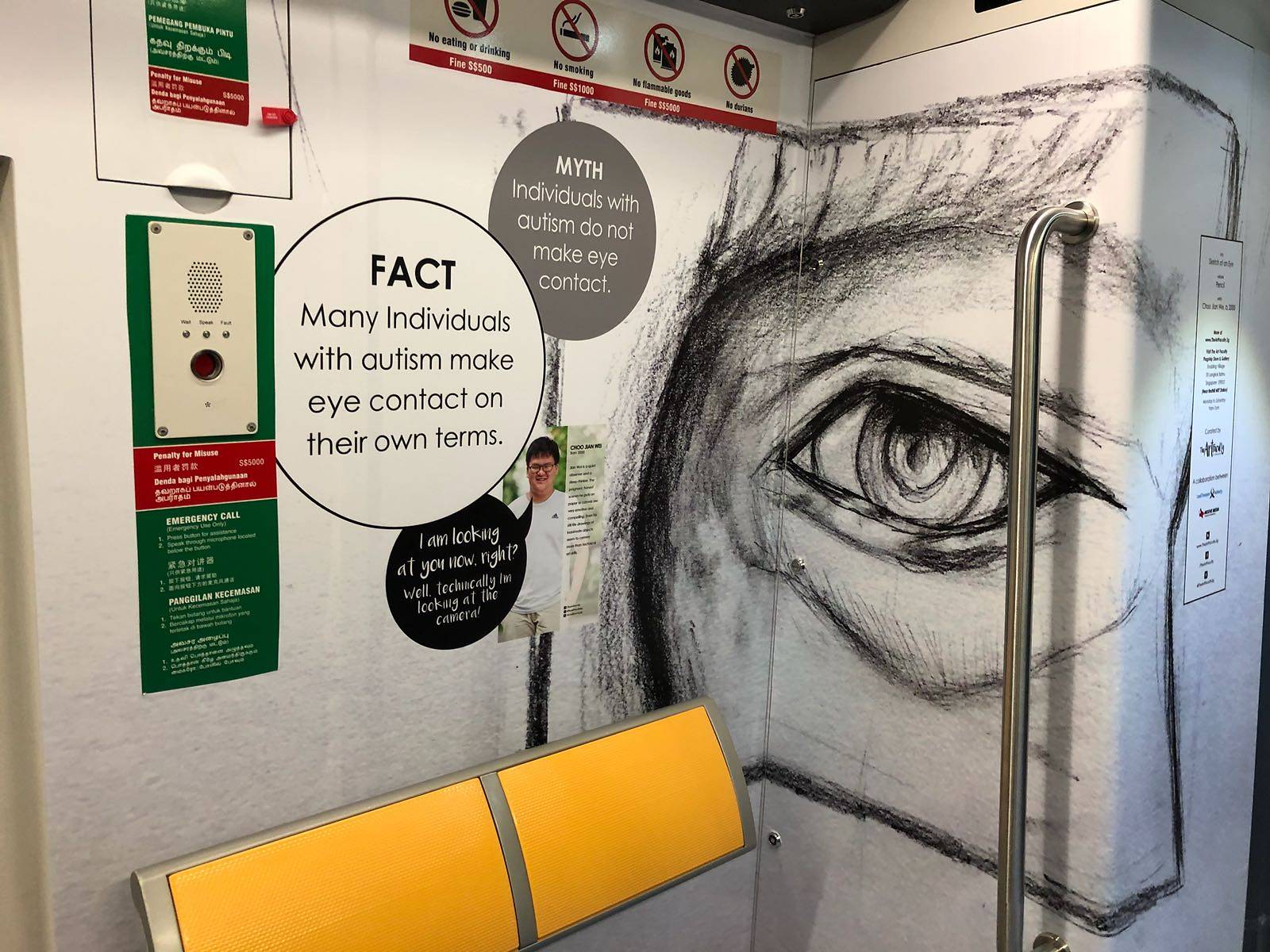
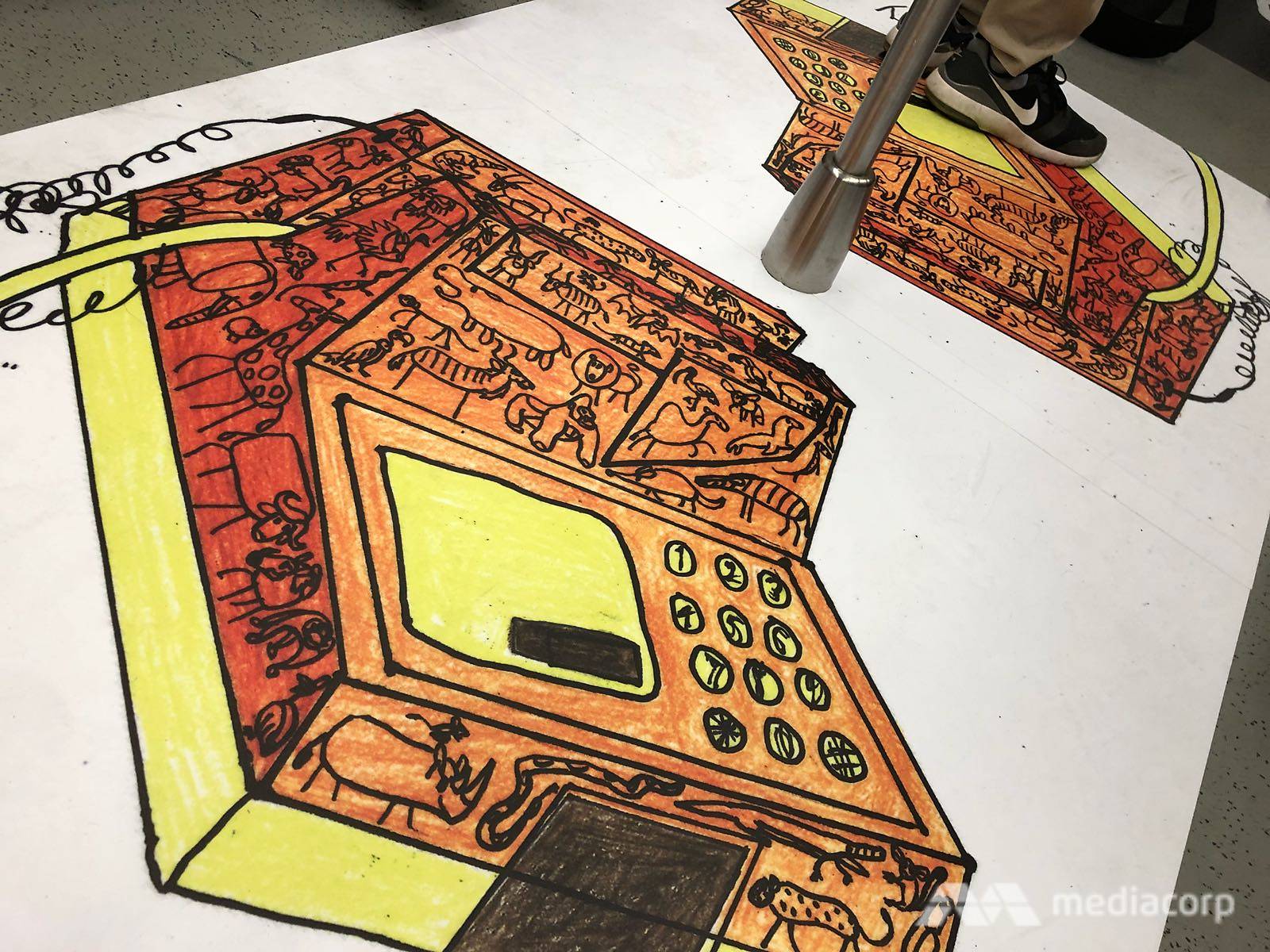
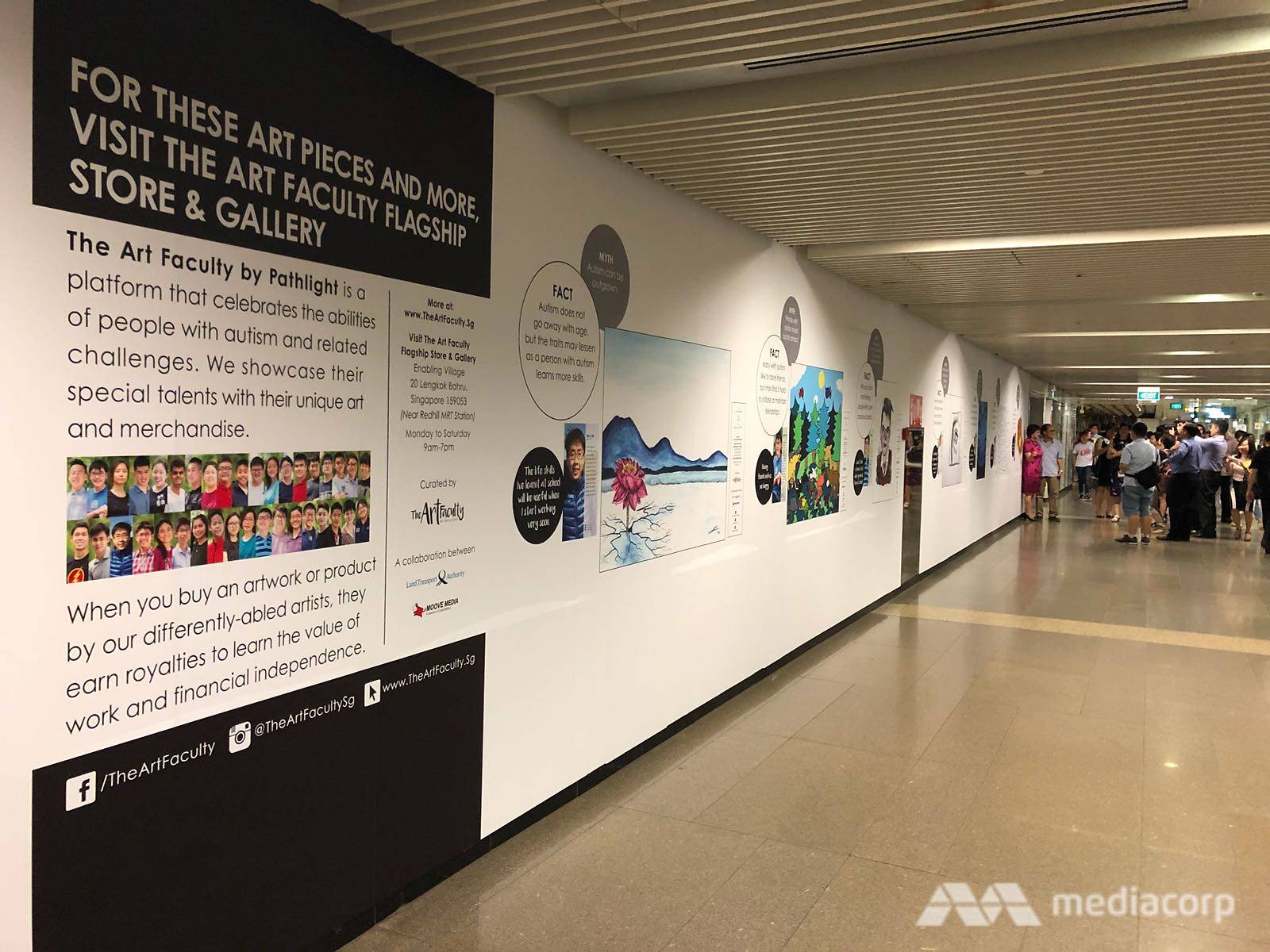
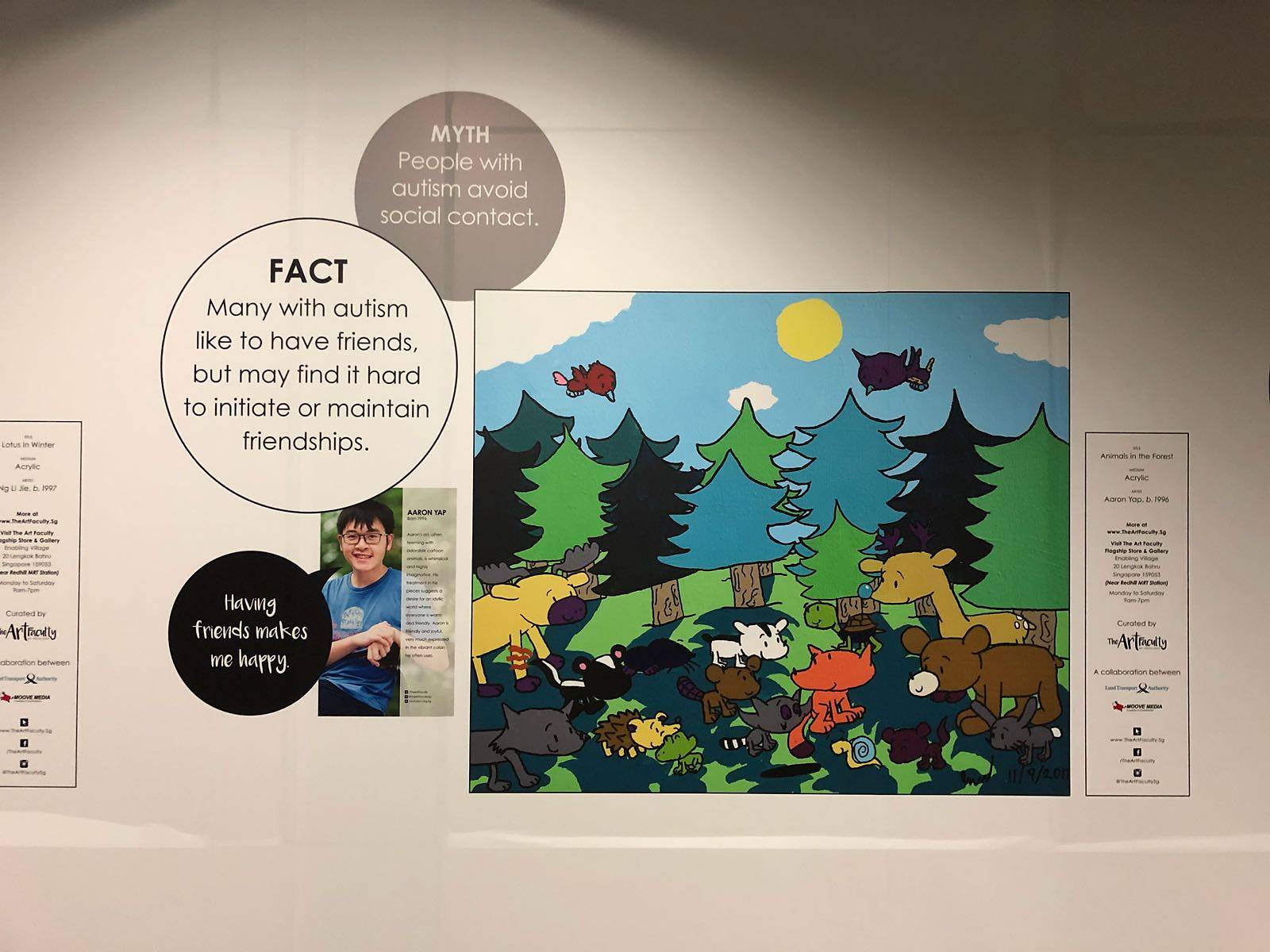
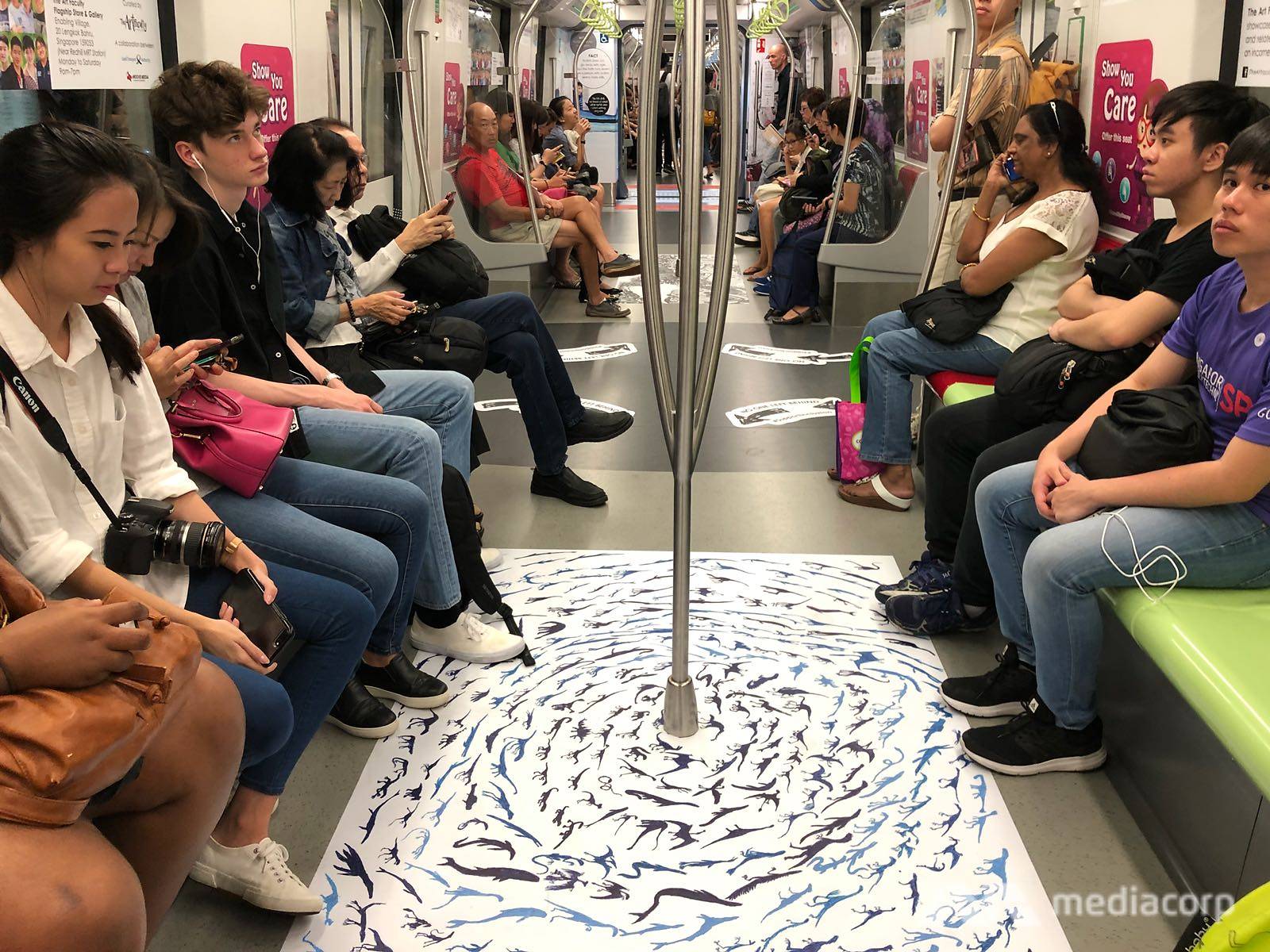
SINGAPORE: Spot something different about your commute on the Downtown Line? A train and four interchange stations – Bugis, Newton, Serangoon and Tampines – have been decked out with artwork from artists from Pathlight School, an autism-focused school.
Artwork from artists from Pathlight School in a Downtown Line train. (Photo: Howard Law)
The month-long community outreach programme featuring contributions from Pathlight School’s artist development programme is a collaboration between the Autism Resource Centre, the Land Transport Authority (LTA) and SBS Transit to commemorate World Autism Awareness Singapore.
Types of artwork featured from artists from Pathlight School on a Downtown Line train. (Photo: Howard Law)
It aims to “raise awareness of autism and celebrate the talents of people with autism”, the Autism Resource Centre and Pathlight School said in a joint news release on Thursday (Apr 12).
“People with autism are very much a part of Singapore and have much to contribute.
“It is time to celebrate what they can do, instead of thinking of them as persons with disabilities,” said the president of the Autism Resource Centre and school supervisor of Pathlight School Board Denise Phua.
“One of the best ways to better understand persons with autism is through their artistic creations, which reflect their inner thoughts, fine attention to details and passion for topics close to their hearts,” Ms Phua added.
Artwork from artists from Pathlight School seen at Bugis MRT station. (Photo: Howard Law)
Close-up of a piece of artwork along Bugis MRT station. (Photo: Howard Law)
World Autism Awareness Day is celebrated yearly on Apr 2, a day used to highlight autism and the need to include those with autism as an integral part of society.
The Autism Network Singapore (ANS), an alliance comprising four non-profit autism service providers, organises a series of events every April to mark this occasion.
This year, these initiatives include a series of movies relating to the theme of autism, including locally produced “Wayang Kids” and a staging of “The Curious Incident of the Dog in the Night-time”.
The featured pieces are part of the commemoration of World Autism Awareness Singapore. (Photo: Howard Law)
According to the news release, there are about 30,000 individuals with autism spectrum disorders in Singapore and many of these individuals struggle to have their condition recognised and respected because of the lack of understanding about autism.
Many also face challenges when trying to access the support they need.
“Partners operating essential services like the LTA and SBS Transit, are important in the efforts to not only include members of the autism community in mainstream society but also to connect with key outreach partners,” said Ms Phua.
SINGAPORE: The Malaysian man accused of helping former City Harvest Church leader Chew Eng Han flee Singapore in February was on Thursday (Apr 12) sentenced to six months in jail.
Khoo Kea Leng, 45, pleaded guilty to one charge under the Immigration Act.
He had collected S$8,000 in cash from Chew on Feb 20 as partial payment for helping him skip town to avoid serving jail time. The plan was for Chew, 57, to flee to Malaysia, according to court documents.
Khoo met Chew in the vicinity of Block 75 Marine Drive, near East Coast Park, to discuss escape plans and for Khoo to collect payment, a court heard.
Khoo was then a freelance driver who ferried passengers between Singapore and Johor Bahru and other parts of Malaysia.
Chew was arrested at sea the next day, Feb 21, and charged the following morning with fleeing the country from Pulau Ubin – an unauthorised point of departure – in a motorised sampan.
He had been on bail of S$1 million and was due to turn himself in on Feb 22 to start serving a jail term of three years and four months for his part in misappropriating S$50 million of City Harvest Church funds. The fraud is the largest involving a charity in Singapore’s history.
The sampan, piloted by fish farm owner Tan Poh Teck, was intercepted by the Police Coast Guard about 2.4km away from Pulau Ubin after a tip-off.

Tan, 53, has also been charged. He faces three charges of helping people to flee Singapore illegally in his fishing boat.
Chew, who is represented by Mr Jonathan Phipps, and Tan will next appear in court on May 3 for a pre-trial conference. Chew’s older brother Eng Soon, 61, was arrested the same day. He has not been charged.
Follow our new CNA LIFESTYLE page on Facebook for more dining stories and videos
SINGAPORE: Every week, a new restaurant is born in Singapore. So diverse are our city’s offerings that we have eateries serving Spanish small plates, French nouvelle cuisine, new-fangled bak chor mee, gourmet grilled cheese sandwiches, and Chinese dim sum dyed blue. No doubt about it — if you can think it, we have it.
But like all things trendy, what’s hot today often turns stone cold in a matter of six months. Throw in high rents, a lack of manpower and rising food costs, and the average life span of a restaurant in Singapore is woefully short. All too often, restaurants shutter as soon as their leases run out. Which is why a home-grown restaurant that has managed to not only stay in business, but thrive for 47 years, is something worth celebrating.
Many think of Rang Mahal as an Indian fine-dining restaurant that opened at the Pan Pacific Singapore in the early Noughties. What they don’t realise is that its history goes back to 1971, when it started life as a casual family restaurant serving traditional Indian fare at the now-defunct Imperial Hotel, near the old National Theatre off River Valley Road.
(From left) The late Mr Shyam Sundar Ji Jhunjhnuwala, Mrs Vidya Devi Jhunjhnuwala, Mrs Ritu Jhunjhnuwala and her husband Mr Surya Jhunjhnuwala. (Photo: Brand Cellar Pte Ltd)
The old Imperial Hotel on Jalan Rumbia, off River Valley Road. (Photo: Brand Cellar Pte Ltd)
“At that time, it was also quite a musical place,” recalled Rang Mahal’s managing director, Mrs Ritu Jhunjhnuwala. “We had a sitar player, a tabla player, and there was also a dancer. People used to come to Rang Mahal for the music.”
Her late father-in-law Mr Shyam Sunder Ji Jhunjhnuwala, helmed the family-owned Hind Group, which bought what was then Oberoi Imperial Hotel in 1977. The family’s decision to sell the hotel in the late 1990s meant the restaurant would go along with it. Loathe to see it disappear, Mrs Jhunjhnuwala suggested they re-open the restaurant elsewhere. “And that’s how we ended up at Pan Pacific,” she explained.
The move in 2001 spawned a new era for Rang Mahal, as it transformed from a casual, family-style restaurant to something decidedly more upscale. “We felt that there were already a lot of restaurants in Singapore serving traditional Indian food, and there wasn’t an Indian fine-dining concept,” she said.
ROYALTY AND BOLLYWOOD
Today, 16 years after that first move, Rang Mahal remains in the top ranks of Singapore’s Indian fine dining restaurants. Besides its cabal of regular guests who have patronised the restaurant for generations, it has also played host to royalty, heads of states, and Bollywood celebrities.
Among its roll call of guests are the late former President of Singapore SR Nathan, members of royalty from the UAE, and Indian celebrity fashion designer Suneet Varma.
The secret to its success, said Mrs Jhunjhnuwala, is constant reinvention while cleaving close to its traditional Indian roots.
Rang Mahal at the Pan Pacific Singapore 10 years ago. (Photo: Rang Mahal)
Rang Mahal at the Pan Pacific Singapore today. (Photo: Rang Mahal)
“Staying relevant is important. We have to keep innovating. You can only serve the same kind of food for a few years, then you need to change or people get tired of the same old stuff,” she said.
True to this ethos, the menu’s focus shifted to lighter Indian fare when the restaurant moved to a new location across the floor at Pan Pacific Singapore in 2012.
“My husband and I had become conscious of what we eat. And because our diners are made up of a mainly corporate crowd, we knew we had to make the food lighter so they wouldn’t feel sluggish after a meal,” she told CNA Lifestyle.
The kitchen stopped using heavier ingredients like cream and ghee, and replaced them with more healthful things like avocado oil and nuts. They began serving soups and salads, amuse bouche and palate cleansers, and contemporary dishes like clove-smoked aubergine tossed with ginger and smoked tomatoes.
IT TAKES A VILLAGE
To give her traditionally trained chefs exposure to new ways of cooking Indian food, Mrs Jhunjhnuwala invited renowned contemporary Indian chefs to cook at Rang Mahal as part of special promotions. With Michelin-starred names like Atul Kochar and Vineet Bhatia working in their kitchen, the chefs learned new perspectives of Indian fare and saw how they could evolve their cuisine for their latter-day audience.
Chef Milind Sovani has cooked for Bollywood A-listers like Amitabh Bachchan and Prime Ministers Indira Ghandhi and Rajiv Gandhi. (Photo: Rang Mahal)
While Mrs Jhunjhnuwala has shaped Rang Mahal’s evolution, much of its success can also be attributed to chefs Vinod Kumar and Milind Sovani. Chef Kumar has been with the restaurant since 1990 and is affectionately described by Mrs Jhunjhnuwala as a chef who “can do anything”.
“He is multi-talented,” she said. “Many (Indian) chefs specialise in certain styles of cooking, like tandoor, thavaar, curries or desserts. Vinod can do everything well.”
The much-acclaimed Chef Sovani joined the restaurant in 2002 and returned to India in 2006, where he has cooked for Bollywood A-listers like Amitabh Bachchan and Prime Ministers Indira Ghandhi and Rajiv Gandhi. He came back to Rang Mahal last year and has set about his task of taking the restaurant into the future and, hopefully, earning them a Michelin star or two in the process.
Roomali Masala Papad. (Photo: Rang Mahal)
Parsi Kheema Per Eeda, Maska Bao. (Photo: Rang Mahal)
AND NOW, THE WORLD
For Rang Mahal’s next act, Mrs Jhunjhnuwala is planning to take the brand international, starting with her family-owned Naumi Hotels in Australia and New Zealand.
In the meantime, the restaurant continues to innovate with its successful brand of contemporary Indian fare.
The latest menu serves up novelties like tandoori fondue, comprising an assortment of grilled chicken kebabs and cubed garlic naan served with a cheese-based makhni sauce (much like the sauce in traditional Indian butter chicken).
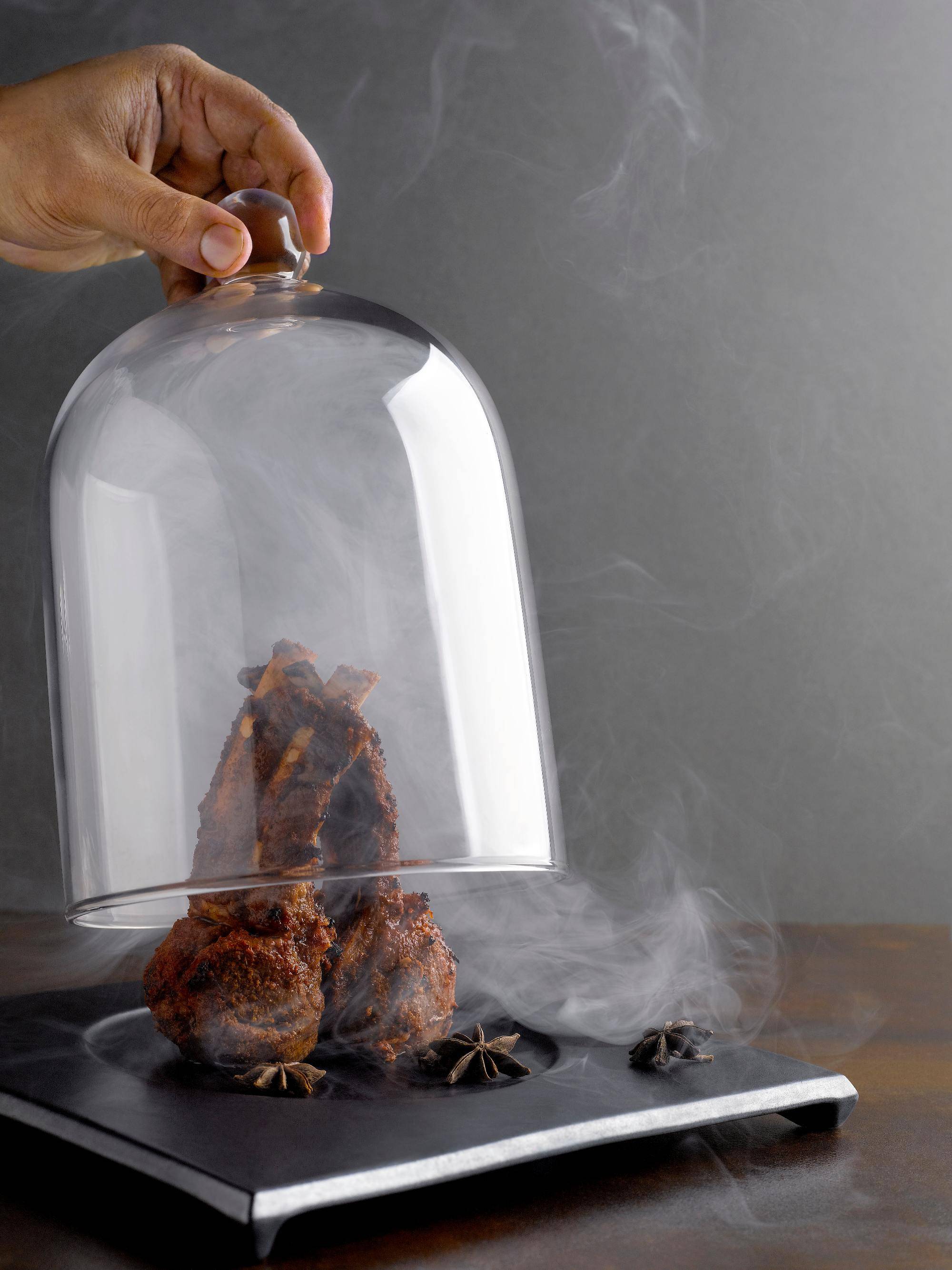
Dhuwandaar Lamb Chops (Photo: Rang Mahal)
Tandoori Fondue – An Ensemble of Kebabs. (Photo: Rang Mahal)
There is also the giant roomali masala papad, a wok-sized pappadum topped with chopped onions, tomatoes, chillies and spices.
Already, dishes like these have found their way across Instagram, compelling avid foodies to visit the restaurant for their own fix and feeds. Popular as they are though, Mrs Jhunjhnuwala knows that these are fads.
“People hear about these out-of-the-box items and they come because they think it’s interesting,” she said.
“They order it once or twice – but these are never their favourite things. It’s always the classics that people come back for.”
And that, in essence, is the key to the restaurant’s longevity: A shrewd understanding and ability to strike that fine balance between modernity and classicism.
Level 3, Pan Pacific Singapore, Tel: 6333 1788. www.rangmahal.com.sg
Follow our new CNA LIFESTYLE page on Facebook for more wellness stories and videos
SINGAPORE: A simple sneeze.
That’s all it took to change forever the life of blind masseur, Tan Chiew Song. With just a sneeze, his view of the world, literally changed in an instant.
To this day, the best ophthalmologists in Singapore aren’t exactly sure what happened to cause Song – who had perfect vision till he was 33 years old – to start losing his sight, other than that it was a bacterial infection of both sets of optic nerves.
Recently, on a late cool afternoon, sitting on the massage bed in his small studio at the back of a hairdressing salon in Commonwealth’s Tanglin Halt Road, he remembered that wet August afternoon in 1994. He was driving through a light rain from the Yishun HQ of the aluminium and glass factory where he was the supervisor to a job site in Woodlands. “For a few days, I’d been having headaches and fever.”
His nose itched and he sneezed. And just like that, his vision blurred over.
Pulling over to the side of the road, he stepped out of the car to wash his eyes in the rain, but the blurriness continued. Despite consulting a battery of doctors and eye-specialists, within the month, his eyesight had deteriorated to the point where he saw only opaque shapes and shadows. He never saw clearly again.
Tan Chiew Song has been operating out of this small space in Tanglin Halt since 1998. (Photo: Jeremy Long)
What followed was a storyline with a cinematic arc. You know the one.
Endless medical appointments accompanied by the faithful handmaidens of Fear and Stress.
Prayers demanding: “Why me?”
Dashed hopes with each scan and test results.
Financial worries for his then three- and seven-year-old sons and seamstress wife.
He flew to Chengdu to consult acupuncturists and came back helplessly disappointed.
A LIFE-CHANGING JOURNEY TO THAILAND
Eventually, Song was certified as blind by the Singapore Association of the Visually Handicapped (SAVH). Its head of department suggested he go to Bangkok to learn massage – one of the few viable careers available to the visually handicapped.
And so, almost a year to the day of that fateful sneeze, he arrived at the Thailand Caulfield Foundation for the Blind, a charitable institution supported by the Thai queen, for its six-month course in traditional Thai acupressure massage.
Even then, in his heart of hearts, Song never really believed that this was his lot in life. It just couldn’t be. The doctors said his optic cones and rods were still intact – surely, his vision would return? But after he gave his first professional massage back at the SAVH in Singapore, he cried.
“It took me three years to adjust to my situation, and to accept my blindness,” he said.
Tan Chiew Song trained at the Thailand Caulfield Foundation for the Blind. (Photo: Jeremy Long)
As it turned out, the man had an innate gift for the art of massage. A friend, bedridden for days with bodily pain, stood up after a rub-down by Song. Other friends were astonished at his progress. Encouraged, he convinced a senior massage therapist in the community to give him special training in tui-na.
One ache-free customer at a time, his confidence grew. By the end of 1998, he’d gathered his courage and rented his current Tanglin Halt studio.
The phone has not stopped ringing since.
“Blind masseurs have a more sensitive touch,” Song told CNA Lifestyle. “We have a better sense for where the problem areas are.”
NEVER SAY DIE
The demographics of his clients – ranging in age from six to 90 – are spectacularly varied. Every day, CEOs, advertising and media mavens, tai-tais, architects and, memorably, an English peer, stream through the door or book house-calls.
As a one-man show, he takes his own appointments, sometimes in the middle of a massage – the handphone in the crook of his neck as he chats in English, Hokkien, Cantonese or Mandarin – while his extraordinarily sensitive fingers continue to zero in on errant knots.
Nobody minds, they’re all so blissed out. He writes nothing down, neither phone number nor date; everything is committed to a memory he has developed to a formidable degree.
Tan Chiew Song now trains other blind students so they too can make a living and live independently. (Photo: Jeremy Long)
Sharing the studio in the adjoining partition, separated by a sliding glass door, is another visually impaired masseur, Grace Ng – a former life insurance agent who developed retinisis pigmentosa, a condition that destroys the optic cones and rods, and whom Song trained. Though Song’s clientele is democratically unisex, those who prefer a female masseur will book Grace.
For the small, tightly-knit Tanglin Halt community, she and Song are both beloved and familiar sights as they wander the five-foot ways to shops and cafes on various errands between appointments. Shopkeepers call out fondly and, in kind, they’re acknowledged by name and gentle smiles.
Which is not to say that their lives are easy. But after all these years, they’ve achieved a peace with themselves and their condition. Not for the sad script in which they are helpless victims.
“You just have to accept things and move on,” said Song, as he got up to prepare for his next customer.
In the end, life has turned out just fine. Business is good. He still trains other blind students. He is, at 57, in excellent physical condition. His eldest son is in the air force, whilst the younger one is in the army. “You need to think about how you want to live your life independently, and plan for the future. As long as I can make a living, I do my best for society.”
At his side, Grace nodded. “He’s indomitable, with this never-say-die attitude,” she said with a beatific smile. “I’ve learned a lot from Song.”
So could we.
Song & Grace – The Visually Impaired Massage, Block 48, #01-331 Tanglin Halt Road. Tel: 6476 7350, 9798 9363 (Song), 9180 0056 (Grace).
SINGAPORE: A 36-year-old man suspected of robbing two men of S$365,000 in cash during a fake bitcoin-related transaction along Middle Road was charged with robbery with hurt on Thursday (Apr 12).
Malaysian Mohd Abdul Rahman Mohamad is accused of robbing compatriot Pang Joon Hau and punching his face at Hotel 81 along Middle Road on Apr 8.
He allegedly committed the offence with an accomplice, 36-year-old Singaporean Syed Mokhtar Syed Yusope, an Uber driver who was charged on Apr 11 with the same offence.
It is unclear if the two men will face additional charges for assaulting and robbing the second victim.
Both the victims were bitcoin brokers looking to buy bitcoins. Channel NewsAsia understands Syed Mokhtar was acting as a prospective seller of bitcoins when he met both victims, while Abdul Rahman claimed to be a part-time broker.
The two suspects then allegedly hit both the victims and fled the scene with the large sum of money.
Abdul Rahman is believed to have given Syed Mokhtar about S$10,000 and spent about S$80,000 himself to buy branded goods, including a Rolex watch valued at S$45,800.
About S$271,000 in cash remain unaccounted for.
Syed Mokhtar was arrested by the authorities on Monday at the Woodlands Checkpoint, while Abdul Rahman was arrested the following day at Shangri-La Rasa Sentosa.
Sources say Abdul Rahman was staying in multiple luxury hotels after the alleged robbery.
Separately, Abdul Rahman’s ex-wife, Singaporean Yogeshwry Raman, was charged with dishonestly receiving stolen property in court on Thursday. Court documents stated that Yogeshwry allegedly received items including the Rolex watch and cash worth S$4,500 between Monday and Tuesday.
The branded goods that were purchased using the proceeds of the crime recovered by the Singapore Police Force. (Photo: Kamini Devadass)
At a police press conference on Thursday, Commander of Central Police Division, Assistant Commissioner of Police Arthur Law said: “This case is unusual because the victim had carried along with him large amounts of cash totalling S$365,000.
“Generally when people transact in bitcoins or any other transactions, they do not carry that kind of cash. In fact, if you carry that kind of cash, you run the risk of being robbed.”
Abdul Rahman was also charged with another offence of housebreaking and theft by night. He is accused of committing the offence at a landed property home along Chuan Walk on Mar 7 and is believed to have stolen cash and other items worth a total of S$150,000.
SINGAPORE: A new technique of mixing concrete could make buildings more durable and put wood waste to good use, shared researchers from the National University of Singapore (NUS) on Thursday (Apr 12).
The researchers found that combining cement with recycled saw dust made from wood waste or what is known as Biochar, can enhance the curing and hardening process for concrete or mortar mixtures, making the concrete stronger.
This is because Biochar is porous and made of a carbon-rich material, and retains water well.
“Biochar acts like a reservoir or a regulator, it helps to hold onto the water, so that it can be retained in the mixture during the hydration process and this will help to harden it,” said lead researcher Associate Professor Kua Harn Wei.
In the experiments, researchers found that the new concrete mixing method could create structures that can withstand up to 20 per cent more weight than those created by conventional methods.
Concrete structures made with biochar mix can withstand up to 20 per cent more weight than those created by conventional methods. (Photo: Vanessa Lim)
It could also potentially help cut the construction’s industry carbon footprint as well.
By strengthening the concrete mixture, items could be made thinner and lighter while still retaining its strength. This could mean less concrete is used.
Concrete manufacturing accounts for about 5 per cent of global emissions of carbon dioxide, which is a main cause of climate change.
Beyond this, the new method could also provide a solution for Singapore’s growing mountain of waste.
Last year, out of the 424,100 tonnes of wood waste generated in Singapore, only 77 per cent was recycled. In 2016, 530,000 tonnes of wood waste was generated.
Researchers are also in talks with government agencies to use the method for local construction projects. (Photo: Vanessa Lim)
By using biochar, nearly 50kg of wood waste will be recycled for each tonne of concrete fabricated.
This translates to about six tonnes of wood waste being recycled to build a typical four-room HDB unit.
The researchers are currently in discussion with a local company to commercialise it.
They are also in talks with government agencies to use the method for local construction projects.
Portfolio changes will also see Mediacorp exit ELLE Singapore and SmartParents in September.
Both 8DAYS and i-Weekly will have their last print editions in September 2018.
SINGAPORE: Mediacorp publications 8 DAYS and i-Weekly will move to become digital-only, the company said on Thursday (Apr 12).
The two weekly magazines, which cover trends in entertainment, celebrities and lifestyle, will have their last print editions at the end of September this year.
8 DAYS, an English-language magazine, and i-Weekly, a Chinese-language magazine, will focus on growing their digital properties which have gained popularity over the past year, Mediacorp said.
Since its launch last April, 8days.sg has attracted an average of 2.1 million page views a month. The i-Weekly digital publication, housed on toggle.sg, has seen average page views of 1.3 million a month since its revamp in July last year.
Mediacorp also said it will not renew its licence to publish the Singapore version of fashion magazine ELLE. The magazine’s October edition, to be released in September, will be the last one published by the company. Mediacorp will also close its parenting advice website SmartParents.
ELLE Singapore and SmartParents readers will continue to be served by Mediacorp’s range of products and platforms, the company said.
“These decisions are in line with Mediacorp’s efforts to refresh the iconic 8 DAYS and i-Weekly brands as it focuses on building its own lifestyle and entertainment content. Through these brands, Mediacorp will continue to offer advertisers targeted, innovative solutions,” it said.
As a result of the changes, a “number of roles will be affected”, Mediacorp said. Affected employees will be retrained and redeployed to other jobs within the company over the next six months, it added.
“Mediacorp thanks all employees supporting 8 DAYS, i-Weekly, ELLE Singapore and SmartParents for their dedication and past and continuing contributions to these properties. We also thank our partners for their support through the years,” it said.
Chief Customer Officer Debra Soon said: “The moves we are announcing today enable us to focus our editorial capabilities on the digital delivery of content. We will continue to innovate, create and present lifestyle and entertainment news in fun and relevant ways for readers and clients. Through our digital offerings, TV and radio platforms and ground events, we are increasing engagement and building communities.”
SINGAPORE: For locals Sarah, a Muslim, and Serene, who is Christian, listening to big-name religious leaders hailing from all around the world is both “inspiring” and “refreshing”.
American Islamic speaker and author Yasmin Mogahed, for instance, offers insights on spiritual enlightenment and personal development – “a combination that speaks to many young Muslims”, as Sarah explains.
And Serene recalls a worship and songwriting conference she attended last year, which featured California-based pastor Dan McCollam. “It’s encouraging to hear from fellow believers who practice their faith and serve God in a different culture, but with the same love for Jesus Christ,” she said.
The reputation and popularity of such foreign preachers lends greater credibility, authority and prestige to the experience of hearing them “live” here, said anthropologist Lai Ah Eng, a researcher at the National University of Singapore who has authored several books on religion.
But to do so they must first be screened by the Government – a process under the microscope recently, after alleged anti-Islamic comments made in Singapore last month by Lou Engle, a Christian preacher from the US.
The Ministry of Home Affairs (MHA) is investigating the matter and Singapore police have requested Mr Engle to return to the country for an interview. Cornerstone Community Church, which invited Mr Engle to Singapore, has apologised to local Muslim leaders and promised he would not be asked here again.
Foreigners who wish to preach in Singapore must obtain a pass from the manpower ministry, which consults relevant agencies before granting approval, said MHA.
“From a security perspective, MHA will assess inter alia whether the foreigner concerned has attracted adverse security attention previously, or is known to have espoused radical teachings, for example, advocating violence, or promoting segregationist and intolerant teachings that are inimical to Singapore’s multi-racial, multi-religious society,” the ministry told Channel NewsAsia.
SHOULD RULES BE TIGHTENED?
Last year, two Christian and two Muslim foreign preachers were barred from speaking in Singapore.
When asked about the vetting process for foreign speakers, the National Council of Churches of Singapore (NCCS) pointed to an advisory issued last year reminding churches to exercise due diligence. This was reiterated in a statement released shortly after the Engle incident.
The Islamic Religious Council of Singapore referred to its comments on Cornerstone’s apology. It stressed at the time the need “to move on and look forward to a more constructive and healthy relationship” with other religions.
The Roman Catholic Archdiocese of Singapore, meanwhile, told Channel NewsAsia: “If indeed the Government has to tighten the rules to protect religious harmony, it should be because it wants to ensure that all will able to continue practising our faiths freely, without agitation from those who are insensitive to our environment and those who seek to spread falsehood under the guise of religious teachings.”
Asked if they thought the screening process should be more stringent, Serene said no while Sarah said it sufficed and was “fair”.
Dr Lai, however, suggested that there could be room to tighten the process. “It is not a free marketplace of ideas in the choice of bringing in speakers or in the mass gatherings of the converted,” she noted.
“But post-event action seems to help with damage control, where pre-event intelligence work falls short.”
MHA said that on top of assessments by various agencies, an advisory may be issued to the foreign religious preachers, through the bodies that have invited them, as a reminder.
If still found to have breached laws, foreign preachers will be subject to the Maintenance of Religious Harmony Act, the Sedition Act or the Penal Code. They may also be banned from future entry into Singapore.
The ministry added: “The Government regularly engages local religious leaders and communities across the different faiths … to foster inter-religious harmony and understanding generally, and what we need to pay attention in this regard.”
This was echoed by Dr Lai, who also stressed the importance of individuals’ critical thinking and action. But should the screening process fall short, then MHA might need to “directly monitor” religious speeches, she suggested.
“For example, instead of waiting for some reporter or person to complain, implement compulsory recordings which are also open to others interested. But this would be Big Brother power,” Dr Lai admitted.
American Christian preacher Lou Engle speaking at a conference in Singapore on Mar 13, 2018 (Photo: Kingdom Invasion Singapore Facebook page)
In Engle’s case, it was an article by online website Rice Media which brought attention to his remarks at the three-day Kingdom Invasion conference at Singapore Expo last month.
It was his third time speaking in Singapore – and this year, Cornerstone staff “forgot” to read Mr Engle the advisory on what not to say, said the church’s founder Pastor Yang Tuck Yoong.
Sarah acknowledged she had attended talks by foreign Islamic preachers which mentioned other religions. “Certain lectures are by nature prescriptive, hence there’s a tendency sometimes to compare,” she observed. “But you have to have a certain level of education … to be able to interpret things objectively, and that’s the tricky part.”
Meanwhile, Serene said tensions only arise “when external actors highlight differences with malicious intent”.
“For example, Islam and Christianity are monotheistic religions – each believes theirs is the only God. Theoretically, neither should be able to accept the existence of the other,” she said.
“But no one I know from either religion would interpret this fact as an insurmountable obstacle to making friends with those from the other religion. We accept it as something the other party is fully entitled to believe, just as we trust they would say the same about our faith.
“Most people I know have deep appreciation of someone who is committed to his or her faith, even if it’s a different religion to yours.”