SINGAPORE: The lorry driver involved in the accident that killed three pedestrians near Yio Chu Kang MRT station was on Tuesday (Apr 24) charged with dangerous driving causing death.
Singaporean Xu Kai Xiang, 25, allegedly drove “in a manner which was dangerous to the public”, according to court documents. The lorry had mounted a kerb, collided into railings before “surging forward” and hitting three pedestrians and a stationary bus.
It came to a stop after colliding into a bollard just outside Yio Chu Kang bus interchange. The accident happened on Monday at about 9.35am along Ang Mo Kio Avenue 6 towards Marymount Road.
The three victims have been identified as Ms Gina Chua, 58, Mr Chua Cheng Thong, 86, and Mr Yap Soon Huat, 63.
For dangerous driving causing death, Xu could be jailed for up to five years if convicted.
SINGAPORE: Six toilets at The Shoppes at Marina Bay Sands have received the six-star rating from the Restroom Association of Singapore – the first toilets in Singapore to be awarded its top rating.
The association had introduced the six-star rating in 2014, but it was only on Tuesday (Apr 24) that any toilets here hit the mark.
Under the grading system, six-star or “magnificent restrooms” are expected to use smart technology and employ cleaners who have completed a Workforce Skills Qualification (WSQ) module in washroom cleaning.
This is on top of the standards laid out under the five-star rating. Toilets under this category are expected to have facilities in working condition, provide basic amenities such as soap and toilet paper, be odour and litter-free, have a “reasonably dry floor” as well as include “special delights, user-friendliness and/or eco-friendly facilities”, according to the Restroom Association.
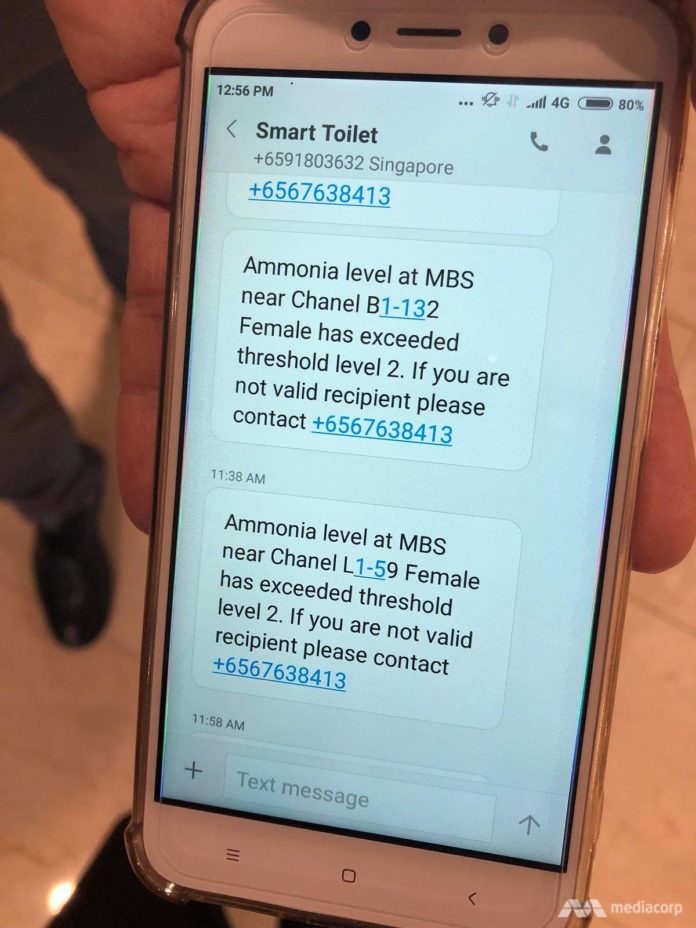
In one of the six-star toilets at The Shoppes at Marina Bay Sands, for instance, there is a detector which measures the level of ammonia in the air and relays this information to cleaners via SMS.
Once odour levels exceed a certain threshold, a text message will be sent to the cleaners with information about which toilet is affected.
Once odour levels exceed a certain threshold, a text message will be sent to the cleaners with information about which toilet is affected. (Photo: Revathi Valluvar)
The six-star toilets are also equipped with smart tablets that allow users to provide real-time feedback.
If negative feedback is given, the programme will also send text messages to the cleaner in charge so that problems can be tackled as soon as possible.
Both these tech solutions were provided by Singapore companies. Convergent Smart Technologies provided the ammonia detectors while Infinergy Systems Solutions was responsible for the feedback software.
The six-star toilets are also equipped with smart tablets that allow users to provide real-time feedback. (Photo: Revathi Valluvar)
The six-star rating is due for renewal on an annual basis.
Speaking to reporters at the certification of Marina Bay Sands’ six-star toilets, president of the Restroom Association Tan Puay Hoon said it is hoped that including technological solutions in its criteria would lead to better standards and quality.
“We also hope that it (will) encourage other toilet owners to implement tech solutions to help manage their resources and manpower more effectively,” said Mdm Tan.
SINGAPORE: Crazy Rich Asians is finally here. Well, sort of.
The first full trailer for the rom-com about Singapore’s secret moneyed elite has been released – and it looks like the Hollywood adaptation of Singaporean Kevin Kwan’s bestselling novel is living up to its title.
Directed by Asian-American director Jon M Chu (Now You See Me 2), Crazy Rich Asians tells the story of Chinese-American economics professor Rachel Chu (played by Fresh Off The Boat’s Constance Wu), who follows her Singaporean boyfriend Nick Young (Henry Golding) back home for a visit, only to discover that he is the heir to one of the biggest fortunes in Asia.
All eyes are firmly on this highly anticipated film, which is billed as the first Hollywood film to feature an all-Asian cast since Joy Luck Club. The main cast includes bigwigs such as Michelle Yeoh, Ken Jeong, Awkwafina and Ronny Chieng.
Filming took place on location in Singapore as well as various parts of Malaysia.
Here’s what caught our eye in the trailer so far.
1. Passion made possible? Various requisite Singapore skyline tourism porn shots of Shenton Way, Marina Bay Sands, Gardens By The Bay and of course, the Merlion. The Singapore Tourism Board should be so proud.
Marina Bay Sands. (Photo: Crazy Rich Asians)
The Merlion. (Photo: Crazy Rich Asians)
Singapore skyline. (Photo: Crazy Rich Asians)
Gardens By The Bay. (Photo: Crazy Rich Asians)
The Crazy Rich Asians’ wedding party of the year between Colin Khoo and Araminta Lee being celebrated at Gardens By The Bay ( Photo: Crazy Rich Asians)
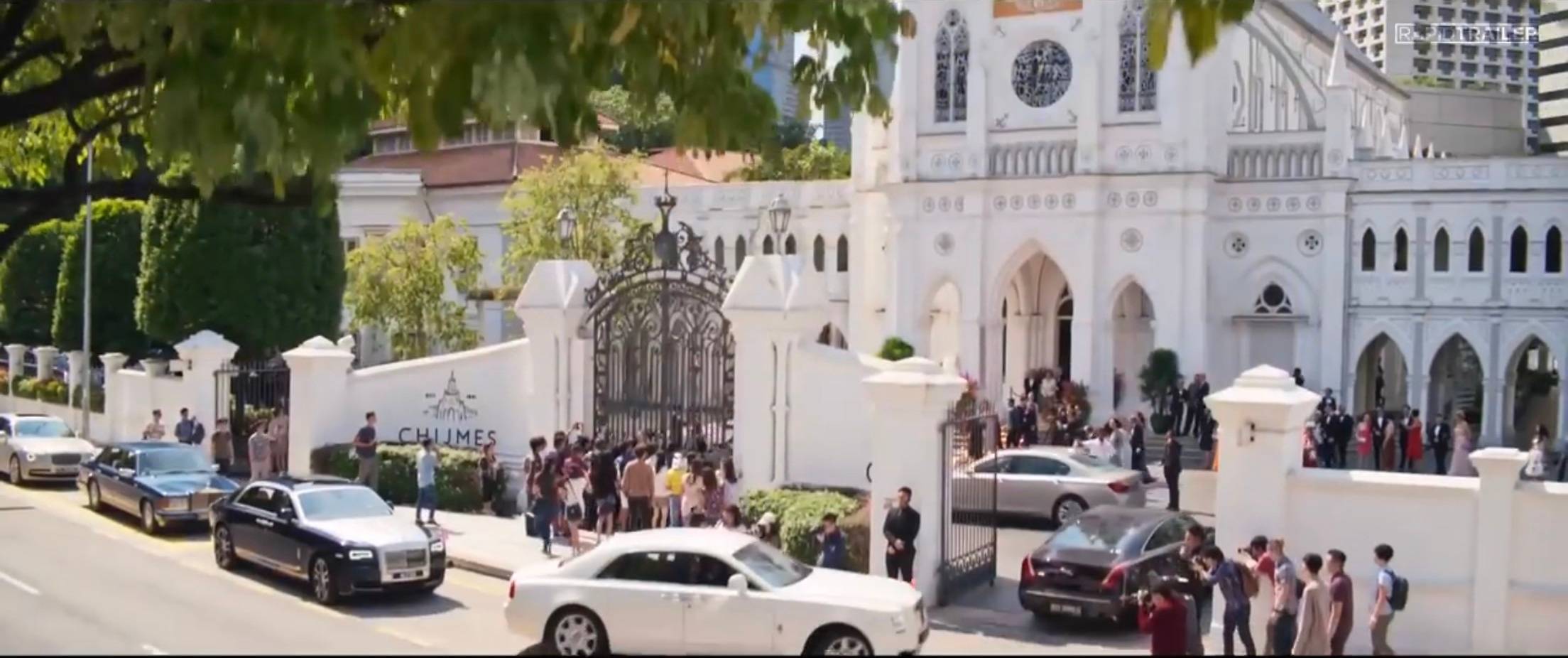
2. Who knew the inside of CHIJMES chapel could look like that? Only in our Garden City would we take our outdoor plants indoors.
Inside Chjimes Chapel. (Photo: Crazy Rich Asians)
Outside the CHIJMES chapel for the wedding of the year between Singapore’s most eligible bachelor Colin Khoo and fashion socialite Araminta Lee (Photo: Crazy Rich Asians)
3. Spotted! Singapore thespians Janice Koh (playing Felicity Young), Amy Cheng (Jacqueline Ling) and Selena Tan (Alexandra “Alix” Young) having a whale of a time behind doyenne Michelle Yeoh (Eleanor Young).
4. Oh, even crazy rich Asians like Nick Young, Colin Khoo and Araminta Lee take a break from haute cuisine for some local delights and dare we say, Tiger Beer, at Newton Hawker Centre?
Newton Hawker Centre. (Photo: Crazy Rich Asians)
5. Looks like Singaporean actor Pierre Png is kissing everyone these days! Here he is as Michael Teo, spotted with some very nice abs, having a nice smooch with Gemma Chan’s Astrid Teo.
Pierre Png and Gemma Chan. (Photo: Crazy Rich Asians)
Singaporean actor Pierre Png’s abs on full display in the trailer of Crazy Rich Asians. (Photo: Crazy Rich Asians)
6. Spotted! Singaporean Fiona Xie (right) as Kitty Pong who just about made it in the trailer squeezing in a hammy moment by the edge of the frame. Malaysian Carmen Soo ain’t going to let her steal the limelight though…
Fiona Xie in the yellow dress. (Photo: Crazy Rich Asians)
7. Everyone knows if you want to skive for a natter with your best friend about your crazy rich boyfriend’s evil mother, the best place to do it is at Bukit Pasoh, right across from The Reading Room. Right?
Bukit Pasoh. (Photo: Crazy Rich Asians)
8. Aqua-robics at night at the Marina Bay Sands Infinity Pool. We’ve never witnessed something like this but that’s probably because we aren’t crazy rich Asians.
Marina Bay Sands Infinity Pool. (Photo: Crazy Rich Asians)
9. Spotted! Singapore’s very own Tan Kheng Hua as Rachel’s mother Kerry Chu, giving us that all too familiar concerned Asian mother look when you confide about your boyfriend and his possibly crazy family.
SINGAPORE: Deaf since childhood, Razali Mohamad Habidin has developed a closer bond with the creatures under his care than any other keeper at Singapore’s Jurong Bird Park, where other members of staff refer to him simply as the “bird whisperer”.
Razali, who lost 80 per cent of his hearing after falling ill as a baby, started working at the park more than two decades ago, and has risen to the position of deputy head avian keeper.
Razali Mohamad Habidin posing with a hyacinth macaw at Jurong Bird Park in Singapore. (Photo: AFP/Roslan Rahman)
He communicates with the birds through grunts, gestures and body languages and told AFP that he recognises the birds by their “behaviours and personalities”.
“All of them are my friends,” he added, communicating through a mix of gestures and Malay.
Other workers at the park have dubbed the 48-year-old “the bird whisperer” – after Hollywood film The Horse Whisperer, starring Robert Redford as a trainer with a gift for understanding horses.
Razali Mohamad Habidin checking on hyacinth macaws at Jurong Bird Park in Singapore. (Photo: AFP/Roslan Rahman)
“He has a way of communicating with the birds that very few of us can,” said assistant curator Angelin Lim. “Just by a look, he knows whether or not the bird is well.”
Communication with his colleagues can be more challenging than with the birds.
Razali leads about a dozen staff and giving them instructions usually involves him making various complex hand gestures, and then reading the lips of his colleagues when they respond.
Razali Bin Mohamad Habidin preparing fruit at Jurong Bird Park in Singapore. (Photo: AFP/Roslan Rahman)
His way with the creatures at the park, which is home to more than 5,000 birds from parrots to hornbills, was on display as he brought a snack of palm fruits into an enclosure filled with parrots.
The hyacinth macaws, the world’s largest parrots, stopped squawking and watched him curiously before following him.
One of the giant birds perched on his shoulder, playfully rubbed his finger with its beak – a sign of trust and affection – and ate out of his hand.
The Maritime Cybersecurity Operation Centre will be established by the third quarter of this year, says the Maritime and Port Authority of Singapore.
A view of the Keppel container port in Singapore. (File photo: AFP/Roslan Rahman)
(Updated: )
Bookmark
SINGAPORE: The Maritime and Port Authority of Singapore (MPA) on Tuesday (Apr 24) announced it will establish a round-the-clock cybersecurity operations facility by the third quarter of this year.
The Maritime Cybersecurity Operation Centre is meant to augment the agency’s capabilities for early detection, monitoring, analysis and response to potential cyberattacks, MPA said in its press release, adding that more details on this initiative will be announced subsequently.
The protection of critical information infrastructures (CIIs) is one of the key areas the agency will focus on as sector lead for maritime cybersecurity, it added.
Mr Niam Chiang Meng, chairman of MPA and guest-of-honour at the Maritime Cyber Security Seminar on Tuesday, said cybersecurity has “vaulted to the forefront” as a key challenge the industry must take seriously and view as a business priority.
“We need to move beyond awareness towards action,” said Mr Niam. “This means investing in necessary measures, be it system enhancements, process changes or people development to be cyber resilient.”
This comes after Singapore’s Cybersecurity Bill was passed in February this year, which deals with CIIs in particular. The owners of CIIs have to comply with codes of practice and standards of performance, conduct cybersecurity audits and risk assessments and participate in cybersecurity exercises under the Bill.
SINGAPORE: If performing a song makes you feel like you’re in a warm bed – which is what it does to Nathan Hartono – then taking up music might be for you.
Come August, contestants on Mediacorp Channel 8’s new musical talent show competition SPOP Sing!, to be hosted by actor-host Lee Teng and YES 933 DJ Gao Meigui, will have the chance to creatively reinvent local songs on a shiny new stage.
Auditions, which will begin in May, will soon be open to aspiring singers aged 13 to 25. Would-be contestants can keep a lookout for more details on Toggle.
Talented young singers hoping to break into the music scene won’t be embarking on this challenge with no one to hold their hands. Hartono, Joanna Dong and Boon Hui Lu, the show’s ambassadors, will be present to provide mentorship.
All three have represented Singapore in singing competitions abroad: Hartono and Dong in Sing! China, and Boon in Taiwan Hopestar.
“I saw every single face (in the audience)… all these actors that I grew up seeing on TV,” the 26-year-old said. “It was like, ‘Ah, there’s Zoe Tay. There’s Desmond Tan.’ The whole time I was singing, half my brain was like, ‘Lyrics. Chords.’ The other half was, ‘Eh, it’s that person!’”
A telltale sign that he’s nervous is if you catch him looking up while performing. “I’ll look at the ceiling because it’s the least distracting thing in the room,” he chuckled.
Dong, 36, who placed third at Sing! China 2017, agreed that stage fright “never goes away”. “All through my competition in Sing! China, I was terrified,” she confessed.
And sometimes, no matter how much you’ve done your due diligence, things do go wrong on stage. “There was more than once when my in-ear monitors didn’t work,” she said.
“In fact, during the Sing! China competition, when I was singing the Open Arms and Lovers’ Tears mashup in the crucial round, I remember (the sound in) my in-ear monitors fading in and out. All I could do was to keep my wits together and sing by faith. That’s one way to help yourself calm down: When you’ve done what you can, trust that you also have the ability to cope on stage.”
Nathan Hartono gets stage fright once in a while. (Photo: Nathan Hartono/Facebook)
Hartono’s best advice is to any aspiring musician is to “keep looking for opportunities to perform in front of people and find an audience. It could be at school shows, or even to a virtual audience. Live streaming is a great way to practice because you have an audience that gives you feedback, and they can be very honest. As long as there are stakes – that’s the key in becoming a much more natural performer.”
Dong added: “Singing in the bathroom doesn’t count because there’s no audience to give feedback, help you get over stage fright and hone your performance skills. It’s one thing to be a great singer, another thing to be a great performer. In this day and age, live performance really matters, because you don’t really make money from recording music any more. You have to build your success around providing people with an experience they can’t download or reshare.”
That said, she still sings in the shower all the time – because you have to do stuff for your own pleasure, too.
Her rubber ducky hits could be anything from Wham!’s Wake Me Up Before You Go-Go and Rick Astley’s Never Gonna Give You Up (“Rickroll!” she quipped) to emo songs by Charlie Lim. “At one time it was Nathan’s Electricity – but I always get the lyrics wrong. Every time I see him, I have to clarify them with him.”
Joanna Dong performing Feng Fei Fei’s Applause at the finals of the Sing! China competition. (Screengrab: SingtelTV Jia Le)
Singing, she said, is “who I am. Since I was a child, whenever I sang, people told me I was special because of it. But there are also so many times I compare myself to other singers. Then, I feel incompetent. It’s something that cuts both ways – it can build your self-esteem, but it can also break you if you let yourself be defined only by your singing.”
As for Hartono, singing “puts me in a very comfortable place, almost like a warm bed. When I find that my mood is shifting or if I’m a little bit off-kilter, it’s because I’m not performing as much. I’m not having the chance to do this thing that makes me feel like I’m in a warm bed.”
Short of actually being in a warm bed, we suppose.
Catch SPOP Sing! starting Aug 9 at 8.30pm on Mediacorp TV Channel 8 and Toggle.sg, with audition highlights starting from June on Toggle. For more contest information, visit https://toggle.sg/spopsing.
SINGAPORE: It’s 7.30pm after a long day in the office; you’re meeting someone for the first time. All you have to go on is their online profile and the hope that maybe, this time, they might be “the one”.
Finding the right business partner can be as tough as finding a soul mate in Singapore – only there’s no Tinder for business match making.
“What do you look for in a partner?” is a question I’m frequently asked.
Since setting up Amadeus Next – a community to nurture travel technology start-ups – I’ve had first-hand experience of how partnerships between big and small businesses can change the fortunes of budding entrepreneurs.
But my answer to this question often surprises people.
GROWING COMPETITION
This year’s Budget emphasised the importance of partnerships to turbo-charge Singapore’s economy and, with an integrated PACT scheme launching earlier in March to further encourage established businesses to partner with start-ups, there are going to be even more opportunities for the country’s fledgling businesses to find their fairy godmothers.
This is great news for Singapore’s ever-growing army of entrepreneurs. Not only is partnership often a fast-track to experience and connections, but for the lucky ones it can also be a stepping stone to investment.
However as more opportunities open up, the level of competition in the region is growing too.
Minister for Trade and Industry (Industry) S Iswaran speaking at his ministry’s Committee of Supply debate on Mar 2, 2018, where he announced an integrated PACT scheme.
Indeed, the last few years have seen an unprecedented rise in the number of start-ups globally, not least in Asia where there are over 47,000 listed on angel.co. Singapore is at the centre of this boom thanks to its location and generous government subsidies.
This means that – just like in the dating world – finding and attracting the right partner means going the extra mile to stand out from the crowd.
FOCUSING ON WRONG PLACES
However I see many entrepreneurs, particularly in their early days, focusing their attention in the wrong places.
Many fall into the trap of trying to create companies with mass consumer appeal. Everyone’s seen the success stories of Lazada, LINE and Grab. These companies are well-known and their brilliant simplicity is attractive to entrepreneurs who dream of similar levels of success.
Yet in reality, these “unicorn” triumphs are rare – hence the name.
For novice entrepreneurs it can be very difficult to get mass-appeal companies off the ground in the first place, particularly competing with the huge marketing budgets of established players.
By comparison, while starting a business-to-business (B2B) company might not sound as “sexy”, it definitely has its advantages.
A ComfortDelgro taxi passes Uber and Grab offices in Singapore March 26, 2018. (Photo: REUTERS/Edgar Su)
FIND AND FIX PROBLEMS
For large companies there’s always a long list of problems, of varying levels of priorities, that they just don’t have time to fix themselves.
It’s these non-urgent tasks – the 21st, 51st or even 101st business problems that are pushed to the bottom of to-do lists – that could be the real sweet spot for Singapore’s start-ups to tackle.
The added advantage is that rather than the stress of worrying about sales figures or spending time marketing to attract new customers, the start-up can instead focus on serving that one customer with that one product.
Take a hotel, for example. Maybe they want to cut their laundry bill or determine how rooms can be cleaned in a more efficient way to offer early check-ins, accommodate late check-outs, offer an awesome guest experience and drive loyalty.
It could even be how to improve internal efficiencies or help companies manage their supply chain better.
Other industries will have their own unique problems just waiting to be solved – from restaurants needing to reduce their food waste, to long-distance haulage companies grappling with the perennial issue of over-tired drivers, to concerts wanting to sell all of their seats at the best price.
The list goes on.
So my top tip for budding entrepreneurs and anyone dreaming of setting up their own business is that identifying specific pain points is the best place to start. In fact, the more specific the problem, and the simpler your solution, the better.
As Singapore invests in more and more initiatives to encourage entrepreneurship and big-small partnership, the opportunities are huge.
No doubt we’ll see more consumer giants following in the footsteps of trail-blazers like Grab, but for now my money is on the start-ups that can solve the region’s business problems.
Simon Akeroyd is vice-president for Corporate Strategy and Business Development at Amadeus.
SINGAPORE: The lorry involved in an accident near Yio Chu Kang MRT station on Monday morning (Apr 23) had mounted a pavement near a bus stop before hitting and killing three pedestrians, as seen in videos that have emerged online.
In the moments before impact, one of the victims was seen on a wheelchair with another person pushing it. Channel NewsAsia understands that two of the victims – an 87-year-old man and a 59-year-old woman – are related. A 63-year-old man was also pronounced dead at the scene.
The accident happened along Ang Mo Kio Avenue 6 towards Marymount Road at around 9.30am.
One video circulating online shows the lorry changing from the second to third lane. Within seconds, it had veered into the bus bay and mounted the pavement.
An accident involving a lorry near Yio Chu Kang MRT killed three pedestrians on Monday (Apr 23). (Screengrab: Stomp, Singapore Road Accident/Facebook)
Another video shows the lorry hitting a stationary bus before coming to a stop next to it. SBS Transit had earlier said the lorry “came hurtling” when the bus stopped at a traffic junction.
Photos posted online show a wheelchair lying on its side next to the lorry.
Eyewitness Kayden Leow, who was at a nearby bus stop in front of Presbyterian High School, said he saw the lorry mounting the kerb before hitting at least two people.
“It drove up the pavement, drove by me and banged the railing before hitting a young man. It then hit the bus and knocked down a traffic light before hitting another man,” the 19-year-old told Channel NewsAsia, adding that he did not see the third person being hit.
He said it felt like the lorry sped by him “less than a metre away”.
“It rammed into the bus which was waiting at the traffic light,” he told Channel NewsAsia. “It was Bus 72 that got hit.
“I wanted to go over to help, but I did not have the confidence or medical knowledge to be of help. I tried to make an ambulance call but someone was already doing that, so all I could do was to feel helpless and watch for about 45 minutes.”
He added that he saw an old man under the lorry and a younger person lying beside it.
“The medic pronounced both dead after five minutes of investigation,” said Mr Leow. “They placed the white paper over the two bodies I saw being hit.”
According to the Singapore Civil Defence Force, two of the pedestrians had to be extricated from underneath the lorry using a rescue lifting airbag.
The 25-year-old lorry driver has been arrested for dangerous driving causing death. Investigations are ongoing, police said.
SINGAPORE: Indian ride-hailing firm Jugnoo wants riders and private-hire drivers in Singapore to have total control over how much their rides cost.
On May 1, it will be rolling out a reverse-bidding pricing system that will emphasise price transparency.
When a rider makes a booking, drivers nearby will be able to bid for the ride.
Drivers will be shown three options by the app: Jugnoo’s suggested price; a price 10 per cent higher; and a price 10 per cent lower. They can select one of the three as their bid, or they can choose to input their own price.
The rider will then choose from the bids based on each driver’s rating, bid price and how long they will have to wait for the ride.
Jugnoo CEO Samar Singla said this “free market system” is an experiment that will reveal more about consumer behaviour. While the entire bidding process may take more effort and will add roughly 10 seconds to what consumers are used to with current ride-hailing algorithms, he believes Jugnoo’s system will address frustration from both drivers and consumers over prices.
“We want to test: do people value control over their transactions more than just (speed)?” said Mr Singla. “If you want to be in control, you must spend a little more time … what we are trying to achieve is a contrarian approach to a very big problem.”
Jugnoo CEO Samar Singla. (Photo: Jugnoo)
The system has undergone a small-batch pilot of a few thousand rides, but Singapore is the first city where it will be rolled out on a large scale.
While the idea of reverse-bidding had been in development for a while, Mr Singla said the company was motivated to launch the system in Singapore, rather than its home country, after observing the proposed buyout of Uber by Grab.
The company, based in Chandigarh, was also attracted by Singapore’s open market, high technological penetration, and users’ openness to new technologies.
If it is successful, Jugnoo plans to expand to Scandinavian cities such as Oslo, Stockholm and Copenhagen – markets that believe in the sharing economy.
Jugnoo has the third-largest market share in India using traditional ride-hailing algorithms, after Uber and home-grown Ola.
But they are comfortable where they are, said Mr Singla. Its aim is to be profitable, rather than fight for market share. Their aim is to capture 10 per cent of the market share in Singapore, similar to where they stand in India.
The usual strategy for ride-hailing firms is to aggressively expand their fleet in an attempt to be the dominant market player.
“We’re not hoping to come in and try to take market share,” said Mr Singla. “We are focusing on getting that niche market for people who really want … control. We want to be a niche player.”
Jugnoo hopes to start with a fleet of 500 drivers and clock 2,000 rides per day. For now, it will not charge drivers a commission, but it will eventually take a 10 per cent cut from each ride, the same percentage it charges its drivers in India.
This will put it on par with RydeX’s commission rate, which is also 10 per cent.
Jugnoo will be the fourth player in Singapore’s private-hire ride-hailing market, after RydeX’s launch at the end of this month.
SINGAPORE: With Parliament currently on its mid-term break, the 27 months over which the first half of the session had spanned were rather eventful, to say the least.
When the 13th Parliament opened in January 2016, a Workers’ Party (WP) member turned her back on the Non-Constituency Member of Parliament (NCMP) post, forcing a debate on the worth of such members.
Less than two months later, Parliament was rocked by a scandal which saw Mr David Ong resigning as a MP over an extramarital affair with a fellow People’s Action Party (PAP) member who has since quit the ruling party.
Singaporeans also witnessed the stepping down of a Parliamentary Speaker to run for President, with the surprising replacement in the form of a Cabinet Minister – only the second time in the republic’s post-independence history that a Minister resigned to take on the post of Speaker.
Along the way, the Constitution was amended to allow a Presidential Election to be reserved for a particular race that has not seen an elected representative for five consecutive terms. In total, more than 100 Bills were written into laws amid an active legislative agenda.
Several ministerial statements were also delivered, with Prime Minister Lee Hsien Loong himself apologising to Singaporeans before putting himself before the House to address allegations of abuse of power in the Oxley Road saga.
But beneath all the heat and dust generated, political watchers say the first half of the 13th Parliament has thrown up trends that may become more pronounced in the second half, as the run-up to the next General Election (GE) – which has to be held by January 2021 – begins in earnest.
Increasing partisanship is one such trend. While this has resulted in more vigorous debates, it has also at times led to unnecessary politicking, the observers point out.
The other is the emergence of younger leaders from both sides of the House, who have been front and centre in several parliamentary debates.
RIGOROUS DEBATES, A ‘MORE POLARISED’ PARLIAMENT
For the first time in about three decades, there are only two political parties – the PAP and the WP – in the House.
Between 1986 and 1988, veteran opposition figure Chiam See Tong, who was then the chief of the Singapore Democratic Party, was the sole opposition member in Parliament, following the expulsion of the late former WP leader J B Jeyaretnam from the House after a criminal conviction.
And with WP currently having nine representatives (six elected MPs and three NCMPs), some political watchers felt that the party has shown an improvement in its overall performance in the House compared to previous parliamentary terms.
“The WP has raised its game in a concerted effort to impress Singaporeans of the need for a credible opposition in the legislature,” said Singapore Management University law lecturer Eugene Tan.
The Workers’ Party’s first CEC meeting since MP Pritam Singh was elected secretary-general. (Photo: The Workers’ Party/ Facebook)
Echoing the view, Dr Felix Tan, an associate lecturer at SIM Global Education, said the more vociferous debates have kept “the ruling party on its toes”. He added:
It provides a sense that they are not simply there to oppose the Government for (the sake of opposing), but really to critically examine the issues at hand and to make the government of the day accountable for policies.
While the WP has been “increasingly assertive” in debates, Nanyang Technological University Assistant Professor Woo Jun Jie nevertheless felt that its performance has not been “entirely consistent”. For example, he noted that the WP MPs appeared to be rather subdued in expressing their stance on fake news.
Former PAP MP Inderjit Singh said the WP MPs have shown that their greater numbers in Parliament have made them more effective. “For example, for the first time, they voted against the Budget, showing they are willing to stand firm on their position,” he added.
Last month, eight members of the WP – excluding former WP chief Low Thia Khiang who was not present in Parliament as he had to attend to family matters – had voted against the Budget statement, the first time this has happened since 1986.
Nevertheless, Mr Singh said the WP has yet to provide compelling alternative policy ideas, which remains the weakness of the Opposition.
As a sign of WP’s increasing assertiveness as well as the polarisation of views in the august chambers, the division bell was rung on several occasions – at the request of the PAP or the WP – in the first half of the 13th Parliament.
These included the Budget debate, as well as the debates on the Constitution of the Republic of Singapore (Amendment) Bill and the Criminal Law (Temporary Provisions) (Amendment) Bill.
These included the Budget debate, as well as the debates on the Constitution of the Republic of Singapore (Amendment) Bill and the Criminal Law (Temporary Provisions) (Amendment) Bill.
Most decisions in Parliament are determined by a majority vote, typically through members voicing “aye” or “no”. This can, however, be challenged by calling for a division that has to be first supported by at least four other members in the House.
After a division has been called, every MP will have to vote on the issue and their votes are tabulated electronically. Alternatively, MPs can also have their dissent recorded without calling for a division.
National University of Singapore sociologist Tan Ern Ser noted that a division is called when a consensus is unlikely, and the MPs are required to state their positions clearly and explicitly.
A total of 89 MPs supported Budget 2018 in a vote, and eight Workers’ Party MPs voted “No”.
Assoc Prof Eugene Tan said it was not surprising for the opposition party to call for a division for contentious issues. He added:
For the PAP, it is rare for them to ask for the division bell since they very much dictate the legislative agenda. But it signals the PAP’s intent to hold the WP to a position on certain key issues.
During the debate on this year’s Budget, a division was called by Finance Minister Heng Swee Keat, after the WP said they had intended to vote to approve the Budget but this should not be mistaken as supporting the Government’s intention to raise the goods and services tax (GST) from 7 to 9 per cent sometime between 2021 and 2025.
But Mr Heng responded by saying that the 2018 Budget statement includes the Government’s plan to raise the GST in the coming years. He then called for a division, and the WP MPs voted against the Budget.
While the observers felt that the general quality of the parliamentary debates has gone up, Dr Felix Tan noted that the Parliament sittings were marred by some rather “petty squabbles over certain expression of opinions”. He added:
Not only was that distracting, it was rather unnecessary.
Last month, several PAP ministers demanded WP chairman Sylvia Lim withdraw and apologise for her claims that the Government had floated “test balloons” on the need to raise revenues within this term and had intended to raise the GST immediately.
Ms Lim refuse to do either, which prompted Leader of the House Grace Fu to remark that she was “deeply disappointed” with Ms Lim’s “deplorable” conduct, and the “low standards” set by her and the opposition party.
The incident drew criticism from some sections of the public. However, Senior Minister of State for Communications and Information and Health Chee Hong Tat explained on Facebook that it was important for the PAP Government to call out Ms Lim on her claims and remove any doubt about the intended timing of the GST hike, as the issue could later be used for political attacks, including during the next GE.
Finance Minister Heng Swee Keat, Workers’ Party MP Sylvia Lim and Leader of the House Grace Fu in Parliament on Thursday (Mar 8).
WHAT STOOD OUT
While there were plenty of memorable debates in the first half of the 13th Parliament, several political watchers said the one on 38 Oxley Road stood out above the rest.
The two-day debate last July came after a dispute between the Prime Minister and his two younger siblings over the fate of their family home spilled into the public domain.
At the start of the debate, Mr Lee delivered a ministerial statement to address allegations of abuse of power, among other things, which were levelled against him by his siblings.
During the debate, the party whip was lifted, which allowed MPs to vote freely, instead of adhering to the party line.
Dr Gillian Koh, deputy director for research at the Institute of Policy Studies, said: “Questions about government processes and even integrity would be explosive any day in Singapore where political legitimacy of both the ruling PAP and opposition parties depend on the idea that actors keep on the straight and narrow.”
Other closely-watched debates were the discussions on the Elected Presidency scheme, and the impending GST hike during the Budget debate.
The debate on this year’s Budget was the longest in five years, with the House discussing the issue for 51 hours and 50 minutes spread over eight days.
Minister for Finance Heng Swee Keat arrives in Parliament to deliver Budget 2018. (Photo: Gaya Chandramohan)
Asst Prof Woo noted that these issues were highly unprecedented in nature. “These issues also emphasise the importance of Parliament as a venue for discussing issues of great (importance) to the Singaporean polity,” he added.
Assoc Prof Tan Ern Ser reiterated that the robust debates on these issues had a bearing on the integrity of the PAP leadership and the citizens’ trust in the Government.
“Trust is a critical political capital for the Government. Once that trust is eroded or lost, the Government would not be able to mobilise the people behind its vision, goals, strategies, and policies, which means that it’d not have the legitimacy and authority to govern effectively,” he added.
HIGH ATTENDANCE RATE, FIRST-TERM MPS MAKING THEIR MARK
Out of the 88 elected MPs currently in the 13th Parliament, 20 – or about 23 per cent – are first-term MPs. This excludes the three NCMPs from the WP, who are also cutting their teeth in Parliament for the first time.
And the performances of some first-term backbenchers were singled out by the political watchers. These included Mr Louis Ng (Nee Soon GRC) and Ms Joan Pereira (Tanjong Pagar GRC) from the PAP, and WP NCMPs, Associate Professor Daniel Goh and Mr Leon Perera.
Away from the new faces, the observers felt that WP’s Aljunied GRC MPs Mr Pritam Singh and Ms Sylvia Lim, as well as some younger PAP office-holders such as Education Minister (Higher Education and Skills) Ong Ye Kung, Mr Chee and Senior Minister of State (Education and Communications and Information) Janil Puthucheary, also made an impression.
Dr Janil Puthucheary speaking at a Select Committee hearing.
Based on Hansard records, the most outspoken backbenchers were Mr Ng, Mr Perera and Dr Lee Bee Wah (Nee Soon GRC). The least vocal were Mr Lee Yi Shyan (East Coast GRC), Mr Teo Ser Luck (Pasir Ris-Punggol GRC) and Mr Edwin Tong (Marine Parade GRC).
Among the Nominated MPs, Ms K Thanaletchimi spoke up the most often, while Mr Ganesh Rajaram was at the other end of the spectrum.
In terms of attendances, the first half of the 13th Parliament was generally well-attended, with all MPs – excluding NMPs – attending at least about three quarters of the 71 sittings.
Those with relatively lower attendance were Senior Minister of State (Defence and Foreign Affairs) Maliki Osman, Mr Heng, Foreign Affairs Minister Vivian Balakrishnan, and Law and Home Affairs Minister K Shanmugam. Mr Heng was out of action for several months after suffering a stroke in May 2016.
Among the NMPs, Mr Azmoon Ahmad and Assistant Professor Mahdev Mohan had the lowest attendance at about 66 per cent.
Those with full attendance included Ms Thanaletchimi, Mr Louis Ng (Nee Soon GRC), Mr Desmond Choo (Tampines GRC), Dr Tan Wu Meng (Jurong GRC), Mr Christopher de Souza (Holland-Bukit Timah GRC), Ms Denise Phua (Jalan Besar GRC), Mr Sitoh Yih Pin (Potong Pasir), Mr Patrick Tay (West Coast GRC), Mr Melvin Yong (Tanjong Pagar GRC) as well as the three NCMPS – Asst Prof Daniel Goh, Mr Leon Perera and Mr Dennis Tan.
Prime Minister Lee Hsien Loong, Minister in the Prime Minister’s Office Chan Chun Sing and Parliamentary Secretary (Culture, Community and Youth) Baey Yam Keng were the political officeholders who attended every sitting.
File photo of Minister in the Prime Minister’s Office Chan Chun Sing. (Photo: Gaya Chandramohan)
CHANGING OF THE GUARD
Leadership transitions at both the PAP and the WP – which recently elected a new chief, Mr Pritam Singh, to take over from Mr Low – are on the cards, and some observers have noticed the younger leaders coming to the fore.
From posing or fielding parliamentary questions and participating in debates and motions, Assoc Prof Eugene Tan said the new generation of leaders are “making their presence felt even if it’s under the watchful eyes of their party elders”. He added:
We are witnessing a generational change in Singapore’s Parliament with both parties undergoing the transition.
Assoc Prof Tan Ern Ser noted that political officeholders, in particular, have to demonstrate that they have done their homework and hold considered opinions that are defensible, for instance.
For example, the political watchers cited how Mr Heng has been helming the Budget debates since he took over the finance portfolio in October 2015, as well as 4G members of the Select Committee studying deliberate online falsehoods – Minister for Social and Family Development Desmond Lee and Senior Minister of State (Education and Communications and Information) Janil Puthucheary – fronting some of the discussions on the matter.
Even so, Mr Inderjit Singh felt that the 4G PAP leaders could have done more in taking the lead in some of the debates on issues related to national security, the economy and transport.
While Mr Heng’s performance during this year’s Budget debate stood out, he said the other younger Ministers could have done more in convincing Singaporeans why the impending GST hike had to be announced this year.
On the opposition front, Dr Felix Tan noted that WP’s newly-minted chief Pritam Singh has been more vocal on certain issues.
Assoc Prof Eugene Tan said he expects the younger WP leaders to take on a higher profile for the second half of the Parliament’s term, while the PAP’s 4G leaders seek to demonstrate that they are equal to the task of leading the country.
Workers’ Party MP Pritam Singh in Parliament.
A major Cabinet reshuffle will take place before Parliament reconvenes next month. On Saturday (Apr 21), the Prime Minister said the changes will be announced next week and “will involve almost all of the ministries”.
The 4G leaders are also heavily involved in the drafting of the President’s Address, which will be delivered by President Halimah Yacob at the opening of the second half of the 13th Parliament on May 7 to set out the Government’s priorities, policies and programmes for the remainder of its current term.
ON THE AGENDA
Among the items topping the agenda when Parliament reconvenes next month would be the findings by the Select Committee studying deliberate online falsehoods.
The 10-member committee wrapped up eight days of public hearings last month, which took in oral evidence from 65 witnesses including local and overseas experts, as well as representatives from technology and media giants such as Facebook, Twitter and Google. A total of 170 written representations were submitted to the committee.
Other priorities for the Government include leadership succession – with the identity of Mr Lee’s successor set to become clearer in the second half of the 13th Parliament – and addressing social inequality, political observers said.
Representatives from social media and Internet giants Facebook, Twitter and Google at the public hearings by the Select Committee on Deliberate Online Falsehoods on Thursday (Mar 22).
In fact, if the first half was anything to go by, parliamentary debates are set to become even more intense, as the current term of Government enters its final leg and the drumbeat of the next GE gets louder.
“The second half will be critical for the PAP 4G leadership and the WP new leadership to show their effectiveness in their new roles and this will also determine how they can swing votes (to) their sides. We can expect much more aggressive debates … as the stakes are very high, (and) will directly affect the outcome of the next GE,” said Mr Inderjit Singh.