Home Blog Page 1052

Sizzling competition, ‘encouraging’ sign-ups as electricity market opens up in Jurong

0

SINGAPORE: Within days after electricity retailers were allowed to begin marketing their services to residents in Jurong, Mr Wang Zhili made up his mind to sign up with independent provider Ohm Energy. 

Likening the liberalisation of the retail electricity market to the opening up of the local telecoms market years ago, the 30-year-old said he is “happy” about having the option to pick a power provider with the best deal. Currently, households buy electricity solely from SP Group at a regulated tariff that is reviewed quarterly. 

“Electricity is a key part of a household bill. If there is a chance to go for a cheaper price plan, why not?” 

With his new 12-month plan charging 16.95 cents per kilowatt hour (kWh), almost 5 cents lower than SP Group’s current electricity tariffs, Mr Wang is expecting a much leaner bill from this month.

Mr Wang is among those living in Jurong who are included in the pilot launch of the Open Electricity Market – an initiative by the Government to open up the power market to competition.

From Apr 1, about 108,000 household and 9,500 business accounts in Jurong have been allowed to go shopping for electricity retailers other than SP Group. For the soft launch, 14 players, which consisted a fair mix of big firms with power generation arms and independent retailers, were approved and given the green light to start marketing on Mar 19.

Since then, the response has been “encouraging”, according to retailers that Channel NewsAsia spoke to.

Among those willing to reveal sign-up rates, PacificLight Energy has attracted more than 1,200 customers, while both Tuas Power Supply and Best Electricity Supply said they are fast approaching 1,000 sign-ups.

Ohm Energy said it has about 800 consumers on board. Solar energy firm Sunseap and Red Dot Power described their sign-ups thus far as “a three-digit figure”.

Other retailers declined to reveal figures citing commercial sensitivity, but they agreed that consumers seem to be warming up to the idea of a liberalised retail electricity market faster than they expected.

“Electricity is something that’s not the easiest thing to explain. There will be customers who hesitate but thus far, what we’ve seen has been encouraging,” said Mr Low Boon Tong, executive vice president of retail at Seraya Energy.

Describing the response over the past few weeks as “enthusiastic”, iSwitch’s spokesperson Ross Han said: “Other foreign markets, like Australia or the United Kingdom, took a much longer time to get started so we are happy.”

When contacted, the Energy Market Authority (EMA) declined to reveal the number of consumers in Jurong that have opted for a different retailer thus far. Its spokesperson said based on feedback from participating retailers, “the response has been encouraging”. 

COMPETITION HEATING UP

But with 14 retailers approved from the get-go, competition has been sizzling since the soft launch began.

To entice consumers, a majority have adjusted their plans in the form of price cuts, steeper discounts and rolling out shorter-duration contracts.

Plenty of freebies were also doled out. When Channel NewsAsia visited a roadshow organised by the EMA over the weekend at Westgate mall, iPads, the latest Google Home Mini smart speakers, shopping vouchers and air tickets were among the rewards dangled out.

PacificLight Energy, for instance, reduced the price of its fixed price plan to 16.78 cents per kWh, from the initial 19.19 cents. It also more than doubled the discount for one of its plans to 21 per cent. Apart from the chance of winning a free trip to Hong Kong, the first 100 customers who sign up before the end of this month will get S$80 off their third month’s bill. Customers who opt for e-billing also get S$1 off.

Commenting on the adjustments and wide variety of promotions, its general manager Geraldine Tan said: “This soft launch is for us to discover what works and what doesn’t for consumers. We monitor the market closely and if need be, we will introduce promotions and price changes.”

Over at Best Electricity Supply, cash rebates have been dished out on top of lowering the rate of its fixed-price plan to below 17 cents per kWh and increasing discounts for another plan.

“This is in response to the price cuts by other competitors,” said its general manager Terence Neo. “Jurong is only that big and there are 14 retailers. Competition is definitely heating up.”

Tuas Power Supply unveiled a three-month trial plan – a move that it said aims to “help consumers overcome the hurdle of trying something new”, according to its general manager Michael Wong.

“According to feedback, there are customers who are not comfortable with a long-term contract of one or two years so we came up with a three-month trial. With this, they don’t need to think too hard before taking the first step,” said Mr Wong.

But there are retailers who have chosen to stay put.

Mr Lawrence Kwan, vice president of energy at Sunseap, said prices of its clean energy plans “are already at their most competitive”.

“We don’t believe in having a price war because the premium is all about allowing Singaporeans to have access to clean energy and being environmentally responsible.”

EMA roadshow on Open Electricity Market 2

Electricity retailers and consumers at a Open Electricity Market roadshow held at Westgate mall on Apr 21, 2018. (Photo: Energy Market Authority)

SOME EARLY ADOPTERS, SOME PREFER TO WAIT AND SEE

For some residents, the discounts and freebies being dangled out have been a steal.

Mr Chang Chi Weng, 40, had set his sights on getting a fixed-price plan “to counter the uncertain market conditions” that sway the electricity tariffs charged by SP Group. Noting that the price cuts have brought all retailers to “roughly the same price point”, the engineer considered other factors, such as the ease of conversion and additional discounts, before deciding on PacificLight Energy.

“They were having a promotion of S$80 off my third month’s bill. That’s a practical thing that any consumer would consider,” said the resident of Jurong East.

Nonetheless, there are others who prefer to wait and see.

Ms Mabel Lee, who visited the EMA roadshow on Saturday, said the presence of 14 retailers and the buffet of price plans have been “overwhelming”.

“There are too many plans with different rates. You also need to look through the fine prints to see which ones require a security deposit or have hidden costs,” said the mother of three. “Even with the discounts, we still think we should do more research on our own so that we pick the correct plan and don’t lose out in the long term.”

There are also residents who remain clueless about the Open Electricity Market. 

29-year-old Charmaine Teo said while she has seen posters about the soft launch, she knew little about it. “Maybe when more people sign up then I’ll start thinking about it.”

Another Jurong East resident who preferred to be known as Mr Chua said he was more than happy to remain with SP Group as the new initiative “sounds complicated”. He also wondered if a change in retailer would affect his electricity supply. 

To that, while retailers agreed there are still gaps in consumer awareness, almost all said they would not be too worried just yet. 

Said Mr Jomar Eldoy, managing director of Ohm Energy: “Electricity is not something that most people pay attention to so it takes a while to realise that no matter who you buy from, the quality remains the same as the power grid continues to be operated by SP Group.” 

“Market reach is a challenge as it takes some time for people to notice the change and when they do realise that they have the option of not just SP Group, they find themselves having to sieve through 14 retailers. But we believe that this deluge of information that’s keeping out some people is something that will solve by itself over time,” said iSwitch’s Mr Han.

Others, like Sembcorp Utilities, said it will continue to have roadshows in Jurong to “help educate” residents about the Open Electricity Market.

In response to queries, EMA said it is aware of questions that consumers may have, such as the reliability of electricity supply when they switch retailers, and have been addressing these concerns through its educational materials, such as information booklets and flyers. 

“We will continue to refine and improve our public communications and consumer education efforts based on the feedback from the roadshow,” the spokesperson said.

FULL ROLL-OUT TO REST OF SINGAPORE

For the rest of Singapore, the full roll-out of the Open Electricity Market is slated for the second half of this year. 

Most retailers participating in the soft launch told Channel NewsAsia that they have started preparing for that but still hope for some clarity soon. They also expect more players to enter the market in the upcoming months when that happens. 

Agreeing, Mr Allan Loi, a research associate at the Energy Studies Institute at the National University of Singapore (NUS), noted that price cuts could intensify moving forward “as new entrants attempt to grab market share”. 

But in the long run, retailers will need to differentiate themselves based on product and service innovation. 

“If you look at the EMA website, there are 33 licensed retailers. Clearly, there are players that have not participated in the Jurong pilot scheme but could enter the market when the contestability is rolled out to the rest of Singapore,” said Mr Loi.

Raising the example of how there are more than 90 power suppliers in a smaller market like New Zealand, Mr Loi added: “How the Singapore market matures will depend on whether consumers are willing to embrace a lifestyle change in terms of energy use and how retailers market their plans moving forward. Instead of price, they will need to offer some sort of differentiated product for consumers.”
Source link

The last farewell: Past and present caregivers surround Inuka the polar bear in his final moments

0

SINGAPORE: Past and present caregivers gathered for Inuka’s final health check before the polar bear was put down on Wednesday (Apr 25), photos released by the Wildlife Reserves Singapore (WRS) showed. 

The 27-year-old male polar bear, the first to be born in the tropics, was put down in the morning at Singapore Zoo due to his deteriorating health. 

In one of the photos, Inuka’s family of caregivers appeared sombre as they gathered around to watch Inuka receive the final injection that was administered by Dr Abraham Mathew, the assistant director of veterinary services.

In another photo, Dr Cheng Wen-Haur, the chief life sciences officer and deputy CEO of WRS, was seen examining Inuka’s lower abdomen for the last time. The final examination was conducted alongside Dr Mathew and Mr Mohan Ponichamy, the deputy head keeper and one of Inuka’s caregivers. 

Final health check on Inuka the polar bear 2

Dr Cheng Wen-Haur (centre), chief life sciences officer and deputy CEO of Wildlife Reserves Singapore, examining Inuka’s lower abdomen. (Photo: Wildlife Reserves Singapore)

A third photo showed a caregiver placing her hands on one of Inuka’s paws as a sign of goodbye. 

Hands on Inuka's paws

A caregiver placing her hands on Inuka’s paw as a sign of goodbye. (Photo: Wildlife Reserves Singapore)

For the past five years, Inuka had been suffering from age-related ailments including arthritis, dental issues and occasional ear infections. A health check on Apr 3 showed that his health was declining even further.

Inuka’s ailing limbs could no longer support his weight. This caused him to drag his feet, leading to ulcers on his paw pads and a deep infection between his toes. 

He also had a wound on his lower abdomen, which was likely due to urinary incontinence and recurring urinary tract infections, WRS said. 

“Today’s medical examination revealed that the open wounds on his paws and abdomen had not significantly improved despite additional treatment over the last three weeks. These wounds, which were quite deep, would have caused pain and discomfort to Inuka, and would only be aggravated as his arthritis worsened,” WRS said in a statement.

At a press conference, Dr Cheng said: “From his point of view, he was in deep sleep, surrounded by all his keepers who care deeply about him. Having been born and lived in Singapore for the past 27 years where a whole generation of Singaporeans have grown up with him, we bade him farewell. It is a very sad moment for us … but I think we have done the right thing by him and he is no longer suffering.”

Inuka had outlived the lifespan of a wild male polar bear, which is typically between 15 and 18 years, WRS said. 

A private memorial will take place on Thursday followed by an autopsy to fully understand Inuka’s condition. WRS also said that his body parts may be preserved for educational purposes. 

Meanwhile, Inuka’s exhibit will undergo refurbishment and redesign in the next few months. It will then be used to house sea lions. 

Source link

Commentary: With the Cabinet reshuffle, the race for Singapore’s next Prime Minister has narrowed

0

SINGAPORE: With the Cabinet reshuffle announced on Tuesday (Apr 24), the race to become Singapore’s next Prime Minister has been further narrowed, with Mr Chan Chun Sing and Mr Heng Swee Keat leading the pack.

Slated to take on leadership positions at the Ministry of Trade and Industry (MTI) and Public Service Division while retaining his role as deputy chairman of the People’s Association, Mr Chan will be assuming new, important positions that will grant him invaluable exposure to economic policy and allow him to foster close ties with the public administration.

More importantly, there are important synergies between these new roles and Mr Chan’s experience in policy and government.

Having spent stints at the Ministry of Community Development, Youth and Sports (MCYS), Ministry of Social and Family Development (MSF), National Trades Union Congress (NTUC) and the People’s Association, Mr Chan has accumulated strong experience in labour and social issues.

His achievements include the expansion of NTUC’s mandate to include managers to freelancers and an aggressive shift in focus towards job training and placement.

The expansion of social services offices in HDB towns also took place when he was Minister for Social and Family Development.

While such experience in social policy and labour relations arguably provides Mr Chan with an edge in fostering strong social consensus and leading labour transformation, his new portfolio will allow him to combine these strengths with economic development and industrial policy. 

This will be particularly useful, as Singapore aims to prepare its industries and workers for potential economic transformations and disruptions.

Mr Chan’s appointment to MTI mirrors that of Prime Minister Lee Hsien Loong and Emeritus Senior Minister Goh Chok Tong, both of whom have taken on the role of Minister for Trade and Industry during their political careers.

Chan Chun Sing Chongqing

Minister in the Prime Minister’s Office Chan Chun Sing at the opening of the CCI Administrative Bureau Office in January 2016. (Photo: Jeremy Koh)

Both PM Lee and ESM Goh also spent an extensive period of time in defence, experience that Mr Chan shares.

While PM Lee served in the Singapore Armed Forces rising to the rank of Brigadier-General, ESM Goh was Minister of Defence for almost 10 years prior to his assuming the role of Prime Minister. Mr Chan himself spent almost two decades in the SAF, where he held various roles including Chief of Army, Chief of Staff of Joint Staff and Chief Infantry Officer.

A dual focus on economic development and labour transformation is already evident in Mr Chan’s existing work in the NTUC.

For instance, Mr Chan has driven a shift in the NTUC’s focus towards more job training and placement programmes, which included the establishment of a training council to help workers deal with the impact of disruption. Under Mr Chan’s stewardship, the NTUC’s mandate has also been expanded to include PMEs.

Mr Chan possesses the technical know-how to lead Singapore through economic disruptions and labour transformation and, perhaps more importantly, the skills and relations needed to foster strong social consensus across Singaporean society – the kind of people person our next Prime Minister needs to be to forge a new consensus and lead Singapore.

More broadly speaking, this will make Mr Chan a relatively well-rounded Prime Ministerial candidate.

His previous appointments have allowed him to foster close relations with various sectors of Singaporean society – ranging from the military when he was in the SAF, families during his time at MSF and MCYS, workers in the NTUC, to the grassroots with the People’s Association.

Looking ahead, Mr Chan’s new appointments will allow him to continue fostering close ties with other segments of society, this time with businesses and the civil service.

Chan Chun Sing (2)

Chan Chun Sing having a light moment with bus captains at Hougang Depot. (Photo: NTUC)

A MODEL OF TECHNOCRATIC LEADERSHIP

In contrast, Mr Heng Swee Keat presents a more traditional set of skills and capabilities that are well-suited to the technocratic governance of Singapore’s economy. Such skills are no doubt important as well, given the impending economic challenges Singapore faces.

Specifically, Mr Heng’s experience as Managing Director of the Monetary Authority of Singapore (MAS) and Minister for Finance places him in good stead to drive Singapore’s continued development as a leading global financial centre. His leadership of the Future Economy Council, and role in driving Singapore’s Industry Transformation Maps also make Mr Heng a key figure in Singapore’s ongoing economic transformation.

It is by no stretch of the imagination that these roles will be crucial for a potential Prime Minister. 

Indeed, both PM Lee and ESM Goh have served as MAS Chairmen, with PM Lee serving as Minister for Finance for six years while ESM Goh served as Senior Minister of State for Finance in his early years in Cabinet. 

PM Lee also headed the 2001 Economic Review Committee, tasked to chart a blueprint to restructure and reshape the economy, a committee that bears many similarities to the Future Economy Council.

While Mr Heng possesses strong credentials in economic governance and financial sector policy, his ability to forge social consensus should also not be doubted. 

As Education Minister, Mr Heng has made great strides in raising the quality of Singapore’s education system as well as ensuring more equal education policy outcomes – including expanding the number of university places, the removal of the secondary school league tables and raising the quality of teaching.

Heng Swee Keat budget arrival

Minister for Finance Heng Swee Keat arrives in Parliament to deliver Budget 2018. (Photo: Gaya Chandramohan) 

Furthermore, Mr Heng has played a key role in chairing Our Singapore Conversation, which reached out to 47,000 Singaporeans, as well as the SG50 Steering Committee – which oversaw the year-long celebration of Singapore’s 50th year of independence. Both were key initiatives that aimed to engage and unify Singaporeans.

Mr Heng also has experience in the security sector, having spent 14 years in the Singapore Police Force in his younger days – though he doesn’t have the defence experience that a position at the Ministry of Defence would have afforded him.

Regardless, Mr Heng’s expertise and reputation as a top financial regulator and finance minister make him a highly skilled technocratic Prime Minister capable of leading economic and financial sector transformation.

Certainly, both Mr Chan and Mr Heng possess the skills and capabilities needed to become Singapore’s next Prime Minister.

ONE MORE QUESTION

There remains the question of Mr Ong Ye Kung, who has also been touted to be a potential Prime Ministerial candidate.

The recent Cabinet reshuffle has consolidated Mr Ong’s position within the Ministry of Education, one that is already bolstered by his recent moves to emphasise lifelong learning. 

At the same time, Mr Ong retains leadership over the SkillsFuture Initiative, a key policy initiative that will be crucial for Singapore’s economic future.

Ong Ye Kung on education planning (1)

Education Minister (Higher Education and Skills) Ong Ye Kung.

Having said that, historical precedence suggests that the multiple portfolios held by Mr Chan and Mr Heng over the years – and the additional responsibilities they will take over from DPM Teo –  place these two men in a stronger position for the top job. Both PM Lee and ESM Goh had previously held multiple portfolios before becoming Prime Minister.

In this, while Mr Ong’s larger education portfolio has given him more responsibilities, it is unclear if this will be sufficient exposure, especially since Mr Heng himself had helmed that portfolio in his first Cabinet appointment after 2011.

Given the need for a future Prime Minister to acquire a broad set of skills and exposure to a wide range of policy issues, and the track record of our past Prime Ministers, it seems the search for Lee Hsien Loong’s successor has narrowed.

Woo Jun Jie is an assistant professor at the Public Policy & Global Affairs Programme of Nanyang Technology University, where he teaches Singapore Politics and Singapore Foreign Policy.

Source link

Inuka the polar bear put to sleep on ‘humane grounds’

0

Singapore Zoo will not bring in any more polar bears, says Wildlife Reserves Singapore.

Gaya - Inuka last days 20

Inuka the polar bear is seen in its enclosure. (Photo: Gaya Chandramohan)

SINGAPORE: Singapore’s last polar bear, Inuka, has been put down on “humane grounds” after a second health examination in three weeks found that its health had not improved despite intensive treatments.

The 27-year-old polar bear was put into “deep sleep” under anaesthesia at around 7am on Wednesday (Apr 25) and was not revived, said Dr Cheng Wen-Haur, deputy CEO and Chief Life Sciences Officer of Wildlife Reserves Singapore (WRS).

Any form of treatment would have caused it more stress and prolonged its suffering, Dr Cheng added.

Gaya - Inuka last days 12

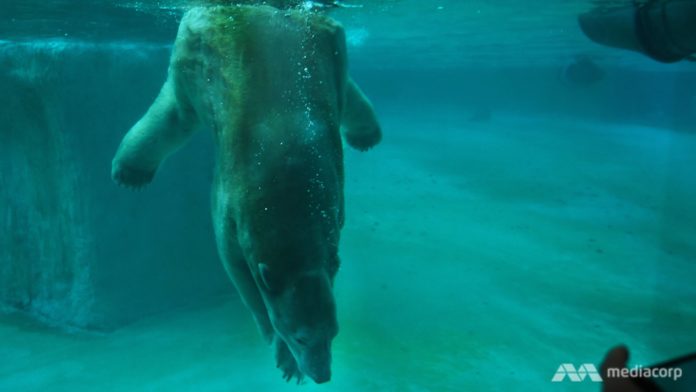
Inuka dives down in its pool on Apr 23, 2018, two days before it was put down. (Photo: Gaya Chandramohan)

“Today’s medical examination revealed that the open wounds on his paws and abdomen had not significantly improved despite additional treatment over the last three weeks. These wounds, which were quite deep, would have caused pain and discomfort to Inuka, and would only be aggravated as his arthritis worsened,” WRS said in a statement.

“The vets had hoped that the treatment instituted since the last checkup would have resulted in more improvement, and as it was not the case, it was clear that Inuka’s health and welfare state was compromised and the responsible course of action was not to prolong Inuka’s suffering,” WRS added.

Gaya - Inuka last days 4

Inuka was put down on Apr 25, 2018, after a second health check in three weeks. (Photo: Gaya Chandramohan)

Mr Mohan Ponichamy, deputy head keeper and one of Inuka’s primary caregivers, said the keepers spent the entire night with Inuka, ensuring it was comfortable. 

A private memorial service will be held on Thursday. An autopsy will be done to fully understand Inuka’s condition, and the zoo said it may also preserve its body parts for educational purposes. 

Inuka’s exhibit will be refurbished and redesigned to house sea lions, the zoo said. The changes will be made over the next few months.

​​​​​​​

Gaya - Inuka last days 18
Gaya - Inuka last days 19

Cards and drawings of Inuka left by zoo visitors. (Photos: Gaya Chandramohan)

The polar bear had been kept under close watch and away from its exhibit since Tuesday. It was found to be less active in recent weeks and preferred to rest than playing and interacting with its keepers.

Inuka was born in the Singapore Zoo in 1990 and was the first polar bear to be born in the tropics. It had lived beyond the average life expectancy of 15 to 18 years of polar bears in the wild and 25 years in captivity.

The zoo said in 2006 it will not bring in any more polar bears to Singapore – a decision that was reaffirmed last month and is in line with its focus on featuring tropical wildlife and threatened Southeast Asian species, WRS said.

Additional reporting by Tan Si Hui.

Source link

RIP, Inuka: The world’s first polar bear born in the tropics

0

SINGAPORE: Singapore Zoo’s late resident polar bear Inuka was an “inquisitive soul” and a “cheeky fellow”, Wildlife Reserves Singapore (WRS) said on Wednesday (Apr 25).

The polar bear was put down “on humane grounds” on Wednesday morning, said WRS, after a second health examination in three weeks showed its welfare had been “seriously compromised” and would only “deteriorate further”.

The 27-year-old’s health had been “declining markedly”, with Wildlife Reserves Singapore (WRS) – which runs the zoo – saying earlier in the month that vets might have to make the “very difficult decision” to put it down if its health was not shown to be improving.

In human years, Inuka lived well into its 70s – and well past the 25-year average lifespan of polar bears under human care, according to WRS. Wild male polar bears have a life expectancy of between 15 and 18 years.

Here are some facts about the late polar bear:

1. First polar bear to be born in the tropics

Welcomed into the world on Boxing Day, 1990, Inuka was the first polar bear to be born in the tropics.

Its father Nanook and mother Sheba arrived at the Singapore Zoo from Canada and Germany respectively in 1978. Inuka weighed just 350g at birth – but grew to weigh more than 500kg.

Gaya - Inuka last days 12

Inuka dives down in its pool on Apr 23, 2018, two days before it was put down. (Photo: Gaya Chandramohan)

2. Its name means “silent stalker” in Inuit

Inuka’s name means “silent stalker” in Inuit, and was chosen in a national naming contest.

More than 10,000 entries were received, including names like Arctos and Shardik, according to reports.

Gaya - Inuka last days 9

One of Inuka’s favourite games was peek-a-boo. (Photo: Gaya Chandramohan)

3. Liked to play peek-a-boo

Described by WRS as “young at heart”, Inuka was a mischievous bear that liked to invent its own games from the toys provided by its keepers, according to WRS.

Its favourite game was peek-a-boo – where the bear would “stalk” and surprise guests by popping up right in front of their faces when they came close to the glass front of its enclosure.

It was also a “cheeky fellow” who would wait until its keepers were not watching and then spit out its medication, said WRS. It would also put its toothbrush out of the keepers’ reach and move it further every time they wanted to retrieve it.

Gaya - Inuka last days 14

In human years, Inuka lived well into its 70s – and well past the 25-year average lifespan of polar bears under human care. (Photo: Gaya Chandramohan)

4. It went green from time to time

Polar bears are generally known for their “white” fur – though the bears’ coats actually have no white pigment, but are hollow, according to the World Wildlife Fund.

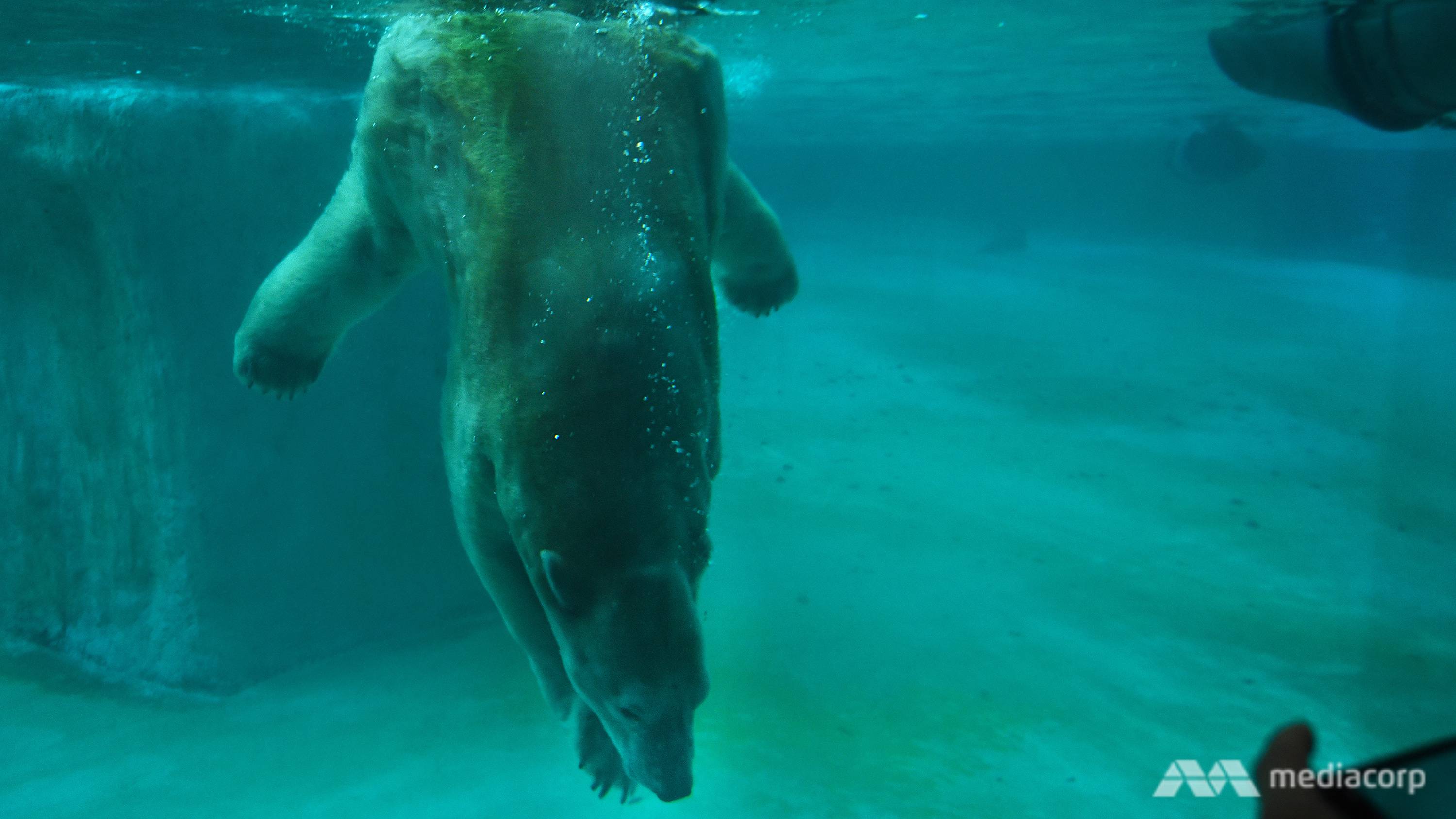
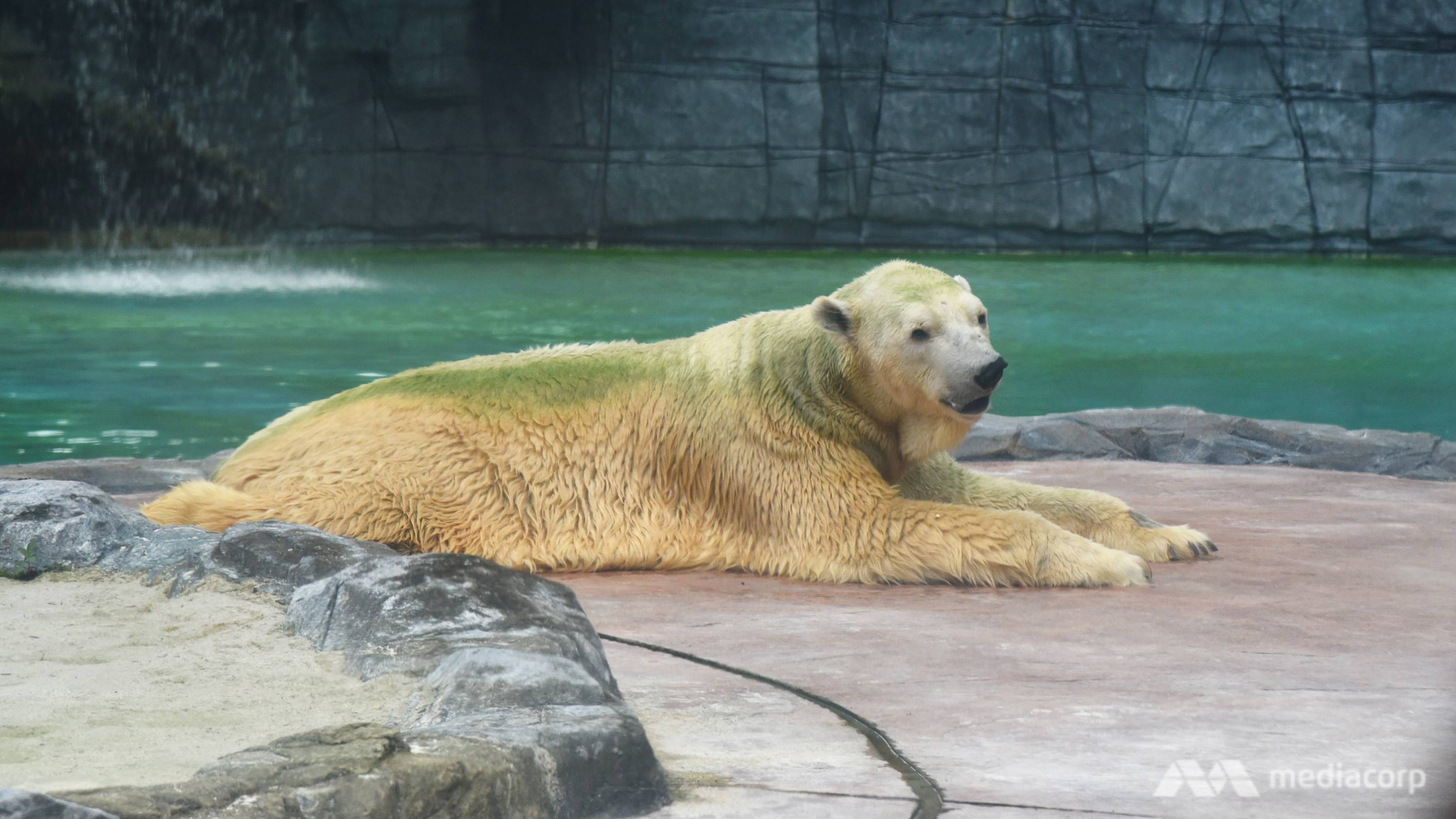
In Inuka’s case, microscopic algae from its pool would sometimes enter these hollow hair shafts, tingeing its fur green.

Gaya - Inuka last days 3

Microscopic algae would sometimes enter Inuka’s hollow hair shafts, tingeing its fur green. (Photo: Gaya Chandramohan)

5. Loved “fruitsicles” and salmon

Inuka’s daily menu consisted of meat, fish, vegetables and fruit, with the bear especially enjoying salmon. It also loved tossing and flipping “fruitsicles” – large blocks of ice with frozen fruit inside.

Its year-end birthday celebrations also saw the bear treated to “birthday cakes” made out of ice and various toppings. Last year’s cake featured agar-agar – an Asian jelly desert – for the first time, while previous celebrations had seen cakes with salmon, minced beef and even peanut butter.

However it was “fussy about food” at times, according to WRS. When its favourite meat was presented to it along with others it did not like as much, it would only focus on the meat it liked.

Inuka 27 birthday

Singapore Zoo polar bear Inuka celebrates its 27th birthday with an agar-agar salmon cake. (Photo: Wildlife Reserves Singapore)

6. It loved massages and dips in the pool

Inuka loved taking dips in the pool, and enjoying “hydro massages” under the waterfall, according to WRS.

On hot days, when keepers encouraged it to go into the pool – Inuka would tap with its left forepaw to tell them to throw food down to it on the cliff, and not the water.

Inuka’s passing marks the last of the polar bears in Singapore. The zoo had announced in 2006 that it would not bring any more polar bears into Singapore, following discussions with its animal welfare and ethics committee.

Source link

Commentary: Electric vehicles have a long way to go, so don’t write off oil yet

0

SINGAPORE: By almost any measure, China leads the world in road transport electrification. 

It makes more, buys more and, with 75 different models available in 2017, offers consumers a wider choice of electric vehicles (EVs) than any other country.

Elsewhere in Asia, Singapore launched its first electric vehicle sharing service in December 2017 with 80 cars and 30 charging stations. 

By 2020, the goal is to have 1,000 of such green cars, along with 500 charging locations offering 2,000 charging points – making BlueSG the second-largest electric-car sharing programme in the world.

The service was launched by BlueSG, a subsidiary of France’s Bolloré Group that runs the world’s largest electric car sharing service Autolib in Paris.

It’s easy to get carried away with the hype surrounding electric vehicles (EVs). 

But while sales of battery-powered cars may be surging, the technology is still in its infancy and batteries are by no means the only low-carbon solution for global mobility.

What’s clear however, is that understanding the changing face of transport in whatever form it takes is one of the big challenges facing the energy and commodities industries.

That said, it’s too early to think about the demise of fossil fuels just yet.

A BlueSG electric car-sharing vehicle is parked at a charging station in a public housing estate in

A BlueSG electric car-sharing vehicle is parked at a charging station in a public housing estate in Singapore December 12, 2017. REUTERS/Edgar Su

MULTIPLE DRIVING FACTORS

For one, three years of low oil prices have stimulated strong car sales, while growing urbanisation and a buoyant global economy have boosted demand in various forms of transportation globally. 

These point to strong “demand stickiness” for fossil fuels in the near term which many commentators have failed to factor in when considering the future trajectory for oil demand.

About two-thirds of oil consumption comes from transportation, with 40 per cent of that demand coming from cars. In the passenger vehicle sector, all the hype is around EVs, but despite 55 per cent growth of EV sales globally last year, overall sales amount to less than 2 per cent of new car sales, and less than 0.2 per cent of the total fleet. 

Today’s 3 million EVs displace less than around 60,000 barrels per day, or less than 0.06 per cent of total global demand.

Second, the growth of EVs in global markets such as Europe is driven by subsidies and policies designed to push consumers into battery-powered transport, especially in urban areas. 

Similarly, in Asia, government incentives have turned China into the biggest manufacturer and market for electric vehicles, while most electric cars in Singapore qualify for a S$30,000 rebate on the main car tax.

Yet, subsidies have their limitations. They hit the treasury coffers twice (cost of subsidies and loss of fuels duty revenue) and their swift removal has seen an equally swift decline in sales. How the market for this emerging form of passenger transport will hold up once these incentives are removed is uncertain.

Finally, consumer behavior will be driven in part by policy and technology, which will influence the relative cost of transportation options – both upfront capital costs and fuel costs. 

But there also will be a reciprocal impact on policy and technology by consumer concerns and preferences regarding performance, storage space, refueling time and uncertainty, and other driving amenities.

Electric vehicles may also see uplift from being perceived as “next generation transport”. Consumer comfort with autonomous vehicles, car and ride-sharing may play a role in the longer term and future generations may take a different view on the importance of car ownership.

READ: A commentary on whether driverless cars will drive down car insurance premiums.

A safety driver sits in a moving driverless car during a public trial run by Southeast Asia's

A safety driver sits in a moving driverless car during a public trial run by Southeast Asia’s leading ride-hailing firm Grab in Singapore in 2016. (Photo: AFP/Roslan Rahman)

In Singapore, there is still a long way to go before there is significant adoption of electric vehicles. 

As at the end of last year, there were 520 such cars in Singapore, a sharp increase of 380 per cent from only 137 at the close of 2016. But such cars still make up only a tiny proportion of cars on the road here.

Factors affecting adoption rate include the lack of charging stations across the island and a highly stringent Vehicular Emissions Scheme. 

Under the scheme, only full-electric cars – which are costlier and in limited supply – will qualify for the top-tier rebate of S$20,000, causing traders to appeal for a revision. 

FUTURE SHIFTS IN TRANSPORT, FUELS

S&P Global Platts Analytics’ projections are that oil production will have to increase from around 100 million barrels a day today to just under 125 million barrels in 2040 in the “most likely” reference case to meet rising demand from transport. 

Like any disruptive technology, there will be winners and losers in the drive for more fuel-efficient internal combustion engines, or the development of cheaper and more usable EVs. 

Big oil companies are already adapting fast by investing heavily into the production of cleaner transportation fuels, such as liquefied natural gas, and by installing charging points into their service station networks. Some are going a step further by investing in power generation and distribution.

But we should recognise that EVs are also not the only low-carbon solution for future mobility. Autonomous vehicles could transform the traditional model of car ownership, while hydrogen may eventually provide another alternative fuel, especially for larger commercial vehicles.

Chris Midgley is the head of Analytics for S&P Global Platts.

Source link

Cabinet reshuffle: Six interesting facts

0

SINGAPORE: Prime Minister Lee Hsien Loong on Tuesday (Apr 24) announced a “more extensive than usual” Cabinet reshuffle, where younger ministers will head two-thirds of Singapore’s ministries

“I have decided to stretch the younger ones, giving many of them two ministries and additional responsibilities,” said Mr Lee in a Facebook post shortly after the announcement. 

“The leadership transition taking place in the next few years is well underway.”

Here are six facts about the latest Cabinet reshuffle. 

1. There will be three female full ministers in the Cabinet

Indranee Rajah

Indranee Rajah (Photo: MCI)

With Ms Indranee Rajah’s promotion, there will be three female full ministers in the Cabinet come May 1. The other two are Minister for Culture, Community and Youth Grace Fu and Mrs Josephine Teo who will be the new Manpower Minister.

2. Indranee Rajah to hold the most portfolios – until Jun 30, 2018

From May 1, Ms Indranee Rajah will hold four portfolios – Minister in the Prime Minister’s Office, Second Minister for Finance, Second Minister for Education as well as Second Minister for Law. 

She will hold on to the law portfolio as a transition arrangement until Jun 30, until Mr Edwin Tong assumes the role of Senior Minister of State for Law from Jul 1. 

3. Of the 15 ministries, three will get new ministers at the helm

Mr Chan Chun Sing, currently a Minister in the Prime Minister’s Office, will head the Ministry of Trade and Industry. He was recently asked by Mr Lee to return to Government after three years with the National Trades Union Congress (NTUC).

Mrs Josephine Teo will be the Minister for Manpower, taking over from Mr Lim Swee Say, while Mr S Iswaran will be appointed Minister for Communications and Information, in place of Dr Yaacob Ibrahim who is also retiring.

4. The three retiring ministers leave behind nearly 70 years of collective experience

collage Lim Hng Kiang, Lim Swee Say, Yaacob Ibrahim


When Minister for Trade and Industry (Trade) Lim Hng Kiang, Minister for Manpower Lim Swee Say and Minister for Communications and Information Yaacob Ibrahim leave their ministerial posts on May 1, they will be leaving behind 66 years of collective experience as office holders. 

Of the three, Mr Lim Hng Kiang is the longest-serving one. The 64-year-old took office in 1991 as Minister of State for National Development, shortly after he was first elected as Member of Parliament for Tanjong Pagar GRC. Since then, he has made the rounds among the ministries, becoming the Acting Minister for MND in 1994 before becoming a full minister a year later. 

5. The Ministry of Finance will have three full ministers 

Following Ms Indranee Rajah’s promotion, the Ministry of Finance will have three full ministers – the other two being Finance Minister Heng Swee Keat and Second Finance Minister Lawrence Wong.

6. All CEOs of Business China have gone on to take on political office

Sun Xueling PAP

PAP candidate Sun Xueling. (Photo: Xabryna Kek) 

CEO of non-profit organisation Business China, Ms Sun Xueling, will be joining the Ministry of Home Affairs and the Ministry of National Development as Senior Parliamentary Secretary on May 1. 

All previous CEOs of Business China, including Ms Low Yen Ling, Mrs Josephine Teo and Mr Sam Tan, had also earlier left the post to take on political office. 

Source link

New digital platforms for local food manufacturers to access overseas markets

0

SINGAPORE: Overseas buyers will now be able to purchase food products in bulk from Singapore through a new mobile application.

It is a digital extension of an existing programme called “Working in Partnership” by the Singapore Manufacturing Federation (SMF), where purchase orders are manually consolidated from individual food manufacturers before being shipped overseas. 

The business-to-business (B2B) app was one of several initiatives launched by Enterprise Singapore and SMF on Tuesday (Apr 24) at a food and hospitality trade show Food & Hotel Asia 2018 (FHA2018). 

Called the SMF SMART App, overseas buyers can access all products listed on the app, allowing for easier consolidation of online orders. 

There are currently 871 products being sold by 103 Singapore companies on the app’s digital marketplace. 

The app also has a function which allows buyers to check the authenticity of the Singapore products through the use of QR codes. 

Another initiative is the launch of a website where the range of Singapore products showcased at the trade show can also be browsed on Alibaba.com. 

According to SMF’s deputy president Sunny Koh, these initiatives will help local small and medium-sized enterprises (SMEs) reach out to overseas markets like Southeast Asia.

Senior Minister of State for Trade and Industry Koh Poh Koon, who officiated the launch, said that internationalisation is a key growth strategy for Singapore’s food services and manufacturing companies. 

Dr Koh also announced a new B2B e-sourcing platform by Zeemart, which links up major food suppliers such as Australian Fruit Juice and Globe Mart with their clients, making it easier for food service operators to buy and source for food supplies. 

The platform will supposedly help over 100 food service operators cut down costs by 5 per cent to 15 per cent and is expected to launch at the end of July. 

NEW TECHNOLOGIES FOR FOOD SERVICES INDUSTRY

Several new technologies for the food services industry were also on exhibit at FHA2018. 

One of them is Makko, also dubbed “The Robot Chef”, which is part of a RESTAURANT 3.0 showcase aimed at encouraging more SMEs in the industry to adopt new technologies. 

Makko robotic arm

Makko is a pre-programmed robotic arm that is able to perform simple cooking functions such as frying and grilling. (Photo: Janice Lim)

Developed in-house by a local restaurant Mak’s Place, Makko is a pre-programmed robotic arm that is able to perform simple cooking functions such as frying and grilling. 

Its founder, Mr Feroz Mak, said that the impetus for developing such a robot was the lack of manpower in his restaurant. He added that the robotic arm will soon be commercialised. 

Dr Koh said at FHA2018’s opening ceremony that it is critical for companies to embrace new technologies. 

“Such technologies can be leveraged to redesign work processes, reduce manpower needs and improve customer experience. This, in turn, can help improve profitability and productivity,” he added. 

More than one-third of food outlets in Singapore have already adopted some of the technologies showcased at the event, according to Enterprise Singapore.

Source link

Backbenchers given political appointments in cabinet reshuffle

0

SINGAPORE: Prime Minister Lee Hsien Loong has announced the promotion of four backbenchers to the front bench in the latest cabinet reshuffle

They are MP for Marine Parade GRC Edwin Tong, MP for Chua Chu Kang GRC Zaqy Mohamad, MP for Pasir Ris-Punggol GRC Sun Xueling and MP for Jurong GRC Tan Wu Meng.

It was announced on Tuesday (Apr 24) that Mr Tong will become Senior Minister of State in the Ministry of Law (MinLaw) and the Ministry of Health (MOH). He will take office on July 1.

Mr Zaqy will be appointed Minister of State in the Ministry of National Development (MND) and the Ministry of Manpower (MOM), while Ms Sun will serve as Senior Parliamentary Secretary in the Ministry of Home Affairs (MHA) and MND.

Dr Tan will be appointed Senior Parliamentary Secretary in the Ministry of Foreign Affairs and the Ministry of Trade and Industry.

The three appointments will take effect from May 1.

EDWIN TONG: SENIOR MINISTER OF STATE IN MINLAW AND MOH

Mr Tong first became MP in May 2011, when he was part of the People’s Action Party (PAP) team that was elected in Moulmein-Kallang GRC during the elections that year.

Edwin Tong

Marine Parade GRC MP Edwin Tong also represented City Harvest Church founder Kong Hee during his trial (File photo: Lam Shushan)

In the 2015 General Elections (GE), Mr Tong was fielded in Joo Chiat as part of the Marine Parade GRC team which included then Social and Family Development Minister Tan Chuan-Jin and Emeritus Senior Minister Goh Chok Tong.

The 48-year-old is currently a partner with law firm Allen & Gledhill, where his core practice areas are in corporate and commercial disputes as well as restructuring and insolvency matters.

Mr Tong has also acted on several large arbitrations, under International Chamber of Commerce, United Nations Commission on International Trade Law, London Court of International Arbitration and Singapore International Arbitration Centre Rules, seated in Singapore and elsewhere in the world.

He is currently a member of the Select Committee set up to study deliberate online falsehoods in Singapore, led by chairman and fellow PAP MP Charles Chong.

In October 2014, Mr Tong, alongside fellow MPs Yeo Guat Kwang, Alex Yam, Gan Thiam Poh, Edwin Tong and Vikram Nair, tabled a Private Member’s Bill to strengthen animal welfare.

The Bill includes heftier fines and longer jail terms for animal abusers, and requires all pet-related businesses to undergo training on animal handling. 

Then Minister for National Development Khaw Boon Wan praised the Bill, saying it “made history” and will “give teeth” to measures to protect animals.

(pg) FAS Interim Council

S Thavaneson, Lim Kia Tong and Edwin Tong in the FAS Provisional Council. (Photo: Philip Goh) 

In April 2017, Mr Tong was appointed vice-president of the Football Association of Singapore (FAS). He was part of Team LKT, led by criminal litigation lawyer Mr Lim Kia Tong, who heads the leadership of FAS after defeating a challenge led by Hougang United chairman Mr Bill Ng.

He was also senior counsel for City Harvest Church’s pastor Kong Hee, who is currently serving a three-and-a-half year jail sentence for misappropriating S$50 million of church funds.

ZAQY MOHAMAD: MINISTER OF STATE IN MND AND MOM

Mr Zaqy Mohamad was 32 years old when he was first elected as part of PAP’s Hong Kah GRC team in 2006. Now 43, he has served as MP for over a decade and will come to the fore as Minister of State for National Development and Manpower.

CCK PAP team

Chua Chu Kang PAP team: Yee Chia Hsing, Gan Kim Yong, Low Yen Ling and Zaqy Mohamad. (Photo: Lam Shushan)

In response to his appointment, Mr Zaqy told Channel NewsAsia that he was “very thankful” for the opportunity to serve and “play a part in nation-building”.

“I am looking forward to value-add by bringing perspective from the private sector,” he said. “I’ve been in the private sector all my life and it’s good to serve in a different environment.”

Mr Zaqy will leave his current role as director for ASEAN accounts and business development at global accounting firm Ernst & Young. He was previously a consultant for Arthur Andersen and IBM.

zaqy mohamad (1)

PAP’s Zaqy Mohamad. (Photo: Lam Shushan)

In the 2011 election, Mr Zaqy was elected in Chua Chu Kang GRC, where he continues to serve as MP till today.

Mr Zaqy is currently the chairman of the People Action’s Party Government Parliamentary Committee (GPC) for Communications and Information, and a member of the GPC for Transport.  

He had also served in the GPCs of Manpower, Trade and Industry, and Finance in his previous terms.

In August 2017, the father of three was appointed the adviser to Marsiling-Yew Tee GRC Grassroots Organisation, taking over from Madam Halimah Yacob, who stepped down after declaring her intention to contest in the presidential election.

Commenting on her replacement then, President Halimah said she was glad that Mr Zaqy would take her place.

“I have known Mr Zaqy for more than 10 years,” she had written. “He is a warm and sincere person. He is someone who will take the first step to engage residents. In Parliament, he has championed issues that relate to the welfare of the people.”

“The residents of Marsiling are in good hands.”

SUN XUELING: SENIOR PARLIAMENTARY SECRETARY IN MHA AND MND

In a Facebook post following the announcement, Ms Sun addressed residents of her Punggol West ward. 

“I treasure the interactions we have. You keep me grounded and remind me of the issues that are important to you. I hope that we can continue to engage each other meaningfully and together, make our Punggol Town a better home for all,” she said.   

She joined politics in 2015 when she was elected as part of PAP’s Pasir Ris-Punggol GRC team, led by Deputy Prime Minister Teo Chee Hean.

Ms Sun, who has two daughters, started to volunteer for grassroots work at Buona Vista in 2001 when she was an undergraduate at the National University of Singapore.

She is currently the deputy chairman of the PAP’s GPC for Communications and Information, and a member of the GPC for Culture, Community and Youth as well as Finance and Trade and Industry. 

Sun Xueling PAP

PAP candidate Sun Xueling. (Photo: Xabryna Kek) 

The 38-year-old started her career in 2003 with the Economic Development Board. From 2004 to 2014, she worked in the private sector for DBS Bank Singapore as assistant vice president, and worked in Hong Kong as senior vice president for Macquarie Capital Securities and Director for Deutsche Bank AG.

In 2014, she was appointed investment director with Temasek Holdings. After about a decade in finance, Ms Sun became CEO of non-profit organisation Business China in November 2015.

All the previous CEOs of Business China, which comprise Ms Low Yen Ling, Ms Josephine Teo and Mr Sam Tan had earlier left the post to take on political office.

Like Mr Tong, Ms Sun also served as a panel member for the Select Committee on deliberate online falsehoods. 

DR TAN WU MENG: SENIOR PARLIAMENTARY SECRETARY IN MFA AND MTI

In response to his appointment, Dr Tan told Channel NewsAsia that he was”very much humbled at being brought to political office” and pledged to do his best “to serve Singapore and Singaporeans”. He also said he would leave the medical profession.

“It is with regret that I am leaving my professional medical practice. I will miss caring for patients. But if one can help improve Singapore’s future more directly, even if in a small way, there is a duty to take up this new journey,” he added. 

Dr Tan joined politics in 2015 when he was elected as part of PAP’s Jurong GRC team, which was led by Deputy Prime Minister Tharman Shanmugaratnam. 

tan wu meng

Dr Tan Wu Meng. (Photo: Xabryna Kek)

In 2008, the medical doctor was elected organising secretary for PAP’s youth wing, Young PAP, at the age of 33.

From 2007 to 2011, Dr Tan served as a member of the Senja-Cashew Youth Executive Committee (YEC), and sat on the Senja-Cashew Citizens’ Consultative Committee (CCC) from 2010 to 2013.

Dr Tan is currently an oncologist and consultant at Parkway Cancer Centre. He was previously a specialist in medical oncology at the National Cancer Centre Singapore (NCCS), and lead medical oncologist for lung cancer at the NCCS Clinic in Changi General Hospital.

On Apr 16, Dr Tan was attacked by a 32-year-old man during a Meet-the-People (MPS) session in Clementi.

Dr Tan said he suffered bruises on an arm and “some abrasions” on his neck, but after being assessed medically at the Accident and Emergency department, he returned to finish up the MPS session.  

Source link

In profile: The men who could be Singapore’s next Prime Minister

0

SINGAPORE: Much has been discussed and written since the start of the year in an attempt to divine who the next Prime Minister of Singapore might be, and the focus has fallen squarely on Chan Chun Sing, Heng Swee Keat and Ong Ye Kung.

In the latest round of cabinet changes, Mr Chan has been recalled from his stint at the National Trades Union Congress (NTUC) to head the Ministry of Trade and Industry. In doing so, he will also relinquish his appointment in the Prime Minister’s Office.

He will also take over responsibility for the Public Service Division from Deputy Prime Minister Teo Chee Hean, as well as continue being the deputy chairman of the People’s Association.

Mr Ong, meanwhile, will continue at the Ministry of Education, where he will now be the sole Minister taking on the whole ministerial portfolio. His counterpart, Mr Ng Chee Meng, has been tasked to lead the Labour Movement and will take up the role of Minister in the Prime Minister’s Office.   

Finally, Finance Minister Heng Swee Keat has had his wish answered after he retained his current portfolio. He had earlier this month said he would be “very happy” to continue in his role as “there are many things that we need to do” as announced in this year’s Budget.

He also picked up additional responsibilities, as he will be taking over assisting the Prime Minister on National Research Foundation matters from DPM Teo.

Here’s a closer look at the three men touted to be next in line to lead Singapore:

CHAN CHUN SING (48)

Chan Chun Sing Interview (5)

File photo of Mr Chan Chun Sing. (Photo: Gaya Chandramohan)

Life before politics: A military man, Mr Chan Chun Sing’s time at the Singapore Armed Forces (SAF) saw him hold various appointments such as Chief Infantry Officer, Chief of Staff of Joint Staff and Chief of Army.

These didn’t stop him from serving in other capacities though, with stints on various statutory boards and government-linked companies including Singapore Totalisator Board, ST Kinetics, Civil Service College, Defence Science and Technology Agency, Defence Science Organisation and International Enterprise Singapore.

Life in office: Mr Chan, like Mr Heng, decided to leave SAF and stand for election in 2011. As he was fielded in Tanjong Pagar GRC – the stronghold of founding Prime Minister Lee Kuan Yew – his first General Election was a walkover after an opposition team failed to submit their application forms in time.

Upon being elected, he was appointed Acting Minster for Community Development, Youth and Sports as well as Minister of State for Information, Communications and the Arts for about a year – one of the youngest in the Cabinet then. He was also given a stint with the Ministry of Defence as its Senior Minister of State.

Of the appointment of office holders from the new MPs then, Prime Minister Lee Hsien Loong said: “It is a faster pace than normal but I decided to bring them in early and test them out quickly because I think there is urgency in the task of preparing for leadership succession as I have explained many times before.”

Mr Chan’s full ministerial post came in September 2013, when he helmed the newly formed Ministry of Social and Family Development, although he had been its Acting Minister for some time before the promotion. He was also Second Minister for Defence. 

His next move, however, saw him relinquish his post at MSF and MINDEF, to take up the position of Minister in the Prime Minister’s Office. He had earlier been appointed Secretary-General of NTUC.

Mr Chan is currently the deputy chairman of People’s Association as well as the Party Whip at PAP, having taken over from current Health Minister Gan Kim Yong.

Private life: Mr Chan, 48, is married with three children – a daughter and two sons. During a Mediacorp talk show in 2016, he shared that he met his wife during a training course and was in the same project group, and their first “date” was having a meal at the MINDEF canteen.

More nuggets of information on his relationship with his wife, how he proposed and where they got married can be found on this Toggle programme

ONG YE KUNG (48)

Life before politics: Mr Ong Ye Kung was a long-time civil servant who started off at the then-Ministry of Communications in 1993, before moving over to the Ministry of Trade and Industry at the turn of the 21st century where he was the deputy chief negotiator for the Singapore-US Free Trade Agreement. The pact was signed in May 2003.

He was also the press secretary and principal private secretary to the current Prime Minister Lee Hsien Loong during the period of 1997 to 2005.

Mr Ong was then appointed the Chief Executive of the Singapore Workforce Development and followed that by joining NTUC. He was later appointed the Labour Movement’s Deputy Secretary-General and oversaw its employment and employability programmes.

After his GE2011 loss, he stayed on at NTUC for a year before joining Keppel Corporation where he was director of group strategy. There, he was responsible for the long-term strategic planning of the organisation’s activities until decided to stand again in the next election.

Life in office: In the watershed elections of 2011, Mr Ong and his team-mates – including then-Foreign Affairs Minister George Yeo and Second Minister for Transport and Finance Lim Hwee Hua – lost to a Workers’ Party slate led by Mr Low Thia Khiang in Aljunied GRC. This was the first time PAP had lost a GRC to an opposition party.

The setback didn’t deter the 48-year-old from standing again four years later, when he was part of the five-man Sembawang GRC team that won against the team by National Solidarity Party. He was thrust straight into office by being appointed the Acting Minister for Education (Higher Education and Skills) in October 2015, which oversees the ITE, polytechnics, universities and SkillsFuture.  

He was subsequently promoted to a full Education minister, as well as the Second Minister for Defence, a year later.

Ong Ye Kung Wallaby 1

Mr Ong disembarking from a Light Strike Vehicle after a familiarisation ride. (Photo: Aqil Haziq Mahmud)

Explaining the changes, Mr Lee said then: “These changes are part of the renewal process, to reinforce my Cabinet and get a younger team in place, ready to take over.”

Private life: Mr Ong is married to Ms Diana Kuik Sin Leng, daughter of property magnate and executive chairman of Sim Lian Group Kuik Ah Han. They have two daughters. In a recent Straits Times interview, he admitted the loss in GE2011 was difficult to take but one good thing to come out of it was he got to spend more time with his family while the children were still young.

His father is former Barisan Socialis Member of Parliament Ong Lian Teng.

HENG SWEE KEAT (57)

Life before politics: Mr Heng Swee Keat was a long-time civil servant before he stepped into the arena of politics, serving in various places including the Singapore Police Force, as the Permanent Secretary of the Ministry of Trade and Industry and as the CEO of the Trade Development Board.

He was the managing director for the Monetary Authority of Singapore (MAS) from 2005 before deciding to stand in the 2011 GE.

He was also the Principal Private Secretary to the then-Senior Minister Lee Kuan Yew from 1997 to 2000.

Life in office: Mr Heng was named Education Minister by PM Lee in May 2011 – only the second time a new MP was named a full minister immediately after being elected.

It is in this ministry that he cut his teeth in policy-making, moving Singapore’s education system towards a student-centric, values-driven phase, most notably doing away with school rankings altogether.

It was also during his tenure as Education Minister that he coined the phrase “Every school a good school” – one he used to reduce the emphasis on elite schools and create a vision where every school is good in its own way.

In October 2015, he was moved from the education portfolio to take the reins at the Finance Ministry, replacing current Deputy Prime Minister Tharman Shanmugaratnam. 

Heng Swee Keat budget arrival

Minister for Finance Heng Swee Keat arrives in Parliament to deliver Budget 2018. (Photo: Gaya Chandramohan) 

Prime Minister Lee Hsien Loong had this to say then: “He has proved himself in education, which is a very demanding portfolio. As a former civil servant, he is familiar with many different ministries: MHA, MAS and MTI.

“Now, he will oversee our national finance, allocate resources to implement our agenda, work closely with economic ministries to continue creating opportunities and jobs, and make sure we spend within our means.”

During this time, Mr Heng was also chairman of the SG50 steering committee, which oversaw the year-long celebration of the country’s 50th year of independence, and currently chairs the Future Economy Council that drives the growth and transformation of Singapore’s economy for the future.

Private life: The 57-year-old is married to National Heritage Board CEO Chang Hwee Nee, and has two children. He has a Master of Arts in Economics from Cambridge University, and also holds a Masters in Public Administration from the Kennedy School of Government at Harvard University.

Source link