SINGAPORE: The demand for liquefied natural gas (LNG) in Asia is growing.
Asia alone accounted for 55 per cent of the total demand growth for LNG globally in 2017.
In particular, China has edged its way to become the second largest importer of LNG, taking over South Korea and being behind only Japan.
The total demand for LNG in China last year surged by 50 per cent, reaching 38 million tonnes. And according to DNV GL’s Energy Transition Outlook model, this trend is likely to continue.
This is driven by three key factors: The continued growth of the manufacturing sector, China’s rising need for natural gas – which will see it become the leading gas importer by 2030, and the prediction that gas will become the largest single source of energy from 2034 onwards.
This rise in interest in natural gas and LNG, in particular, coincides with the upcoming implementation of the Global Sulphur Cap by the International Maritime Organisation.
Coming into effect on Jan 1, 2020, the new regulation will mean that ships operating outside of sulphur emission control areas will have to use fuel with a sulphur content not exceeding 0.5 per cent.
To meet the regulations, ships have the option of either fitting in scrubbers which control gaseous emissions from ships, use low sulphur fuels, or adopt LNG as an alternative fuel.
In line with this new regulation, we predict that LNG, together with liquefied petroleum gas (LPG), will account for 32 per cent of the total energy use in shipping by 2050.
FILE PHOTO: Shipping containers being loaded onto Xin Da Yang Zhou ship from Shanghai, China at Pier J at the Port of Long Beach in Long Beach, California, U.S., April 4, 2018. REUTERS/Bob Riha Jr./File Photo
DIFFERENT LNG UPTAKE ACROSS VARIOUS SHIP SEGMENTS
The most noticeable interest in the adoption of LNG as a ship fuel is in the cruise industry, where we have seen a number of vessels ordered with this option.
These recent orders can have a tremendous effect on the total volume of LNG sold to ships as large cruise ships can easily consume 30,000 to 50,000 tonnes of LNG per year, depending on their operational profile.
Such bunker volumes will give LNG suppliers the confidence to invest in additional LNG bunker vessels, which will likely be the preferred way of supplying these ships. These bunker vessels will increase the availability of LNG in certain regions and therefore, benefitting LNG-fuelled vessels in other segments and potentially leading to additional orders.
Container ships are also well suited to be a forerunner in the adoption of LNG fuel, given their fixed routes and high fuel consumption, to earn back the additional investment.
For a while now, the interest in the use of LNG fuel has been relatively high for container ships. As such, the use of dual fuel engines and other novel solutions that can utilise LNG fuel are currently being explored.
Five ships from the P&O Cruise line in Sydney harbour. (Photo: Reuters)
DEVELOPING LNG INFRASTRUCTURE
Our assessment is that the availability of LNG for ships is actually higher than what the industry generally perceives. Furthermore, our LNG intelligence suggests the infrastructure for LNG bunkering is developing rapidly.
In total, there are already 60 locations worldwide that supply LNG for ships, and this is exclusive of the various LNG bunker vessels and trucks that are in operation.
To date, 20 countries in the world already have operational LNG bunkering facilities, with another 18 starting or in discussions to build such facilities on their home grounds.
Meanwhile, government-backed initiatives are also getting underway in China, Korea and Japan as these countries strive to meet ambitious national targets for combating local pollution and reducing greenhouse gases.
In Singapore, a concerted effort by the Maritime and Port Authority of Singapore over the past few years has seen the construction of an LNG import terminal, as well as the development of ship-to-ship bunkering, and LNG fuelled vessels.
The Singapore liquefied natural gas import terminal in Jurong Island is used for importing LNG, reloading and re-gasification and storage. (Photo: SLNG)
It is also clear that the orders for LNG bunker vessels are picking up, and it is expected that these vessels will play in important role in ensuring a cost-efficient distribution and bunkering of LNG.
All these factors point to one key message: LNG as an alternative ship fuel is a solution that is available, and that the conditions needed to accelerate its adoption are in place.
While conventional oil-based fuels will remain as the main fuel option for most existing vessels in the near future, the commercial opportunities of LNG as a fuel for shipping are interesting and growing.
Cristina Saenz de Santa Maria is a speaker at the inaugural LNG Forum 2018 held on Apr 24 as part of the annual Singapore Maritime Week. She is responsible for DNV GL’s maritime operations in South East Asia, Pacific and India.
SINGAPORE: A park in Marsiling that became infamous for its vice activities reopened on Sunday (Apr 29) after nearly two years of enhancement works.
The former Woodlands Town Garden, now known as Marsiling Park, was closed for upgrading in July 2016 following feedback from residents.
Media reports had said residents complained about vice activities at the park, and those living in the area had avoided the park as they felt unsafe.
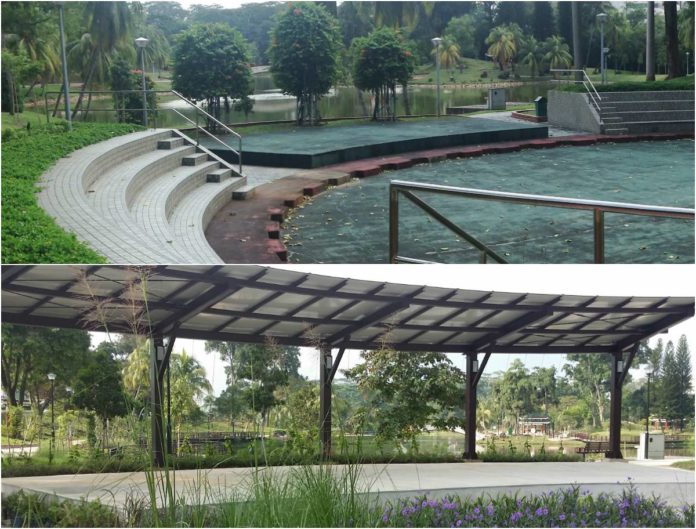
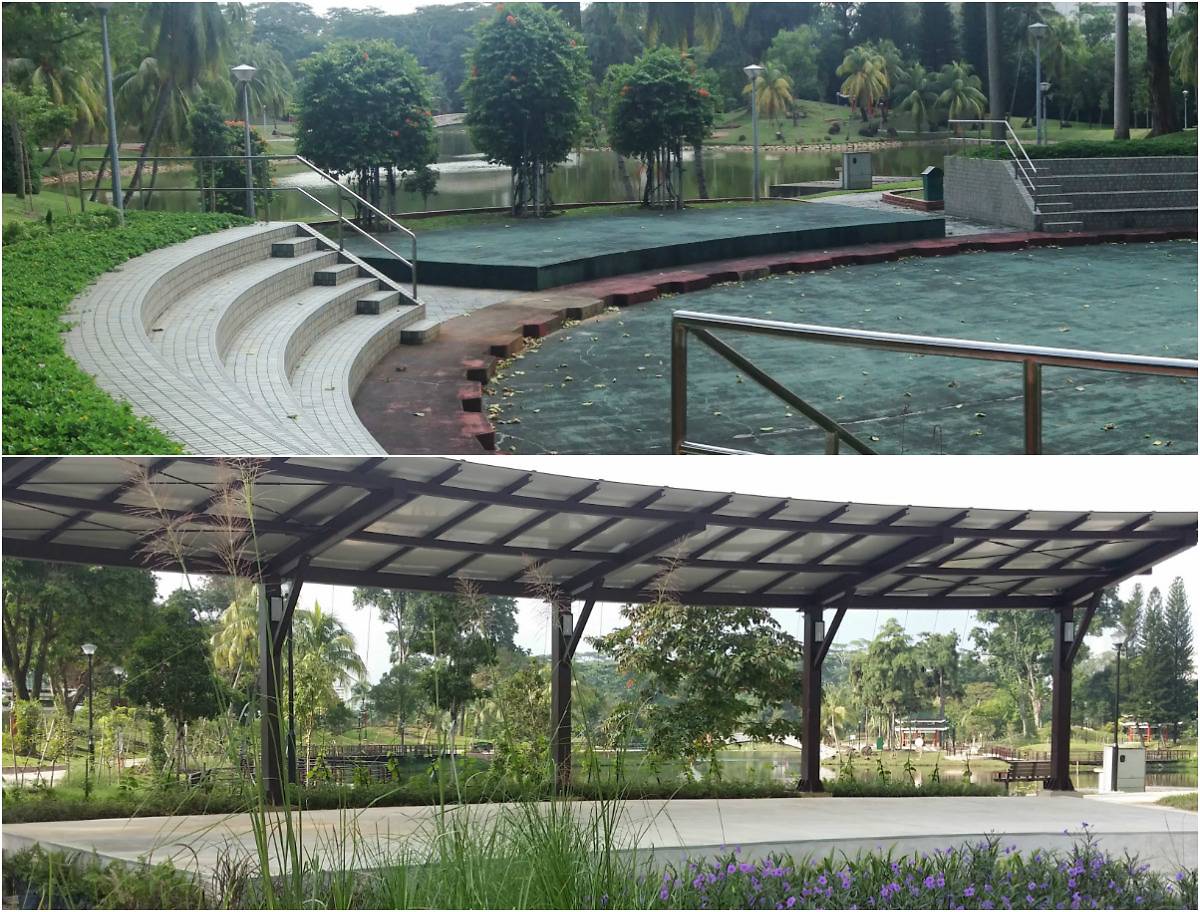
Above: Woodlands Town Garden’s amphitheatre, before the park closed for upgrading. Below: The revamped amphitheatre. (Photos: NParks)
Speaking at the park’s reopening on Sunday, Minister for National Development Lawrence Wong said: “In the last few years, as you saw from the media reports, we had some vice activities in this area.”
The park has now been transformed with the help of grassroots leaders, NParks as well as President Halimah Yaacob, who pushed for the park to be upgraded during her time as Member of Parliament for Marsiling, Mr Wong said.
The 13ha park now has a new butterfly-shaped playground – the only one of its kind in Singapore – a new boardwalk, heritage corner as well as a cafe that is open around the clock.
The new butterfly-shaped playground is the only one of its kind in Singapore. (Photo: NParks)
Lighting has also been improved and activity areas are now well-lit to allow visitors to enjoy the park and use its facilities in the evenings, NParks said.
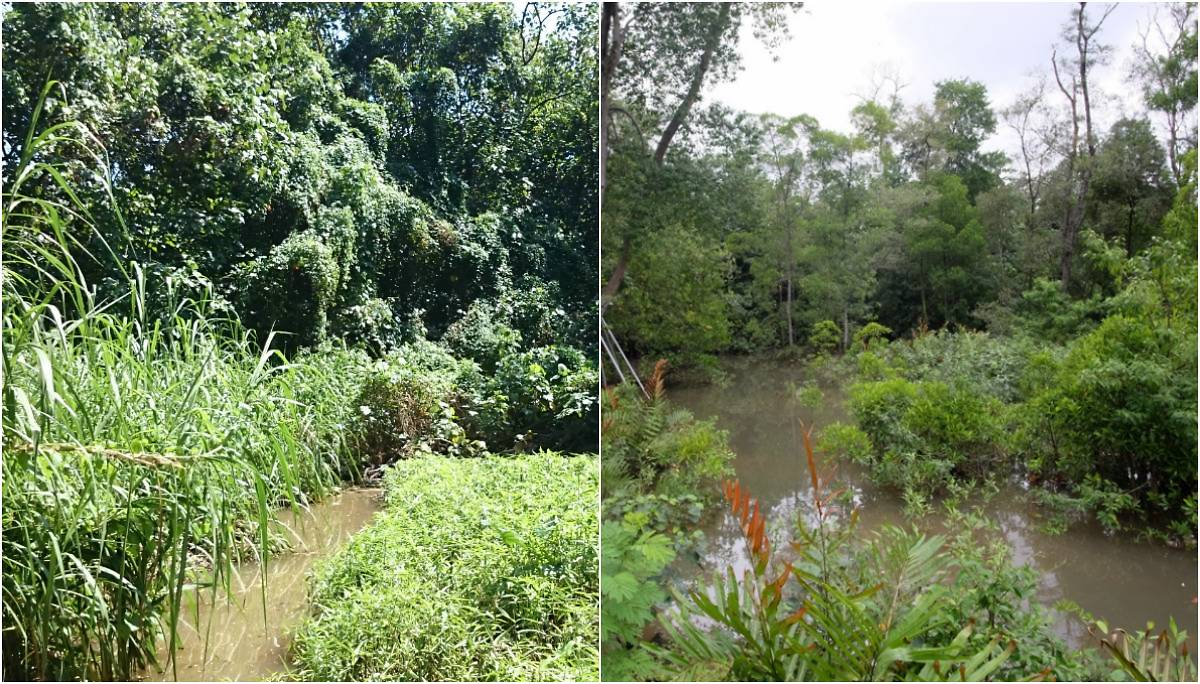
The mangrove area has also been enhanced to allow visitors to get closer to nature. More than 1,000 saplings of mangrove species such as Api Api and White Teruntum were planted. Critically endangered local mangrove species such as the Berembang have also been reintroduced to boost the biodiversity and ecological resilience of the mangrove.
Before and after: The park’s mangrove area has been enhanced to encourage park visitors to get closer to nature. (Photos: NParks)
The park is part of the six “star attractions” that was introduced last year to revitalise the Woodlands estate. Other attractions include new recreational and residential developments.
As part of the third batch of estates under the Housing and Development Board’s Remaking Our Heartlands programme, the Woodlands estate will be spruced up over the next five to 10 years.
SINGAPORE: As Singapore prepares for one of the most important political leadership transitions, history is in the making once again.
14 years ago, Prime Minister Lee Hsien Loong took over the reins of leadership from Mr Goh Chok Tong. The third generation (3G) of leaders established themselves, taking Singapore forward and beginning the next chapter of the Singapore story, many have said.
With the recent Cabinet reshuffle, a new chapter has begun. A fourth generation (4G) team now helms two-thirds of all ministries, as PM Lee has noted.
Three senior office holders Mr Yaacob Ibrahim, Mr Lim Swee Say and Mr Lim Hng Kiang, will be stepping down, while younger officer holders such as Ms Indranee Rajah, Mr Baey Yam Keng and Mr Amrin Amin were promoted.
As for the three ministers who have been mentioned as potential prime ministers, Mr Heng Swee Keat and Mr Ong Ye Kung will be staying on in their existing roles but with expanded responsibilities while Mr Chan Chun Sing will return to Government to serve as the Minister for Trade and Industry and take over responsibility for the Public Service Division from Deputy Prime Minister Teo Chee Hean.
While no obvious successor to PM Lee has yet emerged, it is clear that the transition from 3G to 4G leadership has entered a new phase.
Much of the spotlight has been placed on this reshuffle and the upcoming President’s Address which will be delivered on May 7.
Some have said that the 4G leaders must more actively establish themselves with Singaporeans and convince them of their policies and visions.
But what does this actually mean?
The most obvious expectation is for the 4G team to be more active in fronting and communicating policies, just as, for instance, Finance Minister Heng Swee Keat fronted the impending GST hike when he announced plans to implement it sometime between 2021 and 2025 during Budget 2018.
Finance Minister Heng Swee Keat speaks in Parliament.
But establishing themselves and winning over Singaporeans’ hearts and minds will require more than just being the face of policy changes. The 4G leaders are not the next generation of public servants – they are the next generation of national leaders, tasked with providing vision and direction.
In the light of this, we should expect the 4G leadership to engage in two other foundational aspects of governance as they establish themselves – building a new narrative and forging a new consensus.
“From Third World to First”, “Shining Red Dot”, “City in a Garden” – narratives are essentially frames and stories we use to make sense of things, provide direction and anchor ourselves.
Just as we as individuals choose what narrative we wish to employ as we move forward in life, we as a nation must choose the direction for our journey which best takes us forward together.
Although this endeavour involves all Singaporeans, it must be spearheaded by national leaders.
What the next Singapore narrative will be is the most important choice that the 4G leaders will need to make, together with Singaporeans.
The appropriate narrative helps citizens make sense of policy changes and appreciate broader contexts. More importantly, it provides direction for the nation – a narrative after all, must have a beginning, a middle and a conclusion.
Of course, while narratives can be imagined, they must reflect the realities of national life. The beginning, the conclusion and the middle thus essentially become “where we came from”, “where we’re going” and “how we get there” respectively.
The act of charting our way forward needs to be rooted in our shared history and values as well as a common consensus on the paths we will take towards the future.
Furthermore, while fostering national unity, this new narrative, what I would call Narrative 4.0, must also connect emotionally to individual aspirations, for it is ultimately the aspirations of Singaporeans that powers the continued progress of the nation.
Writing the above, my suggestion is for a narrative along the lines of, “A Nation of Pioneers, A World of Opportunities”.
The reference to pioneers simultaneously alludes to the past and the future. It reminds us of the values embodied by the pioneer generation while “a world of opportunities” connects this immediately with how Singaporeans must venture forth into an uncertain world with a pioneering spirit to seek opportunities together.
SAF pioneers in the crowd at the armed forces’ 50th anniversary parade (Photo: Loke Kok Fai)
CONSENSUS 4.0
While narratives serve to communicate policies and guide the nation forward, consensus-building serves to strengthen the link between the Government and the people. It is thus an essential task which the 4G leadership must take on.
Consensus-building by a new generation of leaders in a new age should be seen as a negotiation of the social contract between the Government and the people, in light of new challenges and changing circumstances. Consider the 2013 Our Singapore Conversation exercise, headed by Mr Heng, which sought to build consensus for a new period through more extensive engagements.
Moving forward, where could we most likely see a new consensus being sought? Consider where major shifts are taking place.
On the economic front, consensus must be sought on the need for higher taxes, to ensure fiscal sustainability while having the means to fund rising social and infrastructural expenditure.
In this, trade-offs must be discussed. In the book The Big Ideas of Lee Kuan Yew, Mr Heng himself highlighted:
A society loses its vigour if it eschews excellence and competition; equally a society loses its cohesion if it fails to take care of those who are left behind or disadvantaged.
Another example – regarding Singapore’s drive to be a Smart Nation, consensus would need to be sought on how technology and data are leveraged in everyday life to solve problems and create opportunities, including how much the population will need to build tech and data literacy.
Changing leadership is also a reason for the re-negotiation of the social contact.
Previous social contracts were forged between the people and the 3G leadership, many have pointed out. To lead effectively and establish themselves, new leaders must therefore forge their own consensus, in their own ways.
For example, Mr Chan has strengthened the consensus on the need for the labour movement to be inclusive and relevant, by leading NTUC’s efforts to enhance its reach to also cover PMEs.
Chan Chun Sing and MWC Chairman Yeo Guat Kwang (second from left) with tripartite partners. (Photo credit: NTUC)
In education, Mr Ong has strengthened the consensus that his predecessors built on the importance of lifelong learning. As the key minister fronting higher education and skills, he has moved swiftly to shift Institutes of Higher Learning towards seeing themselves as hubs of lifelong learning.
Both ministers strengthened consensus on those issues in their own ways. We can expect the intensification of such efforts by the 4G team in the years to come.
A NEW GENERATION’S TIME HAS COME
As the leadership transition progresses, we can expect the 4G leaders to more actively establish themselves with Singaporeans in the coming years. Doing so would require more than just fronting policy changes, but also building new narratives and forging new consensus.
14 years ago, the 3G team took over the reins of leadership and led Singapore forward. Come 7 May, when Parliament reconvenes, may we witness a new generation ready do the same.
History is in the making once more.
Ng Chia Wee will begin his undergraduate education at the National University of Singapore’s Faculty of Arts and Social Sciences this August.
SINGAPORE: Aditi Saayujya has been passionate about biology since she was young.
“When I was young, my parents used to bring me out to the Science Centre and nature parks, and I used to read science magazines that my mum borrowed for me from the library,” said the recent graduate from the NUS High School of Mathematics and Science.
“To me, Biology solves the mysteries I saw around me in life, and that’s what has interested me in it from the start.”
And Aditi’s passion for the subject has brought her places: Last year, Aditi represented Singapore at the International Biology Olympiads held in Britain, and came away with a gold medal for her efforts.
“At a personal level, it’s a huge honour to represent Singapore and be given all the opportunities to train and take part,” she said. “But what really drew me to it was the challenge of solving all the most difficult biology problems and competing against the other students who are the best in the world.”
MOE ENCOURAGING STUDENTS FROM “AS MANY SCHOOLS AS POSSIBLE” TO PARTICIPATE
Singapore has generally performed well at the various International Olympiads, which bring together students from around the world to compete in Science, Technology, Engineering and Mathematics (STEM) disciplines. Last year, for example, Singapore was placed joint third in a field of 241 student participants from 63 countries at the International Biology Olympiad, and took a joint first position in the International Physics Olympiad, out 394 student participants from 86 countries.
Each country is only allowed to send a handful of students for each competition. And as it stands, these students typically come from a select group of schools, like NUS High, Raffles Institution and ACS Independent.
But the Ministry of Education (MOE) hopes to change that, telling Channel NewsAsia that it has been working with its partners to organise local Olympiads and “increase the outreach to as many students from as many schools as possible”.
“Teachers have also been playing a key role in encouraging students to participate,” said Director of Sciences from MOE’s Curriculum Planning and Development Division Chua Chor Huat.
He explained that local versions of these competitions are organised to allow more students to experience the challenge, and schools are invited to nominate their students to participate in them.
He added that through these competitions, students can also be identified to join the national teams, before they continue training to ultimately represent Singapore in the international competitions.
And the selection and training process is by no means a walk in the park.
Aditi, for example, took part in the national-level Singapore Biology Olympiad, where she had to undergo theory and practical tests. There was also a five-day residential selection camp where students took more practical and theory exams.
The four students representing Singapore would then be selected from the camp results.
“After joining the team, the four trained together, studied textbooks, practised laboratory skills and read papers,” she added. “It took up a lot of time, during weekends and school holidays, but it never felt like a chore to me.”
Aditi Saayujya (second from left) with her teammates at last year’s International Biology Olympiads. (Photo: Aditi Saayujya)
A STEPPING STONE TO A STEM-RELATED CAREER
Participating in such competitions can also stand one in good stead when choosing a career. Or at least, that’s the experience Dr Ernest Chong had.
Dr Chong, who participated in the International Mathematics Olympiad in 2003 and received an Honourable Mention, knew all along that he had a passion for mathematics. He pointed out that taking part in the competition “reaffirmed his passion for mathematics and anything mathematical”.
Today, he holds a doctorate in mathematics, and is now a research scientist with A*STAR. And he credits his competition experience for equipping him with some valuable skills.
“It really helped train my concentration,” he said, explaining that the format of the competition – four and a half consecutive hours of problem solving a day for two days – required them to concentrate for long periods of time. The nature of the mathematical problems, he added, also required them to “think very creatively”.
“The training sessions also helped me and my teammates further develop patience and perseverance…you literally don’t give up,” he added. “You know there’s a solution and you just work on it, and if you’re stuck, you can discuss with other people.
“All this, before we’ve even started on our careers.”
MEETING PEOPLE FROM AROUND THE WORLD A “HUMBLING” EXPERIENCE
Valuable lessons were also learnt outside of the actual competition.
For Aditi, visiting the UK for the first time was an eye-opening experience.
“Many people may think an Olympiad is all work and no play, but it was a really amazing experience,” she said. “In between the days when we had exams, they also organised excursions for us.”
She remembers visiting castles, an old cathedral and botanical gardens. And she also remembers meeting people from all over the world.
“They organised this Scottish dance where we would have to change partners every few minutes,” she said. “So I got to meet people from many different places, like Belarus, Taiwan and South Africa.
“Everyone had a similar interest in biology, and it was nice to hear their perspective of how it was to study science in their countries.”
As for Dr Chong, despite having taken part in the competition more than a decade ago, the people he met are still firmly entrenched in his mind.
“They were all from different backgrounds and cultures, but we all shared the same passion for mathematics,” he said. “After the first day of the competition, we were all discussing our answers and how we did.”
Ernest Chong (third from left) represented Singapore at the 2003 International Mathematics Olympiad in Tokyo, Japan. (Photo: Ernest Chong)
Dr Chong, who was then a student at Raffles Junior College, also highlighted another valuable life lesson he picked up from the competition.
“Singapore has a very rigorous training and selection process, and there are other countries with way fewer resources than we do,” he said. “But every once in a while, there’ll be someone who may become one of the best in the world, even if they come from a country with way fewer resources.”
“There was someone from an Eastern European country while I was there … it wasn’t really a rich country. But he was really brilliant,” he added.
“It’s very humbling to know that no matter where you’re from and how much you have, there could be someone out there who’s way smarter than you are, and can do way better even if they don’t have as much as you do.”
SINGAPORE: If you are concerned about pigeon droppings dirtying your laundry or other hygiene issues, it may come as a surprise to hear that it’s not the birds which are causing the problem. In fact, their feeders are.
The Agri-Food and Veterinary Authority (AVA) said that actively feeding pigeons and food litter are the main factors contributing to the growth of the pigeon population.
The authority was responding to queries from Channel NewsAsia on the root cause of the decades-old issue, and the effectiveness of the current penalties for pigeon feeding.
A spokesperson cautioned that the pigeon population will continue to grow if food is readily available, which will make pigeon-related issues worse, such as droppings on window ledges.
“Enforcement alone will not solve the pigeon-feeding problem,” she said.
The penalty for feeding pigeons is a fine of up to S$500. AVA penalised 130 people in 2016, five of whom were repeat offenders. Last year, that went up to 218, of whom eight were recalcitrant. As of Mar 20 this year, 93 people had been penalised, out of whom one was a repeat offender.
At the same time, AVA numbers suggest that concern about pigeons is increasing, with 5,500 instances of feedback in 2017, a 34 per cent increase from 4,100 in 2016.
The spokesperson added that pigeons are not native birds and are an invasive species. “Their droppings dirty the environment, and leftover food from pigeon feeding may attract other pests, like rats, that carry diseases and pose a risk to public health,” she said.
They can also potentially spread diseases to humans through contaminated droppings or via contact with diseased or dead birds, she added.
CAMERAS INSTALLED AS EYES OF AVA
The authority has installed about 100 cameras since 2016, the spokesperson said. “Through the use of these cameras, AVA has taken enforcement actions against recalcitrant pigeon feeders, who are subjected to heavier penalties,” she said.
The presence of cameras also serves as a deterrent to pigeon feeding, she said, adding that in cases where the photos or video footage of the alleged feeders are available, AVA will also work with the respective Town Councils to put up notices at the feeding spots to appeal for information from members of the public.
AVA said that it takes a multi-pronged approach, which involves long-term planning to better understand and tackle the issue at its root, and shorter-term measures in order to address immediate threats to public health and safety.
Banner urging the public not to feed the pigeons, in Balam Road. (Photo: Jalelah Abu Baker)
In the long term, AVA conducts studies and analyses surveillance and feedback data to formulate a science-based management approach and continue efforts to educate the public on the right behaviour to have towards animals, the spokesperson added.
“As animal-related issues are often complex, there is no single solution,” she said.
She added that the public has a part to play.
“The public can play a bigger role in managing pigeon-related issues by talking to others about the downsides of feeding. By leveraging their sphere of influence, members of the public can help change the behaviour and perspectives within their community,” she said.
AVA also urged members of the public not to feed pigeons, and to report pigeon feeders.
HOW TO SOLVE THE ISSUE OF PIGEON FEEDING?
Laws to empower citizens to stop animal feeders, including pigeon feeders, could come into effect, if MP for Nee Soon GRC Louis Ng has his way.
Mr Ng told Channel NewsAsia during an interview about upcoming plans to conduct a public consultation on amending the Wild Animals and Birds Act. He is looking to file a private member’s Bill to make changes to the Act, which he believes currently has gaps.
He said that citizens could be issued with a warrant card in order to have powers to stop feeders and collect their details.
“Then feeders will know there are people watching,” he said.
Among the changes he wants to introduce is the introduction of fines for feeding wild animals regardless of the location. He said the changes will address feeders regardless of the environment the animals are in, as enforcement prescribed in current laws distinguish between protected areas and other public areas.
When it comes to pigeons, he stressed that the feeding of pigeons and easy access to food for them are the problems.
“The issue is that we have been treating the symptoms – the pigeons – instead of the root cause, easy availability of food,” he said.
ANIMALS GO AWAY WHEN THEY DON’T GET FREE FOOD
He recalled an incident that proved his point, although it did not involve pigeons. Some months ago, a monkey started turning up in the heart of his ward in Yishun. Mr Ng’s response was to get people to go door-to-door to give residents a simple instruction: Do not feed the monkey.
Residents heeded the advice, and in no time, the monkey left and was not seen again. Mr Ng pointed to this as a sure sign that if people do not feed the animals and watch from a distance, birds and animals will be less of a problem.
“If people don’t feed them, they are not going to breed rapidly,” he said, adding that current measures could be counter-productive, or not effective.
“If they were effective, this issue will not be decades-old,” he said.
He also addressed another solution AVA has tried: Feeding contraceptives to pigeons. He said this is not sustainable as it requires the birds to be fed without fail, and that increasing manpower to deal with such issues is not sustainable either.
PIGEON FEEDERS THINK THEY ARE BEING KIND
When Channel NewsAsia visited some areas singled out for their pigeon problems in Ang Mo Kio, Boon Lay and Bukit Batok, residents pointed to recalcitrant feeders as culprits. However, they can be difficult to catch in action, they said.
One resident in Ang Mo Kio said that feeders wait till no one is around, and by the time she sees the food, the feeder is nowhere to be found. She added however, that even if she catches the offender red-handed, she would not know what to do.
Mr Jimmy Chua, 62, who takes care of a community garden in Ang Mo Kio Ave 10, said that he has come to the garden and seen it littered with items like bread crumbs and other food, thrown by people from windows that overlook the area.
“It’s so dirty. I know they live in this block, but I don’t know who they are or when they throw,” he said.
Mr Ng, who has also experienced residents complaining to him about pigeons, said that pigeon feeders think they are doing good and may not be aware of the harm they are doing.
MP for West Coast GRC, and the area’s town council chairman Patrick Tay echoed the view. While he said pigeons are “not a major problem” in his ward, he said they are a challenge to deal with.
“The main challenge are the feeders. They believe they are doing it out of compassion and kindness, and continue doing so,” he said.
SINGAPORE: Dr Lai Chee Kien is often seen carrying a backpack, holding maps and brochures of heritage sites in his hand and trekking with a group of wide-eyed visitors.
He himself has written and designed many of the maps and brochures, including the Green Rail Corridor Map, a guide to the ecology and heritage of former railway land in Singapore.
The registered architect and now an Adjunct Associate Professor at the Singapore University of Technology and Design marries his two passions – architecture and history – by enthusiastically researching the history of art, architecture, settlements, urbanism and landscapes in Southeast Asia.
One of his first architectural projects was the restoration of four pre-war shophouses along Kreta Ayer Road for the Singapore Anti-Tuberculosis Association.
He explains the reason for his obsession.
“I grew up in different housing types. Very early on, in the 1960s, I lived in a shophouse beneath Bukit Timah Hill and subsequently, we moved to a kampung house in Bukit Panjang before moving to a HDB flat in Queenstown. Now, I live in a terrace house. These different contexts allowed me to mingle with different types of people. It gave me an interest in architectural forms and the heritage of Singapore more generally.”
Among the books he has authored is Last Train from Tanjong Pagar, a graphic novel based on the closure of the heritage-rich Tanjong Pagar Railway Station in 2011.
Over the years, he has participated actively in debates about heritage and even nature as a member of both the Singapore Heritage Society and the Nature Society of Singapore.
GOVERNMENT SHOULD ENGAGE CITIZENS “THROUGHOUT THE PROCESS”
Clearly, the loss of heritage and nature in Singapore deeply concerns him and even though Government agencies have started consulting the public and interest groups more than they used to, he feels they need to do more in taking public sentiments into account.
“I think the Government agencies do pay attention. Some are very receptive. But the engagement has to be throughout the process, not just consult folks and then make decisions independent of the interest groups.”
He notes that the Urban Redevelopment Authority has started conducting more public consultations, but he feels the process can be improved.
“Members of the public should be able to follow the whole process of arriving at the solutions. I think usually the solutions are announced and then there will be a debate.”
He concedes though that citizens themselves need to “get informed” and step up earlier.
While he commends the work of agencies such as the Preservation of Sites and Monuments division within the National Heritage Board (NHB), the normally even-tempered Dr Lai’s voice rises as he bemoans some recent decisions by agencies in general.
“It also depends on which Government agency. For example, the Land Transport Authority (LTA) is actually really late to the game. With the Ellison Building incident, they were reticent about engaging heritage consultants to advise them. They wanted to put a road through and wanted to take down parts of the structure of certain shophouses. It was a protected building yet they wanted to do this.
“It scares us but we take these incidents as they come.”
In the case of the Ellison Building, the authorities did eventually consult heritage experts and a compromise was reached. It has been agreed that a larger portion of the historic building in Selegie Road will be retained during the construction of the North-South Corridor, a major expressway that will connect towns in the northern region to the city.
Dr Lai strongly believes that there is space to be “creative about how we can keep these old buildings”.
Justifying the destruction of heritage and nature with reasons such as the need for development and catering to a country’s current needs “is not right”. He believes “there are ways to do both”.
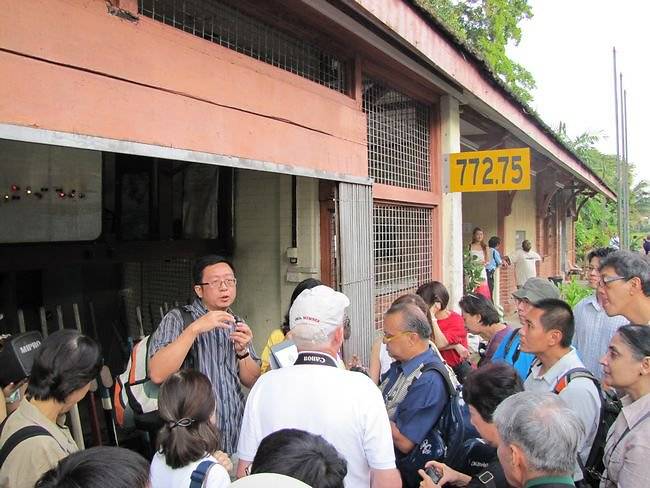
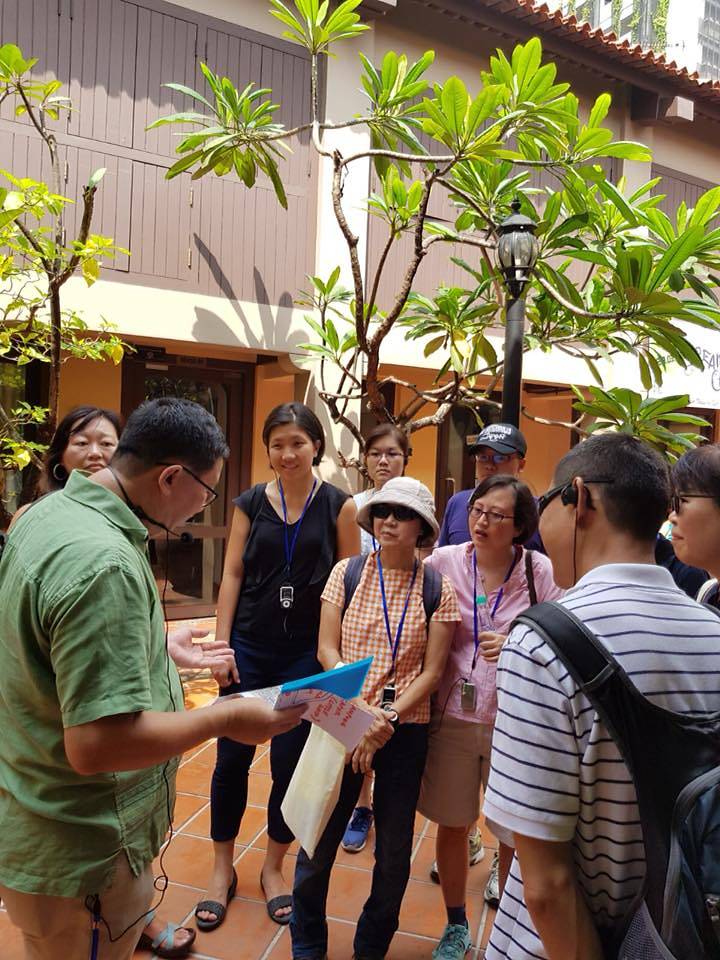
Architect and historian, Lai Chee Kien at Bukit Timah Railway Station, leading a tour of various sites connected to Singapore’s rail history. (Photo: Singapore Heritage Society)
SINGAPORE’S GREATEST LOSSES
One of Singapore’s greatest losses, he says, is the National Theatre. It was closed in 1984 as it was deemed to be structurally unsafe and was demolished in 1986 to make way for a flyover along Clemenceau Avenue that was to become part of the Central Expressway.
“This could have been avoided. Something could have been done to fix any safety issues there might have been. They could have re-planned the road but I think they were calculating the most direct route and that included part of the National Theatre. It’s really a matter of whether the buildings that you demolish are worthy enough. That debate wasn’t quite ripe at that time. There were not that many conservation folks.”
He was in architecture school at the time and hadn’t found his activist voice.
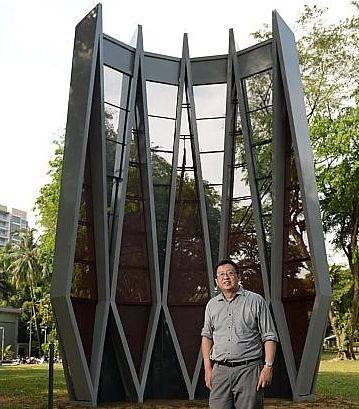
However, in 2013, 50 years after the building was first erected, he proposed a replica of its façade be built.
“I couldn’t build it on the original site because it was going to be an MRT station, so I had to place it across the street in Tank Road.”
There are plans now to move the replica to Fort Canning, closer to the original theatre’s site.
He admits many say the replica hardly does justice to the original and what it stood for.
“The intention really was to suggest that there was this really amazing building here linked with the independence era.”
After all, the theatre was built to commemorate Singapore’s achievement of self-government in 1959. It was referred to as the “People’s Theatre” as members of the public had contributed to its construction through fund-raising activities.
An architectural competition was held to choose a design and local architect Alfred H. K. Wong’s was the one eventually adopted. It constituted a five-pointed façade representing the five stars and a fountain representing the crescent moon depicted on the national flag.
Dr Lai temporarily relinquishes his historian identity and morphs into an architectural geek as he explains why the building’s design was remarkable.
“In the 1960s, it wasn’t viable to air-condition the entire space, but it had to be enclosed. So you had to rely on natural ventilation. The design solution was to have a cantilevered steel roof overhanging an open-air auditorium extending out onto the slopes of Fort Canning. That could accommodate about 3,400 people.
“The other remarkable thing was that the design incorporated the slope of Fort Canning. So even if you were not a paying patron, you could move right up to the top of Fort Canning and you could still see some of these performances on stage in the theatre. For example, you could see Louis Armstrong from up there. He would look the size of a bee but at least you could listen to him play in the distance. There was something egalitarian about it. The theatre was a space where in our early years, Singaporeans could learn about different types of cultures.”
Lai Chee Kien with the National Theatre replica in Tank Road. (Photo: Facebook / Lai Chee Kien)
One could say that since then we seen the construction of new iconic arts and performance venues such as The Esplanade where shared memories could be built too.
“But I think something like the National Theatre is still relevant because it can still function as a theatre and strangely enough, open-air theatre is now actually making a comeback. If you go to Austria, there are performances that specify that you have to have an open-air environment. That’s because the music from the orchestra is the purest in that environment,” he says.
GETTING SINGAPOREANS ON BOARD EARLIER
While enthusiasts like him might wax lyrical about such buildings and sites, I wonder if they have made enough of a case for more Singaporeans to join the cause so that Government agencies would naturally think twice before making decisions about what to conserve and what not to.
He admits that it often seems like a cause spearheaded by niche groups and others only come on board when a building or site is threatened.
“I think people are definitely reactionary. We need to examine this as a whole community. People need to go to these places before they are threatened. Also, for example in the case of the Ellison Building, we have to ask why is it that protected buildings are suffering this kind of fate?
“These agencies have their own reasons for doing things, efficiency, cost, and so on and so forth. I think it’s about slowly influencing them and turning them around. If we have a lot more documentation, if we have a lot more experts, if the whole society can turn around to more citizen awareness of heritage from the start, we can avoid these situations and the authorities might make decisions in a more considered way from the start instead of making a decision and running into problems with groups later on in the process. Both the citizens and the state have to work together,” he says emphatically.
He is also a member of the Urban Redevelopment Authority-Ministry of National Development’s Bukit Brown Cemetery Heritage Advisory Working Committee and was part of the team that documented significant tombs on the site.
It was in 2011 that LTA announced that a new dual four-lane road linking MacRitchie Viaduct and Adam Flyover would be built over parts of Bukit Brown Cemetery to cater to increased traffic and help ease peak-hour congestion along Lornie Road and the PIE.
The remaining parts of the cemetery and its surrounding land are slated for redevelopment into a new housing estate in the future.
The fate of Bukit Brown became almost a national issue as heritage groups protested the authorities’ plans for the site.
“I think that neither the advocacy groups nor the state agencies, the LTA and the NHB expected Bukit Brown would be the arena for heritage discussion and contestation at such heightened levels.”
I suggest that it’s probably because very few people went to the cemetery before it was threatened. Can we really blame the authorities for thinking such sites are replaceable and that it is acceptable to encroach on them in the name of development and meeting society’s current needs?
“Yes, I agree people should be more proactive but the NHB entered the discussion very late. While they deliberated, some concerned Singaporeans from all walks of life formed a group calling themselves ‘The Brownies’. They had a headstart in defining what heritage information could be derived from the tombs, discovering important local personages connected to all sorts of political and socio-economic histories of Singapore, such as the tomb of Gan Eng Seng, Chew Joo Chiat, etc. The interred slowly formed a web of history quite unlike what had been recorded in textbooks.”
While he didn’t find the absence of LTA and NHB in these discussions unusual, he wishes they had “convened discussions with heritage and even nature groups as various endangered local species found there”.
THE LOSS OF BUKIT BROWN
He claims that what happened to Bukit Brown was avoidable.
“I have been using the stretch of Lornie and Adam Roads for over 25 years and I know it was part of the Outer Ring Road system the British had planned in the 1930s to connect outlying areas to town areas. The Outer Ring Road is a kind of highway infrastructure heritage and a concerted effort on the part of various parties via discussions would have avoided the highway being constructed in its present form.”
He maintains that other trade-offs could have been made.
“A seven-lane highway is broadened into an eight-lane one, so if we shave off some parts of Bukit Brown near the road, some parts near the nature reserve and golf course, it could have been broadened into an eight-lane highway from its present form. We just needed to sacrifice slips of land to widen the existing highway. Some tombs would have been affected but not as many as what was done eventually. Also the traffic jams are caused mainly by vehicles exiting the PIE into Lornie Road into a red light junction at Sime Road less than 50 metres away. Take away that junction and you’d have smoother flow.
“It would have been ideal if the agencies had delayed their plans on the account of such newfound heritage, but that was not what transpired in the end.”
Bukit Brown Cemetery. (Photo: AFP)
Since he couldn’t save Bukit Brown, he did the next best thing. He helped with the documentation of significant graves even though his expertise didn’t lie in that arena. He specialised in independence era architecture.
“The problem is those who potentially have the expertise sometimes don’t want to step up to the plate because in this case it was something controversial. We haven’t really done a lot of research to make sense of all these different places and when you have something like Bukit Brown pop up in the radar, it really connects a lot of people who have the same ideas but I think the important thing for Singaporeans is really, if you think it’s heritage, you should go there and write about it and often times there isn’t really enough information.”
He feels more of us should step up to make an impact. After all, he is just one person.
We move on to discussing the other reason given for the sacrifice of such sites – Singapore’s housing needs.
HOUSING SINGAPOREANS MORE EFFICIENTLY
Dr Lai feels it wouldn’t be entirely necessary had the city been planned better from the start and this is where traces of his fiery mentor, architect, Tay Kheng Soon’s influence come through.
Mr Tay has been vocal on a range of issues including stating that the Government’s city planners have not used land here efficiently enough.
Dr Lai too is an advocate of perimeter blocks for housing which would have ensured more homes per square metre of the island without the need for so many high-rise blocks and possibly even without too many heritage and nature sacrifices.
“Perimeter blocks means you build right to the edge of a plot, along the perimeter. It looks less dense but in fact you could actually get a lot of density out of just making it a perimeter block rather than having something in the centre. It could come up to slightly even more than the current HDB density, even if the blocks are low-rise. So it’s more efficient use of land and it makes for a better landscape. And you can actually have a nice social space in the centre of each block.”
He concedes that this could be challenging for laypeople to understand but assures me that it’s a well-researched concept.
I wonder why the early planners didn’t consider this.
“There was a pressing need for housing, so the model that was explored was the public housing flat which had proven itself in other countries. HDB was also continuing from what the British Singapore Improvement Trust had done.
“I think if we had gone into further research into these kinds of more traditional housing forms, we could have had a better mix of buildings. What we’re trying to do right now is to go up to 40 storeys and in Hong Kong they’ve gone up to 60. I’m not sure if that is conducive to building a community. Imagine if one day if the lifts are all not working!”
He claims it’s not too late to consider such new ways of housing the masses.
“We should look at areas that are sensitive in terms of heritage and perhaps these housing models can be introduced to use land more efficiently so that heritage doesn’t have to be sacrificed to make way.”
Lai Chee Kien conducting a tour of Middle Road for The Theatre Practice in relation to their production: “Four Horse Road”. (Photo: The Theatre Practice)
THE TRADE-OFFS ARE WORTH IT
Other subjects of rigorous debate come up. One that he is especially concerned about is the building of the Cross Island Line and how that could potentially affect the Central Catchment Nature Reserve (CCNR).
“I was completely surprised when I heard of the news because from the 1960s onwards, we were told that that’s a sacred nature space that you couldn’t cut through. Suddenly you have a proposal that you might go through beneath. Even cutting through beneath could affect the nature above.”
However, the Government has explained that skirting the MRT line around the nature reserve has its drawbacks.
The skirting alignment, about 9km long, will incur an additional travel time of six minutes for commuters crossing between the East and the West. It will also require longer tunnels and extra ventilation facilities. It involves land and home acquisitions that could affect families. The extra works could also incur S$2 billion more in expenditure.
The Government did eventually work with nature groups and agreed to only come to a decision after an Environmental Impact Assessment.
But why does he feel the trade-offs are worth it?
“After 50 years of independence, I think there is a need for us to sit back and really think about what kinds of developments should proceed because heritage and nature does not come by a second time. We really have to reconsider what is the edge that Singapore has to act as a ballast for Singaporeans. Singapore has a very short history and all of these buildings and places really don’t just give us character but define us as Singaporeans. Yes, there’s a price to be paid to protect such things and I do think that Singapore is not that poor so much so that we don’t consider it,” he says this as a matter-of-fact, but with a tinge of emotion.
“We’re starting to look like any other global city. I really feel it’s important for Singaporeans to feel connected to this place somehow and part of the way we can connect to this place is through places that are very significant to you.
“The LTA has been narrowly focused in the sense that we’ve been talking about the National Theatre, and many other buildings and sites. Too much is being affected by roads and MRT lines. These don’t show LTA in a good light in relation to considering the heritage of Singapore,” he adds.
Lai Chee Kien engaging audience members after one of the many talks he gives on heritage and history. (Photo: Singapore Heritage Society)
BROADENING OUR KNOWLEDGE OF OUR COUNTRY
He claims many areas in Singapore are under-studied. This includes Lim Chu Kang, Chua Chu Kang and Yio Chu Kang.
“In Teochew, ‘chu’ means ‘house’ and ‘kang’ means ‘river’. It’s related to the histories of the northern settlements. Nee Soon used to be one of the ‘Chu Kangs’. It was called Chan Chu Kang because people with the surname “Chan” settled there. Likewise with the other “Chu Kangs.” “Lim”, “Chua” and “Yio” indicate the surnames of the people who settled there. These people were given deeds to plant pepper and gambier on both sides of the river bank.”
He commends the NHB’s work in creating brochures and booklets highlighting the history of different districts, but reiterates that citizens must step up.
“In other countries I’ve visited such as Taiwan, a lot of this comes from the ground. The schools or different interest groups start to document their own areas, particular buildings. They are so proud of their environment.”
More recently the fate of Pearl Bank Apartments, People’s Park Complex and Golden Mile Complex and Tower have resurfaced.
Pearl Bank Apartments was recently sold to developer CapitaLand.
While many said it and the other buildings in question were not well-maintained and are losing their relevance, others say the Brutalist architectural style of these buildings is iconic of Singapore’s early development.
“This will be one of the big challenges for heritage and that’s really because of the land tenure of 99 years.
“A lot of these buildings have gone past the halfway mark of their use-by date. In terms of collective sales we might start to see more.”
I ask him if he thinks the Government should intervene.
“I think it’s probably quite hard in this case because it’s a multi-tenanted, but if the state feels that it is an important typology and losing it will mean losing something of heritage value, then I think they should definitely step in. At the moment, that’s not happening. I think the state should actually step in for a lot of significant buildings. You may have to repurpose them to make the retail offerings in People’s Park for example, more relevant, but otherwise the building itself has a significant history.
“If you look at the plan of the building, on the ground level it’s actually designed as if it were a bazaar, trying to be as close to the original as possible but also with open spaces. It was a testing out of a new typology. This is what brought Singapore into a new level of modernity.”
While he feels passionately about certain heritage and nature areas, I ask him how clear criteria can be formulated so that decisions on such issues can be more universally objective.
“I think if we can have a scale of relative importance, it would be helpful. If we can give a certain value, so for example, things that shouldn’t be disturbed at all should be put in Class A. Anything in Class B and C can be subject to debate. The various agencies can come up with a preliminary ranking system and then of course have constant consultation between the different interest groups and stakeholders.”
However, what factors should determine what buildings or sites go into a particular class?
“With some things such as the Central Catchment Nature Reserve, there shouldn’t be any trade-offs because it’s the only one of its kind. If we’re talking about groups of shophouses, maybe some trade-offs can be made because there could be many of the same kind. So there should be tiers of possible trade-offs.”
He is also in favour of a mandatory heritage impact assessment before decisions are made.
“Past SG50, we really need to think about what would make people live in Singapore till SG100. Heritage allows people to identify with the country.”
SINGAPORE: When she was just 19, and fresh out of junior college, Ms Nagajyothi Mahendran suddenly found herself at the helm of her family’s business – and not just any business, but Samy’s Curry, one of Singapore’s oldest South Indian restaurants celebrated for its signature fish head curry.
She had to take over its operations after her father, Mr V Mahendran, had a heart attack in 2007. But within a year of recovery, the strong-willed patriarch was back at the restaurant at Dempsey Hill – not ready yet to fully cede control of his business, much to his daughter’s chagrin.
“My father has very strong opinions. I get frustrated because I’m unable to convince him and make the changes that I want to,” she said.
“He doesn’t want to change. He said, ‘If it’s not broken, why fix it?’ That’s his mentality. It’s still his final say.”
Mr Mahendran still has his hands very much in the business, though “semi-retired”.
Ms Nagajyothi belongs to a generation of young successors in local F&B businesses such as Rumah Makan Minang and kueh business HarriAnns who are facing challenges taking control of the family business, as the programme On The Red Dot discovers. (Watch the series here.)
As the third generation in the family business, Ms Nagajyothi and her younger brother Veerasamy have had to learn how to navigate family politics, and stay relevant in a cut-throat industry while holding onto their food heritage.
The restaurant’s signature fish head curry.
HER DASHED DREAMS
The 34-year-old entrepreneur – who serves, takes orders and mans the till at the restaurant – had harboured hopes of landing a mass communications job after school, but her father’s heart attack changed all that.
“It didn’t really occur to me that oh, okay, I’m going to have to give up my dreams,” she said. “But being the eldest, I had no choice but to take over.”
Even though she’d spent much of her childhood at the restaurant (which began life as a roadside stall at Tank Road run by her grandfather in the 1950s), running it and trying to get employees to listen to her proved more challenging than she’d expected.
Especially for a wet-behind-the-ears young female chief who didn’t quite have the commanding air of a boss.
“There was one staff who did not listen to me, maybe because he saw me grow up,” she recounted. “But at the end of the day, I’m the boss, if you don’t listen to me then I have to let you go.”
While she has since earned the respect of her staff, her father’s dominating presence continues to intrude. The siblings take care of day-to-day operations, but the very vocal and strict 60-year-old is never far from sight or earshot.
“Even if I cannot walk as fast these days, I still walk around (my restaurant).
“This is my business, if you asked me to do any other thing apart from this, I don’t know how to do,” said Mr Mahendran, who considers himself only “semi-retired” and can be heard berating the staff for mistakes.
Still ‘the boss’ in many respects.
He himself took over the restaurant when his father died suddenly in 1979 and left him running “a one-man show” with no time for a social life.
But that experience of ruling the place with an iron hand and stentorian voice for over 20 years, before ailing health forced him to step back in 2003, might explain his reluctance to trust his children with any major changes to the business he’d built.
YOUNG VS OLDER GENERATION
Indeed, little has changed about Samy’s Curry since it opened at Dempsey Hill in the 1980s.
Recently, though, they’ve been losing customers, and most of their patrons are in their 40s and 50s. The siblings want to change that by modernising the restaurant – starting with fully air-conditioning the place, to attract younger patrons and families with children.
“As my customers grow older, for the simple rule of survival, we need to bring in younger customers,” said Ms Nagajyothi.
A lot of times we get requests to sit in our air-conditioned section because it’s too hot outside. When I say that that section is full, some reservations get cancelled.
Her idea to fully equip the restaurant with air-conditioning would cost them some S$200,000, and her father is unconvinced of the pay-off.
He thinks customers prefer the natural setting amidst greenery and nature. “I know it can be stuffy and a bit warm, but a lot of my customers say they enjoy it,” he reasoned.
So to bolster her case, Ms Nagajyothi set about a strategy of canvassing feedback from customers – but her dad did the same too. Unsurprisingly, her younger customers liked the idea of air-conditioning, while Mr Mahendran’s older customers and friends were firmly on his side, declaring that he might even lose customers if they enclosed the whole place.
One urged him: “I feel that you are the person in charge, you decide. Their time will come.”
Like him, they were against air-conditioning.
Ms Nagajyothi felt her father might have misunderstood and thought she wanted to remodel the place to look like a café. But when she tried to reason with him, he brushed her off.
“You all want to do air con, (to be) more posh, then you find another place,” he said. “I want to serve the majority. I don’t want to serve the elite group. I still hold the reins.”
And that is how Mr Mahendran still views them: As his children first, business partners second. “With all my experience, I think I’m a bit better than them, smarter than them,” he said.
Usually, my children compromise. I don’t compromise.
Sure enough, the siblings have decided to improve the ventilation for now, and revisit the idea of air-conditioning the whole restaurant a year or two later.
WATCH: When dad is your toughest critic (4:39)
THE SWEET WAY
In the meantime, Ms Nagajyothi worked on gaining her father’s trust in her judgment by introducing changes in another area.
Recent customer feedback gave the siblings the opportunity to expand their desert menu, which had only three items, leaving patrons asking for more.
“Nowadays, youngsters are into social media like Instagram or Facebook. So by introducing a new, innovative dessert, I feel that I can attract them,” she explained.
The siblings enlisted the help of their mother, Madam Veerasakthi, to prepare a selection of halwa – an Indian dessert made from shredded fruit or vegetable mixed with milk, sugar and ghee – that would be served to customers on a platter.
Ms Nagajyothi was apprehensive about how her father would react to the taste-test. “Sometimes when we bring in a new thing, he’s super negative about it,” she confided. “I’m just worried he’s not going to like it and say we cannot include halwa.”
Too sweet, says dad during the taste-test.
When the five halwa portions were served to him, Mr Mahendran, who is diabetic, was predictably critical.
“The portions are too big. The sweetness is overpowering the taste, that’s why I wash my mouth with water,” he said. “You torture me by asking me to eat five at one go.”
But instead of rejecting the whole idea, to Ms Nagajyothi’s pleasant surprise, he gave them the green light to test out the new menu item, albeit advising them to go easy on the sugar and to cut the five portions down to three.
“I know we have a lot of customers who say that we are lacking (in desserts) but… we are not a bakery, why spend so much time and effort on it?” he argued. “But I’m happy (my children) started with something. So let them go get customers’ feedback.”
Unfortunately, the halwa platter of carrot, beetroot and pumpkin flavours with low sugar and less oil didn’t sit well with customers – so it was back to the drawing board for the siblings.
Their father is happy that at least they tried. “They are making an effort. That means they are putting 100 per cent in the restaurant business,” he said.
“Let them go and do. Even if they make mistakes, even if they lose money, I am ready to help them.”
SINGAPORE: More than 10 people came forward to help clear a large tree branch that fell on Saturday evening (Apr 28), obstructing a three-lane road at Ganges Avenue towards Indus Road.
They helped lift the branch to the side of the road, and cleared the smaller branches as well.
The incident took place around 8.15pm, said eyewitness Loh Soon Heng. He heard a loud bang while watching TV in his flat, located in the Housing and Development Board block in front of the road.
“After five minutes, around 15 people helped to carry the branches,” said the full-time national serviceman, who also saw an individual helping to direct traffic.
A man seen in this photo helping to direct traffic at Ganges Avenue. (Photo: Loh Soon Heng)
Loh saw police officers arriving at the scene and workers sawing off the tree branches at about 8.45pm.
Channel NewsAsia understands that nobody was injured.
The Land Transport Authority had tweeted at 8.18pm that there was an obstacle on Ganges Avenue.
Obstacle on Ganges Avenue (towards Indus Road) after Delta Road
Mediacorp will return as the official broadcaster, and will be screening all 2018 International Champions Cup 2018 matches live on Toggle.
(From left) Jose Luis Caminero of Atletico de Madrid, Robert Pires of Arsenal and Maxwell Scherrer of Paris Saint-Germain in Singapore to launch the 2018 International Champions Cup on Apr 17, 2018. (Photo: ICC)
They can be purchased via the Sports Hub website and hotline, the Singapore Indoor Stadium Box Office, The Star Theatre Box Office, Scotts Square Concierge and at all SingPost outlets.
Fans can also purchase seats on the field at S$388 each. The Field Seat category consists of 50 seats which are located in a “strategic location situated on the length of the pitch, right opposite the dugouts”, said organisers Catalyst Media Group and Relevent, in a media release on Saturday (Apr 28).
Group, family and multi-day packages are also available. UnionPay members get a 10 per cent discount except for Field Seat tickets.
The 2018 ICC Singapore will kick off on Jul 26 at 7.30pm with a match between 2018 UEFA Europa semi-finalists Atletico Madrid and Arsenal.
Paris Saint-Germain, who have won the 2017-18 Ligue 1 championship, will go against Arsenal on Jul 28 followed by Atletico Madrid on Jul 30.
Singapore is the only Asian stop for the ICC’s 27 matches, which will also be played in the United States and Europe.
Mediacorp will return as the official broadcaster and will be screening all 2018 International Champions Cup matches live on Toggle. Selected matches, including all three matches in Singapore, will also be screened live on oktoSports.
SINGAPORE: The Housing and Development Board (HDB) will soon offer wheelchair ramps for seniors who live in flats that have steps at their entrances under its Enhancement for Active Seniors (EASE) programme.
Owners of flats with a multi-step entrance or entrance with two to four steps can opt to install the ramps for wheelchair-bound seniors, HDB said on Saturday (Apr 28). There will be two types of ramps – a portable ramp or a customised fixed ramp, depending on the suitability of the flat.
A portable ramp will be suitable for units with more space at the flat’s door and can be dismantled when not in use. The other option of a customised fixed ramp can be made according to the configuration of the flat’s entrance and space.
For flats where neither ramps are suitable, mechanical wheelchair lifts can be installed under a separate pilot scheme. However, these lifters will be costlier and require regular maintenance, said HDB.
The fixed ramp can be customised according to the configuration of the unit’s entrance and space. (Photo: Wendy Wong)
HDB said it will provide more details, such as the cost of the ramps, in the second half of this year.
“The last time I had a ministerial community visit, there was feedback about having ramps to serve the multi-step entrances. Because in the past, HDB had designed some flats with steps. And these were in fact things residents had asked for in the past, because they valued privacy, security.
“So we have old flats with not just one but even two or three steps. But now the residents are older, so they have difficulty accessing the flats. That’s why we’ve been thinking what we can do for these multi-step entrances,” said National Development Minister Lawrence Wong.
On the mechanical wheelchair lifter, Mr Wong said: “We’ve piloted it – we think it can work, but it’s expensive and costly to maintain. For this particular lifter, we’ll try it out first as a pilot, roll it out, get more feedback from residents, understand what it means to install and maintain the lifter before we do a more nationwide scheme.”
There are about 170,000 such HDB flats, which were designed to raise the windows above eye level and thus offer residents, particularly those living along common corridors, greater privacy and security, HDB said.
HDB added that there are still a number of flats where these solutions will not be feasible. These are ground-level flats with five to seven steps leading up to the apartment. Wheelchair-bound seniors living in such flats may approach HDB to explore other solutions.
Home owners can apply directly to HDB for EASE, and it is also offered concurrently with the Home Improvement Programme which targets and upgrades ageing flats.
EASE currently offers HDB homeowners who have seniors living with them slip-resistant treatment for bathroom floor tiles and the installation of grab bars and ramps at subsidised rates.
First launched in 2012, the EASE programme offers elderly-friendly home fittings such as with the Government footing up to 95 per cent of their cost. Previously, only flats with a single step at their entrance were eligible for ramps.
Since end March, over 160,000 homes have benefitted from the EASE programme.
*Additional reporting by Channel NewsAsia’s Wendy Wong.