SINGAPORE: The Housing and Development Board (HDB) will soon offer wheelchair ramps for seniors who live in flats that have steps at their entrances under its Enhancement for Active Seniors (EASE) programme.
Owners of flats with a stepped entrance can opt to install the ramps for wheelchair-bound seniors, HDB said on Saturday (Apr 28). There will be two types of ramps – a portable ramp or a customised fixed ramp, depending on the suitability of the flat.
A portable ramp will be suitable for units with more space at the flat’s door and can be dismantled when not in use. The other option of a customised fixed ramp can be made according to the configuration of the flat’s entrance and space.
For flats where neither ramps are suitable, mechanical wheelchair lifts can be installed under a separate pilot scheme. However, these lifters will be costlier and require regular maintenance, said HDB.
The fixed ramp can be customised according to the configuration of the unit’s entrance and space. (Photo: Wendy Wong)
HDB said it will provide more details, such as the cost of the ramps, in the second half of this year.
There are about 170,000 such HDB flats, which were designed to raise the windows above eye level and thus offer residents, particularly those living along common corridors, greater privacy and security, HDB said.
HDB added that there are still a number of flats where these solutions will not be feasible. These are ground-level flats with five to seven steps leading up to the apartment. Wheelchair-bound seniors living in such flats may approach HDB to explore other solutions.
Home owners can apply directly to HDB for EASE, and it is also offered concurrently with the Home Improvement Programme which targets and upgrades ageing flats.
EASE currently offers HDB homeowners who have seniors living with them slip-resistant treatment for bathroom floor tiles and the installation of grab bars and ramps at subsidised rates.
SINGAPORE: There was barely a dry eye among the 400 people who gathered on Thursday (Apr 26) to celebrate the passing of a life, as eulogies were delivered.
“For the past 27 years, he has brought not just smiles to our keepers and Singapore Zoo staff. He also brought lots of smiles to the millions of visitors,” a speaker said.
“Our Inuka may be an old bear, but he was a good boy … our good boy.”
Ahead of the memorial for Singapore Zoo staff to pay their respects to Singapore’s last polar bear, a bouquet of orchids was placed on the rock Inuka used to spend time on.
A wall has been erected for members of the public to place tributes.
Online, news that Inuka had been put down on humane grounds on Wednesday morning had already sparked off a wave of outpouring from netizens by mid-day.
Photographs of the polar bear, videos of his life and personal tributes saturated social media.
Many called for ways to honour his memory. Bury him in the zoo’s compound. Build a memorial where people can lay flowers, a few suggested.
Some saw an arctic creature born and raised in the tropics as an extraordinary anomaly reflective of the Singapore story.
Others simply took the step of allowing their kids to skip school to head to the zoo to watch Inuka’s final moments.
But have we gone a little overboard?
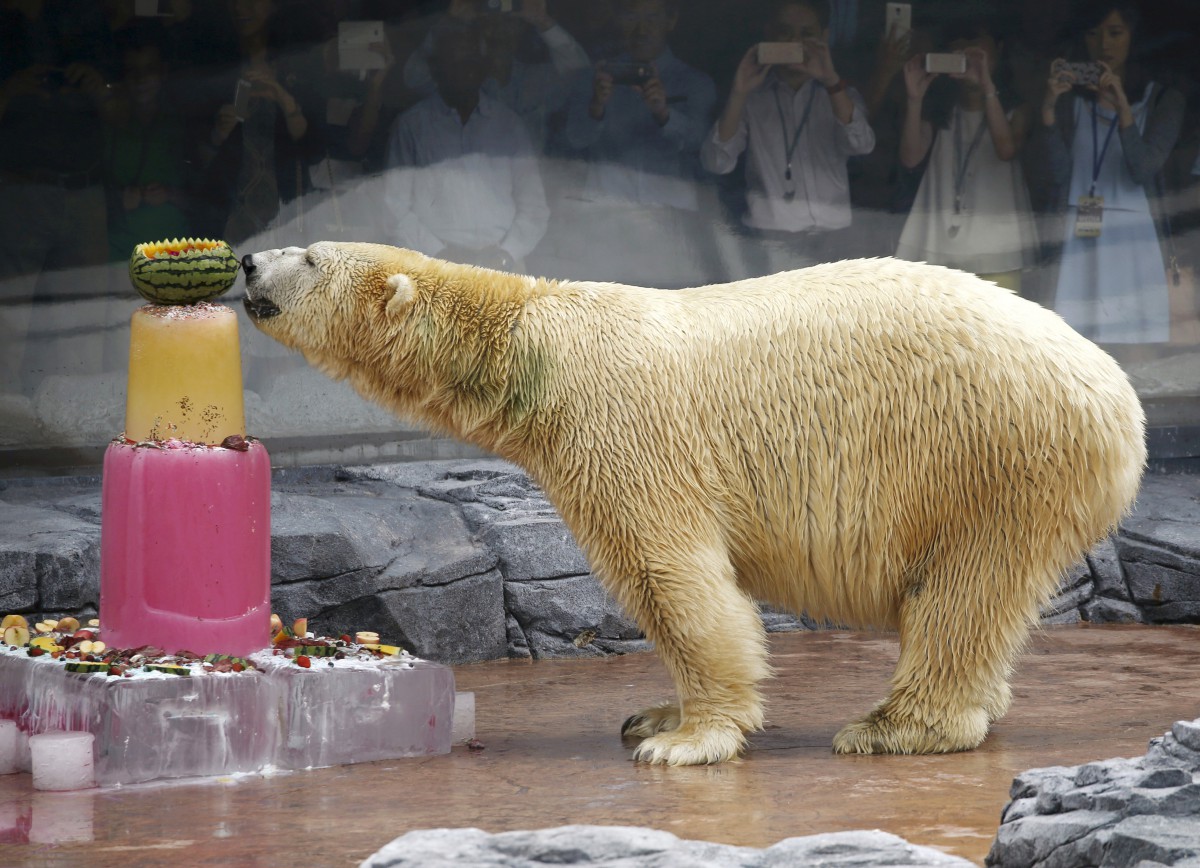
Inuka, the first polar bear born in the tropics, enjoys an ice cake during its 25th birthday celebrations at the Singapore Zoo December 16, 2015. (Photo: REUTERS/Edgar Su/File Photo)
It is no doubt heart-warming to see Singaporeans band together in remembering a well-loved animal, whom many of us grew up alongside.
Yet the torrent of expression and extent of public interest seemed disproportionate.
The zoo receives 1.7 million visitors each year, according to Wildlife Reserves Singapore. But at the Frozen Tundra enclosure that served as Inuka’s home, how many visitors and Singaporeans did more than simply watch briefly in awe, snap photos – and move on?
GREATLY MISSED, TEARS WELLING UP
Like many netizens who shared pictures of themselves with Inuka, I have one from years back when I was a child. Yet that brief moment is not a semblance of meaningful connection by any stretch of the imagination.
Why exactly do we care so much about a zoo mammal’s death? And when most of us didn’t concern ourselves when he was around?
A litmus test is this: Did many Singaporeans reflect deeply on the animal’s welfare while he was still alive?
More broadly, how many of us thought about what polar bears in the wild have to deal with facing the threat of climate change and melting icecaps?
A zookeeper places a flower under polar bear Inuka’s photo at a private memorial for the polar bear on Thursday (Apr 26) at the Singapore Zoo. (Photo: Gaya Chandramohan)
Or have we chosen instead to be one-off polar bear obituary writers this week – revelling in collective feel-bad, and putting our emotions on exhibit?
This display of public sentiment suggests something more disturbing, where studies have shown that we sometimes overshare in seeking out validation and belonging, because we feel empty and long for human connection.
RISE OF SOCIAL MEDIA HAS A PART TO PLAY
My memories are hazy but Singapore orang utan Ah Meng’s passing in 2008 didn’t seem to rouse such a reaction.
Thinking further back to a time when news of a death captured our imagination, many of us watched news of Princess Diana’s funeral in 1997 and took the chance to bond with loved ones over it.
I remember sitting with my grandparents and the conversation we had. We talked about why her death resonated with us, how life can be fleeting and how we would each spend our last day on earth.
We might not have followed stories of the royal family before that, but the sad news gave us pause for thought and collective reflection.
Floral tributes and photographs are seen outside one of the entrances of Kensington Palace to mark the coming 20th anniversary of the death of Diana, Princess of Wales, in London. (Photo: AFP/Daniel LEAL-OLIVAS)
But how many of us still bother to connect with each other in the same manner – whether over news or otherwise?
The explosion of social media may have a part to play.
With technology and instant communication, every development prompts us to disconnect from the moment and people around us to stare at our smartphones, read the news and react with a comment on social media.
Like the zoo visitors, we snap a mental picture to revel in later and move on.
We put out a social media post in a bid to chase after the dopamine hits when our friends like or comment on our posts. And to what end?
For decades, experts have said the Internet erodes our desire to connect with others in deep, impactful ways and fosters alienation, even isolation.
As a result, many of us develop an interest in popular figures as a form of coping with our emptiness.
Humans at the core are social beings, and research has shown the less connected people feel, the more they turn to icons and celebrities for affinity, said Adam Galinsky, an expert in ethics and social psychology and a professor at the Kellogg School of Management at Northwestern University.
“It’s a very adaptive and functional behaviour,” he said.
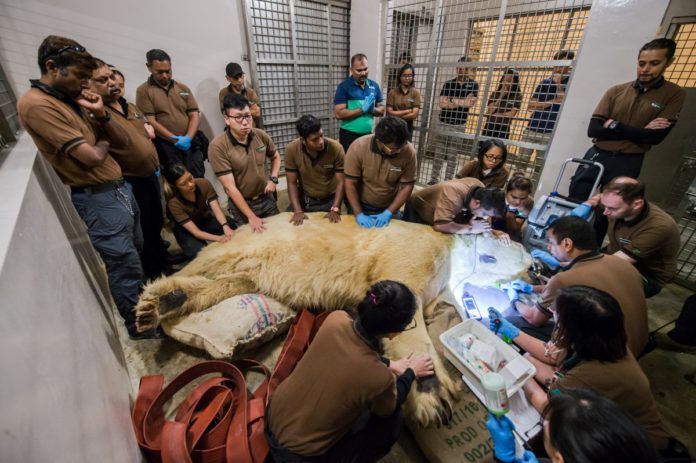
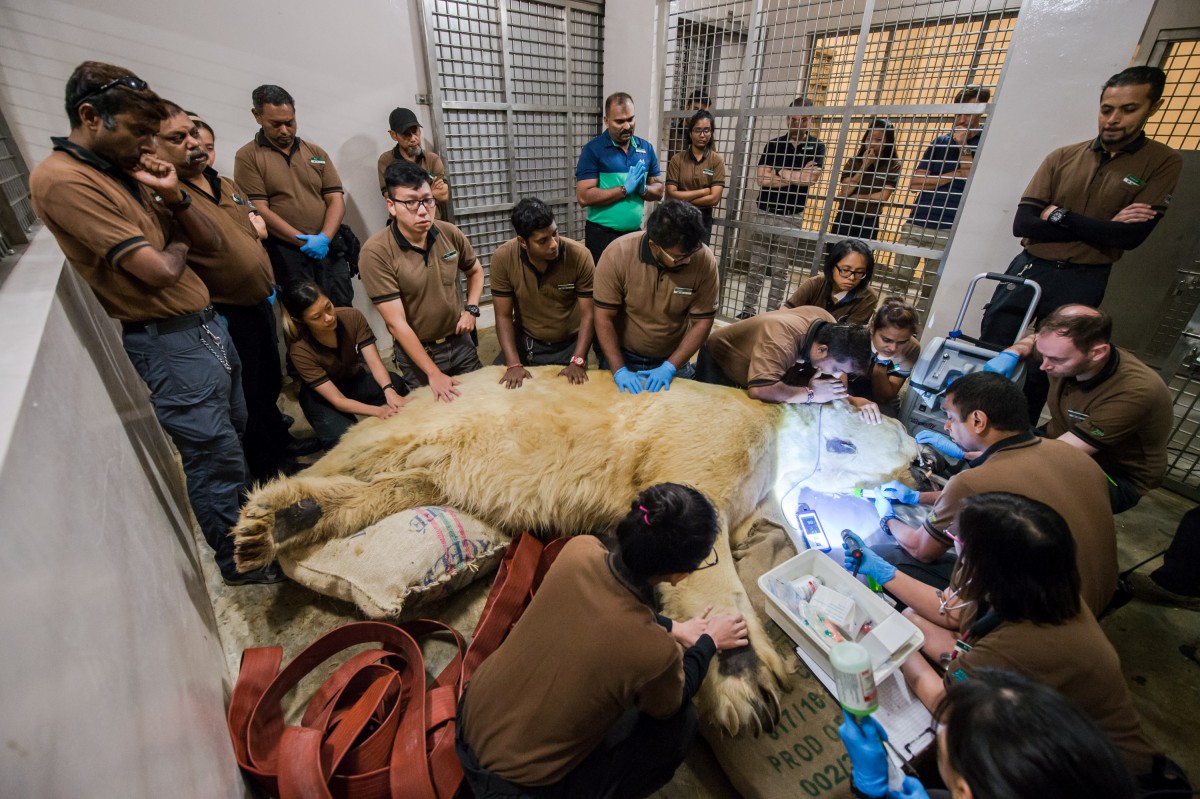
Inuka’s family of past and present caregivers gathered around him as Dr Abraham Mathew, assistant director for veterinary services, administered the final injection on the polar bear. (Photo: Wildlife Reserves Singapore)
NO TRAGEDY
What can we do to rebuild connection in an age of social media?
Some perspective may be useful. Inuka’s passing is no tragedy.
“From his point of view, he was in deep sleep, surrounded by all his keepers who care deeply about him”, said Dr Cheng Wen-Haur, the chief life sciences officer and deputy CEO of WRS.
He had lived to a ripe old age, beyond the average life expectancy of 15 to 18 years of polar bears in the wild and 25 years in captivity.
So there’s no reason to feel sad for him.
Understanding how we feel and whether our reactions are warranted when reading sad stories like Inuka’s is useful for a few reasons, including to temper unhealthy reactions to address emotions that arise.
Consumerism may be one. A few companies have already capitalised on this news to opportunistically launch new polar bear paraphernalia.
Homeware retailer Iuiga has upset fans of Inuka the polar bear by naming a porcelain tea set after the animal. (Photo: Facebook/Iuiga)
INVEST IN RELATIONSHIPS
If anything, the news of Inuka’s passing and the online reactions should force us to realise that life must be more than how we feel about zoo animals passing on.
It should renew in us an effort to connect with the people we care about, and even those we don’t.
It should serve to encourage us to focus on investing in our relationships, and building new ones with those we should.
It should spur us to spend quality time with our family this weekend, or encourage us to get to know the neighbour we see every morning.
Such actions may not be the sexy Facebook post that will generate likes but it’s what will make for an enriching, well-lived life.
An attachment to a polar bear at the zoo is no substitute for a deeper relationship with our loved ones.
Lin Suling is executive editor at Channel NewsAsia Digital News where she oversees the Commentary section.
SINGAPORE: It was about a year ago when Ms Florence Tay came across a video on Facebook showing a zero-waste provision store in Europe.
Decked out with self-service dispensers containing food items, the store provided no plastic bags or other forms of packaging and required customers to bring their own containers.
“I thought it was a great idea that took a step further when it comes to minimising the use of unnecessary packaging, especially plastic”, said the Singaporean who makes the effort to bring her own reusable container, cutlery and water tumbler whenever she goes out.
“I liked it so much that when I saw the message ‘Share the video if you like one in your neighbourhood’ at the end of the video, I did and even bookmarked it.”
Fast forward a year later, a grocery store with a similar do-it-yourself (DIY) and packaging-free concept will be opening its doors in the quiet neighbourhood of Sembawang Hills Estate.
And one of its owners is none other than Ms Tay.
CUTTING DOWN ON PACKAGING TO SAVE THE EARTH AND MONEY
Called UnPackt, the store is currently preparing for its soft launch on May 5 and its concept of having no food packaging may likely make it the first of its kind in Singapore.
Like the video that inspired Ms Tay, customers keen to do their grocery shopping at UnPackt will be encouraged to bring their own reusable packaging.
Before going about their shopping, customers will need to weigh their containers, jars or bottles on a weighing scale provided so that the weight can be noted down and later excluded from their bills. After filling up each container with the food item they like, customers will need to weigh their containers again at the counter before making payment.
Though cleaned recycled containers and shopping bags – most of them donated by members of the public – will be available for free, this means that it’s best for consumers to do some planning before heading down to UnPackt.
This “mindful planning” of one’s shopping list will help to curb impulse purchases and reduce waste, said Ms Tay.
“We are quite the opposite of supermarket shopping,” she said.
“We encourage you to come with a shopping list so that you only buy what you really need. But if you do forget or see something else that you need, pick up one of our recycled containers and we hope that you will continue to use these containers or even bring them back.”
Ms Tay, a marketing manager turned entrepreneur, and her co-founder Jeff Lam have thus far invested about S$100,000 to get things started, with the bulk of the money going into rental and renovation works to refurbish the 1,200-sqft shophouse space.
As a start, the grocery store will focus on selling food items, with a majority being healthier options such as rice with lower glycaemic index, organic pasta and superfood powders.
These will be kept in large dispensers or gravity bins to minimise individual packaging. It will also be stocking locally-made cleaning supplies, such as cold-pressed soap bars and an eco-enzyme detergent made by local social enterprise ecosenses and non-governmental organisation MINDS.
An eco-enzyme detergent made by homegrown social enterprise ecosenses in partnership with beneficiaries of MINDS. (Photo: Tang See Kit)
Ms Tay said the bigger focus on food items from the get-go boils down to how it is hard to find food, especially organic ones, with zero packaging in Singapore.
With the absence of individual packaging, the owners of UnPackt think they could reduce retail prices by about 5 per cent and hope that would “lower the entry barrier” for people to take the first step in changing their consumption habits.
“The price that consumers pay usually involves the costs of buying packaging materials and the manpower costs at the packaging facilities of manufacturers,” said Mr Lam.
“Because we buy in bulk, there is no packaging costs that we need to transfer to our customers. Our research indicate that bulk purchases are usually 5 per cent lower than packaged items so we will price ours accordingly.”
Added Ms Tay: “People tend to have the idea that going green requires additional costs but we want to prove that wrong by making our prices affordable.”
Eventually, the duo aims to expand the store offerings to consumer items, such as eco-friendly body wash, shampoos and other plastic-free alternatives like stainless steel straws, making it a “one-stop shop” for sustainable living.
Donated containers will be available for free should customers forget to bring their own. Eventually, UnPackt hopes to roll out a recycling scheme where customers can contribute their own reusable containers for others to use. (Photo: Tang See Kit)
FUTURE PLANS
Other plans on the pipeline include rolling out a recycling scheme where members of the public can donate their cleaned containers and bottles.
Once its operationally stable, the social enterprise also intends to hire full-time employees, with a preference for single mums and senior citizens. For this, UnPackt is already in touch with non-governmental organisations (NGOs) to find suitable candidates.
When that happens, the empty room at the back of the grocery store will be converted into a children’s playroom for single-mum employees to bring their kids to work.
Ms Tay, who is a single mum herself, said this is due to her own experience of finding it difficult to juggle both work and family.
“It’s really hard for single mums, especially those with lower education levels, to find a job. With childcare centres costing about S$600 to S$700 a month, it is just so much tougher for them,” she said.
But before that, the two founders are concentrating on promoting the store’s zero-waste concept.
Mr Lam admitted that he had doubts initially when Ms Tay first approached him with the idea, but his interest in curbing food waste soon helped him to come round.
The bachelor who is living alone said even with conscious purchasing efforts, he still finds it difficult to do grocery shopping for one. He reckons that a store like UnPackt will help singles like him.
But the 37-year-old still thinks there could be slower business on weekdays when the grocery store opens, and expects potential customers to have “plenty of questions” given that the concept of having no food packaging in a grocery store goes against what Singaporean consumers are used to.
“We have all been brought up in an environment where everything is convenient. Our food comes with packaging and that’s associated with being clean,” said Mr Lam.
“There may be people who won’t be able to accept food that doesn’t come in packaging so I think we will have to do a lot of explaining to do for that,” he added.
Self-service dispensers that will be used to store food items. (Photo: Tang See Kit)
Ms Tay is more hopeful.
Citing a survey that she had put out while preparing for the launch of UnPackt, more than 1,000 respondents indicated that they are willing to support a zero waste grocery store. She has also received emails from schools that would like to arrange excursion trips to UnPackt for their students.
However, the owners have had to battle with one dilemma. While they have taken steps to be more eco-conscious and avoid disposables, both Ms Tay and Mr Lam said they still have a long way to go before they can call themselves as “zero wasters”.
“This was something that Jeff and I debated several times. Can we call ourselves owners of a zero waste store if we ourselves haven’t fully achieved a zero waste lifestyle?” said Ms Tay.
While most of the furniture in the store are second-hand items and recycled materials, there are things that are brand new, such as the self-service gravity bins used to store food items.
With zero-waste organic products being hard to find in Singapore, the duo also had to source for these overseas, which inevitably creates packaging and food miles.
“That’s something that we had to overcome but we’ll like people to know that we are not zero wasters yet. We are working towards that and hopefully, everyone can join us.
“Perhaps becoming more eco-conscious can start from something simple. A slight change in lifestyle can be cultivated into habits. If everyone does that, the effect will accumulate and grow,” said Ms Tay.
SINGAPORE: As the dust settles from the latest Cabinet reshuffle, including the news that three veteran ministers will be stepping down from May 1, political analysts have identified two Group Representation Constituencies (GRCs) – East Coast and Jalan Besar – to watch come the next general election, which is due by January 2021.
Mr Lim Hng Kiang, Mr Lim Swee Say and Dr Yaacob Ibrahim, the current Minister for Trade and Industry (Trade), Minister for Manpower and Minister for Communications and Information, respectively – will be stepping down from the Cabinet to allow the younger, fourth-generation leaders to take on more responsibilities.
Mr Lim Swee Say and Dr Yaacob are the anchor ministers for East Coast GRC and Jalan Besar GRC, respectively, and their departure from Cabinet will leave these constituencies without an anchor minister.
Mr Lim currently leads the People Action Party’s (PAP) four-member East Coast GRC team which comprises Dr Maliki Osman, Ms Jessica Tan and Mr Lee Yi Shyan. But this GRC has been a traditional hot spot at the ballot box.
The People’s Action Party’s MPs for East Coast GRC. (Left to right) Lee Yi Shyan, Maliki Osman, Jessica Tan, Lim Swee Say.
In the 2015 General Election, this PAP slate secured nearly 61 per cent of the popular vote against what was widely regarded as a relative strong up-and-coming slate from the Workers’ Party (WP) comprising Dr Daniel Goh, Mr Gerald Giam, Mr Leon Perera and Mr Mohamed Fairoz Shariff.
In both 2011 and 2015, the WP showing in East Coast GRC earned them a Non-Constituency MP (NCMP) seat – which is traditionally awarded to those who polled the highest percentage of votes among losers at the general election if the minimum number of opposition members returned are not met.
The NCMP seat is currently held by Mr Perera, who is a member of the WP central executive committee and also heads the party’s Youth Wing. His East Coast GRC running mate, Dr Goh, is also a NCMP, having taken Ms Lee Li Lian’s spot after she declined the position despite being the “best loser” in the previous general election.
Meanwhile over at four-member Jalan Besar GRC, Dr Yaacob leads a PAP team comprising Mr Heng Chee How, Ms Denise Phua and Dr Lily Neo. They secured nearly 68 per cent of the popular vote against a WP team comprising Ms Frieda Chan, Mr L Somasundaram, Mr Redzwan Hafidz Abdul Razak and Mr Sim Tian Hock.
People’s Action Party’s Jalan Besar GRC MPs, led by Dr Yaacob Ibrahim (second from left). (Photo: Lam Shushan)
ANCHOR MINISTERS NOT NEEDED?
Singapore Management University’s associate professor Eugene Tan told Channel NewsAsia the PAP will “certainly be looking hard and carefully” at East Coast and Jalan Besar GRCs.
One possibility is that other members in these GRCs will step up to lead the team at the next general election, Prof Tan said.
In East Coast GRC, for instance, 52-year-old Dr Maliki, who is concurrently Senior Minister of State at the Ministry of Defence and the Ministry of Foreign Affairs, could anchor the team. He entered politics in 2001 and was elected an MP of Sembawang GRC, before being promoted into Cabinet in 2004 as Parliamentary Secretary of Ministry of Health and then Ministry of Community Development, Youth and Sports. His other postings were at the Ministry of National Development.
Likewise, Mr Heng, who will assume the position of Senior Minister of State for Defence come May, could play the same role over at Jalan Besar, he said. The 56-year-old was elected to be MP in the same year as Dr Maliki, but had cut his teeth in politics earlier by contesting the 1997 General Election against WP’s Low and lost.
He joined the National Trades Union Congress in 1995, where he is currently deputy secretary-general. He was promoted into the Cabinet in 2004 as Minister of State for Trade and Industry and has since held similar appointments at the Ministry of National Development and Ministry of Health. He’s been at the Prime Minister’s Office since April 2008, and is currently its Senior Minister of State.
“The PAP will have to assess if the Senior Minister of States can lift the team and get the job done,” said Prof Tan.
Such a scenario – of fielding a PAP slate in a GRC without a full minister – is not without precedent in recent elections but only in a GRC already held by the opposition.
In 2015, the PAP sent a team led by a former labour MP Yeo Guat Kwang and comprising four new faces to face the WP heavyweight slate of Mr Low Thia Kiang, Ms Sylvia Lim, Mr Pritam Singh, Mr Chen Show Mao and Mr Muhamad Faisal Manap in the five-member Aljunied GRC, which had been held by the opposition party since 2011.
WP’s Pritam Singh (left) meeting PAP’s Shamsul Kamar (right) as they reached out to voters during the 2015 General Election. (Photo: Try Sutrisno Foo)
Despite being dubbed the “suicide squad”, the PAP slate secured 49 per cent of the vote in a narrow defeat.
The question is whether the PAP would contemplate such a strategy in a GRC which it currently holds and, if it did, what signal would that send to the residents.
PARACHUTE IN A MINISTER?
A more likely scenario would be to parachute in a minister from another constituency to helm the East Coast and Jalan Besar GRCs.
Prof Tan said anchor ministers add weight to a GRC line-up and, by virtue of their higher profiles, signal the PAP’s intent in providing leadership to the slate and constituency.
But it also raises the stakes for voters in the GRC – and the PAP.
One narrative that has been advanced by the PAP during past elections has been that if a PAP GRC team led by a minister is not elected – the voters and Singapore at large would suffer the collateral loss of a political office holder slated to lead the nation as part of the 4G leadership.
Despite this argument, in 2011, the PAP slate led by Mr George Yeo, then the Foreign Affairs Minister, and Mdm Lim Hwee Hua, Minister in the Prime Minister’s Office, were defeated by the WP in Aljunied GRC. Also in the line-up then was Mr Zainul Abidin Rasheed, who was then the Senior Minister of State for Foreign Affairs.
“Given that East Coast and Jalan Besar GRCs have always been helmed by ministers, voters there may also have the legitimate expectation that the PAP team includes a minister. If there is no minister fielded, the voters’ perceptions of how seriously the PAP regard the GRCs and (them) could take a dip,” Prof Tan added.
The issue of whether a minister is needed to helm these two constituencies is compounded by the fact that in GE2015, these were the only two PAP GRCs where no new candidates was fielded.
“What’s interesting about both these GRCs is that they are very likely to see changes to the line-ups as part of the party’s renewal process,” Prof Tan pointed out.
PAP does refresh its line-up extensively each time a general election comes around. In GE2011, it fielded 24 new faces while the number in GE2015 was 22.
Another political observer, Dr Gillian Koh, agreed with the possibility of changes in the PAP line-ups in these two GRCs.
“Will new anchor ministers be drawn from areas that are contiguous to these two GRCs – in the case of Jalan Besar, drawn from Tanjong Pagar GRC, and in the case of East Coast, drawn from Tampines GRC or Pasir Ris-Punggol GRC – where the spare talent that is moved can tap on their pre-existing political capital as they helm those newly constituted GRCs?” suggested the deputy director of the Institute of Policy Studies.
One indicator might be to look out for 4G ministers who may be extending their presence by walking the ground in these two GRCs.
A third scenario: A change to the electoral boundaries of these two GRCs. “(There could be) some tweaks to the boundaries to include the political constituencies that have already been nurtured by the new anchor ministers of in neighbouring GRCs,” Dr Koh said.
Whatever the outcome may be, Prof Tan said Singaporeans “can expect East Coast and Jalan Besar GRCs to be hotly contested” in the next general election.
As for West Coast GRC, where Mr Lim Hng Kiang is currently the anchor minister, the transition appears to be clearer.
Prof Tan said Mr S Iswaran, who will be moving from Trade and Industry Ministry to helm the Ministry of Communications and Information from May, is “very likely” to take over from Mr Lim. Mr Iswaran has been a member of the West Coast GRC slate since 1997.
SINGAPORE: He was the first person to discover Inuka when it was born. He was there when its mother Sheba died. And he was there when the end came for Singapore’s last polar bear.
Wildlife Reserves Singapore (WRS) deputy head keeper Mathivanan Samy (Tony) was the closest thing to being its dad since the bear’s father Nanook died in 1995, when Inuka was five years old.
And just before the day arrived, the 60-year-old finally made peace with the inevitable parting.
“I think, yes, I’ve accepted it. At the beginning, it was too much for me,” said an emotional Mr Mathivanan. “He’s like a son to me.
“Like any other parent … you’d want to do the right thing for your child. If the child is still suffering, do you want to see that?”
With a sniffle, he added: “Of course, it saddens me. But there’s a time for everything.”
Past and present caregivers gathered around Inuka as Dr Abraham Mathew administered the final injection. (Photo: Wildlife Reserves Singapore)
That time came on Wednesday, the morning of April 25, with Inuka’s entire family of zookeepers by its side – moments the public only had a glimpse of through three photos released by the WRS.
In the 27-year-old’s final days, however, Talking Point was given exclusive access to Inuka and its Frozen Tundra home at the Singapore Zoo – and came away with a little more insight into why those who knew the bear loved it so.
ENTER ‘OUR LITTLE FRIEND’
The only polar bear born in the tropics first graced the Singapore Zoo on Dec 26, 1990. The zookeepers knew Sheba was pregnant but could not tell when the exact delivery date would be.
Mr Mathivanan, who has been with the zoo since 1982, was looking after the expectant mother then, and had just released it into the outdoor enclosure.
“She was walking out, and I went, ‘What’s that blood stain on her back?’” he recalled.
I said to myself, ‘She gave birth?’ So I closed the doors, went to the cubbing den and saw our little friend wriggling around.
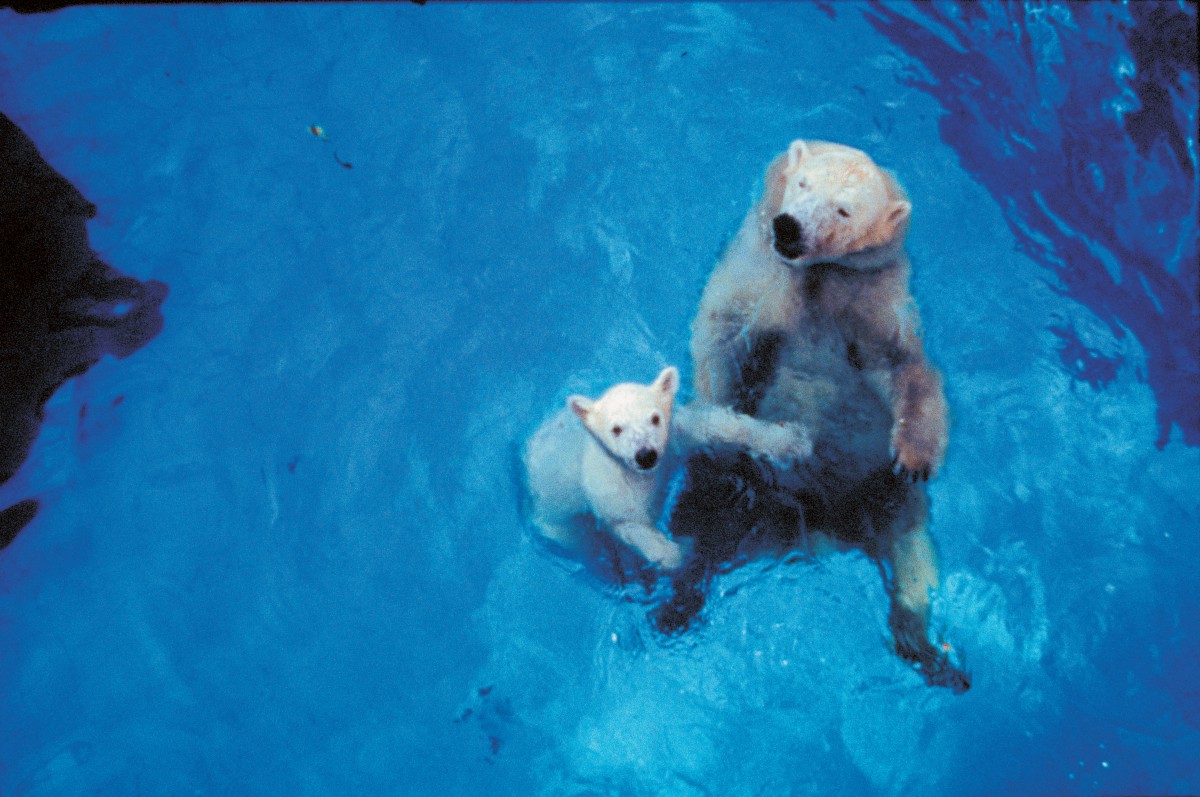
A young Inuka and his mother Sheeba. (Photo: Wildlife Reserves Singapore)
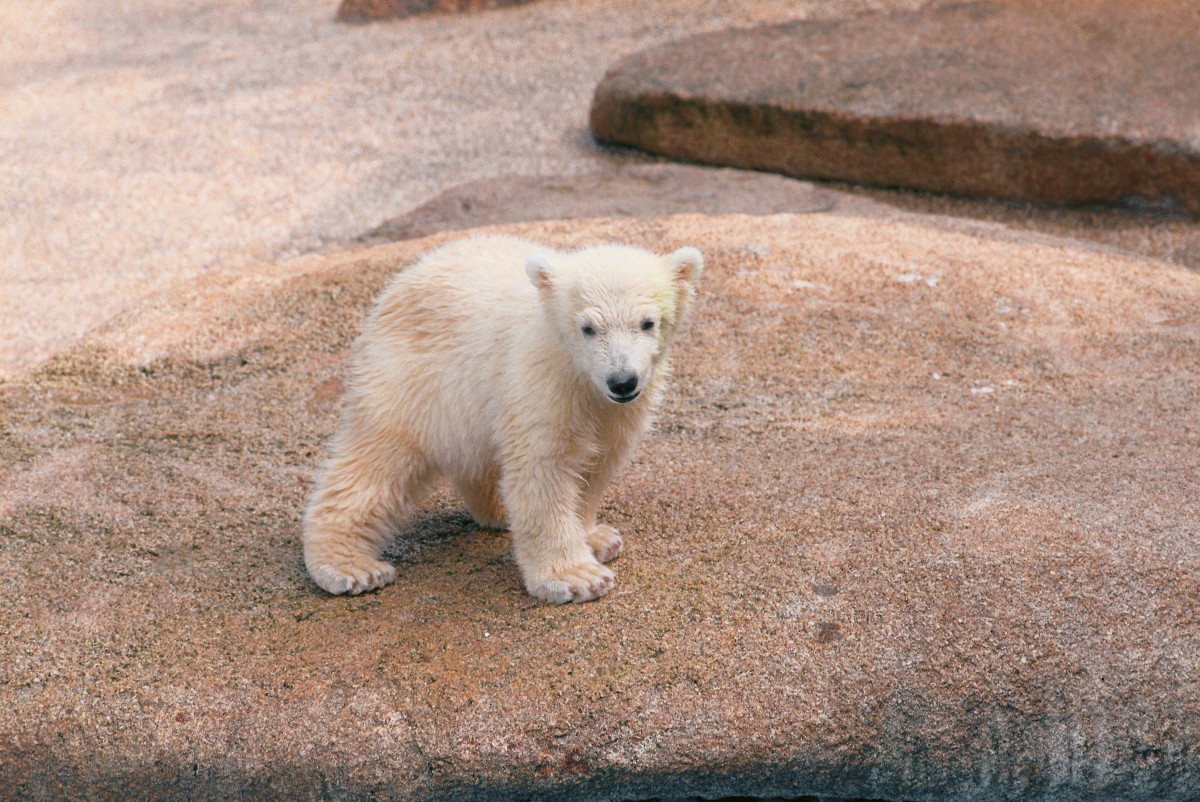
The newborn cub could be carried in the palm of one hand. Full-grown Inuka weighed more than half a tonne.
The bear was cared for by different keepers over the years, but Mr Mathivanan was especially attached to it, just as he was to its mother. And he remembers how Inuka was when Sheba died in 2012.
“He’d come around and look at mummy’s den,” he said.
He knew there was something wrong when she wasn’t there. And I’d say, for about one and a half or two months, you could see it in his eyes.
‘FUSSY, SMART BEAR’
In 2016, WRS deputy head keeper Mohan Ponichamy became one of Inuka’s primary keepers. Having tended to many elderly animals in the zoo, he was familiar with the care required for the bear, which was 70-plus in human years.
One of the things he found Inuka to be was “very inquisitive”, and so it was even in the last days, when the Talking Point team visited and brought “new scents” to its home.
‘Open, Inuka’, says his keeper Mohan.
It was also known to love the limelight. As the crowds gathered this month, however, the bear did not always feel up to leaving its air-conditioned ice cave.
“We explained to them that, if he didn’t feel like coming out, if he felt like sleeping, we’d leave him alone,” said Mr Ponichamy, gesturing as he would to Inuka. “It’s okay, buddy. You just rest.”
To help the bear cope with its arthritis and ulcers in the final three weeks, a higher dosage of medication and supplements were administered. These were mixed in its food three to four times a day.
But the keepers had to hide the pills and even disguise the smell and taste by, for example, soaking them in honey.
“Sometimes he’d spit out the whole meat, and then he’d open it up to check if there was a pill,” said Mr Ponichamy, 41. “He’s a fussy, smart bear.”
The keepers had to hide his pills in his food, but Inuka wised up to this trick.
The way the pills were given had to be changed “all the time” because Inuka caught on “very fast”. And the keepers had to be patient during feeding time, as they could not let the bear skip its medication.
At one point during the weekend before Inuka’s crucial check-up, as Mr Ponichamy watched footage of the waiting crowd, his thoughts just got to him.
“Everybody loves him. Everybody knows him. And he was … when he … Sorry, when I think of all this, it’s very …” his voice trailed off.
An emotional moment for keeper Mohan Ponichamy.
NO MORE SUFFERING
Some have questioned the decision to put down the ageing polar bear. But WRS assistant director of veterinary services Abraham Mathew said his team realised that they could not help Inuka any more.
“We had been monitoring him for a couple of years. Every now and then, he was a bit more lethargic,” he said.
But over the last couple of months, we noticed that rest period – of not wanting to be so active – had increased.
Inuka spent most of his time resting in his final days.
Its teeth were wearing down. Its hearing was not as good as before. And probably because of age-related changes to its bone structure, Inuka’s gait had stiffened into a shuffle, causing abrasions on its paw pads.
Carrying its heavy weight around was “really a painful process”, and meant that the bear needed a “fairly high” dosage of painkillers every day. But the medication would eventually have taken a toll on Inuka’s other organs.
Dr Mathew said: “We wouldn’t allow him to go through that process of pain and suffering. That’s our stand on this.”
Dr Abraham Mathew.
Having had the chance to speak with those who cared for Inuka over the years, Talking Point host Steven Chia summed it up by saying: “You can see there’s clearly a connection between them.”
Since birth, Inuka captured the hearts and imagination of locals and visitors alike, becoming one of the Singapore Zoo’s icons. And to the ones who loved it the most, like Mr Mathivanan, it has given “a lot of fond memories”.
Watch the programme Talking Point here. New episodes every Thursday at 9.30pm on Mediacorp Channel 5.
In healthier times. (Photo: Wildlife Reserves Singapore)
The cities, which are located in the various ASEAN countries, will need to develop action plans specific to their cities as part of the countries’ bid to cooperate and share best practices on smart cities development.
Prime Minister Lee Hsien Loong at the ASEAN Summit working dinner on Friday (Apr 27). (Photo: ASEAN2018 Organising Committee)
(Updated: )
Bookmark
SINGAPORE: Twenty-six cities from the 10 ASEAN countries have been named pilot cities for the ASEAN Smart Cities Network, according to a concept note released by the regional bloc on Friday (Apr 27).
The concept note, released as leaders from the 10 countries meet in Singapore this week for the 32nd ASEAN Summit, outlines the proposal to establish the ASEAN Smart Cities Network.
An initiative spearheaded by Singapore, the network is envisioned as a collaborative platform where up to three cities per ASEAN country work towards a common goal of smart and sustainable urban development. Cities include Singapore, Johor Bahru, Phuket, Yangon, Phnom Penh and Vientiane.
In explaining the rationale for the network, the note cites the challenges of rapid urbanisation, and its implications on issues like city congestion, water and air quality. Technological and digital solutions can be used to resolve these issues and enhance quality and accessibility of services, it says.
Many ASEAN member states have already designated certain areas as smart cities or launched smart city projects, according to the note. The ASEAN Smart Cities Network will synergise these efforts and bring the smart cities together, “thereby contributing to ASEAN Community-building”.
CORE ELEMENTS OF THE ASEAN SMART CITIES NETWORK
Highlighting some of the core elements of the network, the note says that member cities will develop action plans specific to their cities. These action plans contain specific projects and actions that the member city will undertake from 2018 to 2025.
An ASEAN Smart Cities Framework will also be jointly crafted by member cities that will articulate the bloc’s definition of a smart city, outline key principles and identify core outcomes.
An initial draft of the framework was prepared by Singapore and circulated to member states last month. The aim is to get it endorsed at the first ASEAN Smart Cities Network meeting, slated to be in July. ASEAN leaders will adopt the framework at the 33rd ASEAN Summit in November.
As part of the framework, member cities can each pair up with one of ASEAN’s external partners to cooperate on smart cities development.
LEADERS COMMIT TO BUILDING RESILIENT, INNOVATIVE ASEAN IN FACE OF GROWING GLOBAL UNCERTAINTIES
At the Summit, the ASEAN leaders also released a vision statement that reiterates several key principles that underscored the grouping’s collective vision and commitment. This is in line with Singapore’s chairmanship themes of resilience and innovation.
According to the statement, the leaders recognise the increasing change and growing uncertainties in the global landscape, and are committed to building a resilient and innovative ASEAN that is able to “navigate these challenges in a coordinated, integrated and effective manner”.
Among other things, the leaders agree to commence work on an ASEAN Extradition Treaty to strengthen the grouping’s capacity to combat transnational crimes. They also agree to work actively towards the conclusion of an effective Code of Conduct in the South China Sea.
The ASEAN leaders also released a separate statement on cybersecurity cooperation. In the statement, the leaders recognise that cybersecurity is a “cross-cutting issue” that requires coordinated expertise from multiple stakeholders from across different domains to address effectively, and notes that the cyber domain potentially represents an opportunity for “significant regional economic and technological development”.
Hence, they reaffirm the need to build closer cooperation and coordination with each other on cybersecurity policy development and capacity building initiatives.
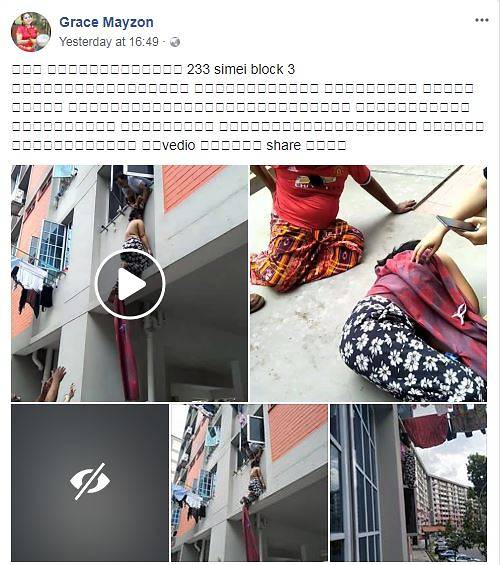
SINGAPORE: A few residents tried to save a woman who fell from the third floor of a Housing and Development Board block in Simei on Thursday morning (Apr 26).
Photos and videos of the incident, which took place at Blk 233 Simei Street 4, have since gone viral online.
Video clips show a man trying to save the woman, who is in her thirties, from falling by holding on to her hair while standing at a window on the second floor. He was also heard saying that he could not withstand her weight any longer.
Another man on the ground floor appeared to have cushioned the woman’s fall. Police officers were seen arriving at the scene, as the woman lay on the ground.
The photos and videos were taken by eyewitness Grace Mayzon, who told Channel NewsAsia that she saw a leg dangling from a window above her when she was in a flat on the second floor.
She added that she had also tried to hand some clothes to the woman, who had lost her shirt during the fall.
The Singapore Civil Defence Force (SCDF) were alerted to the incident at about 11.26am. A woman and a man were taken to Changi General Hospital, and the woman was in “serious condition”, SCDF said.
Channel NewsAsia has reached out to the Ministry of Manpower for comments.
A screenshot of a post by eyewitness Grace Mayzon. (Image: Facebook)
Speaking at a working dinner during the 32nd ASEAN Summit, Mr Lee said these threats include terrorism, climate change and cyber security.
Prime Minister Lee Hsien Loong speaking at a working dinner during the 32nd ASEAN Summit on Friday (Apr 27).
(Updated: )
Bookmark
SINGAPORE: Singapore has adopted the themes of “resilience” and “innovation” for its ASEAN chairmanship because of the need for the grouping to strengthen its collective resilience against growing transboundary threats, said Prime Minister Lee Hsien Loong on Friday (Apr 27).
These threats, he said, include terrorism, climate change and cybersecurity.
There is also a need for ASEAN to make use of technology and innovation as sources of growth and development in order to improve its people’s lives, he added.
In his speech delivered at a working dinner during the 32nd ASEAN Summit, he said that Singapore hopes to work with its ASEAN partners to tackle these shared concerns.
“We do not expect to resolve all the issues within the one-year span of our chairmanship, but we do hope to prompt a productive discussion and develop a consensus on an overall approach, as crystallised in our vision statement, to take ASEAN forward,” he said.
“We also hope to put forth tangible initiatives that will contribute to a resilient and innovative ASEAN.”
Leaders from the 10 ASEAN countries are in Singapore this week for the summit and related meetings. The summit is the first gathering of the ASEAN leaders hosted in Singapore this year.
The leaders will discuss ASEAN’s priorities, as well as the challenges and opportunities that it faces, with A focus on strengthening ASEAN’s resilience and innovation.
SINGAPORE’S last polar bear, Inuka, was euthanized on Wednesday after a years-long battle with health complications stemming from old age.
The 27-year-old animal who grappled with challenges ranging from arthritis to dental problems and ear infections, carried until his last days a green tinge in his fur blamed on algae growth.
“As much as we would like to keep Inuka with us for as long as possible, our ultimate responsibility is his welfare,” said Cheng Wen-Haur, an official of zoo operator Singapore Wildlife Reserves, said.
“The greater kindness would be to relieve him from prolonged suffering,” Cheng said in a statement.
Inuka, Singapore’s first born and bred polar bear undergoes a final check up at the Singapore zoo before it was put down April 25, 2018. Source: Reuters
According to Reuters, calls for Inuka to be allowed to live out his natural life grew after the zoo operator said this month that the bear, whose age corresponded to 70 years in human terms, was sick.
“Please do let him pass on naturally,” said Vanessa S. Wee, one of more than 100 social media users who commented on the zoo operator’s Facebook page.
“He is the only tropical polar bear, a true-blue Singaporean, a one-of-a-kind icon,” added another, Anita Ryanto.
Wildlife Reserves Singapore’s deputy chief executive officer and chief life sciences officer Cheng Wen-Haur said Inuka’s body will undergo a full autopsy to “add to the knowledge of science”, according to Singaporean news site Today.
Dr Cheng said the enclosure where Inuka was once housed will be refurbished and redesigned for a potential sea lions exhibit.
Inuka, the first polar bear born in the tropics, enjoys an ice cake during its 25th birthday celebrations at the Singapore Zoo December 16, 2015. Source: Reuters
Inuka, or “foreboding strength” in Inuit, was born on Boxing Day in 1990 to parents Nanook and Sheba, who had arrived from Canada and Germany, respectively, in 1978.
His father, Nanook, died in 1995 at 18 while Sheba died at the ripe old age of 35 in 2012. In the wild, the bears have an average life expectancy of 15 to 18 years.
Polar bear Inuka is pictured in this undated handout photo released April 25, 2018. Source: Reuters
His name picked from among 390 suggested in a nationwide contest, Inuka was three when he was chosen as one of the city’s icons by its main broadsheet, the Straits Times, alongside the Singapore Sling cocktail.
But in 2004, when the fur on Inuka and his mother started turning green, questioning began over the ethics of keeping polar bears in the tropics.
The Singapore Zoo said the green tinge was algae growth. In 2004, the BBC said the bears were bleached with hydrogen peroxide.
Animal rights groups have urged zoos not to keep polar bears, who suffer from being denied the huge ranges they are accustomed to in their natural habitat.
Polar bear Inuka is pictured next to mother Sheba in this undated handout photo released April 25, 2018. Source: Reuters
“Add the additional challenge of a hot climate and it becomes clear the animal’s needs are being entirely disregarded in favour of the desire to exhibit,” said Chris Draper, animal welfare head at Britain’s Born Free Foundation.
Inuka will be the last polar bear in Singapore, the zoo operator has said.
The movie, distributed by Warner Bros Pictures and produced by the same production company as the Hunger Games movies, is based on the bestselling novel of the same name by Singapore-born, US-based Kevin Kwan.
The romantic comedy is about Rachel Chu (played by Fresh Off The Boat’s Constance Wu), an American girl who travels to Singapore for the first time to meet her Singaporean boyfriend’s (played by Henry Golding) family, and subsequently discovers that they are obscenely rich and bats**t crazy. Cue scenes of Marina Bay Sands, ridiculous opulence and Michelle Yeoh as a terrifying matriarch.
Other Singaporeans had reactions that were different from mine. Because the film is set in Singapore, and some of its scenes were filmed in Singapore, they were expecting a win for Singaporean representation.
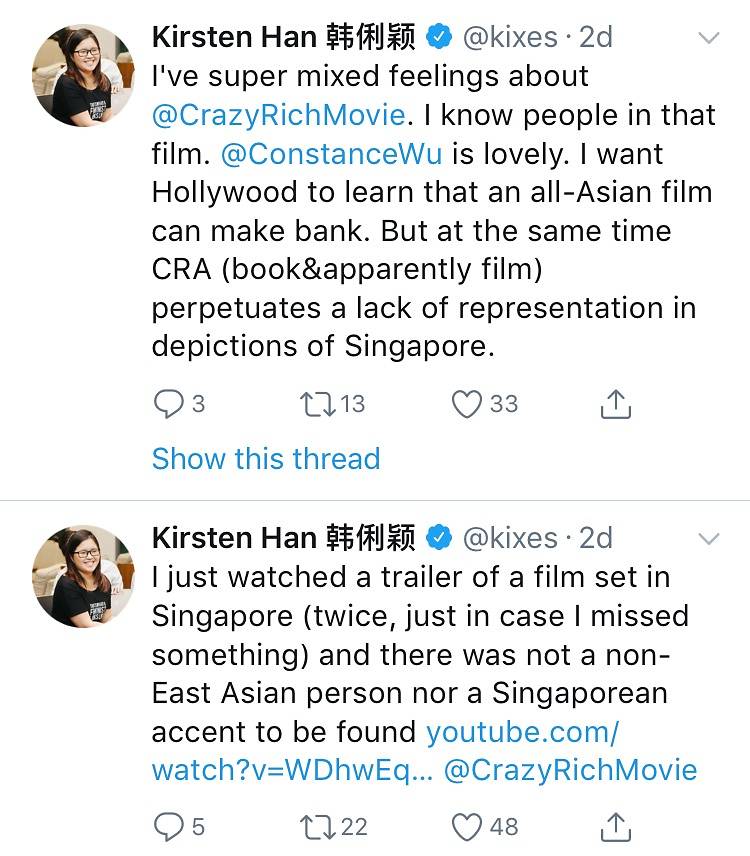
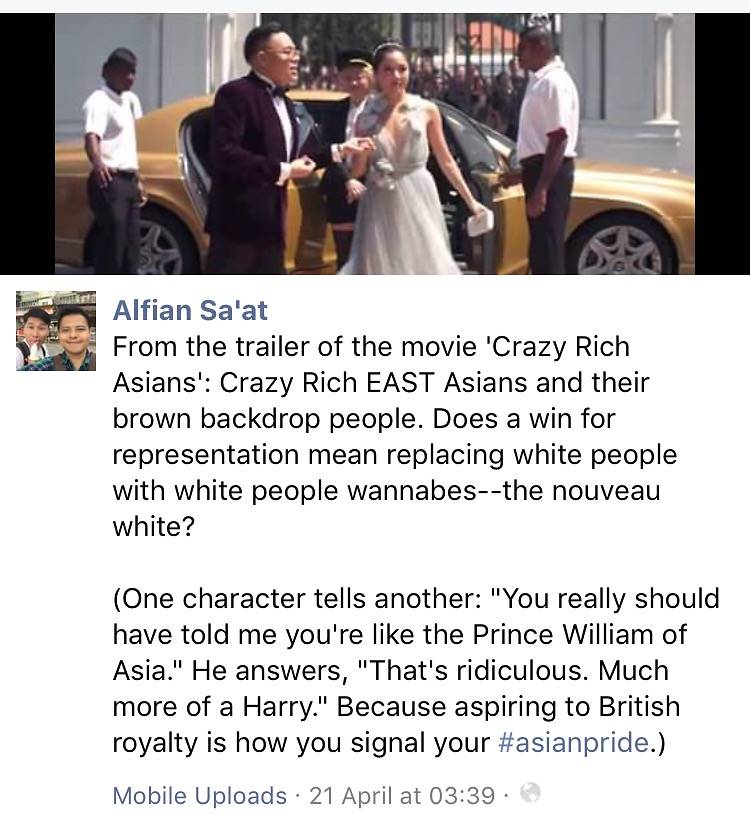
As a result, many Twitter users were disappointed that it didn’t look like “an accurate representation of our country and culture”. Or that it “has nothing to do with Singapore … There’s SO much missing”.
Others were disappointed that although the film, with its all-Asian cast, had been touted by Hollywood as a milestone achievement for representation, Singapore’s racial diversity was not accurately represented, with only Chinese people being featured.
They speak truth.
But in the first place, I’m not sure why I would expect a Hollywood rom-com to be able to represent Singapore, much less care about doing it faithfully.
Am I crazy and rich? (Answer: Bitter laugh.) It does not mean the movie is about me just because it is set in Singapore. The title itself already signals that this is not a film concerned with verisimilitude. It is an over-the-top freak show spectacle, as viewed by an outsider who is passing a value judgment.
Hollywood is making a film for Hollywood, not for Singapore. This includes an audience that still think Singapore is located in China.
That’s why they chose a story in which the protagonist and central character is an American girl seeing a new, exotic world through American eyes. That’s why her Singaporean friend, although Singlish-speaking in the book, is played by American rapper-comedian Awkwafina, who was born in Queens, New York. And why her father is played by America’s most famous Asian funnyman, Ken Jeong.
And in all fairness, its creators didn’t simply brush aside questions about representation. In a CNA Lifestyle interview last year, director Jon Chu admitted he grappled with these.
“Are we allowed to cast a half Chinese, half some other ethnicity person in a Chinese role? Are we allowed to cast a Korean as a Chinese person?” he said. “Because with other ethnicities, we have British people playing US soldiers or Spiderman which is an all-American thing…”
And, you know what, even though the movie is more concerned about being relatable to Westerners than to Asians, it’s still going to make a ton of money off Asians all over the world, who will watch a landmark Hollywood movie with an all-Asian cast. Sorry if this makes you feel less than special, but the awful truth is even if the whole of Singapore refused to watch it, that would barely make a dent in the total box office revenue.
Needless to say, this film, and the hype about “representation” surrounding it, says much more about Hollywood than it does about Singapore.
Singapore-made web series Perfect Girl. (Photo: BananaMana Films)
So, when I read the comments and tweets by people who had felt let down by the trailer, I was heartened by what these clearly indicated: That Singaporeans were mature and discerning enough to be hungry for stories about Singapore told by the people who know Singapore best: Singaporeans.
Er, but, hang on a minute. Don’t we have those? I mean, there are cop thrillers on Vasantham. There are heartland family dramas on Channel 8 and Suria. There are soap operas on Channel 5. Some wonderful films have been done by directors such as Royston Tan and K Rajagopal. There’s a Singapore-made web series, Perfect Girl, which was picked up by Netflix, Viki and Naver TVcast. And there are Singaporean actors who have given a lifetime of hard work and sacrifice.
Sure, not every show is worth spending your time on. Local productions don’t have even a fraction of Hollywood’s budgets. Our industry – along with our society – hasn’t had half the time to develop. And our pool of talent is infinitely smaller, thanks to our tiny population. We have a crazy long way to go.
But it comforts me to know that at least our audiences can appreciate how important it is to support local efforts so that we can one day have more and better stories that accurately represent Singapore. Right?
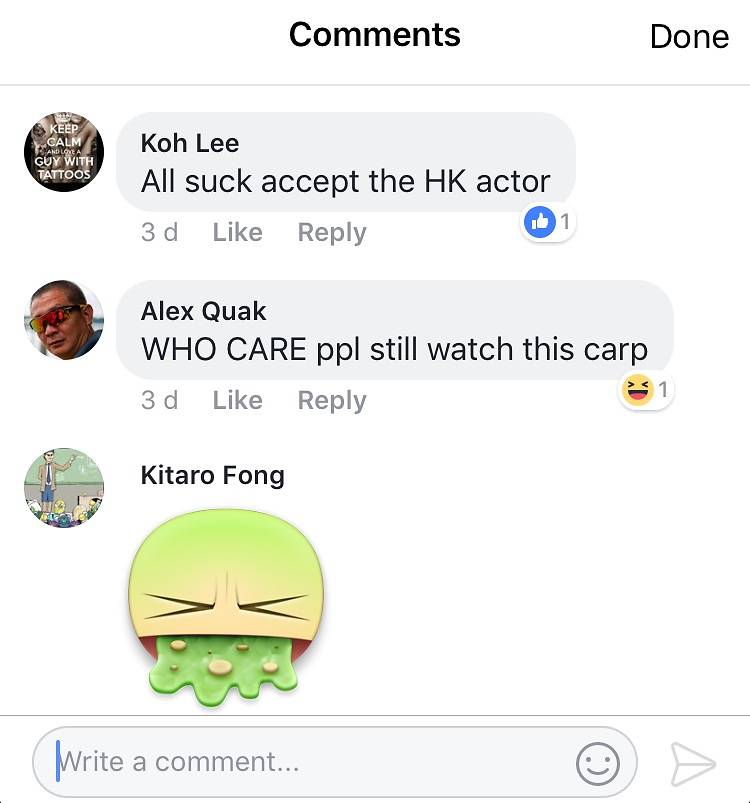
And then I read some of the comments from Facebook users about the Star Awards 2018, which was held just last weekend to acknowledge work done in local Mandarin television over the past year.
Help me out here, guys. So, naturally, we don’t want stories that seem to be about us but aren’t really about us – we want stories that are properly us. At the same time, we go out of our way to say unsupportive things about films and TV shows that are made by us, for us, which have no chance of growing or developing without our support. I have to admit that I’m a little confused. What do we want, exactly?
Until someone ’splains it to me, there’s only one thing I know with any measure of certainty: The good folks at the tourism board have already hit their KPIs for the year to come. Because when it comes to marketing, things don’t have to be representative in order to sell.
Like how people think those are Golding’s crazy rich abs in the trailer when they might actually belong to his co-star Pierre Png.