Home Blog Page 1048

Old and retired? We want them, say age-friendly companies

0

SINGAPORE: With a combined age of nearly 200 years old, these three seniors continue to work past the retirement age of 62 with elderly-friendly companies. 

All three work for early adopters of a voluntary tripartite standard launched last week that identifies progressive employers with age-friendly practices.

Madam Chua Ai Gek, 67, is one of the two elderly bar assistants at The Other Room, a bar at the Marriott Tang Plaza Hotel. She left her job as a hotel cleaner earlier this year due to underemployment and joined the bar.

Between Mdm Chua and her 78-year-old colleague, they prepare, cut and hand-squeeze 8kg of lemon and lime to extract their juices each day.

After that, the freshly-squeezed juices have to sit and settle for four hours before being vacuum-packed and left in the freezer. The juices will then be used by bartenders for their cocktails on the same night.

The laborious tasks were previously done by bartenders themselves but human resources director Mr New Kheng Tiong decided to outsource them to part-time workers so that the bartenders can be freed up to tackle other chores and perform research for their cocktail creations.

“The task doesn’t require high-skilled workers but it takes up a lot of time … and the consistency and quality of the juices are very important to us,” Mr New said. As to why Mr New decided on older workers, it’s because “mature workers tend to be a bit more loyal and punctual”.

“We see that the older workers will be more prudent and they will squeeze the lemons to the last drop to avoid wastage,” Mr New added.

JOB REDESIGN JUST TO FIT THE PROFILE

The bar initially met with some resistance from the older workers they approached. “Their children said, ‘but you will have to work until midnight, don’t take it’ or they found the Orchard location too rowdy,” Mr New added.

Mdm Chua was one of those initially uncertain about accepting the job because of the working environment.

Chua

Apart from hand-squeezing the fruits for juice extraction, Mdm Chua and her colleague had to be trained on operating the machines used to vacuum pack the juices. (Photo: The Other Room)

“I was concerned because I’ll have to work the night shift at a bar and it will be dark so it’s quite difficult for older folks like us. We are not able to see well in dark places,” Mdm Chua said.

The Other Room found a compromise by moving the lemon-squeezing work to their head office in Aljunied, and letting their two elderly workers start their work in the morning.

“Over here, it’s more convenient. I start at 9am and end at 2pm. After that I have time to cook for my children so I’m very happy about it,” Mdm Chua said.

Apart from Mdm Chua, 65-year-old Mr Zakaria Abdullah Boey also appreciates the extra time he gets from shorter hours at work.

Mr Zakaria had spent more than 15 years at Suntec Singapore, and his last full-time position was assistant manager in the security and fires safety department. He left in 2016 when his health took a tumble and spent the next two years recuperating.

After getting better, self-professed “workaholic” Zakaria wanted to return to work but was looking for something new with shorter hours to spend more time with his family. However, he was rejected by several companies.

“I wanted a change of job from security so I went to look for a job in the food and beverage industry but unfortunately because of my age and partially because of my medical condition, I was not successful,” Mr Zakaria said.

Zakaria

65-year-old Zakaria Abdullah Boey is back with his former employer but in a different job role. He walks around Suntec Singapore’s convention centre and makes sure it’s in a pleasant and presentable state. (Photo: Fann Sim)

He approached his former employer and was hired as a quality control supervisor, a role that was specially created for Mr Zakaria. He works 20 hours a week and patrols the convention centre to check on its safety and security, while also making sure that the centre is pleasant for visitors.

Suntec Singapore’s CEO Arun Madhok said they jumped at the opportunity to rehire Mr Zakaria as a mentor for younger staff.

“It’s that healthy mix of experienced and new staff that we put together in our company that brings us success,” Mr Madhok said.

IT MAKES FINANCIAL SENSE TO HIRE OLDER WORKERS

Other than Mr Zakaria, Suntec Singapore has also re-hired its executive sous chef Foo Shee Fong after he turned 62 last year. Chef Foo was offered the same salary and terms he previously enjoyed.

Chef foo

62-year-old Chef Foo Shee Fong was converted to the re-employment scheme last year and is one of eight workers re-employed beyond retirement at Suntec Singapore. (Photo: Fann Sim)

His daily roles include planning his team’s deployment and roster, as well as playing mentor to a younger chef who will take over his position in the next two to three years. As his protege slowly takes over his daily duties, Chef Foo said that his job has become less tiring.

“I have more time to look after the kitchen’s operations instead of doing the paperwork. Last time I used to work for 12 hours a day, now I can go home after eight hours,” Chef Foo said. This is one way of balancing his family’s financial needs and also having more time with his family in his golden years, he said.

While the companies have the option of hiring a younger worker in lieu of Mdm Chua, Mr Zakaria and Chef Foo, their employers said they are worth the money.

“If you look an excel sheet, you might come to the wrong conclusion. I think it’s the intrinsic value of an individual that must be taken into consideration. It’s the total contribution of an individual, it’s the experience, the capability that we must add in,” Mr Madhok said.

“If we don’t hire the two aunties, we would have hired a bar assistant who would have worked in the outlet,” said Mr New of Mdm Chua and her colleague.

“In fact, it’s cost-savings to us because the aunties want shorter hours,” Mr New added. Mr New said that they are exploring the option of employing more senior workers for other restaurants under its food business. 

“Of course, we will make it appropriate to their age and skills, like cutting vegetables or peeling cucumbers and we won’t ask them to do the heavy work like roasting suckling pig,” he said. 

Source link

Avengers: Infinity War smashes Singapore box office with biggest opening weekend ever

0

The superhero film also has the biggest global opening in history with an estimated S$835 million box-office take.

avengers infinity war movie who dies

Avengers: Infinity War director Joe Russo says everything must come to an end. (Photo: Marvel Studios)

Like our new CNA LIFESTYLE page on Facebook for more trending stories and videos

SINGAPORE: Disney and Marvel’s Avengers: Infinity War topped the box office over the weekend with tickets sales of S$5.26 million – the biggest opening weekend of all time in Singapore.

The Joe and Anthony Russo-directed battle to save the universe from a big bad named Thanos also pulled off a jaw-dropping feat, scoring the biggest global opening in history with an estimated US$630 million (S$835 million).

The Fate Of The Furious from the Fast And Furious franchise previously held the global record with a US$543 million box-office take during its opening weekend last year.

Infinity War earned an estimated US$250 million in North America, surpassing Star Wars: The Force Awakens’ US$248 million record for the biggest US debut. At the international box office, the film grossed a staggering US$380 million in 52 material markets.

Black Panther is currently the top movie title of 2018 with S$9.7 million at the box office. With this record-breaking opening weekend, Infinity war is expected to surpass Black Panther’s haul.

The all-time Top 3 films in Singapore are all Marvel movies: The Avengers (S$13.73 million), Avengers: Age of Ultron (S$13.11 million) and Iron man 3 (S$12.64 million). 

Avengers: Infinity War is currently showing in cinemas.

Source link

Trio arrested for using stolen credit card details to buy mobile phones

0

SINGAPORE: Two men and a woman, aged between 22 and 24, have been arrested for allegedly using stolen credit card details to buy mobile phones online. 

The Singapore Police Force said in a news release on Monday (Apr 30) that it was alerted to a case last Thursday involving the fraudulent purchase of a mobile phone worth S$1,888.

The suspects were identified and arrested at various locations last Thursday and Friday. A laptop and four mobile phones were seized as evidence, said the police.

Credit card fraud mobile phones evidence

Items seized by the police as evidence. (Photo: Singapore Police Force)

Preliminary investigations showed that compromised credit card details were used in the fraudulent purchases, the police said, adding that the suspects are believed to be involved in other similar cases. 

Investigations are ongoing. Anyone convicted of abetment by conspiracy to cheat may face up to 10 years in jail and a fine. 

In the news release, the police advised all debit and credit card holders to safeguard their card details and not to disclose sensitive banking information to anyone. 

“They are also advised to be prudent when making online payments using their card details and to visit only reliable websites for online shopping,” said the police.

Source link

Always work together as ‘Team Singapore’, so workers are taken care of: PM Lee

0

Writing in his May Day message on Monday (Apr 30), Mr Lee expressed caution about the global trade environment, but noted that if Singaporeans work together, the nation can be ready for any opportunities and shocks that may come its way.

PM Lee speaking to students at Yale-NUS

File photo of Prime Minister Lee Hsien Loong. (Photo: Sherlyn Goh)

SINGAPORE: Regardless of international developments, Prime Minister Lee Hsien Loong stressed the importance of always working together domestically as “Team Singapore” on Monday (Apr 30).

This is so that workers are taken care of, and Singapore is ready for “any opportunities or shocks that come our way”, he wrote in his May Day message, even as he expressed caution about the global trade environment.

Singapore made the most of favourable global conditions last year, with the economy growing 3.6 per cent, a good result for a developed economy, he said. 

“Our workers are hardworking and agile, and our businesses are resourceful and adaptable,” Mr Lee added, with productivity growth last year the highest in seven years.

More and higher-paying jobs were also created. This, he said, was the result of a “collective effort” that has paid off.

Singapore can look forward to healthy economic growth this year if it “maintains the momentum”, but this will depend on how the external environment shapes up, the prime minister said.

He added that prospects for the global economy have been clouded by recent trade tensions between the United States and China.

“We are watching developments with concern because trade is our lifeblood,” Mr Lee said. “A trade war would damage the international trading system that has sustained global economic growth for decades.”

Singapore is making progress transforming its industries and sectors, “making them more productive and efficient”, he said, adding that all 23 Industry Transformation Maps have been launched, and the tripartite partners are working to turn these plans into actions and programmes that make a “meaningful difference” to companies and workers.

Mr Lee noted that while the Government provides support and incentives to employers and workers to upgrade and transform, employers and workers must do their part too.

“We are fortunate to have a strong Labour Movement fully committed to support our workers, protect their interests and fulfil their aspirations,” he said.

He also described the Labour Movement under the leadership of Mr Chan Chun Sing, as having “grown in strength”. It has also, he said, extended its outreach to freelancers, the self-employed, migrant workers and professionals.

After three years in the National Trades Union Congress (NTUC), Mr Chan will move on to head the Ministry of Trade and Industry as part of the recently announced Cabinet reshuffle. 

“The Labour Movement will be a pillar of strength as we brave the challenges and storms, working together to build a dynamic and prosperous Singapore,” said Mr Lee.

Source link

Household gas prices to go up from May to July

0

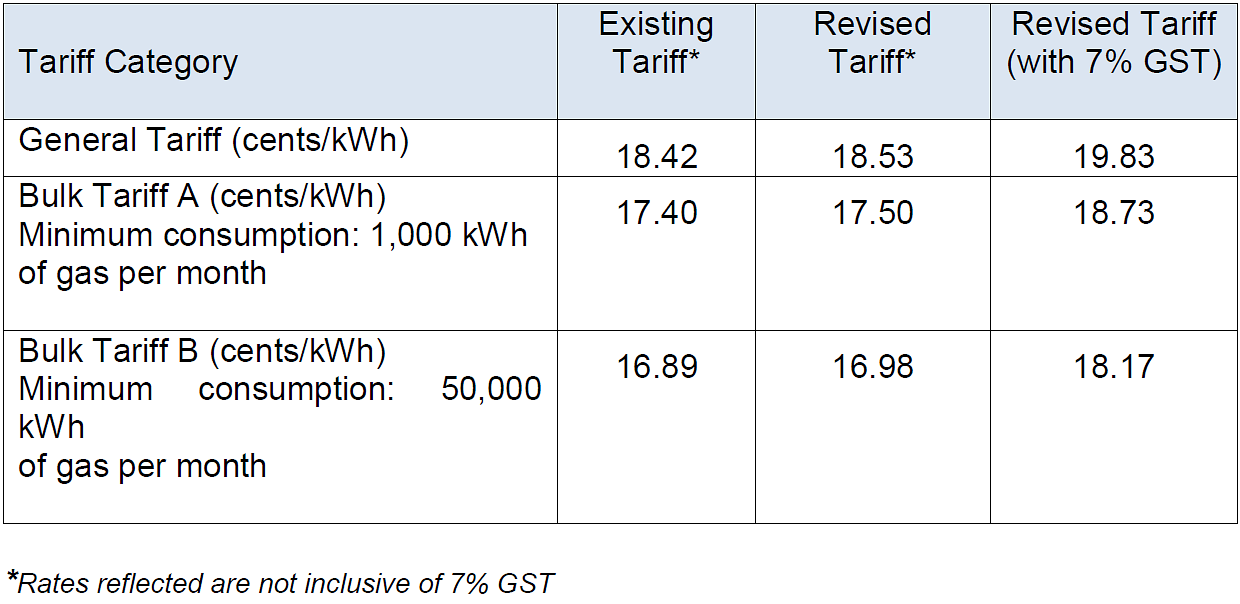
SINGAPORE: The gas tariff for households will increase by 0.6 per cent for the next three months, City Gas announced on Monday (Apr 30).

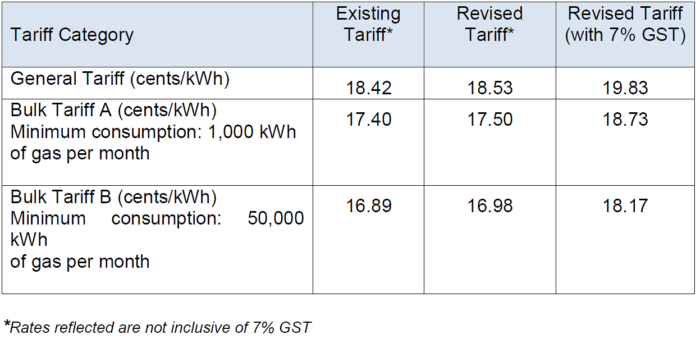
The tariff will be raised from 18.42 cents per kWh to 18.53 cents per kWh from May 1 to Jul 31, the company said in a media release. 

This is due to the higher cost of producing and delivering town gas, explained City Gas, which supplies town gas to nearly 90 per cent of residents in new housing board estates and private properties.

Gas tariffs are reviewed based on guidelines set by the Energy Market Authority, the gas industry regulator.

Household gas tariffs May to July

Source link

LTA buys 17 new trains for North East Line, Circle Line extensions

0

SINGAPORE: French train manufacturer Alstrom will supply 17 of Singapore’s new driverless MRT trains – six for the North East Line (NEL) and 11 for the Circle Line (CCL) – under a S$250 million contract awarded by the Land Transport Authority (LTA).

This will boost the NEL’s fleet by 14 per cent to 49 trains, said LTA in a news release on Monday (Apr 30). For the CCL, the fleet will increase by 17 per cent to 75 trains.

LTA’s purchase will cater for additional capacity on the two lines, when their respective extensions are ready.

The 1.6km NEL extension, comprising Punggol Coast station, is scheduled to begin service in 2023.

For the extension of the Circle Line, three new stations – Keppel, Cantonment and Prince Edward – will close the Circle Line loop by 2025.

The trains will be manufactured and assembled in Alstrom’s manufacturing facility in Barcelona, before they are progressively shipped to Singapore from 2020 for NEL and 2021 for the CCL trains.

After that, the trains will undergo testing and commissioning before being put into service when the extensions open, LTA said. 

LTA new trains signing

The Land Transport Authority awarded a contract worth about S$250 million to Alstrom for the purchase of 17 new MRT trains. (Photo: Fann Sim)

PREDICTIVE MONITORING SYSTEMS INSTALLED

All 17 new trains will be equipped with “condition monitoring systems” to gather data from equipment on the trains, LTA said. The system enables the state of the equipment to be monitored continuously and allows the operator to carry out predictive maintenance for the trains. 

“The current collector shoes on the new CCL trains will also be equipped with sensors to enable the operator to react promptly and take necessary measures if any dislodgement is detected,” LTA added.

In addition, two of the new CCL three-car trains will each be fitted with an Automatic Track Inspection (ATI) system which enables monitoring of the running rails, track equipment and sleepers while the trains are in operation. 

The ATI system supplements existing track inspection activities for timely or more effective identification of rail and trackside components which require maintenance, LTA said. 

Source link

‘China model’ threatens press freedom in Asia Pacific

0


AHEAD of World Press Freedom Day on Thursday, two prominent watchdogs have warned of worsening press freedom across the Asia Pacific, particularly with the rise of populist politics and growing geopolitical influence of China.

Reporters Without Borders (RSF) released its World Press Freedom Index for 2018 last week, which specifically highlighted the threat to regional democracies posed by “China’s media control model”. The one-party state is ranked 176 out of 180 countries on the Index, with RSF stating that the country’s media landscape was getting “closer to a contemporary version of totalitarianism”.

China – which currently has more than 50 journalists locked in its prisons – is “exporting its oppressive methods” of censorship and surveillance within its sphere of influence, said RSF, in order to create a “new world media order”.

SEE ALSO: Liu Xiaobo’s death provides terrifying insight into China’s censorship machine

Cambodia – where Chinese political influence has grown in recent years – dropped 10 places to 142, reflecting Prime Minister Hun Sen’s crackdown against local news media including forcing the closure of more than 30 independent media organisations.

Amid Western criticism of his government’s abolition of the political opposition, media and human rights groups has seen Hun Sen grow ever closer to Beijing, however in January he praised US President Donald Trump’s so-called Fake News Awards.

Burma (Myanmar) fell six places on RSF’s Index to 137, as two Reuters journalists continue to face prosecution for reporting on potential war crimes by the Tatmadaw Army amid the Rohingya crisis.

2018-04-11T000000Z_759215738_RC1EC8DBC950_RTRMADP_3_MYANMAR-JOURNALISTS

Detained Reuters journalist Wa Lone gestures to the media as he is escorted by police after a court hearing in Yangon, Myanmar April 11, 2018. Source: Reuters/Ann Wang

“The government led by Aung San Suu Kyi has lost all credibility as regards its obligation to defend the role of the media,” said the group, which also cited the growth of hate speech in the country which has fueled violence against its Muslim minorities.

RSF said that the Chinese model was also being “felt by the media” in Thailand (140), Malaysia (145) and Singapore (150). Malaysia has recently implemented the world’s first “anti-fake news law” which carries a penalty of up to six years’ imprisonment, while neighbouring Singapore is considering similar legislation.

The Philippines also dropped 6 places to 133, with the administration of President Rodrigo Duterte frequently attacking the press and seeking to shutter independent publisher Rappler. During a meeting with Trump last year he called journalists spies and has warned that media workers are not “exempted from assassination”.

SEE ALSO: Aung San Suu Kyi crowned world’s ‘biggest backslider in press freedom’

North Korea, meanwhile, remained the “world’s worst violator of the freedom to inform” at 180, with its state KCNA news agency remaining the only source of news for its population.

“A press corps that calls out government failures is fundamental to the functioning of all democracies,” read another report from US-based democracy watchdog Freedom House entitled Attacks on the Record: The State of Global Press Freedom, 2017-2018, also released last week.

“Populist leaders are intentionally denouncing critical media and their coverage as biased, and the factual information they report as ‘fake,’ weakening their credibility and leaving citizens unsure whom to believe.”

In the Asia Pacific, Freedom House cited China’s “new heights” of internet censorship with the Cybersecurity Law of June 2017; the “crippling blow” to press freedom in Cambodia with the closure of the Cambodia Daily newspaper; and the Philippine government’s attempts to shut down Rappler on the grounds it breached foreign ownership laws.

2017-11-12T141947Z_2070776707_RC177840B4F0_RTRMADP_3_ASEAN-SUMMIT-1

US President Donald Trump speaks with Philippines President Rodrigo Duterte during the gala dinner marking ASEAN’s 50th anniversary in Manila, Philippines, November 12, 2017. Source: Reuters/Athit Perawongmetha

“Populist leaders today constitute a new and growing challenge to free expression in open societies, and interference from Russia and China has compounded the threat,” said Michael J. Abramowitz, president of Freedom House.

“The assault on press freedom is an attack against a core institution of democracy. Elected leaders who try to discredit factual, critical reporting are undermining democratic accountability and reasoned political debate,” he said.

SEE ALSO: The world’s largest democracy must better protect its journalists in 2018

This was reflected in India’s ranking – falling a further two places on the RSF Index to 138. Under “strongman” Prime Minister Narendra Modi, who has ruled since 2014, journalists have become increasingly targeted online and in some cases with deadly physical violence by right-wing Hindu groups.

Other democracies in the Asia Pacific saw improvements, however. Hong Kong and Taiwan both rose three places, while South Korea shot up by 20 places on the Index to 43, more than any other country regionally.

According to RSF, incumbent President Moon Jae-in’s tenure has been a “breath of fresh air” for the press in South Korea despite enduring issues with defamation and national security laws. Neighbouring Japan rose 5 places to 67.

New Zealand and Australia remained at the top of the list in the spots of 8 and 19, respectively.

Source link

Tembusu tree accident: Death of woman a ‘tragic misadventure’, says coroner

0

The tree that fell at the Singapore Botanic Gardens did not have any external signs of decay, Coroner Marvin Bay said, quoting experts.

Mrs Radhika Angara

Ms Radhika Angara was killed after a 270-year-old tree, last inspected in September 2016 and deemed healthy, collapsed, crushing her and injuring four others, including her husband and one-year-old twins.

SINGAPORE:  The death of a 38-year-old woman who was killed by a Tembusu tree which uprooted at the Singapore Botanic Gardens last year was a tragic misadventure. 

That was Coroner Marvin Bay’s finding on Monday (Apr 30), two weeks after the conclusion of the inquiry into the death of Indian national Radhika Angara.

Experts had pointed to strong winds and heavy rain in the days before the tragic incident which led to the “final failure” of the tree, said the coroner, adding that there were no external signs of the decay within the tree.

The incident happened on Feb 11, 2017, when Ms Angara was at the UNESCO world heritage site with her husband and now two-year-old twins. She was killed when the 40m-tall tree fell on her. Four others, including her husband and children, were injured.

Ms Angara’s husband, French national Jerome Rouch-Sirech, sat with his face in his hands most of the time while the finding was delivered. 

A four-day inquiry, spread out over about nine months, had revolved around why the heritage tree, estimated to be 270 years old, last inspected in September 2016 and deemed healthy, could uproot.

At the close of the inquiry on Apr 17, Ms Angara’s father stood up to say a few words about the daughter he lost. She was “a young mother out on a pleasant day for a picnic with her babies”, he said.

It was a tragedy that could have been prevented “with some vigilant action” on the part of NParks, the father told the inquiry, which was also attended by Ms Angara’s mother, sister and husband. The family was also present on Monday. 

Among the witnesses who gave evidence at the inquiry which started in July, were three arborists and two NParks employees in charge of arboriculture at the Singapore Botanic Gardens.

Senior Counsel Chelva Rajah, who represented Ms Angara’s family, quizzed NParks’ director of streetscape Abdul Hamid on why the tree was not more closely examined for faults and how it could have collapsed “for no apparent reason”. 

The director, who is also an arborist, had testified that there were no external signs or symptoms of an internal decay, which was discovered only when the Tembusu tree fell, crushing Ms Angara.

When the tree uprooted, arborists observed that at the point where the trunk broke, it was 70 to 75 per cent decayed. Parts of the tree’s roots were also decayed or dead.

The Singapore Botanic Gardens’ deputy director Elango Velautham and senior manager Thaddeus Cheng had also testified, along with independent arborists Derek Yap of Camphora and Richard Gordon Thomas of ArborCulture.

Source link

Commentary: A leading chipmaker’s expansion here and what it means for Singapore

0

SINGAPORE: The recent news about Micron’s investments in Singapore made for interesting reading.

Micron has several facilities around the world. It is indeed a positive signal that it has chosen Singapore as the location for its next cutting-edge plant.

The investment is good for Singapore because of several reasons.

WELL-PAID JOBS FOR HIGHLY SKILLED EMPLOYEES

The first is the product focus of the planned investment — 3D NAND flash memory chips, the leading edge products in the semiconductor industry.

Manufacturing in the semiconductor industry tends to be highly automated, which means the jobs created by the Micron investment will be for highly skilled people and well-paid, exactly the kind of jobs that Singapore wishes to attract and its citizens aspire to do.

Equally importantly, the employees in this cutting-edge facility will acquire skills that may be useful to other firms considering similar investments in Singapore.

The investment could, in fact, enhance the competitiveness of Singapore for attracting further investments in semiconductor manufacturing.

(na)Micron Technology groundbreaking event photo

Front (left to right): Chairman of EDB Beh Swan Gin; Micron Vice President and Country Manager Chen Kok Sing; Minister for Trade and Industry (Industry) S Iswaran; Micron President and CEO Sanjay Mehrotra; JTC CEO Ng Lang. (Photo: Micron Technology)

STRONG FUTURE FOR NEW FACILITY

The product focus of the proposed investment is also important from another perspective.

3D NAND flash memories are higher capacity, provide faster data access and are cheaper to produce than older designs which makes their usage a logical choice not only in consumer devices such as smartphones but also in high-end computer servers used in data centres.

The growing demand for many of these devices (such as smartphones) and applications (such as high-end computers used in data centres) will imply a strong future for the proposed facility, including possible expansion of facilities and investments in the future.

file photo phone woman 4

File photo of a person using a smartphone. (File photo: Xabryna Kek)

There are also important multiplier effects for cutting-edge investments such as the one Micron is making in Singapore.

These range from the jobs created in industries that supply goods and services to the new facility (e.g. utilities, raw materials, construction and other services) to the higher spending power of employees working in the facility, thus helping a range of goods and service industries.

In fact, the multiplier effect means the actual economic benefit of the investment is several times the value of the investment.

Micron will also be undertaking research and development (R&D) in Singapore, thus creating the possibility of developing more highly paid and highly skilled jobs. Equally importantly, it may provide opportunities for the many technology graduates and scientists that Singapore universities are training.

DEEPENED PRESENCE IN SINGAPORE

The new investment also deepens the already strong and longstanding relationship between Micron and Singapore, another plus.

(na)micron technology groundbreaking event photo

Front (left to right): Chairman of EDB Beh Swan Gin; Minister for Trade and Industry (Industry) S Iswaran; Micron President and CEO Sanjay Mehrotra; JTC CEO Ng Lang; Micron Senior Vice President Global Manufacturing Wayne Allan. (Photo: Micron Technology)

Micron employs more than 20 per cent of its global workforce in Singapore. Since it is a leader in cutting-edge semiconductor manufacturing, having a strong relationship with it can only be beneficial for Singapore, moving forward.

A high-tech manufacturing investment such as the one by Micron also diversifies the base of economic activity in Singapore.

A focus on R&D intensive sectors such as biotechnology and nanotechnology, while important to Singapore’s continuous economic development, also carries several risks related to the uncertain nature of technology development, and the intense competition among many players. Many countries and cities for instance, are vying to be biotech hubs.

Services sectors such as financial services, another focus area for Singapore, on the other hand, provide skilled and highly paid jobs but these tend to be fewer in number, versus manufacturing facilities.

Many companies in the service sectors such as FinTech tend to be small, have lower margins (many may even be loss making, at least in the short-term) and volatile (with plenty of entry and exit).

Investments by a global leader such as Micron in manufacturing are contrasting and complementary in terms of stability of the investor and the number of jobs that can be created.  

JOBS BUT ARE THESE FOR SINGAPOREANS?

On the flip side, the investment may also raise a few concerns. One concern could be about how many of the 1,000 new jobs would go to Singaporeans.

workers Singapore file

File photo of people walking on a street in Singapore. (File photo: Ngau Kai Yan)

Without having an idea of the number of Singaporeans with the appropriate skill, it is difficult to estimate the number of jobs going to locals versus foreigners.

It is noteworthy however that the Singapore government is aiming for a gradual increase in population and given the low fertility rate in Singapore, inward immigration of foreigners with a high degree of skill may be one good way to achieve the gradual increase in population.

CONSISTENT WITH SINGAPORE’S FUTURE ECONOMIC DEVELOPMENT PLANS?

Another concern is whether the new investment is consistent with Singapore’s development plans, specifically whether a manufacturing investment is as good a fit with future development plans as an investment in the services sector (e.g. financial services or FinTech) or in technology sectors such as biotechnology or nanotechnology.

While services account for a greater proportion of GDP as economies develop, a base of manufacturing industries is always useful for any country, especially if the manufacturing industry is high tech.

There is also a strong learning-by-doing effect in manufacturing industries – meaning the likelihood of a country having the latest generation manufacturing is contingent on whether the country had a manufacturing plant based on the previous generation technology.

One reason the US “lost” the semiconductor manufacturing (other than Intel, which was interested in protecting its technology and hence kept its manufacturing within the US, and Micron which still makes memory chips in the US) was that the US manufacturers got out of commodity sectors (incidentally, memory chips or DRAMs) because they were less profitable.

Intel logo

An Intel logo. (REUTERS/Nir Elias/File Photo)

The learning-by-doing effect meant that manufacturers that exited one generation of technology, found it rather difficult to get back in the game for the next generation.

Interestingly, Micron persisted with memory chip manufacturing through good times and bad, which explains its strong position in the industry today. The Micron investment thus will help Singapore stay in the game of semiconductor manufacturing.

A complete analysis would require that the benefits and costs – in terms of the incentives provided to Micron to invest in Singapore – be weighed together.

I believe, however, the benefits are manifold and Singapore will continue to accrue them over the long term.

Micron’s proposed investment is win-win for Micron and Singapore. In addition to creating high-value added jobs in Singapore, it is likely to have a multiplier effect on Singapore’s economy and improve its competitiveness in attracting future investments in semiconductor manufacturing.  

Nitin Pangarkar is an Associate Professor in the Department of Strategy and Policy at the National University of Singapore (NUS) Business School.

Source link

PUB to produce solar power at Bedok, Lower Seletar reservoirs for operations

0

SINGAPORE: PUB announced on Monday (Apr 30) that it has called a tender to conduct engineering studies for the deployment of floating solar photovoltaic (PV) systems in Bedok Reservoir and Lower Seletar Reservoir. 

In the press release, the national water agency said there was potential to replace some of the grid energy used for the reservoirs’ water loop operations with solar energy.

Such operations include the pumping of raw water from reservoirs to waterworks, production of drinking water at waterworks, treatment of wastewater and production of NEWater and desalinated water. 

PUB explained that solar power will be generated by panels installed on the roof spaces of existing installations and on the surfaces of the reservoirs. 

“PUB’s tender for engineering studies will look into the detailed designs for a 1 MWp (megawatt peak) floating solar PV system at Lower Seletar Reservoir and a 1.5MWp floating solar PV system at Bedok Reservoir.” 

Each solar system will occupy 1ha and 1.5ha respectively and will take up less than 2 per cent of total surface area at the reservoirs, said PUB. 

The floating panels will also be installed away from current water activities. 

PUB added that a 0.5 MWp PV system will be installed on the roof of Bedok Waterworks by this year. 

Both systems are estimated to reduce PUB’s carbon footprint by about 1.3 kilotonnes of carbon dioxide annually – equivalent to taking around 270 cars off the road every year. 

PUB solar power infographic

With the additional PV system on Bedok Waterwork’s roof, the total carbon footprint will be reduced by at least 1.5 kt of carbon dioxide yearly, said PUB. (Graphic: PUB) 

With the additional PV system on Bedok Waterwork’s roof, the total carbon footprint will be reduced by at least 1.5 kt of carbon dioxide yearly, said PUB. 

PUB’s chief executive Ng Joo Hee said that even though the solar PV systems were small, they were “significant forays into making the water treatment process greener and less dependent on fossil fuels”. 

Source link