The 2018 edition of the Energy-Saving Challenge was launched on Saturday to encourage households to save energy.
Minister for the Environment and Water Resources Masagos Zulkifli and Mayor of North West District Teo Ho Pin, launch the energy-saving challenge at Northpoint City on May 5, 2018. (Photo: Tan Si Hui)
(Updated: )
Bookmark
SINGAPORE: Four in five Singapore households are motivated to save energy if they can save money, according to a 2017 National Environment Agency (NEA) study released on Saturday (May 5).
But households may not practise energy-saving actions if they are perceived to be inconvenient.
These findings were released in conjunction with the launch of the second edition of the Energy-Saving Challenge, which aims to encourage energy-saving practices.
This year’s challenge was launched by Minister for the Environment and Water Resources Masagos Zulkifli, and Mayor of North West District Teo Ho Pin, at Northpoint City.
According to the survey, which metered the electricity consumption of 550 households for a week in 2017, households consumed a total of about 7,295 Gwh, which is up by about 17 per cent from 2007 levels. This is equivalent to each household in Singapore spending an average of about S$1,000 per year on electricity consumption.
NEA found that air-conditioners (24 per cent), refrigerators (17 per cent) and water heaters (11 per cent) accounted for most of the electricity consumption in a typical home. Others included lamps, fans and television sets.
Minister for the Environment and Water Resources Masagos Zulkifli launches the energy-saving challenge on May 5, 2018. (Photo: Tan Si Hui)
The survey also revealed that more households in 2017 compared to 2012 were practising actions such as choosing energy-efficient appliances and setting their air-conditioners to 25 degrees Celsius or higher.
However, fewer households switched off appliances after use or opted to use a fan instead of the air-conditioner.
“This is why we designated 2018 as the Year of Climate Action – to raise the level of national consciousness on the need to take climate action for a sustainable Singapore,” said Mr Masagos.
“This year’s Energy-Saving Challenge will continue to encourage households to practise simple energy saving habits, and at the same time, emphasise how these positive actions will reduce our carbon footprint.”
The 2018 edition of the Energy-Saving Challenge encourages the practice of three simple energy-saving tips: switching off appliances after use, setting the temperature of air-conditioners at 25 degrees Celsius or higher and choosing energy-efficient appliances that have more ticks.
Under the Challenge, participating households must reduce their electricity use by 1 per cent or more during the Challenge period from May to August to stand a chance to win one of 700 prizes worth more than S$60,000.
Registration for the Challenge is now open and interested households can sign up at www.cgs.sg.
SINGAPORE: More than one hundred family members, friends and servicemen turned up on Saturday (May 5) afternoon to pay their last respects to full-time national serviceman (NSF) Dave Lee, who died after suffering from heat injuries.
The mood at the wake in Jurong East was sombre, with some relatives seen sobbing.
At about 1.25pm, fellow servicemen sporting black armbands loaded the flag-covered coffin on a hearse.
The cortège, carrying black umbrellas, followed the hearse as it made its way to Mandai Crematorium where the cremation ceremony will be held.
Family members following the hearse carrying Dave Lee’s casket outside his home in Jurong East. (Photo: Tang See Kit)
“We will honour Dave’s memory and service, and give him a dignified send-off,” said Army Chief Brigadier-General (BG) Goh Si Hou in a letter sent to fellow soldiers on Thursday. “It is the least we can do.”
Dave Lee’s mother outside their home in Jurong East ahead of his funeral on May 5, 2018. (Photo: Tang See Kit)
The crowd outside Dave Lee’s block in Jurong East ahead of his funeral on May 5, 2018. (Photo: Tang See Kit)
The Guardsman from the 1st Battalion Singapore Guards died on Monday at Changi General Hospital, almost two weeks after he was hospitalised with “signs of heat injury” upon completing an 8km fast march on the morning of Apr 18. He enlisted for National Service four months ago.
The former Jurong Junior College student, described by his mother as a “very good boy”, was posthumously promoted from private to Corporal First Class (CFC).
The Ministry of Defence (MINDEF) said on Wednesday that a Committee of Inquiry (COI), chaired by a senior official from the Ministry of Education (MOE), has been convened to investigate the incident. COIs are convened for all training-related deaths.
The police will also conduct investigations independently and a coroner’s inquiry may be held depending on the outcome.
In the letter sent to SAF soldiers, BG Goh reassured that the army will conduct “thorough investigations” to ascertain the facts behind the death of the youth. “We will ask honest questions of ourselves,” he said.
SINGAPORE: Two weeks ago, Prime Minister Lee Hsien Loong announced what was described by many as the biggest shake-up of Cabinet in recent years with nearly two-thirds of ministries now helmed by a fourth-generation (4G) leader.
In terms of renewal, this Cabinet reshuffle had it all. There was the promotion of a female minister, the appointment of four backbenchers from the private sector into political office and the retirement of three veteran ministers, among other rearrangements of the deck chairs.
But there was not to be, as PM Lee had already clarified earlier, any new Deputy Prime Minister.
Nevertheless, the announcement was much anticipated because Singaporeans were hoping to identify who their next Prime Minister might be.
PM Lee offered this soundbite: “The leadership transition taking place in the next few years is well underway.”
So what are we to make of the forthcoming Changing of the Guard 3.0? Does this reshuffle mean that all three apparent contenders – Heng Swee Keat, Chan Chun Sing and Ong Ye Kung – are still in the frame?
The speculation looks likely to continue. To join in the chatter, let us consider the following three scenarios of what could be happening behind the scenes.
SCENARIO 1: OUR NEW PM HAS BEEN DECIDED BUT NO ONE HAS BEEN TOLD YET
In this scenario, it has already been decided who will succeed PM Lee, but no one has been told, not even PM Lee’s successor.
The reason may be that PM Lee and the 3G leaders want to be absolutely certain that the next Prime Minister will not only perform well, but also command the full support of his peers – not just the “group of 16 4G leaders” who responded in a letter to Emeritus Senior Minister Goh Chok Tong, but also the future 5G leaders.
In terms of ministerial experience, with the exception of Ong who was only elected into parliament in 2015, Heng and Chan have already served in senior roles in at least two ministries in earlier Cabinets and already have the necessary kudos.
Yet it appears that the runway has been extended a little more by giving each of them a concentrated ministry to prove their mettle to Singaporeans and the international community.
Chan’s move back into the Government fold as Trade and Industry Minister, a portfolio that has recently grown in global significance, seems to have persuaded some pundits that he is the man. Trade and Industry may well be the economic fix that Chan needs to shore up his resume as it will give him access to the movers and shakers of business and local intelligentsia.
But Heng does not play second fiddle to Chan. He is effectively the Chief Financial Officer of Singapore tasked with ensuring that the nation’s future economy will continue to thrive in an era of multiple disruptions, top of the list being the prospect of a China-US trade war.
Notwithstanding Ong’s elevation to the full education portfolio this round, he remains a political novice and seems unlikely to be in the running to be the next Prime Minister within this parliamentary term.
Chan Chun Sing, Heng Swee Keat and Ong Ye Kung. (Photo: MCI)
Crunching the bits of data available to us, it appears Chan has indeed emerged as the frontrunner. The key here is that Chan’s gap in the economic realm, along with a need for international exposure, would be well plugged with his new MTI role.
A second Cabinet reshuffle may not be needed under this scenario, since it will gradually become clearer who the next leader will be. However PM Lee may decide to make a few adjustments – by appointing Chan or Heng as a new Deputy Prime Minister – to end the speculation once and for all.
SCENARIO 2: 4G LEADERS NEED MORE BETA-TESTING TO REMOVE THE ELEMENT OF SURPRISE
This scenario exists because the 4G team has yet to agree on any one candidate.
So what we are witnessing in the recent reshuffle is a different form of “changing of the guards” (“guards” in plural and with a small “g”), where the now-famous “group of 16 4G leaders” are given major duties so that they can prove their ministerial competence while demonstrating that they can work together as a team.
This is akin to doing beta-testing where a product is given another round of practical trial. The three leadership contenders are given deep specialisation in major portfolios, while also broadening them and exposing them to their 4G peers and 5G leaders.
In this way, it becomes clear whom they should elect from among themselves – and with a little luck, a consensus will emerge.
It is here that we may see the original design of a Westminster political system – where the Prime Minister is chosen by his fellow colleagues, and truly becomes the first among equals – come into play.
Singapore Parliament in session (File photo: TODAY)
The problem with this system is that it is very difficult to effect a seamless political transition – as has been done in the past with Goh Chok Tong’s and, indeed, Lee Hsien Loong’s assumption of the top post – because we simply cannot predict who will receive unanimous support.
So a little more beta-testing will help ensure the system remains foolproof, and that there will be no surprises when the final result is announced.
It is likely that scenario 2 will also see a Cabinet reshuffle prior to the next General Election to present Singaporean voters with the full 4G leadership team, with one of the three contenders emerging as a clear candidate for the top post.
SCENARIO 3: PRAGMATISM AND STABILITY DEMANDS PM LEE STAY ON LONGER
The discourse around who would lead Singapore in four years’ time, when PM Lee turns 70, was first raised by PM Lee himself. He had declared his wish to retire after the next General Election on the basis of good governance and succession planning principles.
Indeed, predictable leadership transitions transpired during the first and second changing of the guard, under Lee Kuan Yew and Goh Chok Tong, in 1990 and 2004 respectively. But they took place during an era when Singapore had to present order and stability to both voters and foreign investors via extraordinarily smooth political transitions.
Although we have been told that the group of 16 office holders will select a leader from among themselves, PM Lee is still the “kingmaker” by default as he will have to decide when to step down.
PM Lee will want to ensure the baton is passed on to the next generation in a timely and judicious manner. He will want to shape Singapore’s political and economic environment to handle these leadership changes.
It is often said that politics is “the art of the possible”, which means that it is not about what’s right or what’s ideal, but what is pragmatic and can be carried out smoothly. This is referred to in political science as realpolitik, something Singaporeans should be familiar with as it privileges pragmatism over ideology.
In other words, whilst PM Lee may have an ideal PM-in-waiting in mind, if the person is not able to step up to the plate for personal or structural reasons, or if the climate and timing are not ripe for a political handover, it is not wise to effect change for its own sake.
Singapore Prime Minister Lee Hsien Loong speaking at the opening of the 32nd ASEAN Summit in Singapore on Apr 28, 2018 (Photo: Gaya Chandramohan)
If the 4G team is not ready, we cannot categorically rule out PM Lee staying on after the next General Election, and then revisiting the transition planning anew.
(In fact, under scenario 3, the plot would thicken as we cannot rule out Ong Ye Kung either, since he would have spent a substantial time as a full Minister.)
WHERE TO NEXT?
Singaporeans have been conditioned to prefer stability rather than change, especially in the political sphere. Voters are hence likely to be supportive if PM Lee stays on for a while more, as long as they can see progress being made to nurture the next generation of leaders, whether they are of the 4G or 5G variety.
This is possibly precisely what PM Lee is doing right now with the mid- term Cabinet reshuffle, and in getting us all to postulate more deeply about Singapore’s political future.
Regardless of which scenario will play out, we know that the forthcoming Changing of the Guard 3.0 will take place in due course. We just have to exercise a little patience, and hope that the next Prime Minister and the entire 4G leadership team will be the best possible one for Singapore.
Terence Lee is Associate Professor of Communication and Media, Murdoch University, Australia. He is co-editor with Professor Kevin Y L Tan of Voting in Change: Politics of Singapore’s 2011 General Election and Change in Voting: Singapore’s 2015 General Election, both published by Ethos Books.
SINGAPORE: During the hectic lunch hour, freelance social worker Shihui Khee’s instructions on how her food should be served can ruffle a few feathers.
“Some people behind me in the queue will say quite passive-aggressive things,” the 36-year-old told Channel NewsAsia. “Like ‘oh you’re so slow’ or ‘it’s not like I have all the time in the world’.”
It’s not that Ms Khee is a picky eater. Rather, she refuses to use disposables like plastic and styrofoam containers or paper cups when eating out or ordering takeaways. Food goes strictly into her 1l collapsible lunchbox; cold drinks into her 750ml cup.
This means taking a longer time to process her order, especially with stallholders who pre-pack their Styrofoam boxes with rice.
Still, Ms Khee is serious about reducing her waste. The “kick up my backside” was a newspaper article she read last May about how the Great Barrier Reef had been damaged beyond repair.
The Telegraph reported then that about 95 per cent of the reef suffers from bleaching, which is believed to be caused by global warming. The life cycle of disposables contributes to the emission of greenhouse gases.
According to National Environment Agency figures, Singapore generated almost 2 million tonnes of plastic and paper or cardboard waste last year, a roughly 5,000-tonne drop from 2016. However, the recycling rate of such waste also dropped by 1 per cent.
“It was just very shocking because it’s the largest reef formation in the world,” Ms Khee said of the article. “How is it possible that human actions have destroyed it within a very quick couple of decades?
“It made me realise I can think about being environmentally friendly and feel sad for the environment, but what are my concrete actions? What am I actually going to do about the situation?”
Since then, Ms Khee has steered clear of disposables. She practises this everywhere, even in fast food joints like McDonald’s and MOS Burger. The smallest details, like the wooden toothpick in a cocktail, are not spared.
Most of Ms Khee’s utensils are from home; others can be bought from household discount stores.
It started with just one set of cutlery and a water bottle. Soon Ms Khee’s inventory grew to include a lunchbox, metal straw and a cup each for hot and cold drinks. She carries these items, plus different carriers for groceries and produce, in a large bag every day.
“I’ve given up on cute girly bags that are tiny,” she said. She even brings along extra sets of cutlery when eating in a group.
As the interview progresses, it becomes clear that Ms Khee’s mission extends far beyond herself. “I would be naive to believe that me saving 170 plastic items a month is going to change the world,” she said.
“But if you think about 170 plastic items multiplied by 6 million in Singapore, then it’s decent. At least get them to be more mindful about the choices they’re making in their everyday life, and the impacts of those choices on the environment.”
That’s when she started an Instagram page documenting her meals and the amount of related waste she’s saved. @tabaogirl, which currently has close to 800 followers, has been growing “organically”.
“I feel that a lot of it is about helping people realise that global warming is real; climate change is real. And yet it has to be explained in a way that is accessible and understandable by people that may not necessarily be interested in the issue at all,” she said.
“Food is something that is very literal and key to the Singaporean psyche. So, I thought that by signposting my actions every single day, I’m this nagging presence that is not going away.”
She’s seen some success. Friends would update her whenever they tried to reduce waste, like asking colleagues not to use plastic straws. “It’s nice to see my friends change the way they behave,” she added.
ROADBLOCKS
However, not everyone is convinced. Some have approached Ms Khee to question her actions. “You think you’re very environmentally friendly?” they would ask. “Do you know that your box also needs soap and water to clean?”
Ms Khee said she would respond politely, telling them that takeaway boxes also require resources to make and leave a carbon footprint during transportation. “I just try to have a reasonable conversation with people and incite more critical thinking,” she said.
“But it’s very interesting because people judge very quickly. If I’m doing this thing, I must come from a very well-to-do family,” she added, declaring that she’s not rich “by any standards”. “My point is that if an average Jane can do this, anyone can.”
Some eateries also refuse to fill Ms Khee’s containers because of hygiene issues, or the fact that they are too big for some portions.
But Ms Khee counters by saying she’s never gotten sick doing this. As for the portions, she said doesn’t need her lunchboxes filled to the brim.
Still, some eateries are insistent, she said. This includes halal food stallholders who prefer that their serving ladles not touch her lunchbox. In this case, she apologises and backs away.
“Some sellers will say my char kway teow is so hot that it will melt the plastic in your box,” she added. “If it cannot be done, then I’d rather not eat it.”
This means that Ms Khee has had to give up some of her favourite drinks and dishes.
“I guess being different in Singapore is sometimes very challenging,” she said of her habit. “It is almost as if people don’t like being reminded that they could do more in their everyday life.”
PERSISTENCE
Nevertheless, Ms Khee is determined to stick to her cause. Last month alone, she refused about 175 pieces of disposables, comprising wooden, plastic and paper utensils.
She’s not bothered by the stares she gets when washing her utensils in public toilets, nor has she grown tired of the constant cleaning. “It’s not terribly onerous,” she said.
She’s keen to go a step further, too. She mentors youth who want to do the same. She also occasionally writes to restaurants, urging them to reduce waste.
“I don’t imagine always that I will change the mind of the restaurants,” she said. “But I’m letting the restaurants know that there’s a bunch of customers like that now. If you want to take our money, you better change your practice.”
However, Ms Khee acknowledged that in some situations, wastage cannot be avoided, like when surgeons regularly throw out their gowns to prevent contamination.
“I’m not crazy or unreasonable,” she said. “But where I’m coming from is that my everyday eating habits are well within my control. Now that I know that, will I make a choice to do something about it?”
If Ms Khee chose to do something about it while eating out, veterinarian Cassandra Ng, 27, does the same while eating in.
COMPOSTING
Ms Ng started composting at home less than a year ago after getting concerned by the sheer amount of waste that’s being produced. Singapore generated about 810,000 tonnes of food waste last year, with less than a quarter of that recycled.
After joining the Journey to Zero Waste Life in Singapore Facebook group and getting tips from one its members on how to compost, Ms Ng never looked back.
“It’s so easy,” she said, adding that the process doesn’t require daily attention. “It seems like a really good way to get into the circular economy type of thinking.”
Compost posts should be aerated and placed on a flat surface away from rain and pets. Newspaper is used as a base and to keep away fruit flies.
While most kitchen waste goes into the incinerator, Ms Ng puts hers in compost pots and fills them with remix powder, a kind of cocopeat-based, microbe-rich soil that helps breaks down the food. Worms can do the same job. This produces compost that can be used as plant fertiliser.
Ms Ng mixes up the powder and waste – which includes egg shells, fruit skins, rice and pasta – every weekend, before sieving out good compost every four weeks. This way, she generates almost zero food waste from the four meals she has at home every week.
Ms Ng’s waste takes longer to break down because she doesn’t add microbes to her pile.
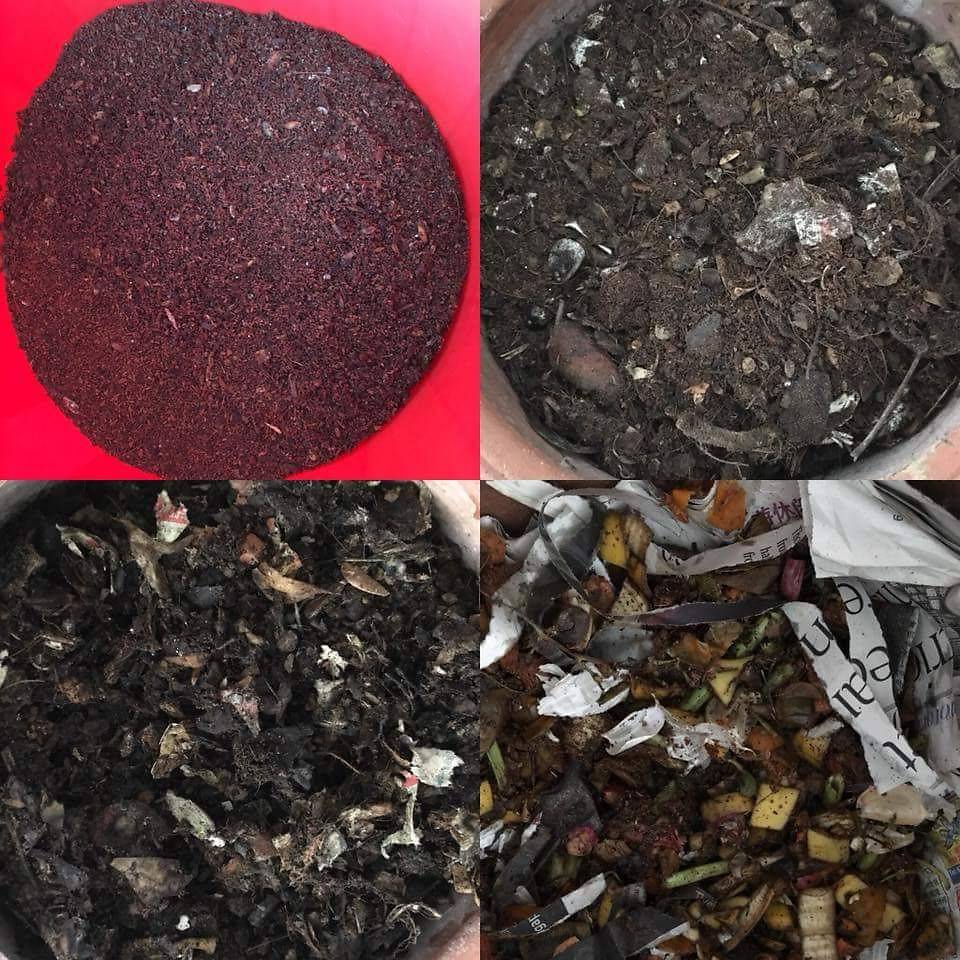
The remix powder helps break down food waste (bottom right) into good compost (top left). (Photo: Zelizzel Ng)
“It’s not anything more than you would do on a regular basis,” she said, pointing out that her pots are conveniently placed near the kitchen. “Instead of putting it in the bin, you put it in the compost.”
MISCONCEPTIONS
But doesn’t the rotting food stink up the house? This is the question Ms Ng, who lives with her boyfriend in a condominium, usually gets. Even her boyfriend had reservations. Others have asked if she adds faeces into the pile.
“People have this conception that you’re going to have lots of cockroaches, flies and disgusting things everywhere, but it’s not the case,” Ms Ng said, adding there’s a slight smell but it doesn’t stink up her home.
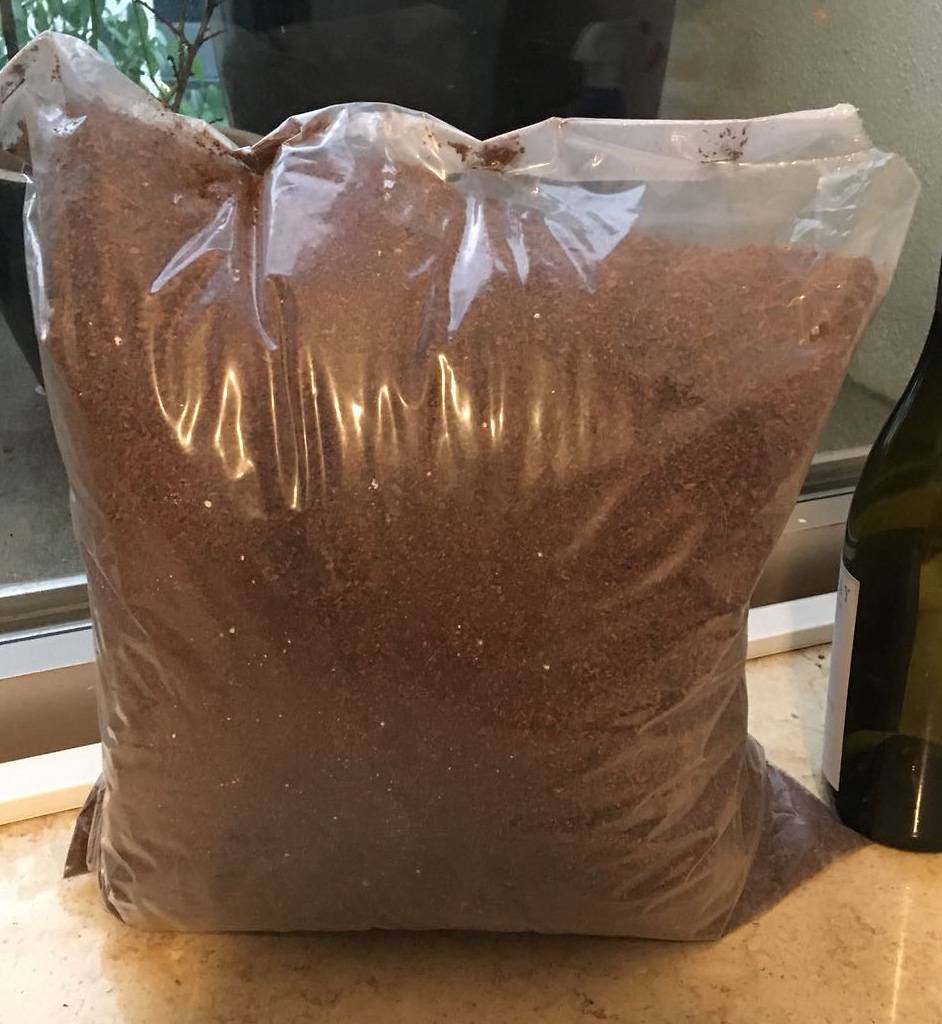
A bag of remix powder. (Photo: Cassandra Ng)
However, Ms Ng admitted that she does not add meat to her pile. While such waste can stink and attract pests, it is possible to compost meat with ample layering and frequent mixing.
Composting doesn’t require a lot of space either, Ms Ng said, adding that she places some of her pots on top of her air-conditioning units. Housing and Development Board staircase landings are possible locations too, she added.
When it comes to cost, Ms Ng said it’s usually a one-time purchase. Her compost pot and two 5kg bags of remix powder cost S$150.
THE CASE AGAINST PLASTIC BAGS
Because composting is not a hassle, Ms Ng said it is a “very good” argument against those who say they need plastic bags to bag up their food waste.
Even then, Ms Ng said many items already come in plastic packaging that can be used for the trash. “Loads of things come with bags and it’s something you can’t escape. Why not use that instead?” she asked. “We’re just such a wasteful society in general.”
Ms Ng uses the compost as fertiliser for her ornamental plants. (Photo: Zelizzel Ng)
To that end, Ms Ng urged more people to try composting. “It’s really not that much of an effort,” she said. “Everybody wants to think they’re doing their small part; makes them feel good about themselves at the same time.”
When it comes to ditching disposables, Ms Khee advised to start small. “If it’s bringing out a water bottle, that’s great,” she said. “Once you get the hang of it, try something else.”
Ms Ng added: “People don’t realise that little steps can really make a big difference.”
In a letter addressed to fellow soldiers, Army Chief BG Goh Si Hou also said that where the army has fallen short, it will “strengthen and enforce safety purposefully”. Initial findings and immediate measures to be taken will also be announced in a week’s time.
Dave Lee Han Xuan and his mother Jasmine Yeo. (Photo: Facebook/Jasmine Yeo)
(Updated: )
Bookmark
SINGAPORE: In a letter sent to SAF soldiers on Thursday (May 3), Army Chief BG Goh Si Hou sought to reassure his men that the army will ascertain the facts behind the death of full-time National Serviceman Dave Lee.
The 19-year-old died on Monday, almost two weeks after he was hospitalised with signs of heat injury upon completing an 8km fast march on the morning of Apr 18. He was taken to Bedok Camp’s medical centre and later admitted to Changi General Hospital, but his condition worsened.
“Many of you would have read online allegations about the circumstances that led to this grave incident,” BG Goh said in the letter seen by Channel NewsAsia.
“We do not have all the facts yet, and there is no point in speculation. Trust that our Army is conducting thorough investigations, as we take all major training incidents seriously. We will ask honest questions of ourselves,” he added.
“We have also convened an independent Committee of Inquiry. As a public institution, we must ensure accountability. Equally important, trust that our Army will be fair. We will back our commanders and trainers up, as long as we do our job in line with sound regulations, and anchored on our values,” BG Goh said.
He said that the army will strengthen its safety system, to ensure that soldiers can “train realistically and train safely”.
“Where we find that we have fallen short, we are determined to strengthen and enforce safety purposefully – more so when we have lost a precious son,” he said. “We will be holding a Command Call in the week ahead, to share initial findings and immediate measures we are taking as an Army.”
“The Army safety system is not broken,” BG Goh stressed. “Otherwise, we would not be able to take civilian soldiers and train thousands of NSFs and NSmen every year, and still manage the inherent risks of military activities.”
BG Goh also urged commanders and trainers to protect and restore confidence in the institution, and called on soldiers to continue to do their jobs well.
“We are a citizen Army that is built on public trust and confidence. When that confidence is shaken, we must protect and restore it. And it starts with all our commanders and trainers, who are the touchpoints to our soldiers and, by extension, their families,” BG Goh said.
“Take ownership and give confidence to our soldiers, especially our NSFs. Explain our training and safety systems; tell them the Army you know. For we have good systems, and good commanders – many of whom are NSFs themselves. But more than words, through your actions, you will be the most solid proof that we place utmost importance on training safety, and we care for our soldiers,” he added.
“Any training death is one too many. Dave’s passing will not be forgotten, and must spur us to do better for all our soldiers. We will take a hard look, learn the right lessons, and strengthen our systems.”
Corporal First Class Lee will be accorded a military funeral on Saturday.
BG Goh said: “We will honour Dave’s memory and service, and give him a dignified send-off. It is the least we can do. And nothing we can do will truly ease the anguish and loss felt by his parents, in losing their son. This will always be a painful reminder of our duty of care for our soldiers.”
Lee enlisted in the army on Jan 5. After completing Basic Military Training in March, he was posted to the 1st Battalion Singapore Guards unit.
The 44-year-old man had obtained the photos from the victim’s ex-boyfriend, who had made a post on social networking site Alamak offering the photos to users.
File photo of a person holding a mobile phone. (Photo: Jeremy Long)
(Updated: )
Bookmark
SINGAPORE: A 44-year-old man was sentenced to two months’ jail on Friday (May 4) for threatening to disseminate the nude photos of a woman unless she paid him off with either cash or sexual favours.
Alexandra Chan Chee Meng had obtained the photos from the victim’s ex-boyfriend, who had taken the photos while he and the victim were in a relationship, according to court documents.
The couple broke up in January 2015.
In June that year, the ex-boyfriend, who cannot be named due to a gag order, uploaded the photos on the Internet. He also made a post on social networking site Alamak that he had nude pictures to share, and invited users to contact him privately.
Chan responded to the post, and the ex-boyfriend sent him the photographs of the victim.
The ex-boyfriend also gave Chan the victim’s mobile phone number, and suggested that Chan try and coax the victim into performing oral sex on him.
‘CASH OR BODY’ IN RETURN FOR DELETING PHOTOS
According to the documents, Chan initiated contact with the victim through WeChat on Sept 23, 2015, the same day he received the photos. He sent her the nude photos, with edits made to cover her private parts.
Chan also sent a photograph of the victim performing oral sex, and commented that “looking at your this photo got me feel something”.
He also asked her repeatedly to meet with him.
From Sep 2015 to Feb 2016, Chan texted the victim repeatedly in a bid to seek her attention. However, she either ignored him or excused herself by saying she was having exams.
In April 2016, he resumed the texts, using the Line mobile application, and sent the victim two photos of her nude upper body.
The victim told Chan that she would lodge a report, and that she wanted her photos back. In response, Chan texted: “What can you offer me to take it (the photos) back? Cash or body.”
When the victim asked how much cash he wanted, Chan asked her to meet him at a hotel that night before he would tell her. He also later threatened to send the photos to other men.
In May that year, the victim lodged a police report against Chan and her ex-boyfriend.
For distributing the nude photos, the victim’s ex-boyfriend has since been sentenced to two months’ jail.
Chan, who pleaded guilty to one count of criminal intimidation, could have been jailed up to two years and fined.
SINGAPORE: A man and woman who fell into a canal in the MacPherson area were rescued by Singapore Civil Defence Force (SCDF) personnel on Thursday (May 3).
SCDF said it received a call that two people had fallen into the canal beside Block 83 MacPherson Lane at about 5.10pm.
A man in his 50s and a woman in her 70s were rescued with a life buoy and ladder, SCDF said.
Photos of the scene show at least 13 SCDF rescuers at the canal, as well as bystanders holding umbrellas in the rain. (Photo: Darren Colin Goh)
Both were conscious when taken to Tan Tock Seng Hospital, SCDF said.
Eyewitness Darren Colin Goh said he heard sirens and stepped out of his home to see what was going on.
He took some photos of the scene that showed at least 13 SCDF rescuers at the canal, as well as bystanders holding umbrellas in the rain. The water was about waist-deep.
The photos show the man in a white T-shirt and an SCDF rescuer helping the woman, who had a life buoy around her, onto the ladder. The woman is later seen on a stretcher.
The man and woman were rescued with a life buoy and ladder. (Photo: Darren Colin Goh)
Both were conscious when taken to Tan Tock Seng Hospital. (Photo: Darren Colin Goh)
Eyewitness Darren Colin Goh estimated that the entire rescue operation took between 20 and 40 minutes. (Photo: Darren Colin Goh)
Mr Goh estimated that the entire rescue operation took between 20 and 40 minutes.
National water agency PUB, citing the National Environment Agency, had warned on Thursday of heavy rain over many areas of Singapore from 4.55pm to 5.30pm.
NEA: Heavy rain expected over many areas of SG from 16:55 hours to 17:30 hours. Issued 16:52 hours. #sgflood
FLIGHTS between Kuala Lumpur, Malaysia and Singapore are the most numerous of any international airline route in the world, according to data released this week.
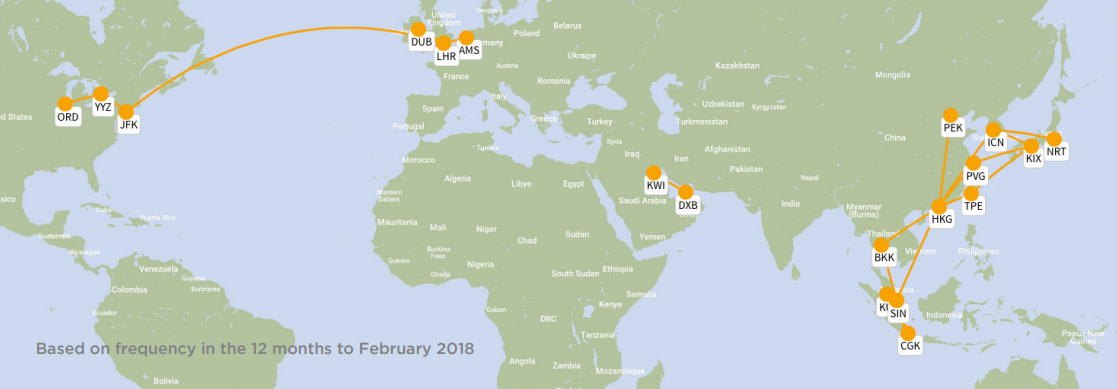
According to UK-based air travel intelligence company OAG, the number of flights between Singapore and KL in the 12 months to February 2018 was a whopping 30,537 – primarily operated by Air Asia, Singapore Airlines, Malaysia Airlines, Scoot, SilkAir, Jetstar and Malindo.
More than four million passengers travelled this leg Feb 2017 and Feb 2018. In second place was the route between Hong Kong and Taipei with 28,887 flights, followed by Jakarta, Indonesia to Singapore with 27,304.
A majority of the most highly trafficked air routes were in Asia, with 14 out of the top 20 being in the region. In contrast, there was only two within Europe and North America, respectively; and one in the Middle East.
The world’s busiest airline routes are heavily concentrated in Asia. Source: OAG
“Given the robust expansion of air passenger travel across Asia Pacific and the fierce competition between carriers in the region, it is unsurprising that 14 of the world’s busiest 20 routes, including 8 of the top 10 routes, are between Asian city pairs,” said Mayur Patel, Regional Sales Director JAPAC for OAG.
Hong Kong-Shanghai Pudong came in fourth; Jakarta-Kuala Lumpur in fifth; Seoul Incheon in South Korea to Osaka, Japan; and Hong Kong to Seoul Incheon in seventh place.
New York LaGuardia to Toronto, Canada crept in at eighth place, followed by Dubai to Kuwait in the rich Gulf States. Next, however, was Hong Kong to Singapore with more than 3.2 million passengers making this journey in the 12 month period.
The highest on-time performance among Asian routes was Kansai-Taipei with 83 percent, followed by Bangkok-Singapore percent and Incheon-Kansai percent.
SINGAPORE: Construction company ZAP Piling has been fined S$290,000 over “numerous and glaring oversights” that resulted in the death of a worker in 2016, the Ministry of Manpower (MOM) said on Friday (May 4).
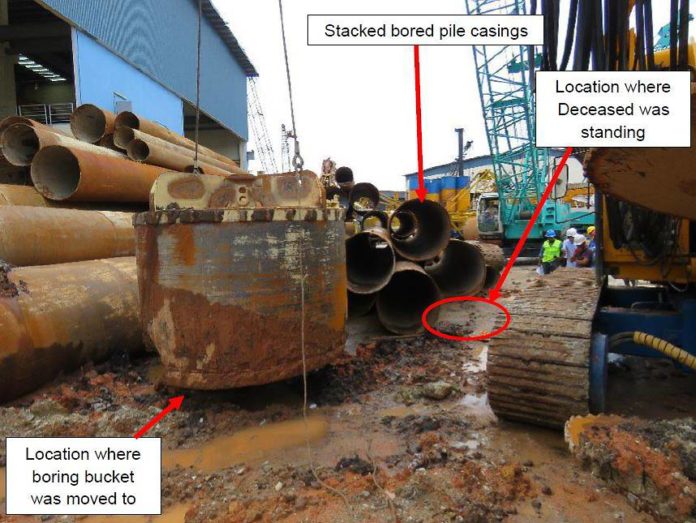
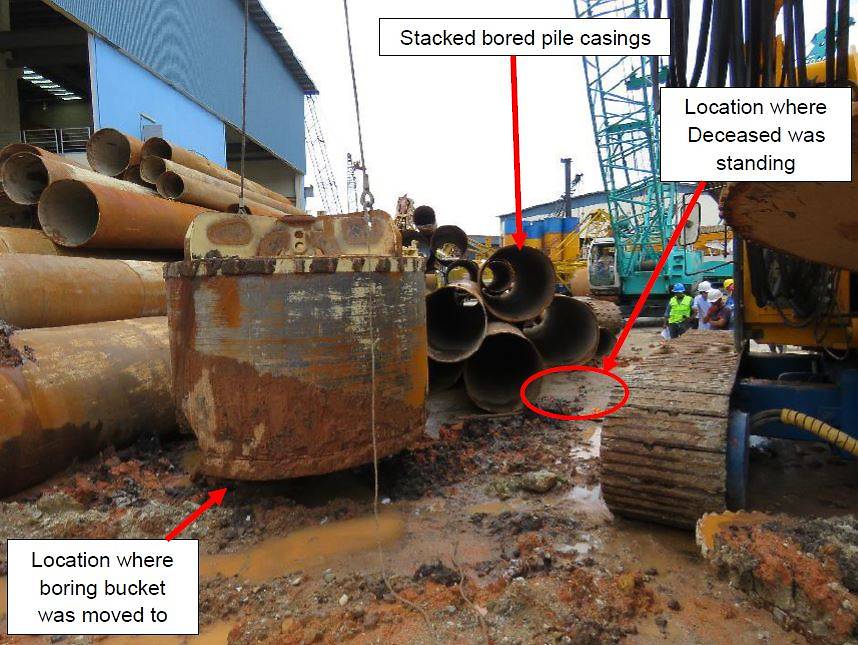
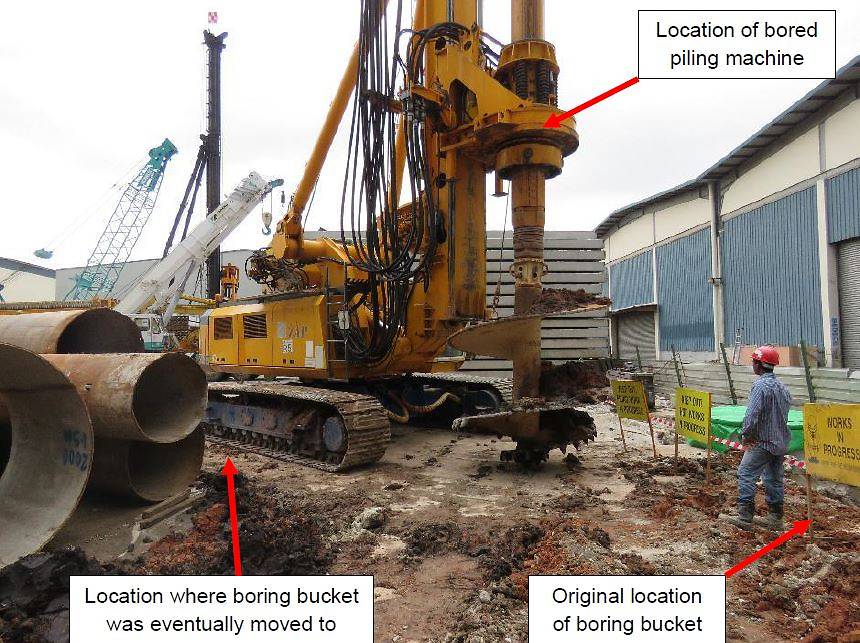
The worker, Arumugam Elango, died after he was pinned against the tracks of a piling machine by piling casings weighing 1.76 tonnes each. The casings had toppled off a stack that was struck by a boring bucket being lifted by a crane.
He was pronounced dead at the scene due to multiple injuries.
(Source: Manpower Ministry)
The accident took place on Jun 9, 2016, at a machinery storage yard at 6 Kranji Link. MOM investigations found that the company had failed to conduct a risk assessment or establish appropriate safety procedures for the work being done.
ZAP Piling had also failed to apply for the necessary permits required for lifting operations, the ministry said.
Proper housekeeping arrangements were also not in place, such as setting up effective supporting structures to ensure that the heavy casings are stabilised to prevent their collapse, it added.
(Source: Manpower Ministry)
“The risk of a load coming into contact with the casings in the tight and congested premises was high and it was foreseeable that there can be accidental dislodgement,” MOM said.
Mr Sebastian Tan, the ministry’s director of occupational safety and health inspectorate, said ZAP Piling had failed to address the “obvious risks” in the lifting works.
“The company’s numerous and glaring oversights in ensuring their workers’ safety resulted in a loss of life. A heavy fine was sought to remind employers not to blatantly disregard the safety of their workers,” he said.