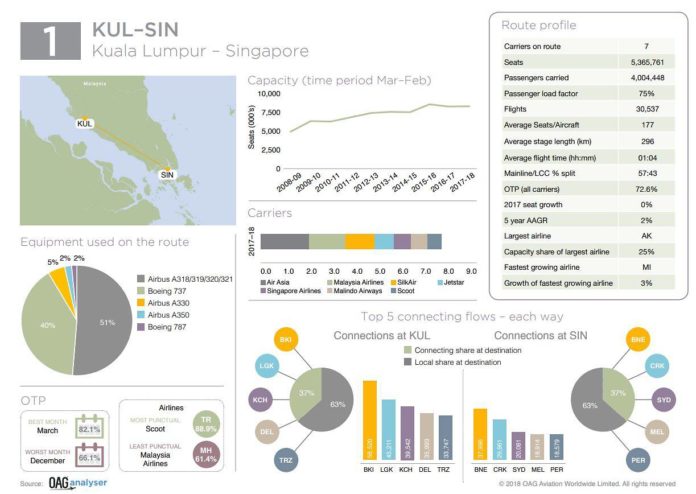
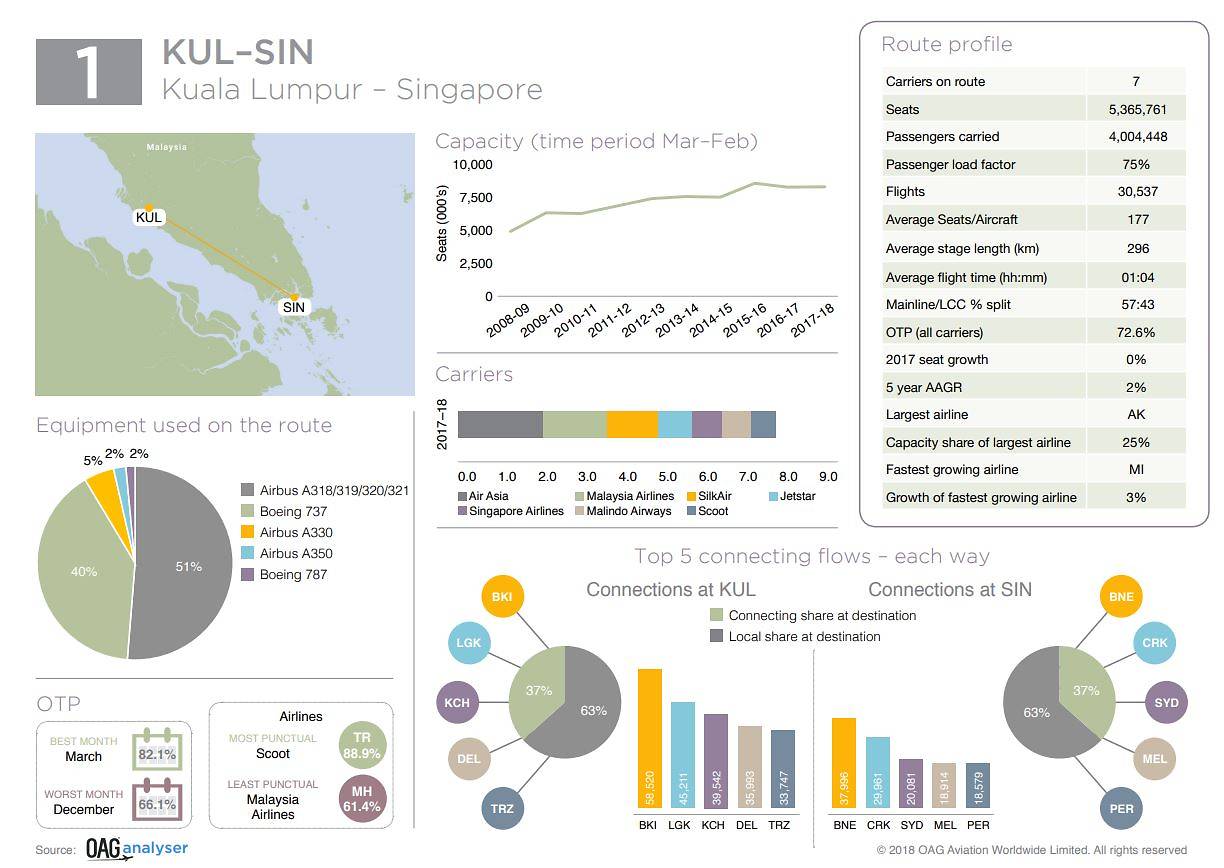
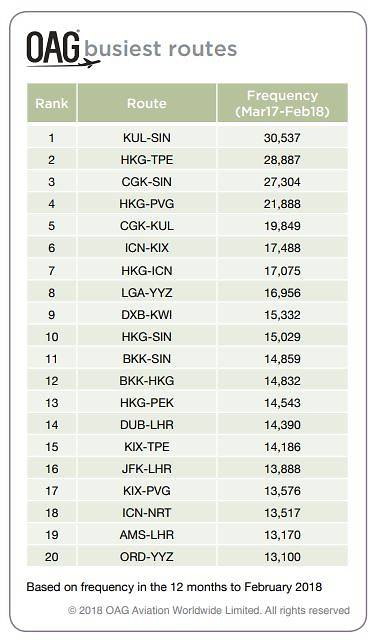
SINGAPORE: The Kuala Lumpur-Singapore route is the world’s busiest international flight route with 30,537 flights recorded between March 2017 and February 2018, according to aviation consultancy OAG.
While the Kuala Lumpur-Singapore route topped the rankings, Hong Kong was the busiest Asian airport on the list, ranking six times in the top 20. Singapore’s Changi Airport was featured four times.
On the Kuala Lumpur-Singapore route, the most punctual carrier was Scoot and the least punctual, Malaysia Airlines, said OAG.
Of the flights between the two cities, 57 per cent were operated by legacy carriers and 43 per cent by low-cost carriers (LCCs).
Jakarta-Singapore was ranked the third busiest in the OAG list, with 27,304 flights between the cities.
Hong Kong-Singapore was ranked 10th busiest and Bangkok-Singapore ranked 11th, with 15,029 and 14,859 flights respectively.
Fourteen intra-Asian routes were ranked in the top 20; eight in North Asia, four Southeast Asia and two between North and Southeast Asia.
The highest on-time performance among Asian routes was Kansai-Taipei with 83 per cent, followed by Bangkok-Singapore (80 per cent) and Incheon-Kansai (78 per cent).
Other major hubs like New York and London also made it into the list, with the route from New York’s John F Kennedy International Airport to London’s Heathrow Airport ranked 16th.
“Given the robust expansion of air passenger travel across Asia Pacific and the fierce competition between carriers in the region, it is unsurprising that 14 of the world’s busiest 20 routes, including eight of the top 10 routes, are between Asian city pairs,” said Mayur Patel, regional sales director JAPAC for OAG.
EVERY city today wants to become a smart city so they can provide the best solutions and services to their citizens. There’s heavy investment in the field and news of new activity almost every other day.
However, not everyone can win the race. According to ABI Research, Singapore, for now, wins the title of the world’s smartest city.
Singapore scores highest on all innovation criteria with a special focus on Mobility-as-a-Service (MaaS) and Freight-as-a-Service (FaaS) to maintain its leading role as a transportation and freight hub with driverless taxis, autonomous shuttles and platooning trials and projects.
Additionally, Singapore’s Smart Nation initiative addresses a wide range of urban issues linked to high-density living which has received applause internationally. The Smart City Ranking competitive assessment ranked 10 megacities across developed regions: New York, Los Angeles, Paris, London, Dubai, Beijing, Shanghai, Singapore, Tokyo, and Seoul.
ABI Research analysed each city for its innovative programs, strategies and implementation achievements measured through verifiable metrics for congestion, air quality, GDP, crime rates, and cost of living.
In terms of innovation, cities are assessed on the extent of which they are embracing out-of-the-box thinking and planning to deploy disruptive technologies to fundamentally address the issues and challenges of megacities of the future across areas like mobility, transportation, energy, education, healthcare, and public services.
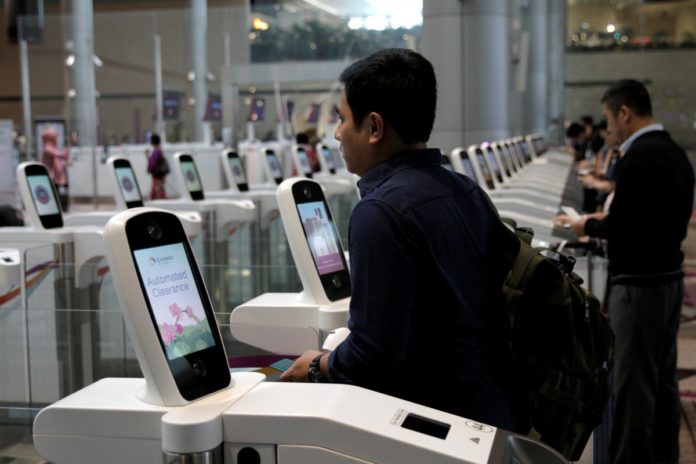
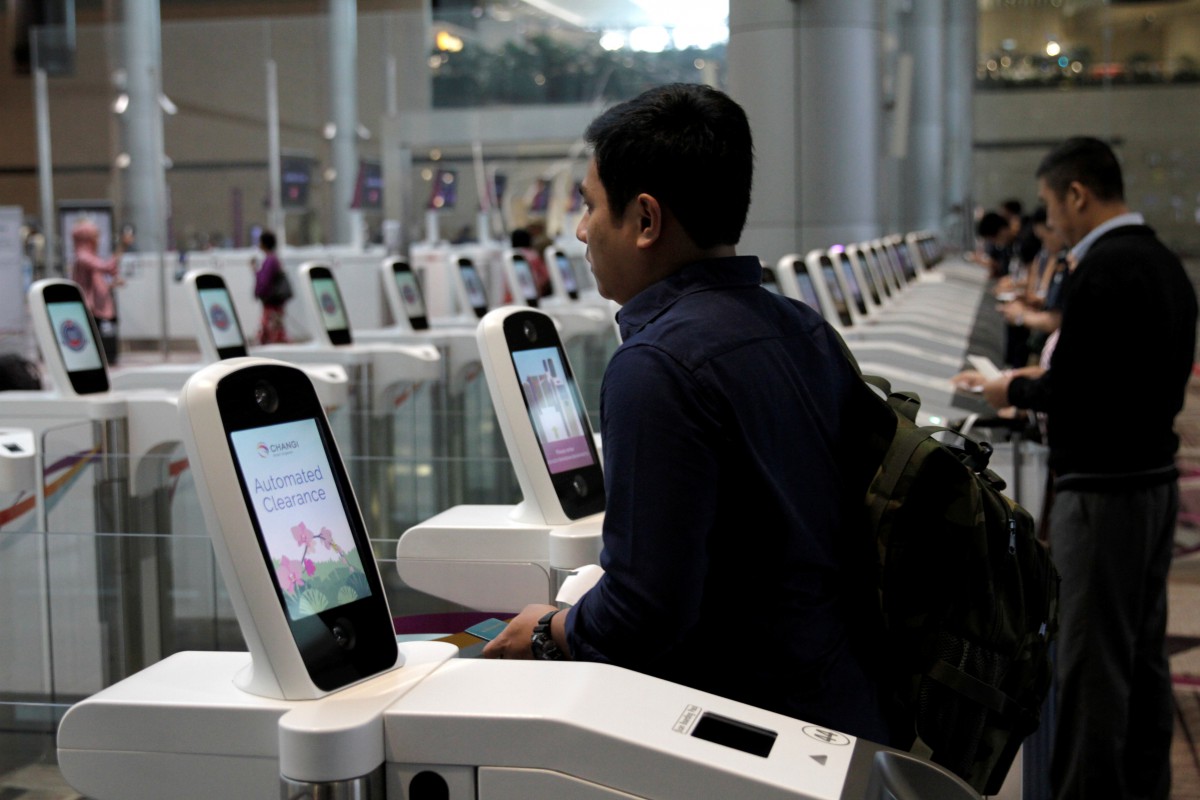
A passenger passes through an automated immigration control gate at Changi airport’s Terminal 4 in Singapore April 30, 2018. Source: Reuters/Thomas White
“Singapore and second-placed Dubai emerge as smart city leaders, excelling in innovation in terms of the adoption of next-generation technologies and disruptive smart city paradigms as structural solutions for hard problems. Dubai is leading the way in the implementation of distributed ledgers with all government transactions to be processed via blockchain technology by 2030,” said Dominique Bonte, Vice President End Markets at ABI Research.
Somewhat surprisingly, Shanghai and Beijing were assessed as laggers, coming in at rank 9 and 10 respectively.
Despite both cities’ efforts to deploy technologies like smart meters and smart grids, bike sharing, vehicle electrification, smart parking, and smart cards, they continue to face formidable issues related to congestion and pollution and trail the other cities on economic development in terms of GDP per capita.
At the same time, both Chinese cities have huge potential to improve their ranking in the future as they continue to evolve their smart cities solutions from basic sensor-centric technologies to more advanced approaches while benefiting from expertise gained during trials in smaller cities in China.
This article was originally published on our sister site Tech Wire Asia.
SINGAPORE: A Genting Dream cruise ship en route back to Singapore had to be pulled to the dock due to technical issues, and an outbound trip to Port Klang was cancelled on Wednesday (May 2).
In a notice on its website, operator Dream Cruises said: “Due to technical issues, we are required to cancel Genting Dream’s two-night Port Klang cruise departing on 2 May 2018 at 2100.”
The company said it was giving passengers affected by the cancellation a full refund, including the cabin fare and port charges.
A tugboat can be seen in this photo taken from onboard the Genting Dream cruise ship. (Photo: Singapore Cruise Society)
It also said that as a “gesture of goodwill”, it was offering passengers a complimentary two-night weekday cruise valid until Nov 30 this year.
In a Facebook post, Singapore Cruise Society said that on its way back to Singapore, the Genting Dream cruise ship encountered technical issues related to its engines and had to engage four tugboats to pull it to the dock.
Genting Dream was docked at the Marina Bay Cruise Centre at 6.20pm, and guests disembarked while those expecting to board for their trip to Port Klang had to be “sent home”, according to another Facebook post.
Passengers were stranded at Marina Bay Cruise Centre after their Genting Dream trip to Port Klang was cancelled on Wednesday (May 2). (Photo: Aye Thida)
One of them, Ms Aye Thida, said she arrived at the cruise centre early at 2pm. Check-in for the trip was meant to be at 5pm, but she was told it would be late due to “engine problems”. “They only informed us after 4pm that it was cancelled. Before that we were just waiting there to check in,” she told Channel NewsAsia.
Ms Aye Thida, who paid S$1,030 for two people, said she was among more than 100 passengers who were turned away at the time.
She also said that she went to the Dream Cruises office when the compensation email had not arrived by Thursday morning.
“They said they would refund to my account within 10 weeks and also offered the complimentary cruise,” she said.
Ms Evelyn Chia, another passenger affected by the cancellation, wrote in a comment on the Cruise Society page: “The cancellation was so last minute, leaving thousands of people stranded at the cruise centre departure … Terrible experience.”
Channel NewsAsia has reached out to Dream Cruises for comment.
SINGAPORE: Decades before the Mass Rapid Transport and Light Rail Transit systems were introduced in Singapore, the country’s first trains ran along the railway in Bukit Timah.
It was constructed to ease the traffic flow along Bukit Timah road, whose tendency to be congested dated even back to the late 1800s.
Now part of the Rail Corridor – which was opened in 1903 – sits empty of trains but not devoid of people, as it has earned itself a spot on the newly refreshed Bukit Timah Heritage Trail.
The trail, first launched in 2007, now comprises 38 heritage sites, the National Heritage Board (NHB) said in a media release on Thursday (May 3).
New sites on the trail include the Dairy Farm Nature Park, St Joseph’s Church, Adam Park, Former Command House, as well as the Fuyong and Former Princess Elizabeth estates.
These sites were incorporated into the refreshed trail as new information was uncovered through oral interviews and new research materials gathered from archival newspapers, maps and other resources from government agencies, NHB said.
Eight of the heritage sites also feature newly-installed trail markers, which contain the history of these sites: Bukit Timah Nature Reserve, Singapore Botanic Gardens, Masjid Al-Huda, Hoon San Temple, Former Ford Factory, the former Raffles College, the former Beauty World as well as Cheong Chin Nam Road, Chun Tin Road, Yuk Tong Avenue and Tham Soong Avenue.
Masjid Al-Huda and Hock San Temple are just some of the religious buildings that exist in the Bukit Timah kampongs. (Photo: Revathi Valluvar)
The NHB has also created three thematic routes covering different segments of Bukit Timah Road to enhance the accessibility of the trail.
Spanning an average of 2.5km each, these cater to different interests and allow visitors to “easily explore in their own time the buildings, structures, religious institutions and sites of natural heritage that make up Bukit Timah’s multi-faceted history”, NHB said in the release.
The Kampong Life Trail, which takes about an hour by bus and walking, features buildings and institutions that were once part of Bukit Timah’s kampong (Malay for “village”) past, including a former railway station as well as houses of faith for communities that used to live there.
The WWII Legacy Trail, 1.5 hours by bus and walking, explores World War II-related sites as well as places that carry the “memories and legacies” of the Japanese Occupation.
Finally, the Leisure and Learning Trail is a two-hour walk that covers some of the social and leisure landmarks well-loved by residents and Singaporeans, including popular eating destinations, Singapore’s first UNESCO World Heritage Site as well as vital centres of research and education, NHB said.
NHB Assistant Chief Executive (Policy and Community) Alvin Tan said that he hoped the new aspects of the trail will provoke a sense of curiosity among Singaporeans and encourage them to look at these old sites with new eyes.
“With the stories, we wanted to add a more personal layer to the content and make it more relatable by telling stories through the eyes of Singaporeans,” said Mr Tan.
Community contributions also feature prominently in the refreshed Bukit Timah Heritage Trail, NHB said, adding that it interviewed members of the public who lived and worked in Bukit Timah to document their memories, anecdotes and experiences.
This is reflected in the trail’s updated information booklets, which feature stories from people who used to live or work at some of the sites.
Available in the four national languages – English, Mandarin, Malay and Tamil – the booklet and map can be downloaded from NHB’s heritage portal, Roots.sg, or picked up physically from several locations: Former Ford Factory, Asian Civilisations Museum, the National Museum of Singapore, the Peranakan Museum and NHB’s office at 61 Stamford Road.
One of the people whose stories and memories are shared in the booklet is Masjid Al-Huda chairman Azman Kassim.
Masjid Al-Huda, constructed in 1925, was central to the community life of Muslim villagers living in kampongs in the vicinity, according to NHB.
Mr Azwan who used to lived in Kampong Tempe near the mosque, said he hoped the stories and memories he shared of living and growing up in Kampong Tempe will show Singaporeans and tourists what kampong life was.
His memories shine a light on, for example, how Malays and Chinese residents of the kampong lived together.
“Even though I was Malay, every year when they put up the Chinese Opera for the Hungry Ghost festival, me and friends would all go and join in,” said Mr Azwan. “When they sold cheng tng (a Chinese sweet dessert with ingredients such as gingko, longan and barley), the Malays would be lining up as well.”
Mr Tan said that through the refreshed Bukit Timah Heritage Trail, NHB hoped to present a more complete and updated story of Bukit Timah’s heritage.
“As with all our heritage trails, we hope that the Bukit Timah Heritage Trail will showcase Bukit Timah’s rich and diverse heritage, foster a greater sense of pride and belonging amongst residents, and provoke a sense of curiosity amongst Singaporeans and entice them to visit and look at the estate through fresh eyes.”
SINGAPORE: The team behind Parking.sg, the mobile app that eliminates the need for motorists to pay for parking using physical coupons, should have put a prototype into end-users’ hands earlier than it did, according to one of the key people behind its development.
Mr Li Hongyi, deputy director of product and engineering at Government Technology Agency (GovTech), shared his reflections on the app’s creation on Thursday (May 3), saying the team’s “biggest mistake” was spending too much time on its features. The app was launched for those driving cars last October, before being extended to motorcycles and heavy vehicles in December.
“When you can get people to touch and hold” the prototype, you can help start them imagining how the service could work,” Mr Li explained, adding their “job is to try and bridge the gap” between imagination and reality when trying to solve existing gaps in the transport sector.
The GovTech deputy director was speaking at a fireside chat on how technology is impacting transport at Seamless Asia, a conference focusing on e-commerce, payments, banking and retail. It was moderated by Ms Piruze Sabuncu, head of Southeast Asia and Hong Kong at Stripe, the vendor that handles payments for Parking.sg.
The Parking.SG app. (Photo: MCI)
Mr Li shared similar thoughts during a presentation at the Public Sector Infocomm Seminar in March.
“If you have something concrete that people can touch, feel and give feedback on, that actually speeds things up a lot in terms of getting actual users to your product,” he said in a GovTech article last month detailing his presentation.
More than two million parking sessions have been logged by about 250,000 vehicle users on the app since its launch last October, the Ministry of National Development said in a written parliamentary response in March this year.
USERS’ NEEDS FIRST
He also stressed the need to put users’ foremost in the pursuit of using technology in the area of transport.
Citing Parking.sg again, Mr Li said the team identified two stress points to address: What if the motorist does not put enough parking coupons and is, say, stuck in meeting and cannot add to them? Or what if the motorist uses too many coupons, when it is not necessary?
As such, the team tried to address these two points primarily, and the user interface was designed to reflect this, he said.
Similarly, the decision to have motorists pay for the stated parking duration upfront, and refund them the unused balance, was a deliberate one. This, Mr Li said, is more palatable than for an open-ended parking session, when drivers may forget to end the session and incur high parking fees.
“We had to recognise the psychology of the user,” he added.
(Photo: Gaya Chandramohan)
Another example of this mentality of users first can be seen in the Beeline app, another GovTech invention.
Mr Li said approaches for transport in Singapore has been about connectivity, rather than efficiency, previously. This means a commuter might have to travel a longer journey in order to reach his or her destination, so as to serve a wider area of commuters, he said.
“But as the country grows, it doesn’t make sense for 10 buses to go everywhere,” he explained.
Enter Beeline, which is a crowdsourcing platform for commuters to “activate more direct, private express bus routes that cater to their travel needs, especially during peak periods”, according to GovTech’s website.
The aim is to be able to bring down travel times from say 60 minutes to 30 minutes, and then further to 10 minutes, Mr Li elaborated.
Ms Annabella Ng, Government Affairs manager at Grab Singapore, who was also on the panel, shared similar sentiments.
She pointed to how Grab had made paying for their rides with credit cards easy for commuters, but this had caused problems for some taxi drivers, who prefer cash so as to pay their daily cab rental.
To address this challenge, Grab went to the various banks here to figure out how to shorten the process of drivers being able to get the money from these credit card transactions. The result? Drivers are now able to cash out twice in a 24-hour window, Ms Ng said.
The local ISP says it will continue to focus on “Singapore’s younger, more tech-savvy crowd” with its mobile services.
The MyRepublic outlet at Hillion Mall. (Photo: Facebook/MyRepublic)
(Updated: )
Bookmark
SINGAPORE: Local Internet service provider (ISP) MyRepublic on Thursday (May 3) announced it will partner telco StarHub to offer mobile services here.
In a press release, MyRepublic said it has formed a mobile virtual network operator (MVNO) partnership with StarHub, which allows it to use the telco’s infrastructure to offer mobile services.
This is similar to what another local MVNO, Circles.Life, struck up with M1.
The ISP did not reveal details on the mobile plans it will launch, although its managing director for Singapore Yap Yong Teck hinted at the customer segment it may be targeting.
“MyRepublic has resonated with Singapore’s younger, more tech-savvy crowd and that is where we will continue (to) focus with our mobility services,” he said in the press release.
The company had been looking for a partner since failing to clinch the fourth telco licence in 2017, and Mr Yap believed that beyond having an “excellent mobile network”, StarHub is also “well aligned” with its strategy.
The ISP said it expects to launch the mobile services “very soon” with details on its plans and bundles to come.
CEO Malcolm Rodrigues had said in November last year that MyRepublic plans to launch mobile services in Singapore in the first quarter of this year, and in Australia and Indonesia by mid-2018.
Jung Haelin had left her room to throw some rubbish, and realised later that she had left the card that would unlock the door in the room.
The Sheares Hall at National University of Singapore. (File photo: NUS website)
(Updated: )
Bookmark
SINGAPORE: The fatal fall of an 18-year-old foreign student at National University of Singapore (NUS) was a tragic misadventure, State Coroner Kamala Ponnampalam ruled on Wednesday (May 2).
The findings were delivered following an inquiry into the death of South Korean undergraduate Jung Haelin, who fell last year from the seventh floor of Sheares Hall, one of the university’s residential hostels.
The incident happened on Oct 28, 2017. Ms Jung, a first-year student at NUS, fell while trying to climb into her dormitory room after locking herself out unintentionally. She had left her matriculation card, which doubled up as a key, in her room.
In delivering her findings, District Judge Kamala noted that NUS has since conducted a review and made changes to prevent such incidents from happening again.
Previously, doors were automatically locked once they close. Now, they will only be locked if occupants do so.
The court earlier heard that Ms Jung had left her room at about 11.15am to throw away rubbish, and tried to re-enter her room by climbing through the window of a pantry that was located next to her room.
Camera footage from the corridor of Sheares Hall showed that Ms Jung tried knocking on nearby doors, but did not receive any response.
She was then seen walking in and out of the pantry twice before the fall. At about 11.30am, a student called the Singapore Civil Defence Force after seeing Ms Jung lying on the ground, breathing heavily.
Ms Jung went into cardiac arrest while she was in the ambulance heading to National University Hospital and later died.
An autopsy report said Ms Jung suffered multiple injuries consistent with a fall from height. District Judge Kamala found that no foul play was involved.
SINGAPORE: You’re trudging through an 8km route march under the blazing sun. Your integrated load bearing vest traps heat like a furnace. Your helmet feels sticky as sweat trickles down your cheeks.
You turn to look at your buddy. He’s not walking straight. Disoriented, he tells you he doesn’t feel right – something about feeling weak and dizzy.
In a situation like this, what should you do?
First,recognisethat your buddy is showing signs of heat injury. Move him in the shade to rest and remove his clothing. Reduce his temperature as quickly as possible by applying a wet towel or pouring water on his body.
If he is conscious, give him water to rehydrate. If he is not breathing or does not have a pulse, resuscitate with cardiopulmonary resuscitation. Finally, rush him to the nearest medical facility.
These steps were from the Singapore Armed Forces (SAF)’s 7R management model on heat injury, an issue which has been in the spotlight following the death of full-time national serviceman Dave Lee on Apr 30.
He had been hospitalised for nearly two weeks with “signs of heat injury” after completing an 8km fast march in Bedok Camp, the Ministry of Defence (MINDEF) said.
The 19-year-old Guardsman was treated by SAF medics before being taken to Changi General Hospital, where his condition worsened, MINDEF added. As with all training-related deaths, an independent Committee of Inquiry (COI) will be convened to investigate the incident.
According to a 1999 edition of an SAF commanders’ guide to preventing heat injuries seen by Channel NewsAsia, Guards units are considered “high risk” because they “generally have a higher training intensity”.
“The time of the year with the highest incidence of heat injuries are April to May which coincides with the period of the year with the highest Wet Bulb Globe Thermometer readings,” the guide said.
The Wet Bulb Globe Temperature refers to a composite measure of heat, humidity and wind chill.
DIFFERENT TYPES OF HEAT INJURY
But what exactly are heat injuries?
It is when one participates in physical activity to the point that heat production within the body exceeds its ability to lose heat adequately, the guide said. This results in a rise in body core temperature that can lead to “temporary or permanent disturbances” in bodily functions.
The guide also categorised heat injuries into three types: Heat cramps, heat exhaustion and heat stroke.
Heat cramps, which are intermittent muscle cramps that usually occur on the legs, result from excessive salt and water loss due to profuse sweating. Heat exhaustion is more severe and points to a significant loss of water. Signs include exhaustion, headaches and dizziness.
The most serious form, heat stroke, comes with a body core temperature of 41 degree Celsius and above. “Soldiers may present with confusion, aggressive behaviour and may progress into a comatose state,” the guide said, stressing that heat stroke is a medical emergency.
SAF recruits going through a route march. (Photo: Facebook/Basic Military Training Centre)
“When the body is unable to adapt to the heat stress, the chemical changes that take place in the body can lead to inflammation in various organs and cause damage,” Dr Philip Koh, who runs a clinic in Tampines, told Channel NewsAsia.
“When the vital organs are damaged enough, it leads to death. And this can be quite accelerated in certain conditions.”
To that end, Dr Koh stressed that speed is important when it comes to recognising heat injury symptoms and treating them.
“If you think the person looks a bit off, either see a doctor or go straight to the hospital,” he added. “Because rehydration with water or 100 Plus may or may not be enough. If it’s not enough, then you need to get a drip going.”
PREVENTION VERSUS CURE
When it comes to prevention, Dr Koh said soldiers should have enough rest and ensure their bodies are conditioned before an activity. “If there’s anything along the way that the soldier is not able to cope with, this should be picked up,” he added.
Factors that help prevent heat injuries include acclimatisation, hydration and having proper work-rest cycles, the SAF guide said.
Acclimatisation involves progressive training to help soldiers get used to the heat. “The intensity of exercise should be gradually increased each day, working up to an appropriate physical training schedule adapted for the environment,” the guide said.
Commanders are also responsible for ensuring soldiers regularly consume fluids, the guide stated. “Soldiers tend not to sense that they are dehydrated and must therefore be consciously reminded to replace the water that is lost through sweating,” it said.
As for work-rest cycles, the guide pointed out that commanders should prevent a “dangerous” increase in body temperature by reducing the pace of work and increasing the duration of rest, especially in very hot and humid conditions.
SAF guidelines based on the Wet Bulb Globe Temperature concept state that above 33 degree Celsius, troops should work 15 minutes at a stretch, followed by 30 minutes rest. During this Code Black category, commanders can also choose to delay or postpone training.
The guide also includes a risk assessment matrix that tells commanders how to respond to causal factors of heat injuries.
Other measures include ensuring soldiers remove unnecessary layers of clothing and teaching them to monitor their hydration through the colour and volume of their urine. In 2012, the SAF introduced a compulsory temperature-taking regime for soldiers.
DECREASE IN CASES
According to 2010 SAF-Ministry of Health guidelines on managing heat injuries, a retrospective review of exertional heat injury in the SAF from 1990 to 2008 revealed that heat injury cases had decreased from 50 to about five cases per 10,000 training population.
This follows the “introduction of a system for risk management during training, soldier education, hydration regime and acclimatisation and periodisation training”, the guidelines said.
Channel NewsAsia has contacted MINDEF for comment on heat injuries in the SAF.
The US Army takes a similar approach to heat injuries, according to a training document published in 2016 by its Training and Doctrine Command. Brigade commanders are also required to conduct heat illness prevention and treatment training for subordinate leaders every year.
“Heat injuries are totally preventable,” the SAF guide said. “When a heat injury occurs, it is an indication of failure in one or more components of the prevention system.”
South Korean Jung Haelin had left her room to throw some rubbish, and realised later that she left the card that would unlock the door in the room.
The Sheares Hall at National University of Singapore. (File photo: NUS website)
(Updated: )
Bookmark
SINGAPORE: The fatal fall of an 18-year-old foreign student at National University of Singapore (NUS) was a tragic misadventure, State Coroner Kamala Ponnampalam ruled on Wednesday (May 2).
The findings were delivered following an inquiry into the death of South Korean undergraduate Jung Haelin, who fell last year from the seventh floor of Sheares Hall, one of the university’s residential hostels.
The incident happened on Oct 28, 2017. Ms Jung, a first-year student at NUS, fell while trying to climb into her dormitory room after locking herself out unintentionally. She had left her matriculation card, which doubled up as a key, in her room.
In delivering her findings, District Judge Kamala noted that NUS has since conducted a review and made changes to prevent such incidents from happening again.
Previously, doors were automatically locked once they close. Now, they will only be locked if occupants do so.
The court earlier heard that Ms Jung had left her room at about 11.15am to throw away rubbish, and tried to re-enter her room by climbing through the window of a pantry that was located next to her room.
Camera footage from the corridor of Sheares Hall showed that Ms Jung tried knocking on nearby doors, but did not receive any response.
She was then seen walking in and out of the pantry twice before the fall. At about 11.30am, a student called the Singapore Civil Defence Force after seeing Ms Jung lying on the ground, breathing heavily.
Ms Jung went into cardiac arrest while she was in the ambulance heading to National University Hospital and later died.
An autopsy report said Ms Jung suffered multiple injuries consistent with a fall from height. District Judge Kamala found that no foul play was involved.
The court heard that on the day of the incident on Aug 1 last year, Hashim Hamzah had been looking for discarded items to sell in order to return a S$400 loan he had taken from a licensed moneylender.
Items he found included a white helmet, a knife with a 15cm blade and a red bag. But Hashim then realised that he would not be able to raise enough money to repay the loan just by selling the items.
He then decided to rob the Western Union branch in Ubi, with the white helmet on and wearing a green mask.
Hashim waited for an employee, a 28-year-old Thai customer service officer, to open the shutters. The employee left the shutters unlocked while she prepared to open the branch.
At about 10.40am, Hashim entered the outlet, closed the shutters behind him and asked the employee for money. She opened a metal cash box containing S$4,000 in notes and coins, and gave some to him.
Hashim placed the money in the red bag and fled. The court heard that he dropped some money while running and ended up with S$654. The dropped money was recovered on the same day.
Hashim left the area on a bicycle and rode towards Bedok Central. When he was found and arrested two days later, he was slurring in his speech and walking unsteadily. Some money, lottery tickets and drugs were found in his possession.
The court heard that he had repaid the S$400 loan and spent S$200 on drugs, food and drinks.
Hashim has prior convictions from as far back as 1987 for drug offences, snatch theft and theft. He was last released from prison in 2014.
The court heard that Hashim had contemplated taking his life using the knife he found, but decided against it. A forklift operator previously, he was unable to find a job after his release and became a cleaner.
He was charged in court on Aug 5 last year. For armed robbery, he could have been jailed for up to 10 years and given at least 12 strokes of the cane. For possession of drugs, he could have been jailed for 10 years and fined up to S$20,000. He will not be caned as he is above 50 years old.