Home Blog Page 1042

Commentary: US–Singapore relations require an ambassador in the city-state

SINGAPORE: Critics of President Donald Trump previously opined that the many unfilled Asia policy positions at the Department of State would persist as long as Rex Tillerson remained Secretary of State.

Amid President Trump’s announcement that his planned summit with North Korean leader Kim Jong Un will take place in Singapore on Jun 12, and Mike Pompeo’s taking over as Secretary of State, now is the time to address one of the most important unfilled US ambassadorships.

More broadly, as a defence partner, free trade partner and export market that supports 215,000 American jobs, and with which the United States enjoys a US$20 billion trade surplus in goods and services annually, Singapore certainly deserves the courtesy of a US ambassador.

Filling the top post will also strengthen the US’ ability to continue expanding bilateral cooperation in areas of mutual interests.

SECURING BILATERAL DEFENCE RELATIONS

The role of Singapore vis-à-vis US national security strategy in the Indo-Pacific cannot be overstated, which makes the absence of an ambassador all the more concerning.

Both sides clearly place importance on defence cooperation. In April 2017, Defence Minister Ng Eng Hen was among the first foreign defence ministers to visit Defence Secretary James Mattis during the early days of the Trump Administration.

The enhanced Defence Cooperation Agreement (eDCA) signed in December 2015 strengthened cooperation in humanitarian assistance and disaster relief, cyberdefence and biosecurity, and built on earlier bilateral agreements including the forward deployment of US naval vessels, the 1990 Memorandum of Understanding and the 2005 Strategic Framework Agreement.

Indeed, the US and Singapore maintain an excellent and long-standing bilateral defence relationship, and with the confirmation last December of Randall Schriver as the Pentagon’s Assistant Secretary of Defense for Asian and Pacific affairs, such ties are likely to expand.

PM Lee Hsien Loong and Donald Trump - AFP

Prime Minister Lee Hsien Loong and US President Donald Trump participate in a joint press conference in the Rose Garden of the White House in Washington, DC, October 23, 2017. (Photo: AFP / SAUL LOEB)

SENSITISING THE US TO SINGAPORE AND ASEAN’S INTERESTS

Prime Minister Lee Hsien Loong had excellent relations with recent US Presidents George W Bush and Barack Obama.

Mr Lee also met President Trump in Washington DC in October 2017, during which time the two leaders issued a statement reaffirming the strong and enduring partnership especially in the economic, defence, security, and people-to-people spheres, and also witnessed the signing of an agreement by Singapore Airlines to purchase 39 Boeing aircraft for US$13.8 billion that will create more than 70,000 US jobs.

Despite the good personal ties at the leadership level, issues of disagreement are bound to surface even between countries that share common interests and shared perspectives on regional issues.

In December 2017, Singapore joined more than 100 United Nations members to vote in favour of a motion to reject the US decision to recognise Jerusalem as Israel’s capital, despite US warnings to its friends that the US “will remember this day”.

Where disagreements surface in multilateral initiatives, Singapore must be expected to move forward in a direction in line with its national interests, as with any other country.

Singapore, with 10 other countries, inked the Comprehensive and Progressive Agreement for Trans-Pacific Partnership despite the Trump administration’s decision to withdraw from the original TPP.

Periodic disagreements and discussions on regional issues require a US ambassador on post to serve as a facilitator and mediator between Washington and Singapore.

Additionally, Singapore chairs ASEAN this year, which is an important platform for regional countries in Southeast Asia to engage extra-regional countries like the US on areas of shared interests.

Perhaps most importantly for the maintenance of excellent bilateral ties is the need for the United States to familiarise itself with Singapore’s transition to the fourth generation leadership team. 

With last month’s extensive cabinet reshuffle, now is the time for a US ambassador to expand relationships with leaders in Singapore who will lead the country into the future.

EXPLAINING US POLICY TO SINGAPORE

The Trump Administration’s National Security Strategy published by the White House last December pledges to strengthen the US’ partnerships with Singapore, though China, with whom Singapore maintains excellent relations, is identified as a key global competitor to the US, along with Russia.

The 2018 National Defence Strategy, published by the Pentagon in January, identifies as a main concern “China’s military modernisation, influence operations, and predatory economics to coerce neighbouring countries to reorder the Indo-Pacific region to their advantage”, and states that the strategy’s most far-reaching objective is to set the military relationship between the US and China on “a path of transparency and non-aggression”.

A US ambassador will explain to stakeholders in Singapore, including policymakers, scholars, and the defence industry, how both strategy documents will shape US foreign policy in Asia.

Amid White House concerns about China’s gaining access to important technologies and trade imbalances, the Trump administration recently refused to allow Broadcom to proceed in its proposed acquisition of Qualcomm, forcing Broadcom to abandon what would have been one of the biggest takeovers in technology industry history. 

An ambassador would be an important spokesman to explain why this outcome occurred notwithstanding the close trade ties between both countries, and especially as Broadcom was essentially run from its San Jose, California office and recently completed the transition of its parent to a Delaware corporation.

As to the possibility of a tariff war with China, now that China and the US do not appear to be much closer to a solution, the concerns of many US business executives who oversee Asia businesses from a regional headquarters in Singapore, as well as Singaporean companies who manufacture in China for export to the US, can best be addressed by an ambassador who can shed light on considerations behind the Trump Administration’s trade policies.

FILE PHOTO: A sign to the campus offices of chip maker Broadcom Ltd, who announced on Monday an uns

A sign to the campus offices of chip maker Broadcom Ltd is shown in Irvine, California, United States, November 6, 2017. (Photo: REUTERS/Mike Blake/File photo)

WHAT TO LOOK OUT FOR IN A US AMBASSADOR

Recent US ambassadors to Singapore have been political appointees rather than career foreign service officers.

Previous and relevant government service is also important. Prior to his ambassadorship in Singapore, Jon Huntsman was Deputy Assistant Secretary of Commerce for East Asia and the Pacific in the George HW Bush administration and a Staff Assistant to President Ronald Reagan. 

Frank Lavin was Deputy Assistant Secretary of Commerce for Asia and the Pacific in the George H W Bush administration and White House Director of the Office of Political Affairs under President Reagan.

Most US ambassadors to Singapore identify an achievable goal that will serve as a sustainable legacy, such as Ambassador Lavin’s efforts to negotiate and sign the US-Singapore Free Trade Agreement or Ambassador David Adelman’s initiation of the US-Singapore Strategic Partnership Dialogue.

Past ambassadors also typically continue to contribute to Singapore. Lavin later served as Under-Secretary for International Trade at the Department of Commerce, where he promoted bilateral trade, and he currently is a director of Singapore’s UOB. 

Adelman went on to serve as a member of the Monetary Authority of Singapore’s Capital Markets Committee.

With Singapore’s membership in the CPTPP, and the Trump Administration’s decision to implement trade remedies to address trade imbalances between the US and its trading partners, the next US ambassador must have an intimate understanding of US–Singapore trade relations.

Whether it comes to understanding Section 301 of the 1974 Trade Act that is the basis for many of the significant trade remedies announced with regard to China, customs regulations, Singapore’s investment laws, intellectual property rights protection amid a rapidly changing digital economy, and World Trade Organisation processes, an expertise in global trade is crucial.

DESERVING OF A US AMBASSADOR SOON

Singapore is one of the Trump administration’s key partners in the Indo-Pacific and as such, deserves a US ambassador on post as soon as possible.

As the Trump Administration plans the Trump-Kim summit, implements an Indo-Pacific strategy, and responds to China’s unfair trade practices, the need is increasingly urgent.

Even as the US ambassador to Singapore can help set the tone for US diplomacy not only in Singapore, but for the broader region, the unfilled position in Singapore is also a reminder that there is also no nominee to serve as US ambassador to ASEAN, for whom the experiences discussed above are also relevant.

Let’s hope the Trump Administration nominates an ambassador to Singapore, as well as one to ASEAN soon.

The author is a political analyst who advises on US trade and security relations with Asia. He previously served as Asia Chairman of Republicans Abroad. The views expressed herein are his own.

Source link

Iconic Nokia 8110 ‘slider’ phone to hit Singapore in May

It will also be introducing three other phones – Nokia 7 Plus, Nokia 6 and Nokia 1 – to Singapore this month.

Nokia 8110 in 4G

The retro Nokia 8110 will come in 4G and will be available in two colours – Traditional Black and Banana Yellow. (Photo: HMD Global)

SINGAPORE: HMD Global, the licensee of the Nokia brand, announced on Friday (May 11) that it will be bringing its iconic “slider” phone Nokia 8110, as well as the new Nokia 7 Plus and Nokia 6, to Singapore this month. 

In a press release, HMD said the iconic curved phone 8110 will come enabled with 4G and an access to an app store, so users will be able to downloads apps like Google Assistant, Google Maps, Facebook and Twitter. It also comes with the revamped version of snake, it added. 

The feature phone will be available from end-May at S$109, and will come in two colours – traditional black and banana yellow, the company said. 

The New Nokia 6, Nokia 8 Sirocco, Nokia 8110, Nokia 1 and the Nokia 7 Plus are seen at a pre-launch

The New Nokia 6, Nokia 8 Sirocco, Nokia 8110, Nokia 1 and the Nokia 7 Plus are seen at a pre-launch event in London on Feb 22, 2018. (Photo: Reuters/Peter Nicholls)

The other three phones to enter the market will be the Nokia 7 Plus and Nokia 6 as well as the entry-level Nokia 1 – all of which were announced during this year’s Mobile World Congress

HMD also said it will be the first global partner to have a “full suite of devices” selected into Google’s Android One programme, and that the Nokia 7 Plus and Nokia 6 are included and will ship with Android Oreo operating software (OS). 

Announced in 2014, Android One is a set of rules for hardware makers to follow, ensuring consistency in the user experience while figuring out the costs for manufacturers. It was an initiative to ensure its Android operating system can work in low-end smartphones prevalent in emerging markets.

The Nokia 7 Plus will go on sale from May 12, and will cost S$599. The Nokia 6 will be priced at S$439 and will be available on May 12 as well. 

Meanwhile, the Nokia 1 will be available from the end of May at S$129, and will come with Android Oreo (Go edition) – a version of Android OS optimised for devices with 1GB RAM or less, HMD said. 

“With these additions to our product portfolio in Singapore, we’re confident every consumer will have a Nokia phone they can truly rely on,” said HMD vice president for Asia Pacific James Rutherfoord. 

Source link

Indonesian maid bond: Embassy referred 64 cases with employment issues to MOM last year

MOM responds after the Indonesian Embassy on Wednesday said that the bond was “urgently necessary” in order for it to better protect its workers, claiming that the 1,579 cases it handled last year was only the “tip of the iceberg”.

foreign domestic workers' day

File photo of foreign domestic workers. (Photo: Wee Teck Hian/TODAY)

SINGAPORE: The Indonesian Embassy referred 64 foreign domestic workers (FDWs) with employment issues to the Ministry of Manpower last year, the authority told Channel NewsAsia on Thursday (May 10).

The comments from the MOM came after the Indonesian Embassy said on Wednesday that it handled 1,579 cases last year from migrant workers citing issues such as sexual and physical abuse, salaries being delayed for several months, being made to work for up to 20 hours a day and not being allowed to perform prayers.

“Every case referred to MOM is looked into,” an MOM spokesperson said.

“We urge the Indonesian Embassy to refer FDW cases that require the attention of MOM for follow-up,” the spokesperson added.

Of the 64 cases referred to MOM last year, the authority found that employment regulations had been breached in six cases. Enforcement action were duly taken against the errant employers and one employment agency on those six cases, MOM said. 

Two cases are still under investigation, while no breaches were found in the remaining cases, it added.

The ministry on Tuesday released an advisory to employers in which it called a new S$6,000 performance bond requirement by the Indonesian Embassy “unnecessary”, given that Singapore already has a “comprehensive regulatory framework to protect all FDWs”.

MOM also said that the conditions under which the Indonesian Embassy could forfeit the performance bond were not clear.

In response, the Indonesian Embassy on Wednesday said that the bond was “urgently necessary” in order for it to better protect its workers, claiming that the 1,579 cases it handled last year was only the “tip of the iceberg”.

There are more than 120,000 Indonesian migrant workers in Singapore.

The embassy also listed several clauses under which the performance bond is bound to. It also clarified that the bond would not be automatically forfeited, and would only be done so as a “last resort” after previous attempts at mediation are exhausted.

On Thursday, MOM said that questions still remained over whether conditions for forfeiting the performance bond would be spelt out clearly in the documents that employers would be made to sign. 

“There are also no details on who will be mediating and whether there will be neutrality during the dispute resolution,” it said.

Source link

SMEs should tap on trade links to capture overseas opportunities: Chan Chun Sing

SINGAPORE: Small- and medium-size enterprises (SMEs) need to tap on all the trade links Singapore has established with partners, in order to expand into overseas markets, said Trade and Industry Minister Chan Chun Sing on Thursday (May 10). 

“This is the microcosm of how we want to develop our industries, use our free-trade platforms, use our good logistics and supply chain system to bring in the best materials,” said Mr Chan during his visit to food manufacturer SMC Food 21.

“At the same time, (we should) value-add and have the assurance that we do not compete on the basis of price alone, but instead on the quality of our products,” he said.

This is Mr Chan’s first such visit since taking on his new portfolio following a Cabinet reshuffle.

Mr Chan added that other SMEs should learn from SMC Food’s efforts in going global – by capitalising on its strengths to attract foreign companies to partner them.

“They know that while we may not be the cheapest in terms of land and labour, we can certainly be the best in terms of quality and quality assurance.”

SMC Food factory

The food manufacturer said it has spent millions investing in new technology and equipment. (Photo: Brandon Tanoto) 

The food manufacturer said it has spent millions investing in new technology and equipment, which is in line with the food industry transformation roadmap launched in September 2016. 

The blueprint aimed to steer growth in the food services industry through the adoption of innovative business models and technology.

The firm’s managing director Mr Cheng Liang Chye said that while machinery has helped raised output and productivity by at least twofold, more can be done to expand overseas.

As such, it has made use of Singapore’s trade relationships with countries like China and India to partner with the multinationals and helping them save costs through manufacturing their products for them.

“Singapore is not the cheapest place to manufacture products so we have to actually carve out a niche for ourselves … and quality is one of the main focuses we go after.”

“The trend going forward is that MNCs and food companies may not want to invest in brick and mortar manufacturing companies but they’d rather focus on brand building and marketing of their brands,” said Mr Cheng. 

“So there is room for companies like us to partner with all these MNCs to grow their business at a much faster rate, instead of them building their own factories and manufacturing their own products.” 

He added that the company’s strategy has already reaped benefits, having secured customers from the region including New Zealand, Vietnam, Pakistan, Malaysia, Hong Kong and Taiwan.

In fact, plans for further expansion are already in the works.

The company is constructing a new facility in Singapore, with completion slated for the end of the year.


SMC building construction

SMC Food 21 has invested S$30 million in its new six-level facility which is expected to be completed by end-2018. (Photo: Brandon Tanoto) 

The six-level facility which is located next to its Jurong premises, will add to its current count of six across Singapore, Malaysia and Thailand.

SMC Food 21 has invested around S$30 million in this new plant and is expecting it to help boost its revenue growth by at least two to three times.

Mr Chan also touched on the Malaysia general election results during his visit, saying that the Singapore Government is “closely following” the developments in the neighbouring country.

Source link

Traffic Police to trial new cameras that detect illegal U-turns, vehicles stopping in yellow box junctions

SINGAPORE: A new traffic camera system will be tried out in June capable of detecting multiple traffic offences at junctions, Traffic Police (TP) said on Thursday (May 10).

The system uses a 3D laser scanner to track the movements of vehicles and automatically detect three types of offences: Illegal u-turns, vehicles turning in a non-turning lane and vehicles causing obstruction at yellow box junctions, it said.

It will record the time of the violation, the lane the vehicle was travelling on and its registration plate.

The system which can also detect multiple offences committed simultaneously, will be tested for three months at the junction of Thomson Road and Newton  Road. The location is prone to such violations, TP said. 

No summons will be issued for offences detected by the system during the trial period.

new tp camera 2

TP commander SAC Sam Tee. (Photo: Nevin Jacob)

“These are violations that potentially can cause accidents, and we have seen such accidents happening at major junctions,” said TP commander Senior Assistant Commissioner of Police (SAC) Sam Tee.

“That causes concern and TP wants to use technology to remind and deter motorists from committing such violations.”

The system’s effectiveness in detering such offences will be evaluated after the trial period before deciding on next steps, SAC Tee said.

When asked if it will deploy the new system at other junctions, TP said it will adopt a risk-based approach, similar to how speed cameras are deployed on roads where speeding-related accidents have occured.

“We don’t have a specific timeline in mind, but quite certainly we want to deploy such technology,” SAC Tee added.

Source link

Commentary: Why a five-hour work day is a double-edged sword

SINGAPORE: Discussion about shorter working hours has re-emerged thanks to a recent story about an Australian financial advice firm which trialled a five-hour work day.

In Sweden, the city of Gothenburg experimented with six-hour work days among nurses in an aged care facility. Although the nurses took less sick leave and showed increased productivity, the city council eventually ended the experiment as the costs outweighed the benefits. 

Despite the productivity gains, the facility had to hire more nurses to make up for the lost hours, which became too expensive for the small city to bear. 

There is no doubt working excessive hours makes people less productive and takes a toll on their health and personal lives, but could a five-hour work day be the solution to some deep-seated workplace issues such as workaholism, long working hours and presenteeism?

First, let’s explore some of the potential benefits of a five-hour work day.

FLEXIBILITY, FREEDOM AND BOOST IN PRODUCTIVITY

Working fewer hours means that more hours are available for employees to focus on their personal priorities. We all lead busy lives outside work. Family is important to us.

Working adults can spend more time with their children and elderly parents. Pet lovers also value the time spent with their treasured companions.

At home, hours can be filled with duties such as doing household chores and maintaining the garden. Fitness fanatics can also visit the gym more frequently.

Dog walking

(Photo: Pixabay/russmac)

Nurses in Sweden who went from working eight to six hours a day felt that reduced hours boosted their productivity as they organised more activities for their patients and provided better quality care. They also felt healthier and happier, making them more focused and productive at work.

Multiple studies have consistently shown that the more hours people worked, the more their productivity declined. Reduced work hours also encouraged employees to prioritise job tasks over non-work-related matters, avoiding the scourge of presenteeism at work.

Another advantage of a shorter work day is the opportunity for exploring hobbies, activities and pursuits beyond the workplace that give a sense of meaning, purpose and belonging.

Some employees volunteer for not-for-profit organisations, sharing their professional expertise and free labour to advance cherished causes. Others participate in community groups like Boy Scouts or Girl Guides.

These activities build skills and connections that enhance performance on the job. Higher performance subsequently fosters a sense of job and career satisfaction for employees.

READ: A commentary on work-life balance, that elusive unicorn

READ: A commentary on reviewing our assumptions on work-life balance.

NOT FOR EVERYONE

However, the five-hour work day is unlikely to benefit all employees or all job types.

A study conducted on South Korea’s Five-Day Working Reform found that reduced working hours did not increase job and life satisfaction. Instead, the reduced hours made employees stressed because their work had intensified. 

Another disadvantage of a five-hour work day is finding the right job arrangement. Some job roles, such as a consultant or customer service representative, are client-facing, meaning employees must be available during business hours when customers expect to receive service.

These employees do not have autonomy to shape their work arrangements to work fewer hours. Employees, like knowledge workers, are more suited for shorter work days, as their work is typically technologically-enhanced, flexible and portable.

South Korea office workers

File photo of office workers. (Photo: AFP)

A five-hour work day is unlikely to leave much time for interaction, brainstorming, discussions and lunch or coffee breaks. Consequently, workplace camaraderie may suffer, reducing productivity and project progress.

In industries such as advertising and tech start-ups which thrive on creativity and collaboration, the added pressure from a reduced work day is likely to stifle and disrupt innovation.

Further, work–family researchers have found that working long hours is not necessarily bad for health. Rather, a compulsive work mentality – workaholism – gives rise to depression, sleep problems and difficulties in recovering from work exertions, impairing employees’ physical health.

The negative effects were particularly pronounced for employees who did not love their jobs.

Even with reduced work days, employees who have a hard time “switching off” from their jobs will be stressed, frustrated and anxious, as they constantly think about their jobs after hours.  

REMAINING FLEXIBLE AND OPEN TO CHANGES IS KEY

The five-hour work day is an exciting promise, but it’s clearly not for everyone. It offers a great way for employees to balance work, home, community and leisure pursuits. But workers and their employers need to consider the nature of the work, individual personality preferences and national culture.

If the job role is flexible and portable, one solution could be that employees are allowed to work any number of hours each day so long as they complete their tasks.

We believe it’s more important for organisations to be open to changes and to help their employees find the right balance, rather than instituting a strict five-hour work day or nine-to-five rule.

Employees should also speak up if their workload isn’t working for them, and hopefully both employees and organisations will adapt to meet each other’s needs.

Carys Chan is Assistant Professor in Management at RMIT University. Justin Field is Principal Organisational Development Consultant at Oracle and Adjunct Lecturer in Strategic Human Resource Management at the University of New England. David Cheng is Assistant Professor in Leadership at the Australian National University.

Source link

36 arrested in one-month blitz on public entertainment outlets

SINGAPORE: The police said on Wednesday (May 9) that 36 individuals were arrested during a one-month blitz on public entertainment outlets by multiple security agencies.

The 36 men and women, aged between 21 and 31, were arrested for offences under the Employment of Foreign Manpower Act, Misuse of Drugs Act, Societies Act and Liquor Control Act, the police said in a news release.

In all, 427 individuals, aged between 21 and 65, were checked during the joint operations by the Central Police Division, Criminal Investigation Department and Central Narcotics Bureau.

Enforcement operation 2

Eighteen public entertainment outlets were found to have contravened licensing conditions. (Photo: Singapore Police Force)

The police also said that 18 public entertainment outlets were found to have contravened licencing conditions, and that actions will be taken against the licensees.

Investigations are ongoing.

“The police take a serious view of anyone who commits violent crimes or public nuisance in the vicinity of public entertainment outlets and will continue to take tough enforcement actions against such activities,” they said.

Source link

More households fined for breeding mosquitoes last year: NEA

SINGAPORE: More households were caught breeding mosquitoes last year, according to figures released by the National Environment Agency (NEA).

According to the figures, about 4,200 households were fined for mosquito breeding in 2017, compared to 3,900 in 2016.

Nearly three-quarters, or 87, of the 126 breeding habitats found in the Jurong West dengue cluster as of May 7 (Monday) were in residential premises, NEA told Channel NewsAsia on Tuesday. These habitats include flower bowls and vases, fountain, pails and dish drying trays.

The other 39 habitats were found in common areas including in gully traps and scupper drains.

A total of 65 dengue cases – including three deaths – have been reported in the cluster, which according to agencies is the largest thus far this year.

In March 2016 NEA moved to slap all errant households with a S$200 fine, regardless of whether they are within dengue clusters. “This is to ensure that all homeowners take immediate steps to remove and prevent mosquito breeding,” NEA said on its website.

Besides households, NEA said it has also been monitoring areas with higher potential for dengue transmission and breeding, such as construction sites.

Last year, the agency issued 48 stop work orders to construction sites and took 28 court prosecutions against contractors for repeat offences.

This is lower than in 2016, when it issued more than 60 Stop Work Orders and took court action against more than 60 repeat offenders.

In addition, NEA issued about 670 Notices to Attend Court to errant construction sites last year. This figure remains largely unchanged from 2016.

“Orders under the Control of Vectors and Pesticides Act are served to owners of unkempt or neglected premises for them to improve their housekeeping or otherwise risk heavier penalties,” NEA said.

Back in 2016, Environment and Water Resources Minister Masagos Zulkifli had said in Parliament that owners of premises found with breeding habitats can be fined up to S$5,000 under the Act.

“The current penalties have been effective in keeping re-offending rates low,” he said then. “Nonetheless, my ministry will continue to monitor the situation and introduce stiffer penalties if necessary.”

JURONG WEST RESIDENTS REACT

Back in the Jurong West cluster, NEA said officers have been spraying insecticides in common corridors and households to kill infected adult mosquitoes that might be propagating transmission.

“Since the cluster was notified on Apr 3, multiple rounds of checks have been carried out, both in the day and in the evenings when residents are back from work, as well as on weekends,” NEA said.

jurong west dengue 2

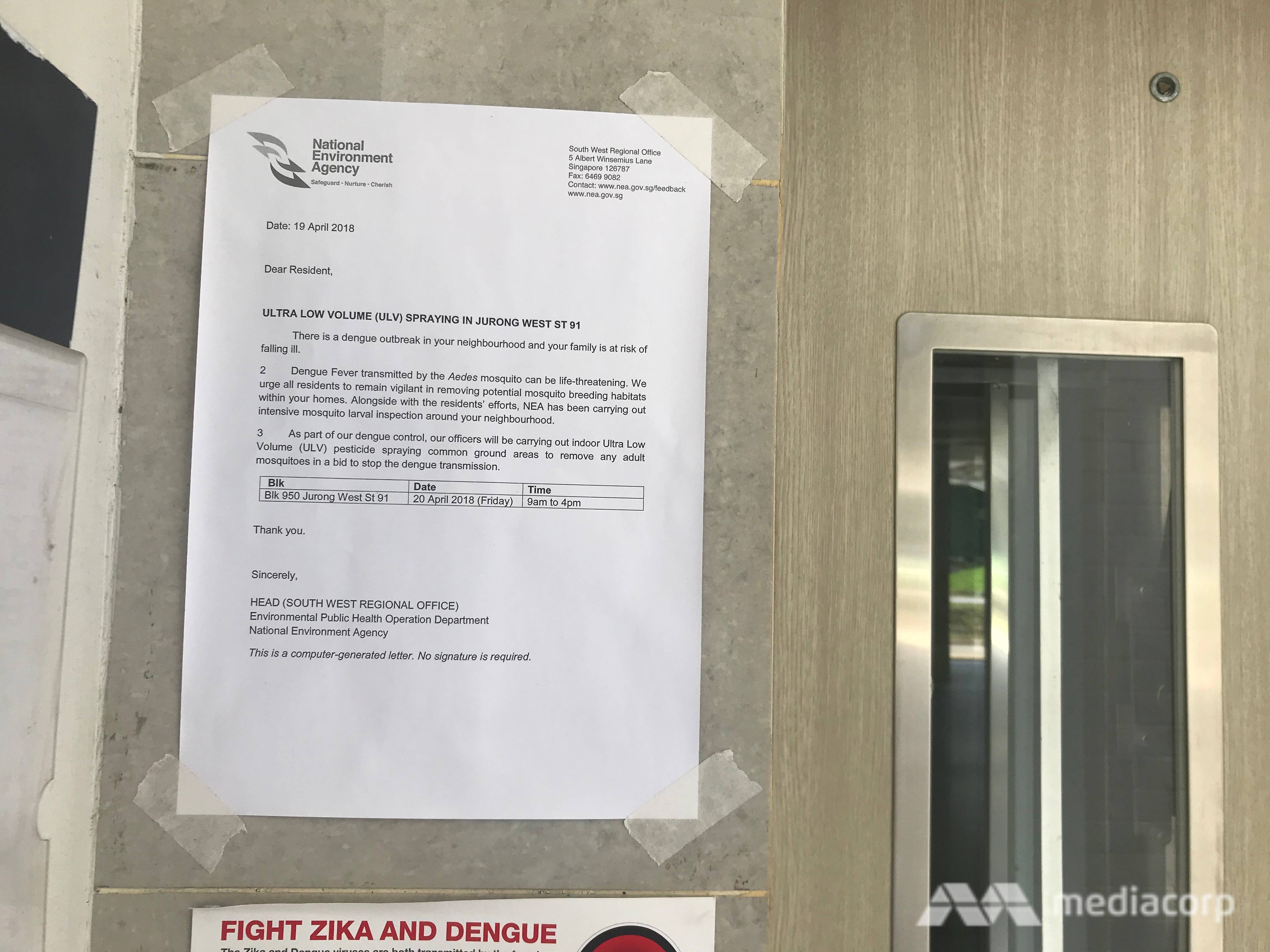
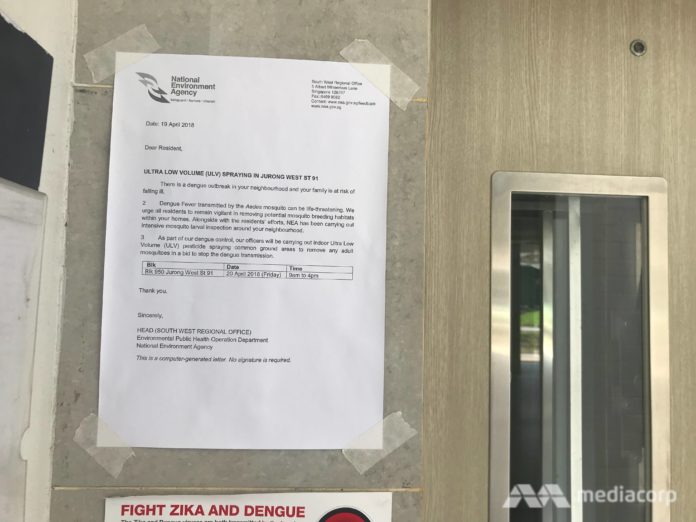
A notice informing residents of dengue control operations in the cluster. (Photo: Aqil Haziq Mahmud)

When Channel NewsAsia visited the cluster at Jurong West Street 91 and 92 on Wednesday, residents said officers have been entering their homes for inspections.

Homemaker Le Thi Que Lam, who lives in Block 953, said officers have come by twice in the past two weeks to check her room, toilet and flower pots.

“They did it quite carefully,” the 33-year-old told Channel NewsAsia. “They told me that if they see breeding spots, we will be fined.”

Ms Lam added that she is “really worried” about the “dangerous” outbreak because of the sheer number of cases and the reported deaths. As a precaution, she applies insect repellent on her young son and sprays insecticide at home.

Civil servant Png Chin Hoe, who lives in Block 944, said officers have entered his home thrice in the last month. “It’s a red zone here, so it’s better to have more checks,” the 25-year-old added.

Shopkeeper Mohammad Alamgir Hossain, 39, said officers are doing a “100 per cent good job” after they visited his home twice in the past week. Mr Alamgir lives in Block 950, which saw the highest number of cases in the cluster.

“They checked the kitchen and asked if they could apply chemicals (to kill the mosquitoes),” he said. “I see them working very hard every day until 9pm or 10pm.”

Mr Alamgir said his sister-in-law, whom he lives with, was hospitalised two weeks ago after coming down with dengue. Still, he remains unfazed. “There are more control measures now,” he added.

Source link

Addenda to President’s Address: 3 population strategies to improve Singaporeans’ lives

These strategies include developing and implementing policies to “enable all Singaporeans to age with purpose and dignity”, says Deputy Prime Minister Teo Chee Hean.

Elderly man child Singapore

A man carrying an infant in Singapore. (Photo: Gaya Chandramohan)

SINGAPORE:  Three broad strategies by the Government to maintain a population profile in Singapore that “improves the lives of each generation” were outlined by Deputy Prime Minister Teo Chee Hean on Wednesday (May 9).

In the Prime Minister’s Office (Strategy Group) addendum to the President’s address, Mr Teo said the country is entering a new phase of nation building in a more complex landscape that will require policy responses to challenges that are “still emerging and therefore not yet well defined”.

“It will require Government agencies to work more closely together because solutions to policy challenges will increasingly cut across ministry domains,” the Minister-in-charge of the Strategy Group said.

One of these issues is the country’s population policy, and Mr Teo said the country’s changing demography has wide-ranging effects on many Government policies including the economy, healthcare, infrastructure, defence planning and social cohesion.

For instance, in the medium term, Singapore’s ageing population presents both challenges and opportunities to sustain a dynamic economy, he said.

“The slower growth of our local workforce provides a strong impetus to press on with economic restructuring,” the deputy prime minister explained.  “In the long term, our fertility rates and our openness to others who are willing and able to contribute to Singapore will shape the type of society that future generations of Singaporeans will live in.”

As such, the Strategy Group will focus on three broad strategies: Develop and implement policies to enable all Singaporeans to age with purpose and dignity; make Singapore a great place for families where marriage and parenthood are achievable, enjoyable and celebrated; and maintain a careful balance in foreign worker as well as immigrant flows.  

These policies, he said, will support a cohesive society and vibrant economy, and the country will continue to be a place “where Singaporeans are proud to call home”.

CLIMATE CHANGE MUST BE ADDRESSED

Another issue that cuts across ministries is climate change, the deputy prime minister highlighted. 

“Singapore must address climate change and safeguard our collective future,” Mr Teo said.

“As a low-lying, tropical island state, we must develop plans to address the impact of climate change such as rising sea levels, higher temperatures, and more extreme rainfall patterns. At the same time, we need to work as part of the international community to reduce our collective carbon footprint.”

To tackle this issue, the minister said Singapore will fulfil its commitment to the Paris Agreement and implement the carbon tax, as well as work to reduce energy use, increase energy efficiency and reduce greenhouse gases.

In fact, 2018 has been designated as the Year of Climate Action to raise awareness and intensify the national effort to bring down emissions and adopt sustainable practices, Mr Teo said.

Singapore had previously stated that it aims to reduce its emissions intensity by 36 per cent from 2005 levels by 2030, and to stabilise its emissions with the aim of peaking around 2030.

Source link

Jurong Region Line, Singapore’s 7th MRT line, to open in phases from 2026

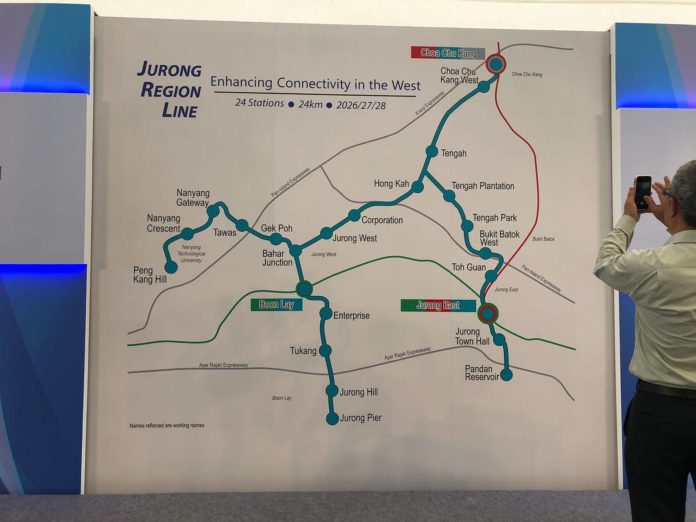
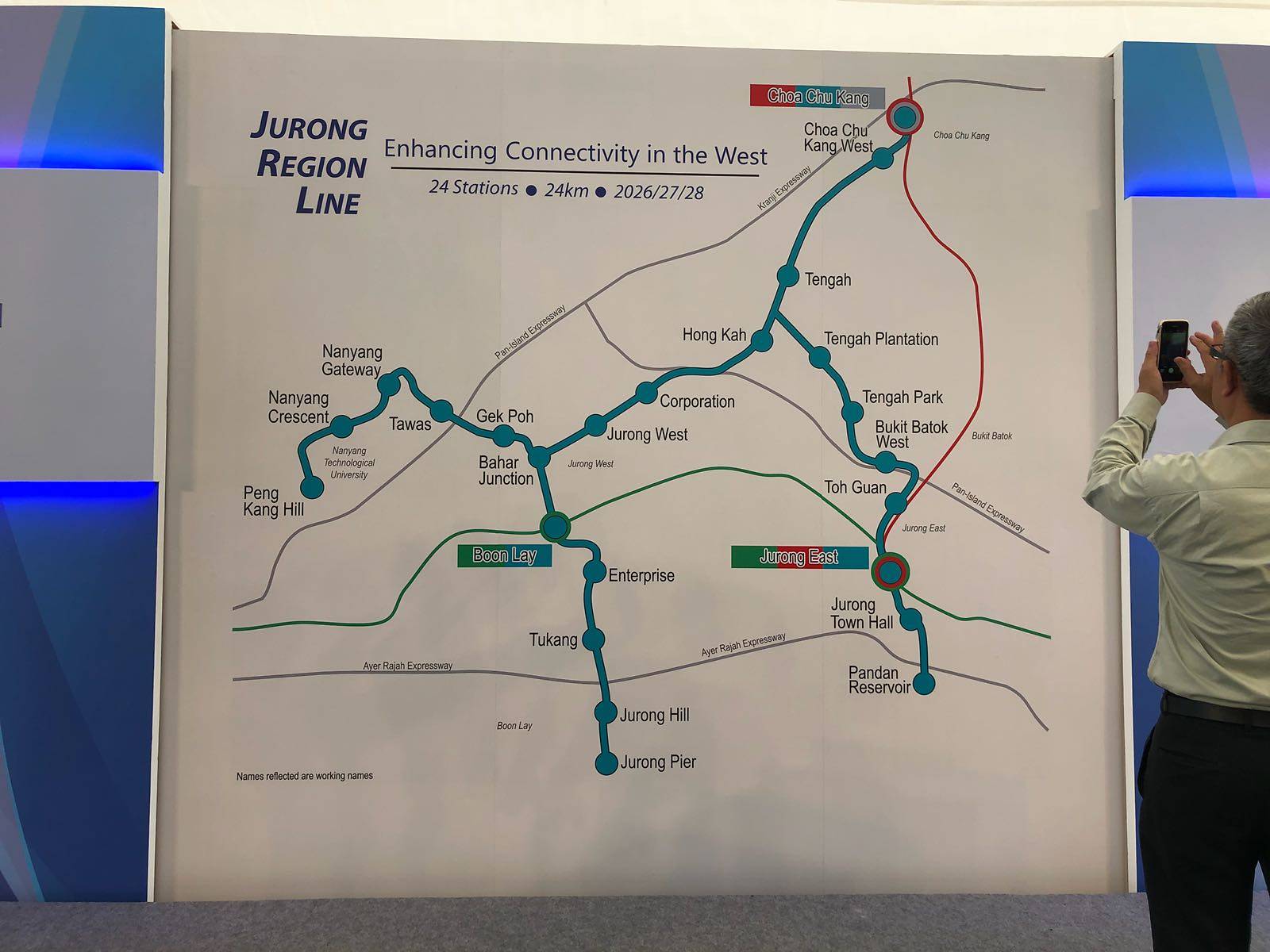
SINGAPORE: The new Jurong Region Line (JRL), Singapore’s seventh MRT line, will open in three phases starting from 2026, said Transport Minister Khaw Boon Wan on Wednesday (May 9).

JRL will be 24km long with 24 stations above ground, he said, adding that line will connect with the North-South Line and East-West Line with interchange stations at Choa Chu Kang and Boon Lay.

jurong region line

Jurong Region Line will be Singapore’s seventh MRT line. (Photo: Fann Sim)

Speaking during a visit to the worksite of Canberra MRT station on the North-South Line, Mr Khaw said the JRL will improve the resilience of the entire MRT network and provide commuters with alternative travel routes.

“This will help to distribute and relieve train loading between Choa Chu Kang and Jurong East stations, so that commuters can enjoy more comfortable rides,” Mr Khaw said.

He added that the JRL will develop the Jurong Lake District into the largest commercial hub outside the central business district. It will also support the development of the Jurong Innovation District into a next generation industrial estate.

“Together with the upcoming Kuala Lumpur-Singapore High Speed Rail, commuters will have convenient connections not just within western Singapore, but also to Malaysia. When all these plans come together, Jurong will be a waterfront business hub nestled in greenery, served by good public transport connections, as well as amenities to support active mobility. This is our vision for Jurong,” he said.

The new Jurong Region Line, Singapore’s 7th MRT line, to have 24 stations above ground and open in phases starting from 2026.

Source link