Home Blog Page 1041

Deep-sea ‘aliens’ no one knew existed, unearthed in Singapore-Indonesia expedition

SINGAPORE: The expedition lasted two weeks. But it will take two years for the scientists to complete their studies of more than 12,000 specimens – some bizarre and new to science – hauled up from the bottom of the Sunda Strait and Indian Ocean.

These Indonesian waters off West Java had been largely unexplored by marine biologists until now. That changed in March, when a combined team from Singapore and Indonesia set out to sea.

“People have collected data off west of Sumatra, eastern parts of Indonesia and southeastern part of Java,” said Professor Peter Ng, head of the Lee Kong Chian Natural History Museum at the National University of Singapore (NUS).

“But for whatever reasons, the Sunda Strait in southwestern and southern Java were poorly collected. We had almost no information about the deep-sea animals living there. 

So we thought, here’s a nice chance to fill the gap. We cannot conserve what we do not know.

Prof Ng, a well-known crab expert, led the 14-day South Java Deep Sea Biodiversity Expedition (SJADES 2018) with Professor Dwi Listyo Rahayu, a world authority on hermit crabs from the Indonesian Institute of Sciences (LIPI).

The research vessel with 31 scientists and support staff sailed from Jakarta towards Cilacap in southern Java and back, covering a total distance of 2,200km.

(ry) nus expedition map

The team sailed anti-clockwise from Jakarta along Sunda Strait towards Cilacap in southern Java. (Image: SJADES 2018)

Using trawls, dredges, box corers and multicorers, the NUS-LIPI team collected marine animal samples at depths averaging 800m – the deepest was at 2,100m. 

The result exceeded Prof Ng’s expectations: Over a dozen new species of hermit crabs, prawns, lobsters and crabs were found, and more than 40 species of various kinds are new records for Indonesia.

Here are some of them, in photos.

DECORATOR CRABS (New to science)

Three new species of bizarre-looking spider crabs were found – all in the deep waters of southwestern Java. 

They were immediately recognised as unique species by Prof Ng and Dr Bertrand Richer de Forges from France, both of whom have been studying this group of crustaceans for over three decades.

(ry) 1_Rochinia new species (Big Ears)

“Big Ears”. Size: 6cm. From depth: more than 1,000m. (Photo: SJADES 2018)

This yet-to-be-named crab was found camouflaged with detritus, small zoanthid anemones and mud. It has a distinctive plate that resembles oversized ears adjacent to its red eyes.

(ry) 2_Rochinia new species (Spiky)

“Spiky”. Size: 8cm. From depth: 800m. (Photo: SJADES 2018)

A orange species with many strong spines. Only one specimen of this rare species was obtained.

(ry) 3_Rochinia new species (clinger)_mod

“Clinger”. Size: 6cm. From depth: 800m to 1,200m. (Photo: SJADES 2018)

A decorator crab with a more elongated form. Several specimens were found clinging to stalked sea lilies, a living fossil. Scientists are still not sure if this is their only habitat, but they do believe these crabs have a preference for these sea lilies.

Why do these crabs decorate themselves when there is no light in the depths of the ocean?

That is because “a whole bunch of animals are using sound”, said Prof Ng. “They hit you with sonar. Which means that even if they can’t see you, you don’t want to look like a crab, you want to look like a blob of sponges. 

Even in the deep, it pays that you try to pretend to be something you’re not.

HERMIT CRABS (New to science or new for Indonesia)

Hermit crabs live solitary lives protected by shells. They are a major component of the deep-sea fauna and appear in almost every catch.

These animals come in a surprising diversity of form, shape and sizes. During the expedition, Prof Dwi found over 40 hermit crab species, many of which look nothing like the typical hermit crabs found in shallow waters and on land. 

Some are very skinny because they live in hollow twigs. Some resemble small lobsters – they burrow into wood. Others live inside swollen sea anemones.

(ry) 4_Paguristes new species

A new species of hermit crab with jade-green eyes. Size: 3cm. From depth: about 200m. (Photo: SJADES 2018)

Hermit crabs are mostly found in the shallow waters. There are few species in deeper waters, so the discovery of this new species is noteworthy. 

The bright green eyes and distinctly patterned granulated pincers are distinctive for this new species. Professor Dwi immediately recognised it as something she has never seen before.

(ry) 1_Xylopagurus cf philippinensis

A hermit crab species newly recorded in Indonesia. Scientific name: Xylopagurus cf. philippinensis. Size: 12 to 15cm. From depth: 370m (Photo: SJADES 2018)

This slender twig-dwelling hermit crab with a straight body has adapted its body to live inside the narrow cavities of hollow twigs and sticks. 

GIANT SEA COCKROACHES (New to science)

The expedition found a new species of Bathynomus, which is 30cm in length. 

(ry) 10_Giant Sea Isopod

A new species of Bathynomus or giant sea cockroach. Size: 30cm. From depth: 1,300m. (Photo: SJADES 2018)

Also called giant sea cockroaches, they are important deep-sea scavengers. They feed on dead animals that sink to the ocean bottom, and are an integral part of the ecosystem there.

However, Bathynomus had not been officially recorded in Indonesia before.

There are 18 species globally, 15 of which reside in the Indian and Pacific Oceans. Among these, the most famous are eight species which experts have called “supergiants” because they reach sizes of 50cm in length.

WATCH: Meet the critters (3:24)

The two chief scientists were excited, and their check of the literature indicated that the “supergiant” species collected was quite different from known species – they may well be new.

SHRIMPS & LOBSTERS (New to science)

Also on the expedition was Professor Chan Tin-Yam from the National Taiwan Ocean University, a world expert in deep-water shrimps and lobsters who, with his team, discovered five new species.

(ry) 6_Glyphocrangon new species_mod

A new shrimp species. Size: 8cm. From depth: 1,013m. (Photo: SJADES 2018)

A new shrimp species with shiny eyes. These bottom-dwelling shrimps possess unique mechanisms to lock their abdomens to protect against predators.

(ry) 7_Munidopsis new species_mod

A new species of squat lobster. Size: 8cm. From depth: 525m. (Photo: SJADES 2018)

This was among the 20 species of squat lobsters found by scientists on the expedition. This species has a distinctive zebra pattern on its body.

GOBY FISH (New to science?)

(ry) 2_Platygobiopsis sp.

A goby species that may be new to science. Size: 5 to 6cm. From depth: 182m. (Photo: SJADES 2018)

Gobies are mostly found in shallow intertidal waters, but some can be found in much deeper waters of almost 200m, like the specimen in the photograph, which was collected from the Sunda Strait.

This strange goby is flat-headed, and has very enlarged otoliths (ear stones for balance) behind the eyes. There are currently three known species in the world, and scientists are examining whether this specimen is one of them – or new to science.

OTHER INTERESTING FINDS

(ry) 5_Ice Cream Cone Worm_mod

The ice-cream cone worm. (Photo: SJADES 2018)

This 6cm deep-sea tube-dwelling worm pastes sediment grains with their tentacles to the pre-existing conical tube as they grow, forming a structure which resembles an ice-cream cone.

(ry) 7_Deep Sea Scallop

A peculiar scallop. (Photo: SJADES 2018)

This deep sea scallop has some peculiar habits. Scientists believe it is carnivorous, feeding on very small animals.

In addition, it almost has a sea anemone attached to one of its valves – presumably for protection.

(ry) 8_Dumbo Octopus_mod

Dumbo octopus. (Photo: SJADES 2018)

Nicknamed the Dumbo Octopus because of its resemblance to the beloved Disney character, this animal has a jelly-like feel and was dark purple when first observed in the trawl net. 

It swims using the two large flaps on its head.

(ry) 9_Cock-eyed Squid

A cock-eyed squid. (Photo: SJADES 2018)

This peculiar squid measuring some 8cm has one eye much larger than the other. 

It apparently swims with the larger eye looking downwards for food, whilst the smaller eye peers upwards presumably watching out for predators.

(ry) 11_Blood Shrimp

Blood shrimp. (Photo: SJADES 2018)

A brightly coloured shrimp that was caught alive. It regurgitates a bioluminescent cloud to confuse predators when disturbed – a habit shared with several other species of deep-sea prawns.

(ry) 12_Chain-saw Lobster

Chain-saw lobster. (Photo: SJADES 2018)

Nicknamed the chain-saw lobster, this is a rare deep-sea blind lobster with scary right claws lined with many sharp teeth. 

Scientists, however, suspect that the claw is not a predatory device but acts to sieve bottom substrates for small animals to eat. 

These lobsters are rarely collected because they dig deep burrows.

(ry) 14_Deep-sea Tripod Fish

A tripod wonder. (Photo: SJADES 2018)

The deep-sea tripod fish has peculiar fins and filaments that help it balance and detect small prey swimming past. It has eyes that have no lenses, so it’s unable to focus on objects. 

Last but not least, they are hermaphrodites. These odd features help it survive in perpetual darkness.

(ry) 15_Fang Tooth_mod

Fang tooth. (Photo: SJADES 2018)

The aptly named Fang Tooth has wicked-looking long teeth. No escape for any prey that gets into this mouth.
Source link

‘I knew my life was in danger’: Singaporean hiker lost on Johor mountain

KULAI, JOHOR: Lost on Johor’s nearest mountain to Singapore, hiker Clarice Lum tried to sleep – but the fear of rolling down the steep slope, and the grunting of wild boars around them, kept her awake.

In the dark of the Gunung Pulai forest reserve, she and her hiking companion could only just make out the creatures’ shadows.

“There were probably about four or five boars around us. We froze instantly. because we knew they’d attack us if they were provoked,” recalled the 27-year-old.

“I knew that my life was in danger.”

OTRD johor hiker 3

Surrounded by wild boars: An artists’ impression.

Telling her story to the programme On The Red Dot, in her first full interview since the pair went missing in February, Ms Lum described how a “simple hike” – one that normally takes hours – turned into a four-day nightmare when she and her friend strayed off course. (Watch the episode here.)

Their disappearance and the subsequent search operations grabbed headlines and stirred social media buzz on both sides of the Causeway, with some 200 volunteers stepping forward to assist in the hunt.

WATCH: A survivor’s account (5:01)

FOREST’S SPOTTY HISTORY

When fellow hiker Dominick Tan suggested climbing Gunung Pulai, it was a challenge Ms Lum readily accepted, even though she hardly knew him and had never been up that mountain before.

“I’m a spontaneous person. Whenever my friends ask me to go for activities like rock climbing or sky diving, I’d be very game,” she said.

OTRD johor hiker 7

(Photo: Clarice Lum)

This particular hike requires about three hours via the paved road, from the base of the mountain to the 654-metre summit and back.

But the forest reserve has a problematic history: It was closed following a landslide that killed five people in 2001, and reopened only in 2016.

Though Ms Lum was going to take the jungle path to the summit, she was undaunted because her companion – who declined to be interviewed for the programme – was said to be an experienced climber who had also trekked up Gunung Pulai several times.

As it was supposed to be a half-day trip, they did not pack extra food or tents. They reached the first viewpoint after about three hours.

“I was feeling very happy with the adrenalin,” said Ms Lum. “I couldn’t wait to reach the summit.”

OTRD johor hiker 4

RED MEANS DANGER

On the second leg of their climb, they noticed that the forest had become denser.

“Dominick had to use his hands to push the leaves apart so that we could keep going through the forest,” she said. “That was when he cut his hand, and it started bleeding.”

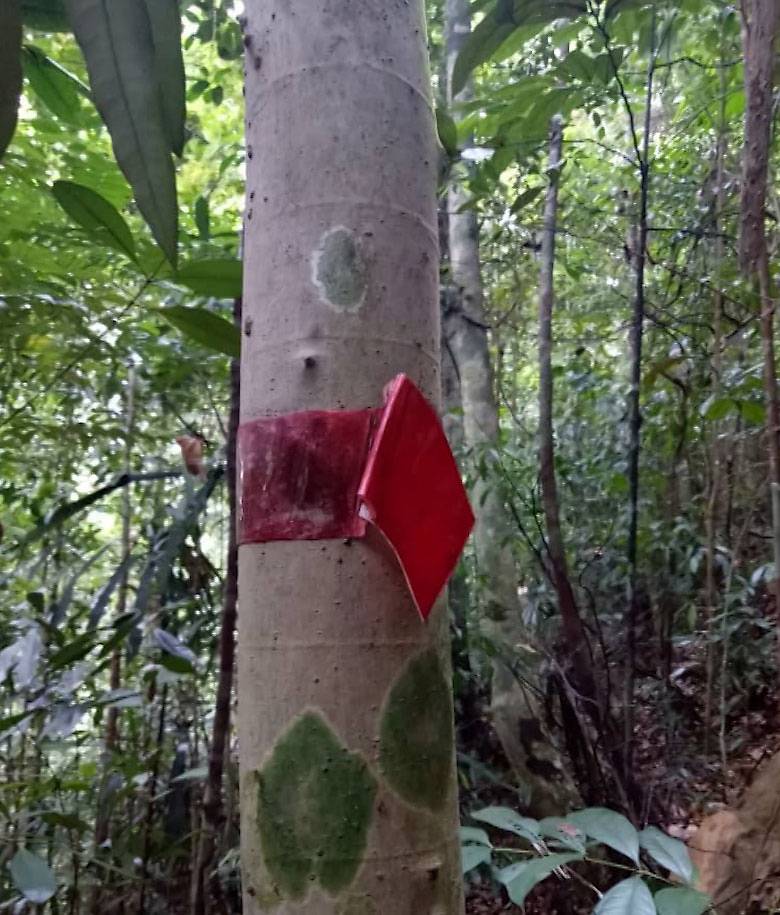
Worried that the wound would become infected, they decided to take what they thought was a shortcut, by following the red markers on some trees. With hindsight, Ms Lum said: “I don’t think it was the right shortcut.”

In actuality, the red markers meant the area was dangerous and off-limits to climbers.

OTRD johor hiker 5

Said Ms Lum: “It got denser and denser, and it was very hard to bash on through the forest. And it got steeper.”

By the late afternoon, she added, “we knew we were lost. That was when he decided to call the Bomba”, Malaysia’s fire and rescue department.

Kulai Fire and Rescue Station chief Mohd Khairi S Zainudin was puzzled as to how the two Singaporeans had got lost in the reserve, as it was a straightforward trekking area.

“The first thing we did was to tell the victims to stay calm,” he said.

We also instructed the victims not to move around so that we could find them more easily.

His team pinpointed the duo’s possible locations based on information from Mr Tan, who had an app on his phone that could locate their coordinates.

The coordinates suggested that the two were on Hill 308, where the red markings were, said Mr Mohd Khairi. But his team was unable to locate the hikers after four hours of searching.

OTRD johor hiker 15

Kulai Fire and Rescue Station chief Mohd Khairi S Zainudin.

VENOMOUS ANIMALS

The two hikers had to spend the night in the forest. “It was cold. We were wearing basic sports tops, and Dominick was wearing shorts,” said Ms Lum.

We were on a very steep slope. And my fear was that I’d roll down the forest. I got very worried, and I couldn’t sleep.

Then there was the wildlife, especially the wild boars wandering around. Mr Mohd Khairi knows only too well the dangers that lurk in the forest. “There are venomous animals, and there could be wild boar attacks,” he warned.

“There are areas where the rocks are slippery. There had been a case where a victim died.”

He mobilised a new team to take over for the morning search, though he himself did not sleep that night. “But being tired wasn’t my concern,” he said.

“It was our duty to find them. We were determined to save them; we felt like our own siblings were in trouble.”

OTRD johor hiker 16

That second day, the two climbers started rationing their food. They only had some packets of cashew nuts, potato chips and a couple of nutrition bars.

And they faced a dilemma: Stay and wait for help, or search for water for survival. They decided to leave their location and were relieved to find a stream three hours later.

“After collecting our water, we decided to follow the stream downwards,” said Ms Lum.

“I thought it was a good idea to keep moving so that the wild animals wouldn’t follow us. But I was worried that (the search team) couldn’t find us,” she added, as they were moving away from the coordinates they had given.

OTRD johor hiker 14

Map showing the way the hikers took, deeper into the red-flagged area, while the search area expanded around them.

SOCIAL MEDIA HELP

Mr Mohd Khairi suspected that the two might have wandered off, even though they were told to stay put. His team of 60 split up to look for them over an ever-expanding area – with help from some 200 Malaysian and Singaporean volunteers.

They joined in the search partly owing to the efforts of Ms Lum’s friend Chloe Quek, who had learnt on Facebook that her friend was lost and decided to galvanise social media users.

“I updated all the posts to say that we needed volunteers with experience in hiking,” she said. “They could go down to the site to help the authorities.”

OTRD johor hiker 2

Ms Lum’s mother Ann Chia remembers waiting for he daughter at the foot of the mountain, hopeful with every returning team. “But the 100 to 200 trekkers returned with no news of her,” she said. “I cried non-stop.”

Meanwhile, her daughter was particularly hungry, tired – and had been bitten by a leech while walking along the stream.

“I was terrified.,” she said. “My first instinct was to pull it off, but Dominick told me that I couldn’t … because the blood would gush out. He helped me to burn off the leech using his lighter.”

The hikers even started to hallucinate at some point.

“We were shouting, ‘Tolong! Tolong!’ (Help! Help!), and we heard something – we heard ‘Hello, are you there?’ from across the river. We said we were along the river, and the sound responded. It said, ‘OK,’” recalled Miss Lum.

But it was just their imagination.

OTRD johor hiker 13

CROCODILES AND SNAKEHEADS

Mr Tan was feeling very apologetic for putting his companion in this predicament. “I told him that it was okay, (that) we’d get out of there alive,” Miss Lum recounted. “I still had so many things that I had yet to achieve.

I had yet to travel around the world, to settle down … to buy a house for my parents. I really couldn’t die without accomplishing these things.

On the fourth day, the Bomba team decided to concentrate on an area they had not yet searched – one the two hikers had ventured into.

Said Mr Mohd Khairi: “That area is extremely dangerous, and we didn’t expect the victims to go there. There are crocodiles and giant snakehead (fish) there, which can attack humans.”

OTRD johor hiker 9

Volunteers helping with the search and rescue.

The two tried building a raft to cross the water but gave up, as the logs were too heavy. They then decided to swim across the river.

It was then that they heard the sound of a helicopter. They immediately started shouting to get its occupants’ attention. But the aircraft flew away, sending Ms Lum into a panic.

She said: “I thought they didn’t see us, and I had a mix of emotions – of sadness and frustration.”

But they had been spotted. Mr Mohd Khairi was on the rescue chopper, and at first, he thought the figures they saw in the river were fishermen.

“Then I thought again – fishing is prohibited in that area. So we turned around … we were certain they were the victims.”

WILL TO LIVE

When the aircraft returned, Ms Lum was ecstatic. “I was crying. I was saying to Dominick, ‘I’m going to get out of here alive!’”

Mr Mohd Khairi said he was the happiest person to have located them. “I was shocked because we didn’t expect their will to live to be so strong. Especially in such an extreme area, and in their injured condition.”

(Read: ‘No longer tired when I saw them’: Rescue commander on spotting missing Singaporeans at Gunung Pulai)

OTRD johor hiker 12

Clarice Lum and Dominick Tan Chang Xiang were found on Feb 8. (Photo: Facebook/Polis Johor)

The two, who suffered minor injuries, were sent to Pontian Hospital and then to Tan Tock Seng Hospital, where Ms Lum took a blood test, was given an intravenous drip, and had her wounds cleaned.

Some five weeks after the ordeal, the On The Red Dot team arranged for her to return to Johor, to visit her rescuers. She brought some gifts to thank them, and was surprised when the whole Bomba team turned up.

“As I shook each and every one of their hands, I felt this tingling sensation of emotions. I was about to cry,” she said.

“They gave me a second chance at life because without them, I’d still have been stuck in the forest, or I’d have died.”

OTRD johor hiker 10

Thanking the team that rescued her.

The Malaysian agencies’ efforts also drew praise from Singapore’s Prime Minister and Foreign Minister.

When Mr Mohd Khairi ask Ms Lum if she would consider returning to Gunung Pulai to hike, she said yes, but not yet.

“I’ll take my time to heal first. Once I’m ready, I’m sure (next) time, I’ll reach the summit,” she added.

Clarice Lum is one of four Singaporean travellers who share their stories of terrifying misadventures abroad, on On The Red Dot. Watch this episode here. New episodes air on Mediacorp Channel 5 every Friday at 9.30pm.

OTRD johor hiker 6

Source link

Singapore, Brunei ink deals to boost cooperation in FinTech, counter money laundering

SINGAPORE: Two agreements were signed between Singapore and Brunei on Saturday (May 12), to boost cooperation in Financial Technology (FinTech) as well as to strengthen the exchange of information to combat money laundering and terrorist financing. 

The signing of the agreements was witnessed by Brunei Sultan Hassanal Bolkiah and Singapore President Halimah Yacob, who is on a four-day state visit to Brunei.

Both sides also welcomed the conclusion of a Memorandum of Understanding on Info-Communications Media Cooperation between Singapore and Brunei’s ministries of communications, to share expertise on developing the info-communications media industries of both countries, said Singapore’s Ministry of Foreign Affairs (MFA) in a press statement. 

“These agreements reflect the growing cooperation between Singapore and Brunei,” it added.

Before the signing of the agreements, Mdm Halimah had a bilateral meeting with Sultan Bolkiah when the discussed regional and global developments.

They reaffirmed the “special and longstanding relationship” between Singapore and Brunei, noting that both countries cooperate closely across many sectors.

Mdm Halimah thanked Brunei for allowing the Singapore Armed Forces (SAF) to train in Brunei. Both leaders also reaffirmed the importance of the Currency Interchangeability Agreement.

“The Currency Interchangeability Agreement has been in place for almost 51 years and has helped to facilitate trade, investment, and tourism between our two countries. More importantly, the agreement reflects the deep mutual trust and confidence,” said Mdm Halimah later at a state banquet hosted in her honour.

Brunei Sultan and Halimah Yacob

President Halimah Yacob was hosted to a state banquet in Brunei. 

Sultan Bolkiah, on his part, said his country is happy to welcome the SAF, and that Brunei fully supports Singapore in its role as ASEAN chair.

“This is a reflection of the close and longstanding relationship that has existed for more than 50 years between our two countries. I’m confident your visit will bring our people much closer together and deepen our relations further,” he said.

Earlier in the day, Mdm Halimah attended a welcome ceremony at the Istana Nurul Iman where she was given a 21-gun salute.

Brunei Sultan and Halimah Yacob (1)

A welcome ceremony was held for President Halimah at the Istana Nurul Iman in Brunei. 

Source link

Elderly-friendly ‘vertical kampung’ with housing, healthcare facilities opens in Woodlands

SINGAPORE: Singapore’s first public integrated development to be extensively designed with elderly-friendly features was officially opened by Prime Minister Lee Hsien Loong on Saturday (May 12).

The 11-storey Kampung Admiralty houses about 100 flats for seniors, along with healthcare, wellness and commercial facilities, all under one roof. The pilot project, which was conceptualised by the Housing and Development Board (HDB) more than four years ago, aims to encourage active living among seniors, as well as inter-generational bonding.

There are also childcare centres within the development.

Mr Lee said HDB had come up with the idea against the backdrop of an ageing population. 

“We wanted people to lead active and meaningful lives. And HDB looked for new ideas to develop new designs that would fit an elderly population – to build flats, common areas, and neighbourhoods to promote strong social support and community bonding, and to let people in their silver years stay socially engaged, and live safely, healthily and happily,” he said.

FACILITATING ACTIVE AGEING

Under the Action Plan for Successful Ageing, the project is the first to co-locate eldercare and childcare facilities, with a childcare centre, as well as a community park and playground, located beside an Active Ageing Hub run by NTUC Health. The one-stop hub integrates active ageing and care services for elderly residents, such as day care and assisted living services.

NTUC Active Ageing Hub

A public integrated development designed with elderly-friendly features opens in Woodlands. (Photo: Wendy Wong)

Programmes encouraging intergenerational bonding are also organised weekly, such as outdoor activities and music and art sessions. 

“These joint activities and regular interactions encourage the young and old to bond together,” said Mr Lee. “It’s a wonderful way for the young people to learn empathy and respect, and also to lift the spirits of the elderly, when they see the children’s joy and vitality, they too will smile and perk up – and perhaps laugh and sing and dance as well.”

The development also houses the two-level Admiralty Medical Centre, as well as a hawker centre run by NTUC Foodfare and NTUC FairPrice. A skyrise community farm located on the rooftop allows residents to plant and harvest the edibles, with more than 30 tropical plants being grown.

Vertical kampung woodlands

The community gardens at Kampung Admiralty. (Photo: Wendy Wong)

Its sheltered 1,000 sq m community plaza has held more than 50 group activities over the last year, including weekly fitness exercises, movie screenings and carnivals.

Interior of vertical kampung in woodlands

The interior of the new elderly-friendly public integrated development in Woodlands. (Photo: Wendy Wong)

REVIVING THE ‘KAMPUNG’ SPIRIT

But it’s not just about the hardware. Residents Channel NewsAsia spoke to said they appreciate the ‘kampung’ spirit fostered in the close-knit community.

One of them is 70-year-old Ho So Wah, who is moving in with his 68-year-old wife next month, with the couple already active participants in the neighbourhood.

“The best part is we know more people, especially of our own age, so we can help each other, so anything we can ask,” said Mr Ho. “Although our children will come every week, but it’s better to have more people around here and we can spend the time inside the hub too.”

“Before I move here … nothing. Just go home, work, go home, work. Even neighbour also close the door,” said 58-year-old Doris Yuen. “But here no, everybody very friendly.”

“This is kampung, like sister, brother, all together so we help each other. This is what we want,” said the resident, who moved in with her husband last year. “At our age I don’t care if big house or small house, as long as there’s home for us that’s good. So I like this place very much. I hope Singapore can have more this kind of things for senior citizens so they don’t feel lonely.”

Spearheaded by seven agencies, the project has been recognised for its innovative design and approach. Partners of this initiative received the inaugural May Day Innovative Breakthrough Award, in recognition of the inter-agency efforts facilitating ageing-in-place.

Said Mr Lee: “This is a small kampung – modest in scale but bold in ambition. We will make it succeed, and when it is successful, we will build more kampungs like this in future HDB estates.”

Source link

M Nasir marks 40th anniversary in music with special homecoming concert

The Singapore-born musician comes home to perform for one night only. CNA Lifestyle has the details.

M. Nasir 1

Singapore-born music legend M. Nasir. (Photo: Mediacorp) 

Follow our new CNA LIFESTYLE page on Facebook for more trending stories and videos

SINGAPORE: Local music fans are in for a rare treat: Legendary rock, pop and folk musician M Nasir will be holding a special concert in Singapore come July 6 at the MES Theatre at Mediacorp. 

The singer and composer, who resides in Malaysia and holds the title of Datuk, will be returning to the country of his birth to mark his 40th year in the music industry. At the concert, titled “M Nasir’s Suatu Masa Concert – Celebrating 40 Years of Music”, the 61-year-old promises to perform favourite hits including Hati Emas, Raikan Cinta and Mentera Semerah Padi.

He will be joined by local singer Aisyah Aziz in a duet.

“This concert is a great opportunity for me to present my music to the younger generation, and I hope it will inspire up-and-coming talents,” said the man who, in addition to being a performer and songwriter, is also a poet, actor and film director. “It is very important for us to appreciate and understand the roots of our music.”  

M Nasir’s Suatu Masa Concert takes place on July 6 at the MES Theatre at Mediacorp. Tickets from S$38 to S$118 from Sistic

Source link

Commentary: As reality dawns on consumers, time to question if private-hire cars advance our car-lite drive

SINGAPORE: Consumers have been given a shot of reality.

Especially since Grab’s announcement in March of a takeover of Uber, its American rival’s operations in Southeast Asia, more and more are reporting fewer promotional codes and discounted fares on bookings from the ride-hailing giant.

Even as Grab explains that perks such as shopping gift cards and frequent flyer miles through GrabRewards have replaced the good old promotional codes, many are starting to realise that analysts’ warnings in the last few months were warranted.

Several had said that discerning consumers should have figured out that the perks would not last forever as they did not make for a sustainable business model.

The discounts are merely a strategy many industry disruptors use to acquire a larger market share.

While some consumers only began to worry about monopolistic prices after Uber announced its intention to exit the Singapore market, Nitin Pangarkar, Associate Professor in the Department of Strategy and Policy at the National University of Singapore (NUS) Business School pointed out that with or without the Uber-Grab merger, “the discounting was bound to stop at some point in time, probably as early as next year, because of Uber’s planned IPO.”

If you think about it, fares are not really rising. They are now just being set at levels they should have been in the first place.

Putting aside the issue of discounting, he said “we should not be unduly alarmed about the loss of consumer welfare because of high prices for the simple reason that there is a cap on how much the “new Grab” can raise prices, especially in Singapore.”

READ: Nitin Pangarkar’s commentary on Grab-Uber’s merger.

READ: A commentary on what can be done to ensure Grab’s service standards remain high

Grab Uber collage

Grab announced on March 26, 2018 that it has acquired Uber’s Southeast Asia operations. (File photos: Reuters, Grab)

Also, as many others have pointed out, there are several alternatives to private-hire cars in our transportation ecosystem.

Consumers could very well switch to taxis, trains and buses in the face of monopolistic prices.

ANOTHER CYCLE OF DISCOUNTS

However, since then several new players have entered the private-hire car service market.

Ryde and Jugnoo have made their debuts.

More are due to enter soon including local startup Filo and possibly, Indonesia’s Go-Jek.

It is highly likely that we will see another round of promotional fares and other measures from these players aimed at expanding market share.

But again, analysts warn we should not become accustomed to this state of affairs.

Perhaps the best way to process this is to enjoy it while it lasts and not be unduly disappointed or alarmed when the situation normalises.

FILE PHOTO: Woman rides on the back of a motorbike, part of the Go-Jek ride-hailing service, on a b

A woman rides on the back of a motorbike, part of the Go-Jek ride-hailing service, on a busy street in central Jakarta, Indonesia. (FILE PHOTO: Reuters/Garry Lotulung)

Others say for as long as ride-hailing service providers are keen on entering the market even as some leave, we can be assured of cycle-after-cycle of perks for both riders and drivers as the market remains in flux at least in the short-term.

We should note that several players who entered the market in 2013 and 2014, exited by 2016.

Clearly this has not dampened other players’ desire to enter the market.

In a recent episode of Channel NewsAsia’s podcast, The Pulse, executive adviser to the National Taxi Association and the National Private Hire Vehicles Association (NPHVA) said we can expect this to carry on and it is not possible at this point to fathom if the market will ever stabilise. 

He also pointed out that newcomers to the scene may end up offering a suite of services including concierge services which would include things such as queueing up to buy you bak kwa during Chinese New Year and delivering it to your home.

THE LARGER TRANSPORT ECOSYSTEM

But while private-hire cars services have been lauded in many quarters as a welcome panacea to the numerous difficulties consumers experienced with taxi services in the past, it is worth considering how such services fit into the larger transportation ecosystem.

First of all, there are some indications that the state of flux is off-putting to drivers.

ComfortDelGro Taxi announced on Monday (May 7) that it is set to add 200 new hybrid Hyundai Ioniqs to its fleet, bringing it close to 13,000.

ComfortDelGro Taxi CEO, Mr Ang Wei Neng, said: “We have seen things settle down lately with more drivers switching from private-hire cars as they find driving taxis relatively more stable.”

However, those who see driving for such services as a part-time job or a way to at least partially finance their own cars might see things differently.

LOW FARES THWART SINGAPORE’S CAR-LITE VISION

At the same time, we should consider whether car-sharing services such as private-hire cars are furthering or thwarting Singapore’s car-lite vision.

Observers point out that the roads seem more congested with the proliferation of private-hire cars.

File shot of Singapore traffic

File shot of Singapore traffic. (Photo: Hester Tan)

Several studies in the US have shown that while policymakers think that private-hire car trips have the effect of reducing trips by private passenger cars, it may very well be that low promotional fares are merely inducing demand from commuters who would otherwise have taken the train or bus.

It’s quite common also for those who might have walked or taken a feeder bus service on the last-mile of their journey to now use a private-hire car service instead.

Studies in the US of such services have shown similar findings.

One by researchers at Northeastern University in Boston found greater congestion, and commuters who are now opting for a cheap private-hire car ride instead of walking, cycling or using public transport.

Researchers at the University of California, Davis found an increase in the number of miles driven in and around cities including New York, Washington, Boston and Seattle.

MORE REGULATIONS IN ORDER?

If we are to forge ahead towards a car-lite Singapore, perhaps more regulations are in order.

In his addenda to the President’s address this week, Transport Minister Khaw Boon Wan said the authorities are “reviewing the regulatory framework to license the private-hire car (PHC) industry. We aim to keep the PHC and taxi industries open and contestable, and protect the interests of commuters and drivers”.

Analysts have pointed out that private-hire car companies enjoy a lower-cost regime largely because of their business models and there is no cap to their fleet size.

How exactly such services can be regulated to keep the market contestable and to also advance our move towards a car-lite Singapore remains to be seen.

DTL pic 3

Will Singapore be able to achieve its goal of becoming a car-lite society soon? (Photo: Noor Farhan)

Experts need to look into how such services can target the demand for privately-owned cars more directly.

ALTERNATIVES NEED TO BE ATTRACTIVE

In the meantime, let’s remember that the Land Transport Authority’s target is to to expand the rail network to about 360km by 2030.

With this, eight in 10 households will live within 10 minutes of a train station.

As long as the train and bus services are accessible, reliable and efficient, “car-lite” can indeed be achieved.

But if private-hire services continue to remain artificially cheap, commuters might opt for them instead.

The authorities might very well have to reconsider how new services fit into the ecosystem not just for commuters’ convenience but whether they further Singapore’s larger goals.

Bharati Jagdish is the host of Channel NewsAsia Digital News’ hard-hitting On The Record, a weekly interview with thought leaders across Singapore, and The Pulse, Channel NewsAsia’s weekly podcast that discusses the hottest issues of the week.

Source link

It’s like ‘holding two full-time jobs’: How MPs cope with parliamentary duties

SINGAPORE: A Member of Parliament’s life revolves around two key places: Their constituencies, walking the ground, holding Meet-the-People Sessions and spending time with residents; and in Parliament, where they undertake their role as legislators and seeing to the national interest when Parliament sits. 

And in recent years, Parliamentary sittings appear to be getting longer.

“In the old days, we used to sit from 1.30pm to 7pm,” said MP for Chua Chu Kang GRC Zaqy Mohamad, who became an MP in 2006. “But now, it can start at 10am, and run to 7.30pm or 8pm.”

“There’ve been a few times when a 1-2 day sitting became 4 or 5 days because there were a lot of topics, or something controversial came up,” he added. “That caused a lot of commitment clashes.”

CRUNCHING THE NUMBERS

Indeed, data on the Parliament website bear out Mr Zaqy’s observations. 

Each sitting usually begins at 1.30pm, but some have started as early as 10am. 

Attendance is compulsory, and MPs will have to seek permission from the Speaker of Parliament if they wish to be absent from a sitting. 

The letter of the law as set out in the Constitution of Singapore is clear: If an MP is absent for 2 consecutive months from Parliament sittings or any committee of Parliament to which he or she has been appointed without getting permission from the Speaker, the MP’s seat will become vacant.

Channel NewsAsia tabulated the numbers from Jan 2006 to Mar 2018, and found that Parliament sat for an average of 28.45 days each year between 2006 to 2017. While there was no discernible increase in the number of days Parliament has sat, the total length of time in terms of hours has gone up.

Election years such as 2006, 2011 and 2015 saw shorter hours due to the dissolution of Parliament, which precedes each General Election. Parliament also sometimes takes a mid-term break lasting about a month, known as a prorogue, before beginning its second session. The latest prorogue ended on Monday (May 7) with the opening of the second session of the 13th Parliament.​​​​​​​

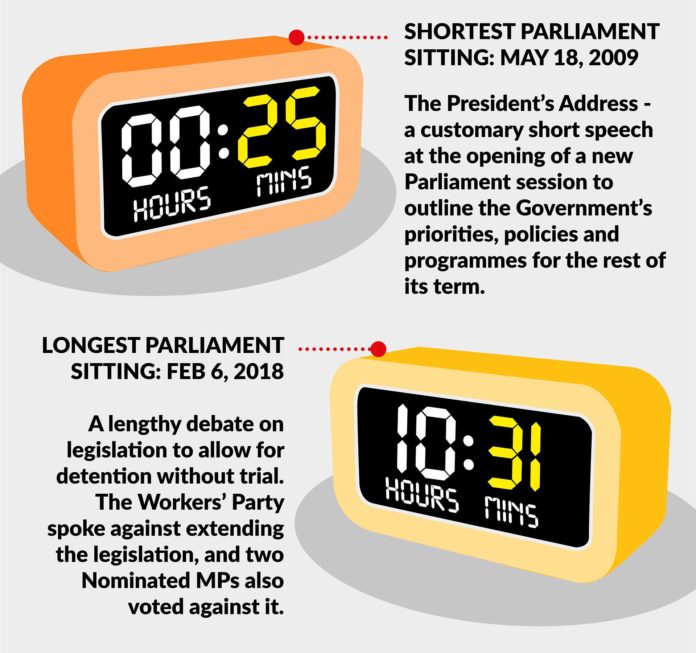
According to the data, the longest sitting happened on Feb 6 this year, where Parliament sat for 10 hours and 31 minutes. The marathon sitting was due to a lengthy debate on the Criminal Law (Temporary Provisions) Actwhich allows for detention without trial. During the debate, the Workers’ Party spoke out against extending the legislation, which also saw two Nominated MPs vote “no”. 

The shortest sitting was on May 18, 2009, which lasted 25 minutes. The session marked the opening of the second session of the Eleventh Parliament, during which then-President S R Nathan outlined the Government’s priorities, policies and programmes for the rest of the term. President Halimah Yacob also did so on May 7 – and she spoke for a  similar length of time.

longest and shortest parliament sittings

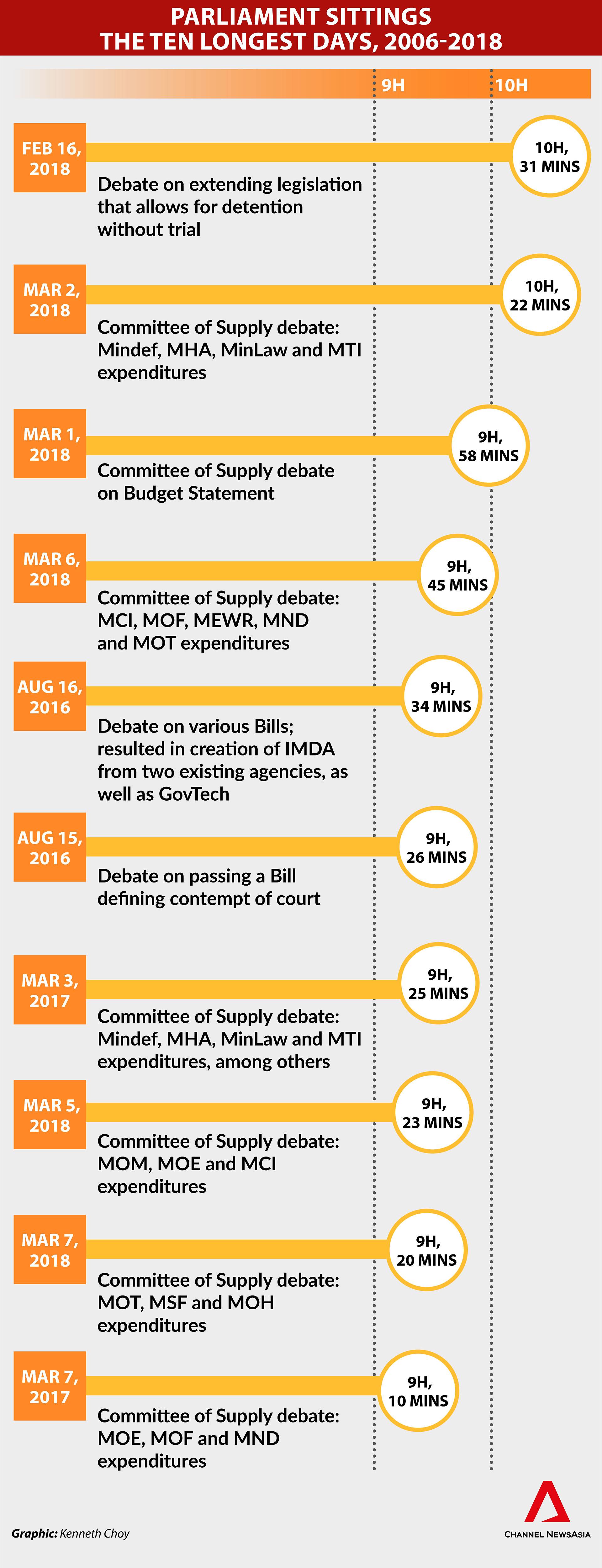
Sittings have also tended to be longer this year. Over the 12-odd years of data examined, there were 10 days that saw sittings that lasted nine hours or longer. Six of those 10 days happened this year. 

Sittings are also typically longer during the yearly Budget and Committee of Supply debates, which is the extended period of parliamentary debate that follows the Budget speech early in the year. During this period, Parliament will sit for about ten days to debate the speech, and for each ministry to later present its expenditure plans for the new financial year. 

According to the data, seven of the ten longest days in Parliament have occurred during the Committee of Supply debates. And five of them occurred this year: A round-up speech delivered by Leader of the House Grace Fu in Parliament highlighted that MPs had filed a total of 530 cuts, which lasted 3,120 minutes or about 52 hours, during this year’s Committee of Supply debates. 

longest parliament sittings - infographic

There were also drawn-out debates during sittings outside of the Committee of Supply debate. For instance, a bill on what constitutes contempt of court was passed in Parliament on Aug 15, 2016. It was passed only after a lengthy debate between Law Minister K Shanmugam and MPs from the Workers’ Party. 

HOW DO THEY COPE?

But having Parliament sit for longer may not be a bad thing. For one, as Mr Zaqy explained, the longer sittings could be a result of more robust debate in the House. 

“You have more MPs speaking up and more people putting questions through, which ultimately means having a lot more people making speeches,” he said. “So I guess that’s why we’re seeing much longer sittings now.”

“The other interesting thing is that there are also a lot more adjournment motions now,” he added. “This adds on to the sitting times as well.”

“Parliament has had to grapple with a range of complex issues and bills relating to public order, corporate governance and cyber security, as well as phenomena such as fake news,” added Nominated MP Mahdev Mohan, who is an Assistant Professor of Law at the Singapore Management University.

“It’s important that these matters which impact all Singaporeans are debated vigorously.”

How then, do MPs cope, particularly those who hold full-time jobs?

Mr Zaqy, who was a partner at accounting firm Ernst & Young at the time of his interview with Channel NewsAsia, admits that it can be difficult. He has since left the firm to take on a political appointment as Minister of State for National Development and Manpower.

“There’s no dispensation on my targets and KPIs, so despite having fewer hours than usual to work, you still have to perform to your role,” he explained. “You just have to be efficient and ensure that your targets are met.”

“In my previous firm, I used to take leave for Parliament sittings, and it could go all the way to a negative balance,” he added. “It becomes no-pay leave after that.”

“Now, I still take annual leave when there are important meetings I have to miss, or if I have to go overseas on Parliament business. But otherwise, they just benchmark me on my targets.”

MP for Nee Soon GRC Lee Bee Wah considers herself fortunate that unlike some of her fellow MPs, she does not have to take annual leave to be present for Parliament sittings.

“Before I merged my company, I got the understanding from the chairman that I don’t need to apply for leave for MP work,” she said. Dr Lee, who is a professional engineer, used to run her own engineering firm that she eventually merged with a bigger firm, Meinhardt. She now holds the position of Group Director at Meinhardt Singapore.

“This was one of the conditions before I let my company go,” she said.

But she did have to take a pay cut in the process.

“I’m receiving about a third of what I should be getting, because I told them I could only afford to spend a third of my time for the company,” she explained.

“It’s a sacrifice I had to make.”

Unlike MPs, Nominated MPs (NMPs) do not have to attend daily or weekly to their constituents’ concerns. But they face similar issues.

Apart from being an NMP, Ms K Thanaletchimi is a senior assistant manager in the healthcare industry, a member of the NTUC Central Committee and the President of the Healthcare Services Employees’ Union. She is also a member of several tripartite committees.

Despite not having a constituency to take care of, unlike her MP colleagues, Ms Thanaletchimi said she spends a lot of time conducting extensive dialogue sessions with union members in the healthcare sector. She added that getting material resources to draft her speeches “do take some time”.

As a result, she said, she works regularly from home on weekends and does late nights on weekdays to make up for the lost time.

But still, there have been clashes.  She recalled an incident which she described as a time when she was “emotionally bankrupt”: When her mother was hospitalised for an urgent heart operation.

“That was the very fateful day when I had a Parliament sitting, and had to rush down to speak on the Bill which I had already prepared for,” she said.

‘LIKE HAVING TWO FULL-TIME JOBS’

Sleep and social gatherings are other things the MPs have to forego – not just to attend and prepare for Parliament sittings, but to see to their day-to-day work as an MP.

“Most times, I just work through the night,” said Mr Zaqy, who says he averages about 4-5 hours of sleep a night during peak periods. “Say you have a Meet-the-People session on Monday night and there’s a Parliament sitting on Tuesday. So you end up going home late on Monday, and it’s 3-4am before you can submit your speeches for the next day.”

“I also honestly can’t remember the last time I had a social gathering,” he added. “I’ve lost contact with a lot of my friends, unless they’re in the same industry.” 

“It’s really like having two full-time jobs.” 

The same point was made by Dr Lee, who noted that she spends about 50 hours a week on MP-related duties. 

“The moment I decided to enter politics, I was very clear in my mind that my first priority is to serve my residents,” she said. “Unfortunately this meant that I have to sacrifice my family time.” 

While she makes it a point to be around on special days like her children’s birthdays or wedding anniversary, she added that she is at Nee Soon almost every other day. “They’ve been very supportive, and I think they understand,” she said. 

So why, then, do they do it? 

Asst Prof Mohan pointed out that being a non-partisan voice in Parliament for sectors and Singaporeans he believes deserve to be heard is a “privilege”. This is a sentiment, he said, that is also shared by the rest of his NMP colleagues.

“When those voices contribute to law and policy through impassioned debate, or a constructive behind-the-scenes dialogue session with policy makers, our efforts are vindicated,” he said.

For Dr Lee, the reason is simple. 

“I benefitted from our system, and I feel that this a very good opportunity for me to give back and make a difference in people’s lives,” she said. 

“Other people have helped me, so now it’s time that I help other people.”

Source link

Commentary: A bold vision of happy housing options for Singapore’s seniors

SINGAPORE: In her speech to the Parliament on Monday (May 7), President Halimah Yacob stressed Singapore’s foundational values of self-reliance and inclusiveness. 

She also spoke about helping older Singaporeans with social inequality, new housing options, and staying employable. She expressed a vision of Singapore as a “world-class city and an endearing home”.

With the population of Singapore becoming so rapidly older, the aspiration of inclusiveness and developing an “endearing home”, should mean that seniors should be spending their time as mainstream members of society, not just at play, but also at work and in building happy, healthy communities.

The retirees of tomorrow will not be the same as the retirees of today. They will be healthier, better educated, and have higher expectations of a post retirement lifestyle. With seniors expected to reach 25 per cent or more of our population in 2030, it is important to look at their quality of life.

Deputy Prime Minister Teo Chee Hean said on Wednesday (May 9), that one of the broad strategies the Government will focus on is to develop and implement policies to enable all Singaporeans to age with purpose and dignity.

OUR DEMOGRAPHICS

Singaporeans have one of the world’s longest life expectancies. They also expect to live many years after age 65 in good to excellent health. The years lived in good health is a trend that has been increasing. 65 may be the new 50 as far as physical and mental capability is concerned.

In 2030 and beyond, mainstream life in Singapore will be coloured in senior terms, as our population becomes one quarter aged. One only needs to look to Japan, who are one quarter senior now, and read news about how their society is faring.

A growing number of Japanese companies are encouraging exercise breaks, in the hope of keeping

A growing number of Japanese companies are encouraging exercise breaks, in the hope of keeping employees limber – and productive – for longer, as the nation contends with a shrinking labour pool and a fast ageing population. (Photo: AFP/Toru Yamanaka) 

The current generation of retirees were around 40 to 49 in the early 1990s.

In 1990, the 40 to 49 age group was six times more likely to have a below-secondary school education than this age group in 2017. They were also 10 times less likely to have a university education.

The current generation of retirees have a vastly different education than our future generation of retirees. They will also have an income and a lifestyle expectation to match. They are also likely to be more capable in professional terms.

The number of households with only seniors living in them has been increasing. This number has almost doubled since 2012 and is likely to increase dramatically again by 2030. Single people in the 40 to 49 year age group form almost 30 per cent of this age group.

One can only do so much line dancing, tai chi, karaoke, travel, grandchild sitting and so on, before it begins to pall for some. Families are getting smaller too, with less having children, so the option to stay with family is getting less relevant. Singapore has one of the world’s lowest fertility rates, which has been below replacement rates since the 1970s.

Elderly people gather to play a checkers game

Elderly people gather to play a checkers game next to their housing area in Singapore. (Photo: AFP/Roslan Rahman)

What these mean is that we can expect retirees in the coming decades to depend less on family, have higher expectations of lifestyle, and be capable of engaging in work, play and interaction with the community in significant ways.

IMPORTANT TO THINK BOLDLY AND EXPERIMENT

The Government has been heavily involved with promoting active ageing, ageing in place, and outreach to all seniors through programmes such as Silver Generation Ambassadors. This is very laudable and may even be unique in the world for its ambition.

Retirement is frequently associated with a long slow road of decline. Much planning is spent on retirement adequacy, health and disability care. All these things are necessary, but insufficient.

How dreary and wasted is a life spent just passing the time, without meaning, waiting to die? What is the desired quality of one’s senior life? What are the expectations and aspirations?

80 per cent of our population live in HDB estates – a great achievement by the Government. However, the overwhelming dominance of HDB and heavy reliance on government programmes may subtly lead us down well-travelled paths, and steer us from trying better solutions.

Second Beginnings, a publication of the Lien Foundation, underlines this.

We have been trapped in a ‘false choice’ between institutional long-term care and an idealised ageing-in-place vision. Healthcare institutions have traditionally been driven by a biomedical perspective on ageing that emphasises dependency, loss and decline.

ONE IDEA: COOPERATIVE LIVING FOR SENIORS

This idea is not for everyone. However, it might appeal to some.

Supposing we form complete communities with seniors in a high-density living concept. Each senior can pay for 10 to 30 sq m of private space and an additional 15 sq m of common space. With 1,000 seniors, this can mean 15,000 sq m of common space. As a reference, the retail space of Raffles City is 39,000 sq m.

The common space will be shared by all seniors and will include both businesses such as shops, supermarkets, clinics, childcare, kindergartens, yoga studios, disability care, as well as facilities such as common dining, recreation, exercise and other areas. These are facilities that will allow seniors to work, play and interact with the community.

Seniors will get income from rental from these businesses but should also be encouraged to work at these venues with flexible work arrangements in place, and a small full-time professional staff to facilitate these arrangements.

There should be no question of ageism or non-inclusiveness in these arrangements. With a large community of seniors, one can surely find almost any pre-retirement profession especially if units are sold to a wide socio-economic audience.

HOW WILL THIS BE FUNDED?

Currently, the Government has a programme to encourage seniors to downgrade to 2-room flexi flats with leases as short as from 15 years and prices from S$28,000 for a 36 sqm flat. From a financial point of view, rightsizing to this cooperative living community is going to be similar.

hdb flats (2)

A view of an HDB block of flats in Singapore. (Photo: TODAY/file photo)

To get the right price and avoid the risk of outliving the lease or having seniors choose a non-optimal lease, the price should include an insurance component so that seniors can be guaranteed accommodation as long as they or their partner live.

The Government can assist by allocating and regulating land to be used only for this type of property arrangement, along with modifications to regulations relating to strata title living.

I would recommend this be developed by the private sector to allow for innovation. Fears that such an option would be priced out of reach for people can be allayed by cash subsidies for those earning a lower income, and regulation to ensure a range of accommodation types in the same development.

With economies of scale, fees paid by seniors need not be high. Seniors will also earn from the co-ownership of businesses and the ability to work flexibly.

President Halimah said “We may be tempted not to go for bold changes, but instead be content to tweak things at the margins”. 

So too must we apply this vision to housing for seniors – to ensure a high quality of life that allows them to be self-sufficient, giving them autonomy and control over their golden years.

Tan Jin Meng is a postgraduate from the Lee Kuan Yew School of Public Policy with an interest in social policy and economics.

Source link

‘Burn, burn, kill, kill, die’: The terrifying face of youth depression

SINGAPORE: Even in preschool, Jodee Kua was picked on “quite a bit” by her classmates. And it did not take much, like stealing her seat or making fun of her, to make her burst into tears.

“It was easy to just push that button,” said Ms Kua, now 21. “Once, I had some chee cheong fun sauce on my face, and it became a joke to the whole class. So I cried.”

In primary school, she had self-esteem issues. To cope, she started to cut herself, at the age of 11.

“I didn’t know there was such a thing as depression. I didn’t know self-harm was a thing … that it was in a way a problem, and shouldn’t be done,” she recounted. “To me, it was just cutting.”

Facing depression youth 1

Ms Jodee Kua.

Studies suggest that depression – the most common mental illness in Singapore – may affect up to 18 per cent of youths here. And if not treated adequately, it has a propensity to persist into adulthood.

In the documentary Facing Depression, three young Singaporeans opened up about how they found coping with adolescent life difficult, and their struggles with depression, anxiety and self-harming behaviour.

THE PAIN ‘BECAME APPEALING’

According to the Samaritans of Singapore, the troubled youths who reach out to the organisation cite mental health issues, academic pressure and relationship problems at home and in school as their greatest sources of stress.

This is because of the great amount of time a child spends in both environments, explained senior clinical psychologist Wong Hui Yi, from the Institute of Mental Health’s department of child and adolescent psychiatry.

Miss Kua, for example, started feeling the academic pressure at her elite primary school, where expectations were high. She first engaged in self-harm after a poor mathematics test result.

Facing depression youth 2

Ms Kua at  primary school.

“My mum was like a math genius, so I felt as if I was terrible at this (maths) and wasn’t getting any better at it,” she said. “It kept spiralling downwards.”

Thinking she was stupid, she cut herself as a form of self-discipline. She said:

With every careless mistake I made, I’d inflict pain one time, so that I’d remember not to do it again.

Eventually, it became something she did every time she was stressed. She had so many scars on her hands that she had to hide them from her teachers.

Her self-esteem was so low that she disliked having her photo taken and did not even want to look at herself in the mirror when she brushed her teeth.

At secondary school, she was ostracised because she was always feeling sad after her first relationship failed, when she was 13. And in a girls’ school, where “popularity is important”, being alone was a “very bad thing”.

Facing depression youth 3

At secondary school.

Regarding such friendship issues, Dr Wong said: “Among the pre-teens and the teens, the peer group becomes so important that they’re an excellent source of support, but at the same time they can be a source of much stress.”

So it was for Ms Kua, who tried to cope with her depression through exercise and by confiding in a friend. But in her last year of secondary school, self-harm became her form of emotional release.

“It’s like how when we get caned, we feel the pain and we don’t want to let this happen again,” she said. “Subsequently the pain just became appealing.”

Children and adolescents who commit self-harm do so for various reasons, noted Dr Wong. For some, it is a way of coping with “very intense psychological pain”. She said:

They feel some relief when they inflict physical pain on themselves.

“That’s a very unhealthy way of thinking, but to them it’s a way of control. They certainly need help.”

HORMONAL CHANGES

A typical teenager undergoes a difficult part of life trying to become an adult because it exposes teens to different kinds of life situations they had not experienced before, said The Resilienz Clinic’s medical director and consultant psychiatrist Thomas Lee.

Facing depression youth 4

Dr Thomas Lee.

“Throwing tantrums or being moody may be one of the ways they cope. But the hormonal changes kind of add to the picture,” he added, explaining that these affect how the teens feel and behave.

While the effects of oestrogen and testosterone on the brain are complex and not fully understood by scientists, what is known is that these two hormones can affect one’s moods.

For teens who are already facing some life challenges, these fluctuations in hormones and brain chemicals could make them susceptible to depression, said Dr Lee.

In teenager Charmaine Seow’s case, her behaviour started to change at the beginning of Secondary Three last year. She would wake up crying “uncontrollably”, said her mother Hong Sok Yin.

Getting her ready for school was a “hassle”, and when she reached, she would sometimes hide in the toilet, cry and call her mother to say that she was scared and did not want to be there.

“It was heartbreaking. For the record, she called me eight times within two hours in the morning,” said Mdm Hong, whose eyes reddened as she related the episode.

Facing depression youth 5

Mdm Hong Sok Yin.

At first, she wondered whether her daughter was calling for attention. “But there was never a lack of attention at home because we were so close,” said Mdm Hong, who described her 15-year-old as being “quite emotional” since young.

Charmaine herself realised something was wrong when she stopped talking and hanging out with her friends, and started losing her appetite and dreading school more and more. “I felt as if I was drowning,” she shared.

Sometimes I got better, and it was as if … I found a log and could float with that. But after that, it was as if another wave came and hit me. It’s like a roller-coaster.

While everyone has unhappy days and mood swings, a prolonged and intense mood swing, which may even last for months, could indicate depression, said Dr Lee.

“If these changes start to affect the kid’s life, academically or his relationship with the peers or parents, then we have to start considering whether this kid is having depression,” he added.

‘MY BRAIN BROKE’

Mr Chia Xun An’s depression started when he was 10, triggered by an asthmatic episode and having sore eyes, which changed his appearance and affected his self-esteem.

The situation at home did not help. Money was an issue, and for a few years, his family had to live in his maternal grandmother’s home. This resulted in frequent arguments among the adults, which took a toll on him.

Facing depression youth 6

When he was younger, his family’s household income wasn’t always stable.

He had difficulty sleeping and would even hit his head against the wall at night.

“They always say that depression is marked by low mood most of the time,” said Mr Chia, now 25.

I tried my best to get rid of it, but unfortunately life had other plans. I really hit rock bottom – I thought I had lost hope forever.

Diagnosed with major depressive disorder, he had to repeat a few years at school. But he worked hard to cope with his emotions, got into a polytechnic at the age of 19 and was discharged from his condition.

“I just wanted to live life … to be like everybody else and break free from my past,” he said. “I was adjusting. I felt that I was finally reaching that sense of normalcy.”

In his final semester in 2013, however, things took a turn for the worse. He started seeing scribbles and lines that were not there and hearing voices in his head that kept repeating, “Burn, burn, kill, kill, die.”

He had never experienced these symptoms before. “It was terrifying,” recalled Mr Chia, who tried to fight off the depression, telling himself he did not want it to happen again.

“But it got worse and worse,” he said. “I finally felt a shift in my mind … My brain broke. I finally lost control.”

He dragged a chair to the front of the classroom, sat down and rambled for half an hour. He cannot remember what he said, but because of the relapse, he had to repeat his final year.

Facing depression youth 7

Mr Chia remembers the day his brain “broke”: Nov 18, 2013.

“Sometimes when things like this happen, you just wish people would be more understanding,” he said. “But they didn’t really get it, they didn’t really see the severity of it or maybe they thought I was bluffing – I don’t know.”

DEPRESSION ISN’T TRANSIENT

Ms Kua’s turning point also came at polytechnic. With a new environment and new friends, she was feeling happier and her self-harming habit was seemingly a thing of the past – until one day when she started to experience bodily pains.

To handle the pain, she grabbed a penknife off her table without thinking and cut her wrist so hard that it bled profusely.

Facing depression youth 8

“The doctor said, ‘You were 0.1mm from the artery. A little bit more pressure, and you may not have been here today,’” recalled Miss Kua, who was 18 years old then.

She could not understand why she lost control, since she thought she was happy, had things to strive for and reasons to live. Only then did she seek help for her depression.

Dr Lee noted that many people, including parents, believe that depression or a change in mood “is just something that’s transient, or it’s some character defect”.

“But it’s not. Depression is very much a medical condition … which definitely needs treatment,” he said.

As for Charmaine, she has her mother to thank for recognising that she had a problem, sitting her down and discussing why she was constantly feeling frustrated and crying. Together they ruled out cyberbullying, unhappiness at home and boyfriend issues.

Facing depression youth 9

The girl said: “I knew there was something wrong – it could be depression or anxiety. But reading about the symptoms and actually feeling them yourself are very different things.”

It was not long before she told her mother she wanted help. She was diagnosed with clinical depression and has been getting help since February last year.

Looking back, she thinks her illness came about because all her friends went to another class after streaming at the end of Secondary Two and because of anxiety about her Higher Chinese course.

Facing depression youth 10

She also thinks the stigma to seeking treatment means “people who are sick aren’t getting the help they need”. She admitted: “I was very ashamed of having to see a doctor.”

A 2010 Singapore Mental Health Study found that the average time taken to seek help for major depressive disorder is four years, and Dr Lee agreed that stigma is “a very big obstacle” here. He added:

(Another) very, very common reason is denial. Parents may think that the kid is just not feeling well … and hope that the kid will become better.

“The other thing is that, even if they may really want to (get help), they may not know how to or where to get the help.”

TREATING DEPRESSION

There are generally two kinds of treatment: Antidepressants and psychotherapy. The latter involves a trained mental health professional exploring the issues that caused the depression in the first place.

The health professional would guide the children towards what they should do when faced with certain kinds of adversities, shared Dr Lee.

This includes teaching stress management skills, such as breathing exercises and muscle relaxation, as well as other coping strategies like sports and reading.

Facing depression youth 11

Charmaine with her therapist Jeanie Chu.

Full recovery is possible, especially with support from the parents and other family members, said Dr Lee. But for some patients, certain setbacks, challenging situations or difficult relationships can trigger their depression again.

“The whole purpose of therapy is to really teach these kids how to handle those situations or similar situations better in future,” he added.

For Charmaine, slime-making and having a pet have helped her cope with her depression. “I had wanted a dog for the longest time ever. And she’s a blessing,” she said.

“When I’m sad, she lies beside me and falls asleep. And it makes me a little bit happier. She doesn’t talk, but she gives me a lot of love.”

Facing depression youth 12

Charmaine with her dog Luna.

Miss Kua, on the other hand, has turned to dancing, especially hip-hop.

If she has a bad day, she would be dancing with “a lot of hard energy”. But if she is feeling sad, she would “do movements that I could relate that emotion to, and it would leave my body”.

“Dance is like the friend I never had – my perfect friend. It doesn’t judge; it never leaves you unless you choose not to do it,” she said.

She is now working at the IMH as a peer support specialist, helping others with their recovery journey.

Meanwhile, Mr Chia is actively raising awareness about mental illness. He has been volunteering with Over The Rainbow, a charity promoting youth mental wellness, and has self-published a book about his experience with depression.

Facing depression youth 13

Mr Chia chatting about his book, The Black Box, at an Over The Rainbow event.

An undergraduate today, he is working on a second such book. His parents, who did not understand his depression for a long time, have finally accepted him for who he is.

And in doing outreach work in the community, he wants to spread the message that it is a medical condition that can be treated and managed with a support system.

“I’ve been particularly vocal about stigma and discrimination. And by doing that, I hope that things will change,” he said. “I hope that in future, individuals with mental health challenges can face it without fear and without being alone.”

Watch this episode of Facing Depression here. The four-part series addresses misconceptions about how depression affects working adults, women, children and the elderly.

Read about the demons and stigma working adults must battle, and about the loss, loneliness and killing pain of elderly depression.

Where to find help:

Institute of Mental Health’s Helpline: 6389 2222

Samaritans of Singapore Hotline: 1800 221 4444

Singapore Association of Mental Health Helpline: 1800 283 7019

Source link

Trump, Kim summit in Singapore presents logistical challenges for North Korea

SINGAPORE: North Korean leader Kim Jong Un’s trip to Singapore for talks with US President Donald Trump poses logistical challenges that are likely to include using Soviet-era aircraft to carry him and his limousine, as well as dozens of security and other support staff.   

The choice of Singapore as the site of the first-ever meeting of a sitting US president and a North Korean leader was as much because it was within reasonable flight time and distance from Pyongyang as because of the island state’s political neutrality, a South Korean presidential official told reporters.

Since becoming North Korea’s leader in 2011, Kim has only taken one known overseas trip by air – and that was earlier this week to Dalian in China to hold talks with Chinese President Xi Jinping. He flew in his personal Ilyushin-62M jet accompanied by a cargo plane that people with knowledge of North Korean affairs say is believed to have carried his limousine.

FILE PHOTO: A North Korean airplane takes off at an airport in Dalian

A North Korean airplane takes off at an airport in Dalian, Liaoning province, China, in this photo taken by Kyodo May 8, 2018. (Photo: Mandatory credit Kyodo/via REUTERS/File Photo)

“It looks very much like the trip to Dalian was a dry run,” said Andray Abrahamian, a research fellow at Pacific Forum CSIS and formerly with Choson Exchange, a Singapore-based group that trains North Koreans in business skills.

At 4,700 km from Pyongyang’s Sunan airport, Singapore is easily in the range of the Il-62M aircraft. The Soviet-era narrow-body jet with four engines was first introduced in the 1970s and has a maximum range of 10,000 km.

But the Ilyushin-76 cargo plane cannot fly more than 3,000 km without refuelling if carrying a full load. It will therefore have to stop off at a friendly location like Vietnam’s capital on the way to Singapore or fly with a reduced load.

The Il-76, originally designed for moving heavy machinery to remote parts of the Soviet Union, is big enough to fit a school bus or two shipping containers inside it, according to passenger and cargo flight operator Antarctic Logistics & Expeditions.

But the cargo plane has had some safety issues. In the latest incident last month, a crash killed 257 people on board after takeoff from an Algiers air base.

Unlike his father Kim Jong Il, who died in 2011 and who travelled by armoured train on his rare trips abroad because he feared being shot down, according to a North Korean defector familiar with his security details, the younger leader is not known to be averse to flying.

But air travel of this distance does pose a significantly greater challenge in transporting communication and security equipment and personnel needed to back up a summit meeting.

SUITE FIT FOR A LEADER

Lee Yun-keok, a defector who had worked for the North’s government and now heads the North Korea Strategic Information Service Center in Seoul, said the trip will involve dozens of security personnel and equipment including possibly a personal toilet for the leader.

It will also mean burning a large quantity of jet fuel, a refined oil product sharply limited by UN sanctions targeting North Korea’ imports. Kim’s two planes will need around 50 metric tons of jet fuel per aircraft for the flight from Pyongyang to Singapore.

China, the main source of fuel for the North, exported just 3 tons of jet fuel in March and made no official exports the two previous months, according to Chinese customs data.

But the North’s planes can pick up extra fuel when they fly to China and Russia for commercial operations, and international security experts believe the North may have been stockpiling the fuel which it has also used for its missile programme.

“The United States had preferred Geneva,” the South Korean presidential official told reporters, requesting anonymity to discuss the arrangements for the summit meeting.

“But Singapore was selected as it was the most realistically viable destination Kim Jong Un could probably travel when considering the travel time and flight distance.”

The two sides initially considered meeting in the Panmunjom truce village straddling the Korean military border, the scene of the third inter-Korea summit attended by Kim and South Korean President Moon Jae-in last month, the official said. The official said the South did not know the reason why Panmunjom was dropped.

There was no confirmation on the specific location for the meeting between Kim and Trump although there are a number of sites in Singapore that can guarantee security protection, including hotels that have experience hosting high-security events, Singapore media and a Singapore government official said.

The meeting is scheduled for one day on Jun 12, but if either or both of the leaders decide to stay overnight, there is only one hotel room in all of the city that meets “security protocol” for the US president, according to a source with knowledge of previous US presidential visits.

That is the 348 sq m Shangri-la Suite in the Valley Wing of the hotel of the same name, at a current rate of S$10,000 (US$7,500) a night for Jun 12.

(Additional reporting by Dewey Sim in Singapore, Christine Kim and Joori Roh in Seoul; Edited by Martin Howell)

Source link