A three-door double-deck bus. (Photo: LTA/Facebook)
(Updated: )
Bookmark
SINGAPORE: The Land Transport Authority (LTA) has called a tender to buy 100 three-door buses based on positive commuter feedback and “encouraging results” of earlier trials, it said on Tuesday (May 15).
The buses will take to the road in 2020, it added.
The purchase of the 100 new buses will “allow LTA to better assess suitability for fleet-wide implementation, and also replace ageing buses in the fleet”, the authority said in a news release.
According to LTA, during the trials commuters welcomed the additional door on the buses as it made boarding and alighting from buses smoother and quicker.
“To further improve commuter flows and shorten journey times, LTA will explore feasible improvements to the current bus designs with bus suppliers,” it said.
SINGAPORE: When Singapore company Razer chose to list in Hong Kong in 2017, the news made regional headlines.
Razer’s listing followed not long after home-grown OSIM International had delisted from the Singapore Exchange and listed on the Hong Kong Stock Exchange as V3 Group.
Whenever high-profile companies and organisations move out of Singapore as their places of business and choose a competing location, it is natural for many to wonder whether the city-state has lost its aura.
Indeed, has the country lost its competitiveness?
Many can still recall the spectacular merger a year earlier by Maersk Line, the world’s largest container shipping company, of its Hong Kong and Singapore offices. Maersk had then picked the former as its headquarters.
Just this year, the University of Chicago’s Booth School of Business completed its move from Singapore to Hong Kong with a new Asia campus to house its flagship executive MBA programme, which had run in Singapore for more than 15 years.
SINGAPORE CONTINUES TO DO WELL IN GLOBAL RANKINGS
By any yardstick, Singapore continues to do well in major global rankings.
In the Global Competitiveness Report 2017-2018 compiled by the renowned World Economic Forum, Singapore was ranked third in the world after Switzerland and United States but attained a top place in Asia. In another study by the IMD World Competitiveness Centre, Singapore was ranked third globally.
Singapore was ranked third in the world in the Global Competitiveness Report 2017-2018 compiled by the renowned World Economic Forum (File photo: AFP/Roslan Rahman)
In more specialised studies, however, Singapore appears well ahead in the region. It was ranked top in the Asia-Pacific for the fifth straight year in the Global Talent Competitiveness Index released by INSEAD this April. Securing the second spot after Switzerland, it was the only Asia-Pacific country placed in the global top ten.
Singapore was also number one in the world in the Global Smart City Performance Index done by Juniper Research released in March, ahead of next-ranked London and New York.
Singapore still attracts and retains its fair line-up of regional headquarters of big companies like Apple, Bayer, Bridgestone, Chevron, Google, Hewlett Packard, Sony, Proctor & Gamble, and Unilever. Just last week, global healthcare giant Johnson & Johnson opened its Asia-Pacific headquarters in Singapore.
But the worry is naturally the perception that initial public offerings or IPOs are on the decline. These are new listings on a stock exchange that seek new financial capital through shares.
Looking at the bigger picture beyond Razer, the number of new listings has not declined in Singapore – this was 24 in 2017 compared to just 19 a year earlier. But there were comparatively more delistings of 27 in 2017 although this was a slight decline from the 30 in 2016.
The Johnson and Johnson logo is seen at an office building in Singapore January 17, 2018. (Photo: REUTERS/Thomas White)
However, these numbers pale in comparison with those in Hong Kong, which saw 174 new listings in 2017 and 126 in 2016, several fold larger than Singapore’s.
The race for new, big listings will remain intense. The famous Alibaba is an oft-quoted US$25 billion (S$33 billion) IPO that skipped Asia to list on the New York Stock Exchange. This enabled its unique governance arrangement to continue, whereby directors are appointed by a select group of top executives and investors, a feature prohibited even in Hong Kong.
Alibaba is reportedly considering double listing now in Hong Kong where the stock exchange has been set to amend rules on “dual-class shares” so as to allow the company to list there too.
Singapore likewise is on track to permit such listings through a liberalisation of its regulations which may well attract the next wave of Alibabas. The public consultation on the admission criteria and safeguards has just ended last month and implementation in the second half of this year looks likely.
New regional IPOs may drive the impetus to further liberalise Singapore’s financial markets. Xiaomi the Chinese smartphone maker has just filed for an IPO in Hong Kong. Expected to raise more than US$10 billion, it will be the world’s biggest IPO since Alibaba.
Xiaomi’s Vice President Hugo Barra looks on in front of the company’s logo during a group interview after the launching ceremony of Redmi Note 3 in Hong Kong, China March 21, 2016. (Photo: REUTERS/Bobby Yip)
When OSIM relocated to Hong Kong, its founder Ron Sim lamented that its stock has not been fairly valued due to the lack of financial depth and liquidity in the Singapore exchange.
This is true if we look at the statistics. As at end-2017, the domestic market capitalisation for Singapore and Hong Kong were US$787 billion and US$4.35 trillion respectively – Hong Kong’s total share value is 5.5 times larger than that of Singapore.
More revealing is the average daily turnover value of shares – Hong Kong commanded US$7.96 billion as at end-2017 which is 9.4 times that of Singapore’s US$850 million.
PROXIMITY TO CONSUMER MARKETS A KEY CONSIDERATION
Beyond finances, proximity to large consumer markets is becoming a key consideration for IPOs. After being on the Singapore bourse for 16 years, OSIM decided on the move as it had 172 stores in mainland China and 35 in Hong Kong compared to only 26 in Singapore.
Likewise, Alibaba’s pre-dominant market is China. This may be a key factor in its consideration to also list in Hong Kong – to tap financiers who are familiar or involved with domestic markets and are thus more amenable to invest in its shares.
Singapore may lose out due to its distance to the big Chinese market and its large available pots of investor funding compared to Hong Kong or to even rising bourses like Shanghai and Shenzhen. This being so, it should reconstruct its unique selling point and redefine its relevance.
As at end-2017, the domestic market capitalisation for Hong Kong was US$4.35 trillion which total share value is 5.5 times larger than that of Singapore. (Photo: AFP/PHILIPPE LOPEZ)
First, Singapore has the clear advantage of being an access point to the ASEAN market. Singapore needs to play this ASEAN trump suit.
Southeast Asia has a sizeable population of some 650 million, and a youthful one with a median age of 29 – compared to China’s median age of 37 even with its population of 1.4 billion.
ASEAN is also the world’s third largest market after China and India, and surpasses market blocs like the European Union.
Second, it is good that Singapore is strengthening its involvement in the Belt and Road Initiative (BRI), a huge market. Its coverage traverses across an inland Silk Road Economic Belt with multiple inter-country corridors as well as a Maritime Silk Road with several sea routes beyond Asia.
The BRI is envisaged to connect some 65 countries and 4.4 billion people which is almost 60 per cent of the world’s population; it will account for one-third of global GDP and one-third of world trade in goods and services.
In fact, total BRI investments at maturity are estimated at US$4 trillion which is 13 times Singapore’s GDP.
Third, Singapore must not shy away from China – the elephant in the room when it comes to competition for foreign companies. But China’s tremendous growth offers as much opportunity as it does competition.
The next thirty years is a period of opportunity, as China surges forward in its aim to become a fully developed country when it celebrates the 100th anniversary of the People’s Republic of China in 2049.
For now, Singapore will have to take a leaf from the book of Chinese idioms: Strike while the iron is hot. In other words, tap on the increased spending and liquidity the Chinese market potentially offers as its economy develops and incomes rise.
Singapore is not a sizeable market in itself. To thrive, it has to be a platform for the big markets.
Singapore’s sustained success for competitiveness is really in the “ABC” – A for ASEAN, B for BRI and C for China.
Lawrence Loh is deputy head and associate professor of Strategy and Policy at NUS Business School. He is also director of the Centre for Governance, Institutions and Organisations at the school.
ON JUNE 12, 2018, Singapore will play host to one of the most historic events of our lifetime – the Trump-Kim summit.
The news was confirmed by US President Donald Trump and later, Singapore.
“The highly anticipated meeting between Kim Jong Un and myself will take place in Singapore on June 12th. We will both try to make it a very special moment for World Peace!” Trump tweeted.
“We hope this meeting will advance prospects for peace in the Korean Peninsula,” the island city-state’s Ministry of Foreign Affairs said in a May 10 statement.
Previously, it was expected that the meet would take place inside the Demilitarized Zone (DMZ) that divides the two Koreas, where South Korean President Moon Jae In and Kim Jong Un met in late April for the inter-Korean summit.
There were also rumours that the summit may be held in Beijing, China.
So why Singapore, also known as the Lion City, a country 4,828km south of North Korean capital Pyongyang and even further for Trump?
Security
When two notoriously unpredictable world leaders meet, of course, security is top priority.
The ultra-modern country is widely considered as one of the safest cities in Asia and its land area of only 719.9 square kilometers allows for a controlled environment.
Singapore ranked the most welcoming city in the world, according to Travelbird. Source: Jodrum/Shutterstock
Singapore also has a track record for putting together top-level international summits.
This includes:
To add on, Singapore also hosts the annual Shangri-La Dialogue.
The multi-day dialogue, held at Shangri-La Hotel, is region’s most important defense forum attended by heads of state, defence ministers, and high-level military officials.
Neutrality
“Singapore is the best alternative option for both nations because it has maintained close diplomatic ties to the US and has also established relations with North Korea with a North Korean embassy on its soil,” The Straits Times quoted the Asian Institute for Policy Studies senior fellow Dr. Shin Beom Chul as saying.
The Seoul-based expert added North Korea would have preferred other countries such as China, Russia, and Mongolia, but the US would have minded their positions as global rivals or as an unfamiliar third party.
“As a neutral, and objective country with much-admired consistent foreign policy principles and a small state with no desire or capacity to harm other states and their interests, Singapore fits that bill well,” National University of Singapore’s East Asia Institute adjunct research fellow Lim Tai Wei told The Straits Times.
Its competitive financial market contributes to its thriving economy. In fact, banking in Singapore is a service industry that has grown significantly in recent years. Singapore is home to over 200 banks.
Source: Shutterstock.
Coupled with its healthy foreign relations and robust security infrastructure, it cements the country’s status as one of the most stable (if not the most stable) Asian countries.
This article originally appeared on our sister site Travel News Asia.
SINGAPORE: These days, Chinatown has become synonymous with two things: Hordes of tourists who soak in the sights at Temple and Pagoda Streets, or bar-hoppers on their way to that hip, new F&B outlet.
But for three Singaporeans who grew up there decades ago, Chinatown was way more than a tourist trap or a nightlife destination. It was a dirty, dodgy and sometimes even dangerous place to live in. But theirs was a childhood to remember. Here are their stories.
YIP YEW CHONG: ‘THE CORPSE WAS SITTING UP!’
It’s one of the most macabre childhoods one could ever have: From the moment he was born until he was teenager, Yip Yew Chong spent his time around dead people.
Mural artist Yip Yew Chong standing exactly where his house used to be along Sago Lane. It’s now a car park. (Photo: Mayo Martin)
The 49-year-old accountant-artist, who’s known for his Instagram-friendly nostalgic murals in places such as Tiong Bahru and Kampong Glam, lived with his family at the infamous Sago Lane, also known as the Street of the Dead.
Today, it is nothing more than a busy carpark right beside the Buddha Tooth Relic Temple, and just across the road from Maxwell Food Centre and a short walking distance from the busy nightlife area of Erskine Road and Ann Siang Hill. But during the 1970s and 1980s, his family lived on the second floor of a shophouse smack in the middle of action.
“In the day, there were funerals, and at night, there would be wakes. When I went downstairs, I’d have to walk past funeral parlours and the corpses would be on wooden planks. After a few days, they’d wash the corpses out in the open before putting them inside coffins. Nothing in those days was sanitary but you get used to it!” recalled Yip, with a laugh.
Yip Yew Chong (centre) as a child living on the second floor of a shophouse along Sago Lane. (Photo: Yip Yew Chong)
His family was literally surrounded by things related to death. The store below them sold paper effigies and nearby were a couple of funeral parlours. Opposite the street (where the temple now stands) were shops that made mourning clothes and coffins.
From his second-floor vantage point, Yip had a bird’s eye view of everything. “It became very interesting at night. There would be rows of tables out on the streets during the wakes and at 10pm, the rituals would start. A priest would spit kerosene into a small bonfire, which would result in a fireball directly underneath our house – every other night,” Yip said, adding that he had to put up with the noise, too.
Artist Yip Yew Chong’s drawing of his childhood memories of Sago Lane. (Photo: Yip Yew Chong)
“I remember studying for PSLE and it would be tung-tung-chang-tung-tung-chang all day and night!”
During the day, the street was just as lively as huge, colourful paper effigies would be displayed along the street, and trishaws bearing tourists would often stop by to take pictures.
As a young boy, Yip also heard of some unusual stories.
“Once, there was an ambulance that came (to deliver a corpse) and when the door was opened, there was a commotion because the corpse was sitting up!” he laughed. “Maybe the muscles had contracted or something but people were talking about it for weeks.”
Another incident involved the police dropping by during the last few days of a wake. The corpse had already been in the coffin for a week and the police, who was investigating an incident, demanded it be opened.
“By the time you put a body inside a coffin, it already smells – and when they opened it, wah, the whole street stank!”
One of the death houses along Sago Lane in 1960. (Photo: National Archives of Singapore, Wong Ken Foo)
In 1983, a 14-year-old Yip and his family had to move as the shophouses was slated for demolition as part of the government’s plan to clean up the Singapore River – the source of all the rubbish in Chinatown.
Together with the other residents and hawkers along Sago Lane, they moved to nearby Chinatown Complex.
“But the strange thing was, after the street was demolished, the place was a grass patch for many years and we could see it from our new home,” said Yip, adding that the empty land would become the site of operas and temporary market stalls.
Ironically, when his father died in 2009, the family set up the wake on that very same patch where Sago Lane once stood.
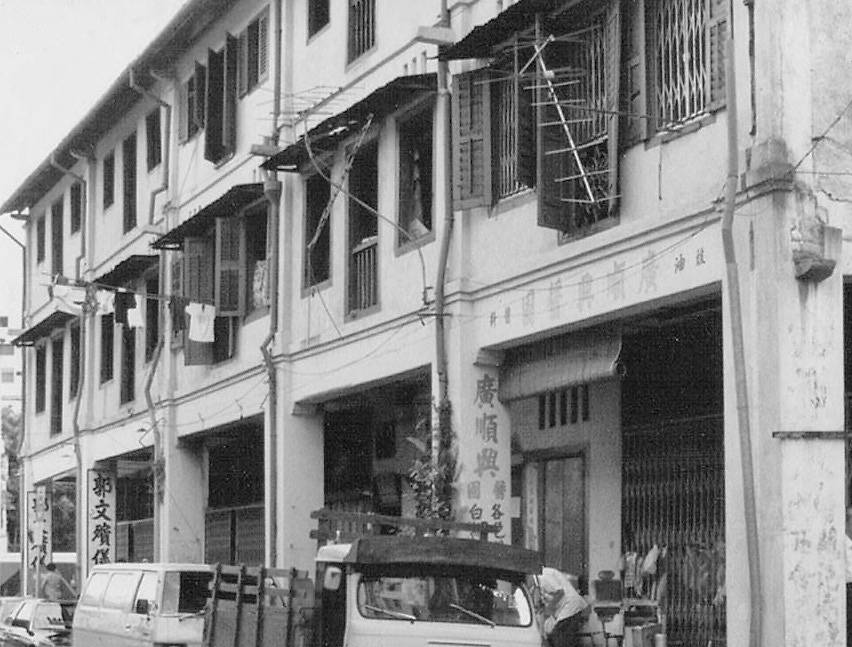
Yip Yew Chong’s old home along Sago Lane. It’s the one with the clothes hanging outside to the far left. (Photo: Yip Yew Chong)
Despite having created murals of old Singapore all around the city (including a recent one at Chinatown Complex), Yip hasn’t done anything related to Sago Lane due to the taboo surrounding death.
But he hasn’t forgotten it. One of his very first murals included an image of an amah (a domestic helper/nanny), the same woman who had lived with his family as a fellow boarder on 9A Sago Lane.
VICTOR YUE: ‘MY UNCLE WAS ONCE BEATEN UP’
If you thought your childhood was tough, try telling that to Victor Yue, who grew up in Chinatown with no proper toilets, and always having to keep an eye out for gangsters.
Retiree Victor Yue visiting his old childhood haunt in Craig Road. (Photo: Mayo Martin)
“A lot of the streets were gangster-infested. Different gangs had different turfs and when you’re around 10 years old, you have to be careful not to step into another’s turf, you know?” said the 65-year-old retired engineer and heritage enthusiast.
His elders would also warn him to be alert when passing by coffeeshops. “In those days, they’d say you better be careful – when cups get overturned, you run for your life. It’s a sign of a fight!”
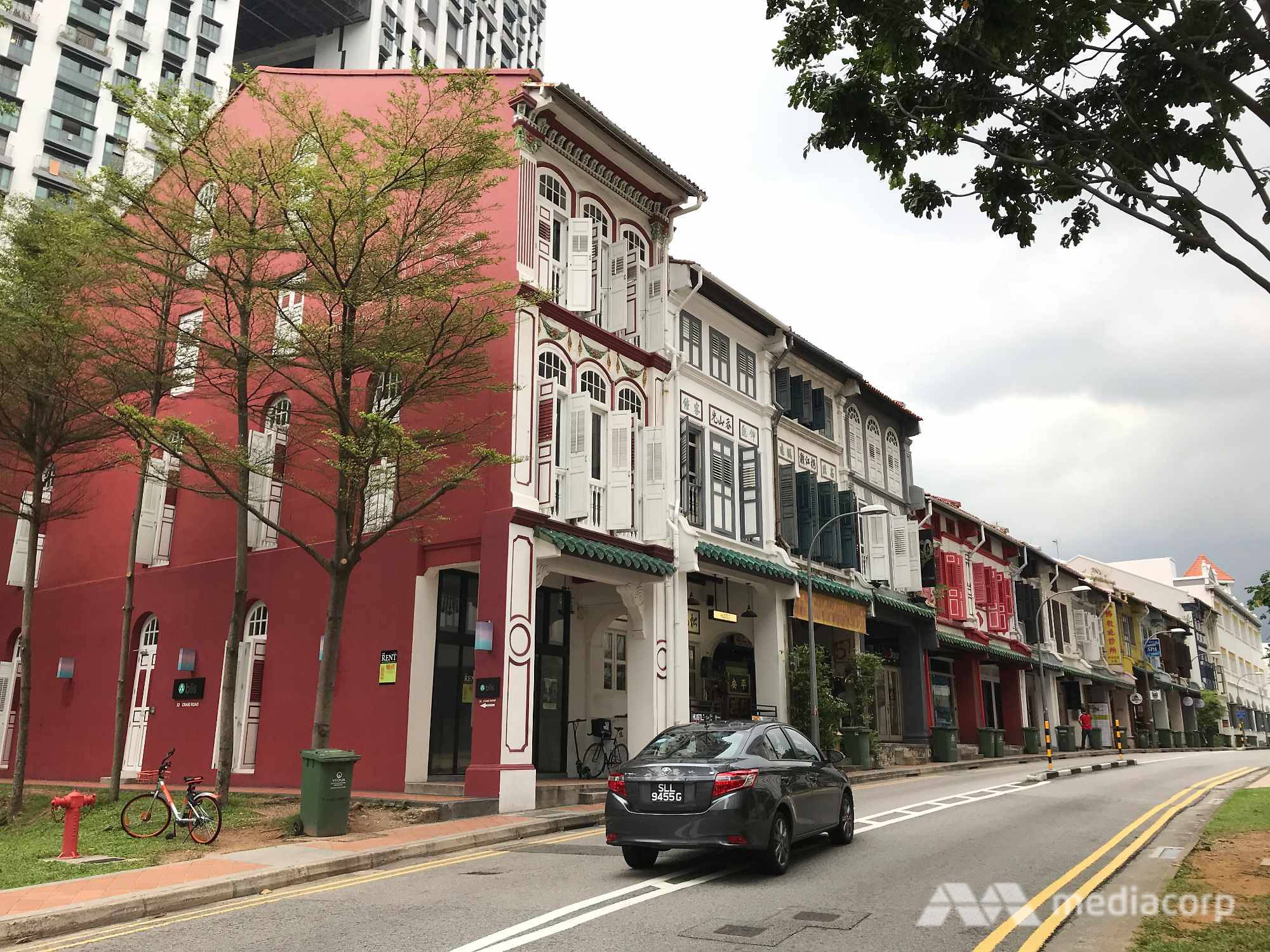
Yue has lived in different parts of Chinatown all his life and spent his first 10 years at 29 Craig Road. Today, the row of shophouses where he lived has made way for Craig Place condominium, where foodies drop by today for the Spanish tapas twin restaurants Binomio and El Tardeo.
A coffeeshop at Craig Road in 1984. If cups get overturned, it’s a sign of a fight, said Victor Yue. (Photo: National Archives of Singapore)
But Yue’s vivid memories of the area as a kid during the 1950s and 1960s was different. His family rented a room on the upper floor of a Peranakan woman’s shophouse – which proved tricky considering the row of houses on the street had no sewage system and relied on nightsoil carriers.
“It stank and sometimes, if you go and s**t at the wrong time, you can find that the bucket has disappeared because the guy came to change it,” said Yue. “And since we were on the second floor, you always prayed that when the guy walked up the flight of stairs, he didn’t spill!”
Nevertheless, Craig Road had enough to entertain inquisitive youngsters like Yue, who would wander around the area up to Duxton Road, which today is packed with bars and restaurants. Back then, there was a small temple on the second floor of one of the shophouses, which was popular among residents. (Further up on Duxton Hill, where you’ve now got L’Entrecote The Steak & Fries Bistro and Lucha Loco, was no man’s land for kids like Yue, who wouldn’t dare enter another gang’s turf.)
A scene of Craig Road in 1984. (Photo: National Archives of Singapore)
Yue’s immediate vicinity was equally interesting. He recalled that at the corner of Craig Road and Neil Road was a Tiger Balm factory, while opposite it was an old building where Chinatown Plaza now stands. “There were jambu and mango trees outside and we kids used to wait for the fruits to drop,” he said.
There were also a couple of interesting shops along the road, selling wooden swords for wushu practitioners and a rental stall for old Chinese comics. At one corner, the results of chap ji ki – an old illegal lottery – would also be written out and sometimes his grandmother would ask him to check out the results.
The shophouse where Victor Yue lived as a kid along Craig Road is long gone. In its place today is a condominium. (Photo: Mayo Martin)
Incidentally, there were also two spirit mediums along the street – including an old lady who lived in a shophouse just beside where Pasta Brava now stands. “She’d be cooking and someone would come for consultation. She’d stop cooking, go into a trance, give you advice, then go back to cooking. She was a spirit medium on-demand,” he quipped.
The street’s colourful character was also literally found on the pavement and walls – Craig Road was in the late Lee Kuan Yew’s Tanjong Pagar constituency. But Yue remembers there used to be an office of the opposition group Barisan Sosialis somewhere.
For a child, these were all adult stuff – but one thing he had to really be alert about were gangsters. Yue would remember sneaking to the nearby Yan Kit Swimming Complex for a dip – but he knew he was taking risks.
Craig Road was a colourful place before, with political parties putting up posters everywhere, a shop that sold wooden swords and even two spirit mediums (including one “on-demand”). (Photo: Mayo Martin)
“A young boy might come up to challenge you by asking: ‘What number do you play?’ which referred to gang numbers,” he said. “If you quoted the wrong one, you’d be in trouble. If you thought you could bully him, you’d better watch out because behind him, there might be a bigger guy watching.”
Luckily, Yue never had any personal encounters by making sure he didn’t stray far from home (gangs never harmed those who lived in in their turf, he pointed out). But there was one incident when he was very young that proved too close for comfort.
“My uncle was once beaten up through mistaken identity. We had to seek help from the elders to find out, and later the gang apologised. In those days, the gangsters or secret societies had a code of conduct, so apologies were very ritualistic. They had to give you candles and things to pray to your ancestors and gods as a form of a very formal apology.”
CHARMAINE LEUNG: ‘SOME MIGHT SHOW A LITTLE BIT OF FLESH’
Her mother ran a brothel. Her nanny was an alcoholic. And she once lived in fear of her friends discovering her home was in a red light district. Charmaine Leung’s childhood story is a Channel 8 drama waiting to happen.
Author Charmaine Leung grew up in 15A Keong Saik Road, the shophouse in the middle, flanked by her mother’s old brothel and the temple where they would hang out and watch the world go by. (Photo: Mayo Martin)
At the moment, though, you can already read all about it in her memoir titled 17A Keong Saik Road. The 45-year-old author’s moving story about growing up in the area during the 1970s was published last year. The title’s address refers to her mother’s brothel, while Leung herself lived on the second floor of the shophouse next door 15A with her nanny.
Today, 17A is a hip bar and restaurant called Sluviche, while 15A is the office of German radio and television outfit ARD.
But some places have remained the same. Next door is the Cundhi Gong Temple, where Leung and her mother would often sit down to watch their unusual world go by. Just opposite the road is a brothel that still operates today, marked by a light box with the number 8.
Charmaine Leung as a child living in 15A Keong Saik Road, right beside her mother’s brothel. (Photo: Charmaine Leung)
“We’d sit around 6pm or 7pm and our view would be the ladies from that place who would come out and burn incense for good business,” she recalled.
As a young child, she would often see them as they walked to and from the brothels. “They’d wear nice dresses in pretty hot weather,” said Leung. “And they weren’t what ordinary people would wear.”
“Some might show a little bit of flesh. But the dresses seemed more like what people would wear when going onstage to perform, or what a nice dress would be in the 1970s and 1980s but exaggerated. Their skirts would have a bit of the can-can feel but shorter.”
In the past, brothels were discreetly advertised by white lightboxes with numbers in red. There are still a few remnants of these along Keong Saik Road. (Photo: Mayo Martin)
Back then, her mother’s brothel was just one of the many along Keong Saik Road and nearby streets. “At any one time, you can get up to 40 to 50 of these. Every few houses, you’d see the white box with the red words and numbers. “19” was one of the bigger ones with quite a lot of pretty, younger ladies,” she said, adding that prostitutes would start coming in at around mid-afternoon and the whole area would be the busiest between 8pm and 10pm.
Of course, at that age, she was more or less oblivious to everything. “Overall, it never felt too dodgy because there were no transactions on the streets. But my perspective is really that of a child,” she said.
But life in Keong Saik Road wasn’t just all about the brothels. Leung remembers loving the feeling of the street in the mornings.
“There was almost no life compared to at night when it was a lot buzzier. There was a sense of serenity. Outsiders didn’t really dare to come in, so it almost felt like a city waking up,” she said.
Keong Saik Road in 1989. (Photo: National Archives of Singapore)
Leung also remembers playing along the back alleys and visiting her neighbours at nearby Jiak Chuan and Teck Lim Roads. Most of them are gone now, replaced by hip F&B places, but Leung remembers them vividly: Lime House and Harry’s Bar used to house a refrigerator repair store and a paper box shop, respectively. The back half of Spanish bar Esquina, she pointed out, was where her favourite ice cream uncle used to be.
“It was just home-made ice cream with flavours like red bean, durian, corn and attap chee, which was my favourite,” she said.
Gentrification has undoubtedly changed the face of Keong Saik Road, and Leung has mixed thoughts about it. While she welcomes the preservation of architecture and how some businesses embrace the place’s history (Keong Saik Bakery has done buns inspired by the shophouse’s previous majie owner), she bemoans the absence of actual residents who can form a community.
“It has become a place where people visit, consume and walk away. And sometimes, I feel everything’s a bit too bright – the place used to look more lived in,” she said.
A photo taken in 1989 of Jiak Chuan Road, which is perpendicular to Keong Saik Road and right in front of where author Charmaine Leung used to live. (Photo: National Archives of Singapore)
Since coming back from Hong Kong, where she had been based, Leung has been active in promoting the area’s heritage. Aside from the occasional tours, she was also involved in the Chinatown segment of the recent Singapore Heritage Festival. She’s also been helping to promote theatre group Drama Box’s upcoming show in June titled Chinatown Crossings, which looks at the hidden histories of the area.
In a way, all these is a continuation of her book, which was an effort not just to tell her story but that of an overlooked community.
“It was also about people who, no matter what happened or how hard lives were, made the best of what they had. These are the stories of the early immigrants, of people who laid down the foundations for Singapore. Without these people, we probably wouldn’t have what we have today.”
It is not enough just have found the strongest set of individuals but to “mould them into the strongest team possible”, says the Trade and Industry Minister.
Prime Minister Lee Hsien Loong, together with Minister Vivian Balakrishnan, Minister S Iswaran, Minister Ong Ye Kung and the Singapore delegation, was hosted by President Donald Trump to a bilateral working lunch with US Cabinet Secretaries and key White House officials. (Photo: Ministry of Communications and Information)
(Updated: )
Bookmark
SINGAPORE: Singapore must have the strongest leadership team possible for others to “take us seriously and be willing to work with us”, Trade and Industry Minister Chan Chun Sing said on Monday (May 14) during the debate on the President’s address.
Mr Chan said it is “not enough” to find the strongest set of individuals but there is a need too to mould them into the strongest team possible. This sense of teamwork, he added, does not just exist within one generation but also between generations.
“Our leadership model is to have overlapping generations of leadership teams to help the next generation do even better,” the minister said. “This provides continuity in our interaction with others and for us to compete at the highest global level with consistency in vision and execution with purpose.
“All these leadership traits – commitment, teamwork, courage to evolve, a sense of mission – are what we will need to keep our systems special,” he added.
Mr Chan also pointed out that his belief is for the need of political leaders, not just politicians, to lead the country. These are leaders who weigh the options carefully before acting decisively and never opting for the most expedient idea or a solution for personal interests or short-term gains.
“It also means not shying away from making difficult or unpopular decisions, but being guided by that resolve to always do what is in the best interests of Singapore and Singaporeans – never shirking responsibilities towards our current and future generations,” he said.
Additionally, there is a need to keep politics “constructive” and not make it just about winning votes, Mr Chan stressed.
To win the heart and votes of the people, he said the Government must work hard to develop sound policies for the country’s common future.
“To win votes by stoking anger and unhappiness may be a common practice in politics elsewhere. This is negative politics and is not constructive,” the minister added.
“THANK YOU MR LOW”
Mr Chan, whom many have identified as being one of the frontrunners to succeed current Prime Minister Lee Hsien Loong, also took the opportunity to thank former Workers’ Party chief Low Thia Khiang for his contributions.
Mr Low had recently handed over the reins as the opposition party’s secretary-general to Mr Pritam Singh, although he remains in its Central Executive Council.
He said while Mr Low sat on the opposite bench, he is a fellow Singaporean and very much part of Team Singapore.
“While we may not always agree with his perspectives or methods, we nevertheless appreciate his efforts to work together to build a better Singapore,” Mr Chan said. “Although Mr Low may have different perspectives, but from his speeches, we can detect his pride in Singapore and his determination to defend our sovereignty.
“Thank you Mr Low.”
The ruling People’s Action Party (PAP) Government also looks forward to working with Mr Singh and the WP to “put Singapore’s and Singaporeans’ interest first, always”, Mr Chan added.
SINGAPORE: A new system that can help channel commuters to less crowded train cars is being piloted along the Downtown Line by the Land Transport Authority (LTA) starting on Monday (May 14).
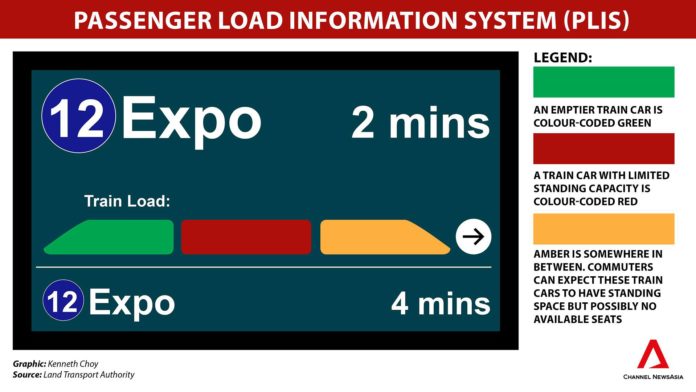
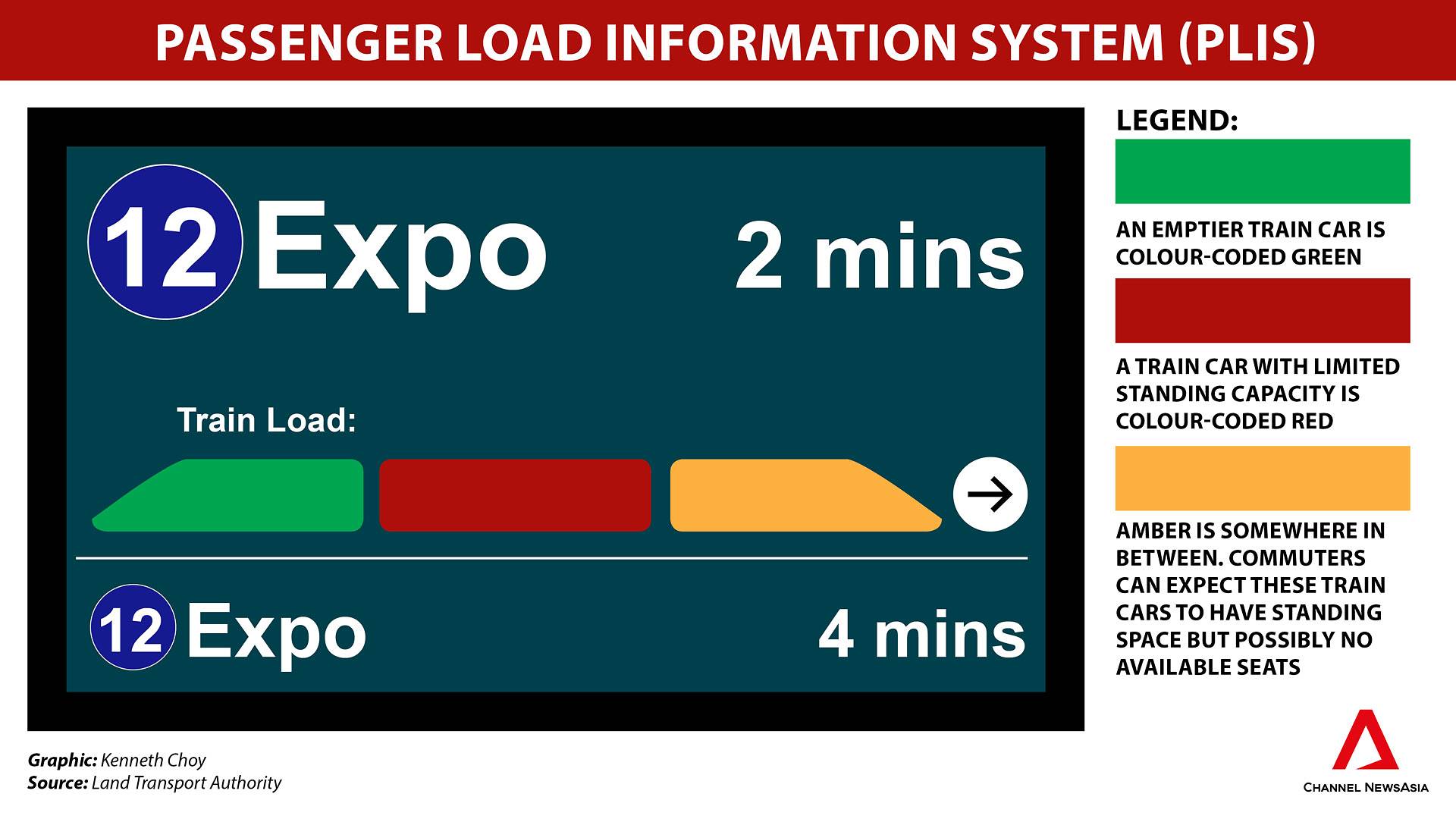
The Passenger Load Information System (PLIS) displays the load levels in each train car through LCD screens at the MRT platforms using three colour-coded icons – red, amber and green.
An emptier train car is colour-coded green while a train car with limited standing capacity is colour-coded red. Amber is somewhere in between, and commuters can expect these train cars to have standing space but possibly no available seats.
The PLIS, which is similar to a system used on the Yamanote Line in Tokyo, detects the passenger load through load sensors that are already on trains. The data is then transmitted wirelessly at one-second intervals to the next train station, according to LTA. When incoming trains reach the next station, the information is also updated as passengers alight and board.
Commuters can use the information to move to less crowded train cars for easier boarding, LTA said, adding that this will help improve passenger distribution and allow for smoother boarding.
The system will be rolled out on six stations on the Downtown Line, between Bugis and Chinatown, by the end of Monday before it is extended to all 34 stations on the rail line by next week.
LTA will monitor the system over a six month period to fine-tune it, as well as get commuter feedback, it said.
SINGAPORE: An ambitious project is underway to equip lampposts in Singapore with various capabilities to improve urban planning – serving to be more than just a light source.
A trial by the Smart Nation and Digital Government Office (SNDGO) and the Government Technology Agency (GovTech) will start next year in Geylang and One-North.
This is part of Singapore’s Smart Nation Sensor Platform project, which could see all of Singapore’s 110,000 lampposts fitted with a network of wireless sensors, to transform them into “smart lampposts”.
POSSIBLE USES OF SMART LAMPPOSTS
Currently, prototypes are being tested to determine the kind of technological capabilities that can be incorporated.
A “smart lamppost” prototype being tested for possible uses, to determine the kind technological capabilities that can be incorporated.
For example, environmental sensors could potentially be added to monitor rainfall, humidity and temperature, and noise sensors to detect unusually loud sounds, such as a person screaming or a car crash.
With video sensors, it would be possible to incorporate facial recognition systems.
Navigational beacons could also be mounted to direct autonomous vehicles while speed-trap sensors could be used to track speeding bicycles or personal mobility devices.
Citing this as an example, SNDGO’s Deputy Secretary Tan Kok Yam described how these smart lampposts can be put to good use.
“We want to look at places where people most frequently use active mobility devices,” he said.
“If we know where these places are, we can look at the infrastructure and the signage, to make the place safer. You want to know whether people are speeding or not for public safety reasons.
“If there is a bad collision, would a visual sensor be able to pick that up? And if that happens, would we be able to respond with emergency services?”
PRIVACY FEARS
Despite their potential, some aspects of the Smart Lampposts have sparked concerns about privacy, especially the platform’s prospective ability to recognise faces.
But Mr Tan tried to allay such fears.
Some aspects of the “smart lampposts” have sparked concerns about privacy, especially the platform’s prospective ability to recognise faces.
“We have no plans to use it to probe into how people live their lives,” he said.
“The whole point of the sensor platform is to look at improving services, look at how to run the city and operate the city better and how to plan the city better. We have no plans to do moral policing or things like that.”
According to Professor Archan Misra from Singapore Management University’s School of Information Systems, better education and disclosure is the solution to such concerns.
He said: “You want the public agencies to be more upfront about what they’re using them for and to highlight the positive use cases.”
“Admittedly there will be a very tiny sliver of cases, when you’re tracking a person of interest, criminal on the run, and you’re going to be using all this infrastructure to monitor those and track them. But that’s going on already, there’s no surprise and there’s high public acceptance of that.”
Instead, the professor warned that cybersecurity threats such as hacking and data leaks could be bigger dangers.
“Some of the things I’ve heard is that there is potential that a lot of the communication infrastructure is based on things such as Wi-Fi. These are unlicensed spectrum, meaning they are sort of more vulnerable to threats, because anybody can bring a laptop and start messing around with these,” he said.
“So you (have) got to have a higher level of security for some of those.”
SNDGO, though, says the data collected will be safe, and there will be measures to prevent misuse.
“Internally we have access controls to make sure that those accessing any kind of sensor or personal data have a purpose, are allowed to do so,” said Mr Tan.
“We will be able to track whoever who accesses the data in a matter that is not relevant, that does not gel with what the officer is supposed to do. As for those who misuse or abuse the access to personal data, they will be penalised.”
SMART NATION FOR THE FUTURE
For now, the agencies behind the project still need to determine whether the technology behind their vision of the smart lampposts is cost-effective, feasible and can be used to solve real-life problems.
An expert warns that cybersecurity threats such as hacking and data leaks could be bigger dangers than privacy concerns.
But Professor Misra said it is essential for Singapore to press on.
“I think it’s important as a showcase of what Smart City infrastructure can be, because Singapore is a leading smart city in this part of the world, in ASEAN,” he said.
“There’s a lot of Smart City investments that are upcoming, and our ability to show that we can do it right positions us to be a top leader, to have the right business contracts and enable these cities to come up to speed over the next decade.”
He believes the smart lamppost is still at least four years away from reaching a level where its capabilities will match its intent.
SINGAPORE: Singapore’s universities have long been held up as a key component of the city-state’s success story.
The 2018 iteration of the QS Top Universities Ranking places Nanyang Technological University (NTU) at 11th place and the National University of Singapore (NUS) at 15th. Not bad for a small city-state that has only been in existence for little more than 50 years.
Yet as critiques of university rankings have rightly pointed out, such rankings do not paint a complete picture of higher education, focusing instead on faculty research output.
At the same time, university graduate starting salary figures are but one marker of the quality of university education.
As those of us who work and teach at universities know, higher education is much more than the rank of a university or how much money our students can earn upon graduation.
In focusing on these quantifiable outcomes, we often negate the fundamental goals of education in any society: Shaping well-rounded students who possess both the hard skills necessary for their employment as well as the soft skills needed for good citizenship.
One way of ensuring such as well-rounded education is through a pedagogical tool known as “service learning”.
Indiana University education scholars Robert Bringle and Julie Hatcher (1996) have described service learning as:
A credit-bearing educational experience in which students participate in an organised service activity that meets identified community needs and reflect on the service activity in such a way as to gain further understanding of course content, a broader appreciation of the discipline, and an enhanced sense of civic responsibility.
As a credit-bearing component of a degree course, service learning differs from community service (which is entirely voluntary and non-mandatory) and internships (which is essentially a paid service).
Furthermore, service learning is not a one-way process.
Service learning requires students to reflect on the process and allows them to pick up important skills and knowledge, such as the ability to foster collective action and ground-up initiatives or the ability to engage a broader range of groups and individuals, even as it allows them to contribute to the activities of grassroots organisations.
For the past semester, I have been running a service-learning initiative as part of a core course under NTU’s Public Policy and Global Affairs Programme. As part of this initiative, students participate in a 6-week attachment at a grassroots organisation.
At the end of the attachment, students are asked to write a reflection essay based on their experience. Aside from the essay, students’ performance are also assessed through the collection of feedback from external organisations and partners where the students have been attached.
A man riding an e-scooter at NTU. (Photo: Olivia Siong)
By incorporating community service into core curriculum, service learning allows for a more holistic educational experience, where learning takes place both within and outside the classroom.
This is especially important for public policy students, since it is meaningless to talk about policies without understanding how these policies impact citizens at the individual and community levels.
Certainly, the soft skills picked up by students will benefit their future employers immensely. Their experience in engaging a broad range of citizens and facilitating ground-up initiatives will be especially relevant in business areas that require them to steer stakeholder relations or drive project management.
UNIVERSITIES IN COMMUNITY
Aside from ensuring a more holistic educational experience, service learning also grants universities the opportunity to engage their local communities.
By requiring students to be engaged in community service activities as part of their educational experience, universities can foster long-term relationships between their students and their immediate neighbourhoods and communities.
More than simply educational institutions or spaces for learning, universities are spatially located within neighbourhoods. Service learning can contribute to NTU’s ongoing efforts to engage its Jurong and Pioneer neighbourhoods as well as the upcoming Jurong Innovation District.
It should, however, be noted that community engagement is not entirely new to NTU. Indeed, the university has established a Local Community Engagement Office for this very purpose.
The Office has since facilitated various activities and events for residents of the neighbouring Jurong area.
A driverless vehicle being tested by NTU in December 2016. (Photo: TODAY/Koh Mui Fong)
For academics, service learning presents an opportunity to align one’s teaching and research activities to community service.
Given that much of our research funding derives from public monies, academics should also be obliged to ensure that their teaching and research activities provide direct positive impact to local communities and their residents.
SKILLS AND CIVIC CONSCIOUSNESS
Singapore’s education system has traditionally prided itself as a means of skills development and social mobility.
By ensuring equal access to education and imbuing students with relevant skills, the education system has been a crucial component of Singapore’s economic and social development. Service learning can contribute to both of these aspects of Singapore’s education system.
Apart from allowing students to pick up useful job skills such as project management and stakeholder engagement, it also fosters a deeper sense of civic consciousness that is strongly tied to community service.
Such skills cannot be learnt through traditional pedagogical tools but requires students to “learn in action” by engaging with local communities.
In the words of the education philosopher John Dewey: “There is no such thing as educational value in the abstract”. A well-rounded education should require students to understand the lives and conditions of their fellow citizens, not in the abstract, but in community. Service learning provides good opportunities for such engaged learning.
Woo Jun Jie is an assistant professor in the Public Policy and Global Affairs Programme of Nanyang Technological University. He is also the recipient of NTU’s inaugural Community Research Fellowship.
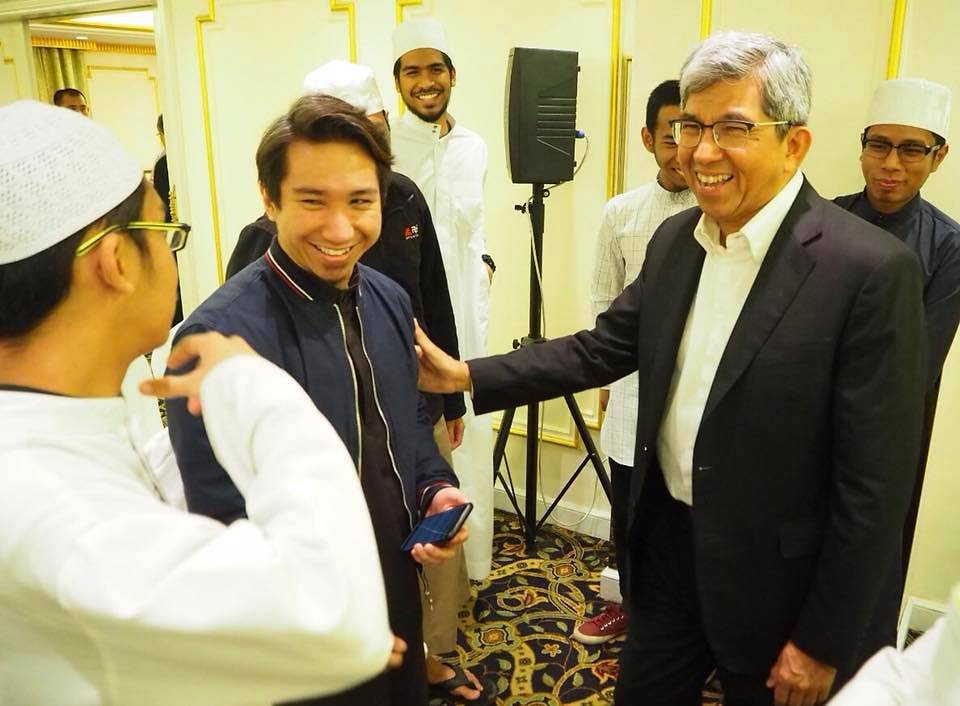
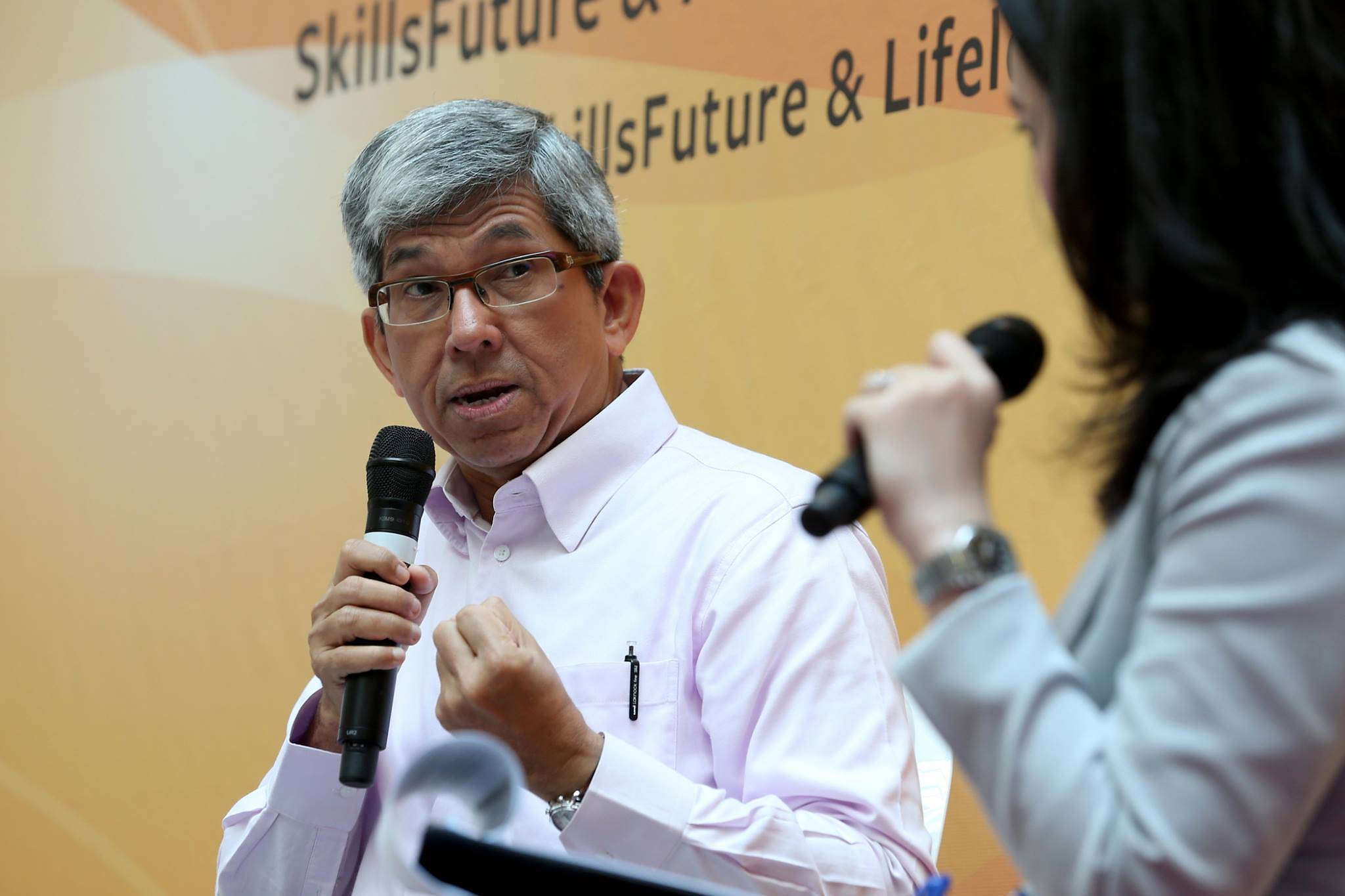
SINGAPORE: As Dr Yaacob Ibrahim arrives for our interview, it becomes clear that old habits die hard.
My colleagues and I address him as “Minister Yaacob” several times.
After all, he was first appointed Acting Minister for Community Development and Sports and Acting Minister-in-charge of Muslim Affairs in 2002.
The following year, he became a minister and went on to serve in various ministries for the last 16 years.
Still, Mr Yaacob corrects us.
“I’m no longer Minister,” he says, laughingly.
The recent Cabinet reshuffle saw him stepping down as Minister for Communications and Information and Minister-in-charge of Muslim Affairs and Cyber Security to allow younger, fourth-generation leaders to take on more responsibilities.
But he is still very much a Member of Parliament. And while he has said in previous interviews that he will use his free time to catch up on his reading among other things, he points out that his work on the ground as MP for Jalan Besar Group Representation Constituency (GRC) continues.
In fact, some analysts are saying that Jalan Besar GRC is likely to be hotly contested in the next election as it will be one of those left without an anchor minister. I ask him if he envisages an erosion of support from the ground as a result.
“We just have to be ready,” says Dr Yaacob confidently.
“We always anticipate a fight. Whether an erosion of support will happen or not, we have to prevent it from happening. We have to work hard.”
He says he has briefed all his key grassroots leaders.
“Between now and the next election, I have to prepare the team. The most important thing is just to make sure that when the button is pressed, we are ready to go.”
His next statements, however, suggest some uncertainty as to whether he will even run.
“Whoever takes over my place, he will know that the system is in place. Everything is there for him or her to take over and I’ll be there to guide him or her to make sure we win the next election. Whether I’m around or not, that’s immaterial.”
STEPPING OUT OF POLITICS ALTOGETHER?
When directly asked if he will be running as an MP, his initial reply is brief.
“You have to ask the Prime Minister that.”
But as we continue talking he admits that while he does not know for certain if he will run, he has other considerations.
“I’ll be very candid. My family wants me to step down. They think I’ve been there for a long time and I need to look to other things to do in my life. They all know that I work very hard. They’ve seen how it has stressed me out in the last 22 years. I suppose they feel that now it’s time for me to do something else that will be more relaxing.
“But I’m a party man. I shall wait on instructions from the Prime Minister. Whatever comes my way, I have to make all the evaluations and re-prioritise accordingly,” he says with his signature good-natured laugh.
While his family wants him to step down, I wonder what he himself wants.
“I want to continue to contribute. I have always been that person who cannot stay idle. I don’t imagine myself sitting by and watching history go by. If I continue as MP, I will play my role as MP. If not, I will have to find other roles for myself.”
As we continue talking, it’s clear he still sees a role for himself, and he is keeping his options open.
“I’m not retiring as a member of the Muslim community. There’s a new Minister-in-charge of Muslim Affairs. I will not get in his way but I will find a space where I can operate, to continue to contribute my part.
“At the national level, I think the digital economy and digital transformation is an interesting evolution that is taking place. I’ve been a part of it for the last seven years as Minister for Communications and Information. How can I play a role to see that transformation taking place?”
“I’ve always believed one of the lessons I’ve learnt from Mr Lee Kuan Yew. He said that what you want is to be able to shake hands with the person and have the person look into your eyes and say, “I trust this chap to look after me”. (Photo: Facebook / Yaacob Ibrahim)
A QUESTION OF TRUST
In the meantime, he speaks fondly about engaging the residents in his constituency as an MP, which he has been doing since 1997.
He admits he had concerns initially about not being able to connect with the majority Chinese community because of the language barrier.
He has picked up some Mandarin over the years.
“Yi dian dian (a little bit),” he says to prove it.
Dialects were the other challenge.
“In a way, by saying a few words in the dialect, I can break the ice. It helps. I cannot pretend that I know the language well, but I think they know who I am.
“I’ve always believed one of the lessons I’ve learnt from Mr Lee Kuan Yew. He said that what you want is to be able to shake hands with the person and have the person look into your eyes and say, ‘I trust this chap to look after my affairs’. I think that’s what’s important.”
Language was not the only barrier. He also had no idea what living in an HDB estate was like.
Dr Yaacob’s father worked as a lawyer’s clerk and his mother was a housewife.
The family was large – nine children in all and couldn’t afford a home till Dr Yaacob was in secondary school.
They lived in kampungs for all his growing-up years.
“My sister moved to landed property at some point, but that was the time I left and went overseas to do my PhD. When I came back, I lived in university housing.”
To familiarise himself with HDB living before his first election, he made sure he visited every block twice.
Nevertheless, I point out the oft-heard criticism that ministers are out of touch with the ground.
“I don’t think that’s a fair criticism. I think our ministers are plugged in. You can check. Almost every weekend, all of us are down on the ground.”
But can they relate to the realities of ordinary Singaporeans?
I point out how, for example, whenever there are issues with the public transport system, many say our political leaders are not able to relate as they don’t make an effort to experience first-hand what it’s like to deal with such issues on a daily basis.
“I appreciate where that’s coming from, but I don’t quite agree that is the yardstick that you should use. I would use this argument that I’ve used before: you want me to be a communist before I appreciate communism? I know what public transport is all about. I used to take public transport. Now, because of the nature of my job I have to move from place-to-place, so I have to take the car. I think the measure by which we must judge is how well can you relate to the minister and how well the minister can relate to his constituents.
“I think we have to look at the totality of things that we do rather than whether we take the bus or not. I think that’s a bit too minutiae to use as a criteria. I don’t have to experience everything to appreciate the problem. I think the Ministers are concerned when there is a big problem and that we need to tackle that problem.”
He maintains that ministers are fully cognizant of the importance of engendering trust.
“At the end of the day, it is the ground that will vote for us. We can have the fanciest policy but if the ground doesn’t trust us, that’s the end of it. We know that.”
He admits that not everyone trusts them and some have been quite unrestrained in conveying that message. He has had his share of doors slammed in his face during house-to-house visits.
“WE’RE NOT GOD”
During the 2011 election, he admits that at least one resident brought up the issue of high ministerial salaries.
In light of this, some might say the electorate’s high expectations are justified.
He thinks expectations should be high regardless of salaries.
“We expect people, including the ministers, to work their best. I’ve always believed that we are a small country with no margin of error. If you’re given a position or responsibility, you’d better do your job right and do the best that you can, but sometimes things may not work out. That’s the reality of life. I think what’s important is how we respond. The way we respond to a crisis has to be professional and constructive. You’ve seen incidents in other places where the agencies couldn’t deal with the situation and the population gets inundated by other crises.”
At this point, he raises several incidents that occurred under his watch which he seems to regret.
One occurred in 2013 – the fire at Singtel’s Bukit Panjang Internet exchange that affected banking and telecommunications services for eight days.
“I was in-charge of telcos for the last seven years. When the fire took place, I couldn’t sleep because it meant that our system is vulnerable.”
Since then, the Infocommunications Media Development Authority (IMDA) has imposed new standards on Singtel to prevent a recurrence.
“You have to do the best you can but can you anticipate every problem? It’s not possible. We’re not God. I am confident that at least for the ministry that I’ve been overseeing, the IMDA knows what needs to be done.”
The flooding of Orchard Road in 2010, when he was Environment and Water Resources Minister, is also something he wishes had been avoided.
Many often recall how seven months before the flooding, he had described a flood along Bukit Timah Road as a “freak event” that happened once in 50 years.
I ask him if he regretted making that statement.
“I regretted not explaining that statement. People forget I’m an engineer by training. One in 50 is a probability concept for hydrology. I learnt that in school. It’s just a probability that this event can occur. But it doesn’t mean that it cannot happen tomorrow. I should have thought through more carefully how to explain that concept.”
He admits that the incident taught him a lesson.
“Nobody in PUB expected such a rainfall to happen. If you look at the chart of rainfall data that we have in PUB, that data point didn’t exist. One of the things we need is imagination, to think of the impossible and if it is really impossible, can it still happen or not? You have to plan for it.”
Various anti-flooding measures have since been rolled out.
I ask him what his sense of the ground is today, how happy or unhappy the electorate may be.
“I think more positive compared to 2011. I think people understand where we are coming from. At the end of the day, we can alleviate some of some of the transport woes. I think all the ministers including current Transport Minister Mr Khaw Boon Wan showed that they are working very hard to try and solve the problem.
“I think the concerns now are about the whole economy. People are worried about jobs. The Government is trying it’s very best to grow the economy. There are some concerns about cost of living but I think generally, they know that we are trying our very best.”
Dr Yaacob Ibrahim became Minister-in-charge of Muslim Affairs in 2002. (Photo: Facebook / Yaacob Ibrahim)
A QUESTION OF RACE AND RELIGION
Another role which he has found challenging is that of Minister-in-charge of Muslim Affairs.
The aftermath of the 9/11 attacks on the US when the Malay-Muslim community was under the spotlight, was especially tough for him as he had only just taken the helm then.
The discovery of the Jemaah Islamiyah plot in Singapore soon after exacerbated matters.
“For us to be in that type of limelight is never pleasant but it is something which is part of leadership and you have to deal with it.”
Today, he is encouraged by the strides that have been made in Singapore especially in terms of inter-faith dialogue and understanding, but he says the work has to continue.
There were numerous other issues that proved challenging over the years.
“There was a growing concern amongst some segments of the Government that we’re becoming conservative and we were becoming exclusionary. It cast a perception that the Malay community wants to be isolated. But when I went down to the ground, I could see integration taking place in everyday life. Sometimes we are the victims of one or two people who are louder than others.”
He saw it as “a very important challenge to educate the Government that that’s not what we are all about”.
But he also had to explain to the community why the Government was concerned.
“Sometimes when the Government raises these concerns, it’s not because there is a denial or suspicion about the community, but they are worried about the larger picture about how we can hold the nation together. They are not opposed to Muslim religious practices but we want to see how we can find that balance. The issues of tudung, handshaking and greeting and the issues of whether more Malays want to go to madrasah and so on – those were the issues that I had to confront and they are not the easiest of issues.”
He appreciates the fact that Prime Minister Lee Hsien Loong had several sessions with the community to understand the issues.
But this is not to say all the issues are resolved.
“I think this tension will always exist and we will always have people who will come out with different ideas. It is a continuous balancing act.
“I always saw myself as that person in the middle, balancing between the concerns of the Government and the needs of the community. I always felt that it was my job to make sure that I articulate both points of view so that the Government can understand better.”
I suggest however that some within the community might feel as if he did a better job of representing the Government’s interests than of standing up for the community’s interests.
“There will always be suspicion because I’m a Government man, I have to speak the Government lingo. But I’m also a community man. My heart is always with the community. I hope that in the last 16 years I’ve been able to convince them I have their interests at heart. We may differ in our approach, but I think the intent is the same. I would say, let history judge. I can’t say anything else.”
Another issue that became a lightning rod for criticism was that of the reserved Presidential Election. It brought the Malay-Muslim community under the spotlight as last year’s Presidential Election was reserved for Malay candidates.
I put to him that many within the community felt that it implied that Malays could never be president on their own merit.
“When the idea was first discussed, I was uncomfortable for those very reasons. But having thought through all the implications and reasons and why it goes beyond the individual, I realised it’s about the institution and how we need to preserve the multiracial character of the institution.
“Sometimes in life, you cannot go on a perfect trajectory. You need to intervene.
“Our talent pool is not deep. That’s the honest truth. We have talented people, but we don’t have that depth of other communities like the Indian or the Chinese communities.
“So I decided on balance that this was the better approach and the most important thing is that the person must meet the criteria set out for any presidential candidate.”
He notes that President Halimah Yacob meets the criteria and is “more than able to do the job”.
“We may disagree with the circumstances in which she became President but she is now President. The hope is that six years later, people will forget that she is a Malay and only see and respect her as our President.”
He has mentioned before that he hopes “the President is so good” that his or her race becomes a non-issue.
But I ask him how confident he is that this will happen, since some still question the President’s legitimacy, despite her capabilities.
“I’m not sure whether it’ll be enough but I think it’s necessary for any one of us who are given a position to influence public life, public policies, to do the best job we can.”
As to whether he will ever considering running for President, he says he has “not thought about it yet” and that “it all depends on what I do in the next phase of my life” which he isn’t certain about at this time.
I wonder if he envisions a day when race truly becomes a non-issue in politics.
“I think the issue of race will not go away as some of us would like it to. But at the same time, the question is about how is the issue is framed as we go forward.”
He points to the rise in inter-racial marriages.
“We have seen more convergence of the various communities. Will the CMIO (Chinese, Malay, Indian, Others) racial categorisation model still be operable? So whether race will matter in future or not is for the next generation to decide.”
“The world is filled with different people. People who are prejudicial carry on all these stereotypes. The most important thing for me is really to look forward on how you can use those learning experiences,” says Dr Yaacob Ibrahim. (Photo: Facebook / Yaacob Ibrahim)
DEALING WITH PREJUDICE
Dr Yaacob often talks about the progress the Malay-Muslim community has made over the years in terms of education and socio-economic status.
When he was growing up, he often felt the community was in the spotlight for the wrong reasons and the negative stereotypes affected him personally.
“I was good at mathematics. But we had a Chinese math teacher who was very nasty, who basically degraded the Malay community and every time we went to class, we were told that we are only good at playing guitar or sitting at the void deck. So I was really upset. I continued to do my best to prove otherwise.
“The world is filled with different people. People who are prejudicial carry on all these stereotypes. The most important thing for me is really to look forward on how you can use those learning experiences.”
He feels that as the Malay community progresses, such incidents have become far less common.
His own consciousness about the issues surrounding his community became more acute in university.
“When I entered the campus in 1976, a few Malay-Muslim students from the Muslim society had petitioned the late Dr Goh Keng Swee to see whether the Government could recruit more Malays into National Service. The issue at that time was that some Malays were not asked to serve National Service and it had some implications on their employment. Those concerns were what shaped me as a person.”
He suggests that today, even this situation has improved markedly.
“We see Malays serving in all sorts of roles. Some of them have risen through the ranks and become officers. I think Malays are now participating fully in the armed forces. We even have several candidates now going through naval training to become naval officers.
“I think this is a healthy evolution of how the various communities have come together to trust one another. We share this island and we have to protect it together as one nation.”
I wonder if that spirit can be extended to other areas of community life.
For instance, the social and educational issues that exist within the Malay-Muslim community also exist in other communities. Why should they be tackled in the framework of racial groups? Could that end up being divisive and in fact have the effect of negatively singling out certain communities?
“Frankly, I used to hold that view. But when I got involved with self-help groups, I realised that there is a value in having a community approach because when I reached out to my fellow Malay-Muslims, I could talk to them, I could understand the cultural nuances. For example, you must also know how to empower Malay-Muslim parents who may not be familiar with the latest curriculum in mathematics or familiar with what’s going on with the world. It’s a lot easier for me to go in and to speak to them in a language in which they can understand.”
But he points out that the self-help groups have come together in recent years to run a common tuition programme for all races.
“We have to continue to find ways in which we can evolve that model so that we can be more inclusive.”
UNFINISHED BUSINESS
He might have achieved a lot in his 16 years as a minister, but there are two initiatives that he wishes he had seen to fruition.
One is his wish to set up an Islamic college in Singapore to train a new generation of religious teachers who understand Singapore’s multi-racial and multi-religious context.
“We spent a lot of time developing the model. Hopefully, when it gets approved and it gets launched I can find a way to play a part to make that dream a reality.”
He also mentions the Broadcasting Act that is due to be updated to take into account changes to the media landscape.
I point out that recently, legislative changes related to the media have attracted criticism from some quarters who perceive it as the Government’s way of silencing dissenting voices.
Several years ago, a licensing framework for online news media sparked similar criticism. He maintains there are good reasons for this.
“If you are reporting on Singapore, we have to hold you accountable just as I hold the mainstream media accountable for their reporting. You can criticise the Government, but you must give us a right of reply.”
He singles out the 2015 case of the now-defunct sociopolitical site The Real Singapore (TRS) as being different.
An article it published claimed that a Filipino family complained about noise resulting in a scuffle between the police and participants at a Thaipusam procession.
While this did not actually occur, the article had the potential of inciting hatred against the Filipino community in Singapore.
“If you say something that is really untruthful, then we really have to come down hard on you. In this case, the intent was to peddle fake news so that they could attract eyeballs.”
“You can criticise the Government, but you must give us a right of reply,” says Dr Yaacob Ibrahim. (Photo: Facebook / Yaacob Ibrahim)
I ask him what he thinks of Singapore’s poor rankings in the World Press Freedom Index.
“I have not gone into depth on their criteria. All I would say is that we are a different country. We’re a small country that was never supposed to be a country. We have fault lines that can be exploited – race, language or religion and we are such a small society that we hardly have a margin of error.
“I’m not apologetic about what the Government has done.”
But can’t Singaporeans be trusted to be discerning media consumers? Is the Government being paranoid, as some critics suggest, I ask him.
“There has been a lot of content we’ve allowed online. It’s only when you cross certain red lines, that we come down hard because we have to protect the larger interests.”
Another controversial issue that arose under his watch involved two gay-themed children’s books. The National Library removed them from the children’s section and planned to pulp them.
Members of the public were divided on this. Some supported the move. Others bristled at the censorship.
Later, the titles were moved to the adult section.
“Our instincts were different at that time. In hindsight, we could have been more enlightened in our approach.”
Today, his advice to younger Ministers is to “not just meet your grassroots leaders who always agree with you, but meet the people who disagree with you” so that “they can hear where you’re coming from and you can hear where they are coming from”.
He claims that during his years in politics, he has done this several times.
SINGAPORE IS WORTH FIGHTING FOR
When asked how he would like to be remembered, he says with a smile: “He did his best when he was given the opportunity. He made a couple of mistakes and he tried to move on and do whatever he could to make Singapore a better place for everyone.”
One of the most vital tasks ahead for Singapore he says is to “empower generations of Singaporeans to really believe that Singapore is worth fighting for.”
But he concedes that nation-building is a complex process.
“At the end of the day, this is the only country we have and if we don’t do something to make sure this country continues survive, continues to thrive, I think we would have lost the battle.
“When I meet young people, I try to inspire them in some way, to show them that they have a role to play. We have to give young people a stake in Singapore’s future. We are asking for young people to take it upon themselves to do something to create a better future for themselves and their children.”
SINGAPORE: When Mrs Y L Dong and her family moved into their resale five-room Housing Development Board (HDB) flat 20 years ago, she was certain they had found their ideal home. The Ang Mo Kio apartment may have been 17 years old, but its age did not bother her.
“We have all the necessary conveniences like coffee shops and wet markets nearby. It’s a really friendly neighbourhood with a cosy feel and it is also really convenient to get to town from here,” she said.
But last year, when she approached a property agent with the intention of selling her flat, the response was poor.
“After realising that the lease of the house was reaching its 40-year mark, most buyers weren’t keen at all. They were afraid they might not be able to sell it off in the future,” said the housewife who has two teenage children.
“Even though the flat is spacious and opposite Bishan Park and near prestigious schools, no one wanted to buy.”
Mrs Dong is not alone. A growing number of HDB flat owners are holding on to properties nearing the halfway point of their 99-year leases, raising mounting uncertainties of depreciating values, which have run counter to long-held narratives that Singaporeans’ HDB flats are not just homes, but also appreciating assets.
Today, with older flats in the spotlight, the notion of asset-enhancement, which has seen HDB flat prices rise in the past few decades, is under threat.
And the larger question of what will happen to people’s HDB homes when leases actually end has become an issue of growing traction.
Experts like Dr Fu Yuming put it starkly. “I know what will happen to a private estate when the land lease expires: it will revert to the government,” said the associate professor at the Department of Real Estate in National University of Singapore.
“But I don’t know what the government is thinking about for the lease management of HDB estates, since there is no open discussion about the issue. In theory, the estates revert to HDB when their lease expires. But will there be any lease renewal policy or re-housing policy? The uncertainty needs to be resolved to protect the interest of HDB homebuyers.”
His comments came after reports of buyers forking out high prices for ageing flats, in the hope of cashing in through SERS, where residents are rehoused in new blocks and also receive compensation for their old homes.
But Mr Wong cautioned that SERS is a highly-selective scheme. Since it started in 1995, only 80 sites have been chosen. That makes up a mere 4 per cent of total HDB flats.
There are about 70,000 flats which are more than 40 years old, all facing lease expiry in about 50 years.
Among them, there will be owners who may have bought the new flats at a subsidised rate. But there will be a sizeable group who, like Mrs Dong, are resale flat owners and who bought these flats at a much higher price with the hope of making a profit.
Many could be disappointed. If properties have to be handed back to the Government at the end of the 99-year lease, some owners of old flats may have to sell at a loss, assuming any buyer can be found. And if there are no buyers, owners will eventually be left with an asset which has negligible value. This despite the fact that they may have spent many hundreds of thousands of dollars on it.
The first to cross the line will be the oldest HDB flats in Geylang, Jurong East and Queenstown, and property agents are reporting dips of up to 20 per cent for the prices of these flats, depending on the flat’s and the buyer’s age.
“We have to educate sellers of these older flats that with the Central Provident Fund (CPF) Withdrawal Limit imposed, younger buyers are no longer keen,” said Ms Tracey Wong, chief executive officer at the Institute of Estate Agents, Singapore.
“We then ask the sellers to be more realistic in their sale price in order to attract buyers.”
The CPF Withdrawal Limit places a cap on how much a buyer can tap on his CPF for property purchases. The shorter the lease of a flat, the less CPF can be used.
FEAR OF THE UNKNOWN
Mrs Charan Singh, 78, enjoying some quiet time in the living room of her five-room HDB apartment located at Marine Terrace. (Photo: Prabhu Silvam)
Mrs Charan Singh, 78, is one of those who worries about the future even though she is not looking to cash in on her five-room flat in Marine Parade, which is 45 years old.
She wants to bequeath the property to her children but wonders if she is passing on a worthless asset.
“I’m content for now but once I die, my flat will go to my children,” she said. “If my house does not fall under the SERS policy what will happen to the value of my flat then? What will this mean for my children?”
Experts say there is no point in speculating. Instead, they suggest that the authorities be more transparent, in engaging people more in discussions on the fates of their ageing homes.
“The important question is how relevant policies should be debated and made,” said Dr Fu, urging more dialogue on lease management and potential re-housing solutions.
HOME FIRST, ASSET NEXT
On the part of Singaporeans, a shift in mindset would be useful, said analysts. Instead of seeing their flats as investments, they should view them primarily as homes.
“HDB flats are public housing, so it needs to serve the needs of the housing demand first. The decision of buying and selling a HDB flat for investment purposes should not be the end game,” said Dr Tu Yong, associate professor at the Department of Real Estate in NUS.
In this regard, homeowners can be assured that the Government will not allow ageing flats to be neglected, said observers.
“The Government is committed to the upkeep of HDB estates regardless of SERS,” said Dr Fu. “There has been no general degradation of old HDB estates and, I believe, it is unlikely that the Government will allow general degradation to happen in the future.”
Mdm Tan, 86, and her daughter Ms Tan Chia Chia, 42, sit down to take a breather after a morning stroll around their estate at Mei Ling Street. (Photo: Prabhu Silvam)
One homeowner who is happy with her older estate is Ms Tan Chia Chia, a 42-year-old PhD Student who lives with her 86-year-old mother in a four-room flat at Mei Ling Street in Queenstown.
“I’ve lived in this estate my whole life and all my memories have been built here,” she said. “I’m completely happy with my estate and I hope they never tear it down. There’s a lift on every floor and there are ramps around to help the elderly so I couldn’t ask for more really.”
STILL A GOOD FIRST STEP
While concerns are emerging about ageing flats, both experts and homeowners believe that many properties still retain some value, whether it’s monetary or other qualities.
After all, the flats are still subsidised by the government, said Professor Sing Tien Foo, Director of Institute of Real Estate Studies in NUS,
“They can still use their HDB flat as the starting house, and accumulate wealth to support their upgrading aspirations as they move onto the next phase of their lives,” he added.
If an old flat is in a good location or has easy access to key amenities, there is still a demand, said Ms Wong.
It was this sort of demand that first attracted Mrs Keethanjali Prakaash, 27, to buy an executive maisonette at Serangoon North.
Mrs Keethanjali Prakaash in the living room of her Serangoon North executive mansion. (Photo: Prabhu Silvam)
Having recently tied the knot, the first-time house buyer and her husband made the decision to buy the unit, which had reached its 35-year mark, in the region of S$600,000.
“We were looking around for quite a bit and we finally settled here because it’s near my parents’ house and it’s also a really lovely neighbourhood with plenty of shops and other amenities nearby,” she said.
When asked about her flat’s future resale options, she said that given the rarity of executive maisonettes, it will always offer a premium for buyers especially for large families looking for bigger spaces. The government has stopped building executive maisonettes since 1995.
“The housing market in Singapore is always changing and you never know what to expect – what was relevant 10 years ago isn’t now and the same goes for the next few years ahead. What’s important is living in a house that is conducive and comfortable for your family, that’s the only thing you can really control.”