Home Blog Page 1027

Government should ‘stay out’ of it: KF Seetoh goes On the Record about preserving hawker food culture

SINGAPORE: KF Seetoh remembers a time when hawkers were viewed with “utter disdain”.

“Hawker food was something from the streets and in the 80s, in an industrialising, developing potential First World Singapore, a lot of people loved hawker food but they didn’t want to be associated with hawkers. It was seen as a profession of folks who could not get on in life, ex-cons or people who are jobless, drug addicts and all that.

“There were gangster stories about how hawkers were fighting with the authorities as they were cleaning up the streets.”

However, he saw them quite differently as he was growing up.

“I’m not perfect also and I believe in what people do, not what they did and if somebody can put out that perfect platter of pleasure for the masses, something has to be right about that person.”

Today, the 56-year-old food consultant, photographer, writer and television host, who is best known for creating the popular hawker food guide Makansutra in 1998, promotes food culture through specialised events such as The World Street Food Congress that have garnered him international fame in culinary circles. 

To listen to the full interview, click here.

The New York Times hails him as a “food guide maven” and CNN calls him the “Guru of Grub”. 

He is also the owner and operator of Makansutra Gluttons Bay which offers Singapore’s favourite street food in one location.

As more and more pioneer hawkers retire or pass on without passing on their skills, Mr Seetoh is growing increasingly worried.

He sees hawker food as the most important aspect of Singapore’s identity.

“The migrant generation came and created it because they had to survive and ingenuity made this food culture of ours.”

There’s a faraway look in his eyes as he proceeds to speak passionately about the early years of Hainanese chicken rice in Singapore.

“Back in Hainan, everybody served poached chicken with rice and a ginger dip.”

He explains how this evolved here into rice cooked with chicken stock that boasts an intense flavour.

The chilli sauce that goes along with it “is non-existent in Hainan”, he points out.

Today, he says, Singapore’s Hainananese chicken rice is being “re-exported” to Hainan and it’s something to be proud of.

KF Seetoh_3

“I’ve never followed the rules. I always take the other fork in the road,” says KF Seetoh. (Photo: Makansutra)

“I’VE NEVER FOLLOWED THE RULES”

Over the years, he has sought to showcase hawkers who are often underrated through several TV programmes such as Makansutra Raw and The Food Surprise that have made him a household name in Singapore and other parts of Asia.

His signature irreverent presentation style has made him stand out among other food show hosts.

He confesses that he has never been “normal”.

“I’ve never followed the rules. I always take the other fork in the road.”

One could say he’s been this way since childhood.

He went to what are considered prestigious schools – St Michael’s Primary and St Joseph’s Institution – before going to a vocational institute.

“I was supposed to go to college, university and all that, but I struggled with studies. I’m one of those for whom learning what one plus one equals, doesn’t do it. It just didn’t feel right. But I thought there must be something right about me.”

He embarked on creative pursuits at the Baharuddin Vocational Institute.

He learnt graphic design, photography and advertising.

“The creative side of my mind could settle in and I enjoyed it.”

I ask him if the stigma of studying in a vocational institute, especially in the late 70s or early 80s, bothered him.

“Yeah, there was a stigma, but I didn’t see it like that. I had very, very good years there. I played football there, I had friends who were like-minded.”

The first job he was offered was as a graphic designer, but he rejected it to work as a photojournalist at a local newspaper.

“That job really shaped my thinking. Every day, we were out seeing, touching, hearing, photographing things.”

It made him realise that experiencing things was the best way to learn.

“In schools today, they say they want to do away with rote learning. But have they really put it to action? Implementation is the hardest. You’ve got to let students out in the real world. You’ve got to release these fish from their cosy cages and let them touch and see the real world. Let them get an idea of what the real tomorrow is going to be because what you learn today is irrelevant tomorrow. Don’t teach them how to change. Let them decide how they want to change. That’s how teaching should be.”

CHAR KWAY TEOW IS A “PORTAL”, “NOT JUST A DISH”

While he encourages unconventional approaches to education, when it comes to food, he seems like a traditionalist. It was this that ignited his fire to advocate the preservation of Singapore’s culinary heritage.

“It just clicked for me one day. I looked at a plate of char kway teow and I realised that it’s a portal. It’s not just a dish. That plate of char kway teow is actually a portal into a world of education, culture, tourism, entrepreneurial opportunities, all in one plate.

“If you’ve mastered cooking that dish, you can be an entrepreneur. Through that dish, you can learn about the Teochews. I learnt about the “Silk Road of char kway teow” because it has a version in Thailand, Malaysia, Indonesia and Singapore. That’s history and culture. In terms of tourism, it’s obvious. Don’t we enjoy taking our friends from around the world to eat a plate of char kway teow when they’re here?”

It was this realisation that made him want to dedicate his life to food. But he is well aware of the possibility that such food may not exist in the near future.

Hill Street Fried Kway Teow founder Ng Chang Siang

Ng Chang Siang (foreground) died on Tuesday morning (May 15). (Photo: Facebook / KF Seetoh)

Recently, the death of Hill Street Fried Kway Teow founder, Mr Ng Chang Siang, was on his mind.

“Do you know how many people Mr Ng has pleased over the decades? People just went there without thinking, ate it and felt comforted by his char kway teow. It’s an unspoken culture in our food. It’s good that his son has taken over he was actually quite reluctant at first.”

According to Mr Seetoh, it was years of encouragement that led to the younger Mr Ng, Yeow Kiat’s decision to embrace the profession.

“I was telling him he had to continue as his father was getting old and sick. Then people came, started giving him feedback, started giving him recognition. We invited them to do the Singapore Day in London events. Recognition is very important.”

THE YOUNG GIVE UP TOO EASILY

But few want to do this job because it is seen as a hard slog. Also, over the years, many more attractive and higher-status job opportunities in other sectors have opened up for Singaporeans,

He remarks that even among those who do enter the business, many unrealistically expect instant recognition.

“Some of them think, “Maybe Gordon Ramsay will come and eat at my stall and I will be famous.’ They’ll tell me, ‘I am the son of so-and-so and I’m taking over. Can you tell all your bloggers, writers and influencer friends to come?’ When they are not spun into the sparkling limelight, they give up. They quit within three months.”

He claims he has seen this happen too many times.

But he has met a few who are genuine and patiently put in the work.

“They say, ‘It’s what I want to do. I ditched my degree, I ditched my previous job to do this’.”

I ask him what he thinks can be done to encourage more to commit to the business.

It’s an issue that is receiving the Government’s attention too.

In fact, a few years ago, the Government convened a Hawker Centre 3.0 Committee which came up with a list of recommendations to attract more to the hawker trade.

The National Environment Agency (NEA) and the People’s Association have introduced the Hawker Fare Series of culinary classes with each class conducted by veteran hawkers.

The NEA and Institute of Technical Education jointly developed the Introduction to Managing a Hawker Business course.  

A One-Stop Information and Service Centre which provides information such as the various types of equipment that can help in food preparation and contacts for suppliers of raw ingredients, was also set up.

One of the most important initiatives is the Incubation Stall Programme for aspiring hawkers.

They would have to attend the Introduction to Managing a Hawker Business course or equivalent courses, submit a business plan to the NEA and undergo a food tasting evaluation before they qualify.

Under the programme, they are offered a stall for six months at half of the assessed market rent. The stalls also come pre-fitted with basic equipment so that applicants’ start-up costs are greatly reduced.
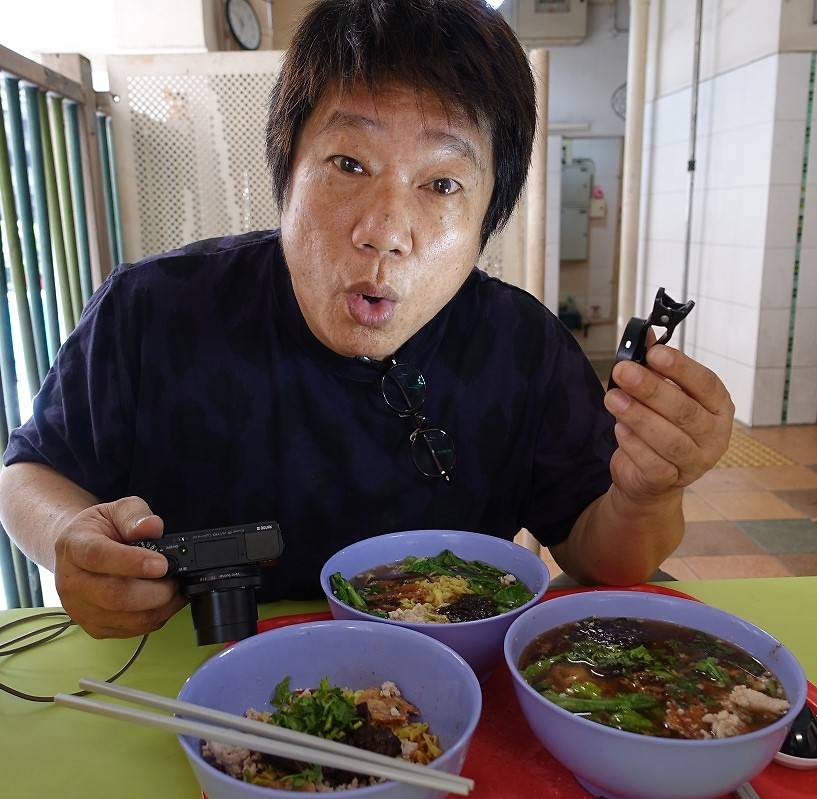
KF Seetoh_4

“I want to make people realise that the pleasure of eating is not just a function. It is about who we are,” says KF Seetoh. (Photo: Makansutra)

“THE GOVERNMENT SHOULD STAY OUT OF THIS”

One would think such efforts to keep the hawker trade alive would be lauded by advocates like Mr Seetoh.

I’m surprised when he says otherwise.

“I think the Government should stay out of this. They are not fit. They are not qualified,” he says definitively.

I ask him to explain his statements.

“Because they’re only throwing money at you. Hawker work is tough. Just because the Government wants to incubate you, doesn’t mean this job is easy.  You have to cook well, know how to reach people, know how to cook a hundred portions an hour and so on. A short course is not enough and pumping money into the industry to fire this up may not be helpful. It gives people the impression that it is so easy. They say, ‘Let’s go and do a ‘try, try’ thing’. It’s easy to walk out when you are funded by somebody else’s money, but if it’s your own and you realise that this is good, this is what you really want to do, it’s a different story.”

I suggest that if the Government stopped these initiatives, it would be even harder to keep the trade going. Even the ones who currently try may not consider it.

“Let’s attract the real ones. I’d rather encourage you to come out on your own because that will be more organic and you will be in it not because you got funding. It’s your own money. It’s your own belief. Go and learn as an apprentice. Go and work for a hawker for one year. The hawker may or may not teach you everything, but if you have slightly more than half a brain, you will be able to figure out the entire story and do it on your own later. 

“If you just take some funding and go for some Government programmes, you will still wind up with not much. The more successful newer-generation hawkers are those who came out on their own and they are still around despite the failures. They took time to learn. They didn’t fall the minute they came across the first wall.”

What would he suggest to encourage more such hawkers then?

It’s the same story as in the past. People went into the hawker business back in the day because they were desperate. Today, I think there’s more reason for you to be desperate again. A lot of jobs are going to the machines, the computers and Artificial Intelligence (AI). Maybe food is something AI cannot fully take over because people are spoilt with the pleasure of artisanal food.”

But even though consumers enjoy hawker food, in some quarters, being a hawker is still seen as a profession that lacks status.

“If we enjoy food, we can’t see it that way. It’s a very noble profession today. If you can think about it: ‘Wow, hey, maybe I like to dredge up this food that I believe in and love and I know that I’ve got a story to tell about this food and I want to sell and tell. And I want to go out and do it because it makes me happy and  because I know I can generate some money from this’.”

“LET THIS FOOD CULTURE DIE”

I’m sceptical about whether enough people will realise this on their own, but he reiterates the Government should “stay out of this”.

“Just give people very good, reasonable rents and tell them where to get their supplies. Let them figure out on their own how to be good, how to be better.”

Often, the issue of rent is raised as a hurdle to hawkers’ success. However, the NEA has taken a few measures to stabilise rents. This includes disallowing subletting and not setting a reserve rent when tendering out vacant stalls.

In July last year, Senior Minister of State for the Environment and Water Resources Amy Khor said that rental rates at NEA hawker centres remain in check.

The average successful tender bid for cooked food stalls over the three years leading up to her statement had been $1,370 per month, with bids ranging from S$1 to S$4,888.

Mr Seetoh believes that more can be done to ensure even lower rents.

If even under the right conditions, the traditional hawker food scene doesn’t flourish, “so be it”, he says.

“If it doesn’t happen organically, then let this food culture die. Then let the soil rot and let new shoots come out. Burn the whole forest down. Right now, the future looks bleak, but I still believe down the road there will be some kind of a sub-culture coming up. Somebody will realise that it’s not just about running a food stall. You can become the world’s best one-dish entrepreneur and your hawker store concept can go worldwide.”

In the meantime, he offers would-be hawkers something to aspire to.

“I will tell you how to get into it, who you can meet, who you can talk to and get into it because you love the food culture that you grew up with. It is very sexy.  I just came back from New York and one of the biggest food markets, street food players down there who has hawker stores, pop-up hawkers – he’s the only vendor in the entire United  States who’s been given permission to set up pop-up stores in the heart of Times Square. 20 to 30 million people traverse that area and that guy was saying, ‘I would love to have some Singapore hawkers.’ Imagine you are selling chicken rice balls in Times Square or nasi lemak packs and people talk about you. Those are very, very worthwhile goals.”

He’s quick to urge patience though.

“Don’t expect success overnight.”

KF Seetoh_2

“If it doesn’t happen organically, then let this food culture die. Then let the soil rot and let new shoots come out,” says KF Seetoh. (Photo: Makansutra) 

“HIPSTER FOOD IS NOT FOOD”

As more hawker centres are built to cater to changing tastes, Mr Seetoh cautions against going overboard.

While he laud efforts to automate certain functions, such as dishwashing, to keep manpower costs down in newer hawker centres, he doesn’t agree with the hipster feel that some have and other initiatives to inject vibrancy into the centres through events such as musical performances, digital art showcase, interactive games and art and music workshops.

“It’s irritating. When I eat, please shut up. I’ll give you S$5 for you to shut up.

“I feel hawker centres should be comfortable, but there’s no need to be fancy or hipster in terms of design. This takes away from the fact that you are selling food. It also shows desperation when you put on concerts and talks to attract people.  Make sure the food is good and ventilate the hawker centre well, make it more comfortable. That’s all people want.”

He also attacks the many young hawkers who have started serving up hipster cuisine.

“Hipster food is not food,” he declares. 

“With hipster food, you target the millennials who are not loyal. They will come once or twice, take a nice picture, post it on instagram and they won’t come back. You have to remember that millennials are people too and all people ultimately love good food. The traditional fare, if done well, will keep them and everyone else coming back. Focus on the food.

“Hipster food like putting curry in a waffle cone is also not going to attract tourists. The tourists want to eat char kway teow, hokkien mee, bak chor mee – stuff they can’t pronounce. If you always focus on new, new, new, I think the Singapore food culture will die within 10 years.”

When I remark that he might be too much of a purist, he clarifies that he doesn’t object to traditional food being infused with new elements.

“If you start putting giant prawns or lobster in your noodles, I wouldn’t fault you. Because you are still expressing who you are and if you are using fancier produce, you’re placing it nicely, serving it in a nicer environment, I won’t fault you because you’re still expressing who you are.”

A COMMITMENT TO TEACHING AND LEARNING

In order to keep this going, veteran hawkers have to be willing to teach. He claims he has heard that many of them are reluctant to do so fully even when they are paid to do so.

“The full recipes are not taught.”

But should we expect veteran hawkers to give their recipes away so easily?

“Yeah, we shouldn’t, but at least teach them the thinking behind the recipe, the taste notes, tell them about the techniques that go into the cooking and inspire the younger ones to come up with even better things.”

The younger ones, on their part, need to be patient and inquisitive when learning, he says. Hawkers tell him it can take several years to perfect a dish.

“Beyond that, you need to know how to design a stall, how to promote, how to scale, how to trend. All these are very, very important. Also, if you want to expand, who do you look for when you go overseas.”

He used to conduct such programmes to help would-be hawkers, and intends to do so again in the near future.

In the meantime, he continues to spread the stories of Singapore’s heritage cuisine far and wide and gain exposure for Singapore’s hawkers through special events.

I ask him if he has ever considered cooking for a living.

It’s something that has crossed his mind, but he loves what he’s doing today and intends to continue.

“I still have some energy left to do what I love doing. So one day, maybe as a retirement project, I will come out and be the next hipster hawker,” he says with a raucous laugh. 

When forced to get serious, he says he “will go back to tradition”.

“I think in 10 years, old food will be new again and put on a nicer plate maybe. I’ll sell you char kway teow and chicken rice with fancier cuts of meat and better ingredients.”

Today, his focus on preventing the death of Singapore hawker cuisine remains unstinting as he encourages younger hawkers to continue our traditions.

“I want to make people realise that the pleasure of eating is not just a function. It is about who we are. The pleasure of eating can be heightened if we realise this and I want to help people enjoy this journey a whole lot more.” 
Source link

‘My heart cries’: Muslim migrant workers ache for family, but find support from bosses this Ramadan

SINGAPORE: When Kadir Mohammad Abdul first arrived in Singapore seven years ago, he spent his nights crying. Then 26, the young father would call his family in Bangladesh in the evening, but make no mention of his misery to his parents, wife or children. 

Though once the calls ended, tears flowed.

“Why did I come to Singapore?” was the question he repeatedly asked himself. Like the thousands of migrant labourers who come to Singapore each year, life as a construction worker in the city state was not what he had expected it to be.

(ry) cooking sahur

Kadir and his coworkers heating up food for their predawn meal.

Before he left home, friends and relatives who had worked in Singapore told of a dream city where the roads were clean, people were friendly, and everyone followed the law. 

Above all, they spoke of a better life with better-paying jobs.

Although all of those things turned out to be somewhat true, it was what they had failed to bring up that was the cause of Kadir’s grievances.

“Singapore really is a dream country. But for workers, it is different,” he said. “Workers wake up at 6am to go to work. Come back at 11pm (after working overtime). After showering, praying and makan, it’s midnight. It means six hours of rest. 

“That’s why we are not feeling the dream.”

(ry) prayer 2

Morning prayer at the dormitory before these migrant workers head off to work. 

SIX RAMADANS AWAY FROM HOME

Other than the long hours and physical demands, Kadir – who has a master’s degree in Islamic Studies – also feared going to work because he could not understand some supervisors who, as a result of miscommunication, often got mad at him for not following instructions.

“My previous company was a Chinese company,” he explained. “I spoke English and Bengali, they didn’t understand. When they talked in Chinese, I didn’t understand. Supervisors sometimes got very angry. My life was very difficult.”

(ry) on bus

Kadir catching up on sleep on the way to work.

Language complications are commonly faced by many newly-arrived migrant workers. To end his misery, Kadir harboured thoughts of going home, even though he knew it wasn’t really an option.

Farming jobs in Comilla where he came from would not earn him enough to support a growing family. And on top of that, he had debts to clear.

To secure a job in Singapore, workers like Kadir who had no referral have to go through recruitment agencies in Bangladesh that typically charge between S$5,000 and S$10,000 in fees. To pay those agents, workers borrow large sums from banks or acquaintances. Their earnings from the first year or two in Singapore go towards repaying those loans.

Fortunately for Kadir, the situation at work improved as he learnt the ropes. He even approached a manager who could speak English and suggested: “My understanding is a big problem. You can teach me how to say things in Mandarin. Then I can translate for you (to other workers).”

(ry) morning exercise

Morning warm-up exercise led by Kadir who works as a safety coordinator at the Paya Lebar Quarter worksite.

Kadir’s newfound confidence and industry gradually earned him the trust of his managers and coworkers. He rose through the ranks and is now a senior worker.

But there is one thing he still constantly yearns for: His family.

When he left home in 2012, his son was only three years old and his daughter, one. His wife gave birth to their third child six months after he moved to Singapore. Now, his children are aged 10, eight and six.

Daily calls home make him miss them more. And these feelings of homesickness only intensify during occasions like Ramadan and Hari Raya Puasa.

It has been six long years since he last celebrated Ramadan with his family. This Eid al-Fitr, he will once again remain in Singapore, away from his wife and children.

(ry) dorm ext 2

Mandai Lodge 1 houses around 2,000 migrant workers.

FAMILY OF BROTHERS

At the intersection of Bukit Timah Expressway and Mandai Road, not far from Mandai Hill Army Camp and the Singapore Zoo, is Mandai Lodge 1. This gated dormitory is where Kadir and and almost 2,000 other construction workers retire after a long day at work.

Each dorm room houses 12 workers. These men from Bangladesh, India and China share facilities such as TV rooms, a laundry room, a gym and a basketball court. There is also a canteen, a grocery store and a barbershop.

But at the heart of their communal experience is the two-storey cookhouse. Rows of gas stoves and sinks cater to the cooking needs of all the hungry labourers. 

(ry) cookhouse 2

The cookhouse in the workers’ dormitory has rows of stoves to cater to the workers’ cooking needs.

This is where most days start and end for Kadir and his coworkers, especially during Ramadan.

They typically have breakfast here at around 6am, their meals usually consisting of rice and fish or chicken curry. By 6.30am, they would be on the company shuttle to the work site. 

Their labour ends at 7pm or 10pm, depending on whether there is urgent work to be done. And when they return to the dormitory, they cook.

Kadir moved to Mandai Lodge 1 last year after he joined Chian Teck Realty, a local SME. At 33, he is the big brother to a small group of mostly younger Bangladeshi coworkers.

“There are people from different districts here, but we feel like we are from the same family,” said Hosen Sahadat, 28, who has lived in Singapore for five years.

(ry) sahur 1

Kadir and his coworkers preparing their predawn meal.

The youngest of the lot is Hosen Abul, 26. He came to Singapore three years ago and is currently a general worker. Junior workers like him typically take home about S$800 a month; Abul says he sends home about S$600. His dream is to send his parents on the pilgrimage to Mecca.

“Many times when I lie in bed at night, I remember my parents back home,” he said. “I feel really bad especially when I think of my mother, but there is nothing I can do.”

As someone who has gone through it all, Kadir often uses himself as an example to spur his younger friends on.

“I show them that I work hard, and that’s why I now have my position. If you follow me, you can also have your dream position. Everybody can do it,” he stressed.

(ry) safety officer

Kadir checking up on his coworkers as one of the worksite’s safety coordinators.

At Chian Teck, Kadir works as a safety coordinator. He was asked to join the company last year by Xu Tian Cheng, one of its project managers who’d met Kadir two years ago on another project and thought him a “very responsible guy”.

Tian Cheng recalled the incident that made him decide to hire Kadir. “At construction sites, we have waste bins that get counted by the trip, so whether you fill them up 70 or 100 per cent, they charge you one trip,” he explained.

“Even though Kadir was in charge of safety, he made sure his colleagues filled up the bins totally. That’s what I saw, and that’s why I thought he was the right guy for us.”

(ry) construction site

Paya Lebar Quarter under construction.

SAFETY FIRST, ESPECIALLY WHILE FASTING

The team is currently working on Paya Lebar Quarter (PLQ), a mixed development by property developer Lendlease that consists of office towers, a shopping mall and a condominium. 

As the safety lead at one of the PLQ plots, Kadir is dead serious when it comes to his duties. “I want everybody to go back the same – meaning two hands, two legs and two eyes.

If anyone does unsafe work, immediately we stop them.  I remind them that their father, mother and children are waiting for them. 

“Or if they are single, I ask them how they are going to get married with only one hand or one eye. Cannot, right?” he laughed.

In the fasting month of Ramadan, extra precautions are put in place by Lendlease to ensure the health and safety of Muslim workers at PLQ. They make up over 70 per cent of the workforce on site.

“There’s a heightened awareness for us for this period, when there are risks associated with being in a very hot working environment and not eating or drinking throughout,” says Richard Paine, managing director of PLQ.

(ry) working in hot sun

Men working under the sun. Extra measures are taken to ensure the workers’ well-being during Ramadan.

Workers always work in pairs during this period so that they can keep a look out for each other. 

They also wear helmets with stickers that state “I’m fasting”, so that supervisors can easily identify them and assign them less strenuous tasks. Where possible, workers can also request to work night shifts to avoid doing laborious tasks while on fast.

(ry) putting fasting sticker on helmet

A hardhat with the “I’m fasting” sticker worn by fasting Muslim workers.

On a personal level, if conditions get tough, some workers do break their fast and make up for it on another day.

“On the second day of Ramadan, I couldn’t fast, it was difficult,” said Islam Shohidul, who has been in the country for four years. “I work with panels. When I cut them, they release dust that goes into the nose and it makes me feel very thirsty.”

While Ramadan is often associated with the physical discomfort of hunger and thirst, the rewards it brings to those who observe the faith are seen as fulfilling.

(ry) breaking fast on site

Chian Teck employees breaking fast together at the worksite canteen.

Kadir especially enjoys breaking fast on site at sundown with fellow Muslim workers and non-Muslim colleagues. Iftar meals during this period are provided by Chian Teck.

“Our company culture is like this. Boss said, last time our company was very small. But when we come here to work and support the company, the company also takes care of us,” Kadir said. 

We are one contractor, one family, that’s why we eat together and work together.

“PAPA, WHEN ARE YOU COMING BACK?”

Indeed, for Kadir and men like him, their Singapore family consists of coworkers with whom they spend almost every waking hour.

Many of them also have blood relatives – brothers, cousins, uncles – who work in other parts of Singapore, and together they form the extended family.

Sunday is when these families gather, usually at Little India where they feel most at ease. During Ramadan, they can seen breaking fast together, picnic style, on pavements around the precinct.

(ry) iftar little india

Kadir sharing iftar meal in Little India with Bangladeshi friends who work in other parts of Singapore. They do this every Sunday during the Ramadan month.

After the meal, they pray before they go shopping at Mustafa. But even when he is surrounded by his Singapore family, his parents, wife and children back in Bangladesh are never far from Kadir’s mind.

“Now I have money. But I go shopping by myself,” he said.

“In my country, during Ramadan, whole family goes to the shopping mall together. My father, mother, my wife and baby children, my brother and my best friend, everybody in one car. 

When I think of this, my heart cries.

Kadir was planning to go home for Eid this year, but had to reschedule due to unfinished work at PLQ – which is due to open in phases from the second half of this year.

“When I called my small baby, she said, ‘Papa, when are you coming back? I’m waiting for you.’ And then they sometimes cry.

(ry) kadir family

Kadir looking at a picture of his wife and child.

“They would ask me, ‘Another uncle is coming back, why are you not coming home?’ I would tell them, ‘I already sent you money, you can go shopping with your mother.’ They’d say, ‘No, I’m not happy with mother, I want you.’ 

“When they talk like this, it really pains my heart. I cannot tahan.”

Kadir said he plans to head home for good when he hits the 10-year mark in Singapore.

“For me, money is not the most important thing. I’ve seen other men return to Bangladesh when they are old, and they are too weak to enjoy the time with their family. I don’t want to be like that,” he said.

Next week: A Singapore family shows their appreciation for Kadir and his fellow migrant workers this Ramadan.

Source link

Singapore signs defence agreements with UK, Germany

SINGAPORE: Singapore signed two separate defence agreements with the United Kingdom and Germany on Saturday (Jun 2), covering areas such as cybersecurity, counter-terrorism and maritime security.

The Memorandum of Understanding (MOU) with the UK is the first on defence signed between the two countries.

Signed on the sidelines of the Shangri-La Dialogue, the agreement covers cooperation in areas ranging from cyber and non-conventional warfare, to counter-terrorism, as well as maritime security and disaster relief.

“It’s also a partnership that will extend beyond operations, to innovation and to scientific technological development, blending the talents of our nations so we will be able to have cutting edge capabilities needed to tackle tomorrow’s threats, while also enhancing our own nations’ prosperity, both the United Kingdom’s and Singapore’s,” said UK Secretary of State for Defence Gavin Williamson.

Singapore Defence Minister Ng Eng Hen said it is “particularly appropriate” that the MOU was signed this year, given the historical ties both countries share and that Singapore is gearing up to mark the 200th anniversary of Sir Stamford Raffles’ landing on the island.

Dr Ng also noted the “warm and long-standing” bilateral defence relationship. 

Earlier on Saturday, Dr Ng signed an enhanced defence cooperation agreement with German’s Federal Minister of Defence Dr Ursula von der Leyen. 

Ng Eng Hen Germany defence minister

Singapore Defence Minister Ng Eng Hen (right) and German Federal Minister of Defence Dr Ursula von der Leyen signing an enhanced Defence Cooperation Agreement (DCA) on the sidelines of the 17th Shangri-La Dialogue. (Photo: MINDEF)

It builds on the existing pact signed in 2005, and paves the way for future cooperation in non-conventional security areas like cybersecurity and hybrid attacks. 

“We signed the first DCA (Defence Cooperation Agreement) between Singapore and Germany in 2005. Since then, defence relations have grown in breadth as well as in depth … so this enhanced DCA is very timely to consolidate existing platforms and define new areas of cooperation,” Dr Ng said.

At their bilateral meeting earlier, Dr Ng expressed Singapore’s appreciation to Germany for its support in allowing the Singapore Armed Forces to train in Germany since 2009, which includes an annual bilateral live-firing exercise between both armies.

Source link

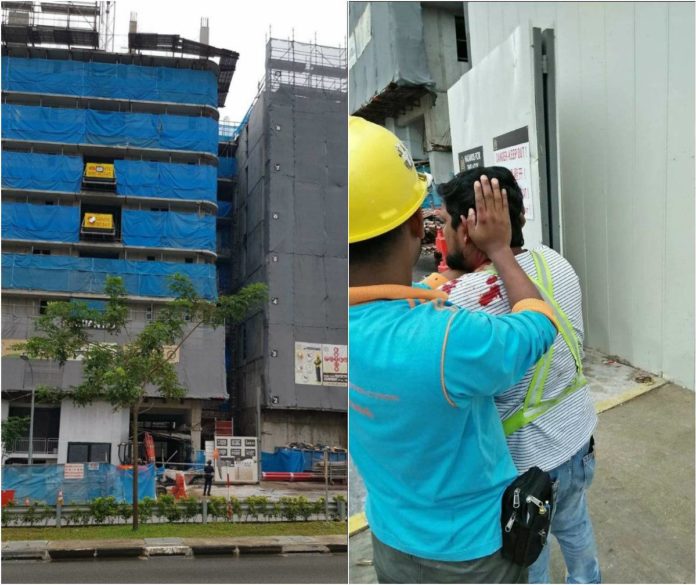
3 workers injured after scaffolding collapses at Bukit Batok construction site

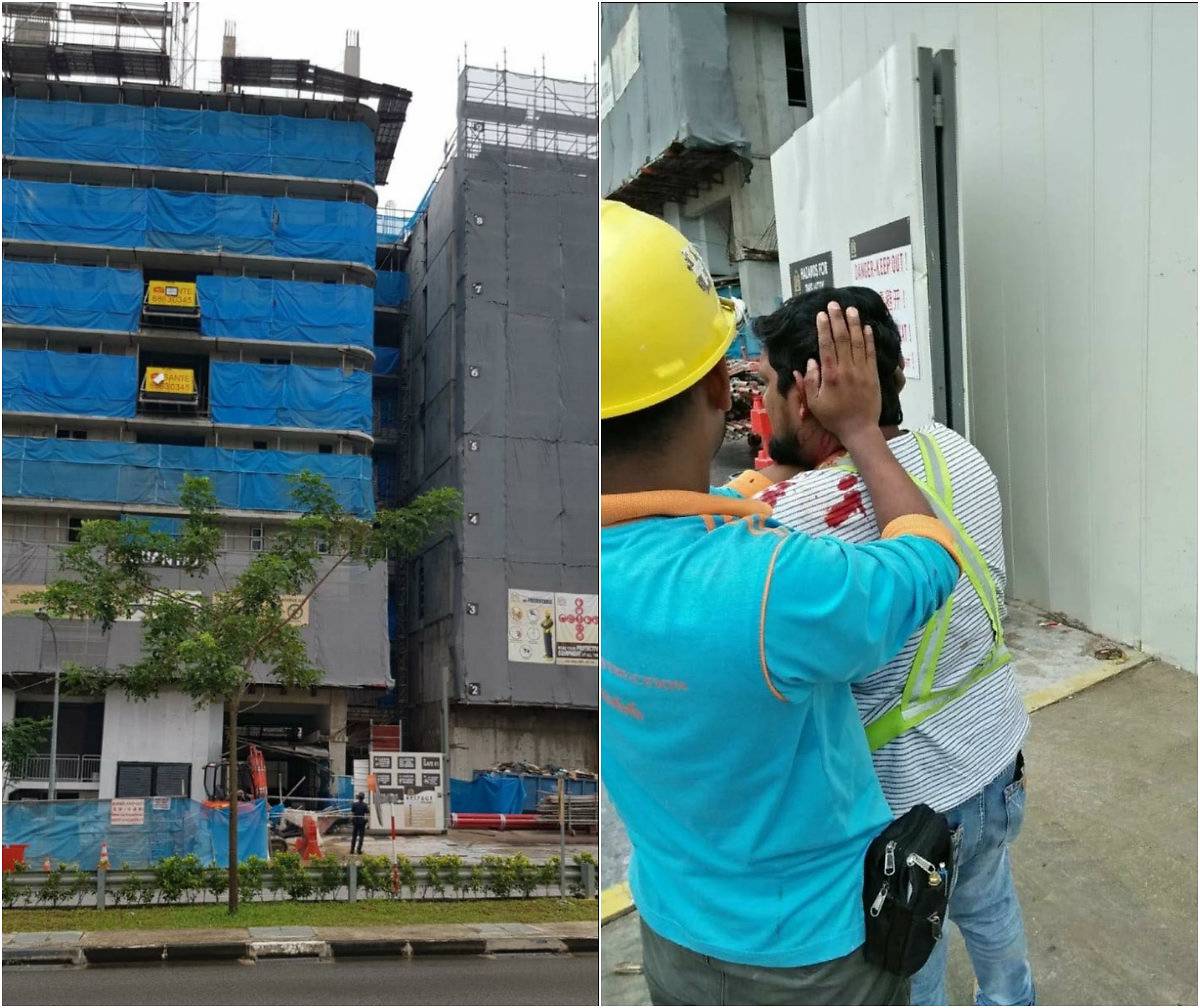
SINGAPORE: Three workers were injured after a scaffolding fell from the ninth storey of a building under construction in Bukit Batok on Saturday (Jun 2). 

The Singapore Civil Defence Force said it responded to the incident at 448B Bukit Batok West Avenue 9 at about 11.50am. All three workers, who are in their 30s, were taken to Ng Teng Fong Hospital. 

Responding to Channel NewsAsia’s queries, the Ministry of Manpower (MOM) said it has instructed the company, Guan Ho Construction, to stop all work while it investigates the incident. 

The ministry added that the developer of the project under construction is MOH Holdings, the holding company for Singapore’s healthcare institutions.

According to an Urban Redevelopment Authority location plan, a nursing home is being built at the site. 

Photos uploaded onto a Facebook page show a worker bleeding from his ear, while another worker is seen lying face down on the ground near several collapsed structure. 

Construction site Bukit Batok West Ave 9

The construction site at Bukit Batok West Avenue 9 (left), and an injured worker at the construction site (right). (Photos: Facebook/Safety First (Singapore))

Source link

Singapore launches first digital readiness blueprint, with inclusivity a key thrust

SINGAPORE: Singapore has launched its first digital readiness blueprint, with inclusivity a key thrust in the initiatives the Government is embarking on to get Singaporeans ready for the digital economy.

Minister for Communications and Information S Iswaran, who unveiled the blueprint on Saturday (Jun 2), said the document comprises of strategies and recommendations made by the Digital Readiness Workgroup, which was convened last year.

The 16-strong workgroup was led by Dr Janil Puthucheary, Senior Minister of State for Communications and Information and Transport, and included officers from MCI, Ministry of Education, Ministry of Culture, Community and Youth and the Smart Nation and Digital Government Group, as well as private sector executives from Google, Facebook, Microsoft and DBS Bank. Representatives from Singapore Polytechnic, SG Enable and Touch Community Services round off the group.

“This blueprint … contains recommendations around providing widespread access to technology, driving digital literacy, encouraging everyone to play a part in strengthening digital readiness and hardcoding digital inclusion into the design of all processes and services,” Dr Janil said in the foreword of the document.

The 10 recommendations by the workgroup are:

  • Make access to basic digital enablers as widespread as possible
  • Customise access package for those with specific needs
  • Identify a set of basic digital skills for everyday activities to spur take-up of technology, especially among the less digital-savvy
  • Strengthen focus on information and media literacy to build resilience in era of online falsehoods
  • Ensure that children and youth grow up to form meaningful relationships with people around them and use technology to benefit their communities
  • Encourage private and people sector organisations to amplify efforts and help more Singaporeans adopt technology
  • Provide one-on-one assistance to make it easy for Singaporeans to adopt technology, especially those who find it challenging
  • Provide support for projects that create opportunities for community participation
  • Encourage organisations to design for digital inclusion
  • Reach out to more Singaporeans by ensuring that relevant digital services are made available in vernacular languages

VERNACULAR LANGUAGES FOR MORE DIGITAL SERVICES

In a multiracial, multilingual society like Singapore, the workgroup pointed out that “language can sometimes be one of the key barriers to the understanding, acceptance and adoption of anything, including technology”.

As such, it stressed that relevant services, whether it is an app, a workshop or publicity materials, should be communicated and implemented in vernacular languages to reach out to non-English-speaking Singaporeans, especially the elderly.

Machine translation could also be used where possible to make apps more usable to those who speak only vernacular languages, it added. The Info-communications Media Development Authority (IMDA) had in November last year unveiled the National Speech Corpus, an example of an artificial intelligence (AI) library, to “support and enhance the accuracy of speech recognition engines” here.

While the effort to offer vernacular languages is not new, the workgroup stressed that Singaporeans should be given the option of transacting and using digital services in their mother tongue languages, particularly for common tools like communication apps and more regularly used digital government services. 

HELPING “DIGITAL NON-NATIVES”

As for the one-on-one assistance recommendation, the workgroup said they see a need to provide greater support for “digital non-natives” on the use of such devices or services. The IMDA and National Library Board (NLB) have some initiatives today to assist seniors and mature adults in navigating the technology landscape.

MCI had, for instance, mentioned in this year’s Committee of Supply debates that under IMDA’s Silver Infocomm Initiative, digital clinics and experiential learning journeys will be made available to the elderly to try their hand at technology.

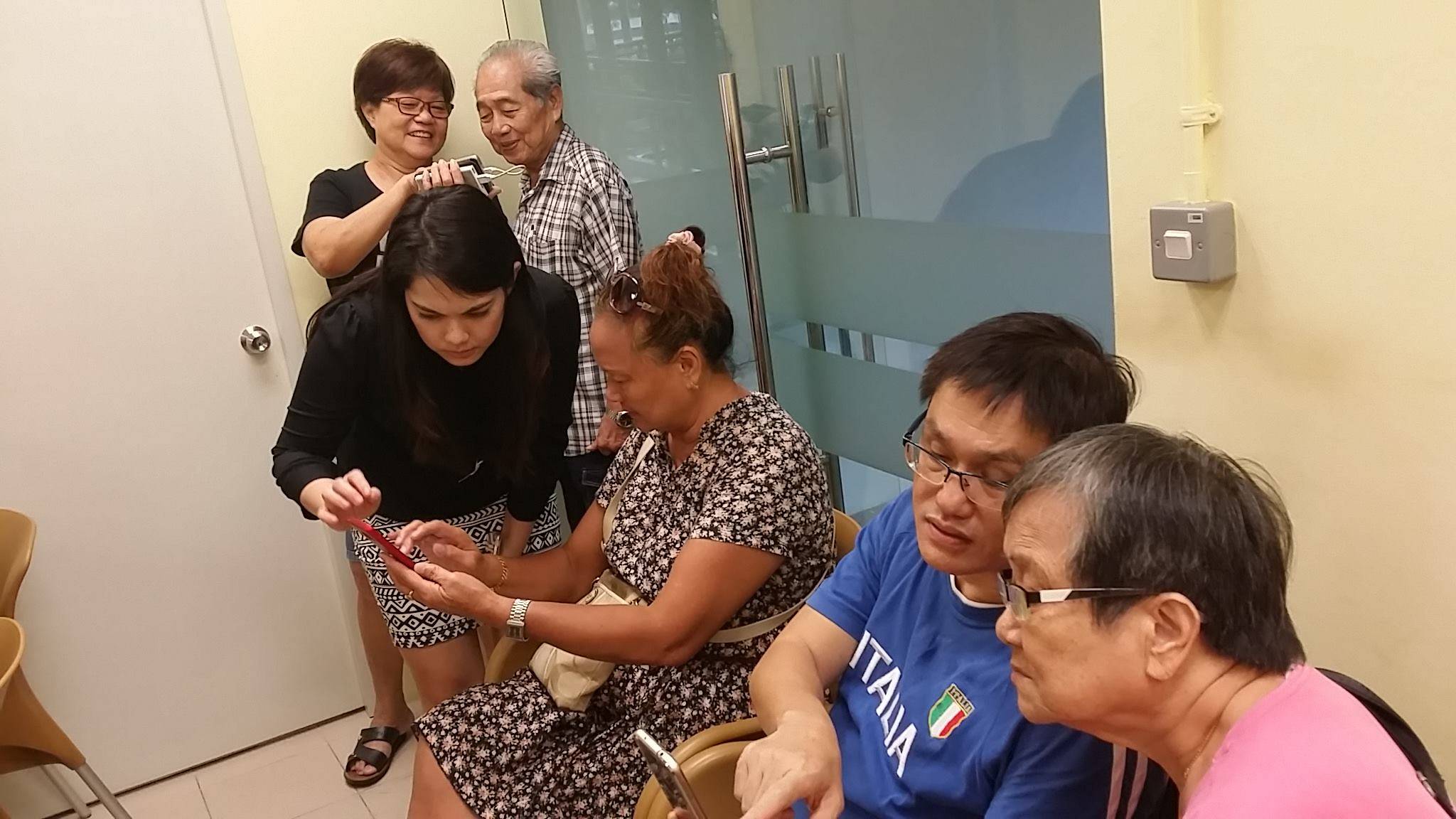
IMDA staff helping elderly with IT

IMDA staff helping senior citizens learn IT skills during its IM Bonding project. (Photo: IMDA/Facebook)

In tandem with these, the workgroup recommended a “dedicated and regular avenue through which the public can obtain one-on-one concierge-type assistance” on the use of digital devices or services. This can be offered at common social gathering points like community clubs, public libraries and senior activity centres, and staff there can help impart basic digital skills, it added.

A MCI spokesperson told Channel NewsAsia that the intention for this recommended assistance is intended to be a permanent avenue in the long term, and the operational model is being discussed by the relevant agencies. It will be piloted at selected community clubs by the fourth quarter of this year, the spokesperson added.

It also suggested that more emphasis be placed on helping citizens living in mature estates that have higher proportions of seniors.

Madam Saw Geok Choo, an 80-year-old who does not live with her family, was held up as an example in the blueprint. She received a new smartphone from her daughter, but did not have anyone to easily turn to for help in using the device and did not want to trouble others to find out more.

She later learnt about IMDA’s digital clinic from her friend and attended one in May this year, which proved useful as she learnt how to check for bus arrival timings and transfer photos from her old phone to the new.

What, then, is the end goal now that the blueprint is revealed?

The Government said its digital readiness efforts are directed at ensuring four “strategic outcomes”: That every Singaporean has the means to transact digitally, has the skills, confidence and motivation to use technology, makes use of technology to achieve a better quality of life and every digital product or service is designed for easy and intuitive use.

“The heart of the nation is our people,” Mr Iswaran said. 

“And we want to ensure that all Singaporeans can thrive and lead fulfilling lives in a digital era, using technology as a critical enabler.”

Source link

New framework mooted to combat online scams, misinformation in Singapore

A national info and media literacy framework will consolidate existing initiatives by IMDA, NLB, CSA and the Media Literacy Council.

Singapore students showcasing cyber wellness game

CHIJ Katong Primary students showing their cyber wellness project to those at the 14th Conference of ASEAN Ministers Responsible for Information. (Photo: Media Literacy Council/Facebook)

SINGAPORE: A new common framework to incorporate the various information and media literacy initiatives currently available is being developed to build up Singaporeans’ resilience against online scams and deliberate online falsehoods.

This was announced by Minister for Communications and Information S Iswaran on Saturday (Jun 2) when he unveiled Singapore’s first Digital Readiness Blueprint.

A spokesperson from the Ministry of Communications and Information (MCI) told Channel NewsAsia separately that a national info and media literacy framework will bring together existing programmes by the Info-communications Media Development Authority (IMDA), National Library Board (NLB), Cybersecurity Agency of Singapore (CSA) and the Media Literacy Council (MLC).

These programmes include the Better Internet Campaign, Cyber Awareness Campaign and SURE (Source, Understand, Research, Evaluate).

This common framework will help guide public education efforts as well as to ensure consistency in public messaging and communications, the spokesperson said.

The spokesperson added: “The digital age offers both tremendous opportunities and also risks, as can be seen with the proliferation of fake news, videos and so on. Public education has been identified as a bulwark to tackle the issue, and part of that will involve stepping up efforts to bolster information and media literacy skills.

“We hope that through a concerted approach, we will contribute towards raising scepticism of misinformation in the short to intermediate term and a more informed and resilient community against such online falsehoods in the longer term,” the spokesperson said.

The framework is being developed by MCI in collaboration with IMDA, NLB and CSA.

On Saturday, Mr Iswaran unveiled the country’s first Digital Readiness Blueprint that addressed the issue of information and media literacy and contained other strategies and recommendations made by the Digital Readiness Workgroup.

One of the recommendations called for the provision of customised resources including how to discern online falsehoods.

“These resources should be made readily accessible, and carry information that is easily understood,” the document stated. “This includes making sure that the resources are made available in Singapore’s four main languages to reach out to non-English speakers too.”

The issue of deliberate online falsehoods was put under the microscope earlier this year when a Select Committee led by Deputy Speaker Charles Chong was convened and a host of experts and industry stakeholders were invited to give their views in writing as well as during the eight-day public hearing.

Source link

Promo codes, lower minimum orders: Is a price war brewing among food delivery apps?

SINGAPORE: The entry of a heavyweight player like Grab has turned up the heat in the local food delivery scene and some observers expect a tussle for market share to whip up a potential price war here. 

GrabFood, the food delivery arm of Grab, was officially launched in Singapore on Monday (May 28). It replaces UberEats, which the ride-hailing giant had acquired when it took over Uber’s operations in Southeast Asia, and will go head-to-head with a slew of food delivery apps. 

Among them include foodpanda and Deliveroo, which entered Singapore in 2012 and 2016, respectively. 

While the growing food delivery scene has seen various new entrants over the years, Grab’s market stature and deep pockets “will definitely shake up” the industry, said associate professor Lawrence Loh from the National University of Singapore (NUS) Business School. 

“It is coming from a totally different vantage point,” he explained. “Once Grab is in, the market’s competitive dynamics won’t be the same anymore.” 

Echoing that, Mr Samuel Tan, a retail management expert from Temasek Polytechnic’s (TP) School of Business, said Grab is supported by competitive advantages derived from the acquisition of UberEats and its domination of the on-demand transportation market. 

“They are building on the large customer base of existing Grab services and UberEats. Food and beverage vendors will be eager to come on board given the established set-up … Additionally, in terms of technological advantages, Grab has its own expertise on top of that from the merger with UberEats.” 

Grab also seems “serious about getting a stronghold in the food delivery business” as it steers itself towards the goal of becoming an “everyday app”, said Assoc Prof Loh. 

“To be able to attract so many restaurants within two months says something … This is just the beginning and I don’t think they will stop here.”

PRICE WAR BREWING?

Price will likely be the first battleground for the eager new player aiming for a slice of the market pie and incumbents defending their turfs, experts told Channel NewsAsia. 

This boils down to how price-sensitive customers are and the low switching costs involved. “An alternative option is just an app away,” said Assoc Prof Loh. 

Nanyang Technological University’s (NTU) associate professor Momin Zafar Abdulmajid reckoned “a price war is imminent as Grab looks to build up the size of the business quickly”. 

Already, GrabFood has dished out a promo code giving users a S$5 discount for three orders before the end of this week, among other promotions. 

When asked if there could be more discount codes in the pipeline, a Grab spokesperson said the company “continually creates new and exciting products, not just on the food delivery front, to ensure that customers always have something new and exciting to look forward it”.

GrabFood delivery

File photo of a GrabFood delivery. (Photo: Grab)


Other food delivery players also seem to be gearing up to compete on price. 

Apart from a promo code for first-time customers, London-headquartered Deliveroo has sliced its minimum order value from S$18 to S$12 and reduced delivery fees by 50 cents to S$3. 

Homegrown online concierge service Honestbee also cut its minimum spend on orders by nearly half to S$8 in April and offers free delivery. “We hope that we’ll be able to entice more customers to try out our food delivery service,” said its Singapore managing director Chris Urban.

Over at major player foodpanda, the minimum spend was reduced to S$12 from S$15 in February. When asked if it could do away with that or have promo codes like its rivals, managing director Luc Andreani replied that the company focuses on balancing a long-term business model with “the dynamics of the industry” and is “continuously exploring next steps”.

MORE THAN JUST PRICE

But market observers were quick to add that while a competition on price could take place in the near term, it would unlikely be sustained as it is a costly undertaking that will ultimately be detrimental to all.

“A sustained price war, like what we saw in the ride-hailing scene, will be very bloody,” said Assoc Prof Momin, referring to the bruising battle for market control between Uber and Grab that prioritised aggressive discounts over profits. 

Besides, players in the local market still have work to do when it comes to improving efficiency and profitability through the scale of their operations. 

“The business is good but to make money, they will need to be of a reasonable size to optimise resources. None of them in Singapore have scaled enough to be that efficient or economical,” said the NTU professor who is experienced in strategy consulting.

Food delivery players that Channel NewsAsia spoke to clearly understood that.

Mr Andreani stressed that foodpanda’s business philosophy “is not centred around a quick-win burn-based strategy” though being backed by Berlin-based Delivery Hero means that it has “the resources and capabilities to match or better any of the offerings in the market” should it wish to do so. 

The oldest player in the food delivery market here said it has signed up more delivery riders and merchants in recent months, as well as replaced UberEats in a rewards programme of e-commerce platform Lazada. Its growth plans also include opening a centralised kitchen with a dine-in concept

“With the amount of data that we’ve amassed, we are able to successfully predict trends of our users and allows us to better plan for resource allocation to ensure that we operate at an optimal level … With a better understanding, we are able to predict and adjust our promotions accordingly to retain a strong market share and repeat orders.”

Growth for the first quarter of 2018 has been a robust 45 per cent, said Mr Andreani. But he declined to reveal specific figures on profitability and would only say that operations in Singapore are “firmly on a path to profitability” that is expected to materialise early next year. 

Deliveroo Foodpanda collage

For Deliveroo, while current priorities in Singapore remain on growth, profitability is equally important. 

“In the short term because of the competition, we will have promotions but to build a product that consumers want to continue using, it’s a combination of price, selection and service,” said general manager Siddharth Shanker. 

To do so, Deliveroo has invested in technology with the launch of a new business intelligence unit and set up delivery-only central kitchens here. The latter, which runs on leaner cost structures, helps it to “reduce prices more meaningfully and sustainably”. 

Deliveroo has also added a “very big number” of 2,000 freelance delivery riders since April, while attracting more than 300 restaurants that were formerly listed on UberEats – boosting its total restaurant-partners to 4,000 and delivery fleet size to 6,000. 

“We anticipated that with the re-establishing of a player in the market, there will be uncertainty and it will be an opportunity for us to get market share … so we put together a plan months ago and once the merger happened, we started work on it,” said Mr Shanker. 

While Grab declined to reveal the exact number of restaurants it is partnering, it said a majority were from UberEats. 

“Our priority was to ensure that they come on board as quickly as possible in order to continue having a platform for delivery for their F&B business,” said a spokesperson, who added that these merchants enjoyed a waiver of an onboarding fee. 

Noting that there are about 4,000 restaurants and 12,000 hawker stalls that remain untapped by food delivery apps, Grab said that it “will bring more food vendors online to offer the widest selection of cuisines and local delights for consumers, and more revenue opportunities for merchants.” 

SMALLER PLAYERS SEE CONSOLIDATION?

As the battle for food-delivery supremacy plays out, experts said smaller players may lose out and face consolidation. 

“If the smaller rivals can’t match the deals offered to customers and partners, they might lose out. If Grab’s partner restaurants base is very large, the smaller players might lose out as well,” said associate professor Nitin Pangarkar from the NUS Business School. 

However, some experts like TP’s Mr Tan said having a niche target market may help smaller players to stay afloat. Tie-ups with selected F&B outlets or diversification in the range of delivery services may also help, he suggested. 

While there may be some short-term impact, Fastbee’s founder Khoo Kar Kiat said he remains confident that his business “fills an unique niche” and customers will return once the promotion campaigns wane. 

Fastbee is an online portal for people to make lunch orders and later pick up their food from designated vending machines. Founded last year, the start-up focuses on delivering hawker food and targets workers at various industrial and business parks in the West. 

“To keep our business sustainable, Fastbee has been continually refining our business processes in order to reduce our business cost even further,” he said. 

For restaurants, the myriad of food delivery apps has been a boost to sales and brand visibility, with most preferring to team up with several platforms. 

Bismillah Biryani Restaurant, for instance, is available on at least five, including GrabFood. 

With the additional exposure likely to bring in more sales orders, Ms Zara Salahuddin, who manages the restaurant’s delivery business, said “there’s nothing to lose” even as terms and conditions offered by GrabFood remained the same as UberEats. 

Despite that, the restauranteur said she will be watching the competition in the online food delivery scene closely. 

Noting the possibility of a price war that could translate into perks for customers and restauranteurs, she said: “Who wouldn’t want lower commission rates or promo codes? But I think it’s also important that they don’t lower so much that it affects other parts of their business. That would be the worst-case scenario for all of us.”

Source link

‘See the number of cups thrown’: Can the waste produced during marathons be reduced?

SINGAPORE: When avid runner Anjali Sharma started taking part in major running events in Singapore six years ago, she was shocked by the sheer amount of waste they produce.

“You see the number of cups that are thrown and you just think, oh my god,” the 38-year-old, who runs a communications consulting firm, told Channel NewsAsia. “You open the race pack and you want to vomit, because there’s that much paper inside.”

Ms Anjali, who grew up in India and ran competitively before moving to Singapore, participates in an average of five runs a year. This includes the Standard Chartered Singapore Marathon (SCSM) and Great Eastern Women’s Run.

And at each of her races, she tries to go waste-free by always carrying her own water bottle and giving up her race pack, medal and finisher’s tee.

“I repeat my tees,” she said. “What are you going to do with the medal? You finish the 21km in two hours, you get a medal; you finish it in four hours, you get a medal.”

“The amount of paper in the race packs – I get a vision of a factory line preparing these bags, and they’re literally picking up paper after paper and just dumping it inside the bag,” she added.

While there are no statistics on how much waste is produced by the annual marathons here, Singapore Environment Council (SEC) executive director Jen Teo told Channel NewsAsia it is a matter for concern.

“There’s a lot of litter found after these events, be it this type of race or National Day. It’s not just the litter, people dump their plastic bottles and it means a lot of waste out there to be cleared,” she explained.

According to organisers, last year’s OSIM Sundown Marathon – which attracted some 27,000 runners – produced almost 22,000kg of waste, just slightly lesser than the weight of two buses. The waste came from 39,700 banana peels, 18,075 packs of energy gels, paper cups and water bottles.

marathon waste 2

Workers putting away waste after the 2XU Compression Run on Apr 8. (Photo: Aqil Haziq Mahmud)

Ms Teo said there’s “definitely an increase” in the amount of waste produced by such runs over the years, given how organisers try to offer more freebies to “get people excited or interested”.

“Seriously, how much of all these do you use? It’s another goodie bag, T-shirt or medal that you collect,” she said. “But people are much more aware now in terms of what they can do to generate less waste by taking less, consuming less.”

And these people, like Ms Anjali, are jumping at the opportunity to sign up for races with an eco-friendly slant.

ZERO WASTE RUNNERS

At this year’s Income Eco Run, which took place on Apr 29 and attracted 9,000 participants, a total of 1,974 runners participated as zero waste runners, which means they gave up their medal and finisher’s tee.

This figure, according to an SEC audit released in May, is a 30 per cent jump from last year. Some 2,000 runners also opted out of getting race packs.

This means organisers saved about 1,400kg of material including metal from medals, polyester from finisher’s tees and fabric from race packs, the audit showed. This figure is an 80 per cent increase from last year.

marathon waste 3

Recycling aluminium cans at the Income Eco Run. (Photo: Income Eco Run)

While the audit indicated that each runner generated 0.1kg of waste, 26 per cent more than last year, the overall recycling rate also went up from 63 per cent to 94 per cent.

This came as organisers used recyclable cups with 50 per cent less plastic lining as compared to standard paper cups, which cannot be recycled. On top of that, banana peels were composted and plastic bottles and cans recycled.

Runners were also encouraged to carpool, use public transport or take provided shuttles to the event, meaning the race produced 30 per cent less carbon emissions as compared to last year.

marathon waste 4

Cups being sent for recycling after the Income Eco Run. (Photo: Income Eco Run)

Ms Teo said the measures proved to be “significant”. “They have been very conscious about ensuring that at every step of the way, where they acquire the applicants, they also educate them on what they can do in terms of adopting an eco race,” she said.

Ms Anjali, who participated in the Income Eco Run, said organisers made it simple for runners to reduce waste. “A lot of people want to be good people and help the environment,” she said. “So if I can just tick a button to choose to be a zero waste runner, then it just becomes so much easier.”

To that end, she added, organisers made use of the thousands of runners, or “captive audiences”, to make an environmental difference on a larger scale. “Races should all do what Eco Run is doing,” she stated. “You’ve got those people, do something with it.”

WHAT ARE OTHER RACES DOING?

IRONMAN Asia, which organises the SCSM taking place on Dec 8 and 9, said it deploys ambassadors on its race route to encourage runners to recycle and sort trash into the correct bins. It did not say how much waste last year’s race produced.

A clean-up team will also comb through the route post-event to ensure all waste, including recyclable materials and gel packets, are recycled and disposed properly, it said.

“The team has also increased the number of waste and recycle bins throughout the marathon route,” it added, pointing out that trash disposal was made fun by having basketball-themed bins to aim at.

HiVelocity, which organises the OSIM Sundown Marathon, said it encourages runners to bring their own bottles through pre-event announcements on social media, and places signs along the route to remind runners to dispose trash responsibly.

It also stretches water point areas by adding more but smaller disposal points, while placing larger disposal areas near the finish line.

marathon waste 5

Recycling bins at the OSIM Sundown Marathon on May 19 and 20. (Photo: OSIM Sundown Marathon)

For this year’s race, which took place on May 19 and 20 and attracted 25,500 runners, more recycling bins and signs were set up, organisers added, while ambassadors spread the message on-site through signs and pledges.

Channel NewsAsia has contacted the organisers of the 2XU Compression Run, SAFRA Singapore Bay Run and Army Half Marathon, and Great Eastern Women’s Run for comment.

MORE CAN BE DONE

Nevertheless, Ms Teo feels that more organisers can follow suit. “There’s a lot more out there that can be done,” she said. “You’re talking about at least a hundred of these events in a year. And these are just sports events.”

However, she acknowledged that organisers face logistical challenges when planning ahead and providing an option to give up freebies.

marathon waste 6

Ms Rima Chai (holding up second sign from left), popularly known as Tyre Lady, with green ambassadors at the OSIM Sundown Marathon. (Photo: OSIM Sundown Marathon)

Ms Rima Chai, an experienced runner who has since 2006 been lobbying race organisers to go green, said some are hesitant as they fear it might affect their brand.

“People like free things,” the 48-year-old said. “Have you noticed how runners put up pictures of their goodie bag on their blogs and compare them with other races?”

As for the runners, Ms Chai said some care more about their personal best timings. “It is another egotistical badge to have an excuse for not being mindful,” she said.

For Ms Anjali, reducing waste during runs has not affected her experience “in any way”. “I didn’t lose out on anything,” she said. 

“What I do think is that you would always have a section of society who would not opt for it. But you have to go with the fact that there’s a certain section of society that opts for it, and that’s what I am going to work with.”

The pair also encouraged fellow runners to start by bringing their own bottle. “Learn to care,” Ms Chai said, highlighting how volunteers picked up 3.5kg of trash – including gel packs and shoe soles – along a 5km stretch of East Coast Park after last year’s SCSM.

Ms Anjali added: “Go with whatever is easy for you to do, but do something.”

Source link

Commentary: Can education fix inequality in Singapore? If not, what can?

SINGPORE: Combating inequality has been declared a “national priority” in Singapore. 

This makes sense, given the pernicious effects that persistently high inequality can have on economic growth, political stability, social cohesion, quality of life, and even national security.

The 2016 Brexit and Trump votes occurred in the two major developed countries with the greatest income inequality — the UK and US respectively. Studies suggest that socio-cultural as well as economic divides resulting from inequality contributed to these electoral results, which have since led to populist and protectionist policy proposals that will slow growth in the long run.

Inequality itself also directly lowers economic growth through under-realisation of scarce talent, and weaker consumption demand — both are of particular concern to Singapore given our small labour force and market size. 

As an already mature, high-income and thus slow-growing economy, we can also no longer expect rapid growth to mask the economic effects and social challenges of rising inequality, as it did in previous decades.

Instead we need to boldly confront the root causes of inequality, which lie in how our economic and social institutions actually work. Focusing on education policy as the main solution can actually worsen inequality.

HOW DOES EDUCATION CONTRIBUTE TO INEQUALITY?

In developed economies like the UK, US and Singapore, income inequality increases with average incomes because growth increasingly derives from the application of capital and skills, rather than labour, to production, as comparative advantage and technology shift in a capital- and skills-biased direction.

This raises the returns to capital (profits and rents) and skills (PMET salaries) more than it does the returns to labour (wages). Education, especially university education, contributes to the widening skills premium (excess of skilled over unskilled labour income), and parents and students naturally clamour for more of it.

This is where education and inequality are mutually reinforcing. Higher-income families invest more in private tuition for academic subjects, extracurricular enrichment activities, and parental attention. 

This enhances their children’s school performance and chances of getting into “good” (elite, brand-name) schools and universities, thus achieving credentials that employers value and reward with “good jobs” and high salaries. 

Employers are known to use educational certification and school reputation as “screening devices” that differentiate between job candidates, and as proxies for behavioral characteristics and social networks they believe enhance employees’ contribution to the enterprise.

Expansion of higher education has been accompanied by a widening “college premium” — or gap between graduate and non-graduate incomes — even as the supply of graduates increases.

Recent studies in the US and UK suggest that this is due to losses to non-graduates, as well as gains to graduates, as employers start requiring degrees for work that did not need it 30 years ago.

And as university degrees become more common, institutional reputation becomes more important, intensifying competition for places at the most selective institutions, and widening their graduates’ salary premium over graduates of less selective institutions.

File photo of students taking their seats for the diploma ceremony at Harvard University in Cambrid

A university student graduation. (Photo: REUTERS/Brian Snyder)

READ: The relentless pursuit of university rankings is leading to a two-track system, a commentary.

READ: Is academic competition really necessary to be the best we can be? A commentary.

CAN EDUCATION REFORMS REDUCE INEQUALITY?

Policy-makers in developed countries have focused on reforms in education to reduce inequality. In some countries, particularly the US, unequal resource allocation between “rich” and “poor” school districts is a major factor contributing to unequal educational, employment and income outcomes. 

This is less of a problem in Singapore, given the Ministry of Education’s worthy efforts to equalise the allocation of resources — including the “best” teachers and administrators — between “neighbourhood” and “elite” schools.  But it is hard to improve already high-performing, well-resourced schools.

More importantly, as we noted in the New Nation in 1976: ”The effect of any school variable which can be manipulated by decision-makers is small relative to other determinants of student performance … Family background is a very important variable affecting educational performance and earnings of individuals … changes within the school system itself will not necessarily bring about more equal performance of students in school or greater income equality among them when they are employed.”

Recent, separate research by NTU associate professor of sociology Teo You Yenn, and NUS associate professor of social work Irene Ng, confirms the dominant impact of family circumstances on student performance in Singapore today.

The PISA test which we regularly top shows that 15-year-old students in Singapore on average perform better than those in OECD countries, but here the gap between the top and bottom scorers is wider and the dependence on parents’ socio-economic status higher.

Another popular policy is to increase lower-income students’ access to more selective schools, including through priority admissions, as Singapore plans to do in Primary One and post-PSLE student assignments to elite schools.

But at best this can cater to only a small subset of low-income students, probably those already best qualified. This could widen the student performance gap between elite and neighbourhood schools, and subject more families to “exam stress”. 

secondary school students Singapore

Students awaiting their exam results. (File photo: TODAY)

Since school performance is heavily dependent on family resources, lower-income children could underperform relative to higher-income classmates in elite schools, reinforcing stigmatisation from priority admission, and lowering self-esteem which research shows is a major determinant of individual performance.

Priority admission for lower-income children would also intensify competition among higher-income students for “fewer” elite school places, thus worsening the “education arms race”. 

In the US, such competition has worsened inequality and increased social stratification by increasing home values (hence family wealth) in residential neighbourhoods in the top public school districts.  

Tweaking Singapore’s education system will not reduce inequality because it does not change the underlying unequal socio-economic structure to whose incentives families of all income levels rationally respond.

Parents naturally seek for their children entry into secure, well-paid employment in large corporate and government bureaucracies, and cartelised high-earning professions, which still use traditional academic credentials to screen candidates and remunerate employees.  

Attendees carry their resumes at a job fair in Washington

Attendees at a job fair line up for an interview carrying their resumes in leather bags. (Photo: REUTERS/Jason Reed)

READ: Is there an education arms race? A commentary.

READ: Are we missing the point of education? A commentary.

OUR ECONOMIC MODEL GENERATES HIGH INEQUALITY

Despite Singapore’s rapid growth in economic output and average incomes, income inequality as measured by the Gini coefficient has increased since the late 1970s, and is high relative to other developed countries, before taxes and transfers.

The Gini also counts only income from work, which in Singapore is under half of national income, a very low ratio by international standards. It does not consider wealth or property, which everywhere is more unequally distributed than income, especially in expensive dense cities.

High inequality reflects several features of our economic development over the decades. 

Most significantly, increased output has come mainly from factor accumulation, the employment of more capital and labour, rather than from productivity growth, which has been relatively low, and is necessary for labour incomes to rise.  The long and heavy reliance by business on cheap foreign labour, facilitated by government policy, has depressed wages of the low-skilled.

The rapid increase in population necessary to propel this input-intensive growth model has also raised returns to owners of the scarcest factor in Singapore, land, thereby increasing the inequality that derives from residential home values and monopoly rents.

Compared to other high-income countries, Singapore also has a relatively weak social safety net, lacking public provision for unemployment insurance and guaranteed social security (retirement income) that is almost universally provided elsewhere.

Cleaner

A cleaner pushes his trolley in a shopping centre in Singapore. (File photo: AFP/Roslan RAHMAN)

THE IMPACT OF MERITOCRACY 

The Singaporean ideology that we are a “meritocracy” where economic success based on hard work and the right academic credentials justifies unequal returns, poses two problems. 

First, it entrenches hierarchy, and hence a systemic inequality to which social mobility can at best contribute slightly more diverse members at each level of the pyramid. Overall inequality does not decline, and at worst, those who fail to “make it” up the ladder are considered to “deserve” their inferior position on the social as well as income scale.

Beginning with the competitive “streaming” of students by exam results at an early age, such stratification has stigmatising and demotivating effects which limit educational attainment and reduce intergenerational mobility.  

Second, in the post-industrial society to which Singapore is inevitably transitioning, a laddered meritocracy and the social divide it subtends impede further economic progress.

Innovation, and response to the disruption it causes, increasingly hinge on entrepreneurship rather than bureaucracy, risk-taking rather than risk-avoidance, diversity rather than similarity, collaboration rather than competition, imagination rather than instruction, contestation rather than conformity, and bottom-up rather than top-down initiative.

In short, meritocracy as currently construed in Singapore, and served by the educational system, is arguably the problem, not the solution, for both economic development and inequality, as it is in other highly unequal rich societies.  

Singapore skyline, CBD

Singapore’s skyline. (File photo: AFP/Roslan Rahman)

A UK study shows that students from higher-income families are more likely to go to university, and to more selective universities. They also earn more than students from lower-income families who graduate from the same institutions in the same subjects, and with similar other characteristics. 

In the US, Yale Law School professor Daniel Markovits has said

American meritocracy has become … a mechanism for the dynastic transmission of wealth and privilege across generations. Meritocracy now constitutes a modern-day aristocracy.

REDUCING INEQUALITY THROUGH REDISTRIBUTION NEED NOT HARM GROWTH

We need to look outside the education system for policies that do work to reduce income and wealth disparities. They include higher tax rates on high income earners, levies on capital gains, estates and inheritance, and a stronger social safety net — all of which Singapore has eschewed, believing these would reduce the incentive to work hard, save and invest, and thus harm economic growth. 

But high-income Scandinavian countries, Switzerland and Germany, have reduced inequality over decades through progressive universal tax-and-transfer systems that included labour market policies, spending on healthcare and social protection while growing at respectable rates and ranking high on productivity and innovation indices — some even while maintaining budget surpluses and strong currencies.  

Some high earners may resent high tax rates, but all citizens benefit from subsidised public services, including health and education, and receive unemployment insurance and retirement pensions. 

Besides reducing economic and social divides, these policies may also encourage savings for growth-enhancing investments in business enterprises (rather than housing consumption, as in Singapore).

Recent improvement in Singapore’s still-high Gini coefficient also results not from educational policy, but from increased social transfers to vulnerable groups — subsidies for low-wage workers, the elderly and elderly poor.

But these have been insufficient to narrow the cumulative wide income and wealth gaps created by past policies and market forces. Our post-tax-and-transfers Gini still ranks with the highest among developed countries (lower than the US but similar to the UK), is much higher than those of other small high-income economies (in Scandinavia), and is unlikely to be fiscally sustainable.

However, we have run large budget and current account surpluses for decades, piling up huge foreign exchange reserves that have been well-invested by our sovereign wealth funds. More of these could be converted into social spending that could both increase productivity and reduce inequality.

Reforming the education system — by equalising resources, eliminating streaming, increasing curricular flexibility and minimising social segregation — can reduce inequality and social stratification, and foster the innovation and entrepreneurship required for post-industrial economic growth, only if the deep-seated institutional roots of inequality are addressed. 

The political will to do this is what matters in the struggle for a more just and equal society that will benefit all of us.

Linda Lim is Professor Emerita of Corporate Strategy and International Business, Stephen M Ross School of Business, University of Michigan. Pang Eng Fong is Professor of Strategic Management (Practice) at Singapore Management University.

Source link

Commentary: Blurred lines and new means – terrorism’s alarming new dimensions

SINGAPORE: Terrorism remains high on the agenda of defence and security organisations worldwide.

Indeed, the ongoing Shangri-La Dialogue 2018 in Singapore brings together defence officials to unpack the new dimensions of terrorism and counter-terrorism in its plenary sessions. The dialogue is crucial as current developments attest to the intractable nature of the problem.

The annual spring offensive by the Taliban underscores how terrorist groups continue to be a destabilising force in Afghanistan. The war in Yemen and recent launch of the jihadi propaganda outlet “Al-Badr”, named after a fabled battle in AD 624, highlight the longevity of Al Qaeda in the Arabian Peninsula.

Suicide attacks committed by jihadi families and the Depok prison riot caused by inmates – both linked to the Islamic State (IS) – in Indonesia in May 2018 demonstrates how IS is far from defeated and evolving from a caliphate into a transnational terrorist movement similar to Al Qaeda.

STRUGGLING TO CONTAIN TERRORISM

New dimensions of terrorism, the theme of a plenary at the Shangri-La Dialogue, is a pertinent theme because the resilience of jihadi terrorist groups is one of the primary reasons why the world is still struggling to contain the problem 18 years after the 9/11 attacks.

For example, the shift in IS’ focus from its diminished position in the Levant to the wider world – cities in non-conflict zones and other restive regions – may reek of desperation but more importantly highlights how IS adapts to counter-terrorism efforts by framing a battlespace that is unencumbered by national borders.

This puts more pressure on the approaches that nations currently take to coordinate operations and share intelligence at the international level while upholding their sovereign interests.

The interaction of military and civilian targets in the urban environment, given the need for soldiers to support police officers in joint operations to deter and disrupt terrorist attacks, may blur the lines between targets. Furthermore, any public concerns arising from certain socio-political sensitivities over the separation of functions between the military and police may influence counter-terrorism strategies.

Palestinian demonstrators run for cover from Israeli fire and tear gas during a protest against U.S

Palestinian demonstrators run for cover from Israeli fire and tear gas during a protest against US embassy move to Jerusalem and ahead of the 70th anniversary of Nakba, at the Israel-Gaza border in the southern Gaza Strip. (Photo: REUTERS/Ibraheem Abu Mustafa)

Geopolitical developments such as the opening of the US embassy in Jerusalem has inflamed sentiments of Palestinian victimhood, and by extension sentiments of Muslim victimhood. This risks reinvigorating jihadi narratives, which terrorist groups could espouse to galvanise their supporters and justify domestic attacks against the West, their allies and their interests overseas.

 DIFFICULTIES UNFOLD

Closer to home, Southeast Asia is seeing new dimensions of terrorism unfolding with no clear solutions in sight. 

The ongoing humanitarian crisis in Rakhine state risks engulfing the region in an endless cycle of disenfranchisement that regional terrorist groups could capitalise on to radicalise individuals.

The crisis complicates regional security (and humanitarian) cooperation as, firstly, some soldiers there have been accused of abuses, secondly the violence there has given rise to non-jihadi militancy among hardline Buddhist groups, and thirdly whether the crisis is domestic or regional has become a divisive issue.

The battle of Marawi may have ended but it revealed how the military may be underprepared for an Aleppo scenario – urban takeover – happening beyond Middle East.

Furthermore, Marawi has seen how terrorists can leverage new technologies – consumer drones – to match the capabilities of security forces; and the city is now seeing how rehabilitation – a key effort of counter-terrorism – is potentially becoming an issue of geopolitical rivalry given concerns over the involvement of Chinese construction firms even as the US provides military aid.

During the five-month siege, government airstrikes on Marawi and house-to-house fighting left

During the five-month siege, government airstrikes on Marawi and house-to-house fighting left neighbourhoods in ruins that have been compared to battlegrounds in Syria or Iraq. (Photo: AFP/Merlyn Manos)

The series of suicide attacks by jihadi families in Indonesia demonstrates the operational difficulty of gathering intelligence on and intercepting numerous foreign fighters and their radicalised families returning home from the frontlines. 

This by extension may give rise to the risk of these individuals surreptitiously crossing the borders to launch attacks in neighbouring countries.

Furthermore, security forces would need to gird for increased public scrutiny especially if the use of necessary force to neutralise attackers who are women and children risk inflaming anti-government sentiments, which terrorists could then capitalise on.

ASEAN – MULTILATERALISM IS KEY

The current trajectory of terrorism increasingly blurs the lines between domestic and international security. For example, IS foreign fighters are combatants that the military must neutralise in the Levant. However, they also constitute social and security challenges when they return home as well as pose a cross-border security threat if they travel through other countries.

The situation in Syria shows how big power rivalry between Russia and US may impede counter-terrorism actions at the frontlines, and even feed the terrorist narratives. These issues, if not addressed, would only perpetuate terrorism and frustrate counter-terrorism efforts.

These issues cannot be resolved unilaterally or bilaterally, but best addressed through neutral multilateral platforms that facilitate international cooperation in an open and inclusive way.

ASEAN is the key regional architecture in East Asia and beyond a “talk shop”; it plays a central role in enabling multilateral platforms that facilitate international counter-terrorism cooperation particularly in raising awareness of emerging terror threats and reducing disparities in counter-terrorism capacity among member countries.

Within ASEAN, the ASEAN Defence Ministers Meeting (ADMM) and ADMM-Plus are key to maintaining good relations that underpin strong defence cooperation in various areas; and engaging external partners such as China and US to build confidence and lower the risk of miscalculations at the frontlines.

Land storming exercise ADMM-Plus

3,500 personnel took part in an ADMM-Plus counter-terrorism drill in Lim Chu Kang in May 2016. (Photo: MINDEF)

The ASEAN Political-Security Community, through its Convention on Counter-Terrorism helps strategically in coordinating counter-terrorism policies in the region. It operationally supports counter-terrorism efforts by police forces through better information sharing on its enhanced database and its partnership with other regional police organisations such as EUROPOL.

ASEAN member countries should stay united to ensure that the architecture continues to work well and not be blindsided by new dimensions of terrorism.

Member countries should ensure that the state of their counter-terrorism cooperation keeps pace with the trajectory of terrorism. This would require reviewing existing multilateral initiatives – strategic and operational – and adapting them to suit new dimensions of terrorism.

SINGAPORE – NAVIGATING THE WAY FORWARD

As the current chair of ASEAN in 2018, Singapore is in a good position to advocate deeper cooperation at the strategic and operational levels among the member countries to keep pace with the new dimensions of terrorism.

This position also stems from Singapore’s strong defence relations with its neighbours and external partners, commitment to a rules-based international order; and credibility in the form of a strong Armed Forces (SAF) and effective homeland security organisations.

For example, the professional exchange on Urban Operations between the SAF and Philippine Army at the Murai Urban Training Facility in December 2017 marks the blending of Singapore’s state-of-the-art urban operation capabilities and Phillipines’ deep experience in combatting terrorists at the frontlines.

Moving forward, ASEAN member states and external partners should work closely with Singapore to sustain good bilateral and multilateral relations, and build confidence among themselves.

This would pave the way for deeper counter-terrorism cooperation that is essential to first countering transnational terrorist threats that do not respect national borders, and second adapting existing strategic and operational CT initiatives to suit the changing terrorism landscape.

Muhammad Faizal Abdul Rahman is a Research Fellow with the Homeland Defence Programme at the Centre of Excellence for National Security, a unit of the S Rajaratnam School of International Studies at the Nanyang Technological University, Singapore

Source link